 Patrícia Abrantes
 Rosário Oliveira2
- 1Universidade de Lisboa Instituto de Geografia e Ordenamento do Territorio, Lisbon, Portugal
- 2Universidade de Lisboa Instituto de Saude Ambiental, Lisbon, Portugal
Editorial on the Research Topic
Food systems, spatial modelling, and planning
Building sustainable, resilient, and just food systems is a global priority, anchored in the United Nations Sustainable Development Goals, international climate accords, biodiversity frameworks, and national strategies. However, turning these commitments into concrete action remains profoundly complex, calling for systemic integration across the biophysical processes, economic relations, spatial configurations, and planning and governance mechanisms that shape food systems. At the same time, climate emergency, persistent food insecurity, widening social inequalities, and ongoing land degradation continue to challenge the capacity to ensure secure and nutritious food for all while maintaining the planet integrity (Viana et al., 2022; Rockström et al., 2025). Achieving sustainable food systems therefore demands a systems-thinking approach that recognizes the interconnectedness, complexity, and uncertainty inherent in these systems. Such an approach requires coordinated efforts to align the multidimensional spatial dynamics of food systems with spatial planning instruments, integrating both hard (regulatory, infrastructural) and soft (participatory, adaptive) planning strategies. This broader and more systemic perspective enables the implementation of food sustainable transitions within a pro-resilience planning context (UN Food Systems Task Force, 2025; Kasper et al., 2017; Oliveira and Cavaco, 2025).
This Research Topic on Food Systems, Spatial Modelling, and Planning, was conceived to address these challenges through an intersectional lens focusing on food system thinking, geospatial modeling, and land use and spatial planning. This triad is deeply interdependent: food systems require understanding of their multiple dimensions and scales in a holistic manner; modeling provides the analytical foundation for evidence-based decision-making; and planning translates these insights into place-based strategies for food systems' sustainable transformation.
This Research Topic brings together seven interdisciplinary studies from diverse contexts, including China, Central Asia, South Africa, Italy, Ireland, and the United Kingdom. Collectively, these contributions explore the complex interplay between food systems, spatial modeling, and spatial planning through two complementary dimensions:
• A systemic framework dimension, which discusses key concepts, integrative approaches, and participatory frameworks for planning and governance processes to enable food system transformation.
• An analytical dimension, which applies spatial modeling to examine the multidimensional drivers that shape agri-food and land-use dynamics, thereby supporting evidence-based planning and informed decision-making.
1 The systemic dimension
The first group of contributions situates food systems transformation within broader systemic and governance contexts. A conceptual paper outlines a system-thinking framework that integrates environmental, social, and economic drivers through a One Health perspective. It emphasizes that food system resilience cannot be achieved in isolation from human and ecosystem health, and that participatory processes, bringing together policymakers, scientists, and communities, are essential to co-designing sustainable pathways (Gilmor et al.). Complementing this, another study examines climate-smart adaptation and mitigation strategies, highlighting how farmers' perceptions of climate change influence their willingness to adopt innovative practices, particularly when supported by adequate knowledge, financial resources, and institutional frameworks (Mudzielwana).
Both papers converge on a critical insight: food system's resilience and sustainability depend as much on enabling conditions as on technological options. Knowledge dissemination, social organization, and inclusive governance emerge as decisive factors for adaptive capacity, echoing studies (Dawid and Boka, 2025).
2 The analytical dimension
The second group of contributions deepens this discussion by examining the agri-food dynamics that underpin food security. These studies deploy geospatial models, statistical methods, and scenario analyses to map how environmental, socio-economic and political factors shape agricultural performance and land-use change.
Four studies from China exemplify the analytical power of spatial modeling. In Xinjiang, an optimized MaxEnt ecological niche model reveals how climate change and human activity jointly influence cotton cultivation distribution, emphasizing that production systems respond to both natural and socio-economic gradients (Wang et al., 2025). Spatial statistical analysis uncovers the heterogeneity of grain production drivers, showing how inputs such as cultivated land, fertilizers, and rural electrification shape regional disparities In Sichuan Province (Dang et al.). Wu et al. apply a coupling coordination model and geographically weighted regression to assess the relationship between agricultural productive services and rice production carbon efficiency in Jiangxi Province. In Jiangsu's coastal cities, Li et al., uses PLUS–Markov simulations to project land-use scenarios in 2035, predicting continued paddy loss unless strict farmland-protection measures are maintained. Across these studies, GDP, population density, temperature, and precipitation consistently emerge as dominant variables, corroborating earlier global findings that, despite varying spatial contexts, there are certain structural drivers of agricultural change that remain common (Hazell and Wood, 2008; Pingali and McCullough, 2010; Alexander et al., 2015).
Beyond China, a spatial agent-based model (ABM) developed by Verza et al. for Italy explores how an underutilized crop could expand under EU Common Agricultural Policy (CAP) eco-schemes. Modeling 3,500 farmers across nine regions, it demonstrates that peer influence and intrinsic motivation can be more decisive than economic incentives in shaping adoption patterns. This behavioral dimension enriches the spatial analysis by revealing that land-use patterns are co-determined by social networks, perceptions, and learning processes. Although the use of ABMs is not new (Valbuena et al., 2010), advances in computational power now allow these models to integrate multiple spatial and behavioral layers with greater efficiency, opening new possibilities for simulating the co-evolution of human decision-making and landscape dynamics within food systems.
3 Triangulating system-thinking, spatial modeling, and planning for sustainable food systems
The studies gathered under the Food Systems–Spatial Modelling–Planning topic enhance our understanding of how complex societal challenges can be addressed through the combined use of spatial modeling and system's thinking. Spatial modeling of agri-food systems informs planning (e.g., from water-saving measures and land-use assessments for farmland protection to policies that account for farmers' motivations) while systems' thinking translates these analytical insights into territorially coherent strategies. Together, they show that planning for sustainable food systems demands interdisciplinary and collaborative frameworks that equip policymakers with a holistic, data-informed vision of change.
An important takeaway from this synthesis is that advancing sustainable food system requires triangulation, bringing together systemic understanding, spatial and quantitative evidence, and planning and governance practice (Figure 1).
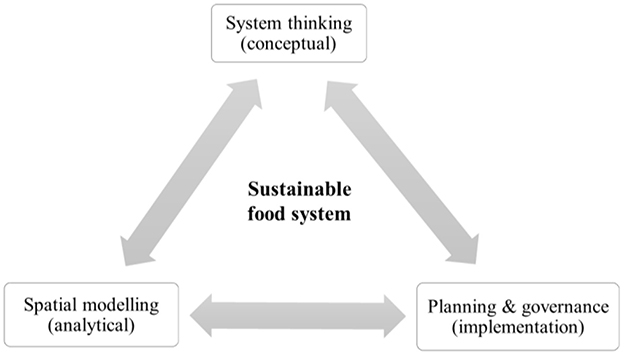
Figure 1. Interactions among systems thinking, spatial modelling, and planning for a sustainable food system. Arrows indicate dynamic feedbacks among the three domains, illustrating how holistic understanding, spatial evidence, and policy design co-evolve to support sustainable food system outcomes.
This conceptual framework illustrates how systems thinking, spatial modeling, planning and governance can interact to build more sustainable food systems. Systems thinking provides a holistic understanding of the multiple dimensions within food systems; spatial modeling offers analytical, “what-if,” and visual tools to assess spatial dynamics; and spatial planning and governance translate this knowledge into coordinated strategies and policies. Together, they advance a more comprehensive understanding of how systems thinking, spatial modeling, and (food) planning may interact to drive the transition toward a Sustainable Food System. This need for integration extends beyond food systems to other complex socio-ecological and spatial domains, as contemporary realities increasingly demonstrate.
Of the seven studies, three lines of research emerge:
1. Spatial diagnostics and monitoring, which should evolve toward dynamic and systems thinking capable of continuously assessing agri-food performance and supporting evidence-based decision-making;
2. Social and behavioral integration in planning, embedding farmer and stakeholder behavior through participatory methods, supported by emerging tools such as GeoAI, large-language-model analytics, and agent-based simulations for scenario design;
3. Cross-scale integration, linking local food systems with regional, national, and global sustainability goals through multi-level governance and planning.
To strengthen and operationalize these strands, policy frameworks play a pivotal role in enabling and sustaining food system transformation. Effective spatial and agri-food planning can incentivize sustainable practices, foster innovation, and align multi-level governance toward shared sustainability goals. Integrating systems thinking and spatial evidence into policy design ensures that interventions are adaptive, equitable, and grounded in local realities.
Recent work underscores that participatory and polycentric governance processes are increasingly advocated to support food system integration and transformation, while linking modeling outputs with policy processes enhances coherence and responsiveness (Edwards et al., 2024; Allen and Prosperi, 2016). For instance, the integrated assessment modeling framework developed for China demonstrates that most social and environmental targets of the Chinese food system remain misaligned with the United Nations Agenda 2030 (Wang et al.). Similarly, the indicator framework proposed by the Food Systems Countdown Initiative helps inform more coherent policy responses by elucidating interactions among indicators (Schneider et al., 2025). Other perspectives propose integrating agricultural and agronomic models with social and demographic modeling to strengthen understanding of productivity and resilience for food security (Brown et al., 2023). Such integration enables decision-makers to explore trade-offs, anticipate unintended consequences, and evaluate alternative pathways toward sustainability. As food systems face unprecedented pressures, spatially informed and evidence-based policies provide the analytical and institutional foundations needed to plan sustainable and resilient food systems, serving as effective pathways toward a healthy planet. More broadly, the studies in this collection engage with wider scientific debates on spatial justice, planetary health, resilience, territorial metabolism, circularity, and land system science. Collectively, these frameworks underscore the importance of integrated, multi-scalar, and systemic approaches that recognize and operationalize the dynamic linkages and feedbacks among land use, policy, environmental integrity, and social wellbeing.
Author contributions
PA: Conceptualization, Writing – original draft, Writing – review & editing. RO: Writing – original draft, Writing – review & editing. CV: Writing – original draft, Writing – review & editing.
Funding
The author(s) declare that no financial support was received for the research and/or publication of this article.
Conflict of interest
The authors declare that the research was conducted in the absence of any commercial or financial relationships that could be construed as a potential conflict of interest.
Generative AI statement
The author(s) declare that no Gen AI was used in the creation of this manuscript.
Any alternative text (alt text) provided alongside figures in this article has been generated by Frontiers with the support of artificial intelligence and reasonable efforts have been made to ensure accuracy, including review by the authors wherever possible. If you identify any issues, please contact us.
Publisher's note
All claims expressed in this article are solely those of the authors and do not necessarily represent those of their affiliated organizations, or those of the publisher, the editors and the reviewers. Any product that may be evaluated in this article, or claim that may be made by its manufacturer, is not guaranteed or endorsed by the publisher.
References
Alexander, P., Rounsevell, M. D., Dislich, C., Dodson, J. R., Engström, K., and Moran, D. (2015). Drivers for global agricultural land use change: the nexus of diet, population, yield and bioenergy. Global Environ. Change 35, 138–147. doi: 10.1016/j.gloenvcha.2015.08.011
Allen, T., and Prosperi, P. (2016). Modeling sustainable food systems. Environ. Manage. 57, 956–975. doi: 10.1007/s00267-016-0664-8
Brown, M. E., Carcedo, A. J., Eggen, M., Grace, K. L., Neff, J., and Ciampitti, I. A. (2023). Integrated modeling framework for sustainable agricultural intensification. Front. Sustain. Food Syst. 6:1039962. doi: 10.3389/fsufs.2022.1039962
Dawid, I., and Boka, E. (2025). Farmers' adaptation strategies to climate change on agricultural production in Arsi zone, Oromia National Regional State of Ethiopia. Front. Clim. 7:1447783. doi: 10.3389/fclim.2025.1447783
Edwards, F., Sonnino, R., and Cifuentes, M. L. (2024). Connecting the dots: integrating food policies towards food system transformation. Environ. Sci. Policy 156:103735. doi: 10.1016/j.envsci.2024.103735
Hazell, P., and Wood, S. (2008). Drivers of change in global agriculture. Philos. Trans. R. Soc. B 363, 495–515. doi: 10.1098/rstb.2007.2166
Kasper, C., Brandt, J., Lindschulte, K., and Giseke, U. (2017). The urban food system approach: thinking in spatialized systems. Agroecol. Sustain. Food Syst. 41, 1009–1025. doi: 10.1080/21683565.2017.1334737
Oliveira, R., and Cavaco, C. (2025). “When bells ring: placing food system planning towards a spatial planning transition,” in Productive Urban and Peri-urban Landscapes - Benefits, Co-benefits, and New Modes for Planning, eds. R. Werner (New York: Elsevier).
Pingali, P., and McCullough, E. (2010). “Drivers of change in global agriculture and livestock systems,” in Livestock in a Changing Landscape Volume 1, Drivers, Consequences and Responses.
Rockström, J., Thilsted, S. H., Willett, W. C., Gordon, L. J., Herrero, M., Hicks, C. C., et al. (2025). The EAT-Lancet Commission on healthy, sustainable, and just food systems. Lancet 406, 1625–1700. doi: 10.1016/S0140-6736(25)01201-2
Schneider, K. R., Remans, R., Bekele, T. H., Aytekin, D., Conforti, P., Dasgupta, S., et al. (2025). Governance and resilience as entry points for transforming food systems in the countdown to 2030. Nat. Food 6, 105–116. doi: 10.1038/s43016-024-01109-4
UN Food Systems Task Force (2025). Food Systems Thinking Guide for UN Resident Coordinators and UN Country Teams – Working collectively towards food systems transformation. Rome: FAO.
Valbuena, D., Verburg, P. H., Veldkamp, A., Bregt, A. K., and Ligtenberg, A. (2010). Effects of farmers' decisions on the landscape structure of a Dutch rural region: an agent-based approach. Landsc. Urban Plan. 97, 98–110. doi: 10.1016/j.landurbplan.2010.05.001
Viana, C. M., Freire, D., Abrantes, P., Rocha, J., and Pereira, P. (2022). Agricultural land systems importance for supporting food security and sustainable development goals: a systematic review. Sci. Total Environ. 806:150718. doi: 10.1016/j.scitotenv.2021.150718
Keywords: governance, spatial planning, modeling, GIS, system thinking, food system planning
Citation: Abrantes P, Oliveira R and Viana CM (2025) Editorial: Food systems, spatial modelling, and planning. Front. Sustain. Food Syst. 9:1743517. doi: 10.3389/fsufs.2025.1743517
Received: 10 November 2025; Revised: 12 November 2025;
Accepted: 12 November 2025; Published: 01 December 2025.
Edited and reviewed by: Ademola Braimoh, World Bank Group, United States
Copyright © 2025 Abrantes, Oliveira and Viana. This is an open-access article distributed under the terms of the Creative Commons Attribution License (CC BY). The use, distribution or reproduction in other forums is permitted, provided the original author(s) and the copyright owner(s) are credited and that the original publication in this journal is cited, in accordance with accepted academic practice. No use, distribution or reproduction is permitted which does not comply with these terms.
*Correspondence: Patrícia Abrantes, cGF0cmljaWEuYWJyYW50ZXNAZWR1LnVsaXNib2EucHQ=