 Oliver Allanson
 Thomas Elsden
 Clare Watt
 Thomas Neukirch
- 1Environmental Mathematics Group & Geophysical and Astrophysical Fluid Dynamics Group, Department of Mathematics, University of Exeter, Exeter, United Kingdom
- 2Department of Mathematics, Physics and Electrical Engineering, Northumbria University, Newcastle upon Tyne, United Kingdom
- 3School of Mathematics and Statistics, University of Glasgow, Glasgow, United Kingdom
- 4Department of Physics and Astronomy, University of Leicester, Leicester, United Kingdom
- 5School of Mathematics and Statistics, University of St Andrews, St Andrews, United Kingdom
We derive weak turbulence and quasilinear models for relativistic charged particle dynamics in pitch-angle and energy space, due to interactions with electromagnetic waves propagating (anti-)parallel to a uniform background magnetic field. We use a Markovian approach that starts from the consideration of single particle motion in a prescribed electromagnetic field. This Markovian approach has a number of benefits, including: 1) the evident self-consistent relationship between a more general weak turbulence theory and the standard resonant diffusion quasilinear theory (as is commonly used in e.g. radiation belt and solar wind modeling); 2) the general nature of the Fokker-Planck equation that can be derived without any prior assumptions regarding its form; 3) the clear dependence of the form of the Fokker-Planck equation and the transport coefficients on given specific timescales. The quasilinear diffusion coefficients that we derive are not new in and of themselves, but this concise derivation and discussion of the weak turbulence and quasilinear theories using the Markovian framework is physically very instructive. The results presented herein form fundamental groundwork for future studies that consider phenomena for which some of the assumptions made in this manuscript may be relaxed.
1 Introduction
Quasilinear diffusion theory forms the basis of much of the modeling and interpretation of particle transport and energization due to interactions with electromagnetic waves; at terrestrial (Horne et al., 2005; Summers, 2005; Thorne, 2010) and planetary (Woodfield et al., 2014; Kollmann et al., 2018) radiation belts; in the solar atmosphere and solar wind (Steinacker and Miller, 1992; Vocks et al., 2005; Vocks, 2012; Verscharen and Chandran, 2013; Jeong et al., 2020); and for the dynamics of cosmic rays (Schlickeiser, 1989; Mertsch, 2020).
The classic derivations of quasilinear theory (Drummond and Pines, 1962; Vedenov et al., 1962; Kennel and Engelmann, 1966; Lerche, 1968; Lyons, 1974; Summers, 2005) not only provide the form of the Fokker-Planck equation to describe the particle dynamics, but also the diffusion coefficients that encode the effect of the resonant wave-particle interactions as a function of the background magnetic field strength, plasma refractive index, and electromagnetic wave spectral properties. It is also possible to derive the diffusion coefficients due to resonant wave-particle interactions via a different technique, i.e., a Hamiltonian analysis of single particle interactions with given wave modes (e.g., see Albert (2001); Albert (2010)). Furthermore, Lemons (2012) has demonstrated a quite general method to derive both the form of the Fokker-Planck equation itself, as well as the transport coefficients that apply in a particular circumstance.
The method presented by Lemons (2012) (building on work presented in Lemons et al. (2009)) is in principle quite general and could be applied to a wide range of phenomena, but was applied to a particular restricted case in that paper, namely particle pitch-angle dynamics due to interactions with a stationary transverse magnetic field only. Using a Markovian analysis [e.g., see Wang and Uhlenbeck (1945); Reif (2009); Zheng et al. (2019); Allanson et al. (2020)] Lemons (2012) derives a theory to describe both the weak turbulence and quasilinear regimes. Despite the fact that the electromagnetic perturbation considered is a stationary magnetic field only, the equations derived by Lemons (2012) do in fact reproduce the standard form for pitch-angle diffusion by field-aligned propagating electromagnetic waves using the quasilinear theory - for the particular case of pitch-angle diffusion only. This corresponds to the subset of plasma environments in which the plasma frequency is significantly larger than the gyrofrequency (fpe ≫ fce, e.g., see Eq. 8 in Summers and Thorne (2003)).
In this paper, we study relativistic particle dynamics due to interactions with travelling electromagnetic waves, and therefore build upon the work by Lemons (2012) who considered time-invariant magnetic fields. This addition allows us to study both energy and pitch-angle dynamics, and is therefore applicable in regions with any value of fpe/fce. Some of the most important expressions in this paper may not be new in and of themselves (e.g. the quasilinear theory for field-aligned waves). However, this concise self-consistent derivation and discussion of both the weak turbulence and quasilinear theories by using the Markovian framework is physically very instructive. We emphasize that the methods presented herein do allow in principle for the derivation of not only the transport (drift and diffusion) coefficients, but also the very form of the transport (Fokker-Planck) equation itself, based upon prescribed electromagnetic waves and some sensible physical assumptions.
In Section 2 we present the derivation of the general Fokker-Planck equation in energy and pitch-angle space, using the Chapman-Kolmogorov equation as a starting point, and we indicate its relationship to the most basic form (i.e., the non-bounce-averaged and two-dimensional form in e.g., Glauert and Horne (2005); Summers (2005)) of the energy and pitch-angle diffusion equation as is employed in radiation belt studies (although typically after a bounce-averaging procedure (Glauert et al., 2014)). In Section 3 we calculate the exact relativistic equations of motion for particle position, gyrophase, pitch-angle and kinetic energy, due to interactions with field-aligned electromagnetic waves. In Section 4 we present the main calculations and results of this paper, namely the derivation of the weak turbulence and quasilinear diffusion coefficients. We conclude and discuss future possible directions in Section 5, which may include the relaxing of some assumptions as presented in this manuscript.
2 Fokker-Planck Equation Derived Using Markov Theory
Consider a spatially uniform (or equivalently, a spatially averaged) collisionless particle distribution function, gs = gs(p, t), for particle species s, normalized according to
where ∫d3p is taken to be the integral over all relativistic momentum space ( − ∞ < px, py, pz < ∞), and ns is the number density (such that Vns = Ns, with Ns the total number of particles in a spatial volume V). The relativistic momentum is defined as p = γm0sv, with v the velocity,
where p∥ = p ⋅B0/|B0| and p⊥ = |p ×B0|/|B0|, for B0 the local background magnetic field, and we assume that B0 = |B0| > 0 without loss of generality. The relativistic momentum and kinetic energy, E, are related by p2c2 = E(E + 2ERs) (Glauert and Horne, 2005), for ERs = m0sc2 the rest-mass energy. To clarify, E is the relativistic kinetic energy only, and not the total relativistic energy. Furthermore, the particle pitch angle, 0 < α < π, is defined by p∥ = |p| cos α and p⊥ = |p| sin α. Using these definitions and the Jacobian relation, dp⊥dp∥ = c−2(E + ERs)dEdα, we can rewrite the integrals so that
where we have made the association gs(p∥, p⊥, t) = fs(E, α, t). From hereon in we will dispense with the s subscript for brevity. We will now derive the general form of the equation that evolves f in time, as is consistent with Markovian stochastic particle dynamics in energy and pitch-angle space.
2.1 Fokker-Planck Equation in a General Form
Markovian dynamics are a special example of a stochastic/random process, and are essentially characterized by the requirement that the conditional probability of a given future state (at an immediately successive time t = t0 + Δt) only depends on the current state (at t = t0) (Wang and Uhlenbeck, 1945; Zheng et al., 2019). The Markovian stochastic formalism is appropriate to use in this paper since we are seeking a solution of particle motion in a statistical sense (i.e., the evolution of a particle distribution function), and not a deterministic sense (i.e., the exact dynamics of a very large number of particles).
The Chapman-Kolmogorov equation is the basic equation for Markov theory, and is also sometimes known as the Einstein-Smoluchowski equation, (e.g., see Wang and Uhlenbeck (1945); Einstein (1956); Reif (2009); Zheng et al. (2019)). The Chapman-Kolmogorov equation for f, adapted to be written in energy and pitch-angle space, is
Here, Ψ(E, α; E′, α′, Δt) is the transition probability density that a particle located at (E′, α′) at time t will reach (E, α) at time t + Δt. Using a standardized procedure based on so-called “Kramers-Moyal” theory (essentially using Taylor series, and as described in e.g. Wang and Uhlenbeck (1945); Einstein (1956); Walt (1994); Reif (2009); Roederer and Zhang (2013); Lemons (2012); Zheng et al. (2019)), we derive the following Fokker-Planck equation
for
where ⟨…⟩ denotes a suitable statistical or ensemble average, and the set notation {…} is used only to write the definitions in a compact manner. The denominator in the transport coefficients, Δt = t − t0, is a ‘suitable’ timescale over which to consider the drift/diffusion, and helps to define the increments Δα = α(t0 + Δt) − α(t0), ΔE = E(t0 + Δt) − E(t0) (e.g., see Liu et al. (2010); Liu et al. (2012)); Lemons (2012); Allanson et al. (2019); Allanson et al. (2020) for discussions regarding ensemble averages and timescales). Note that here we are using the same formal definitions of transport coefficients as in e.g., Lemons (2012); Glauert et al. (2014), such that
Equation 1 is the Fokker-Planck equation that describes particle transport (diffusion and drift) in relativistic kinetic energy and pitch-angle space, under the assumption of Markovian stochastic dynamics and a uniform background magnetic field. It is currently written in a very general form, and an investigation of the particle dynamics in a given system (i.e., a given set of background and perturbative forces and considered timescales) may reveal the exact form of the diffusion and drift coefficients, their relationship, and thus the exact form of Eq. 1 itself.
2.2 Fokker-Planck Equation Reduced to a More Familiar Form
Equation 1 can be re-written as
Examination of the particle dynamics in a given system can reveal the relationship between the drift and diffusion coefficients, sometimes known as the “drift-diffusion relation” (e.g. see Lemons (2012)). As one specific example, consider that the following drift-diffusion relations could be satisfied,
then Eq. 1 reduces to the following transport equation for energy and pitch angle diffusion
Equation 4 is exactly consistent with the standard relativistic quasilinear equation as derived via a different approach (see discussion of derivations and regions of applicability in Sections 1 and 5), used to describe energy and pitch-angle dynamics due to wave-particle interactions in the resonant diffusion quasilinear theory (Glauert and Horne, 2005; Summers, 2005) prior to ‘bounce-averaging’.
Equation 4 (or some variant thereof that may also include dynamics in real/radial space, and/or a so-called ‘bounce-/drift-averaging’ procedure) is often known as ‘the diffusion equation’ in the terrestrial and planetary magnetospheric communities. This reflects the fact that one can only see diffusion coefficents “
However it is important to note that some form of drift processes are in principle playing a role, despite the fact they do not appear in Eq. 4. The drift-diffusion relations in Eqs 2, 3 demonstrate this fact. Equations 2, 3 do not state that the drift coefficients “
It is therefore of great interest to try and derive Fokker-Planck equations for a given system using the Markovian approach (as opposed to the historically more standard Vlasov-Maxwell approach), to see if we can gain more insights regarding energetic particle dynamics. One important question is to discover when a more standard “diffusion equation” such as Eq. 4 is appropriate, and when a more rich formalism such as Eq. 1 is necessary.
3 Exact Equations of Motion
We consider a right-handed xyz co-ordinate system, with a uniform background magnetic field B0 = (B0, 0, 0) defining x as the “parallel’” direction, with “perpendicular” quantities in the yz plane. Particle velocities are defined according to
The magnetic components of a field-aligned electromagnetic spectrum can be expressed as a sum over all considered wave-modes k. We define
The ∓ sign corresponds to right-/left-handed waves (e.g., field-aligned whistler-mode and electromagnetic ion-cyclotron waves respectively). Note that by using a dimensionless
where we have used the assumption that the electromagnetic fields
Starting from the Lorentz force law
with
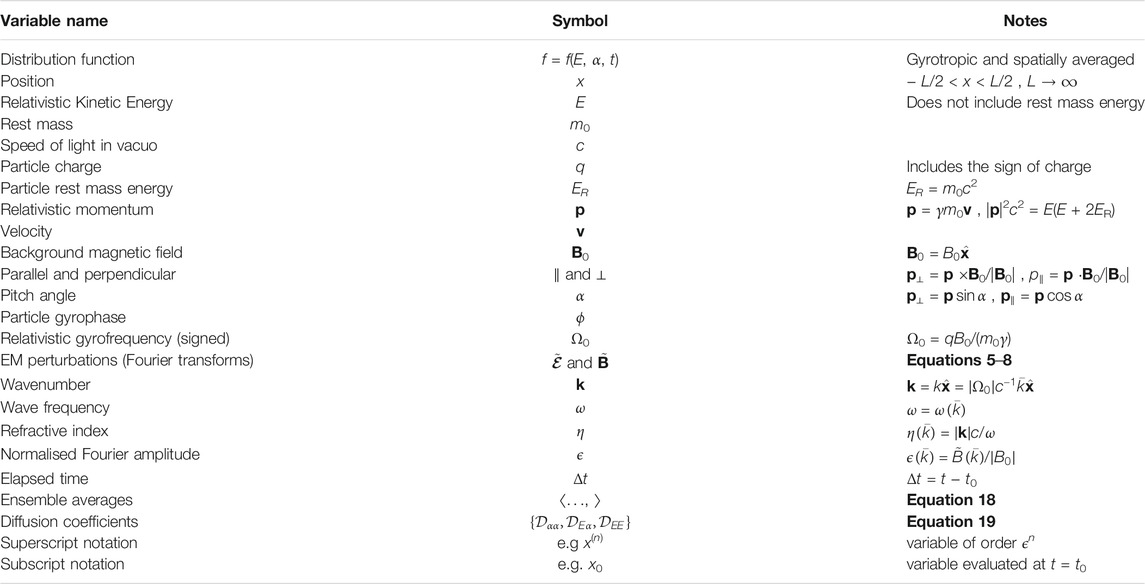
TABLE 1. Many of the important algebraic symbols that are used in this article.
4 Derivation of the Weak Turbulence Transport Coefficients
4.1 Expansions of the Equations of Motion
The equations of motion Eqs 9–12 are nonlinear, coupled ordinary differential equations in the variables (x, E, α, ϕ). Therefore we seek solutions via expansion in a small dimensionless parameter, and the form of the equations suggests that
In the same way as was done in Lemons (2012), we look for solutions up to and including second order, i.e., of the form
such that terms with a “(n)” superscript are proportional to ϵn. Without loss of generality, we state the following initial conditions: x(t0) = x(0)(t0) = x0; E(t0) = E(0)(t0) = E0; α(t0) = α(0)(t0) = α0; and ϕ(t0) = ϕ(0)(t0) = ϕ0. Therefore
Inserting Eqs 13–16 into the equations of motion Eqs 9–12 leads to zeroth-, first- and second-order equations of motion for x(0), x(1), x(2), E(0), E(1), E(2), α(0), α(1), α(2), ϕ(0), ϕ(1) and ϕ(2). Full details of this expansion process and solution methods are given in Supplementary Appendix B.
4.2 Diffusion Coefficients for Weak Turbulence
In this paper we have considered integral sums of Fourier modes (Fourier transforms) for the electromagnetic perturbations. This corresponds to an infinite spatial domain (whereas a finite spatial domain would correspond to a finite sum of discrete Fourier modes). Therefore we conduct a spatial average over − L/2 < x < L/2 but formally send L → ∞. The further averaging procedure that we will consider will be over gyrophase, ϕ. In particular we will assume that (to zeroth order) particles are uniformly distributed over position x and phase ϕ, i.e. x(0)(t) and ϕ(0)(t) remain uniformly distributed over [ − L/2, L/2] and [0, 2π] respectively. This “random-phase” approximation (Lemons et al., 2009; Lemons, 2012) is standard in the derivations of quasilinear theory (e.g., assumptions regarding spatial and azimuthal/gyrotropic symmetries of the distribution function in Kennel and Engelmann (1966)). We therefore define the ensemble averaging ⟨…⟩ for a generic function A as
We use this definition of ensemble averaging to complete the derivation of the weak turbulence diffusion coefficients in Supplementary Appendices B, C. Note that the integrals are performed “over the initial conditions” for particle position and gyrophase, x0 and ϕ0 respectively. The zeroth-order solutions for x(0)(t) and ϕ(0)(t) in Supplementary Appendix B demonstrate that particles initially uniformly distributed in x0 and ϕ0 will stay uniformly distributed at all later times t, to zeroth-order. Therefore the assumption of random-phase is justified and consistent to zeroth-order. This corresponds philosophically to the “integration over unperturbed (i.e., zeroth-order) orbits, as is commonplace in the aforementioned Vlasov-Maxwell treatments of quasilinear theory (e.g., see Kennel and Engelmann (1966); Verscharen and Chandran (2013).
We note that the expansions defined by Eqs 14, 15, the initial conditions of Eq. 17, and the zeroth-order solutions of the equation of motion in Supplementary Appendix B lead to the following definitions (up to second-order)
Therefore, considering contributions to the diffusion coefficients in energy and pitch-angle up space up to and including second order in
The calculations in Supplementary Appendices B, C then provide the following weak turbulence expressions
with
the zeroth order approximation solution for the parallel velocity (i.e. the unperturbed solution).
Equations 20–22 show that the weak turbulence diffusion coefficients all involve integrating over a time-dependent factor that we define as A
with
The term designated by R determines how close to resonance a given particle is with a given right-/left-handed electromagnetic wave mode (described by
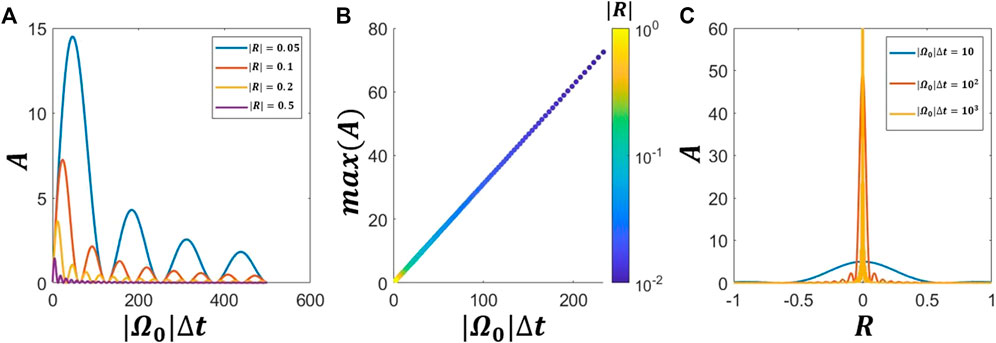
FIGURE 1. In (A) we show A as a function of |Ω0|Δt, for given fixed values of R = 0.05, 0.1, 0.2, 0.5. In (B) we show the maximum value of A that is obtained, as a function of the value of |Ω0|Δt, and for given fixed values of R from R = 10−2 to R = 1 (see colour bar). In (C) we show A as a function of R, for given fixed values of |Ω0|Δt = 10, 102, 103.
In Figure 1A we show A as a function of |Ω0|Δt, for given fixed values of |R| = 0.05, 0.1, 0.2, 0.5. There are two important features to note: 1) A and therefore the weak turbulence diffusion coefficients demonstrate a periodic dependence on the elapsed timescale Δt (albeit with the contributions becoming less significant as |Ω0|Δt → ∞); 2) for smaller values of |R| (i.e., closer to cyclotron resonance), the contribution to the weak turbulence coefficients from this factor A is more significant, at all times.
In Figure 1B we show the maximum value of A that is obtained, as a function of the value of |Ω0|Δt, and for given fixed values of |R| from R = 10−2 to R = 1 (see colour bar). When |R| indicates that waves and particles are closer to resonance (i.e. |R| is closer to 0), then A maximizes at later times (this can also be seen from Figure 1A). One important implication to note is that particles further away from resonance (larger values of |R|) contribute most to A at earlier times.
In Figure 1C we show A as a function of R, for given fixed values of |Ω0|Δt = 10, 102, 103. This shows that as |Ω0|Δt → ∞, the weak turbulence diffusion coefficients are essentially determined only via particles that are close to or exactly in resonance |R| ≈ 0. Equivalently, for smaller elapsed times |Ω0|Δt, we can state that the contribution to diffusion from non-resonant particles is non-negligible and worthy of consideration.
4.3 Diffusion Coefficients in Resonant Diffusion Quasilinear Theory
The expressions for the diffusion coefficients, “
via one definition of the Dirac delta function. This gives
making use of: (i) δ(X/Ω0) = |Ω0|δ(X); (ii) defining
the magnetic wave energy density associated with mode
Note that the “limL→∞1/L” does not send all results to zero. This spatial average (over an infinite domain) is common in studies of quasilinear theory (e.g., see Kennel and Engelmann (1966); Summers (2005)). In fact, the “1/L” factor in the denominator competes with an “L” factor in the numerator due to the fact that the integral over all space (i.e., L) of
A discussion of this feature is given in Lyons (1974), for example.
Similarly, we obtain
The definitions of “
Therefore, taking |Ω0|Δt → ∞ has allowed us to obtain the time-independent quasilinear diffusion coefficients in energy and pitch-angle space, from the corresponding time-dependent weak turbulence coefficients. This calculation and process mirrors the same result as presented in Lemons (2012), for the more restricted pitch-angle case.
5 Discussion
5.1 Weak Turbulence Diffusion Coefficients
The first main result of this paper is the derivation of the diffusion coefficients,
The result is a diffusion coefficient, “
One particularly interesting observation to make is that when considered over finite timescales, the weak turbulence diffusion coefficients demonstrate the contribution towards particle diffusion of wave modes that are not in exact resonance (R ≠ 0). Specifically, the terms in the integrand of Eqs 20–22 admit contributions towards particle diffusion (i.e. for a specific value of energy and pitch angle) from a range of wave modes (i.e., different values of
Furthermore, we note that Lemons (2012) discussed some possible restrictions to the validity of the general methodology that they, and we, present. Namely, that for very small pitch angles the assumption of a very small magnetic field perturbation (as compared to the background magnetic field strength) may not be sufficient to derive meaningful weak turbulence and quasilinear theories. This is essentially due to the appearance of a cot α factor appearing in the equation for dϕ/dt (Eq. 3b in Lemons (2012), and note that they use θ in place of α). Lemons (2012) develop a “small-correlation time” theory to specifically investigate the small pitch angle regime, but explain that it will be difficult to demonstrate the validity of their theory. Equation 12 in this manuscript demonstrates that there may be a similar regime of interest for the system that we consider. However, these considerations are subtle and are beyond the scope of this study.
It will be interesting to further investigate the properties of the weak turbulence diffusion coefficients: 1) the nature of their dependency on elapsed timescale Δt; 2) and the role of the resonance-broadening effect (and in particular its correspondence to the pre-existing literature). These considerations are left for future work and are beyond the scope of this study.
5.2 Quasilinear Diffusion as a Limit of Weak Turbulence
The second main result of this paper is a new derivation via the Markov method of the pitch-angle and energy diffusion coefficients (
5.3 Novel Derivation of the Weak Turbulence and Quasilinear Diffusion Theories
The standard derivations of the quasilinear theory (Drummond and Pines, 1962; Vedenov et al., 1962; Kennel and Engelmann, 1966; Lerche, 1968; Lyons, 1974; Summers, 2005) are founded upon a perturbative analysis of the Vlasov-Maxwell equations (e.g., see Schindler (2007)), and describe the evolution of a gyrophase-averaged (gyrotropic) particle distribution function in an infinite and homogeneous collisionless plasma with a uniform and static background magnetic field, although we do note a comparatively recent example of a derivation by Brizard and Chan (2004) that does include spatial inhomogeneities from the very outset. The standard derivations rely on a number of assumptions: 1) sufficiently small electromagnetic wave power and a correspondingly sufficiently large spectral width (e.g., see Karpman (1974); Tong et al. (2019)); 2) sufficiently small wave growth rates and slowly varying wave spectra, and a correspondingly slowly varying spatially averaged distribution function (e.g., see Kennel and Engelmann (1966); Davidson et al. (1972)); 3) a wave spectrum that satisfies the so-called “Chirikov resonance overlap condition” (e.g., see Zaslavskiĭ and Chirikov (1972); Artemyev et al. (2015)). Quasilinear theory in the limit of resonant diffusion further restricts that wave growth rates actually tend to zero (Kennel and Engelmann, 1966), and this is the version of the quaslinear theory that is commonly used in numerical radiation belt diffusion models (e.g., see Beutier and Boscher (1995); Albert et al. (2009); Su et al. (2010); Subbotin et al. (2010); Glauert et al. (2014)).
The approach presented in this paper to derive the weak turbulence and quasilinear diffusion coefficients has some important benefits. Firstly, our derivations rely on fewer technical assumptions than those mentioned above for the case of the quasilinear theory in the resonant diffusion limit (zero wave growth rate). Ultimately, the main two assumptions are the small wave amplitudes ϵk, and the “random-phase” criteria. Secondly, we believe that the theory has a very intuitive and “user-friendly” entry point, namely an expansion of particle trajectories that obey the Lorentz force law,
5.4 Nonlinear Wave-Particle Interactions
Numerous observations have shown the prevalence of high-amplitude electromagnetic whistler-mode and ion-cyclotron waves in the Earth’s inner magnetosphere (Cattell et al., 2008; Cully et al., 2008; Breneman et al., 2011; Kellogg et al., 2011; Wilson et al., 2011; Hendry et al., 2019; Tyler et al., 2019; Zhang et al., 2019; Zhang et al., 2021), such as are responsible for local changes in the energy and pitch-angle of radiation belt electrons. These high “nonlinear” wave amplitudes cast some doubt on the applicability of the quasilinear theory in such cases. Furthermore, a number of co-ordinated wave and particle measurements have directly demonstrated the existence of nonlinear wave-particle interactions in the Earth’s inner magnetosphere (Agapitov et al., 2015; Foster et al., 2016; Kurita et al., 2018; Mozer et al., 2018; Shumko et al., 2018). Therefore, an improved theoretical understanding and modelling capability of radiation belt dynamics that incorporates the most appropriate elements of the quasilinear and nonlinear theories of wave-particle interactions is an important and outstanding question (e.g., see Omura et al. (2008); Albert et al. (2013); Tao et al. (2012a,b); Omura et al. (2015); Camporeale (2015); Camporeale and Zimbardo (2015); Artemyev et al. (2018); Mourenas et al. (2018); Vainchtein et al. (2018); Zheng et al. (2019); Gan et al. (2020); Allanson et al. (2020); Allanson et al. (2021)).
Theoretical and modeling studies (Albert and Bortnik, 2009; Liu et al., 2012; Zheng et al., 2012; Lee et al., 2018; Artemyev et al., 2018; Vainchtein et al., 2018; Mourenas et al., 2018; Zheng et al., 2019; Gan et al., 2020; Allanson et al. (2020); Allanson et al. (2021)) indicate that an effective incorporation of nonlinear wave-particle interactions into existing modeling paradigms may require the addition of extra, or modified, transport coefficients (or some other addition) to the version of the Fokker-Planck equation that is currently used (e.g., see Schulz and Lanzerotti (1974); Glauert et al. (2014)). There are a number of candidate methods to achieve this (or a similar) goal, and a number of these are summarized in Artemyev et al. (2021). A fully nonlinear model of wave-particle interactions in the radiation belts would necessarily need to include inhomogeneous background magnetic fields and number density, to incorporate: 1) phase decorrelation specifically due the inhomogeneity itself (e.g., see Albert (2010)): 2) nonlinear effects known as phase bunching and phase trapping (e.g., see Omura et al. (2008)). We do not include such spatial inhomogeneities and therefore cannot describe these associated effects. However, we emphasize that the methods in this paper do present a consistent mechanism that allows for the derivation of not only the transport (drift and diffusion) coefficients, but also the very form of the transport (Fokker-Planck) equation itself, based upon prescribed electromagnetic waves and some sensible physical assumptions. In future works, we could derive drift-diffusion relations such as Eqs 2, 3 from first principles for other situations, as opposed to a-priori assuming them to hold. This advance is one of the main benefits of using the approach demonstrated in this paper, and it remains to be seen if these methods can be applied to include the inhomogeneous cases.
6 Summary
In this paper we have presented new derivations of relativistic weak turbulence and quasilinear diffusion models. These models describe charged particle dynamics due to interactions with right-/left-handed electromagnetic waves, and specifically for the case of waves that are travelling parallel (and/or anti-parallel) to the direction of the background magnetic field. The approach differs from the most standard methods of derivation, that are based upon the Vlasov-Maxwell set of equations (e.g., see Kennel and Engelmann (1966)). Instead, our approach uses the principles of Markovian dynamics, and is fundamentally based on solutions to the single-particle Lorentz force equation,
• A derivation and discussion of the general Fokker-Planck equation to describe stochastic charged particle dynamics in energy and pitch-angle space, using Markov theory (Eq. 1; Section 2). This equation includes all possible advective and diffusive dynamics, in principle. The form of the drift and diffusion coefficients are then to be determined on a system-by-system basis. In this paper we solve for the diffusive dynamics only, and leave investigations of the drift coefficients and drift-diffusion relations for future works;
• In sections 3 and 4 we solve the Lorentz force law using expansions in the small parameter
• The weak turbulence diffusion coefficients recover the standard form as used in the resonant-diffusion limit of relativistic quasilinear theory (e.g., see Glauert and Horne (2005); Summers (2005)), when we consider elapsed timescales much greater than a gyroperiod (i.e., we allow Δt ≫ 1/|Ω0|, and formally |Ω0|Δt → ∞);
• Whilst the form of the quasilinear diffusion coefficients is not new in and of itself, our new derivation has a number of benefits, including: 1) the evident self-consistent relationship between a more general weak turbulence theory and the standard resonant diffusion quasilinear theory (as is commonly used in e.g. radiation belt and solar wind modeling); 2) the general nature of the Fokker-Planck equation that can be derived without any prior assumptions regarding its form; 3) the clear dependence of the form of the Fokker-Planck equation and the transport coefficients on given specific timescales.
Data Availability Statement
The original contributions presented in the study are included in the article/Supplementary Material, further inquiries can be directed to the corresponding author.
Author Contributions
OA derived the equations and wrote the article. TE reproduced the equations and consulted on the article. CW 1) consulted on the article; 2) discussed key themes with OA on many occasions; 3) and provided Figure 1. TN 1) consulted on the article; 2) provided key early input with regards to the ensemble averaging method.
Funding
OA acknowledges financial support from the University of Exeter and from the United Kingdom Natural Environment Research Council (NERC) Independent Research Fellowship NE/V013963/1. OA and CW acknowledge financial support from the NERC Highlight Topic Grant NE/P017274/1 (Rad-Sat), and from United Kingdom Science and Technology Facilities Council (STFC) via Consolidated Grant ST/W000369/1. TE acknowledges financial support from an Early Career Fellowship, split jointly by the Leverhulme Trust (ECF-2019-155) and the University of Leicester in the first instance (2019-21), but presently the University of Glasgow (2021-). TN acknowledges financial support from the STFC via Consolidated Grant ST/S000402/1. The University of Exeter cover the Open Access Publication Fee via a UKRI block grant.
Conflict of Interest
The authors declare that the research was conducted in the absence of any commercial or financial relationships that could be construed as a potential conflict of interest.
Publisher’s Note
All claims expressed in this article are solely those of the authors and do not necessarily represent those of their affiliated organizations, or those of the publisher, the editors, and the reviewers. Any product that may be evaluated in this article, or claim that may be made by its manufacturer, is not guaranteed or endorsed by the publisher.
Supplementary Material
The Supplementary Material for this article can be found online at: https://www.frontiersin.org/articles/10.3389/fspas.2021.805699/full#supplementary-material
References
Agapitov, O. V., Artemyev, A. V., Mourenas, D., Mozer, F. S., and Krasnoselskikh, V. (2015). Nonlinear Local Parallel Acceleration of Electrons through Landau Trapping by Oblique Whistler Mode Waves in the Outer Radiation belt. Geophys. Res. Lett. 42, 10,140–10,149. doi:10.1002/2015GL066887
Albert, J. M., and Bortnik, J. (2009). Nonlinear Interaction of Radiation belt Electrons with Electromagnetic Ion Cyclotron Waves. Geophys. Res. Lett. 36, L12110. doi:10.1029/2009GL038904
Albert, J. M. (2001). Comparison of Pitch Angle Diffusion by Turbulent and Monochromatic Whistler Waves. J. Geophys. Res. 106, 8477–8482. doi:10.1029/2000JA000304
Albert, J. M. (2010). Diffusion by One Wave and by many Waves. J. Geophys. Res. 115, A00F05. doi:10.1029/2009JA014732
Albert, J. M. (2005). Evaluation of Quasi-Linear Diffusion Coefficients for Whistler Mode Waves in a Plasma with Arbitrary Density Ratio. J. Geophys. Res. 110, A03218. doi:10.1029/2004JA010844
Albert, J. M., Meredith, N. P., and Horne, R. B. (2009). Three-dimensional Diffusion Simulation of Outer Radiation belt Electrons during the 9 October 1990 Magnetic Storm. J. Geophys. Res. Space Phys. 114, A09214. doi:10.1029/2009ja014336
Albert, J. M., Tao, X., and Bortnik, J. (2013). Aspects of Nonlinear Wave-Particle Interactions. Editors D Summers, I. R. Mann, D. N. Baker, and M Schulz, 199, 255–264. Washington, DC: American Geophysical Union. doi:10.1029/2012GM001324 https://agupubs.onlinelibrary.wiley.com/doi/book/10.1029/GM199.
Allanson, O., Watt, C. E. J., Allison, H. J., and Ratcliffe, H. (2021). Electron Diffusion and Advection during Nonlinear Interactions with Whistler-Mode Waves. J. Geophys. Res. Space Phys. 126, e2020JA028793. doi:10.1029/2020ja028793
Allanson, O., Watt, C. E. J., Ratcliffe, H., Allison, H. J., Meredith, N. P., Bentley, S. N., et al. (2020). Particle-in-cell Experiments Examine Electron Diffusion by Whistler-Mode Waves: 2. Quasi-Linear and Nonlinear Dynamics. J. Geophys. Res. Space Phys. 125, e2020JA027949. doi:10.1029/2020JA027949
Allanson, O., Watt, C. E. J., Ratcliffe, H., Meredith, N. P., Allison, H. J., Bentley, S. N., et al. (2019). Particle‐in‐cell Experiments Examine Electron Diffusion by Whistler‐mode Waves: 1. Benchmarking with a Cold Plasma. J. Geophys. Res. Space Phys. 124, 8893–8912. doi:10.1029/2019JA027088
Artemyev, A. V., Mourenas, D., Agapitov, O. V., and Krasnoselskikh, V. V. (2015). Relativistic Electron Scattering by Magnetosonic Waves: Effects of Discrete Wave Emission and High Wave Amplitudes. Phys. Plasmas 22, 062901. doi:10.1063/1.4922061
Artemyev, A. V., Neishtadt, A. I., Vasiliev, A. A., and Mourenas, D. (2018). Long-term Evolution of Electron Distribution Function Due to Nonlinear Resonant Interaction with Whistler Mode Waves. J. Plasma Phys. 84, 905840206. doi:10.1017/S0022377818000260
Artemyev, A. V., Neishtadt, A. I., Vasiliev, A. A., Zhang, X.-J., Mourenas, D., and Vainchtein, D. (2021). Long-term Dynamics Driven by Resonant Wave-Particle Interactions: from Hamiltonian Resonance Theory to Phase Space Mapping. J. Plasma Phys. 87, 835870201. doi:10.1017/S0022377821000246
Beutier, T., and Boscher, D. (1995). A Three-Dimensional Analysis of the Electron Radiation belt by the Salammbô Code. J. Geophys. Res. 100, 14853–14861. doi:10.1029/94JA03066
Breneman, A., Cattell, C., Wygant, J., Kersten, K., Wilson, L. B., Schreiner, S., et al. (2011). Large-amplitude Transmitter-Associated and Lightning-Associated Whistler Waves in the Earth's Inner Plasmasphere at L < 2. J. Geophys. Res. 116, A06310. doi:10.1029/2010JA016288
Brizard, A. J., and Chan, A. A. (2004). Relativistic Quasilinear Diffusion in Axisymmetric Magnetic Geometry for Arbitrary-Frequency Electromagnetic Fluctuations. Phys. Plasmas 11, 4220–4229. doi:10.1063/1.1773554
Cai, B., Wu, Y., and Tao, X. (2020). Effects of Nonlinear Resonance Broadening on Interactions between Electrons and Whistler Mode Waves. Geophys. Res. Lett. 47, e2020GL087991. doi:10.1029/2020GL087991
Camporeale, E. (2015). Resonant and Nonresonant Whistlers-Particle Interaction in the Radiation Belts. Geophys. Res. Lett. 42, 3114–3121. doi:10.1002/2015GL063874
Camporeale, E., and Zimbardo, G. (2015). Wave-particle Interactions with Parallel Whistler Waves: Nonlinear and Time-dependent Effects Revealed by Particle-In-Cell Simulations. Phys. Plasmas 22, 092104. doi:10.1063/1.4929853
Cattell, C., Wygant, J. R., Goetz, K., Kersten, K., Kellogg, P. J., von Rosenvinge, T., et al. (2008). Discovery of Very Large Amplitude Whistler-Mode Waves in Earth's Radiation Belts. Geophys. Res. Lett. 35, L01105. doi:10.1029/2007GL032009
Cully, C. M., Bonnell, J. W., and Ergun, R. E. (2008). Themis Observations of Long-Lived Regions of Large-Amplitude Whistler Waves in the Inner Magnetosphere. Geophys. Res. Lett. 35, L17S16. doi:10.1029/2008GL033643
Davidson, R. C., Hammer, D. A., Haber, I., and Wagner, C. E. (1972). Nonlinear Development of Electromagnetic Instabilities in Anisotropic Plasmas. Phys. Fluids 15, 317–333. doi:10.1063/1.1693910
Drummond, W. E., and Pines, D. (1962). Nonlinear Stability of Plasma Oscillations. Nucl. Fusion Suppl. 3, 1049–1058.
Dupree, T. H. (1966). A Perturbation Theory for strong Plasma Turbulence. Phys. Fluids 9, 1773–1782. doi:10.1063/1.1761932
Einstein, A. (1956). Investigations on the Theory of the Brownian Movement. Dover Books on Physics Series. New York, NY: Dover Publications.
Foster, J. C., Erickson, P. J., Baker, D. N., Jaynes, A. N., Mishin, E. V., Fennel, J. F., et al. (2016). Observations of the Impenetrable Barrier, the Plasmapause, and the VLF Bubble during the 17 March 2015 Storm. J. Geophys. Res. Space Phys. 121, 5537–5548. doi:10.1002/2016JA022509
Gan, L., Li, W., Ma, Q., Albert, J., Artemyev, A., and Bortnik, J. (2020). Nonlinear Interactions between Radiation belt Electrons and Chorus Waves: Dependence on Wave Amplitude Modulation. Geophys. Res. Lett. 47, e2019GL085987. doi:10.1029/2019GL085987
Glauert, S. A., and Horne, R. B. (2005). Calculation of Pitch Angle and Energy Diffusion Coefficients with the PADIE Code. J. Geophys. Res. 110, A04206. doi:10.1029/2004JA010851
Glauert, S. A., Horne, R. B., and Meredith, N. P. (2014). Three‐dimensional Electron Radiation belt Simulations Using the BAS Radiation Belt Model with New Diffusion Models for Chorus, Plasmaspheric Hiss, and Lightning‐generated Whistlers. J. Geophys. Res. Space Phys. 119, 268–289. doi:10.1002/2013JA019281
Hendry, A. T., Santolik, O., Kletzing, C. A., Rodger, C. J., Shiokawa, K., and Baishev, D. (2019). Multi‐instrument Observation of Nonlinear EMIC‐Driven Electron Precipitation at Sub-MeV Energies. Geophys. Res. Lett. 46, 7248–7257. doi:10.1029/2019GL082401
Horne, R. B., Thorne, R. M., Shprits, Y. Y., Meredith, N. P., Glauert, S. A., Smith, A. J., et al. (2005). Wave Acceleration of Electrons in the Van Allen Radiation Belts. Nature 437, 227–230. doi:10.1038/nature03939
Jeong, S.-Y., Verscharen, D., Wicks, R. T., and Fazakerley, A. N. (2020). A Quasi-Linear Diffusion Model for Resonant Wave-Particle Instability in Homogeneous Plasma. ApJ 902, 128. doi:10.3847/1538-4357/abb099
Karimabadi, H., Krauss-Varban, D., and Terasawa, T. (1992). Physics of Pitch Angle Scattering and Velocity Diffusion, 1. Theory. J. Geophys. Res. 97, 13853–13864. doi:10.1029/92JA00997
Karimabadi, H., and Menyuk, C. R. (1991). A Fast and Accurate Method of Calculating Particle Diffusion: Application to the Ionosphere. J. Geophys. Res. 96, 9669–9687. doi:10.1029/91JA00315
Karpman, V. I. (1974). Nonlinear Effects in the ELF Waves Propagating along the Magnetic Field in the Magnetosphere. Space Sci. Rev. 16, 361–388. doi:10.1007/BF00171564
Kellogg, P. J., Cattell, C. A., Goetz, K., Monson, S. J., and Wilson, L. B. (2011). Large Amplitude Whistlers in the Magnetosphere Observed with Wind-Waves. J. Geophys. Res. 116, A09224. doi:10.1029/2010JA015919
Kennel, C. F., and Engelmann, F. (1966). Velocity Space Diffusion from Weak Plasma Turbulence in a Magnetic Field. Phys. Fluids 9, 2377–2388. doi:10.1063/1.1761629
Kollmann, P., Roussos, E., Paranicas, C., Woodfield, E. E., Mauk, B. H., Clark, G., et al. (2018). Electron Acceleration to Mev Energies at jupiter and Saturn. J. Geophys. Res. Space Phys. 123, 9110–9129. doi:10.1029/2018ja025665
Kurita, S., Miyoshi, Y., Kasahara, S., Yokota, S., Kasahara, Y., Matsuda, S., et al. (2018). Deformation of Electron Pitch Angle Distributions Caused by Upper Band Chorus Observed by the Arase Satellite. Geophys. Res. Lett. 45, 7996–8004. doi:10.1029/2018GL079104
Lee, S.-Y., Lee, E., Seough, J., Lee, J.-g., Hwang, J., Lee, J.-J., et al. (2018). Simulation and Quasi-Linear Theory of Whistler Anisotropy Instability. J. Geophys. Res. Space Phys. 123, 3277–3290. doi:10.1029/2017ja024960
Lemons, D. S., Liu, K., Winske, D., and Gary, S. P. (2009). Stochastic Analysis of Pitch Angle Scattering of Charged Particles by Transverse Magnetic Waves. Phys. Plasmas 16, 112306. doi:10.1063/1.3264738
Lemons, D. S. (2012). Pitch Angle Scattering of Relativistic Electrons from Stationary Magnetic Waves: Continuous Markov Process and Quasilinear Theory. Phys. Plasmas 19, 012306. doi:10.1063/1.3676156
Lerche, I. (1968). Quasilinear Theory of Resonant Diffusion in a Magneto-Active, Relativistic Plasma. Phys. Fluids 11, 1720–1727. doi:10.1063/1.1692186
Liu, K., Lemons, D. S., Winske, D., and Gary, S. P. (2010). Relativistic Electron Scattering by Electromagnetic Ion Cyclotron Fluctuations: Test Particle Simulations. J. Geophys. Res. 115, A04204. doi:10.1029/2009JA014807
Liu, K., Winske, D., Gary, S. P., and Reeves, G. D. (2012). Relativistic Electron Scattering by Large Amplitude Electromagnetic Ion Cyclotron Waves: The Role of Phase Bunching and Trapping. J. Geophys. Res. 117, A06218. doi:10.1029/2011JA017476
Lyons, L. R. (1974). General Relations for Resonant Particle Diffusion in Pitch Angle and Energy. J. Plasma Phys. 12, 45–49. doi:10.1017/S0022377800024910
Mertsch, P. (2020). Test Particle Simulations of Cosmic Rays. Astrophys Space Sci. 365, 135. doi:10.1007/s10509-020-03832-3
Mourenas, D., Zhang, X.-J., Artemyev, A. V., Angelopoulos, V., Thorne, R. M., Bortnik, J., et al. (2018). Electron Nonlinear Resonant Interaction with Short and Intense Parallel Chorus Wave Packets. J. Geophys. Res. Space Phys. 123, 4979–4999. doi:10.1029/2018JA025417
Mozer, F. S., Agapitov, O. V., Blake, J. B., and Vasko, I. Y. (2018). Simultaneous Observations of Lower Band Chorus Emissions at the Equator and Microburst Precipitating Electrons in the Ionosphere. Geophys. Res. Lett. 45, 511–516. doi:10.1002/2017GL076120
Omura, Y., Katoh, Y., and Summers, D. (2008). Theory and Simulation of the Generation of Whistler-Mode Chorus. J. Geophys. Res. 113, A04223. doi:10.1029/2007JA012622
Omura, Y., Miyashita, Y., Yoshikawa, M., Summers, D., Hikishima, M., Ebihara, Y., et al. (2015). Formation Process of Relativistic Electron Flux through Interaction with Chorus Emissions in the Earth's Inner Magnetosphere. J. Geophys. Res. Space Phys. 120, 9545–9562. doi:10.1002/2015JA021563
Osmane, A., and Lejosne, S. (2021). Radial Diffusion of Planetary Radiation Belts' Particles by Fluctuations with Finite Correlation Time. ApJ 912, 142. doi:10.3847/1538-4357/abf04b
Reif, F. (2009). Fundamentals of Statistical and Thermal Physics. Long Grove, Illinois: Waveland Press.
Roederer, J., and Zhang, H. (2013). Dynamics of Magnetically Trapped Particles: Foundations of the Physics of Radiation Belts and Space Plasmas. Astrophysics and Space Science Library. Springer Berlin Heidelberg.
Schindler, K. (2007). Physics of Space Plasma Activity. Cambridge, United Kingdom: Cambridge University Press.
Schlickeiser, R. (1989). Cosmic-ray Transport and Acceleration. I - Derivation of the Kinetic Equation and Application to Cosmic Rays in Static Cold media. II - Cosmic Rays in Moving Cold media with Application to Diffusive Shock Wave Acceleration. ApJ 336, 243. doi:10.1086/167009
Schulz, M., and Lanzerotti, L. (1974). Particle Diffusion in the Radiation Belts. Physics and chemistry in space. Berlin-Heidelberg: Springer-Verlag. doi:10.1007/978-3-642-65675-0
Shumko, M., Turner, D. L., O'Brien, T. P., Claudepierre, S. G., Sample, J., Hartley, D. P., et al. (2018). Evidence of Microbursts Observed Near the Equatorial Plane in the Outer Van allen Radiation belt. Geophys. Res. Lett. 45, 8044–8053. doi:10.1029/2018GL078451
Steinacker, J., and Miller, J. A. (1992). Stochastic Gyroresonant Electron Acceleration in a Low-Beta Plasma. I - Interaction with Parallel Transverse Cold Plasma Waves. ApJ 393, 764. doi:10.1086/171544
Su, Z., Xiao, F., Zheng, H., and Wang, S. (2010). STEERB: A Three-Dimensional Code for Storm-Time Evolution of Electron Radiation belt. J. Geophys. Res. 115, A09208. doi:10.1029/2009JA015210
Subbotin, D., Shprits, Y., and Ni, B. (2010). Three-dimensional Verb Radiation belt Simulations Including Mixed Diffusion. J. Geophys. Res. 115, A03205. doi:10.1029/2009JA015070
Summers, D. (2005). Quasi-linear Diffusion Coefficients for Field-Aligned Electromagnetic Waves with Applications to the Magnetosphere. J. Geophys. Res. 110. doi:10.1029/2005JA011159
Summers, D., and Thorne, R. M. (2003). Relativistic Electron Pitch-Angle Scattering by Electromagnetic Ion Cyclotron Waves during Geomagnetic Storms. J. Geophys. Res. 108 (A4), 1143. doi:10.1029/2002JA009489
Tao, X., Bortnik, J., Albert, J. M., and Thorne, R. M. (2012a). Comparison of Bounce-Averaged Quasi-Linear Diffusion Coefficients for Parallel Propagating Whistler Mode Waves with Test Particle Simulations. J. Geophys. Res. 117, A10205. doi:10.1029/2012JA017931
Tao, X., Bortnik, J., Thorne, R. M., Albert, J. M., and Li, W. (2012b). Effects of Amplitude Modulation on Nonlinear Interactions between Electrons and Chorus Waves. Geophys. Res. Lett., L0610239. doi:10.1029/2012GL051202
Thorne, R. M. (2010). Radiation belt Dynamics: The Importance of Wave-Particle Interactions. Geophys. Res. Lett. 37, L22107. doi:10.1029/2010GL044990
Tong, Y., Vasko, I. Y., Artemyev, A. V., Bale, S. D., and Mozer, F. S. (2019). Statistical study of whistler waves in the solar wind at 1 au. ApJ 878, 41. doi:10.3847/1538-4357/ab1f05
Tsurutani, B. T., and Lakhina, G. S. (1997). Some Basic Concepts of Wave-Particle Interactions in Collisionless Plasmas. Rev. Geophys. 35, 491–501. doi:10.1029/97RG02200
Tyler, E., Breneman, A., Cattell, C., Wygant, J., Thaller, S., and Malaspina, D. (2019). Statistical Occurrence and Distribution of High‐Amplitude Whistler Mode Waves in the Outer Radiation Belt. Geophys. Res. Lett. 46, 2328–2336. doi:10.1029/2019GL082292
Vainchtein, D., Zhang, X. J., Artemyev, A. V., Mourenas, D., Angelopoulos, V., and Thorne, R. M. (2018). Evolution of Electron Distribution Driven by Nonlinear Resonances with Intense Field‐Aligned Chorus Waves. J. Geophys. Res. Space Phys. 123, 8149–8169. doi:10.1029/2018JA025654
Vedenov, A. A., Velikhov, E., and Sagdeev, R. (1962). Quasilinear Theory of Plasma Oscillations. Nucl. Fusion Suppl. 2, 465–475.
Verscharen, D., and Chandran, B. D. G. (2013). The Dispersion Relations and Instability Thresholds of Oblique Plasma Modes in the Presence of an Ion Beam. ApJ 764, 88. doi:10.1088/0004-637x/764/1/88
Vocks, C. (2012). Kinetic Models for Whistler Wave Scattering of Electrons in the Solar Corona and Wind. Space Sci. Rev. 172, 303–314. doi:10.1007/s11214-011-9749-0
Vocks, C., Salem, C., Lin, R. P., and Mann, G. (2005). Electron Halo and Strahl Formation in the Solar Wind by Resonant Interaction with Whistler Waves. ApJ 627, 540–549. doi:10.1086/430119
Walt, M. (1994). Introduction to Geomagnetically Trapped Radiation. Cambridge Atmospheric and Space Science Series. Cambridge, United Kingdom: Cambridge University Press. doi:10.1017/CBO9780511524981
Wang, M. C., and Uhlenbeck, G. E. (1945). On the Theory of the Brownian Motion II. Rev. Mod. Phys. 17, 323–342. doi:10.1103/RevModPhys.17.323
Watt, C. E. J., Allison, H. J., Thompson, R. L., Bentley, S. N., Meredith, N. P., Glauert, S. A., et al. (2021). The Implications of Temporal Variability in Wave-Particle Interactions in Earth’s Radiation Belts. Geophys. Res. Lett. 48. doi:10.1029/2020GL089962
Wilson, L. B., Cattell, C. A., Kellogg, P. J., Wygant, J. R., Goetz, K., Breneman, A., et al. (2011). The Properties of Large Amplitude Whistler Mode Waves in the Magnetosphere: Propagation and Relationship with Geomagnetic Activity. Geophys. Res. Lett. 38. doi:10.1029/2011GL048671
Woodfield, E. E., Horne, R. B., Glauert, S. A., Menietti, J. D., and Shprits, Y. Y. (2014). The Origin of Jupiter's Outer Radiation belt. J. Geophys. Res. Space Phys. 119, 3490–3502. doi:10.1002/2014JA019891
Zaslavskiĭ, G. M., and Chirikov, B. V. (1972). Stochastic Instability of Non-linear Oscillations. Sov. Phys. Usp. 14, 549–568. doi:10.1070/pu1972v014n05abeh004669
Zhang, X.-J., Mourenas, D., Shen, X.-C., Qin, M., Artemyev, A. V., Ma, Q., et al. (2021). Dependence of Relativistic Electron Precipitation in the Ionosphere on Emic Wave Minimum Resonant Energy at the Conjugate Equator. J. Geophys. Res. Space Phys. 126. doi:10.1029/2021JA029193
Zhang, X. J., Mourenas, D., Artemyev, A. V., Angelopoulos, V., Bortnik, J., Thorne, R. M., et al. (2019). Nonlinear Electron Interaction with Intense Chorus Waves: Statistics of Occurrence Rates. Geophys. Res. Lett. 46, 7182–7190. doi:10.1029/2019GL083833
Zheng, L., Chen, L., and Zhu, H. (2019). Modeling Energetic Electron Nonlinear Wave‐Particle Interactions with Electromagnetic Ion Cyclotron Waves. J. Geophys. Res. Space Phys. 124, 3436–3453. doi:10.1029/2018JA026156
Keywords: space plasma, plasma waves, wave-particle interactions, relativistic, Markov, quasilinear theory, weak turbulence, radiation belts
Citation: Allanson O, Elsden T, Watt C and Neukirch T (2022) Weak Turbulence and Quasilinear Diffusion for Relativistic Wave-Particle Interactions Via a Markov Approach. Front. Astron. Space Sci. 8:805699. doi: 10.3389/fspas.2021.805699
Received: 30 October 2021; Accepted: 26 November 2021;
Published: 14 January 2022.
Edited by:
Joseph Eric Borovsky, Space Science Institute, United StatesReviewed by:
Danny Summers, Memorial University of Newfoundland, CanadaJay M. Albert, Air Force Research Lab, United States
Copyright © 2022 Allanson, Elsden, Watt and Neukirch. This is an open-access article distributed under the terms of the Creative Commons Attribution License (CC BY). The use, distribution or reproduction in other forums is permitted, provided the original author(s) and the copyright owner(s) are credited and that the original publication in this journal is cited, in accordance with accepted academic practice. No use, distribution or reproduction is permitted which does not comply with these terms.
*Correspondence: Oliver Allanson, b2xpdmVyYWxsYW5zb25AZ21haWwuY29t