 Lu Shen
 Bin Qian3
- 1School of Civil Engineering, Wanjiang University of Technology, Ma’anshan, Anhui, Chian
- 2Ma’anshan Engineering Technology Research Center of Land Test Evaluation and Restoration, Wanjiang University of Technology, Ma’anshan, Anhui, China
- 3Geotechnical Engineering Department, Nanjing Hydraulic Research Institute, Nanjing, China
- 4China Construction Eighth Engineering Division Co., Ltd., Shanghai, China
Time-dependent consolidation behavior of unsaturated soils is a vital problem in the geotechnical engineering. With the aid of the Fredlund consolidation theory, this work further assumes the total stress of soils skeleton freely change, and extends the Fredlund consolidation theory to a Biot-type theory, establishing the fully-coupled equation model of multilayered unsaturated poroelastic media with transversely isotropic permeability. To convert the partial differential governing equation into ordinary differential equations, the integration transform technology is applied. Subsequently, the precise integration method is used to acquire the time-dependent consolidation solution of multilayered unsaturated media with transversely isotropic permeability in the transformed domain, which is further solved in the actual domain by the inverse Hankel transform. A verification examples is provided to compare the present results with the existing work in the literature, showing a great coincidence and proving the feasibility of the present solution. Finally, numerous numerical examples are presented to investigate the evolution of excess pore pressure and settlement under quasi-static loads, revealing the consolidation behavior of unsaturated soils. The results demonstrates that the ramping time, stratification, permeability, depth and
1 Introduction
Consolidation theory remains a key topic in geotechnical engineering. Originating from Biot’s work (Biot, 1941; Biot, 1955), which rigorously integrated pore pressure and settlement, lots of researchers (McNamee and Gibson, 1960; Schiffman and Fungaroli, 1965; Gibson et al., 1970; Booker and Randolph, 1984; Yue et al., 1994; Wang et al., 2023a; Wang et al., 2023b; Chen et al., 2005; Singh et al., 2007; Ai and Wang, 2008; Cai and Geng, 2009) have explored this complex issue. Their investigations typically assume geomaterial behaves as either an elastic half-space or a finite soil layer. In fact, natural geotechnical materials exhibit pronounced stratification due to prolonged and complex deposition processes, profoundly influencing their consolidation characteristics (Pan, 1989; Yue, 1996; Pan, 1997; Yue and Yin, 1998). Consequently, considering the layered characteristic in the consolidation analysis is quite significant. Booker and Small (Booker and Small, 1982; Booker and Small, 1987) firstly employed the finite layer method to explore the mechanical-hydraulic behavior of layered soils. Moreover, other researchers addressed this issue using the boundary element method (Aramaki, 1985; Dargush and Banerjee, 1991) and the transfer matrix method (Wang and Fang, 2001), the analytical layer-element method (Ai et al., 2011). In particularly, the analytical layer-element method only has the decaying exponential functions thin its stiffness matrix, mitigating the instability and the exponential overflow problem in the transfer matrix method. However, many existing studies fail to accurately model the comprehensive three-dimensional conditions that involve both vertical and tangential loads. Therefore, it is essential to expand this research to include three-dimensional scenarios for a more generalized understanding of consolidation problems. Vardoulakis and Harnpattanapanich (Vardoulakis and Harnpattanapanich, 1986; Harnpattanapanich and Vardoulakis, 1987) examined settlement along depth under external loads, while Senjuntichai and Rajapakse (Senjuntichai and Rajapakse, 1995) addressed the three-dimensional consolidation response of soil, providing precise solutions. Additionally, Pan (1999) derived fundamental solutions for layered poroelastic systems, and Ai and his colleagues (Ai et al., 2010; Ai and Zeng, 2012) explored non-axisymmetric consolidation solutions.
The above works assumes that the soil as the saturated medium. In fact, most of the soils on the earth are located in arid and semi-arid unsaturated zones, and the subgrade filler of railways and airport runways is also mostly unsaturated soil. Therefore, studying the consolidation characteristics of unsaturated soil under external loads is of great engineering significance. Early studies were limited to specific types of unsaturated soils, in which bubbles existed in a closed form in the liquid, ignoring the free flow effect of the two-phase fluid in the soil. To solve this problem, there are many works (Barden, 1965; Fredlund and Rahardjo, 1993; Loret and Khalili, 2000; Cao et al., 2024a; Cao et al., 2024b; Cao et al., 2023). Among them, Fredlund and Rahardjo (Fredlund and Rahardjo, 1993) used dual stress-strain state variables to define the contribution of the net stress and the matrix suction respectively, and then constructed the two-phase flow equation of unsaturated soils. Dakshanamurthy et al. (1984), Dakshanamurthy and Fredlund (1980) further proposed 2D and 3D consolidation models for unsaturated soils based on the assumption that the total stress of the soil skeleton remain unchanged.
Building on the governing equations for unsaturated soil consolidation, many investigators apply numerical or semi-analytical methods to study consolidation behavior. Ausilio and Conte (Ausilio et al., 2002) connected the displacement rate to the average degree of consolidation, utilizing Fourier transform to examine consolidation in unsaturated soils under both water-air coupled and uncoupled conditions. Qin and her cooperators (Qin et al., 2010; Wang et al., 2017a; Wang et al., 2017b) used analytical methods and combined different boundary conditions to study the one-dimensional unsaturated soil consolidation theory. Shan et al. (2012) used the transfer matrix method to discuss the distribution of pore water and air pressure of layered one-dimensional unsaturated soils. Ho et al. (2014) derived the governing equations of the one-dimensional consolidation model of unsaturated soil under single-sided and double-sided permeable boundaries, and proposed a theoretical solution method combining the eigenfunction method and Laplace transform. Based on previous work (Ho et al., 2014; Ho et al., 2015), Ho et al. (2016) further derived the uncoupled axisymmetric mathematical consolidation modelling of unsaturated soil. Huang and Li (2018) developed a plane strain consolidation model under bidirectional continuous permeable boundary conditions, solving it using Fourier transform and the method of separation of variables. Moradi et al. (2019) proposed a 1D multi-layer analytical model for unsaturated consolidation under partially permeable boundaries and time-varying loads, employing the differential quadrature method for the layered unsaturated soil system. Other researchers have also explored soil consolidation issues by incorporating non-ideal permeable boundaries. Tian et al. (2020) studied a 1D consolidation model of saturated soils under multi-stage loading conditions based on continuous drainage boundary conditions. Zong et al. (2020) pointed out that even if the external load is q0, the pore pressure at the initial moment is smaller than q0, based on a one-dimensional single-layer soil nonlinear consolidation model considering a continuous permeable boundary. Wang et al. (2019) utilized the eigenfunction method expansion and integration transform method to solve the 2D settlement-pore pressure distribution of unsaturated soil introducing the lateral semi-permeable drainage boundary (LSDB). Building upon a semi-permeable boundary (Wang et al., 2017a; Wang et al., 2017b), Wang et al. (2017c) also investigated the impact of time-varying loads on consolidation behaviors Niu et al. (2021) introduced a 1D consolidation model for unsaturated soils incorporating dynamic loaded scenarios. The partial differential equations (PDEs) were theoretically resolved via the eigenfunction expansion technique. Liu et al. (2022) explored the impact of exponential time-varying loads on consolidation characteristics, comparing these effects with those of constant loads.
In summary, current solutions for unsaturated consolidation problems predominantly focus on one-dimensional loading conditions, with limited research on two- or three-dimensional scenarios. It is particularly noteworthy that the above studies are all based on the assumption that the total stress remains unchanged during the consolidation process, so they can be regarded as a Terzaghi-type consolidation theory, that is, a non-coupled theory. In comparison, there are few studies based on the fully coupled consolidation theory (i.e., Biot-type consolidation theory) in which the total stress changes during the consolidation process. In addition, the stratification and transverse isotropy of permeability characteristics formed by natural soil deposition are often ignored in previous studies. Therefore, this paper utilizes Fredlund’s dual stress variable consolidation theory to investigate the fully coupled consolidation of layered unsaturated soil under variable loads, examining the influence of ramping time, the transverse isotropy of the permeability, the volume variation coefficient of pore water regarding net stress, depth and stratification on the time-dependent settlement, pore water pressure and pore air pressure distribution. Compared with the existing research, the innovation of this work can be drawn as follows: (1) A fully-coupled Fredlund consolidation model is proposed in this work, while the other work is limited to the non-coupled model based on the excessive assumption. (2) The transverse isotropy of permeability of soils is considered in the work, which is not included in the previous work. (3) The precise integration method is utilized to deal with these partial differential equations of the mathematical model, showing a great stability and robustness.
2 Methodology
2.1 Governing equations
In elasticity theory, the equilibrium differential equation ignoring body forces is:
where
Based on Fredlund’s dual stress variable theory (Fredlund and Rahardjo, 1993), the linear elastic constitutive equation of unsaturated soils is given:
where the volume stress is
It is assumed that two-phase flow in unsaturated soil is continuous. By introducing Darcy law and the constitutive relationship of pore water in Fredlund theory (Fredlund and Rahardjo, 1993), the seepage continuity equation of pore water with transversely isotropic permeability can be obtained as follows:
in which
Similarly, with the aid of Boyle law (Fredlund and Rahardjo, 1993) and the constitutive equation of the skeleton, the seepage continuity equation of the pore air with transversely isotropic permeability can also be obtained:
where
Finally, the total volume flow rate
Equations 1–5 constitute the mathematical governing equations of the fully-coupled consolidation for unsaturated soils. It is found that these equations are the partial differential equations (PDEs), hard to solve directly. Therefore, the Laplace-Hankel transform and the corresponding inverse transform in Equation 6 are introduced to simplify these PDEs into ordinary differential equations (ODEs) for solution:
in which,
2.2 Ordinary differential governing equations
In the Laplace transform domain, applying the 0th and 1st order Hankel transforms to Equations 2d, 2c respectively, we can obtain:
Similarly, applying Laplace and 0th-order Hankel transforms to Equations 5a, 5b, we can obtain:
Substituting Equations 2a, 7b into Equation 1a and applying Laplace and first-order Hankel transforms, we obtain:
Based on Equation 1b, the following equation in the Laplace and 0th-order Hankel domains can be acquired:
In the Laplace and 0th-order Hankel transform domains, the water seepage continuity Equation 3 and Equations 7b, 7c are integrated to obtain:
In the Laplace and 0th-order Hankel transform domains, the air flow continuity Equation 4 and Equations 7b, 7c are integrated to obtain:
where
In Equations 7a–7h, the superscripts “0”and “1”represent that the variables have been processed by 0th-order or 1st-order Hankel transform.
Combination of the above equations leads to the following matrix expression:
in which, the generalized stress vector is
In terms of the time-varying loads (ramping loads and exponential loads) selected in this paper, the initial load magnitudes are all 0. Therefore, it can be assumed that the instantaneous generalized state vectors
2.3 Solution to the governing equation
In the context of the two-point boundary value problem, the Precise integration method (PIM) introduced by Zhong (1994) stands out as an efficient and highly accurate technique widely utilized in various fields such as wave propagation, quasi-static analysis, and dynamic interaction studies. This section adopts the PIM for discretizing the ODE matrix along the depth dimension. In terms of a layered unsaturated soil with a depth L, the initial step of PIM is to dividing the model into 2N micro layers, the length of each micro layers is L/2N. Notably, within any adjacent micro layers, there exist four generalized state vectors, denoted as
In terms of adjacent micro layers given in Figure 1, four generalized state vectors between the upper and lower surface are established, respectively, i.e.,
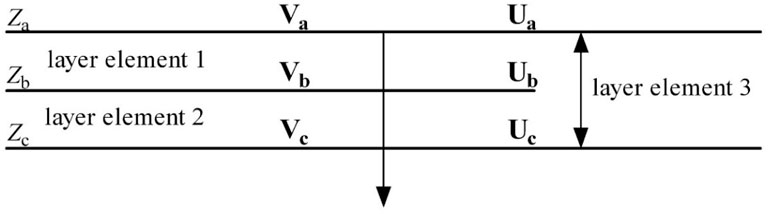
Figure 1. The state vectors between the adjacent micro layers.
In terms of the layer element 1:
Analogously, for the layer element 2:
where
where
Subsequently, we merge the adjacent micro layers into a new micro layer, termed as micro layer 3. The following expression is defined as follows:
in which
Thus far, we have derived the expression for the state vector of the newly formed micro layer as given in Equations 11–14. It is important to note that the system was initially divided into 2N micro layers. Consequently, each application of the merging operation to adjacent micro layers reduces the total count by half, resulting in 2N−1 remaining micro layers, each sharing identical expressions. The discretized micro layers can be recombined into a new layer block, and the corresponding generalized state vector can also be obtained similarly.
Following these operations, the generalized state vectors of the layer blocks are determined using
The ramping loads in the physical domain and transformed domain are given in Equation 15:
The exponential loads in the physical domain and transformed domain are given in Equation 16:
It is noteworthy that the solution obtained is situated in the transformed domain, while the actual solution in the physical domain still requires implementation through numerical inversion. The Laplace inverse transform adopts the Stehfest method (Stehfest, 1970), and its specific expression is given in Equation 17:
in which, the precision control variable N is set to 12.
Using the Hankel inverse transform, every two adjacent zeros of the Bessel function are grouped into sections, reducing the semi-infinite integral to 64 segments. Each segment is then evaluated using the 32-point Gauss-Legendre integration method, as detailed in reference (Ye et al., 2023). Following the numerical Laplace-Hankel inverse transformation, we can obtain the solution for the fully coupled consolidation of unsaturated soils under time-varying loads in the real domain.
2.4 Verification
In view of the lack of fully coupled consolidation solution of axisymmetric unsaturated soil under variable load at present, this paper compares it with the consolidation solution of saturated soil under construction load in reference (Geng and Cai, 2009), and the results are shown in Figures 2, 3. By comparison, it can be seen that solution in this work is in good coincidence with solution in reference (Geng and Cai, 2009) in both settlement and pore pressure.
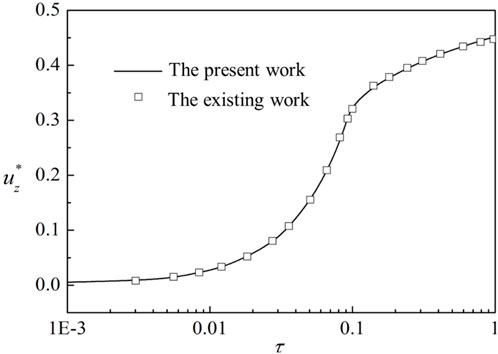
Figure 2. The variation of settlement against time under a ramp loading.
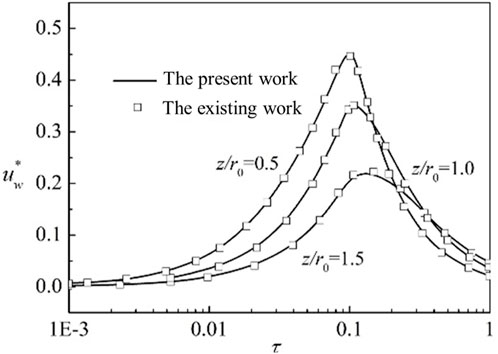
Figure 3. The variation of excess pore water pressure against time under a ramp loading.
3 Parametric analyses
3.1 The ramping time
The subsequent analysis presents a series of numerical examples to examine the influence of ramping time
The influence of ramping time on the time-varying properties of unsaturated soil consolidation is discussed in the following. As can be seen from Figure 4: for different ramp times T0, the final consolidation settlement is the same. Hence, the final settlement is not related to the ramp times. In the logarithmic coordinate system, most of the consolidation settlement occurs in the three sections of
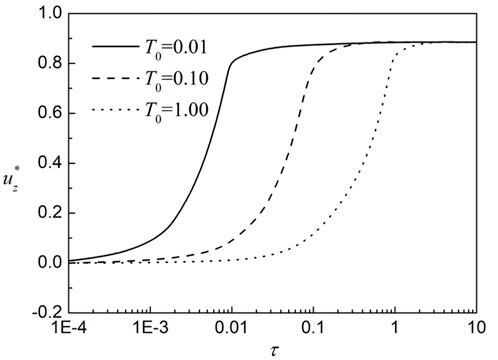
Figure 4. The variation of settlement against time with different ramp time T0.
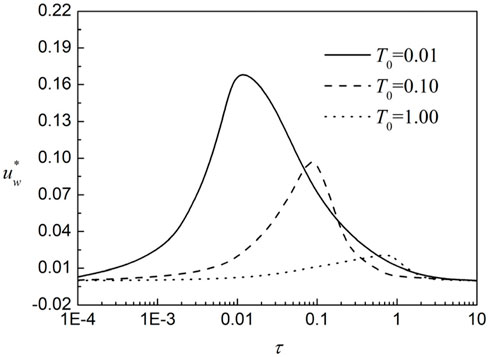
Figure 5. The variation of excess pore water pressure against time with different ramp time T0.
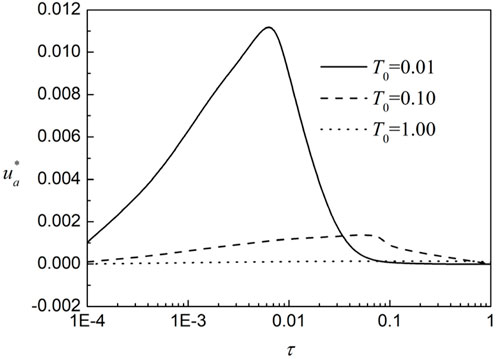
Figure 6. The variation of excess pore air pressure against time with different ramp time T0.
3.2 The transverse isotropy of the permeability
To investigate the influence of the transverse isotropy of the permeability on the flow-deformation behavior, four transverse isotropy coefficient cases
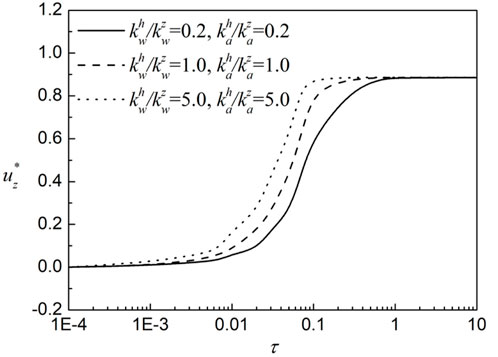
Figure 7. The variation of the settlement under different transversely isotropic permeability.
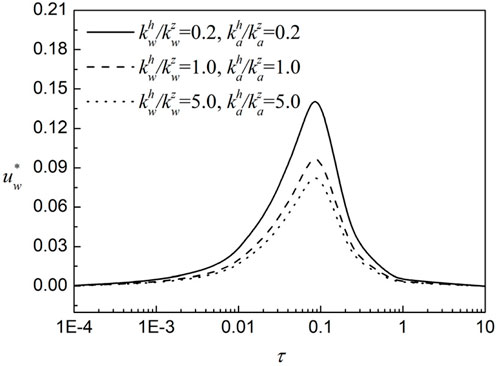
Figure 8. The variation of the excess pore water pressure under different transversely isotropic permeability.
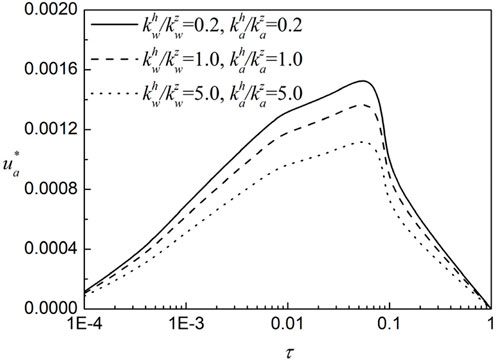
Figure 9. The variation of the excess pore air pressure under different transversely isotropic permeability.
3.3 The volume variation coefficient of pore water regarding the net stress
In order to discuss the effect of the volume variation coefficient of pore water regarding the net stress
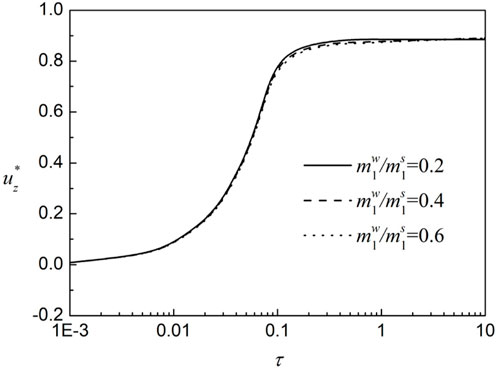
Figure 10. The variation of settlement against time with different
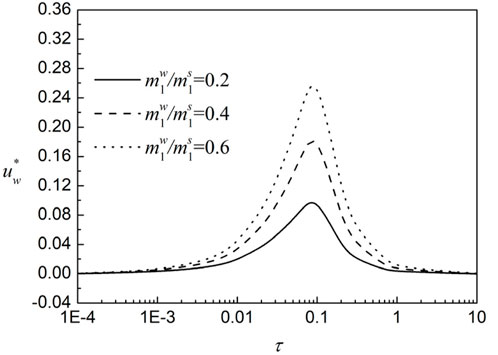
Figure 11. The variation of excess pore water pressure against time with different
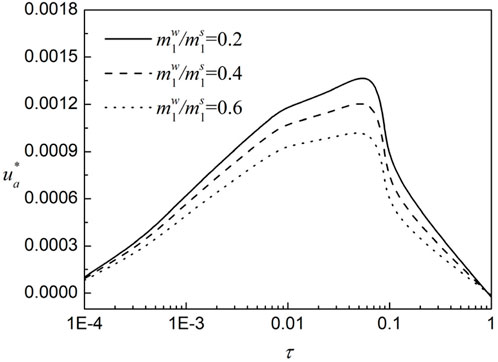
Figure 12. The variation of excess pore air pressure against time with different
3.4 Calculation depth
The displacement and pore pressure shows a different trend along the depth. To describe the displacement development trend along the depth direction and the dissipation law of excess pore pressure and excess air pressure with time, the effect of calculation depth is discussed in this section. It can be seen from Figure 13 that the main development time of consolidation settlement is concentrated in this stage
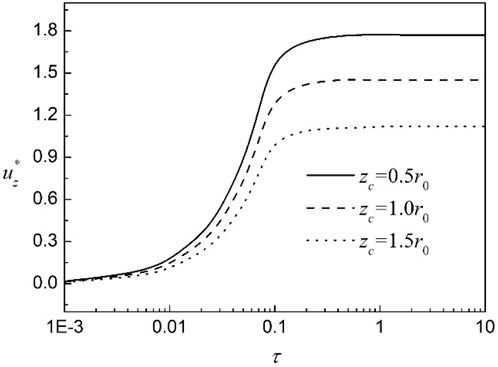
Figure 13. The variation of settlement against time along the depth.
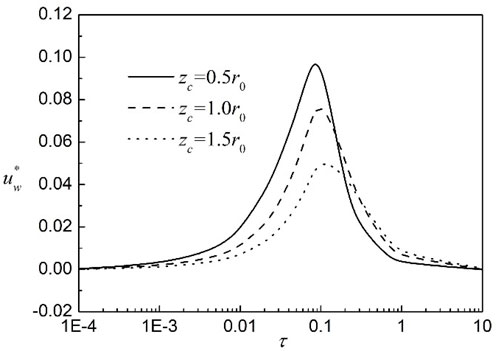
Figure 14. The variation of excess pore water pressure against time along the depth.
3.5 Stratification
To illustrate the feasibility of the present solution to multilayered media, we constructed a multilayered soil with a soft interlayer (Case1) and compared it with a single-layer soil (Case 2) in which soil parameters, including modulus, permeability, and so on, were calculated by the weighted average method based on the parameters and thickness of layers in Case 1. The specific settlement, excess pore water and air pressure are shown in Figures 16–18. Parameters of the soil layer in Case 2 are the same as those in the original case except that the saturation is 0.73. Case 1 is a three-layer soil with a soft interlayer. The thickness ratio of each layer is 1:1:1, the ratio of the volume variation coefficient of the soil skeleton regarding the net stress (from top to bottom) is
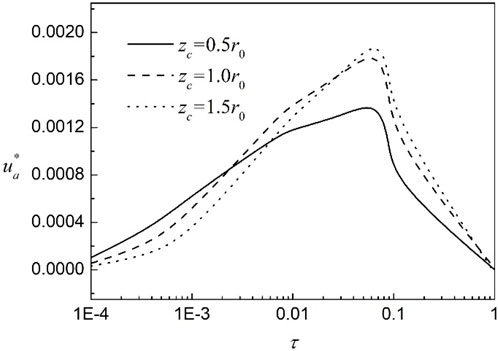
Figure 15. The variation of excess pore air pressure against time along the depth.
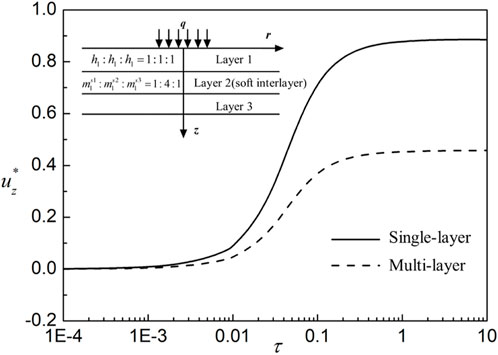
Figure 16. The variation of excess pore water pressure against time under multi-layered and single-layered cases.
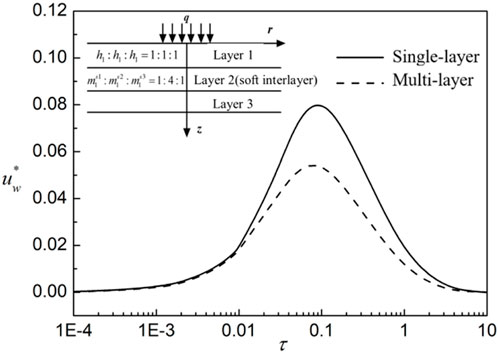
Figure 17. The variation of excess pore water pressure against time under multi-layered and single-layered cases.
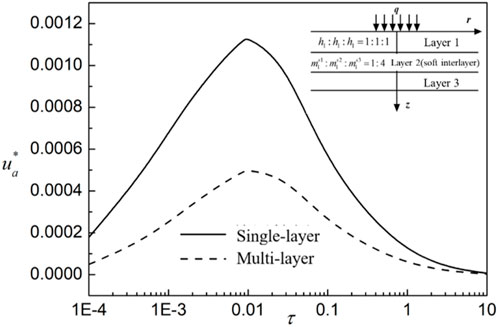
Figure 18. The variation of excess pore water pressure against time under multi-layered and single-layered cases.
4 Conclusion
Based on Fredlund’s dual stress variable theory, the fully-coupled axisymmetric consolidation governing equations of unsaturated soils is presented. With the aid of integration transform and precise integration method, proposed governing equations are solved, obtaining the solution in the actual domain. A series of numerical examples are provided to discuss the influence of the ramp time,
(1) Under time-varying loads, the dissipation rate of excess pore air pressure is significantly faster than that of excess pore water pressure, but its magnitude remains negligible in comparison.
(2) The ramping time T0 does not affect the final steady-state settlement; it only influences deformation rates and alters pore pressure and air pressure dissipation during consolidation. A rapid loading velocity induce a surge of pore pressure.
(3) The volume variation coefficient of pore water regarding the net stress
(4) The vertical displacement and excess pore water pressure along the depth shows a significant decrease, while the excess pore air pressure along the depth shows a unsignificant change.
(5) Stratification significantly influences the flow and deformation of unsaturated soils. Using a weighted average method to model multi-layer soil parameters in engineering analyses can result in substantial errors in the final settlement.
In the future work, we can further extend the axisymmetric condition to a three-dimensional condition. Meanwhile, the transverse isotropy of soil skeleton can also be considered in the future work to establish a more generalized consolidation model of unsaturated soils. Thea time-dependent soil-structure interaction investigation can also be considered based on the proposed model, which is meaningful for the long-time settlement prediction and control of underground structures in unsaturated soils, such as piles, plate and beam.
Data availability statement
The original contributions presented in the study are included in the article/supplementary material, further inquiries can be directed to the corresponding author.
Author contributions
LS: Conceptualization, Formal Analysis, Methodology, Validation, Writing–original draft. BQ: Formal Analysis, Methodology, Visualization, Writing–review and editing. LL: Investigation, Visualization, Writing–review and editing.
Funding
The author(s) declare that financial support was received for the research, authorship, and/or publication of this article. This research was funded by the Key Project of Natural Science Research Program of Anhui Provincial Education Department (No. 2023AH052494), and Open Foundation of Ma’ anshan Engineering Technology Research Center of Land Test evaluation and Restoration (No. TDJC24001).
Conflict of interest
Author LL was employed by China Construction Eighth Engineering Division Co., Ltd.
The remaining authors declare that the research was conducted in the absence of any commercial or financial relationships that could be construed as a potential conflict of interest.
Publisher’s note
All claims expressed in this article are solely those of the authors and do not necessarily represent those of their affiliated organizations, or those of the publisher, the editors and the reviewers. Any product that may be evaluated in this article, or claim that may be made by its manufacturer, is not guaranteed or endorsed by the publisher.
References
Ai, Z. Y., Cheng, Y. C., and Zeng, W. Z. (2011). Analytical layer-element solution to axisymmetric consolidation of multilayered soils. Comput. Geotech. 38 (2), 227–232. doi:10.1016/j.compgeo.2010.11.011
Ai, Z. Y., and Wang, Q. S. (2008). A new analytical solution to axisymmetric Biot’s consolidation of a finite soil layer. Appl. Math. Mech.-Engl. 29 (12), 1617–1624. doi:10.1007/s10483-008-1209-9
Ai, Z. Y., Wang, Q. S., and Han, J. (2010). Analytical solutions describing the consolidation of a multilayered soil under circular loading. J. Eng. Math. 66 (4), 381–393. doi:10.1007/s10665-009-9299-6
Ai, Z. Y., and Zeng, W. Z. (2012). Analytical layer-element method for non-axisymmetric consolidation of multilayered soils. Int. J. Numer. Anal. Meth. Geomech. 36 (5), 533–545. doi:10.1002/nag.1000
Aramaki, G. (1985). Application of the boundary element method for axisymmetric Biot's consolidation. Eng. Anal. 2 (4), 184–191. doi:10.1016/0955-7997(85)90002-5
Ausilio, E., Connte, E., and Dente, G. (2002). “An analysis of the consolidation of unsaturated soils,” in Proceeding of the 3rd International Conference on Unsaturated Soils, London, 31 May 2021 (Recife), 239–251.
Barden, L. (1965). Consolidation of compacted and unsaturated clays. Géotechnique 15 (3), 267–286. doi:10.1680/geot.1965.15.3.267
Biot, M. A. (1941). General theory of three-dimensional consolidation. J. Appl. Phys. 12 (2), 155–164. doi:10.1063/1.1712886
Biot, M. A. (1955). Theory of elasticity and consolidation for a porous anisotropic solid. J. Appl. Phys. 26 (2), 182–185. doi:10.1063/1.1721956
Booker, J. R., and Randolph, M. F. (1984). Consolidation of a cross-anisotropic soil medium. Q. J. Mech. Appl. Math. 37 (3), 479–495. doi:10.1093/qjmam/37.3.479
Booker, J. R., and Small, J. C. (1982). Finite layer analysis of consolidation II. Int. J. Numer. Anal. Meth. Geomech. 6 (2), 173–194. doi:10.1002/nag.1610060205
Booker, J. R., and Small, J. C. (1987). A method of computing the consolidation behaviour of layered soils using direct numerical inversion of Laplace transforms. Int. J. Numer. Anal. Meth. Geomech. 11 (4), 363–380. doi:10.1002/nag.1610110405
Cai, Y. Q., and Geng, X. Y. (2009). Consolidation analysis of a semi-infinite transversely isotropic saturated soil under general time-varying loadings. Comput. Geotech. 36 (3), 484–492. doi:10.1016/j.compgeo.2008.08.014
Cao, Z., Jia, Y., Li, Z., and Du, F. (2023). Research on slurry diffusion and seepage law in mining overburden fractures based on CFD numerical method. Sci. Rep. 13 (1), 21302. doi:10.1038/s41598-023-48828-5
Cao, Z., Yang, X., Li, Z., Haung, C., Du, F., Wang, W., et al. (2024b). Fracture propagation and pore pressure evolution characteristics induced by hydraulic and pneumatic fracturing of coal. Sci. Rep. 14 (1), 9992. doi:10.1038/s41598-024-60873-2
Cao, Z., Yang, X., Zhang, P., Li, Z., Du, F., Wang, W., et al. (2024a). Experimental study on the fracture surface morphological characteristics and permeability characteristics of sandstones with different particle sizes. Energy Sci. Eng. 12 (7), 2798–2809. doi:10.1002/ese3.1768
Chen, S. L., Zhang, L. M., and Chen, L. Z. (2005). Consolidation of a finite transversely isotropic soil layer on a rough impervious base. J. Eng. Mech. 131 (12), 1279–1290. doi:10.1061/(asce)0733-9399(2005)131:12(1279)
Dakshanamurthy, V., and Fredlund, D. G. (1980). “Moisture and air flow in an unsaturated soil,” in Proceedings of the fourth international conference on expansive soils, Colorado, June 16-18, 1980 (Denver), 514–532.
Dakshanamurthy, V., Fredlund, D. G., and Rahardjo, H. (1984). “Coupled three-dimensional consolidation theory of unsaturated porous media,” in Proceedings of the fifth international conference on expansive soils, Australia, 21-23 May 1984 (Adelaide), 99–103.
Dargush, G. F., and Banerjee, P. K. (1991). A boundary element method for axisymmetric soil consolidation. Int. J. Solids Struct. 28 (7), 897–915. doi:10.1016/0020-7683(91)90007-3
Fredlund, D., and Rahardjo, H. (1993). Soil mechanics for unsaturated soil. New York: John Wiley and Sons.
Geng, X. Y., and Cai, Y. Q. (2009). Axisymmetric Biot consolidation of a semi-infinite isotropic saturated soil subjected to time-dependent loadings. Rock Soil Mech. 30 (8), 59–65. doi:10.16285/j.rsm.2009.08.039
Gibson, R. E., Schiffman, R. L., and Pu, S. L. (1970). Plane strain and axially symmetric consolidation of a clay layer on a smooth impervious base. Q. J. Mech. Appl. Math. 23 (4), 505–520. doi:10.1093/qjmam/23.4.505
Harnpattanapanich, T., and Vardoulakis, I. (1987). Numerical Laplace-Fourier transform inversion technique for layered soil consolidation problems, II. Gibson soil layer. Int. J. Numer. Anal. Meth. Geomech. 11 (1), 103–112. doi:10.1002/nag.1610110108
Ho, L., Fatahi, B., and Khabbaz, H. (2014). Analytical solution for one-dimensional consolidation of unsaturated soils using eigenfunction expansion method. Int. J. Numer. Anal. Meth. Geomech. 38 (10), 1058–1077. doi:10.1002/nag.2248
Ho, L., Fatahi, B., and Khabbaz, H. (2015). A closed form analytical solution for two-dimensional plane strain consolidation of unsaturated soil stratum. Int. J. Numer. Anal. Meth. Geomech. 39 (15), 1665–1692. doi:10.1002/nag.2369
Ho, L., Fatahi, B., and Khabbaz, H. (2016). Analytical solution to axisymmetric consolidation in unsaturated soils with linearly depth-dependent initial conditions. Comput. Geotech. 74, 102–121. doi:10.1016/j.compgeo.2015.12.019
Huang, M., and Li, J. (2018). Generalized analytical solution for 2D plane strain consolidation of unsaturated soil with time-dependent drainage boundaries. Comput. Geotech. 103, 218–228. doi:10.1016/j.compgeo.2018.07.012
Liu, Y., Zheng, J., You, L., Lu, J., Cui, L., Yang, W., et al. (2022). An analytical solution for 2D plane strain consolidation in unsaturated soils with lateral and vertical semipermeable drainage boundaries under time-dependent loading. Int. J. Geomech. 22 (12), 06022032. doi:10.1061/(asce)gm.1943-5622.0002508
Loret, B., and Khalili, N. (2000). A three-phase model for unsaturated soils. Int. J. Numer. Anal. Meth. 24 (11), 893–927. doi:10.1002/1096-9853(200009)24:11<893::aid-nag105>3.0.co;2-v
McNamee, J., and Gibson, R. E. (1960). Plane strain and axially symmetric problem of the consolidation of a semi-infinite clay stratum. Q. J. Mech. Appl. Math. 13 (2), 210–227. doi:10.1093/qjmam/13.2.210
Moradi, M., Keshavarz, A., and Fazeli, A. (2019). One dimensional consolidation of multi-layered unsaturated soil under partially permeable boundary conditions and time-dependent loading. Comput. Geotech. 107, 45–54. doi:10.1016/j.compgeo.2018.11.020
Niu, J., Ling, D., Zhu, S., Gong, S., and Shan, Z. (2021). Solutions for one-dimensional consolidation of unsaturated soil with general boundary conditions subjected to time-dependent load. Int. J. Numer. Anal. Meth. Geomech. 45 (11), 1664–1680. doi:10.1002/nag.3219
Pan, E. (1989). The static response of multilayered foundations to general surface loading and body force. Acta. Mech. Sin. 21 (3), 344–353.
Pan, E. (1997). Static Green’s functions in multilayered half spaces. Appl. Math. Model. 21 (8), 509–521. doi:10.1016/s0307-904x(97)00053-x
Pan, E. (1999). Green's functions in layered poroelastic half-spaces. Int. J. Numer. Anal. Meth. Geomech. 23 (13), 1631–1653. doi:10.1002/(sici)1096-9853(199911)23:13<1631::aid-nag60>3.0.co;2-q
Qin, A., Sun, D., and Tan, Y. (2010). Analytical solution to one-dimensional consolidation in unsaturated soils under loading varying exponentially with time. Comput. Geotech. 37 (1), 233–238. doi:10.1016/j.compgeo.2009.07.008
Schiffman, R. L., and Fungaroli, A. A. (1965). Consolidation due to tangential loads. Proc. 6th Int. Conf. Soil. Mech. Found. Eng. 1, 188–192.
Senjuntichai, T., and Rajapakse, R. K. N. D. (1995). Exact stiffness method for quasi-statics of a multilayered poroelastic medium. Int. J. Solids Struct. 32 (11), 1535–1553. doi:10.1016/0020-7683(94)00190-8
Shan, Z., Ling, D., and Ding, H. (2012). Exact solutions for one-dimensional consolidation of single-layer unsaturated soil. Int. J. Numer. Anal. Meth. Geomech. 36 (6), 708–722. doi:10.1002/nag.1026
Singh, S. J., Rani, S., and Kumar, R. (2007). Quasi-static deformation of a poroelastic half-space with anisotropic permeability by two-dimensional surface loads. Geophys. J. Int. 170 (3), 1311–1327. doi:10.1111/j.1365-246x.2007.03497.x
Stehfest, H. (1970). Algorithm 368: numerical inversion of Laplace transforms [D5]. Commun. ACM. 13 (1), 47–49. doi:10.1145/361953.361969
Tian, Y., Wu, W., Jiang, G., Ei Naggar, M. H., Mei, G., Xu, M., et al. (2020). One-dimensional consolidation of soil under multistage load based on continuous drainage boundary. Int. J. Numer. Anal. Meth. Geomech. 44 (8), 1170–1183. doi:10.1002/nag.3055
Vardoulakis, I., and Harnpattanapanich, T. (1986). Numerical Laplace-Fourier transform inversion technique for layered-soil consolidation problems, I. Fundamental solutions and validation. Int. J. Numer. Anal. Meth. Geomech. 10 (4), 347–365. doi:10.1002/nag.1610100402
Wang, J., Shen, Q. S., Yuan, S., Wang, X. H., Shu, J. W., Zheng, J., et al. (2023b). A siphon drainage method for consolidation of soft soil foundation. Appl. Sci.-Basel. 13 (6), 3633. doi:10.3390/app13063633
Wang, J. F., Yuan, M., Yin, X. X., Li, W. J., and Li, X. Y. (2023a). One-dimensional consolidation properties of soft clay under multi-stage loading. Appl. Sci.-Basel. 13 (18), 10340. doi:10.3390/app131810340
Wang, J. G., and Fang, S. S. (2001). The state vector solution of axisymmetric Biot's consolidation problems for multilayered poroelastic media. Mech. Res. Commun. 28 (6), 671–677. doi:10.1016/s0093-6413(02)00218-5
Wang, L., Sun, D., and Qin, A. (2017a). General semi-analytical solutions to one-dimensional consolidation for unsaturated soils. Appl. Math. Mech.-Engl. 38 (6), 831–850. doi:10.1007/s10483-017-2209-8
Wang, L., Sun, D., Qin, A., and Xu, Y. (2017c). Semi-analytical solution to one-dimensional consolidation for unsaturated soils with semi-permeable drainage boundary under time-dependent loading. Int. J. Numer. Anal. Meth. Geomech. 41 (16), 1636–1655. doi:10.1002/nag.2694
Wang, L., Sun, D., Qin, A., and Xu, Y. F. (2017b). Semi-analytical solution to one-dimensional consolidation for unsaturated soils with semi-permeable drainage boundary under time-dependent loading: semi-analytical Solution to Consolidation for Unsaturated Soil. Int. J. Geomech. 41, 1636–1655. doi:10.1002/nag.2694
Wang, L., Xu, Y., Xia, X., and He, Y. (2019). Semi-analytical solutions of two-dimensional plane strain consolidation in unsaturated soils subjected to the lateral semipermeable drainage boundary. Int. J. Numer. Anal. Meth. Geomech. 43 (17), 2628–2651. doi:10.1002/nag.2986
Ye, Z., Chen, Y., Kong, G., Chen, G., and Lin, M. G. (2023). 3D elastodynamic solutions to layered transversely isotropic soils considering the groundwater level. Comput. Geotech. 158, 105354. doi:10.1016/j.compgeo.2023.105354
Yue, Z. Q. (1996). On elastostatics of multilayered solids subjected to general surface traction. Quart. J. Mech. Appl. Math. 49 (3), 471–499. doi:10.1093/qjmam/49.3.471
Yue, Z. Q., Selvadurai, A. P. S., and Law, K. T. (1994). Excess pore pressure in a poroelastic seabed saturated with a compressible fluid. Can. Geotech. J. 31 (6), 989–1003. doi:10.1139/t94-113
Yue, Z. Q., and Yin, J. H. (1998). Backward transfer-matrix method for elastic analysis of layered solids with imperfect bonding. J. Elast. 50 (2), 109–128. doi:10.1023/a:1007421014760
Zhong, W. X. (1994). Precise time-integration method for structural dynamic equation. J. Dalian Univ. Tech. 34 (2), 131–136.
Keywords: unsaturated media, consolidation, semi-analytical solution, transverse isotropy, multilayered soils
Citation: Shen L, Qian B and Li L (2024) Axisymmetric consolidation behavior of multilayered unsaturated soils with transversely isotropic permeability. Front. Earth Sci. 12:1483314. doi: 10.3389/feart.2024.1483314
Received: 19 August 2024; Accepted: 21 October 2024;
Published: 31 October 2024.
Edited by:
Manoj Khandelwal, Federation University Australia, AustraliaReviewed by:
Qibin Lin, University of South China, ChinaZhengzheng Cao, Henan Polytechnic University, China
Copyright © 2024 Shen, Qian and Li. This is an open-access article distributed under the terms of the Creative Commons Attribution License (CC BY). The use, distribution or reproduction in other forums is permitted, provided the original author(s) and the copyright owner(s) are credited and that the original publication in this journal is cited, in accordance with accepted academic practice. No use, distribution or reproduction is permitted which does not comply with these terms.
*Correspondence: Lu Shen, bHVzaGVuXzIwMDBAMTYzLmNvbQ==