Abstract
The Shanxi rift system, a tectonic transfer zone between the Ordos and the North China plain, has experienced multiple strong earthquakes that have caused dev-astating disasters. Based on historical records and paleoseismic investigations, three seismic gaps with high seismic risk are still hanging in the Shanxi rift, posing a signifi-cant threat to the local population and economy. To better assess the seismic hazard potential of the Shanxi rift system, here we modeled the Poisson probability of earthquake occurrence by employing the Coulomb stress changes and friction constitutive law. The result indicated that several faults with high cumulative Poisson probability are predominantly located within two seismic gaps in the Datong and Taiyuan basin and the cumulative Poisson probability for M ≥ 6 earthquake exceeds 0.9 within the next 30 years. Our research provides valuable insights for assessing future seismic hazards in the Shanxi rift system, and may serve as a reference for disaster mitigation strategies and risk reduction efforts.
1 Introduction
The Shanxi rift system (SRS) is a major tectonic transfer zone in the central North China. Characterized by intense neotectonic activity, this rift system serves as one of China’s primary strong earthquake regions and represents a crucial tectonic unit for seismic activities in North China. Historical records document three catastrophic earthquakes in this zone, the 512 AD Yuanping M7½ earthquake, the 1303 AD Hongtong M8 earthquake, and the 1695 AD Linfen M7¾ earthquake, along with nearly 20 events exceeding M6½ since 512 AD, all of which resulted in devastating consequences. Based on historical records and paleoseismic investigations, previous study has identified several high-risk seismic gaps with high elapse rate along the SRS (Zheng et al., 2024a). In addition to geological investigations, researchers have assessed the seismic hazard in the SRS through multiple approaches, including analyses of seismicity (Yi et al., 2004), crustal deformation (Wang et al., 2016), in situ stress measurements (Chen et al., 2010), and numerical simulations (Shi et al., 2020). These studies consistently suggest that the SRS possesses the potential to generate major earthquakes in the future (Working Group of M7, 2012). However, most existing research has neither focused on specific fault segments nor provided clear estimates of the magnitudes of potential seismic events.
To further evaluate the seismic potential and the corresponding seismic activity levels within these seismic gaps in the SRS, we first calculated the Coulomb stress accumulation changes of the major faults along the SRS using updated fault models and coseismic rupture models. The Burgers rheological model was then employed to account for both long-term steady state deformation and short-term transient postseismic relaxation. Then the friction constitutive law was utilized to assess the further seismic activity level in the SRS. This work may provide valuable references for seismic risk assessment in the SRS, and may also offer useful references for probability-based earthquake forecasting.
2 Tectonic setting and seismicity
2.1 Tectonic setting of the Shanxi rift system
The Shanxi rift system originated in the Pliocene and trends mainly NNE with a total length of approximately 1,000 km (Lu et al., 2009). It serves as a crucial tectonic corridor within the central North China Craton, acting as a deformation nexus that links the stable Ordos Block to the seismically active North China Plain (Tang and Chen, 2008; Chen et al., 2009). This region has experienced significant lithospheric extension and thinning, with a crustal thickness that is thinner than Ordos Block but thicker than the North China Plain. This extensional rift system exhibits intense neotectonic activity as a dextral transtensional belt, comprising five NE-trending basin and half-basin, such as Yuncheng basin, Linfen basin, Taiyuan basin, Xinding basin and Datong Basin (Figure 1). Under pervasive dextral transtension, active faults exhibiting dextral slip and normal faulting have developed along the margin of these basins. This complex tectonic environment has also produced more than 20 strong earthquakes with magnitudes ≥6½ since 512 AD.
FIGURE 1

Tectonic setting of the Shanxi rift system. The blue and red areas are the historical earthquake rupture regions and the seismic gaps with high seismic risk (Zheng et al., 2024a). The white arrows indicate the direction of tensile stress, while the black dotted arrows represent the rotation of the Ordos and the North China block. The numbers within white circle are the major faults in Shanxi rift system. ①Tianzhen Fault (TZF), ②Yanggao-Tianzhen Fault (YTF), ③Kouquan Fault (KQF), ④Liulengshan Fault (LLF), ⑤Yu-Guang Fault (WGF), ⑥Sunzhuang-Wulong Fault (SWF), ⑦Hengshan Fault (HSF), ⑧Taibai-Weishan Fault (TBF), ⑨Yunzhongshan Fault (YZF), ⑩Wutaishan Fault (WTF), ⑪Xizhoushan Fault (XZF), ⑫Jiaocheng Fault (JCF), ⑬Taigu Fault (TGF), ⑭Huoshan Fault (HSF), ⑮Luoyunshan Fault (LYF), ⑯Emei Fault (EMF), ⑰Hancheng Fault (HCF), ⑱Shuangquan-Linyi Fault (SLF), ⑲Zhongtiaoshan Fault (ZTF), ⑳Sanmenxia-Lingbao Fault (SLF). DT, XD, TY, LF and YC refer to the five basins within the Shanxi rift system, namely, Datong basin, Xinding basin, Taiyuan basin, Linfen basin and Yuncheng basin, respectively.
The Yuncheng basin (YC) is located in the southern section of the SRS and is bordered by a serial of activity faults along its margins, e.g., Hancheng Fault, Zhongtiaoshan Fault, and Linyi Fault etc. According to historical records, the seismicity activity in this area is relatively low, and the maximum recorded earthquake magnitude is about M5. However, its western flank in the Weihe Basin of Shaanxi Province generated the catastrophic 1,556 Huaxian M8¼ earthquake, which caused ∼830,000 fatalities (Du et al., 2013), making it the deadliest seismic event in recorded human history. The Hancheng Fault, a boundary fault that separating the SRS from the Ordos Uplift, originated as a Mesozoic thrust fault during the Yanshanian orogeny and was reactivated as a normal-slip fault in the Cenozoic. Its northern segment was involved in the 1,695 Linfen M7¾ earthquake and exhibits a Holocene vertical slip rate of 0.45–0.6 mm/yr (Hu et al., 2017). The Zhongtiaoshan Fault is a high-angle normal fault active throughout the Holocene, with a vertical slip rate of ∼0.75 mm/yr (Si et al., 2014). Paleoseismic studies have identified a seismic gap with high potential for future large earthquakes. Critical faults within this gap include the Hancheng Fault, Zhongtiaoshan Fault, and Emei Fault, etc. (Zheng et al., 2024a).
The Linfen basin (LF), located north of the YC, is transected by submeridional-trending faults including the Huoshan Fault and Luoyunshan Fault, along with a series of ENE-WSW striking active faults such as the Subao Fault and Wan’an Fault. This region has experienced recurrent high-magnitude seismic events, notably the 1,303 Hongtong M8 and the 1,695 Linfen M7¾ earthquakes. The Luoyunshan Fault demonstrates intense Quaternary activity (Xu J. H. et al., 2011), with a holocene vertical slip rate of ∼0.36 mm/yr (Sun et al., 2013). The Huoshan Fault, the primary seismogenic structure of the 1303 M8 event, exhibits a vertical slip rate of 0.88–1.49 mm/yr (Xu et al., 2018).
The Taiyuan basin (TY) has a relatively simple tectonic setting, dominated by two NE-striking boundary faults, the Jiaocheng Fault along its western margin and the Taigu Fault on the eastern flank. The largest recorded earthquakes in this region were two M6½ events that occurred in 1102 AD and 1614 AD. As the western boundary of TY, the Jiaocheng Fault has generated three paleo-earthquakes with identifiable surface ruptures, dated to approximately ∼3,060–3,740 years BP, ∼5,910 years BP and 8,530–8,560 years BP (Xie et al., 2008). Its average vertical slip rate since the Late Pleistocene is around ∼1.9 mm/yr (Jiang et al., 2017). The Taigu Fault is an active Holocene normal fault with a vertical slip rate of ∼0.12 mm/yr (Xie et al., 2017). Paleoseismic investigations have identified a critical seismic gap in the TY region, indicating substantial potential for future earthquakes, primarily associated with the Taigu and Jiaocheng Faults (Zheng et al., 2024a).
The Xinding basin (XD), located north of the Taiyuan Basin, is tectonically controlled by the NS-trending Yunzhongshan Fault and the NE-striking Wutaishan Fault and Xizhou Shan Faults. This region has experienced intense seismicity, including the 512 AD Yuanping M7½ earthquake and multiple ∼ M7 events. The Wutaishan Fault, which caused the 512 AD M7½ earthquake, functions as a pure normal-slip fault with a vertical slip rate between 0.47 and 0.64 mm/yr. Paleoseismic studies reveal six surface-rupturing events with a mean recurrence interval of ∼1,400 years (Zheng et al., 2024b). The Xizhoushan Fault is an active dextral normal-slip fault with a vertical slip rate of ∼1.48 mm/yr. It generated the 1038 AD Dingxiang M7¼ earthquake (Zheng et al., 2024b). The Yunzhongshan Fault exhibits Holocene dextral oblique-slip kinematics with vertical and strike-slip components of 0.33 mm/yr and 0.67 mm/yr respectively, and was involved in the 1683 AD Yuanping ∼ M7 earthquake (Jiang et al., 2000).
The Datong basin (DT), located in northern SRS, has a complex tectonic framework characterized by a series of NE-striking faults, including the Kouquan Fault, Hengshan Fault, Liulengshan Fault, and Yanggao-Tianzhen Fault. This region experiences frequent but relatively low-intensity seismic activity, with the largest recorded event being the 1,626 Lingqiu ∼ M7 earthquake. The Hengshan Fault, which forms the southern boundary fault of the DT, is an active Holocene fault with a vertical slip rate of 0.78–1.0 mm/yr (Luo et al., 2021). Paleoseismic studies have identified three surface-rupturing events with mean recurrence interval of 2,471 years (Jiang et al., 2003). The Liulengshan Fault showed thrust motion during the Late Mesozoic but shifted to normal dip-slip faulting in the Cenozoic due to changes of the regional stress field (Duan and Fang, 1995). It currently has a vertical slip rate of 0.18–0.63 mm/yr (Luo et al., 2022). The Kouquan Fault is a Holocene-active, dextral normal-slip fault with a vertical slip rate of 0.17–0.53 mm/yr (Xu W. et al., 2011). The Yanggao-Tianzhen Fault has a relatively low slip rate and was the seismogenic structure of the 1,673 Tianzhen M6½ event (Luo et al., 2021). Paleoseismic evidence indicates a significant seismic gap in the DT with potential for future large earthquakes. This gap is primarily bounded by active faults such as the Yuguang basin Fault and Hengshan Fault (Zheng et al., 2024a).
2.2 Seismic activity in Shanxi rift system
Historical records indicate that the SRS has experienced 22 earthquakes with magnitudes of 6½ or greater since 500 AD (Figure 1). These earthquakes are predominantly distributed along the periphery of the Datong basin, Xinding basin, Linfen basin, and the Weihe basin adjacent to the southern margin of the Yuncheng basin. Since 1970, the widespread deployment of modern seismic networks has significantly enhanced the completeness of small earthquake records in the SRS. The minimum magnitude of completeness (MC) has gradually decreased with increasing station density, MC ≈ ML 3.0 during 1970–1980; MC ≈ ML 2.2 during 1980–2008 and till now the MC could be lower than ML 1.0 since 2008 (Wang et al., 2014). In this study, we adopt ML 3.0 as the magnitude of completeness for the period of 1970–present. Earthquakes with ML ≥ 3.0 recorded since 1970 are illustrated in Figure 2. These earthquakes are predominantly distributed along the SRS. In addition to the historically seismically active Xinding Basin and Linfen Basin, the Taiyuan Basin and Yuncheng Basin have also exhibited dense small-magnitude earthquake activity since 1970. Notably, the latter two basins have relatively weak records of large historical earthquakes, making them high-potential seismic gaps for future large earthquakes.
FIGURE 2

Seismic activity in the Shanxi rift system. (a) Historical strong earthquakes. (b) Instrumentally recorded earthquakes of magnitude equal or above ML3.0 since 1970. Same as in Figure 1, the blue areas in (a) represent the rupture zones of historical earthquakes, the yellow rectangles indicate the surface projection of coseismic rupture planes, and the red lines represent the corresponding surface traces. The black text denote the year and magnitude of the historical earthquakes.
3 Methods and models
3.1 Coulomb stress change method
Coulomb stress change originates from the Coulomb failure criterion, which was established through laboratory rock mechanics experiments (Jaeger and Cook, 1979). In the mid-late 20th century, seismologists incorporated this criterion into seismic risk analysis based on a series of assumptions (Skempton, 1954; Rice and Cleary, 1976; Rice, 1992; Harris, 1998). By investigating the stress changes on specific target fault planes induced by surrounding earthquakes, scientist use this approach to illustrate interaction among strong earthquakes and their spatiotemporal distribution patterns (Parsons and Dreger, 2000; King et al., 2001; Freed and Lin, 2001), as well as to identify potential locations of future large earthquakes (Toda et al., 2008; Shan et al., 2009; Shao et al., 2010). The Coulomb stress change on a defined failure plane is given bywhere is the effective friction coefficient. This coefficient is influenced by mechanical property of fault zone media, fluid infiltration, etc. It is also correlated with fault types (Ali et al., 2008) and slip rates (Parsons and Dreger, 2000). Recent studies (Hergert and Heidbach, 2010; He et al., 2013) have conducted inversion research on fault effective friction coefficients by developing regional dynamic models constrained by geodetic observations. Based on previous research (Shen et al., 2004; Li et al., 2015a; Shi et al., 2020), here we adopt . The uncertainty associated with the effective friction coefficient is explicitly addressed in the discussion section. Coulomb stress change calculations are performed at a depth of 10 km, representing the mean focal depth of major earthquakes in the SRS and North China (Li et al., 2015b).
3.2 Method of seismic probability model
The occurrence of an earthquake is influenced not only by fault stress accumulation but also by the background seismicity rate. Catalli et al. (2008) analyzed the interaction between earthquakes during the 1997 Umbria-Marche (Italy) seismic sequence and modified the Dieterich (1994) seismicity rate model by incorporating the Coulomb stress chang. The revised seismicity rate model is given in Equation 2.
Here represents the Coulomb stress change. is the background seismicity rate. is the friction resistance. is the duration of transient deformation, which can be expressed by the shear stressing rate and the constitutive parameter (Equation 3),
The constitutive parameter is defined to 0.04 MPa based on previous researches (Catalli et al. (2008); Toda et al., 2008; Shao et al., 2016). And the shear stressing rate is defined in Equation 4 by an approximate relationship that related to the background seismicity rate (Catalli et al., 2008; Shao et al., 2016),
In which the stands for the seismogenic layer thickness, is the parameter of the Gutenberg-Richter equation (Gutenberg et al., 1954), represents the seismic moment of (Hanks and Kanamori, 1979) and are the maximum and minimum magnitude, respectively. To analyze the combined stress change effects associated with all historical earthquakes, the Coulomb stress changes associated with time related postseismic relaxation is utilized to quantify the seismicity rate evolution. The n years of cumulated seismicity rate can be expressed as Equation 5.
Here is obtained from Equation 2. Then the rate of earthquake occurrence can then be expressed using the standard Poisson probability model (Equation 6).
3.3 Lithospheric model
Research on post-seismic deformation (e.g., Broerse et al., 2015) indicates that the rheological properties of the lithospheric medium significantly influence regional crustal deformation, with notable variations observed in medium rheological characteristics across different timescales (Huang et al., 2014). In this study, we employ the Burgers model, which effectively integrates both transient and long-term steady-state deformation, to simulate the Coulomb stress evolution in SRS (Shao et al., 2007; Shi et al., 2020). Previous studies show that the model provides a satisfactory explanation for the current spatial pattern of minor seismic activity in North China (Yuan et al., 2021) as well as the temporal evolution of aftershock sequences (Zhu et al., 2021). Details are presented in Table 1.
TABLE 1
| No. | Lithospheric structure | Thickness (km) | VP(km/s) | VS(km/s) | Density (kg/m3) | (Pa·s) | (Pa·s) |
|---|---|---|---|---|---|---|---|
| 1 | Sedimentary layer | 4.2 | 4.82 | 2.78 | 2,600 | Elastic | |
| 2 | Upper crust | 11.1 | 5.91 | 3.42 | 2,700 | ||
| 3 | Middle crust | 10.0 | 6.30 | 3.64 | 2,800 | ||
| 4 | Lower crust | 15.0 | 6.75 | 3.90 | 3,000 | 7.10e + 18 | 3.00e + 20 |
| 5 | Upper mantle | — | 8.00 | 4.38 | 3,300 | 2.10e + 19 | 2.00e + 21 |
Mechanical properties of the Lithosphere of the Shanxi rift.
3.4 Fault model
The fault model in this study comprises a total of 20 faults within SRS (Table 2). In accordance with the active fault research findings of Deng et al. (2002), the surface fault trace is simplified into multiple straight-line segments, with their corresponding midpoints and the straight-line length used to represent the fault model. The strike of each fault model was calculated based on the spatial distribution of its surface trace and the fault dip direction. All faults are simplified as straight plain and the dip angles were assigned based on previous geological investigations. Rake angles were determined based on geologically inferred slip rates and further constrained by moderate-to-large contemporary earthquakes. Specific parameters are listed in Table 2.
TABLE 2
| No. | Fault name | Center position | Strike/(°) | Dip /(°) |
Rake/(°) | Length /(Km) |
Ref. | |
|---|---|---|---|---|---|---|---|---|
| Latitude/°N | Longitude/°E | |||||||
| ① | Tianzhen fault (TZF) | 114.4351 | 40.7083 | 52 | 45 | −90 | 72.5 | (a) |
| ② | Yanggao-tianzhen fault (YTF) | 113.7175 | 40.4288 | 74.5 | 45 | −97 | 66.5 | (b) |
| ③ | Kouquan fault (KQF) | 113.1032 | 40.0203 | 29 | 70 | −158 | 145 | (b) |
| ④ | Liulengshan fault (LLF) | 114.5988 | 40.1947 | 225 | 65 | −135 | 44 | (b) |
| 114.0017 | 39.9941 | 260 | 65 | −135 | 72 | |||
| 113.4275 | 39.7972 | 223.6 | 65 | −135 | 42 | |||
| ⑤ | Yu-Guang fault (WGF) | 114.9503 | 39.9988 | 234 | 60 | −174 | 110 | (b) |
| ⑥ | Sunzhuang-Wulong fault (SWF) | 115.1905 | 39.7815 | 212 | 65 | −138 | 119 | (a) |
| ⑦ | Hengshan fault (HSF) | 113.2438 | 39.4578 | 237 | 65 | −115 | 117 | (b) |
| ⑧ | Taibai-Weishan fault (TBF) | 114.1998 | 39.4219 | 255 | 45 | −101 | 46 | (b) |
| ⑨ | Yunzhongshan fault (YZF) | 112.6238 | 38.7507 | 3 | 62 | −135 | 53 | (b) |
| ⑩ | Wutaishan fault (WTF) | 113.5625 | 39.2380 | 256 | 60 | −135 | 61 | (b) |
| 113.0142 | 39.0565 | 235 | 60 | −135 | 43 | |||
| 112.7817 | 38.7961 | 189 | 60 | −135 | 33 | |||
| ⑪ | Xizhoushan fault (XZF) | 113.1635 | 38.5835 | 229 | 65 | −135 | 89 | (b) |
| ⑫ | Jiaocheng fault (JCF) | 112.4638 | 37.7990 | 24 | 60 | −135 | 35 | (b) |
| 112.3057 | 37.6394 | 76.5 | 60 | −135 | 15 | |||
| 111.9023 | 37.4009 | 48 | 60 | −135 | 77 | |||
| ⑬ | Taigu fault (TGF) | 112.7690 | 37.5239 | 211 | 55 | −135 | 26 | (b) |
| 112.5362 | 37.3592 | 242 | 55 | −135 | 32 | |||
| 112.1656 | 37.1554 | 229 | 55 | −135 | 49 | (c) | ||
| ⑭ | Huoshan fault (HSF) | 111.8832 | 36.4097 | 185 | 70 | −135 | 125 | |
| ⑮ | Luoyunshan fault (LYF) | 111.3751 | 36.1875 | 21 | 68 | −152 | 87.5 | (b,d) |
| 111.0650 | 35.7504 | 58 | 68 | −152 | 29 | |||
| 110.7784 | 35.6855 | 91 | 68 | −152 | 26.5 | |||
| ⑯ | Emei fault (EMF) | 110.9531 | 35.4375 | 250 | 65 | −90 | 127 | (e) |
| ⑰ | Hancheng fault (HCF) | 110.5368 | 35.5999 | 43 | 60 | −135 | 29 | (f) |
| 110.3072 | 35.3013 | 27.5 | 60 | −135 | 52 | |||
| 110.0574 | 35.0003 | 46 | 60 | −135 | 30 | |||
| ⑱ | Shuangquan-Linyi fault (SLF) | 110.5426 | 35.0768 | 247 | 60 | −135 | 225 | (b) |
| ⑲ | Zhongtiaoshan fault (ZTF) | 111.2373 | 35.1437 | 222 | 70 | −135 | 70.5 | (b) |
| 110.7234 | 34.8857 | 264 | 70 | −135 | 47 | |||
| 110.3646 | 34.7734 | 223 | 65 | −135 | 28 | |||
| ⑳ | Sanmenxia-Lingbao fault (SLF) | 111.1305 | 34.6152 | 220 | 60 | −149 | 63 | (b) |
Received faults in Shanxi rift system and the related parameters.
(a) Deng et al., 2002. (b) Li et al., 2015. (c) Xu et al., 2018. (d) Sun et al., 2013. (e) Xu et al., 2014. (f) Hu et al., 2017.
3.5 Coseismic rupture model
The Shanxi Rift System has a history of intense seismicity, yet no earthquakes exceeding magnitude 7.0 have been recorded since the advent of instrumental monitoring. Consequently, determining source parameters relies solely on historical seismic intensity data and the latest geological investigations. Taking the 1,556 Huaxian M8¼ earthquake as an example, Shen et al. (2004) represented its source using a single rectangular fault plane striking NEE based on the historical intensity map. The associated parameters were derived through regressions based on magnitude-related scaling relationships, yielding a total rupture length exceeding 200 km, extending from the center of the Weihe Basin in the west to the center of the Yuncheng Basin in the east and with an average slip of 8.27 m. However, the surface rupture trace did not coincide with any regional Late Pleistocene active faults. Recent field investigations (Ma, 2019; Lei et al., 2025) indicate that the coseismic rupture of the 1,556 Huaxian M8¼ earthquake primarily occurred along the EW trending Huashan Fault to Weinan Fault (HF-WF) and the NE-trending Tongguan -Zhongtiaoshan Fault (TGF-ZTF), with a total rupture length of approximately 120 km. The average displacement was ∼8.5 m along the HF-WF and ∼4 m along the TGF-ZTF. For the 1,303 Hongtong M8 earthquake, magnitude -based scaling relationship [10] suggested a rupture length of 177 km and an average slip of 4 m. These values exceed both the length of its seismogenic fault, the 125 km length Huoshan Fault and the field surveyed coseismic rupture length (98 km) (Xu et al., 2018). All these parameters could directly impacts the reliability of Coulomb stress change calculation.
To further modify the coseismic rupture models of other earthquakes with insufficient seismogeological research, we adopted the methodology of Shi et al. (2020) and recalculated the parameters based on the scaling relations for Chinese continental earthquakes provided by Cheng et al. (2020). All parameters are list in Table 3. We also utilized the two well-studied historical earthquakes as mentioned above, the 1,303 Hongtong M 8 earthquake and the 1,556 Huaxian M 8¼ earthquake, to validate the reliability of the regression results in Table 3. The methodology utilized in this paper yielded parameters for the 1,303 Hongtong earthquake: rupture length = 92.0 km, rupture width = 21.2 km, average displacement = 8.65 m; and for the 1,556 Huaxian earthquake: rupture length = 124.7 km, rupture width = 21.2 km, average displacement = 8.46 m. These results are consistent with those obtained from field investigations (Xu et al., 2018; Ma, 2019; Lei et al., 2025).
TABLE 3
| Date yy/mm/dd | Magnitude MS | Longitude lon/°E | Latitude lat/°N | Strike (/°) | Dip (/°) | Rake (/°) | Length (km) | Width (km) | Slip (m) | Location |
|---|---|---|---|---|---|---|---|---|---|---|
| 512/05/23 | 7½ | 113.15 | 39.13 | 240 | 65 | −91 | 57 | 21 | 1.75 | Yuanping, Shanxi |
| 649/09/15 | 6¾ | 111.33 | 36.10 | 21 | 68 | −147 | 33 | 19 | 0.26 | Linfen, Shanxi |
| 1022/04/01 | 6½ | 113.16 | 40.04 | 30 | 70 | −176 | 18 | 13 | 0.28 | Huairen, Shanxi |
| 1038/01/15 | 7¼ | 113.03 | 38.50 | 229 | 65 | −108 | 48 | 21 | 0.96 | Dingxiang, Shanxi |
| 1102/01/22 | 6½ | 112.40 | 37.70 | 40 | 57 | −150 | 18 | 13 | 0.28 | Taiyuan, Shanxi |
| 1209/12/13 | 6½ | 111.75 | 36.00 | 20 | 60 | −138 | 18 | 13 | 0.28 | Fushan, Shanxi |
| 1291/09/01 | 6½ | 111.33 | 36.13 | 20 | 68 | −147 | 18 | 13 | 0.28 | Linfen, Shanxi |
| 1303/09/25 | 8 | 111.88 | 36.48 | 185 | 70 | −153 | 98 | 21 | 8.18 | Hongtong, Shanxi |
| 1305/05/11 | 6½ | 113.00 | 39.88 | 39 | 80 | −160 | 18 | 13 | 0.28 | Huairen, Shanxi |
| 1337/09/16 | 6½ | 115.70 | 40.40 | 110 | 70 | −4 | 18 | 13 | 0.28 | Huailai, Hebei |
| 1501/01/29 | 7 | 109.94 | 34.87 | 25 | 50 | −151 | 38 | 21 | 0.41 | Chaoyi, Shaanxi |
| 1556/02/02 | 8¼ | 109.68 | 34.50 | 270 | 45 | −90 | 90 | 39 | 8.50 | Huaxian, Shaanxi |
| 110.28 | 34.68 | 220 | 45 | −90 | 40 | 25 | 4.00 | Huaxian, Shaanxi | ||
| 1568/05/25 | 6¾ | 109.00 | 34.40 | 80 | 70 | −44 | 33 | 19 | 0.26 | Xi’an, Shaanxi |
| 1614/10/23 | 6½ | 112.08 | 37.10 | 230 | 60 | −65 | 18 | 13 | 0.28 | Pingyao, Shanxi |
| 1618/11/16 | 6½ | 114.52 | 39.76 | 234 | 65 | −116 | 18 | 13 | 0.28 | Yu County, Hebei |
| 1626/06/28 | 7 | 114.18 | 39.40 | 255 | 45 | −100 | 38 | 21 | 0.41 | Lingqiu, Shanxi |
| 1628/10/07 | 6½ | 114.18 | 40.60 | 60 | 75 | −33 | 16 | 12 | 0.34 | Huai’an, Hebei |
| 1673/10/18 | 6½ | 113.55 | 40.39 | 75 | 45 | −93 | 18 | 13 | 0.28 | Tianzhen, Shanxi |
| 1683/11/22 | 7 | 112.62 | 38.74 | 3 | 85 | −172 | 38 | 21 | 0.41 | Yuanping, Shanxi |
| 1695/05/18 | 7¾ | 111.58 | 36.08 | 285 | 60 | −16 | 50 | 21 | 4.48 | Linfen, Shanxi |
| 111.39 | 36.23 | 21 | 60 | −152 | 20 | 21 | 4.48 | Linfen, Shanxi | ||
| 1720/07/12 | 6¾ | 115.50 | 40.40 | 110 | 70 | −4 | 33 | 19 | 0.26 | Shacheng, Hebei |
| 1815/10/23 | 6¾ | 111.13 | 34.61 | 220 | 60 | −126 | 33 | 19 | 0.26 | Pinglu, Shanxi |
Coseismic slip model of historical earthquakes in Shanxi rift system.
However, the above analysis inevitably results in significant slip being assigned to the edges of the rupture plane, which may lead to artificial stress concentration near the rupture tips and generate unrealistically large Coulomb stress changes, thereby affecting the accuracy of local stress transfer analysis (Biasi and Weldon, 2006). Furthermore, to reduce stress concentration effects at the edges of the rupture plain, we modified the uniformed coseismic slip model in Table 3 based on the method from Shan et al. (2020) to obtain the sinusoidally distributed coseismic slip along the length of the source model. The function used to modify the coseismic slip model is provided in Equation 7. And The advantage of this assumption lies in its ability to yield a more reasonable distribution of fault slip while maintaining a constant seismic moment.
Here represents the rupture length. The variation range of is between 0 and . is the average slip in Table 3.
4 Results
4.1 Seismicity rate and b-value
Based on the seismicity in the SRS and adjacent areas shown in Figure 2, the annual earthquake production rate of ML ≥ 3.0 earthquakes was calculated (Figure 3). The results indicate that current average seismicity rate in the SRS is about 1–2 times per 0.1 square degree. And the northern segment of the Taiyuan basin exhibits particularly stronger seismicity, with an annual seismicity rate exceeding 3. Furthermore, the spatial distribution of b-values in SRS was calculated by employing the hierarchical space-time point-process model (HIST-PPM) proposed by Ogata (2011) and the b-values along major fault segments were determined through linear interpolation. This method eliminates the need for sample segmentation required by conventional b-value estimation approaches and optimizes parameters using the Akaike Bayesian Information Criterion (ABIC) based on entropy maximization. As a result, it theoretically provides both higher spatial resolution and more accurate b-value (Hu et al., 2024). The results reveal relatively low b-values and high stress in DT and YC. In contrast, XD and LF exhibit relatively high b-values, which may be attributed to historical strong earthquake activity and ongoing stress release.
FIGURE 3

(a) The annual earthquake production rate of ML≥3.0 earthquakes (per 0.1 square degree) and the b-value of the major faults in Shanxi rift system (b).
4.2 Cumulative Coulomb stress changes of major faults
Based on Equation 1 and the models as mentioned in Section 3, we calculate the cumulative Coulomb stress changes on major faults in SRS caused by historical strong earthquakes since 512 AD. The results indicate that several fault segments in DT, the Jiaocheng Fault and Taigu Fault in TY, as well as the Hancheng Fault, Luoyunshan Fault, Emei Fault, Shuangquan-Linyi Fault, and Zhongtiaoshan Fault in YC, all exhibit Coulomb stress loading, with a maximum increase of up to 0.2 MPa. Notably, these stress-loaded areas coincide with seismic gaps along historical strong earthquake ruptures, indicating significant potential seismic hazards (Figure 4a). Furthermore, three points (A, B, and C in Figure 4a) exhibiting significant stress loading were selected within DT, TY, and YC, respectively, to analyze the temporal evolution of Coulomb stress (Figure 4b). The results reveal that the cumulative Coulomb stress changes on major faults in SRS are primarily influenced by the 1,303 Hongdong M8 earthquake, the 1,556 Huaxian M8¼ earthquake, and the 1,695 Linfen M7¾ earthquake. Following these events, Coulomb stress changes underwent rapid changes, followed by a nonlinear transient deformation phase lasting approximately several hundred years before stabilizing into a linear trend. The duration of this nonlinear transient deformation closely aligns with the stress perturbation durations estimated for most major faults in SRS (Figure 4b).
FIGURE 4

The cumulated Coulomb stress changes of major faults in Shanxi rift system (a) the temporal evolution of Coulomb stress change of the three selected points that marked in (a) and the text in (b) represent the three major earthquakes in Table 3.
4.3 Poisson probability of large earthquake
Based on the calculated Coulomb stress changes, Equation 2 to Equation 4 were used to compute the Poisson probability for the occurrence of M ≥ 6 and M ≥ 7 earthquakes on major faults in the SRS within the next 30 years (Figure 5). The results indicate that faults with high cumulative Poisson probability are predominantly located within two seismic gaps in the DT and TY. Faults that exhibit high seismic risk include Tianzhen Fault, Liulengshan Fault, and Yunzhongshan Fault in DT and Taigu Fault in the TY. For these faults, the cumulative Poisson probability for M ≥ 6 earthquakes exceeds 0.9 within the next 30 years. In contrast, other faults show significantly lower hazard potential, with M ≥ 6 probabilities of approximately 0.2 (Figure 5a). Additionally, Figure 5b presents the Poisson probability for the occurrence of M ≥ 7 earthquakes. The result showed that the Liulengshan Fault and the Tianzhen Fault exhibit relativity high Poisson probability (∼0.6). For other faults in SRS, the cumulated Poisson probability of M ≥ 7 earthquake could be as low as 0.2 or below, indicating a relatively low likelihood of M ≥ 7 earthquakes occurring in the SRS within the next 30 years.
FIGURE 5
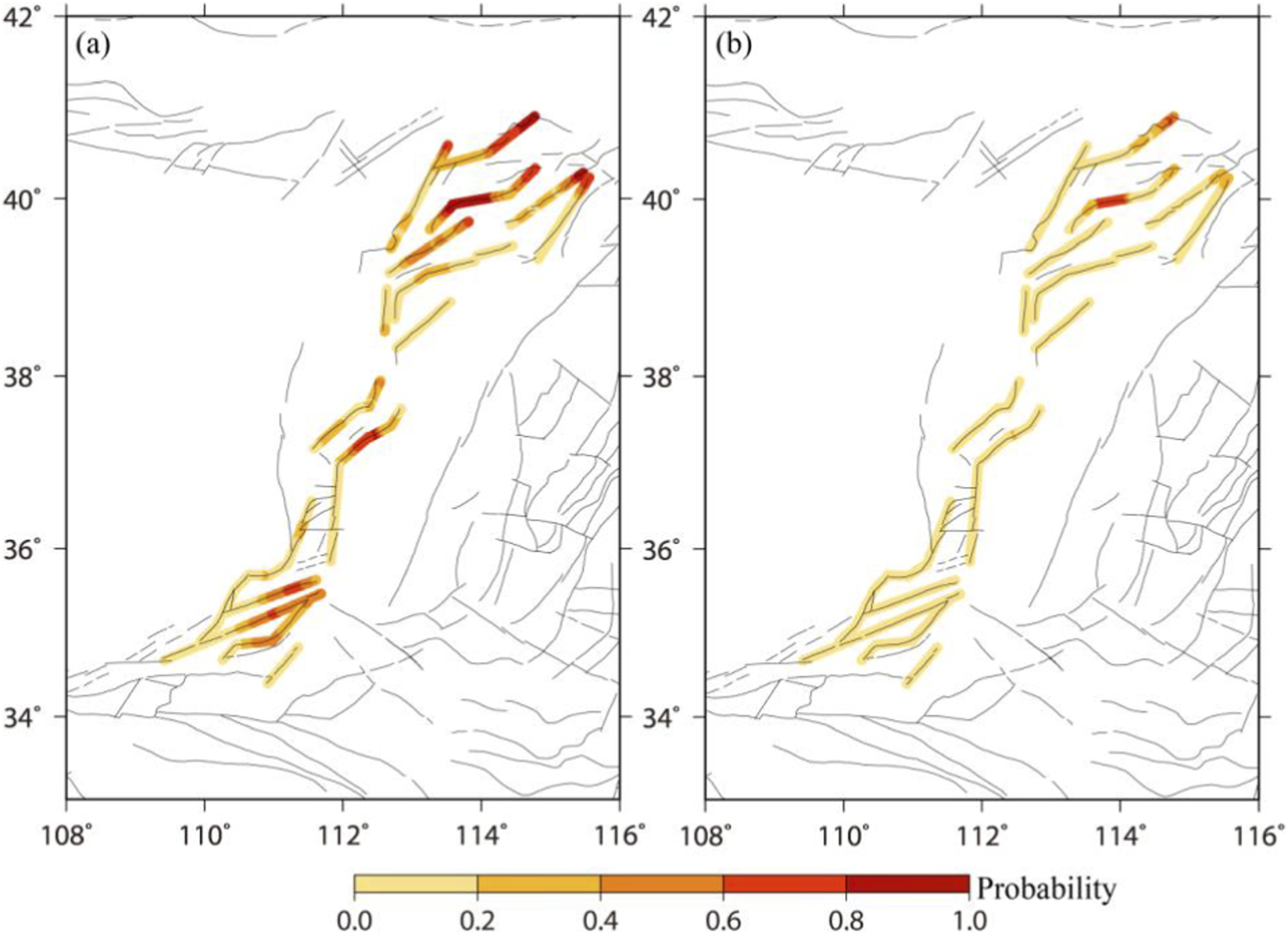
The modeling Poisson probability of large earthquake with different target magnitude. (a) for potentional earthquake with M ≥ 6 and (b) for M ≥ 7.
5 Discussions
5.1 Uncertainty in the effective friction coefficient
The effective friction coefficient (μ′) is one of the most critical parameters influencing Coulomb stress changes. As a physical parameter characterizing fault resistance to relative motion and deformation between adjacent blocks, it is inherently challenging to quantify through experiments or direct observations. This study examined the impact of this parameter on Coulomb stress change and consequently on the estimation of seismic hazard probability. Two additional representative effective friction coefficients (0.1 and 0.7) were selected to calculate cumulative Coulomb stress changes and further estimate the 30-year Poisson probability of earthquakes with M ≥ 6. The results indicate that increasing the effective friction coefficient moderately elevates Poisson probabilities for future earthquakes, whereas decreasing it produces the opposite effect (Figure 6). The most significant variations occur in TY, LF, and YC, which have been notably affected by stress perturbations from historical major earthquakes. The 1,303 Hongdong M8, 1,556 Huaxian M8¼, and 1,695 Linfen M7¾ earthquakes generated substantial normal stress loading on faults in these regions. Increasing μ′ enhanced normal stress contribution to Coulomb stress changes, thereby leading to higher earthquake occurrence rates (Equation 2) while decreasing μ′ had the opposite effect. However, the overall influence of μ′ variation on Poisson probability remains relatively limited, generally confined within 10% (Figure 6).
FIGURE 6

The relative change of modeling Poisson probability with different effecitve friction coefficient to that with effecitve friction coefficient equal to 0.4. (a) for effecitve friction coefficient equal to 0.7 (a) and (b) for 0.1.
Previous studies suggest that the effective friction coefficient (μ′) is closely associated with fault slip types (Ali et al., 2008). It is recommended to use μ' = 0.6 for normal faults, μ' = 0.2 for strike-slip faults, and μ' = 0.8 for thrust faults. Other research indicates that μ′ may also be correlated with fault slip rates (Parsons et al., 2000), with faults experiencing larger slip displacements tending to have lower μ′ values (0.2–0.4). Those with smaller slip displacements exhibit higher μ′ values (0.6–0.8). Compared to other faults on the Chinese mainland, North China represents a typical diffuse tectonic zone with strain partitioning and is characterized by low fault slip rates. As part of North China, the SRS exhibits fault slip rates generally around 1 mm/a, with some faults having rates as low as 0.5 mm/a, making it a typical normal faulting basin characterized by low slip rates and small displacement accumulation. Consequently, its effective friction coefficient is likely relatively high, potentially leading to higher Poisson probabilities for potential earthquakes than those shown in Figure 6.
This implies that when evaluating seismic hazard in SRS, the higher μ′ values associated with its low slip rates should be taken into account, which may lead to greater Coulomb stress changes and, consequently, increased earthquake occurrence probabilities compared to regions with more active faulting. Further sensitivity analyses that incorporate these μ′ variations would help refine the seismic hazard assessment for this region.
5.2 Uncertainty in friction resistance
Friction resistance () is a crucial parameter affecting the calculation of earthquake production rates and is commonly regarded as a spatially invariant parameter (Toda and Enescu, 2011; Stein et al., 1997; Feng et al., 2024; Catalli et al., 2008; Shao et al., 2016; Dieterich, 1994). It is associated with both stress perturbation duration and tectonic stress loading rate, hence its analysis necessitates determining the stress perturbation duration. Paleoseismic studies indicate that earthquake recurrence intervals in the SRS are approximately 1,020–3,930 years (Zheng et al., 2024a). Assuming the stress perturbation duration to be 1/10 of the recurrence period (Shao et al., 2016), along SRS is estimated to be approximately 0.026 ± 0.0215 MPa. Considering slip rates of 0.1–2 mm/yr along major faults, and based on the correlation between stress perturbation duration and slip rate established by Stein and Liu (2009), is estimated to be approximately 0.089 ± 0.0923 MPa. Alternatively, applying the slip rate-duration relationship proposed by Toda and Stein (2018), is estimated to 0.01 ± 0.0098 MPa. Consequently, this study adopts an average value of 0.04 MPa as the frictional resistance for the major faults in the SRS. For further discussion, and without loss of generality, we selected the Zhongtiaoshan fault in YC where stress changes are pronounced to analyze how variations in affect the Poisson probability (Figure 7). Results indicate that when changes from 0.0001 to 0.1 MPa, the earthquake probability changes accordingly, with the maximum variation amplitude not exceeding 5%.
FIGURE 7

The relative change of modeling Poisson probability with different friction resistance () to that with equal to 0.04 MPa.
5.3 Seismic hazard in Shanxi rift system
The Shanxi rift system has historically been seismically active, making its potential seismic hazards a long-standing research focus among many scholars (Zheng et al., 2024a; Chen et al., 2010; Shao et al., 2022; Xu et al., 2017; Working Group of M7, 2012; Middleton et al., 2017). In summary, several seismic gaps have been identified along historically active fault segments. Within these gaps, some faults exhibit elapsed times since paleoearthquake that are approaching or surpassing their typical recurrence periods, such as the Jiaocheng Fault in the TY (Zheng et al., 2024a). Additionally, some faults may lack historical earthquake records. As one of the key birthplaces of Chinese civilization, the SRS has earthquake records dating back to 512 AD, indicating that certain faults may have been seismically inactive for at least 1,500 years. Geological field investigations indicate that these faults have been active since the Late Pleistocene (Zheng et al., 2024b), such as the Hancheng Fault in YC. Paleoseismic studies on existing faults in the SRS reveal the recurrence intervals ranging from approximately 1,020 to 3,930 years (Zheng et al., 2024b). The absence of seismic records for over 1,500 years implies that the elapsed time since the last major earthquake of these faults has exceeded at least half of their recurrence intervals, and in some cases, may approach or even surpass a full recurrence period. According to global (Wang et al., 2022) and Chinese (Wen, 1999) studies on large earthquake recurrence, faults with elapsed times exceeding half of their recurrence intervals already present a significant potential for major earthquakes. Therefore, even in the absence of detailed paleoseismic sequence studies for some of these faults, their seismic hazards warrant serious attention. Scholars also conducted seismic hazard analyses of the Shanxi Rift System based on geodetic observations (Middleton et al., 2017; Middleton et al., 2018; Liu et al., 2023). In terms of the assessment of seismic hazards, the Shanxi Rift System exhibits a significant strain deficit, and its future seismic risk cannot be overlooked, which is consistent with the findings of this study.
This study assesses the future seismic hazard of the SRS by integrating historical earthquake records with modern geodetic observations, employing Coulomb stress change analysis and the rate-and-state friction constitutive model. The results (Figure 8) indicate several faults with relatively high seismic hazard potential, including the Tianzhen Fault, Yanggao-Tianzhen Fault, Liulengshan Fault, and Yunzhongshan Fault in the DT, as well as the Taigu Fault in TY. These high-risk faults are located within historical seismic gaps, indicating that their elevated seismic risk requires urgent attention. Conversely, some faults located within historical seismic gaps such as the Jiaocheng Fault in TY and the Hancheng Fault in YC, exhibit low calculated probabilities of earthquake occurrence, suggesting relatively lower seismic hazard. However, further research that incorporates regional seismic activity is still required. Notably, despite not previously defined as seismic gaps, the Emei Fault, Shuangquan-Linyi Fault, and Zhongtiaoshan Fault in YC exhibit significant modern microseismic activity. Moreover, significant stress loading associated with the 1,303 Hongtong M8 and 1,556 Huaxian M8¼ earthquakes has led to a relatively high probability of M ≥ 6 earthquake (Figure 8). Consequently, these faults also present a considerable risk of moderate to strong earthquakes.
FIGURE 8

The modeling Poisson probability of potential earthquakes with M ≥ 6 of major faults in the Shanxi rift system. Blue areas represent historical earthquake rupture regions while black circles indicate high-risk seismic gaps (Zheng et al., 2024a).
6 Conclusion
This study assesses the seismic potential of three major seismic gaps in the Shanxi rift system by modeling the Poisson probabilities of earthquake occurrence using Coulomb stress change analysis and a rate- and state-dependent friction (RSF) model. To achieve this objective, we first compiled and refined the source parameters of 22 historical earthquakes (M ≥ 6½) that have occurred since 500 AD and then calculated the cumulative Coulomb stress changes on the major faults using a viscoelastic layered lithospheric model. Subsequently, based on the calculated Coulomb stress changes, we employed the RSF model to simulate the earthquake production rate, taking into account stress perturbations. These rates were then converted into Poisson probabilities representing the temporal urgency of seismic events.
The results indicate that several faults with high Poisson probability are located in Datong basin and Taiyuan basin, showing strong consistency with the seismic gaps identified through geological field investigation. These findings suggest that the seismic risk in these regions deserves more attention in the future analyses. The maximum Poisson probability for M ≥ 6 events on faults in the Yuncheng basin is around 0.5 to 0.6, yet these faults do not lie within identified seismic gaps. This suggests that the M ≥ 6 seismic risk in the Yuncheng basin is possibly lower than that in the Datong basin. It also indicates that the seismic risk in Yuncheng basin may be more complex and deserves further studies. This study provides valuable insights for assessing future seismic hazards in the Shanxi rift system, facilitating targeted disaster mitigation strategies and regional risk reduction efforts. Additionally, the methodology may serve as a reference for seismic hazard evaluation in other strain-partitioned diffuse tectonic zones.
Statements
Data availability statement
The original contributions presented in the study are included in the article/supplementary material, further inquiries can be directed to the corresponding author.
Author contributions
FS: Writing – original draft, Conceptualization. MY: Data curation, Writing – review and editing. BA: Formal Analysis, Writing – review and editing. NH: Funding acquisition, Writing – review and editing. LS: Investigation, Writing – review and editing. CY: Methodology, Writing – review and editing.
Funding
The authors declare that financial support was received for the research and/or publication of this article. This research was funded by the Natural Science Basic Research Program of Shaanxi (Program No. 2024JC-YBMS-210, 2023-JC-QN-0332 and 2025JC-YBMS-338) and the Science for Earthquake Resilience supported by China Earthquake Administration (No. XH25035A).
Conflict of interest
The authors declare that the research was conducted in the absence of any commercial or financial relationships that could be construed as a potential conflict of interest.
Generative AI statement
The authors declare that no Generative AI was used in the creation of this manuscript.
Any alternative text (alt text) provided alongside figures in this article has been generated by Frontiers with the support of artificial intelligence and reasonable efforts have been made to ensure accuracy, including review by the authors wherever possible. If you identify any issues, please contact us.
Publisher’s note
All claims expressed in this article are solely those of the authors and do not necessarily represent those of their affiliated organizations, or those of the publisher, the editors and the reviewers. Any product that may be evaluated in this article, or claim that may be made by its manufacturer, is not guaranteed or endorsed by the publisher.
References
1
Ali S. T. Freed A. M. Calais E. Manaker D. M. Mccann W. R. (2008). Coulomb stress evolution in northeastern Caribbean over the past 250 years due to coseismic, postseismic and interseismic deformation. Geophys. J. Int.174, 904–918. 10.1111/j.1365-246x.2008.03634.x
2
Biasi G. P. Weldon R. J. (2006). Estimating surface rupture length and magnitude of paleoearthquakes from point measurements of rupture displacement. Bull. Seismol. Soc. Am.96 (5), 1612–1623. 10.1785/0120040172
3
Broerse T. Riva R. Simons W. Govers R. Vermeersen B. (2015). Postseismic GRACE and GPS observations indicate a rheology contrast above and below the Sumatra slab. J. Geophys. Res. Solid Earth120, 5343–5361. 10.1002/2015jb011951
4
Catalli F. Cocco M. Console R. Chiaraluce L. (2008). Modeling seismicity rate changes during the 1997 Umbria-Marche sequence (Central Italy) through a rate-and state-dependent model. J. Geophys. Res. Solid Earth113, B11301. 10.1029/2007jb005356
5
Chen L. Cheng C. Wei Z. (2009). Seismic evidence for significant lateral variations in lithospheric thickness beneath the central and Western north China craton. Earth Planet. Sci. Lett.286, 171–183. 10.1016/j.epsl.2009.06.022
6
Chen Q. C. An Q. M. Sun D. S. Du J. J. Mao J. Z. Feng C. J. (2010). Current in-situ stress state of Shanxi basin and analysis of earthquake risk. Acta Geosci. Sin.31, 541–548.
7
Cheng J. C. Rong Y. F. Magistrale H. Chen G. H. Xu X. W. (2020). Earthquake rupture scaling relations for mainland China. Seismol. Res. Lett.91, 248–261. 10.1785/0220190129
8
Deng Q. D. Zhang P. Z. Ran Y. K. Yang X. P. Min W. Chu Q. Z. (2002). Basic characteristics of active tectonics in China. Sci. China Earth Sci.45, 1020–1030.
9
Dieterich J. (1994). A constitutive law for rate of earthquake production and its application to earthquake clustering. J. Geophys. Res. Solid Earth99, 2601–2618. 10.1029/93jb02581
10
Du J. J. Li D. P. Ma Y. S. Wang C. M. Shao J. (2013). The high-speed and long-distance ancient landslides before 187 ka: the evidence from the OSL dating of the loess overlying the landslide body of lianhuasi landslides in Huaxian, Shaanxi Province, China. Quat. Sci.33, 1005–1015. 10.3969/j.issn.1001-7410.2013.05.18
11
Duan R. T. Fang Z. J. (1995). Neotectonic characteristics of the Northern Piedmont fault of the Liuleng Mountain. Seismol. Geol.17, 207–213.
12
Feng Y. Xiong N. Shan B. Wang R. Jiang X. X. (2024). Constraining parameter uncertainties in the coulomb rate-state approach: a case study of seismicity in the longmenshan region after the 2008 Mw7.9 Wenchuan earthquake, China. Seismol. Res. Lett.95, 2820–2832. 10.1785/0220230414
13
Freed A. M. Lin J. (2001). Delayed triggering of the 1999 hector mine earthquake by viscoelastic stress transfer. Nature411, 180–183. 10.1038/35075548
14
Gutenberg B. Richter C. F. Princeton N. J. (1954). Seismicitiy of the Earth and associated phenomenon. 2nd Ed. Princeton, NJ: Princeton University Press. p. 17–19.
15
Hanks T. C. Kanamori H. (1979). A moment magnitude scale. J. Geophys. Res. Solid Earth84 (B5), 2348–2350. 10.1029/jb084ib05p02348
16
Harris R. A. (1998). Introduction to special section: stress triggers, stress shadows, and implications for seismic hazard. J. Geophys. Res. Solid Earth103, 24347–24358. 10.1029/98jb01576
17
He J. K. Lu S. Wang W. (2013). Three-dimensional mechanical modeling of the GPS velocity field around the northeastern Tibetan Plateau and surrounding regions. Tectonophysics584, 257–266. 10.1016/j.tecto.2012.03.025
18
Hergert T. Heidbach O. (2010). Slip-rate variability and distributed deformation in the marmara Sea fault system. Nat. Geosci.3, 132–135. 10.1038/ngeo739
19
Hu G. R. Li Z. H. Yan X. B. Zhao J. Q. Zeng J. Y. Guo J. (2017). Study of late Quaternary activity of Hancheng fault. Seismol. Geol.39, 206–217. 10.3969/j.issn.0253-4967.2017.01.016
20
Hu N. Han P. Wang R. Shi F. Chen L. Li H. (2024). Spatial heterogeneity of b values in northeastern Tibetan Plateau and its interpretation. Entropy26, 182. 10.3390/e26030182
21
Huang M. Bürgmann R. Freed A. M. Calais E. (2014). Probing the lithospheric rheology across the eastern margin of the Tibetan Plateau. Earth Planet. Sci. Lett.396, 88–96. 10.1016/j.epsl.2014.04.003
22
Jaeger J. C. Cook N. (1979). Fundamentals of rock mechanics. London: Chapman and Hall. p. 593.
23
Jiang W. L. Xiao Z. M. Xie X. S. (2000). Segmentations of active normal dip-slip faults around ordos block according to their surface ruptures in historical strong earthquakes. Acta Seismol. Sin.22, 517–526.
24
Jiang W. L. Xie X. S. Wang H. Z. Feng X. Y. Zhang K. F. (2003). Holocene palaeoseismic activities along the Northern Piedmont fault of Hengshan Mountain, Datong Basin, Shanxi Province. Earthq. Res. China19, 8–19.
25
Jiang W. L. Guo H. Xie X. S. (2017). Explanatory notes for the distribution map (1:50,000) of Jiaocheng active fault Zone, Shanxi Province. Beijing: Seismological Press.
26
King G. C. Hubert-Ferrari A. Nalbant S. S. Meyer B. Armijo R. Bowman D. (2001). Coulomb interactions and the 17 August 1999 Izmit, Turkey Earthquake. C. R. Geosci.333, 557–569. 10.1016/s1251-8050(01)01676-7
27
Lei S. Walker R. Li Y. Ma J. Johnson B. Ou Q. et al (2025). Surface ruptures from the 1556 huaxian earthquake, North China, measured using high-resolution topography: implications for large magnitude normal-faulting earthquakes in Continental interiors. Quat. Sci. Adv.18, 100270. 10.1016/j.qsa.2025.100270
28
Li B. Atakan K. Sørensen M. B. Havskov J. (2015b). Stress pattern of the Shanxi rift System, North China, inferred from the inversion of new focal mechanisms. Geophys. J. Int.201, 505–527. 10.1093/gji/ggv025
29
Li B. S?rensen M. B. Atakan K. (2015a). Coulomb stress evolution in the Shanxi rift system, north China, since 1303 associated with coseismic, post-seismic and interseismic deformation. Geophys. J. Int.203, 1642–1664. 10.1093/gji/ggv384
30
Liu R. Zhang J. Guo W. Chen H. (2023). Adaptive vertical-deformation field estimation and current tectonic deformation significance analysis in Shanxi rift valley. Front. Earth Sci.11, 1083562. 10.3389/feart.2023.1083562
31
Lu H. F. Li Y. S. Ma B. Q. Wang C. H. (2009). Late Quaternary activity of the NEE-striking fault belt in Northern Shanxi fault-depression Zone. Geoscience23, 440–446.
32
Luo Q. Li C. Li X. Ren G. Dong J. (2021). Slip distribution and footwall topography of the Yanggao-Tianzhen fault (Northern Shanxi Graben): implications for the along-strike variations in fault activity and regional deformation. Tectonics40, e2020TC006593. 10.1029/2020tc006593
33
Luo Q. X. Li Y. L. Hu X. Guo A. L. Liu Q. R. Jiang S. R. (2022). Constraints on the late quaternary dextral strike-slip rate of the sestern segment of the north Liulengshan fault in the northern Shanxi graben system. Quat. Sci.42, 717–731. 10.11928/j.issn.1001-7410.2022.03.08
34
Ma J. (2019). Surface rupture and its seismogenic faults of 1556 Huaxian M8¼ earthquake. Beijing, China: Institute of Geology, China Earthquake Administration. Ph.D. Thesis.
35
Middleton T. A. Elliott J. R. Rhodes E. J. Sherlock S. Walker R. T. Wang W. et al (2017). Extension rates across the northern Shanxi Grabens, China, from Quaternary geology, seismicity and geodesy. Geophys. J. Int.209 (2), 535–558. 10.1093/gji/ggx031
36
Middleton T. A. Parsons B. Walker R. T. (2018). Comparison of seismic and geodetic strain rates at the margins of the ordos Plateau, northern China. Geophys. J. Int.212 (2), 988–1009. 10.1093/gji/ggx446
37
Ogata Y. (2011). Significant improvements of the space-time ETAS model for forecasting of accurate baseline seismicity. Earth Planets Space63, 217–229. 10.5047/eps.2010.09.001
38
Parsons T. Dreger D. S. (2000). Static-stress impact of the 1992 landers earthquake sequence on nucleation and slip at the site of the 1999 M=7.1 hector mine earthquake, Southern California. Geophys. Res. Lett.27, 1949–1952. 10.1029/1999gl011272
39
Rice J. R. (1992). Chapter 20 fault stress States, pore pressure distributions, and the weakness of the San Andreas fault. Int. Geophys.51, 475–503. 10.1016/s0074-6142(08)62835-1
40
Rice J. R. Cleary M. P. (1976). Some basic stress diffusion solutions for fluid-saturated elastic porous media with compressible constituents. Rev. Geophys.14, 227–241. 10.1029/rg014i002p00227
41
Shan B. Xiong X. Zheng Y. Diao F. Q. (2009). Stress changes on major faults caused by Mw7.9 Wenchuan Earthquake, May 12, 2008. Sci. China Earth Sci.52, 593–601. 10.1007/s11430-009-0060-9
42
Shan B. Feng Y. S. Liu C. L. Xiong X. (2020). Interactions of earthquakes in central Italy over the past 100 yr through coulomb stress changes, and implications for seismic hazards. Bull. Seismol. Soc. Am.110, 178–190. 10.1785/0120190112
43
Shao Z. G. Fu R. S. Xue T. X. Huang J. H. (2007). Simulating postseismic viscoelastic deformation based on burgers model. J. Geod. Geodyn.27, 31–37.
44
Shao Z. G. Zhou L. Q. Jiang C. S. Ma H. S. Zhang L. P. (2010). The impact of Wenchuan MS8.0 Earthquake on the seismic activity of surrounding faults. Chin. J. Geophys.53, 1784–1795. 10.3969/j.issn.0001-5733.2010.08.004
45
Shao Z. G. Xu J. Ma H. S. Zhang L. P. (2016). Coulomb stress evolution over the past 200 years and seismic hazard along the xianshuihe fault zone of Sichuan, China. Tectonophysics670, 48–65. 10.1016/j.tecto.2015.12.018
46
Shao Z. G. Wu Y. Q. Ji L. Y. Diao F. Q. Shi F. Q. Li Y. J. et al (2022). Comprehensive determination for the late stage of the interseismic period of major faults in the boundary Zone of active tectonic blocks in Chinese mainland. Chin. J. Geophys.65, 4643–4658. 10.6038/cjg2022P0489
47
Shen Z. K. Wan Y. G. Gan W. J. Li T. M. Zeng Y. H. (2004). Crustal stress evolution of the last 700 years in north China and earthquake occurrence. Earthq. Res. China20, 211–228.
48
Shi F. Q. Zhang H. Shao Z. G. Xu J. Shao H. C. Li Y. J. (2020). Coulomb stress evolution and stress interaction among strong earthquakes in north China. Chin. J. Geophys.63, 3338–3354. 10.6038/cjg2020O0094
49
Si S. P. Li Y. L. Lü S. H. Wang Y. R. (2014). Holocene slip rate and paleoearthquake records of the salt Lake segment of the Northern zhongtiaoshan fault, Shanxi Province. Sci. China Earth Sci.57, 2079–2088. 10.1007/s11430-014-4887-3
50
Skempton A. W. (1954). The pore-pressure coefficients A and B. Geotechnique4, 143–147. 10.1680/geot.1954.4.4.143
51
Stein S. Liu M. (2009). Long aftershock sequences within continents and implications for earthquake hazard assessment. Nature462, 87–89. 10.1038/nature08502
52
Stein T. Ross S. Barka A. A. Dieterich J. H. (1997). Progressive failure on the North Anatolian fault since 1939 by earthquake stress triggering. Geophys. J. Int.128, 594–604. 10.1111/j.1365-246x.1997.tb05321.x
53
Sun C. B. Xie X. S. Xu J. H. (2013). Late Quaternary faulted landforms characteristics on the tumen-jiazhu village segment of the luoyunshan Piedmont fault. Earthq. Res. China29, 347–357.
54
Tang Q. Chen L. (2008). Structure of the crust and uppermost mantle of the yanshan Belt and adjacent regions at the Northeastern boundary of the north China craton from rayleigh wave dispersion analysis. Tectonophysics455, 43–52. 10.1016/j.tecto.2008.04.021
55
Toda S. Enescu B. (2011). Rate/State coulomb stress transfer model for the CSEP Japan seismicity forecast. Earth Planets Space63, 171–185. 10.5047/eps.2011.01.004
56
Toda S. Stein R. S. (2018). Why aftershock duration matters for probabilistic seismic hazard assessment. Bull. Seismol. Soc. Am.108, 1414–1426. 10.1785/0120170270
57
Toda S. Lin J. Meghraoui M. Stein R. S. (2008). 12 May 2008 M=7.9 Wenchuan, China, earthquake calculated to increase failure stress and seismicity rate on three major fault systems. Geophys. Res. Lett.35, L17305. 10.1029/2008gl034903
58
Wang X. Song M. Q. Li L. Luo Y. (2014). Minimum magnitude of completeness for earthquake catalogues of different periods in Shanxi region. Earthquake34, 82–88.
59
Wang X. W. Cui Z. J. Yang G. H. Zhu Y. Q. Li H. W. (2016). Research on relationship between evolution characteristics of crustal deformation, strain field and earthquakes along shanxi rift zone. J. Geodesy Geodyn.36 (1), 52–56. 10.14075/j.jgg.2016.01.012
60
Wang P. Shao Z. G. Liu X. X. Yin X. F. (2022). Ten-year probability of strong earthquakes on major faults in boundaries of active blocks in Chinese continent. Chin. J. Geophys.65, 3829–3843. 10.6038/cjg2022Q0082
61
Wen X. Z. (1999). Empirical distribution of recurrence intervals of segment-rupturing earthquakes along active faults in Chinese mainland. Acta Seismol. Sin.21, 616–622.
62
Working Group of M7 (2012). Study on the Mid-to long-term potential of large earthquakes on Chinese continent. Beijing: Seismological Press, 345.
63
Xie X. S. Jiang W. L. Sun C. B. Yan C. G. Feng X. Y. (2008). Comparison study on Holocene paleoseismic activities among multitrenches along the Jiaocheng Fault Zone, Shanxi. Seismol. Geol.30, 412–430.
64
Xie F. R. Jing Z. J. Zhang S. M. (2017). Explanatory notes for the distribution map (1:50,000) of Taigu fault Zone. Beijing: Seismological Press.
65
Xu W. Liu X. D. Zhang S. M. (2011). Late Quaternary faulted landforms and determination of slip rates of the middle part of Kouquan fault. Seismol. Geol.33, 335–346.
66
Xu J. H. Xie X. S. Sun C. B. (2011). Holocene active evidence on the Longci-Yukou segment of Luoyunshan frontal Fault Zone, Shanxi. Seismol. Geol.33, 855–864. 10.3969/j.issn.0253-4967.2011.04.010
67
Xu W. Gao Z. W. Yang Y. Y. (2014). Late Quaternary activity research of the Northern marginal fault of emei platform, Shanxi Province. Seismol. Geol.36, 1064–1076. 10.3969/j.issn.0253-4967.2014.04.011
68
Xu X. W. Wu X. Y. Yu G. H. Tan X. B. Li K. (2017). Seismo-Geological signatures for identifying M≥7.0 earthquake risk areas and their preliminary application in mainland China. Seismol. Geol.39, 219–275. 10.3969/j.issn.0253-4967.2017.02.001
69
Xu Y. He H. Deng Q. Wei Z. Li Y. Bi L. (2018). The CE 1303 hongdong earthquake and the huoshan Piedmont fault, Shanxi graben: implications for magnitude limits of normal fault earthquakes. J. Geophys. Res. Solid Earth123, 3098–3121. 10.1002/2017jb014928
70
Yi G. Wen X. Xu X. (2004). Average recurrence intervals of strong earthquakes and potential risky segments along the Taiyuan-Linfen portion of the Shanxi graben system. Acta Seismol. Sin.17 (4), 426–437. 10.1007/s11589-004-0022-4
71
Yuan W. N. Shi F. Q. Wu J. (2021). Cumulated stress changes and its implications for current seismic activities in north China. J. Geod. Geodyn.41, 939–944. 10.14075/j.jgg.2021.09.011
72
Zheng W. J. Peng H. Liu X. W. Zhang Z. Q. Zhang D. L. Wei S. Q. et al (2024a). Strong earthquake activities around the ordos active block in past 15000 years and its implications. Chin. Sci. Bull.69, 2632–2647. 10.1360/TB-2023-0767
73
Zheng W. J. Sun X. Lei Q. Y. Gong Z. K. Wang Y. Liu X. W. et al (2024b). Late Quaternary tectonic activity and strong earthquake generation mechanism around the boundary zone of the ordos active-tectonic block, central China. J. Geomech.30, 206–224. 10.12090/j.issn.1006-6616.2023154
74
Zhu L. Li T. F. Shi F. Q. Shi J. Shao H. C. (2021). The coulomb stress evolution after the 1976 tangshan strong earthquake swarm and its relationship with the 2020 guye M5.1 earthquake. J. Seismol. Res.44, 1–8.
Summary
Keywords
seismic hazard modeling, Poisson probability, Coulomb stress change, friction constitutive law, Shanxi rift in north China
Citation
Shi F, Yang M, An B, Hu N, Su L and Yang C (2026) The earthquake probabilities of Shanxi rift system, China, based on Coulomb stress changes and friction constitutive law. Front. Earth Sci. 13:1705353. doi: 10.3389/feart.2025.1705353
Received
15 September 2025
Revised
14 November 2025
Accepted
17 November 2025
Published
02 January 2026
Volume
13 - 2025
Edited by
Giovanni Martinelli, National Institute of Geophysics and Volcanology, Italy
Reviewed by
Bouhadad Youcef, National Earthquake Engineering Center (CGS), Algeria
Chong Yue, China Earthquake Networks Center, China
Updates
Copyright
© 2026 Shi, Yang, An, Hu, Su and Yang.
This is an open-access article distributed under the terms of the Creative Commons Attribution License (CC BY). The use, distribution or reproduction in other forums is permitted, provided the original author(s) and the copyright owner(s) are credited and that the original publication in this journal is cited, in accordance with accepted academic practice. No use, distribution or reproduction is permitted which does not comply with these terms.
*Correspondence: Fuqiang Shi, shifuqiang121@163.com
Disclaimer
All claims expressed in this article are solely those of the authors and do not necessarily represent those of their affiliated organizations, or those of the publisher, the editors and the reviewers. Any product that may be evaluated in this article or claim that may be made by its manufacturer is not guaranteed or endorsed by the publisher.