 Heng Li
 Waqas Ali
 Claire Chassagne
 Lorenzo Botto
- 1Section of Complex Fluid Processing, Department of Process and Energy, Faculty of Mechanical Engineering, Delft University of Technology, Delft, Netherlands
- 2Section of Environmental Fluid Mechanics, Department of Hydraulic Engineering, Faculty of Civil Engineering and Geosciences, Delft University of Technology, Delft, Netherlands
The density of individual particles is commonly assessed experimentally by quantifying the settling velocity of a collection of particles transferred into a settling column and allowed to settle under the action of gravity. The individual settling velocities of the particles are recorded close to the bottom of the settling column, in a region where it is assumed that the particles have reached their Stokes terminal velocity after the particle cloud has broken up. In the present study we use numerical particle-based simulations in the Stokes regime to demonstrate that this fundamental assumption might not be fulfilled in practice. Even at low volume fraction of monodisperse spheres, a large deviation from the Stokes settling velocity was found. In the case of a collection of polydisperse spheres, a distinction could be made between particles belonging to a cloud, and particles trailing the cloud. It was found that the velocity of the largest trail particles is reasonably close to their Stokes settling velocity. However, the particles close to the core of the cloud can have velocities more than ten times their Stokes velocities, making the use of the single-particle Stokes velocity based on the core particle not suitable to extract the particle density without corrections. An expression based on the local volume fraction, the cloud radius and the particle settling velocity in the cloud is proposed to estimate the single-particle Stokes settling velocity, and therefrom the particle density.
1 Introduction
Stokes settling velocity of small micro-particles is one of the main input parameters of the numerical models used to estimate the transport of these particles in the water column (Lesser et al., 2004; Blumberg et al., 1996; Normant, 2000). The quantification of particle settling velocities is therefore a major topic in marine sciences, as it enables the prediction of the transport and fate of marine sediments in estuaries, seas and oceans (Rulent et al., 2024; Masria et al., 2024; Zhang and Choi, 2025; Isachenko and Chubarenko, 2022). Recently, a lot of research has focused on the microplastics found in water bodies (Ahmed et al., 2021; Hale et al., 2020; Andrady, 2011; Li et al., 2018), and this has similarly led to numerous studies to measure the settling velocities of microplastics (Al-Zawaidah et al., 2024; Yu et al., 2022; Dittmar et al., 2023; Dittmar et al., 2024; Goral et al., 2023; Zhang et al., 2023). In aquatic environment, most of the suspended particulate matter (SPM) is in the form of flocs (Chassagne and Safar, 2020; Manning et al., 2010; Spencer et al., 2022; Gu et al., 2025). Flocs are composed of mineral clay particles (and/or other small colloidal particles such as microplastics) bound by organic matter (often in the form of polymeric substances). One particular property of flocs is that their density is variable, as it depends on their composition (Chassagne et al., 2021; Deng et al., 2019; Safar et al., 2022). Knowing the size of a floc is therefore not enough to estimate its density as it would be for mineral particles, for example, (which have densities in the range of 2,600
The most common approach is to sample particles in the field and study them on board the ship or in the laboratory upon return. A small amount (mL) of the collected suspension (water + particles) is transferred into a settling column containing water with the same properties as the sampling area (same chemical properties, same temperature). A detailed description is given in (Ali et al., 2024). The settling velocity is recorded with a camera at locations far away from the injection point, to ensure that the particles have reached their terminal velocities (Ali et al., 2024; Manning et al., 2011; Manning, 2015; Fall et al., 2021; Kaiser et al., 2019; Khatmullina and Chubarenko, 2021; Glockzin et al., 2014). In most practical cases involving flocs, particle (floc) density is very close to the density of the suspending liquid, typically water. Therefore, the particles have reached their terminal velocity and are expected to settle in the Stokes regime when reaching the recording point. In the Stokes regime, the settling velocity
Recent experiments with flocs have shown that the settling velocity measured with the settling column method is incompatible with predictions using realistic values of the floc density (Ali et al., 2024). Measurements done by transferring a drop of a dilute suspension of flocs at the top of the column give values of the settling velocity of flocs at the bottom of the column that are much larger than the value predicted by the Stokes settling rate. One of the reasons for this large velocity is that flocs fall in the wake of others, which enhance their settling velocity. This velocity was hence termed “collective settling” velocity in (Ali et al., 2024). Experiments shown in the same article have instead demonstrated that dropping single flocs in the settling column gave settling velocities (“individual settling”) that are close to the Stokes settling value.
The results of this study on the effect of collective motions on particle settling is of practical interest in several contexts. Collective settling is encountered during the discharge of particle-laden plumes in (deep-sea) mining (Peacock and Ouillon, 2023), the propagation of turbidity currents (Meiburg and Kneller, 2010), hypopycnal plumes (Snyder and Hsu, 2011), etc. To estimate the settling fluxes in the far-field region of the plume, where the particle concentration is very low, the Stokes settling velocity is used as input parameter, and its validity assumed. The assumption is based on the fact that the suspension is very dilute (volume fraction within 1%), so hydrodynamic interactions are assumed to be unimportant. The current study challenges this assumption.
In this article, we start from experimental observations using spherical particles of given size and density. The use of such well controlled particles enables us to be in the regime where the Stokes formula is known to hold exactly in the individual settling case and avoid the uncertainties in shape, size and density encountered when using flocs. Experiments were performed using a video microscopy setup described in Section 2, quite similar to the ones used by other experimentalists (Manning et al., 2011; Manning, 2015; Fall et al., 2021; Kaiser et al., 2019; Khatmullina and Chubarenko, 2021; Glockzin et al., 2014). We then interpret the experimental results using numerical simulations that illustrate the difference between collective settling and individual settling. Settling of suspension drops in quiescent viscous liquids has been studied both experimentally and numerically (Nitsche and Batchelor, 1997; Ekiel-Jeżewska et al., 2006; Metzger et al., 2007). In these studies, the initial velocity of the cloud, breakup of the cloud and particle leakage from the cloud were the main focuses. In the current article, we are interested in discussing implications of theoretical predictions for the settling velocity as a function of solid concentration and particle polydispersity in size in view of experimental measurements. The simulations presented in Section 3 enable to propose a simple expression for the single-particle Stokes settling velocity and density using the local volume fraction, the cloud radius and the particle settling velocity in the cloud. This expression is valid for a dilute suspension and a cloud size much larger than the particle’s size, which are conditions generally fulfilled in the experiments.
2 Experimental methods
For the settling experiments two batches of polystyrene particles are utilized, with a median particle diameter of approximately 600

Figure 1. (a) Particle size (diameter) distribution of polystyrene particles as measured by Malvern Mastersizer 2000. (b) Schematic representation of the FLOCCAM setup (Ali et al., 2022).
The settling velocity was measured with a home-made video microscopy device (FLOCCAM) designed to measure particle size distributions (PSDs) for particles larger than 20
The FLOCCAM system consists of a rectangular settling column measuring
For illumination, a Flat Lights TH2 Series Red LED panel (63
To inject the particles into the settling column, a plastic conical feed well terminating with a rectangular outlet measuring 2
The post-processing of FLOCCAM videos was done by using the software Safas (Ali et al., 2022; MacIver, 2019). Safas, which stands for Sedimentation and Floc Analysis Software, is a Python module specifically designed for processing and analyzing images and videos of sedimenting particles, especially cohesive sediment flocs. This open-source software enables users to easily extract critical data such as particle size, morphology, and settling velocity, allowing users to customize its image filters.
In the first set of experiments, particles with a given size (600
The group settling behaviour of a polydisperse group of particles, consisting of a mixture of 600
3 Simulation approach
Simulations were carried out with a Stokesian dynamics method in the force formulation (Durlofsky et al., 1987; Brady and Bossis, 1988). The simulation code is the same as in Ref. (Li and Botto, 2024), where complete validation cases are presented. Essentially the method is based on calculating the average settling velocity starting from the particle position by knowing that, in a low-Reynolds number suspension, the velocity of each particle is a linear function of the gravitational forces (weight and buoyancy) acting on each particle.
The numerical simulations are carried out as follows. Firstly, particles are randomly placed inside a cubic box ensuring no overlap between any pair of particles. The group of particles in the box is assumed to settle in an unbounded fluid. Then, the particle velocities are calculated by the Stokesian dynamics method (Durlofsky et al., 1987; Brady and Bossis, 1988). In the Stokesian Dynamics method, a mobility matrix
where
When the average separation between identical particles of radius
The simulation results are presented in non-dimensional form. The simulations are non-dimensionalized using a characteristic length
4 Results and discussions
4.1 Experimental results
Figure 2 (top) presents the results of a settling experiment for particles of diameters centered around 600

Figure 2. (top) experimental particle settling velocities, comparing individual and group settling for a range of particle diameters centered at 600
Having particles settling in a group has several effects: a larger spread in velocities and a larger average velocity are found for a given diameter in the collective settling case (orange dots) compared to the individual settling case (blue dots). Note that the FLOCCAM setup does not allow to measure velocities larger than
Figure 2 (bottom) represents the comparison between individually settling particles and suspensions containing both particles with diameters 600
From the experiments, it can be concluded that, in line with what has been observed with flocs, a large spread in sizes and velocities is obtained during the collective motion of particles, even though these particles have a density close to water and settle in the Stokesian regime (Ali et al., 2024).
The increase in the number of particles in a suspension is generally believed to give a reduction in settling rate (Brzinski and Durian, 2018), a phenomenon commonly referred to as hindered settling. In our experiment instead we have a case of enhanced settling. The reason lays in the fact that particles in the FLOCCAM experiment are settling in a group, in a water otherwise devoid of particles, as sketched in Figure 3a. In that simplistic sketch, it is assumed that the particles fall collectively with the same velocity. Their velocity can be estimated, using Stokes, as being equal to the velocity of the cloud, i.e.,
where

Figure 3. Sketches showing (a) collective settling of particles, and (b) hindered settling of a suspension. Blue lines with arrows represent the fluid streamlines, and red arrows show the particle moving direction.
In hindered settling, the group of particles spans the entire width of the tank (Figure 3b). In this latter case hydrodynamic interactions produce a significant upward flow by conservation of volume (the flux of particles moving downward imposes a water flux upward). This results in a reduction of individual particle settling velocities (Chassagne, 2021).
We will now proceed to analyze in more detail the kinetics of collective settling using numerical simulations.
4.2 Settling of two spheres
In order to get a first estimate of characteristic lengths, we consider the settling kinetics of pairs of spheres. We first study the classical case of a pair of identical spherical particles of radius
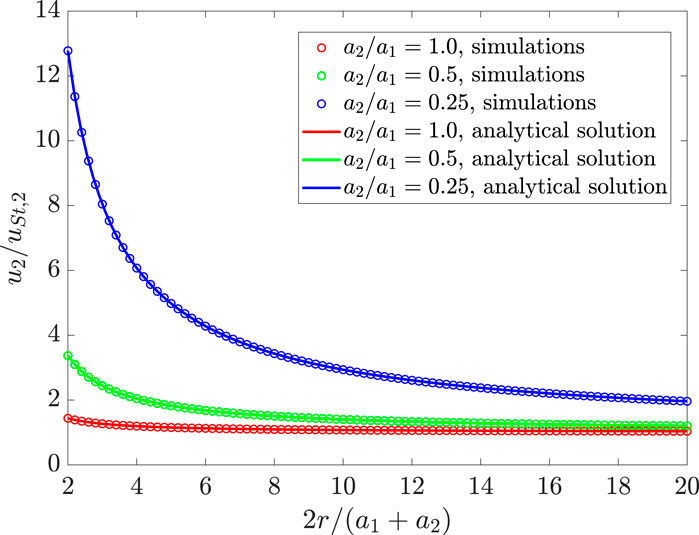
Figure 4. Simulated settling velocities of a sphere of radius
4.3 Settling of a group of spheres
The long-range velocity hydrodynamic disturbances created by particles settling in a group result in settling velocities that are much larger than the single particle settling velocity, but also to a significant spread in velocity. In Figure 5 we compare group settling and individual settling for configurations in which 100 particles are randomly placed in a cubic box of side
This expression can be used for an estimation of the settling velocity of particles in a dilute cloud. Note that Equations 2, 3 reduce to the same expression,
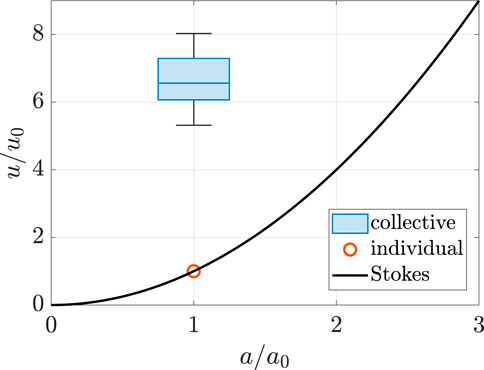
Figure 5. Monodisperse case: Particle settling velocities normalized by the particle Stokes settling velocity as function of the normalized particle size. Single particles settle according to Stokes (red circle), whereas particles settling collectively display a spread in settling velocities (boxplot). The mean value and standard deviation of the settling velocity are 6.6 and 0.7, respectively. The horizontal line in the blue box represents the median value. The volume fraction of particles is

Figure 6. Monodisperse case: average particle settling velocity normalized by the individual Stokes settling velocity versus volume fraction in the settling group. Symbols are results of current simulations with error bars showing the standard deviation of the particle velocity fluctuations. The dashed line is the analytical solution from the reference (Ekiel-Jeżewska et al., 2006) for particles randomly distributed within a spherical cloud. The radius of the cloud is half of the box size.
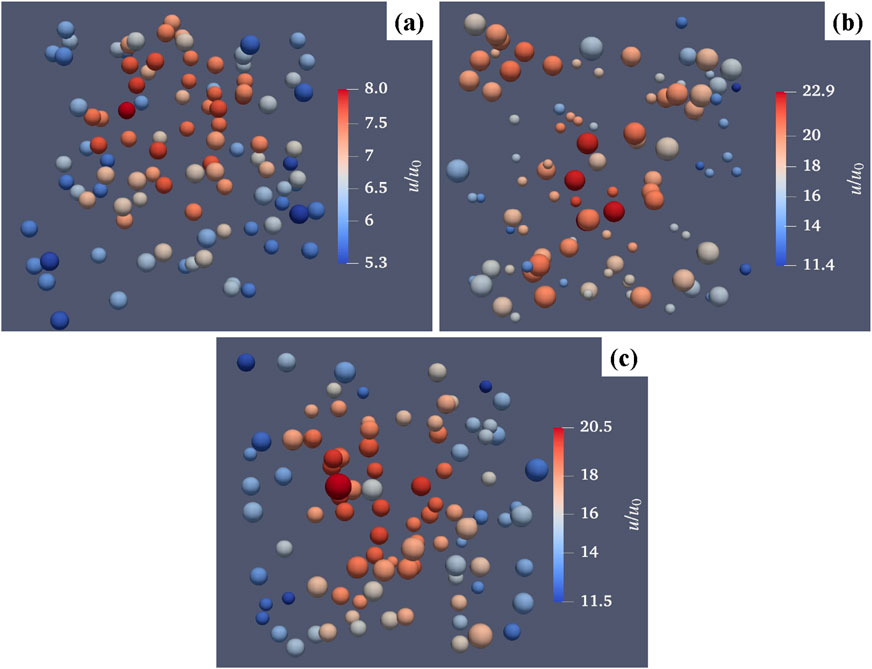
Figure 7. Example of simulated configurations for (a) monodisperse, (b) bidisperse and (c) polydisperse cases. The particles are colored according to their settling velocities (normalized by the reference Stokes velocity).
4.4 Settling of a bidisperse group of spheres
We now turn to the analysis of simulations in the bidisperse case. The normalized particle settling velocities in both individual settling and group settling cases are shown in Figure 8. For these calculations, in the individual settling case, a single particle with radius

Figure 8. Bidisperse case: Normalized particle settling velocities for collective and individual settling. For the collective settling, 50 particles of radius
4.5 Settling of a polydisperse group of spheres
Finally, Figure 9 shows results for the polydisperse case. The particle size is distributed according to a Gaussian with mean 1.5 and standard deviation 0.2. A graph comparing the settling velocity vs. particle radius for individual settling and collective settling is shown in Figure 9a. For the collective settling simulation, 100 particles are placed randomly in a cubic box with
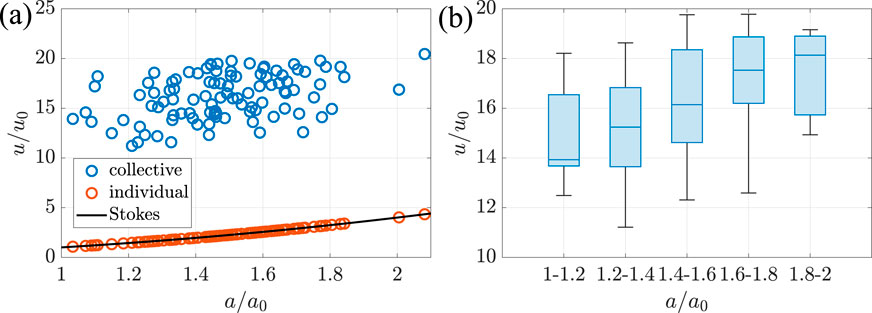
Figure 9. Polydisperse case: (a) normalized particle settling velocities comparing collective and individual settling, and (b) spread of the normalized particle settling velocities per size range during collective settling.
When a cloud of spherical monodisperse particles settles, the cloud maintains its shape while growing in size until it breaks up into “blobs”, except for clouds with very low initial volume fractions which disintegrate without keeping their shapes. A polydispersity in size has the effect of destabilising the cloud much faster. If the polydispersity is large, the cloud disintegration is faster.
In Figure 10a we show a snapshot of a dynamic simulation of a polydisperse suspension of 949 particles initially confined within a sphere. The initial volume fraction is

Figure 10. (a) A snapshot of a dynamic simulation of a settling polydisperse cloud. Particles are colored according to their sizes. (b) Particle size distribution used in the dynamic simulation. The mean value and standard deviation of the particle radius is 0.94 and 0.32, respectively.
Particles in the tail reach their Stokes settling velocity as time progresses. This trend is demonstrated in Figure 11, where the particle velocities are given in terms of trail particles (in red) and particles in the core of the cloud (blue) for

Figure 11. Particle velocities for different size classes at three different times in the dynamic simulation. Blue symbols are for the particles in the cloud, red symbols are for the particles in the trail, and the red lines are the Stokes velocities. Time progresses from (a–c). (a,b) happen before the cloud is completely broken, and (c) happens after that.
4.6 Criteria for stability of polydisperse cloud of particles
The time for disintegration of a particle cloud depends primarily on the initial volume fraction. For example, for
In an experiment, most interesting is the destabilisation length

Figure 12. The destabilization length versus the destabilization time of the cloud. Symbols are the results of our dynamic simulations (Triangles for monodisperse clouds, squares and diamonds for polydisperse clouds), and the dashed line is the correlation given in the Ref. (Ho et al., 2016).
5 Conclusion
Settling experiments, where a small volume of a dilute suspension of flocs is introduced in a settling column and the velocity of these particles is recorded at the bottom of the column are widely used to obtain Stokes settling velocities which are an input parameter to sediment transport models. The experiments presented in this article were done with a setup that is the same or is similar to the ones used in different studies to evaluate the density of small particles collected in situ, the majority of which are aggregates (flocs). Experiments on flocs in previous studies have demonstrated that the effective particle (floc) density,
Numerical simulations were subsequently presented to model the sedimentation of a cloud of particles at low Reynolds number in an unbounded fluid to evaluate the effect of collective particle interactions on the increase in settling rate over the single-particle (Stokes) settling rate formula. When a dilute amount of particles is introduced at the top of the settling column, a particle cloud is formed. At that point, each particle in the cloud settles approximately with the velocity of the cloud. This velocity scales proportionally to the number of particles in the cloud and is thus much larger than the single particle settling rate. This, in turn, gives rise to an overestimation of the effective density.
From Equation 3, assuming
where

Figure 13. Sketch of a settling particle group with dashed circle enclosing the cloud particles and leaving the trail particles behind.
Because we have access to accurate simulation data, we are in the position to test the accuracy of the simple model Equation 4. We estimated the particle-water density difference from the measured (from the simulation) average particle velocity of a monodisperse cloud, and compared the measured and real (imposed) density differences. The results are shown in Figure 14. Blue dots are the results from the Stokes velocity formula and the average particle velocity as the Stokes velocity, and red dots are the results using the correction Equation 4. For a very dilute cloud (i.e.,

Figure 14. The ratio between the estimated particle and water density difference from the simulations of a monodisperse cloud and the real density difference versus the volume fraction of the cloud. Blue dots are results without correction, and red dots are results with correction using Equation 4. Here
We conclude by summarising some of the key assumptions in our simulation. The main assumptions are that the Reynolds number based on the fluid-particle velocity difference is negligibly small and non-hydrodynamic particle-particle interactions (e.g., adhesion, electrostatic interaction, etc.) do not affect the sedimentation dynamics at the explored range of relatively small volume fractions. The particles are assumed to have equal density. The effect of the lateral bounding walls is also not considered. Developing simulations where these limitations are overcome is feasible with modern numerical methods for multiphase flows (Yousefi et al., 2020; Hu et al., 2024). The current work has indicated quantities that can be computed in simulations and that are of direct interest to scientists and practitioners seeking to use physical experiments to estimate particle-fluid density differences.
Data availability statement
The original contributions presented in the study are included in the article/supplementary material, further inquiries can be directed to the corresponding authors.
Author contributions
HL: Writing – original draft, Writing – review and editing. WA: Writing – original draft, Writing – review and editing. CC: Writing – original draft, Writing – review and editing. LB: Writing – original draft, Writing – review and editing.
Funding
The authors declare that financial support was received for the research and/or publication of this article. LB received funding from the European Research Council (ERC) under the European Union’s Horizon 2020 research and innovation program (Grant Agreement No. 715475, project FLEXNANOFLOW). This work is performed in the framework of PlumeFloc (TMW.BL.019.004, Topsector Water and Maritiem: Blauwe route) within the MUDNET academic network.
Acknowledgements
The authors would like to thank all co-funding partners. The authors would also like to thank Deltares for using their experimental facilities in the framework of the MoU between TU Delft/Deltares.
Conflict of interest
The authors declare that the research was conducted in the absence of any commercial or financial relationships that could be construed as a potential conflict of interest.
Generative AI statement
The authors declare that no Generative AI was used in the creation of this manuscript.
Any alternative text (alt text) provided alongside figures in this article has been generated by Frontiers with the support of artificial intelligence and reasonable efforts have been made to ensure accuracy, including review by the authors wherever possible. If you identify any issues, please contact us.
Publisher’s note
All claims expressed in this article are solely those of the authors and do not necessarily represent those of their affiliated organizations, or those of the publisher, the editors and the reviewers. Any product that may be evaluated in this article, or claim that may be made by its manufacturer, is not guaranteed or endorsed by the publisher.
References
Ahmed, M. B., Rahman, M. S., Alom, J., Hasan, M. S., Johir, M., Mondal, M. I. H., et al. (2021). Microplastic particles in the aquatic environment: a systematic review. Sci. Total Environ. 775, 145793. doi:10.1016/j.scitotenv.2021.145793
Ali, W., Enthoven, D., Kirichek, A., Chassagne, C., and Helmons, R. (2022). “Can flocculation reduce the dispersion of deep sea sediment plumes,” in Proceedings of the world dredging conference. Copenhagen, Denmark.
Al-Zawaidah, H., Kooi, M., Hoitink, T., Vermeulen, B., and Waldschlaäger, K. (2024). Mapping microplastic movement: a phase diagram to predict nonbuoyant microplastic modes of transport at the particle scale. Environ. Sci. and Technol. 58, 17979–17989. doi:10.1021/acs.est.4c08128
Ali, W., and Chassagne, C. (2022). Comparison between two analytical models to study the flocculation of mineral clay by polyelectrolytes. Cont. Shelf Res. 250, 104864. doi:10.1016/j.csr.2022.104864
Ali, W., Kirichek, A., and Chassagne, C. (2024). Flocculation of deep-sea clay from the clarion clipperton fracture zone. Appl. Ocean Res. 150, 104099. doi:10.1016/j.apor.2024.104099
Ali, W., Enthoven, D., Kirichek, A., Chassagne, C., and Helmons, R. (2022). Effect of flocculation on turbidity currents. Front. Earth Sci. 10, 1014170. doi:10.3389/feart.2022.1014170
Andrady, A. L. (2011). Microplastics in the marine environment. Mar. Pollut. Bull. 62, 1596–1605. doi:10.1016/j.marpolbul.2011.05.030
Blumberg, A. F., Ji, Z.-G., and Ziegler, C. K. (1996). Modeling outfall plume behavior using far field circulation model. J. Hydraulic Engineering 122, 610–616. doi:10.1061/(asce)0733-9429(1996)122:11(610)
Brady, J. F., and Bossis, G. (1988). Stokesian dynamics. Annu. Rev. Fluid Mech. 20, 111–157. doi:10.1146/annurev.fl.20.010188.000551
Brzinski, T., and Durian, D. (2018). Observation of two branches in the hindered settling function at low reynolds number. Phys. Rev. Fluids 3, 124303. doi:10.1103/physrevfluids.3.124303
Chassagne, C. (2021). Introduction to colloid science: applications to sediment characterization. doi:10.34641/mg.16
Chassagne, C., and Safar, Z. (2020). Modelling flocculation: towards an integration in large-scale sediment transport models. Mar. Geol. 430, 106361. doi:10.1016/j.margeo.2020.106361
Chassagne, C., Safar, Z., Deng, Z., He, Q., and Manning, A. J. (2021). “Flocculation in estuaries: modeling, laboratory and in-situ studies,” in Sediment transport-recent advances (IntechOpen).
Deng, Z., He, Q., Safar, Z., and Chassagne, C. (2019). The role of algae in fine sediment flocculation: in-situ and laboratory measurements. Mar. Geol. 413, 71–84. doi:10.1016/j.margeo.2019.02.003
Dittmar, S., Ruhl, A. S., and Jekel, M. (2023). Optimized and validated settling velocity measurement for small microplastic particles (10–400 μm). ACS ES&T Water 3, 4056–4065. doi:10.1021/acsestwater.3c00457
Dittmar, S., Ruhl, A. S., Altmann, K., and Jekel, M. (2024). Settling velocities of small microplastic fragments and fibers. Environ. Sci. and Technol. 58, 6359–6369. doi:10.1021/acs.est.3c09602
Durlofsky, L., Brady, J. F., and Bossis, G. (1987). Dynamic simulation of hydrodynamically interacting particles. J. Fluid Mech. 180, 21–49. doi:10.1017/s002211208700171x
Ekiel-Jeżewska, M., Metzger, B., and Guazzelli, E. (2006). Spherical cloud of point particles falling in a viscous fluid. Phys. Fluids 18, 038104. doi:10.1063/1.2186692
Faletra, M., Marshall, J. S., Yang, M., and Li, S. (2015). Particle segregation in falling polydisperse suspension droplets. J. Fluid Mech. 769, 79–102. doi:10.1017/jfm.2015.111
Fall, K. A., Friedrichs, C. T., Massey, G. M., Bowers, D. G., and Smith, S. J. (2021). The importance of organic content to fractal floc properties in estuarine surface waters: insights from video, lisst, and pump sampling. J. Geophys. Res. Oceans 126. doi:10.1029/2020jc016787
Glockzin, M., Pollehne, F., and Dellwig, O. (2014). Stationary sinking velocity of authigenic manganese oxides at pelagic redoxclines. Mar. Chem. 160, 67–74. doi:10.1016/j.marchem.2014.01.008
Goral, K. D., Guler, H. G., Larsen, B. E., Carstensen, S., Christensen, E. D., Kerpen, N. B., et al. (2023). Settling velocity of microplastic particles having regular and irregular shapes. Environ. Res. 228, 115783. doi:10.1016/j.envres.2023.115783
Gu, C., Li, H., Spencer, K. L., and Botto, L. (2025). Sedimentation and resistance tensor of a river floc from 3D X-Ray microtomography. Int. J. Multiph. Flow.
Hale, R. C., Seeley, M. E., La Guardia, M. J., Mai, L., and Zeng, E. Y. (2020). A global perspective on microplastics. J. Geophys. Res. Oceans 125, e2018JC014719. doi:10.1029/2018jc014719
Ho, T. X., Phan-Thien, N., and Khoo, B. C. (2016). Destabilization of clouds of monodisperse and polydisperse particles falling in a quiescent and viscous fluid. Phys. Fluids 28, 063305. doi:10.1063/1.4953412
Hu, J., Yin, Q., Xie, J., Su, X., Zhu, Z., and Pan, D. (2024). Settling dynamics and thresholds for breakup and separation of bi-disperse particle clouds. Phys. Fluids 36, 033306. doi:10.1063/5.0196098
Isachenko, I., and Chubarenko, I. (2022). Transport and accumulation of plastic particles on the varying sediment bed cover: Open-channel flow experiment. Mar. Pollut. Bull. 183, 114079. doi:10.1016/j.marpolbul.2022.114079
Kaiser, D., Estelmann, A., Kowalski, N., Glockzin, M., and Waniek, J. J. (2019). Sinking velocity of sub-millimeter microplastic. Mar. Pollut. Bull. 139, 214–220. doi:10.1016/j.marpolbul.2018.12.035
Khatmullina, L., and Chubarenko, I. (2021). Thin synthetic fibers sinking in still and convectively mixing water: laboratory experiments and projection to Oceanic environment. Environ. Pollut. 288, 117714. doi:10.1016/j.envpol.2021.117714
Lesser, G. R., Roelvink, J. v., van Kester, J. T. M., and Stelling, G. (2004). Development and validation of a three-dimensional morphological model. Coast. Engineering 51, 883–915. doi:10.1016/j.coastaleng.2004.07.014
Li, H., and Botto, L. (2024). Hindered settling of a log-normally distributed stokesian suspension. J. Fluid Mech. 1001, A30. doi:10.1017/jfm.2024.1068
Li, J., Liu, H., and Chen, J. P. (2018). Microplastics in freshwater systems: a review on occurrence, environmental effects, and methods for microplastics detection. Water Res. 137, 362–374. doi:10.1016/j.watres.2017.12.056
MacIver, M. (2019). Safas: sedimentation and floc analysis software. Available online at: https://github.com/rmaciver/safas.
Manning, A. (2015). Labsfloc-2—the second generation of the laboratory system to determine spectral characteristics of flocculating cohesive and mixed sediments. UK.
Manning, A. J., Friend, P., Prowse, N., and Amos, C. L. (2007). Estuarine mud flocculation properties determined using an annular mini-flume and the labsfloc system. Cont. Shelf Res. 27, 1080–1095. doi:10.1016/j.csr.2006.04.011
Manning, A., Langston, W., and Jonas, P. (2010). A review of sediment dynamics in the severn estuary: influence of flocculation. Mar. Pollut. Bull. 61, 37–51. doi:10.1016/j.marpolbul.2009.12.012
Manning, A., Baugh, J., Soulsby, R., Spearman, J., and Whitehouse, R. (2011). Cohesive sediment flocculation and the application to settling flux modelling. Sediment. Transp., 91–116. doi:10.5772/16055
Masria, A., Elejla, K., Abualtayef, M., Qahman, K., Seif, A. K., and Alshammari, T. O. (2024). Modeling the dispersion of wastewater pollutants in gaza’s coastal waters. Mar. Pollut. Bull. 208, 117071. doi:10.1016/j.marpolbul.2024.117071
Meiburg, E., and Kneller, B. (2010). Turbidity currents and their deposits. Annu. Rev. Fluid Mech. 42, 135–156. doi:10.1146/annurev-fluid-121108-145618
Metzger, B., Nicolas, M., and Guazzelli, É. (2007). Falling clouds of particles in viscous fluids. J. Fluid Mech. 580, 283–301. doi:10.1017/s0022112007005381
Nitsche, J., and Batchelor, G. (1997). Break-up of a falling drop containing dispersed particles. J. Fluid Mech. 340, 161–175. doi:10.1017/s0022112097005223
Normant, C. L. (2000). Three-dimensional modelling of cohesive sediment transport in the loire estuary. Hydrol. Processes 14, 2231–2243. doi:10.1002/1099-1085(200009)14:13<2231
Peacock, T., and Ouillon, R. (2023). The fluid mechanics of deep-sea mining. Annu. Rev. Fluid Mech. 55, 403–430. doi:10.1146/annurev-fluid-031822-010257
Rotne, J., and Prager, S. (1969). Variational treatment of hydrodynamic interaction in polymers. J. Chem. Phys. 50, 4831–4837. doi:10.1063/1.1670977
Rulent, J., James, M. K., Rameshwaran, P., Jardine, J. E., Katavouta, A., Wakelin, S., et al. (2024). Modelling pollutants transport scenarios based on the x-press pearl disaster. Mar. Pollut. Bull. 209, 117129. doi:10.1016/j.marpolbul.2024.117129
Safar, Z., Chassagne, C., Rijnsburger, S., Sanz, M. I., Manning, A., Souza, A., et al. (2022). Characterization and classification of estuarine suspended particles based on their inorganic/organic matter composition. Front. Mar. Sci. 9, 896163. doi:10.3389/fmars.2022.896163
Snyder, P. J., and Hsu, T.-J. (2011). A numerical investigation of convective sedimentation. J. Geophys. Res. Oceans 116, C09024. doi:10.1029/2010jc006792
Spencer, K., Wheatland, J., Carr, S., Manning, A., Bushby, A., Gu, C., et al. (2022). Quantification of 3-dimensional structure and properties of flocculated natural suspended sediment. Water Res. 222, 118835. doi:10.1016/j.watres.2022.118835
Wacholder, E., and Sather, N. (1974). The hydrodynamic interaction of two unequal spheres moving under gravity through quiescent viscous fluid. J. Fluid Mechanics 65, 417–437. doi:10.1017/s0022112074001467
Ye, L., Manning, A. J., and Hsu, T.-J. (2020). Oil-mineral flocculation and settling velocity in saline water. Water Res. 173, 115569. doi:10.1016/j.watres.2020.115569
Yousefi, A., Costa, P., and Brandt, L. (2020). Single sediment dynamics in turbulent flow over a porous bed–insights from interface-resolved simulations. J. Fluid Mech. 893, A24. doi:10.1017/jfm.2020.242
Yu, Z., Yang, G., and Zhang, W. (2022). A new model for the terminal settling velocity of microplastics. Mar. Pollut. Bull. 176, 113449. doi:10.1016/j.marpolbul.2022.113449
Zhang, J., and Choi, C. (2025). A transport mechanism for deep-sea microplastics: hydroplaning of clay-laden sediment gravity flows. Mar. Pollut. Bull. 218, 118191. doi:10.1016/j.marpolbul.2025.118191
Zhang, J., Ji, C., Liu, G., Zhang, Q., and Xing, E. (2023). Settling processes of cylindrical microplastics in quiescent water: a fully resolved numerical simulation study. Mar. Pollut. Bull. 194, 115438. doi:10.1016/j.marpolbul.2023.115438
Keywords: settling velocity, particle sedimentation, particle density measurement, flocs, particle cloud
Citation: Li H, Ali W, Chassagne C and Botto L (2025) Estimating the density of individual particles from the settling of a particle cloud. Front. Earth Sci. 13:1710847. doi: 10.3389/feart.2025.1710847
Received: 22 September 2025; Accepted: 24 November 2025;
Published: 10 December 2025.
Edited by:
Roberto Sulpizio, University of Bari Aldo Moro, ItalyReviewed by:
Jian Zhou, Hohai University, ChinaIver Hakon Brevik, Norwegian University of Science and Technology, Norway
Copyright © 2025 Li, Ali, Chassagne and Botto. This is an open-access article distributed under the terms of the Creative Commons Attribution License (CC BY). The use, distribution or reproduction in other forums is permitted, provided the original author(s) and the copyright owner(s) are credited and that the original publication in this journal is cited, in accordance with accepted academic practice. No use, distribution or reproduction is permitted which does not comply with these terms.
*Correspondence: Claire Chassagne, Yy5jaGFzc2FnbmVAdHVkZWxmdC5ubA==; Lorenzo Botto, bC5ib3R0b0B0dWRlbGZ0Lm5s
†Present address: Waqas Ali, NMDC Group, Abu Dhabi, United Arab Emirates