 Jennifer Morinay
 Jukka T. Forsman
 Sami M. Kivelä
 Lars Gustafsson
 Blandine Doligez
- 1Laboratoire de Biométrie et Biologie Evolutive, Centre National de la Recherche Scientifique UMR 5558, University of Lyon-Université Claude Bernard Lyon 1, Villeurbanne, France
- 2Department of Ecology and Evolution, Animal Ecology, Evolutionary Biology Centre, Uppsala University, Uppsala, Sweden
- 3Department of Ecology and Genetics, University of Oulu, Oulu, Finland
- 4Department of Zoology, Institute of Ecology and Earth Sciences, University of Tartu, Tartu, Estonia
A corrigendum on
Heterospecific Nest Site Copying Behavior in a Wild Bird: Assessing the Influence of Genetics and Past Experience on a Joint Breeding Phenotype
by Morinay, J., Forsman, J. T., Kivelä, S. M., Gustafsson, L., and Doligez, B. (2018). Front. Ecol. Evol. 5:167. doi: 10.3389/fevo.2017.00167
In the original article, there was an error. In the pedigree of the population, some offspring from 2013 and 2014 were considered as originating from their nest of rearing, not the nest where they hatched before being cross-fostered. We corrected these miss-assignments in the pedigree and re-fitted the models.
A correction has been made to the Results section, first paragraph:
Nevertheless, the day of choice (95% CI = [−0.517; 0.576]) did not explain the probability to copy (Appendix S5). Similarly, the proportion of boxes occupied by tits on the day of choice was greater in 2012, but this variable did not affect the probability to copy (95% CI = [−3.687; 3.419], Appendix S5). As could be expected, when a symbol was overrepresented on the empty boxes in a given patch, the probability to choose a box with this symbol was higher than random (95% CI = [3.725; 20.103], Table 3).
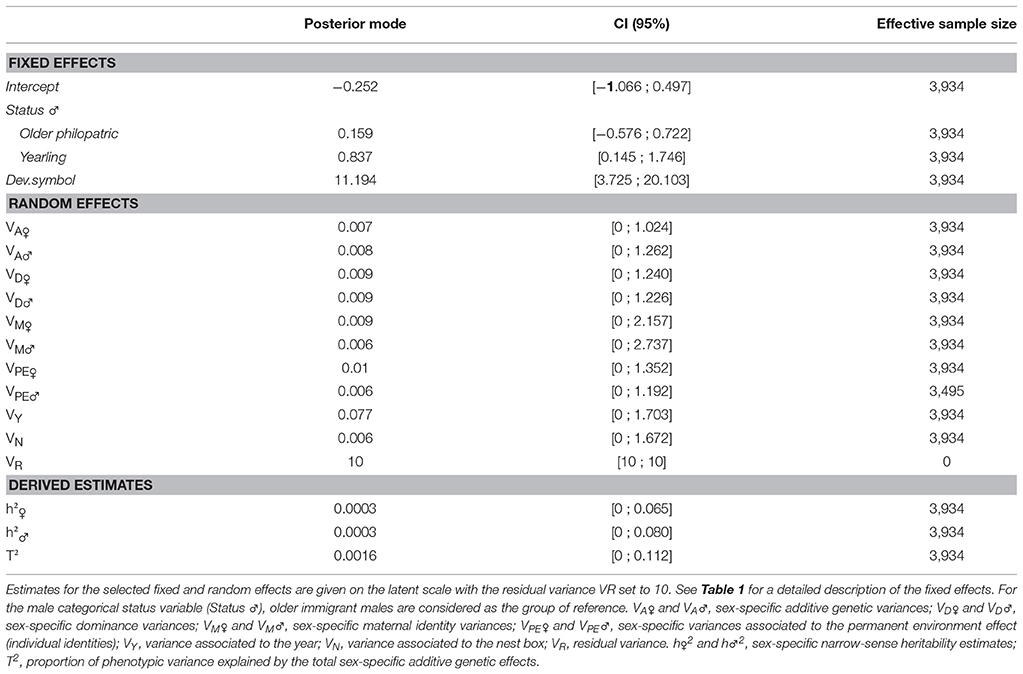
Table 3. Posterior modes and credible intervals of the final animal model fitting the probability to copy the tit preference.
A correction has been made to the Results section, sub-section “Age, Experience, and Environmental Effects on the Probability to Copy”:
Based on the animal model output, pairs including a yearling male were more likely to copy compared to pairs including an older immigrant male (56.0% of copying over the years, against 47.3% for pairs with an old immigrant male; 95% CI = [0.145; 1.746], Tables 2, 3, Figure 2). Pair experience with symbols, defined as whether both or one partner was naive or had experience with symbol choice had no effect on the probability to copy, even though we got a slight trend for mixed pair to reject tit preference (95% CI = [−2.064;0.174], Appendix S5).
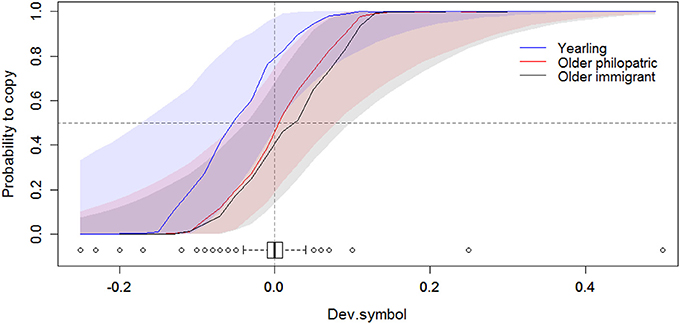
Figure 2. Relationship between the probability to copy and the deviation to an equal proportion of symbols on empty boxes (Dev.symbol, see Table 1) for the different male age and dispersal status (yearling/older immigrant/older philopatric). Positive values of Dev.symbol indicate a prevalence of empty nest boxes with the same symbol as the tit apparent preference. The posterior modes (solid lines) and their 95% Credible Intervals (shades) are given on the original scale, for pairs with a yearling male (in blue), an older philopatric male (in red), or an older immigrant male (in black). The vertical dashed line corresponds to an even proportion of triangles and circles on empty boxes on the day of flycatcher choice. The horizontal dashed line corresponds to a random choice (probability = 0.5). The boxplot represents the distribution of Dev.symbol. There was no interaction between Dev.symbol and the male experience status.
A correction has been made to the Results section, sub-section “Quantitative Genetics of the Probability to Copy”:
There was no cross-sex additive genetic covariance in the probability to copy (95% CI = [−0.024; 0.029] in the full model).
A correction has been made to the Appendix S3, S4, and S5, and the corrected file is available using the link provided hereafter.
The corrected Tables 3, 4, and Figures 2, 3 appear below.
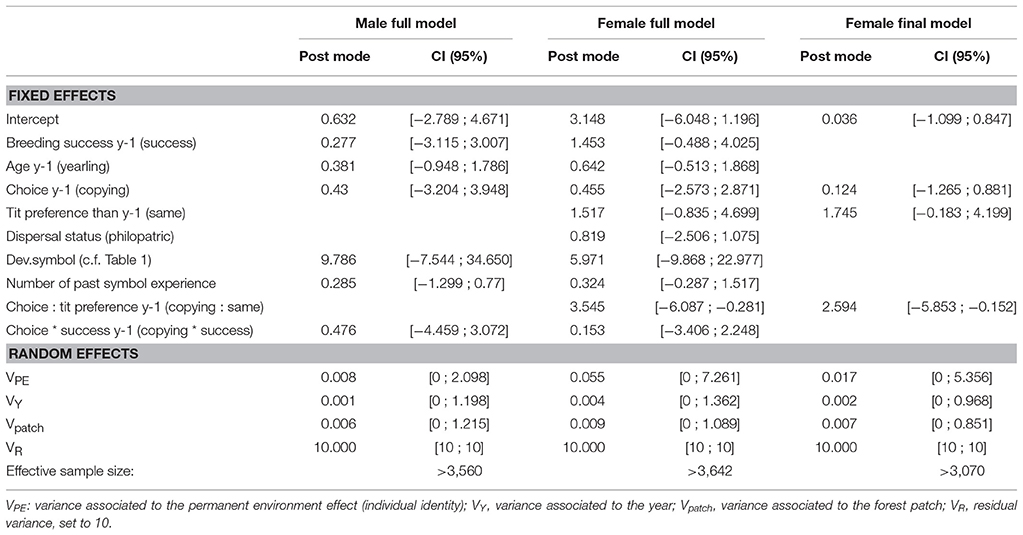
Table 4. Posterior modes and credible intervals of the model explaining the probability to copy in subsequent years.
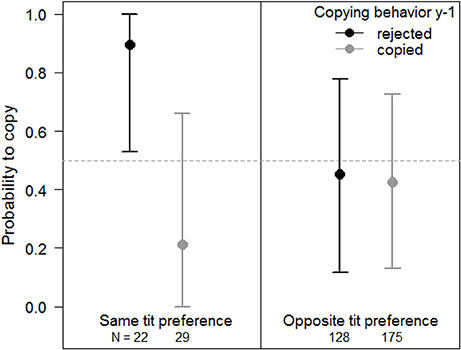
Figure 3. Female probability to copy in subsequent nest site choices, given previous copying behavior and the difference in exposure to the apparent tit preference compared to the previous year. Females were either exposed to the same (Left) or opposite (Right) apparent tit preference than the year before. Females that rejected (did not copy) the tit preference the year before are represented in black, and females that copied are represented in light gray. Posterior means and 95% CI are given on the original scale. The horizontal dashed line corresponds to a random choice (probability = 0.5). Sample sizes are given at the bottom of each panel. Sample sizes are higher for females exposed to the opposite tit preference because this situation corresponds to both the philopatric females and the females that dispersed to a patch with the opposite symbol.
The authors apologize for this error and state that this does not change the scientific conclusions of the article in any way.
The original article has been updated.
Author Contributions
JM re-conducted the analyses for the correction. JM drafted the correction. JM, JF, SK, LG, and BD revised and approved the correction.
Conflict of Interest Statement
The authors declare that the research was conducted in the absence of any commercial or financial relationships that could be construed as a potential conflict of interest.
Supplementary Material
The Supplementary Material for this article can be found online at: https://www.frontiersin.org/articles/10.3389/fevo.2018.00080/full#supplementary-material
Keywords: social information, breeding site selection, collared flycatcher, Ficedula albicollis, heritability, indirect genetic effects, quantitative genetics, past experience
Citation: Morinay J, Forsman JT, Kivelä SM, Gustafsson L and Doligez B (2018) Corrigendum: Heterospecific Nest Site Copying Behavior in a Wild Bird: Assessing the Influence of Genetics and Past Experience on a Joint Breeding Phenotype. Front. Ecol. Evol. 6:80. doi: 10.3389/fevo.2018.00080
Received: 01 March 2018; Accepted: 23 May 2018;
Published: 06 June 2018.
Edited by:
Deseada Parejo, Universidad de Extremadura, SpainReviewed by:
Michael P. Ward, University of Illinois at Urbana-Champaign, United StatesCopyright © 2018 Morinay, Forsman, Kivelä, Gustafsson and Doligez. This is an open-access article distributed under the terms of the Creative Commons Attribution License (CC BY). The use, distribution or reproduction in other forums is permitted, provided the original author(s) and the copyright owner are credited and that the original publication in this journal is cited, in accordance with accepted academic practice. No use, distribution or reproduction is permitted which does not comply with these terms.
*Correspondence: Jennifer Morinay, amVubmlmZXIubW9yaW5heUBnbWFpbC5jb20=