 Carolina Rodrigues da Costa Doria1*
 Edwin Agudelo2
 Alberto Akama3Bruno Barros1
 Mariana Bonfim4
 Laís Carneiro5
 Sylvio Romério Briglia-Ferreira6
 Lucélia Nobre Carvalho7
 César Augusto Bonilla-Castillo2
 Patricia Charvet5Dayana Tamiris Brito dos Santos Catâneo1Hugmar Pains da Silva8Carmen Rosa Garcia-Dávila9Hélio Daniel Beltrão dos Anjos10Fabrice Duponchelle11
 Andrea Encalada12,13Izaias Fernandes14
 Alexandro Cezar Florentino15Paula Carolina Paes Guarido16Tharles Lopes de Oliveira Guedes17
 Luz Jimenez-Segura18
 Oscar Miguel Lasso-Alcalá19
 Marc Ruben Macean20Elineide Eugênio Marques17Raimundo Nonato G. Mendes-Júnior21
 Guido Miranda-Chumacero22
 Jorge Luiz Silva Nunes20
 Thiago Vinícius Trento Occhi5Leonardo Silva Pereira23
 William Castro-Pulido2Lariessa Soares1Raniere Garcez Costa Sousa23Gislene Torrente-Vilara24Paul André Van Damme25
 Jansen Zuanon26
 Jean Ricardo Simões Vitule5
- 1Laboratory of Ichthyology and Fisheries, Federal University of Rondon̂ia, Porto Velho, Brazil
- 2Grupo de Ecosistemas Acuáticos, Instituto Amazónico de Investigaciones Científicas SINCHI, Leticia, Colombia
- 3Museu Paraense Emílio Goeldi, Belém, Brazil
- 4Department of Biology, Temple University, Philadelphia, PA, United States
- 5Laboratory of Ecology and Conservation, Technology Sector, Federal University of Paraná, Curitiba, Brazil
- 6Programa de Pós graduação em Recursos Naturais, Federal University of Roraima, Boa Vista, Brazil
- 7Laboratory of Tropical Ichthyology, Federal University of Mato Grosso, Sinop, Brazil
- 8Laboratory of Cytogenetics and Animal Genetics, Federal University of Mato Grosso, Cuiabá, Brazil
- 9Laboratorio de Biologia y Genetica Molecular, Instituto de Investigaciones de la Amazonia Peruana-IIAP, Iquitos, Perú
- 10Laboratory of Ichthyology, Federal University of Amazonas, Manaus, Brazil
- 11Institut de Recherche pour le Développement, MARBEC (Univ. Montpellier, CNRS, Ifremer, IRD), Montpellier, France
- 12College of Biological and Environmental Sciences, Quito, Ecuador
- 13Laboratory of Aquatic Ecology, BIOSFERA Research Institute, Universidad San Francisco de Quito, Quito, Ecuador
- 14Laboratory of Biodiversity and Conservation, Federal University of Rondon̂ia, Rolim de Moura, Brazil
- 15Environment Science Program (PPGCA), Federal University of Amapá, Macapá, Brazil
- 16Institutional Training Program (PCI), National Institute for Amazonian Research, Manaus, Brazil
- 17Environment Science Program (PPGCiamb), Federal University of Tocantins, Palmas, Brazil
- 18Laboratory of Aquatic Organisms, Instituto de Biologia, Universidad de Antioquia, Federal University of Maranhão, São Luís, Brazil
- 19Museo de Historia Natural La Salle, Fundación La Salle de Ciencias Naturales, Caracas, Venezuela
- 20Laboratory of Aquatic Organisms, Federal University of Maranhão, São Luís, Brazil
- 21Reserva Extrativista do Rio Cajari, Instituto Chico Mendes de Conservação da Biodiversidade, Macapá, Brazil
- 22Wildlife Conservation Society Program, La Paz, Bolivia
- 23Research Group in Fisheries, Aquaculture and Ecology of Fish in Inland Waters, Federal University of Rondon̂ia, Porto Velho, Brazil
- 24Instituto do Mar, Federal University of São Paulo, São Paulo, Brazil
- 25Asociación FAUNAGUA, Cochabamba, Bolivia
- 26Laboratory of Fish Systematics and Ecology, Biodiversity Department, National Institute for Amazonian Research, Manaus, Brazil
Non-native fish (NNF) can threaten megadiverse aquatic ecosystems throughout the planet, but limited information is available for the Amazon Region. In this study we review NNF data in the Amazonian macroregion using spatiotemporal records on the occurrence and the richness of NNF from a collaborative network of 35 regional experts, establishing the Amazon NNF database (ANNF). The NNF species richness was analyzed by river basin and by country, as well as the policies for each geopolitical division for the Amazon. The analysis included six countries (Brazil, Peru, Bolivia, Ecuador, Venezuela, and Colombia), together comprising more than 80% of the Amazon Region. A total of 1314 NNF occurrence records were gathered. The first record of NNF in this region was in 1939 and there has been a marked increase in the last 20 years (2000–2020), during which 75% of the records were observed. The highest number of localities with NNF occurrence records was observed for Colombia, followed by Brazil and Bolivia. The NNF records include 9 orders, 17 families and 41 species. Most of the NNF species are also used in aquaculture (12 species) and in the aquarium trade (12 species). The most frequent NNF detected were Arapaima gigas, Poecilia reticulata and Oreochromis niloticus. The current data highlight that there are few documented cases on NNF in the Amazon, their negative impacts and management strategies adopted. The occurrence of NNF in the Amazon Region represents a threat to native biodiversity that has been increasing “silently” due to the difficulties of large-scale sampling and low number of NNF species reported when compared to other South American regions. The adoption of effective management measures by decision-makers is urgently needed and their enforcement needed to change this alarming trend and help protect the Amazon’s native fish diversity.
Introduction
The current worldwide biodiversity crisis has been characterized by an unprecedented rate of species loss, introduction of non-native organisms, biological invasions and biotic homogenization (McGeoch and Jetz, 2019; Padial et al., 2020). At a global scale, species introductions are linked to drivers like aquaculture, aquarium trade, ballast water transfer, biofouling, and habitat modification (dams, canals or artificial waterways, urbanization and deforestation) (Wonham et al., 2000; Lasso-Alcalá et al., 2011; Davidson and Simkanin, 2012; Patoka et al., 2018; Doria et al., 2020), with impacts potentially increased by current climatic crisis (Li et al., 2016). In freshwater ecosystems, the intensity of human activity has been positively related to the number of non-native fish species (hereinafter NNF) (Leprieur et al., 2008), but the number of NNF are underestimated and increasing (i.e., Bezerra et al., 2019; Vitule et al., 2019). South America was indicated as one of the six freshwater fish global invasion hotspots of the world, with 5–20 NNF species recorded for the Paraná-Paraguay-Amazon river systems more than a decade ago (Casal, 2006; Leprieur et al., 2008). As expected, more papers have documented the presence of NNF, mainly in the southeastern South America, and considerably augmented the list of invasive fish species in this continent (Orsi and Agostinho, 1999; Méndez et al., 2012; Casimiro et al., 2015, 2018; Latini et al., 2016; Garcia et al., 2018; Gubiani et al., 2018).
The Amazon is one of the most biodiverse regions on the planet (Mittermeier et al., 1997). Traditional and indigenous communities still inhabit these lands and obtain their income mainly from artisanal fisheries, which are threatened by the advance of agricultural frontiers, dam construction, mining disturbances and environmental contamination (Doria et al., 2017; da Silva and Lima, 2020) and NNF invasions (Doria et al., 2020). In the present study, the term “Amazon Region” has been adopted considering this region as a whole, comprising independent neighboring basins (i.e., Orinoco and other rivers). In the Amazon Region (hereinafter Amazon) there are many evidences of increasing propagule pressure due to accidental NNF introductions through fish farming without effective escape barriers, or by river overflooding in fish farming areas (Carvajal-Vallejos et al., 2011; Van Damme et al., 2017; Doria et al., 2020). Introductions of NNF have clear negative impacts on native fish assemblages, leading to local species extinctions, reducing genetic diversity, causing loss of ecosystem functions, habitat disruption (Vitule, 2009; Cucherousset and Olden, 2011), and homogenization or differentiation (Toussaint et al., 2016b) at genetic, taxonomic, and functional levels (Olden et al., 2004). Also, NNF can cause socioeconomic impacts, compromising native fish markets and food sources for riverside communities (Villéger et al., 2011; Bezerra et al., 2018). Understanding spatial and temporal trends in NNF invasions is an important milestone for mitigating their negative impacts on biodiversity, especially in global biodiversity hotspots such as the Amazon.
Although there are many anecdotal, occasional and underestimated records of NNF and some of their impacts are well known for many regions, a comprehensive synthesis about the spatiotemporal trends in NNF occurrence records for the Amazon did not exist so far (da Silva and Silva-Forsberg, 2015). Despite the limited data availability, the potential risks for the diversity of native fish in this unique region are expected to add on to other established environmental disturbance drivers (Bittencourt et al., 2014; Guarido, 2014; da Silva and Silva-Forsberg, 2015; Padial et al., 2017; Brabo et al., 2015, 2017; Doria et al., 2020). The study of NNF negative impacts and biological invasions in hyperdiverse ecosystems, such as the Amazon, represents a new frontier in ecology and ecosystem management and will help understand the new era of biological reshuffling in aquatic ecosystems (Padial et al., 2020). In this sense, the historical occurrence records of NNF in the Amazon were compiled by country and sub-basin to infer about propagule pressures and colonization trends along a spatiotemporal scale. This study contributes to the understanding of the main processes, patterns and trends involved in NNF establishment and spreads in the Amazon.
The major aim of this paper is to present a pioneer Amazon NNF database (ANNF) and a scenario review analysis highlighting important aspects to be considered in NNF policies and management in this region.
Materials and Methods
A collaborative scientific network was established, comprising researchers from six countries that cover more than 80% of the Amazon Region. Research leaders from Bolivia, Brazil, Colombia, Peru, Ecuador and Venezuela gathered information on NNF from publications (in English, Portuguese and Spanish) and museum records (i.e., scientific peer-reviewed publications and books, gray literature, and unpublished data, such as field surveys databases and local biological collections with ID numbers) to build an up-to-date and unified database of NNF species occurrence records in the Amazon (ANNF - Supplementary Material 1).
Here, NNF was considered all species introduced intentionally or accidentally by humans into areas in which they did not naturally occur, i.e., exotic, alien, or non-indigenous species. The Amazon NNF database was constructed with the occurrences reported in the Amazon, following a drainage basin scale (see Venticinque et al., 2016 for basin definition) that presented spatiotemporal information (see methods in Supplementary Material 2). Ecological traits (i.e., trophic category and migratory behavior) and invasion vectors or pathways (i.e., aquaculture and aquarium trade) of the recorded NNF species were compiled from FishBase (Froese and Pauly, 2019) and used to identify major characteristics related to NNF in the Amazon (Supplementary Material 3).
In order to identify possible mechanisms to prevent, mitigate or manage the impacts of NNF, information concerning legal instruments and public policies related to management and control of non-native species were reviewed and compiled using geopolitical subdivisions for each of the six countries (see Supplementary Table 1). Due to the heterogeneous geopolitical subdivisions in the Amazon, the following units were adopted: states in Brazil, regions in Peru (i.e., the Selva Alta and Selva Baja), and country level for Bolivia, Ecuador and Colombia, totaling 13 operational regions. All the subsequent analyzes and comparisons were conducted according to those regions. Policies were categorized as described and non-described (i.e., presence or absence) considering topics related to NNF exploitation and environmental protection regulations, mainly for protected areas.
Spatial and temporal representations were applied to explore trends in NNF occurrence records and species richness (Vitule et al., 2021) using the basin scale (see methods in Supplementary Material 2).
Results
The compiled NNF database comprises 1,314 records of 41 species belonging to nine orders and 17 families. The most widespread NNF species were Arapaima gigas, Poecilia reticulata and Oreochromis niloticus, with 153, 82, and 47 locality records, respectively (Supplementary Materials 1, 3). The Madeira River sub-basin showed the highest NNF species richness and occurrence records density, followed by the Tocantins, Negro, and lowlands of the Amazon River sub-basins, with six species each (Figures 1A,B). The estimated NNF species richness per 100 km2 in each basin (Figure 1C) showed higher values at the Nanay and Napo basins, with 0.02 NNF species per unit area. On the country scale, Colombia presented the highest absolute NNF species richness, followed by Brazil and Bolivia (Figure 1D). The covariance analysis among sampling effort and NNF records showed no significant relationship (Supplementary Table 2).
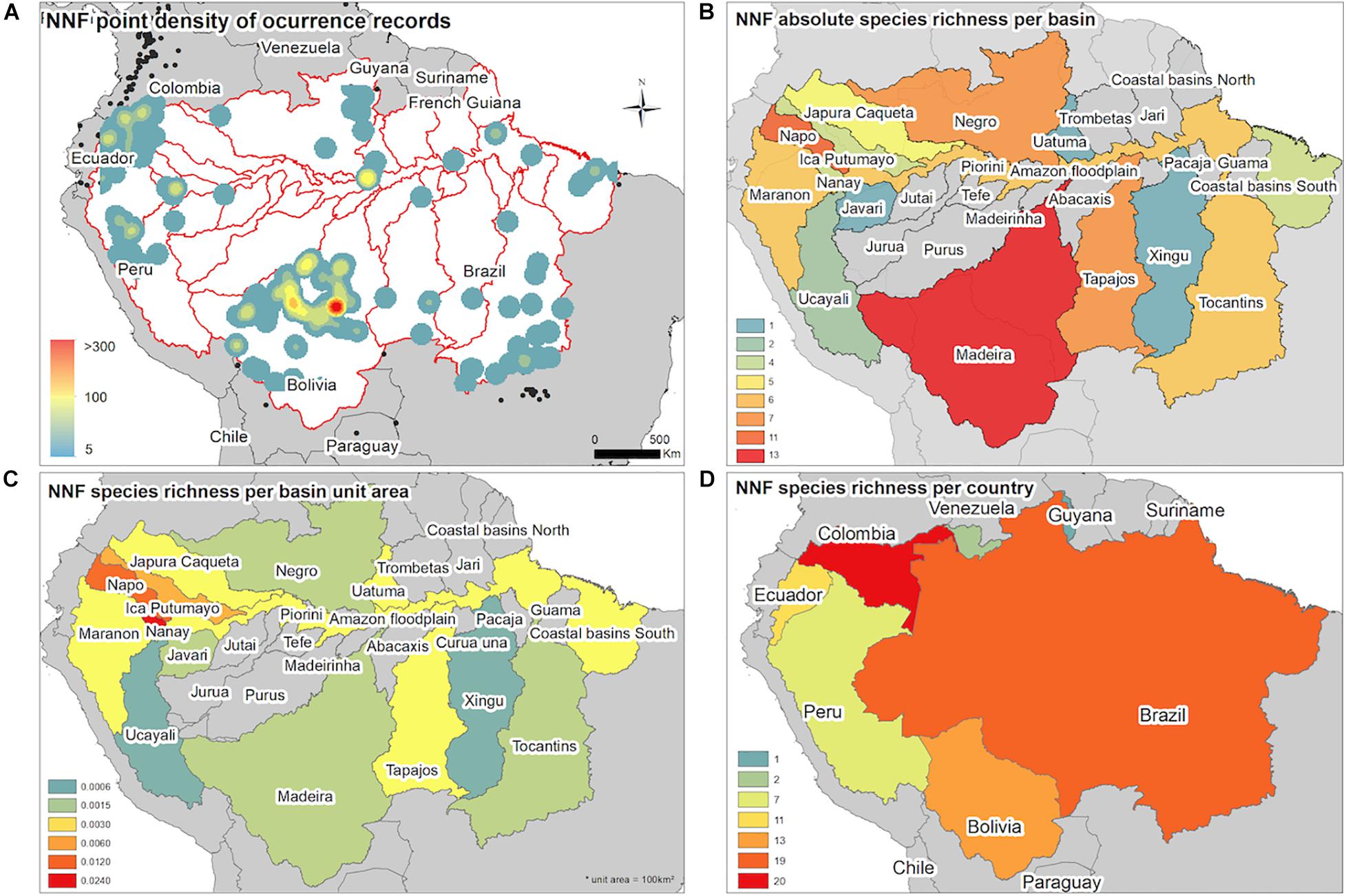
Figure 1. Geographical distribution of occurrence records of NNF in the Amazon (A) and richness per basin (B), richness per basin unit area (C), and per country (D), until 2020. The choropleth scale shows an increasing NNF richness, ranging from lower values indicated in blue to highest values indicated in red.
The NNF records by decade exhibited a constant increase for the countries altogether and within countries. The same fast increase pattern was observed at the watershed and sub-basin scales (Figures 2, 3). The main NNF introduction vectors identified from the literature search were aquarium trade (12 species) and aquaculture (12 species), followed by sport-recreational fishing and use as live bait (Supplementary Material 3). The trophic analysis showed that the majority of the NNF species in the Amazon were classified as omnivorous (19 species) or carnivorous (6 species). The reproductive characteristics of most NNF species showed multiple spawning seasons or year-round continuous cycles (12 species), with high fecundity (8 species), and without parental care (12 species); some taxa showed migratory behavior (9 species) (Supplementary Material 3). The first NNF record dated back to 1939 and there has been a marked increase in NNF species records in the last 20 years (2000–2020), a period during which 75% of the records were made (Figure 3).
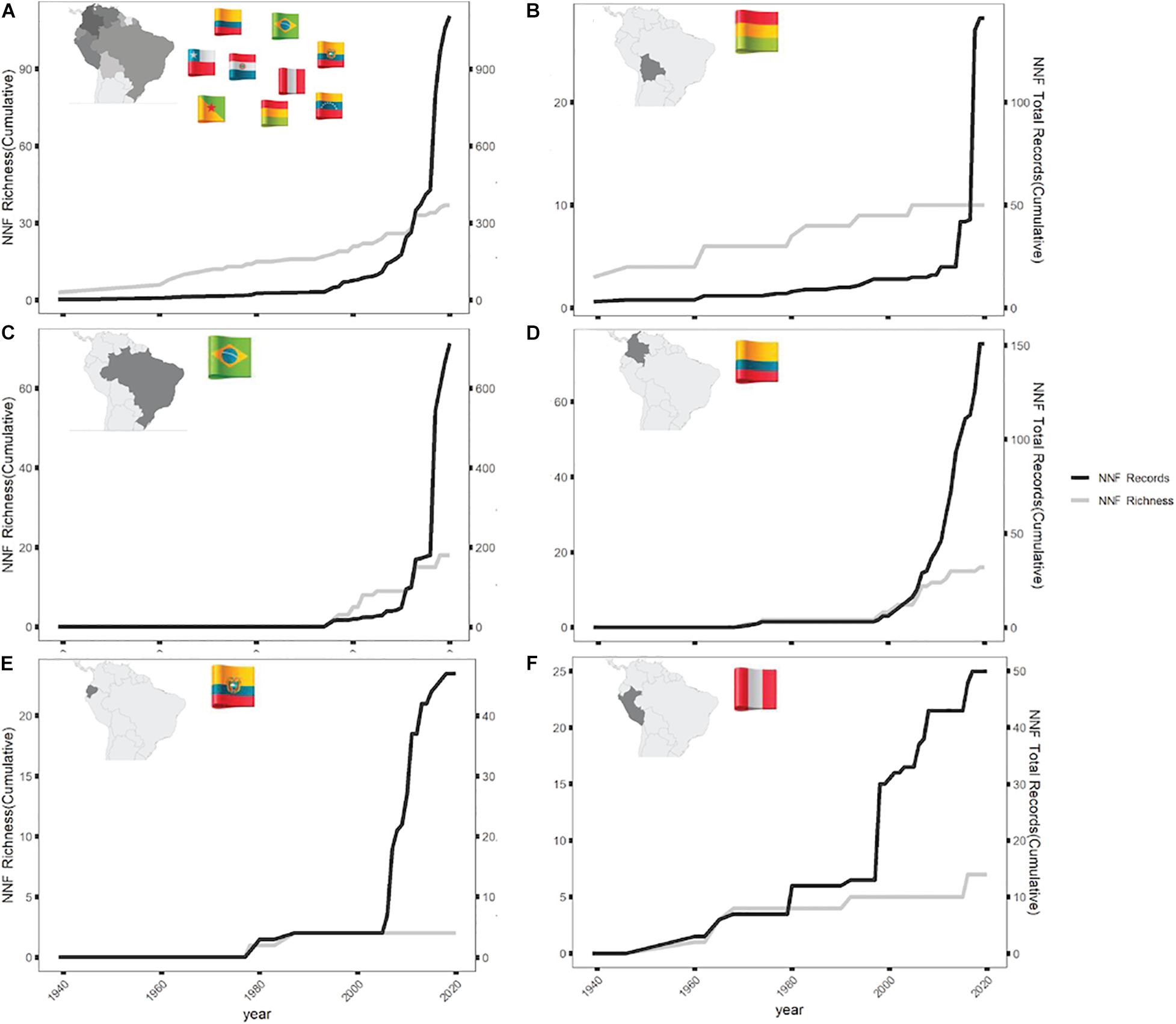
Figure 2. Cumulative curve of NNF records (black lines), first occurrence records (gray lines), and overall NNF richness in the region and split by each country, which shelters part of the Amazon Region. Flags represent the country information used to build each figure (A) All countries; (B) Bolivia; (C) Brazil; (D) Colombia; (E) Ecuador; (F) Peru. Please note that Y-axis are not at the same scale to avoid hindering exponential visual trends due to scaling effects of the data. NNF, Non-Native Fish.
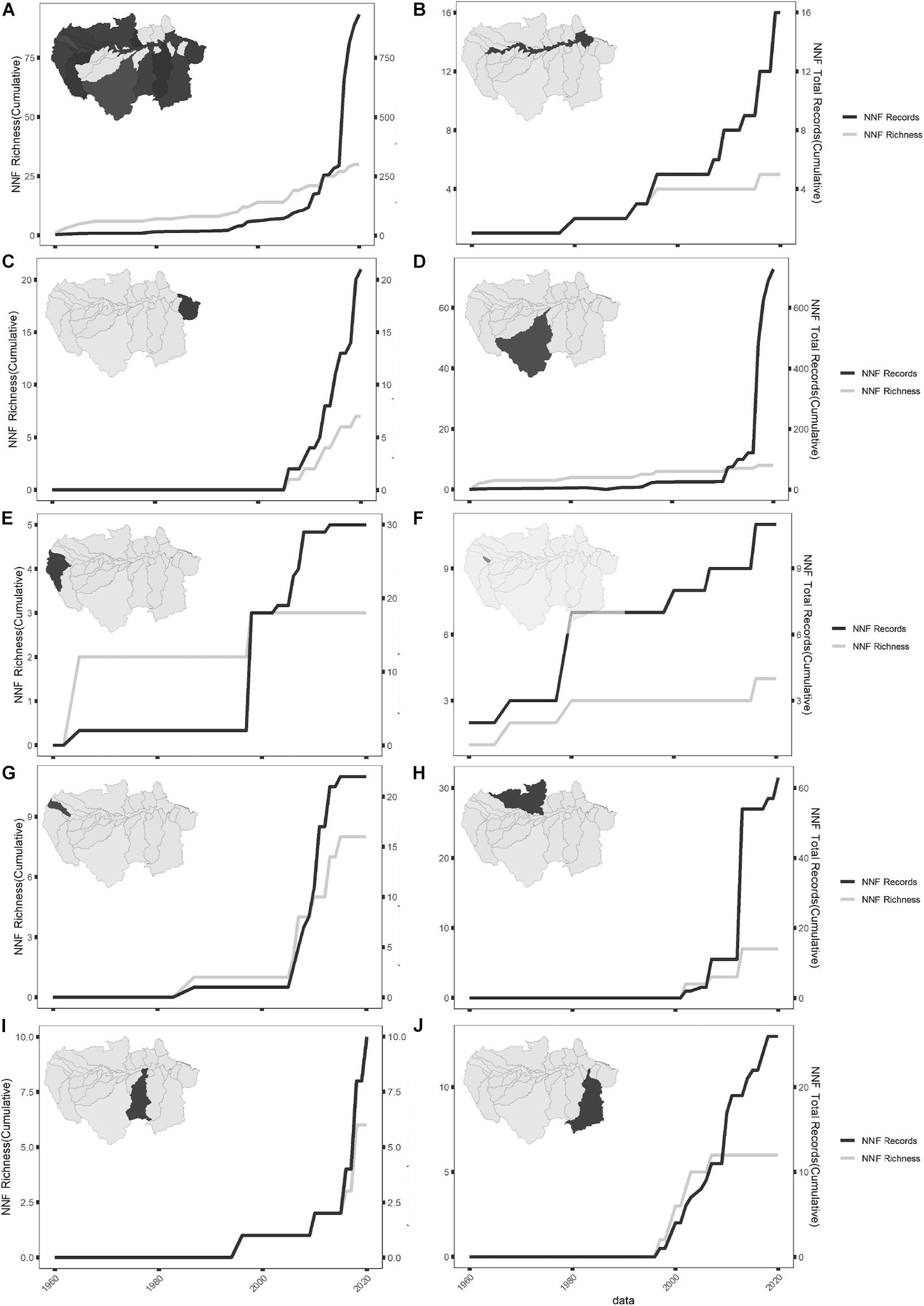
Figure 3. Cumulative curve of NNF records (black lines) and first occurrence record (gray lines), NNF richness in the Amazon region, considering the river subbasins and adjacent basins. Please note that Y-axis are not at the same scale to avoid hindering exponential visual trends due to scaling effects of the data. Legend: A—Amazon region; B—Amazon River; C—Amazon Estuary; D—Madeira River; E—Maranon River; F—Nanay River; G—Napo River; H—Negro River; I—Tapajós River; J—Tocantins River (Venticinque et al., 2016).
The current legislation on NNF in the Amazon showed that in seven out of 13 considered geopolitical regions there is some mention regarding these species (Supplementary Tables 1, 5). All these legal instruments do not allow intentional introduction of NNF in protected areas, but most of them (12), allow this practice outside protected areas and in nine of them specify containment strategies to be implemented. Only three regions recorded NNF negative impacts. The release of NNF in natural environments was cited as prohibited in 10 regions, and only in eight regions the regulation imposed a fine for illegal NNF farming. Despite the regulations, NNF introduction has been indirectly encouraged, mainly by strong incentives for fish farming to private companies. Several cases of NNF species purposely or accidentally introduced by fish farming in impacted urban streams were also recorded (Supplementary Table 3).
Only seven studies have reported freshwater and estuarine invasive fish species that have likely established stable populations in the Amazon and are impacting local biota and economy (Supplementary Table 4): four in Peru and three in Brazil. Only seven publications describe the impacts of invasions on native fish communities: five from Brazil, one from Peru, and one from Bolivia (Supplementary Table 4). The reported impacts caused by invasions were reduction on abundance of native species, changes on local fisheries composition, and introduction of parasites.
Discussion
Despite having the richest native freshwater fish diversity on the planet (Toussaint et al., 2016a) and great scientific interest, there is limited knowledge on non-native species introductions and invasions in the Amazon (Frehse et al., 2016), in particular regarding NNF (Vitule et al., 2019). Several recent studies on fish diversity conservation in South America and in the Amazon have underestimated or completely ignored (intentionally or not) the role of NNF as an existing and significant threat (i.e., Reis et al., 2016; Dagosta and de Pinna, 2019—but see discussion in Vitule et al., 2017; Bezerra et al., 2019). The most recent research pointed to 5 (Tedesco et al., 2017) and ∼18 (Gubiani et al., 2018; Jézéquel et al., 2020) NNF species recorded in the Amazon, while the present study unveiled more than twice as many NNF species in the region. This contrast in great part is due to species translocations, which generally are not taken into account, nor properly characterized (see Vitule et al., 2019). Therefore, when considering only fish species, a high colonization pressure level has been identified in South America, resulting in a large number of intra-country invasions, i.e., translocated species (i.e., Bezerra et al., 2019; Vitule et al., 2019). The temporal trend of NNF occurrences presented herein shows no signs of reaching an asymptote. Moreover, this trend also indicates a spatiotemporal increase in NNF records in the Amazon, corroborating studies from other biomes in Latin America. Vitule et al. (2021) showed similar increasing trends in the Atlantic Forest for other aquatic organisms (ranging from microscopic fungi, invertebrates and plants to large mammals), but NNF represent the group with most studies and occurrence records (i.e., Frehse et al., 2016; Bezerra et al., 2019; Vitule et al., 2021). These trends are of high concern in the Neotropical Region, mainly due to the high number and proportion of native endemic species and the increased risk of extinction caused by negative impacts of NNF introductions.
The database compiled for the present study is the first large scale and up to date compilation of NNF for the Amazon Region. The number of NNF species recorded (41) and of occurrence records (1,314) are warnings of the potential negative impacts that NNF can exert on the local and endemic Amazonian biota. Many of the NNF identified in this review have biological characteristics that favor establishing populations in new regions and/or invading new habitats (i.e., multiple spawning or continuous/year round reproduction, high fecundity, omnivorous diets, migratory behavior - Kolar and Lodge, 2002; Liang et al., 2020). The list of NNF species compiled here corresponded to 1.5% of the native valid species described for the Amazon (Dagosta and de Pinna, 2019—including the Tocantins-Araguaia River basin), but this number has been increasing fast. The temporal trends of NNF exhibited an exponential growth since the 2000s. The accumulation curves of Amazonian NNF keep rising, aligned with global trends for introduced biota (Seebens et al., 2018). However, for the Amazon, the major increase in NNF records occurred recently and may reflect a delayed awareness or recording of the presence of these non-native organisms (i.e., Vitule et al., 2021). Invasion biology as a research field only emerged in Brazil in the last 20 years (Frehse et al., 2016) and there seems to be a time lag between field data collection and the formal record of NNF occurrences. The number of NNF species is likely underestimated due to delay in publication or other factors limiting local studies (Bonfim et al., 2017). It is important to highlight that in all analyses conducted in this study, we have adopted conservative definitions (i.e., just considering introduced NNF species and ignoring species found in intermediate stages of the invasion process). This was largely due to the huge spatial scale of the present study and because most NNF have long been signalized as potential invaders. Moreover, large rivers positioned on the “deforestation arch” in Brazil (states of Pará, Tocantins, Mato Grosso and Rondônia) seem to be the portal for several NNF invasion events and other synergic environmental disturbances (i.e., Bezerra et al., 2019). Large-scale deforestation is a known gateway for agribusiness frontiers, mainly based on extensive monocultures and cattle ranching, frequently associating fish-farming initiatives using NNF species (Valenti et al., 2021). Furthermore, the natural biogeographic barriers deconstruction, such as reservoir construction over waterfalls and rapids stretches, and the establishment of new hydrological connections through artificial fish transposition systems and waterways (i.e., Vitule et al., 2012; Daga et al., 2019; Santos et al., 2019). In fact, fish farming represents important mechanisms that facilitate new fish species introductions in the Amazon, leading to direct negative ecological and, in some instances, socioeconomic impacts (i.e., Doria et al., 2020). While many factors may accelerate rates of NNF invasion and spread in many freshwater systems, it all converges to understanding local invasion dynamics and composition of non-native assemblage.
The high economic attractiveness and market demand stimulate the farming of some NNF species and increase the probability of unintentional introductions of escapees from fish tanks to the natural environment (i.e., propagule pressure). The “intensive use in aquaculture” is considered one of the main factors inducing exotic species establishment in freshwater environments (Liang et al., 2020) and have contributed to global ichthyofaunal homogenization (Olden et al., 2012; Toussaint et al., 2016a). The Amazon Region as considered here comprises nine countries, and despite all of them having recorded NNF for over 70 years, few or no effective actions to prevent new introductions and invasions were executed. The analysis of regulatory acts promoted by those countries suggests uneven policy distribution and inexistent or limited collaboration among amazonian governments to contain or mitigate the spread of non-native taxa. On the contrary, some countries have been incentivizing the farming of economically relevant NNF by private stakeholders (Supplementary Table 3). Analyzing regional policy implications can contribute to understanding local establishment and spread of NNF, and even its eventual naturalization, especially in cases where ecological processes alone are not sufficient to explain the observed temporal and spatial patterns.
Many political decisions regarding the use of natural resources threaten fish diversity in South America (i.e., Pelicice et al., 2017). Regulation gaps related to NNF species farming in the Amazon only add to unsuccessful introduction attempts and inspection limitations, expanding the possibilities for errors and further NNF escapes. The increase in the number of NNF records since 2000 seems to be intrinsically linked to the loosening of species farming regulations (Supplementary Material 2). Countries like Peru, Brazil and Colombia encourage fish farming business through financial benefits (i.e., tax breaks). Furthermore, NNF species have also been purposely or accidentally introduced by fish farmers in impacted urban streams (i.e., see Supplementary Table 2).
Regulations often protect NNF in detriment of native ichthyofauna (Ota et al., 2018; Geller et al., 2020), including NNF species naturalization for purposes of regularizing environmental impacts. One emblematic example is the naturalization of O. niloticus (Nile Tilapia) in Colombia (Resolution 2287/2015) that declared naturalized “some species of domesticated fish for the development of aquaculture, species that had been introduced in the national territory” (Colombia, 2015). The results indicated that Colombia has the highest number of invasive NNF species. There, the environmental authorities’ main efforts have been directed toward identifying and establishing NNF control actions. Meanwhile, the agricultural authorities have focused on declaring some of the most important NNF as naturalized species (i.e., Onchorhynchus mykiss, Cyprinus carpio, Coptodon rendalli, Oreochromis niloticus) by decree (sensu Pelicice et al., 2014) to increase their use in fish farms. Regardless of efforts to propose control plans for NNF in Colombia, practical measures have not yet been established by authorities. In the same way, in Peru, Nile Tilapia farming was legal and encouraged for several years in some regions of the country (i.e., San Martin Region). As a consequence, recently the Ministry of Production has been holding technical meetings to evaluate a Tilapia farming management plan for the Ucayali Region, using time and financial resources to mitigate the effects of irresponsible decisions made in the past.
Brazil fosters similar incentives of species naturalization processes (Pelicice et al., 2017). An attempt to naturalize the Nile Tilapia in Brazil was conducted by Congress Members under the strong influence of lobbyists from the fish net-tanks and fish food industry, as well as fish fry and matrices retailers (i.e., Pelicice et al., 2015; Padial et al., 2017). In the State of Rondônia, the farming of O. niloticus has been ongoing for at least two decades, without the mandatory registration in the State Environment Agency and without adequate State supervision (Soares et al., 2020). Inadequate management conditions in fish farms, associated with the seasonal Amazon flood regime effects, allow these species to escape to the natural environment, explaining their unwanted presence in various natural water bodies in the State of Rondônia (Soares et al., 2020). In the State of Tocantins, the Environment Regulatory Agency changed its regulation to allow net-tank farming of O. niloticus in hydroelectric and water supply reservoirs. In 2020, a national decree has encouraged the farming of the Nile Tilapia in Brazilian reservoirs throughout the country (Charvet et al., 2021). This kind of scenario is very contradictory considering that Brazil has thousands of native fish species, which could subsidize sustainable aquaculture conducted coherently and consistently according to sustainable ecological principles across the country (Pelicice et al., 2015; Padial et al., 2017; Bezerra et al., 2019).
Bolivia promulgated normatives as an intent to control the expansion of the invasive Arapaima gigas (paiche or pirarucu) in that region by prohibiting farming and transport of juveniles, and promoting control and management of the species in protected areas. In addition, three management plans were drafted in indigenous and traditional communities territories (TIOC Tacana I, TIOC Tacana II), and in a protected area (Manuripi Natural Wildlife Reserve). The spreading of A. gigas in Brazil is also of concern to the Rondônia State Environment Regulatory Agency. The invasion of this NNF in the upper Madeira River and the sudden increase in its abundance promoted changes in fishing rules. Based on scientific and local fishers knowledge, Rondônia’s Environmental Regulatory Agency allowed A. gigas fishing as a measure to contain its population increase in a region where previously it did not naturally occur (Doria et al., 2020). This situation is remarkable since the species is officially protected in Brazil and has its fishing prohibited in the Lower Madeira River where it naturally occurs. In the long term a tracking system to monitor range expansion of NNF species such as A. gigas should be encouraged, and future studies can build upon the information curated on the ANNF database. Overall, management actions implemented to reduce invasion impacts in the Amazon are limited, considering constraints in recognizing these impacts and actions taken by regional agencies. This may be related to the fact that interest in these species for fish farming was generated by local governments. In addition, the consequences of NNF introductions are neglected at the policy level (Liang et al., 2006; Patoka et al., 2020). There are gaps or limitations in the laws that should regulate the breeding and farming of these species in the Amazon, which certainly has facilitated NNF invasion speed (Pelicice et al., 2015).
Fish introductions have been changing and homogenizing freshwater fish communities worldwide (Vitule, 2009; Vitule et al., 2012; Toussaint et al., 2014, 2016b). This pressure exerted by invasive species is now getting recognized as a significant but “silent threat.” This is mainly due to the difficulty of large-scale sampling, resulting in data concentration in some areas and the existence of poorly studied regions, such as the Central Amazon (i.e., Jézéquel et al., 2020). Yet, the studies’ intensity and frequency in each site seems to be strongly related to accessibility, research interests and resources (Rosa et al., 2020). The presence of NNF has been observed in adjacent basins to the Central Amazon basin, such as in the Napo and Marañon river basins in Colombia, so even if not yet registered, it is likely that NNF occur in at least portions of those basins. In this sense, it is important to consider riverside, indigenous, and other traditional communities’ knowledge to better understand the local scale impacts and help identify cryptic invasion processes. In ecological terms, the high functional diversity of Amazon native fishes might provide some resistance or resilience against NNF invasions (i.e., Toussaint et al., 2016a; Vitule et al., 2017) due to functional overlapping at different scales (Peterson et al., 1998). The consequences of NNF invasions can be considered silent or invisible threats (i.e., Vitule, 2009) because their impacts are not immediately perceived, nor identifiable (i.e., native species loss may diminish ecological resilience of local assemblages, causing disturbance or disruption that will only be noted in the future). Areas with high deforestation rates increase ecosystem vulnerability to functional collapse by reducing ecological organization alternatives and therefore increasing species invasion chances (i.e., Leprieur et al., 2008; Bezerra et al., 2019). Also, NNF negative effects remain underexplored in the Amazon when compared to other environmental pressures, such as deforestation, forest fragmentation, hunting, river damming for hydropower, and fires (Lees et al., 2016; Sousa et al., 2018; Brando et al., 2020). However, it is well known that heavily impacted landscapes tend to be more susceptible and favor NNF establishment, mainly because native fish, in particular endemic species, are sensitive to habitat modifications and more vulnerable to predation and other negative biotic interactions (Johnson et al., 2008; Hermoso et al., 2011; Britton and Orsi, 2012).
The NNF impact on Amazonian ichthyofauna is gradually being recognized as compromising native species abundance, impacting local fisheries’ catch composition, and generating new parasitic infestations (Carvajal-Vallejos et al., 2017; Doria et al., 2020). When compared to river basins of more densely occupied regions of South America and of the Northern Hemisphere, the occurrence of NNF in the Amazon could mistakenly be considered of lower concern. However, the occurrence, spread and impacts of NNF in the Amazon has been continuously rising, putting at risk part of the most extraordinary freshwater fish fauna of the world. This risk is mainly due to the lack of dedicated policies and law enforcement, simultaneously associated with unsustainable policies that lead to fast expansion of NNF farming activities, and other regional anthropogenic impacts. Avoiding or containing the spread of invasive species requires combined efforts from all involved stakeholders, fom policy-makers and the scientific community, to fish farmers and final consumers. The remarkable recent NNF records increase in the Amazon is especially concerning because it amplifies propagule pressure, which can affect native communities biotic resistance to biological invasions (i.e., Von Holle and Simberloff, 2005). Even in biodiversity hotspots, such as the Amazon, the local biota might not be sufficiently resistant to provide biotic resilience to the establishment of NNF, if regulations are flexible and permissive. All evidence presented here reinforces the negative effects of NNF species to the Amazonian unique fish diversity and threatens food security and other biodiversity services for the generations to come.
Data Availability Statement
The raw data supporting the conclusions of this article will be made available by the authors, without undue reservation. The authors should be consulted for use of the ANNF database and any of the information it contains.
Author Contributions
CRCD and JRSV conceived, planned the research, and took the lead in writing the manuscript. TVTO, JZ, and LaC contributed to the data preparation, analyses and interpretation of the results. PC, MB, JZ, and GTV contributed to the review of the manuscript. All authors contributed to data and provided critical feedback, and helped shape the research, analysis, and manuscript.
Funding
WWF-Bolivia and WCS (Wildlife Conservation Society). TVTO thanks to the Brazilian National Research Council (CNPq) for the financial support (process 152236/2020-1). JZ received a productivity grant from CNPq (#313184/2014-7). CRCD received a productivity grant from CNPq (#305836/2020-0).
Conflict of Interest
The authors declare that the research was conducted in the absence of any commercial or financial relationships that could be construed as a potential conflict of interest.
The reviewer, FP, declared a past co-authorship with one of the authors, JRSV, to the handling editor.
Acknowledgments
The authors thank the AMAZONFISH Project (ERANet-LAC: ELAC2014/DCC-0210, www.amazon-fish.com) for providing important information regarding species distribution data and fish sampling effort by sub-basins, and Tiago H. S. Pires for helping with the sampling effort analysis. The Bolivian authors acknowledge the technical and financial support by the Peces para la Vida project (IDRC and Global Affairs, Canada).
Supplementary Material
The Supplementary Material for this article can be found online at: https://www.frontiersin.org/articles/10.3389/fevo.2021.646702/full#supplementary-material
Supplementary Table 1 | Review of regulations for exotic species farming in the Amazon. The regulations were summarized according to geopolitical divisions for each country (at federal level for Bolivia, Colombia and Ecuador, at state level for Brazil, and province level for Peru).
Supplementary Table 2 | Relation between sample effort (data from Jézéquel et al., 2020) and NNF records in Amazon Region (Ancova).
Supplementary Table 3 | Actions that promoted or allowed the invasion of non-native fishes in the studied sites.
Supplementary Table 4 | Published invasion recorded and related field impact.
Supplementary Table 5 | Current legislation on aquaculture, fisheries and environmental licensing by countries and states.
Supplementary Material 1 | Amazon Non-native Fish database (ANNF).
Supplementary Material 2 | Methodology details.
Supplementary Material 3 | Natural occurrence, introduction pathway, biological and ecological aspects of NNF introduced in aquatic systems of the Amazon region and native species transplanted to areas other than their natural distribution ∗(references).
Supplementary Material 4 | Tables.
References
Bezerra, L. A. V., Angelini, R., Vitule, J. R. S., Coll, M., and Sánchez-Botero, J. I. (2018). Food web changes associated with drought and invasive species in a tropical semiarid reservoir. Hydrobiologia 817, 475–489. doi: 10.1007/s10750-017-3432-8
Bezerra, L. A. V., Freitas, M. O., Daga, V. S., Occhi, T. V. T., Faria, L., Costa, A. P. L., et al. (2019). A network meta-analysis of threats to South American fish biodiversity. Fish Fish. 20, 620–639. doi: 10.1111/faf.12365
Bittencourt, L. S., Pinheiro, D. A., Cárdenas, M. Q., Fernandes, B. M., and Tavares-Dias, M. (2014). Parasites of native Cichlidae populations and invasive Oreochromis niloticus (Linnaeus, 1758) in tributary of Amazonas River (Brazil). Rev. Bras. Parasitol. Vet. 23, 44–54.
Bonfim, M., Martins, A. P. B., Coelho, de Carvalho, G. K. F., Magalhães Piorski, N., and Silva Nunes, J. L. (2017). Non-native mud sleeper Butis koilomatodon (Bleecker, 1849)(Perciformes: Eleotridae) in Eastern Amazon Coastal region: an additional occurrence for the Brazilian coast and urgency for ecological assessment. BioInvasions Rec. 6, 111–117. doi: 10.3391/bir.2017.6.2.04
Brabo, M. F., Brito, C. R., da Silva, Souza, G., Ferreira, P. F. G., Campelo, D. A. V., et al. (2017). Visão técnica da gestão ambiental da piscicultura no nordeste do estado do Pará/technical overview of the environmental management of fish farming in northeastern of Pará State. Acta Fish. Aquat. Res. 5, 11–18. doi: 10.2312/Actafish.2017.5.2.11-18
Brabo, M. F., Costa, M. M., Paixão, D. J. D. M. R., Costa, J. W. P., and Veras, G. C. (2015). Potencial invasor de tilápia (Oreochromis niloticus) em microbacias hidrográficas do Nordeste paraense. Amazônia:Magistra. 227–234.
Brando, P. M., Soares-Filho, B., Rodrigues, L., Assunção, A., Morton, D., Tuchschneider, D., et al. (2020). The gathering firestorm in Southern Amazonia. Sci. Adv. 6:eaay1632. doi: 10.1126/sciadv.aay1632
Britton, J. R., and Orsi, M. L. (2012). Non-native fish in aquaculture and sport fishing in Brazil: economic benefits versus risks to fish diversity in the upper River Paraná Basin. Rev. Fish Biol. Fish. 22, 555–565. doi: 10.1007/s11160-012-9254-x
Carvajal-Vallejos, F. M., Montellano, S. V., Lizarro, D., Villafán, S., Zeballos, A. J., and Van Damme, P. A. (2017). “La introducción del paiche (Arapaima gigas) en la Cuenca Amazónica boliviana y síntesis del conocimiento,” in Bases Técnicas para el Manejo y Aprovechamiento del Paiche (Arapaima gigas) en la Cuenca Amazónica Boliviana, eds F. M. Carvajal-Vallejos, R. Salas, J. Navia, J. Carolsfeld, and P. A. Van Damme (Ottawa, ON: IDRC), 21–42.
Carvajal-Vallejos, F. M., Van Damme, P. A., Cordova, L., and Coca, C. (2011). “La introducción de Arapaima gigas(paiche) en la Amazonía boliviana,” in Peces y Delfines de la Amazonía boliviana: Hábitats, potencialidades y amenazas, eds F. M. Carvajal-Vallejos, P. A. Van Damme, L. Cordova, and C. Coca (Cochabamba: Editorial INIA), 367–396.
Casal, C. M. V. (2006). Global documentation of fish introductions: the growing crisis and recommendations for action. Biol. Invasion. 8, 3–11. doi: 10.1007/s10530-005-0231-3
Casimiro, A. C. R., Garcia, D. A. Z., Vidotto-Magnoni, A. P., Britton, J. R., Agostinho, ÂA., Almeida, F. S. D., et al. (2018). Escapes of non-native fish from flooded aquaculture facilities: the case of Paranapanema River, southern Brazil. Zoologia 35, 1–6. doi: 10.3897/zoologia.35.e14638
Casimiro, A. C. R., Garcia, D. A. Z., Vidotto-Magnoni, A. P., Vitule, J. R. S., and Orsi, M. L. (2015). Biodiversity: is there light for native fish assemblages at the end of the Anthropocene tunnel? J. Fish Biol. 89, 48–49. doi: 10.1111/jfb.12847
Charvet, P., Occhi, T. V. T., Faria, L., Carvalho, B., Pedroso, C. R., Carneiro, L., et al. (2021). Tilapia farming threatens Brazil’s waters. Science 371, 356. doi: 10.1126/science.abg1346
Colombia (2015). Resolúcion n 22887 of December 2, 2015 Por la cual se Declaran Unas Especies de Peces Como Domesticadas Para el Desarrollo de la Acuicultura y se Dictan Otras Disposiciones. Bogotá: Autoridad Nacional de Aucuicutura y Pesca – AUNAP.
Cucherousset, J., and Olden, J. D. (2011). Ecological impacts of nonnative freshwater fishes. Fisheries 36, 215–230. doi: 10.1080/03632415.2011.574578
da Silva, A. F., and Silva-Forsberg, M. C. (2015). Espécies exóticas invasoras e seus riscos para a Amazônia Legal. Sci. Amaz. 4, 114–124.
da Silva, S. F., and Lima, M. O. (2020). Mercury in fish marketed in the amazon triple frontier and health risk assessment. Chemosphere 248:125989. doi: 10.1016/j.chemosphere.2020.125989
Daga, S. V., Azevedo-Santos, V. M., Pelicice, F. M., Fearnside, P. M., Perbiche-Neves, G., Paschoal, L. R. P., et al. (2019). Water diversion in Brazil threatens biodiversity. Ambio 49, 165–172. doi: 10.1007/s13280-019-01189-8
Dagosta, F. C. P., and de Pinna, M. (2019). The fishes of the amazon: distribution and biogeographical patterns, with a comprehensive list of species. Bull. Am. Mus. Nat. Hist. 431:163. doi: 10.1206/0003-0090.431.1.1
Davidson, I. C., and Simkanin, C. (2012). The biology of ballast water 25 years later. Biol. Invasion. 14, 9–13. doi: 10.1007/s10530-011-0056-1
Doria, C. R. C., Athayde, S., Marques, E. E., Lima, M. A. L., Dutka-Gianelli, J., Ruffino, M. L., et al. (2017). The invisibility of fisheries in the process of hydropower development across the Amazon. Ambio 47, 453–465. doi: 10.1007/s13280-017-0994-7
Doria, C. R. C., Catâneo, D. T. B. S., Torrente-Vilara, G., and Vitule, J. R. S. (2020). Is there a future for artisanal fishing in the Amazon? The case of Arapaima gigas. Manage. Biol. Invasion. 11, 1–8. doi: 10.3391/mbi.2020.11.1.01
Frehse, F. A., Braga, R. R., Nocera, G. A., and Vitule, J. R. S. (2016). Non-native species and invasion biology in a megadiverse country: scientometric analysis and ecological interactions in Brazil. Biol. Invasion. 18, 3713–3725. doi: 10.1007/s10530-016-1260-9
Froese, R., and Pauly, D. (2019). Coptodon Rendalli Boulenger, 1897. FishBase. Available online at: https://www.fishbase.de/summary/Coptodon-rendalli.html (Accessed May 15, 2020).
Garcia, D. A. Z., Britton, J. R., Vidotto-Magnoni, A. P., and Mário, L. O. (2018). Introductions of non-native fishes into a heavily modified river: rates, patterns and management issues in the Paranapanema River (Upper Paraná ecoregion, Brazil). Biol. Invasion. 20, 1229–1241. doi: 10.1007/s10530-017-1623-x
Geller, I. V., Garcia, D. A. Z., Casimiro, A. C. R., Pereira, A. D., Jarduli, L. R., Vitule, J. R. S., et al. (2020). Good intentions, but bad effects: environmental laws protects non-native ichthyofauna in Brazil. Fish. Manage. Ecol. 28, 1–4. doi: 10.1111/fme.12446
Guarido, P. C. P. (2014). Degradação Ambiental e Presença de Espécies de Peixes não Nativas em Pequenos Igarapés de Terra Firme de Manaus, Amazonas. Ph.D thesis. Manaus: Instituto Nacional de Pesquisas da Amazônia -INPA.
Gubiani, éA., Ruaro, R., Ribeiro, V. R., Eichelberger, A. C. A., Bogoni, R. F., Lira, A. D., et al. (2018). Non-native fish species in Neotropical freshwaters: how did they arrive, and where did they come from? Hydrobiologia 817, 57–69. doi: 10.1007/s10750-018-3617-9
Hermoso, V., Linke, S., Prenda, J., and Possingham, H. P. (2011). Addressing longitudinal connectivity in the systematic conservation planning of fresh waters. Freshw. Biol. 56, 57–70. doi: 10.1111/j.1365-2427.2009.02390.x
Jézéquel, C., Tedesco, P. A., Darwall, W., Dias, M. S., Frederico, R. G., Hidalgo, M., et al. (2020). Freshwater fish diversity hotspots for conservation priorities in the Amazon Basin. Conserv. Biol. 34, 956–965. doi: 10.1111/cobi.13466
Johnson, P. T., Olden, J. D., and Vander Zanden, M. J. (2008). Dam invaders: impoundments facilitate biological invasions into freshwaters. Front. Ecol. Environ. 6:357–363. doi: 10.1890/070156
Kolar, C. S., and Lodge, D. M. (2002). Ecological predictions and risk assessment for alien fishes in North America. Science 298, 1233–1236. doi: 10.1126/science.1075753
Lasso-Alcalá, O., Nunes, J. L. S., Lasso, C., Posada, J., Robertson, R., Piorski, N. M., et al. (2011). Invasion of the Indo-Pacific blenny Omobranchus punctatus (Perciformes: Blenniidae) on the Atlantic Coast of Central and South America. Neotrop. Ichthyol. 9, 571–578. doi: 10.1590/S1679-62252011000300010
Latini, A. O., Oporto, L. T., Lima-Junior, D. P., Resende, D. C., and Latini, R. (2016). “O Peixes,” in Espécies Exóticas Invasoras de Águas Continentais no Brasil, eds A. O. Latini, D. C. Resende, V. B. Pombo, and L. Coradin (Brasília: Ministério do Meio Ambiente), 295–649.
Lees, A. C., Peres, C. A., Fearnside, P. M., Schneider, M., and Zuanon, J. A. (2016). Hydropower and the future of Amazonian biodiversity. Biodivers. Conserv. 25, 451–466. doi: 10.1007/s10531-016-1072-3
Leprieur, F., Beauchard, O., Blanchet, S., Oberdorff, T., and Brosse, S. (2008). Fish invasions in the world’s river systems: when natural processes are blurred by human activities. PLoS Biol. 6:e28. doi: 10.1371/journal.pbio.0060028
Li, X., Liu, X., Kraus, F., Tingley, R., and Li, Y. (2016). Risk of biological invasions is concentrated in biodiversity hotspots. Front. Ecol. Environ. 14:411–417. doi: 10.1002/fee.1321
Liang, S. H., Chuang, L. C., and Chang, M. H. (2006). The pet trade as a source of invasive fish in Taiwan. Taiwania 51, 93–98. doi: 10.6165/tai.2006.51(2).93
Liang, S. H., Walther, B. A., and Shieh, B. S. (2020). Determinants of establishment success: comparing alien and native freshwater fishes in Taiwan. PLoS One 15:e0236427. doi: 10.1371/journal.pone.0236427
McGeoch, M., and Jetz, W. (2019). Measure and reduce the harm caused by biological invasions. One Earth 1, 171–174. doi: 10.1016/j.oneear.2019.10.003
Méndez, C., Rico López, G., Carvajal-Vallejos, F. M., Salas Peredo, R., Wojchiechowski, J. M., and Van Damme, P. (2012). Cadena de Valor Del Pescado en el Norte Amazónico de Bolivia: Contribución de Especies Nativas y de Una Especie Introducida (el Paiche-Arapaima gigas). Investigación Ambiental/Fundación PIEB. Available online at: https://idl-bnc-idrc.dspacedirect.org/bitstream/handle/10625/53643/IDL-53643.pdf?sequence=1&isAllowed=y (Accessed March, 15 2020).
Mittermeier, R. A., Mittermeier, C. G., Gil, P. R., and Wilson, E. O. (1997). Megadiversity: Earth’s Biologically Wealthiest Nations. San Pedro Garza García: CEMEX.
Olden, J. D., Kennard, M. J., and Pusey, B. J. (2012). A framework for hydrologic classification with a review of methodologies and applications in ecohydrology. Ecohydrology 5, 503–518. doi: 10.1002/eco.251
Olden, J. D., Poff, N. L., Douglas, M. R., Douglas, M. E., and Fausch, K. D. (2004). Ecological and evolutionary consequences of biotic homogenization. Trends Ecol. Evol. 19, 18–24. doi: 10.1016/j.tree.2003.09.010
Orsi, M. L., and Agostinho, A. A. (1999). Introdução de espécies de peixes por escapes acidentais de tanques de cultivo em rios da bacia do rio paraná. Brasil. Rev. Bras. Zool. 16, 557–560. doi: 10.1590/S0101-81751999000200020
Ota, R. R., Deprá, G. D. C., Graça, W. J. D., and Pavanelli, C. S. (2018). Peixes da planície de inundação do alto rio Paraná e áreas adjacentes: revised, annotated and updated. Neotrop. Ichthyol. 16:e170094. doi: 10.1590/1982-0224-20170094
Padial, A. A., Agostinho, A. A., Azevedo-Santos, V. M., Frehse, F. A., Lima-Junior, D. P., Magalhães, A. L. B., et al. (2017). The “Tilapia Law” encouraging non-native fish threatens Amazonian river basins. Biodivers. Conserv. 26, 243–246. doi: 10.1007/s10531-016-1229-0
Padial, A. A., Vitule, J. R. S., and Olden, J. D. (2020). Preface: aquatic homogenocene—understanding the era of biological re-shuffling in aquatic ecosystems. Hydrobiologia 847, 3705–3709. doi: 10.1007/s10750-020-04413-9
Patoka, J., Magalhães, A. L. B., Kouba, A., Faulkes, Z., Jerikho, R., and Vitule, J. R. S. (2018). Invasive aquatic pets: failed policies increase risks of harmful invasions. Biodivers. Conserv. 27, 3037–3046. doi: 10.1007/s10531-018-1581-3
Patoka, J., Takdir, M., Aryadi, H., Jerikho, R., Nilawati, J., Tantu, F. Y., et al. (2020). Two species of illegal South American sailfin catfish of the genus Pterygoplichthys well-established in Indonesia. Knowl. Manag. Aquat. Ecosyst. 421:28. doi: 10.1051/kmae/2020021
Pelicice, F. M., Azevedo-Santos, V. M., Vitule, J. R. S., Orsi, M. L., Lima Junior, D. P., Magalhães, A. L. B., et al. (2017). Neotropical freshwater fishes imperilled by unsustainable policies. Fish Fish. 18, 1119–1133. doi: 10.1111/faf.12228
Pelicice, F. M., Latini, J. D., and Agostinho, A. A. (2015). Fish fauna disassembly after the introduction of a voracious predator: main drivers and the role of the invader’s demography. Hydrobiologia 746, 271–283. doi: 10.1007/s10750-014-1911-8
Pelicice, F. M., Vitule, J. R. S., Lima Junior, D. P., Orsi, M. L., and Agostinho, A. A. (2014). A serious new threat to Brazilian freshwater ecosystems: the naturalization of nonnative fish by decree: naturalization of nonnative fish by decree. Conserv. Lett. 7, 55–60. doi: 10.1111/conl.12029
Peterson, G., Allen, C., and Holling, C. (1998). Ecological resilience, biodiversity, and scale. Ecosystems 1, 6–18. doi: 10.1007/s100219900002
Reis, R. E., Albert, J. S., Di Dario, F., Mincarone, M. M., Petry, P., and Rocha, L. A. (2016). Fish biodiversity and conservation in South America. J. Fish Biol. 89, 12–47. doi: 10.1111/jfb.13016
Rosa, C. A. D., Ribeiro, B. R., Bejarano, V., Puertas, F. H., Bocchiglieri, A., Barbosa, A. L. D. S., et al. (2020). Neotropical alien mammals: a data set of occurrence and abundance of alien mammals in the Neotropics. Ecology 101:e03115. doi: 10.1002/ecy.3115
Santos, D. A., de Paiva Affonso, I., Message, H. J., Okada, E. K., Gomes, L. C., Bornatowski, H., et al. (2019). Societal perception, impacts and judgment values about invasive freshwater stingrays. Biol. Invasion. 21, 3593–3606. doi: 10.1007/s10530-019-02071-0
Seebens, H., Blackburn, T. M., Dyer, E. E., Genovesi, P., Hulme, P. E., Jeschke, J. M., et al. (2018). Global rise in emerging alien species results from increased accessibility of new source pools. Proc. Natl. Acad. Sci. U.S.A. 115:201719429. doi: 10.1073/pnas.1719429115
Soares, L., Cavali, J., Vitule, J. R. S., and Doria, C. R. C. (2020). Ciência cidadã como forma de identificação de ocorrência de espécies não nativas na Amazônia. South American J. Bas. Edu. Tech. Technol. 7, 145–159.
Sousa, R. G. C. S., Mereles, M. A., Siqueira-Souza, F. K., Hurd, L. E., and Freitas, C. E. C. (2018). Small dams for aquaculture negatively impact fishdiversity in Amazonian streams. Aquacult. Environ. Interact. 10, 89–98. doi: 10.3354/aei00253
Tedesco, P. A., Beauchard, O., Bigorne, R., Blanchet, S., Buisson, L., Conti, L., et al. (2017). A global database on freshwater fish species occurrence in drainage basins. Sci. Data 4, 1–6. doi: 10.1038/sdata.2017.141
Toussaint, A., Beauchard, O., Oberdorff, T., Brosse, S., and Villéger, S. (2014). Historical assemblage distinctiveness and the introduction of widespread non-native species explain worldwide changes in freshwater fish taxonomic dissimilarity. Glob. Ecol. Biogeogr. 23, 574–584. doi: 10.1111/geb.12141
Toussaint, A., Beauchard, O., Oberdorff, T., Brosse, S., and Villéger, S. (2016a). Worldwide freshwater fish homogenization is driven by a few widespread non-native species. Biol. Invasion. 18, 1295–1304. doi: 10.1007/s10530-016-1067-8
Toussaint, A., Charpin, N., Brosse, S., and Villéger, S. (2016b). Global functional diversity of freshwater fish is concentrated in the Neotropics while functional vulnerability is widespread. Sci. Rep. 6:22125. doi: 10.1038/srep22125
Valenti, W. C., Barros, H. P., Moraes-Valenti, P., Bueno, G. W., and Cavalli, R. O. (2021). Aquaculture in Brazil: past, present and future. Aquac. Rep. 19:100611. doi: 10.1016/j.aqrep.2021.100611
Van Damme, P. A., Coca-Méndez, C., Córdova, L., Carvajal-Vallejos, F. M., and Carolsfeld, J. (2017). “La expansion del paiche (Arapaima gigas) (Osteoglossiformes: Arapaimidae) en la Amazonía boliviana,” in Bases Técnicas Para El Manejo Y Aprovechamiento Del Paiche (Arapaima gigas) En La Cuenca Amazónica Boliviana, ed. F. M. Carvajal-Vallejos, R. Salas, J. Navia, J. Carolsfeld, and P. A. Van Damme (Santa Cruz de la Sierra: INIAF), 43–58.
Venticinque, E. M., Forsberg, B. R., Barthem, R. B., Petry, P., Hess, L. L., Mercado, A., et al. (2016). An explicit GIS-based river basin framework for aquatic ecosystem conservation in the Amazon. Earth Syst. Sci. Data 8, 651–661. doi: 10.5194/essd-8-651-2016
Villéger, S., Novack-Gottshall, P. M., and Mouillot, D. (2011). The multidimensionality of the niche reveals functional diversity changes in benthic marine biotas across geological time. Ecol. Lett. 14, 561–568. doi: 10.1111/j.1461-0248.2011.01618.x
Vitule, J. R. S., da Costa, A. P. L., Frehse, F. A., Bezerra, L. A. V., Occhi, T. V. T., Daga, V. S., et al. (2017). Comment on ‘Fish biodiversity and conservation in South America by Reis et al. (2016)’. J. Fish Biol. 90, 1182–1190. doi: 10.1111/jfb.13239
Vitule, J. (2009). Introdução de peixes em ecossistemas continentais brasileiros: revisão, comentários e sugestões de ações contra o inimigo quase invisível. NBC 4, 111–122. doi: 10.4013/nbc.2009.42.07
Vitule, J. R. S., Occhi, T. V. T., Carneiro, L., Daga, V. S., Frehse, F. A., Bezerra, L. A. V., et al. (2021). “Non-native Species Introductions, Invasions, and Biotic Homogenization in the Atlantic Forest,” in The Atlantic Forest, eds M. C. M. Marques and C. E. V. Grelle (New York, NY: Springer International Publishing), 269–295. doi: 10.1007/978-3-030-55322-7_13
Vitule, J. R. S., Occhi, T. V. T., Kang, B., Matsuzaki, S., Bezerra, L. A., Daga, V. S., et al. (2019). Intra-country introductions unraveling global hotspots of alien fish species. Biodivers. Conserv. 28, 3037–3043. doi: 10.1007/s10531-019-01815-7
Vitule, J. R. S., Skóra, F., and Abilhoa, V. (2012). Homogenization of freshwater fish faunas after the elimination of a natural barrier by a dam in Neotropics. Divers. Distrib. 18, 111–120. doi: 10.1111/j.1472-4642.2011.00821.x
Von Holle, B., and Simberloff, D. (2005). Ecological resistance to biological invasion overwhelmed by propagule pressure. Ecology 86, 3212–3218. doi: 10.1890/05-0427
Keywords: biological invasions, invasive alien species, freshwater ecosystems, escapes, colonization success, propagule pressure
Citation: Doria CRdC, Agudelo E, Akama A, Barros B, Bonfim M, Carneiro L, Briglia-Ferreira SR, Nobre Carvalho L, Bonilla-Castillo CA, Charvet P, dos Santos Catâneo DTB, da Silva HP, Garcia-Dávila CR, dos Anjos HDB, Duponchelle F, Encalada A, Fernandes I, Florentino AC, Guarido PCP, de Oliveira Guedes TL, Jimenez-Segura L, Lasso-Alcalá OM, Macean MR, Marques EE, Mendes-Júnior RNG, Miranda-Chumacero G, Nunes JLS, Occhi TVT, Pereira LS, Castro-Pulido W, Soares L, Sousa RGC, Torrente-Vilara G, Van Damme PA, Zuanon J and Vitule JRS (2021) The Silent Threat of Non-native Fish in the Amazon: ANNF Database and Review. Front. Ecol. Evol. 9:646702. doi: 10.3389/fevo.2021.646702
Received: 27 December 2020; Accepted: 29 April 2021;
Published: 10 June 2021.
Edited by:
Lawrence Hurd, Washington and Lee University, United StatesReviewed by:
Pablo Tedesco, IRD UMR253 Evolution and Diversité Biologique, FranceFernando Mayer Pelicice, Federal University of Tocantins, Brazil
Copyright © 2021 Doria, Agudelo, Akama, Barros, Bonfim, Carneiro, Briglia-Ferreira, Nobre Carvalho, Bonilla-Castillo, Charvet, dos Santos Catâneo, da Silva, Garcia-Dávila, dos Anjos, Duponchelle, Encalada, Fernandes, Florentino, Guarido, de Oliveira Guedes, Jimenez-Segura, Lasso-Alcalá, Macean, Marques, Mendes-Júnior, Miranda-Chumacero, Nunes, Occhi, Pereira, Castro-Pulido, Soares, Sousa, Torrente-Vilara, Van Damme, Zuanon and Vitule. This is an open-access article distributed under the terms of the Creative Commons Attribution License (CC BY). The use, distribution or reproduction in other forums is permitted, provided the original author(s) and the copyright owner(s) are credited and that the original publication in this journal is cited, in accordance with accepted academic practice. No use, distribution or reproduction is permitted which does not comply with these terms.
*Correspondence: Carolina Rodrigues da Costa Doria, Y2Fyb2xpbmFyY2RvcmlhQHVuaXIuYnI=