Abstract
Estimating the value of ecosystem services (ES) helps inform policies, development programs, and promote sustainable use and management of forest resources. The Western Ghats—a global biodiversity hotspot in southern India—contribute significantly to the well-being of Indigenous and local communities (IPLCs) by providing a range of ES. In this paper, we aim to assess the value of ES from the Western Ghats, applying IPLCs perspectives, to inform policy decision-making for understanding their role in people’s well-being. We estimate the value of ES applying various monetary (e.g., direct cost using production function) and non-monetary (e.g., revealed preferences using replacement or travel cost) valuation methods. The main ES include provisioning services—Non-Timber Forest Products and water; regulating services—soil erosion prevention and carbon sequestration; and cultural services. The estimated economic value of ES, at US$ 612 million (2021 values), suggests that conserving Ghat’s ecosystems is vital for supporting tribal peoples’ well-being, delivering ES to the mainstream population, and for protecting biodiversity. To date, lack of such understanding has often led to development programs that largely omit natural resources and tribal well-being connections. This study can inform future policies by offering a better and in-depth understanding of the role of ES in supporting Indigenous well-being, and underlines Ghat’s economic importance for non-marketable values which are often ignored for policy decision-making. Understanding these values will help the policy-makers to integrate the role of ES in policy planning, and design suitable development and conservation programs that protect a diverse range of ecosystems in the Western Ghats and elsewhere as well as support the sustainable living of many IPLCs/Adivasi communities across the globe.
1. Introduction
Natural resources and their Ecosystem Services (ES), defined as the benefits (goods and services) people derive from natural systems (following the Millennium Ecosystem Assessment, 2005), are the foundation of life on earth as advocated by many. Our survival on planet earth depends upon the state of natural ecosystems and their ES that fulfill our basic needs, such as good air to breathe, water to drink, and food to eat—essential yet irreplaceable for supporting human life on earth (MA, 2005; DasGupta, 2020). The ES concept became popular after the United Nations led the MA program (2000–2005), and it is the first one of its kind for linking natural systems with human well-being (for details, see Costanza et al., 1997, 2017; Daily, 1997; Sangha, 2007; Fisher et al., 2009; de Groot et al., 2010). The ES term is later simplified as Nature’s Contributions to People (NCPs), and the MA program is followed by the Intergovernmental Platform on Biodiversity and Ecosystem Services (IPBES), which has published several seminal reports highlighting various links between ES and human well-being (Intergovernmental Platform on Biodiversity and Ecosystem Services (IPBES), 2019, 2023).
Understanding and evaluating these ES and people’s well-being links are particularly important for Indigenous Peoples and Local Communities (IPLCs) who have maintained such connections with nature, for their livelihoods and well-being that are directly linked to the state of natural systems—in contrast to many mainstream communities who live in isolation from nature (Sangha et al., 2015, 2018; Sangha and Russell-Smith, 2017; Dawson et al., 2021; Das et al., 2022). In this paper, we explore these connections between a unique and highly biodiverse landscape, the Western Ghats, and the Indigenous peoples living within that landscape, called “Adivasis” (Indian term for Indigenous/tribal, meaning the original inhabitants). We first describe the landscape to portray the Western Ghat’s natural settings, its global significance, the geographically vast expanse and unique flora and fauna, and its socio-ecological context, followed by the application of the ES approach which helps to integrate and assess both monetary (marketable) and non-monetary (non-marketable) values. Our aim is to highlight the importance of Western Ghats in supporting the well-being of Adivasi communities and to inform policy decision-making for future Adivasi Development as well as Conservation-related programs.
The Western Ghats in India (along with the island of Sri Lank) comprise one of the world’s 36 biodiversity hotspots that spread over six states1 covering an area of around 164,280 km2, over a distance of 1,500 km (Ministry of Environment and Forest (MoEF), 2013; Srivathsa et al., 2019; Figure 1). The Ghats were declared a world heritage by UNESCO in 2012 for their exceptionally high level of biological diversity and endemism. A significant feature of the Western Ghats is that they are recognized among the world’s eight “hottest hotspots” of biological diversity, harboring 27 National Parks (five in Karnataka) and 160 Wildlife Sanctuaries (23 in Karnataka alone; http://wiienvis.nic.in/Database/wls_8230.aspx). These Ghats are home to around 6,500 flora and fauna species with a high degree of endemism, including 4,600 species of flowering plants (38% endemic), 330 butterflies (11% endemic), 156 reptiles (62% endemic), 508 birds (4% endemic), 120 mammals (12% endemic), 289 fish (41% endemic), and 135 amphibians (75% endemic; Ministry of Environment and Forest (MoEF), 2013; Ramachandra and Bharath, 2019).
Figure 1

Western Ghats study areas in the Indian state of Karnataka.
The Western Ghats forests provide a myriad of ES to the local, regional, and global communities. At a local scale, the Ghats are a source of livelihoods and well-being for many “Adivasi” and local communities who mostly live either in proximity or within the Ghats. Adivasi and locals produce many non-timber forest and agricultural products for cash and non-cash crops, such as coffee, pepper, nuts, honey, coconut, rubber, tapioca, potato, and millets. The Ghats are a major source of water for south India with 37 rivers (Dudani et al., 2011), main ones include Kaveri, Krishna, Godavari, Thamaraparani, and Thungabhadra (Ministry of Environment and Forest (MoEF), 2011). They provide water for drinking in many cities, such as Bangalore, Mysore, Coimbatore, Tiruchirappalli, Thanjavur, Thrissur, and Palakkad; for agriculture in rural areas; and for industrial purposes. Gadgil (2014) estimated that about 245 million people receive water for drinking, irrigation, and commercial purpose from the Ghats. Major forest products such as teak wood, timber wood, pulpwood production, and tourism also afford significant revenues for the local governments.
Internationally, the Western Ghats are renowned for their unique biodiversity, with a high level of endemism, and nationally 60% area of the Ghats represent a living cultural landscape, meaning people have dominated the landscape with special relationships, including human settlement, religious and spiritual connections, and usage for agriculture (Ministry of Environment and Forest (MoEF), 2013). The rest 40 per cent of the area represents a natural landscape, particularly 37% supporting rich biological resources listed under Protected Areas. The Ghats offer several charismatic tourist attractions and are treasured for biodiversity, unique fauna and flora, mountainous ranges, sacred and spiritual places, and the esthetic beauty of the landscape [Ministry of Environment and Forest (MoEF), 2011; Gadgil, 2014].
Many Adivasi communities reside within the Western Ghats: mainly, Soligas, Adiyan, Barda, Bhil, Dubla, Malasar, Maratha, Toda, and Siddi communities in Karnatka; Karda, Koraga, Adiyan, Irula, Malasar, and Kattunayaka in Kerala; and Toda, Kota, Irular, Kattunayaka, Paniyan, and others in Tamil Nadu. They are highly dependent on the forests and sacred groves for their cultural activities, medicinal plants, livelihoods, and regulating services, especially pollination for honey production (Blicharska et al., 2013; Balasubramanian, 2019). On contrary, the Adivasi communities play an important role in conserving and managing forests by applying their traditional knowledge (Salafsky and Wollenberg, 2000; Bhagwat et al., 2005; Godbole et al., 2011). For local and Adivasi communities, the Western Ghats support almost every aspect of their well-being, well beyond their livelihoods. These communities are the original inhabitants of the Western Ghats who have evolved their practices and knowledge over millennia (Gadgil, 2014; Balasubramanian and Sangha, 2021). This study aims to understand and evaluate the people-landscape connections and the role that Adivasi people have played in managing the Western Ghats, applying the ES lens.
Assessing and understanding the value of ES delivered from the Western Ghats are critical to support Adivasi communities to continue applying their traditional practices that have helped them to sustain natural resources as well as their livelihoods in the region. Mainly due to sustainable use and maintenance of the Ghats by the tribal people over millennia the Ghats now afford ES for millions of people in the region, particularly for provisioning water, good air, and food. We assess the ES values of the Western Ghats using the on-ground socio-economic and ecological data, as well as from a wider public perspective. Our aim is to inform the policy makers about the role of Adivasi communities in provisioning a range of ES not just for themselves but also for the wider public for astutely managing forest resources in the Ghats. Applying an ES approach, this study demonstrates and emphasizes the importance of supporting tribal communities in their efforts to sustainably manage forest resources and the flow of their ES for supporting the well-being of Adivasi communities and of the wider population in the region.
The ES approach offers an important tool to influence policy decision-making to better plan for investing in protecting ecosystems, and realizing their contributions toward people’s well-being (Costanza et al., 1997; de Groot et al., 2012; Sangha et al., 2018, 2020, 2022). The ES assessments, such as this, are particularly imperative for developing countries like India where often other compelling priorities for development take over conservation due to limited budget and resources. Despite a wider recognition that Adivasi communities depend on forest resources from the Western Ghats, there is hardly any consideration of people’s needs and values of forest systems in the current government policies, let alone the recognition of their efforts in managing the landscape (Chemmencheri, 2013; Balasubramanian and Sangha, 2021; Das et al., 2022). Evaluating ES applying the right set of tools and integrating them with policy decision-making is challenging and difficult. The present study not only estimates the value of ES but also integrates that with policy decision-making to enhance the better use and management of resources in the Western Ghats. Hence, this study is pivotal for demonstrating the role of Adivasi communities to the decision-makers by highlighting their monetary and non-monetary contributions that can help better protect the diversity of ecosystems in the Western Ghats.
2. Materials and methods
2.1. Site description
The Western Ghats start from the Tapti valley in Gujarat in the north and end in Kanyakumari, Tamil Nadu, stretching between 8°0–22°26′ N and 72°55–78°11′ E, in south India (Figure 1). The Ghats in the state of Karnataka, representing 60% of the entire area, were selected for our study (Figure 1; the rest 40% lie in the state of Tamil Nadu, Kerala, Maharashtra, Goa, and Gujarat). Rainfall on average is 2,500 mm per annum, spread over 8–9 months, with some sites on the south-western side receiving >4,000 mm/annum whereas some on the eastern side receiving much less, 500 mm rainfall per annum (Reddy et al., 2018). A variety of forest ecosystems, i.e., tropical rainforests, evergreen, dry deciduous and deciduous forests, grassland, lateritic plateau, moist deciduous, and dry forest exist in the Ghats. The Ministry of Environment and Forest (MoEF) (2011) estimated that 7% of the area is under primary vegetation cover, 15% under Protected Areas, and a large area is under secondary forest or tree cover.
In India, the Ghats are known as the Sahyadri mountain ranges. The selected study areas include five main Protected Areas namely, Bannerghatta National Park (NP), Nagarahole NP, Bandipur NP, Shettihalli Wildlife Sanctuary (SWS), Biligiri Rangasamy Temple Wildlife Sanctuary (BRTWS), and Nandi Hills—the latter two are also famous tourist destinations (Table 1). These areas are rich in flora and fauna, the iconic species include Asian palm civet (Paradoxurus hermaphroditus), sambar chital (Rusa unicolor), tiger (Panthera tigris), sloth bears (Melursus ursinus), jackal (Canis aureus), leopard (Panthera pardus), and different types of flora such as Schleichera oleosa, Terminalia tomentosa, Azadirachta indica, Shore atalura, and Anogeissus latifolia.
Table 1
| Study area | Area (km2) | Adivasi tribes | Latitude/Longitude |
|---|---|---|---|
| Biligiri Rangaswamy Temple Wildlife Sanctuary (BRTWLS) | 539.52 | Soliga | 11-13′N |
| 77-78′E | |||
| Nagarahole National Park | 643.39 | Kadu Kurumba | 12.04′N |
| 76.1′E | |||
| Bannerghatta National Park | 260.51 | Iruligas | 12.8′N |
| 77.5′E | |||
| Bandipur National Park | 872.24 | JenuKuruba | 11.7′N |
| 76.4′E | |||
| Shettihalli Wildlife Sanctuary (SWS) | 395.6 | JenuKuruba and “other backward classes” (local) communities | 13.8′N |
| 75.3′E | |||
| Nandi Hills | 0.56 | Non-tribal (Tourism Part) | 13.3′N |
| 77.6′E |
Details of the study areas and related Adivasi tribes.
We followed the Framework of Millennium Ecosystem Assessment (2003) for assessing the ES values for provisioning, regulating, and cultural services, as described in section 2.2.
The main Adivasi tribes that reside in the selected case study areas include Soligas, Kadu Kurumba, Iruligas, and Jenu Kuruba (Table 1). The other dominant Adivasi communities living in the Western Ghats include Korga, Yarava, and Kattunayaka. The tribal people have multiple values ranging from provisioning, cultural, spiritual, and educational values that are imbued within the landscape, over millennia (Gadgil, 2014). The main communities are described below.
Soliga tribe is located in BRTWLS, in the eastern parts of the Western Ghats in Karnataka. More than 1,000 tribal families live within and nearby the sanctuary, comprising ~12,500 Soliga people. More than 60% of the tribal population is dependent on Non-Timber Forest Products (NTFPs) for their livelihoods and income (Sindhu et al., 2019). Soligas are called “the children of Bamboo” meaning they have originated from Bamboo. They usually practice hunting and shifting agriculture, and worship trees and animals, particularly tigers as Huliverappa.
Kadu Kuruba is one of the oldest tribal communities in south India, with ~12,000 people residing in the Nagarhole NP in Karnataka. “Kadu” means “forest” and “Kuruba” a group name. Their main occupation is collecting NTFPs, shifting cultivation, livestock, etc. They highly believe in sacred groves, and “Baluva”—a sacred ritual—is one of the famous sacred rituals performed at “Ambala”—a sacred place within the Western Ghats (Prabhakar and Gangadhar, 2011).
Iruligas are the tribal people living in southern parts of Karnataka, Kerala, and Tamil Nadu. Iruligas means “dark people” and they represent one of the oldest tribes in south India. There are about 215,000 people in total, with about 10,259 people residing in Karnataka, mostly around the Bannerghatta NP. The main occupation of Iruligas include honey collection, snake and rat catching, the latter is useful for many rice farmers in the region.
Jenu Kuruba is a primitive tribal community living in the Western Ghats in Karnataka, with a population of 36,000 (2011 Census). “Jenu” means honey and Kuruba is a group/clan name. They worship trees and their main occupation is collecting NTFPs such as honey, fruits, nuts, etc. (Pradeep and Kalicharan, 2016). The community practices gender equity evident in their socio-economic decision-making. They have preserved traditional knowledge, particularly on adaptation strategies to protect forests from fires and other natural calamities. Nearly 60% of Jenu Kuruba work as daily labors.
For all these Adivasi communities, natural resources from the Western Ghats are the main source for supporting people’s day-to-day life and overall well-being. For this study, we selected BRTWLS and SWS which support Soligas and Jenu Kuruba tribes respectively, including locals from “other backward classes (OBC)” (OBC is a common term used in India for poor people, however they are local to the region and in here we call them local communities) in the Western Ghats.
2.2. Data collection and analysis
For the selected study areas, i.e., BRTWLS and SWS, we assessed the value of ES for main provisioning, regulation, and cultural services, applying a mix of standard ES valuation techniques as well as on-ground research and analysis to include local perspectives, details as below.
2.2.1. Provisioning services
We estimated the value of key provisioning services, i.e., timber and non-timber forest products (NTFPs), and water—the main source to support agriculture production in the region, particularly in SWS.
We collected data from randomly selected 253 households (out of the total 450 households; as per the State Forest Department in Karnataka) from September 2018 to November 2019, using a questionnaire survey that comprised three parts: (1) Socio-economic characteristics such as gender, age, marital status, education, and household income; (2) Type and quantity of NTFPs, for example honey, amla, leaves, fruits, and roots; and (3) Agricultural production in BRTWLS (Chamrajnagar district) and SWS (Shivamogga district) in Karnataka. In BRTWLS, 148 households were sampled, mainly for NTFPs as there was no agricultural activity reported. In SWS, 105 households were sampled who largely engaged in using water for cultivating paddy, ginger, jowar, banana, sugarcane, cotton, and areca nut—an important agricultural product from the sanctuary. Most of the households use fuelwood as a major source of cooking in the study area. The questionnaire surveys were used to assess the value of the local produce and its usage.
For valuing the provisioning ES, we used the direct market price method for forest or crop products (Costanza et al., 1997; Ninan and Kontoleon, 2016; Kibria et al., 2017; Balasubramanian, 2020). The price of NTFPs was available from the Large Scale Adivasi-Multi Purpose Co-operative societies (LAMP). Water for agricultural production is an important service that is increasing in demand in the region (Helian et al., 2011; Karabulut et al., 2016), and the four rivers, Kaveri and Kapila or Kabini in BRTWLS, and Thungabhadra and Kumadwhathi in the SWS, are the key sources. The value of water as a provisioning ES for supporting the agriculture sector was interpreted from the value of agricultural produce.
All values are presented in using a conversion rate of 1 USD = Rs. 70.34, unless stated otherwise.
2.2.2. Regulating services
We assessed the value of the following two main regulating services:
2.2.2.1. Carbon sequestration
We used the secondary data for estimating the economic value of carbon sequestration in above-ground vegetation and soil from five protected areas, i.e., BRTWS, Bannerghatta NP, Nagarahole NP, Bandipur NP and SWS, each supporting different types of forest ecosystems.
The amount and value of carbon sequestered in above-ground vegetation was estimated using recent studies in the Western Ghats, following three steps: (i) Size of the forest in all the five protected areas; (ii) Using an average amount of carbon sequestered (94.01 t/ha) based on the recent (Forest Survey of India, 2019)2; (iii) Applying a carbon value at US$ 30/t/ha (Ramachandra and Bharath, 2019).3 We acknowledge that the Ghats support different types of forests, but due to a lack of data for each forest type, we have used a generalized rate of carbon sequestration for all forest ecosystems.
The amount and value of carbon sequestered in soil were estimated using: (i) the area of forest size (ha); (ii) the amount of soil carbon sequestered, i.e., 66.23 t/ha, following the recent (Forest Survey of India, 2019); and (iii) Applying a value of carbon at US$ 30/t/ha (Ramachandra and Bharath, 2019).
2.2.2.2. Prevention of soil erosion
Forest cover in the Western Ghats prevents soil erosion which in return affords a wide range of ES, including provisioning services listed earlier. A few studies have calculated the amount of soil erosion prevention [Phnom Penh Water Supply Authority (PPWS), 2015; Ninan and Kontoleon, 2016; Kibria et al., 2017]. This study estimated the amount and value of soil erosion prevented by forests as follows:
where Vsc indicates the economic value of soil conservation (US$);
Csr denotes the cost per tonne of sediment removal from rivers [US$ 2.5/tonne in 2021 values, following Kibria et al., 2017 and Phnom Penh Water Supply Authority (PPWS), 2015];
G indicates the ratio of the amount of sediments present in rivers or reservoirs to the total soil loss;
Si stands for the area of the respective type of forest (ha);
D is erosion reduction in forest land (t/ha); and
d i designates the rate of erosion in broad-leaved forest [t/ha, i.e., 0.5 t/ha following Phnom Penh Water Supply Authority (PPWS), 2015] compared to do which represents the rate of erosion in non-forested land [t/ha, i.e., 320 t/ha following Phnom Penh Water Supply Authority (PPWS), 2015 and Kibria et al., 2017].
The above method helped us to estimate the value of soil conservation offered by the forest cover, which otherwise would have been eroded.
2.2.3. Cultural services
The Western Ghats are a major source of cultural ES, particularly for thousands of Adivasi people residing across the landscape, who continue to practice their knowledge and skills to date. We acknowledge that most of these values comprise a vital part of Adivasi living but are beyond any monetary measures. At this stage, this vital service for the Adivasi communities is not evaluated in this study as we intend to conduct a special study separately on the cultural services, for the local and Adivasi communities.
However, for the general public cultural services in the form of recreation from the conserved forest areas are covered in detail here. Following the standard approaches (Costanza et al., 1997; de Groot et al., 2012; others), we estimated the value of recreational ES from the selected five Protected Areas in the Ghats. For that, we undertook a detailed field survey from September 2018 to November 2019 to collect information on tourist visitation and related expenditure (Sharma and Pal, 2020). A primary survey was conducted through in-person interviews (total n = 725) at BRTWS (n = 125), Bannerghatta NP (n = 150), Nagarahole NP (n = 150), Bandipur NP (n = 150), and Nandi Hills (n = 150). The respondents were selected randomly near the entrance and inside the parks. The survey questionnaire included information about the socio-economic characteristics of the respondents for example gender, age, education, income, household size, the reason for visit, and total incurred travel costs.
Travel Cost Method (TCM) basically refers to a conventional household production model where households make the most of utility based on many uses and production decisions. TCM helps to evaluate individual preferences for expenditure on non-market goods, particularly in order to estimate the recreational benefits provided by the site (Timah, 2011). People express their preferences through choices and trade-offs, given certain constraints such as income or time availability (Anderson, 2010). To estimate the recreational value, we used the following formula (following Bateman et al., 2019):
Where V is the number of visits to the site;represents the visitors’ cost; and the other socio-economic indicators that influence . TCM defines “V” as an independent variable for the number of visits made by each visitor to a NP or wildlife sanctuary over a specific period. The number of visits to the recreational site includes time, and costs incurred during traveling to tourist places. The time and costs of travel vary from visitor to visitor because it depends on the place of origin.
3. Results
3.1. Provisioning services
As mentioned in the methods section, provisioning services were studied only from the BRTWS and SWS areas for the local and Adivasi people in the region.
3.1.1. Biligiri Rangaswamy Temple Wildlife Sanctuary
Soliga, the dominant tribal community in the BRTWS, are highly dependent on the forest for their basic living requirements such as food, fodder, fiber, fuelwood as well as other spiritual and socio-cultural needs. The collection of NTFPs is the main source of income for Soligas. After being declared a wildlife sanctuary in 1974, the cultivation of coffee, pepper, and other cash and non-cash crops has become important. Fuelwood is one of the primary sources of energy for household cooking. On average, a household collects 3,715 kg of fuelwood per year from the forest. Table 2 shows the economic value of provisioning services at a household level.
Table 2
| BRTWS | SWS | ||
|---|---|---|---|
| No. of households | 148 | 105 | |
| NTFPs income per household ($US) | Price per unit (US$/kg) | ||
| Paduvanache | 0.28 | NA | 0.30 |
| Magaleberu | 1.00 | 0.49 | |
| Amla | 0.41 | 0.55 | |
| Pacchi | 23.46 | 0.40 | |
| Shikakai (Acacia concinna) | 0.76 | 0.52 | |
| Honey | 34.77 | 2.37 | |
| Gooseberry | 2.78 | 0.55 | |
| Arole oil | 0.24 | 0.24 | |
| Total | 63.70 | ||
| Agricultural Products | Price per unit (US$) | ||
| Silverwood | 90.87 | 4.61per cubic cm | |
| Areca nut | 2859.88 | 27.2/kg | |
| Coconut | 61.97 | 0.279/kg | |
| Paddy | 103.29 | 0.235/kg | |
| Banana | 0.05 | 29.70 | 0.085/kg |
| Jower | 185.92 | 0.033/kg | |
| Tali | 63.27 | 0.012/kg | |
| Cotton | 7.75 | 0.063/kg | |
| Ginger | 1.24 | 542.28 | 0.046/kg |
| Sugarcane | 1.29 | 0.0037/kg | |
| Coffee | 120.89 | 2.16/kg | |
| Pepper | 42.04 | 6.17/kg | |
| Guava | 1.02 | 1.44/kg | |
| Chakkotta | 0.93 | 1.21/kg | |
| Lemon | 1.42 | 0.63/kg | |
| Jackfruit | 12.08 | 2.06/kg | |
| Total | 270.55 | 3,855.36 | |
| Average household income (USD)/year | 334.25 | 3,855.36 | |
Economic value of NTFPs and Agricultural production (US$/year) for surveyed households of Adivasi communities residing in the BRTWS and SWS.
Data collected from household surveys.
The NTFPs are available only seasonally, for example, honey is available from March to July, and Shikakai (Acacia concinna) in January and February. Honey is one of the major NTFPs contributing significantly to household income, and is available three times per year. On average, >60–80 kg of honey/household/year is obtained from the forest for which people travel more than 25 km from their homes. Similarly, Shikakai—another important plant product—is collected at about 50 kg per household/year Gooseberry, another key source of income for households, is harvested from March to April. All these non-timber products require about 10 long working days (8–10 h/person) each, per season, for collection. All the products collected from the sanctuary are sold through Large Scale Adivasi Multipurpose Societies (LAMP) located within the wildlife sanctuary. For example, honey is sold at Rs 170/kg (US$2.46/kg). On average, for each household, the annual income from NTFPs has been estimated at about US$ 334 in the BRTWS (Table 2, ~Rs 23,493; which is about 1/11th of the median adult income as per the national India income survey in 2021). Some households have small land plots (two acres on average) for cultivating crops for household use, but a majority of the households do not possess any agricultural land.
Overall, NTFPs comprise 45% of the total household income in the BRTWS. One of the respondents shared his concerns during the household survey that the total income from NTFPs has declined compared to the two previous decades due to climate change. A number of restrictions are also enforced by the forest department in the sanctuary.
3.1.2. Shettihalli Wildlife Sanctuary
Shettihalli Wildlife Sanctuary (SWS) is spread over parts of three sub-regions of district Shimoga, viz. Shimoga, Hosanagara, and Thirthahalli in Karnataka. The sanctuary consists of a total geographical area of 824 km2, covered by dry deciduous, moist deciduous and semi-evergreen forests which are rich in flora and fauna both in variety and diversity.
There are 20 enclosures and 69 villages with around 35,600 people and 30,250 cattle living inside the sanctuary. The people living in and around the sanctuary are dependent upon the sanctuary for fuelwood, fodder, timber, and other forest products required for their livelihoods but not for sale. 95% of the respondents are dependent on agriculture as their major source of income (Table 2). About 80% of the population represents small and marginal farmers from the sample households. The collection of NTFPs is banned in the sanctuary.
To support agriculture, Thungabhadra and Kumadwhathi are the main rivers in the sanctuary, affording perennial sources of water for irrigation and drinking. A number of irrigation water tanks are spread all over the sanctuary, e.g., in Gajanur, Haihole, Purdal, and Seegehalla. Areca nut is a main agricultural product in SWS. Our surveys reported that 60% of the households produce 1–2 quintals and 16% of farmers produce more than 4 quintals of areca nut from their agricultural lands per annum (Table 2). Paddy is another important agricultural product. 28% of the respondents produce 2.5 quintals of paddy/year inside the wildlife sanctuary (Table 2). The overall annual income from agricultural produce for people living in and around SWS is USD 3,855 per annum [i.e., Rs. 271,160 per household, which is comparable to the median family income per adult (Rs. 204,200) as per national standards 2021].
3.2. Regulating ecosystem services
This section discusses the value of regulating ES, i.e., carbon sequestration and soil protection function, of five protected areas within the Western Ghats while recognizing that these areas also provide several other regulating ES.
Bandipur Tiger Reserve accounts for the largest area (87,224 ha) located in Chamarajanagar, followed by Nagarhole NP (64,339 ha) located in the Mysuru and Kodagu districts of Karnataka (Figure 1).
3.2.1. Carbon sequestration
The economic value of carbon sequestration was estimated in the above-ground vegetation and soil for five nature reserve areas, as presented in Table 3. Bandipur NP contributes the highest economic value at US$ 5.61 million, for the amount of carbon in vegetation and soil, followed by Nagarhole NP, US$ 4.16 million, based on the secondary data obtained from the protected area. The value of carbon sequestration has been estimated at US$ 3.49 million for BRTWS. For SWS and Bannerghatta NP, the estimated value of carbon sequestration was US$ 2.55 million and 1.7 million, respectively. The total economic value of carbon sequestration has been estimated at US$ 17.51 million, from the five protected areas in Karnataka (Table 3).
Table 3
| Name of protected areas | Value of carbon stored in above-ground vegetation US$ (million) | Value of carbon stored in soil US$ (million) | Total value of carbon sequestration US$ (million) |
|---|---|---|---|
| BRTWS | 2.05 | 1.44 | 3.49 |
| Bannerghatta National Park | 1 | 0.7 | 1.7 |
| SWS | 1.5 | 1.05 | 2.55 |
| Bandipur Tiger Reserve | 3.31 | 2.3 | 5.61 |
| Nagarhole National Park | 2.44 | 1.72 | 4.16 |
| Total US$ | US$ 17.51 |
The economic value of carbon sequestered in vegetation and soils of five protected areas in the Western Ghats.
3.2.2. Value of soil protection
The economic value of soil protection was estimated at US$ 149 million for all the five protected areas in Karnataka, with the highest contribution from Bandipur NP, US$ 47.1 million, followed by Nagarhole NP US$ 34.7 million, BRTWS US$ 32.4 million, SWS US$ 21.3 million, and Bannerghatta NP at US$ 14 million (Table 4).
Table 4
| Name of protected areas | Economic value of soil protection function US$ (million) |
|---|---|
| BRTWS | 32.4 |
| Bannerghatta National Park | 14.0 |
| SWS | 21.3 |
| Bandipur Tiger Reserve | 47.1 |
| Nagarhole National Park | 34.7 |
| Total | 149.62 |
Economic value of soil protection function.
3.3. Cultural ecosystem services
We assessed the monetary value of recreational ES from the case study areas for the general public, but not the cultural values for Adivasi communities which requires a special study in itself. However, the recreational value helps us emphasize the importance of maintaining these areas for the wider benefit.
3.3.1. Number of visitors in the five protected areas of Western Ghats
In total, >12 million people visit the Western Ghats each year. Nandi hills recreational site supported the greatest number of visitors compared to any other site. SWS received a negligible number of tourists hence not included in our data collection. Instead, Nandi Hills is a famous tourist spot within the Western Ghats, hence included in here. BRTWS received less number of visitors due to a lack of transportation and food and accommodation facilities inside the sanctuary. Bannerghatta and Bandipur national parks are also getting more annual visitors according to the economic survey of Karnataka (Table 5; Figure 2). A majority of the people visit a place once only, and a small percentage twice; BRTWLS is the only place that is visited twice by >70% of the tourists.
Table 5
| Amount (US$) | Percent of tourists visiting BRTWS paying | Percent of tourists visiting Bandipur National Park paying | Percent of tourists visiting Bannerghatta National Park paying | Percent of tourists visiting Nagarhole National Park paying | Percent of tourists visiting Nandi Hills paying |
|---|---|---|---|---|---|
| US$ 1–10 | 51.2 | 52.8 | 12 | 7.3 | 35.3 |
| US$ 10–50 | 36 | 44.8 | 63.3 | 20.3 | 54 |
| >US$50 | 12.8 | 2.9 | 24.7 | 72.7 | 10.7 |
| Total no. of tourists per year | 441 | 156,435 | 1,616,130 | 1,021,627 | 9,900,966 |
| Average amount of US$ spent per tourist/year | 27.38 | 15.40 | 45.9 | 113.37 | 25.45 |
| Average total amount spent by the tourists US$/year | 12,075 | 2,409,099 | 74,180,367 | 115,821,853 | 251,979,585 |
The amount spent by each tourist while visiting the case study protected areas.
Estimates based on primary survey and the tourist numbers obtained from the Economic Survey of Karnataka (2020).
Figure 2
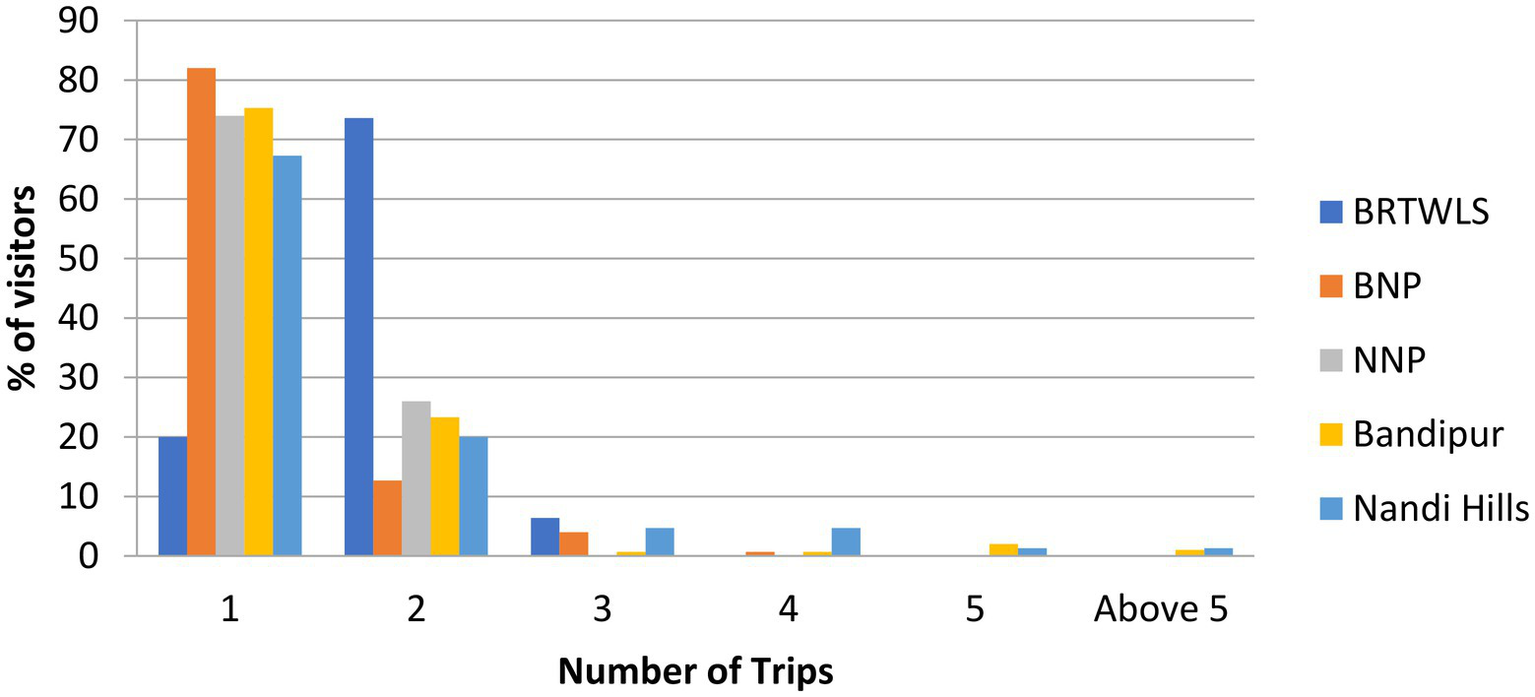
Frequency of tourist trips to the protected areas in the Western Ghats.
3.3.2. The actual amount spent by the tourists
We surveyed 725 tourists about the amount of money they spent visiting the parks. A relatively small amount of US$ 1–10 was spent by >50% visitors in BRTWS and Bandipur NP, whereas only 12 and 7.3% spent that amount in Bannerghatta and Nagarhole NPs, and 35% visiting Nandi Hills. Relatively a bit higher amount, US$ 10–50, was spent by 63% of tourists visiting Bannerghatta NP, compared to 36, 44.8, or 54% visiting BRTWS, Bandipur NP, and Nandi Hills, respectively. Only a few tourists spent >US$ 50, mainly those visiting the Nagarhole NP (Table 5).
The average amount spent by a tourist was the highest for BRTWLS (US$27.38) followed by Nandi Hills (US$25.45). The total amount spent by all the tourists for visiting a site over a year was the highest for Nandi Hills (US$ 252million/year), followed by Nagarhole NP (US$115million/year; Table 5).
4. Discussion
Our assessment of ES from the Western Ghats in Karnataka, representing 60% of the total Ghat’s area, underlines the monetary value of a range of benefits delivered by forests for the Indigenous (Adivasi) communities as well as for the wider public. The assessed ES values accounted for the NTFPs, regulatory services (C sequestration and soil protection), and recreational services from the main protected areas in the Western Ghats, and are worth >US$ 612 million per year (Table 6). This value largely remains obscure to the policy decision-makers due to its intangible nature (Costanza et al., 1997; de Groot et al., 2012; Sangha, 2020; Coyne et al., 2022), which further leads to ignoring the critical role Adivasi communities play in maintaining the flow of these services (Sangha et al., 2019; Sangha, 2020; Dawson et al., 2021; Das et al., 2022). We argue that sustainable use and management of the protected areas in the Western Ghats by the Adivasi communities over millennia is a key factor that help ensure the delivery of ES for the local and wider public benefits.
Table 6
| Name of protected areas | Value of NTFPs (US$/annum) | Total value of carbon sequestration (US$ million/annum) | Value of soil protection (US$ million/annum) | Value of tourism (US$/annum) |
|---|---|---|---|---|
| BRTWS | 334.25*250 (households#) = 83,562 | 3.49 | 32.4 | 12,075 |
| Bannerghatta NP | NTFPs not allowed (120 households) | 1.7 | 14.0 | 74,180,367 |
| SWS | 3855.36*200 (households) = 771,072 | 2.55 | 21.3 | Not applicable |
| Bandipur NP | NTFPs not allowed (400 households) | 5.61 | 47.1 | 2,409,099 |
| Nagarhole NP | NTFPs not allowed (1,000 households) | 4.16 | 34.7 | 115,821,853 |
| Nandi Hills | NA | NA | NA | 251,979,585 |
| Total US$/annum | 854,634 (avg $427,317 based on two protected areas) | US$ 17.51 | 149.62 | 444,402,979 |
Summary of various ES delivered from protected areas in the Western Ghats.
Data collected from the Forest Department, Karnataka.
Typically, in many valuation studies, only the NTFPs are evaluated in monetary terms to understand their role in people’s livelihoods (Semwal et al., 2007), however we suggest that the actual value of NTFPs is much greater than that interpreted from the market price. In this study, we evaluate the monetary values of NTFPs (incl. Agricultural produce), worth US$ 854,634, for Adivasi and local people living in the BRTWS and SWS regions, contributing to 60% of the total household income. Likewise, Madegowda (2002) reported that NTFPs contribute 58% to the annual household income in the same region. We emphasize that the collection of NTFPs is important not only for the livelihoods but also for supporting the overall well-being of the Adivasi communities which includes utilizing and passing on their knowledge on harvesting and processing NTFPs to future generations, following an earlier study in the region by Balasubramanian and Sangha (2021). The true value of the NTFPs will be much greater if accounted for the knowledge and skills (capabilities) required to process NTFPs, like any other marketable product. Access to forest resources and the opportunity to utilize capabilities further contribute to Adivasi people’s well-being in several ways such as enabling people to develop their skills, ability to do something that they like, and ability to pass on their knowledge to future generations (following Sen, 1999; Sangha et al., 2019; Balasubramanian and Sangha, 2021). Hence, for policy decision making there is a need to consider: (i) access to forest resources for the Adivasi communities to NPs such as SWS or Bannerghatta NP; and (ii) the true value of NTFPs to appropriately account for their role toward people’s well-being, beyond livelihoods (Figure 3).
Figure 3
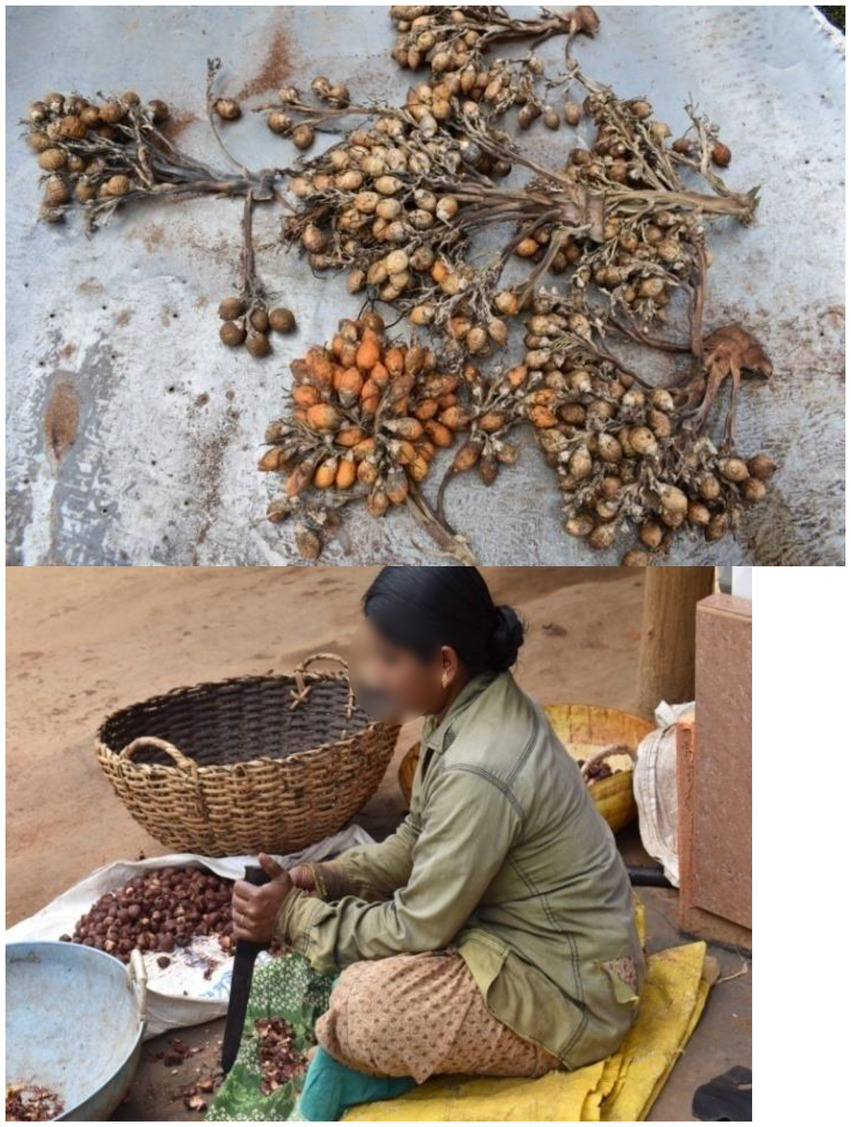
Field photos: segregation of Areca nut and the lady processing them (courtesy: the lead author).
We acknowledge that only the value of recreational services as part of the cultural services was assessed from the selected five study area, which is worth US$ 444 million/year (Rs. 31 billion/year), applying an average amount spent by tourists visiting each study area. Highlighting this value for 12.6 million tourists per year—as high number of tourists visit these areas—suggests that a significant proportion of that amount goes to the government as the parks’ entry fee. Assuming conservatively that at least 10% of the total value is the park entry fee, >US$ 40 million per annum revenue is generated from these protected areas—a significant figure to support the role of Adivasi communities in managing those areas. In contrast, the presence of Adivasi communities, in general, within the national parks and sanctuaries in India is mainly seen as a barrier (much evidence of people’s eviction; Report of The Indigenous World, 2019; Chemmencheri, 2013; Alex et al., 2016), despite a wider recognition that these people have been living within those areas and managing them sustainably over millennia (Gadgil et al., 1993; Ramakrishnan et al., 2005; Gadgil, 2014; Sangha, 2020).
For the Adivasi communities, many other cultural ES than recreation are rather vital for people’s well-being [Gadgil et al., 1993; Ministry of Environment and Forest (MoEF), 2013; Gadgil, 2014], and requires a detailed assessment in itself. There are ~2,000 Adivasi families living within the selected study areas in the Western Ghats, holding a myriad range of cultural values for various components of the forest systems. For example, Soligas living in BRTWS (Tiger Reserve) worship tiger as Huliverappa, which is equated to a deity, and locals can smell and sense the presence of a tiger. They also worship various elements of nature such as rivers, hills, trees, etc., perform rituals and songs in relation to mother’s nature. Because of Adivasi peoples’ deep connections with their forests and their consistent efforts, these protected areas are mainly in existence to date, otherwise modern development pressures would have gobbled up many of these beautiful places (Ramakrishnan et al., 2005; Shakya, 2011; Sindhu et al., 2019).
Access to forests and use of forest resources for the Adivasi communities is very limited in India to date (Chemmencheri, 2013; Alex et al., 2016; Balasubramanian and Sangha, 2021). For our selected case study areas, people living in SWS are not allowed to access forest resources, instead, they have their own small-scale farming systems. Typically, tribal people have limited rights to use resources from forests due to restrictions imposed on the collection of NTFPs with the implementation of the Forest Rights Act (2006). These regulations limit peoples’ access to resources even for adequate amounts of nutritious food, and the quantity and type of food that one can collect (Alex et al., 2016). For instance, if a person in a tribal community wants to cultivate a traditional food plant, he/she is not able to do so due to a lack of access to cultivable land, and imposed political and institutional restrictions (Chemmencheri, 2013). Currently, a lack of understanding of Adivasi people’s role in resource use and management in relation to people’s well-being for policies and legislative instruments in India is a serious issue that leads to misunderstanding of people’s role, as highlighted by Balasubramanian and Sangha (2021) and Lele and Menon (2014). There is an urgent need to apply a holistic understanding of integrating forest resources management and tribal well-being for future policy planning.
Evaluating ES in the form of total benefits that flow to the general public (recreational in our study) is vital for the forest management authorities to understand, which can help develop future policies in line with people’s needs and aspirations. Currently, many of the policies and related legislative instruments in India, including the Forest Rights Act (2006), are designed without any consideration of people’s needs, let alone embracing Adivasi communities’ role in forest management. The current legal arrangements also reflect the legacy of colonization from which countries like India need to shift away given the millennia-old history of tribal people managing the forests. To protect biodiversity and our fast-depleting forest resources, effective engagement with Indigenous Peoples and Local Communities is the key to delivering multiple outcomes for meeting conservation goals as well as seven out of 17 Sustainable Development Goals (no poverty, zero hunger, good health and well-being, clean water, climate action, life on land, and peace justice and strong institutions; The United Nations, 2016).
5. Conclusion and policy implications
In developing countries like India, development (mainly perceived as economic growth/GDP) is the key focus of public policies. With the exhaustion of available resources, particularly land in urban and suburban areas and the growing population, the Adivasi people’s lands come under immense pressure, which are not exploited or modified yet. Hence, mainstreaming Adivasi living and their economies into the public becomes the main target for government policy decision-making (Balasubramanian and Sangha, 2021). The need is to understand how natural resources managed by the Adivasi people are important not only for their own well-being but for the wider public as well. This study demonstrates this point by assessing the economic value of ES and linking it with people’s well-being.
The economic value of ES provided by five protected areas in Karnataka, India, estimated at >US$612 million, is important for policy decision-making, particularly for a global biological diversity hotspot like the Western Ghats for: (1) Informing the policymakers to design better conservation and development policies, in collaboration with the Adivasi communities/IPLCs; (2) Integrating ES values into the state and national income accounting that can help measure sustainable economic development at the local/regional/state level, targeting well-being of locals; and (3) Providing with an important tool for achieving Sustainable Development Goals, particularly for developing countries by accounting for nature’s role toward the well-being of local and Indigenous communities.
Over time, the Western Ghats’ forest resources have been degraded through various exploitative economic activities (e.g., mining, agriculture, and industrial uses). This study informs policy decision-makers to understand the value of ES that directly and indirectly contributes to the state economy (such as tourism revenue from park fees) and the well-being of the wider public. By integrating ES and natural resource management with the well-being of people, this research can inform the planning and implementation of forest management policies and development programs to deliver improved natural resource conservation. We emphasize that the future forest conservation policies should be co-designed in collaboration with the local Adivasi communities while considering their socio-economic, cultural, and ecological needs that will deliver better outcomes, both for the state as well as for people, over a long-term to effectively conserve biological diversity in the Western Ghats of India.
Funding
This project was funded by the Indian Council of Social Science Research (ICSSR), Indian Government.
Publisher’s note
All claims expressed in this article are solely those of the authors and do not necessarily represent those of their affiliated organizations, or those of the publisher, the editors and the reviewers. Any product that may be evaluated in this article, or claim that may be made by its manufacturer, is not guaranteed or endorsed by the publisher.
Statements
Data availability statement
The raw data supporting the conclusions of this article will be made available by the authors, without undue reservation.
Ethics statement
The studies involving human participants were reviewed and approved by the Institute for the Social and Economic Change, Bangalore. Written informed consent for participation was not required for this study in accordance with the national legislation and the institutional requirements.
Author contributions
MB designed, and conducted the field research and drafted the first outline. KS worked on the draft, analyzed the data, and compiled the document for submission. All authors contributed to the article and approved the submitted version.
Acknowledgments
We sincerely thank the Adivasi people and many tourists who participated in our surveys. We also appreciate feedback and comments from K. N. Ninan and Martin Dallimer (University of Leeds) on the earlier drafts.
Conflict of interest
The authors declare that the research was conducted in the absence of any commercial or financial relationships that could be construed as a potential conflict of interest.
Footnotes
1.^ Gujarat, Goa, Maharashtra, Kerala, Karnataka. and Tamil Nadu.
2.^ Carbon sequestration is estimated based on the recent Forest Survey of India (2019) mentioned, according to Good Practices Guidance (2003) introduced by IPCC the living biomass such as stems, stumps, branches, bark, and seeds. Carbon sequestration was calculated applying three steps: first, stratification of forest area it means carbon stored in the vegetation largely depends upon canopy density and forest type (pp.140); second, forest type mapping including bio-physical conditions of plant growth, soil, topography and climate; and third, estimation of biomass and carbon in different pools for example, above ground level biomass of tree having dbh ≥ 10 cm. Soil carbon is calculated based on humus and soil carbon, two sub-plots of size 1 m X 1 m are laid out within the main plot. In addition, the center of the two sub-plots, a pit of 30 cm × 30 cm × 30 cm dug and composition samples of soil of 200 g were analyzed for organic carbon (pp.143).
3.^ Ramachandra and Bharath (2019) estimated the value of carbon sequestration for the standing biomass of different forest types such as dense evergreen forest, semi-evergreen forest, low-evergreen forest, dense deciduous forest and other forest. Soil carbon (top 30 cm) was estimated for tropical wet-evergreen forest, tropical semi-evergreen forest, tropical moist deciduous forest, and tropical dry evergreen forest.
References
1
Alex A. Vidyasagaran K. Prema A. Kumar A. S. (2016). Analyzing the livelihood opportunities among the tribes of the Western Ghats in Kerala. Stud. Trib. Tribal.14, 11–17. doi: 10.1080/0972639X.2016.11886727
2
Anderson D. M. (2010). Estimating the economic value of ice climbing in hyalite canyon: an application of travel cost count data models that account for excess zeros. J. Environ. Manag.91, 1012–1020. doi: 10.1016/j.jenvman.2009.12.010
3
Balasubramanian M. (2019). Economic value of regulating ecosystem services: a comprehensive at the global level review. Environ. Monit. Assess.191, 1–27. doi: 10.1007/s10661-019-7758-8
4
Balasubramanian M. (2020). Valuation of ecosystem services and their impactions for accounting for natural Capital in Karnataka, Aarthika Charche. FPI J. Econ. Gov.5, 59–72.
5
Balasubramanian M. Sangha K. K. (2021). Integrating capabilities and ecosystem services approaches to evaluate indigenous connections with nature in a global biodiversity hotspot of Western Ghats, India. Glob. Ecol. Conserv.27:e01546. doi: 10.1016/j.gecco.2021.e01546
6
Bateman I. Binner A. Day B. Fezzi C. Rusby A. Smith G. et al . (2019). “United Kingdom: paying for ecosystem services in the public and private sectors” in Green Growth That Works. eds. L. Mandle, Z. Ouyang, J. E. Salzman and G. Daily (Washington, DC: Island Press), 237–254.
7
Bhagwat S. A. Kushalappa C. G. Williams P. H. Brown N. D. (2005). The role of informal protected areas in maintaining biodiversity in the Western Ghats of India. Ecol. Soc.10. doi: 10.5751/ES-01285-100108
8
Blicharska M. Mikusiński G. Godbole A. Sarnaik J. (2013). Safeguarding biodiversity and ecosystem services of sacred groves–experiences from northern Western Ghats. Int. J. Biodivers. Sci. Ecosyst. Serv. Manag.9, 339–346. doi: 10.1080/21513732.2013.835350
9
Chemmencheri S. R. (2013). Decentralisation, participation and boundaries of transformation: Forest rights act, Wayanad, India. Commonwealth J. Local Govern.12, 51–68. doi: 10.5130/CJLG.V12I0.3264
10
Costanza R. d'Arge R. De Groot R. Farber S. Grasso M. Hannon B. et al . (1997). The value of the world's ecosystem services and natural capital. Nature387, 253–260. doi: 10.1038/387253a0
11
Costanza R. De Groot R. Braat L. Kubiszewski I. Fioramonti L. Sutton P. et al . (2017). Twenty years of ecosystem services: how far have we come and how far do we still need to go?Ecosyst. Serv.28, 1–16. doi: 10.1016/j.ecoser.2017.09.008
12
Coyne C. Williams G. Sangha K. K. (2022). Assessing the value of ecosystem services from an indigenous estate: Warddeken indigenous protected area, Australia. Front. Environ. Sci.10:845178. doi: 10.10.3389/fenvs.2022.845178
13
Daily G. C. (1997). “Introduction: what are ecosystem services?” in Book Nature's Services—Societal Dependence on Natural Ecosystems. ed. DailyG. C. (Washington: Island Press), 1–10.
14
Das M. Das A. Seikh S. Pandey R. (2022). Nexus between indigenous ecological knowledge and ecosystem services: a socio-ecological analysis for sustainable ecosystem management. Environ. Sci. Pollut. Res.29, 61561–61578. doi: 10.1007/s11356-021-15605-8
15
DasGupta P. (2020). The Dasgupta review—independent review on the economics of biodiversity economics (interim report), UK Government, p. 81
16
Dawson N. M. Coolsaet B. Sterling E. J. Loveridge R. Gross-Camp N. D. Wongbusarakum S. et al . (2021). The role of indigenous peoples and local communities in effective and equitable conservation. Ecol. Soc.26:19. doi: 10.5751/ES-12625-260319
17
de Groot R. S. Alkemade R. Braat L. Hein L. Willemen L. (2010). Challenges in integrating the concept of ecosystem services and values in landscape planning, management and decision making. Ecol. Complex.7, 260–272. doi: 10.1016/j.ecocom.2009.10.006
18
de Groot R. Brander L. Van Der Ploeg S. Costanza R. Bernard F. Braat L. et al . (2012). Global estimates of the value of ecosystems and their services in monetary units. Ecosyst. Serv.1, 50–61. doi: 10.1016/j.ecoser.2012.07.005
19
Dudani S.N. Chandran M.D.S. Mahesh M.K. Ramachandra T.V. (2011). Diversity of Pteridophytes of Western Ghats. Sahyadri E-News Issue-33.
20
Economic Survey of Karnataka (2020). Economic Survey of Karnataka 2020-21. Published by the Planning, Programme Monitoring and Statistics Department, Karnataka Government, India. https://drive.google.com/file/d/1zfr6X17trfgjI1J_MExlRnPOYa4aeaa8/view (Accessed March 15, 2022).
21
Fisher B. Turner R. K. Morling P. (2009). Defining and classifying ecosystem services for decision making. Ecol. Econ.68, 643–653. doi: 10.1016/j.ecolecon.2008.09.014
22
Forest Rights Act (2006). Forest Rights Act — Act, Rules, and Guidelines. Government of India. https://tribal.nic.in/downloads/FRA/FRAActnRulesBook.pdf (Accessed December 12, 2022).
23
Forest Survey of India (2019). State Forest report 2019, Ministry of Environment Forest and Climate Change, Government of India.
24
Gadgil M. (2014). Western Ghats ecology expert panel: a play in five acts. Econ. Polit. Wkly.49, 38–50.
25
Gadgil M. Berkes F. Folke C. (1993). Indigenous knowledge for biodiversity conservation. Ambio22, 151–156.
26
Good Practices Guidance (2003). Good Practice Guidance for Land Use, Land-Use Change and Forestry. IPCC National Greenhouse Gas Inventories Programme, the UN. Published by the Institute for Global Environmental Strategies (IGES) for the IPCC.
27
Godbole A Sarnaik J Mungikar R ., (2011). Biodiversity Assessment of Asaniye-Dabhil Landscape, North Western Ghats, India. Pune: AERF
28
Helian L. Shilong W. Guanglei J. Ling Z. (2011). Changes in land use and ecosystem service values in Jinan, China. Energy Procedia5, 1109–1115. doi: 10.1016/j.egypro.2011.03.195
29
Intergovernmental Platform on Biodiversity and Ecosystem Services (IPBES) (2019). Global assessment report on biodiversity and ecosystem services of the intergovernmental science-policy platform on biodiversity and ecosystem services. (eds.) E. S. Brondizio, J. Settele, S. Díaz, and H. T. Ngo. IPBES secretariat, Bonn, Germany, 1148.
30
Intergovernmental Platform on Biodiversity and Ecosystem Services (IPBES) (2023). IPBES conceptual framework, Available at: https://www.ipbes.net/conceptual-framework (Accessed January 23, 2023).
31
Karabulut A. Egoh B. N. Lanzanova D. Grizzetti B. Bidoglio G. Pagliero L. et al . (2016). Mapping water provisioning services to support the ecosystem–water–food–energy nexus in the Danube river basin. Ecosyst. Serv.17, 278–292. doi: 10.1016/j.ecoser.2015.08.002
32
Kibria A. S. Behie A. Costanza R. Groves C. Farrell T. (2017). The value of ecosystem services obtained from the protected forest of Cambodia: the case of Veun Sai-Siem pang National Park. Ecosyst. Serv.26, 27–36. doi: 10.1016/j.ecoser.2017.05.008
33
Lele S.M. Menon A. (eds.) (2014). Democratizing Forest Governance in India. New Delhi: Oxford University Press, 432.
34
Madegowda C. (2002). Tribal participation in collection of NTFPs in Biligiri Rangaswamy Temple wildlife sanctuary: A study conducted in Chamarajanagar District of Karnataka State. M.Sc. thesis. Sikkim Manipal University of Health, Medical and Technological Science, Gangtok, India: 31–36.
35
Millennium Ecosystem Assessment (2003). Ecosystem and human well-being: A framework for assessment. Published by the World Resources Institute, Washington, DC.
36
Millennium Ecosystem Assessment (2005). Ecosystems and human well-being: biodiversity synthesis. World Resources Institute, Washington, DC.
37
Ministry of Environment and Forest (MoEF) (2011). Report of the Western Ghats, ecology expert panel, part 1. Published by the Government of India. Available at: https://www.yumpu.com/en/document/read/24551250/report-of-the-western-ghats-ecology-expert-panel (Accessed June 2022).
38
Ministry of Environment and Forest (MoEF) (2013). Report of the high level working group on Western Ghat, Volume 1. Published by the Government of India. Available at: http://uttarakannada.nic.in/docs/Publication/HLWGWESTERNGHATSVOLUME1.pdf
39
Ninan K. N. Kontoleon A. (2016). Valuing forest ecosystem services and disservices–case study of a protected area in India. Ecosyst. Serv.20, 1–14. doi: 10.1016/j.ecoser.2016.05.001
40
Pradeep M. D. Kalicharan M. (2016). A study about life style of Jenu Kuruba tribes working as unorganised labourers. Adel. J. Soc. Work3, 278–292.
41
Phnom Penh Water Supply Authority (PPWS) (2015). Annual Report 2015. PPWS, Phnom Penh, Cambodia.
42
Prabhakar S. J. Gangadhar M. R. (2011). Baluvu: A Ritual among Kadu Kuruba Tribe of Karnataka. Stud. Trib. Tribal.9, 129–132. doi: 10.1080/0972639X.2011.11886635
43
Ramachandra T. V. Bharath S. (2019). Global warming mitigation through carbon sequestrations in the Central Western Ghats. Remote Sens. Earth Syst. Sci.2, 39–63. doi: 10.1007/s41976-019-0010-z
44
Ramakrishnan P. S. Boojh R. Saxena K. G. Chandrashekara U. M. Depommier D. Patnaik S. et al . (2005). One Sun, Two Worlds: An Ecological Journey. UNESCO, Man and the Biosphere Programme (MAB). New Delhi, IN: Oxford & IBH Publishing.
45
Reddy C. S. Jha C. S. Dadhwal V. K. (2018). Earth observations based conservation prioritization in Western Ghats, India. J. Geol. Soc. India92, 562–567. doi: 10.1007/s12594-018-1068-6
46
Salafsky N. Wollenberg E. (2000). Linking livelihoods and conservation: a conceptual framework and scale for assessing the integration of human needs and biodiversity. World Dev.28, 1421–1438. doi: 10.1016/S0305-750X(00)00031-0
47
Sangha K. K. (2007). Linking ecosystem services to well-being: a case study of aboriginal communities in northern Australia. Aust. Aborig. Stud.2, 145–147.
48
Sangha K. K. (2020). Global importance of indigenous and local communities’ managed lands: building a case for stewardship schemes. Sustain. For.12:7839. doi: 10.3390/su12197839
49
Sangha K. K. Brocque A. L. Costanza R. Cadet-James Y. (2015). Ecosystems and indigenous well-being: an integrated framework. Glob. Ecol. Conserv.4, 197–206. doi: 10.1016/j.gecco.2015.06.008
50
Sangha K. K. Duvert A. Archer R. Russell-Smith J. (2020). Unrealised economic opportunities in remote indigenous communities: case studies from northern Australia. Soc. Sci. Hum. Open2:100093. doi: 10.1016/j.ssaho.2020.100093
51
Sangha K. K. Gordon I. J. Costanza R. (2022). Ecosystem services and human wellbeing-based approaches can help transform our economies. Front. Ecol. Evol.10:841215. doi: 10.3389/fevo.2022.841215
52
Sangha K. K. Maynard S. Pearson J. Dobriyal P. Badola R. Hussain S. A. (2019). Recognising the role of local and indigenous communities in managing natural resources for the greater public benefit: case studies from Asia and Oceania region. Ecosyst. Serv.39:100991. doi: 10.1016/j.ecoser.2019.100991
53
Sangha K. K. Preece L. Villarreal-Rosas J. Kegamba J. J. Paudyal K. Warmenhoven T. et al . (2018). An ecosystem services framework to evaluate indigenous and local peoples’ connections with nature. Ecosyst. Serv.31, 111–125. doi: 10.1016/j.ecoser.2018.03.017
54
Sangha K. Russell-Smith J. (2017). Towards an indigenous ecosystem services valuation framework: a north Australian example. Conserv. Soc.15, 255–269. doi: 10.4103/cs.cs_16_156
55
Semwal R. Tewari A. Negi G.C.S. Thadani R. Phartiyal P. (2007). Valuation of Ecosystem Services and Forest Governance: A Scoping Study From Uttarakhand. LEAD India: New Delhi, 112
56
Sen A. (1999). Commodities and Capabilities. New Delhi: Oxford University Press.
57
Shakya M. B. (2011). “Namo Buddha and its environs: a legacy of great compassion” in The High Ground: Sacred Natural Sites, Bio-Cultural Diversity and Climate Change in the Eastern Himalayas. eds. Higgins-ZogibL.DudelyN.AzizT.MallaS. (WWF, World Wide Fund for Nature), 44.
58
Sharma C. Pal D. (2020). Exchange rate volatility and tourism demand in India: unraveling the asymmetric relationship. J. Travel Res.59, 1282–1297. doi: 10.1177/0047287519878516
59
Sindhu M. Natchimuthu K. Ramkumar S. Venugopal S. Rao S. (2019). Scope and challenges faced by Soliga tribes of Biligiri Rangan hills of Chamarajanagar District, Karnataka in livestock rearing. J. Entomol. Zool. Stud.7, 345–1348.
60
Srivathsa A. Karanth K. U. Kumar N. S. Oli M. K. (2019). Insights from distribution dynamics inform strategies to conserve a dhole Cuon alpinus metapopulation in India. Sci. Rep.9, 1–13. doi: 10.1038/s41598-019-39293-0
61
The Indigenous World (2019). The indigenous world 2019. Published by the International Work Group for Indigenous Affairs, Copenhagen, Denmark.
62
The United Nations (2016). The sustainable development goals report 2016. Published by the United Nations, New York, USA.
63
Timah P.N. (2011). Non-market valuation of beach recreation using the travel cost method (TCM) in the context of the developing world: An application to visitors of the Ngoé Beach in Kribi, Cameroon. Master’s thesis. Swedish University of Agricultural Sciences, Uppsala. Available at: https://stud.epsilon.slu.se/3582/1/Master%20Thesis-TIMAH.pdf
Summary
Keywords
ecosystem services, ecosystems, Western Ghats, tribal people, wellbeing, indigenous peoples and local communities
Citation
Balasubramanian M and Sangha KK (2023) Valuing ecosystem services applying indigenous perspectives from a global biodiversity hotspot, the Western Ghats, India. Front. Ecol. Evol. 11:1026793. doi: 10.3389/fevo.2023.1026793
Received
24 August 2022
Accepted
14 February 2023
Published
08 March 2023
Volume
11 - 2023
Edited by
Dimitris Poursanidis, Terrasolutions Marine Environment Research, Greece
Reviewed by
Rajiv Pandey, Indian Council of Forestry Research and Education (ICFRE), India; Manob Das, University of Gour Banga, India
Updates
Copyright
© 2023 Balasubramanian and Sangha.
This is an open-access article distributed under the terms of the Creative Commons Attribution License (CC BY). The use, distribution or reproduction in other forums is permitted, provided the original author(s) and the copyright owner(s) are credited and that the original publication in this journal is cited, in accordance with accepted academic practice. No use, distribution or reproduction is permitted which does not comply with these terms.
*Correspondence: Kamaljit K. Sangha, Kamaljit.Sangha@cdu.edu.au
This article was submitted to Conservation and Restoration Ecology, a section of the journal Frontiers in Ecology and Evolution
Disclaimer
All claims expressed in this article are solely those of the authors and do not necessarily represent those of their affiliated organizations, or those of the publisher, the editors and the reviewers. Any product that may be evaluated in this article or claim that may be made by its manufacturer is not guaranteed or endorsed by the publisher.