 David Chun Yin Li
Introduction
Originally coined by Maynard Smith and Price, the term evolutionarily stable strategy has been adopted by a broad range of disciplines across the spectrum of natural and social sciences (Piel, 2019, 2020; Leimar and McNamara, 2023). ESS, a subset of Nash equilibrium (NE; Apaloo et al., 2015), states that if a population adopts a strategy in a given environment, it cannot be invaded by an alternative strategy that is initially very rare (Nakamaru, 2023, Chapter 1). As described by Bishop and Cannings (1976), in a population where most individuals use a strategy p against a mutant strategy q, , for p to be an ESS, for every possible q, a) the average pay-off, in terms of inclusive fitness, the ultimate utility (Levin and Grafen, 2019), of using strategy p against itself is greater than the pay-off of q against p, ; or b) If the pay-off of p against p is equal to the pay-off of q against p, i.e., , then p must have a higher pay-off against q than q does against itself, . Notably, Taylor (1989) further refined ESS by providing a mathematically rigorous definition in the context of continuous one-parameter models under weak selection by introducing two conditions required for ESS, namely a) m-stability, stability which favors convergence by causing a population near an evolutionary equilibrium to gravitate toward the equilibrium (this concept of convergence stability is analogous a situation if p were rare and invading the more common q in Bishop and Cannings, 1976); and b) δ-stability, local stability that causes a population at the equilibrium to remain and resist deviations. An equilibrium can be said to be m-stable if a variant has a positive fitness increment when is on the same side of m as , and a negative one when on the opposite side; this is represented as , and . An equilibrium is δ-stable if for small , the fitness increment is negative; this is represented as , and . The principles of ESS, initially defined at the individual level, could apply to populations, given additional assumptions (Van Cleve, 2023).
Using the correct terminology would be more historically accurate, better representing the original authors (Maynard Smith and Price, 1973). Unfortunately, “evolutionarily” often mutates into “evolutionary” when this acronym is unshortened or mistyped. Interestingly, the first documented substitution occurred in Parker (1974), a paper with over 2,000 citations. It is impossible to determine if subsequent errors was influenced by this mistake or arose independently. In an ironic twist of evolutionary memetics (Fomin, 2019), “evolutionary stable strategy” had become established and entrenched in the population analogous to an invasive allele. Adding to the confusion, “evolutionary stable” is sometimes used without the context of “strategy.” Hence, it might be unclear to some members of a general audience whether “evolutionary stable” refers to a well-defined ESS concept or a notion that is both evolutionary and stable. A similar analogy in economics is the term “socially responsible investing,” sometimes miswritten as “social responsible investing.” Using “social responsible” without the word “investing” can lead to confusion (e.g., Alda, 2019) by blurring where the responsibility rests: with investors or society.
Using search engine data, I examined: a) whether there were trends in the usage of the incorrect form of over time, b) how the trend of ESS misuse compared to similarly comparable misnomers, and c) the prevalence of incorrect ESS usage in the biological versus economic literature. The purpose was not to criticize authors for using the incorrect form, especially those with unrelated backgrounds or facing linguistic challenges (Labrador, 2022). Rather, the aim was to improve scientific communication quality and discourse.
Historical data
This study examined the annual usage of correct and incorrect ESS terms from 1973 through 2022, based on Google Scholar search results. The analysis investigated the number of papers using “evolutionary stable strategy” as a proportion of those using either “evolutionary stable strategy” or “evolutionarily stable strategy.” The same procedure was applied for the term ES (“evolutionary stable” versus “evolutionarily stable”) and two similarly comparable terminologies: ECP (“evolutionary conserved protein” versus “evolutionarily conserved protein”) and ESU (“evolutionary significant unit” versus “evolutionarily significant unit”). Because Google Scholar does not offer discipline-based filtering, JSTOR, an online digital libary, was utilized to quantify the frequency of misnomers in biological sciences compared to economics and social sciences.
Statistical analyses
Due to the time-series nature of the data and the outcomes of the Shapiro-Wilk and Breusch-Pagan tests (see Table 1), normality and homoscedasticity could not be assumed. Hence, a nonparametric method was employed to detect long-term trends in the data. The Mann-Kendall test (Kendall and Gibbons, 1990); Yue et al., 2002; Bronaugh et al., 2023) was applied to determine whether there was a significant upward or downward trend over time (Bürger, 2022). The test calculated the Kendall’s tau rank correlation coefficient, which measures the strength and direction of the relationship between variables in the time series, with values closer to −1 or 1 indicating stronger trends (Rahman and Dawood, 2017). Figure 1 also provides a visual representation of the identified trends.
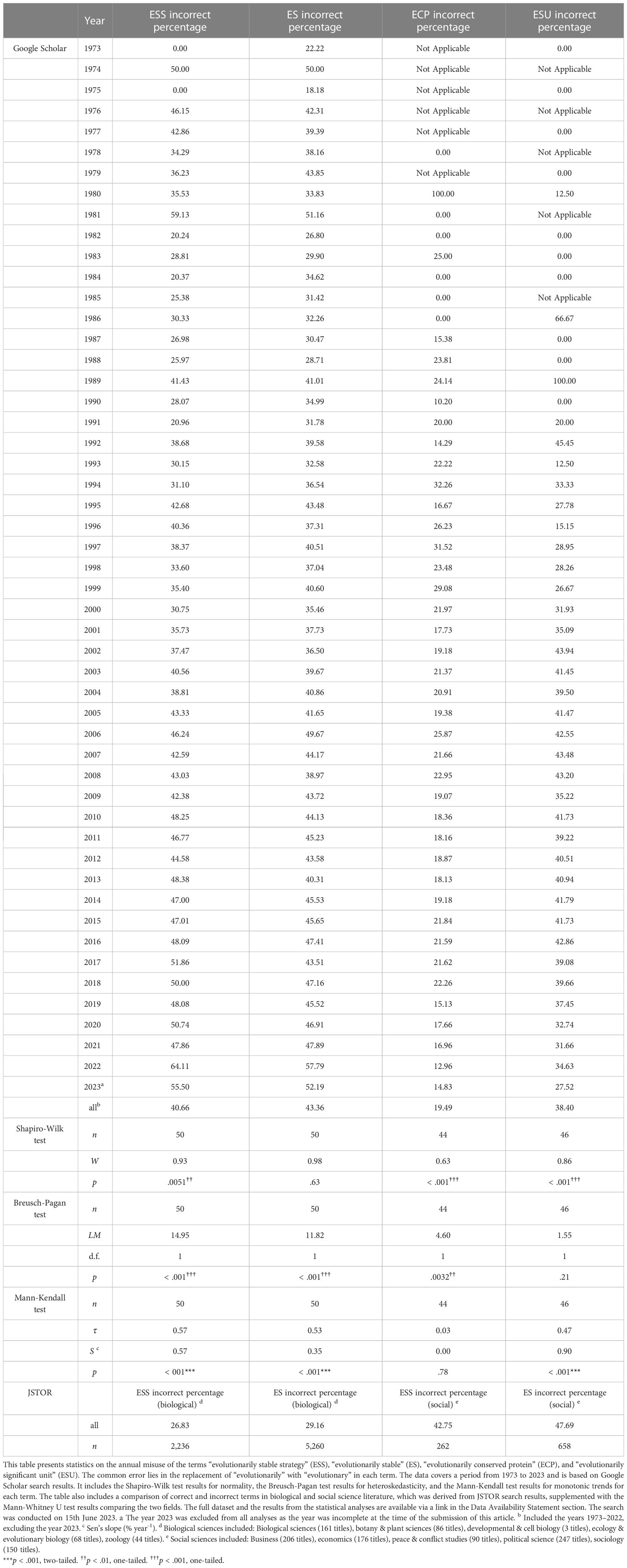
Table 1 Incorrect usage of terminologies over time and across subjects
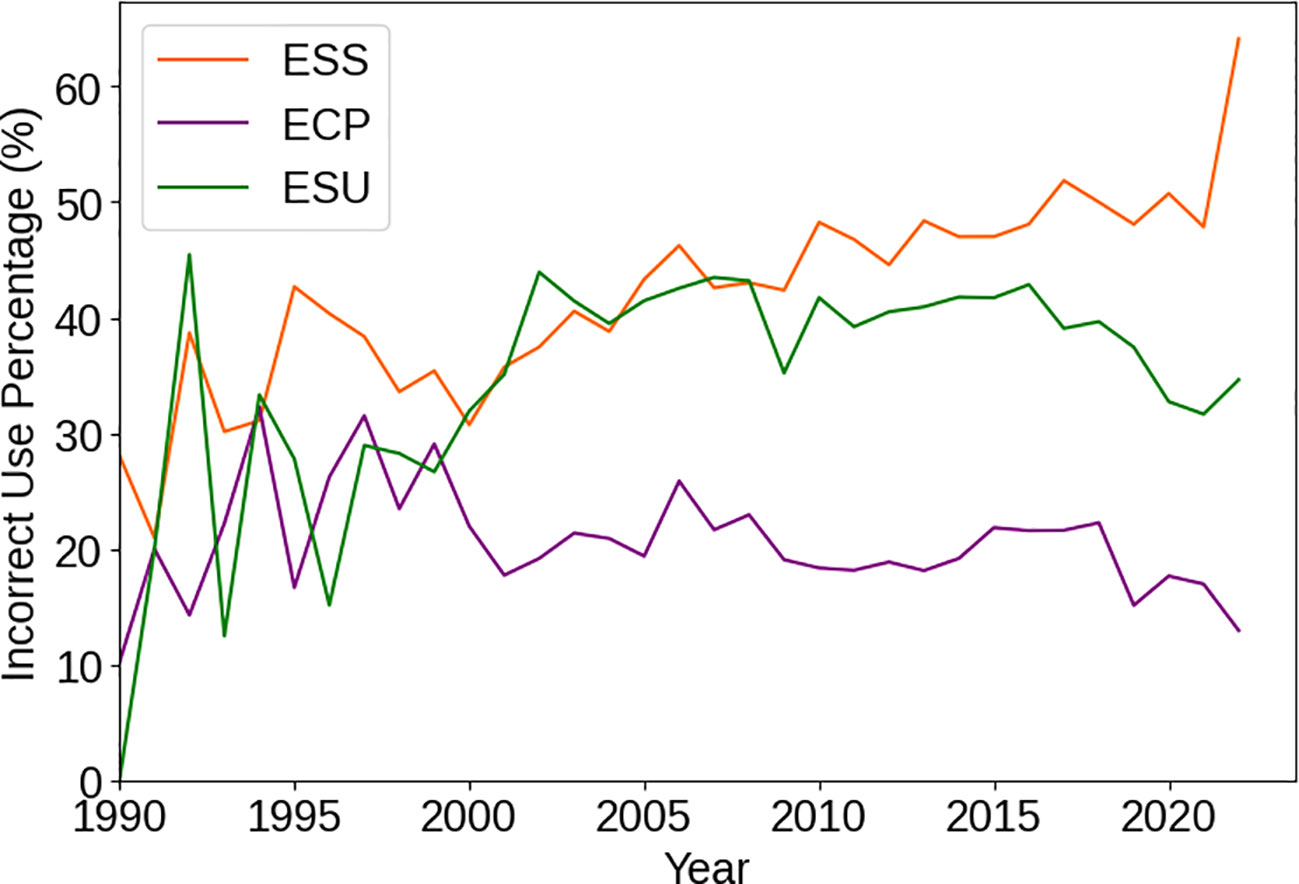
Figure 1 Annual incorrect use of evolutionary terms from 1990 to 2022. The graph represents the annual percentage of incorrect uses of the terms ESS in blaze orange, ECP in purple, and ESU in office green, based on Google Scholar search results. The incorrect uses involved replacing "evolutionarily" with "evolutionary" in each term. Data prior to 1990 were not included to plot this figure due to high variability caused by small sample sizes in those years. Excluding these data allows for improved visualization of long-term trends.
The results of the Mann-Kendall test indicated significant positive monotonic relationships between ESS incorrect percentage (τ = 0.57, p < .001) with time and between ES incorrect percentage (τ = 0.53, p < .001) with time, implying strong and substantial increasing trends respectively. No significant monotonic relationship was found for ECP incorrect percentage (τ = 0.032, p = .78), suggesting the absence of a discernible trend. ESU incorrect percentage showed a significant positive monotonic relationship with time (τ = 0.47, p < .001), indicating a moderate increasing trend. To compare the ESS incorrect percentage with the ES incorrect percentage, a Wilcoxon Signed-rank test was conducted on a sample of 50 years, finding no significant difference between the ESS and ES incorrect percentages (W = 468.50, p = 0.22). The social sciences had a greater proportion of incorrect terminology than the biological sciences, as indicated by the Mann–Whitney U test showing a significant difference in the distribution of the ESS incorrect percentage (U = 2,500,966, p < .001) and both ES incorrect percentage (U = 13,836,430, p < .001). Statistical analyses were performed using R on Posit Cloud (2023; formerly known as RStudio Cloud) and Figure 1 was plotted using Python on Colab (Google Research Team, 2023). All raw data, Python, and R codes for analyses are accessible in the data repository link provided in the Data Availability Statement section.
Discussion
Although I cannot offer a good hypothesis to explain the higher incidence of incorrect spelling in the economics literature compared to the biological literature, I could propose one for the greater prevalence of the misnomer in ESS relative to similarly comparable terminologies. The incorrect spelling of ESS might be less deleterious because it is less confusing and, as a result, faces less scrutiny in the publication process. Consider Sperlich and Uriarte (2019), where the authors mentioned “the evolutionary stable mixed strategy Nash equilibrium of the game to build an economic model of linguistic behavior.” Is this a new, specialized subset of NE? Upon closer inspection, it becomes clear that this is just a wordy way of saying ESS. Similarly, in the study by Migot and Cojocaru (2021), they explored “stability for the replicator dynamics towards an evolutionary stable state.” This phrase raises questions regarding what state is simultaneously evolutionary and stable. Could it refer to games involving more than three strategies where there is a continuous orbit around a cyclic attractor fixed point (Adami et al., 2016; Kuhn et al., 2023) without ever achieving a stable state? However, an examination of Google Scholar’s preview window quickly clarifies this; it is merely a misspelling. In contrast, consider the example of the article titled “proteome-wide discovery of evolutionary conserved sequences in disordered regions” (Nguyen Ba et al., 2012). This phrasing causes confusion about what is simultaneously evolving and being conserved. Is it possible that the non-functional parts of the protein evolved while the functional parts remained conserved? Could the changing keto-enol tautomerization equilibrium ratios of DNA bases (Gheorghiu et al., 2020) change over time? Alternatively, one might wonder whether the transition probabilities in a hidden Markov model may have evolved over time (Nystrup et al., 2017) with the amino acid sequences remaining static. Or, did the proteins evolve somatically (Wang and Tsien, 2006) while their germline counterparts remained conserved? Without opening and reading the article, it is difficult to determine whether the term “evolutionary” is a typographical error.
Regardless of terminological variation, the concept is not generally clouded by whether “evolutionarily” or “evolutionary” is used, although the correct spelling does improve database searches, an important advantage. However, this variation can potentially lead to confusion for casual readers who are not necessarily interested in elaborate biorealistic models. This is because the incorrect form, which juxtaposed “evolutionary” and “stable,” seems to push the reader to imagine that the ESS of a typical game is evolutionary (constantly changing). This is not impermissible in nature, as the expected pay-offs of a game could indeed constantly change if there is new knowledge or information about costs and benefits (Leimar and McNamara, 2019), perceived or speculated relatedness (Faria et al., 2018; Madgwick et al., 2019), frequency (Rubin, 2016), or other external clues (Mühlenbernd et al., 2022), not to mention the fact that an equilibrium of phenotypic strategies exists does not preclude evolutionary changes in genetic frequency. An evolutionary equilibrium that is m-stable but not locally δ-stable (Taylor, 1989, as cited in Christiansen, 1991) will also tend to become polymorphic with more evolutionary dynamics of variation. Still, as most models concede to simplifications (Grodwohl and Parker, 2023), these lifelike nuisances are not typically captured. They could be a source of distraction for general audiences and learners, preventing them from focusing on the mathematics.
From a grammatical perspective, “evolutionarily stable strategy” is the clear winner as it unambiguously conveys the intended meaning. It features an adjective phrase (Berg, 2019) modifying the noun “strategy.” Here, “evolutionarily” is an adverb modifying the adjective “stable,” and the adjective phrase “evolutionarily stable” modifies the noun “strategy.” In this manner, it conveys the robustness of the strategy, which is a key attribute of an ESS. In contrast, “evolutionary stable strategy” is confusing due to the existence of two interpretations. The words “evolutionary” and “stable” could be read as coordinating or cumulative adjectives. 1) As coordinating adjectives: These could be separated by a comma or “and,” namely “evolutionary, stable strategy” or “evolutionary and stable strategy.” Here, both adjectives independently describe “strategy,” misrepresenting the intended meaning of a strategy stable in an evolutionary context. 2) As cumulative adjectives: If considered as cumulative adjectives, “evolutionary” would modify “stable strategy.” This portrayal can be misleading, as it would imply that the strategy is stable first and foremost, and then secondarily evolutionary, which could suggest the strategy changes stably. This confusing notion is not the original intended meaning of ESS.
Conclusion
The findings demonstrate a growing trend of improper ESS terminology usage over time, with a significantly higher rate of misuse in economics literature compared to biology. The rate of incorrect usage for ESS is higher than that for similarly comparable terminologies, possibly attributed to the lower editorial penalties associated with such a misspelling. However, the correct form should still be encouraged, as it reduces confusion, maintains consistency, and improves searchability. The incorrect version of the terminology resembles an allele that is slightly deleterious (or arguably inconsequential at best) with no conservation significance in a species’ genome. Authors are encouraged to use “evolutionarily stable” instead of “evolutionary stable” in their writing.
Data availability statement
The original data and codes are publicly available on Harvard Dataverse, an online data repository https://doi.org/10.7910/DVN/HX0IC9.
Author contributions
The author confirms being the sole contributor of this work and has approved it for publication.
Acknowledgments
The author would like to express one’s appreciation and gratitude to the two reviewers of this article. Their insightful feedback and constructive criticisms have significantly enhanced the quality of this work.
Conflict of interest
The author declares that the research was conducted in the absence of any commercial or financial relationships that could be construed as a potential conflict of interest.
Publisher’s note
All claims expressed in this article are solely those of the authors and do not necessarily represent those of their affiliated organizations, or those of the publisher, the editors and the reviewers. Any product that may be evaluated in this article, or claim that may be made by its manufacturer, is not guaranteed or endorsed by the publisher.
Abbreviations
ESS, evolutionarily stable strategy; NE, Nash equilibrium; ES, evolutionarily stable; ECP, evolutionarily conserved protein; ESU, evolutionarily significant unit.
References
Adami C., Schossau J., Hintze A. (2016). Evolutionary game theory using agent-based methods. Phys. Life Rev. 19, 1–26. doi: 10.1016/j.plrev.2016.08.015
Alda M. (2019). Corporate sustainability and institutional shareholders: The pressure of social responsible pension funds on environmental firm practices. Bus. Strat. Environ. 28, 1060–1071. doi: 10.1002/bse.2301
Apaloo J., Brown J. S., McNickle G. G., Vincent T. L., Vincent T. L. (2015). ESS versus Nash: Solving evolutionary games. Evol. Ecol. Res. 16, 293–314. Available at:https://www.evolutionary-ecology.com/issues/v16/n04/ccar2934.pdf%20ccar2934.pdf.
Berg T. (2019). Adjective phrases with doubly modified heads: How lexical information influences word order and constituent structure. Engl. Lang. Linguist. 23, 341–361. doi: 10.1017/S1360674317000430
Bishop D., Cannings C. (1976). Models of animal conflict. Adv. Appl. Probab., 8, 616–621. doi: 10.2307/1425917
Bronaugh D., Schoeneberg A., Zeman L. (2023). Package ‘zyp’: Zhang + Yue-Pilon trends package (Version 0.11–1) (Vienna, AUS: The Comprehensive R Archive Network (CRAN)). Available at: https://cran.r-project.org/web/packages/zyp/zyp.pdf.
Bürger G. (2022). A conundrum of trends – comment on a paper by Lischeid et al., (2021). J. Hydrol. 609:127745. doi: 10.1016/j.jhydrol.2022.127745
Christiansen F. B. (1991). On conditions for evolutionary stability for a continuously varying character. Am. Nat. 138, 37–50. doi: 10.1086/285203
Faria G. S., Varela S. A., Gardner A. (2018). The relation between RA Fisher’s sexy-son hypothesis and WD Hamilton’s greenbeard effect. Evol. Lett. 2, 190–200. doi: 10.1002/evl3.53
Fomin I. (2019). Memes, genes, and signs: Semiotics in the conceptual interface of evolutionary biology and memetics. Semiotica 2019, 327–340. doi: 10.1515/sem-2018-0016
Gheorghiu A., Coveney P. V., Arabi A. A. (2020). The influence of base pair tautomerism on single point mutations in aqueous DNA. Interface Focus 10:20190120. doi: 10.1098/rsfs.2019.0120
Google Research Team (2023). Colaboratory (Version 2023/06/23) (Mountain View, CA: Alphabet Inc.). Available at: https://colab.research.google.com.
Grodwohl J. B., Parker G. A. (2023). The early rise and spread of evolutionary game theory: perspectives based on recollections of early workers. Philos. Trans. R. Soc. B 378:20210493. doi: 10.1098/rstb.2021.0493
Kendall M. G., Gibbons J. D. (1990). Rank correlation methods. 5th ed. (New York: Oxford University Press). Available at: https://id.lib.harvard.edu/alma/990019239250203941/catalog.
Kuhn T., Junier P., Bshary R., Terrettaz C., Gonzalez D., Richter X. Y. L. (2023). Nutrients and flow shape the cyclic dominance games between Escherichia coli strains. Philos. Trans. R. Soc. B 378:20210503. doi: 10.1098/rstb.2021.0503
Labrador B. (2022). Word sketches of descriptive modifiers in children’s short stories for teacher training in teaching English as a foreign language. Ling. Educ. 69:101036. doi: 10.1016/j.linged.2022.101036
Leimar O., McNamara J. M. (2019). Learning leads to bounded rationality and the evolution of cognitive bias in public goods games. Sci. Rep. 9:16319. doi: 10.1038/s41598-019-52781-7
Leimar O., McNamara J. M. (2023). Game theory in biology: 50 years and onwards. Philos. Trans. R. Soc B 378:20210509. doi: 10.1098/rstb.2021.0509
Levin S. R., Grafen A. (2019). Inclusive fitness is an indispensable approximation for understanding organismal design. Evolution 73, 1066–1076. doi: 10.1111/evo.13739
Madgwick P. G., Belcher L. J., Wolf J. B. (2019). Greenbeard genes: Theory and reality. Trends Ecol. Evol. 34, 1092–1103. doi: 10.1016/j.tree.2019.08.001
Maynard Smith J., Price G. R. (1973). The logic of animal conflict. Nature 246, 15–18. doi: 10.1038/246015a0
Migot T., Cojocaru M. G. (2021). On Minty-variational inequalities and evolutionary stable states of generalized monotone games. Oper. Res. Lett. 49, 96–100. doi: 10.1016/j.orl.2020.11.012
Mühlenbernd R., Wacewicz S., Żywiczyński P. (2022). The evolution of ambiguity in sender—receiver signaling games. Games 13:20. doi: 10.3390/g13020020
Nakamaru M. (2023). Trust and credit in organizations and institutions: As viewed from the evolution of cooperation (Singapore: Springer Singapore). doi: 10.1007/978-981-19-4979-1
Nguyen Ba A. N., Yeh B. J., Van Dyk D., Davidson A. R., Andrews B. J., Weiss E. L., et al. (2012). Proteome-wide discovery of evolutionary conserved sequences in disordered regions. Sci. Signal. 5:rs1–rs1. doi: 10.1126/scisignal.2002515
Nystrup P., Madsen H., Lindström E. (2017). Long memory of financial time series and hidden Markov models with time-varying parameters. J. Forecast. 36, 989–1002. doi: 10.1002/for.2447
Parker G. A. (1974). Assessment strategy and the evolution of fighting behaviour. J. Theor. Biol. 47, 223–243. doi: 10.1016/0022-5193(74)90111-8
Piel H. (2019). Complicating the story of popular science: John Maynard Smith’s “Little Penguin” on The Theory of Evolution. J. Hist. Biol. 52, 371–390. doi: 10.1007/s10739-019-9566-y
Piel H. (2020). Scientific broadcasting as a social responsibility? John Maynard Smith on radio and television in the 1960s and 1970s. Br. J. Hist. Sci. 53, 89–108. doi: 10.1017/S0007087419000918
Posit Team (2023). RStudio: Integrated development environment for R (Version 4.3.0) (Boston, MA: Posit Software PBC). Available at: https://posit.cloud.
Rahman A., Dawood M. (2017). Spatio-statistical analysis of temperature fluctuation using Mann-Kendall and Sen’s slope approach. Clim. Dyn. 48, 783–797. doi: 10.1007/s00382-016-3110-y
Rubin H. (2016). The phenotypic gambit: Selective pressures and ESS methodology in evolutionary game theory. Biol. Philos. 31, 551–569. doi: 10.1007/s10539-016-9524-4
Sperlich S., Uriarte J. R. (2019). The economics of minority language use: theory and empirical evidence for a language game model. arXiv [Preprint]. doi: 10.48550/arXiv.1908.11604
Taylor P. D. (1989). Evolutionary stability in one-parameter models under weak selection. Theor. Popul. Biol. 36, 125–143. doi: 10.1016/0040-5809(89)90025-7
Van Cleve J. (2023). Evolutionarily stable strategy analysis and its links to demography and genetics through invasion fitness. Philos. Trans. R. Soc. B 378:20210496. doi: 10.1098/rstb.2021.0496
Wang L., Tsien R. Y. (2006). Evolving proteins in mamMalian cells using somatic hypermutation. Nat. Protoc. 1, 1346–1350. doi: 10.1038/nprot.2006.243
Keywords: evolutionarily stable strategy, history of evolutionary game theory, history of behavioral ecology, scholarly communication, Google trends, linguistic evolution, behavior
Citation: Li DCY (2023) The semantics of stability: evolutionarily stable strategy in biology and economics literature. Front. Ecol. Evol. 11:1229093. doi: 10.3389/fevo.2023.1229093
Received: 25 May 2023; Accepted: 07 August 2023;
Published: 31 August 2023.
Edited by:
Heikki Helanterä, University of Oulu, FinlandReviewed by:
Jeremy Van Cleve, University of Kentucky, United StatesAndy Gardner, University of St Andrews, United Kingdom
Copyright © 2023 Li. This is an open-access article distributed under the terms of the Creative Commons Attribution License (CC BY). The use, distribution or reproduction in other forums is permitted, provided the original author(s) and the copyright owner(s) are credited and that the original publication in this journal is cited, in accordance with accepted academic practice. No use, distribution or reproduction is permitted which does not comply with these terms.
*Correspondence: David Chun Yin Li, ZGF2aWRjeTNAbWUuY29t