 Sara Souther
 Sarah Colombo
 Nanebah N. Lyndon2
- 1School of Earth and Sustainability, Northern Arizona University, Flagstaff, AZ, United States
- 2Kaibab National Forest, USDA Forest Service, Williams, AZ, United States
Traditional Ecological Knowledge (TEK) is an understanding of natural systems acquired through long-term human interactions with particular landscapes. Traditional knowledge systems complement western scientific disciplines by providing a holistic assessment of ecosystem dynamics and extending the time horizon of ecological observations. Integration of TEK into land management is a key priority of numerous groups, including the United Nations and US public land management agencies; however, TEK principles have rarely been enshrined in national-level US policy or planning. We review over 20 years of TEK literature to describe key applications of TEK to ecological understanding, conservation, restoration and land management generally. By identifying knowledge gaps, we highlight research avenues to support the integration of TEK into US public land management, in order to enhance conservation approaches and participation of historically underrepresented groups, particularly American Indian Tribes, in the stewardship of ancestral lands critical to the practice of living cultural traditions.
1. Introduction
Traditional Ecological Knowledge (TEK) refers to an understanding of ecosystems acquired through long-term observations by people inhabiting a region. In contrast to western Scientific Ecological Knowledge (SEK), TEK is often encoded in rituals, beliefs, and cultural practices (Gadgil et al., 1993; Berkes et al., 1994; Berkes et al., 2000). Any group of people routinely interacting with the environment for extended time periods develop TEK, though the term often refers specifically to Indigenous Traditional Ecological Knowledge (ITEK). The term ‘traditional ecological knowledge’ has been criticized, since the word ‘traditional’ can be construed negatively to imply a regressive or static knowledge system. While TEK has been described using other terms, like ‘Indigenous knowledge’ or ‘local ecological knowledge’, these monikers are less broadly applied, in part because they do not fully capture the range of knowledge systems represented in contemporary, highly mobile, pluralistic societies and in part because ‘traditional ecological knowledge’ quickly established after its use in several seminal publications. Some argue that no single term or definition can capture the plurality of local environmental knowledge, and instead suggest using the term ‘TEK’ as a working concept to drive inclusive collaborations aimed at achieving sustainable management of ecological systems (Whyte, 2013). In this spirit and given its widespread application, we continue to use TEK here, while acknowledging the drawbacks, limitations and history of the term.
While TEK has existed for millennia, formal description of the term in western scientific literature occurred in the late 1980s and early 1990s (Johannes, 1989; Berkes et al., 2000). Since that time, hundreds of papers have incorporated TEK, and described the value of including local knowledge in management and conservation planning (Gadgil et al., 1993; Berkes et al., 1994, 2000; Moller et al., 2004; Berkes and Turner, 2006). Limited, yet critical, inroads have been established to include TEK, and more broadly, ecocultural-related goals in US federal land management (Armatas et al., 2016; Ens et al., 2016). Simultaneously, frameworks for understanding human roles in ecosystems are evolving (Berkes and Turner, 2006; Liu et al., 2007), providing a springboard to incorporate TEK in management plans, improve protections for cultural natural resources, and identify novel methodology for evaluating the socio-ecological merits of management actions.
Building on this momentum, we review literature related to TEK, explain how and why TEK can inform management, enumerate challenges of incorporating TEK into land management, and address a core debate within this field that suggests that TEK and SEK are incompatible. Using this framework, we highlight best practices, knowledge gaps, and US policies that could be strengthened or expanded to enshrine protection of ecocultural resources in Federal land management. Finally, we support key concepts using a case study of the Emory oak Collaborative Tribal Restoration Initiative (EOCTRI), a collaboration between western Apache Tribal Nations, the US Forest Service, industry, and university researchers to conserve a cultural keystone species in the southwestern US. While numerous opinion pieces or case studies describe the benefits of TEK-integrated land management, to our knowledge, no review has examined the current body of literature to inform US federal land management and policy.
There is an urgent need for a clear strategy to manage ecocultural resources on US Federal land, and to co-develop management actions with local or Indigenous groups (Bach et al., 2019). Indigenous communities, relocated to reservations a fraction of the size of ancestral territories, rely on public lands to access sacred areas and harvest sites to supply natural products used in traditional foods, crafts, and ceremonies (Souther et al., 2021b). Mismanagement of public lands could trigger irrevocable cultural loss since language, traditions and spiritual practices are often tied to particular species and ecosystems (Ens et al., 2016). At the same time, global change has amplified risks of inappropriate management actions and necessitated large-scale restoration initiatives to prevent broad-scale habitat and diversity loss (Benito-Garzón et al., 2013). Rapid integration of TEK into US federal management plans could improve ecological outcomes of these restoration actions, support local communities and tribal sovereignty, and proactively prevent global change exacerbating historical injustices.
2. Methods
To identify literature related to TEK and land management, we conducted systematic searches in both the ISI Web of Science and the SCOPUS databases. We intentionally used broad search terms to retrieve a wide-range of manuscripts linked to this theme. Within both databases, we searched the terms “traditional ecological knowledge” OR “Indigenous knowledge” OR “local environmental knowledge” AND “land management” OR “natural resource management” for occurrence in the title, abstract, or keywords of manuscripts published from 1900 to 2022. This initial search yielded 432 primary research articles. Articles were then screened for relevance, excluding literature that described predominantly human-dominated systems, such as agricultural and urban areas, and literature focused on describing the knowledge system itself, without tangible ecological or management connections. Using this method, we culled the original body of literature by ca. 28%, resulting in a total of 284 articles with content that matched the theme of this review (Supplementary Data Sheet S1). We were unable to review a total of 27 publications, primarily because they were not published in English; however, publications excluded due to inaccessibility represented only 6% of the 432 articles from the original search. Finally, we used a snowball sampling technique, in which we followed citation chains associated with emergent themes, adding a further 37 citations. In total, we reviewed 321 manuscripts for this review.
We used an inductive-deductive approach, in which we iteratively developed and refined themes that emerged from the literature (Shamseer et al., 2015). In order to characterize the current TEK literature, we also categorized manuscripts according to manuscript type, which included the classifications, primary research (studies in which data were collected and reported by the authors), literature reviews, case studies and opinion pieces. The literature reviews, case studies, and opinion pieces reviewed here, by our definition, included no direct data collection or analysis. For primary research studies, we noted whether investigators collected social data, ecological data, or both data types. Finally, we classified primary research studies in terms of analytical data treatment. If data were collected, but simply summarized to characterize TEK or other response variables, we indicated that statistics were descriptive. Alternatively, if data were used in hypothesis-testing, studies were classified as employing inferential statistics.
3. Key informational gaps in TEK literature
Overall, the number of TEK-focused studies has increased since the term was initially introduced in the published literature (Figure 1A). Less than half of all studies we reviewed were primary research on TEK, while the remaining publications were classified as case studies, literature reviews, or opinion pieces (Figure 1B). For the majority of primary research publications, authors collected solely social data, with many fewer incorporating ecological data (Figure 1C). Twenty-five percent of primary research studies employed inferential statistics to analyze data, with most describing data patterns only (Figure 1C). Globally, Australia contributed the highest number of publications, followed by the United States, and Canada (Figure 2). Within the US, TEK-research was geographically skewed toward the west coast, with the highest number of publications occurring in California. Notable gaps in publication rates were observed in the central and eastern portion of the country (Figure 3).
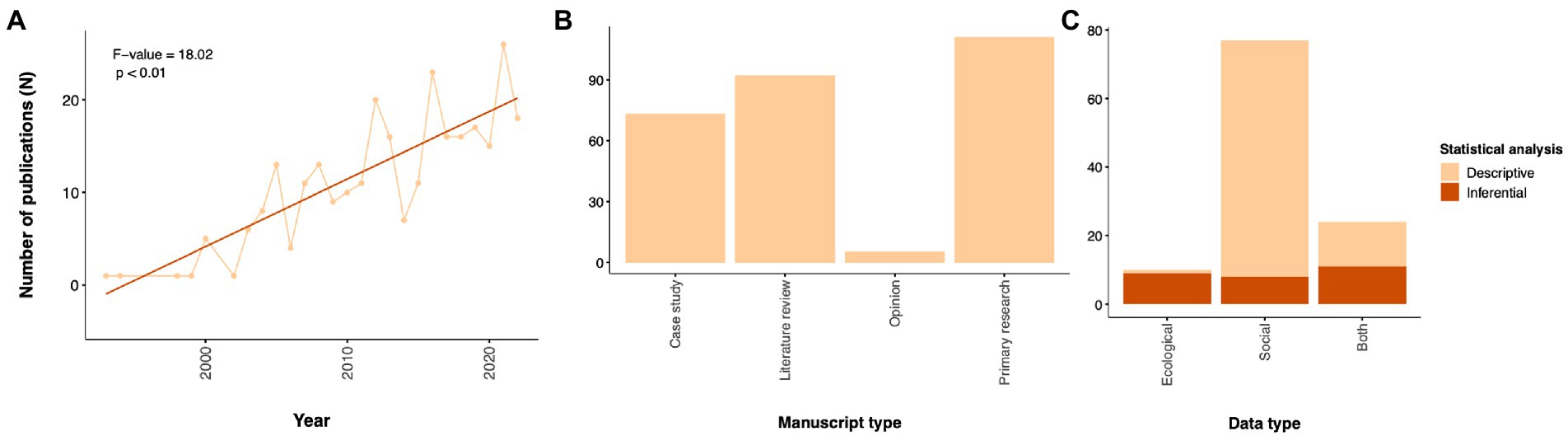
Figure 1. Summary information for literature reviewed within this manuscript. (A) Publication of TEK-themed manuscripts has increased through time since the year 2000. (B) Around half of the TEK-literature reviewed here was primary research and the remaining publications were divided among case studies, literature reviews, and opinion pieces. (C) Among the primary research papers, the majority collected social data only and applied only descriptive statistics.
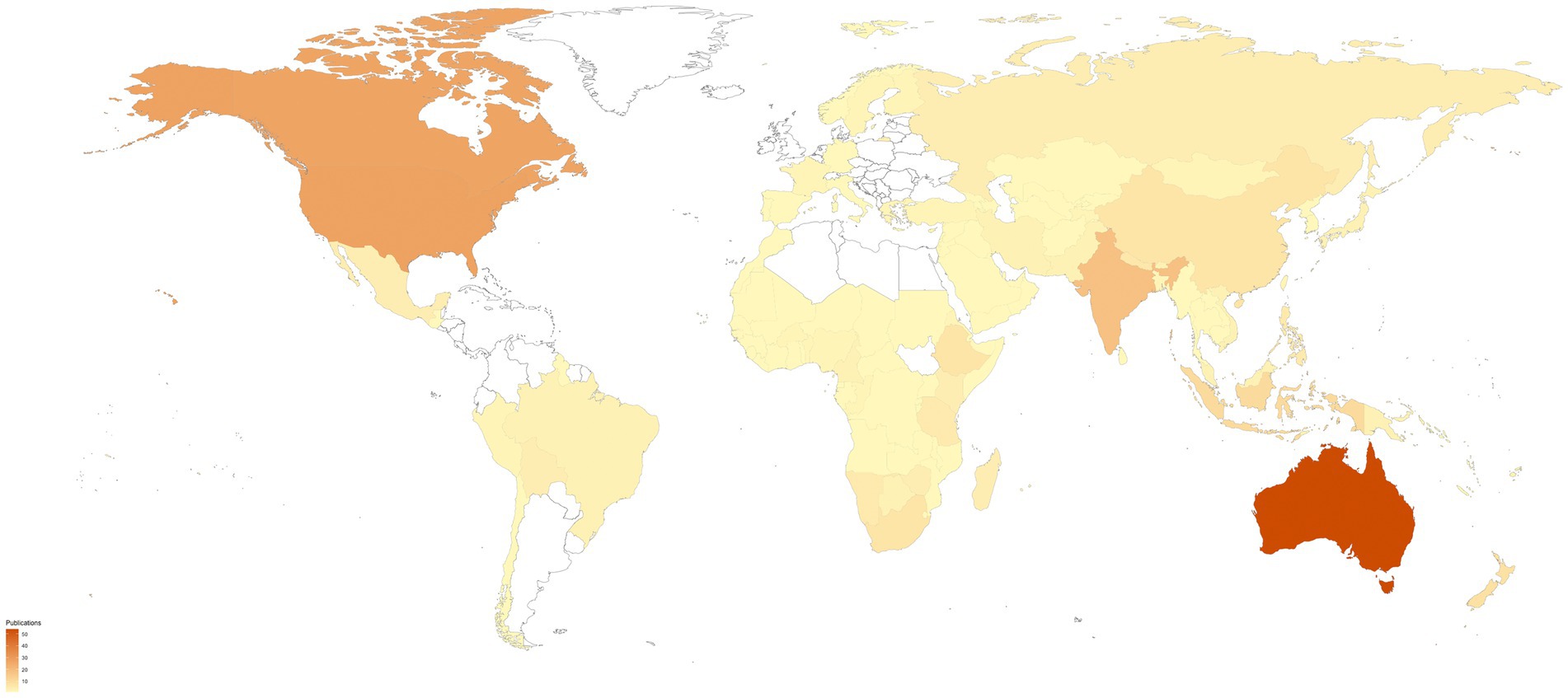
Figure 2. Global choropleth map of TEK-publications. The majority of studies have been conducted in the US, Canada, and Australia. South America, Africa, and much of Asia emerge as geographical gaps in TEK-focused studies.
Interpretation of the literature reviewed herein should be contextualized within geographic, topical, and quantitative gaps in this TEK literature. Lack of data precludes quantitative techniques, such as meta-analysis, to examine patterns among studies, reducing inferential strength and preventing description of the magnitude of social and ecological impacts of incorporating TEK into management. As an example, several studies stated that incorporating TEK into land management increased species diversity at these sites, but either did not provide quantities or did not compare with a reasonable control method. Like most literature, TEK-focused manuscripts suffer from positive publication bias – in other words, virtually all studies suggest that TEK has a positive effect on management outcomes. While we acknowledge these biases, this review revealed broad themes relevant to guide management actions as well as future research trajectories.
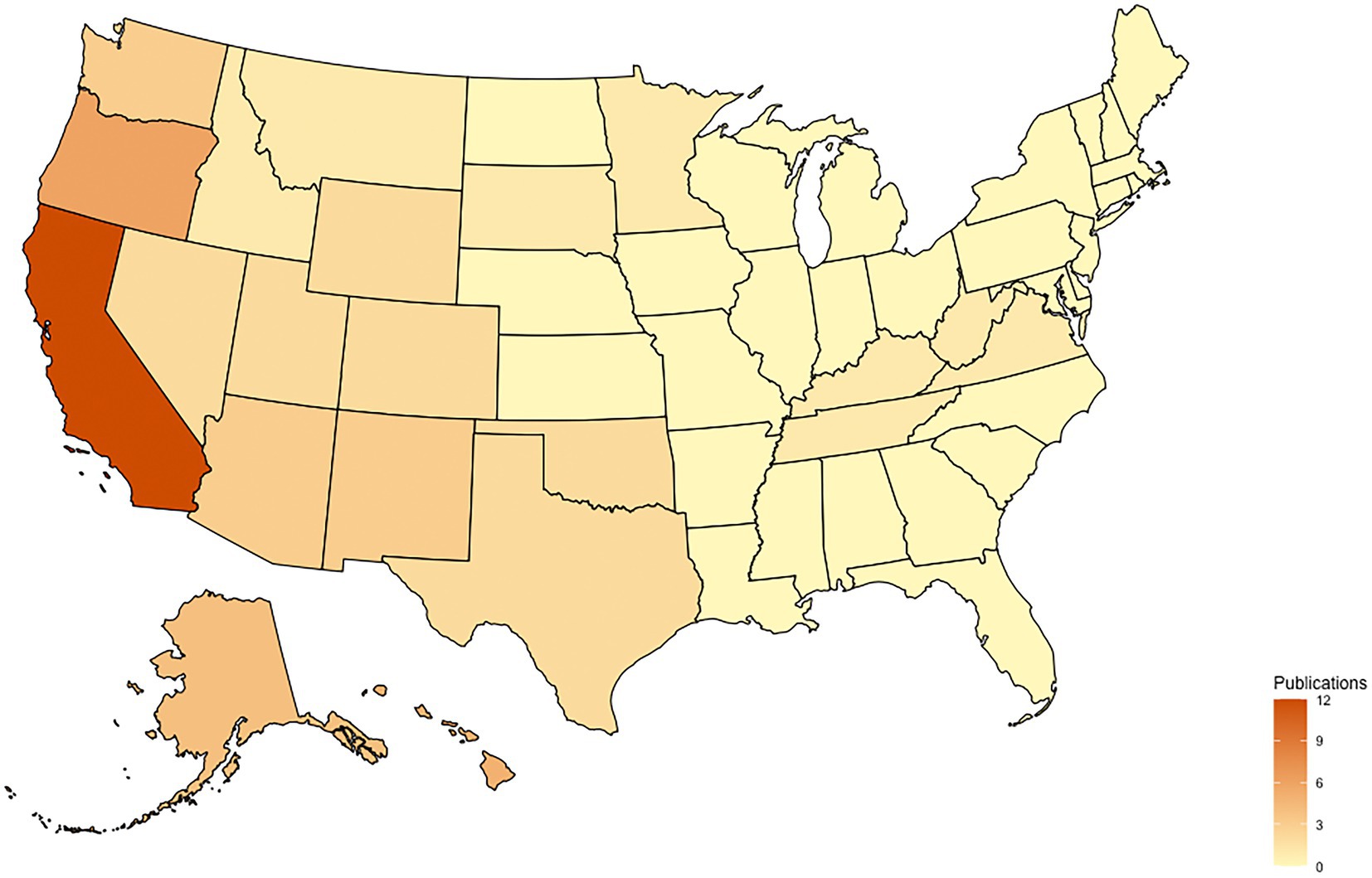
Figure 3. Distribution of TEK-focused publications within the US. The highest number of studies were conducted in California. Few studies were observed elsewhere in the US, with a notable gap in the central and eastern portions of the country.
4. Traditional ecological knowledge (TEK) overview
4.1. TEK supports sustainable land management
Before modern supply chains introduced global commodities to local communities, human groups, particularly from non-agricultural societies, relied on nearby ecosystems for food, clothing, shelter, and other essentials. Irresponsible use of natural resources would therefore negatively impact reliant human communities. These feedback loops between ecological and social systems drove the development of cultural mechanisms that promoted sustainability (Gadgil et al., 1993; Berkes et al., 2000; Moller et al., 2004; Carpenter et al., 2009; Chapin et al., 2010; Camacho et al., 2012; Folke, 2015; Westley et al., 2021). For this reason, TEK emergent from coupled socio-ecological systems provides insight into sustainable land management practices. Viewing land management through a social-ecological lens can improve outcomes by identifying pathways and feedbacks structured by management decisions that shape ecosystem dynamics and dictates the nature of human-ecological interactions (Rai, 2007; Ruiz-Gutiérrez and Zipkin, 2011; Schultz et al., 2015; Cinner et al., 2016; Gill et al., 2017; Lyver and Tylianakis, 2017; Kobluk et al., 2021).
Traditional ecological knowledge improves understanding of contemporary ecosystems. While the past functional roles of Indigenous peoples have often been ignored or dismissed as insignificant, numerous studies demonstrate that the legacy of past social-ecological interactions manifests in current ecological systems. Humans, throughout time, have profoundly affected ecosystems, acting as ecosystem engineers that shape landscapes, (Smith, 2007), climate, and fire regimes (Kimmerer and Lake, 2001; Bond and Keeley, 2005; Raish et al., 2005; Bliege Bird et al., 2008, 2018; Rodenburg et al., 2012; Bird R. B. et al., 2013; Bird M. I. et al., 2013; McCune et al., 2013; Pellatt and Gedalof, 2014; Prober et al., 2016; Albuquerque et al., 2018; Bliege Bird and Nimmo, 2018; Power et al., 2018; Crabtree et al., 2019; Moura et al., 2019; Long et al., 2021; Halpern et al., 2022; O’gorman et al., 2022), as selective agents altering evolutionary trajectories (Rangan et al., 2015; Sullivan et al., 2017), as seed dispersers influencing gene flow patterns (Kondo et al., 2012; Auffret and Cousins, 2013), and as keystone species modifying trophic pathways (Lepofsky and Caldwell, 2013; Dunne et al., 2016; Suraci et al., 2016; Smith et al., 2017; Crabtree et al., 2019; Westley et al., 2021). For some ecosystems, removing traditional human communities has resulted in ecosystem degradation and loss of diversity (Bliege Bird and Nimmo, 2018; Knight et al., 2022).
In the US, new estimates suggest that human groups may have arrived from Asia to North America as much as 21 ka (Moreno-Mayar et al., 2018), indicating that human populations influenced ecosystems for thousands of years prior to the imposition of contemporary land management. The ecological impacts of these groups, particularly effects mediated through cultural burning practices, are thought to have been profound and persistant through time. (Devin and Doberstein, 2004; Kimmerer and Lake, 2001; Raish et al., 2005; Adlam et al., 2021; Halpern et al., 2022; Knight et al., 2022; O’gorman et al., 2022). Indigenous burning reinforced oak and chestnut dominance in the Appalachian forests of the eastern US, maintained the extent of the tallgrass prairie in the Midwest, and shaped the composition of western forests (Kimmerer and Lake, 2001). Cultural burning was widespread, implemented by numerous Indigenous groups, and practiced for myriad reasons; to clear home sites, to encourage the growth of desirable species such as food provisioning-species (i.e., oaks, chestnuts), to send long-distance signals, to foster habitat for important game species or to corral game, and to control pest populations (Kimmerer and Lake, 2001). Integrating TEK into prescribed burning to restore fire regimes has been largely successful (Bond and Keeley, 2005; Bliege Bird et al., 2008, 2018; Butz and Butz, 2009; Pellatt and Gedalof, 2014; Fache and Moizo, 2015; Clinchy et al., 2016; Bliege Bird and Nimmo, 2018; Adlam et al., 2021; Halpern et al., 2022). In addition to cultural burning, Indigenous communities likely shaped ecosystems through multiple pathways, including harvest, hunting, and transport of species, as has been shown for past human populations in other countries. Failure to acknowledge Indigenous functional roles within ecosystems on public lands will result in the omission of key ecological processes (Donlan, 2005; Alagona et al., 2012; Higgs et al., 2014). Engaging local and Indigenous communities for ecological insights may provide a more comprehensive understanding of these systems.
4.2. TEK developed over long time horizons
Traditional ecological knowledge develops via long-term interactions of human populations with ecosystems, and thus may contextualize contemporary ecological change, extending descriptions of baseline conditions to time periods preceding modern documentation (Homann et al., 2008; Gratani et al., 2011; Johnson et al., 2015; Armatas et al., 2016; Hopping et al., 2016; Bach et al., 2019). In response to changing climate, species are undergoing widespread changes in the timing of critical life events (i.e., phenology), traits, spatial distribution, and abundance (Thomas et al., 2004; Skelly et al., 2007; Kelly and Goulden, 2008; Lavergne et al., 2010; Walther, 2010; Parmesan and Hanley, 2015). System-level understanding of the timing of important ecological events can help identify phenological mismatches, disruptions of species interactions, and overall phenological shifts in response to climate change (Prober et al., 2011; Moura et al., 2013; Armatas et al., 2016; Pyhälä et al., 2016; Wiseman and Bardsley, 2016). In North America, many tribes track cryptic seasonal events using the phenology of indicator species (Armatas et al., 2016). The Karuk, Hupa, and Yurok Tribes, for instance, track the migration of edible fish species by following the flowering schedule of dogwood trees (Armatas et al., 2016). Applying comprehensive phenological knowledge spotlights shifts in critical life events and mismatches among interacting species important for understanding ecological impacts of climate change that may not be identified by conventional short-term western scientific studies.
More broadly, long-term landscape perspectives may provide reference conditions for restoration targets and serve as an early warning of species extirpation, state transitions, or other changes from which recovery is challenging (Prober et al., 2011; Uprety et al., 2012; Vinyeta and Lynn, 2013; Johnson et al., 2015; Wiseman and Bardsley, 2016; Souther et al., 2021b). As an example, western Apache Tribes in Arizona, who consume Emory oak acorns as a traditional food, advised the US Forest Service that populations of this oak lacked smaller size trees and produced fewer acorns relative to populations in the past. Tribal members attributed decline in reproduction and recruitment to a variety of factors, including climate change, livestock grazing, and fire suppression (Coder et al., 2005). These observations initiated a landscape-scale Emory oak restoration project, the Emory oak Collaborative Tribal Restoration Initiative (EOCTRI), taking place on USFS and Tribal Lands in the Southwest (Figure 4; Souther et al., 2021a). Without this warning from western Apache people, land managers would likely not have identified Emory oak as a conservation concern, since the presence of long-lived adult trees masks risks to this species. Western Apache TEK drove implementation of conservation interventions for this species prior to irreversible decline (Souther et al., 2021a). Environmental change in response to anthropogenic disturbance of terrestrial and atmospheric systems is occurring at the local-level in complex and idiosyncratic ways (Pyhälä et al., 2016). By engaging local populations, land managers can broaden understanding of ecological change, and make management decisions in real-time as issues emerge (Pyhälä et al., 2016).
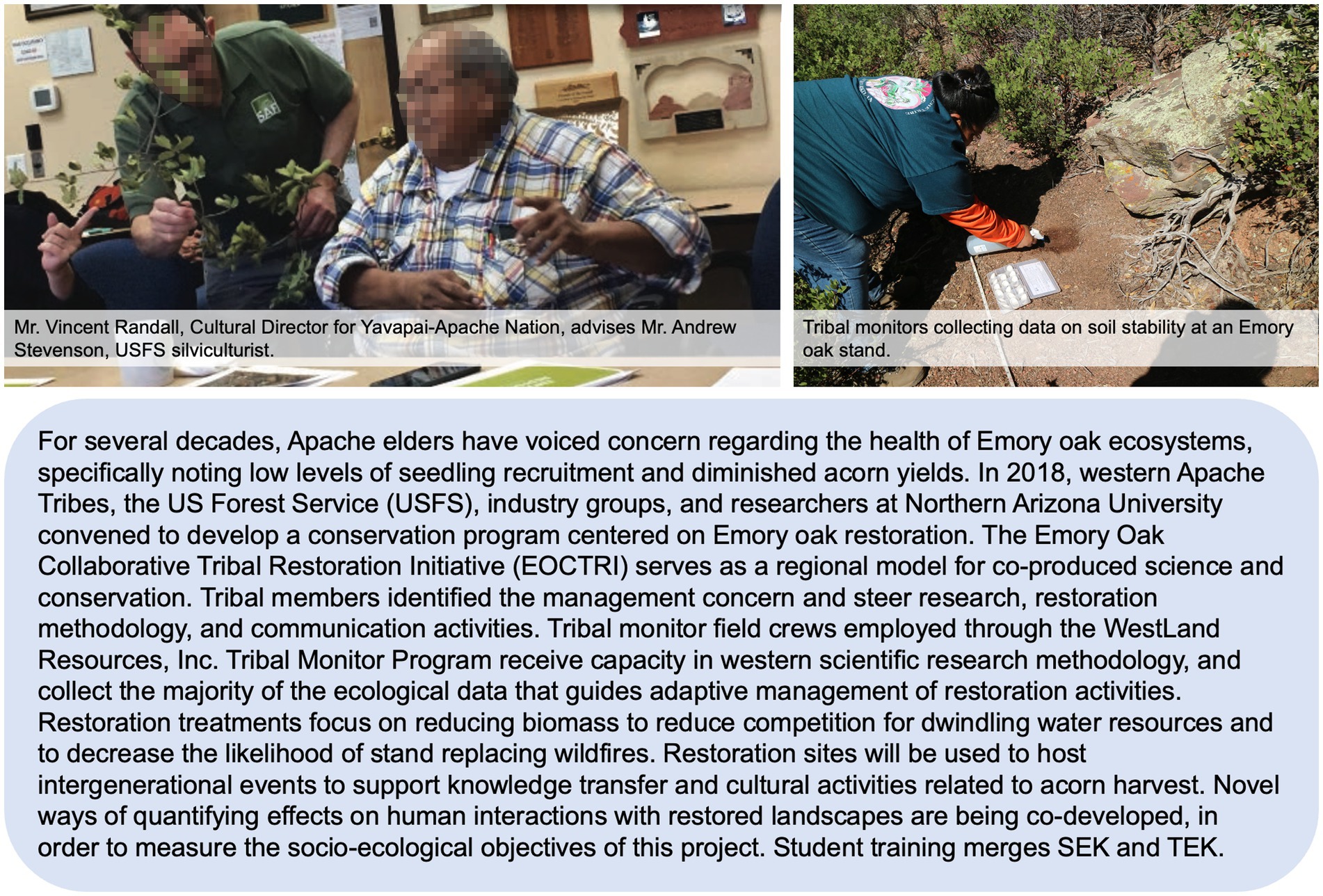
Figure 4. A model for co-produced science and management in the Southwest.
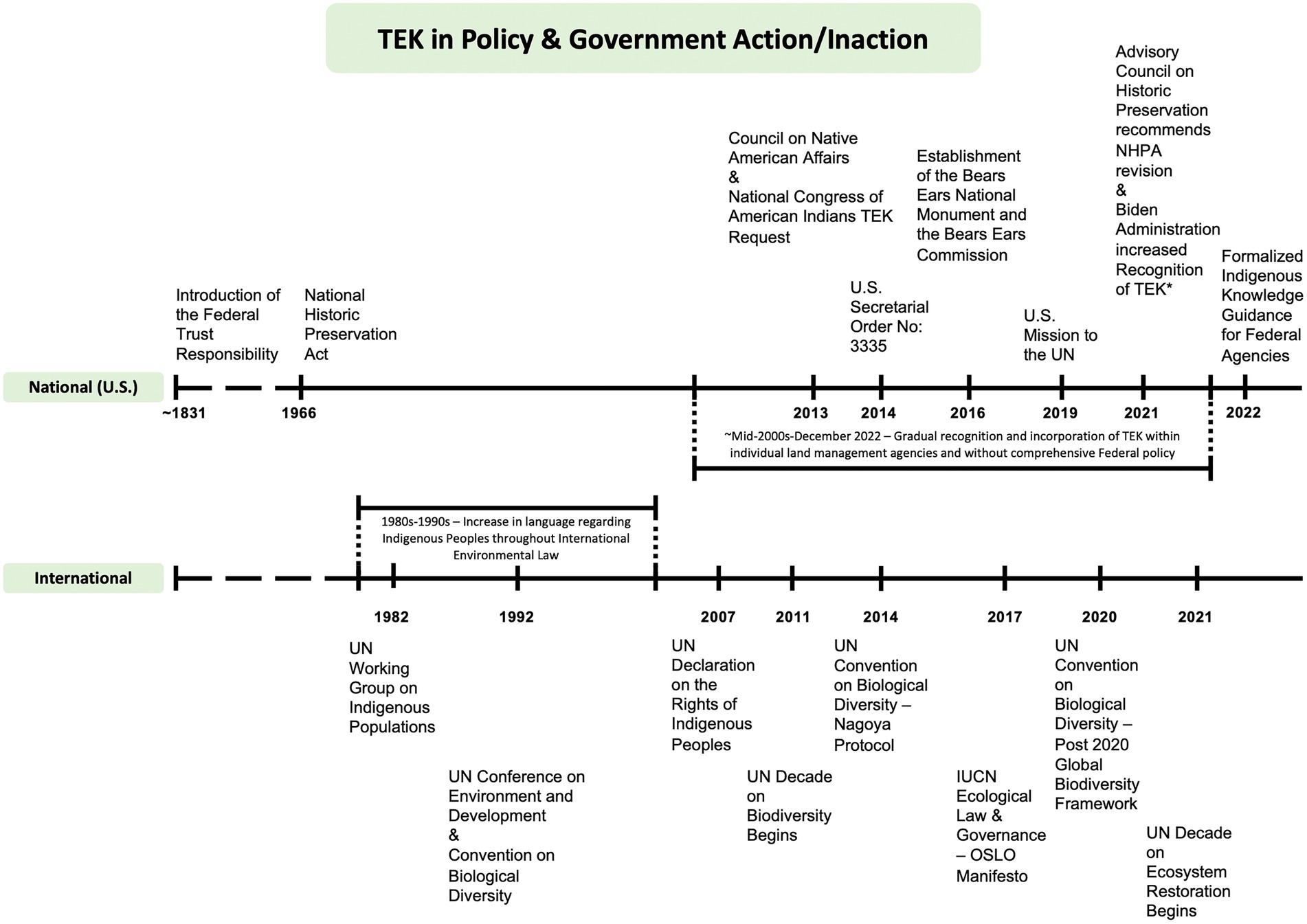
Figure 5. A timeline of TEK policy integration at both the national (upper timeline) and international (lower timeline) level. This timeline is not exhaustive but meant to highlight the overall progression of TEK acknowledgment within policy. *The Biden Administration’s increased recognition of TEK is represented in policy such as: Memorandum for the Heads of Departments and Agencies, Indigenous Traditional Ecological Knowledge and Federal Decision Making, 2021, U.S. Joint Secretarial Order No. 3403: Fulfilling the Trust Responsibility to Indian Tribes in the Stewardship of Federal Lands and Waters, 2021, Executive Order #14072 Strengthening the Nation’s Forests, Communities, and Local Economies, 2022, Executive Order #14049 White House Initiative on Advancing Educational Equity, Excellence, and Economic Opportunity for Native Americans and Strengthening Tribal Colleges and Universities, 2022, and Executive Order #13990 Protecting Public Health and the Environment and Restoring Science To Tackle the Climate Crisis.
4.3. TEK is often holistic
In many cases, TEK is characterized by a comprehensive understanding of ecosystems, with humans situated within biotic communities, and landscapes representing not only ecological features, but also place-based sociocultural memories (Athayde and Silva-Lugo, 2018). Recognition of the complexities and interrelationships within biotic communities broadly supports scientific understanding of ecological systems. The model of coupled human and natural systems, or the concept of the eco-cultural landscape (i.e., the totality of ecological and cultural elements in a region) may improve management and conservation outcomes by appropriately recognizing human roles within ecosystems (Rai, 2007; Cullen-Unsworth et al., 2012; Johansson et al., 2019; Campbell, 2020; Pablo and Córdova, 2021).
Conservation failures due to lack of cultural understanding or engagement have increased recognition of the importance of collaborative planning in US and global resource management. A prime example is the establishment of biodiversity conservation reserves or carbon sequestration offset areas by wealthy countries in equatorial regions where lack of consultation with local communities has resulted in ineffective programs (Michon et al., 2007; Dressler et al., 2012; Vaz and Agama, 2013; Albuquerque et al., 2019; Johansson et al., 2019). In Ethiopia, the creation of Reducing Emissions from Deforestation and forest Degradation (REDD) carbon conservation areas increased risk of large fires, reducing or potentially nullifying overall carbon sequestration gains (Johansson et al., 2019). More broadly, ignoring local traditions and use patterns has frequently resulted in conflict and non-compliance with imposed regulations; problems largely resolved by co-development of management plans with local communities (Rodriguez-Navarro, 2000; Anderson et al., 2005; Spak, 2005; Michon et al., 2007; Dressler et al., 2012; Uprety et al., 2012; Vaz and Agama, 2013; Indrawan et al., 2014; Albuquerque et al., 2019; Kiage, 2019; Nanlohy et al., 2019; Fabre et al., 2021). Inclusive land governance often results in increased engagement and stewardship behavior when local values and priorities are incorporated into land management practices, creating a shared vision for governance (Oettlé et al., 2004; McGetrick et al., 2015; Long and Lake, 2018; Pyke et al., 2018; Tsai, 2020; Skroblin et al., 2022). This is particularly important for reducing conflict when managing pooled or common resources (Kanwar et al., 2016). Applying a coupled human-natural system lens is critical to meet the multiuse missions of many US public land managers that must maintain ecological health, while supporting social uses of national forests, grasslands, and other areas.
4.4. Intrinsic value of TEK
Though this review focuses on improving ecological outcomes by integrating TEK into land management, we recognize the intrinsic value of ecocultural practices, traditions, and local ecological knowledge (Carino et al., 2009; Mackey and Claudie, 2015). For much of the 20th century, society broadly valued local knowledge of flora and fauna due to potential economic contributions of new foods, medicines or other products. While the benefit of TEK for identifying and managing these resources is still important (Turner et al., 2000; Chapman, 2008; McCallum and Carr, 2012; Rodenburg et al., 2012; Maroyi, 2017, 2022; Nalau et al., 2018; Strenchok et al., 2018; Guerrero-Gatica et al., 2020; Abbas et al., 2022), ecocultural resources have been more holistically valued within the framework of ‘Cultural Ecosystem Services’ (CESs). Cultural ecosystem services include intangible, yet invaluable, functions beyond supplying commodities, such as providing inspiration, aesthetically pleasing views, a sense of place, cultural vitality, and recreational, educational and fellowship opportunities (Paudyal et al., 2016; Pascua et al., 2017). The CES categorization provides a strong foundation to better value human connections to ecosystems, yet may not fully capture the pivotal role of TEK in preserving culture, language and relationships. Cultural keystone species, a term coined by Nabhan and Carr (1994), describes species that feature so heavily in language, ceremonies, traditions and oral history to be necessary for cultural practices. The cultural keystone concept could be extended to describe ecosystems, places, and landscapes necessary to sustain culture.
Incorporating local and Indigenous perspectives into land management to support the continuation of cultural practices is increasingly valued, even when financial gains are not a primary driver (Kruger, 2005; Long and Lake, 2018; Lindsay et al., 2022; Skroblin et al., 2022), as exemplified by several recent court rulings requiring dam removal to support traditional fishing (Long and Lake, 2018). Support of bio-cultural sovereignty, the right of people to access landscapes and natural resources necessary for cultural practice, itself an important management goal (Cleary, 2005; Jackson et al., 2005; Spak, 2005; Alan et al., 2006; Jackson, 2006; Menzies, 2006; Christensen and Grant, 2007; Houde, 2007; Banjade et al., 2008; Grice et al., 2012; Uprety et al., 2012; Baldy, 2013; Brondízio et al., 2021; Fabre et al., 2021; Parsons et al., 2021; Lindsay et al., 2022). In addition to advancing favorable ecological outcomes, co-management of natural resources with local and Indigenous groups, protects cultural diversity, and power-sharing, a core value of democratic societies (Devin and Doberstein, 2004; Spak, 2005). As medical research increasingly demonstrates health benefits of interactions with nature (Driessnack, 2009; Hansen et al., 2017; Chaudhury and Banerjee, 2020), access to eco-cultural resources may be seen as a fundamental human right (Menzies, 2006). Given the reliance of local and Indigenous groups on nearby ecosystems for cultural practices and subsistence, mismanagement of natural resources disproportionally affects these often marginalized groups. Inclusive governance is particularly important to avoid exacerbating historical injustices and inequities as climate change drives shifts in ecosystems and natural resources (Pollino et al., 2007; Banjade et al., 2008; Blanch, 2008; Vinyeta and Lynn, 2013; Maldonado et al., 2014; McGetrick et al., 2015; Schick et al., 2018). Valuation of alternative knowledge systems is important in modern pluralistic societies and may drive novel insights of complex coupled human and ecological systems (Colchester, 2004; Houde, 2007; Bohensky and Maru, 2011). Integration of TEK and goals related to eco-cultural protections in to land management strategic planning is generally supported by local communities and should be prioritized by US land management agencies (Nanlohy et al., 2019; Fabre et al., 2021; Skroblin et al., 2022).
5. Applying TEK to improve land management
5.1. Harvest practices and single species conservation
Ecological constraints and human reliance on ecosystems reinforced norms associated with ecological sustainability, which can be broadly applied to single species management (Turner et al., 2000; Moller et al., 2004; Phuthego and Chanda, 2004; Menzies, 2006; Rai, 2007; Ulluwishewa et al., 2008; Mulyoutami et al., 2009; Newmaster et al., 2011; Nimachow et al., 2011; Baldy, 2013; Walsh et al., 2013; Childs and Choedup, 2014; Mackey and Claudie, 2015; Mavhura and Mushure, 2019; Shokirov and Backhaus, 2020; Alexander et al., 2021; Kobluk et al., 2021; Negi et al., 2021). Traditional harvest practices often integrate triggers to slow, pause or alter harvest based on on-the-ground observations, adjusting behavior to prevent resource degradation (Walsh et al., 2013; Mavhura and Mushure, 2019). In British Columbia, the Haítzaqv (Heiltsuk First Nation) harvest feather boa kelp for food, ceremonial use and as a trade item. Ecological analysis of traditional harvest revealed that the rate of removal of kelp fronds was similar to loss incurred through wave action during the growing season, revealing how traditional harvest mimicked natural ecological processes. Moreover, the Haítzaqv provided researchers with a variety of environmental conditions, like water temperature and wave exposure, that support recovery after harvest (Kobluk et al., 2021).
In some cases, traditional human harvest behavior may shape evolutionary, demographic or spatial characteristics of populations (Herrmann, 2005, 2006; Cosby et al., 2022). In Chile and Argentina, monkey puzzle trees (Aruacaria araucana (Molina) K. Koch), a threatened species of conifer, are an important food source for Mapuche people, supplying nutritious nuts, called piñones. The accepted Mapuche harvest technique of men climbing to harvest nuts, constrained which trees within a population were harvested, since harvest was limited to trees that could support the weight of an adult human (Herrmann, 2005, 2006). This not only promoted sustainable harvest, but may have shaped genetic diversity patterns, demographic structure of populations, and evolutionary trajectories, by allowing younger or smaller trees to disproportionally contribute to population growth, since seeds from smaller class trees avoided harvest. Species valued as food, fiber, or medicine may drive traditional management practices that influence ecosystems at the landscape-level. The Karuk and Yurok Tribes of California reduce acorn infestation of black oaks by filbertworms and filbertweevils through cultural burning (Halpern et al., 2022). Management for this important first food may have shaped fire regimes and community composition within Californian forests (Kimmerer and Lake, 2001; Adlam et al., 2021; Halpern et al., 2022). Understanding human interactions with such cultural keystone species may yield broad insights about landscape management and restoration.
As globalization and other forms of anthropogenic change increase pressure on natural resources, integrating TEK into regulations supports sustainable harvest and can reduce conflict over resources (He et al., 2011; Childs and Choedup, 2014). In China, land managers successfully employed TEK to establish harvest laws to regulate an emergent mushroom market (He et al., 2011). In response to the commercialized harvest of Thelephora ganbajun, or ganba fungus, a type of coral mushroom native to the Yunnan province of China, land managers co-produced regulations with local communities who had sustainably harvested this mushroom, in order to support the conservation of both the mushroom and the tradition of harvest practiced by Yunnan communities (He et al., 2011). Applying traditional harvest techniques may ensure sustainable harvest, and thus support continued cultural connections with harvested species, when global markets lead to increased demand on local resources.
5.2. Improving ecological assessments
Engaging local communities in the development of ecological monitoring and assessments has the potential to advance our ability to track ecological changes (Goodall, 2008; Kakinuma et al., 2008; Ens et al., 2010; Rasalato et al., 2010; van de Pol et al., 2010; Prober et al., 2011; Leonard and Parsons, 2013; Moura et al., 2013; Gratani et al., 2014; Behmanesh et al., 2016; Savo et al., 2017; von der Porten et al., 2019; Mugambiwa and Makhubele, 2021; Pyke et al., 2021; Souther et al., 2021b). First, incorporating TEK in ecological assessments can increase monitoring efficiency and coverage, which is particularly important, given that many land management agencies lack the resources to support comprehensive monitoring programs (Souther et al., 2021b; Teixidor-Toneu et al., 2022). Traditional ecological knowledge enhances efficiency by applying detailed understanding of landscapes to survey methodology (Ballard et al., 2008). As an example, one group tasked with monitoring lynx populations on public lands in California trained local community members to census lynx. Locals increased the completion speed of the surveys due to superior knowledge of the landscape and of lynx population locations (Ballard et al., 2008). Integrating TEK of local groups into monitoring is particularly important when species or phenomena of interest are not readily observed by the general public, federal staff, or researchers, such as when focal species are remote, rare or cryptic (Parlee and Manseau, 2005; Goldman, 2007; Marin et al., 2017; Deb, 2018; Pyke et al., 2018; Baker and Constant, 2020; Sloane et al., 2021; Teixidor-Toneu et al., 2022).
Local communities distil complexity of ecological systems using TEK, employing methods like identifying indicator species linked to more complex ecological phenomena, which can be used to simplify monitoring procedures (Armatas et al., 2016; Behmanesh et al., 2016). In Iran, for instance, the government modified rangeland degradation assessments to incorporate indicators (i.e., abundance or depletion of particular grasses) used by local pastoralists, supporting widespread and consistent documentation of key ecological processes (Behmanesh et al., 2016). Local communities may also have fine-scale knowledge of systems, critical for effective management (Pyke et al., 2018; Baker and Constant, 2020; Matshameko et al., 2022). Cree fishermen in Canada described more morphotypes of fish species, potentially representing important genetic variation in fish populations, and provided more detailed information on seasonal movement, spawning behavior, and reproductive timing compared to SEK research conducted in the same region (Marin et al., 2017). These observations allowed managers to attribute declining lake trout populations, an important game fish and food source, to climate change driven loss of trout prey base (Marin et al., 2017). Finally, the deep-time perspective of TEK may be leveraged to define baseline conditions, establish restoration targets (Uprety et al., 2012; Leonard and Parsons, 2013; Gratani et al., 2014), track global change impacts (Armatas et al., 2016), and serve as an early warning system of large-scale ecological state transitions (Souther et al., 2021a). Programs integrate TEK into monitoring in a variety of ways, like co-developing monitoring protocols with local and Indigenous groups and overlaying these procedures with western SEK techniques to extrapolate observations from monitoring plots using local insights (Ballard et al., 2008). Ecological studies and management actions employing Multiple Evidence-Based approaches, which include both western and traditional science methods, likely yield a more comprehensive ecological understanding and foster creative solutions to address environmental problems (Pyke et al., 2021).
5.3. Enhancing management actions
Indigenous and local communities interact with ecosystems in a variety of ways, ranging from species-specific interactions, like removing undesirable species to reduce competition with preferred plants, or acting as ecosystem engineers by modifying soils for cultural and food-generating purposes. TEK-guided management may especially improve ecological outcomes when ecosystems co-evolved with human populations long-term, and adoption of traditional behaviors represents a restoration of essential human functions within the landscape (Pellatt and Gedalof, 2014). In Australia, reintroduction of cultural burning practiced by Aboriginal people produced unexpected secondary ecological changes, increasing the diversity and abundance of mid-sized mammalian species, whose numbers were steadily declining (Gott, 1982; Kay, 1994; Bond and Keeley, 2005; Smith, 2007; Bliege Bird et al., 2008; Kondo et al., 2012; Bird M. I. et al., 2013; Bird R. B. et al., 2013; Rangan et al., 2015; Boivin et al., 2016; Clinchy et al., 2016; Suraci et al., 2016; Smith et al., 2017; Sullivan et al., 2017; Vigilante et al., 2017; Albuquerque et al., 2018; Bliege Bird and Nimmo, 2018; Power et al., 2018; Crabtree et al., 2019). Similar patterns are emerging in the US, where cultural burning supports land management agencies efforts to re-establish natural fire regimes following 20th century fire suppressions policies (Adlam et al., 2021; Long et al., 2021). Reintroduction of fire in fire-adapted systems reduces risk of catastrophic, stand altering wildfires and removes invading, non-fire adapted species, decreasing competition for resources of endemic species. In California, US, for instance, TEK-integrated forest restoration reduced burn severity and damage caused by wildfires relative to untreated areas (Slaton et al., 2019). Other forms of traditional land management, such as grazing strategies and alteration of vegetation for agroforestry or hunting, increases plant diversity, principally through increasing the heterogeneity of management strategies on the landscape (Pyke et al., 2018; Silva-Rivera et al., 2018; Uchida and Kamura, 2020; Fabre et al., 2021). Developing a understanding of ecological systems, which integrates human functional roles, provides a more comprehensive ecological perspective and is particularly important for developing appropriate restoration actions.
Co-development of management strategies generally improves land management outcomes (Michon et al., 2007; Vaz and Agama, 2013; Albuquerque et al., 2019; Forest et al., 2019). Engaging local populations in land management decisions has been found to increase buy-in on agreed upon practices, lead to stewardship behavior and reduce exploitation of shared natural resources (Sanchez, 2000; Spak, 2005; Mackey and Claudie, 2015; Sheil et al., 2015). Similarly, regulations developed specifically to enhance cultural connections to the landscape has been shown to increase engagement with public lands and reduce conflict (Rodriguez-Navarro, 2000; Indrawan et al., 2014; Matthews, 2016). On some tribal lands, management is shifting away from western scientific concepts of management, and explicitly making decisions that improve the viability of first foods (Quaempts et al., 2018). Reframing management of public lands to prioritize cultural ecosystem services may result in more equitable land management, increase long-term support for public lands, and reduce conflict with land management agencies.
Ecological restoration projects are growing in number and scale, particularly as anthropogenic change increases the frequency and severity of disturbances, like wildfire and drought (Copeland et al., 2018). Traditional ecological knowledge can contribute to restoration success in several key ways. Local or Indigenous groups may identify restoration plant materials that are not only adapted to regional climate and soils, but are also utilized by local populations, thus improving the intrinsic value of restored lands and encouraging stewardship behaviors (Gaur and Gaur, 2004; Tarbox et al., 2020). ‘Traditional technologies’ may represent low-cost, culturally appropriate methods of landscape restoration. Rock dams (commonly referred to as trincheras or, gabions, in the Southwest US) are used in arid and semi-arid regions to promote growth of vegetation (Bainbridge, 2012; Cassin et al., 2021; Norman et al., 2022). These rock dams slow water infiltration and stabilize soil during rain events driving revegetation in degraded areas. The Zuni people create waffle gardens to grow dryland crops (Bainbridge, 2012). By creating indentations in the soil for planting, dryland farmers encourage water to accumulate at the base of the plant. Applying similar techniques prior to reseeding plant materials following disturbance in dryland areas could increase plant recruitment, which is notoriously low in these systems (Bainbridge, 2012).
5.4. Identification of protected areas
Many Indigenous groups identify sacred areas (Das et al., 2021), which often represent unique species assemblages, high numbers or performance of culturally important species, and/or areas with an abundance of a limiting resource (i.e., water; Watson et al., 2003; Rai, 2007, 2011; Boillat et al., 2013; Mackey and Claudie, 2015; Friday and Scasta, 2020; Utami and Oue, 2021). In India, sacred groves of trees have higher plant diversity relative to similar unprotected habitat (Rai, 2011). The Minangkabau people in Indonesia protect areas within forests and river habitat that serve as a source population for fish and other natural resources, ensuring the long-term provisioning of these resources (Utami and Oue, 2021). Higher diversity and function of these systems may be driven through cultural practices or because these regions are ecologically unique. Regardless, incorporating sacred areas into land management strategies can improve landscape-scale conservation and ecological resilience in the context of climate change by capitalizing on extant human connections to place (Watson et al., 2003; Herrmann, 2006; Rai, 2011; Kamal and Lim, 2019; Das et al., 2021; Utami and Oue, 2021). Many Indigenous and local groups connect lineages and family to particular places. Ensuring access to these areas is important for the health of human populations and culture, while also encouraging land stewardship (Mackey and Claudie, 2015). Prioritization of sacred areas for TEK-integrated management planning, conservation and restoration actions protects ecologically important areas, while simultaneously supporting cultural practices, and priorities of local and Indigenous groups (Rai, 2007).
5.5. Identifying and coping with novel threats posed by global change
Long-term perspectives allow the identification of novel threats posed by rapid global change, and can serve as an early warning system for catastrophic ecological events (Seely, 1998; Macharia, 2004; Pamo, 2004; Pollino et al., 2007; Goodall, 2008; Liwenga, 2008; Vaarzon-Morel and Edwards, 2012; Barber et al., 2013; Leonard and Parsons, 2013; Lepofsky and Caldwell, 2013; Ruiz-Mallén and Corbera, 2013; Armatas et al., 2016; Austin et al., 2017; Farimani et al., 2017; Kainamu-Murchie et al., 2018; Kaiser et al., 2019; Arias-Bustamante and Innes, 2021; Copes-Gerbitz et al., 2021; Sinta et al., 2022). Integrating TEK into management of ecosystems affected by global change may improve outcomes, since TEK guides management actions based on ecological indicators rather than arbitrary jurisdictional or bureaucratic dictates (Bach et al., 2019). As an example, Aboriginal Australian-led weed management activities, cataloged invasive weeds based on their effects and roles within ecosystems rather than government-generated categories, like native/non-native status or abundance, which may or may not reflect impacts to ecosystems (Bach et al., 2019). Traditional ecological knowledge may also provide technological advances to natural resource management of emergent threats. In Australia, Aboriginal Australians applied natural piscicides developed for fishing to reduce abundance of invasive tilapia (Gratani et al., 2011, 2014). Since TEK-management actions are tied to temporal ecological processes rather than Gregorian calendars or funding calendars, they are easily modified to account for global change. For instance, many local and Indigenous communities ignite fires based on observed fuel loading or the occurrence of seasonal rains, allowing flexibility to shift practices that result in desired conditions (Butz and Butz, 2009; Armatas et al., 2016). An understanding of social systems related to land management may support adaptive responses to changing environmental conditions by identifying beliefs, needs or behaviors that support or constrain mitigation (Leonard and Parsons, 2013). Impoverished communities in Peru prioritized meeting immediate existential needs, precluding long-term planning necessary for climate adaptation (Popovici et al., 2021). In this case, effective climate change-integrated management also addressed societal needs of Peruvian communities. In addition to improving climate adaptation strategies, local and Indigenous people should be involved in climate adaptation planning to prevent exacerbating historic injustices, since cultural practices depend on species and places that may be imperiled by climate change (Bardsley and Wiseman, 2012; Ruiz-Mallén and Corbera, 2013; Maldonado et al., 2014; Beamer et al., 2021; Souther et al., 2021a).
5.6. The role of western scientific knowledge in the TEK-management paradigm
Traditional ecological knowledge and SEK systems are frequently contrasted, and cited as a primary barrier that prevents incorporation of TEK into land management. While some contend that TEK and SEK are inherently incompatible (Bohensky and Maru, 2011), in practice these knowledge systems are largely complementary, providing distinct benefits and possessing inherent limitations (Moller et al., 2004; Cullen-Unsworth et al., 2012; Holmes and Jampijinpa, 2013; Johnson et al., 2015; Holtgren and Auer, 2016; Zahn et al., 2018; Keats and Evans, 2020). Traditional ecological knowledge provides a long-term and comprehensive view of ecological systems, which can provide key insights for scientific inquiry and advance ecological disciplines (Moller et al., 2004). Scientific disciplines have developed experimental, statistical, and instrumental methodology that allow researchers to attribute causality to particular phenomena, detangle effects of multiple variables, and quantify the magnitude and direction of ecosystem responses to various factors. The peer-review process and mandate to publish findings supports quality control and knowledge transmission. While advancing understanding of natural phenomena, the scientific process is limited by the accuracy of instrumentation and bounds on the complexity and realism of experiments, and in some cases may not have the capacity to test hypotheses posited by TEK-holders.
Some suggest that validation of TEK-generated hypotheses using the western scientific process is disrespectful and derivative (Bohensky and Maru, 2011; Gratani et al., 2014). Without exception, no research should take place without express support from local or Indigenous communities, and TEK must be properly attributed to knowledge-holders. However, issues of disrespect can be largely addressed by valuing TEK as a complementary and important form of knowledge, and by acknowledging the limits of scientific inquiry (McMillan and Prosper, 2016). In Canada, land managers and Indigenous Canadians, adopted the conceptual framework of ‘Two-Eyed Seeing’, with a focus on respecting both knowledge systems and working towards mutual understanding and integration of different viewpoints in land management decisions (McMillan and Prosper, 2016). With a respectful approach, SEK can codify lessons derived from TEK, which has several important benefits. First, Indigenous and local groups are not monolithic, but represent a diversity of opinions, observations, and beliefs, which means that there may be competing hypotheses generated within communities not easily translated into management recommendations without testing (Kiptot, 2007; Knapp and Fernandez-Gimenez, 2009; Fritz-Vietta et al., 2017; St Laurent et al., 2017; Albuquerque et al., 2019; Baker and Constant, 2020; Friday and Scasta, 2020; Varghese and Crawford, 2021). Secondly, while SEK is limited in scale and scope, strict adherence to the scientific process limits bias and erroneous conclusions. Devaluing scientific knowledge has significant risks and drawbacks, as exemplified recently during the COVID-19 pandemic in which a large portion of the US population ignored medical recommendations, prolonging and extending the reach of the pandemic with catastrophic loss of life, particularly in Indigenous communities (Hatcher et al., 2020; Wang, 2021).
Federal land-managers are often tasked with maintaining ecological integrity while supporting multi-use mandates for public lands. Certain social and cultural preferences are prioritized in land management, even when ecological sciences suggest negative impacts. A key example is the development of roadways for on and off-road vehicles to access public lands for recreational purposes. Development of roadways negatively impacts ecosystem connectivity and wildlife behavior (Trombulak and Frissell, 2000; Gelbard and Belnap, 2003), yet is broadly accommodated by land management agencies, since providing public access is an inter-agency value. Protection of traditional ecological knowledge and ecocultural resources should be similarly prioritized in federal land management for cultural benefits alone, regardless of consensus of TEK and SEK.
6. Challenges to integrating TEK into land management
6.1. Lack of financial support
Co-developing management strategies that integrate TEK with local and Indigenous communities is time-consuming and resource intensive, in ways that are difficult to justify under current budget, funding, and performance assessment structures. Months of engagement may result in a single document, management action or other deliverable; yet those months of collaborative planning are vital for ethical project management (Long and Lake, 2018). Many funding sources do not provide support for project co-development, leading projects to skip the critical step of building trust and consensus (Görg et al., 2014; Johnson et al., 2015; Woodward and Marrfurra McTaggart, 2016; Pristupa et al., 2018; Adlam et al., 2021). Funding constraints often prevent providing food and travel to participants, depressing participation of historically disadvantaged, impoverished, or rural groups. Similarly, funding may not support appropriately-priced honoraria to support TEK transfer (Adlam et al., 2021). As one member of the EOCTRI directory board explained, Indigenous elders are perceived in a similar way as PhD scientists, and deserve adequate compensation for expertise.
6.2. Institutional norms and barriers
Federal, and more generally, US workforce norms that promote transience preclude meaningful long-term engagement with communities. Upward mobility within many Federal agencies often requires detailing into and/or accepting positions in other regions across the country (Diver, 2016). Revolving doors of key project personnel limit the ability to build the trust and relationships to effectively engage with local or Indigenous communities. Top-down organizational systems also echo unjust power structures, while simultaneously limiting access of local and Indigenous community members to higher level managers to co-develop management plans (Robbins, 2000; Ferse et al., 2010; Ogbaharya and Tecle, 2010; Pickering Sherman et al., 2010; Raymond et al., 2010; Gallemore et al., 2014; Diver, 2016; Schick et al., 2018; Fache and Pauwels, 2020). At times, excellent co-developed projects spearheaded by lower-level federal employees are never realized due to lack of upper-level engagement and buy-in, exacerbating sentiments of mistrust (Gallemore et al., 2014). Disciplinary and organizational silos within federal agencies and academic institutions are often inherently incongruous with holistic concepts embodied in TEK. The structure of these systems adds to project inertia, since completing the necessary tasks and gathering decision-makers to move projects forward is time-consuming. Short-term funding cycles, which typically provide a maximum of 5 years of project support, do not permit sufficient time to develop the relationships and programmatic infrastructure necessary for successful project completion and delivery of meaningful products (Keppel et al., 2012). Extending timelines for project completion may result in disengagement of local communities (Ross and Pickering, 2002; Henn et al., 2010; Görg et al., 2014).
6.3. Informational sensitivity
Due to historic injustices, many local groups, particularly Indigenous communities, are hesitant to share cultural information with the broader public (Pinel and Pecos, 2009; Johnson et al., 2015; Lynch et al., 2017; Baker and Constant, 2020). Concerns around information security may make Indigenous communities less likely to engage with land management agencies to protect cultural resources or integrate TEK into practice. Co-produced management strategies must develop strong rules regarding the release, use and disclosure of information (Chapman, 2008; Singh, 2008; Pinel and Pecos, 2009; Holcombe and Gould, 2010; Johnson et al., 2015; Lynch et al., 2017; Baker and Constant, 2020). Formalized data management plans and information sharing agreements should be developed to protect both privacy and intellectual property of local and Indigenous groups. Informational advisory boards, like the EOCTRI Chi’chil advisory board, can review content prior to publication (Figure 4). Western scientific scholars are codifying methods to cite and attribute local and Indigenous knowledge (MacLeod, 2021). Incorporation of TEK into management must not be extractive, but beneficial to participating groups. Governing and academic institutions should support the professional development of local and Indigenous leaders to guide appropriate use and incorporation on TEK (Latulippe and Klenk, 2020).
6.4. Disparate data types
Traditional ecological knowledge is often passed through generations and communities in oral histories and information is generally qualitative, rather than quantitative (Prober et al., 2011; Long and Lake, 2018). For governing or land management institutions, analytical evidence generated through quantitative statistical approaches is often favored, and thus TEK is often translated to SEK frameworks (Ross and Pickering, 2002; Pickering Sherman et al., 2010; Lemieux et al., 2018; Lindsay et al., 2022). Translating TEK to SEK at times results in losses of meaning, because topics of faith or spirituality by definition cannot be tested via the scientific process and thus are dismissed as irrelevant to management (Prober et al., 2011; Long and Lake, 2018). Such cultural differences between land managers and local groups can lead to misunderstandings or generate unbalanced power dynamics that devalue TEK in favor of SEK (Salmon, 2000; Houde, 2007; Raymond et al., 2010; Quaempts et al., 2018; Friday and Scasta, 2020; Huambachano and Cooper, 2020). Reconciling different knowledge types is time-consuming, requires establishing a shared vocabulary, identifying metrics that can be evaluated, and creating a respectful environment for knowledge sharing (Keats and Evans, 2020). Because local and Indigenous communities are diverse, careful consideration must be given when conducting outreach to identify TEK-experts in order to create a holistic understanding of an ecosystem. In many cultures, for instance, women and men hold different knowledge of the landscape (Pfeiffer and Butz, 2005; Wirf et al., 2008; Pinel and Pecos, 2009; Elias et al., 2017; Pristupa et al., 2018; Rumbiak and Wambrauw, 2018; Nayak, 2019). Meeting times and locations should be created such that no group is systematically excluded from conversations. For many US Indigenous communities, respected knowledge holders are often elderly and may have mobility or other issues that must be addressed to ensure their participation (Kiptot, 2007; St Laurent et al., 2017; Williams et al., 2020).
6.5. Bridging the local-national scale
By nature, TEK is local, yet public land management occurs at a variety of scales, ranging from local to national-levels. Extrapolating information from one project area to another may be impossible, though broad themes and concepts will no doubt emerge and support programs nationally (Cox and Elmqvist, 1994; Robbins, 2000; Ballard et al., 2008; Raymond et al., 2010; Watson, 2013; Bocco and Winklerprins, 2015; Armatas et al., 2016; Fernández-Llamazares et al., 2016; Schick et al., 2018). Local communities must respond to emergent environmental issues, yet often, due to bureaucratic structures, decision-making power often resides with institutions or officials located far from management areas (Nooteboom and de Jong, 2010; Mistry et al., 2016). On the other hand, programs that are too large or complex, risk being so cumbersome and impersonal as to lose the consensus of participants necessary to effectivity function (Bocco and Winklerprins, 2015; Fernández-Llamazares et al., 2016).
7. Best practices and emerging tools to bridge TEK and SEK
Integration of TEK into land management and scientific inquiry must be ethical and inclusive. Several best practices for working with local and Indigenous knowledge emerged from this review, including the need for:
1. Rigorous safeguards to protect intellectual property around TEK;
2. Respectful knowledge sharing and co-creation of products, with formalized partnership agreements that outline roles and expectations at the onset of projects;
3. Prioritization of long-term consistent engagement of partners, with a focus on community and relationship-building; and
4. Proper acknowledgement and compensation for TEK.
These basic precepts could be expanded or adjusted to effectively protect and engage local or Indigenous communities depending on project needs. However, projects that explicitly integrate informational protections, specify collaborative best practices, particularly related to TEK attribution and compensation, and center relationships from the outset are more likely to lead to long-term meaningful outcomes (Chapman, 2008; Jones et al., 2008; Singh, 2008; Cullen-Unsworth et al., 2012; Woodward and Marrfurra McTaggart, 2016; Lynch et al., 2017; Albuquerque et al., 2019). Frameworks, such as ‘Two-Eyed Seeing’, offer conceptual structures to bridge TEK and SEK systems (Preuss and Dixon, 2012; McMillan and Prosper, 2016; Badry and Hickey, 2022). In essence, ‘two-eyed seeing’ is a collaborative strategy that aims to respectfully and equally represent both TEK and SEK perspectives during project development (McMillan and Prosper, 2016). Analytical methods to support project co-creation within the framework of ‘Two-Eyed Seeing’ and similar paradigms include Actor-Network Theory (ANT; Badry and Hickey, 2022). Actor-network theory is rooted in social-ecological theory, and provides a framework to investigate emergent properties of coupled human-environmental systems including critical system components, interactions and feedbacks (Badry and Hickey, 2022). In this vein, Bayesian Belief Networks (BBNs) allow users to explore system dynamics by using oral interviews and other forms of qualitative data to identify common vocabulary, structures, and processes (Liedloff et al., 2009). Another potentially powerful tool for incorporating TEK in land management Participatory Geographic Information Systems (PGIS), which is a form of participatory planning using maps. The use of maps to guide discussions provide a bridge among different knowledge systems (Puri and Sahay, 2003; Robbins, 2003; Sandström et al., 2003; McCall and Minang, 2005; Puri, 2007; Laumonier et al., 2008; Torres-Meza et al., 2009; Cullen-Unsworth et al., 2012; Hoverman and Ayre, 2012; McCallum and Carr, 2012; Cullen, 2015; Gadamus and Raymond-Yakoubian, 2015; McGetrick et al., 2015; Lynch et al., 2017; Albuquerque et al., 2019; Peart, 2019; Cho and Mutanga, 2021; Shaw et al., 2021). Other emergent methodologies, such as art-based ecological projects (Höivik and Luger, 2009; Foley, 2017), ecosystem accounting (Normyle et al., 2022), online collaborative tools (Pert et al., 2015), and other technologies (Touchette et al., 2021), could further support TEK-integration into land management. Land managers may benefit from training in group facilitation and frameworks for working with diverse human populations. Most critically, integrative projects, particularly when working with historically marginalized populations, must center respectful relationships by valuing different viewpoints and building trust (Jones et al., 2008; Cullen-Unsworth et al., 2012; Woodward and Marrfurra McTaggart, 2016; Lynch et al., 2017; Albuquerque et al., 2019; Badry and Hickey, 2022).
8. US policy pertaining to TEK
Within the US, there is a policy framework that could be expanded to enhance protection for ecocultural resources and prioritize TEK-integrated management actions on public lands (Figure 4). Policy relating to TEK began with the introduction of the Federal Trust Responsibility around 1831, which established a perceived responsibility of the Federal government to Native Nations via their government-to-government relationship (Berkey, 2006). While not specific to TEK, the Federal Trust Responsibility marks the initial recognition of the so-called trust relationship. The Federal Trust Responsibility has been loosely recognized by administrations throughout time and is characterized by ambiguity, providing little accountability or legal strength (Berkey, 2006). Into the 1900s, there was little to no activity surrounding TEK at a policy level. Later in the 1960s, a glimpse of recognition of traditional knowledge occurred through the verbiage in Section 106 of the National Historic Preservation Act, mentioning ‘special expertise’ when referring to the level of involvement by Indigenous peoples (Advisory Council on Historic Preservation, 2021).
More specific consideration of Indigenous peoples’ knowledge systems and rights occurred first at the international level during the 1980s and 1990s with an increase in language within international environmental law (Colchester, 2004). The United Nations Economic and Social Council established the Working Group on Indigenous Populations in 1982, which shortly after began the two-decade-long process of drafting the Declaration on the Rights of Indigenous Peoples (Colchester, 2004; United Nations, 2007; Robinson et al., 2021). In 1992, the United Nations Conference on Environment and Development, also known as ‘Earth Summit,’ introduced a call to action to governments to integrate TEK in research, land management, and conservation but only at the ‘appropriate level’ (United Nations Sustainable Development, 1992). Simultaneously, the UN Convention on Biological Diversity recognized Indigenous peoples as knowledge holders with traditional ways of life relevant to conservation and biodiversity efforts (United Nations Sustainable Development, 1992; United Nations, 1992). By 2007, the UN finally formalized the Declaration on the Rights of Indigenous Peoples, which included rights to their traditional knowledge (Robinson et al., 2021). Upon formalization, 144 countries voted for the declaration and 4 countries voted against, one of which was the United States.
While some Federal agencies such as the Environmental Protection Agency (EPA) had mentioned cooperation with Indigenous peoples in their policies as early as the 1980s, the focus was often in consideration of the Federal Trust Responsibility and limited to reservation lands (Environmental Protection Agency, 1984). During the mid-2000s, there was a gradual recognition and incorporation of TEK within individual Federal agency statements and policies, such as the EPA, National Park Service, United States Fish and Wildlife Service, and the USFS. However, there was still no comprehensive Federal policy on TEK. In 2011, the United Nations Decade on Biodiversity began, which emphasized place-based knowledge and recommended the consultation of Indigenous and local communities to implement the strategic plan surrounding biodiversity conservation (United Nations Environmental Programme, 2011). Former President Barack Obama issued an executive order in 2013 establishing the White House Council on Native American Affairs, reaffirming the Federal Trust Responsibility and communicating support for honoring Indigenous sovereignty and self-determination (The White House Office of the Press Secretary, 2013). In the same year, the National Congress of American Indians passed resolution #REN-13–035 titled: Request for Federal Government to Develop Guidance on Recognizing Tribal Sovereign Jurisdiction over Traditional Knowledge (National Congress of American Indians, 2013). The following year US Secretarial Order No: 3335, Reaffirmation of the Federal Trust Responsibility to Federally Recognized Indian Tribes and Individual Indian Beneficiaries – recognized the failings of the Department of the Interior in fulfilling the Trust Responsibility and called for collaboration and partnership on mutually beneficial projects in a ‘New Era of Trust’, but without specific mention of TEK (US Secretary of the Interior, 2014).
The 2010 Nagoya Protocol on Access and Benefit Sharing was an important international agreement that helped to implement protections for traditional knowledge holders regarding genetic resources. The Protocol, enforced in 2014, underscores the rights of Indigenous communities to grant access to genetic resources, the necessity of prior informed consent, and equitable benefit sharing to ensure recognition and compensation to the knowledge holders (United Nations Environmental Programme, 2011). The presidential proclamation that designated the Bears Ears National Monument also established the Bears Ears Commission, which communicated TEK as a ‘resource’ to be protected and heard rather than knowledge formation which should be built upon (The White House Office of the Press Secretary, 2016). Additional international policy continued to incorporate key perspectives from TEK, such as viewing ourselves as a part of nature rather than separate from, as referenced in the 2017 OSLO manifesto (Ecological and Governance Association, 2016).
Further mentions supporting TEK integration in international policy are included in the UN Post 2020 Global Biodiversity Framework draft and the 2021 UN Decade on Ecosystem Restoration (United Nations Environment Program, 2021a,b). Only in the last few years has the United States begun to formally recognize TEK as a knowledge system as valuable as western science and one to be considered in Federal decision-making. The United States delivered its mission to the UN in 2019, citing the intention to form a legal framework to incorporate traditional knowledge into US government decision-making. (Hauser, 2019). The Advisory Council on Historic Preservation (2021) released a recommendation to revise Section 106 of the National Historic Preservation Act to specifically define and incorporate traditional knowledge. The Biden Administration’s commitment to ‘strengthening Nation-to-Nation relationships’ has increased more concrete recognition of TEK in US policy. In November 2021, the Administration released a memorandum for the heads of departments and agencies on Indigenous Ecological Knowledge and Federal Decision-Making. The memorandum officially formalized TEK as a valued knowledge system and recognized the 2013 request from the National Congress of American Indians (Executive Office of the President, 2021). The same day, Joint Secretarial Order No: 3403 was issued on ‘Fulfilling the Trust Responsibility to Indian Tribes in the Stewardship of Federal Lands and Waters,’ which officially included the incorporation of Indigenous knowledge to Federal land and resource management as part of the Federal Trust Responsibility (US Department of the Interior, 2021).
In 2022, further efforts toward integration of TEK into policy include verbiage presented in: Executive Order #14072 ‘Strengthening the Nation’s Forests, Communities, and Local Economies,’ Executive Order #14049 ‘White House Initiative on Advancing Educational Equity, Excellence, and Economic Opportunity for Native Americans and Strengthening Tribal Colleges and Universities,’ and Executive Order #13990 ‘Protecting Public Health and the Environment and Restoring Science To Tackle the Climate Crisis.’ As a response to the formal recognition of TEK as a valued knowledge system in November 2021, the Biden Administration finally released a formalized plan on ‘Indigenous Knowledge Guidance for Federal Agencies’ in December 2022 (The White House, 2022). The plan, which is the first of its kind, is intended to support agencies in understanding TEK, further develop relationships with Indigenous peoples, and incorporate TEK into Federal research, policies, management, and decision-making (Executive Office of the President, 2022). A framework such as this cannot be developed in a vacuum and requires ample input and perspective. The guide was developed through the White House Office of Science and Technology Policy and the White House Council on Environmental Quality, with input from 25 Federal agencies, 100 Native Nations, Indigenous youth, and various public and organizational sources. The Biden Administration has made historic and laudable advancements to prioritize protections for Indigenous groups in land management. This important progress can be built upon by increasing representation of and centering Indigenous peoples in planning, land management, and goverment, and more formally protecting important natural resources and cultural and landscapes.
9. Discussion
In the 20 years since TEK entered the lexicon of western SEK, numerous studies have examined TEK application to land management from both a social and ecological lens. Taken together, studies have advanced our understanding of the nature of TEK, its transmission among knowledge holders, cultural importance, utility in land management and conservation, and benefits as context for understanding ecological change. One critical development has been the identification of a signature of past Indigenous groups within modern ecosystems (Bliege Bird et al., 2008; Bird R. B. et al., 2013; Bird M. I. et al., 2013; Sullivan et al., 2017; Power et al., 2018; Adlam et al., 2021). This finding expanded the ecological role of non-agricultural societies, which was often ignored or minimized, resulting in the fetishization of ‘pristine’ ecosystems, absent of humans (Vining et al., 2008). Adopting a community-integrated approach to land management, rather than deprioritizing human roles within landscapes, will likely increase the efficacy of management, conservation, and restoration strategies.
Simultaneously, the realization that ignoring the concerns of human populations impedes successful land management is driving numerous agencies and groups to prioritize collaborative planning at initial stages of project development. Conservation movements and land management policies that disregard community input may inadvertently harm local and Indigenous communities and livelihoods, and thus lack long-term stability (Vining et al., 2008; Johansson et al., 2019; Campbell, 2020). A prime example, conservation easements or carbon conservation areas in tropical regions were often established without consulting with local groups, or equitably sharing benefits or payments for ecosystem services. Such mismanagement and exclusion of traditional harvest practices within conservation areas resulted in illegal behavior like poaching, increased conflict and resentment, and further marginalized impoverished communities (Johansson et al., 2019; Campbell, 2020). Similarly, agencies in the US that established barriers to prevent traditional harvest on public lands depressed the ability of Indigenous communities to practice cultural activities, increasing resentment towards the government, despite the fact that little, if any, evidence suggests that traditional harvest negatively impacts target populations (Souther et al., 2021b). Co-developed land management and conservation policies bolster the long-term success of ecological protections (NEPSTAD et al., 2006; Reniko et al., 2018; Schuster et al., 2019; Schang et al., 2020). Prioritizing local and Indigenous perspectives in land management decisions is an important goal simply to support cultural practices and social justice, and likely improves understanding of ecological systems and management outcomes; suggesting that TEK integration into land management should be a primary objective of US land management agencies.
We identified several fundamental gaps in the TEK-literature. Studies rarely included both social and ecological data and infrequently applied inferential statistics, which precluded generalizing to other systems. Few studies were conducted outside of Australia, the US, and Canada, again limiting our ability to understand how patterns vary across landscapes and cultures. The model of coupled social-ecological systems provides a framework to more completely understand TEK and land management (Liu et al., 2007; Long and Lake, 2018). Long and Lake (2018) adopt a coupled social-ecological systems frame to contextualize management outcomes. Specifically, authors describe the feedback loops that have created ‘social traps’ for many US Indigenous groups, in which separation of Indigenous communities from ancestral lands contributed to mis-management of natural resources, which in turn, degraded ecological systems. Ecological decline then contributed to ecocultural erosion, as loss of access to first foods and sacred spaces further impoverished and degraded the health of communities. Using this frame work, decisions can be made to avoid, prevent or stop social-ecological feedbacks that that result in persistent, undesirable states (Long and Lake, 2018). This is particularly important as climate change creates social-ecological perturbations that could further degrade the function of coupled systems (Long and Lake, 2018). Future research should focus on developing analytical methodology to study and model complex systems, in order to provide generalizable insights and generate projections of coupled-human and natural systems.
Traditional ecological knowledge systems are currently imperiled by a variety of factors, including modernization, globalization (Mistry, 2009; Camacho et al., 2012; Juanwen et al., 2012; Mackey and Claudie, 2015; Amelia et al., 2018), resource exploitation (Rai, 2011; Mackey and Claudie, 2015; Kuklina et al., 2022), development including agriculture, climate change, loss of knowledge holders (i.e., elders), and shifts in land tenure to private land ownership (Pangging et al., 2011; Rai, 2011; Juanwen et al., 2012; Rodenburg et al., 2012; Scales, 2012; Mackey and Claudie, 2015; Schmidt and Pearson, 2016; Selemani, 2020). Within this manuscript, we detailed numerous benefits of TEK to land management, which included providing insights into sustainable management of natural resources, improving ecological assessments, and addressing novel threats driven by global change. Urgent action is needed to enshrine the protection and incorporation of TEK into land management strategies at national levels (Armatas et al., 2016; Kanwar et al., 2016; Keats and Evans, 2020; Das et al., 2021). Creating national-level policies ensures consistency across agencies and may increase the adoption rate of TEK-integrated management approaches. Scaffolding to create comprehensive TEK-policy exists in the US, and is broadly supported by the Biden administration. Concerted efforts to integrate TEK into to land management, particularly in the US, could support ecological and cultural health and reduce the likelihood of global change further harming marginalized groups.
Author contributions
SS conducted the literature review and co-authored the manuscript. SC conducted the policy review and co-authored the manuscript. NL provided content guidance and editing. All authors contributed to the article and approved the submitted version.
Funding
This work was supported by a National Science Foundation Dynamics of Integrated Socio-Environmental Systems (NSF DISES) project number 2206810 awarded to SS and the Resolution Emory oak Restoration Endowed Chair.
Acknowledgments
We thank the Emory oak Collaborative Tribal Restoration Initiative (EOCTRI) and the Chi’chil Advisory Board (CAB), in particular Vincent Randall for his guidance and insight.
Conflict of interest
The authors declare that the research was conducted in the absence of any commercial or financial relationships that could be construed as a potential conflict of interest.
Publisher’s note
All claims expressed in this article are solely those of the authors and do not necessarily represent those of their affiliated organizations, or those of the publisher, the editors and the reviewers. Any product that may be evaluated in this article, or claim that may be made by its manufacturer, is not guaranteed or endorsed by the publisher.
Supplementary material
The Supplementary material for this article can be found online at: https://www.frontiersin.org/articles/10.3389/fevo.2023.988126/full#supplementary-material
References
Abbas, Z., Bussmann, R. W., Khan, S. M., and Abbasi, A. M. (2022). A review of current trends and future directions in the medical ethnobotany of Gilgit-Baltistan (Northern Pakistan). Ethnobot. Res. Appl. 24, 1–16. doi: 10.32859/era.24.18
Adlam, C., Almendariz, D., Goode, R. W., Martinez, D. J., and Middleton, B. R. (2021). Keepers of the flame: supporting the revitalization of indigenous cultural burning. Soc. Nat. Resour. 35, 575–590. doi: 10.1080/08941920.2021.2006385
Advisory Council on Historic Preservation (2021). Traditional Knowledge and the Section 106 Process: Information for Federal Agencies and Other Participants. Available at: https://www.achp.gov/sites/default/files/2021-05/TraditionalKnowledgePaper5-3-21.pdf (Accessed July 6, 2022).
Alagona, P. S., Sandlos, J., and Wiersma, Y. F. (2012). Past imperfect: using historical ecology and baseline data for conservation and restoration projects in North America. Environ. Philos 9, 49–70. doi: 10.5840/envirophil2012914
Alan, B., Sillitoe, P., and Pottier, J. (2006). Review Reviewed Work(s): Development and Local Knowledge: New Approaches to Issues in Natural Resources Management, Conservation, and Agriculture, The University of Chicago Press.
Albuquerque, U. P., Gonçalves, P. H. S., Ferreira Júnior, W. S., Chaves, L. S., Oliveira, R. C. D. S., Da Silva, T. L. L., et al. (2018). Humans as niche constructors: revisiting the concept of chronic anthropogenic disturbances in ecology. Perspect. Ecol. Conserv. 16, 1–11. doi: 10.1016/j.pecon.2017.08.006
Albuquerque, U. P., Nascimento, A. L. B.Do, Chaves, L. Da S., Feitosa, I. S., Moura, J. M. B.De, Gonçalves, P. H. S., et al. (2019). How to partner with people in ecological research: challenges and prospects. Perspect. Ecol. Conserv. 17, 193–200. doi: 10.1016/j.pecon.2019.11.004.
Alexander, S. M., Provencher, J. F., Henri, D. A., Nanayakkara, L., Taylor, J. J., Berberi, A., et al. (2021). Bridging indigenous and Western sciences in freshwater research, monitoring, and management in Canada. Ecol. Solut. Evid. 2:e12085. doi: 10.1002/2688-8319.12085
Amelia, F., Iskandar, J., Partasmita, R., and Malone, N. (2018). Recognizing indigenous knowledge of the Karangwangi rural landscape in south Cianjur, Indonesia for sustainable land management. Biodiversitas 19, 1722–1729. doi: 10.13057/biodiv/d190518
Anderson, D. M., Salick, J., Moseley, R. K., and Xiaokun, O. (2005). Conserving the sacred medicine mountains: a vegetation analysis of Tibetan sacred sites in Northwest Yunnan. Biodivers. Conserv. 14, 3065–3091. doi: 10.1007/s10531-004-0316-9
Arias-Bustamante, J. R., and Innes, J. L. (2021). Adapting forest management to climate change: experiences of the Nisga’a people. Int. For. Rev. 23, 1–15. doi: 10.1505/146554821832140402
Armatas, C. A., Venn, T. J., Mcbride, B. B., Watson, A. E., Carver, S. J., Armatas, C. A., et al. (2016). Opportunities to utilize traditional phenological knowledge to support adaptive management of social-ecological systems vulnerable to changes in climate and fire regimes. Ecol. Soc. 21:16. doi: 10.5751/ES-07905-210116
Athayde, S., and Silva-Lugo, J. (2018). Adaptive strategies to displacement and environmental change among the Kaiabi Indigenous people of the Brazilian Amazon. Soc. Nat. Resour. 31, 666–682. doi: 10.1080/08941920.2018.1426801
Auffret, A. G., and Cousins, S. A. O. (2013). Humans as long-distance dispersers of rural plant communities. PLoS One 8:e62763. doi: 10.1371/journal.pone.0062763
Austin, B. J., Vigilante, T., Cowell, S., Dutton, I. M., Djanghara, D., Mangolomara, S., et al. (2017). The Uunguu Monitoring and Evaluation Committee: intercultural governance of a land and sea management programme in the Kimberley, Australia. Ecol. Manag. Restor. 18, 124–133. doi: 10.1111/emr.12257
Bach, T. M., Kull, C. A., and Rangan, H. (2019). From killing lists to healthy country: aboriginal approaches to weed control in the Kimberley, Western Australia. J. Environ. Manag. 229, 182–192. doi: 10.1016/J.JENVMAN.2018.06.050
Badry, N. A., and Hickey, G. M. (2022). “Enhancing collaboration across the knowledge system boundaries of ecosystem governance” in Advances in Ecological Research (Cambridge, MA: Academic Press Inc.), 63–88.
Bainbridge, (2012).“Restoration of Arid and Semi-Arid Lands,” in Restoration Ecology: The New Frontier, eds. J. van Andel and J. Aronson (Blackwell Publishing LTD), 115–129.
Baker, S., and Constant, N. L. (2020). Epistemic justice and the integration of local ecological knowledge for marine conservation: lessons from the Seychelles. Mar. Policy 117:103921. doi: 10.1016/J.MARPOL.2020.103921
Baldy, C. R. (2013). Why we gather: traditional gathering in native Northwest California and the future of bio-cultural sovereignty. Ecol. Process. 2, 1–10. doi: 10.1186/2192-1709-2-17
Ballard, H. L., Fernandez-Gimenez, M. E., and Sturtevant, V. E. (2008). Integration of local ecological knowledge and conventional science: a study of seven community-based forestry organizations in the USA. Ecol. Soc. 13:37. doi: 10.5751/ES-02594-130237
Banjade, M. R., Luintel, H., and Neupane, H. R. (2008). “Action research experience on democratising knowledge in community forestry in Nepal” in Knowledge Systems and Natural Resource Management, Policy, and Institutions in Nepal. Cambridge University Press India, IDRC, 110–134.
Barber, M., Jackson, S., Shellberg, J., Sinnamon, V., Barber, M., Jackson, S., et al. (2013). Working Knowledge: characterising collective indigenous, scientific, and local knowledge about the ecology, hydrology and geomorphology of Oriners Station, Cape York Peninsula, Australia. Rangeland J. 36, 53–66. doi: 10.1071/RJ13083
Bardsley, D. K., and Wiseman, N. D. (2012). Climate change vulnerability and social development for remote indigenous communities of South Australia. Glob. Environ. Chang. 22, 713–723. doi: 10.1016/J.GLOENVCHA.2012.04.003
Beamer, K., Tuma, A., Thorenz, A., Boldoczki, S., Kotubetey, K., Kukea-Shultz, K., et al. (2021). Reflections on sustainability concepts: Aloha ʻĀina and the circular economy. Sustainability 13:2984. doi: 10.3390/SU13052984
Behmanesh, B., Barani, H., Abedi Sarvestani, A., Reza Shahraki, M., and Sharafatmandrad, M. (2016). Rangeland degradation assessment: a new strategy based on the ecological knowledge of indigenous pastoralists. Solid Earth 7, 611–619. doi: 10.5194/SE-7-611-2016
Benito-Garzón, M., Ha-Duong, M., Frascaria-Lacoste, N., and Fernández-Manjarrés, J. (2013). Habitat restoration and climate change: dealing with climate variability, incomplete data, and management decisions with tree translocations. Restor. Ecol. 21, 530–536. doi: 10.1111/rec.12032
Berkes, F., Colding, J., and Folke, C. (2000). Rediscovery of traditional ecological knowledge as adaptive management. Ecol. Soc. Am. 10, 1251–1262. doi: 10.1890/1051-0761(2000)010[1251:ROTEKA]2.0.CO;2
Berkes, F., Folke, C., and Gadgil, M. (1994). “Traditional Ecological Knowledge, Biodiversity, Resilience and Sustainability,” in (Springer, Dordrecht), 269–287.
Berkey, C. G. (2006). Rethinking the Role of the Federal Trust Responsibility in Protecting Indian Land and Resources. Denver University La W Review 83:15.
Berkes, F., and Turner, N. J. (2006). Knowledge, learning and the evolution of conservation practice for social-ecological system resilience. Hum. Ecol. 34, 479–494. doi: 10.1007/s10745-006-9008-2
Bird, M. I., Hutley, L. B., Lawes, M. J., Lloyd, J., Luly, J. G., Ridd, P. V., et al. (2013). Humans, megafauna and environmental change in tropical Australia. J. Quat. Sci. 28, 439–452. doi: 10.1002/jqs.2639
Bird, R. B., Tayor, N., Codding, B. F., and Bird, D. W. (2013). Niche construction and Dreaming logic: Aboriginal patch mosaic burning and varanid lizards (Varanus gouldii) in Australia. Proc. R. Soc. B Biol. Sci. 280, 1–7. doi: 10.1098/rspb.2013.2297
Blanch, S. (2008). Steps to a sustainable Northern Australia. Ecol. Manag. Restor. 9, 110–115. doi: 10.1111/j.1442-8903.2008.00401.x
Bliege Bird, R., Bird, D. W., Codding, B. F., Parker, C. H., and Jones, J. H. (2008). The “fire stick farming” hypothesis: Australian Aboriginal foraging strategies, biodiversity, and anthropogenic fire mosaics. Proc. Natl. Acad. Sci. U. S. A. 105, 14796–14801. doi: 10.1073/pnas.0804757105
Bliege Bird, R., Bird, D. W., Fernandez, L. E., Taylor, N., Taylor, W., and Nimmo, D. (2018). Aboriginal burning promotes fine-scale pyrodiversity and native predators in Australia’s Western Desert. Biol. Conserv. 219, 110–118. doi: 10.1016/j.biocon.2018.01.008
Bliege Bird, R., and Nimmo, D. (2018). Restore the lost ecological functions of people. Nat. Ecol. Evol. 2, 1050–1052. doi: 10.1038/s41559-018-0576-5
Bocco, G., and Winklerprins, A. (2015). General principles behind traditional environmental knowledge: the local dimension in land management. Geogr. J. 4, 375–383. doi: 10.1111/GEOJ.12147
Bohensky, E. L., and Maru, Y. (2011). Indigenous knowledge, science, and resilience: what have we learned from a decade of international literature on “Integration”? Ecol. Soc. 16:6. doi: 10.5751/ES-04342-160406
Boillat, S., Serrano, E., Rist, S., and Berkes, F. (2013). The importance of place names in the search for ecosystem-like concepts in indigenous societies: an example from the Bolivian Andes. Environ. Manag. 51, 663–678. doi: 10.1007/S00267-012-9969-4
Boivin, N. L., Zeder, M. A., Fuller, D. Q., Crowther, A., Larson, G., Erlandson, J. M., et al. (2016). Ecological consequences of human niche construction: Examining long-term anthropogenic shaping of global species distributions. Proc. Natl. Acad. Sci. U. S. A. 113, 6388–6396. doi: 10.1073/pnas.1525200113
Bond, W. J., and Keeley, J. E. (2005). Fire as a global “herbivore”: the ecology and evolution of flammable ecosystems. Trends Ecol. Evol. 20, 387–394. doi: 10.1016/j.tree.2005.04.025
Brondízio, E. S., Aumeeruddy-Thomas, Y., Bates, P., Carino, J., Fernández-Llamazares, Á., Ferrari, M. F., et al. (2021). Locally based, regionally manifested, and globally relevant: indigenous and local knowledge, values, and practices for nature. Annu. Rev. Environ. Resour. 46, 481–509. doi: 10.1146/annurev-environ-012220
Butz, R. J., and Butz, R. J. (2009). Traditional fire management: historical fire regimes and land use change in pastoral East Africa. Int. J. Wildland Fire 18, 442–450. doi: 10.1071/WF07067
Camacho, L. D., Combalicer, M. S., Yeo-Chang, Y., Combalicer, E. A., Carandang, A. P., Camacho, S. C., et al. (2012). Traditional forest conservation knowledge/technologies in the Cordillera, Northern Philippines. For. Policy Econ. 22, 3–8. doi: 10.1016/j.forpol.2010.06.001
Campbell, B. (2020). Communicative orders in collision and collusion with natural resource management regimes in Nepal. Ethnos 85, 79–99. doi: 10.1080/00141844.2019.1574854
Carino, J. D., Champagne, D., Collings, N., Cunningham, M., Dorough, N., Kipuri, N., et al. (2009). State of the World’s Indigenous Peoples. United Nations. United Nations Publications, 9.
Carpenter, S. R., Mooney, H. A., Agard, J., Capistrano, D., Defries, R. S., Diaz, S., et al. (2009). Science for managing ecosystem services: Beyond the Millennium Ecosystem Assessment. Proc. Natl. Acad. Sci. U. S. A. 106, 1305–1312. doi: 10.1073/pnas.0808772106
Cassin, J., Matthews, J. H., Lopez-Gunn, E., Bremer, L. L., Coxon, C., Dominique, K., et al. (2021). “Learning from indigenous and local knowledge: the deep history of nature-based solutions” in Nature-Based Solutions and Water Security: An Action Agenda for the 21st Century (Elsevier), 445–454.
Chapin, F. S., Carpenter, S. R., Kofinas, G. P., Folke, C., Abel, N., Clark, W. C., et al. (2010). Ecosystem stewardship: Sustainability strategies for a rapidly changing planet. Trends Ecol. Evol. 25, 241–249. doi: 10.1016/j.tree.2009.10.008
Chapman, T. (2008). The role, use of and requirement for traditional ecological knowledge in bioprospecting and bio banking biodiversity conservation schemes. Environ. Plann. Law J. 25, 196–217.
Chaudhury, P., and Banerjee, D. (2020). “Recovering With Nature”: a review of ecotherapy and implications for the COVID-19 pandemic. Front. Public Health 8:888. doi: 10.3389/FPUBH.2020.604440/BIBTEX
Childs, G., and Choedup, N. (2014). Indigenous management strategies and socioeconomic impacts of Yartsa Gunbu (Ophiocordyceps sinensis) Harvesting in Nubri and Tsum, Nepal. Himalaya J. Assoc. Nepal Himalayan Stud. 34, 8–22.
Cho, M. A., and Mutanga, O. (2021). Understanding participatory GIS application in rangeland use planning: a review of PGIS practice in Africa. J. Land Use Sci. 16, 174–187. doi: 10.1080/1747423X.2021.1882598
Christensen, J., and Grant, M. (2007). How political change paved the way for indigenous knowledge: the Mackenzie Valley Resource Management Act. Arctic 60, 115–123.
Cinner, J. E., Huchery, C., MacNeil, M. A., Graham, N. A. J., McClanahan, T. R., Maina, J., et al. (2016). Bright spots among the world’s coral reefs. Nature 535, 416–419. doi: 10.1038/nature18607
Cleary, M. (2005). “Valuing the tropics”: Discourses of development in the farm and forest sectors of French Indochina, circa 1900-40. Singap. J. Trop. Geogr. 26, 359–374. doi: 10.1111/j.1467-9493.2005.00229.x
Clinchy, M., Zanette, L. Y., Roberts, D., Suraci, J. P., Buesching, C. D., Newman, C., et al. (2016). Fear of the human “super predator” far exceeds the fear of large carnivores in a model mesocarnivore. Behav. Ecol. 27:arw117. doi: 10.1093/beheco/arw117
Coder, C., Randall, V., Smith-Rocha, E., and Hines, R. (2005). “Chi Ch’Il (Acorns): Dissolution of Traditional Dilzhe’e Gathering Practice(s) Due to Federal Control of the Landscape.” in USDA Forest Service Proceedings RMRS-P-36, 277–281.
Colchester, M. (2004). Conservation policy and indigenous peoples. Environ. Sci. Pol. 7, 145–153. doi: 10.1016/j.envsci.2004.02.004
Copeland, S. M., Munson, S. M., Pilliod, D. S., Welty, J. L., Bradford, J. B., and Butterfield, B. J. (2018). Long-term trends in restoration and associated land treatments in the southwestern United States. Restor. Ecol. 26, 311–322. doi: 10.1111/rec.12574
Copes-Gerbitz, K., Hagerman, S. M., and Daniels, L. D. (2021). Situating Indigenous knowledge for resilience in fire-dependent social-ecological systems. Ecol. Soc. 26:25. doi: 10.5751/ES-12757-260425
Cosby, O. G., Bodos, V., Ragai, R., van Deelen, T. R., and McShea, W. J. (2022). Fruit tree phenology in traditionally managed versus protected forests in Malaysian Borneo. Biotropica 54, 691–707. doi: 10.1111/btp.13083
Cox, P. A., and Elmqvist, T. (1994). Ecocolonialism and indigenous knowledge systems: village controlled rainforest preserves in Samoa. Pac. Conserv. Biol. 1, 6–13. doi: 10.1071/PC930006
Crabtree, S. A., Bird, D. W., and Bird, R. B. (2019). Subsistence transitions and the simplification of ecological networks in the Western Desert of Australia. Hum. Ecol. 47, 165–177. doi: 10.1007/s10745-019-0053-z
Cullen, A. (2015). Making sense of claims across institutional divides: critical pgis and mapping customary land in Timor-Leste. Aust. Geogr. 46, 473–490. doi: 10.1080/00049182.2015.1080344
Cullen-Unsworth, L. C., Hill, R., Butler, J. R. A., and Wallace, M. (2012). A research process for integrating Indigenous and scientific knowledge in cultural landscapes: principles and determinants of success in the Wet Tropics World Heritage Area, Australia. Geogr. J. 178, 351–365. doi: 10.1111/J.1475-4959.2011.00451.X
Das, A., Gujre, N., Devi, R. J., and Mitra, S. (2021). A review on traditional ecological knowledge and its role in natural resources management: North East India, a cultural paradise. Environ. Manag. doi: 10.1007/S00267-021-01554-Y
Deb, A. K. (2018). Everything in the water column is connected: traditional ecological knowledge of floodplain fishers of Bangladesh. J. Ethnobiol. 38, 568–588. doi: 10.2993/0278-0771-38.4.568
Devin,, and Doberstein, (2004). Traditional Ecological Knowledge in Parks Management: A Canadian Perspective. Environments 31, 47–69.
Diver, S. (2016). Co-management as a catalyst: pathways to post-colonial forestry in the Klamath Basin, California. Hum. Ecol. 44, 533–546. doi: 10.1007/S10745-016-9851-8
Dressler, W., McDermott, M., Smith, W., and Pulhin, J. (2012). REDD Policy impacts on indigenous property rights regimes on Palawan Island, the Philippines. Hum. Ecol. 40, 679–691. doi: 10.1007/s10745-012-9527-y
Driessnack, M. (2009). Children and nature-deficit disorder. J. Spec. Pediatr. Nurs. 14, 73–75. doi: 10.1111/J.1744-6155.2009.00180.X
Dunne, J. A., Maschner, H., Betts, M. W., Huntly, N., Russell, R., Williams, R. J., et al. (2016). The roles and impacts of human hunter-gatherers in North Pacific marine food webs. Sci. Rep. 6, 1–9. doi: 10.1038/srep21179
Ecological and Governance Association (2016). “Oslo Manifesto” for Ecological Law and Governance. Available at: https://elgaworld.org/oslo-manifesto.
Elias, M., Jalonen, R., Fernandez, M., and Grosse, A. (2017). Gender-responsive participatory research for social learning and sustainable forest management. For. Trees Livelihoods 26, 1–12. doi: 10.1080/14728028.2016.1247753
Ens, E. J., Cooke, P., Nadjamerrek, R., Namundja, S., Garlngarr, V., and Yibarbuk, D. (2010). Combining aboriginal and non-aboriginal knowledge to assess and manage feral water buffalo impacts on perennial freshwater springs of the aboriginal-owned arnhem plateau, Australia. Environ. Manag. 45, 751–758. doi: 10.1007/s00267-010-9452-z
Ens, E., Scott, M. L., Rangers, Y. M., Moritz, C., and Pirzl, R. (2016). Putting indigenous conservation policy into practice delivers biodiversity and cultural benefits. Biodivers. Conserv. 25, 2889–2906. doi: 10.1007/S10531-016-1207-6
Environmental Protection Agency (1984). EPA Policy for the Administration of Environmental Programs on Indian Reservations. Available at: https://www.epa.gov/sites/default/files/2015-04/documents/indian-policy-84.pdf (Accessed June 6, 2022).
Executive Office of the President (2021). MEMORANDUM FOR THE HEADS OF DEPARTMENTS AND AGENCIES - Subject: Indigenous Traditional Ecological Knowledge and Federal Decision Making. Available at: https://www.whitehouse.gov/wp-content/uploads/2021/11/111521-OSTP-CEQ-ITEK-Memo.pdf (Accessed July 6, 2022).
Executive Office of the President (2022). Guidance for Federal Departments and Agencies on Indigenous Knowledge. Available at: https://www.whitehouse.gov/wp-content/uploads/2022/12/OSTP-CEQ-IK-Guidance.pdf (Accessed December 3, 2022).
Fabre, P., Bambridge, T., Claudet, J., Sterling, E., and Mawyer, A. (2021). Contemporary Rāhui: placing indigenous, conservation, and sustainability sciences in community-led conservation. Pac. Conserv. Biol. 27, 451–463. doi: 10.1071/PC20087
Fache, E., and Moizo, B. (2015). Do burning practices contribute to caring for country? Contemporary uses of fire for conservation purposes in indigenous Australia. J. Ethnobiol. 35, 163–182. doi: 10.2993/0278-0771-35.1.163
Fache, E., and Pauwels, S. (2020). Tackling coastal “overfishing” in Fiji: advocating for indigenous worldview, knowledge, and values to be the backbone of fisheries management strategies. Maritime Stud. 19, 41–52. doi: 10.1007/S40152-020-00162-6
Farimani, S., Moghaddas,, Raufirad, V., Hunter, R., and Lebailly, P. (2017). Coping strategies during drought: the case of rangeland users in Southwest Iran. Rangelands 39, 133–142. doi: 10.1016/j.rala.2017.06.004
Fernández-Llamazares, Á., Díaz-Reviriego, I., Guèze, M., Cabeza, M., Pyhälä, A., and Reyes-García, V. (2016). Local perceptions as a guide for the sustainable management of natural resources: empirical evidence from a small-scale society in Bolivian Amazonia. Ecol. Soc. 21:2. doi: 10.5751/ES-08092-210102
Ferse, S. C. A., Máñez Costa, M., Mez, K. S., Adhuri, D. S., and Glaser, M. (2010). Allies, not aliens: Increasing the role of local communities in marine protected area implementation. Environ. Conserv. 37, 23–34. doi: 10.1017/S0376892910000172
Foley, A. V. (2017). “Deep Mapping Towards an Intercultural Sustainability Discourse” in Reimagining Sustainability in Precarious Times. eds. K. Malone, S. Truong, and T. Gray (Singapore: Springer Singapore), 217–235.
Folke, C. (2015). Social taboos: invisible systems of local resource management and biological conservation. Ecol. Appl. 11, 584–600. doi: 10.1890/1051-0761(2001)011[0584:STISOL]2.0.CO;2
Friday, C., and Scasta, J. D. (2020). Eastern Shoshone and Northern Arapaho Traditional Ecological Knowledge (TEK) and Ethnobotany for Wind River Reservation Rangelands. Ethnobiol. Lett. 11, 14–24. doi: 10.14237/EBL.11.1.2020.1654
Fritz-Vietta, N. V. M., Tahirindraza, H. S., and Stoll-Kleemann, S. (2017). Local people’s knowledge with regard to land use activities in southwest Madagascar – conceptual insights for sustainable land management. J. Environ. Manag. 199, 126–138. doi: 10.1016/J.JENVMAN.2017.05.034
Gadamus, L., and Raymond-Yakoubian, J. (2015). Qualitative participatory mapping of seal and walrus harvest and habitat areas: Documenting indigenous knowledge, preserving local values, and discouraging map misuse. Int. J. Appl. Geospatial Res. 6, 76–93. doi: 10.4018/ijagr.2015010105
Gadgil, M., Berkes, F., and Folke, C. (1993). Indigenous knowledge for biodiversity conservation. Ambio 22, 151–156. doi: 10.2307/4314060
Gallemore, C. T., Rut Dini Prasti, H., and Moeliono, M. (2014). Discursive barriers and cross-scale forest governance in Central Kalimantan, Indonesia. Ecol. Soc. 19. doi: 10.5751/ES-06418-190218
Gaur, M. K., and Gaur, H. (2004). Combating Desertification: Building on Traditional Knowledge Systems of the Thar Desert Communities. Environmental Monitoring and Assessment 99, 89–103.
Gelbard, J. L., and Belnap, J. (2003). Roads as conduits for exotic plant invasions in a semiarid landscape. Conserv. Biol. 17, 420–432. doi: 10.1046/j.1523-1739.2003.01408.x
Gill, D. A., Mascia, M. B., Ahmadia, G. N., Glew, L., Lester, S. E., Barnes, M., et al. (2017). Capacity shortfalls hinder the performance of marine protected areas globally. Nature 543, 665–669. doi: 10.1038/nature21708
Goldman, M. (2007). Tracking wildebeest, locating knowledge: Maasai and conservation biology understandings of wildebeest behavior in Northern Tanzania. Environ. Plan D 25, 307–331. doi: 10.1068/D0505
Goodall, H. (2008). Riding the tide: indigenous knowledge, history and water in a changing Australia. Environ. Hist. 14, 355–384. doi: 10.3197/096734008X333563
Görg, C., Spangenberg, J. H., Tekken, V., Burkhard, B., Truong, D. T., Escalada, M., et al. (2014). Engaging local knowledge in biodiversity research: experiences from large inter- and transdisciplinary projects. Interdiscip. Sci. Rev. 39, 323–341. doi: 10.1179/0308018814Z.00000000095
Gott, B. (1982). Ecology of root use by the aborigines of Southern Australia. Archaeol. Ocean. 17, 59–67. doi: 10.1002/j.1834-4453.1982.tb00039.x
Gratani, M., Bohensky, E. L., Butler, J. R. A., Sutton, S. G., and Foale, S. (2014). Experts’ perspectives on the integration of indigenous knowledge and science in wet tropics natural resource management. Aust. Geogr. 45, 167–184. doi: 10.1080/00049182.2014.899027
Gratani, M., Butler, J. R. A., Royee, F., Valentine, P., Burrows, D., Canendo, W. I., et al. (2011). Is validation of indigenous ecological knowledge a disrespectful process? A case study of traditional fishing poisons and invasive fish management from the Wet Tropics, Australia. Ecol. Soc. 16:25. doi: 10.5751/ES-04249-160325
Grice, A. C., Cassady, J., and Nicholas, D. M. (2012). Indigenous and non-Indigenous knowledge and values combine to support management of Nywaigi lands in the Queensland coastal tropics. Ecol. Manag. Restor. 13, 93–97. doi: 10.1111/j.1442-8903.2011.00621.x
Guerrero-Gatica, M., Mujica, M. I., Barceló, M., Vio-Garay, M. F., Gelcich, S., and Armesto, J. J. (2020). Traditional and local knowledge in Chile: review of experiences and insights for management and sustainability. Sustainability (Switzerland) 12, 1–14. doi: 10.3390/su12051767
Halpern, A. A., Sousa, W. P., Lake, F. K., Carlson, T. J., and Paddock, W. (2022). Prescribed fire reduces insect infestation in Karuk and Yurok acorn resource systems. For. Ecol. Manag. 505:119768. doi: 10.1016/j.foreco.2021.119768
Hansen, M. M., Jones, R., and Tocchini, K. (2017). Shinrin-yoku (Forest bathing) and nature therapy: a state-of-the-art review. Int. J. Environ. Res. Public Health 14:851. doi: 10.3390/IJERPH14080851
Hatcher, S. M., Agnew-Brune, C., Anderson, M., Zambrano, L. D., Rose, C. E., Jim, M. A., et al. (2020). COVID-19 among American Indian and Alaska native persons — 23 States, January 31–July 3, 2020. Morb. Mortal. Wkly Rep. 69:1166. doi: 10.15585/MMWR.MM6934E1
Hauser, V. (2019). U.S. Statement: UN Permanent Forum on Indigenous Issues (PFII), 18th Session Agenda Item 9; Traditional Knowledge: Generation, Transmission, and Prote. Available at: https://usun.usmission.gov/u-s-statement-un-permanent-forum-on-indigenous-issues-pfii-18th-session-agenda-item-9-traditional-knowledge-generation-transmission-and-prote/ (Accessed July 6, 2022).
He, J., Zhou, Z., Yang, H., and Xu, J. (2011). Integrative management of commercialized wild mushroom: a case study of Thelephora ganbajun in Yunnan, Southwest China. Environ. Manag. 48, 98–108. doi: 10.1007/S00267-011-9691-7
Henn, M., Ostergren, D., and Nielsen, E. (2010). Integrating traditional ecological knowledge (TEK) into natural resource management. Park. Sci. 27, 48–55.
Herrmann, T. M. (2005). Knowledge, values, uses and management of the Araucaria araucana forest by the indigenous Mapuche Pewenche people: a basis for collaborative natural resource management in southern Chile. Nat. Resour. Forum 29, 120–134. doi: 10.1111/J.1477-8947.2005.00121.X
Herrmann, T. M. (2006). Indigenous Knowledge and Management of Araucaria Araucana Forest in the Chilean Andes: Implications for Native Forest Conservation. Biodivers. Conserv. 2, 647–662. doi: 10.1007/S10531-005-2092-6
Higgs, E., Falk, D. A., Guerrini, A., Hall, M., Harris, J., Hobbs, R. J., et al. (2014). The changing role of history in restoration ecology. Front. Ecol. Environ. 12, 499–506. doi: 10.1890/110267
Höivik, S., and Luger, K. (2009). Folk media for biodiversity conservation: a pilot project from the Himalaya-Hindu Kush. Int. Commun. Gaz. 71, 321–346. doi: 10.1177/1748048509102184
Holcombe, S., and Gould, N. (2010). A preliminary review of ethics resources, with particular focus on those available online from Indigenous organisations in WA, Nt and Qld. Aust. Aborig. Stud. 2, 107–125.
Holmes, M. C. C., and Jampijinpa, W. S. P. (2013). Law for country: the structure of Warlpiri ecological knowledge and its application to natural resource management and ecosystem stewardship. Ecol. Soc. 18:19. doi: 10.5751/ES-05537-180319
Holtgren, J. M., and Auer, N. A. (2016). Re-envisioning State and Tribal Collaboration in Fishery Assessment and restoration. Fisheries (Bethesda) 41:244. doi: 10.1080/03632415.2016.1162159
Homann, S., Rischkowsky, B., Steinbach, J., Kirk, M., and Mathias, E. (2008). Towards endogenous livestock development: Borana pastoralists’ responses to environmental and institutional changes. Hum. Ecol. 36, 503–520. doi: 10.1007/S10745-008-9180-7
Hopping, K. A., Yangzong, C., and Klein, J. A. (2016). Local knowledge production, transmission, and the importance of village leaders in a network of Tibetan pastoralists coping with environmental change. Ecol. Soc. 21:25. doi: 10.5751/ES-08009-210125
Houde, N. (2007). The six faces of traditional ecological knowledge: challenges and opportunities for Canadian co-management arrangements. Ecol. Soc. 12:34. doi: 10.5751/ES-02270-120234
Hoverman, S., and Ayre, M. (2012). Methods and approaches to support Indigenous water planning: An example from the Tiwi Islands, Northern Territory, Australia. J. Hydrol. 474, 47–56. doi: 10.1016/J.JHYDROL.2012.03.005
Huambachano, M., and Cooper, L. (2020). Values, knowledge, and rights shaping land use in the Peruvian AmazonThe Shimaa and Diamante Case Studies. Case Stud. Environ. 4:1234945. doi: 10.1525/CSE.2020.1234945.1
Indrawan, M., Yabe, M., Nomura, H., and Harrison, R. (2014). Deconstructing satoyama—the socio-ecological landscape in Japan. Ecol. Eng. 64, 77–84. doi: 10.1016/j.ecoleng.2013.12.038
Jackson, S. (2006). Compartmentalising culture: the articulation and consideration of Indigenous values in water resource management. Aust. Geogr. 37, 19–31. doi: 10.1080/00049180500511947
Jackson, S., Storrs, M., and Morrison, J. (2005). Recognition of Aboriginal rights, interests and values in river research and management: perspectives from northern Australia. Ecol. Manag. Restor. 6, 105–110. doi: 10.1111/j.1442-8903.2005.00226.x
Johannes, R. E. (1989). Traditional Ecological Knowledge: a Collection of Essays. IUCN, Gland, Switzerland, and Cambridge, UK, 39–42.
Johansson, M. U., Senay, S. D., Creathorn, E., Kassa, H., and Hylander, K. (2019). Change in heathland fire sizes inside vs. Outside the bale mountains national park, Ethiopia, over 50 years of fire-exclusion policy: lessons for REDD+. Ecol. Soc. 24:26. doi: 10.5751/ES-11260-240426
Johnson, N., Alessa, L., Behe, C., Danielsen, F., Gearheard, S., Gofman-Wallingford, V., et al. (2015). The contributions of community-based monitoring and traditional knowledge to arctic observing networks: reflections on the state of the field. Arctic 68:1. doi: 10.14430/arctic4447
Jones, A., Barnett, B., Williams, A. J., Grayson, J., Busilacchi, S., Duckworth, A., et al. (2008). Effective communication tools to engage Torres Strait Islanders in scientific research. Cont. Shelf Res. 28, 2350–2356. doi: 10.1016/j.csr.2008.03.027
Juanwen, Y., Quanxin, W., and Jinlong, L. (2012). Understanding indigenous knowledge in sustainable management of natural resources in China: Taking two villages from Guizhou Province as a case. For. Policy Econ. 22, 47–52. doi: 10.1016/J.FORPOL.2012.02.012
Kainamu-Murchie, A. A., Marsden, I. D., Tau, R. T. M., Gaw, S., and Pirker, J. (2018). Indigenous and local peoples’ values of estuarine shellfisheries: moving towards holistic-based catchment management. N. Z J. Mar. Freshw. Res. 52, 526–541. doi: 10.1080/00288330.2018.1523200
Kaiser, B. A., Hoeberechts, M., Maxwell, K. H., Eerkes-Medrano, L., Hilmi, N., Safa, A., et al. (2019). The importance of connected ocean monitoring knowledge systems and communities. Front. Mar. Sci. 6, 1–17. doi: 10.3389/fmars.2019.00309
Kakinuma, K., Ozaki, T., Takatsuki, S., and Chuluun, J. (2008). How Pastoralists in Mongolia perceive vegetation changes caused by grazing. Nomad People 12, 67–73. doi: 10.3167/np.2008.120205
Kamal, S. F., and Lim, V. C. (2019). Forest reserve as an inclusive or exclusive space? Engaging orang ASLI as stakeholder in protected area management. J. Trop. For. Sci. 31, 278–285. doi: 10.26525/JTFS2019.31.3.278
Kanwar, P., Kaza, S., and Bowden, W. B. (2016). An evaluation of Māori values in multiscalar environmental policies governing Kaipara Harbour in New Zealand. Int. J. Water Resour. Dev. 32, 26–42. doi: 10.1080/07900627.2015.1018410
Kay, C. E. (1994). Aboriginal overkill—the role of Native Americans in structuring western ecosystems. Hum. Nat. 5, 359–398. doi: 10.1007/BF02734166
Keats, B., and Evans, P. (2020). Traditional knowledge and resource management in the northwest territories, Canada: Definitions, disciplinary divides, and reasons for decisions. Extr. Ind. Soc. 7, 1309–1318. doi: 10.1016/J.EXIS.2020.08.009
Kelly, A. E., and Goulden, M. L. (2008). Rapid shifts in plant distribution with recent climate change. Proc. Natl. Acad. Sci. U. S. A. 105, 11823–11826. doi: 10.1073/pnas.0802891105
Keppel, G., Morrison, C., Watling, D., Tuiwawa, M. v., and Rounds, I. A. (2012). Conservation in tropical Pacific Island countries: why most current approaches are failing. Conserv. Lett. 5, 256–265. doi: 10.1111/J.1755-263X.2012.00243.X
Kimmerer, R. W., and Lake, F. K. (2001). The role of indigenous burning in land management. J. For. 99, 36–41.
Kiage, O. E. (2019). The Ogiek peoples’ indigenous knowledge: a pathway towards sustainable natural resource management in the Mau Forest, Kenya. Afr. J. Hosp. Tour. Leisure. 8, 1–19.
Kiptot, E. (2007). Eliciting indigenous knowledge on tree fodder among Maasai pastoralists via a multi-method sequencing approach. Agric. Human Values 24, 231–243. doi: 10.1007/S10460-006-9057-6
Knapp, C. N., and Fernandez-Gimenez, M. E. (2009). Knowledge in practice: documenting rancher local knowledge in Northwest Colorado. Rangel. Ecol. Manag. 62, 500–509. doi: 10.2111/08-175.1
Knight, C. A., Anderson, L., Bunting, M. J., Champagne, M., Clayburn, R. M., Crawford, J. N., et al. (2022). Land management explains major trends in forest structure and composition over the last millennium in California’s Klamath Mountains. Proc. Natl. Acad. Sci. U. S. A. 119:e2116264119. doi: 10.1073/pnas.2116264119
Kobluk, H. M., Gladstone, K., Reid, M., Brown, K., Krumhansl, K. A., and Salomon, A. K. (2021). Indigenous knowledge of key ecological processes confers resilience to a small-scale kelp fishery. People Nat. 3, 723–739. doi: 10.1002/PAN3.10211/SUPPINFO
Kondo, T., Crisp, M. D., Linde, C., Bowman, D. M. J. S., Kawamura, K., Kaneko, S., et al. (2012). Not an ancient relic: the endemic Livistona palms of arid central Australia could have been introduced by humans. Proc. R. Soc. B Biol. Sci. 279, 2652–2661. doi: 10.1098/rspb.2012.0103
Kruger, L. E. (2005). Community and landscape change in southeast Alaska. Landsc. Urban Plan. 72, 235–249. doi: 10.1016/J.LANDURBPLAN.2004.09.023
Kuklina, V. V., Bocharnikov, V. N., Davydov, V. N., Kambalin, V. S., Vashukevich, E. V., and Vashukevich, Y. E. (2022). “Hunting in Siberia: Between Subsistence Practices and Natural Resource Management” in Springer Geography (Berlin, Germany: Springer Science and Business Media Deutschland GmbH), 333–355.
Latulippe, N., and Klenk, N. (2020). Making room and moving over: knowledge co-production, Indigenous knowledge sovereignty and the politics of global environmental change decision-making. Curr. Opin. Environ. Sustainability 42, 7–14. doi: 10.1016/j.cosust.2019.10.010
Laumonier, Y., Bourgeois, R., and Pfund, J.-L. (2008). Accounting for the ecological dimension in participatory research and development: lessons learned from Indonesia and Madagascar. Ecol. Soc. 15. doi: 10.5751/ES-02384-130115
Lavergne, S., Mouquet, N., Thuiller, W., and Ronce, O. (2010). Biodiversity and climate change: Integrating evolutionary and ecological responses of species and communities. Annu. Rev. Ecol. Evol. Syst. 41, 321–350. doi: 10.1146/annurev-ecolsys-102209-144628
Lemieux, C. J., Groulx, M. W., Bocking, S., and Beechey, T. J. (2018). Evidence-based decision-making in Canada’s protected areas organizations: implications for management effectiveness. Facets 3, 392–414. doi: 10.1139/FACETS-2017-0107/SUPPL_FILE/FACETS-2017-0107_SUPPLEMENT2.DOCX
Leonard, S., and Parsons, M. (2013). “Cultural dimensions of climate change adaptation: indigenous knowledge and future adaptive management in East Kimberley, Australia” in Climate Adaptation Futures (Hoboken, NJ: John Wiley and Sons), 190–199.
Lepofsky, D., and Caldwell, M. (2013). Indigenous marine resource management on the northwest coast of North America. Ecol. Process. 2:12. doi: 10.1186/2192-1709-2-12
Liedloff, A. C., Christophersen, P., Mcgregor, S., and Mckaige, B. (2009). Representing Indigenous wetland ecological knowledge in a Bayesian Belief Network. Pages 2842–2848 in 18th World IMAC S Congress and MODSIM09 International Congress on Modelling and Simulation.
Lindsay, M., Beames, L., Managers, Y. C., Rangers, N. N., and Rangers, B. J. (2022). Integrating scientific and Aboriginal knowledge, practice and priorities to conserve an endangered rainforest ecosystem in the Kimberley region, northern Australia. Ecol. Manage. Restor. 23, 93–104. doi: 10.1111/EMR.12535
Liu, J., Dietz, T., Carpenter, S. R., Alberti, M., Folke, C., Moran, E., et al. (2007). Complexity of coupled human and natural systems. Science 317, 1513–1516. doi: 10.1126/science.1144004
Liwenga, E. T. (2008). Adaptive livelihood strategies for coping with water scarcity in the drylands of central Tanzania. Phys. Chem. Earth 33, 775–779. doi: 10.1016/j.pce.2008.06.031
Long, J. W., and Lake, F. K. (2018). Escaping social-ecological traps through tribal stewardship on national forest lands in the Pacific Northwest, United States of America. Ecol. Soc. 23:10. doi: 10.5751/ES-10041-230210
Long, J. W., Lake, F. K., and Goode, R. W. (2021). The importance of Indigenous cultural burning in forested regions of the Pacific West, USA. For. Ecol. Manag. 500:119597. doi: 10.1016/j.foreco.2021.119597
Lynch, A. H., Griggs, D., Joachim, L., Salminen, E., Heider, C., Kestin, T., et al. (2017). Challenges of diverse knowledge systems in landscape analysis of the Murray–Darling Basin, Australia. Reg. Environ. Chang. 17, 767–776. doi: 10.1007/S10113-016-1069-1/TABLES/1
Lyver, P. O., and Tylianakis, J. M. (2017). Indigenous peoples: conservation paradox. Science 357, 142–143. doi: 10.1126/SCIENCE.AAO0780/ASSET/B0B23349-0033-4A73-9734-FF92CBF6B4D4/ASSETS/GRAPHIC/357_142B_F1.JPEG
Macharia, P. N. (2004). Community based interventions as a strategy to combat desertifiction in the semi-arid Rangelands of Kajiado District, Kenya. Environ. Monit. Assess. 99, 141–147. doi: 10.1007/s10661-004-4014-6
Mackey, B., and Claudie, D. (2015). Points of contact: integrating traditional and scientific knowledge for biocultural conservation. Environ. Ethics 37, 341–357. doi: 10.5840/ENVIROETHICS201537332
MacLeod, L. (2021). More than personal communication: templates for citing indigenous elders and knowledge keepers. KULA 5, 1–5. doi: 10.18357/KULA.135
Maldonado, J. K., Colombi, B., and Pandya, R. (2014). Climate Change and Indigenous Peoples in the United States: Impacts, Experiences and Actions. New York, NY: Springer International Publishing.
Marin, K., Coon, A., and Fraser, D. J. (2017). Traditional ecological knowledge reveals the extent of sympatric lake trout diversity and habitat preferences. Ecol. Soc. 22:20. doi: 10.5751/ES-09345-220220
Maroyi, A. (2017). Diversity of use and local knowledge of wild and cultivated plants in the Eastern Cape province, South Africa. J. Ethnobiol. Ethnomed. 13, 1–16. doi: 10.1186/S13002-017-0173-8/FIGURES/6
Maroyi, A. (2022). Traditional uses of wild and tended plants in maintaining ecosystem services in agricultural landscapes of the Eastern Cape Province in South Africa. J. Ethnobiol. Ethnomed. 18, 1–20. doi: 10.1186/S13002-022-00512-0/FIGURES/5
Matshameko, Y., Kebonye, N. M., and Eze, P. N. (2022). Ethnopedological knowledge and scientific assessment of earthenware pottery-making soils of southern Botswana for natural resource management. Geoderma Reg. 31, 1–9. doi: 10.1016/j.geodrs.2022.e00580
Matthews, S. (2016). Ecosystem services worth their salt-determining the value of Limpopo’s water ecosystems. Water Wheel 18, 14–16. doi: 10.10520/EJC189590
Mavhura, E., and Mushure, S. (2019). Forest and wildlife resource-conservation efforts based on indigenous knowledge: the case of Nharira community in Chikomba district, Zimbabwe. For. Policy Econ. 105, 83–90. doi: 10.1016/j.forpol.2019.05.019
McCall, M. K., and Minang, P. A. (2005). Assessing participatory GIS for community-based natural resource management: claiming community forests in Cameroon. Geogr. J. 171, 340–356. doi: 10.1111/J.1475-4959.2005.00173.X
McCallum, R. E., and Carr, D. J. (2012). Integrating indigenous knowledge and Western Science for developing culturally sustainable resources. J. Nat. Fibers. 9, 168–179. doi: 10.1080/15440478.2012.705993
McCune, J. L., Pellatt, M. G., and Vellend, M. (2013). Multidisciplinary synthesis of long-term human-ecosystem interactions: a perspective from the Garry oak ecosystem of British Columbia. Biol. Conserv. 166, 293–300. doi: 10.1016/J.BIOCON.2013.08.004
McGetrick, J. A., Bubela, T., and Hik, D. S. (2015). Circumpolar stakeholder perspectives on geographic information systems for communicating the health impacts of development. Environ. Sci. Pol. 54, 176–184. doi: 10.1016/J.ENVSCI.2015.07.005
McMillan, L. J., and Prosper, K. (2016). Remobilizing netukulimk: indigenous cultural and spiritual connections with resource stewardship and fisheries management in Atlantic Canada. Rev. Fish Biol. Fish. 26, 629–647. doi: 10.1007/S11160-016-9433-2/FIGURES/6
Menzies, C. R. (2006). Traditional Ecological Knowledge and Natural Resource Management. Lincoln: University of Nebraska Press.
Michon, G., de Foresta, H., Levang, P., and Verdeaux, F. (2007). Domestic forests: a new paradigm for integrating local communities’ forestry into tropical forest Science.
Mistry, J. (2009). Indigenous knowledges. Int. Encyclopedia. Human Geogr. 5, 371–376. doi: 10.1016/B978-008044910-4.00101-2
Mistry, J., Berardi, A., Tschirhart, C., Bignante, E., Haynes, L., Benjamin, R., et al. (2016). Community owned solutions: identifying local best practices for socialecological sustainability. Ecol. Soc. 21:42. doi: 10.5751/ES-08496-210242
Moller, H., Berkes, F., Lyver, P. O. B., and Kislalioglu, M. (2004). Combining science and traditional ecological knowledge: monitoring populations for co-management. Ecol. Soc. 9:2. doi: 10.1016/j.anbehav.2004.02.016
Moreno-Mayar, J. V., Vinner, L., de Barros Damgaard, P., de la Fuente, C., Chan, J., Spence, J. P., et al. (2018). Early human dispersals within the Americas. Science 362, 1–28. doi: 10.1126/science.aav2621
Moura, G. G. M., Kalikoski, D. C., and Diegues, A. C. S. A. (2013). A resource management scenario for traditional and scientific management of pink shrimp (Farfantepenaeus paulensis) in the Patos Lagoon estuary (RS), Brazil. J. Ethnobiol. Ethnomed. 9, 1–18. doi: 10.1186/1746-4269-9-6/FIGURES/4
Moura, L. C., Scariot, A. O., Schmidt, I. B., Beatty, R., and Russell-Smith, J. (2019). The legacy of colonial fire management policies on traditional livelihoods and ecological sustainability in savannas: impacts, consequences, new directions. J. Environ. Manag. 232, 600–606. doi: 10.1016/j.jenvman.2018.11.057
Mugambiwa, S. S., and Makhubele, J. C. (2021). Indigenous knowledge systems based climate governance in water and land resource management in rural Zimbabwe. J. Water Climate Change 12, 2045–2054. doi: 10.2166/wcc.2021.183
Mulyoutami, E., Rismawan, R., and Joshi, L. (2009). Local knowledge and management of simpukng (forest gardens) among the Dayak people in East Kalimantan, Indonesia. For. Ecol. Manag. 257, 2054–2061. doi: 10.1016/j.foreco.2009.01.042
Nabhan, G. P., and Carr, J. L. (eds.) (1994). Ironwood: an ecological and cultural keystone of the Sonoran Desert. Arlington, VA, USA: Conservation International.
Nalau, J., Becken, S., Schliephack, J., Parsons, M., Brown, C., and Mackey, B. (2018). The role of indigenous and traditional knowledge in ecosystem-based adaptation: a review of the literature and case studies from the Pacific Islands. Weather, Climate Soc. 10, 851–865. doi: 10.1175/WCAS-D-18
Nanlohy, H., Talakua, W., Soukotta, L. M., and Talakua, E. G. (2019). Factors affecting Implementation of sasi in the management of mangrove ecosystem at Rutong and Leahari village, South Leitimur Sub-district, Ambon City, Indonesia. in IOP Conference Series: Earth and Environmental Science (IOP Publishing Ltd.).
National Congress of American Indians (2013). Resolution #REN-13-035 Title: RequestforFederalGovernmenttoDevelopGuidanceonRecognizing Tribal Sovereign Jurisdiction over Traditional Knowledge. Available at: https://www.ncai.org/attachments/Resolution_opZRyVFLdvvUFJrFgQGBcyGXoYlMduwfYOSaRAnursVMQYYNsCN_REN-13-035%20final.pdf (Accessed July 6, 2022).
Nayak, A. (2019). gender, resource management, and social unrest: an ethnographic case study. Oriental Anthropol. 19, 240–256. doi: 10.1177/0972558X19858550
Negi, V. S., Pathak, R., Thakur, S., Joshi, R. K., Bhatt, I. D., and Rawal, R. S. (2021). Environmental management scoping the need of mainstreaming indigenous knowledge for sustainable use of bioresources in the Indian Himalayan Region. Environ. Manag. doi: 10.1007/s00267-021-01510-w
Nepstad, D., Schwartzman, S., Bamberger, B., Santilli, M., Ray, D., Schlesinger, P., et al. (2006). Inhibition of Amazon deforestation and fire by parks and indigenous lands. Conserv. Biol. 20, 65–73. doi: 10.1111/j.1523-1739.2006.00351.x
Newmaster, A. F., Berg, K. J., Ragupathy, S., Palanisamy, M., Sambandan, K., and Newmaster, S. G. (2011). Local knowledge and conservation of seagrasses in the Tamil Nadu State of India. J. Ethnobiol. Ethnomed. 7:37. doi: 10.1186/1746-4269-7-37
Nimachow, G., Joshi, R. C., and Dai, O. (2011). Role of indigenous knowledge system in conservation of forest resources–a case study of the Aka tribes of Arunachal Pradesh. IJTK 10, 276–280.
Nooteboom, G., and de Jong, E. B. P. (2010). Against “Green Development Fantasies”: resource degradation and the lack of community resistance in the Middle Mahakam Wetlands, East Kalimantan, Indonesia. Asian J. Soc. Sci. 38, 258–278. doi: 10.1163/156853110X490935
Norman, L. M., Lal, R., Wohl, E., Fairfax, E., Gellis, A. C., and Pollock, M. M. (2022). Natural infrastructure in dryland streams (NIDS) can establish regenerative wetland sinks that reverse desertification and strengthen climate resilience. Sci. Total Environ. 849:157738. doi: 10.1016/J.SCITOTENV.2022.157738
Normyle, A., Doran, B., Vardon, M., Mathews, D., and Melbourne, J. (2022). Land cover and fire accounts to support Indigenous land management: a pilot study of Yawuru Country. J. Environ. Manag. 313:115003. doi: 10.1016/j.jenvman.2022.115003
Oettlé, N., Arendse, A., Koelle, B., and van der Poll, A. (2004). Community exchange and training in the Suid Bokkeveld: a UNCCD pilot project to enhance livelihoods and natural resource management. Environ. Monit. Assess. 1–3, 115–125. doi: 10.1007/S10661-004-4011-9
Ogbaharya, D., and Tecle, A. (2010). Community-based natural resources management in eritrea and ethiopia: Toward a comparative institutional analysis. J. Eastern Afr. Stud. 4, 490–509. doi: 10.1080/17531055.2010.517417
O’gorman, C. J., Bentley, L. P., McKay, C., Purser, M., and Everly, K. M. (2022). Examining abiotic and biotic factors influencing specimen black oaks (Quercus kelloggii) in northern California to reimplement traditional ecological knowledge and promote ecosystem resilience post-wildfire. Ecol. Soc. 27, 1–12. doi: 10.5751/ES-13187-270219
Pablo, J., and Córdova, P. (2021). A novel human-based nature-conservation paradigm in Guatemala paves the way for overcoming the metabolic rift. Cap. Class 45, 11–20. doi: 10.1177/0309816820929119
Pamo, E. T. (2004). Community Production Practices and Desertification in the Sahelo-Sudanian Region of Cameroon at the Turn of the Millennium. Environmental Monitoring and Assessment 99, 197–210.
Pangging, G., Arunachalam, A., Mawphlang, I. S. L., and Biswas, S. (2011). Traditional management practices of natural resources of forest dependent communities in Arunachal Pradesh - a case study of fringe villages in Banderdewa forest range. Indian J. Tradit. Knowl. 10, 269–275.
Parlee, B., and Manseau, M. (2005). Using traditional knowledge to adapt to ecological change: Denésoliné Monitoring of Caribou movements. Arctic 58, 26–37. doi: 10.14430/ARCTIC386
Parmesan, C., and Hanley, M. E. (2015). Plants and climate change: complexities and surprises. Ann. Bot. 116, 849–864. doi: 10.1093/aob/mcv169
Parsons, M., Taylor, L., and Crease, R. (2021). Indigenous environmental justice within marine ecosystems: A systematic review of the literature on indigenous peoples’ involvement in marine governance and management. Sustainability (Switzerland) 13:4217. doi: 10.3390/su13084217
Pascua, P., McMillen, H., Ticktin, T., Vaughan, M., and Winter, K. B. (2017). Beyond services: a process and framework to incorporate cultural, genealogical, place-based, and indigenous relationships in ecosystem service assessments. Ecosyst. Serv. 26, 465–475. doi: 10.1016/j.ecoser.2017.03.012
Paudyal, K., Baral, H., and Keenan, R. J. (2016). Local actions for the common good: Can the application of the ecosystem services concept generate improved societal outcomes from natural resource management? Land Use Policy 56, 327–332. doi: 10.1016/J.LANDUSEPOL.2015.11.010
Peart, R. (2019). Sea Change Tai Timu Tai Pari: addressing catchment and marine issues in an integrated marine spatial planning process. Aquat. Conserv. 29, 1561–1573. doi: 10.1002/AQC.3156
Pellatt, M. G., and Gedalof, Z. (2014). Environmental change in Garry oak (Quercus garryana) ecosystems: The evolution of an eco-cultural landscape. Biodivers. Conserv. 23, 2053–2067. doi: 10.1007/S10531-014-0703-9/FIGURES/6
Pert, P. L., Ens, E. J., Locke, J., Clarke, P. A., Packer, J. M., and Turpin, G. (2015). An online spatial database of Australian Indigenous Biocultural Knowledge for contemporary natural and cultural resource management. Sci. Total Environ. 534, 110–121. doi: 10.1016/j.scitotenv.2015.01.073
Pfeiffer, J. M., and Butz, R. J. (2005). Assessing cultural and ecological variation in ethnobiological research: the importance of gender. J. Ethnobiol. 25, 240–278. doi: 10.2993/0278-0771(2005)25[240:ACAEVI]2.0.CO;2
Phuthego, T. C., and Chanda, R. (2004). Traditional ecological knowledge and community-based natural resource management: lessons from a Botswana wildlife management area. Appl. Geogr. 1, 57–76. doi: 10.1016/J.APGEOG.2003.10.001
Pickering Sherman, K., van Lanen, J., and Sherman, R. T. (2010). Practical environmentalism on the Pine Ridge Reservation: Confronting structural constraints to Indigenous Stewardship. Hum. Ecol. 38, 507–520. doi: 10.1007/S10745-010-9336-0
Pinel, S. L., and Pecos, J. (2009). Generating co-management at Kasha Katuwe Tent Rocks National Monument, New Mexico. Environ. Manag. 49, 593–604. doi: 10.1007/S00267-012-9814-9
Pollino, C. A., Tighe, M., Cuddy, S. M., and Whitfield, S. (2007). “Alternative system views of climate change in the central West of New South Wales (Australia).” in Land, Water and Environmental Management: Integrated Systems for Sustainability, Proceedings. 643–649.
Popovici, R., Moraes, A. G. D. L., Ma, Z., Zanotti, L., Cherkauer, K. A., Erwin, A. E., et al. (2021). How do indigenous and local knowledge systems respond to climate change? Ecol. Soc. 26:27. doi: 10.5751/ES-12481-260327
Power, M. J., Codding, B. F., Taylor, A. H., Swetnam, T. W., Magargal, K. E., Bird, D. W., et al. (2018). Human fire legacies on ecological landscapes. Front Earth Sci (Lausanne) 6:151. doi: 10.3389/feart.2018.00151
Preuss, K., and Dixon, M. (2012). “Looking after country two-ways”: insights into indigenous community-based conservation from the Southern Tanami. Ecol. Manag. Restor. 13, 2–15. doi: 10.1111/j.1442-8903.2011.00631.x
Pristupa, A. O., Lamers, M., Tysiachniouk, M., and Amelung, B. (2018). Reindeer herders without reindeer. The challenges of joint knowledge production on Kolguev Island in the Russian Arctic. Soc. Nat. Resour. 32, 338–356. doi: 10.1080/08941920.2018.1505012
Prober, S. M., O’Connor, M. H., and Walsh, F. J. (2011). Australian aboriginal peoples seasonal knowledge: a potential basis for shared understanding in environmental management. Ecol. Soc. 16:12. doi: 10.5751/ES-04023-160212
Prober, S., Yuen, E., O’connor, M. H., and Schultz, L. (2016). Ngadju kala: Australian Aboriginal fire knowledge in the Great Western Woodlands. Austral Ecol. 41, 716–732. doi: 10.1111/aec.12377
Puri, S. K. (2007). Integrating scientific with indigenous knowledge: constructing knowledge alliances for land management in India. MIS Q. 31, 355–379. doi: 10.2307/25148795
Puri, S. K., and Sahay, S. (2003). Participation through communicative action: a case study of GIS for addressing land/water development in India. Inf. Technol. Dev. 10, 179–199. doi: 10.1002/itdj.1590100305
Pyhälä, A., Fernández-Llamazares, Á., Lehvävirta, H., Byg, A., Ruiz-Mallén, I., Salpeteur, M., et al. (2016). Global environmental change: local perceptions, understandings, and explanations. Ecol. Soc. 21:25. doi: 10.5751/ES-08482-210325
Pyke, M. L., Close, P. G., Dobbs, R. J., Toussaint, S., Smith, B., Cox, Z., et al. (2021). ‘Clean Him Up…Make Him Look Like He Was Before’: Australian aboriginal management of wetlands with implications for conservation, restoration and multiple evidence base negotiations. Wetlands 41, 1–16. doi: 10.1007/s13157-021-01410-z
Pyke, M., Toussaint, S., Close, P. G., and Dobbs, R. (2018). Wetlands need people: a framework for understanding and promoting Australian indigenous wetland management. Ecol. Soc. 23:43. doi: 10.5751/ES-10283-230343
Quaempts, E. J., Jones, K. L., O’Daniel, S. J., Beechie, T. J., and Poole, G. C. (2018). Aligning environmental management with ecosystem resilience: A First Foods example from the Confederated Tribes of the Umatilla Indian Reservation, Oregon, USA. Ecol. Soc. 23:20. doi: 10.5751/ES-10080-230229
Rai, P. K. (2011). Assessment of multifaceted environmental issues and model development of an Indo-Burma hotspot region. Environ. Monit. Assess. 184, 113–131. doi: 10.1007/S10661-011-1951-8
Rai, S. C. (2007). Traditional ecological knowledge and community-based natural resource management in northeast India. J. Mt. Sci. 3, 248–258. doi: 10.1007/S11629-007-0248-4
Raish, C., González-Cabán, A., and Condie, C. J. (2005). The importance of traditional fire use and management practices for contemporary land managers in the American southwest. Environ. Hazards 6, 115–122. doi: 10.1016/j.hazards.2005.10.004
Rangan, H., Bell, K. L., Baum, D. A., Fowler, R., McConvell, P., Saunders, T., et al. (2015). New genetic and linguistic analyses show ancient human influence on baobab evolution and distribution in Australia. PLoS One 10:e0119758. doi: 10.1371/journal.pone.0119758
Rasalato, E., Maginnity, V., and Brunnschweiler, J. M. (2010). Using local ecological knowledge to identify shark river habitats in Fiji (South Pacific). Environ. Conserv. 37, 90–97. doi: 10.3929/ethz-b-000156495
Raymond, C. M., Fazey, I., Reed, M. S., Stringer, L. C., Robinson, G. M., and Evely, A. C. (2010). Integrating local and scientific knowledge for environmental management. J. Environ. Manag. 91, 1766–1777. doi: 10.1016/J.JENVMAN.2010.03.023
Reniko, G., Mogomotsi, P. K., and Mogomotsi, G. E. J. (2018). Integration of Indigenous Knowledge Systems in Natural Resources Management in Hurungwe District, Zimbabwe. Int. J. Afr. Renaissance Stud. 13, 96–112. doi: 10.1080/18186874.2018.1475869
Robbins, P. (2003). Beyond ground truth: GIS and the environmental knowledge of herders, professional foresters, and other traditional communities. Human Ecol. 31, 233–253.
Robbins, P. (2000). The practical politics of knowing: state environmental knowledge and local political economy. Econ. Geogr. 76, 126–144. doi: 10.1111/J.1944-8287.2000.TB00137.X
Robinson, J. M., Gellie, N., MacCarthy, D., Mills, J. G., O’Donnell, K., and Redvers, N. (2021). Traditional ecological knowledge in restoration ecology: a call to listen deeply, to engage with, and respect Indigenous voices. Restor Ecol 29:9. doi: 10.1111/rec.13381
Rodenburg, J., Both, J., Heitkönig, I. M. A., van Koppen, C. S. A., Sinsin, B., van Mele, P., et al. (2012). Land-use and biodiversity in unprotected landscapes: the case of non-cultivated plant use and management by rural communities in Benin and Togo. Soc. Nat. Resour. 25, 1221–1240. doi: 10.1080/08941920.2012.674628
Rodriguez-Navarro, G. E. (2000). Indigenous knowledge as an innovative contribution to the sustainable development of the Sierra Nevada of Santa Marta, Colombia. The elder brothers, guardians of the “heart of the world”. Ambio 29, 455–458. doi: 10.1579/0044-7447-29.7.455
Ross, A., and Pickering, K. (2002). The politics of reintegrating Australian Aboriginal and American Indian indigenous knowledge into resource management: The dynamics of resource appropriation and cultural revival. Hum. Ecol. 30, 187–214. doi: 10.1023/A:1015640713250
Ruiz-Gutiérrez, V., and Zipkin, E. F. (2011). Detection biases yield misleading patterns of species persistence and colonization in fragmented landscapes. Ecosphere 2:art61. doi: 10.1890/ES10-00207.1
Ruiz-Mallén, I., and Corbera, E. (2013). Community-based conservation and traditional ecological knowledge: implications for social-ecological resilience. Ecol. Soc. 18:12. doi: 10.5751/ES-05867-180412
Rumbiak, W. A., and Wambrauw, E. v. (2018). “Natural resource management based on gender perspectives and integrating traditional ecological knowledge of the Tepera in Jayapura, Papua.” in IOP Conference Series: Earth and Environmental Science. Bristol: Institute of Physics Publishing.
Salmon, E. (2000). Kincentric ecology: indigenous perceptions of the human-nature relationship. Ecol. Appl. 10:1327. doi: 10.2307/2641288
Sanchez, P. A. (2000). Delivering on the Promise of Agroforestry. Environment, Development, and Sustainability 1, 275–284.
Sandström, P., Pahlén, T. G., Edenius, L., Tømmervik, H., Hagner, O., Hemberg, L., et al. (2003). Conflict resolution by participatory management: remote sensing and GIS as tools for communicating land-use needs for reindeer herding in Northern Sweden. AMBIO 32, 557–567. doi: 10.1579/0044-7447-32.8.557
Savo, V., Morton, C., and Lepofsky, D. (2017). Impacts of climate change for coastal fishers and implications for fisheries. Fish Fish. 18, 877–889. doi: 10.1111/faf.12212
Scales, I. R. (2012). Lost in translation: Conflicting views of deforestation, land use and identity in western Madagascar. Geogr. J. 178, 67–79. doi: 10.1111/J.1475-4959.2011.00432.X
Schang, K., Trant, A., Bohnert, S., Closs, A., Humchitt, M., McIntosh, K., et al. (2020). Ecological research should consider Indigenous peoples and stewardship. Facets 5, 534–537. doi: 10.1139/facets-2019-0041
Schick, A., Sandig, C., Krause, A., Hobson, P. R., Porembski, S., and Ibisch, P. L. (2018). People-centered and ecosystem-based knowledge co-production to promote proactive biodiversity conservation and sustainable development in Namibia. Environ. Manag. 62, 858–876. doi: 10.1007/S00267-018-1093-7
Schmidt, M., and Pearson, O. (2016). Pastoral livelihoods under pressure: Ecological, political and socioeconomic transitions in Afar (Ethiopia). J. Arid Environ. 124, 22–30. doi: 10.1016/J.JARIDENV.2015.07.003
Schultz, L., Folke, C., Österblom, H., and Olsson, P. (2015). Adaptive governance, ecosystem management, and natural capital. Proc. Natl. Acad. Sci. U. S. A. 112, 7369–7374. doi: 10.1073/PNAS.1406493112/SUPPL_FILE/PNAS.201406493SI.PDF
Schuster, R., Germain, R. R., Bennett, J. R., Reo, N. J., and Arcese, P. (2019). Vertebrate biodiversity on indigenous-managed lands in Australia, Brazil, and Canada equals that in protected areas. Environ. Sci. Pol. 101, 1–6. doi: 10.1016/j.envsci.2019.07.002
Seely, M. K. (1998). Can science and community action connect to combat desertification? Journal of Arid Environments 39, 267–277.
Selemani, I. S. (2020). Indigenous knowledge and rangelands’ biodiversity conservation in Tanzania: success and failure. Biodivers. Conserv. 29, 3863–3876. doi: 10.1007/s10531-020-02060-z
Shamseer, L., Moher, D., Clarke, M., Ghersi, D., Liberati, A., Petticrew, M., et al. (2015). Preferred reporting items for systematic review and meta-analysis protocols (PRISMA-P) 2015: elaboration and explanation. BMJ 349:g7647. doi: 10.1136/BMJ.G7647
Shaw, A., Steelman, T., and Bullock, R. (2021). Evaluating the efficacy of GIS maps as boundary objects: unpacking the limits and opportunities of Indigenous knowledge in forest and natural resource management. J. Cult. Geogr. 39, 90–116. doi: 10.1080/08873631.2021.2011683
Sheil, D., Boissière, M., and Beaudoin, G. (2015). Unseen sentinels: local monitoring and control in conservation’s blind spots. Ecol. Soc. 20:39. doi: 10.5751/ES-07625-200239
Shokirov, Q., and Backhaus, N. (2020). Integrating hunter knowledge with community-based conservation in the Pamir Region of Tajikistan. Ecol. Soc. 25:art1. doi: 10.5751/ES-11253-250101
Silva-Rivera, E., Ruiz-Guerra, B., Armenta-Montero, S., Trejo, J., Velázquez-Rosas, N., Silva-Rivera, E., et al. (2018). Traditional Ecological Knowledge as a tool for biocultural landscape restoration in northern Veracruz, Mexico: a case study in El Tajín region. Ecol. Soc. 23:6. doi: 10.5751/ES-10294-230306
Singh, R. K. (2008). Implications of Prior Informed Consent for the conservators of indigenous biological diversity of Northeast Indian. Journal of Traditional Knowledge 7, 655–665.
Sinta, D., Iskandar, J., and Gunawan, B. (2022). Cultural strategies of the local and transmigrant communities in dealing with land and forest fire disasters in West Kotawaringin District, Central Kalimantan, Indonesia. Biodiversitas 23, 4705–4715. doi: 10.13057/biodiv/d230937
Skelly, D. K., Joseph, L. N., Possingham, H. P., Freidenburg, L. K., Farrugia, T. J., Kinnison, M. T., et al. (2007). Evolutionary responses to climate change. Conserv. Biol. 21, 1353–1355. doi: 10.1111/j.1523-1739.2007.00764.x
Skroblin, A., Carboon, T., Bidu, G., Taylor, M., Bidu, N., Taylor, W., et al. (2022). Developing a two-way learning monitoring program for Mankarr (Greater Bilby) in the Western Desert, Western Australia. Ecol. Manage. Restor. 23, 129–138. doi: 10.1111/EMR.12543
Slaton, M. R., Holmquist, J. G., Meyer, M., Andrews, R., and Beidl, J. (2019). Traditional ecological knowledge used in forest restoration benefits natural and cultural resources: the intersection between Pandora Moths, Jeffrey Pine, People, and Fire. Nat. Areas J. 39:461. doi: 10.3375/043.039.0409
Sloane, D. R., Ens, E., Wunungmurra, Y., Gumana, Y., Wunungmurra, B., Wirrpanda, M., et al. (2021). Lessons from old fenced plots: eco-cultural Impacts of feral ungulates and potential decline in sea-level rise resilience of coastal floodplains in northern Australia. Ecol. Manag. Restor. 22, 191–203. doi: 10.1111/EMR.12464
Smith, B. D. (2007). The ultimate ecosystem engineers. Science 315, 1797–1798. doi: 10.1126/science.1137740
Smith, J. A., Suraci, J. P., Clinchy, M., Crawford, A., Roberts, D., Zanette, L. Y., et al. (2017). Fear of the human ‘super predator’ reduces feeding time in large carnivores. Proc. R. Soc. B Biol. Sci. 284:20170433. doi: 10.1098/rspb.2017.0433
Souther, S., Lyndon, N., and Randall, D. (2021a). Insights into the restoration and sustainable management of Emory oak: a southwestern cultural keystone species. For. Ecol. Manag. 483:118900. doi: 10.1016/j.foreco.2020.118900
Souther, S., Randall, V., and Lyndon, N. (2021b). The use of citizen science to achieve multivariate management goals on public lands. Diversity (Basel) 13, 1–18. doi: 10.3390/d13070293
Spak, S. (2005). The position of indigenous knowledge in canadian co-management organizations. Available at: https://www.jstor.org/stable/25606238
St Laurent, R. A., Wagner, D. L., Reeves, L. E., and Kawahara, A. Y. (2017). Notes on the larva and natural history of Lacosoma arizonicum Dyar (Mimallonoidea, Mimallonidae) with new host and parasitoid records. J. Lepid Soc. 71, 177–181. doi: 10.18473/lepi.71i3.a9
Strenchok, L., Dimitrakopoulos, P. G., Kizos, T., and Pitta, T. M. (2018). Local knowledge of selected wild plant species collected in Agiassos, on Lesvos, Greece. Nor. Geogr. Tidsskr. 72, 273–286. doi: 10.1080/00291951.2018.1497699
Sullivan, A. P., Bird, D. W., and Perry, G. H. (2017). Human behaviour as a long-term ecological driver of non-human evolution. Nat. Ecol. Evol. 1, 1–11. doi: 10.1038/s41559-016-0065
Suraci, J. P., Clinchy, M., Dill, L. M., Roberts, D., and Zanette, L. Y. (2016). Fear of large carnivores causes a trophic cascade. Nat. Commun. 7, 1–7. doi: 10.1038/ncomms10698
Tarbox, B. C., Swisher, M., Calle, Z., Wilson, C. H., and Flory, S. L. (2020). Decline in local ecological knowledge in the Colombian Andes may constrain silvopastoral tree diversity. Restor. Ecol. 28, 892–901. doi: 10.1111/REC.13153
Teixidor-Toneu, I., M’Sou, S., Salamat, H., Baskad, H. A., Illigh, F. A., Atyah, T., et al. (2022). Which plants matter? A comparison of academic and community assessments of plant value and conservation status in the Moroccan High Atlas. Ambio 51, 799–810. doi: 10.1007/S13280-021-01584-0
The White House Office of the Press Secretary (2013). Executive Order -- Establishing the White House Council on Native American Affairs. Available at: https://obamawhitehouse.archives.gov/the-press-office/2013/06/26/executive-order-establishing-white-house-council-native-american-affairs (Accessed July 6, 2022).
The White House (2022). White House Releases First-of-a-Kind Indigenous Knowledge Guidance for Federal Agencies. Available at: https://www.whitehouse.gov/ostp/news-updates/2022/12/01/white-house-releases-first-of-a-kind-indigenous-knowledge-guidance-for-federal-agencies/.
The White House Office of the Press Secretary (2016). Establishment Of The Bears Ears National Monument. Available at: https://www.blm.gov/sites/blm.gov/files/documents/files/2016bearsears.prc_.rel_.pdf (Accessed July 6, 2022).
Thomas, C. D., Cameron, A., Green, R. E., Bakkenes, M., Beaumont, L. J., Collingham, Y. C., et al. (2004). Extinction risk from climate change. Nature 427, 145–148. doi: 10.1038/nature02121
Torres-Meza, M. D. J., Báez-González, A. D., Maciel-Pérez, L. H., Quezada-Guzmán, E., and Sierra-Tristán, J. S. (2009). GIS-based modeling of the geographic distribution of Quercus emoryi Torr. (Fagaceae) in México and identification of significant environmental factors influencing the species’ distribution. Ecol. Model. 220, 3599–3611. doi: 10.1016/j.ecolmodel.2009.01.018
Touchette, L., Beaudoin, J.-M., Isabel, N., Gélinas, N., and Porth, I. (2021). How to put forest and conservation genomics into motion for and with Indigenous communities? For. Chron. 97, 300–314. doi: 10.5558/tfc2021-031
Trombulak, S. C., and Frissell, C. A. (2000). Review of ecological effects of roads on terrestrial and aquatic communities. Conserv. Biol. 14, 18–30. doi: 10.1046/j.1523-1739.2000.99084.x
Tsai, F. C. L. (2020). Shuttling between Land and Sea: contemporary practices among amis spearfishing men as a foundation for local marine-area management. Sustainability 12, 1–21. doi: 10.3390/su12187770
Turner, J., Turner, J., Ignace, M. B., Ignace, R., Turner, N. J., Ignace, M. B., et al. (2000). Traditional ecological knowledge and wisdom of Aboriginal peoples in British Columbia. Ecol. Appl. 10, 1275–1287. doi: 10.1890/1051-0761(2000)010[1275:TEKAWO]2.0.CO;2
Uchida, K., and Kamura, K. (2020). Traditional ecological knowledge maintains useful plant diversity in semi-natural grasslands in the Kiso Region, Japan. Environ. Manag. 65, 478–489. doi: 10.1007/S00267-020-01255-Y
Ulluwishewa, R., Roskruge, N., Harmsworth, G., and Antaran, B. (2008). Indigenous knowledge for natural resource management: a comparative study of Māori in New Zealand and Dusun in Brunei Darussalam. GeoJournal 73, 271–284. doi: 10.1007/s10708-008-9198-9
United Nations (1992). Convention on Biological Diversity. Available at: https://www.cbd.int/doc/legal/cbd-en.pdf (Accessed July 6, 2022).
United Nations (2007). United Nations Declaration on the Rights of Indigenous People. Available at: https://www.un.org/development/desa/indigenouspeoples/wp-content/uploads/sites/19/2018/11/UNDRIP_E_web.pdf.
United Nations Environmental Programme (2011). Nagoya Protocol on Access to Genetic Resources and the Fair and Equitable Sharing of Benefits Arising from their Utilization to the Convention on Biologicaly Diversity. Available at: https://www.cbd.int/abs/doc/protocol/nagoya-protocol-en.pdf (Accessed December 1, 2022).
United Nations Environment Programme (2021a). FIRST DRAFT OF THE POST-2020 GLOBAL BIODIVERSITY FRAMEWORK. Available at: https://www.cbd.int/doc/c/abb5/591f/2e46096d3f0330b08ce87a45/wg2020-03-03-en.pdf (Accessed July 6, 2022).
United Nations Environment Programme (2021b) United Nations Decade on Ecosystem Restoration 2021-2030.
United Nations Sustainable Development (1992). United Nations Conference on Environment & Development Rio de Janerio, Brazil, 3 to 14 June 1992 - Agenda 21. Available at: https://sustainabledevelopment.un.org/content/documents/Agenda21.pdf (Accessed July 6, 2022).
U.S. Department of the Interior (2021). Order No. 3403 Subject: Joint Secretarial Order on Fulfilling the Trust Responsibility to Indian Tribes in the Stewardship of Federal Lands and Waters. Available at: https://www.doi.gov/sites/doi.gov/files/elips/documents/so-3403-joint-secretarial-order-on-fulfilling-the-trust-responsibility-to-indian-tribes-in-the-stewardship-of-federal-lands-and-npdf (Accessed July 6, 2022).
Uprety, Y., Asselin, H., Bergeron, Y., Doyon, F., and Boucher, J. F. (2012). Contribution of traditional knowledge to ecological restoration: practices and applications. Ecoscience 19, 225–237. doi: 10.2980/19-3-3530
US Secretary of the Interior (2014). Order No: 3335 Subject: Reaffirmation of the Federal Trust Responsibility to Federally Recognized Indian Tribes and Individual Indian Beneficiaries. Available at: https://www.doi.gov/sites/doi.gov/files/migrated/news/pressreleases/upload/Signed-SO-3335.pdf (Accessed July 6, 2022).
Utami, A. S., and Oue, H. (2021). Collective Management of Natural Resources Based on Traditional Values in West Sumatera Indonesia. Eur. J. Sustain. Dev. 10:179. doi: 10.14207/EJSD.2021.V10N4P179
Vaarzon-Morel, P., and Edwards, G. (2012). Incorporating aboriginal people’s perceptions of introduced animals in resource management: Insights from the feral camel project. Ecol. Manag. Restor. 13, 65–71. doi: 10.1111/j.1442-8903.2011.00619.x
van de Pol, M., Vindenes, Y., Saether, B.-E., Engen, S., Ens, B. J., Oosterbeek, K., et al. (2010). Effects of climate change and variability on population dynamics in a long-lived shorebird. Ecology 91, 1192–1204. Available at:. http://www.ncbi.nlm.nih.gov/pubmed/20462133. doi: 10.1890/09-0410.1
Varghese, J., and Crawford, S. S. (2021). A cultural framework for Indigenous, local, and science knowledge systems in ecology and natural resource management. Ecol. Monogr. 91:e01431. doi: 10.1002/ecm.1431
Vaz, J., and Agama, A. L. (2013). Seeking synergy between community and state-based governance for biodiversity conservation: the role of indigenous and community-conserved areas in Sabah, Malaysian Borneo. Asia Pac. Viewp. 54, 141–157. doi: 10.1111/apv.12015
Vigilante, T., Ondei, S., Goonack, C., Williams, D., Young, P., and Bowman, D. M. J. S. (2017). Collaborative Research on the Ecology and Management of the ‘Wulo’ Monsoon Rainforest in Wunambal Gaambera Country, North Kimberley, Australia. Land (Basel) 6, 1–20. doi: 10.3390/land6040068
Vining, J., Merrick, M. S., and Price, E. A. (2008). The distinction between humans and nature: Human perceptions of connectedness to nature and elements of the natural and unnatural. Hum. Ecol. Rev. 15, 1–11.
Vinyeta, K., and Lynn, K. (2013). Exploring the Role of Traditional Ecological Knowledge in Climate Change Initiatives. Pacific Northwest Research Station.
von der Porten, S., Ota, Y., Cisneros-Montemayor, A., and Pictou, S. (2019). The role of indigenous resurgence in marine conservation. Coast. Manag. 47, 527–547. doi: 10.1080/08920753.2019.1669099
Walsh, F. J., Dobson, P. V., Douglas, J. C., Walsh, F. J., Dobson, P. V., and Douglas, J. C. (2013). Anpernirrentye: a framework for enhanced application of indigenous ecological knowledge in natural resource management. Ecol. Soc. 18:6. doi: 10.5751/ES-05501-180318
Walther, G.-R. (2010). Community and ecosystem responses to recent climate change. Philos. Trans. R. Soc. Lond. Ser. B Biol. Sci. 365, 2019–2024. doi: 10.1098/rstb.2010.0021
Wang, H. (2021). Why the Navajo Nation was hit so hard by coronavirus: understanding the disproportionate impact of the COVID-19 pandemic. Appl. Geogr. 134:102526. doi: 10.1016/J.APGEOG.2021.102526
Watson, A. (2013). Misunderstanding the “nature” of Co-Management: a geography of regulatory science and indigenous knowledges (IK). Environ. Manag. 52, 1085–1102. doi: 10.1007/s00267-013-0111-z
Watson, A., Alessa, L., and Glaspell, B. (2003). The relationship between traditional ecological knowledge, evolving cultures, and wilderness protection in the circumpolar north. Conserv. Ecol. 8:2. doi: 10.5751/ES-00589-080102
Westley, P. A. H., Black, J. C., Carothers, C., and Ringer, D. (2021). State of Alaska’s salmon and people: introduction to a special feature. Ecol. Soc. 26, 1–3. doi: 10.5751/ES-12910-260433
Whyte, K. P. (2013). On the role of traditional ecological knowledge as a collaborative concept: a philosophical study. Ecol. Process. 2, 1–12. doi: 10.1186/2192-1709-2-7/METRICS
Williams, P. A., Sikutshwa, L., and Shackleton, S. (2020). Acknowledging indigenous and local knowledge to facilitate collaboration in landscape approaches—lessons from a systematic review. Land (Basel) 9:331. doi: 10.3390/LAND9090331
Wirf, L., Campbell, A., and Rea, N. (2008). Implications of gendered environmental knowledge in water allocation processes in central Australia. Gend. Place Cult. 15, 505–518. doi: 10.1080/09663690802300852
Wiseman, N. D., and Bardsley, D. K. (2016). Monitoring to Learn, Learning to Monitor: A Critical Analysis of Opportunities for Indigenous Community-Based Monitoring of Environmental Change in Australian Rangelands. Geogr. Res. 1, 52–71. doi: 10.1111/1745-5871.12150
Woodward, E., and Marrfurra McTaggart, P. (2016). Transforming cross-cultural water research through trust, participation and place. Geogr. Res. 54, 129–142. doi: 10.1111/1745-5871.12136
Keywords: TEK, Indigenous knowledge, federal land management, conservation, global change, restoration
Citation: Souther S, Colombo S and Lyndon NN (2023) Integrating traditional ecological knowledge into US public land management: Knowledge gaps and research priorities. Front. Ecol. Evol. 11:988126. doi: 10.3389/fevo.2023.988126
Edited by:
Clare Morrison, Griffith University, AustraliaReviewed by:
Marlow G. Pellatt, Parks Canada, CanadaJennifer Lesley Silcock, The University of Queensland, Australia
Darren Ranco, University of Maine, United States
Thomas Bryce Kelly, University of Alaska Fairbanks, United States
Copyright © 2023 Souther, Colombo and Lyndon. This is an open-access article distributed under the terms of the Creative Commons Attribution License (CC BY). The use, distribution or reproduction in other forums is permitted, provided the original author(s) and the copyright owner(s) are credited and that the original publication in this journal is cited, in accordance with accepted academic practice. No use, distribution or reproduction is permitted which does not comply with these terms.
*Correspondence: Sara Souther, c2FyYS5zb3V0aGVyQG5hdS5lZHU=