 Blažena Hajdová
 Zuzana Cellengová
 Anna Ondrejková
 Monika Drážovská
- University of Veterinary Medicine and Pharmacy in Košice, Department of Epizootiology, Parasitology and Protection of One Health, Košice, Slovakia
Introduction: Urban habitats, including green spaces, host diverse ecosystems where ticks and their hosts thrive, posing public health risks. Understanding the presence of ticks in urban areas is crucial for the effective management of those parasites.
Methods: A three-year study (2021 - 2023) on the presence of ticks in urban green spaces was conducted in the city of Košice, Slovakia. A total of 3443 ticks were collected in woodland and scrubby vegetation areas located in the town by applying the flagging methods.
Results: Three different species of ticks – Ixodes ricinus, Dermacentor reticulatus, and Dermacentor marginatus, were found in the urban spaces, while I. ricinus was the most prevalent tick species (64.7%), followed by D. reticulatus (35.2%). Dermacentor reticulatus, typically found in rural habitats, was detected right in the city centre, where its typical habitat is absent. Significant differences in tick abundance were observed between the scrubby areas (55.9%) and the woodland areas (44.5%), with D. reticulatus being predominantly found in the former. Monthly tick density varied across years, with D. reticulatus activity starting early in February.
Discussion: The findings of the study highlight the importance of considering geographical and ecological factors in tick distribution studies, especially in urban settings. Effective public health management strategies should incorporate efforts aimed at understanding the presence and behaviour of ticks in urban environments, emphasising the need for monitoring those species and taking necessary measures, such as vegetation maintenance, in order to mitigate the tick-related risks in urban areas.
1 Introduction
Urban habitats consist of a diverse range of distinct and fragmented areas, including parks, cemeteries, gardens, and others (Elmqvist et al., 2008). Those environments are constantly changing and impacted by natural and environmental factors as well as social and economic influences (Elmqvist et al., 2008). Despite this diversity, urban areas have become natural habitats for wild animals, such as small warm-blooded mammals, birds and ectotherm lizards, which are excellent hosts for ticks (Savard et al., 2000). Urbanization very often creates better habitats for various tick hosts thus providing conditions for tick development (Uspensky, 2014).
In Europe, factors such as climate change, global warming, human activities, and landscape transformation have led to an increase in tick populations and their expansion into northern regions, urban and suburban areas, and higher altitudes (Brownstein et al., 2003; Materna et al., 2005; Estrada-Peña et al., 2006; Daniel et al., 2009; Pangrácová et al., 2013). Multiple factors (biotic and abiotic), including the presence of potential host species, can affect tick distribution and abundance (Estrada-Peña, 2001). Humidity and temperature are essential abiotic factors that influence the activity and survival of ticks (Vail and Smith, 1998).
Ticks are known as vectors of a wide range of pathogens (Anderson and Magnarelli, 2008). Over 900 different tick species have been identified globally (Beati and Klompen, 2019). There are seven exophilic species of the Dermacentor, Haemaphysalis, and Ixodes genera that can be found in Slovakia (Bona et al., 2022).
Ixodes ricinus dominates the tick fauna in Europe and it is also the most-studied tick species (Estrada-Peña et al., 2006). The tick is epidemiologically the most important tick species in Slovakia and Central Europe (Bona et al., 2022; Nuttal, 2021). It is a three-host tick that progresses through three developmental stages: a larva, a nymph, and an adult (both males and females) (Gern, 2008). Immature tick stages (nymphs, larvae) are mainly found on small to medium-sized animals (e.g. rodents, lizards, birds, squirrels, hares and hedgehogs), while adults mainly parasitise medium-sized and large mammals, such as hedgehogs, hares, deer, and domestic livestock (Gray et al., 2016). All life stages are capable of transmitting numerous viral, bacterial, and protozoan pathogens that are significant in both veterinary and medical contexts (Gern, 2008). They cause tick-borne encephalitis, borreliosis, spotted-fever rickettsioses, anaplasmosis, as well as babesiosis (Daniel et al., 2003; Parola et al., 2005; Casati et al., 2006; Buczek et al., 2014).
Several authors have studied the occurrence of ticks and tick-borne pathogens in urban areas in Slovakia (Pangrácová et al., 2013; Špitalská et al., 2014; Svitálková et al., 2015; Kazimírová et al., 2016; Stanko, 2021; Stanko et al., 2022). Ixodes ricinus has been identified as a carrier of various zoonotic disease agents, including the tick-borne encephalitis virus (TBEV), Borrelia burgdorferi sensu lato (s.l.) spirochetes, spotted fever group rickettsiae (Rickettsia helvetica, R. monacensis), Coxiella burnetii, Francisella tularensis, as well as emerging and neglected pathogens that impose potential risks to humans, such as Borrelia miyamotoi, Anaplasma phagocytophilum, Neoehrlichia mikurensis, Babesia microti, and Babesia venatorum (Stanko et al., 2022).
The ornate dog tick Dermacentor reticulatus is the Central Europe’s second most abundant tick species (Guglielmone et al., 2014; Rubel et al., 2016). The spread of D. reticulatus has significantly increased due to more intensive animal travel and trade (Földvári et al., 2016). Dermacentor reticulatus is a known vector of the tick-borne encephalitis virus, the Omsk hemorrhagic fever virus, Rickettsia spp., Babesia spp., and others (Földvári et al., 2016). Dermacentor reticulatus has been found in highly fragmented landscapes within large patches of uniform vegetation, near permanent watercourses or reservoirs, and its spread is linked to deforested areas (Mierzejewska et al., 2015). Regrettably, there is only limited knowledge of the spatial distribution patterns of D. reticulatus on a small scale and of the ecological mechanism that drive those patterns (Eisen et al., 2006). Some assumptions suggest that the ecological distribution of ticks is influenced by the hosts they rely on (Földvári et al., 2016).
In the present study, the tick community in urban green spaces in the city of Košice in Eastern Slovakia was studied over a three-year period from 2021 to 2023, with the study focus being the species diversity in the urban environment. In particular, the impact of vegetation on the composition of tick species was studied. The hypothesis was that in the urban environment with limited space, ticks do not exhibit preferences for their typical habitats. For example, I. ricinus is typically associated with forested habitats, while Dermacentor species are more often found in meadow, brushy field habitats near rivers. Although the overall tick diversity in the city was examined, the primary area of interest was the discovery of Dermacentor species in urban green spaces, the second most widespread tick vectors of pathogens that cause tick-borne diseases in Europe.
2 Materials and methods
2.1 Tick collection
During the period of three years (2021–2023), ticks were collected from ten distinct green spaces in the city of Košice (N 48.734586, E 21.259850) (Figure 1) by applying the flagging method with the use of a white cotton flag (1 square meter). All ticks were preserved for further use in a polypropylene tube containing 70% ethanol. Ticks were identified based on the morphological keys (Siuda, 1993) using the SLX-3 stereomicroscope (Optica, Italy).
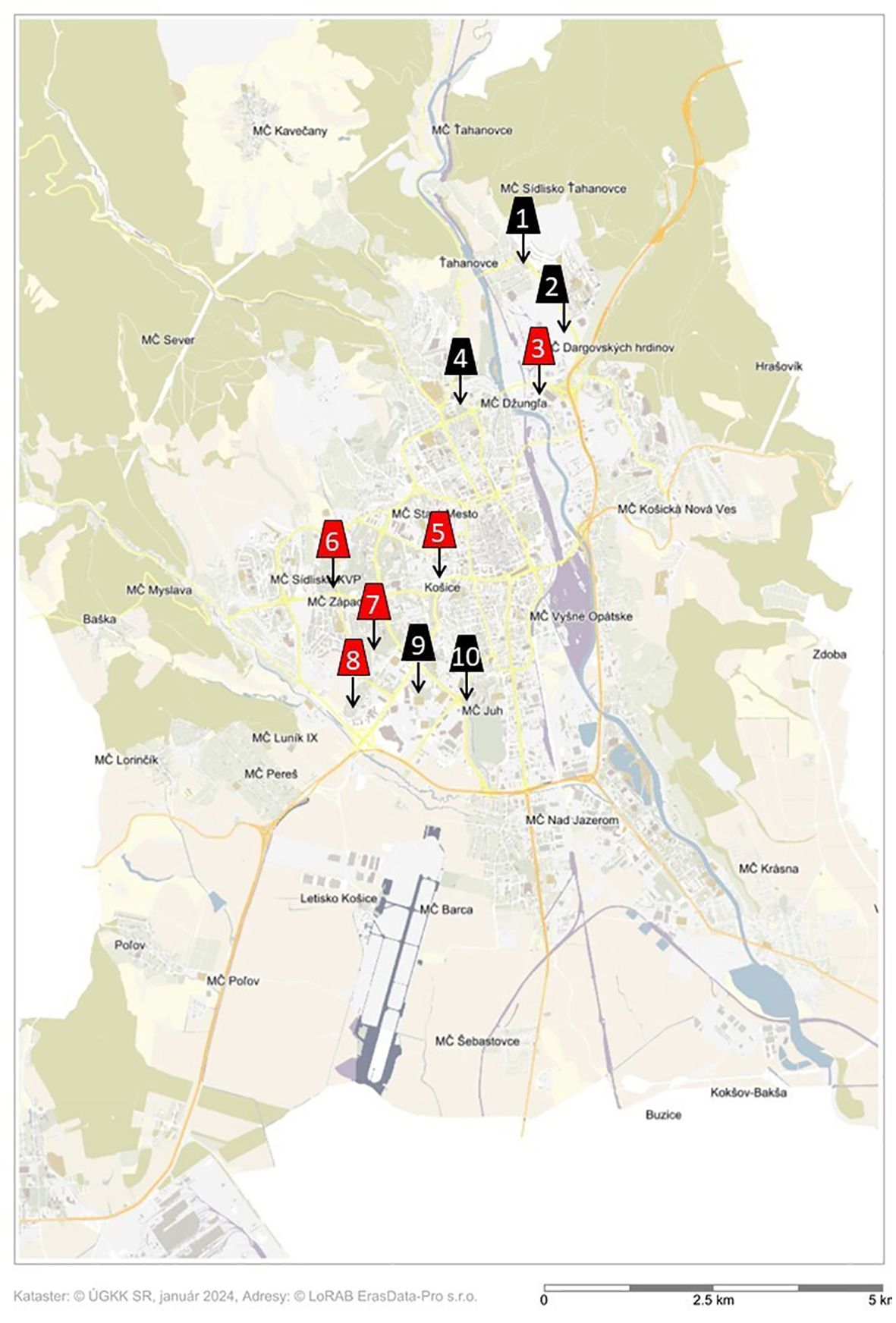
Figure 1. Collection areas in the city of Košice. The locations were divided into two areas (red colour = mixed woodland parks (WV) (areas no. 3, 5, 6, 7, 8); black colour = transition between the residential areas with scrubby and low neglected vegetation (SV) (areas no. 1, 2, 4, 9, 10).
2.2 Urban green localities
The city of Košice is situated at an altitude of 208 m above sea level and has a temperate climate, with average temperatures of 19°C in July and -3°C in January. The city has 229 040 inhabitants and population density is 939.8 inhabitants per square kilometre (Zeleňáková et al., 2015). Since 2023, the city is actively trying to renovate, revitalize and build new green spaces for its residents; those, however, will provide new habitats for ticks and their hosts. The urban greenery in Košice is a suitable environment for tick hosts, such as European hamster (Cricetus cricetus), birds, rodents, lizards and rabbits (Čanády, 2013; Čanády and Mošanský, 2017).
All of the ten examined locations were periodically visited over a period of three years in late February, during the peak seasonal activity of ticks in Slovakia – from March to June, in July and August, and then in September and October, which represent the season of the second peak activity of ticks. The criteria for the selection of locations were determined based on the goal to identify habitats with designated green spaces situated immediately in the urban area, without any connections to suburban green areas. The objective was to evaluate the tick population particularly in those urban green spaces that were defined as cohesive habitats characterised by unique microclimates. External influences, such as nearby forests or significant wildlife presence, were excluded in order to isolate the effects of urban green spaces on the tick populations. The locations were stratified by habitat type into two distinct categories: the category characterised by mixed woodland vegetation (WV), and the category delineated by scrubby, neglected vegetation (SV). In those regions, identical sampling sites with a minimum of 100 square meters were selected.
The collections were executed on rainless days. Ticks were collected from vegetation by applying the linear flagging technique along roadsides, trails, and green areas at a distance of 100 m (the measure of relative tick density/number of ticks per 100 square meters). Ticks collected in scrub habitats were sampled after 15 minutes, while the relative tick density was determined as the number of ticks/15 min, which corresponded to approximately 100 square meters. Only nymphs and adults were collected and a comprehensive data set was created. The sampling was carried out from 10:00 a.m. to 03:00 p.m. The temperature in those locations on the collection days ranged between 5°C and 30°C, while the relative humidity ranged between 53% and 86%.
2.3 Statistical analysis
Density of ticks was compared on the annual basis (2021–2023) using Kruskal-Wallis test. The Chi-square test was used to statistically investigate the difference between the WV and SV locations in terms of tick species presence. The comparison of individual months of tick species and stages presence in respective years was conducted using the mixed-model ANOVA and Bonferroni Post-hoc-test. For all the tests, the significance thresholds were defined as p < 0.05. The statistical analyses were performed using DATAtab (datatab.net).
3 Results
During the observation period from February to October in 2021 to 2023, extensive collection efforts resulted in the collection of 3448 ticks (as detailed in Table 1). The main tick species that was found during the study period was I. ricinus 2232/3448 (64.7%) (n = 603 nymphs, n = 839 females, n = 790 males). In addition, D. reticulatus emerged as the second most abundant species with 1210 individuals collected (35.2% of the total), consisting of 688 females and 522 males. The last identified tick species was D. marginatus 6/3448 (0.1%), (n = 6 females). No nymphs of D. reticulatus or D. marginatus were found.

Table 1. Abundance of questing ticks in green spaces in the city of Košice (Eastern Slovakia).
The Kruskal-Wallis test proved differences between the collection years and showed a significant increase in the abundance of D. reticulatus throughout the study years: H = 6.8155 (2, N = 30), p = 0.03312. However, non-significant differences were observed for I. ricinus ticks and ticks in general: H = 0.8852 (2, N=30) and p = 0.64238 versus H = 1.3168 (2, N = 30) and p = 0.51769, respectively. The highest number of ticks was collected in 2023 (p = 0.02) under consistent conditions in the analysed locations. The lowest number of ticks was collected in 2021 (Figure 2).
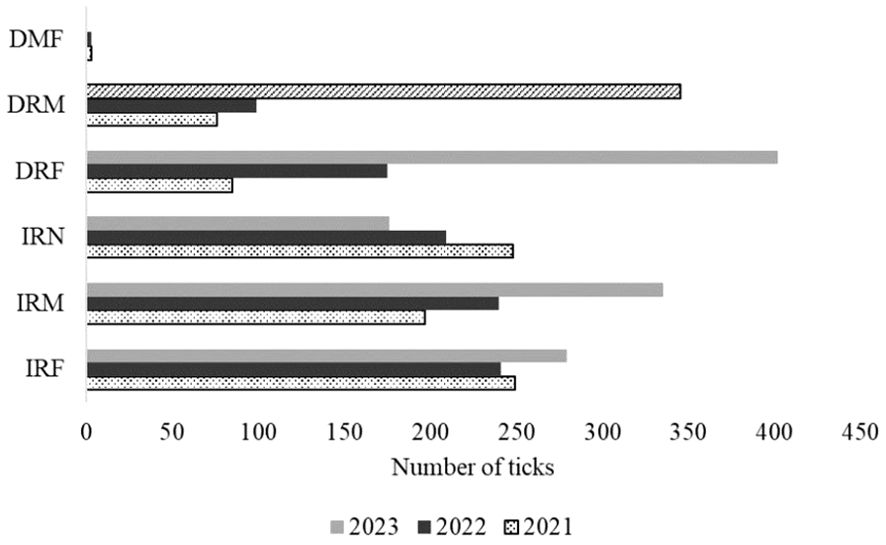
Figure 2. Yearly collection of ticks, divided according to species and stages. (IRF, I. ricinus female; IRM, I. ricinus male; IRN, I. ricinus nymph; DRF, D. reticulatus female; DRM, D. reticulatus male; DMF, D. marginatus female).
3.1 Effect of habitat types on the tick prevalence
The number of ticks collected in the SV areas (55.9%, 1929/3448) was higher than that in WV areas (44.5%, 1533/3448). The density of all ticks per 100 square meters was 385.5 in SV areas and 306.6 in WV areas; 88.6% (1072/1210) of D. reticulatus were collected in SV areas, while only 13.1% (158/1210) were collected in WV areas. Insignificant differences were found for I. ricinus ticks; the detection rate for WV was 61.6% (1375/2232) while for SV it was 38.4% (857/2232) (Figure 3). The density of D. reticulatus was 214 in the SV areas and only 31.5 in the WV areas per 100 square meters.
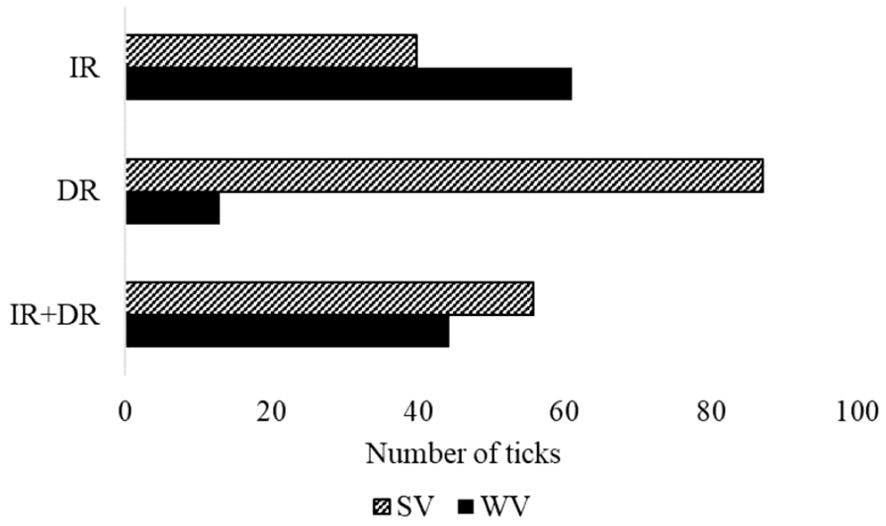
Figure 3. Comparison of the number of ticks, separately for I. ricinus (IR), D. reticulatus (DR), and for both species, collected from two different sampling sites: WV (Woodland Vegetation) and SV (Scrubby Vegetation).
The Chi-squared test demonstrated a significant difference in tick counts between “WV” and “SV” locations for D. reticulatus and I. ricinus (p = 0.001). Data for D. marginatus was not included in the statistical analysis since the values identified were too low. In particular, D. reticulatus showed preference for the “SV” locations over “WV” locations (p = 0.03), whereas no statistically significant difference in location preferences was observed for I. ricinus (p = 0.15). The analysis of the WV and SV locations and the overall tick count did not exhibit any significant effect (p = 0.669).
3.2 Monthly tick density
Monthly densities of nymphal and adult I. ricinus and adult D. reticulatus in the individual locations ranged from 0 to 135 ticks/100 square meters in 2021, with an average of 25 ticks/100 square meters, from 0 to 121 ticks/100 m² in 2022 with an average of 26 ticks/100 square meters and from 0 to 121 ticks/100 square meters, with an average of 30 ticks/100 square meters in 2023. Average monthly densities of I. ricinus, D. reticulatus and D. marginatus per 100 square meters for each yearare presented in Table 2.
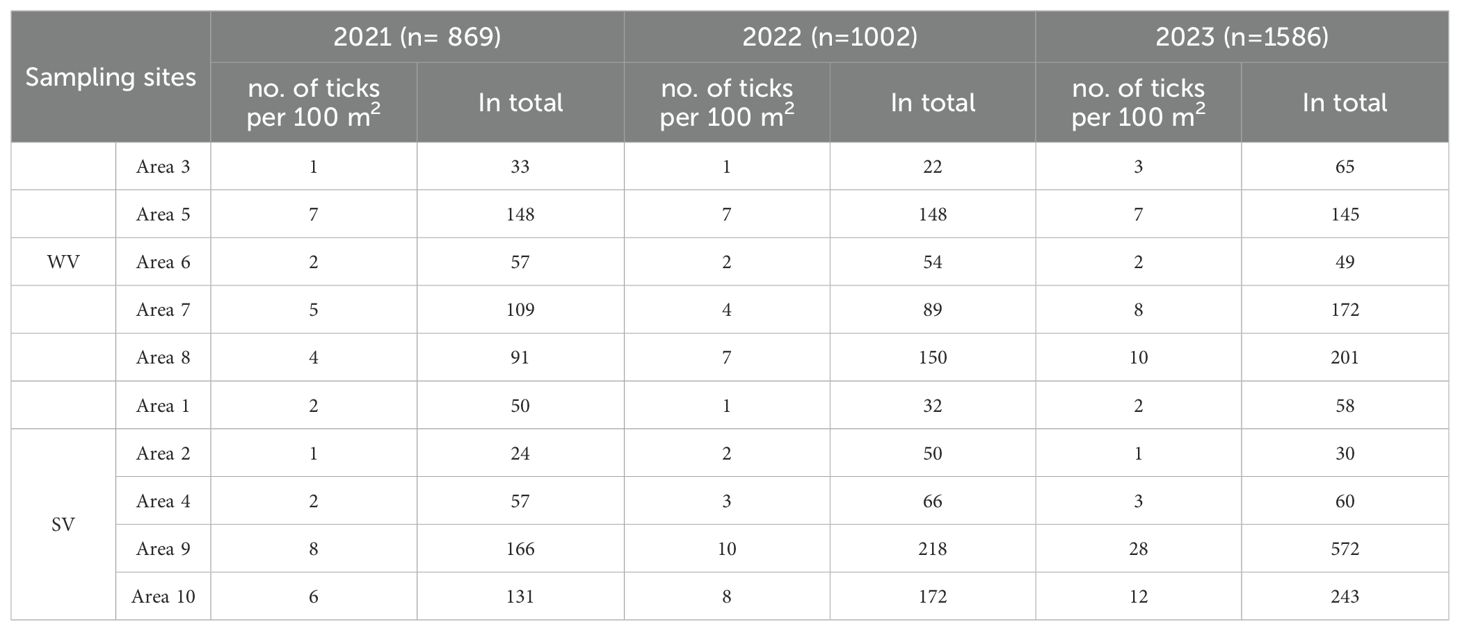
Table 2. The annual monthly density of questing ticks per 100 square meters and the overall tick count for each location in the period from February to October in years 2021, 2022, and 2023 in Košice, Eastern Slovakia; WV represents the woodland vegetation and SV represents the scrubby vegetation.
In 2022 and 2023, the activity of ticks began relatively early – in the first decade of February, with D. reticulatus females being the most active. They were most abundantly collected in SV locations. In 2021, both tick species began their activity in March. Ixodes ricinus exhibited its typical double–peak questing activity, with the highest occurrence in spring (April) and in autumn (October). Nymphs of I. ricinus exhibited the highest activity in April and then it sharply declined. Dermacentor reticulatus became active again with the onset of autumn. Dermacentor marginatus was only present in spring (March) in years 2021 and 2022. Afterwards, that species was not detected in any of the analysed locations. Dermacentor reticulatus has not been observed in the centre of Košice thus far.
The individual months were also compared in term of tick counts. Tick activity was observed in all collection months, with a marked peak of total tick abundance in April (2022) for I. ricinus and in February (2023) for D. reticulatus. In all the study years, the trend of increased tick activity was observed in autumn (October) (Figure 4). Based on the results of the mixed model ANOVA and the Bonferroni Post-hoc-test, no significant differences were found in sex of I. ricinus ticks and in the number of nymphs. A statistically significant difference in sex was observed for D. reticulatus ticks; in particular females were significantly more abundant in vegetation than males (p=0.03).

Figure 4. The graphical representation of tick activity during the studied years and in individual months of tick collection. (IRF, I. ricinus female; IRM, I. ricinus male; IRN, I. ricinus nymph; DRF, D. reticulatus female; DRM, D. reticulatus male; DMF, D. marginatus female).
4 Discussion
Ticks are often linked to rural and wooded environments due to their preference for habitats with dense vegetation and natural wildlife hosts. However, increasing evidence indicates that ticks are also inhabiting urban areas, where they pose potential health risks to city residents (Špitalská et al., 2014; Akimov and Nebogatkin, 2016). The presence of three tick species, I. ricinus, D. reticulatus, and D. marginatus, in confined green spaces in Košice, Eastern Slovakia, was clearly confirmed by the findings of this study. The study also highlighted increasing abundance of ticks, especially of the D. reticulatus species, in urban agglomeration. It was observed that there are suitable conditions for their survival and that they have adapted to the urban environment.
In general, the primary focus of scientific research is the expansion of D. reticulatus ticks into regions and urban areas where they have scarcely been observed in the past (Karbowiak, 2014; Olivieri et al., 2017; Kohn et al., 2019). Adults are typically active from March, with the peak in April (Földvári et al., 2016). The observations made in this study demonstrate that D. reticulatus begin their activity in early February; this may have been caused by elevated temperatures in winter in the analysed years. According to the Slovak Hydrometeorological Institute (SHMU), the temperatures in February 2023 were above the average, reaching 10°C on average per day; this is an ideal temperature for tick questing. Zahler (1994) discovered that those ticks can tolerate a temperature of -10°C for up to 150 days in laboratory conditions. This ability provides them an evolutionary advantage over the other tick species. The questing temperature limits also vary, depending on the ticks’ physiological age. The lowest temperature at which activity of D. reticulatus adults was observed in vegetation was 3.3°C (at 09:00 a.m.) (Földvári et al., 2016). The fact that they can survive extreme temperatures, as described by Zahler (1994), clearly shows the reason why their population in Košice, with its temperate climate, remains stable. Ixodes ricinus is frequently observed in urban settings, especially in city parks, gardens, and other green areas where appropriate hosts and favourable microclimates are present (Rizzoli et al., 2014). In the United Kingdom, different tick activity results were observed, which may be attributed to the microclimates of the individual areas that locally exhibit different temperatures and humidity levels. Those variations in ticks’ activity probably reflect the ticks’ response to the local microclimatic conditions of habitats (UK Health Security Agency, 2023). In cities, such conditions may occur, for example, when heat escapes from buildings on the leeward sides, where residential buildings act as windbreaks, or near heat ducts above the ground. Cities may be more dangerous and conducive to the survival and activity of ticks. Despite the varying climatic conditions that are influenced by the heat released from buildings, the typical tick activity has not changed. The findings of this study indicated that ticks were active throughout all the study period, with a notable peak in I. ricinus abundance in April 2022 and in D. reticulatus abundance in February 2023. Additionally, the number of ticks decreased each summer, followed by a steady rise in autumn, especially in October. During the collections, no larvae or nymphs of D. reticulatus ticks were found. This may have been caused by the fact that the primary hosts for D. reticulatus larvae are voles (while mice are hosts for I. ricinus), which have burrows and nests located as deep as 50 cm underground (Zachos, 2008). Larvae and nymphs of D. reticulatus are generally nidicolous, but engorged and fertilized females detach from the host anywhere and lay eggs on the surface (Pfäffle et al., 2015). Hatched larvae are much faster than I. ricinus larvae and can thus occupy larger areas, up to several square meters; they pursue an active host-seeking strategy, so they do not wait on vegetation for hosts (Fil’chagov and Lebedeva, 1988).
The occurrence of D. reticulatus has been observed in the Košice agglomeration since 2015 in areas adjacent to the surrounding forests and in the wetland areas around lakes and rivers in the vicinity of Košice, which is the typical environment for D. reticulatus. Dermacentor marginatus ticks were only found at the place of confluence of the Torysa and Hornád rivers in the period from 2017 to 2019, along with D. reticulatus (Stanko, 2021; Stanko et al., 2022). However, D. reticulatus and D. marginatus were initially detected right in the centre of Košice, in scrubby, dry, neglected areas that are used as passages between the residential buildings. Dry biotopes cover most of the areas of Spain and Portugal; D. reticulatus are therefore absent in majority of those areas. However, they have been observed in the northern parts of those countries. Thus, this tick species also exists in a continental climate (Estrada-Peña et al., 2013). The occurrence of D. reticulatus in areas that are not their typical habitats may result in their high adaptability and resistance to the external environment, high reproductive capacity, rapid development into adults, low mortality rates, longevity, tolerance to starvation, large blood meal, over 60 hosts and summer diapause (Földvári et al., 2016). A typical habitat for I. ricinus includes deciduous and mixed forests where they thrive in areas with dense underbrush and high humidity (Gray, 2008). The presence of I. ricinus in such habitats was also confirmed by the findings of this study, as the ticks were observed in forested areas in the city of Košice. Stein et al. (2008) found a negative association with dense vegetation. Vegetation density can also impact tick abundance, as very dense vegetation is not commonly found in urban areas. The findings of the present study emphasise the significance of taking into account geographical and ecological factors when researching tick distribution and habitat preferences. The occurrence of ticks in urban areas is a significant problem, underscoring the importance of monitoring their presence and taking preventive measures, such as vegetation maintenance. Understanding the distribution and behaviour of ticks in urban environments is crucial for effective public health management strategies. Increased human activity in urban green spaces elevates the risk of contact with ticks. Activities such as walking, jogging, and recreational pursuits bring people into closer proximity to tick habitats. Moreover, urban gardens and backyard habitats can attract wildlife hosts like rodents and birds, which represent reservoirs for ticks and amplify their presence in urban settings. Therefore, the role of each individual in maintaining a safe urban environment is paramount.
5 Conclusions
In conclusion, this study provides valuable insights into the abundance and distribution of I. ricinus and D. reticulatus in urban greenery, particularly in Košice, Eastern Slovakia. The presence of D. reticulatus was observed right in the centre of the city, in areas that are not their typical habitats. The findings of this study suggest that urban green spaces, especially those with scrubby, neglected vegetation, are suitable habitats for this tick species. Significant differences were noted in tick abundance between the woodland and the scrubby vegetation areas, with D. reticulatus being predominantly found in the latter. Monthly tick densities varied across years, with D. reticulatus activity starting as early as in February, possibly due to rising winter temperatures. Therefore, effective public health management strategies should incorporate efforts aimed at understanding the tick presence and behaviour in urban environments, given the increased human interaction with tick habitats in urban green spaces. It is essential to monitor and maintain vegetation in urban areas in order to reduce the risk of tick infestations.
Data availability statement
The original contributions presented in the study are included in the article/supplementary material. Further inquiries can be directed to the corresponding author.
Ethics statement
The manuscript presents research on animals that do not require ethical approval for their study.
Author contributions
BH: Data curation, Investigation, Writing – original draft. ZC: Investigation, Resources, Writing – review & editing. BP: Formal analysis, Investigation, Writing – review & editing. AO: Formal analysis, Writing – review & editing. JL: Investigation, Resources, Writing – review & editing. MD: Conceptualization, Writing – review & editing.
Funding
The author(s) declare financial support was received for the research, authorship, and/or publication of this article. This research was funded by Scientific Grant Agency of the Ministry of Education of Slovak Republic and the Slovak Academy of Sciences VEGA, grant number 1/0287/22.
Conflict of interest
The authors declare the research was conducted in the absence of any commercial or financial relationships that could be construed as a potential conflict of interest.
Publisher’s note
All claims expressed in this article are solely those of the authors and do not necessarily represent those of their affiliated organizations, or those of the publisher, the editors and the reviewers. Any product that may be evaluated in this article, or claim that may be made by its manufacturer, is not guaranteed or endorsed by the publisher.
References
Akimov I. A., Nebogatkin I. V. (2016). Ixodid ticks (Acari, Ixodidae) in urban landscapes. A review. Vestn. Zool. 50, 155–162. doi: 10.1515/vzoo-2016-0018
Anderson J. F., Magnarelli L. A. (2008). Biology of ticks. Infect. Dis. Clin. North Am. 22, 195–215. doi: 10.1016/j.idc.2007.12.006
Beati L., Klompen H. (2019). Phylogeography of ticks (Acari: ixodida). Annu. Rev. Entomol. 64, 379–397. doi: 10.1146/annurev-ento-020117-043027
Bona M., Blaňárová L., Stanko M., Mošanský L., Čepčeková E., Víchová B. (2022). Impact of climate factors on the seasonal activity of ticks and temporal dynamics of tick-borne pathogens in an area with a large tick species diversity in Slovakia, Central Europe. Biologia 77, 1619–1631. doi: 10.1007/s11756-021-00902-x
Brownstein J. S., Holford T. R., Fish D. (2003). A climate-based model predicts the spatial distribution of the Lyme disease vector Ixodes scapularis in the United States. Environ. Health Perspect. 111, 1152–1157. doi: 10.1289/ehp.6052
Buczek A., Ciura D., Bartosik K., Zając Z., Kulisz J. (2014). Threat of attacks of Ixodes ricinus ticks (Ixodida: Ixodidae) and Lyme borreliosis within urban heat islands in south-western Poland. Parasitol. Vectors 7, 62. doi: 10.1186/s13071-014-0562-y
Čanády A. (2013). New site of the European hamster (Cricetus cricetus) in the urban environment of Košice city (Slovakia). Zool. Ecol. 23, 61–65. doi: 10.1080/21658005.2013.769701
Čanády A., Mošanský L. (2017). Public cemetery as a biodiversity hotspot for birds and mammals in the urban environment of Kosice city (Slovakia). Zool. Ecol. 27, 185–195. doi: 10.1080/21658005.2017.1366024
Casati S., Sager H., Gern L., Piffaretti J.-C. (2006). Presence of potentially pathogenic Babesia sp. for human in Ixodes ricinus in Switzerland. Ann. Agric. Environ. Med. 13 (1).
Daniel M., Danielová V., Kříž B., Jirsa A., Nožička J. (2003). Shift of the tick Ixodes ricinus and tick-borne encephalitis to higher altitudes in central Europe. Eur. J. Clin. Microbiol. Infect. Dis. 22, 327–328. doi: 10.1007/s10096-003-0918-2
Daniel M., Materna J., Hönig V., Metelka L., Danielová V., Harčarik J., et al. (2009). Vertical distribution of the tick Ixodes ricinus and tick-borne pathogens in the northern Moravian mountains correlated with climate warming (Jeseníky Mts., Czech Republic). Cent. Eur. J. Public Health 17, 139–145. doi: 10.21101/cejph.a3550
Eisen L., Eisen R. J., Lane R. S. (2006). Geographical distribution patterns and habitat suitability models for presence of host-seeking ixodid ticks in dense woodlands of Mendocino County, California. J. Med. Entomol. 43, 415–427. doi: 10.1093/jmedent/43.2.415
Elmqvist T., Alfsen C., Colding J. (2008). “Urban Systems,” in Encyclopedia of Ecology Fath B, 2nd ed (Elsevier, Oxford), 452–458.
Estrada-Peña A. (2001). Distribution, abundance, and habitat preferences of Ixodes ricinus (Acari: Ixodidae) in Northern Spain. J. Med. Entomol. 38, 361–370. doi: 10.1603/0022-2585-38.3.361
Estrada-Peña A., Farkas R., Jaenson T. G. T., Koenen F., Madder M., Pascucci I., et al. (2013). Association of environmental traits with the geographic ranges of ticks (Acari: Ixodidae) of medical and veterinary importance in the western Palearctic. A digital data set. Exp. Appl. Acarol. 59, 351–366. doi: 10.1007/s10493-012-9600-7
Estrada-Peña A., Venzal J. M., Sánchez Acedo C. (2006). The tick Ixodes ricinus: distribution and climate preferences in the western Palaearctic. Med. Vet. Entomol. 20, 189–197. doi: 10.1111/j.1365-2915.2006.00622.x
Fil’chagov A. V., Lebedeva N. N. (1988). The ecology of hungry larvae of Dermacentor reticulatus and their relation to food hosts under natural conditions. Parazitologiia 22, 366–371.
Földvári G., Široký P., Szekeres S., Majoros G., Sprong H. (2016). Dermacentor reticulatus: a vector on the rise. Parasitol. Vectors 9, 314. doi: 10.1186/s13071-016-1599-x
Gern L. (2008). Borrelia burgdorferi sensu lato, the agent of lyme borreliosis: life in the wilds. Parasite 15, 244–247. doi: 10.1051/parasite/2008153244
Gray J. S. (2008). Ixodes ricinus seasonal activity: Implications of global warming indicated by revisiting tick and weather data. Int. J. Med. Microbiol. 298, 19–24. doi: 10.1016/j.ijmm.2007.09.005
Gray J. S., Kahl O., Lane R. S., Levin M. L., Tsao J. I. (2016). Diapause in ticks of the medically important Ixodes ricinus species complex. Ticks Tick Borne Dis. 7, 992–1003. doi: 10.1016/j.ttbdis.2016.05.006
Guglielmone A. A., Robbins R. G., Apanaskevich D. A., Petney T. N., Estrada-Peña A., Horak I. G. (2014). The Hard Ticks of the World: (Acari: Ixodida: Ixodidae) (Dordrecht, Netherlands: Springer Science & Business Media).
Karbowiak G. (2014). The occurrence of the Dermacentor reticulatus tick - its expansion to new areas and possible causes. Ann. Parasitol. 60, 34–47.
Kazimírová M., Hamšíková Z., Kocianová E., Marini G., Mojšová M., Mahríková L., et al. (2016). Relative density of host-seeking ticks in different habitat types of south-western Slovakia. Exp. Appl. Acarol. 69, 205–224. doi: 10.1007/s10493-016-0025-6
Kohn M., Krücken J., McKay-Demeler J., Pachnicke S., Krieger K., von Samson-Himmelstjerna G. (2019). Dermacentor reticulatus in Berlin/Brandenburg (Germany): Activity patterns and associated pathogens. Ticks Tick Borne Dis. 10, 191–206. doi: 10.1016/j.ttbdis.2018.10.003
Materna J., Daniel M., Danielová V. (2005). Altitudinal distribution limit of the tick Ixodes ricinus shifted considerably towards higher altitudes in central Europe: results of three years monitoring in the Krkonose Mts. (Czech Republic). Cent. Eur. J. Public Health 13, 24–28.
Mierzejewska E. J., Pawełczyk A., Radkowski M., Welc-Falęciak R., Bajer A. (2015). Pathogens vectored by the tick, Dermacentor reticulatus, in endemic regions and zones of expansion in Poland. Parasitol. Vectors 8, 490. doi: 10.1186/s13071-015-1099-4
Olivieri E., Gazzonis A. L., Zanzani S. A., Veronesi F., Manfredi M. T. (2017). Seasonal dynamics of adult Dermacentor reticulatus in a peri-urban park in southern Europe. Ticks Tick-borne Dis. 8, 772–779. doi: 10.1016/j.ttbdis.2017.06.002
Pangrácová L., Derdáková M., Pekárik L., Hviščová I., Víchová B., Stanko M., et al. (2013). Ixodes ricinus abundance and its infection with the tick-borne pathogens in urban and suburban areas of Eastern Slovakia. Parasit Vectors 6, 238. doi: 10.1186/1756-3305-6-238
Parola P., Paddock C. D., Raoult D. (2005). Tick-borne rickettsioses around the world: emerging diseases challenging old concepts. Clin. Microbiol. Rev. 18, 719–756. doi: 10.1128/CMR.18.4.719-756.2005
Pfäffle M., Littwin N., Petney T. (2015). Host preferences of immature Dermacentor reticulatus (Acari: Ixodidae) in a forest habitat in Germany. Ticks Tick Borne Dis. 6, 508–515. doi: 10.1016/j.ttbdis.2015.04.003
Rizzoli A., Silaghi C., Obiegala A., Rudolf I., Hubálek Z., Földvári G., et al. (2014). Ixodes ricinus and its transmitted pathogens in urban and peri-urban areas in Europe: New hazards and relevance for public health. Front. Public Health 2. doi: 10.3389/fpubh.2014.00251
Rubel F., Brugger K., Pfeffer M., Chitimia-Dobler L., Didyk Y. M., Leverenz S., et al. (2016). Geographical distribution of Dermacentor marginatus and Dermacentor reticulatus in Europe. Ticks Tick Borne Dis. 7, 224–233. doi: 10.1016/j.ttbdis.2015.10.015
Savard J.-P. L., Clergeau P., Mennechez G. (2000). Biodiversity concepts and urban ecosystems. Landsc. Urban Plan. 48, 131–142. doi: 10.1016/S0169-2046(00)00037-2
Siuda K. (1993). Kleszcze Polski (Acari: Ixodida).: Systematyka i rozmieszczenie (Lodz, Poland: Polskie Towarzystwo Parazytologiczne), 357, ISBN: 9788390134901.
Špitalská E., Boldiš V., Derdáková M., Selyemová D., Rusňáková Tarageľová V. (2014). Rickettsial infection in Ixodes ricinus ticks in urban and natural habitats of Slovakia. Ticks Tick Borne Dis. 5, 161–165. doi: 10.1016/j.ttbdis.2013.10.002
Stanko M. (2021). Kliešte a ich epidemiologický význam v mestách: (na príklade košickej aglomerácie) (Bratislava, Slovakia: VEDA, vydavateľstvo Slovenskej akadémie vied).
Stanko M., Derdáková M., Špitalská E., Kazimírová M. (2022). Ticks and their epidemiological role in Slovakia: from the past till present. Biologia 77, 1575–1610. doi: 10.1007/s11756-021-00845-3
Stein K. J., Waterman M., Waldon J. L. (2008). The effects of vegetation density and habitat disturbance on the spatial distribution of ixodid ticks (Acari: Ixodidae). Geospatial Health 2, 241–252. doi: 10.4081/gh.2008.247
Svitálková Z., Haruštiaková D., Mahríková L., Berthová L., Slovák M., Kocianová E., et al. (2015). Anaplasma phagocytophilum prevalence in ticks and rodents in an urban and natural habitat in South-Western Slovakia. Parasitol. Vectors 8, 276. doi: 10.1186/s13071-015-0880-8
UK Health Security Agency (2023). Health effects of climate change (HECC) in the UK (London United Kingdom: GOV), 28.
Uspensky I. (2014). Tick pests and vectors (Acari: Ixodoidea) in European towns: Introduction, persistence and management. Ticks Tick Borne Dis. 5, 41–47. doi: 10.1016/j.ttbdis.2013.07.011
Vail S. G., Smith G. (1998). Air temperature and relative humidity effects on behavioral activity of blacklegged tick (Acari: Ixodidae) nymphs in New Jersey. J. Med. Entomol. 35, 1025–1028. doi: 10.1093/jmedent/35.6.1025
Zachos F. E. (2008). Die säugetiere baden-württembergs band 2. Mamm. Biol. 73, 254. doi: 10.1016/j.mambio.2007.07.003
Zahler M. (1994). Zur Ökologie von Dermacentor reticulatus (Fabricius 1794) (Parasitiformes: Ixodida: Ixodidae). Diss. Med. Vet., 127p.
Keywords: ticks, urban habitat, Košice city, public health, green spaces
Citation: Hajdová B, Cellengová Z, Peťko B, Ondrejková A, Lipinský J and Drážovská M (2024) Tick population dynamics in the city of Košice (Eastern Slovakia): a public health study. Front. Ecol. Evol. 12:1466131. doi: 10.3389/fevo.2024.1466131
Received: 18 July 2024; Accepted: 05 November 2024;
Published: 21 November 2024.
Edited by:
Samson Mukaratirwa, Ross University School of Veterinary Medicine, Saint Kitts and NevisReviewed by:
Maria Kazimirova, Slovak Academy of Sciences, SlovakiaBenjamin Cull, University of Minnesota Twin Cities, United States
Copyright © 2024 Hajdová, Cellengová, Peťko, Ondrejková, Lipinský and Drážovská. This is an open-access article distributed under the terms of the Creative Commons Attribution License (CC BY). The use, distribution or reproduction in other forums is permitted, provided the original author(s) and the copyright owner(s) are credited and that the original publication in this journal is cited, in accordance with accepted academic practice. No use, distribution or reproduction is permitted which does not comply with these terms.
*Correspondence: Monika Drážovská, bW9uaWthLmRyYXpvdnNrYUB1dmxmLnNr