Abstract
Introduction:
TransformEd targets initial teacher education (ITE) to equip future teachers with innovative strategies that increase physical activity in the Primary school classroom.
Methods:
This hybrid implementation-effectiveness trial investigated the effects of the TransformEd program when embedded in ITE degrees at two Australian universities (University 1 Single Unit offering; University 2 Dual Unit offering) over a 12-week period, on pre-service teachers’ perceived competence, confidence, and willingness to deliver active pedagogies, in comparison with a third ‘usual practice’ control university.
Results:
There was a favourable intervention effect on the total teacher perceptions score among pre-service teachers in University 1 compared to the control group pre-service teachers. Further, there was a significant intervention effect on reduced perceived barriers to active strategies in University 1, and a significant increase in perceived effects of active strategies on Primary school student outcomes in University 2. Qualitative data suggested the program strengthened the connection between theory and practice (i.e., how pre-service teachers are educated in university and the way they teach in Primary schools). The program was motivating to both lecturers and pre-service teachers, resulted in them reflecting on their own teaching practice, and helped with pre-service teacher engagement.
Discussion:
Recommendations for improvement included stronger and more explicit alignment with the Australian Professional Standards for Teachers.
Introduction
Physical activity is essential for healthy development in children (Poitras et al., 2016). Further, physical activity is increasingly being demonstrated to improve facets of psychological, emotional and intellectual development such as concentration, behavior, cognitive function and academic achievement (Tomporowski and Pesce, 2019; Valkenborghs et al., 2019). In Australia, only 26% of children (5-12 years of age) meet the government guidelines of accumulating at least 60 min of moderate-to-vigorous physical activity per day (Australian Institute of Health and Welfare, 2018). It is somewhat contradictory, then, that the current norm in many primary school settings is for students to sit for at least 70% of the school day (Arundell et al., 2019). Therefore, the classroom offers an ideal setting to enhance children’s physical activity and simultaneously improve their academic and other developmental outcomes (Salmon et al., 2020).
Several studies have reported improvements in academic results by increasing children’s physical activity during class time (Martin and Murtagh, 2017). Further, increasing classroom-based physical activity generates behavioural benefits such as time-on-task and selective attention (Watson et al., 2017). A systematic review of school-based physical activity interventions concluded that they are an inexpensive, practical and timely means of improving academic outcomes (Watson et al., 2017). One example of a successful school-based intervention that enhances physical activity is TransformUs.1 It uses innovative behavioral and pedagogical strategies within the classroom, at school, and at home to support Primary school children to be more active and more engaged in their learning, improve their educational outcomes and benefit their health (Salmon et al., 2011). At 6 months, the intervention was found to be effective in supporting physical activity and reducing sedentary time among 7–9-year-old Australian children (Carson et al., 2013; Yıldırım et al., 2014; Verswijveren et al., 2022; Salmon et al., 2023), and has been adapted for broad scale implementation. Challenges, however, with TransformUs and similar school-based physical activity initiatives is scalability (ensuring an evidence-based initiative reaches large numbers of schools, teachers and children) and sustainability (embedding an initiative into the education system so that it is not just another ‘fad’ which disappears after a period of time; Lai et al., 2014; Nathan et al., 2018).
Factors known to influence school-based physical activity intervention sustainability and effectiveness include lack of time, teacher overload and competing demands (Lai et al., 2014; Naylor et al., 2015; Nathan et al., 2018; Cassar et al., 2019). It has been argued that brief professional development models are not optimal for sustained changes in pedagogical practices (Nawab et al., 2021), even with organizational and environmental support. Thus, integrating innovative behavioral, pedagogical and environmental strategies into undergraduate or initial teacher education (ITE), rather than or in addition to professional development, may be a more effective and sustainable approach. Further, given the broad spread of schools graduating teachers will end up in, this approach may also help with reach and scale-up. In general, the quality of ITE has a significant impact on learning and teaching outcomes; however, little is known about the effectiveness of physical activity interventions in ITE (Korthagen et al., 2006; Milat et al., 2013; Lander et al., 2017). Therefore, a focus on ITE may provide an underutilized pathway for intervention success, sustainability and reach.
One potential benefit of delivering interventions within ITE is the ability to enhance features known to maximize professional development effectiveness, such as content focus (i.e., deepening knowledge), extended duration (e.g., scaffolded across years), active learning (e.g., interactive tasks), coherence (i.e., building on what participants already know), and collective participation (i.e., participants working together; Nawab et al., 2021). Ideally, ITE should prepare graduates for classroom teaching with a solid understanding of teaching practices that optimize student learning (Darling-Hammond, 2006; Teacher Education Ministerial Advisory Group, 2014). Despite the importance of ITE, the quality of courses has often been criticized for being poorly connected with practice and not informed by evidence, thereby inadequately preparing new graduates for teaching (Teacher Education Ministerial Advisory Group, 2014). Thus, embedding evidence based physical activity interventions in ITE may not only upskill future generations of teachers, but also provide an effective and sustainable way to implement school-based physical activity interventions and improve the current and future health and learning outcomes of Primary school students.
TransformEd is an evidence-based innovative behavioral, pedagogical and environmental intervention targeting physical activity that has been embedded into ITE at an Australian university (Lander et al., 2019, 2020). An adaptation of the effective TransformUs initiative (Carson et al., 2013; Yıldırım et al., 2014; Verswijveren et al., 2022; Salmon et al., 2023), TransformEd targets ITE to equip future teachers with innovative strategies that increase physical activity in the classroom, in their current and future teaching. The researchers used participatory action research (Kemmis and McTaggart, 2005) to co-create TransformEd with university stakeholders and lecturers. After being implemented, the feasibility and efficacy results indicated that TransformEd significantly enhanced pre-service teachers’ willingness, and perceived confidence and competence to deliver active pedagogies (Lander et al., 2019).
Using implementation theory to understand the translation of TransformEd from research to routine ITE practice, the reach, effectiveness, adoption, implementation and maintenance (RE-AIM; Glasgow et al., 1999) of the program was investigated across 2 years (2019 and 2020) of an ITE degree at the same university. The pre-service teachers’ perceived effectiveness of active strategies on Primary school student outcomes significantly increased and perceived barriers to integration decreased (Lander et al., 2020). High adherence was consistently reported, and the program was maintained after completion of the implementation trial by all lecturers. As such, embedding TransformEd in ITE appears be a promising pathway to advance the teaching capability of future teachers and may have the potential to transform the learning experience and physical and academic outcomes of Primary school students (Lander et al., 2020).
Although TransformEd demonstrated feasibility, maintenance and positive outcomes in relation to pre-service teachers’ perceived competence, this initiative has only been tested in an ITE degree of one university. A major limitation of research into school-based physical activity interventions is the lack of understanding regarding the implementation at a population-level (Brownson et al., 2017, 2018). Although the process of implementation (i.e., how evidence is adopted, adapted, implemented, and sustained) is increasingly understood (Glasgow et al., 2019), there is a major knowledge gap in the implementation across diverse settings and by different stakeholders (Rogers, 2003). This knowledge is needed to improve evidence-based practice within organizations and systems and for informing scale-up. Therefore the aims of this research were to expand the TransformEd program across two Australian Universities and: (i) explore the barriers and facilitators to program implementation when the program is implemented by different stakeholders (i.e., lecturers) across two different intervention settings (i.e., University 1: Single Unit offering; University 2: Dual Unit offering), as guided by RE-AIM; and (ii) investigate the effect of the two different program offerings, on pre-service teachers’ confidence, competence and willingness to integrate active strategies and pedagogies into current and future teaching, in comparison to a third ‘usual practice’ control university (University 3).
Methods
Conceptual models and theoretical frameworks
Rogers’ diffusion of innovations theory (Rogers, 2003) is the overarching theory, which helps explain how innovations are adapted, adopted and sustained across different settings by different stakeholders. The RE-AIM framework (Glasgow et al., 1999), which is designed to enhance the quality, speed and public health impact of efforts to translate research into practice, was used to guide the examination of this ‘diffusion’. Participatory action research (Kemmis and McTaggart, 2005), a well-used approach in education and health promotion research, was used to ensure participants (i.e., lecturers) were active contributors to the research, and had increased control over the adaptation, adoption and implementation of TransformEd (Kemmis and McTaggart, 2005). The delivery of the intervention to the pre-service teachers by lecturers was framed by practice architectures theory (Kemmis et al., 2013). Lecturers used practice architectures theory to enable pre-service teachers to critically interrogate existing teaching and ITE practices, and to create new possibilities for their teaching, particularly around pedagogies that facilitate and embody activity.
Study design
A horizontal hybrid scale-up implementation pathway (Rogers, 2003) was used to meet the study aims. The ‘horizontal scale up’ tested expansion of the intervention across different settings (i.e., across two universities). The ‘hybrid’ design enabled the simultaneous testing of intervention implementation across the two different settings by different stakeholders (i.e., lecturers), and the effectiveness of the intervention on pre-service teacher’s confidence, competence and willingness to integrate active strategies and pedagogies into current and future teaching.
Implementation
All implementation processes were guided and evaluated using the RE-AIM framework (Glasgow et al., 1999). Reach was operationalized as the count, proportion and representativeness of pre-service teachers and lecturers exposed to the program. Adoption was assessed based on the number, proportion and representativeness of settings and lecturers willing to deliver the program, and included information on lecturers’ motivation to adopt the program. Adoption also related to understanding how the intervention could vary between settings (i.e., universities, campuses, lecturers). Implementation was assessed in terms of fidelity or adherence to the intervention including consistency of delivery. It also included adaptations to intervention content and implementation strategies. Maintenance was defined as the extent to which the program could become part of routine practices and policies. It also reflected the perceived potential long-term impact of the program, or potential for sustainability.
Effectiveness
A 3-arm quasi-experimental pre-post non-equivalent group design was used to investigate the effectiveness of two different offerings of the intervention on pre-service teacher’s perceptions, in comparison to a control. Pre-service teachers’ perceptions were collected via online survey at the start of the Trimester/Semester, and follow-up measures were collected at the end of the Trimester/Semester, 3 months later. Assuming small to medium effects in self-reported perceived competence, confidence, and willingness to integrate active teaching pedagogies, a conservative estimation conducted using G*Power and parameters set at d = 0.25, two-tailed and α level = 0.05 suggested that a sample of 100 participants would be necessary to detect statistically significant differences over time (i.e., pre-post). Therefore, 40 pre-service teachers per university (n = 120 in total) as a minimum, were required to evaluate program effectiveness.
Recruitment and consent
All lecturers likely to be responsible for the delivery of the units/topic in which TransformEd was embedded (i.e., Intervention Groups - University 1: Single Unit offering; University 2: Dual Unit offering), were invited to participate. Lecturers from University 1 (Single Unit) had been involved in the training and implementation of the TransformEd program in the two previous years (Lander et al., 2019, 2020). Lecturer participation included professional learning, knowledge sharing and curriculum co-creation workshops (3 sessions), in-unit TransformEd program integration and subsequent program delivery, completion of three self-report adherence checklists, and post-program focus groups. One stakeholder (i.e., Course Director) and one lecturer from the control university (University 3) were invited to participate. This included facilitation of participant recruitment and data collection.
All 2021 first year Bachelor of Education (Primary) pre-service teachers enrolled at the two intervention universities (approx. 300 at University 1 and 150 at University 2), and all third year Bachelor of Education (Primary R-7) / Bachelor of Arts pre-service teachers from the control university (approx. 200), were invited to participate in the study. The study was advertised via direct emails, flyers and recruitment material posted on the online platform of units. A plain language statement was provided to all participants via email, and signed consent to participate was required. The study was approved by the University Human Ethics Advisory Group at all three universities (University 1 HAE-17-207; University 2 DCS CHEAN- 24033; University 3 HREC CIA4057).
All first year Bachelor of Education (Primary) pre-service teachers enrolled at the two intervention universities (University 1 and 2) were exposed to the TransformEd program (i.e., program implementation). To investigate the effectiveness of the program on pre-service teachers’ confidence, competence and willingness to integrate active strategies and pedagogies into current and future teaching, a sample of pre-service teachers receiving TransformEd from University 1 (single unit offering) and a sample receiving TransformEd from University 2 (dual unit offering) were recruited as the intervention group. Equal numbers of pre-service teachers not receiving TransformEd (i.e., University 3), were recruited as the control group.
Intervention phases
Table 1 describes the key concepts and components of the intervention program. Briefly, there are five key components to the intervention including: active academic lessons; active breaks from sitting; health lesson curriculum content; active environments and promoting physical activity during recess and lunch breaks; and engaging families. The intervention was adopted, adapted and implementation in three phases described below.
Table 1
| Key concept | Elaboration | Lecturer implementation strategy |
|---|---|---|
| Active academic lessons | Active lessons utilize incidental activity or embodied learning to change the delivery of a traditional seated class lesson. Active lessons help to create a positive environment for learning, and they also provide a platform for excellence in teaching | Modelled active academic teaching strategies in lectures and practical seminars |
| Integrated pedagogical theory (e.g., embodied pedagogy) and practice (e.g., skills, strategies, organizational and managerial concepts) to facilitate active academic lessons | ||
| Provided resources for active academic lessons | ||
| Provided opportunity for pre-service teachers to practice skills, strategies, organizational and managerial concepts required to teach active academic lessons | ||
| Provide opportunity for self, peer and lecturer feedback on pre-service teachers’ active academic micro-teaching | ||
| Active breaks from sitting | Short active breaks used interrupt prolonged periods of sitting. Active breaks can be used to complement lesson content using physical and visual reinforcement, introduce or summarise lesson content, Proactively manage the class and create a positive classroom environment | Modelled active beaks in lectures and seminars |
| Integrated pedagogical theory and practice (skills, strategies, organizational and managerial concepts) to facilitate active breaks | ||
| Provided active break resources | ||
| Provided opportunity for pre-service teachers to practice skills, strategies, organizational and managerial concepts required to break sitting time | ||
| Provided opportunity for self, peer and lecturer feedback on pre-service teachers’ active break micro-teaching | ||
| Health Lesson Curriculum Content | Class lessons, which aim to build skills and increase knowledge about the importance of being active and sitting less | Provided information around the importance of adequate physical activity |
| Provided resources for future teaching around the importance of physical activity | ||
| Provided opportunity for pre-service teachers to practice skills, strategies, organizational and managerial concepts required to deliver physical activity related content in micro-teaching | ||
| Provided opportunity for self, peer and lecturer feedback around their physical activity related content micro-teaching | ||
| Active environments/ promoting activity during recess and lunchtime | Signage, equipment, facilities, resources, policy and teacher encouragement/support to promote physical activity at recess and lunchtime | Delivered seminar/lecture focused on playground-based activities that facilitate PA at recess/lunchtime |
| Provided resources for playground-based activities | ||
| Provided opportunity for pre-service teachers to practice skills, strategies, organizational and managerial concepts required to facilitate playground-based activities, in micro-teaching | ||
| Provided opportunity for self, peer and lecturer feedback around their playground activities micro-teaching | ||
| Engaging families | Information and home-based activities provided for parents and children to engage with, to reinforce the importance of children being active and sitting less | Delivered seminar/lecture on active homework strategies that engage families and educate around the importance of increasing PA and decreasing sitting time at home. |
| Provided information around the importance of engaging families and the community when addressing physical activity behaviour (e.g., ecological model) | ||
| Provided active homework resources | ||
| Provided opportunity for active homework activities, micro-teaching | ||
| Provided opportunity for self, peer and lecturer feedback around their active homework tasks |
TransformEd key concepts and strategies.
Phase 1: The lead author worked with key senior academics and lecturers in the ITE degree at the two intervention universities (University 1 and 2) to identify relevant TransformEd units and teaching staff. Selected units included, as a minimum, 10 one-hour lectures and 10 two-hour practical workshops/seminars across the 12-week Trimester/Semester. Via a co-design approach, the lead researcher provided three 2-h interactive workshops to lecturers and worked with them to co-create, adapt and embed key components of the TransformEd program (see Table 1) within the selected unit curriculum. The aim was to align the TransformEd program with unit learning objectives and scaffold the program concepts to facilitate the development of unit specific teacher competencies (e.g., the use of active breaks as a proactive classroom management strategy).
Single unit/topic exposure (University 1): As in previous trials (Lander et al., 2019, 2020), all five components of TransformEd (see Table 1) were comprehensively embedded into a one core unit, which all Bachelor of Education (Primary) pre-service teachers complete in the first year of their ITE degree. The same lecturers who had been involved in previous years of the TransformEd program at this university, delivered it again in 2021. Dual-unit exposure (University 2): Various aspects of the TransformEd program were included in two core units in the first year of the Bachelor of Education (Primary) degree. Similar to above, all Bachelor of Education (Primary) undergraduates undertake these two core units/topic areas in the first year of the degree.
Phase 2: Lecturers of the targeted units at the intervention universities delivered the TransformEd key concepts (see Table 1) to all pre-service teachers enrolled in the units. The lecturers were encouraged to model the key concepts in their own teaching, incorporate the concepts into unit learning curriculum, content and assessment, and reinforce the content by providing peer-teaching opportunities. The lecturers were provided with a checklist of key implementation considerations for their planning and teaching (see Table 1). A comprehensive bank of over 200 TransformEd two-minute active breaks and over 300 TransformEd active academic lessons were provided to lecturers via a shared online folder. The active academic lessons covered numeracy, literacy, humanities, and science subject areas and were aligned with Australian and Victorian curriculum. These resources were also made available to the pre-service teachers by lecturers to use in their peer teaching and teaching placement.
Phase 3: The pre-service teachers had at least one extended (e.g., over 2 weeks) teaching placement in a Primary school in the first year of their ITE degree. Here, the pre-service teachers were encouraged to incorporate the TransformEd key concepts into their own teaching, providing transferability and relevance of the physically active pedagogical skills to the development of their teaching competencies (Williams et al., 2018).
Control
The control group (University 3) was the third year Bachelor of Education (Primary R-7)/Bachelor of Arts pre-service teachers. These pre-service teachers were exposed to their regular ITE and teacher placement. The third-year pre-service teachers were selected as the control group as first and second year pre-service teachers are not exposed to extended teaching placements at this university. In line with the intervention groups, the control group teaching placement was scheduled for a similar duration to the intervention groups.
Data collection
Mixed methods were used during the 12-week trial to investigate intervention implementation and effectiveness.
Implementation processes
Program reach data at the pre-service teacher level was collected through enrollment records provided by course directors at each university. For lecturers, reach data were collected via course directors, who provided a list of lecturers’ names who would be delivering first year units, and those willing to participate in the program. Adoption data were based on the number, proportion and representativeness of settings and lecturers who delivered the program. Aspects of implementation (i.e., program fidelity and adherence) were collected via online lecturer adherence checklists. The checklists were completed by each lecturer delivering the TransformEd program at three time points across the 12-week trial (i.e., early intervention-week 3, mid intervention-week 6 and late intervention-week 9). Lecturers indicated the implementation frequency on a 5-point Likert scale (1 = Never/No, 2 = Rarely, 3 = Sometimes, 4 = Often, 5 = As much as possible/Yes) for each implementation strategy under the five intervention components (see Table 1). One online focus group discussion with lecturers who delivered TransformEd, at each of the intervention universities, was conducted post-intervention to investigate their perceptions and insights regarding challenges and enablers of implementation via all five RE-AIM domains. The discussions were approximately 1 h in duration, and were guided by the ‘Key Considerations for Qualitative Data with RE-AIM’2 and the ‘RE-AIM Elements and Qualitative Data Questions and Examples’ (Holtrop et al., 2018), and aimed to facilitate in-depth discussion. ‘Member checking’ was performed during the focus groups by summarizing and relaying participant information to establish accuracy (Miles et al., 2013).
Effectiveness
To evaluate program effectiveness at the pre-service teacher level, baseline and follow-up self-report surveys were completed by a sample of consenting pre-service teachers in each of the two intervention groups, as well as a sample of consenting pre-service teachers from the control group. The survey has demonstrated high levels of reliability (Lander et al., 2019), and assessed pre-service teachers’: (i) willingness to integrate active teaching into professional practice (teaching) placements; (ii) perceived impact of increased physical activity and breaking up sitting time on student outcomes; (iii) confidence to integrate specific active teaching strategies within the classroom; (iv) confidence to integrate specific active teaching strategies beyond the classroom (i.e., during recess); (v) competence to effectively integrate specific active teaching strategies across the school day; and (vi) perceived barriers to the delivery of active lessons. There were five to 15 items per construct and survey responses were based on a 5-point Likert scale (1 = strongly disagree to 5 = strongly agree).
Data analysis
Implementation processes
Descriptive statistics were used to report on the counts and proportions related to program reach and adoption. Descriptive statistics were calculated to indicate lecturers’ self-reported implementation adherence to the program, which was summarized by each of the five key TransformEd components. For each key component, summary statistics were calculated in regard to their adherence to each of the lecturer implementation strategies (see Table 1). All lecturer focus groups were transcribed verbatim and saved using a digital text editor (i.e., Microsoft Word 2018, Version 1806, Microsoft, Redmond, WA, United States). Participants were emailed a copy of the transcript to review interpretive accuracy. The transcripts were read, manually coded and collated into categories relevant to each domain of the RE-AIM framework. Coding reliability was conducted by two authors (NS and NL), who also completed reliability testing for approximately 30 min of the focus group data (approx. 33%). Coding decisions were compared, and divergent choices were discussed until agreement was found. The remaining data analysis was conducted by NL, and the accuracy of the coding process was verified by NS.
Effectiveness
After reversing the scores of ten negatively valued statements within the survey, we calculated baseline and follow-up total scores for each domain of the survey by summing up the scores of the related items. Additionally, we derived an overall score by adding up the score of each domain except for Barriers, which was subtracted from the total. These scores were used for subsequent analysis. Linear mixed models were used to determine effectiveness of the intervention by exploring group differences in changes over time in pre-service teachers’ self-reported willingness, confidence, competence, teaching effectiveness, and barriers related to active pedagogic strategies. The fixed effect equation included time (i.e., baseline, post-intervention), group (control, University 1: single unit, University 2: dual unit), time × group interaction, and was adjusted for the potential confounding effects of pre-service teachers’ sex, and age. Random effects were calculated for the individual identity (clustering variable). All the quantitative data analyses were conducted using Stata Statistical Software (StataCorp, 2021).
Results
Program implementation: quantitative data
Lecturers: Seven lecturers from University 1 and 12 lecturers from University 2 participated in the professional development, knowledge sharing and curriculum co-design workshops. Four staff from University 1 and four from University 2 delivered TransformEd to undergraduate teachers, completed adherence checklists and participated in post-program focus group discussions. Overall, the data on lecturer adherence suggests that all lecturers implemented TransformEd strategies with increasing frequency over the intervention period. Whilst the adherence to the program appeared more pronounced for lecturers in University 1 (Single unit) compared to those in University 2 (Dual unit), the limited sample size did not allow for statistical comparisons. Summary data are presented in Table 2.
Table 2
| Possible score range | University 1 (single unit) | University 2 (dual unit) | Overall | |||||||
|---|---|---|---|---|---|---|---|---|---|---|
| Early | Middle | End | Early | Middle | End | Early | Middle | End | ||
| Lecturers, n | – | 4 | 4 | 4 | 4 | 4 | 4 | 8 | 8 | 8 |
| Active lessons | 5–25 | 15.5 (5.2) | 20.0 (3.6) | 21.3 (3.3) | 12.8 (5.1) | 18.0 (5.6) | 17.3 (6.0) | 14.1 (5.0) | 19.0 (4.5) | 19.3 (5.0) |
| Active breaks | 5–25 | 18.0 (4.8) | 24.8 (0.5) | 23.8 (1.5) | 14.0 (4.3) | 17.0 (7.5) | 14.5 (8.2) | 16.0 (4.7) | 20.9 (6.4) | 19.1 (7.4) |
| Health lessons | 4–20 | 15.3 (2.2) | 18.8 (1.3) | 17.8 (2.1) | 11.0 (2.8) | 7.5 (5.7) | 12.3 (5.2) | 13.1 (3.3) | 13.1 (7.1) | 15.0 (4.7) |
| Active environment | 4–20 | 10.8 (5.4) | 13.3 (3.8) | 17.0 (4.1) | 4.8 (1.5) | 5.5 (1.9) | 6.3 (3.9) | 7.8 (4.9) | 9.4 (5.0) | 11.6 (6.8) |
| Families | 5–25 | 13.3 (4.1) | 21.8 (1.9) | 21.0 (2.9) | 6.5 (3.0) | 5.0 (0) | 7.8 (5.5) | 9.9 (4.9) | 13.4 (9.0) | 14.4 (8.2) |
| Overall score | 23–115 | 72.8 (20.6) | 98.5 (8.1) | 100.8 (12.8) | 49.0 (9.4) | 53.0 (15.5) | 58.0 (27.5) | 60.9 (19.5) | 75.8 (26.9) | 79.4 (30.3) |
Summary statistics of lecturer adherence checklist.
Reported statistics are mean values and standard deviation; M (SD).
Pre-service teachers: At University 1, the intervention was delivered in a single unit/topic area across three Victorian campuses (one metropolitan and two rural) to 308 pre-service teachers. At University 2, the intervention was delivered across 2 units/topic areas at one metropolitan campus to 110 pre-service teachers.
Program implementation: qualitative data
Reach. Three themes were developed from the lecturer focus group data that identified factors that could influence program reach: ‘shared problem and shared solution’; ‘alignment to policy’; and ‘broader vision’. Having a ‘shared problem and shared solution’ emerged as a facilitator to reach. Lecturers clearly articulated their passion and dedication for high quality ITE, and also expanded on the challenges they are faced with. Unanimously, they agreed on the value TransformEd would bring to their own teaching, and perceived ‘TransformEd was a conduit for developing an important teacher skill set’ in their pre-service teacher.
The ‘alignment to policy’ theme related to recommendations for enhanced reach. For example, pre-service teachers identified the need for the program to be reflected in ITE policy documents such as the Australian Professional Standards for Graduate Teachers.
There are so many examples of where and how TransformEd concepts, resources or artefacts support the standards. If there were explicit links to TransformEd in these documents, I think you would reach more people (Teacher 4, University 1).
In addition, a ‘broader vision’ for the program was raised as a way to enhance reach. Lecturers suggested that it would be beneficial to target ‘a wider scope of units across each year’ and to ‘scaffold the program concepts across all the years of the course’.
Effectiveness: Five effectiveness related themes were developed from the data. Four of these pertained to factors that enhanced program effectiveness. These included the ‘demand’ or need for the program, ‘comprehensive planning’, ‘evidence of improved teaching’ (both lecturer and pre-service teachers), ‘diversity and quality of resources’, and ‘applicability of the program’ to the development of graduate teacher competencies.
Lecturers shared that there ‘often appears to be a disconnect between how pre-service teachers are educated at university and how we want them to teach when they are out in schools’. As such, lecturers reported that there was a ‘real demand’ for a program that disrupts this approach and closes the gap between ITE and real-world teaching. A lecturer from University 2 shared that this ‘genuine demand is what makes this program effective’. Similarly, a lecturer from University 1 went on to explain that ‘as there is a demand for something like this, it has more chance of working’. Lecturers from both universities shared that the improvement, both in their own teaching and that of the pre-service teacher, was a great motivator to deliver the program and main driver of program effectiveness.
It made me a more reflective practitioner. I performed an inventory on my own teaching and realized that I was lecturing one way and expecting the PSTs [pre-service teachers] to go out and teach in another way. Once I started to integrate opportunities for the PSTs to learn through movement and started to model these strategies, I noticed a big difference in how the PSTs were responding (Lecturer 2, University 2).
The lecturers shared that the impact on their own teaching had a flow-on effect to the pre-service teachers and provided ‘a much more effective learning experience’ for them. This was particularly relevant in the provision of experiential learning.
The way I teach during the TransformEd program enables the pre-service teachers to not only know about these concepts but to see them and experience them. The adherence checklist, particularly the modelling aspects, were a great reminder of how best to teach (Lecturer 4, University 1).
In addition, all the lecturers reported positively on the resources and expressed that the range and quality of resources enhanced the effectiveness of the program.
As all the resources are linked to the curriculum and reflect frameworks for improved learning outcomes, they were a valuable addition to this unit, and I think these resources enhanced the PSTs [pre-service teachers] learning experience (Lecturer 3, University 1).
Another lecturer went on to explain that ‘the resources not only had an impact on my teaching, but they were a great stimulus for the developing teachers who are just starting to build their own skill sets and teacher resource banks’. Further, it was unanimously agreed that the skillsets fostered via the TransformEd program are ‘aligned to many critical elements of teacher development’ (e.g., proactive classroom management, differentiated teaching etc.). A lecturer from University 1 shared that:
Having a comprehensive program with a clear rationale and evidence, coupled with up-to-date resources that all aligned to teaching models and frameworks for improved student outcomes is not only very much needed but a main reason this worked so well (Lecturer 2, University 1).
The fifth theme related to recommendations to enhance effectiveness. Despite the alignment to integral elements of teacher development, most lecturers shared that the program may be more effective if there were explicit connections to ITE standards and procedures, such as the Australian Professional Standards for Teachers.
The standards let you know what you should be teaching and how you should be teaching at each career stage. I think clear alignment and even reference to TransformEd within these standards would be really beneficial, as it sets it as a visible priority (Lecturer 3, University 1).
Adoption: Four themes were identified from the focus group data relating to adoption: ‘knowledge sharing’, ‘shared vision’, ‘pre-service teacher engagement’, and ‘relevance and alignment’. The importance of ‘knowledge sharing’ that occurred at the commencement of the program was frequently highlighted as a factor influencing adoption. One lecturer expressed that ‘having a clear understanding about the purpose of the program gave me a clear reason to adopt it’. Further, lecturers felt the information sessions and co-design workshops gave them a feeling of empowerment and that they ‘were adequately informed and well equipped to take it on, take action and make change’.
The knowledge sharing sessions provided lecturers with important opportunities to present on their own philosophies, objectives and priorities as well as perceived challenges and barriers. This facilitated a unified ‘shared vision’ approach to the program, and lecturers reported that this enhanced program adoption.
Providing our future teachers with the skills and competence to engage their students by learning through movement is a core objective of this unit. Having the TransformEd evidence and resources has supported this objective tremendously (Lecturer 3, University 1).
The third theme related to ‘pre-service teacher engagement’. Lecturers shared that there was a ‘real challenge keeping the preservice teachers engaged with content, particularly with online delivery’ due to remote learning and explained that the strategies and concepts encouraged in TransformEd ‘resulted in a greater connection not only to the content but also to each other’, which motivated the lecturers to adopt the program.
Finally, and as identified above in effectiveness, lecturers shared that the program’s ‘relevance and alignment’ to the broader objective of developing teacher capabilities was a motivator for adoption. One lecturer expressed that:
It is our core business to develop competence in these teachers so they can go on and create better outcomes for their students. The development of critical capabilities such as proactive classroom management are synonymous to this program. The TransformEd strategies provides a great framework and resources to build many of these skills and competencies (Lecturer 4, University 1).
Implementation: Four implementation related themes emerged from the data which included ‘ownership’, ‘contextual relevance and flexibility’, ‘pre-service teacher engagement’, and ‘horizontal planning’. As presented under previous domains the co-design and sharing of knowledge that features early in the intervention design, resulted in a feeling of lecturer empowerment and ownership. Lecturers reported that their increased levels of ownership and resultant growth in program knowledge and confidence positively influenced program implementation. Lecturers from University 1 also reported that their previous exposure and experience in delivering the program (e.g., via the feasibility study Lander et al., 2019; and implementation study Lander et al., 2020) was invaluable, and contributed to increased feelings of confidence and ownership.
This program has just become how I teach. The learnings I have obtained from the formal training over the last 3 years, but also from my own practice with the program have instilled a level of confidence in me. It [TransformEd] is now reflected in how I plan, how I teach and what I expect of my PSTs (University 1, Lecturer 3).
Program flexibility was another theme that was perceived to have influenced implementation. Lecturers shared that having a framework to guide the planning and delivery of the program was helpful, but ‘having the flexibility to adapt the program was invaluable’. A lecturer from University 1 said:
The lecturer adherence checklists were a constant reminder of the key aspects that should be considered. However, how and when these were implemented were up to my discretion. Therefore, I could implement them where the best and most appropriate opportunities were within the lesson plan and learning sequence (Lecturer 2).
Unanimously, all eight lecturers shared that the improvement in ‘pre-service teacher engagement’ that resulted from the program was a driver of implementation. Of particular note was the lecturers’ reflection on increased engagement in learning content, which was particularly evident during the online learning experience during the extensive lockdown period.
It was challenging to authentically engage the PSTs in their online learning. However, TransformEd provided the stimulus to think laterally about the provision of learning activities. I tried to shift my learners from being just receivers of information to being active participants in the process of learning. This often required them leading the active breaks and linking the movement to our learning (University 1, Lecturer 1).
A lecturer from University 2 elaborated and shared that the pre-service teachers:
…appeared to enjoy the opportunities to actively engage in their learning and it created a feeling of connection during quite a disconnected and isolated period of time (Lecturer 2).
Planning appeared to be both an enabler and a barrier to program implementation. Lecturers from University 1 explained that their previous exposure and experience with the program had provided the time to comprehensively plan for, and embed, the program into all facets of their unit, including explicit curriculum content, regular modeling, opportunities for pre-service teachers to practice, and assessment.
Early and comprehensive planning is the key to effective implementation. The concepts need to be considered and planned for well in advance. When they are written is as part of the learning plan, they are then viewed as an integrated phase of the learning, not something extra to be done, that may or may not actually get done (Lecturer 2, University 1).
Whereas a lecturer from University 2 shared that insufficient consideration or planning meant that the active strategies were often overlooked as more pressing aspects arose, particularly in the face of the uncertain online learning period ‘due to the disruptions of the pandemic and moving to online, the opportunities to integrate the program were somewhat diminished’.
Maintenance: Three maintenance-related themes emerged from the data: ‘demand’, ‘policy level change’ and a ‘broader vision’. All lecturers agreed that the ‘demand’ for the program due to the aligned priorities with teacher education would facilitate continued integration. A lecturer from University 1 explained:
Due to contemporary priorities stemming from the need to reactivate schools following COVID, and the development of new teaching and learning models that have wellbeing as a priority [FISO 2.0] - I see TransformEd as being a program that has relevant and long-lasting impact (Lecturer 3, University 1).
The two additional themes to emerge were related to recommendations to enhance maintenance. The first was the need for ‘policy level change’ and was reflective of previous mentioned themes.
Programs gain extra stickiness when they are visible in critical policies. I would like to see this reflected in documents such as the Teacher Performance Assessment or the TPA and the Australian Professional Standards for Teachers (Lecturer 2, University 2).
Also as reflected previously, lecturers referred to ‘broader vision’ where the need for consistent and repeated exposure of messaging across the years and units was clear.
This program is so needed and highly valuable, but without it being integrated across the entire course, I fear the impact will be short-lived. We need this to be embedded in all units and for it to just be the university way of initial teacher education (Lecturer 2, University 1).
Program effectiveness
The number of preservice teachers who consented to participate at baseline was 477 [i.e., approximately 73.4% of the eligible: University 1 (n = 296); University 2 (n = 128); University 3 (n = 53)]. Additional 87 consented to participate at follow-up [i.e., approximately 13.4% of the eligible: University 1 (n = 12); University 2 (n = 8); University 3 (n = 67)]. Hence, a total of 564 preservice teachers consented to participate in the study [approximately 86.8% of the eligible: University 1 (n = 308); University 2 (n = 136); University 3 (n = 120)]. Of all those who consented (N = 564), 448 preservice teachers (79.4%) completed at least one section of the survey, and 370 (65.6%) completed all survey section at baseline. At follow up, 220 (39.0%) completed at least one section of the survey and 167 (29.6%) completed all sections. Of the 308 pre-service teachers exposed to the program at University 1, 213 pre-service teachers (69% response rate) completed the survey only at baseline, nine completed a survey only after the 12-week intervention, and 66 completed the survey at both time points. Their age was 20.3 ± 3.6 years (min = 17, max = 45), and the majority were female (80%) in their first year (65%). At University 2, of the 136 pre-service teachers who received the program, 76 completed at least one component of the survey only at baseline (56% response rate), eight only at follow-up, and 46 completed it at both time points. They were 20.7 ± 3.9 years of age (min = 17, max = 42), mostly female (79%) and in their first year (97%). At University 3, a total of 120 control group pre-service teachers completed at least one component of the survey, 20 only at baseline, 66 only at follow-up, and 27 at both time points. Their age was 21.8 ± 3.3 years (min = 19, max = 47) and they were largely female (79%), and in their third year (94%). Summary statistics of data on pre-service teachers’ perceptions regarding their willingness, effectiveness, confidence, competence, and barriers towards incorporating TransformEd strategies in their own teaching are presented in Table 3.
Table 3
| Item | Possible score range | Control | Single Unit | Dual Unit | Overall | ||||||||
|---|---|---|---|---|---|---|---|---|---|---|---|---|---|
| n | M | SD | n | M | SD | n | M | SD | n | M | SD | ||
| Baseline | |||||||||||||
| Willingness | 6–30 | 47 | 24.6 | 3.0 | 279 | 24.7 | 3.2 | 122 | 23.8 | 3.7 | 448 | 24.4 | 3.3 |
| Student outcomes | 7–35 | 47 | 29.2 | 3.6 | 279 | 28.8 | 3.6 | 122 | 28.0 | 3.5 | 448 | 28.6 | 3.6 |
| Confidence in class | 15–75 | 44 | 62.5 | 6.6 | 242 | 63.1 | 8.0 | 99 | 62.0 | 7.2 | 385 | 62.7 | 7.7 |
| Competence | 5–25 | 45 | 18.4 | 2.4 | 254 | 18.0 | 3.4 | 115 | 17.5 | 3.4 | 414 | 17.9 | 3.3 |
| Confidence out of class | 5–25 | 45 | 15.6 | 3.1 | 254 | 14.7 | 4.6 | 115 | 14.4 | 4.5 | 414 | 14.7 | 4.4 |
| Barriers | 16–80 | 40 | 48.1 | 10.5 | 245 | 50.6 | 10.7 | 111 | 49.4 | 10.0 | 396 | 50.0 | 10.5 |
| Overall score | 22–110 | 39 | 102.5 | 17.0 | 234 | 98.6 | 18.5 | 97 | 96.6 | 19.2 | 370 | 98.5 | 18.6 |
| Follow-up | |||||||||||||
| Willingness | 6–30 | 96 | 24.7 | 2.8 | 71 | 24.6 | 3.4 | 53 | 24.3 | 3.7 | 220 | 24.6 | 3.2 |
| Student outcomes | 7–35 | 96 | 29.1 | 3.7 | 71 | 29.4 | 3.9 | 53 | 29.6 | 4.2 | 220 | 29.3 | 3.8 |
| Confidence in class | 15–75 | 86 | 61.8 | 8.5 | 60 | 64.2 | 7.0 | 37 | 64.7 | 8.0 | 183 | 63.1 | 8.0 |
| Competence | 5–25 | 91 | 19.6 | 2.1 | 61 | 19.2 | 3.1 | 42 | 18.3 | 3.5 | 194 | 19.2 | 2.8 |
| Confidence out of class | 5–25 | 91 | 17.7 | 3.2 | 61 | 17.2 | 4.0 | 42 | 16.4 | 3.5 | 194 | 17.3 | 3.6 |
| Barriers | 16–80 | 81 | 49.3 | 11.3 | 58 | 47.4 | 11.3 | 38 | 46.3 | 10.3 | 177 | 48.0 | 11.1 |
| Overall score | 22–110 | 77 | 104.1 | 19.1 | 57 | 108.7 | 20.1 | 33 | 107.5 | 21.8 | 167 | 106.4 | 20.0 |
Summary statistics of preservice teachers’ perceptions regarding their willingness, effectiveness, confidence, competence and barriers towards the implementation of TransfromEd strategies in their own teaching.
Mean (M), standard deviation (SD).
Overall, linear mixed models revealed a significant time × group interaction in relation to the total pre-service teacher perceptions survey score among pre-service teachers in University 1 compared to control undergraduate teachers (B = 9.01, 95% CI [1.26, 16.77], p = 0.023). The intervention effects on pre-service teacher perceptions appeared to be mainly driven by a significant reduction in perceived barriers for undergraduate teachers in University 1 (B = -4.55, 95% CI [−8.77, −0.33], p = 0.034). Intervention effects on the overall perceptions score were not significant for University 2 pre-service teachers. However, there was an increase in perceived efficacy on Primary school student outcomes for those in University 2 (B = 2.05, 95% CI [0.54, 3.57], p = 0.008) compared to control pre-service teachers. There were no other significant intervention effects. Predictive margins of the change in total score by group are presented in Figure 1.
Figure 1
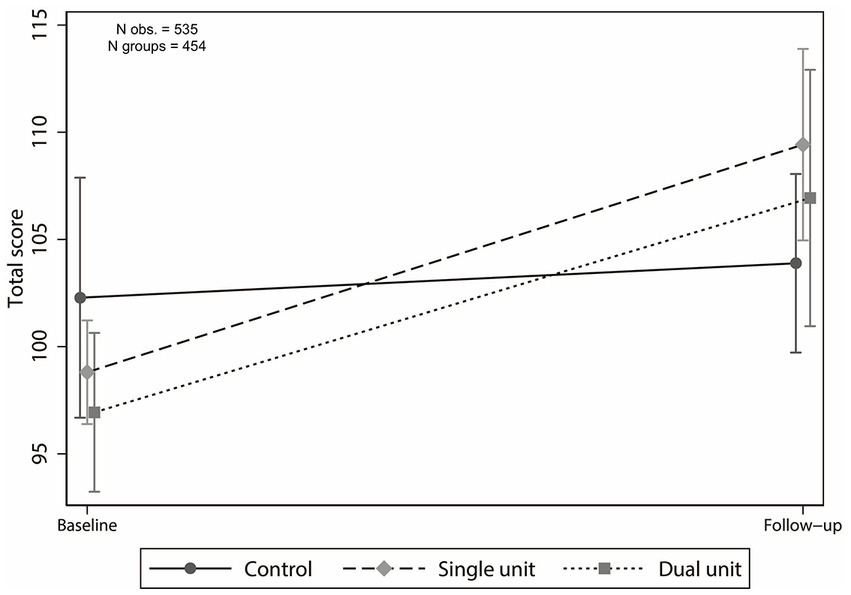
Baseline to follow-up change in pre-service teacher perceptions.
Complete results of the analysis related to pre-service teachers’ perceptions of TransformEd strategies are available in Table 4.
Table 4
| Willingness | Student outcomes | Confidence in class | Competence | Confidence out of class | Barriers | Total score | ||||||||||||||||||||||
|---|---|---|---|---|---|---|---|---|---|---|---|---|---|---|---|---|---|---|---|---|---|---|---|---|---|---|---|---|
| Predictors | Estimate | 95%CI | Value of p | Estimate | 95%CI | Value of p | Estimate | 95%CI | Value of p | Estimate | 95%CI | Value of p | Estimate | 95%CI | Value of p | Estimate | 95%CI | Value of p | Estimate | 95%CI | Value of p | |||||||
| Fixed effects | ||||||||||||||||||||||||||||
| Time a | ||||||||||||||||||||||||||||
| Follow-up | −0.02 | −1.02 | 0.99 | 0.976 | −0.38 | −1.51 | 0.75 | 0.512 | −0.57 | −3.25 | 2.11 | 0.679 | 1.23 | 0.30 | 2.16 | 0.010 | 2.18 | 0.93 | 3.42 | 0.001 | 1.34 | −2.06 | 4.74 | 0.441 | 1.60 | −4.65 | 7.86 | 0.615 |
| Group b | ||||||||||||||||||||||||||||
| Single unit | 0.16 | −0.82 | 1.14 | 0.753 | −0.39 | −1.48 | 0.70 | 0.486 | 0.71 | −1.75 | 3.17 | 0.572 | −0.54 | −1.48 | 0.40 | 0.264 | −1.10 | −2.34 | 0.14 | 0.082 | 2.27 | −1.08 | 5.62 | 0.184 | −3.48 | −9.59 | 2.63 | 0.265 |
| Dual unit | −0.82 | −1.89 | 0.25 | 0.132 | −1.28 | −2.47 | −0.09 | 0.035 | −0.39 | −3.11 | 2.33 | 0.777 | −0.92 | −1.95 | 0.11 | 0.080 | −1.33 | −2.68 | 0.03 | 0.055 | 0.94 | −2.69 | 4.58 | 0.610 | −5.35 | −12.07 | 1.37 | 0.119 |
| Time × group c | ||||||||||||||||||||||||||||
| Follow-up × single | −0.25 | −1.50 | 1.00 | 0.698 | 1.06 | −0.35 | 2.47 | 0.140 | 1.74 | −1.65 | 5.13 | 0.314 | 0.25 | −0.92 | 1.41 | 0.679 | 0.53 | −1.03 | 2.09 | 0.506 | −4.55 | −8.77 | −0.33 | 0.034 | 9.01 | 1.26 | 16.77 | 0.023 |
| Follow-up × dual | 0.65 | −0.70 | 2.00 | 0.347 | 2.05 | 0.54 | 3.57 | 0.008 | 3.30 | −0.56 | 7.15 | 0.094 | −0.50 | −1.78 | 0.77 | 0.440 | −0.18 | −1.89 | 1.53 | 0.839 | −3.21 | −7.85 | 1.42 | 0.174 | 8.40 | −0.46 | 17.25 | 0.063 |
| Sex d | ||||||||||||||||||||||||||||
| Female | 0.04 | −0.62 | 0.69 | 0.914 | 0.22 | −0.51 | 0.94 | 0.560 | 0.65 | −0.99 | 2.29 | 0.435 | −0.11 | −0.78 | 0.56 | 0.748 | −1.61 | −2.48 | −0.74 | < 0.001 | 2.58 | 0.29 | 4.86 | 0.027 | −2.81 | −7.00 | 1.38 | 0.189 |
| Age | 0.08 | 0.00 | 0.15 | 0.043 | 0.11 | 0.03 | 0.19 | 0.007 | −0.06 | −0.24 | 0.12 | 0.508 | −0.09 | −0.17 | −0.02 | 0.013 | −0.12 | −0.22 | −0.02 | 0.016 | −0.29 | −0.54 | −0.04 | 0.025 | 0.16 | −0.30 | 0.61 | 0.505 |
| Random effects | ||||||||||||||||||||||||||||
| Group: identity | ||||||||||||||||||||||||||||
| Variance (intercept) | 4.30 | 2.92 | 6.33 | 5.06 | 3.36 | 7.63 | 13.01 | 5.03 | 33.68 | 5.48 | 4.05 | 7.41 | 8.59 | 6.20 | 11.88 | 57.24 | 42.23 | 77.58 | 179.88 | 128.20 | 252.38 | |||||||
| Variance (residual) | 6.32 | 5.00 | 7.99 | 8.08 | 6.40 | 10.20 | 46.32 | 35.29 | 60.80 | 4.40 | 3.30 | 5.86 | 8.19 | 6.22 | 10.78 | 52.87 | 40.45 | 69.10 | 173.89 | 129.87 | 232.82 | |||||||
| ICC | 0.40 | 0.28 | 0.55 | 0.39 | 0.26 | 0.53 | 0.22 | 0.08 | 0.48 | 0.55 | 0.42 | 0.68 | 0.51 | 0.38 | 0.65 | 0.52 | 0.39 | 0.65 | 0.51 | 0.37 | 0.65 | |||||||
| Observations, n | 666 | 666 | 566 | 606 | 606 | 571 | 535 | |||||||||||||||||||||
| Groups/clusters, n | 535 | 535 | 475 | 500 | 500 | 478 | 454 | |||||||||||||||||||||
Results from linear mixed models used to assess the intervention effects on factors associated with successful implementation of active pedagogic strategies in pre-service teachers.
Significant effects are marked in bold.
Estimates refer to changes over time for the reference group (control).
Estimates refer to baseline differences between groups.
Estimates refer to the moderating effects of the single unit or double unit delivery over time (reference baseline × control).
Reference group: male.
Discussion
Integrating effective school-based physical activity initiatives that involve teaching pedagogy into ITE may be a more effective and sustainable approach than offering professional development for in-service teachers (Nawab et al., 2021). This research builds on the initial pilot feasibility (Lander et al., 2019) and implementation research of the TransformEd program in a single university setting (Lander et al., 2020), by horizontally scaling the program to a second university and comparing the implementation and effectiveness of the intervention in different contexts, to a third usual practice control university.
TransformEd was received positively by lecturers and pre-service teachers in the two intervention universities. There was a significant favourable intervention effect on the total teacher perceptions score among pre-service teachers in University 1 compared to the control group pre-service teachers. This was primarily explained by reduced perceived barriers. There are several well reported teacher barriers (e.g., lack of time, teacher overload and competing demands) to the sustained integration of physical activity interventions by teachers in schools (Lai et al., 2014; Naylor et al., 2015; Nathan et al., 2018; Cassar et al., 2019). Although the effect was not significant in University 2, there was a significant increase in pre-service teachers’ perceived efficacy on Primary school student outcomes. All these findings should be noted within the context of a disrupted year due to school closures in response to the COVID-19 global pandemic and the challenges of remote learning.
The qualitative focus groups with lecturers suggested that the program increased pre-service teacher engagement in learning and contributed to the development of critical teacher competencies. Previous research on teaching practices that make a difference to student outcomes shows that four groups of competencies yield the greatest result (i.e., instructional delivery, classroom management, formative assessment and personal competencies; Cornelius-White, 2007; Hattie, 2008). Further research has indicated that these competencies can be used to organize the numerous specific skills and knowledge available for building effective teacher development (Wenglinsky, 2002). The outcomes of this study found that the TransformEd program appears be a promising pathway to build these critical teacher competencies and advance the teaching capability of future teachers.
Having a clear sense of the need for the program and a shared knowledge of the program were considered critical for adoption. This is consistent with Glasgow and Riley (2013) and Gaglio et al. (2013) who highlighted the need to engage key decision makers early and often to create a shared vision, justify the intervention, and ensure interventions are sustained at the organizational level. The co-design workshops with the two intervention universities were an important initial step to assist with program adoption. These workshops emphasised a sharing of knowledge between researcher and participant and ensured that the key messages, strategies and active pedagogies were authentically aligned with university and unit learning objectives and were relevant to the unit and the pre-service teacher’s needs (Lander et al., 2020). This was a major influence on lecturers signing on to participate in the program. Further, lecturers reported that the program strategies and resources were progressively more frequently adopted and implemented because lecturers believed they were aligned with the unit objectives and context. Ensuring there is a consultative process to align with the needs of users has been shown to improve intervention outcomes (Cottrell et al., 2014). Authentic collaboration drives a sense of ownership and has been shown to enhance adoption, adaption and implementation (Taylor and Bovill, 2018).
Implementation of the program appeared to increase over time. Data from the lecturer adherence checklists showed that both University and 1 and 2 lecturers increased their fidelity to the program components across the 12-week intervention. The qualitative focus groups with lecturers identified that the program was motivating for pre-service teachers and it also resulted in the lecturers reflecting on their own teaching practice. Reflective thought is essential for both student learning and teaching. Reflective practice requires teachers to evaluate their own teaching practice, examine their curricular choices, consider student feedback, and make revisions to improve student belonging and learning (Brookfield, 2017). Teachers who strive to better the education of their students should constantly be reflecting on what they teach and how they teach it, judging the effectiveness of their teaching, learning from that reflection, and using what they learn to inform further teaching (Brookfield, 2017). Overall, the lecturers felt that the TransformEd program improved the pre-service teacher’s learning experience, which was a key driver to continued program implementation.
Flexibility of delivery was also seen as a strength of the program, but it was acknowledged by lecturers that successful implementation required careful and comprehensive planning. Planning was required to embed the program into all facets of their unit/s, including explicit curriculum content, regular modeling, and opportunities for pre-service teachers to practice, and assessment. Planning for and implementing effective teaching and learning is a key professional standard for all Australian teachers [e.g., Graduate, Proficient, Highly Accomplished or Lead Teachers; Teacher Standards].3 The importance of planning is highlighted in national documents such as the Australian Professional Standards for Teachers [Graduate (see footnote 3)], where teachers are expected to establish and meet several planning-related descriptors such as: setting challenging learning goals, plan, structure and sequence learning programs. As such, the planning process that was required for the successful implementation of the TransformEd program, is synonymous to the planning required by all teachers in order to create better educational outcomes for Australian children.
Lecturers responsible for delivering the intervention suggested there was great value in the program in terms of how it strengthened the connection between the way in which pre-service teachers are educated in university, and how pre-service teachers should teach when placed in schools. The use of lecturer modelling and provisions of experiential learning, coupled with the opportunity for pre-service teachers to practice key components of the TransformEd program in their own teaching, meant that the pre-service teachers had the opportunity to develop the right mix of academic knowledge and practical skills needed for the classroom (Teacher Education Ministerial Advisory Group, 2014). ITE is crucial for creating a skilled, passionate teaching workforce that can meet the needs of all learners. As such, there has been considerable focus on increasing the quality of teacher education systems, both nationally and internationally. ITE has changed considerably over the last decade, and many have argued for further new innovative approaches to ITE (Yeigh and Lynch, 2017). TransformEd may provide an evidence-based and innovative program that prepares graduate teachers for classroom teaching with a solid understanding of the teaching practices that optimize student learning (Darling-Hammond, 2006; Teacher Education Ministerial Advisory Group, 2014).
Recommendations for improvement of implementation by lecturers included a stronger and more explicit alignment with the Australian Professional Standards for Teachers.4 The crowded curriculum of ITE programs means that for concepts to make it into courses and be sustained, they must be perceived as relevant and largely aligned to multiple regulatory requirements. To enhance the quality of ITE and the compliance driven approach to the accreditation process often results in a focus on addressing the professional standards and anything identified outside this quality framework is a low priority or non-essential. As such, an important next step will be to work with policy developers in an attempt to reflect the program more explicitly in professional standards. This may not only enhance the reach of the program, but may simultaneously enhance the quality of teacher education programs, as lecturers are required to ensure pre-service teachers receive professional experience opportunities and meet minimum content requirements of the set standards [Initial Teacher Education today (see footnote 3)].
In terms of maintenance, policy alignment (e.g., Teacher Registration and/or Teacher Professional Standards) was suggested to be critical, and embedding the strategies across the whole degree not just in one or several units was also considered important, particularly by lecturers from University 1. Exposure within 1 or 2 units was not considered as powerful for embedding cultural change as taking a course/program wide approach scaffolded across different year levels. Organizational and policy level factors were considered important by staff to ensure appropriate units were identified and staff could work together to ensure they were on the same page and could work together to solve any problems. Consistent with previous work (Kemmis and McTaggart, 2005), the participatory nature of this research allowed capacity-building with key stakeholders (e.g., course co-ordinators, unit chairs, program co-ordinators and lecturers) during all stages of this research (Lander et al., 2020). Lecturers believed knowledge sharing between the investigators and each other was critical to their engagement in the program. Having the shared vision among participants has been reported to be necessary in previous school-based physical activity interventions (Daly-Smith et al., 2020).
There are several limitations and strengths of the current study. The TransformEd program was adopted into different numbers of units at the two intervention universities and data were collected from different year levels for the intervention and control universities. While this makes comparison of effectiveness challenging, it is also consistent with real world delivery and horizontal scale-up where adaptations to interventions need to occur within the context of each setting. This type of study was conducted in a way that aimed to enhance the generalizability of the results that it produced, and as such, the study design is highly aligned with the goals of implementation research. A further limitation was that the intervention was conducted partially during pandemic lockdowns in Melbourne, Australia. An additional challenge was that the control university (based in Adelaide), did not experience school closures to the same extent as Melbourne. Issues associated with a lack of engagement during online delivery such as non-attendance and having cameras off potentially may have reduced the true extent of implementation. There are some measurement limitations due to the restricted reliability testing of the survey instrument, further, the high drop-out rate and the substantial proportion of missing data are factors that warrant caution in interpreting the study results. Lecturers in University 1 had an advantage over those in University 2, as this was their 3rd year of delivering the program. The co-design and alignment of the intervention with unit context was a strength and critical for adoption and implementation.
In conclusion, the present study showed favourable effects on pre-service teachers’ perceptions of their competence, confidence and willingness to deliver active pedagogies. The factors associated with lecturers’ program adoption, implementation and maintenance included co-design of the program, alignment with course curriculum, completion of an adherence checklist, regular modeling, and providing opportunities for pre-service teachers to practice. Future research is recommended to determine the effectiveness of the program on improving Primary school students’ activity levels, engagement in and enjoyment of learning, and their academic outcomes.
Funding
This research was supported by a Leadership Level 2 Investigator Grant, National Health and Medical Research Council (APP 1176885).
Publisher’s note
All claims expressed in this article are solely those of the authors and do not necessarily represent those of their affiliated organizations, or those of the publisher, the editors and the reviewers. Any product that may be evaluated in this article, or claim that may be made by its manufacturer, is not guaranteed or endorsed by the publisher.
Statements
Data availability statement
The original contributions presented in the study are included in the article/supplementary material, further inquiries can be directed to the corresponding author/s.
Ethics statement
The study was approved by the University Human Ethics Advisory Group at all three universities (University 1 HAE-17-207; University 2 DCS CHEAN-24033; University 3 HREC CIA4057). The patients/participants provided their written informed consent to participate in this study.
Author contributions
JS and NL: conceptualization and methodology. NL and EM: software and data curation. NL, NS, and EM: formal analysis. NL: investigation and project administration. NL and NS: resources. NL, EM, AT, KR, and IE: writing – original draft preparation. NL, IE, NS, EM, AT, KR, and JS: writing – review and editing. NL and JS: supervision. All authors contributed to the article and approved the submitted version.
Conflict of interest
The authors declare that the research was conducted in the absence of any commercial or financial relationships that could be construed as a potential conflict of interest.
Footnotes
1.^ https://transformus.com.au
2.^ http://www.re-aim.org/qualitative-guidance-overview/#Template
References
1
Arundell L. Salmon J. Koorts H. Contardo Ayala A. M. Timperio A. (2019). Exploring when and how adolescents sit: cross-sectional analysis of activPAL-measured patterns of daily sitting time, bouts and breaks. BMC Public Health19, 653–659. doi: 10.1186/s12889-019-6960-5
2
Australian Institute of Health and Welfare . (2018). Physical Activity Across the Life Stages. Available at: https://www.aihw.gov.au/reports/physical-activity/physical-activity-across-the-life-stages San Francisco, CA (Accessed October 11, 2022).
3
Brookfield S. D. (2017). Becoming a Critically Reflective Teacher, San Francisco, CA: Jossey Bass.
4
Brownson R. C. Fielding J. E. Green L. W. (2018). Building capacity for evidence-based public health: reconciling the pulls of practice and the push of research. Annu. Rev. Public Health39, 27–53. doi: 10.1146/annurev-publhealth-040617-014746
5
Brownson R. C. Proctor E. K. Luke D. A. Baumann A. A. Staub M. Brown M. T. et al . (2017). Building capacity for dissemination and implementation research: one university’s experience. Implement. Sci.12, 104–112. doi: 10.1186/s13012-017-0634-4
6
Carson V. Salmon J. Arundell L. Ridgers N. D. Cerin E. Brown H. et al . (2013). Examination of mid-intervention mediating effects on objectively assessed sedentary time among children in the transform-us! Cluster-randomized controlled trial. Int. J. Behav. Nutr. Phys. Act.10, 1–11. doi: 10.1186/1479-5868-10-62
7
Cassar S. Salmon J. Timperio A. Naylor P.-J. Van Nassau F. Contardo Ayala A. M. et al . (2019). Adoption, implementation and sustainability of school-based physical activity and sedentary behaviour interventions in real-world settings: a systematic review. Int. J. Behav. Nutr. Phys. Act.16, 120–113. doi: 10.1186/s12966-019-0876-4
8
Cornelius-White J. (2007). Learner-centered teacher-student relationships are effective: a meta-analysis. Rev. Educ. Res.77, 113–143. doi: 10.3102/003465430298563
9
Cottrell E. Whitlock E. Kato E. Uhl S. Belinson S. Chang C. et al . (2014). Defining the Benefits of Stakeholder Engagement in Systematic ReviewsAgency for Healthcare Research and Quality (US).
10
Daly-Smith A. Quarmby T. Archbold V. S. Corrigan N. Wilson D. Resaland G. K. et al . (2020). Using a multi-stakeholder experience-based design process to co-develop the creating active schools framework. Int. J. Behav. Nutr. Phys. Act.17, 13–12. doi: 10.1186/s12966-020-0917-z
11
Darling-Hammond L. (2006). Assessing teacher education: the usefulness of multiple measures for assessing program outcomes. J. Teach. Educ.57, 120–138. doi: 10.1177/0022487105283796
12
Gaglio B. Shoup J. A. Glasgow R. E. (2013). The RE-AIM framework: a systematic review of use over time. Am. J. Public Health103, e38–e46. doi: 10.2105/AJPH.2013.301299
13
Glasgow R. E. Harden S. M. Gaglio B. Rabin B. Smith M. L. Porter G. C. et al . (2019). RE-AIM planning and evaluation framework: adapting to new science and practice with a 20-year review. Front. Public Health7:64. doi: 10.3389/fpubh.2019.00064
14
Glasgow R. E. Riley W. T. (2013). Pragmatic measures: what they are and why we need them. Am. J. Prev. Med.45, 237–243. doi: 10.1016/j.amepre.2013.03.010
15
Glasgow R. E. Vogt T. M. Boles S. M. (1999). Evaluating the public health impact of health promotion interventions: the RE-AIM framework. Am. J. Public Health89, 1322–1327. doi: 10.2105/AJPH.89.9.1322
16
Hattie J. (2008). Visible Learning: A Synthesis of Over 800 Meta-Analyses Relating to Achievement, Springer Singapore: Routledge.
17
Holtrop J. S. Rabin B. A. Glasgow R. E. (2018). Qualitative approaches to use of the RE-AIM framework: rationale and methods. BMC Health Serv. Res.18, 177–110. doi: 10.1186/s12913-018-2938-8
18
Kemmis S. McTaggart R. (2005). “Participatory action research: communicative action and the public sphere” in Strategies of Qualitative Inquiry. eds. DenzinN. K.LincolnY. S. (SAGE)
19
Kemmis S. Wilkinson J. Edwards-Groves C. Hardy I. Grootenboer P. Bristol L. (2013). Changing Practices, Changing Education, Springer, Singapore: Springer Science & Business Media.
20
Korthagen F. Loughran J. Russell T. (2006). Developing fundamental principles for teacher education programs and practices. Teach. Teach. Educ.22, 1020–1041. doi: 10.1016/j.tate.2006.04.022
21
Lai S. K. Costigan S. A. Morgan P. J. Lubans D. R. Stodden D. F. Salmon J. et al . (2014). Do school-based interventions focusing on physical activity, fitness, or fundamental movement skill competency produce a sustained impact in these outcomes in children and adolescents? A systematic review of follow-up studies. Sports Med.44, 67–79. doi: 10.1007/s40279-013-0099-9
22
Lander N. Eather N. Morgan P. J. Salmon J. Barnett L. M. (2017). Characteristics of teacher training in school-based physical education interventions to improve fundamental movement skills and/or physical activity: a systematic review. Sports Med.47, 135–161. doi: 10.1007/s40279-016-0561-6
23
Lander N. Koorts H. Mazzoli E. Moncrieff K. Salmon J. (2019). The feasibility and impact of embedding pedagogical strategies targeting physical activity within undergraduate teacher education: transform-Ed!Pilot Feasibility Stud5, 125–116. doi: 10.1186/s40814-019-0507-5
24
Lander N. Mazzoli E. Cassar S. Symington N. Salmon J. (2020). Embedding active pedagogies within pre-service teacher education: implementation considerations and recommendations. Children7:207. doi: 10.3390/children7110207
25
Martin R. Murtagh E. M. (2017). Effect of active lessons on physical activity, academic, and health outcomes: a systematic review. Res. Q. Exerc. Sport88, 149–168. doi: 10.1080/02701367.2017.1294244
26
Milat A. J. King L. Bauman A. E. Redman S. (2013). The concept of scalability: increasing the scale and potential adoption of health promotion interventions into policy and practice. Health Promot. Int.28, 285–298. doi: 10.1093/heapro/dar097
27
Miles M. B. Huberman M. Saldana J. (2013). Qualitative Data Analysis: A Methods Sourcebook. 3rd Edn SAGE Publication.
28
Nathan N. Elton B. Babic M. McCarthy N. Sutherland R. Presseau J. et al . (2018). Barriers and facilitators to the implementation of physical activity policies in schools: a systematic review. Prev. Med.107, 45–53. doi: 10.1016/j.ypmed.2017.11.012
29
Nawab A. Bissaker K. Datto A. K. (2021). Contemporary trends in professional development of teachers: importance of recognising the context. Int. J. Educ. Manag.35, 1176–1190. doi: 10.1108/IJEM-10-2020-0476
30
Naylor P.-J. Nettlefold L. Race D. Hoy C. Ashe M. C. Higgins J. W. et al . (2015). Implementation of school based physical activity interventions: a systematic review. Prev. Med.72, 95–115. doi: 10.1016/j.ypmed.2014.12.034
31
Poitras V. J. Gray C. E. Borghese M. M. Carson V. Chaput J.-P. Janssen I. et al . (2016). Systematic review of the relationships between objectively measured physical activity and health indicators in school-aged children and youth. Appl. Physiol. Nutr. Metab.41, S197–S239. doi: 10.1139/apnm-2015-0663
32
Rogers E. M. (2003). Diffusion of Innovations, New York. Free Press.
33
Salmon J. Arundell L. Cerin E. Ridgers N. D. Hesketh K. D. Daly R. M. et al . (2023). Transform-us! Cluster RCT: 18- and 30-month efects on children’s physical activity, sedentary time and cardiometabolic risk markers. Br J Sports Med57, 311–319. doi: 10.1136/bjsports-2022-105825
34
Salmon J. Arundell L. Hume C. Brown H. Hesketh K. Dunstan D. W. et al . (2011). A cluster-randomized controlled trial to reduce sedentary behavior and promote physical activity and health of 8-9 year olds: the transform-us! Study. BMC Public Health11, 1–14. doi: 10.1186/1471-2458-11-759
35
Salmon J. Mazzoli E. Lander N. Ayala A. M. C. Sherar L. Ridgers N. D. (2020). Classroom-Based Physical Activity Interventions (the Routledge Handbook of Youth Physical Activity)New York Routledge, 523–540.
36
StataCorp (2021). Stata Statistical Software: Release 17, College Station, TX: StataCorp LLC.
37
Taylor C. A. Bovill C. (2018). Towards an ecology of participation: process philosophy and co-creation of higher education curricula. Eur Educ Res J17, 112–128. doi: 10.1177/1474904117704102
38
Teacher Education Ministerial Advisory Group . (2014). Action Now: Classroom Ready Teachers. A Companion to Research in Teacher Education. Available at: http://www.studentsfirst.gov.au/teacher-education-ministerial-advisory-group (Accessed October 11, 2022).
39
Tomporowski P. D. Pesce C. (2019). Exercise, sports, and performance arts benefit cognition via a common process. Psychol. Bull.145, 929–951. doi: 10.1037/bul0000200
40
Valkenborghs S. R. Noetel M. Hillman C. H. Nilsson M. Smith J. J. Ortega F. B. et al . (2019). The impact of physical activity on brain structure and function in youth: a systematic review. Pediatrics144:e20184032. doi: 10.1542/peds.2018-4032
41
Verswijveren S. J. Ridgers N. D. Martín-Fernández J. A. Chastin S. Cerin E. Chinapaw M. J. et al . (2022). Intervention effects on children’s movement behaviour accumulation as a result of the transform-us! School- and home-based cluster randomised controlled trial. Int. J. Behav. Nutr. Phys. Act.19, 1–11. doi: 10.1186/s12966-022-01314-z
42
Watson A. Timperio A. Brown H. Best K. Hesketh K. D. (2017). Effect of classroom-based physical activity interventions on academic and physical activity outcomes: a systematic review and meta-analysis. Int. J. Behav. Nutr. Phys. Act.14, 114–124. doi: 10.1186/s12966-017-0569-9
43
Wenglinsky H. (2002). The link between teacher classroom practices and student academic performance. Educ Policy Anal Arch10:12. doi: 10.14507/epaa.v10n12.2002
44
Williams J. White S. Forgasz R. Grimmett H. (2018). Stories from the Third Space: Teacher Educators Professional Learning in a School/University Partnership Re-Imagining Professional Experience in Initial Teacher EducationSpringer, 19–36.
45
Yeigh T. Lynch D. (2017). Reforming initial teacher education: a call for innovation. Aust J Teach Educ42, 112–127. doi: 10.14221/ajte.2017v42n12.7
46
Yıldırım M. Arundell L. Cerin E. Carson V. Brown H. Crawford D. et al . (2014). What helps children to move more at school recess and lunchtime? Mid-intervention results from transform-us! Cluster-randomised controlled trial. Br. J. Sports Med.48, 271–277. doi: 10.1136/bjsports-2013-092466
Summary
Keywords
initial teacher education, pre-service, intervention, implementation, physical activity
Citation
Lander NJ, Mazzoli E, Essiet IA, Telford A, Ridley K, Symington N and Salmon J (2023) Equipping future teachers with innovative strategies that increase physical activity in the classroom: a hybrid implementation trial across three Australian universities. Front. Educ. 8:1093234. doi: 10.3389/feduc.2023.1093234
Received
18 December 2022
Accepted
04 May 2023
Published
25 May 2023
Volume
8 - 2023
Edited by
Lorraine Cale, Loughborough University, United Kingdom
Reviewed by
Nick Riley, The University of Newcastle, Australia; Timothy Walker, University of Texas Health Science Center at Houston, United States
Updates
Copyright
© 2023 Lander, Mazzoli, Essiet, Telford, Ridley, Symington and Salmon.
This is an open-access article distributed under the terms of the Creative Commons Attribution License (CC BY). The use, distribution or reproduction in other forums is permitted, provided the original author(s) and the copyright owner(s) are credited and that the original publication in this journal is cited, in accordance with accepted academic practice. No use, distribution or reproduction is permitted which does not comply with these terms.
*Correspondence: Natalie J. Lander, natalie.lander@deakin.edu.au
Disclaimer
All claims expressed in this article are solely those of the authors and do not necessarily represent those of their affiliated organizations, or those of the publisher, the editors and the reviewers. Any product that may be evaluated in this article or claim that may be made by its manufacturer is not guaranteed or endorsed by the publisher.