 Hayat Mahdjoub1
 Afef Baaloudj2Sara Chaib2Valeria Ramírez-Castañeda3,4Leidy Alejandra Barragan Contreras5Daniel González-Tokman6
 Sebastián Villada-Bedoya6,7
 Maya Rocha-Ortega8
 Alex Córdoba-Aguilar8,9
 Rassim Khelifa10,11,12*
- 1Botany Department, University of British Columbia, Vancouver, BC, Canada
- 2Laboratory LBEE: Biology, Water and Environment, Faculty SNV-STU, University 8 May 1945 Guelma, Guelma, Algeria
- 3Department of Integrative Biology, University of California, Berkeley, Berkeley, CA, United States
- 4Museum of Vertebrate Zoology, University of California, Berkeley, Berkeley, CA, United States
- 5Departamento de Biología, Universidad Nacional de Colombia, Bogotá, Colombia
- 6Red de Ecoetología, Instituto de Ecología A. C., Xalapa, Mexico
- 7Neuroecology Lab, Facultad de Psicología, Universidad Nacional Autónoma de México, Mexico City, Mexico
- 8Departamento de Ecología Evolutiva, Instituto de Ecología, Universidad Nacional Autónoma de México, Mexico City, Mexico
- 9Instituto de Ecología, Universidad Nacional Autónoma de México, Ciudad Universitaria, Mexico City, Mexico
- 10Institute for Resources, Environment, and Sustainability, University of British Columbia, Vancouver, BC, Canada
- 11Department of Biological Sciences, Simon Fraser University, Burnaby, BC, Canada
- 12Biology Department, Concordia University, Montreal, QC, Canada
Collaboration is a fundamental aspect of scientific research and innovation. Fair collaborations between scientists from different identities or positions of power (e.g., Global North and Global South scientists) could have a great impact on scientific knowledge and exchange. However, there are existing limitations to the potential of Global South scientists to collaborate fairly. Here we assess the impact and geographic distribution of international collaborations for PhD students in biological sciences in four Global South countries (two from Africa: Algeria and Morocco, and two from the Americas: Colombia and Mexico), where students typically have low English proficiency. We show that overall international collaboration, particularly with the Global North, increased the probability of publishing in a journal with an impact factor and achieved more citations. Most international collaborators were affiliated with French-speaking countries for Algerian and Moroccan students and Spanish and English-speaking countries for Colombian and Mexican universities, suggesting that language and geopolitical history might play a role in shaping the selection of international collaborators. While the results highlight the benefit of international collaboration for researchers in the Global South, we discuss that the current metrics of scientific success could maintain the dependence of Global South scientists on the Global North.
1. Introduction
Collaboration is an essential part of intellectual exchange, scientific productivity, and innovation (Lee and Bozeman, 2005; Wuchty et al., 2007). To conduct a project, researchers in sciences usually share their expertise in various aspects, divide labour, and combine skills to solve problems, build new knowledge, and advance research fields (Adams, 2012). While it may be competition among individual scientists or even nations in scientific endeavors, scientific collaboration occurs mostly between colleagues from the same institution or different institutions of the same country (Abramo et al., 2011), we have seen an increasing number of international collaborations across countries and continents in the last few decades (Ribeiro et al., 2018). Such collaborations have a positive effect on the impact of research and innovation in scientific knowledge (McFadyen and Cannella, 2004; Wuchty et al., 2007; He et al., 2009; Abramo et al., 2011; Hofstra et al., 2020).
Although collaboration is critical in science, there are inequalities among countries in their opportunities to establish fair international collaboration due to various barriers (Matthews et al., 2020), including colonialist practices such as parachute science and biopiracy (Armenteras, 2021; Haelewaters et al., 2021), or consequences of colonialism such as monolingualism in science and lack of scientific infrastructure (Ramírez-Castañeda, 2020; Amano et al., 2021). Thus, further discussions and proactive changes on how to establish collaborations are necessary to overcome those barriers and promote equitable relationships. Collaboration can be successful when the various members of a project communicate effectively with each other to accomplish various tasks (Hwang, 2013), such as exchanging ideas, performing experiments, analyzing data, writing scientific papers, and publishing research. Hence, even when the desire of collaborating with foreign researchers exists, it stands to reason that scientists typically select collaborators with a shared language, shared history or/and geographic proximity. Nevertheless, Global North researchers have a larger history of global networks which allows them to keep or create collaborations (Global North refers to a sociopolitical category of high-income countries and former colonizers instead of a geographical location) (Trisos et al., 2021). In general, Global North researchers also exhibit higher English proficiency or speak other colonial languages that are spread across the Global South, opening the door for more opportunities to collaborate with researchers from different nationalities. Because currently, English is the lingua franca of science, the least English proficient countries are those that find most difficulty in collaborating with a broader spectrum of scientists (Márquez and Porras, 2020). Despite the recent surge of perspectives on equity, diversity, and inclusion in recent years (Bilimoria and Liang, 2012; McGill et al., 2021; Doubeni et al., 2022; Khelifa and Mahdjoub, 2022), the barrier that language imposes on establishing international scientific collaboration has not received sufficient attention and thus needs to be emphasized in the discussions about equity, diversity, and inclusion in science.
To understand how international collaboration impacts the academic success of students and researchers from the Global South, it is important to analyze potential differences in general recognition of their publications when collaborating with researchers based in the Global North. Here, we selected Algeria, Colombia, Mexico and Morocco as four countries in the Global South because they share similar barriers to scientific publishing due to their colonial history, socioeconomic status, and low proficiency in English. In fact, authors affiliated with these countries are not common among the top-publishing authors in biological fields (e.g., Ecology and Evolution) (Maas et al., 2021). Therefore, all four countries are good examples to test the impact of international collaborations on scientific productivity and the factors that mediate the geographic extent of international collaborations.
Here, we determine the benefits and geographic distribution of intellectual collaboration between PhD students from the Global South (Algeria, Colombia, Mexico, and Morocco) and international researchers (i.e., scientists affiliated with countries other than the focal country). We specifically were interested in how international collaboration improves the impact of their research using academic impact metrics (number of publications, impact factor and citation rate). We also determined the geographic distribution of international collaborators and discussed the possibility of assortative matching with international institutions based on familiarity with specific European languages and geopolitical history, which highlights potential limitations that students with low English proficiency have to collaborate with other researchers. Finally, two perspectives are discussed: (1) scientific collaborations are important for innovation and should be promoted if active actions against power asymmetries between the research team are established (Armenteras, 2021; Haelewaters et al., 2021), and (2) the current structure of academia maintains the dependence between Global South scientists on Global North collaborations for increasing the impact of academic publishing. This study is valuable to address policy issues and overcome barriers to meet the goals of equity, diversity, justice, and inclusion (EDJI) for marginalized disadvantaged scientists from the Global South.
2. Methods
2.1. Data collection
We selected five to eight universities with graduate programs in biological sciences from different provinces distributed across the four countries (Supplementary Table S1). For each country, we tried to select universities from different provinces to include a diverse pool of students. From each university, we searched for PhD theses that were published between 2000 and 2022 and downloaded a number of theses that appear first in the unsorted repository list. For some universities, the number of theses was limited because they were not publicly accessible on the Internet. Our sample included 127 PhD students from Algeria who published an average of 1.24 ± 0.64 (range 0–3) papers deriving from their PhD, 56 PhD students from Colombia who published an average of 1.14 ± 1.73 (range 0–9) papers, 196 from Mexico who published an average of 1.63 ± 1.13 (range 0–8) papers, and 87 from Morocco who published an average of 0.76 ± 1.09 (range 0–4) papers.
Here, an international collaborator or researcher refers to a co-author whose main affiliation is located in a country distinct from that of the PhD student. For each PhD thesis, we collected basic information including the title, author’s name, year of publication, the affiliation of the international researcher, and the number of papers published in scientific journals deriving from the thesis. We also noted whether the published research articles deriving from the PhD work included an international researcher, and recorded the affiliation of the latter. To determine how international collaboration affects the scientific success of PhD students, we used the occurrence of an impact factor for the journal selected for publication and the total number of citations that the publications received relative to the number of years since its publication (average rate of citations). We used 2019 InCites Journal Citation Reports to obtain the occurrence of impact factor of the journal selected for publication, and Google Scholar to collect the number of citations that each publication received per year (dividing the total number of citations by the number of years between publication’s date and July 20th 2022). Using the affiliation of the international collaborator, we determined the frequency distribution of the countries used for collaboration.
In this manuscript, we were interested in comparing the influence of international collaboration from Global South and Global North. Global South and North are not geographical terms but well-documented sociopolitical terms in the social sciences (Brandt, 1980). Here, Global South includes all countries of Africa (excluding South Africa), Latin America and the Caribbean, and Asia (excluding Japan, Taiwan, Singapore, and South Korea), whereas the Global North encompasses all countries of Europe, North America (i.e., Canada and United States), Oceania (i.e., Australia and New Zealand), as well as Japan, Taiwan, Singapore, and South Korea.
2.2. Analysis
Our analyses were carried out using R 4.0.2 (R Development Core Team, 2023). We selected three response variables of interest: the number of papers published from the PhD study, whether or not the paper was published in an impact factor journal, and the number of citations received. We used a binary categorical version of the impact factor (presence/absence) instead of a continuous metric for two reasons. First, impact factor changes greatly between discipline and type of journal (multidisciplinary vs. specialized). Second, there is a remarkable difference in the visibility of a journal with and without an impact factor, that is, the difference between an impact factor of 1 and 2 is not equivalent to the difference between an impact factor of 0 and 1 (in terms of public acclaim and research visibility). In this study, our focal explanatory variable was international collaboration. We made two versions of this categorical explanatory variable: one including two levels (presence and absence), and one including three levels (Global North, Global South, and absent). We also tested for the effect of the number of international collaborators on students’ publishing performance response variables. To determine the potential association between international collaboration and the three response variables, we used a Poisson mixed-effects model for the number of papers produced from the PhD study and the total number of citations, and a binomial generalized mixed-effects model for the binary impact factor response variable (binary variable with “yes” and “no” categories). The occurrence of international collaboration was the explanatory variable, and author identity was the random effect. Using the same model structure, we tested for the association between the number of international co-authors instead of the occurrence of international collaboration. Because the number of years since publishing the PhD thesis could influence the number of papers published during the PhD, we used the year of thesis publication as an explanatory variable in the model testing for the effect of international collaboration on the total number of papers published as part of the PhD thesis. To determine whether the occurrence of international collaboration was correlated with the citation rate of papers, we used a Poisson mixed-effect model with the number of citations as a response variable, international collaboration (with two categories), the number of years since publication, and the impact factor of the journal (2019 InCites Journal Citation Reports from Clarivate) as explanatory variables. An observation-level random effect for all Poisson GLME was added to account for overdispersion (Harrison, 2014). To understand whether there is a dominance of a particular country or language in international collaborations, we built a contingency table of the frequency of countries and languages of the institutions where the collaborators were affiliated to conduct a chi-squared test. Values are average ± SD.
3. Results
3.1. Benefits of international collaboration
From highest to lowest, the percentage of students who published at least a paper from their PhD was Algeria (92%), Mexico (91%), Colombia (46%), and Morocco (41%). The percentage of students who had at least one international collaborator in a publication was 69%, 62%, 46%, and 38% for Morocco, Colombia, Algeria, and Mexico, respectively. The average number of international collaborators and the number of international countries per publication varied among countries (Table 1). International collaborators from the Global North were relatively more frequent in Morocco (90%) and Algeria (86%) than in Mexico (72%) and Colombia (51%).
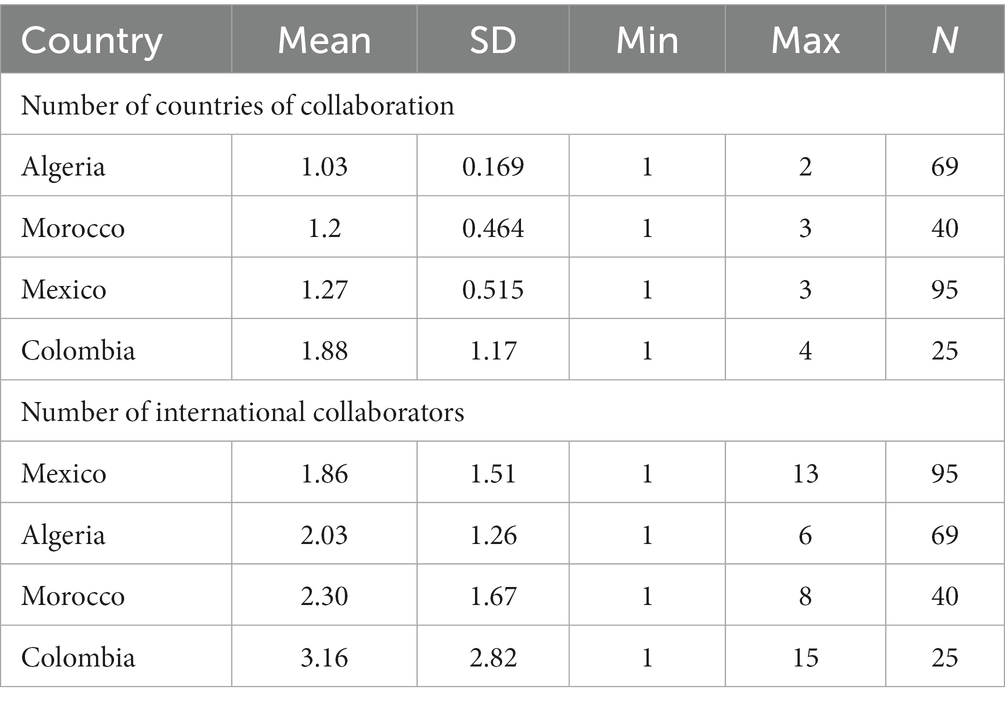
Table 1. Average number of countries of collaboration and international collaborators per publication of PhD students of Algeria, Colombia, Mexico, and Morocco.
Overall, across the four countries, the number of papers produced by the PhD students slightly increased when students collaborated internationally (GLME: z = 4.03, p < 0.0001, Table 2A; Figure 1). The probability of publishing in a journal with an impact factor was on average 25% higher when students collaborated with an international co-author (GLME: z = 4.88, p < 0.0001, Table 2B; Figure 2). The number of citations was higher in the presence of an international co-author (GLME: z = 3.05, p = 0.002, Table 2C; Figure 3). On average across countries, the rate of citations increased by 41% when students collaborated with an international co-author. The number of international collaborators was not correlated with the number of publication (GLME: z = 1.08, p = 0.28) and number of citations (GLME: z = 1.70, p = 0.09), but it was positively correlated with the probability of publishing in an impact factor journal (GLME: z = 4.31, p < 0.0001) (Supplementary Table S2).
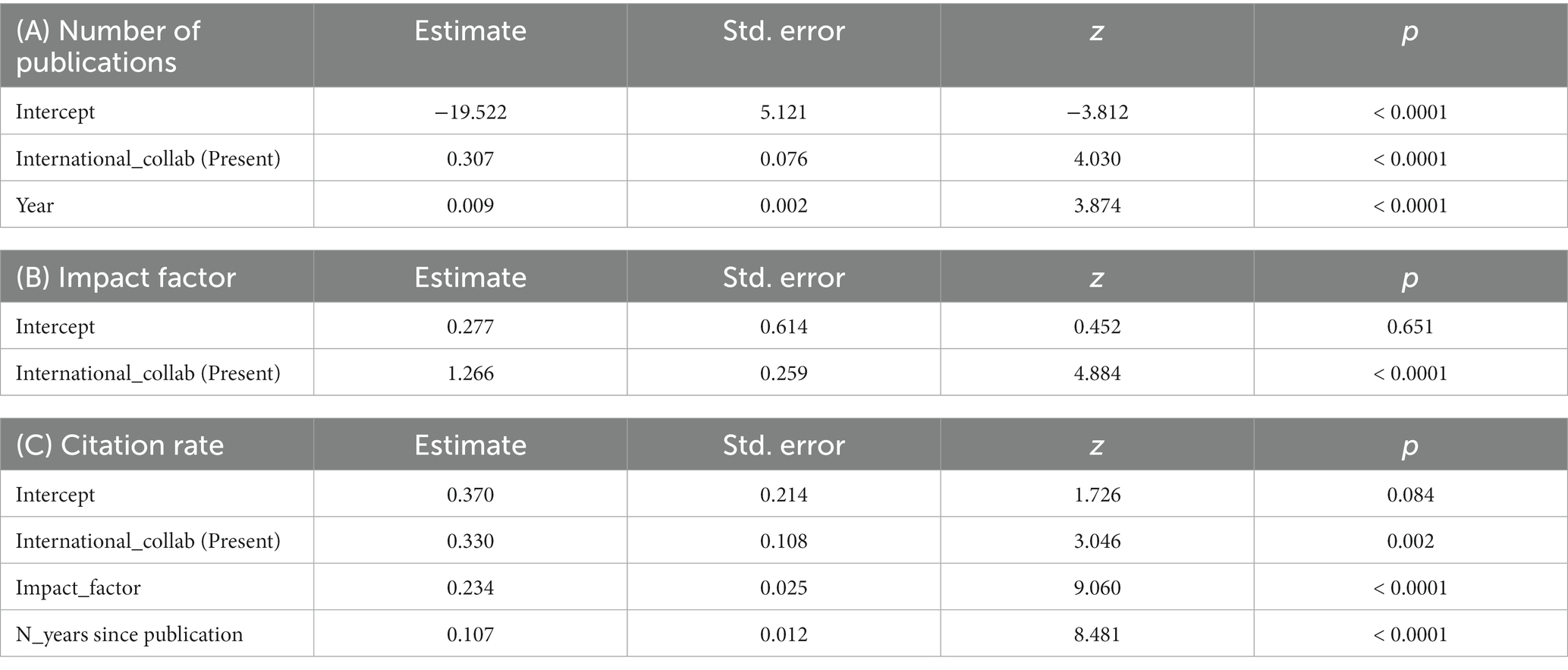
Table 2. Summary statistics of the mixed effects model assessing the difference in the total number of papers published in (A) the PhD, (B) the probability of publishing a paper in an impact factor journal, (C) number of citations received by PhD students based in Algeria, Colombia, Mexico, and Morocco in the presence and absence of international collaborator.
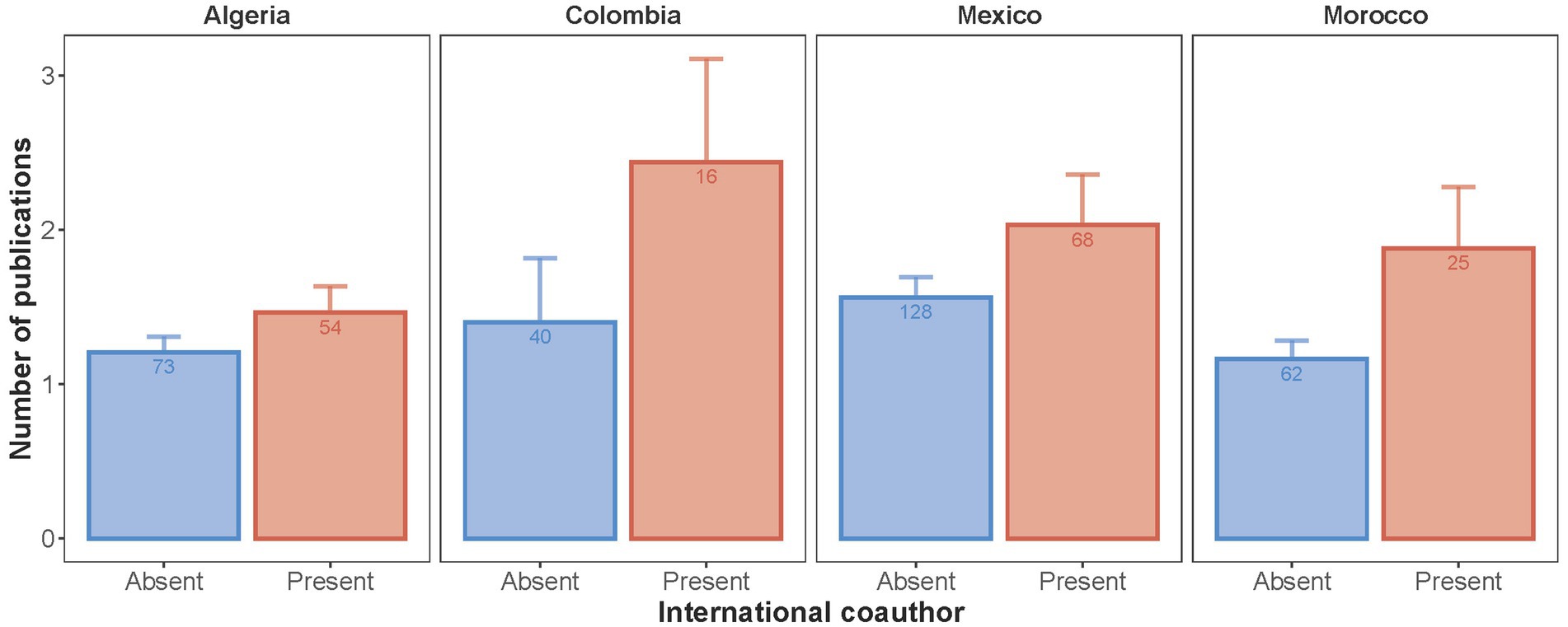
Figure 1. Number of publications published by the PhD student for the PhD thesis in Algeria, Colombia, Mexico, and Morocco in the presence (red) and absence (blue) of international co-author. Error bars are 95% confidence intervals. Summary statistics of the model are in Table 2A.
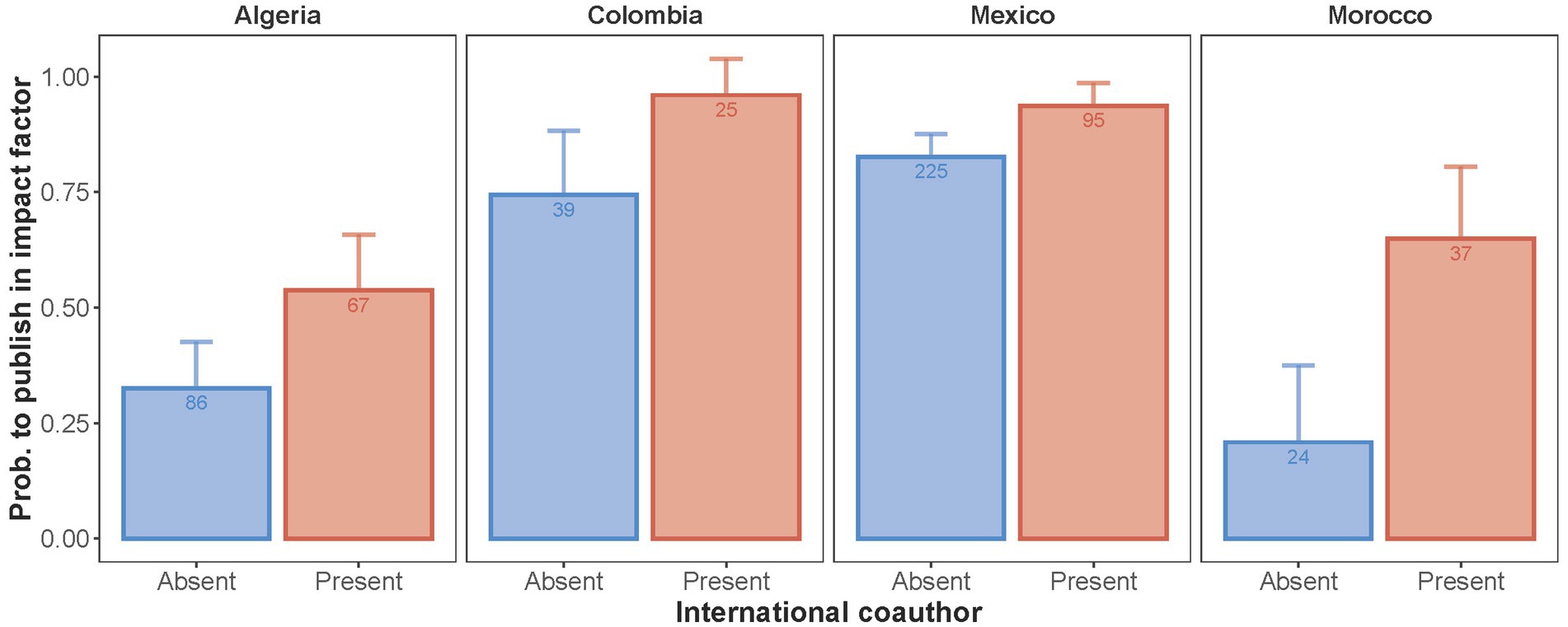
Figure 2. The probability of publishing in a journal with impact factor in Algeria, Colombia, Mexico, and Morocco in the presence (red) and absence (blue) of international co-author. Error bars are 95% confidence intervals. Summary statistics of the model are in Table 2B.
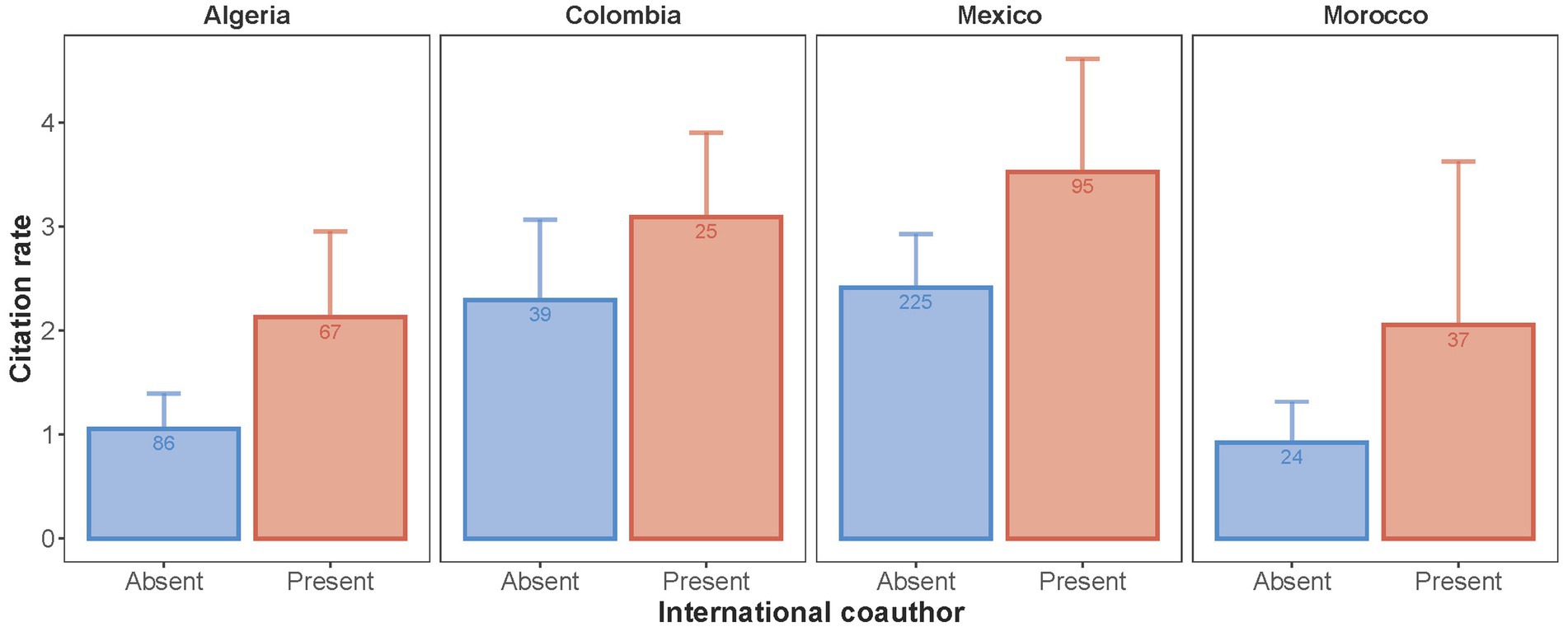
Figure 3. Citation rate of research paper published during the PhD of students in Algeria, Colombia, Mexico, and Morocco in the presence (red) and absence (blue) of international co-author. Error bars are 95% confidence intervals. Summary statistics of the model are in Table 2C.
When we partition international collaborators into those from the Global North and those from the Global South, we found that the number of papers produced by the PhD student was higher when collaborating with researchers from the Global South (GLME: z = 2.14, p = 0.03), and Global North (GLME: z = 2.05, p = 0.04) (Supplementary Figure S1; Supplementary Table S3). International collaboration with researchers from the Global North (GLME: z = 4.88, p < 0.0001) and not from the Global South (GLME: z = 1.63, p = 0.10) increased the probability of publishing in impact factor journals (Supplementary Figure S2; Supplementary Table S3). The rate of citation of research increased only when collaborating with researchers from the Global North (GLME: z = 3.48, p = 0.0005) but not with researchers from the Global South (GLME: z = 0.16, p = 0.87) (Supplementary Figure S3; Supplementary Table S3).
3.2. Geographic distribution of international collaboration
International co-authors of PhD students were located in a total of 10 countries for Algeria, 8 for Morocco, 28 for Mexico, and 18 for Colombia (Figures 4A,B, 5A,D). Algeria and Morocco showed a dominance of collaboration with France with 73% (χ2 = 611.2, df = 9, p < 0.0001) and 47% (χ2 = 136.2, df = 7, p < 0.0001), respectively (Figures 4B,E). Students based in Colombia and Mexico showed a less marked dominance of a single country with the most frequent country being Argentina for Colombia, representing 23% (χ2 = 101.3, df = 17, p < 0.0001), and United States for Mexico, representing 29% (χ2 = 485.5, df = 27, p < 0.0001) of all international co-authors, respectively (Figures 5B,E).
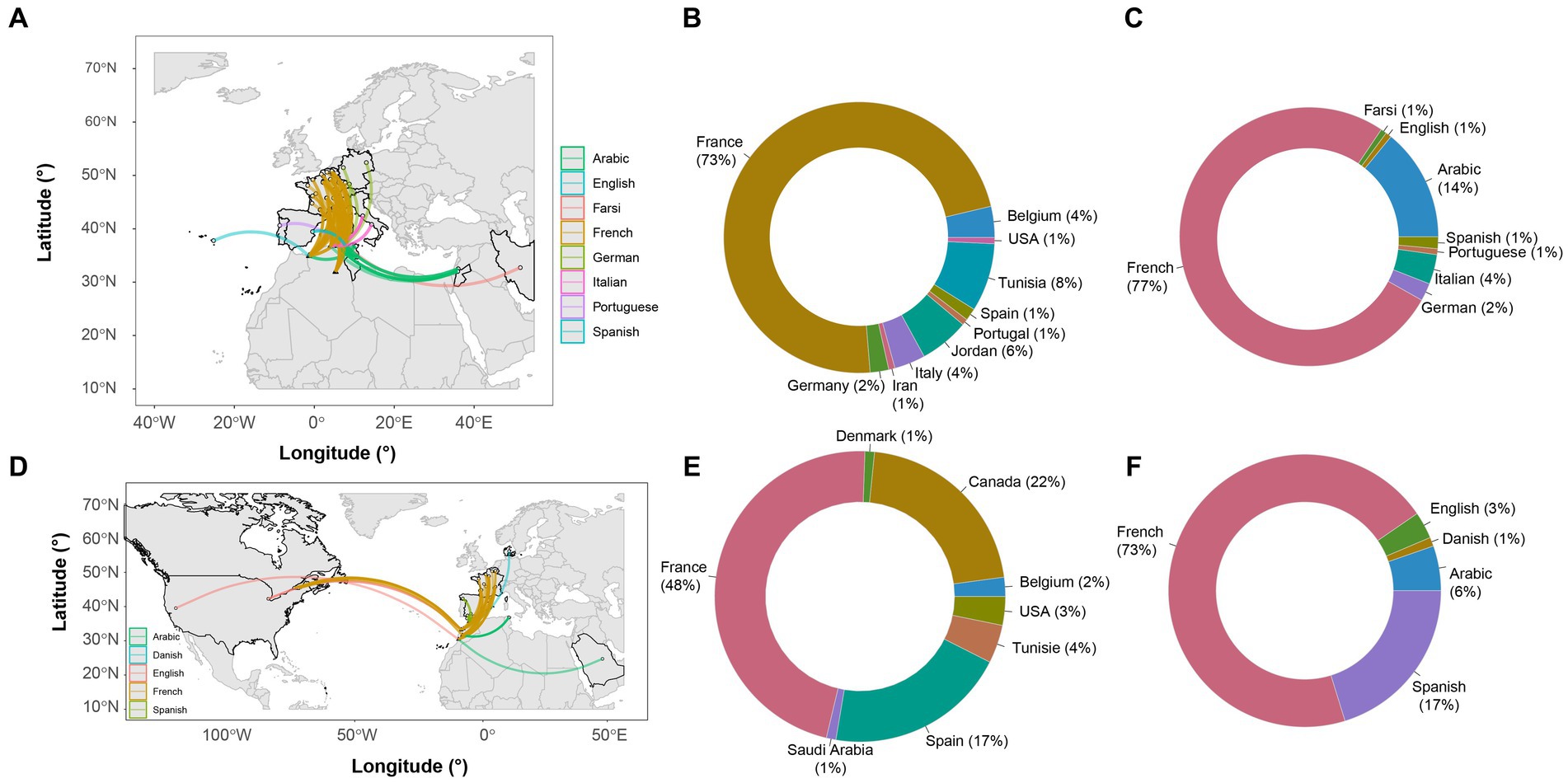
Figure 4. Geographic distribution of countries and language of the international institutions collaborating with PhD students in biological sciences based in Algeria and Morocco. (A) Map showing the link between the Algerian institutions and the institutions of the international coauthor. Frequency distribution of the affiliated country (B) and language (C) of the international collaboration. (D) Map showing the link between the Moroccan institutions and the institutions of the international coauthor. Frequency distribution of the affiliated country (E) and language (F) of the international coauthor of Moroccan students.
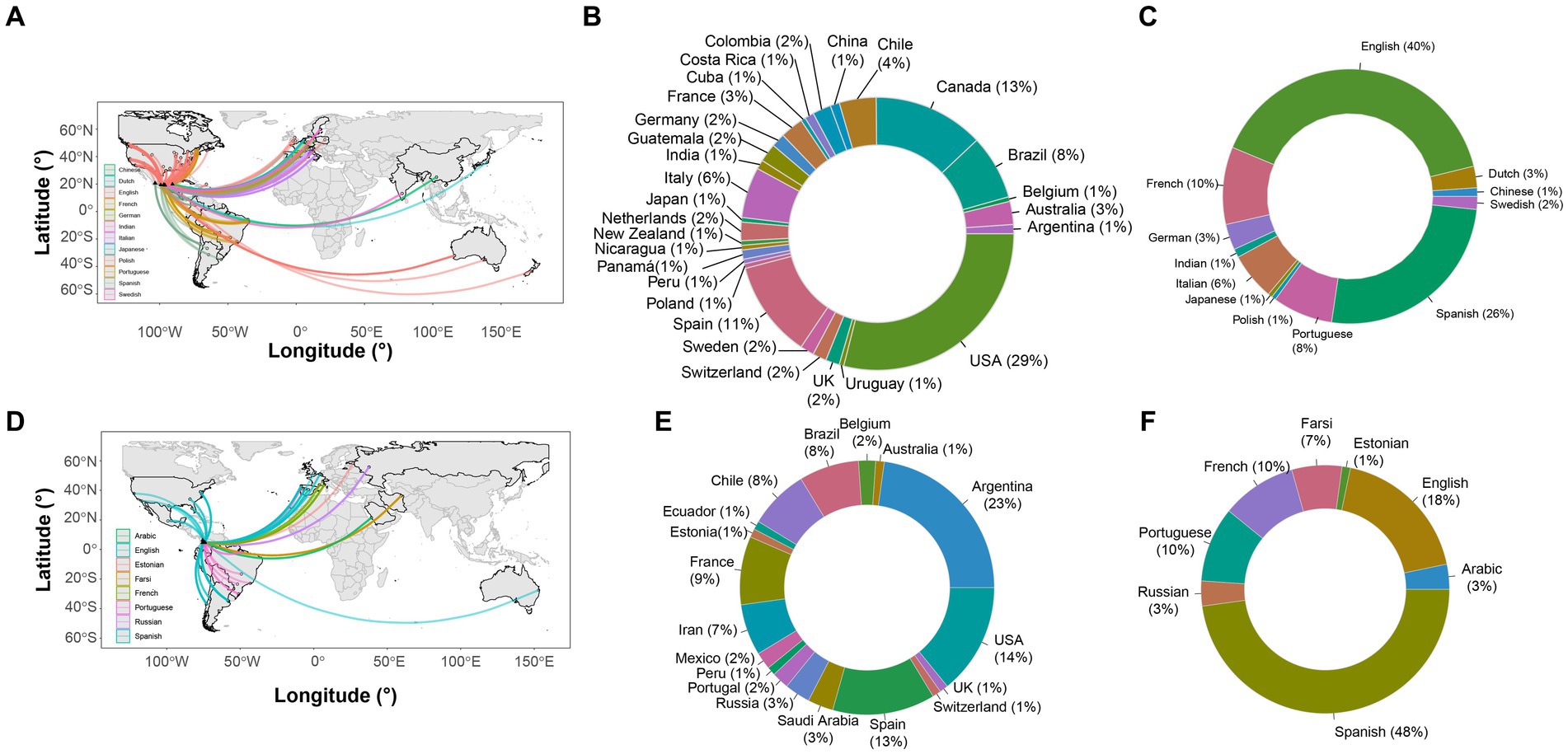
Figure 5. Geographic distribution of countries and language of the international institutions collaborating with PhD students in biological sciences based in Mexico and Colombia. (A) Map showing the link between the Mexican institutions and the institutions of the international coauthor. Frequency distribution of the affiliated country (B) and language (C) of the international collaboration. (D) Map showing the link between the Colombian institutions and the institutions of the international coauthor. Frequency distribution of the affiliated country (E) and language (F) of the international coauthor of Colombian students.
When considering the language of the international affiliations (Figures 4C,F, 5C,F), we found a clear dominance of French for Algeria (77%) (χ2 = 530.2, df = 7, p < 0.0001) and Morocco (61%) (χ2 = 163.0, df = 4, p < 0.0001), but a relatively higher percentage of English for Mexico (40%) (χ2 = 358.6, df = 7, p < 0.0001) and Spanish for Colombia (48%) (χ2 = 120.3, df = 7, p < 0.0001). International collaborators in English-speaking countries accounted for only 1%, 7%, and 29%, for Algeria, Morocco, and Colombia, respectively.
4. Discussion
Increasing the representation of researchers from the Global South in scientific disciplines requires an understanding of factors that facilitate their publishing experience, scientific productivity and impact as well as the limitations that those researchers encounter (Nuñez et al., 2019). Our results suggest that while international collaboration increases the international impact of Global South research in biological sciences, the diversity of countries selected for collaboration was much lower in Algeria and Morocco than in Mexico and Colombia, and apparently mainly driven by language barriers, geographic proximity and/or historical ties. Strengthening the relationship between researchers of the Global South and Global North through co-authorship has been proposed multiple times (Amano and Sutherland, 2013; Nuñez et al., 2019; Lund, 2021). Our study documents that these activities indeed have a positive effect on the visibility and impact of the research, thus contributing to increase the representation of scientific minorities in academia. We discuss below how on one hand this positive feedback contributes to increasing scientific minorities in academia, but on the other hand, maintains a power dynamic between Global North and Global South scientists for access to international scientific recognition.
4.1. Benefits of international collaboration
Overall, students who collaborated internationally, particularly with researchers from the Global North, had a higher likelihood of publishing in impact factor journals and received more citations per year. This result is concordant with other studies in different fields (Basu and Kumar, 2000; Leta and Chaimovich, 2002; Barjak and Robinson, 2008; Guerrero Bote et al., 2013; Breugelmans et al., 2018) and highlights a benefit of international collaborations. The benefit could be scientific – international collaborators might provide useful input that improves the framing of the research questions to the target journal, the analysis of the data, and the writing of the papers (in English); and/or social – international collaboration especially with researchers based in the Global North might reduce implicit bias in the evaluation of papers led by or including researchers from the Global South (Brodie et al., 2021). In the absence of international collaboration, our data showed that PhD students were more likely to publish in low-profile journals that do not have an impact factor, and usually give less visibility to the research and fewer citations. International collaboration, particularly with the Global South, should be valued by the scientific community, institutions, and funders. Researchers have recently suggested a metric (similar to the H-index) for international collaboration that could be used by evaluators to assess the potential of researchers to collaborate internationally (Cardoso et al., 2022).
There are different factors to explain the low tendency of publishing in high-impact journals among students in the Global South. A major barrier is low English proficiency combined with the lack of training in scientific writing which likely contributes substantially to the publishing performance (Nuñez et al., 2019; Khelifa and Mahdjoub, 2022). Most scientific papers are written in English, a language that students from the Global South usually do not master (possibly except for the countries colonized by the British empire) (Khelifa and Mahdjoub, 2022). In 2020, Education First ranked Mexico, Algeria, and Colombia in the “very low” English proficiency category, taking the position of 82, 81, and 77 out of 100 countries, respectively, whereas Morocco was listed in the “low” English proficiency and ranked 74 (Ef Epi, 2022). The native language in Algeria and Morocco is mainly Maghrebi Arabic and the first official language is the modern standard Arabic. Due to French colonization, Algeria and Morocco are more proficient in French than any other western language (Benrabah, 2007). Even though English is taught from middle school, the English workload is very low, and students typically have low English proficiency when they reach graduate school (Mohammed and Brahim, 2010). At university, sciences are taught in French, and English rarely occurs in the curricula before or during graduate school (Mohammed and Brahim, 2010). In Colombia, although there are about 65 languages spoken, 99% of the population speaks Spanish (Mincultura, 2022). In Mexico, there are 68 nationally recognized languages, and most of the population (93.5%) speaks Spanish (INEGI, 2020). In Both Colombia and Mexico, students learn Spanish from primary school to university. In parallel English is taught as a foreign language, however, the workload and quality of teaching depend on socioeconomic origin, typically a higher English proficiency correlates with higher income, private schools, and urban areas, among others (Ramírez-Castañeda, 2020). Thus, the low English proficiency entails a limited ability to write manuscripts that fit the standards of high-impact journals, leading to immediate desk rejections (Amano et al., 2016; Nuñez et al., 2019). As a consequence, students find refuge in low-profile journals that are more flexible as to the language requirements (Khelifa et al., 2022).
Other important limiting factors involve the lack of funding opportunities, resources, and infrastructures, which could generate a difference in the publishing opportunities and connection to the global scientific community. Students in the global South usually do not have funding to cover the article processing charges (so-called APC), which are often too expensive even with a reduced rate (Mekonnen et al., 2022). While the generalization of Open Access among journals is one way to make science available to everyone, it creates yet another inequity in publishing because institutions with limited resources (most institutions in the Global South) cannot afford publication costs. In addition to limited funding, students from the Global South have visa restrictions to attend conferences and interact with experts in their field (Waruru, 2018), hampering them from staying updated with popular research orientations and recent technological and scientific advances, as well as establishing international academic networks. In addition, major conferences are rarely held in the Global South for different reasons including security and lower attendance of researchers from the Global North. Physical meetings facilitate subsequent interactions between researchers, that is, a researcher that a student meets and interacts with is more likely to exchange contact information and collaborate than a researcher that a student does not meet. The absence of physical encounters might restrict Global South students to contact international researchers with emails.
4.2. Geography and language
Algeria and Morocco showed similar dominance of collaborations with institutions located in French-speaking countries, particularly France, whereas Mexico and Colombia showed a less pronounced dominance, yet a higher proportion of collaborations with Spanish- and English-speaking countries. These results suggest that language might partly shape the decision to select and establish scientific connections. The underlying drivers of the lower tendency of collaborating with English-speaking institutions are difficult to determine. One might expect that students would show a higher tendency to collaborate with English-speaking institutions because of their dominance in the authorship and editorial board of major journals in biological sciences (Maas et al., 2021). The observed low frequency of collaboration with English-speaking institutions might be due to a lower intention to collaborate with English-speaking researchers (e.g., language barrier, unfamiliarity) (Hwang, 2013), or a lower success in finding English-speaking collaborators due to low approval from English-speaking collaborators, perhaps because of a certain degree of bias among English-speaking authors. In a survey on the importance and barriers of international collaboration, Matthews et al. (2020) showed that while most non-native English-speaking respondents considered international collaboration crucial, they showed a lower tendency to collaborate due to various barriers including bias. For instance, in the latter study, a Taiwanese scientist stated that “Potential collaborators do not trust me due to my non-USA affiliation”.
The cases of Algeria and Morocco highlight that historical ties and language and not geography explain the dominance of French scientific collaborations. Although France is geographically near Algeria, Spain and Italy are as distant or even closer to Algeria or Morocco and still do not show a collaborative link as strong as that with France. France colonized both Algeria and Morocco, and even after the independence, both countries maintained a close scientific, economic and sociocultural link (Hadjazi, 2019). A lot of the pioneer scientists in biological fields in both countries were from France. For instance, the classic books and field guides for plants, insects, birds, and mammals of North Africa were mostly written by French naturalists (e.g., Selys-Longchamps, 1849; Quezel and Santa, 1962). Moreover, it is common that many of the current supervisors have spent training time (as students or internship) in France, which might have allowed them to establish academic relationships with French scientists.
Students based in Mexico and Colombia collaborated with a larger diversity of countries located in South and North America, Europe, Asia, and Australia. It is difficult to explain the reason for this large geographic diversity, although factors such as language proficiency, location of the fieldwork, nature of the project, and the academic network of the student and supervisor are likely contributors. Unlike Algeria and Morocco where the colonial country (France) was the most frequent collaborator, institutions from Spain (a colonial country for both Mexico and Colombia) represented <15% of all institutions in Mexico and Colombia. This lower proportion might be due to stronger historical ties with nearby countries in North and South America. Most of these nearby countries speak Spanish (same mother tongue), which facilitates collaboration. In fact, we recorded a quite large proportion of institutions based in Spanish-speaking countries in both Mexico (26%) and Colombia (48%).
There are some important variables that were difficult to obtain and that might contribute partially to the variation in student performance. For example, there might be some differences between laboratories in the amount of funds received by principal investigators. While this hypothesis is plausible, researchers from the Global South often receive little financial support and the existing differences should not have major impact on students’ productivity and performance. Differences in the socioeconomic background of students could also shape differences in performance, especially because PhD “salary” is often lower than the local minimum monthly wage. Students from a high-income background could not only afford private language training to improve English proficiency (Ramírez-Castañeda, 2020) but also focus mainly on research rather than balancing studying and working to earn a living. We also were unable to tease apart the effect of the supervisor from the effect of international collaborations, that is, supervisors who perform better in publishing might collaborate more frequently. Nevertheless, the study shows that international collaboration, regardless of whether it is established by the student or the supervisor, is associated with increased benefits on research productivity and impact.
Finding solutions to promote international collaborations in the Global South with language barriers requires reciprocal efforts from scientists of both the Global South and Global North. In fact, strengthening English training for students from the Global South prior to graduate school is strategic (Martirosyan et al., 2015) because it allows them to acquire a fundamental skill that not only improves their publishing success but also opens the door for a larger array of potential collaborations abroad. Second, Global North researchers should consider collaborating with non-English speaking researchers regardless of their English proficiency because such an exchange will benefit the scientific community as a whole, and likely create positive feedback on the interest and motivation of non-native English speaker researchers to learn English (Lund, 2021).
4.3. A critical view of dependency on international collaboration
Although collaborations can be beneficial for all sides, the benefit can be also asymmetrical and the conditions for collaboration can be imposed by just one side of the actors involved. This asymmetrical interaction has been referred to as “parachute science,” the practice of “collaborating” to conduct fieldwork or using technical and logistical resources in the Global South to perform research that Global North researchers will finalize and publish (Stefanoudis et al., 2021; Ramírez-Castañeda et al., 2022). Careful consideration of each collaboration is necessary to address possible negative effects when collaborating with researchers that possess higher relative privilege (Ramírez-Castañeda, 2020; Armenteras, 2021), not only in terms of geopolitics but also in terms of gender, race, disability, academic hierarchy, among others. To ensure a fair collaboration, some critical points could be discussed: (1) the intellectual involvement of collaborators when designing the research, (2) the long-term impacts for researchers and local communities (e.g., resources, materials, tissue collections), (3) the accessibility of results (e.g., open access, translation in the local language, outreach products), and (4) the authorship criteria and funding of the project (Ramírez-Castañeda, 2020; Armenteras, 2021; Haelewaters et al., 2021; Rayadin and Buřivalová, 2022). In this paper, we showed that more than 60% of the collaborations in Algeria, Morocco, and Mexico were established with a global north institution (around 40% for Colombia). However, we did not determine if the international collaboration accomplished all or some of the criteria to reduce parachute science. Therefore, understanding all of these collaborations as positive or fair for the Global South researchers can be misleading.
On the other hand, the fact that these collaborations had an impact on the success of the research can also be interpreted in a negative way. Collaborations should not be mandatory to have success in the scientific community. Minimizing the dependence of the Global South on the Global North to disseminate research and to be valued in the scientific community is necessary to reduce the long-term effects of colonialism. For instance, the Global North research agenda does not necessarily overlap with the most important topics to address in the Global South region. Producing contextual research instead of focusing on the topics valued by the “international” community is fundamental to produce benefits for the southern territories when conducting science (De Sousa Santos et al., 2016). However, publishing rules and manners have been designed by western values and culture. For example, English dominance in science has an impact on how we understand and write about science (Bennett, 2013; Gil, 2020), the increased value of science that is produced with more recent technologies (e.g., Tewksbury et al., 2014; Rausher and Delph, 2015; Tosa et al., 2021), and the common use of western bias terminology and epistemology (e.g., discovery, neotropics, nature/humanity) (De Sousa Santos, 2018; Trisos et al., 2021). All of these homogenize the way that we produce and communicate scientific knowledge.
South–south collaboration is a possible alternative to diversify and promote scientific research and still produce contextual and relevant knowledge (De Sousa Santos, 2010; Dussel, 2016). The Global South shares a lot of ecosystems (e.g., tropical forest, tropical high mountains, coral reefs), challenges (e.g., lack of resources, impoverishment, neocolonialism, extractivism) and cultural ideas. Our research showed that around 23% of the collaborators in Mexico and 52% in Colombia are also based in the global south, implying that this relationship maybe already important in some countries (Ordóñez-Matamoros et al., 2011). Nevertheless, further efforts are essential to connect global south researchers from different continents.
Data availability statement
The datasets presented in this study can be found in online repositories. The names of the repository/repositories and accession number(s) can be found at: https://datadryad.org/stash/share/4BfEBReEeiy3xe81QbISQp5Q6sc9_vQcVqLqMayetcQ.
Ethics statement
Ethical review and approval was not required for the study on animals in accordance with the local legislation and institutional requirements.
Author contributions
HM: Conceptualization, Data curation, Formal analysis, Investigation, Software, Visualization, Writing – original draft, Writing – review & editing. AB: Data curation, Investigation, Writing – review & editing. SC: Data curation, Investigation, Writing – review & editing. VR-C: Data curation, Investigation, Writing – original draft, Writing – review & editing. LC: Data curation, Writing – review & editing. DG-T: Data curation, Writing – review & editing. SV-B: Data curation, Investigation, Writing – review & editing. MR-O: Data curation, Writing – review & editing. AC-A: Investigation, Validation, Writing – review & editing. RK: Conceptualization, Data curation, Formal analysis, Investigation, Writing – original draft, Writing – review & editing.
Funding
The author(s) declare financial support was received for the research, authorship, and/or publication of this article. This study was conducted in the capacity of Postdoctoral Research Fellow (project: P400PB_191139) awarded by the Swiss National Science Foundation (SNSF).
Acknowledgments
We are indebted to Robert A. Cannings for reading an earlier version of the manuscript. We are grateful to Jimena Rey and Karen Miranda for helping us with the data collection. Thanks to https://www.deepl.com/translator for providing the first version of the Spanish abstract.
Conflict of interest
The authors declare that the research was conducted in the absence of any commercial or financial relationships that could be construed as a potential conflict of interest.
Publisher’s note
All claims expressed in this article are solely those of the authors and do not necessarily represent those of their affiliated organizations, or those of the publisher, the editors and the reviewers. Any product that may be evaluated in this article, or claim that may be made by its manufacturer, is not guaranteed or endorsed by the publisher.
Supplementary material
The Supplementary material for this article can be found online at: https://www.frontiersin.org/articles/10.3389/feduc.2023.1281219/full#supplementary-material
References
Abramo, G., D’angelo, C. A., and Solazzi, M. (2011). The relationship between scientists’ research performance and the degree of internationalization of their research. Scientometrics 86, 629–643. doi: 10.1007/s11192-010-0284-7
Amano, T., González-Varo, J. P., and Sutherland, W. J. (2016). Languages are still a major barrier to global science. PLoS Biol. 14:e2000933. doi: 10.1371/journal.pbio.2000933
Amano, T., Rios Rojas, C., Boum Ii, Y., Calvo, M., and Misra, B. B. (2021). Ten tips for overcoming language barriers in science. Nat. Hum. Behav. 5, 1119–1122. doi: 10.1038/s41562-021-01137-1
Amano, T., and Sutherland, W. J. (2013). Four barriers to the global understanding of biodiversity conservation: wealth, language, geographical location and security. Proc. R. Soc. B Biol. Sci. 280:20122649. doi: 10.1098/rspb.2012.2649
Armenteras, D. (2021). Guidelines for healthy global scientific collaborations. Nat. Ecol. Evol. 5, 1193–1194. doi: 10.1038/s41559-021-01496-y
Barjak, F., and Robinson, S. (2008). International collaboration, mobility and team diversity in the life sciences: impact on research performance. Soc. Geogr. 3, 23–36. doi: 10.5194/sg-3-23-2008
Basu, A., and Kumar, B. V. (2000). International collaboration in Indian scientific papers. Scientometrics 48, 381–402. doi: 10.1023/A:1005692505687
Bennett, K. (2013). English as a lingua Franca in academia. Interpret. Transl. Train. 7, 169–193. doi: 10.1080/13556509.2013.10798850
Benrabah, M. (2007). Language-in-education planning in Algeria: historical development and current issues. Lang. Policy 6, 225–252. doi: 10.1007/s10993-007-9046-7
Bilimoria, D., and Liang, X. (2012). Gender equity in science and engineering: advancing change in higher education. New York: Routledge.
Brandt, W. (1980). North south: a programme for survival; report of the independent commission on international development issues. MIT, Cambridge, MA, US.
Breugelmans, J. G., Roberge, G., Tippett, C., Durning, M., Struck, D. B., and Makanga, M. M. (2018). Scientific impact increases when researchers publish in open access and international collaboration: a bibliometric analysis on poverty-related disease papers. PLoS One 13:e0203156. doi: 10.1371/journal.pone.0203156
Brodie, S., Frainer, A., Pennino, M. G., Jiang, S., Kaikkonen, L., Lopez, J., et al. (2021). Equity in science: advocating for a triple-blind review system. Trends Ecol. Evol. 36, 957–959. doi: 10.1016/j.tree.2021.07.011
Cardoso, P., Fukushima, C. S., and Mammola, S. (2022). Quantifying the international collaboration of researchers and institutions. Trends Ecol. Evol. 37, 725–728. doi: 10.1016/j.tree.2022.06.011
De Sousa Santos, B. (2010). Descolonizar el saber, reinventar el poder. Montevideo, Uruguay: Ediciones Trilce.
De Sousa Santos, B., Nimako, K., Maldonado-Torres, N., Burman, A., Aman, R., Sithole, T., et al. (2016). Decolonizing the westernized university: interventions in philosophy of education from within and without. Lanham, MD: Lexington books.
Doubeni, C. A., Corley, D. A., and Peek, R. M. (2022). Advancing diversity, equity, and inclusion in scientific publishing. Gastroenterology 162:e51, 59–62.e1. doi: 10.1053/j.gastro.2021.10.043
Dussel, E. (2016). Filosofías del sur: descolonización y transmoderindad. Madrid, Spain: Ediciones akal.
Ef Epi (2022). EF English proficiency index: A ranking of 100 countries and regions by English skills. Available at: http://www.ef.com/epi (Accessed December 12, 2022).
Gil, Y. E. A. (2020). Ää: manifiestos sobre la diversidad lingüística. Madrid, Spain: Almadía Ediciones.
Guerrero Bote, V. P., Olmeda-Gómez, C., and De Moya-Anegón, F. (2013). Quantifying the benefits of international scientific collaboration. J. Am. Soc. Inf. Sci. Technol. 64, 392–404. doi: 10.1002/asi.22754
Hadjazi, S. (2019). Histoire de la coopération France-Algérie depuis l’indépendance. Revue Défense Nationale N° 822, 97–103. doi: 10.3917/rdna.822.0097
Haelewaters, D., Hofmann, T. A., and Romero-Olivares, A. L. (2021). Ten simple rules for global north researchers to stop perpetuating helicopter research in the global south. PLoS Comput. Biol. 17:e1009277. doi: 10.1371/journal.pcbi.1009277
Harrison, X. A. (2014). Using observation-level random effects to model overdispersion in count data in ecology and evolution. PeerJ 2:e616. doi: 10.7717/peerj.616
He, Z.-L., Geng, X.-S., and Campbell-Hunt, C. (2009). Research collaboration and research output: a longitudinal study of 65 biomedical scientists in a New Zealand university. Res. Policy 38, 306–317. doi: 10.1016/j.respol.2008.11.011
Hofstra, B., Kulkarni, V. V., Galvez, S. M.-N., He, B., Jurafsky, D., and Mcfarland, D. A. (2020). The diversity–innovation paradox in science. Proc. Natl. Acad. Sci. 117, 9284–9291. doi: 10.1073/pnas.1915378117
Hwang, K. (2013). Effects of the language barrier on processes and performance of international scientific collaboration, collaborators’ participation, organizational integrity, and interorganizational relationships. Sci. Commun. 35, 3–31. doi: 10.1177/1075547012437442
INEGI, (2020). Available at: https://www.inegi.org.mx/app/tabulados/interactivos/?pxq=f7d47f2c-66bb-4f81-9ca1-424402f30bf2 (Accessed 30, de mayo de 2023).
Khelifa, R., and Mahdjoub, H. (2022). An intersectionality lens is needed to establish a global view of equity, diversity and inclusion. Ecol. Lett. 25, 1049–1054. doi: 10.1111/ele.13976
Khelifa, R., Mahdjoub, M., Baaloudj, A., and Chaib, S. (2022). Language of citation and publishing performance of graduate students in French-speaking countries with different economic and linguistic advantages. Facets 7, 71–81. doi: 10.1139/facets-2021-0073
Lee, S., and Bozeman, B. (2005). The impact of research collaboration on scientific productivity. Soc. Stud. Sci. 35, 673–702. doi: 10.1177/0306312705052359
Leta, J., and Chaimovich, H. (2002). Recognition and international collaboration: the Brazilian case. Scientometrics 53, 325–335. doi: 10.1023/A:1014868928349
Lund, B. D. (2021). Is academic research and publishing still leaving developing countries behind? Account. Res. 29, 224–231. doi: 10.1080/08989621.2021.1913124
Maas, B., Pakeman, R. J., Godet, L., Smith, L., Devictor, V., and Primack, R. (2021). Women and global south strikingly underrepresented among top-publishing ecologists. Conserv. Lett. 14:e12797. doi: 10.1111/conl.12797
Márquez, M. C., and Porras, A. M. (2020). Science communication in multiple languages is critical to its effectiveness. Front. Commun. 5:31. doi: 10.3389/fcomm.2020.00031
Martirosyan, N. M., Hwang, E., and Wanjohi, R. (2015). Impact of English proficiency on academic performance of international students. J. Int. Stud. 5, 60–71. doi: 10.32674/jis.v5i1.443
Matthews, K. R., Yang, E., Lewis, S. W., Vaidyanathan, B. R., and Gorman, M. (2020). International scientific collaborative activities and barriers to them in eight societies. Account. Res. 27, 477–495. doi: 10.1080/08989621.2020.1774373
Mcfadyen, M. A., and Cannella, A. A. (2004). Social capital and knowledge creation: diminishing returns of the number and strength of exchange relationships. Acad. Manag. J. 47, 735–746. doi: 10.2307/20159615
Mcgill, B. M., Foster, M. J., Pruitt, A. N., Thomas, S. G., Arsenault, E. R., Hanschu, J., et al. (2021). You are welcome here: a practical guide to diversity, equity, and inclusion for undergraduates embarking on an ecological research experience. Ecol. Evol. 11, 3636–3645. doi: 10.1002/ece3.7321
Mekonnen, A., Downs, C., Effiom, E. O., Kibaja, M., Lawes, M. J., Omeja, P., et al. (2022). Can I afford to publish? A dilemma for African scholars. Ecol. Lett. 25, 711–715. doi: 10.1111/ele.13949
Mincultura (2022). Lenguas Nativas y Criollas de Colombia. Available at: https://mincultura.gov.co/areas/poblaciones/APP-de-lenguas-nativas/Paginas/default.aspx.
Mohammed, M., and Brahim, M. (2010). “The LMD higher education system in the Maghreb countries: the example of Algeria” in Towards an Arab higher education space: International challenges and societal responsibilities. ed. B. Lamine (Beirut: UNESCO Regional Bureau for Education in the Arab States), 267–280.
Nuñez, M. A., Barlow, J., Cadotte, M., Lucas, K., Newton, E., Pettorelli, N., et al. (2019). Assessing the uneven global distribution of readership, submissions and publications in applied ecology: obvious problems without obvious solutions. J. Appl. Ecol. 56, 4–9. doi: 10.1111/1365-2664.13319
Ordóñez-Matamoros, G., Cozzens, S. E., and García-Luque, M. (2011). “North-South and South-South research collaboration: What differences does it make for developing countries?-the case of Colombia.” In Atlanta Conference on Science and Innovation Policy ; Atlanta, GA, USA: IEE, doi: 10.1109/ACSIP.2011.6064479
Quezel, P., and Santa, S. (1962). Nouvelle flore de l’Algérie et des régions désertiques méridionales. Paris, France: CNRS.
R Development Core Team (2023). R: A language and environment for statistical computing. Vienna, Austria, R Foundation for Statistical Computing.
Ramírez-Castañeda, V. (2020). Disadvantages in preparing and publishing scientific papers caused by the dominance of the English language in science: the case of Colombian researchers in biological sciences. PLoS One 15:e0238372. doi: 10.1371/journal.pone.0238372
Ramírez-Castañeda, V., Westeen, E. P., Frederick, J., Amini, S., Wait, D. R., Achmadi, A. S., et al. (2022). A set of principles and practical suggestions for equitable fieldwork in biology. Proc. Natl. Acad. Sci. 119:e2122667119. doi: 10.1073/pnas.2122667119
Rausher, M. D., and Delph, L. F. (2015). Commentary: when does understanding phenotypic evolution require identification of the underlying genes? Evolution 69, 1655–1664. doi: 10.1111/evo.12687
Rayadin, Y., and Buřivalová, Z. (2022). What does it take to have a mutually beneficial research collaboration across countries? Conserv. Sci. Pract. 4:e528. doi: 10.1111/csp2.528
Ribeiro, L. C., Rapini, M. S., Silva, L. A., and Albuquerque, E. M. (2018). Growth patterns of the network of international collaboration in science. Scientometrics 114, 159–179. doi: 10.1007/s11192-017-2573-x
Selys-Longchamps, E. (1849). “Exploration Scientifique de l'Algerie” in Les libelluliens. ed. H. Lucas (Paris: Impremerie nationale), 115–135.
Stefanoudis, P. V., Licuanan, W. Y., Morrison, T. H., Talma, S., Veitayaki, J., and Woodall, L. C. (2021). Turning the tide of parachute science. Curr. Biol. 31, R184–R185. doi: 10.1016/j.cub.2021.01.029
Tewksbury, J. J., Anderson, J. G. T., Bakker, J. D., Billo, T. J., Dunwiddie, P. W., Groom, M. J., et al. (2014). Natural History's place in science and society. Bioscience 64, 300–310. doi: 10.1093/biosci/biu032
Tosa, M. I., Dziedzic, E. H., Appel, C. L., Urbina, J., Massey, A., Ruprecht, J., et al. (2021). The rapid rise of next-generation natural history. Front. Ecol. Evol. 9. doi: 10.3389/fevo.2021.698131
Trisos, C. H., Auerbach, J., and Katti, M. (2021). Decoloniality and anti-oppressive practices for a more ethical ecology. Nat. Ecol. Evol. 5, 1205–1212. doi: 10.1038/s41559-021-01460-w
Waruru, M. (2018). African and Asian researchers are hampered by visa problems. Nature 10:d4158. doi: 10.1038/d41586-018-06750-1
Keywords: publication, global south, biology, doctorate, language barriers, science
Citation: Mahdjoub H, Baaloudj A, Chaib S, Ramírez-Castañeda V, Contreras LAB, González-Tokman D, Villada-Bedoya S, Rocha-Ortega M, Córdoba-Aguilar A and Khelifa R (2023) Benefits and geography of international collaboration for PhD students in biology from four global south countries. Front. Educ. 8:1281219. doi: 10.3389/feduc.2023.1281219
Edited by:
Satyam Mukherjee, Shiv Nadar University, IndiaReviewed by:
Srilena Kundu, The University of Chicago, United StatesHaroldo V. Ribeiro, State University of Maringá, Brazil
Copyright © 2023 Mahdjoub, Baaloudj, Chaib, Ramírez-Castañeda, Contreras, González-Tokman, Villada-Bedoya, Rocha-Ortega, Córdoba-Aguilar and Khelifa. This is an open-access article distributed under the terms of the Creative Commons Attribution License (CC BY). The use, distribution or reproduction in other forums is permitted, provided the original author(s) and the copyright owner(s) are credited and that the original publication in this journal is cited, in accordance with accepted academic practice. No use, distribution or reproduction is permitted which does not comply with these terms.
*Correspondence: Rassim Khelifa, cmFzc2lta2hlbGlmYUBnbWFpbC5jb20=