Abstract
At University of California, Irvine, a large-enrollment research university, undergraduate chemistry courses for non-chemistry majors were delivered remotely during the 2020–2021 academic year, with a return to in-person instruction planned for January 2022. Because this return to in-person instruction coincided with the transition of second-year students from general chemistry to organic chemistry laboratory courses, the instructional staff recognized a need for remedial laboratory curricula for students with no prior in-person laboratory experience. Simultaneously, we desired to implement undergraduate Learning Assistants (LAs) in non-chemistry major organic chemistry laboratories for the first time at our university. In this paper, we describe our approach for leveraging undergraduate LAs to (1) test new laboratory curricula and (2) address feelings of comfort and safety for students with no prior in-person laboratory experience. Benefits of our LA program perceived by students include increased laboratory efficiency and improved student learning from near-peer instructors; benefits perceived by LAs include the development of professional skills and teamwork with graduate student teaching assistants. We provide an outline of resources and strategies to enable instructors to simultaneously implement undergraduate LAs and new laboratory curricula.
1 Introduction
Learning Assistants (LAs) — undergraduate students who serve as assistant instructors for courses they have previously taken — are increasingly being leveraged in STEM courses (Emenike et al., 2020; Barrasso and Spilios, 2021). Peer learning, in which experienced students guide current students’ learning through a zone of proximal development, underpins LA programs (Thompson et al., 2020). In traditional learning communities, students learn solely from a senior instructor, who can be perceived as unapproachable or intimidating. Vertical learning communities seek to address this student-instructor gap by introducing a near-peer instructor (Bourne et al., 2021). LAs are approachable due to closeness in age and experience and can provide mentorship to students. Additionally, LAs improve students’ comfort and confidence in the classroom (Ten Cate and Durning, 2007). Student comfort and confidence fall under the affective domain, which — along with the cognitive and psychomotor domains — is an essential part of meaningful learning in the laboratory (Bretz, 2001; Galloway et al., 2016). Therefore, peer instructors have the potential to foster an improved overall learning environment.
The COVID-19 pandemic and subsequent statewide shutdown in 2020 resulted in evacuation of our campus and remote learning that lasted until December 2021 (Lawhon, 2020). During the Spring 2021 term, the organic chemistry laboratory (OCL) course sequence for non-chemistry majors piloted an LA program to facilitate student guidance during a time of isolation and uncertainty.
Returning to in-person learning presented unique challenges for the OCL instructional team. Under usual circumstances, students would have completed two prior in-person general chemistry laboratory courses. Due to remote learning, both students entering the OCL series and pilot program LAs who completed OCL courses online would have little to no hands-on chemistry laboratory experience. Fall 2021 was an opportunity for the simultaneous testing of new experiments and training of LAs with little prior in-person experience before a complete return to in-person teaching in Winter 2022. Herein, we outline a strategy by which we simultaneously tested remedial laboratory curricula designed for this unique cohort of students and trained an initial group of LAs to assist with teaching these modified courses. This strategy was informed by the existing literature on LAs, vertical learning communities, and addressing the affective domain in laboratory instruction. Our overarching research question was: “Does the implementation of LAs in response to instructional discontinuity lead to beneficial outcomes for a cohort of students lacking prior in-person laboratory experience?” Specifically, these beneficial outcomes would include student-and LA-perceived improvements to the laboratory learning community and affective domain.
2 Pedagogical frameworks
2.1 Vertical learning communities with near-peer instructors
Traditional undergraduate learning communities consist of students instructed by a graduate student teaching assistant (GTA) and/or professor with several years of experience and training in the subject matter. In this hierarchical organization, students may feel disconnected or even intimidated, creating a relational gap between the student and instructor (Hall et al., 2014; Bourne et al., 2021). The effects of this structure can be exacerbated in challenging courses, such as OCL (Micari and Pazos, 2012). Implementation of LAs in courses results in a vertical community of scholars; LAs are inserted into the traditional relationship of students and instructors, reducing the gap between their experience and labels (Bourne et al., 2021; Frosch and Goldstein, 2021). An LA or near-peer instructor is an individual who is close in age and education level but is one or more years senior in their educational progress to a student and seeks to provide mentorship and guidance (Bulte et al., 2007; Akinla et al., 2018). Price et al. suggest that the social element of vertical learning communities encourages students to develop collaborative problem-solving skills (Price et al., 2019). Our LA program was inspired by previously-established peer-learning programs, such as the Learning Assistant Program at the University of Colorado Boulder and the Undergraduate Teacher-Scholar Program at UC Berkeley (Otero et al., 2010; Bourne et al., 2021).
2.2 Affective domain in laboratory instruction
The affective domain is defined as encompassing students’ attitudes, motivations, values, expectations, and emotions in the context of the learning process. Galloway has emphasized the relevance of the affective domain in Novak’s framework of meaningful learning (Bretz, 2001; Galloway et al., 2016), which requires complete integration of the cognitive and affective domains with the psychomotor domain. For meaningful learning to occur in an OCL setting, the instructor should aim for holistic treatment of motivational and attitudinal aspects in addition to conceptual and procedural aspects when designing laboratory curricula. Seery argues for preparing and supporting students by managing their expectations for challenges and difficulties in the complex learning environment of chemistry laboratory courses, which LAs could facilitate (Seery et al., 2019).
Despite a relative lack of research on the affective domain in the chemistry laboratory compared to the cognitive or psychomotor domains, considerable effort has been made in assessing the effects of various learning interventions on affect (Penn and Ramnarain, 2019; Flaherty, 2020). Implementation of a process-oriented guided inquiry learning introductory chemistry course resulted in improved self-efficacy and confidence in students with little prior chemistry knowledge and experience (Vishnumolakala et al., 2017). The introduction of LAs during the return to in-person classes had the potential to positively impact students’ comfort and safety in the laboratory, with the additional benefit of improving learning assistants’ confidence and attitudes towards chemistry (Smith, 2008; Kornreich-Leshem et al., 2022).
3 Learning environment
The courses described herein took place at University of California, Irvine, a large public research university in the western United States, designated as a Minority Serving Institution, with the federal designations of Asian American and Native American Pacific Islander-Serving Institution and Hispanic-Serving Institution. The overall student population included in the study is 66% female and 34% male, based on self-reported responses to a binary-choice question about biological sex at time of admission. Students self-reported as 55% Asian, 17% Hispanic/Latinx, 13% white, 3% Black or African American, 8% Native Hawaiian and/or Pacific Islander, less than 1% American Indian and/or Alaskan Native; 3% declined to state. Overall, 44% of students self-identified as first-generation college students and 33% were identified as low-income. First-generation status was defined as neither parent completing a 4-year degree. Students who did not self-report income were assumed to be nonlow-income.
These courses are part of an OCL series consisting of a three-course sequence for non-chemistry majors (Figure 1). Each term is 10 weeks. Laboratory sections meet once per week for 4 h. Additionally, students are expected to attend a one-hour laboratory lecture section once per week. Although the laboratory course, including laboratory sections and laboratory lecture sections, is separate from the organic chemistry lecture course, students enroll in both courses concurrently. Depending on the term and the specific course, an OCL course may have between 150–1,200 students enrolled. Up to 34 GTAs are required during a large-enrollment quarter, with each GTA assigned as the sole instructional staff member present for two 20-student laboratory sections per week.
Figure 1

Timeline of curricula development, curricula testing, LA training, LA implementation, and survey collection.
The OCL course sequence described here is coordinated and taught by a single faculty member (RDL). Because of the scale of these courses, the instructional team includes multiple Head GTAs (JHG, JCT, PAL) who provide logistical, administrative, and pedagogical support to the instructor, including GTA scheduling, addressing grading discrepancies, writing exam questions, and hosting weekly office hours.
4 Results
4.1 Methods
4.1.1 LA implementation
This work represents the first implementation of LAs during the laboratory component of an OCL course at UC Irvine. Students serving as an LA for the first time in any course are required to enroll in the university-wide Certified Learning Assistants Program (CLAP), in which a certified instructor trains new LAs in pedagogical theory and strategies for facilitating classroom teaching. In Summer 2021, the remedial laboratory curricula were developed, and initial recruitment applications were sent to students who had performed well in the relevant course series (B+ or better) within the two prior academic years (Figure 1). In Fall 2021, the first cohort of LAs was accepted, and simultaneous laboratory safety/technique training and experiment testing took place. Implementation of LAs in lab sections occurred in Winter 2022, but continuing disruptions to instruction caused by the COVID-19 pandemic precluded survey data collection for this term. Spring 2022 represents the first term in which student and LA survey data were collected for a full in-person implementation of laboratory LAs.
Applications were sent to prospective LAs using Google Forms (Supplementary material). The application comprises three sections: (1) potential for effective peer instruction, (2) reflection on transferable professional skills, and (3) an example of answering student questions. Applications scoring highly on a rubric were accepted without a limit on the possible number of acceptances (Supplementary material). Application forms were distributed 4 weeks before the start of instruction; the application remained open for 2 weeks. Accepted LAs were notified 2 weeks before the start of instruction. One week before the start of instruction, LAs were assigned to laboratory time slots and were assigned based only on their individual availability such that each laboratory section was led by either one GTA or one GTA and one LA. In an average term of 60 individual laboratory sections, roughly 50% of sections had exactly one LA present, and the remainder did not have any LAs present.
During Fall 2021, LAs who had no prior experience handling chemicals and equipment in an instructional laboratory setting participated in training; these LAs earned the same course credit that they would have as lecture LAs. Training was carried out over five weekly two-hour periods. The first period was dedicated to safety training and familiarity with laboratory equipment. The latter four periods involved testing of both existing and new laboratory experiments. Students were provided with access to a draft version of an experiment handout where they could provide feedback. LA cohorts after Fall 2021 did not participate in training or experiment testing, as they had prior in-person experience and no new curricula were being tested.
4.1.2 LA responsibilities
All LAs attended a weekly 30-min meeting in which the Head GTA reviewed LA feedback from the previous week’s experiment and summarized the upcoming experiment. Specific time was set aside for LAs to develop a plan to address anticipated student challenges or common misconceptions and mistakes. For example: At the beginning of our laboratory sections, students complete a collaborative set of questions concerning safety, equipment, and chemical principles; accordingly, LAs were provided with follow-up questions to guide student learning.
The primary responsibilities of LAs during laboratory time were to supplement GTA instruction by facilitating student completion of experimental work and achievement of related learning outcomes (GTA duties did not change). This was accomplished by addressing challenges and answering questions related to content, equipment, and procedure. During the laboratory section, LAs were free to develop an instructional plan with their GTAs based on information discussed during the weekly meeting. We were comfortable with LAs having the freedom to develop an independent instructional plan because of their CLAP training, but instructors at institutions without a CLAP analogue may want to be more prescribed in what in-laboratory activities are expected of their LAs.
The primary responsibility of LAs between weekly laboratory sections was to provide guided feedback on the completed experiment, addressing both the experiment itself and how students were or were not able to achieve learning goals efficiently. Our framework for collecting LA feedback was inspired by the implementation of “10-min journals” in peer-led team learning (Wilson and Varma-Nelson, 2021). Specifically, LAs provided answers to the following five questions about the laboratory experiment: (1) What went well? (2) What were “traps” or challenges for students? (3) Do you have suggestions for things that can be changed? (4) Do you have feedback on the writing of the experiment handout itself? (5) What information do students need clarification or additional instruction on before attending lab? This feedback was then aggregated by Head GTAs to be discussed in the following week’s LA meeting. We used this feedback on a regular basis to make incremental improvements to the phrasing or organization of course materials.
4.1.3 Student and LA surveys
Our surveys were adapted from work by Bourne et al. on the implementation of a large-scale laboratory LA program at UC Berkeley (Bourne et al., 2021). Specifically, their study analyzed the types of questions students approach GTAs, LAs, and/or peers with during recitation/discussion and laboratory sections. We were interested in whether these findings were consistent for our student population, who were returning from pandemic-related educational disruptions. Additionally, we investigated student and LA perceptions of (1) which LA duties were appropriate and (2) student affect in the laboratory with or without an LA present. The student survey addressed four major themes — LA duties, student learning from LAs and GTAs, student affect, and laboratory time management — using a combination of Likert-scale and open-ended questions. The LA survey included open-ended questions designed to reference the LA application, specifically the professional and academic goals and skills sections (Supplementary material).
This study was approved by the Institutional Review Board as an exempt study (IRB #741). Surveys were available to students, LAs, and GTAs for 1 week during the final week of instruction through Qualtrics. Students were offered one credit toward a “token” for completing this and other research surveys in each quarter; tokens can be exchanged in the course grading system for options such as late passes or the opportunity to revise and resubmit unsatisfactory assignments (McKnelly et al., 2023).
Student survey responses (n = 1,194, 35%) were de-identified before analysis. Student survey response rates varied by term (S22 n = 564, 58%; F22 n = 131, 48%; W23 n = 140, 12%; S23 n = 359, 36%), but results remained consistent across terms regardless of response rate. Summary statistics of demographics for survey respondents matched those of the overall courses. LA survey responses (overall n = 55, 63%; S22 n = 19, 83%; F22 n = 9, 75%, W23 n = 10, 37%; S23 n = 17, 65%) were collected anonymously. GTA responses were not analyzed due to low response rates of two or fewer GTAs per term. Analysis of Likert-type questions and multiple-select questions was conducted using the statistical programming language R (Garnier, 2018; R Core Team, 2019; Wickham et al., 2019). Responses from students to open-ended questions were analyzed using the Taguette free, open-source qualitative research tool (Taguette, n.d.). Students’ own wording was used to identify themes based on identified relations, similarities, and differences that were grouped conceptually.
4.2 Survey results
4.2.1 LA duties
We adapted survey questions used by Bourne et al. to confirm whether LAs were performing expected duties during laboratory sections and gauge the perceived appropriateness of those duties by students and LAs. The actual duties of LAs within the program were to (1) provide information, (2) monitor laboratory safety, (3) supervise instrument use, (4) act as a role model, and (5) facilitate discussion (Figure 2). When students were asked how appropriate these five LA duties were, the majority of respondents (57–60%) indicated that duties 1–4 were “very appropriate,” while the majority deemed duty 5 “usually appropriate” (41%) (Figure 2A). LAs were asked to self-assess these same duties and responded that 1–5 were “very appropriate” at higher rates than the students, particularly for duty 5, with 70% of LAs compared to 37% of students (Figure 2C). A similar trend emerged with student observations of their LAs during laboratory sections. The majority of students reported observing duties 1–4, but only 38% of respondents reported observing duty 5 (Figure 2B). Duty 1 was the most commonly observed by students at 91%, while duties 2 and 3 were also frequently observed at 79 and 75%, respectively. The most common duty performed by LAs was duty 2, in which 100% of LAs reported monitoring laboratory safety, and 95% of LAs reported performing duty 1 (Figure 2D). The largest differences between student and LA responses were that LAs reported performing duty 5 and duty 4 at higher rates than students reporting observing these activities, with discrepancies of 34 and 23%, respectively.
Figure 2
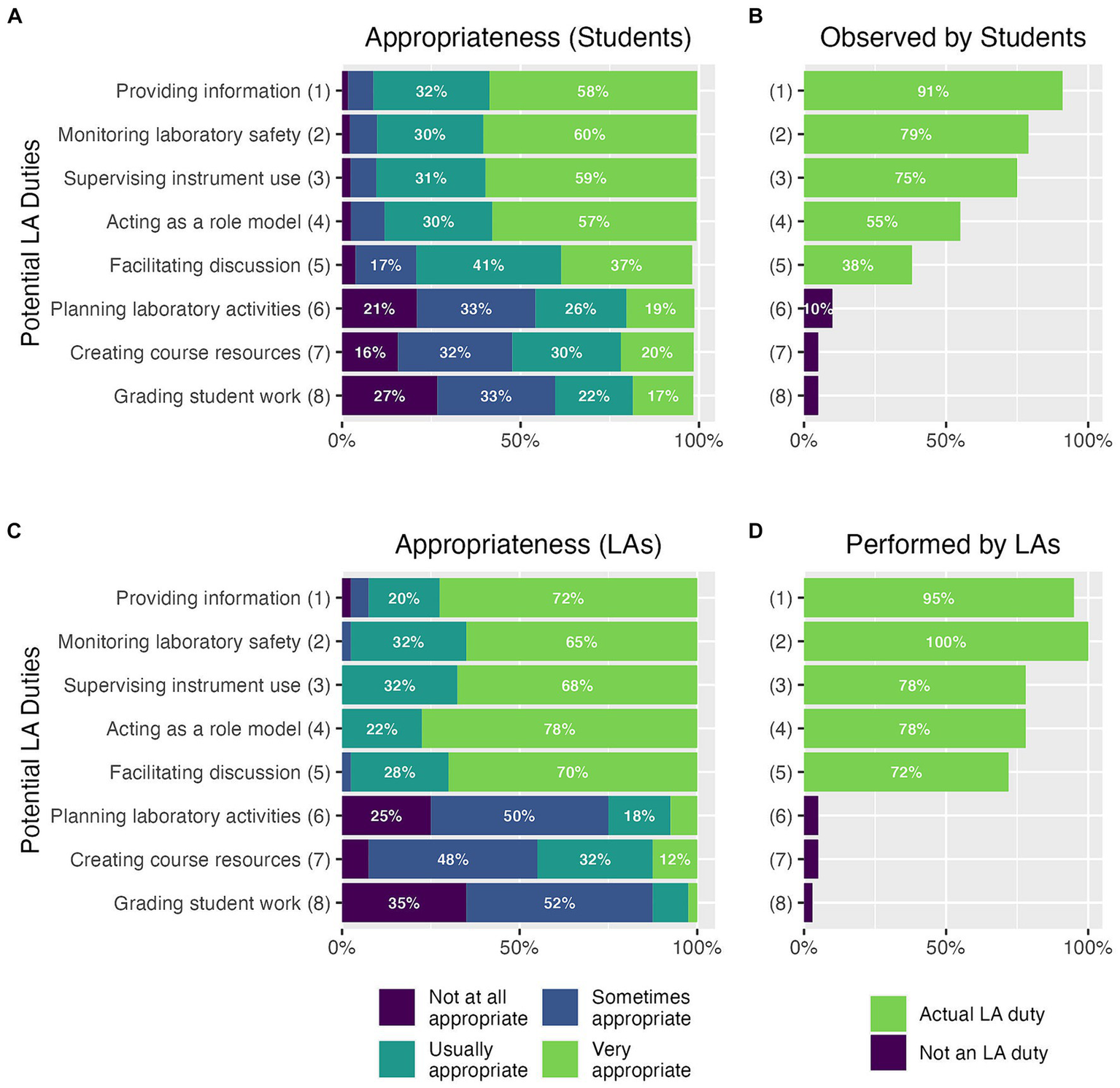
Student and LA responses to survey questions about the appropriateness and observation of LA duties. (A) Appropriateness of potential LA duties as determined by students. (B) Observation of LAs performing these duties as reported by students. (C) Appropriateness of potential LA duties as determined by LAs themselves. (D) Self-reporting of LAs performing these duties.
In addition to the actual LA duties, responsibilities that are instead assigned to other instructional staff were also included in this question. These non-LA duties included (6) planning laboratory activities, (7) creating course resources, and (8) grading student work. While students tended to underrate the appropriateness of duties 1–5 lower compared to LAs, the opposite trend was observed for duties 6–8. Student responses to the appropriateness of duty 6 were not as straightforward as for duties 1–5, with a broad range spanning “sometimes appropriate” (33%), “usually appropriate” (26%), and “very appropriate” (19%). LA responses skewed towards “sometimes appropriate” (50%), with 18% indicating “usually appropriate” and 8% indicating “very appropriate.” Similarly, a small majority of students stated that duty 7 is “sometimes appropriate” at 32%; however, the majority of LA responses (48%) indicated it was “sometimes appropriate.” Lastly, the majority of both students and LAs indicated that it would be “sometimes appropriate” for LAs to perform duty 8 (33 and 52%, respectively) with “not at all appropriate” being the second most common response (27% of students and 35% of LAs). Despite the fact that these duties were not assigned to LAs, a minority of both students and LAs (≤10%) observed or self-reported LAs performing duties 6–8.
4.2.2 Student learning from LAs and GTAs
Following the work of Bourne et al., we investigated the order in which students preferred to ask GTAs, LAs, and peers certain types of questions (Figure 3). For content, equipment, and procedure questions, the majority of students indicated that they would approach a GTA first (51–64%). A smaller proportion of students indicated that they would approach a peer first (24–29%), and a small minority of students indicated that they would approach an LA first (6–20%). LAs were consistently the most popular second choice for asking these types of questions (52–56%), while students indicated that they would approach GTAs second 20–26% of the time and peers second 14–16% of the time. Grading did not follow the trend observed for content/equipment/procedure questions, as a larger majority of respondents (87%) indicated that they would approach GTAs first for questions about grading. Life questions were the only category in which students did not indicate GTAs as their first priority, as 48% reported that they would first approach a peer. Across all question categories, LAs were consistently considered students’ second priority (grading: 57%; life: 48%).
Figure 3

Student responses to the question “Please indicate the order in which you would approach the following people (GTA, LA, peer) to ask the following types of questions.” Survey respondents were not required to give a 1st, 2nd, and 3rd priority for each category of question, so percentages may not add up to 100%.
4.2.3 Affective domain
A primary research question in this study was “Do students with no prior in-person laboratory experience self-report increased feelings of comfort, confidence, and safety when a laboratory LA is present?” In Figure 4A, we have separated results from the Spring 2022 term compared to Fall 2022–Spring 2023 (Figures 4B,C). Spring 2022 was the first term at our university since 2020 in which OCL courses were offered fully in person. For Spring 2022, a dramatic difference in students’ self-assessment of their comfort, confidence, and safety was noted compared to later terms. Confidence appeared to be split fairly evenly between “agree” (no LA 48%, LA 54%) and “disagree” (no LA 52%, LA 46%) responses, while comfort and safety lean slightly towards “agree” responses (comfort: no LA 63%, LA 66%; safety: no LA 63%, LA 66%). For students with no LAs, comfort, confidence, and safety were strongly disagreed with 35, 47, and 34% of the time, respectively. With an LA, these results were 31, 40, and 31%, respectively.
Figure 4

Student responses, separated by presence or absence of an LA in their laboratory section, to the question “Please rate the degree to which you agree with the following statement: ‘I felt [adjective] performing in-person laboratory experiments this quarter.’” (A) Student responses for Spring 2022 only, the first instructional period since the beginning of the COVID-19 pandemic in which the full 10-week laboratory course was offered in person with no interruption. (B) Student responses for each term during the study period other than Spring 2022. (C) Student responses for all terms included in the study period.
Expectedly, students reported feeling more comfortable, confident, and safe when they had prior laboratory experience compared to when they did not: For Fall 2022–Spring 2023, responses overwhelmingly skew towards “agree” for comfort (no LA 96%, LA 96%), confidence (no LA 93%, LA 93%), and safety (no LA 97%, LA 98%). Anxiety, a negative affect trait compared to the positive traits of comfort, confidence, and safety, was consistently more varied in student responses: Furthermore, students appeared to self-report higher anxiety in terms other than Spring 2022, as “agree” responses increased (no LA: 32 to 49%; LA: 39 to 47%).
4.2.4 Open-ended survey question responses
Responses from students and LAs to open-ended questions were used to identify major conceptual themes describing the benefits of the laboratory LA program (Table 1). As a result of LAs answering student questions, students identified improvements to experimental efficiency and LAs identified improvements to communication skills. Students described LAs as being effective near-peer instructors, highlighting previous experience in the course, approachability, and their similar institutional knowledge. Students described LAs as beneficial to the learning experience because LAs were able to support both GTAs and students with their experienced perspective. Additionally, students felt that LAs promoted a safer laboratory environment.
Table 1
| Student Perspective | LA Perspective | |
|---|---|---|
| LAs answer student questions. Answering questions, laboratory efficiency, communication | “Yes I think having multiple upper division role models will help when students have a lot of questions. It also makes labs go by much faster when there are more sets of hands to aid in conducting the lab. My LA was also very helpful when my TA was busy helping someone else. I could ask her for anything about the experiment or conceptually questions and she mostly has the answers to help.” “Labs are usually very hectic and many students are constantly asking questions, so having a second option to refer to for questions greatly helped keep everyone moving efficiently.” “Having the sense of mentorship is a nice touch. Having an extra set of eyes and supervisor helps cut down the time spent on waiting for the TA answer your questions after something goes wrong.” |
“I wanted to improve on my active learning skills during my time as an LA. I feel as though the lab course I chose to assist helped immensely with this because it challenged me to come up with certain tactics to use in assisting students rather than just giving them the answer. This helps both me and the student because it strengthens problem solving skills while also allowing the students to use their own knowledge to get to the answer themselves.” “As far as I can recall, the most important professional skill I wanted to to refine was my communication/teaching skills because in the field of medicine it is required of people to be able to elaborate certain medical knowledge that can be difficult to explain without a particular level of education. I believe that so far this position has been great at helping me rethink how I explain things and I have been able to compartmentalize what knowledge is important to knowing the concept vs. what knowledge is going overboard better than I have been able to do before.” “It is a great experience if someone is trying to get exposed to more teaching positions. It also strengthens communication and problem-solving skills which is an important skill to have for the future and life in general.” |
| Near-peer instructors facilitate student learning. Near-peer instructors, approachability, community | “I see LAs as the middle ground between TA and peer. They are super helpful because sometimes students do not want to go straight [to] the TA for what they may think is a stupid question. If a peer does not know, LA is the next best. I find this to be pretty common in lab settings. Maybe someone messed up the experiment, but they are too embarrassed to ask for help. A kind and understanding LA would be awesome!” “LAs are more relatable for undergraduates, and just having them present is reassuring because they were in our shoes somewhat recently and they passed the class.” “It’s nice seeing someone relatively our age be passionate about chemistry. It encourages learning [in] the lab environment.” |
“I think having another student in the lab really helps both the TA and students. It makes it easier for students to approach other fellow students and can facilitate a more comfortable environment where discussion and questions are encouraged. I think that the main thing [is] that I am only a year older than most of the students, it provides another person of ‘authority’ that the students can depend on while also being more comfortable with as there is a very tiny age gap…” “I think the lab in general can be pretty long and tiring which can exhaust students sometimes, but seeing someone who has taken the lab and come back to LA can make them feel like they are capable of getting through it. It also gives them the opportunity to ask questions about their current course content and future courses in a bit of a peer-to-peer way rather than [professionally].” “I feel like I succeeded since many students ended up enjoying ochem lab. It wasn’t a stressful experience and it made people open their eyes to how great chemistry is.” |
| GTAs and LAs form a cooperative teaching team. GTA-LA teamwork, LAs supplement and support TAs, experienced student perspective | “Yes Having the LA program is beneficial for both the student and the LA. In the case of the students, it allows a different perspective of the experiment and being an undergraduate student compared to the graduate student TAing.” “If in-lab Learning Assistants are present in the lab, the TA will not be too busy tending to students’ questions and will have time to go over crucial concepts more thoroughly with the lab section. The chances of safety and waste violations such as breaking equipment and items being placed into the wrong waste containers might be lowered. Overall, having more eyes and hands to monitor the multiple reactions happening in lab will make things more efficient and safe” “I had an LA during Winter 2022. They were really helpful with answering questions about experiment procedure and safety when the TA was busy with other students. I was also able to clarify concepts with the LA during down time if the TA was busy.” |
“Quick rundown of what the experiment run should look like, potential issues, common questions we’ll get, demonstrations and theory we need to go over before the lab, what can I do as the LA to help her and the lab run smoother.” “Before each lab, we would talk about how ‘tricky’ students may find the experiment, or if I got a lot of the same question I would let them know so they could make an announcement or address it in some way” “With both TAs I worked with, I was able to converse with them freely. They both made me feel like we ran lab as a unit, a team. Both completing the same duty of answering the students questions. There were often times where I did not know how to answer a students question, so I asked my TA and got back to them. When there was down time, my TA and I would sometimes stand towards the front and talk about random stuff.” |
Representative examples of common responses to open-ended survey questions.
Responses are categorized by common themes and highlight the unique perspectives of students and LAs.
5 Discussion
5.1 Comparison to previous results
Despite differences in our implementation of laboratory LAs (the COVID-19 pandemic, our LA training process, 10-week course length, etc.), our results are consistent with Bourne et al. Students approached TAs first for all question categories other than life, where peers are instead ranked first (Figure 3). LAs were ranked as second for each question category. For grading specifically, TAs were overwhelmingly ranked first. Furthermore, we observed similar student observation and LA self-assessment of the various LA duties; for each of the actual LA duties, a majority of both student and LA respondents reported these duties (with the exception of “facilitating discussion;” see Limitations) (Figure 2). For each of the duties LAs were not intended to perform, the majority of students and LAs did not observe or report these duties, respectively.
5.2 Tandem LA training/experiment testing
We find that LAs are useful for testing new or revised curricula. Because of their previous experience in the course, LAs are motivated to improve the clarity and organization of course materials. Following a session of LA experiment testing, we propose organizing LA feedback into (1) identified problems and (2) proposed solutions. While students and LAs are effective at identifying problems, their proposed solutions are not always actionable; this necessitates the review of LA comments and suggestions by an experienced instructor before changes are made to course materials. We find that LAs feel prepared by their training (Supplementary Table S2). Their familiarity with the tested experiments further equipped them to address student questions.
5.3 Student and LA perspectives of laboratory LA benefits
5.3.1 LAs answer student questions
Students report that LAs improve laboratory efficiency. Many students recalled a long line to ask the GTA a question; the presence of an additional instructor in the form of an LA increased the rate at which questions were answered. This is consistent with Figure 3, in which most students would approach the LA second for content, equipment, and procedure questions. Many students reported directing “minor” questions to LAs, while TAs addressed more in-depth questions about chemical principles or specific experimental troubleshooting. However, students indicated that, during periods of an experiment where they had few questions, LAs passively waited until there were questions to answer rather than approaching students to initiate discussion.
LAs consistently indicated the importance of observing, learning, and practicing teaching and communication skills in both their motivations for participating in the program and their primary outcomes from participating. To assess achievement of personal goals, LAs were asked to recall and reflect on their motivations for joining the program and the transferable skills identified as part of their application to the program. Responses overwhelmingly reflected the desire to practice teaching and communication skills, both for career development and to help fellow undergraduate students. Some LAs expressed a desire for more direction and did not feel comfortable approaching students to initiate discussions when students were not asking questions, but overall, LAs felt more confident in their abilities to solve problems, clearly communicate information, and guide students in their learning process. These skills were specifically identified as being transferable to education, healthcare, and GTA positions in graduate programs.
5.3.2 Near-peer instructors facilitate student learning
Students report experiencing emotional stress during laboratory experiments — which may be caused by time management issues, the desire to obtain perfect results, or concerns about their grade — that could inhibit learning in the course. Although student responses to Likert-scale questions about their comfort in the laboratory did not differ based on whether or not an LA was present (Figure 4), open-ended responses indicated an increased sense of comfort from LAs that made the laboratory sections more enjoyable. Students perceive LAs to be more relatable than GTAs or professors because they are closer in age and experience to the students and have recently been in their position. Students identified mentorship and role-modeling as additional benefits of the LA’s presence in the laboratory, which is consistent with the majority of students identifying “acting as a role model” as being an appropriate LA duty (Figure 2). LAs can “empathize” and “understand the struggle” students are encountering and provide an experienced perspective on how to succeed in the course. A number of students shared that LAs gave them advice about navigating their undergraduate degree. LAs additionally brought camaraderie to the laboratory sections, making them more “fun” and “interactive” while still ensuring that experiments were conducted safely.
Many students addressed the teaching hierarchy that vertical learning communities with near-peer instructors seek to mitigate. Students reported feeling intimidated to approach their GTA with certain questions if a mistake was made or for fear of being judged. LAs serve to assist both parties by answering student questions and reducing the burden on the GTA. Accordingly, students reported that LAs are generally more approachable than GTAs, citing that LAs had no power over grades and that LAs tended to explain concepts in a way more digestible to undergraduate students.
Many LAs were motivated by personal experience, joining the LA program out of a desire to reduce stress and increase confidence for students by being an approachable source of support and familiarity. LAs commented on their personal struggles when enrolled in the course and wanted to share their expertise. Throughout an instructional term, LAs described developing a rapport with students by discussing subjects outside of chemistry to help ease chemistry-related discussions. LAs emphasized the near-peer aspect of the program, in which students who were intimidated by their GTA could instead ask someone closer in age and experience. In “bridging the gap” between the GTA and students, LAs reported connecting professionally and personally with both the students and the GTA, fostering a sense of community in the laboratory.
5.3.3 GTAs and LAs form a cooperative teaching team
Students overwhelmingly recommended that the LA program be continued, with the most common reason being that LAs help to supplement GTAs in the laboratory. Students recognize that GTAs are often busy running the laboratory section and cannot help every student simultaneously. A common example was an experiment in which the GTA operated an instrument in an adjacent room while most students remained in the main laboratory space; LAs assisted GTAs by being where the GTA could not. Students recognized that the ability for LAs to supervise students while the GTA was busy improved overall laboratory safety (Figure 2). Finally, students recognized that LAs provide a useful and complementary perspective to the GTA, as LAs are current undergraduate students and have already performed well in the OCL series. This perspective reaches beyond course content, as 85% of students indicate that “My LA helped me improve my understanding of how to navigate UCI as an undergraduate” (Supplementary Figure S1).
LAs and GTAs were expected to work as a team, conferring at the beginning of a laboratory period to discuss how to optimize time management and students’ general experience with the experiment at hand. Correspondingly, LAs were surveyed regarding interactions with their laboratory section’s GTA. A small number of LAs mentioned consulting with the GTA before the laboratory period began to get a general sense of how the laboratory period should proceed. This type of response was less common than expected, which may indicate that our implementation of LAs would benefit from increased structure and clearer expectations of LAs. Based on survey responses, LAs understand their role as being supplemental to and supportive of GTAs; in other words, LAs recognize that their participation can benefit both the students and the GTA.
6 Limitations
The primary limitation of this study is the use of surveys that are not validated instruments. Specifically, we observe that certain words or phrases, such as “facilitate discussion,” may be interpreted differently by students and LAs and that those interpretations may differ from our intent. In the case of “facilitate discussion,” students may interpret this to refer to a recitation section of the course as opposed to the laboratory component (Figure 2). LAs may instead interpret “facilitate discussion” to mean “facilitated discussions/conversations about concepts with students,” which is closer to our intent. Additionally, the results presented are in aggregate and may not represent the experiences of students who hold specific marginalized identities. Due to the scale of our OCL series and the complexity of undergraduate student scheduling, it is unlikely that we will ever be able to provide an LA for each laboratory section in a single term. This is a limitation of our implementation, as LAs are not assigned evenly throughout different section types (i.e., day of week and time of day).
7 Conclusion
We have described the process by which we implemented a laboratory LA program in non-chemistry major OCL for the first time at our institution. This was done in response to instructional discontinuity caused by the COVID-19 pandemic, which necessitated the development of remedial laboratory curricula. In order to (1) test these new curricula and (2) train LAs in hands-on laboratory techniques, LAs participated in the development of the new curricula. Following implementation of both LAs and the new experiments in the OCL series, survey results from students and LAs were compared to the previous study by Bourne et al., which took place prior to shutdowns caused by COVID-19. We find that students correctly identify LAs duties and prioritize LAs over peers when asking questions about experimental content, equipment, or procedure, which is consistent with the previous study. We identify three major categories of student and LA open-ended survey responses which describe the benefits that LAs bring to the teaching laboratory.
We plan to repeat this strategy of curricular development/LA training in the near future as we transition our OCL format to Argument-Driven Inquiry (Walker and Sampson, 2013; Howitz et al., 2023; Saluga et al., 2023). LA feedback indicated that the program could benefit from increased structure, such as additional prescribed leading and exit questions to engage student groups during experiments. Qualitative GTA feedback (excluded from this work) indicated that LA-GTA teamwork could be improved if GTAs were provided with a specific list of LA responsibilities. We have created and compiled resources with which other instructors in a broad range of learning environments can recruit, train, and implement LAs while developing new laboratory curricula. The LA application form, associated rubric, and surveys for both students and LAs are included in the Supplementary material. Tandem LA training/curricular design proved useful in responding to the instructional interruption caused by the COVID-19 pandemic, but we believe that this strategy is generalizable to any kind of curricular innovation/reform in a chemistry laboratory course series. Although the large-scale disruptions to in-person courses necessitated by the onset of the COVID-19 pandemic have passed, other events such as labor actions, natural disasters, or civil unrest could result in a cohort of students entering laboratory courses without in-person laboratory experience; these students may benefit from the presence of LAs in their laboratory courses.
Statements
Data availability statement
The raw data supporting the conclusions of this article will be made available by the authors, without undue reservation.
Ethics statement
The studies involving humans were approved by University of California, Irvine Institutional Review Board. The studies were conducted in accordance with the local legislation and institutional requirements. The participants provided their written informed consent to participate in this study.
Author contributions
JG: Conceptualization, Formal analysis, Investigation, Visualization, Writing – original draft, Writing – review & editing. JT: Formal analysis, Writing – original draft, Writing – review & editing, Investigation. PL: Formal analysis, Writing – original draft, Writing – review & editing. RL: Conceptualization, Data curation, Formal analysis, Investigation, Project administration, Supervision, Visualization, Writing – original draft, Writing – review & editing.
Funding
The author(s) declare that no financial support was received for the research, authorship, and/or publication of this article.
Acknowledgments
The authors would like to recognize MaryAnn Robak, Peter Marsden, and Anne Baranger for inspiring this OCL LA program. JG participated as an Undergraduate Teacher-Scholar at UC Berkeley during the time of Bourne et al.’s study, which was indispensable in developing our own program. Sarah Wang helped to implement a preliminary version of the current program in the Spring 2021 term. We would like to recognize Philip Lechner for assisting in the continuation of the LA program in the Fall 2023 term. Denise Bui and Celso Lopez provided integral support in OCL course implementation. We thank Kameryn Denaro and UCI PERI2 for consultation on statistical analyses and course demographic data. Finally, the authors would like to thank the participating students and LAs for their survey feedback, as well as Joshua Arimond and Alessandra Pantano for coordinating LA recruitment and the CLAP training program.
Conflict of interest
The authors declare that the research was conducted in the absence of any commercial or financial relationships that could be construed as a potential conflict of interest.
Publisher’s note
All claims expressed in this article are solely those of the authors and do not necessarily represent those of their affiliated organizations, or those of the publisher, the editors and the reviewers. Any product that may be evaluated in this article, or claim that may be made by its manufacturer, is not guaranteed or endorsed by the publisher.
Supplementary material
The Supplementary material for this article can be found online at: https://www.frontiersin.org/articles/10.3389/feduc.2024.1367087/full#supplementary-material
References
1
Akinla O. Hagan P. Atiomo W. (2018). A systematic review of the literature describing the outcomes of near-peer mentoring programs for first year medical students. BMC Med. Educ.18:98. doi: 10.1186/s12909-018-1195-1
2
Barrasso A. P. Spilios K. E. (2021). A scoping review of literature assessing the impact of the learning assistant model. Int. J. STEM Educ.8, 1–18. doi: 10.1186/s40594-020-00267-8
3
Bourne S. M. Limfat S. Dilip S. Han S. Robak M. T. Marsden P. et al . (2021). Comparing near-peer and non near-peer instructors in laboratory courses. J. Coll. Sci. Teach.50, 10–17. doi: 10.1080/0047231X.2021.12290521
4
Bretz S. L. (2001). Novak’s theory of education: human constructivism and meaningful learning. J. Chem. Educ.78:1107. doi: 10.1021/ed078p1107.6
5
Bulte C. Betts A. Garner K. Durning S. (2007). Student teaching: views of student near-peer teachers and learners. Med. Teach.29, 583–590. doi: 10.1080/01421590701583824
6
Emenike M. E. Schick C. P. Van Duzor A. G. Sabella M. S. Hendrickson S. M. Langdon L. S. (2020). Leveraging undergraduate learning assistants to engage students during remote instruction: strategies and lessons learned from four institutions. J. Chem. Educ.97, 2502–2511. doi: 10.1021/acs.jchemed.0c00779
7
Flaherty A. A. (2020). A review of affective chemistry education research and its implications for future research. Chem. Educ. Res. Pract.21, 698–713. doi: 10.1039/C9RP00200F
8
Frosch E. Goldstein M. (2021). Using a learning community model for virtual medical student support during the COVID19 pandemic. J. Int. Assoc. Med. Sci. Educ.12, 136–139. doi: 10.5116/ijme.60e2.c777
9
Galloway K. R. Malakpa Z. Bretz S. L. (2016). Investigating affective experiences in the undergraduate chemistry laboratory: students’ perceptions of control and responsibility. J. Chem. Educ.93, 227–238. doi: 10.1021/acs.jchemed.5b00737
10
Garnier S. (2018). Viridis: default color maps from matplotlib. Available at:https://CRAN.R-project.org/package=viridis (Accessed December 30, 2023).
11
Hall S. Stephens J. Andrade T. Davids J. Powell M. Border S. (2014). Perceptions of junior doctors and undergraduate medical students as anatomy teachers: investigating distance along the near-peer teaching spectrum. Anat. Sci. Educ.7, 242–247. doi: 10.1002/ase.1419
12
Howitz W. J. Frey T. Saluga S. J. Nguyen M. Denaro K. Edwards K. D. (2023). A specifications-graded, sports drink-themed general chemistry laboratory course using an argument-driven inquiry approach. J. Chem. Educ.100, 672–680. doi: 10.1021/acs.jchemed.2c00860
13
Kornreich-Leshem H. Benabentos R. Hazari Z. Potvin G. Kramer L. (2022). The cognitive and affective roles of learning assistants in science, technology, engineering, and mathematics college classrooms: an exploration of classroom experiences and students’ metacognitive awareness and disciplinary identity. Sci. Educ.106, 545–572. doi: 10.1002/sce.21703
14
Lawhon C. (2020). Answering the call: the story of how UCI responded and adapted to the historic COVID-19 pandemic. Available at:https://specialreports.news.uci.edu/uci-during-covid/index.php (Accessed December 30, 2023).
15
McKnelly K. J. Howitz W. J. Thane T. A. Link R. D. (2023). Specifications grading at scale: improved letter grades and grading-related interactions in a course with over 1,000 students. J. Chem. Educ.100, 3179–3193. doi: 10.1021/acs.jchemed.2c00740
16
Micari M. Pazos P. (2012). Connecting to the professor: impact of the student–faculty relationship in a highly challenging course. Coll. Teach.60, 41–47. doi: 10.1080/87567555.2011.627576
17
Otero V. Pollock S. Finkelstein N. (2010). A physics department’s role in preparing physics teachers: the Colorado learning assistant model. Am. J. Phys.78, 1218–1224. doi: 10.1119/1.3471291
18
Penn M. Ramnarain U. (2019). South African university students’ attitudes towards chemistry learning in a virtually simulated learning environment. Chem. Educ. Res. Pract.20, 699–709. doi: 10.1039/C9RP00014C
19
Price S. Wallace K. Verezub E. Sinchenko E. (2019). Student learning assistants: the journey from learning advice to creating community. J. Furth. High. Educ.43, 914–928. doi: 10.1080/0309877X.2018.1425379
20
R Core Team (2019). R: A Language and Environment for Statistical Computing. Vienna, Austria: R Foundation for Statistical Computing.
21
Saluga S. J. Burns A. M. Li Y. Nguyen M. M. Edwards K. D. (2023). A specifications-graded, spice-themed, general chemistry laboratory course using an argument-driven inquiry approach. J. Chem. Educ.100, 3903–3915. doi: 10.1021/acs.jchemed.3c00433
22
Seery M. K. Agustian H. Y. Zhang X. (2019). A framework for learning in the chemistry laboratory. Isr. J. Chem.59, 546–553. doi: 10.1002/ijch.201800093
23
Smith T. (2008). Integrating undergraduate peer mentors into Liberal arts courses: a pilot study. Innov. High. Educ.33, 49–63. doi: 10.1007/s10755-007-9064-6
24
Taguette (n.d.). Available at:https://www.taguette.org/ (Accessed December 7, 2022).
25
Ten Cate O. Durning S. (2007). Peer teaching in medical education: twelve reasons to move from theory to practice. Med. Teach.29, 591–599. doi: 10.1080/01421590701606799
26
Thompson A. N. Talbot R. M. Doughty L. Huvard H. le P. Hartley L. et al . (2020). Development and application of the action taxonomy for learning assistants (ATLAs). Int. J. STEM Educ.7:1, 1–14. doi: 10.1186/s40594-019-0200-5
27
Vishnumolakala V. R. Southam D. C. Treagust D. F. Mocerino M. Qureshi S. (2017). Students’ attitudes, self-efficacy and experiences in a modified process-oriented guided inquiry learning undergraduate chemistry classroom. Chem. Educ. Res. Pract.18, 340–352. doi: 10.1039/C6RP00233A
28
Walker J. P. Sampson V. (2013). Argument-driven inquiry: using the laboratory to improve undergraduates’ science writing skills through meaningful science writing, peer-review, and revision. J. Chem. Educ.90, 1269–1274. doi: 10.1021/ed300656p
29
Wickham H. Averick M. Bryan J. Chang W. McGowan L. François R. et al . (2019). Welcome to the Tidyverse. JOSS4:1686. doi: 10.21105/joss.01686
30
Wilson S. B. Varma-Nelson P. (2021). Implementing peer-led team learning and cyber peer-led team learning in an organic chemistry course. J. Coll. Sci. Teach.50, 44–50. doi: 10.1080/0047231X.2021.12290507
Summary
Keywords
learning assistants, organic chemistry laboratory, near-peer assisted learning, affective domain in science education, student-centered learning, collaborative learning
Citation
Griffin JH, Thompson JC, López PA and Link RD (2024) Leveraging undergraduate learning assistants when implementing new laboratory curricula. Front. Educ. 9:1367087. doi: 10.3389/feduc.2024.1367087
Received
08 January 2024
Accepted
06 March 2024
Published
26 March 2024
Volume
9 - 2024
Edited by
Brett McCollum, Thompson Rivers University, Canada
Reviewed by
Jess Allingham, Thompson Rivers University, Canada
John Canal, Simon Fraser University, Canada
Fun Man Fung, National University of Singapore, Singapore
Updates
Copyright
© 2024 Griffin, Thompson, López and Link.
This is an open-access article distributed under the terms of the Creative Commons Attribution License (CC BY). The use, distribution or reproduction in other forums is permitted, provided the original author(s) and the copyright owner(s) are credited and that the original publication in this journal is cited, in accordance with accepted academic practice. No use, distribution or reproduction is permitted which does not comply with these terms.
*Correspondence: Renée D. Link, rlink@uci.edu
Disclaimer
All claims expressed in this article are solely those of the authors and do not necessarily represent those of their affiliated organizations, or those of the publisher, the editors and the reviewers. Any product that may be evaluated in this article or claim that may be made by its manufacturer is not guaranteed or endorsed by the publisher.