 Shannon Proksch
 Lucas J. Hamilton
 Alexander D. Kloth
- 1Department of Psychology, Augustana University, Sioux Falls, SD, United States
- 2Program in Neuroscience, Center for Interdisciplinary Studies, Augustana University, Sioux Falls, SD, United States
- 3Department of Biology, Augustana University, Sioux Falls, SD, United States
Introduction
In response to the rapid growth of undergraduate neuroscience programs across the United States over the last two decades (Rochon et al., 2019), educators have worked tirelessly to produce recommendations for what constitutes an effective curriculum. Recently, Chen et al. (2023) developed core concepts—“clear [and] timeless” scientific principles that cut across subdisciplines of a field and comprise a new framework for teaching within the discipline—with the help of hundreds of colleagues across the country. They proposed that educators examine how “unpacking” ideas like structure-function, communication modalities, emergence, information integration, plasticity, genetics, and evolution across a curriculum can be used to organize student learning (Chen et al., 2023), both as an alternative to thinking about a neuroscience major as a list of disconnected courses and as a complement to a core-competencies approach (Wiertelak and Ramirez, 2008; Wiertelak et al., 2018). Indeed, the core-concepts approach to biology education has led to higher-level thinking in undergraduates (McFarland and Michael, 2020; Chatzikyriakidou et al., 2022; Cliff, 2023); applying this approach to a neuroscience curriculum might similarly boost student learning.
We integrated the core concepts into our new interdisciplinary neuroscience major at Augustana University. Here, we discuss how the core concepts interacted with other features we considered in our curriculum design; their strengths and shortcomings; and the ways in which they may continue to influence our growing program.
Developing the neuroscience major at Augustana University
Campus profile
Augustana University (AU) is a small private liberal arts institution in Sioux Falls, South Dakota. A primarily undergraduate institution, it serves more than 2,100 undergraduate and graduate students. As a liberal arts institution, AU emphasizes that disciplinary breadth—across STEM, social sciences, and humanities—is essential to developing lifelong learning habits and skills necessary for adapting to a changing world. In the tradition of Lutheran education, one goal of an AU education is to instill in students a call to serve others in their lives beyond graduation.
Program goals
In designing a new major in Fall 2023, we had the unique opportunity to use the new community-derived core concepts, alongside other recommendations from the neuroscience education literature. We aimed to provide an extensive, rigorous foundation in both biology and psychology. We drew on our own areas of expertise to give students broad exposure to neuroscience and an ability to tailor their education to their goals and interests. We also wished to promote critical thinking, effective communication, quantitative reasoning, and experimental design—all core competencies recommended by the Faculty for Undergraduate Neuroscience (FUN) (Wiertelak and Ramirez, 2008; Wiertelak et al., 2018). In addition, as a major housed in AU's Center for Interdisciplinary Studies, a program intended to develop new programming by building cross-departmental bridges, we wanted to intentionally emphasize the interdisciplinarity of neuroscience as a field in a liberal arts context. Finally, we wanted to create space to explore the vocation of a neuroscientist–how deep study of the inner workings of our brain shapes our future roles in society and our service to others.
Curriculum overview
Our major is organized around six main learning outcomes (Figure 1A). Most of these outcomes are consistent with the FUN blueprints (Wiertelak and Ramirez, 2008; Wiertelak et al., 2018) and guidelines from the American Psychological Association (2023), but we also included learning outcomes focused on human neuroscience, ethical reasoning, and vocation.
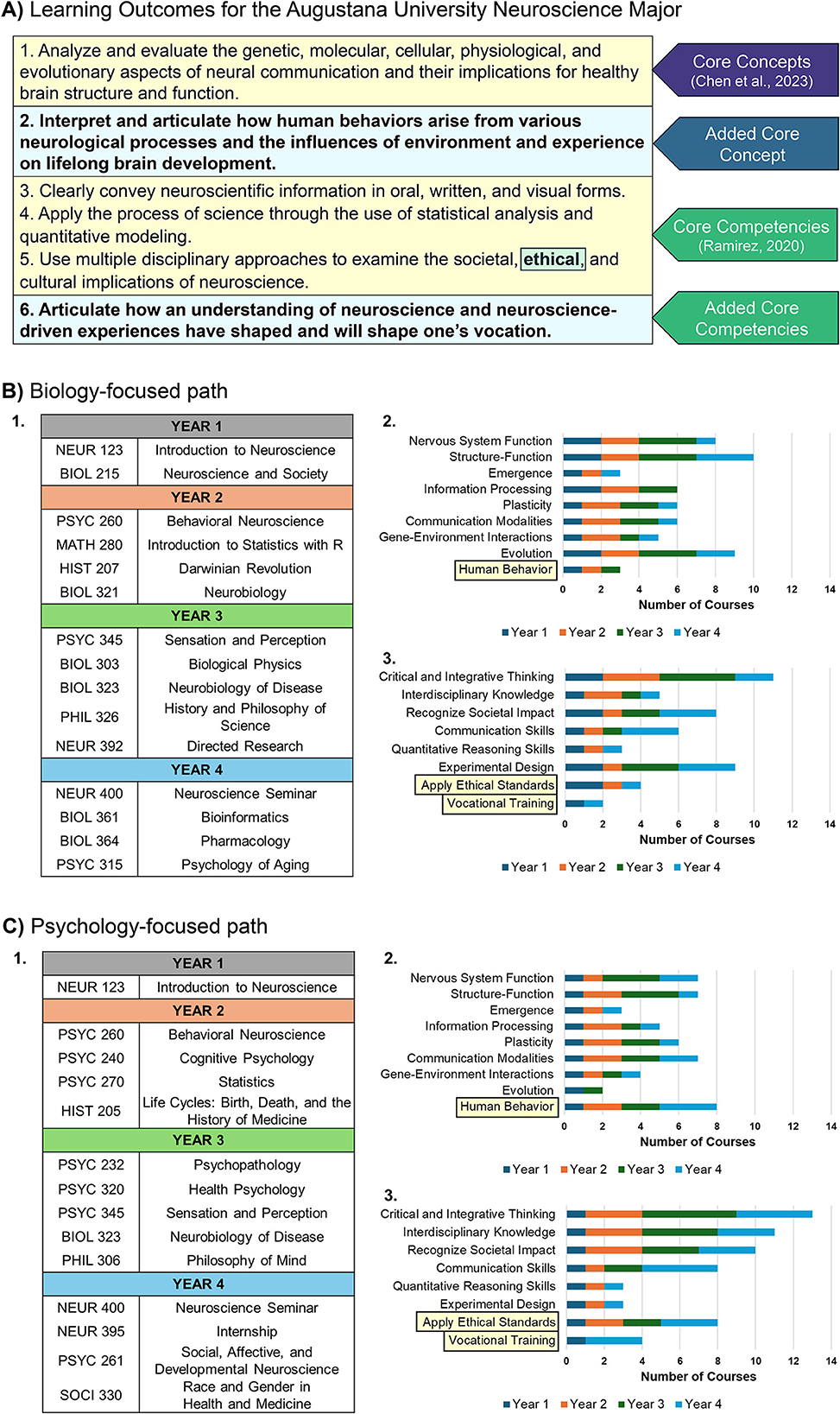
Figure 1. Learning outcomes for the Augustana University neuroscience major (A) include community-derived core concepts (Chen et al., 2023) with an additional core concept in human behavior, and core competencies (Wiertelak and Ramirez, 2008; Wiertelak et al., 2018) with added competencies in ethical reasoning and vocation. A list of required and selective courses is found in Supplementary Table 1. A full list of required, selective, and elective courses in the major including alignment with community-derived core concepts and core competencies can be found in Supplementary Table 2. Sample required and selective course-work is shown for a student following a biology-focused path (B1) and a student following a psychology-focused path (C1). The biology-focused path exposes students to more structure-function and evolution coursework (B2) and more experimental design competencies (B3). The psychology focused path exposes students to more human behavior coursework (C2) and more interdisciplinary and ethical training (C3).
Our students begin meeting these learning outcomes through three core courses (Figures 1B, C). The first course is Introduction to Neuroscience, which students take in their first-year. In their second year, students build upon this foundational knowledge through either Behavioral Neuroscience or Social, Affective, and Developmental Neuroscience. The required capstone, Neuroscience Seminar, taken in the final year, uniquely grounds the idea of vocation and uses ePortfolios to prepare students for their career goals after graduation. Beyond the core courses, students select courses in Neurobiology, Neuropsychology, and Interdisciplinarity as well as electives from multiple neuroscience-relevant fields; this coursework is supported by foundational courses in biology, chemistry, psychology, and statistics or data science (Supplementary Table 1). We intentionally offer flexibility in coursework so that students tailor their studies to their desired interests and career path.
Integration of community-derived core concepts
Because core concepts are “foundational principles that define the field” used to “organize fundamental facts” (Chen et al., 2023), the eight community-derived core concepts map onto our first learning outcome. To determine the extent to which our courses include core concepts, we reviewed syllabi and rated which core concepts are included and what level of mastery is achieved in each course (introductory, reinforcement, and mastery; see coding scheme in Supplementary Table 2). In general, “introductory” applies to Introduction to Neuroscience and the supportive courses, while “mastery” applies to experiential learning courses, Neuroscience Seminar, and courses with higher-level reinforcement with the intention that mastery is approached with repeated exposure. We also modeled the extent to which these core concepts are covered by students who will take more biology-focused (Figure 1B) and psychology-focused (Figure 1C) paths through their neuroscience major. All students receive an introduction to all of the core concepts in their first year, through the Introduction to Neuroscience course, with additional honing of these core concepts in their second year. In subsequent courses, students may receive more instruction in some core concepts (structure-function, gene-environment interactions, information processing, evolution) on the biology-focused path, while others (communication modalities) feature more prominently on the psychology-focused path. With the exception of evolution, students on both paths will have opportunities to master all core concepts, often in each year of the major.
Integration of core competencies
The core concepts do not encompass, on their own, the learning outcomes we set for our program; they must be paired with training in skills used in the field. Accordingly, six core competencies are mapped into our third through fifth learning outcomes (Ramirez, 2020). We used the same process used for the core concepts to assess our courses and paths through the major (Supplementary Table 2). Like the core concepts, these competencies are introduced in the Introduction to Neuroscience course, and reinforced and mastered in different courses throughout the degree. All students, regardless of the path they choose through the major, have opportunities to master critical thinking and interdisciplinarity each year in our curriculum. While a biology-focused path exposes students to more training in experimental design, a psychology-focused path more thoroughly exercises interdisciplinary knowledge and provides slightly more emphasis on recognition of societal impacts (see Figures 1B, C).
Other additions: human behavior, ethical reasoning, vocational training
We added three additional outcomes based on guidelines from the American Psychological Association (2023) to fill out perceived gaps after integrating the community-derived core concepts and the “blueprint” core competencies. One outcome we added to our interdisciplinary curriculum is human behavior. We want our students to be able to address not just how the brain functions but also why simple explanations rarely suffice when explaining behavior. Students will interpret behavioral phenomena by recognizing interactions among biological, psychological, social, and cultural variables. The second outcome we added is ethical reasoning, beyond training for animal or human-subjects research. Students will articulate the ways in which neuroscience knowledge can promote social responsibility. The third outcome we added is vocational training, which is consistent with the goal for all AU undergraduate students. Students will cultivate a body of evidence where they demonstrate key skills that will gain them entry into graduate programs or jobs in the field. Pairing opportunities for research and neuroscience-related internships with ePortfolio and resume building in the fourth-year Neuroscience Seminar, students receive training in creating career-focused materials while purposefully integrating neuroscience knowledge.
Discussion
In developing AU's neuroscience major, we asked whether core concepts (Chen et al., 2023) could be effectively deployed to design an interdisciplinary neuroscience curriculum in a primarily undergraduate institution. We found that the core concepts were the most readily deployed in a neuroscience degree with a substantial biology focus. Psychology-focused students receive much less instruction in the areas that were viewed by respondents in the Chen et al. study as less necessary to a neuroscience education (namely, evolution and genetics). To give students a more broadly interdisciplinary education—and possibly to address the views of more psychology-focused neuroscience educators—we propose including human behavior as a core concept. This concept borrows from psychology's biopsychosocial and cultural approach to understanding the relationship between complex human behavior and the brain—framing human behavior as a “foundational principle” that “organizes fundamental facts” across subdisciplines in neuroscience education (Chen et al., 2023). Moreover, this additional core concept creates an opening for programs on diversity, equity, and inclusion in neuroscience, a recent focus among educators (Basu et al., 2021; National Academies of Sciences, Engineering, and Medicine, 2021). Notably, we are able to extend the core concepts because of the cross-departmental nature of our program: a neurobiologist of disease in the Biology Department has partnered with a cognitive neuroscientist and an aging neuroscientist in the Psychology Department. By the same token, we found that expanding the core competencies was necessary to build a neuroscience major that prepares students for an array of post-graduate goals and interests. For example, adding ethical reasoning emphasizes that our students will need both an ethical mindset and a critical understanding of neuroscience to navigate professional and societal contexts in the future, even though these contexts might differ widely; further exploration of ethical reasoning in neuroscience education is merited, as it does not fit neatly into the definition of a core concept or competency (Chen et al., 2023).
Moving forward, we will need to assess whether the core-concepts orientation of our program does, in fact, build mastery. To do so, we will require both the continued development of the core concepts and the development of instruments for assessing student learning. Mapping a course's content to a particular core concept or core competency—which we sometimes found challenging, even with the community-derived definitions provided—will require a further fleshing out of what each core concept means to various subdisciplines. While some of this work is already being done by Chen and colleagues here, it may be useful to also develop tools that help instructors see how these core concepts fit both into individual courses and across a curriculum [like the BioCore Guide associated with Vision and Change (Brownell et al., 2017)] or assess concept mastery [like concept inventories that are present in physics and many fields of biology, but not in neuroscience (Smith and Tanner, 2017), or assignment rubrics, as have been previously suggested (Kerchner et al., 2012)]. While we are reasonably confident that our existing courses build toward the core concepts based on our mapping, we can imagine that developing new courses would be greatly facilitated by having these design tools. We also agree with Chen and colleagues that having such tools will make it easier to start developing the assessments needed to determine whether a core concepts-oriented curriculum does, in fact, improve student outcomes (Smith et al., 2019).
Overall, the community-derived core concepts were useful in developing a new neuroscience major. They lend themselves to the development of a biology-focused neuroscience major, but with the addition of a human behavior core concept the major can be both more interdisciplinary and can provide students on a biology-focused path with more exposure to neuroscience as it affects humans and society. We agree with Chen and colleagues that the core concepts do not provide a framework for a neuroscience curriculum on their own, but are effective in conjunction with a set of core competencies (Ramirez, 2020) to build a diverse set of skills by the end of a neuroscience degree. The new, interdisciplinary neuroscience major at Augustana University challenges students to go beyond the traditional silos of biology and psychology to understand the brain and the mind. Within a liberal arts context, the program prepares students to understand what neuroscientists know now while also acknowledging that our knowledge will almost certainly change, with repercussions inside and outside the laboratory. As the program progresses, we will seek to include and evaluate best practices like the core concepts in order to maximize student learning and preparation.
Author contributions
SP: Conceptualization, Writing – original draft, Writing – review & editing. LH: Conceptualization, Writing – original draft, Writing – review & editing. AK: Conceptualization, Writing – original draft, Writing – review & editing.
Funding
The author(s) declare that no financial support was received for the research, authorship, and/or publication of this article.
Acknowledgments
We would like to thank the Augustana University Center for Interdisciplinary Studies, Department of Biology, and Department of Psychology for their support of this new program.
Conflict of interest
The authors declare that the research was conducted in the absence of any commercial or financial relationships that could be construed as a potential conflict of interest.
Publisher's note
All claims expressed in this article are solely those of the authors and do not necessarily represent those of their affiliated organizations, or those of the publisher, the editors and the reviewers. Any product that may be evaluated in this article, or claim that may be made by its manufacturer, is not guaranteed or endorsed by the publisher.
Supplementary material
The Supplementary Material for this article can be found online at: https://www.frontiersin.org/articles/10.3389/feduc.2024.1478518/full#supplementary-material
References
American Psychological Association (2023). APA Guidelines for the Undergraduate Psychology Major, Version 3.0. Available at: https://www.apa.org/about/policy/undergraduate-psychology-major.pdf (accessed October 1, 2023).
Basu, A. C., Hill, A. S., Isaacs, A. K., Mondoux, M. A., Mruczek, R. E., Narita, T., et al. (2021). Integrative STEM education for undergraduate neuroscience: design and implementation. Neurosci. Lett. 746:135660. doi: 10.1016/j.neulet.2021.135660
Brownell, S. E., Freeman, S., Wenderoth, M. P., and Crowe, A. J. (2017). BioCore guide: a tool for interpreting the core concepts of vision and change for biology majors. CBE-Life Sci. Educ. 13, 200–211. doi: 10.1187/cbe.13-12-0233
Chatzikyriakidou, K., Tacloban, M. J., Concepcion, K., and McCartney, M. (2022). The five core concepts as a framework for promoting expert-like behaviors in undergraduate learning how to read a primary scientific article. J. Microbiol. Biol. Teach. 23, e00059-22. doi: 10.1128/jmbe.00059-22
Chen, A., Phillips, K. A., Schaefer, J. E., and Sonner, P. E. (2023). Community-derived core concepts for neuroscience higher education. CBE Life Sci. Educ. 22:ar18. doi: 10.1187/cbe.22-02-0018
Cliff, W. (2023). Teaching with core concepts to facilitate the integrated learning of introductory organismal biology. Adv. Physiol. Educ. 47, 562–72. doi: 10.1152/advan.00134.2022
Kerchner, M., Hardwick, J. C., and Thornton, J. E. (2012). Identifying and using ‘core competencies' to help design and assess undergraduate neuroscience curricula. J. Undergrad. Neurosci. Educ. 11, A27–A37.
McFarland, J. L., and Michael, J. A. (2020). Reflections on core concepts for undergraduate physiology programs. Adv. Physiol. Educ. 44, 626–631. doi: 10.1152/advan.00188.2019
National Academies of Sciences Engineering, and Medicine. (2021). Fostering Diversity, Equity, and Inclusion in Neuroscience Training: Proceedings of a Workshop—in Brief. Washington, DC: The National Academies Press. doi: 10.17226/26135
Ramirez, J. J. (2020). Undergraduate neuroscience education: meeting the challenges of the 21st century. Neurosci. Lett. 739:135418. doi: 10.1016/j.neulet.2020.135418
Rochon, C., Otazu, G., Kurtzer, I. L., Stout, R. F., and Ramos, R. L. (2019). Quantitative indicators of continued growth in undergraduate neuroscience education in the US. J. Undergrad. Neurosci. Educ. 18, A51–A56.
Smith, J. I., and Tanner, K. (2017). The problem of revealing how students think: concept inventories and beyond. CBE Life Sci. Educ. 9, 1–5. doi: 10.1187/cbe.09-12-0094
Smith, M. K., Brownell, S. E., Crowe, A. J., Holmes, N. G., Knight, J. K., Semsar, K., et al. (2019). Tools for change: measuring student conceptual understanding across undergraduate biology programs using Bio-MAPS assessments. J. Microbiol. Biol. Educ. 20:1787. doi: 10.1128/jmbe.v20i2.1787
Wiertelak, E. P., Hardwick, J., Kerchner, M., Parfitt, K., and Ramirez, J. J. (2018). The new blueprints: undergraduate neuroscience education in the 21st century. J. Undergrad. Neurosci. Educ. 16, A244–A251.
Keywords: core concept, neuroscience education, curriculum design, higher education, liberal arts education, interdisciplinary/multidisciplinary
Citation: Proksch S, Hamilton LJ and Kloth AD (2024) Considering neuroscience core concepts when designing a new interdisciplinary undergraduate neuroscience major. Front. Educ. 9:1478518. doi: 10.3389/feduc.2024.1478518
Received: 12 August 2024; Accepted: 21 October 2024;
Published: 12 November 2024.
Edited by:
Jennifer Schaefer, College of Saint Benedict and Saint John's University, United StatesReviewed by:
Christopher Vecsey, Skidmore College, United StatesCopyright © 2024 Proksch, Hamilton and Kloth. This is an open-access article distributed under the terms of the Creative Commons Attribution License (CC BY). The use, distribution or reproduction in other forums is permitted, provided the original author(s) and the copyright owner(s) are credited and that the original publication in this journal is cited, in accordance with accepted academic practice. No use, distribution or reproduction is permitted which does not comply with these terms.
*Correspondence: Shannon Proksch, c2hhbm5vbi5wcm9rc2NoQGF1Z2llLmVkdQ==; Lucas J. Hamilton, bHVjYXMuaGFtaWx0b25AYXVnaWUuZWR1; Alexander D. Kloth, YWxleGFuZGVyLmtsb3RoQGF1Z2llLmVkdQ==