 Keiland W. Cooper1,2
 Eric H. Tran2
 Brandon O. McIntosh2Tien Lam2Chau-man T. Tat2Diana M. Gallegos2Angeline J. Dukes3
 Audrey Chen2*
- 1Center for Neurobiology of Learning and Memory, University of California, Irvine, Irvine, CA, United States
- 2Department of Neurobiology and Behavior, University of California, Irvine, Irvine, CA, United States
- 3Department of Neuroscience, University of Minnesota, Minneapolis, MN, United States
General Education (GE) courses field students from different majors with varied preconceptions of the life sciences, and neuroscience in particular. To aid instruction, outcomes, and assessment of students, core concepts are an effective tool that utilizes conceptual elements to promote learning and the transfer of knowledge between disciplines. This study examined students' prior understanding of two core concepts shared across biology and neuroscience—structure-function relationship and evolution—within the student population enrolled in GE neuroscience courses. The structure-function relationship core concept focuses on how characteristics of structures enable or constrain their function and vice versa, while the evolution core concept focuses on how similarities and differences in nervous systems between organisms are shaped by their shared ancestry and adaptations to their environments. Responses were analyzed using a deductive coding approach aimed to classify responses based on proficiency of conceptual understanding either within a general biology context or a neuroscience-specific context. Analysis revealed that the majority of non-biologists at the start of an introductory neuroscience course were unable to demonstrate comprehension of the structure-function (83.4%) or evolution core concept (67.0%) in either a general biology or neuroscience-specific context. Further inductive coding identified common themes that emerged from student responses, revealing student preconceptions of the Structure-function relationship and Evolution core concepts based on student major. These findings can aid educators by informing their selection of background information during course design and presentation of the material to positively shape students' understanding of these core concepts in GE classes.
Introduction
Students entering college must fulfill specific General Education (GE) requirements to graduate. These GE courses are meant to provide students with a well-rounded education through studies not strictly related to their major such as arts and humanities, social sciences, and natural sciences. Goals for GE courses differ from disciplinary, major-specific course goals that prepare students within their chosen discipline. GE courses aim to create intellectually-diverse adults, with a wide-range of basic understanding in multiple fields that are capable of making positive contributions to society (Newton, 2000). GE courses also fill the hard and soft skills-gap between pre-graduate students entering university and postgraduate students entering the workforce (Aloi et al., 2003). For example, a recent survey by the American Association of Colleges and Universities (AAC&U) found that employers value employees with both depth and breadth of knowledge, despite employers overall reporting that they consider postgraduates unprepared for the modern workforce (Finley, 2021).
Undergraduate students often fulfill their GE requirements in the life sciences by taking introductory neurosciences courses. The neuroscience field has grown immensely over the last two decades due to its interdisciplinary appeal, growth in novel technologies, and therapeutic applications (Akil et al., 2016; Schaefer, 2016; Ngai, 2022). The increasing number of undergraduate neuroscience programs globally (Pinard-Welyczko et al., 2017) provides opportunities for both major and non-major students to become exposed to the neuroscience field and content through major-specific and GE courses.
The design of GE courses compared to courses designed to be taken by majors may differ, as a result of their heterogeneous populations as well as their divergent aims. Broadly, an introductory neuroscience course designed for neuroscience majors seeks to provide a foundation for further coursework and studies in neuroscience. In contrast, GE courses are designed with the intention of students developing intellectual skills and gaining societal, civic, and global knowledge through a curriculum that exposes students to multiple modes of inquiry (Schejbal, 2017; Howard and Zoeller, 2007). Instructors may design GE neuroscience courses with less emphasis on preparing students to achieve immediate post-graduate goals but with a broader set of ideas that may be less immediately applicable but nevertheless useful. As a result, students entering neuroscience GE courses may face barriers that may not be experienced by students from within the major.
Unique challenges for GE students as compared to within-major students may arise because GE courses generally, and GE neuroscience courses specifically, consist of students from a wide variety of educational backgrounds. Before enrolling in these courses, students may vary in their prior knowledge, since enrolled students do not take a prescribed order of courses leading to a GE course. Educators may also face challenges in motivating students who do not appreciate the value of courses outside their discipline (Thompson et al., 2015; Humphreys and Davenport, 2005). Indeed, while students preparing for a neuroscience degree would have topics repeated in greater detail as they progress through the disciplinary coursework, students in GE classes would not receive this reiteration and will vary in their levels of prior knowledge and motivation. As a result, students in GE courses may show a wider range of knowledge exposure, knowledge retention, and academic performance.
In light of these objectives and challenges, it is imperative for neuroscience courses fulfilling GE requirements to focus on overarching principles for broader understanding rather than an emphasis on discipline-specific terminology. Core concepts promote cross-disciplinary learning by providing a framework of a subject's most fundamental principles. Vision and Change in Undergraduate Biology Education: A Call to Action, released in February 2010, emphasized the importance of core concepts in solidifying student understanding of the material and identified core concepts for biology (American Association for the Advancement of Science, 2011; Woodin et al., 2010; Ledbetter, 2012). Furthermore, the integration of core concepts reduces the overall amount of information students need to learn and retain, while also addressing any misconceptions that stem from incorrect prior knowledge (Danos et al., 2022).
Since the release of core concepts for general biology, other disciplines have developed core concepts of their own. Along these lines, a set of community-derived core concepts for neuroscience have recently been developed: (1) communication modalities; (2) emergence; (3) evolution; (4) gene-environment interactions; (5) information processing; (6) nervous system functions; (7) plasticity; (8) and structure-function relationship (Chen et al., 2023). These neuroscience core concepts are defined by multiple parameters including their ability to transcend across related subdisciplines, accurately convey conceptual elements in the simplest form, withstand new information, apply to all species comprising a nervous system, undergo deconstruction, and remain distinct from skills that can be taught (Chen et al., 2023).
Interestingly, two core concepts have striking similarities between the AAAS-organized national conference examining undergraduate biology education and the empirical study to identify neuroscience core concepts. Both neuroscience and biology have identified structure and function as a core concept for their fields. Biology educators emphasize that basic units of structure define the function of all living things, while neuroscience educators note that structure permits and constrains nervous system function and function shapes structure (American Association for the Advancement of Science, 2011; Chen et al., 2023). Both neuroscience and biology have also identified evolution as a core concept. In biology education, biology educators emphasize processes of mutation, selection, and genetic change that evolved the diversity of life; similarly, neuroscience educators noted that similarities and differences in nervous systems across species are constrained and defined by their evolutionary backgrounds (American Association for the Advancement of Science, 2011; Chen et al., 2023). Whether instructors choose to focus on biology core concepts or neuroscience core concepts when teaching neuroscience GE courses, it will be important to discern misunderstandings and knowledge gaps that are common when non-majors attempt to grasp structure-function relationships and/or evolution concepts.
In order to help instructors increase student comprehension and reduce potential misinterpretation of the material, this study aims to identify the various preconceptions that students outside the biological sciences have about the structure-function relationship and evolution core concepts. To do so, a deductive coding approach was used to investigate the proportion of student responses that incorporated biology conceptual elements and accurately applied the concept to the neuroscience context (Figure 1). The study also used a grounded theory approach to identify common themes when novices attempted to identify neuroscience examples of structure-function relationship and evolution. The aim of this study was to answer the following research questions:
1. Do students enrolled in a general education neuroscience course have an understanding of structure-function relationship and evolution in biology but fail to accurately apply concepts in a neuroscience context?
2. What preconceptions do students outside the biological sciences have about the structure-function relationship core concept?
3. What preconceptions do students outside the biological sciences have about the evolution core concept?
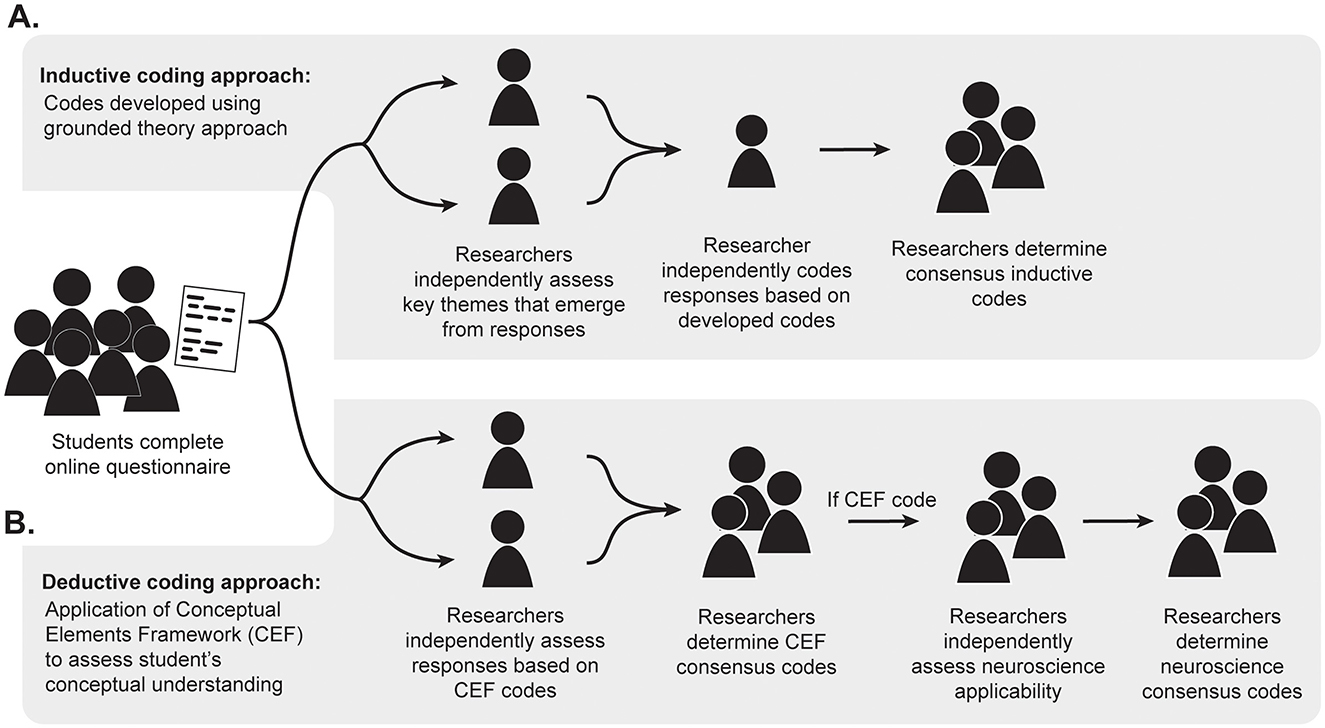
Figure 1. Overview of coding approach Student responses were analyzed using both an inductive and deductive coding approach. (A) In the inductive approach, researchers derived codes from the data (inductive codes). (B) In the deductive approach, researchers used the Conceptual Elements Framework to assess biology conceptual learning (deductive codes) and their application to a neuroscience context. In order to establish trustworthiness of data, researchers determined consensus codes following initial independent coding.
Methods
Participants and study design
The studies involving human participants were considered exempt by the University of California, Irvine Institutional Review Board (IRB 2018-4211). Students were informed of the work with a study information sheet that specified an opt-out policy. Individuals who did not wish to participate in the research contacted a third-party through email and their data was not included in analysis. Prior to instruction, surveys were administered at an introductory neuroscience course at a large, research-intensive R1 public university in the western United States in Fall 2020. The introductory neuroscience course was a GE course which fulfilled a science and technology breadth requirement for graduation; students had a degree of choice in selecting a class that exposed them to the nature of scientific inquiry and the operation of the biological, physical, and technological world. A structure-function question was posed to students asking the following: “A core concept in biology is that structure informs function. To the best of your ability, please describe how structure informs function in neuroscience.” An evolution question was posed to students asking the following: “Darwin's ideas about the diversity of life informed his theory of evolution. To the best of your ability, please describe a neuroscience example of this core concept.” Survey questions were designed to introduce minimal bias while still defining some terms so that the survey question tested concepts apart from student familiarity with specific terminology. Students were instructed to answer with at least a 100-character minimum to obtain completion credit for the required assignment. Four hundred and ten participants attempted the survey, and responses were excluded if responses were only composed of non-sensical character strings or if institutional data reported different majors at different times. Following these exclusions, 342 participants were included in the study. To improve the comparability of the within-university majors to external universities, student majors were grouped by taking all participating majors and combining majors with commonalities together (see Supplementary Figure 1). Information about common departments, programs, and school groups informed research team discussions to determine commonalities. For example, the major “psychological sciences” was grouped with psychology. This yielded 14 major groupings.
Deductive coding approach
A deductive coding approach was used to determine whether student responses revealed evidence of elements of core concepts, and whether students were able to accurately connect the core concept to a neuroscience example (Figure 1). Using the Conceptual Elements Framework (Cary and Branchaw, 2017), two coders independently assessed if students showed evidence of understanding the core concept in a biology context. “And” statements present in the Conceptual Element Framework were adjusted to “or” statements to allow greater flexibility in what responses demonstrated understanding.
Understanding of structure-function relationship was demonstrated when student responses included one of the following ideas: SF1) Biological structures from the molecular to the ecosystem scale and their interactions are determined by chemical or physical properties that enable or constrain function; SF2) Individual structures can be arranged into organized units that enable more complex functions; SF3) Structural features of biological entities undergo changes during development that are determined by the regulation of gene expression; SF4) Structural features are dynamic and modifications can be made in response to environmental changes that are compensatory to restore lost function, or non-compensatory to eliminate functions that are no longer needed; SF5) Comparable changes in structure can have small or large effects on function, depending on the spatial function.
Understanding of evolution was demonstrated when student responses included one of the following ideas: E1) All living organisms share common ancestors at some time in the past; E2) The phenotypes of living organisms result from the gain and loss of traits along their lineage; E3) Genetic variation within a population can be generated by mutation, which results in the generation of novel traits, or by sexual recombination, endosymbiosis or horizontal gene transfer; E4) Phenotypes, based upon underlying genotypes or environmental factors, can be subject to selective pressure; E5) Organisms have greater fitness if they have a fitness that increases their ability to survive or reproduce in a particular environment; E6) Populations are composed of individual organisms that vary in their fitness, leading to differential rates of survival or reproduction and therefore changes in allele frequency over time; E7) Evolution in a population may be due to events not related to fitness, including genetic drift and gene flow; E8) The rate of evolutionary change varies and is influenced by many factors, including mutation rate, generation time, or environmental variation; E9) Speciation occurs when subpopulations can no longer exchange genetic material, allowing them to diverge over time in their physiological or ecological traits.
A simultaneous coding approach was used to capture if students presented evidence of understanding multiple aspects of biology core concepts. If a response did not reach a consensus on the deductive code, the response would be discussed with two additional researchers to determine a consensus.
Inductive coding approach
Student responses were examined using inductive coding following a grounded theory approach where thematic codes emerged in response to students' answers (Figure 1). Each question was initially coded by two independent coders to determine the themes present in the students' attempt to explain how the core concept applied to neuroscience. Codes were generated when new patterns were observed in the data. When continual data analysis found no new patterns, it was determined that code saturation had been achieved (Hennink et al., 2017). Once one coder was sufficiently trained, the remaining responses were coded by a single, independent coder.
Coding generated nine thematic codes for the structure-function question: (1) Legos; (2) Specific Area; (3) Chem Structure; (4) Lesion; (5) General Area; (6) Connectivity; (7) Characteristics; (8) No Answer; (9) Lack of Specificity (Table 1). For the evolution question, 13 unique thematic codes were generated: (1) Longitudinal; (2) Complexity; (3) Sociology; (4) Development; (5) Situational Adaptation; (6) Comparison; (7) Lack of Specificity; (8) Research; (9) Inheritance; (10) Survival Mechanism; (11) Variability; (12) Fitness; (13) No Answer (Table 2).
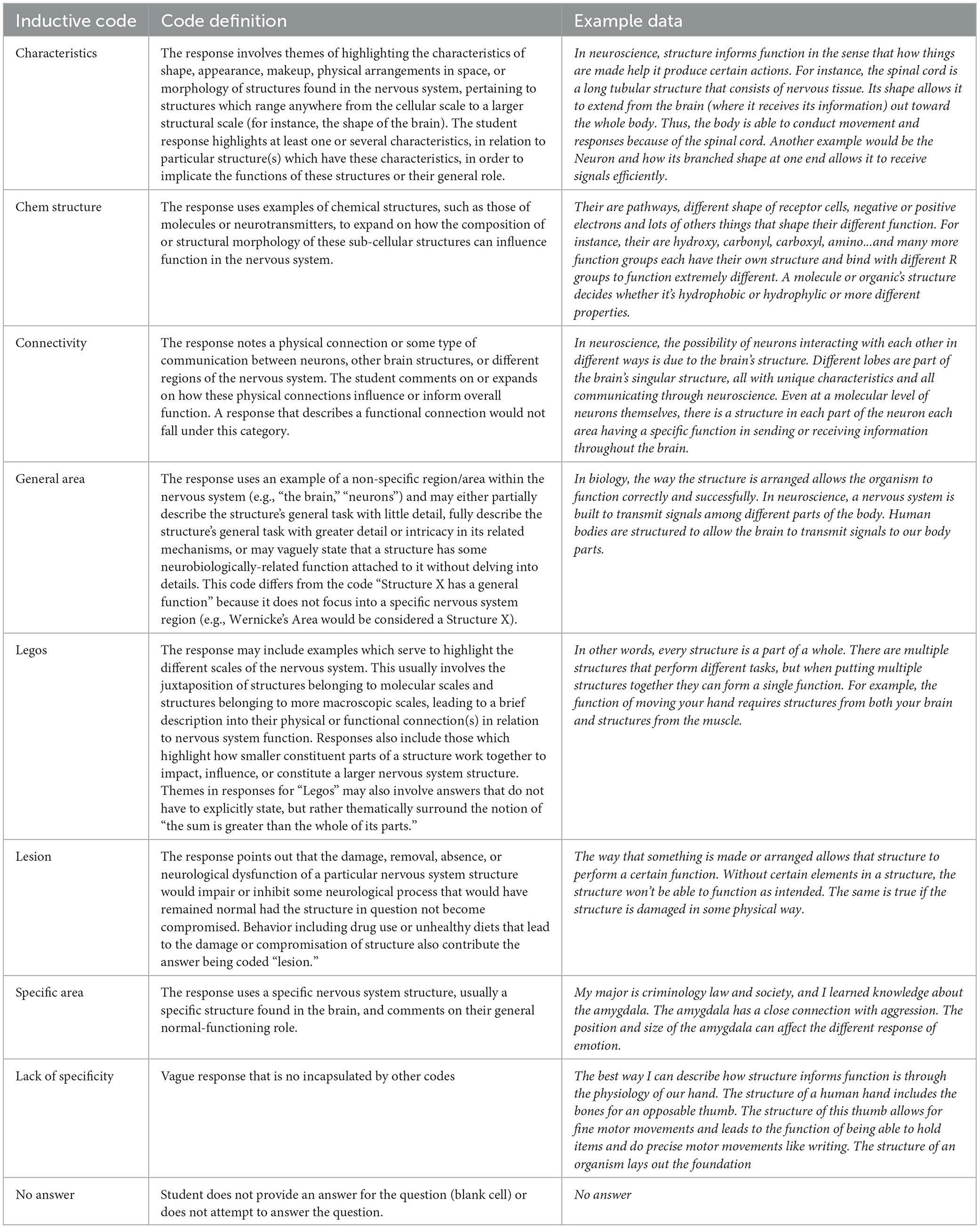
Table 1. Preconceptions of structure-function relationship.
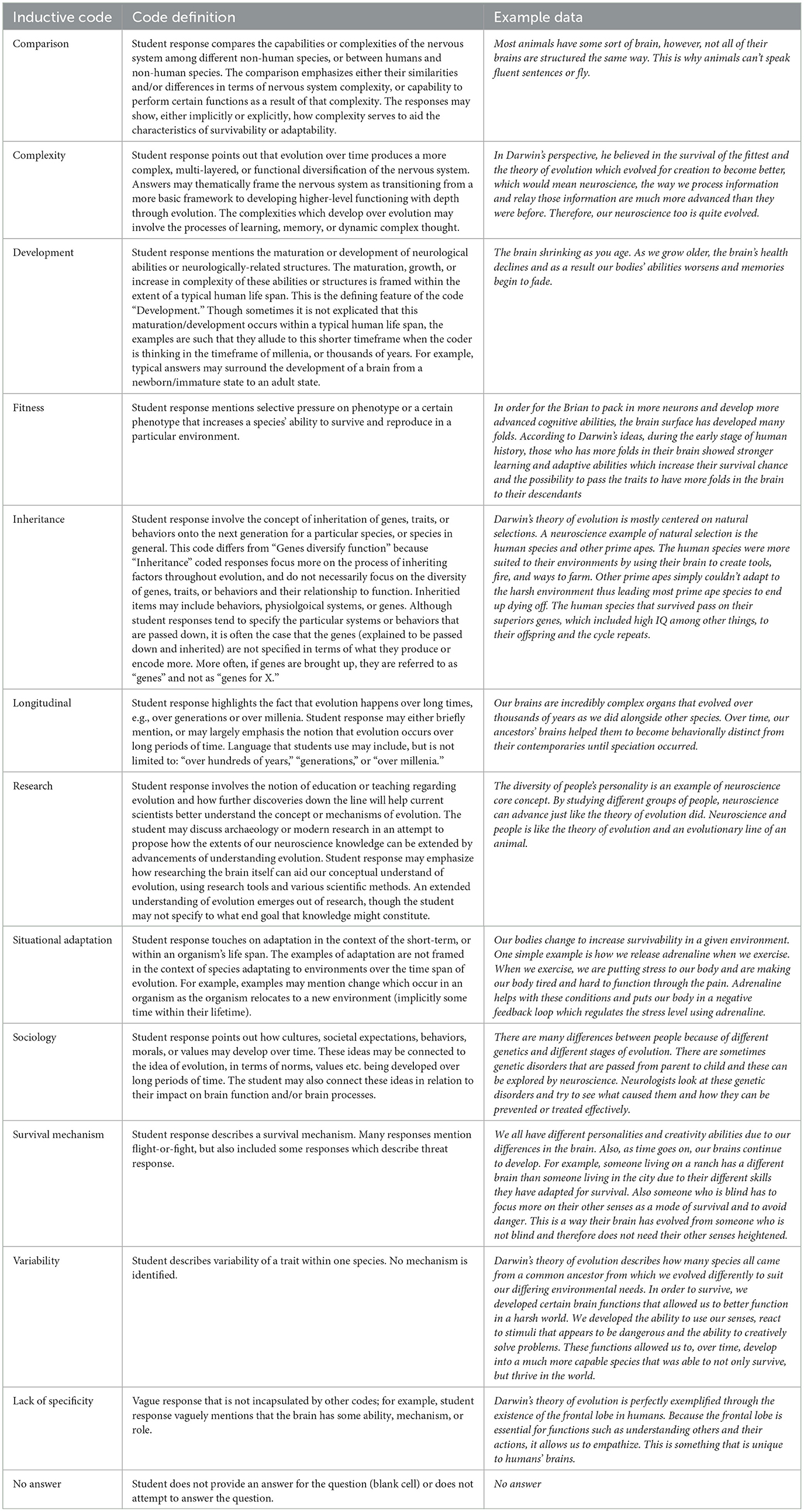
Table 2. Preconceptions of evolution.
For each response, simultaneous coding (more than one code) was used when applicable. Responses with simultaneous coding applied were counted for each of their thematic code. This led to the total number of thematic codes outnumbering the original number of responses.
After inductive codes were generated for each response, a third independent coder reviewed each response to ensure they were accurately coded. Inductive codes were then compared to a blinded, single, independent coder to generate consensus inductive codes. If a response did not reach a consensus on the inductive codes, the responses were discussed with an additional researcher to determine a consensus.
Student ability to provide neuroscience examples of core concepts
Responses that demonstrated some proficiency in understanding the core concept regardless of context were further analyzed for their ability to accurately provide a neuroscience example of the core concept. Responses were considered to provide such an example if they were neuroscientifically accurate and mentioned a nervous system tissue or idea explicitly. Two separate coders independently evaluated whether a student response accurately connected the core concept to neuroscience. If a response did not reach a consensus on the deductive code, the response was discussed with two additional researchers to determine a consensus.
Data analysis
Data visualization and analyses were completed using Python 3.12.0 (Python Software Foundation), utilizing the numpy, pandas, matplotlib, plotly, and sklearn packages, alongside custom-written analysis scripts. Interrater reliability between coders utilized the Jaccard similarity index (Jaccard, 1901; Real and Vargas, 1996), given that student responses were allowed to be dual coded, and standard similarity metrics, such as Cohen's Kappa (Cohen, 1960), are not suitable for dual coding approaches. The Jaccard similarity index quantifies the similarity between sample sets, in this case, each of the codes attributed to student responses. Codes were represented as a binary index along vectors of length equal to the total number of codes. For each student response, each code that the coders determined captured the response was assigned to a position on the vector (1 for the code being present in the response; 0 for the code not being present in the response). These vectors were then compared across coders by using the Jaccard similarity index. The interrater similarity between the inductive codes for Structure-function relationship (Jaccard similarity index = 0.84) and Evolution (Jaccard similarity index = 0.44) was determined. For the CEF codes, the similarity for Structure-function relationship (Jaccard similarity index = 0.75) and Evolution (Jaccard similarity index = 0.61) indicated high interrater similarity.
Since the codes determining student ability to apply their response to a neuroscience application were not dual-coded, Cohen's Kappa was used to determine reliability between the raters, where scores were determined for Structure-function relationship (Cohen's Kappa = 0.97) and Evolution (Cohen's Kappa = 0.98) responses.
Results
Students struggle to apply biological core concepts to neuroscience contexts
The study first aimed to determine whether student responses revealed evidence of utilizing elements of the core concepts understood as biological core concepts, and if so, whether the students were able to apply and connect the given concept to an accurate neuroscience example. Student responses were analyzed using a deductive coding approach, where each response was coded according to Cary and Branchaw's Conceptual Element Framework (CEF; see methods). Developed using an iterative approach involving more than 60 biologists and undergraduate biology educators, the CEF provides key components that transcend biology subdisciplines and scales for each overarching biological concept (Cary and Branchaw, 2017). The study sought to identify which conceptual elements were most prevalent in responses from students enrolled in introductory neuroscience general education courses targeted toward non-biologists at the start of instruction. Only a minority of student responses demonstrated any evidence of conceptual understanding of any element within the Structure-function relationship core concept (17%) or the Evolution core concept (33%). Thus, the vast majority of the students struggled with accurately applying biological core concepts according to the CEF criteria in their responses (Figure 2 top).
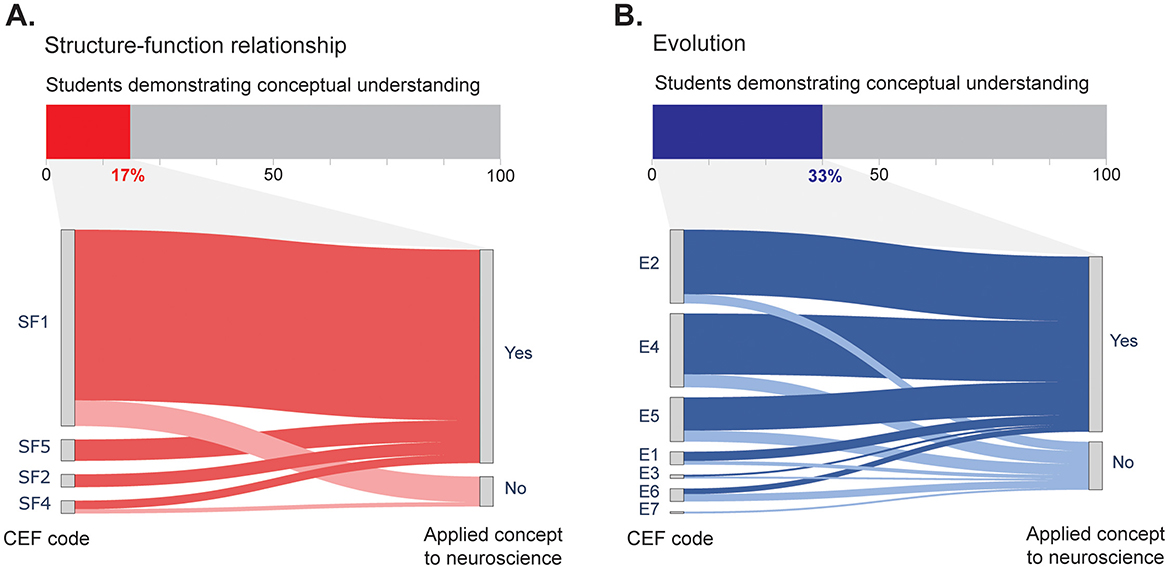
Figure 2. Student's understanding of biological core concepts and their relationship to neuroscience. Top: Proportion of student responses that demonstrated a conceptual understanding of the biological core-concepts as deductively coded according to the Conceptual Element Framework (CEF) developed by Cary and Branchaw (2017). Bottom: Of the students who demonstrated conceptual understanding, the proportion of CEF codes are shown on the left vertical axis. Connections between axes indicate the proportion of CEF codes that showcased a successful (yes; darker shade) or unsuccessful (no; lighter shade) connection back to neuroscience, depicted on the right vertical axis. Responses for prompting questions (A) Structure-function relationship (red) and (B) Evolution (blue) are shown.
When responses indicated some evidence of understanding the Structure-function relationship core concept, the majority of responses (80.7%) were captured by CEF code SF1 (Figure 2A), which highlights the idea that a biological structure's chemical or physical properties enable or constrain function. The second most prevalent conceptual element was SF5 (8.8%), with responses discussing how comparable changes in structure can have small or large effects on function, depending on spatial location. An equal percentage of students responded as SF2 and SF4 (5.3%). Responses coded as SF2 highlighted the arrangement of individual units can enable complex functions whereas responses coded as SF4 discussed the compensatory or non-compensatory structural modifications that arise from environmental changes. No responses were coded as SF3: structural changes during development are determined by gene regulation.
When responses were classified to contain evidence of an Evolution biological conceptual element from the CE Framework, the most prevalent conceptual elements were E2 (33.1%), focused on how an organism's phenotypes result from the gain or loss of traits along their lineage, and E4 (33.1%), which highlights how organisms can be subject to selective pressure (Figure 2B). 19.8% of student responses were coded for E5 and stated how an organism may have greater fitness if it has a quality that enables it to survive or reproduce in a particular environment. An equal percentage of students responded as E6 and E1 (5.8%). Responses coded as E6 discussed how varying fitness within a population eventually leads to changes in allele frequency over time while E1 focuses on the idea that all living organisms share common ancestors at some point in time. Only 1.7% of responses were coded as E3, which showcased that few student responses demonstrated what biological processes can generate novel traits. Only 0.8% of responses were coded for E7 which discussed the various mechanisms related to evolution, and were not natural selection, which may occur in a population. No responses were coded as E8: various factors that affect the rate of evolutionary change, or E9: process of speciation. Speciation, the process by which new species arise, occurs when groups of organisms within the same population become reproductively isolated and diverge to form a new species. However, many student responses suggested a belief that physical differences alone can lead to the formation of new species. For example, one student responded,
“All life stemmed from a common ancestor and homologous structures of embryos is evidence of that. For example, all vertebrates started off with tails and gill slits as embryos but as they matured during the developmental stage, different species either kept or got rid of these features, thus leading to physical differences. And through evolution and natural selection, these physical differences led to the formation of new species.”
The next step was to determine whether students with some demonstration of the core concept from a biological perspective were able to properly apply their understanding to a neuroscience setting. To answer this question, the proportion of students who provided a neuroscientifically accurate example was examined, among students who demonstrated evidence of a biology conceptual element in their response. This revealed that the majority of students who were able to utilize the core concept in a biology sense were also able to accurately apply it to a neuroscience context, with 87.1% of the students for the Structure-function relationship prompt and 78.5% of the students for the Evolution prompt.
The majority of Structure-function relationship responses coded as SF1 (87.0%) or SF4 (66.7%) demonstrated a successful connection back to neuroscience. All responses coded as SF2 or SF5 showcased a successful connection back to neuroscience. A majority of Evolution responses coded as E2 (87.5%), E4 (82.5%), E5 (75.0%), or E1 (71.4%) demonstrated a successful connection back to neuroscience, whereas only half of the responses coded for E3 (50%) showed a successful connection. Conversely, some codes had a majority of students unable to connect back to neuroscience, such as E6, which had 57.1% of responses while E7 had 100% of responses unable to connect back to neuroscience.
What preconceptions do students outside the biological sciences have about the structure-function relationship core concept?
Since the majority of students entering a GE Neuroscience course do not understand elements of the structure-function relationship, the next step was to examine what ideas, and possible misconceptions they enter the class with. To fully capture the student responses without biasing the analysis, a grounded theory approach was used, where codes are derived from the student responses. Analysis of the prompting question of how structure informs function in neuroscience (“Structure-function relationship;” Figure 3A) revealed that the most prevalent code was “General Area” which captures student responses indicating a non-specific region in the nervous system and either partially or fully described its general function (29.0%). An example of this response was: “in neuroscience, a nervous system is built to transmit signals among different parts of the body; human bodies are structured to allow the brain to transmit signals to our body.” A smaller portion of student responses (9.9%) reported a specific area has a function (“Specific Area;” Figure 3A). “Specific Area” differed from “General Area” because students mentioned a particular brain region and discussed its function, as opposed to general structures that may or may not relate to neurobiology. An example response: “the amygdala has a close connection with aggression; the position and size of the amygdala can affect the different response of emotion.” Both of these responses suggest that students have not grasped the relationship between structure and function. While the structure-function relationship core concept is about structure permitting and constraining nervous system function and function shaping structure, students identify structure and function as two distinct entities. They believe that the core concept is about all structures having a function. For example, when one student was asked to provide a neuroscience example of structure informing function, they wrote
“The structure in the body is designed perfectly for it's own function, meaning everything has a purpose. This falls under neuroscience because since the structures have specific roles, it is the neurological point to make sure all the functions are working appropriately. Biology focuses on the structure and the function, the neuroscience is how the function is performed to it's best ability; so they work hand in hand with each other; I think.”
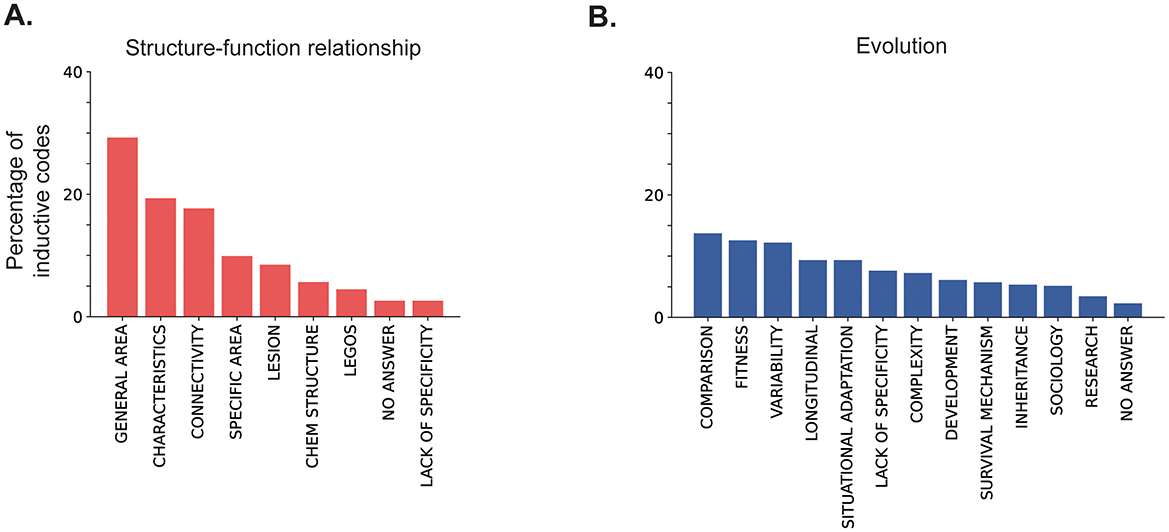
Figure 3. Frequent preconceptions of Structure-function relationship concept and Evolution concept. Proportion of inductive codes for Structure-function relationship (A) and Evolution (B) questions across all student responses. Code names are listed across the x-axis. Color indicates the core concept addressed.
In addition, this following example does not accurately distinguish the chemical and physical properties that enable or constrain a structure's function, further indicating that the student believes arrangement is equivalent to structure,
“I believe that ‘structure informs function' means in order for something operate it must have the correct composition. In terms of neuroscience, the concept can be exemplified through the presence of neurotransmitters. The structure of these molecules enables the transmission of messages between neurons. For the body to be informed and function properly when receiving these chemical messages, it requires the correct structure.”
In order for students to understand the structure-function relationship, they need to identify characteristics of the structure that enable function (Kohn et al., 2018). Structure is thought of as the physical dimensions, three-dimensional shape, organization or arrangements of components that make a physical entity (Michael, 2021). 19.3% of responses were coded for “Characteristics,” in which students commented on the appearance or morphology of structures in the nervous system to allude to its general role. 17.6% of responses were coded for “Connectivity.” “Connectivity” encompasses responses that comment on how physical connections between neural structures influence or inform function.
What preconceptions do students outside the biological sciences have about the evolution core concept?
In order to aid instruction and facilitate student understanding of core concepts in neuroscience general education courses, the preconceptions enrolled students have about the evolution core concept prior to instruction were also examined (Figure 3B). “Comparison” responses were the most prevalent observed in the sample, with 13.7% of the codes. These responses differentiated the capabilities/complexities of neurobiological aspects between two species. A sample response mentioned that “most animals have some sort of brain, however, not all of their brains are structured the same way.” 12.6% of responses were coded for “Fitness,” in which students' responses mention selective pressure on phenotype or a certain phenotype can increase a species' ability to survive and reproduce in an environment. An example of this response is
“According to Darwin's ideas, during the early stage of human history, those who has more folds in their brain showed stronger learning and adaptive abilities which increase their survival chance and the possibility to pass the traits to have more folds in the brain to their descendants.”
12.1% of responses coded for “Variability,” where responses described the variability of a trait within one species with no identifiable mechanism. Here, a student exemplifies this code through their response,
“We developed the ability to use our senses, react to stimuli that appears to be dangerous and the ability to creatively solve problems. These functions allowed us to, over time, develop into a much more capable species that was able to not only survive, but thrive in the world.”
Evolution is a population-level process that occurs over a long period of time; however, many students (9.3%) mistaken evolution for situational adaptation. For example, the following response shows a student had mistaken individual changes and adaptations for this continuous but gradual process,
“Diversity is important as if there is no change, one can become stagnant and be unable to advance or move forward. In the brain, it is constantly evolving and making connections to learn and grow, because if it only stayed with the processes and functions it always makes, then it would not be able to handle new circumstances that cause different problems.”
When attempting to provide neuroscience examples of the evolution core concept, students have a conception of evolution as maturing nervous systems or making them more complex. “Complexity” codes included student responses that discussed how evolution over time increased the complexity of the nervous system or highlighted the transition from a basic framework to a higher-functioning arrangement (7.2%). An example of this code has included student discussion on “the way we process information and relay those information are much more advanced than they were before; therefore, our neuroscience too is quite evolved.” “Complexity” differed from “Development” as the latter code described responses that discussed the maturation of neurological abilities/structures within the species' lifespan. The code “Longitudinal” made up 9.3% of responses and emphasized evolution over a long period of time, along the lines of generations and millennia. This code differed from other codes due to an emphasis on a long time period, while other codes often emphasized other concepts outside of time.
Unfortunately, there was a substantial proportion (7.6%) of students who did not answer the question with enough specificity to identify any themes. “Lack of Specificity,” encompassed responses that were not encapsulated by other codes and vaguely mentioned information attempting to answer the question. An example of this code was the response: “a neuroscience example of Darwin's theory of evolution in neuroscience would be the evolution of the brain conceptually and structurally.”
Student's responses across majors are encompassed by heterogeneous codes
The variability in student's a priori understanding of core concepts was then examined in relation to their major at the time of the survey. To do so, while responses were coded blinded to student major, the proportion of students within a major whose responses were thematically similar was examined, and thus considered within the same inductive code (Figure 4). Across both questions, no single code dominated within a major.
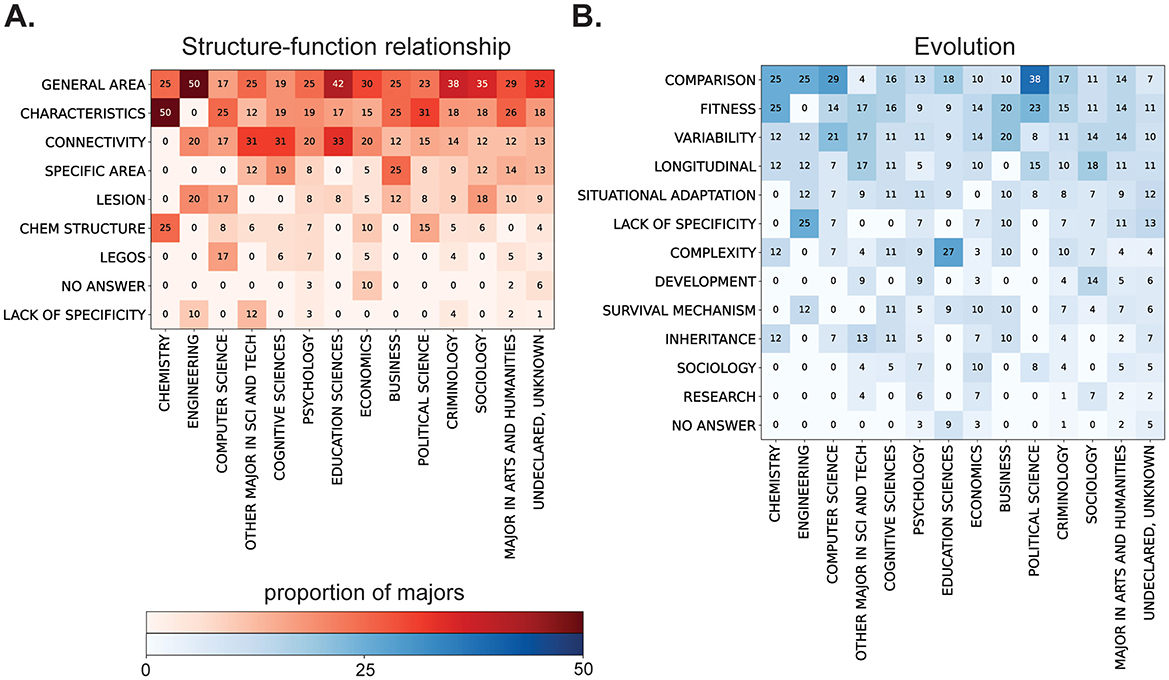
Figure 4. Frequent preconceptions of neuroscience core concepts organized by student major. Heat maps depict the proportion of students within a major (x-axis) whose responses were thematically similar for (A) Structure-function relationship and (B) Evolution core concepts (y-axis). Darker colors indicate a greater proportion of student's responses within a given thematic inductive code. Percent values rounded to nearest whole-number.
The Structure-function relationship question demonstrated less variance in student's thematic responses across majors (Figure 4A). The three most frequent codes, “General Area,” “Characteristics,” and “Connectivity” showed robust prevalence across most of the majors. Students majoring in Engineering (50% of within-major codes), Education Sciences (42%), Criminology (38%), Sociology (33%), Undeclared, Unknown (32%), Economics (30%), and Major in Arts and Humanities (28%) preferentially responded with the most frequent code, “General Area.” Alternatively, students majoring in Chemistry (50%), Political Science (31%), and Computer Science (25%) preferentially responded with “Characteristics.” Students majoring in Cognitive science (31%) and Other Major in Science and Technology (31%) responded preferentially with “Connectivity.” Sixty-six percentage of all responses across majors were thematically coded as these three most frequent codes.
Less prevalent codes displayed more heterogeneity within the various majors in the Structure-function question. Psychology majors, overrepresented in the sample, showed a slight preference for “General Area” followed by “Connectivity” and “Characteristics.” All codes were represented by the psychology-major students, however the most prevalent major represented in the sample, showcasing heterogeneous response themes. Similar heterogeneity was also observed in undeclared major students, with all codes represented in the sample. Conversely, a few majors demonstrated far less variance across the codes. For example, Chemistry majors were restricted to three themes. While their responses predominantly exemplified “Characteristics” or “General area,” 25% Chemistry majors' responses were coded with “Chem structure,” the largest proportion compared to any other major.
The Evolution question showcased more variance in the most prevalent codes of student responses (Figure 3B). Owing to this, the top 5 most frequent codes comprised 57% of all student responses across all majors. “Comparison” was the most prevalent code across all students, with students in the Political Science (38%), Computer Science (29%), preferentially responding with the theme. Alternatively, responses from Education science majors were preferentially coded as “Complexity” (27%), more than any other major.
All codes were represented in the responses from Psychology majors, Criminology majors, Major in Arts and Humanities, and Undeclared, Unknown majors, with sparser sets across the other majors. Other majors including Chemistry, Engineering, Science and Technology, Cognitive Sciences, Economics, and Business saw no clear preference for any codes and showcased more heterogeneous responses. When examining the less prevalent secondary codes across the majors, it is observed that there is more heterogeneity within the various majors. Eight of the 14 majors (Chemistry, Engineering, Cognitive Sciences, Psychology, Economics, Business, Sociology) had tied secondary codes.
Discussion
Students generally, and non-major students specifically, may be aided by the use of core concepts, which promote cross-disciplinary learning through the utilization of a subject's most fundamental principles captured in a cohesive framework. Furthermore, educators can facilitate student understanding by designing key learning goals around core concepts and directly addressing students' previous understanding of core concepts (Kowalski and Taylor, 2009). Common student understandings of neuroscience core concepts, however, have not been explored. The present study assessed student understanding of two core concepts that overlap across biology and neuroscience: structure-function relationships and evolution. A deductive coding approach was developed to quantify the likelihood that non-major students understand biology conceptual elements of structure-function relationship and evolution with accurate applications to neuroscience. Additionally, an inductive coding approach was used to capture student preconceptions of these neuroscience core concepts prior to instruction.
It was found that while the majority of students began the introductory neuroscience GE course with the ability to present isolated facts, they lacked an understanding of the structure-function relationship and evolution concepts. The structure-function relationship concept addresses how structural properties enable functions at all levels of organization and the converse relationship that activity levels and functional demands of nervous systems can alter physical 3-D structures (Chen et al., 2023; Michael, 2021). Many students mistook the concept for the fact that the brain or specific structures have a particular task. Indeed, this could be a misconception further propagated by instructors who set learning objectives as recalling particular brain regions which regulate particular functions (Kötter, 2001; Cahyanto et al., 2019). To address a priori conceptions of the structure-function relationship, student-centered instruction can be accomplished through emphasis on how characteristic(s) enable or constrain function. Knowing this is a common misconception, educators and students should shift their perspectives from teaching and memorizing facts on which nervous system structure associates with which functions to developing a more thorough understanding of concepts (Wiggins and McTighe, 2005).
Similarly, many students have minimal understanding of the evolution concept prior to instruction. This core concept addresses how the similarities and differences in nervous systems between organisms are constrained and defined by their evolutionary backgrounds (Chen et al., 2023; Striedter, 2023). A number of responses indicate that students believe people evolved directly from monkeys. For example, one student eloquently but inaccurately noted,
“A clear example will be the human evolution theory from the chimpanzees. There was a diversity of apes, monkeys, and chimpanzees millions of years ago that all started to breed between one another and genetically change with the centuries. After over 5 millions of years these diverse species of chimpanzees and other apes changed in physical and genetic form to look like us, humans.”
Students often report thinking of evolution as a linear sequence of events, one where hominids, including apes, eventually turn into humans, a misconception likely popularized by influential artistic renditions of evolution which oversimplify the process (Green and Delgado, 2021; Tolman et al., 2021). These misunderstandings can form and be shaped outside of the classroom as well, with one study finding that 96% of the popular media that students report consuming inaccurately depicts evolution (Ferguson et al., 2022). Addressing misconceptions in education is key for boosting student understanding of fundamental concepts that make up the life sciences.
Using the Conceptual Elements Framework (CEF), only one-third of student responses exemplified any biology conceptual element of the evolution core concept and an even lower percentage for the structure-function relationship core concept. Students entering a neuroscience GE course have a dearth of knowledge surrounding core concepts. Strikingly, three conceptual elements were completely absent from student responses. Students did not reference the correlation of gene expression to structural changes during development (CEF element SF3), identify the many factors that vary the rate of evolutionary change (CEF element E8), or define speciation during the evolutionary process as the inability to exchange genetic information (CEF element E9). That is, the students may very well have the knowledge to address these points, but do not include these elements in their responses. Although experts may recognize that evolution encompasses several mechanisms beyond greater fitness, very few responses encompassed the conceptual element that evolution in a population may be due to events not related to fitness, including genetic drift and gene flow. The absence of these responses is an indication that students believe this phenomenon is limited to natural selection, and that ideas of genetic drift and gene flow are novel to students enrolled in a neuroscience GE course. Educators will need to decide whether these elements are best scaffolded later in the neuroscience curriculum for majors students, or whether some exposure to these elements are needed in an introductory neuroscience GE course.
Guiding students toward conceptual understanding rather than fact memorization will benefit them both within and beyond the neuroscience classroom. By condensing the list of required information through core concepts, students are better able to grasp the important ideas which helps foster retention and improve comprehension of the discipline (Brownell et al., 2014; Danos et al., 2022). Additionally, comprehension of transferable core concepts provides students with the scaffolding required to promote further learning and transfer to new contexts (Kaminske et al., 2020; Michael, 2022). Educators also benefit from a focus on core concepts as these overarching concepts provide educators with the luxury to draw upon their expertise and affinities to create a more enjoyable learning environment for students (Danos et al., 2022).
Implications for future course and curricula design
Teaching methods to address inaccurate preconceived notions could be developed to meet students where they stand. Further, as more instructors move toward teaching goals utilizing student learning of core concepts, as opposed to collections of facts, it is important for instructors to gain an understanding of the diversity of typical a priori understandings and misunderstandings of core concepts prior to course instruction. When instructors design class activities that connect neuroscience core concepts to students' preexisitng knowledge, students encode new knowledge relationally to prior knowledge, aiding memory formation in networks (Owens and Tanner, 2017).
Students majoring in the natural sciences, social sciences and humanities displayed different degrees of variation in their preconceptions of neuroscience core concepts, suggesting each major may benefit from tailored teaching approaches. As previously predicted, non-STEM majors possess a wide range of perspectives toward science (Cotner et al., 2017). When introducing neuroscience core concepts to students majoring in the arts and humanities, instructors can approach the material with the understanding that their students' perspectives are diverse and not shaped by a single viewpoint or idea. Some students in the arts and humanities may have some accurate understandings of the structure-function relationship concept that highlights characteristics of structures that implicate functional roles while others may have inaccurate understandings of the structure-function relationship which inappropriately associates general regions to tasks (Figure 4). However, it was rare to see students in the arts and humanities consider physical connections that influence or inform overall function, while this preconception was more common in students majoring in education sciences, cognitive sciences or other majors in science and technology (Figure 4). Therefore, when instructors design materials to teach structure-function relationship to students in the arts and humanities, they should not use connectivity examples to initially teach how structure informs function but may want to apply the core concept to physical connections only after students have first learned the core concept related to other physical attributes.
In the future, the neuroscience educator community can develop resources to aid fellow educators in identifying misconceptions and teaching neuroscience core concepts, similar to the resources that have been developed for biology core concepts. While the inclusion of core concepts in neuroscience pedagogy is relatively new and evidence-based interventions testing methods to include core concepts are limited, several institutions are beginning to embed neuroscience core concepts in curricular planning (Maita et al., 2024; Proksch et al., 2024; Stocker and Duncan, 2024) and the neuroscience education community is brainstorming concrete methods to utilize core concepts in teaching (Chen et al., 2024). Gleaning from the history of how biology core concepts were adopted into biology curricula (Branchaw et al., 2020; Brownell et al., 2014), the neuroscience educator community will need to collectively and iteratively identify conceptual elements that can be easily applied across neuroscience scales and subdisciplines. This work is currently underway. With this unpacking, instruments that assess student learning and instructional reform will have greater clarity in a structured framework. The unpacking will also be useful as publishers begin to explicitly incorporate neuroscience core concepts into textbooks similar to the Integrating Concepts in Biology textbook which interleaves biology core concepts (Campbell et al., 2024). Learning objectives can be tailored to the knowledge gaps presented by student answers, focusing more explicitly on core concepts. In the future, the neuroscience education community can decide whether a nationally endorsed set of lesson-level learning objectives can be developed for neuroscience coursework for neuroscience majors as they have been for general biology (Orr et al., 2022; Hennessey and Freeman, 2024).
It may also be beneficial to develop a NeuroCore Guide that provides specific interpretations of neuroscience core concepts for different subdisciplines in neuroscience which spans multiple levels of scale, ranging from molecular/cellular neurobiology to social neuroscience. This resource would mirror the BioCore Guide developed for biology (Brownell et al., 2014). Currently there are no validated assessments of neuroscience core concepts, but the neuroscience education community is currently in the process of developing concept inventories, similar to GenBio-MAPS that were developed for programmatic assessment of general biology programs (Couch et al., 2019), Eco-Evo-MAPS for ecology and evolution assessment (Summers et al., 2018), and Phys-MAPS for physiology (Semsar et al., 2019). Lessons can also be learned from the recent NSF-funded project that aims to develop and publish a collection of biology core concept teaching tools to help students transfer and apply their knowledge across scales and sub-disciplines. While the currently funded project develops tools to teach biology core concepts, the program can be used as a prototype of methods to recruit and lead educators with expertise from multiple neuroscience sub-disciplines and institution types on how to develop a collection of neuroscience core concept teaching tools.
As teaching tools are developed, the educator community should be cognizant of the diversity of teaching contexts. Laboratory courses, which use more hands-on teaching activities, will need resources to allow students to see core concepts recurrent also in laboratory experiments. Infrastructural differences, such as whether a neuroscience course is housed in Psychology, Cognitive Science or Biology, may also affect an instructor's decision on which core concepts to emphasize within their course (Maita et al., 2024). Institutional type may also affect the administrative ease in fomenting change.
Further, developing learning goals for students may differ between major and non-major students, such as those enrolled in GE courses. Non-major students taking neuroscience GE courses face unique challenges compared to within-major students. These challenges stem from the fact that students enrolled in GE courses often have diverse subject matter backgrounds, biases, motives for enrolling in a course, and levels of motivation (Glynn et al., 2005; Thompson et al., 2015). Non-major students may not be as fully immersed in biology education, or even STEM education generally, ultimately facing fewer opportunities to be exposed to these underlying concepts prior to entering a GE course. While students in the major benefit from repeated emphasis of the fundamental concepts across an array of biology courses, which collectively provide a comprehensive understanding by the time students finish their curricula, non-major students enrolled in a neuroscience GE course may only have exposure in one class. Educators face the dilemma of choosing between exposing students to key concepts that may be useful across a number of real-life applications, or piquing student interest with an in-depth look at one interesting phenomenon. The limited time students may be exposed to these courses may limit the extent to which these concepts can be adequately addressed. Narratives which describe a compelling complex neuroscience phenomenon with embedded illustrations of core concepts may be an effective core concept teaching tool to strike a balance between these competing interests. Consequently, the design of GE neuroscience courses compared to within-major courses may differ, and can be informed by further understanding the student population enrolling in these courses. Students fielded from heterogeneous backgrounds carry an array of misconceptions with them as they enter courses. When preconceptions are appropriately quantified, instructors may be able to use this information to their advantage. Although it may not be possible to completely eliminate neuromyths and misconceptions of core concepts, increased exposure to accurate pedagogical knowledge can reduce the propagation of misconceptions (Macdonald et al., 2017).
From an educator's perspective, knowledge of common preconceptions of core concepts may provide a tool for educators to meet students where they stand prior to course enrollment. If conceptual understanding is known, or at least estimated prior to course design, or even instruction, the course can be tailored to dispel the most common misconceptions based on the population's students. Regardless of this information, however, general knowledge of the various misconceptions that their students are likely to enter the classroom which can help instructors shape their teaching methods to the students (Kowalski and Taylor, 2009). The onus is on instructors to address and correct any misconceptions students may have about the course's core concepts based upon the needs of their specific student population.
Limitations
Limitations of these data include the student population. Psychology students were the majority of majors in the sample compared with other majors. It is not surprising that Psychology students are overrepresented in the sample, since their discipline complements and overlaps with neuroscience material, and they are more likely to enroll in a Neuroscience course for life science GE credit. Conversely, other majors included a more limited number of students (see Supplementary Figure 1B). Ongoing work is to sample from students outside of Psychology in order to find trends in less represented majors who enroll in Neuroscience GE classes. Future work with a larger sample size will allow analysis of distinctions between students majoring in the natural sciences, social sciences vs. humanities. Thus, replication with a broader sample, including to other types of degree granting universities and programs, is needed to extend the applicability of the results and to fully explore the heterogeneity of the student population.
Given the scales, complexity, and broad interdisciplinary nature of neuroscience courses, teaching of core concepts allows consistency even when the particular neuroscience subject matter chosen by the department or instructor for each specific course varies. However, our study does not attempt to describe student preconceptions of core concepts from students majoring in Neuroscience as they proceed through the Neuroscience curriculum. Indeed a study of neuroscience majors from 118 colleges and universities in the United States revealed striking variability across neuroscience courses (Pinard-Welyczko et al., 2017), making the task of characterizing student perceptions along the Neurobiology curriculum challenging.
While the survey was designed to introduce minimal bias while still defining some terms so that the survey question tested concepts apart from student familiarity with specific terminology, future surveys can assess student conceptions of neuroscience core concepts by targeting application of the core concept to specific neuroscience phenomenon. This approach may reveal misconceptions that the current study was unable to uncover.
Conclusion
A cornerstone of the liberal arts tradition, GE courses trace their lineage across thousands of years to the ancient Greeks and Romans (Bourke et al., 2009). Neuroscience courses have the potential to be great general life science courses for students. The broad, interdisciplinary nature of neuroscience courses relates the life sciences directly to students themselves on a subject that has garnered growing public interest and applications. At the same time, this wide-ranging and potentially complex subject matter may be difficult for many students to fully grasp. The implications of this study allow instructors to address the needs and preconceptions of students from heterogeneous backgrounds. It is imperative for future work to further address student's conceptual understanding of core concepts that can be further utilized to improve course design and student achievement.
Data availability statement
The raw data supporting the conclusions of this article will be made available by the authors, without undue reservation.
Ethics statement
The studies involving humans were approved by University of California, Irvine Office of Research Human Research Protections. The studies were conducted in accordance with the local legislation and institutional requirements. The Ethics Committee/institutional review board waived the requirement of written informed consent for participation from the participants or the participants' legal guardians/next of kin because research, conducted in established or commonly accepted educational settings and specifically involves normal educational practice that are not likely to adversely impact students' opportunity to learn required educational content or the assessment of educators who provide instruction. Any disclosure of the human subjects' responses outside the research would not reasonably place the subjects at risk of criminal or civil liability or be damaging to the subjects' financial standing, employability, educational advancement, or reputation. No behavioral interventions were involved. Study information sheets were provided with contact information to opt out of the research study.
Author contributions
KC: Conceptualization, Formal analysis, Investigation, Methodology, Writing – original draft, Writing – review & editing, Data curation, Validation, Visualization. ET: Conceptualization, Formal analysis, Investigation, Methodology, Validation, Writing – original draft, Writing – review & editing. BM: Formal analysis, Investigation, Writing – original draft, Writing – review & editing. TL: Formal analysis, Investigation, Writing – original draft. CT: Formal analysis, Writing – original draft, Writing – review & editing. DG: Formal analysis, Writing – original draft, Writing – review & editing. AD: Investigation, Writing – original draft, Writing – review & editing. AC: Conceptualization, Formal analysis, Investigation, Methodology, Project administration, Supervision, Visualization, Writing – original draft, Writing – review & editing.
Funding
The author(s) declare financial support was received for the research, authorship, and/or publication of this article. This work was supported in part by National Science Foundation (NSF) grant number DGE-1839285 (KC).
Acknowledgments
A sincere thank you to Dr. Katherine J. Nilsen for consultation on open coding design, to Dr. Janet Branchaw for consultation on determining evidence for conceptual elements in deductive coding based on Conceptual Elements Framework, as well as Dr. Stanley M. Lo and Dr. Marina Ritchie for valuable discussions on analytical methods and design.
Conflict of interest
The authors declare that the research was conducted in the absence of any commercial or financial relationships that could be construed as a potential conflict of interest.
Publisher's note
All claims expressed in this article are solely those of the authors and do not necessarily represent those of their affiliated organizations, or those of the publisher, the editors and the reviewers. Any product that may be evaluated in this article, or claim that may be made by its manufacturer, is not guaranteed or endorsed by the publisher.
Supplementary material
The Supplementary Material for this article can be found online at: https://www.frontiersin.org/articles/10.3389/feduc.2025.1488892/full#supplementary-material
Supplementary Figure S1 | Groupings of majors and percentage of each major in the present sample. (A) To improve the comparability of the intra-university majors to external universities, student majors were grouped into 14 categories encompassing each of the primary disciplines. Majors which appeared scarcely in the sample were also grouped. (B) Proportions of each major grouping that appeared in the student sample.
References
Akil, H., Balice-Gordon, R., Cardozo, D. L., Koroshetz, W., Norris, S. M. P., Sherer, T., et al. (2016). Neuroscience training for the 21st century. Neuron 90, 917–926. doi: 10.1016/j.neuron.2016.05.030
Aloi, S. L., Gardner, W. S., and Lusher, A. L. (2003). A framework for assessing general education outcomes within the majors. J. Gen. Educ. 52, 237–252. doi: 10.1353/jge.2004.0009
American Association for the Advancement of Science (2011). Vision and Change in Undergraduate Biology Education: A Call to Action. Available at: https://live-visionandchange.pantheonsite.io/wp-content/uploads/2013/11/aaas-VISchange-web1113.pdf (accessed May 3, 2018).
Bourke, B., Bray, N. J., and Horton, C. C. (2009). Approaches to the core curriculum: an exploratory analysis of top liberal arts and doctoral-granting institutions. J. Gen. Educ. 58, 219–240. doi: 10.2307/25702445
Branchaw, J. L., Pape-Lindstrom, P. A., Tanner, K. D., Bissonnette, S. A., Cary, T. L., Couch, B. A., et al. (2020). Resources for teaching and assessing the vision and change biology core concepts. CBE–Life Sci. Educ. 19:es1. doi: 10.1187/cbe.19-11-0243
Brownell, S. E., Freeman, S., Wenderoth, M. P., and Crowe, A. J. (2014). Biocore guide: a tool for interpreting the core concepts of vision and change for biology majors. CBE–Life Sci. Educ. 13, 200–211. doi: 10.1187/cbe.13-12-0233
Cahyanto, M. A. S., and Ashadi Saputro, S. (2019). Analysis of students' misconception based on the use of learning objectives in classification of materials and their properties. J. Phys. Conf. Ser. 1397:12019. doi: 10.1088/1742-6596/1397/1/012019
Campbell, A. M., Heyer, L. J., and Paradise, C. J. (2024). Integrating Concepts in Biology. Davie, FL: Trunity.
Cary, T., and Branchaw, J. (2017). Conceptual elements: a detailed framework to support and assess student learning of biology core concepts. CBE–Life Sci. Educ. 16:ar24. doi: 10.1187/cbe.16-10-0300
Chen, A., Philips, K. A., Tran, E. H., Schaefer, J. E., and Sonner, P. M. (2024). Unpacking and utilizing neuroscience core concepts. J. Undergrad. Neurosci. Educ. 22, E22–E27. doi: 10.59390/IFWT3187
Chen, A., Phillips, K. A., Schaefer, J. E., and Sonner, P. M. (2023). Community-derived core concepts for neuroscience higher education. CBE–Life Sci. Educ. 22:ar18. doi: 10.1187/cbe.22-02-0018
Cohen, J. (1960). A coefficient of agreement for nominal scales. Educ. Psychol. Meas. 20, 37–46. doi: 10.1177/001316446002000104
Cotner, S., Thompson, S., and Wright, R. (2017). Do biology majors really differ from non-stem majors? CBE–Life Sci. Educ. 16:ar48. doi: 10.1187/cbe.16-11-0329
Couch, B. A., Wright, C. D., Freeman, S., Knight, J. K., Semsar, K., Smith, M. K., et al. (2019). GenBio-maps: a programmatic assessment to measure student understanding of vision and change core concepts across general Biology programs. CBE—Life Sci. Educ. 18:ar1. doi: 10.1187/cbe.18-07-0117
Danos, N., Staab, K. L., and Whitenack, L. B. (2022). The core concepts, competencies, and grand challenges of comparative vertebrate anatomy and morphology. Integr. Org. Biol. 4:obac019. doi: 10.1093/iob/obac019
Ferguson, D. G., Abele, J., Palmer, S., Willis, J., McDonald, C., Messer, C., et al. (2022). Popular media and the bombardment of evolution misconceptions. Evolution 15:19. doi: 10.1186/s12052-022-00179-x
Finley, A. (2021). ‘How College Contributes to Workforce Success', AACU Employer Report, 1 April. Available at: https://dgmg81phhvh63.cloudfront.net/content/user-photos/Research/PDFs/AACUEmployerReport2021.pdf (accessed 29 August, 2024).
Glynn, S. M., Aultman, L. P., and Owens, A. M. (2005). Motivation to learn in general education programs. J. Gen. Educ. 54, 150–170. doi: 10.2307/27798014
Green, K., and Delgado, C. (2021). Crossing cultural borders: results of an intervention on community college biology students' understanding and acceptance of evolution. Int. J. Sci. Educ. 43, 469–496. doi: 10.1080/09500693.2020.1869854
Hennessey, K. M., and Freeman, S. (2024). Nationally endorsed learning objectives to improve course design in introductory biology. PLoS ONE 19:e0308545. doi: 10.1371/journal.pone.0308545
Hennink, M. M., Kaiser, B. N., and Marconi, V. C. (2017). Code saturation versus meaning saturation: how many interviews are enough? Qual. Health Res. 27, 591–608. doi: 10.1177/1049732316665344
Howard, J., and Zoeller, A. (2007). The role of the introductory sociology course on students' perceptions of achievement of general education goals. Teach. Sociol. 35, 209–222. doi: 10.1177/0092055X0703500301
Humphreys, D., and Davenport, A. (2005). What really matters in college: how students view and value liberal education. Liberal education and America's promise. Liberal Educ. 91, 36−43.
Jaccard, P. (1901). ‘Étude comparative de la distribution florale dans une portion des Alpes et du Jura'. Imprimerie Corbaz and Comp.
Kaminske, A. N., Kuepper-Tetzel, C. E., Nebel, C. L., Sumeracki, M. A., and Ryan, S. P. (2020). Transfer: a review for biology and the life sciences. CBE–Life Sci. Educ. 19:es9. doi: 10.1187/cbe.19-11-0227
Kohn, K. P., Underwood, S. M., and Cooper, M. M. (2018). Connecting structure–property and structure–function relationships across the disciplines of chemistry and biology: exploring student perceptions. CBE–Life Sci. Educ. 17:ar33. doi: 10.1187/cbe.18-01-0004
Kötter, R. (2001). Neuroscience databases: tools for exploring structure-functional relationships. Philo. Trans. R. Soc. B. 356, 1111–1120. doi: 10.1098/rstb.2001.0902
Kowalski, P., and Taylor, A. K. (2009). The effect of refuting misconceptions in the introductory psychology class. Teach. Psychol. 36, 153–159. doi: 10.1080/00986280902959986
Ledbetter, M. L. S. (2012). Vision and change in undergraduate biology education: a call to action presentation to faculty for undergraduate neuroscience, july 2011. J. Undergrad. Neurosci. Educ. 11, A22–A26.
Macdonald, K., Germine, L., Anderson, A., Christodoulou, J., and McGrath, L. M. (2017). Dispelling the myth: training in education or neuroscience decreases but does not eliminate beliefs in neuromyths. Front. Psychol. 8:1314. doi: 10.3389/fpsyg.2017.01314
Maita, I., Owens, M. T., and Juavinett, A. L. (2024). A case study of actual versus desired inclusion of community-derived core concepts into neuroscience courses in different disciplines at a large university. Front. Educ. 9:1463992. doi: 10.3389/feduc.2024.1463992
Michael, J. (2021). What do we mean when we talk about “structure/function” relationships? Adv. Physiol. Educ. 45, 880–885. doi: 10.1152/advan.00108.2021
Michael, J. (2022). Use of core concepts of physiology can facilitate student transfer of learning. Adv. Physiol. Educ. 46, 438–442. doi: 10.1152/advan.00005.2022
Newton, R. R. (2000). Tensions and models in general education planning. J. Gen. Educ. 49, 165–181. doi: 10.1353/jge.2000.0023
Ngai, J. (2022). BRAIN 2.0: transforming neuroscience. Cell 185, 4–8 doi: 10.1016/j.cell.2021.11.037
Orr, R. B., Csikari, M. M., Freeman, S., and Rodriguez, M. C. (2022). ‘Writing and using learning objectives.' CBE—Life Sci. Educ. 21:fe3. doi: 10.1187/cbe.22-04-0073
Owens, M. T., and Tanner, K. D. (2017). Teaching as brain changing: exploring connections between neuroscience and innovative teaching. CBE Life Sci. Educ. 16:fe2. doi: 10.1187/cbe.17-01-0005
Pinard-Welyczko, K. M., Garrison, A. C. S., Ramos, R. L., and Carter, B. S. (2017). Characterizing the undergraduate neuroscience major in the U.S.: an examination of course requirements and institution-program associations. J. Undergrad. Neurosci. Educ. 16, A60–A67.
Proksch, S., Hamilton, L. J., and Kloth, A. D. (2024). Considering neuroscience core concepts when designing a new interdisciplinary undergraduate neuroscience major. Front. Educ. 9:1478518. doi: 10.3389/feduc.2024.1478518
Real, R., and Vargas, J. M. (1996). The probabilistic basis of jaccard's index of similarity. Syst. Biol. 45, 380–385. doi: 10.1093/sysbio/45.3.380
Schaefer, J. E. (2016). The BRAIN initiative provides a unifying context for integrating core STEM competencies into a neurobiology course. J. Undergrad. Neurosci. Educ. 14, A97–A103.
Schejbal, D. (2017). General education reconsidered. J Gen. Educ. 66, 217–234. doi: 10.5325/jgeneeduc.66.3-4.0217
Semsar, K., Brownell, S., Couch, B. A., Crowe, A. J., Smith, M. K., Summers, M. M., et al. (2019). Phys-Maps: a programmatic physiology assessment for introductory and advanced undergraduates. Adv. Physiol. Educ. 43, 15–27. doi: 10.1152/advan.00128.2018
Stocker, A. M., and Duncan, C. S. (2024). Incorporating core concepts into an undergraduate neuroscience program in a resource-restricted environment. Front. Educ. 9:1454788. doi: 10.3389/feduc.2024.1454788
Striedter, G. F. (2023). Incorporating evolution into neuroscience teaching. Front. Educ. 8:1278279. doi: 10.3389/feduc.2023.1278279
Summers, M. M., Couch, B. A., Knight, J. K., Brownell, S. E., Crowe, A. J., Semsar, K., et al. (2018). Eco-Evo-MAPS: an ecology and evolution assessment for introductory through advanced undergraduates. CBE-Life Sci. Educ. 17:ar18. doi: 10.1187/cbe.17-02-0037
Thompson, C. A., Eodice, M., and Tran, P. (2015). Student perceptions of general education requirements at a large public university: No surprises? J. Gen. Educ. 64, 278–293. doi: 10.5325/jgeneeduc.64.4.0278
Tolman, E. R., Ferguson, D. G., Hubble, G., Kaloi, M., Niu, M., and Jensen, J. L. (2021). Barriers to teaching evolution in higher education. Evo. Edu. Outreach 14:12. doi: 10.1186/s12052-021-00151-1
Wiggins, G., and McTighe, J. (2005). Understanding by Design (2nd ed.). Alexandria, VA: Association for Supervision and Curriculum Development ASCD.
Keywords: core concepts, neuroscience, general education, evolution, structure-function relationship
Citation: Cooper KW, Tran EH, McIntosh BO, Lam T, Tat CT, Gallegos DM, Dukes AJ and Chen A (2025) Challenges that novices face in applying core concepts to neuroscience contexts. Front. Educ. 10:1488892. doi: 10.3389/feduc.2025.1488892
Received: 30 August 2024; Accepted: 05 February 2025;
Published: 11 March 2025.
Edited by:
André Bresges, University of Cologne, GermanyReviewed by:
Lorenz S. Neuwirth, State University of New York at Old Westbury, United StatesCarlos C. Goller, North Carolina State University, United States
Lorenzo Lorusso, ASST Lecco, Italy
Copyright © 2025 Cooper, Tran, McIntosh, Lam, Tat, Gallegos, Dukes and Chen. This is an open-access article distributed under the terms of the Creative Commons Attribution License (CC BY). The use, distribution or reproduction in other forums is permitted, provided the original author(s) and the copyright owner(s) are credited and that the original publication in this journal is cited, in accordance with accepted academic practice. No use, distribution or reproduction is permitted which does not comply with these terms.
*Correspondence: Audrey Chen, TGV3YWNAdWNpLmVkdQ==