 Björn Vinnerås
- Department of Energy and Technology, Swedish University of Agricultural Sciences, Uppsala, Sweden
The next generation of wastewater management must go beyond centralised treatment to meet emerging environmental and regulatory demands. This study explores source separation as a complementary strategy that enables the tailored treatment of greywater, urine, and faeces. By decentralising processes and recovering resources, especially nutrients and energy, new systems can reduce greenhouse gas emissions and nutrient loads on existing infrastructure and receiving environments. Innovations in urine concentration and fertiliser production demonstrate the feasibility of turning waste into valuable products. A paradigm shift towards source-separated sanitation is essential for climate neutrality and staying within planetary boundaries.
Following the implementation of waterborne sewer systems, the development of wastewater treatment plants has progressed in stages to increasingly focus on mitigating environmental pollution and removing harmful substances. These developments have focused on centralising wastewater treatment with the value of a large scale. Treatment plant processes have been optimised to efficiently remove targeted pollutants in an energy-efficient process. The next stage in the development of centralised treatment plants is the removal of micropollutants driven by the update of the EU Urban Wastewater Directive (EU 2024/3019). The updated directive will further enhance nitrogen and phosphorus removal. At the same time, many municipalities are striving to decrease their environmental impact, with waste and wastewater management playing an important role. The focus is on decreasing emissions of greenhouse gases with the aim of becoming carbon-neutral; this also affects wastewater treatment plants with restrictions on treatment processes and chemical input. Each of the above factors lead to an increased need for further advances in the functions and operations of treatment plants by improving current processes and developing new ones.
The major objective of wastewater treatment is still pollution prevention. However, in some cases resource recovery is included as a component. The two main resources that are recovered are energy and phosphorus. Energy is recovered both as heat from incoming water and as methane production from carbon in the sludge. The recovery of phosphorus is relatively simple as it is easy to separate and recover, especially when the full sludge is recycled. When the sludge is incinerated, the recovery is somewhat more challenging but still manageable (Nilsson et al., 2025). Technologies are being developed to recover phosphorus from wastewater sludge by different types of extraction (Ottosen et al., 2022). Nevertheless, a sole focus on phosphorus recovery still requires large volumes of chemicals and energy.
One alternative to centralised wastewater treatment is to move in the same direction as solid waste management. Over the last 30 years, Europe has gradually introduced an increasing number of different waste fractions—both domestic waste and producer responsibility schemes (Arkady et al., 2024). Sweden currently sorts domestic waste into eight fractions at home, in addition to textiles. Over ten more fractions under producer responsibility, such as batteries and used nicotine products, are supposed to be collected at central collection points.
In the wastewater sector, source separation could complement centralised domestic wastewater treatment systems. Moving some of the treatment closer to the source could decrease the need for several complicated and costly improvements of current centralised treatment systems. To some extent, this has already started with industrial wastewater and wastewater from carwash facilities (Rubí et al., 2009). There are still challenges in moving household wastewater towards source separation, as legislation is largely based on centralised wastewater treatment. Policies are also based on current wastewater management systems, making the introduction of complementary systems challenging. For instance, introducing source separation places pressure on individual to invest in the system and ensure the correct management and use of all products. In contrast, households connected to the central sewer only pay for the connection and are not responsible for anything more than assuring that the pipe is connected to the municipal sewer line at the edge of the property and paying the required connecting fees.
When looking at domestic wastewater fractions, we often divide them into three fractions by volume: greywater, urine, and faeces (Figure 1). Greywater is the fraction containing the majority of energy, both in the form of biodegradable carbon (COD, or KWh per person and year) as well as in the form of heat (kWh per person and year). Urine is the fraction containing the majority of plant nutrients, as it reflects elements taken up by the body, together with the main proportion of consumed pharmaceuticals. The concentration of heavy metals is very low, especially when looking at non-essential heavy metals. For the smallest fraction, faeces, the concentrations of plant nutrients are similar to those in urine but with lower plant availability, as the elements are either bound in organic biomass or, in the case of P, are precipitated as metal phosphates. The concentration of heavy metals is somewhat higher, and the risk of pathogens is considerably higher. Instead of mixing these fractions directly, they could be managed separately in accordance with their composition and then used as resources. Urine and faeces could be ingredients for blending as suitable fertilisers, together with other fertiliser products (Perez-Mercado et al., 2024). The challenge with most circular fertilisers is that the water content is too high for efficient fertilisation while it is too low and is often applied at the wrong time to support the need for irrigation. To reach an efficient circular fertiliser system, the nutrients need to be concentrated and be minimally diluted in water.
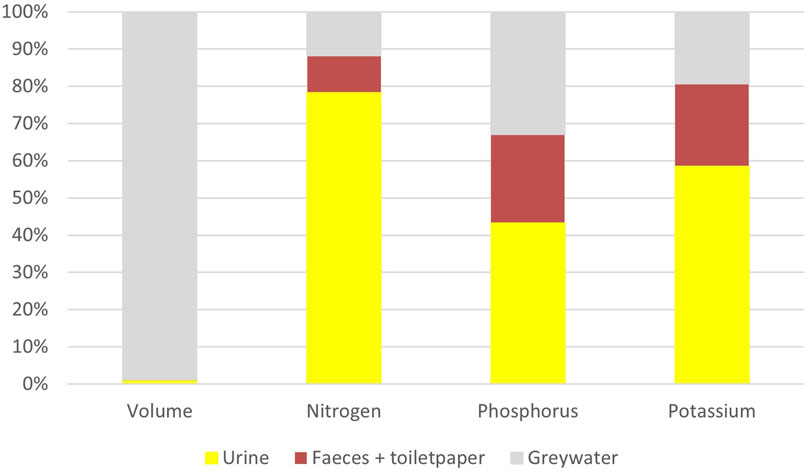
Figure 1. Distribution of volume and plant nutrients in urine, faeces + toilet paper, and greywater (Vinnerås et al., 2006).
Currently, many cities have problems with their wastewater piping system, as it combines water from several sources. Furthermore, ageing systems need to be repaired and replaced, or systems serving a declining population may become oversized. When introducing a source-separation system, the most convenient approach today is not to centralise the piping but to decentralise treatment and then tap into other urban transport systems to handle the concentrate as one extra fraction of solid waste (Aliahmad et al., 2025). Integrating wastewater fractions into solid waste management will be challenging, as it is a major paradigm shift compared to the earlier mentality of increased piping and an end-of-pipe solution for every form of waste and wastewater.
Research on source separation is growing in relation to research on wastewater treatment (Aliahmad et al., 2022). Nevertheless, the proportion of research related to this topic is small in comparison to conventional sanitation. Current research into on-site wastewater management is focused on local water reuse mainly from greywater and fertiliser production from urine only or the mixed toilet fraction. The driving forces behind these local solutions differ significantly from those related to capacity limitations in existing wastewater systems, where new domestic customers would result in an overload of the current sewer system. Other challenges are related to overloading the sewage treatment plant with nutrients. In contrast, reducing nutrient loads could result in a better nitrogen–carbon balance for improved nitrogen removal.
In the context of greywater treatment, the predominant technologies are conventional systems based on filtration and membrane processes. These systems are typically implemented at the local scale to produce reclaimed water for non-potable applications, either within buildings, using dual distribution networks for potable and non-potable water, or externally, such as for landscape irrigation (Buehler et al., 2025).
For blackwater, the technological development is either low-tech sanitisation and reuse of the full fraction as fertiliser in agriculture or a technology more or less similar to conventional wastewater treatment with aerobic biodegradation combined with the precipitation of phosphorus and stripping of ammonia nitrogen (Kjerstadius et al., 2015). For low-tech systems, sanitisation is long-term storage longer than 6 months, in accordance with WHO guidelines. By using ammonia-based treatment, where the function of uncharged ammonia is utilised for sanitisation, the treatment time can be significantly shortened, and the end-product will be of higher hygienic quality. A combination of intrinsic and added ammonia raises the pH of the material. With a pH above 8, a proportion of the ammonia will be found in uncharged form. As the effect of the sanitisation is based on the presence of uncharged ammonia, the treatment time will be regulated by factors of pH, temperature, and total ammonia nitrogen concentration. The higher any of the three parameters, the more efficient the sanitisation process (Magri et al., 2015).
The main development in source separation technologies are new urine concentration systems. The key in this technology is to remove the water fraction from the solutes in the urine and then use the concentrate directly as fertiliser or as the main ingredient in fertiliser production (Larsen et al., 2021). It is a new technology that is expanding from an initial focus on urine treatment collected at events to now also being implemented at full scale in office buildings and at football stadiums. There are two main technologies that have been developed in parallel: the partial nitrification of hydrolysed urine (Larsen et al., 2021) and stabilisation of the urine by raising the pH above 10 or lowering it below 4 (Vasiljev et al., 2022; Simha et al., 2023). This is then followed by water removal either by vacuum distillation or convective drying. Two different fertiliser products have been produced and are available on the market. One is Aurin, a liquid fertiliser with a concentration factor 5 of urine, which is mainly intended for household use but has been tested in agriculture as well. The second is Granurine, a solid fertiliser with a concentration factor 20 that is intended for use in agriculture. Creating commercial fertilisers with a strong market potential can be the driver for pollution prevention by resource recovery.
The research and development of these treatment technologies show that it is possible to transfer a wastewater fraction into a fertiliser product that is valued by farmers (Simha et al., 2017). By doing this, we can achieve multiple gains ranging from local reduction in nutrient load to the wastewater treatment plant to global impacts on biogeochemical flows of nitrogen and phosphorus that are presently far outside recommended planetary boundaries (Rockström, 2025).
In conclusion, adopting a fraction-based approach to wastewater management, similar to solid waste sorting, offers significant environmental and resource recovery benefits. By separately treating greywater, urine, and faeces, we can tailor treatment processes to their specific compositions, reduce nutrient loads on centralized plants, and produce valuable fertiliser products. This shift requires updated legislation, supportive policies, and increased investment in research and infrastructure. Embracing decentralized and source-separated systems is essential for meeting climate neutrality goals and staying within planetary boundaries for CO2 emissions and biogeochemical flows of nitrogen and phosphorus.
Data availability statement
The original contributions presented in the study are included in the article/supplementary material; further inquiries can be directed to the corresponding author.
Author contributions
BV: Writing – original draft, Writing – review and editing.
Funding
The author declares that no financial support was received for the research and/or publication of this article.
Conflict of interest
The author declares that the research was conducted in the absence of any commercial or financial relationships that could be construed as a potential conflict of interest.
The author(s) declared that they were an editorial board member of Frontiers, at the time of submission. This had no impact on the peer review process and the final decision.
Generative AI statement
The author declares that Generative AI was used in the creation of this manuscript. AI was used as language editor of the final manuscript. The prompt used was for evaluating the language to keep British English without changing the style of the writing, presenting the comments as a list with proposed language edits. I made the actual editing of the text to make sure that the content was not changed.
Any alternative text (alt text) provided alongside figures in this article has been generated by Frontiers with the support of artificial intelligence and reasonable efforts have been made to ensure accuracy, including review by the authors wherever possible. If you identify any issues, please contact us.
Publisher’s note
All claims expressed in this article are solely those of the authors and do not necessarily represent those of their affiliated organizations, or those of the publisher, the editors and the reviewers. Any product that may be evaluated in this article, or claim that may be made by its manufacturer, is not guaranteed or endorsed by the publisher.
References
Aliahmad, A., Harder, R., Simha, P., Vinneras, B., and Mcconville, J. (2022). Knowledge evolution within human urine recycling technological innovation system (TIS): Focus on technologies for recovering plant-essential nutrients. J. Clean. Prod. 379, 134786. doi:10.1016/j.jclepro.2022.134786
Aliahmad, A., Lima, P. D., Kjerstadius, H., Simha, P., Vinneras, B., and Mcconville, J. (2025). Consequential life cycle assessment of urban source-separating sanitation systems complementing centralized wastewater treatment in lund, Sweden. Water Res., 268. doi:10.1016/j.watres.2024.122741
Arkady, A., Egedy, A., Kurdi, R., and Tóth, E. (2024). Towards a circular economy - changing needs and solutions for waste management systems. Hung. J. Industry Chem. 52 (1), 45–53. doi:10.33927/hjic-2024-07
Buehler, D., Barmettler, R., Schoenborn, A., Junge, R., and Rousseau, D. P. L. (2025). Off-grid rainwater and greywater treatment and reuse on household level: conceptual approach and pilot operation at the KREIS-haus demonstration case, Switzerland. Water Reuse 15 (2), 178–197. doi:10.2166/wrd.2025.104
Kjerstadius, H., Haghighatafshar, S., and Davidsson, Å. (2015). Potential for nutrient recovery and biogas production from blackwater, food waste and greywater in urban source control systems. Environ. Technol. 36 (13), 1707–1720. doi:10.1080/09593330.2015.1007089
Larsen, T. A., Riechmann, M. E., and Udert, K. M. (2021). State of the art of urine treatment technologies: a critical review. Water Res. X 13, 100114. doi:10.1016/j.wroa.2021.100114
Magri, M. E., Fidjeland, J., Jönsson, H., Albihn, A., and Vinnerås, B. (2015). Inactivation of adenovirus, reovirus and bacteriophages in fecal sludge by pH and ammonia. Sci. Total Environ. 520, 213–221. doi:10.1016/j.scitotenv.2015.03.035
Nilsson, C., Karlsson, S., Allard, B., and Von Kronhelm, T. (2025). Phosphorus speciation in sewage sludge and their ashes after incineration as a function of treatment processes. Waste Manag. and Res. 43 (3), 378–385. doi:10.1177/0734242x241252913
Ottosen, L. M., Thornberg, D., Cohen, Y., and Stiernström, S. (2022). Utilization of acid-washed sewage sludge ash as sand or cement replacement in concrete. Resour. Conservation Recycl. 176, 105943. doi:10.1016/j.resconrec.2021.105943
Perez-Mercado, L. F., Simha, P., Moreira, A. P., Paulo, P. L., and Vinnerås, B. (2024). Circular fertilisers combining dehydrated human urine and organic wastes can fulfil the macronutrient demand of 15 major crops. Sci. Total Environ. 951, 175655. doi:10.1016/j.scitotenv.2024.175655
Rockström, J. (2025). Diagnosing Earth's tipping points: where we stand in the anthropocene. Front. Public Health 13, 1653860. doi:10.3389/fpubh.2025.1653860
Rubí, H., Fall, C., and Ortega, R. E. (2009). Pollutant removal from oily wastewater discharged from car washes through sedimentation-coagulation. Water Sci. Technol. 59 (12), 2359–2369. doi:10.2166/wst.2009.307
Simha, P., Lalander, C., Vinnerås, B., and Ganesapillai, M. (2017). Farmer attitudes and perceptions to the re-use of fertiliser products from resource-oriented sanitation systems - the case of vellore, South India. Sci. Total Environ. 581, 885–896. doi:10.1016/j.scitotenv.2017.01.044
Simha, P., Vasiljev, A., Randall, D. G., and Vinnerås, B. (2023). Factors influencing the recovery of organic nitrogen from fresh human urine dosed with organic/inorganic acids and concentrated by evaporation in ambient conditions. Sci. Total Environ., 879. doi:10.1016/j.scitotenv.2023.163053
Vasiljev, A., Simha, P., Demisse, N., Karlsson, C., Randall, D. G., and Vinnerås, B. (2022). Drying fresh human urine in magnesium-doped alkaline substrates: capture of free ammonia, inhibition of enzymatic urea hydrolysis and minimisation of chemical urea hydrolysis. Chem. Eng. J. 428. doi:10.1016/j.cej.2021.131026
Keywords: recycling, source separation, sanitation, resource recovery, urine
Citation: Vinnerås B (2025) Next generation of domestic wastewater management. Front. Environ. Sci. 13:1719089. doi: 10.3389/fenvs.2025.1719089
Received: 05 October 2025; Accepted: 23 October 2025;
Published: 24 November 2025.
Edited by:
Martin Siegert, University of Exeter, United KingdomReviewed by:
Angela Helen Arthington, Griffith University, AustraliaCopyright © 2025 Vinnerås. This is an open-access article distributed under the terms of the Creative Commons Attribution License (CC BY). The use, distribution or reproduction in other forums is permitted, provided the original author(s) and the copyright owner(s) are credited and that the original publication in this journal is cited, in accordance with accepted academic practice. No use, distribution or reproduction is permitted which does not comply with these terms.
*Correspondence: Björn Vinnerås, Ympvcm4udmlubmVyYXNAc2x1LnNl