 Rodrigo C. Menezes
 Isabela B. B. Ferreira
 Leonardo Martinez
 Bruno B. Andrade
- 1Planetary Health and Science Ensemble (PHASE) Consortium, Multinational Organization Network Sponsoring Translational and Epidemiological Research (MONSTER) Initiative, Salvador, Bahia, Brazil
- 2Laboratório de Pesquisa Clínica e Translacional, Instituto Gonçalo Moniz, Fundação Oswaldo Cruz, Salvador, Bahia, Brazil
- 3Instituto de Pesquisa Clínica e Translacional (IPCT), Faculdade Zarns, Clariens Educação, Salvador, Bahia, Brazil
- 4Programa de Pós-Graduação em Medicina e Saúde Humana, Escola Bahiana de Medicina e Saúde Pública, Salvador, Bahia, Brazil
- 5Department of Epidemiology, School of Public Health, Boston University, Boston, MA, United States
1 Introduction
Planetary health is an inherently complex field that requires the integration of diverse expertise, ranging from environmental science and public health to economics and social sciences. Despite growing recognition of its importance and awareness, planetary health faces significant challenges in translating its goals into effective action (1). These challenges often arise from the fragmented efforts of various sectors, each with distinct priorities, methodologies, and terminologies. This fragmentation is further compounded by differences in data collection practices, funding structures, and institutional frameworks, which hinder the necessary integration for meaningful impact. To effectively address these multifaceted issues, it is necessary to adopt pragmatic approaches that emphasize achievable, impactful goals.
2 Discussion
A primary difficulty in establishing effective planetary health initiatives is the fragmented efforts that arise from the interdisciplinary nature of the field. Every holistic approach goes through a critical phase in which its ideals need to be materialized to have a real impact on the world (2). Despite differences in scope and focus, planetary health can draw valuable lessons from the historical evolution of the One Health movement, as this initiative similarly required the broad engagement of communities, funders, and policymakers to develop an operational framework that translated its ideals into action, showcasing the value of collaboration across disciplines (3).
Currently, different sectors, such as governmental surveillance, climate and geographical sensors, environmental science, public health, and social sciences, often operate with little communication between them (4). For instance, environmental data and health data are frequently collected and analyzed separately, complicating efforts to understand and address their interconnections. Different actors produce data that are not interoperable, hampering the development of the field. Consequently, despite the existence of valuable data, scientists often cannot leverage it to answer important questions due to the lack of integration.
The increasing specialization within scientific fields, while advancing knowledge in specific domains, often leads to a bubble where each discipline develops its own terminologies, methodologies, and paradigms (5). Although beneficial for deepening expertise within a specific field, this can hinder effective collaboration and integration necessary for addressing the multifaceted challenges of planetary health. For instance, environmental scientists may focus on metrics like biodiversity indices and carbon footprints, while public health researchers concentrate on disease incidence rates and healthcare access. Both of these fields may lack the qualitative aspect and community engagement of the social sciences. These differing priorities and approaches can lead to communication barriers and a lack of cohesive strategy.
Implementing planetary health initiatives also faces significant funding challenges, especially in low-resource settings. Despite improvements in recent years, with institutions like the Wellcome Trust supporting broad climate and health research initiatives, securing funding for interdisciplinary and innovative projects remains a persistent challenge. This is likely due to the complexity and magnitude of these projects, which require the integration of expertise, tools and human resources from different fields. Additionally, countries that fund the majority of climate research are the least affected by climate change, creating a disparity in research focus and need (6, 7). Political shifts can further complicate matters by impacting environmental and health policies, thereby affecting the continuity and stability of long-term projects (8, 9).
Brazil exemplifies both the potential and the challenges inherent in planetary health initiatives. The country has comprehensive health and climate registries and plays a central role in global climate discussions due to its vast biodiversity and significant natural resources (10, 11). Also, the country is significantly affected by extreme climate events, such as floods, wildfires, drought, escalating air pollution, amongst others (12). However, Brazil faces substantial obstacles in harnessing planetary health data effectively. The country's health and climate data are often fragmented and managed by different government institutions, which leads to issues of accessibility and integration. Bureaucratic hurdles further complicate data utilization, and disparities in the distribution of technological infrastructure between different regions worsen inequalities (13). Moreover, incomplete datasets can hinder granular analyses and the development of effective interventions.
Considering these challenges, a shift toward more pragmatic approaches in planetary health is essential. We recognize the critical need for systemic changes that align human progress with the health of the planet, as highlighted by the São Paulo Declaration on Planetary Health (14). In consonance, we support the integration of health data across sectors, the strengthening of interdisciplinary collaboration, and capacity-building initiatives that are locally tailored (Table 1). Moreover, both approaches advocate for an unified framework that enables collaboration across sectors and the construction of sustainable health infrastructure and resilient systems, with focus on early intervention and preventive measures.
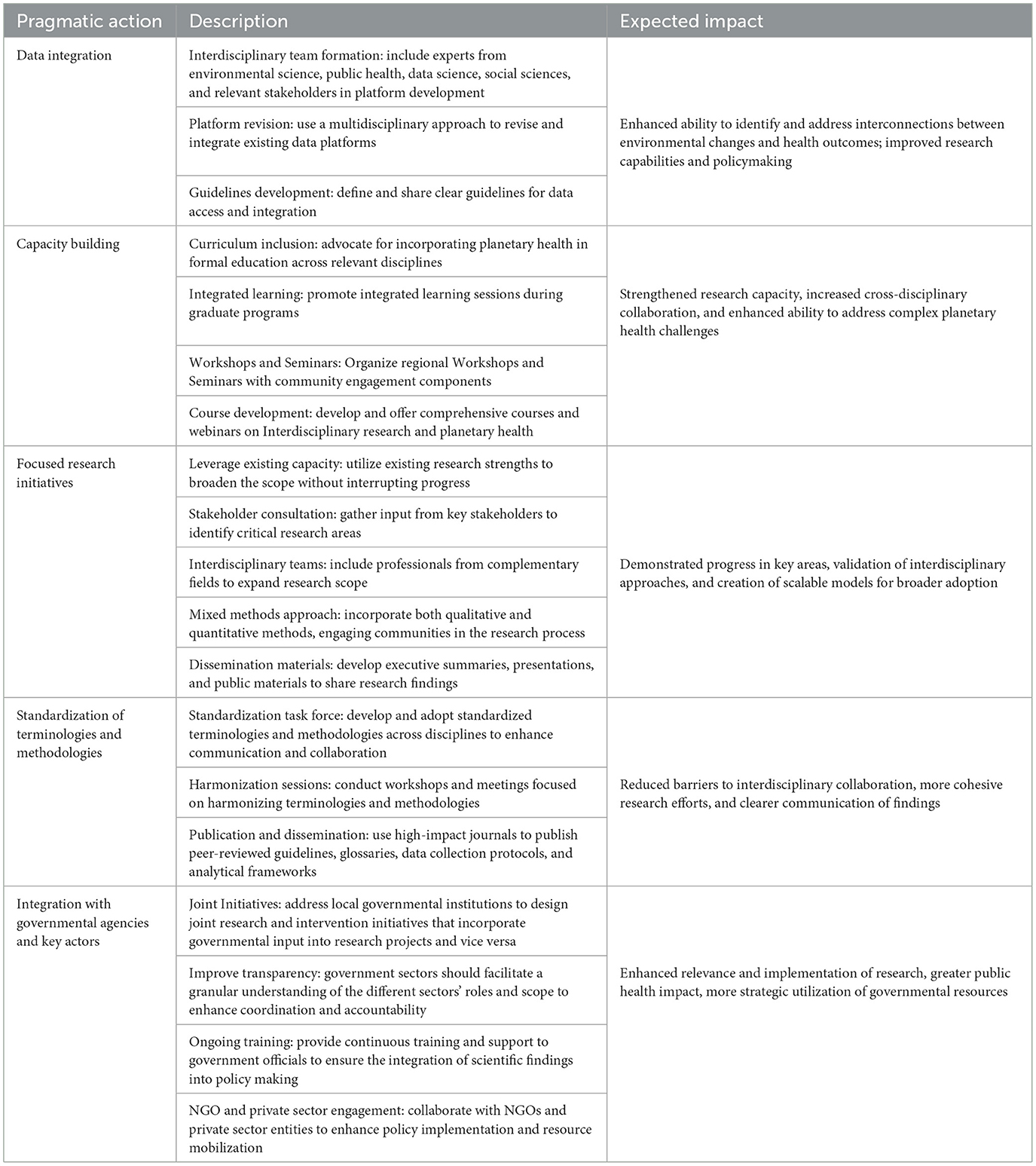
Table 1. The table details each action and their expected impacts.
However, an immediate focus on targeted, practical actions is essential to making these ideals actionable. Achieving “The Great Transition” requires foundational steps that can yield measurable results in the short term, providing the groundwork for broader systemic change. Therefore, our approach complements the Declaration's vision by leveraging existing expertise to focus on achievable, impactful goals, which demonstrate the value of interdisciplinary approaches and can incentivize the broader adoption of planetary health principles. This approach involves identifying areas of weakness within health data infrastructure, building capacity where needed, and integrating experts from diverse fields to broaden the scope of initiatives without attempting to address all aspects of planetary health simultaneously.
In this context, we envision that successful initiatives will leverage existing strengths in health research and epidemiology to address specific planetary health challenges (Table 1). For example, engaging governmental surveillance sectors, integrating and analyzing large datasets from diverse sources at the inception of data curation and uncovering patterns and associations between environmental and health data are paramount. Efforts, such as the development of the One Health Index, are a manifestation of these claims, demonstrating how multisectoral indicators of human, animal, and environmental health can be integrated into a single index for comprehensive assessment and be a foundation to further actions (15).
Additionally, including communities and tailoring interventions to their unique culture, environmental exposures and genetic predispositions, are initiatives that can effectively address the links between environmental changes and climate-sensitive diseases to inform prevention and control strategies This comprehensive strategy will allow for the flourishing of the research field, the construction of a standardized language, solid and effective capacity building and integration with governmental technical areas for targeted and prioritized actions.
While the field faces significant challenges, actionable initiatives may demonstrate that targeted, strategic efforts can lead to meaningful progress. By leveraging existing expertise, fostering collaboration, and embracing innovation, it is possible to make a significant impact in the field of planetary health. Through these efforts, we hope to inspire similar initiatives globally and contribute to a more sustainable, equitable, and healthy future for all.
Author contributions
RM: Writing – original draft, Writing – review & editing. IF: Writing – original draft, Writing – review & editing. LM: Writing – original draft, Writing – review & editing. BA: Writing – original draft, Writing – review & editing.
Funding
The author(s) declare that no financial support was received for the research, authorship, and/or publication of this article.
Conflict of interest
The authors declare that the research was conducted in the absence of any commercial or financial relationships that could be construed as a potential conflict of interest.
Publisher's note
All claims expressed in this article are solely those of the authors and do not necessarily represent those of their affiliated organizations, or those of the publisher, the editors and the reviewers. Any product that may be evaluated in this article, or claim that may be made by its manufacturer, is not guaranteed or endorsed by the publisher.
References
1. Whitmee S, Haines A, Beyrer C, Boltz F, Capon AG, de Souza Dias BF, et al. Safeguarding human health in the Anthropocene epoch: report of the Rockefeller Foundation-Lancet Commission on planetary health. Lancet. (2015) 386:1973–2028. doi: 10.1016/S0140-6736(15)60901-1
2. Mumford EL, Martinez DJ, Tyance-Hassell K, Cook A, Hansen GR, Labonté R, et al. Evolution and expansion of the One Health approach to promote sustainable and resilient health and well-being: a call to action. Front Public Health. (2023) 10:1056459. doi: 10.3389/fpubh.2022.1056459
3. National Center for Emerging and Zoonotic Infectious Diseases, CDC. Operationalizing “One Health”: A Policy Perspective - Taking stock and Shaping an Implementation Roadmap. Georgia: Stone Mountain (2010). p. 24. Available at: https://stacks.cdc.gov/view/cdc/22020 (accessed June 28, 2024).
4. Geffroy M, Pagès N, Chavernac D, Dereeper A, Aubert L, Herrmann-Storck C, et al. Shifting from sectoral to integrated surveillance by changing collaborative practices: application to West Nile virus surveillance in a small Island State of the Caribbean. Front Public Health. (2021) 9:649190. doi: 10.3389/fpubh.2021.649190
5. Jacobs JA, Frickel S. Interdisciplinarity: a critical assessment. Annu Rev Sociol. (2009) 35:43–65. doi: 10.1146/annurev-soc-070308-115954
6. UNDP. Most vulnerable, most affected countries doing most to tackle climate crisis, UN Development Programme report. Available at: https://www.undp.org/press-releases/most-vulnerable-most-affected-countries-doing-most-tackle-climate-crisis-un (accessed June 28, 2024).
7. Klingelhöfer D, Müller R, Braun M, Brüggmann D, Groneberg DA. Climate change: Does international research fulfill global demands and necessities? Environ Sci Eur. (2020) 32:137. doi: 10.1186/s12302-020-00419-1
8. PODER360. Funcionários do Inmet anunciam greve por falta de orçamento. (2024). Available at: https://www.poder360.com.br/brasil/funcionarios-do-inmet-anunciam-greve-por-falta-de-orcamento/ (accessed June 28, 2024).
9. Reardon S, Tollefson J, Witze A, Ross E. US science agencies face deep cuts in Trump budget. Nature. (2017) 543:471–2. doi: 10.1038/nature.2017.21652
10. World Bank. Brazil can be both richer and greener: World Bank Group outlines opportunities for climate action and growth. Available at: https://www.worldbank.org/en/news/press-release/2023/05/04/brazil-can-be-both-richer-and-greener-world-bank-group-outlines-opportunities-for-climate-action-and-growth (accessed June 28, 2024).
11. U.S. Agency for International Development. Brazil Climate Change Country Profile | Climate. (2023). Available at: https://www.usaid.gov/climate/country-profiles/brazil (accessed June 28, 2024).
12. Brasil CN de M. Emergência Climática. (2024). p. 45. Available at: https://cnm.org.br/biblioteca/exibe/15246 (accessed June 28, 2024).
13. Coube M, Nikoloski Z, Mrejen M, Mossialos E. Persistent inequalities in health care services utilisation in Brazil (1998–2019). Int J Equity Health. (2023) 22:25. doi: 10.1186/s12939-023-01828-3
14. Myers SS, Pivor JI, Saraiva AM. The São Paulo declaration on planetary health. Lancet. (2021) 398:1299. doi: 10.1016/S0140-6736(21)02181-4
15. De Moura RR, Chiba De Castro WA, Farinhas JH, Pettan-Brewer C, Kmetiuk LB, Dos Santos AP, et al. One Health Index (OHI) applied to Curitiba, the ninth-largest metropolitan area of Brazil, with concomitant assessment of animal, environmental, and human health indicators. One Health. (2022) 14:100373. doi: 10.1016/j.onehlt.2022.100373
Keywords: One Health, health policy, climate change, sustainability, health promotion
Citation: Menezes RC, Ferreira IBB, Martinez L and Andrade BB (2024) Bridging the gap: a pragmatic approach to planetary health. Front. Public Health 12:1491457. doi: 10.3389/fpubh.2024.1491457
Received: 04 September 2024; Accepted: 11 November 2024;
Published: 27 November 2024.
Edited by:
Priscila Sato, Federal University of Bahia (UFBA), BrazilReviewed by:
Henrik Lerner, Marie Cederschiöld University, SwedenLuca Valera, University of Valladolid, Spain
Gustavo J. Nagy, Universidad de la República, Uruguay
Copyright © 2024 Menezes, Ferreira, Martinez and Andrade. This is an open-access article distributed under the terms of the Creative Commons Attribution License (CC BY). The use, distribution or reproduction in other forums is permitted, provided the original author(s) and the copyright owner(s) are credited and that the original publication in this journal is cited, in accordance with accepted academic practice. No use, distribution or reproduction is permitted which does not comply with these terms.
*Correspondence: Rodrigo C. Menezes, cm9kcmlnb0Btb25zdGVyaW5pdGlhdGl2ZS5jb20=; Bruno B. Andrade, YnJ1bm8uYW5kcmFkZUBmaW9jcnV6LmJy