Abstract
Introduction:
Climate change is increasing vulnerability to food insecurity and biodiversity loss for many Indigenous Peoples globally. For Inuit, food sovereignty is one expression of Indigenous self-determination, and it includes the right of all Inuit to define their own conservation policies. Caribou conservation is particularly pertinent because of the central role caribou play in Inuit food systems. The “Dolphin and Union” (DU) caribou herd is a critical component of Inuit food systems in the Canadian Arctic and has declined by 89% in 2020 (3,815) from the peak measured by aerial survey in 1997 (34,558).
Methods:
Our first objective was to identify insights about this herd from and with Inuit Qaujimajatuqangit (knowledge). Using thematic analysis, we created a collective account on the DU caribou herd through a research partnership among Indigenous knowledge keepers, government, and academia. Our second objective was to put our findings into the broader literature on the DU caribou herd and connect isolated data on their abundance and distribution.
Results:
We found understanding Inuit knowledge of caribou meant situating harvesters’ knowledge within their family history, harvesting methods, conservation ethics, and in relation to other harvesters. Through this framework, we conceptualized Inuit-described metrics of caribou status, resulting in three sub-themes of caribou trends over time – their abundance, distribution, and health, − and ending with conservation concerns and potential actions. The synthesized data indicated that the overall population size increased since ~1990s and then decreased after ~2000s alongside a range contraction. Our results add value to co-management literature by (1) articulating Inuit-described metrics of a population decline that inform continued monitoring and incorporation of these metrics into management planning and (2) synthesizing data from various studies on the DU caribou herd abundance and distribution that assists management to make informed conservation decisions based on Inuit and Western knowledge.
Discussion:
Results from this research contribute to understanding the six dimensions of environmental health, i.e., availability, stability, accessibility, health and wellness, Inuit culture, and decision-making power and management relating to caribou. The results contribute information that is used by to support environmental health, i.e., knowledge systems, policy, and co-management relating to caribou. Thus, this collaborative research study supports the expression of Inuit food sovereignty through caribou conservation.
1 Introduction
Despite global efforts to avoid the worse case climate scenarios, climate change is implicated in numerous cases of increasing vulnerability to biodiversity loss and food insecurity (Nunez et al., 2019; Muluneh, 2021). The destructive ecological impacts of climate change may still be mitigated with swift international cooperation (Whyte, 2020; Intergovernmental Panel on Climate Change, 2022), requiring expertise across disciplines, worldviews, and public service sectors (Gavin et al., 2018). International science-policy organizations, such as the Intergovernmental Science-Policy Platform on Biodiversity and Ecosystem Services (IPBES) or the Convention on Biological Diversity, have emphasized the need to “bridge the divide” between Indigenous and Western knowledges to address biodiversity loss (Löfmarck and Lidskog, 2017; Tengö et al., 2017; Tomasini, 2018; Intergovernmental Panel on Climate Change, 2022). Yet, the effectiveness of these efforts is often impeded by collaboration struggles among conservation actors (Rose et al., 2019). Barriers to collaboration may manifest as misconceptions and biases, language barriers, legacy effects, and limited resources, trust, and experience, among others (Tengö et al., 2017; Ulicsni et al., 2019; Wheeler et al., 2020). Indigenous leaders explain the connection between climate change and colonization, where climate change and colonization are one and the same or that they exist as two issues in the same system, fueling each other (McGregor et al., 2020; Whyte, 2020). These authors contend that addressing climate change requires empowering collective self-determination of Indigenous Peoples.
Indigenous groups around the world have harvested wild species, or country foods, for thousands of years, and this is integral to their culture, identity, and health (Boulanger-Lapointe et al., 2019; Akinola et al., 2020; Ajibola et al., 2023). Inuit food sovereignty, one expression of Inuit self-determination, is the right of all Inuit to define their own conservation policies, determine what is appropriate distribution of food, and maintain means to access country foods (Inuit Circumpolar Council Alaska, 2020). Inuit food sovereignty is required for Inuit food security (Inuit Circumpolar Council Alaska, 2020). Inuit food security is characterized by environmental health, and dependant on six components: (1) availability, (2) stability, (3) accessibility, (4) health and wellness, (5) Inuit culture, and (6) decision-making power and management (Inuit Circumpolar Council Alaska, 2020). Indeed, arctic country foods are nutritionally rich, and although store-bought foods are now common place, country foods remain preferred for their nutritional value, spiritual value, and taste (Inuit Circumpolar Council Alaska, 2020; Inuit Tapiriit Kanatami, 2021). Climate change has generally decreased the accessibility and availability of country foods (Inuit Tapiriit Kanatami, 2021), with Inuit reporting unpredictable and more dangerous harvesting conditions because of thinning sea-ice, thawing permafrost, rising sea levels, stronger and more variable wind conditions, and shifting wildlife ranges (Inuit Circumpolar Council Canada, 2012; Fawcett et al., 2018; Beaulieu et al., 2023). The health of cold-adapted wildlife is challenged under these new climate conditions, like the Arctic char (Salvelinus alpinus) who experience reduced cardiorespiratory performance and recoverability in higher water temperatures (Gilbert et al., 2016, 2020).
Wildlife conservation is inherent to Inuit food security and sovereignty (Inuit Circumpolar Council Alaska, 2020). In Canada, species status assessments through the federal Species at Risk Act (i.e., Endangered, Threatened, Special Concern, Least Concern) and subsequent wildlife management decision-making often rely on reports that compile and analyze the best available information on the species of interest (Lyver et al., 2018; COSEWIC, 2021). Various health indicators, such as population demographics, distribution, habitat quality, body condition, or disease status, can guide a species’ conservation status (Peacock et al., 2020). Historically, these indicators were informed almost exclusively through quantitative science. However, an inclusive process that incorporates Indigenous knowledge side by side with Western knowledge (inclusive of quantitative and qualitative science) is recommended to improve species assessments (Polfus et al., 2014; Lyver et al., 2018; Peacock et al., 2020; Singer et al., 2023) and is often mandated by local (e.g., Statutes of Nunavut, 2018; Government of Northwest Territories, 2019), national (e.g., COSEWIC, 2017a), and international agencies (e.g., Cross et al., 2017; Löfmarck and Lidskog, 2017). Increasingly, Indigenous knowledge, often documented with methods from qualitative science, is used to enhance understanding of wildlife and environmental status, trends, and health (e.g., Ostertag et al., 2018; Tomaselli et al., 2018; Fox et al., 2020). This approach guides and improves decision-making with the goal that wildlife populations who are around today may be present in the future (Berkes et al., 2000; Kutz and Tomaselli, 2019; Peacock et al., 2020; Singer et al., 2023).
In Nunavut and the Northwest Territories (NWT), Canada, the land claims agreements, wildlife management systems, and their corresponding legislation centre Inuit rights and promote the use of Inuit knowledge in wildlife management decisions (e.g., Statutes of Canada, 1984, 1993; Statutes of the Northwest Territories, 2009; Statutes of Nunavut, 2018). For example, article five of Nunavut Land Claims Agreement Act outlines the approach towards wildlife management within the Nunavut Settlement Area. This article recognizes that “there is a need for an effective role for Inuit in all aspects of wildlife management, including research” (5.1.2 (h)) and implements the Nunavut Wildlife Management Board, whose membership includes Inuit, federal government, and territorial government, as “the main instrument of wildlife management” (5.2.33) (Statutes of Canada, 1993). While the Nunavut Land Claims Agreement Act does not invoke the term “co-management,” these mandates towards collaborative management and research for wildlife that shares power between Inuit and public governments is consistent with co-management definitions (Berkes, 2009). Land claims-based co-management within Canada has advanced Indigenous sovereignty in the settlement areas, albeit with facets that require improvement (see Parlee and Caine, 2018; White, 2020; Swerdfager and Armitage, 2023).
An animal of particular importance in Nunavut and the NWT, and more generally across the circumpolar regions, is the caribou, Rangifer tarandus (Freeman, 1976; Anderson and Nuttall, 2004; Borish et al., 2021). Caribou in Canada have experienced widespread declines in abundance, including the three caribou sub-species and designatable units (“discrete and evolutionarily significant units of the taxonomic species”) in the central Canadian Arctic (COSEWIC, 2011, p. 14; Festa-Bianchet et al., 2011). These designatable units include Peary (R. t. pearyi), Dolphin and Union (R. t. groenlandicus x pearyi; DU) and Barren-ground (R. t. groenlandicus) caribou which are currently assessed as Threatened (Peary, Barren-ground) or Endangered (Dolphin and Union) (COSEWIC, 2015, 2016, 2017c; Species at Risk Committee, 2022, 2023; Nunavut Wildlife Management Board, 2022b). These three populations are harvested by Kitikmeot Inuit in Nunavut and Inuvialuit in the NWT. The widespread declines of Barren-ground caribou have limited the availability of caribou for country food and increased community dependence on the DU caribou herd, the latest herd to decline (COSEWIC, 2015, 2016, 2017c).
The goal of our study was to document Inuit knowledge on the DU caribou herd to support and strengthen Inuit food sovereignty through equitably informed caribou co-management. Specifically, our first objective was to create a collective account of Kugluktukmiut knowledge around the DU caribou herd and identify Inuit-described metrics of a changing caribou population. Our research question was “What were the past and present trends in the DU caribou herd’s population, distribution, health, and threats as described by Kugluktukmiut knowledge keepers in 2018–2020?” Our second objective was to position these findings within the broader literature on the DU caribou herd and, by doing so, connect isolated data and different ways of knowing on this herd’s abundance and distribution from previously published peer-reviewed and grey literature. By bringing together these disparate and valuable sources of knowledge, we aim to ensure that co-management partners have the information necessary to uphold their responsibilities outlined in land claims agreements and centre Inuit knowledge in policy recommendations that directly affect Inuit food security.
2 Materials and methods
2.1 Study populations
This work began with a common interest of having the DU caribou herd around for future generations. We started a collaboration among representatives from the University of Calgary, the Kugluktuk Angoniatit Association (a Hunters and Trappers Organization), and the Government of Nunavut to learn more about caribou from Kugluktuk harvesters and their Traditional knowledge. Traditional knowledge, also known as Inuit Qaujimajatuqangit, Inuit knowledge, or Indigenous knowledge, is the term frequently used in Kugluktuk to refer to knowledge that Inuit have gained over many generations and is inclusive of Inuit values, customs, and principles for living (Pedersen et al., 2020). Over the years from 2017 to 2023, our collaboration grew to include the Ekaluktutiak Hunters and Trappers Organization, the Olokhaktomiut Hunters and Trappers Committee, and the Wildlife Management Advisory Council (NWT), covering the main communities that depend on the DU caribou herd. Beyond these caribou, people in Kugluktuk, Ekaluktutiak, and Ulukhaktok share a rich cultural history as Inuinnait. Inuinnait are distinct collective of Inuit who use the coastline of Victoria Island along the Coronation Gulf and around to the neighbouring shore of Banks Island as well as the adjacent mainland (Bennett and Rowley, 2004; Collignon, 2006). Their collective represents at least 16 different groups of Inuit (often identified with the suffix-miut) with loose economic and social ties (Bennett and Rowley, 2004; Collignon, 2006). Today, most Inuinnait have close familial connections and have moved to the main settlements of Kugluktuk, Ekaluktutiak, and Ulukhaktok, with very few people remaining in the outpost camps of Umingmaktok and Kingauk (Bennett and Rowley, 2004).
The interviews in objective one focus on Kugluktukmiut knowledge. Kugluktuk is the westernmost community in Nunavut and was home to 1,382 people in 2021, 89.5% identifying as Inuit (Statistics Canada, 2021) (Figure 1). Caribou are essential for subsistence and were the most frequently discussed wildlife species in previous interviews focusing on climate change and food security (Government of Nunavut, 2018; Panikkar and Lemmond, 2020). Herds commonly harvested by Kugluktukmiut include Barren-ground caribou (Bluenose East, Bathurst) and the DU caribou (Government of Nunavut, 2007). Characteristically, the DU caribou herd summer on Victoria Island and winter on the adjacent mainland, crossing the sea-ice during their fall and spring migrations (Poole et al., 2010) (Figure 1). In 2011, the Government of Canada listed the DU caribou herd as Special Concern in the Species at Risk Act given uncertainty around abundance and harvesting levels (COSEWIC, 2004; Government of Canada, 2011). In COSEWIC (2017c) reassessed the herd as Endangered because of abundance declines and multiple threats such as decreased sea-ice connecting seasonal habitats. The Nunavut Wildlife Management Board supported the federal uplisting of the DU caribou herd to Endangered in 2022 (Nunavut Wildlife Management Board, 2022b), and the Species at Risk Committee in the NWT reassessed the herd as Endangered in 2023 (Species at Risk Committee, 2023).
Figure 1
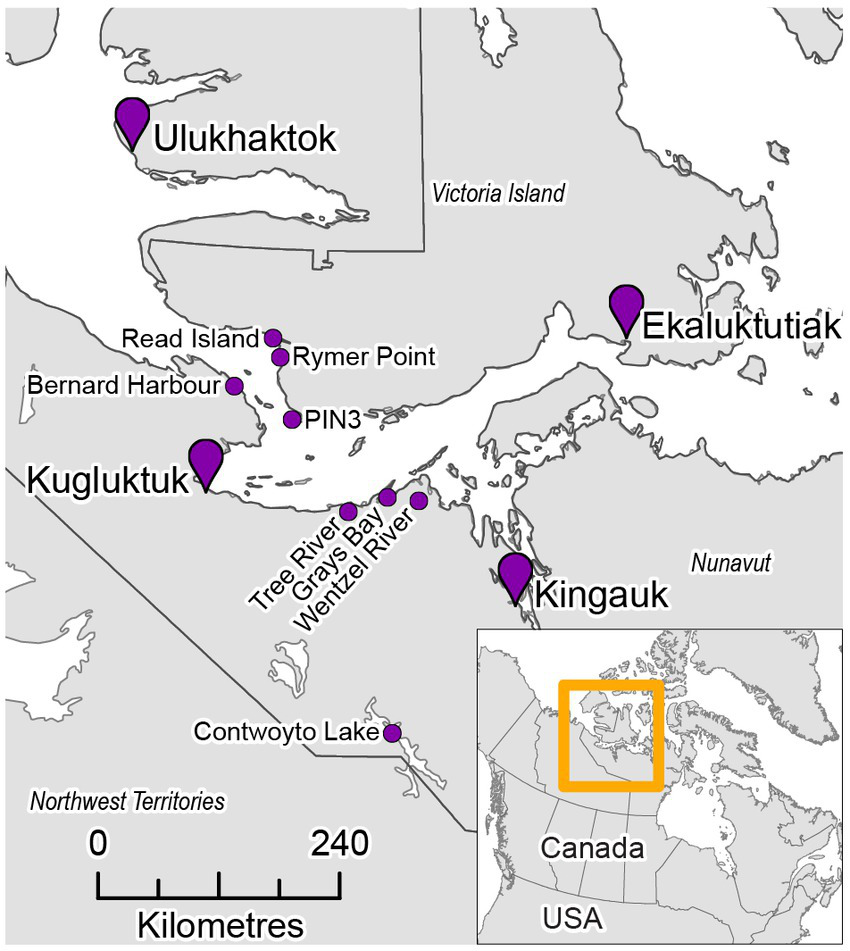
Study area, including communities that harvest DU caribou (pins) and important places for Kugluktukmiut (dots as indicated from interviews).
2.2 Conceptual framework
We used critical realism to conceptualize how harvesters learned and knew about caribou (see Supplementary materials for glossary). Critical realism acknowledges existing external realities (Maxwell and Mittapalli, 2011; Pickens and Braun, 2018). For example, caribou exist and have lives separate from humans. Critical realism also presumes we can never fully understand these realities because of our socially and culturally situated truths of reality (Maxwell and Mittapalli, 2011; Pickens and Braun, 2018). Thus, harvesters can have partial, differing accounts of caribou that can be true simultaneously because they have different lived experiences, influenced by aspects such as age, class, gender, and other individual experiences or characteristics (Maxwell and Mittapalli, 2011). Similarly, harvested and collared caribou are chosen for their particular characteristics, such as body condition, location, age/sex class, or group size. Such characteristics add another lens to understanding data derived from the caribou, which is sometimes called a selection bias. Under critical realism, biases are not aspects to try to reduce or remove. Instead, we have aimed to account for and retain these orientations so that we can make the best connections possible in the data. Critical realism informed our interview facilitation, data documentation, and analytical stages.
2.3 Creating a collective account of Kugluktukmiut knowledge
We held a series of semi-structured interviews from 2018 to 2022, informed by results of previous research (Tomaselli et al., 2018; Hanke et al., 2021) (Figure 2). This approach included initial individual, exploratory interviews, followed by group interviews focused on caribou abundance, distribution, health, and conservation concerns, and then feedback sessions for verification of the researchers’ interpretations of the interviews (see Supplementary materials for interview guides). We invited expert caribou harvesters to participate in the study based on recommendations by the Kugluktuk Angoniatit Association (purposive sampling) and suggestions of other harvesters from people already involved in the interviews (snowball sampling) (Green and Thorogood., 2014). We invited harvesters who were already involved in the study, as well as new ones, at each subsequent research stage.
Figure 2
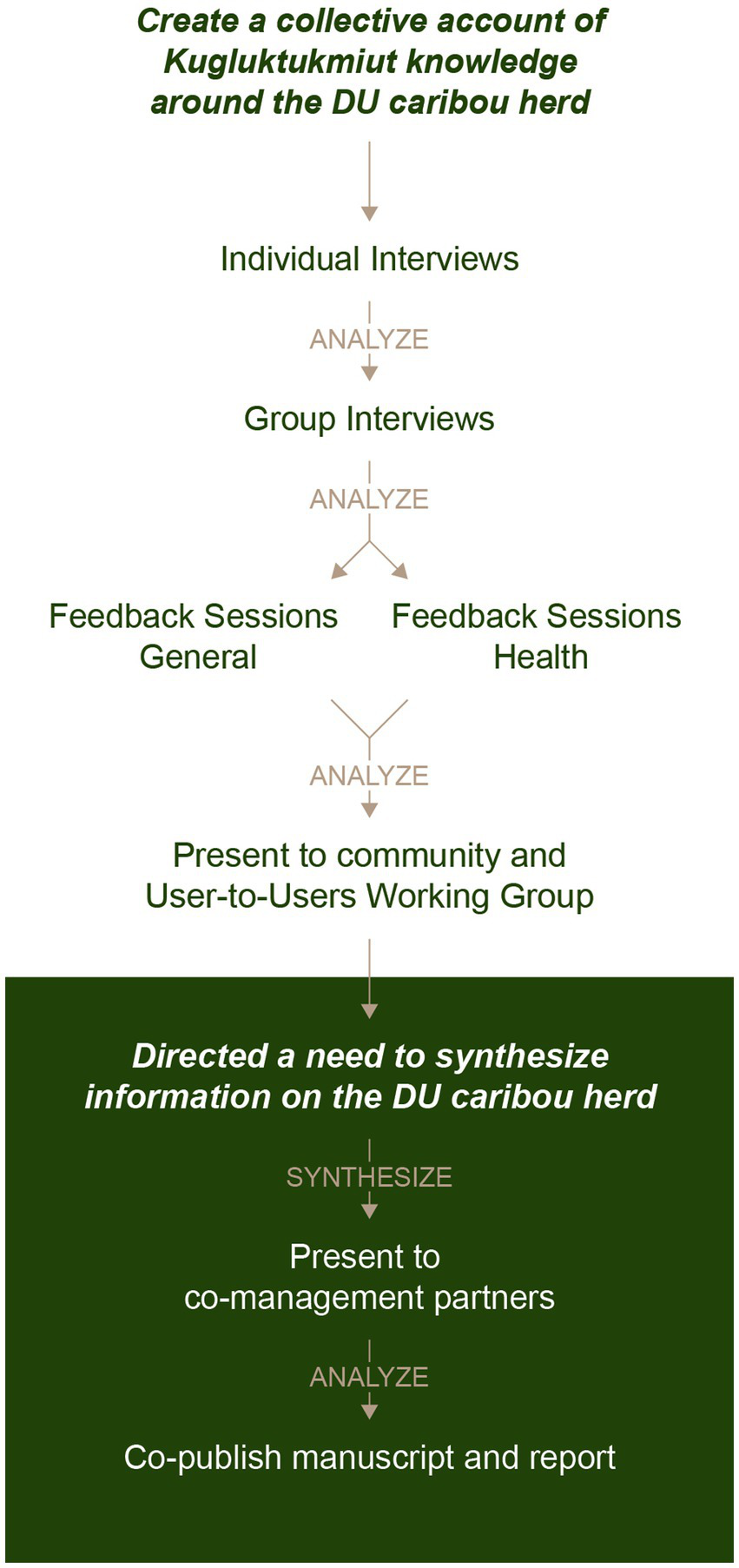
Progression of study methods. The top section in white refers to the steps taken to achieve study objective 1, and the bottom section in green refers to the steps taken to achieve study objective 2. Activities are connected by arrows and the moments taken to complete analyses based on the input received during the previous activities. After a set of analysis was completed, the results were returned and discussed with community (study participants or public presentations) or co-management partners. The User-to-Users Working Group is a collective of representatives from each of the Hunters and Trappers authorities within the DU caribou herd range, including the communities of Kugluktuk and Ekaluktutiak in Nunavut and Ulukhaktok and Paulatuk in the NWT.
All research stages were audio-recorded, but only the individual and group interview recordings were transcribed. The transcription followed a list of conventions that we created for consistently documenting distinct pauses in conversation, laughter and coughing, and parts of the audio-recordings we were unsure about (Tilley, 2016).
Interviews were conducted in English. Harvesters who were fluent in English and Inuinnaqtun translated during group interviews when needed to support conservations between other harvesters and the interview facilitators; no language support was needed during the individual interviews. All harvesters received honoraria set by local guidelines. The Kugluktuk Angoniatit Association confirmed the age/experience category that interviewees self-identified as (i.e., Elders and non-Elders) and all interviewees were over the age of 18 years old. We composed the group interviews based on these categories (e.g., Elders grouped with Elders) to help navigate group dynamics. We offered knowledge keepers the opportunity to be named as a contributor to this research, in their quotes, and on their photographs. This type of participant identification is consistent with Indigenous ethics (McGrath, 2019; Wheeler et al., 2020) and was agreed upon among the University of Calgary, the Kugluktuk Angoniatit Association, and the participating harvesters.
2.3.1 Individual interviews: exploratory
Individual interviews were facilitated in September and October 2018 with nine self-identified Elders and six non-Elders at the Kugluktuk Angoniatit Association office. The interviews explored the meaning of the DU caribou herd to the community, observations related to the herd’s abundance, distribution, and health, as well as conservation concerns and potential ways to address these concerns. The interview guide, which was informed by expertise from the Kugluktuk Angoniatit Association, was built using previous interviews that were facilitated in 2003 and used participatory mapping to aid the discussions (Hanke et al., 2021). The preliminary analysis of the individual interviews was used to inform the group interviews.
2.3.2 Group interviews: participatory epidemiology
The goal of the group interviews was to further explore themes gleaned from the individual interviews and create semi-quantitative data on caribou distribution, abundance, demographics, and health. We facilitated seven group interviews with two to three knowledge keepers in January 2019, engaging nine self-identified Elders and seven non-Elders. We chose group interviews so harvesters could build their answers together and discuss why their perspectives may differ (Tilley, 2016).
We used participatory mapping (see below) to document knowledge keepers’ common travel areas and harvesting ranges for the DU caribou herd. We used proportional piling to document relative abundance of the DU caribou herd and create ratios of changes in abundance over time (Tomaselli et al., 2018). First, we asked harvesters what year(s) in their life experience they saw the most DU caribou; this became the 100% mark and was represented by a two-cup pile of beans. Second, we asked the knowledge keepers to select the portion of the beans from the pile that represents how many DU caribou they saw in 2019 compared to the peak time (100%). Then, we measured that amount of beans with a two-cup measuring cup to create a percent ratio from peak caribou (100%) to the number of caribou observed in 2019 (XX%). If the harvesters had information before peak population (100%), it was determined using the same steps. The facilitator and harvesters then estimated a line that connected the data points on a paper chart. Once drawn, the facilitator calculated the associated percentage for every five years and adjusted the results according to guidance from the knowledge keepers.
We used printed images of common caribou diseases to help guide our discussions around caribou health. When harvesters said they had seen signs of disease in caribou (caught/harvested or observed), we asked harvesters for more details on a temporal line since their first sighting of the abnormality to the time of the interviews (2018–2020). We used proportional piling to track changes in how often they saw this in caribou over time. We used proportional piling and discussion to explore how signs of disease may have varied with caribou demography (sex, age class), seasonality, occurrence, and severity.
2.3.3 Feedback sessions and presentations: verification
Feedback sessions were used to share results, including maps, charts, and themes, and correct any misinterpretation by the researchers. Knowledge keepers had the opportunity to amend all results, including re-piling the abundance data, redrawing the maps, and adding nuance to the disease data. We facilitated four group and five drop-in feedback sessions with knowledge keepers in January and February 2020. Harvesters who could not attend the scheduled group feedback sessions were invited, at their convenience, to come to the Kugluktuk Angoniatit Association office and go through the results. In total, these sessions engaged 16 self-identified Elders and nine non-Elders. A second set of feedback sessions focused on health were completed in May 2022 with a subset of six harvesters (four Elders, two non-Elders) representing five of the original seven interview groups through one-on-one discussions. All participants from one Elder group interview had passed by the time of the health-focused feedback sessions.
2.3.4 Participatory mapping methods
Each interview set employed participatory mapping, using paper maps generated in ArcGIS, to aid discussions about the land (Armitage and Kilburn, 2015). The individual and group interviews used a single map per individual/group and coloured markers to differentiate attributes such as type of observation, year, and season. Each feedback session used 11 different maps to further elucidate spatial and temporal details: one for “What parts of the land do you know really well?”, and two sets of five for “Where do people see DU caribou?”, and “Where do people catch DU caribou?”, respectively during different time-intervals: 1980–1989, 1990–1999, 2000–2009, 2010–2017, and 2018–2020 (i.e., “today”). Each knowledge keeper drew on the maps with a marker unless they asked for the interviewer to do it for them. Interviewer notes were added in pencil to the maps during the interviews. All mapping attributes were confirmed before the end of the interviews.
2.3.5 Analysis
We analyzed the data thematically using inductive thematic analysis to explore shared patterns of meaning in the interviews (Braun and Clarke, 2020a,b). There are six phases to this analytical method: (1) data familiarisation and writing familiarisation notes; (2) systematic data coding; (3) generating initial themes from coded and collated data; (4) developing and reviewing themes; (5) refining, defining and naming themes; and (6) writing the report (Braun and Clarke, 2020b). We familiarized ourselves with the data while facilitating the interviews, transcribing the audio-recordings, digitizing the maps, editing the transcripts and maps, and reviewing the finalized materials while taking notes of analytical interest. Our coding process was systematic through each research phase using two specific coding strategies: holistic coding that allowed room for an analyst-focused exploration of the data, and in vivo coding to ground the coding in the data, that is the words of the knowledge keepers. In this, we were able to reflexively review differences in worldviews that may appear in the coding due to differing cultural backgrounds among the knowledge keepers and the analysts. We did all the interview coding in NVivo 12, a software that assists in organizing qualitative data (QSR International, 2022). We did these steps for each research stage and interview set.
After the individual interviews, our theme development initially focused on categories that described what harvesters were saying about caribou abundance, distribution, health, and other concerns. We presented the main results from this stage of the analysis at the beginning of the group interviews. After the group interviews, we deepened and expanded our analysis to learn how harvesters spoke about the DU caribou herd and identify the relationships among topics discussed in the interviews. We presented results from this analytical stage during the feedback sessions. We then returned to the theme development with the harvesters’ guidance to ground more spatial context into the caribou observations. We presented the revised themes to the community at the Kugluktuk Angoniatit Association annual general meeting. We followed this same iterative process with the sub-group of harvesters involved in the health feedback sessions.
Participatory maps were scanned or photographed, georeferenced, and digitized into polygons and polylines within ArcGIS Pro software (Esri, n.d.). We merged all participatory maps across the study to summarize observations across maps (Honeycutt, 2012). We dissolved all the mapping by harvester or group interview, so that only inter-harvester/group overlapping was counted in the spatial analysis. These methods allowed us to count how many times a location was mapped across different interviews, resulting in a hue gradient in the final maps. We used geoprocessing tools (Dissolve, Clip, Calculate Field) to summarize the area (km2) covered by the polygons, rounding to the nearest hundred to allow a buffer for mapping accuracy (Armitage and Kilburn, 2015; Robertson, 2017).
We created a hue gradient bar, from light to dark, showing caribou relative distance from community based on the oral accounts of changing caribou locations. The darkest hues represent when caribou were closest to community and the lightest hues represent when caribou were furthest from community.
We compiled the proportional piling data on abundance trends with a smoothed quadratic regression model using R software (The R Foundation, n.d.). We tested a linear regression for the affects of polynomial terms and harvester age before determining the model of best fit.
2.4 Synthesis of disparate data sources on the DU caribou herd
The data synthesis was inspired by our interviews and various ongoing research collaborations around the DU caribou herd [e.g., Hanke et al., 2020; Peacock et al., 2020; Hanke et al., 2021; Hanke and WMAC (NWT), 2023] where all partners described in section 2.1 emphasized the importance of using all tools available to learn about these caribou to ensure that the best possible conservation decisions are made. We, thus, pulled together the available peer-reviewed and grey literature on the DU caribou herd to put our results into a broader context and provide a synthesized assessment of this herd’s abundance and distribution (Table 1). We identified literature by reviewing the DU caribou herd assessments and management plans, examining their reference lists, and contacting researchers and authorities who may know of other relevant research (COSEWIC, 2004, 2017c; Environment and Climate Change Canada, 2018; Species at Risk Committee, 2023). Additionally, we searched Scopus and Web of Science to detect additional studies that contained Traditional knowledge of abundance or distribution. Our database search strategy was:
Table 1
Data sources for the synthesis on abundance and distribution.
("Traditional knowledge" OR "local knowledge" OR "Traditional ecological knowledge" OR "Inuit Qaujimajatuqangit" OR "Inuit knowledge" OR "local ecological knowledge" OR "citizen science")
AND ("caribou" OR "Dolphin and Union caribou" OR "Tuktu" OR "tuktuit" OR "reindeer" OR "Rangifer tarandus" OR "Rangifer")
AND ("Kugluktuk" OR "Coppermine" OR "Cambridge Bay" OR "Ikaluktuutiak" OR "Iqaluktuttiaq" OR "Ekaluktutiak" OR "Bay Chimo" OR "Umingmaktok" OR "Bathurst Inlet" OR "Qingaut" OR "Kingauk" OR "Gjoa Haven" OR "Uqsuqtuuq" OR "Victoria Island" OR "Ki'liniq" OR "King William Island" OR "Qikiqtaq" OR "Paulatuk" OR "Paulatuuq" OR "Kitikmeot" OR "Ulukhaktok" OR "Holman")
We reviewed the titles and abstracts, retaining results that included newly documented Traditional knowledge of caribou and removing results that reported secondary data. Next, we reviewed the full reports and retained results that specifically mention the DU caribou herd or behaviour/descriptions that match the DU caribou herd, focusing specifically on abundance and distribution.
2.4.1 Analysis
We digitized and extracted the abundance data from the various literature sources to compile them within one graph. To standardize the y-axis, we retained the relative abundance used in the Traditional knowledge studies and converted the survey results to a percent of 40,000 animals, the peak abundance estimated in the management plan (Environment and Climate Change Canada, 2018). The Ekaluktutiak trend line is a cubic regression model (Tomaselli et al., 2018), and the Kugluktuk trend line is a quadratic regression model (this paper). The survey estimates (Nishi and Gunn, 2004; Dumond and Lee, 2013; Leclerc and Boulanger, 2018, 2020; Campbell et al., 2021) and Ulukhaktok decadal estimates [Hanke and WMAC (NWT), 2023] are connected by straight lines. We retained the smoothed confidence ban and the data points for the Traditional knowledge trend lines and the confidence intervals for the survey results.
Because previous results on the DU caribou herd suggested a close link between the spatial and abundance data (Hanke et al., 2021), we created similar gradient hue bars used in the Kugluktuk interviews to illustrate the relative distance of caribou from Ekaluktutiak and Ulukhaktok. These gradient hue bars were based on the interview quotes and participatory maps available from the study publications [Tomaselli et al., 2018; Hanke and WMAC (NWT), 2023]. We added additional, numbered notes on DU caribou locations and distribution changes from other available studies (Gunn et al., 1997; Thorpe et al., 2001; Nishi and Gunn, 2004; Leclerc and Boulanger, 2018, 2020; Tomaselli et al., 2018). For additional information on the synthesis methods, see the Supplementary materials.
2.4.2 Review of synthesis
Each part of this synthesis underwent extensive review and revision from the co-management partners. We presented these results from 2018 to 2023 to the User-to-Users Working Group, the Kugluktuk Angoniatit Association, the Ekaluktutiak Hunters and Trappers Organization, the Olokhaktomiut Hunters and Trappers Committee, the Governments of Nunavut and NWT, and Environment and Climate Change Canada. We remained cognizant to any sources of tension in the data, methods, and overall research practices as we pieced together data and considered feedback. This practice was similar to our dual coding in objective 1, where any observed tensions indicated a need to review differences in worldviews and ameliorate potential ontological dominance in the analysis (Kutz and Tomaselli, 2019; Wheeler et al., 2020).
3 Results
3.1 Creating a collective account of Kugluktukmiut knowledge
Our study included 62 points of contact over four years with 33 harvesters (Table 2). We documented spatial use of the landscape, stories about travelling and caribou, and thoughts around caribou health and conservation (for study area, see Figure 1).
Table 2
| Research stage | Number of harvesters | Elder harvesters | Harvesters | Date |
|---|---|---|---|---|
| Individual interviews | 15 | Larry Adjun, Bobby Anavilok, Gerry Atatahak, Stanley Carpenter, Joe Allen Evyagotailak, Roger Hitkolok, John Kapakatoak, Allen Niptanatiak, John Panioyak | Anonymous 1, Anonymous 2, Randy Hinanik, Eric Hitkolok, Kevin Klengenberg, Sheldon Klengenberg | September–October 2018 |
| Group interviews | 16 | Larry Adjun, Bobby Anavilok, Charlie Bolt, Jorgan Bolt, Stanley Carpenter, Joe Allen Evyagotailak, Roger Hitkolok, John Kapakatoak, Tommy Noberg | Anonymous 3, Anonymous 4, OJ Bernhardt, Eric Hitkolok, Kevin Klengenberg, Sheldon Klengenberg, Wendy Klengenberg | January 2019 |
| Feedback sessions | 25 | Anonymous 5, Anonymous 6, Bobby Anavilok, Gerry Atatahak, Ida Ayalik McWilliam, Charlie Bolt, Stanley Carpenter, Joe Allen Evyagotailak, Mike Hala, George Haniliak, Roger Hitkolok, Ida Kapakatoak, John Kapakatoak, Allen Kudlak, Tommy Noberg, Agnes Panioyak | Anonymous 3, OJ Bernhardt, Randy Hinanik, Dettrick Hokanak, Kevin Klengenberg, Perry Klengenberg, Sheldon Klengenberg, Wendy Klengenberg, Billy McWilliam | January–February 2020 |
| Feedback sessions (health) | 6 | Bobby Anavilok, Stanley Carpenter, Joe Allen Evyagotailak, Roger Hitkolok | Anonymous 3, Kevin Klengenberg | May 2022 |
| Total Number | 33 | 20 | 13 |
Knowledge keepers who participated at each research stage.
From the interviews, we conceptualized Inuit-described metrics of caribou status that fell under three sub-themes: (1) Abundance trends: “Fewer caribou to see… for the past, maybe 15, 20 years,” (2) Distribution trends: Caribou are further away and way behind, and (3) Health trends: “We know the healthy caribous.” We begin by situating harvesters’ knowledge within “Knowing caribou through harvesters,” present the “Inuit-described metrics of caribou status,” and finish with “Conservation concerns and potential actions.”
3.1.1 Knowing caribou through harvesters
Through the interview process, harvesters frequently interjected contextualizing information when speaking about, and mapping, their personal experiences with DU caribou. We considered this context for each harvester’s insights to understand caribou over time and space, where observations on abundance, distribution, and health were distinct among harvesters yet interconnected and adaptive to changes. Kugluktukmiut knowledge of caribou often differed alongside three key aspects of individual harvesting: family history, harvesting methods, and conservation ethics. These individualized aspects helped to identify which caribou (e.g., herd, age, sex) and what part of their annual lifecycle was reflected in harvesters’ accounts.
Responding to the question “What parts of the land do you know really well?”, the harvesters collectively mapped 286,200 km2 (from approximately 1960 to 2020), including travel routes and general harvesting areas (Figure 3A). They mapped 240,400 km2 as the DU caribou herd range (Figure 3B, Table 3), 33% of which was outside their best-known areas. They also mapped 138,700 km2 of land they used to harvest DU caribou (Table 3, Figure 3C), 8% of which was outside their best-known areas. The decadal maps of caribou range and harvesting area are presented in Figures 4, 5.
Figure 3
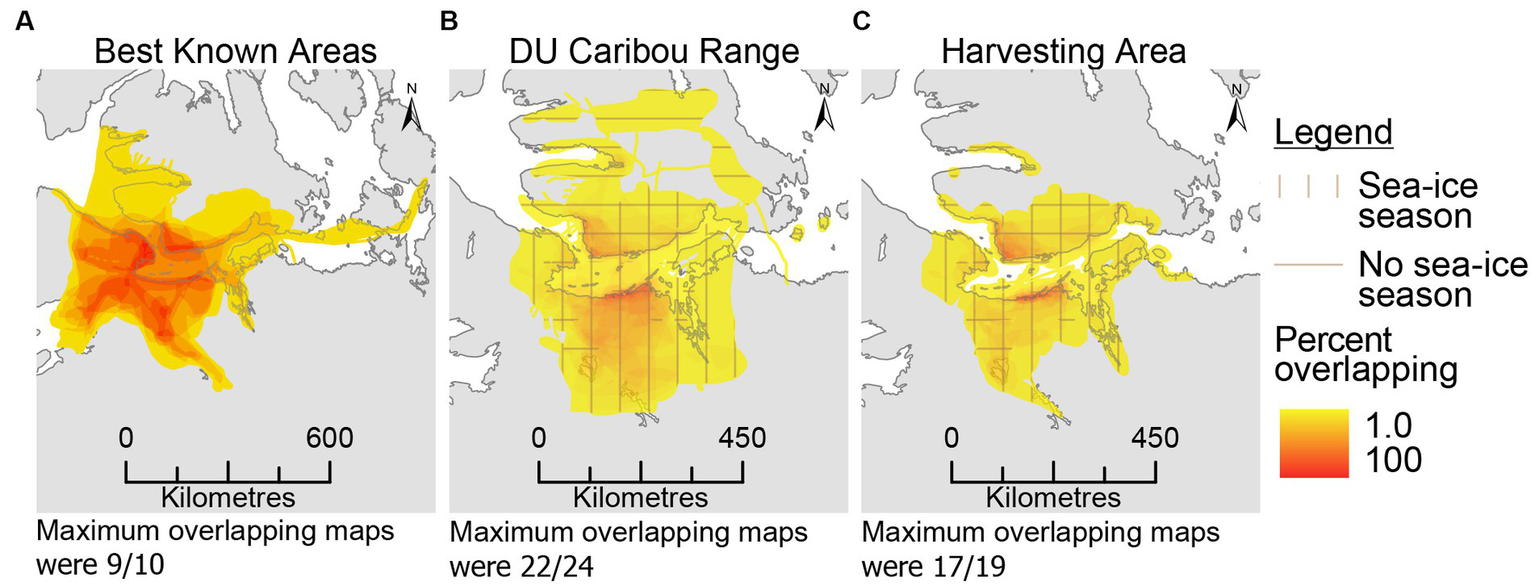
Mapping summaries. (A) Areas harvesters knew best (roughly 1960–2020), including travel and general harvesting ranges, placenames, and cabins. (B) Harvester mapped range of the DU caribou herd from 1980 to 2020 and delineated by sea-ice and no sea-ice seasons. (C) Harvesting area for the DU caribou herd from 1980 to 2020 and delineated by sea-ice and no sea-ice seasons. Colour gradient represents the percentage of overlapping maps that identified an area, and straight lines indicate the season the areas were mapped.
Table 3
| Type | Year Interval | Total Area | % of Total | % Change |
|---|---|---|---|---|
| Caribou range and harvesting area | 1980–2020 | 247,200 km2 | 100 | n/a |
| Caribou range | 1980–2020 | 240,400 km2 | 100 | n/a |
| 1980–1989 | 122,800 km2 | 51 | n/a | |
| 1990–1999 | 158,300 km2 | 66 | 29% | |
| 2000–2009 | 133,300 km2 | 55 | −16% | |
| 2010–2020 | 156,200 km2 | 65 | 17% | |
| Harvesting area | 1980–2020 | 138,700 km2 | 100 | n/a |
| 1980–1989 | 66,400 km2 | 48 | n/a | |
| 1990–1999 | 64,500 km2 | 47 | −3% | |
| 2000–2009 | 77,600 km2 | 56 | 20% | |
| 2010–2020 | 93,700 km2 | 68 | 21% |
Caribou range and harvesting area, summarized by decade from 1980 to 2020, mapped by harvesters in 2018–2020.
The values reflect absolute areas and do not consider overlapping areas. % of Total indicates the percent of the related 1980–2020 interval range (maximum) represented in the specific year interval. % Change indicates the percent change in area from the previous year interval.
Figure 4
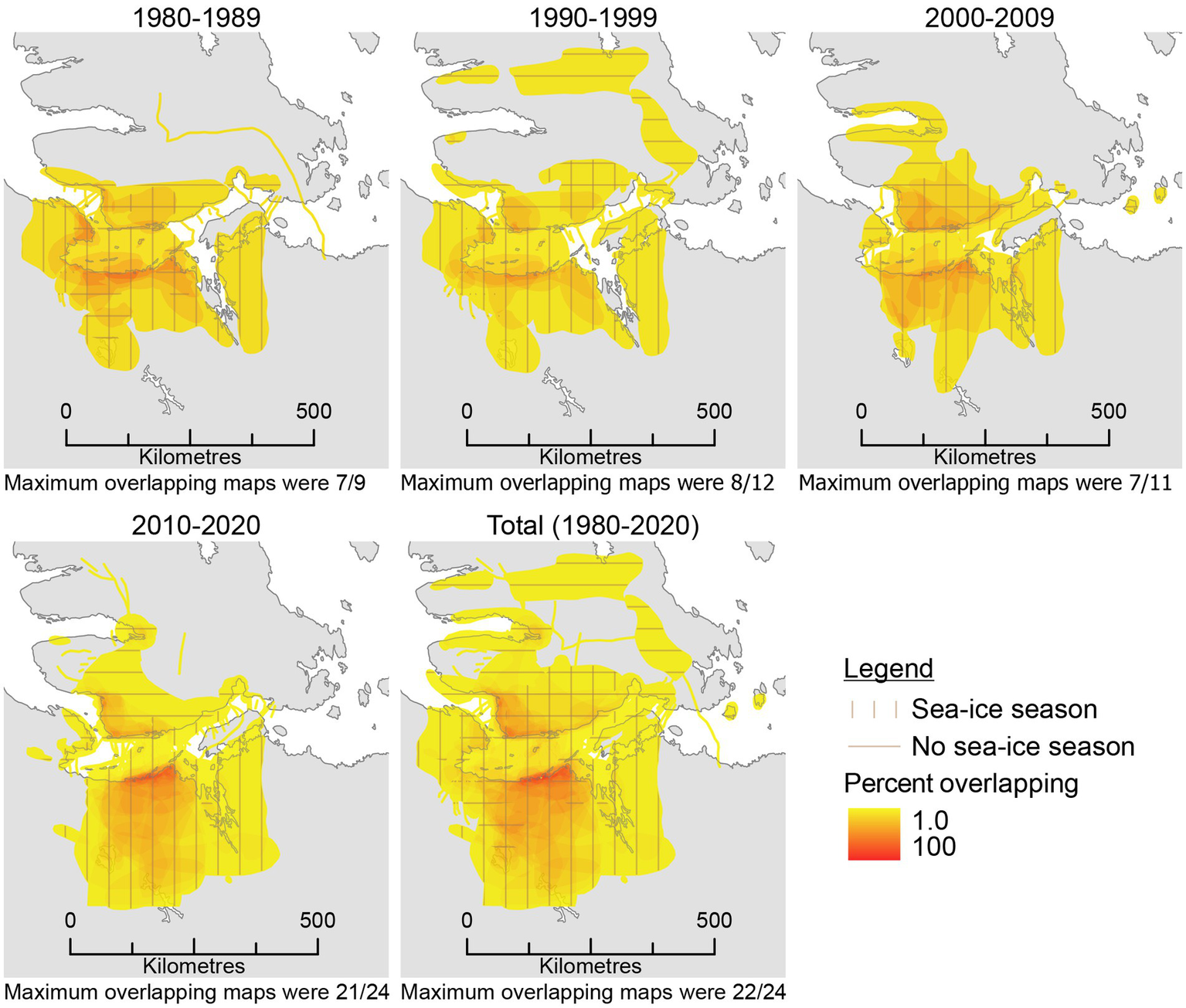
Range of the DU caribou herd per decade from 1980 to 2020, as reported by Kugluktukmiut in 2018–2020 and delimited by sea-ice and no sea-ice seasons. Colour gradient represents the percentage of participatory maps identifying an area.
Figure 5
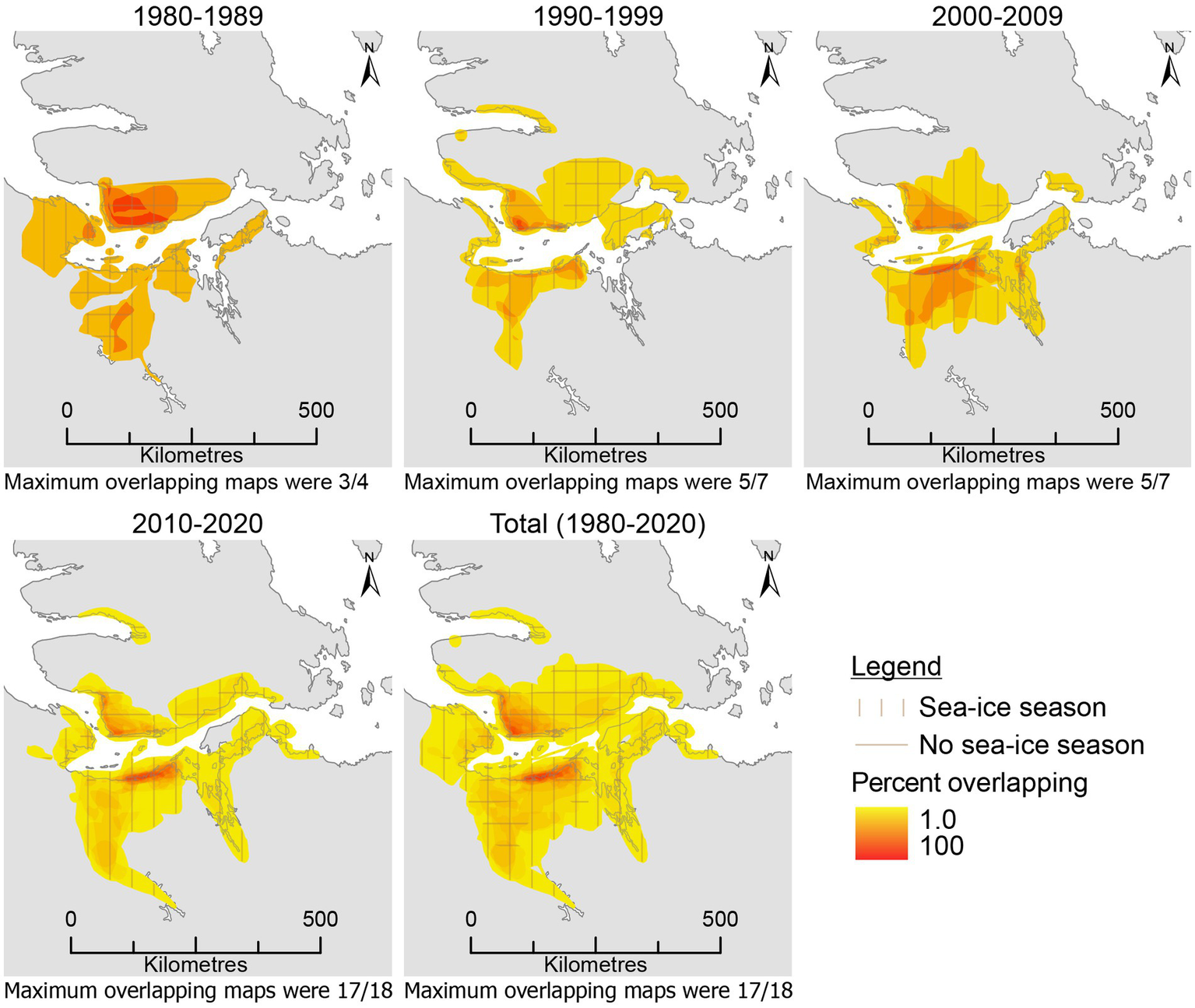
Harvesting area for the DU caribou herd per decade from 1980 to 2020, as reported by Kugluktukmiut in 2018–2020 and delimited by sea-ice and no sea-ice seasons. Colour gradient represents the percentage of participatory maps identifying an area.
Each harvesting area was used during prescribed seasons to match the expected migratory behaviour and health status of the caribou. Knowledge keepers often harvested caribou in locations to which they had family ties:
“[DU caribou] mean a lot. That’s… that’s the most herd I hunt for my family… It means a lot of me because that’s where my family originally started, on Victoria Island. So, they’ve been hunting that herd for as long as I can remember. And I try my hardest to … get there as much as I can, just to keep up the traditional stuff my dad taught me. But my wife is also from Victoria Island and she’s lived and hunted off that herd her whole life and she’s, she really likes that meat. She doesn’t like my caribou that come from the trees. She says it tastes like trees so … yeah, we kind of depend on that herd a lot. It means a lot to my family.”—Harvester 1
As such, there were people who used camps at PIN3, Rymer Point, and Read Island on southwestern Victoria Island (Figure 1), harvesting caribou during late summer before rut (when bull caribou meat is good) and during the fall migration to the coast (when calf-free cows are healthiest). There were knowledge keepers who harvested primarily on the mainland, including groups from Bernard Harbour to Great Bear Lake and westward, groups around Kingauk and Contwoyto Lake areas, and groups east of Kugluktuk to Tree River (Figure 1). The groups harvesting on the mainland often caught DU caribou in the winter before spring migration to Victoria Island, targeting healthy cows or bulls, or following fall migration off the island targeting healthy calf-free cows.
“We take our bulls in, August, September. When they’re at their prime. You know, and then we leave them alone… and then we take the females in winter. The one that don’t have no calves. Females. First year that, never been under stress before! Never had a … carry the, fetus before. Those are the best tasting. And we know those. And you can tell … which ones, under stress and, you know, which ones have calves, no calf, we can tell, you know. And that’s where hunter education comes in.”—Late harvester Jorgen Bolt
Harvesters generally used snowmobiles in the snowy seasons and all-terrain vehicles and/or boats in the non-snowy seasons. These transportation types influenced the search intensity, how far harvesters travelled, and how likely harvesters caught animals opportunistically or after careful tracking and observation. Travelling by all-terrain vehicles on Victoria Island restricted travelling distances, while travelling by snowmobile on the mainland allowed far greater travelling distances. When the caribou seemed to move further away from the regular harvesting areas, mainland harvesters travelling by snowmobile were able to follow the change in caribou distribution with few issues compared to Victoria Island harvesters. Victoria Island harvesters travelling by all-terrain vehicles, often based out of long-used camps, cannot travel as far as snowmobiles during a round-trip. This limitation hampered the harvesters’ flexibility to adapt to the changing caribou distribution and restricted the time available to carefully observe caribou before shooting them.
“You have to shoot whatever you see now, ‘cause back in the haydays when uh … we were Read Island, we’d just, right across the Bay, you’d just glance, “no”, “no”, “no”, “oh, yeah”, so … You can’t do that anymore. It’s get-they’re getting few and far in between. And like what [he] said, you have to go travel pretty far nowadays, specially by quad”—Harvester from Group 5
Annual variations in weather and climate change had impacted the migratory behaviour of caribou and alignment with traditional harvesting locations and seasons. While knowledge keepers expected some deviations in caribou behaviour, there was concern about a sustained shortening of sea-ice seasons, the timing of caribou migrations, and resulting impacts on harvesters’ ability to reach caribou.
"The temperature, the… everything is a bit confused. [DU caribou], they come down thinking it's time to go across, but by the time they get down here [southwest coast of Victoria Island], there's no ice yet. They go back inland, they come back to the shore, then they go back inland"—Harvester 1
"We used to go mainland in July by dog team. Now in July, we're boating. That's how much change it is now … It's really different now"—Elder Roger Hitkolok
An internalized conservation ethic also influenced the number of caribou of which harvesters were knowledgeable. For some harvesters, an assessment of herd status influenced the number of caribou they harvested:
"When their numbers were higher and they were very healthy, [I'd harvest] anywhere from 15 to 20 [DU caribou], no higher. Last year was the first year I didn't shoot one. Since I've seen the number going down steadily… I haven't harvested over 10 [DU caribou] in the last 10 years… I've been avoiding hunting DU caribou … I saw them, but I didn't shoot them. Why? I was brought up by my parents and my grandparents to manage and help sustain wildlife. We were told that if you know that they've not in a healthy state, don't harvest them … because they'll come back … so I also heed and listen to those words and just abide by them"—Elder Allen Niptanatiak
For other harvesters, their conservation ethic included only harvesting cows who did not have calves, choosing adult animals over calves or yearlings when their abundance is low, “mercy killings” for animals who were suffering from injuries or illnesses, or harvesting muskoxen or moose when there are few caribou.
3.1.2 Inuit-described metrics of caribou status
Harvesters detailed interrelated aspects of caribou ecology. They explained that herd abundance was related to distribution, health trends, and the environment: everything exists in cycles. The patterns of caribou abundance, location, and health over time are compiled in Figure 6.
Figure 6
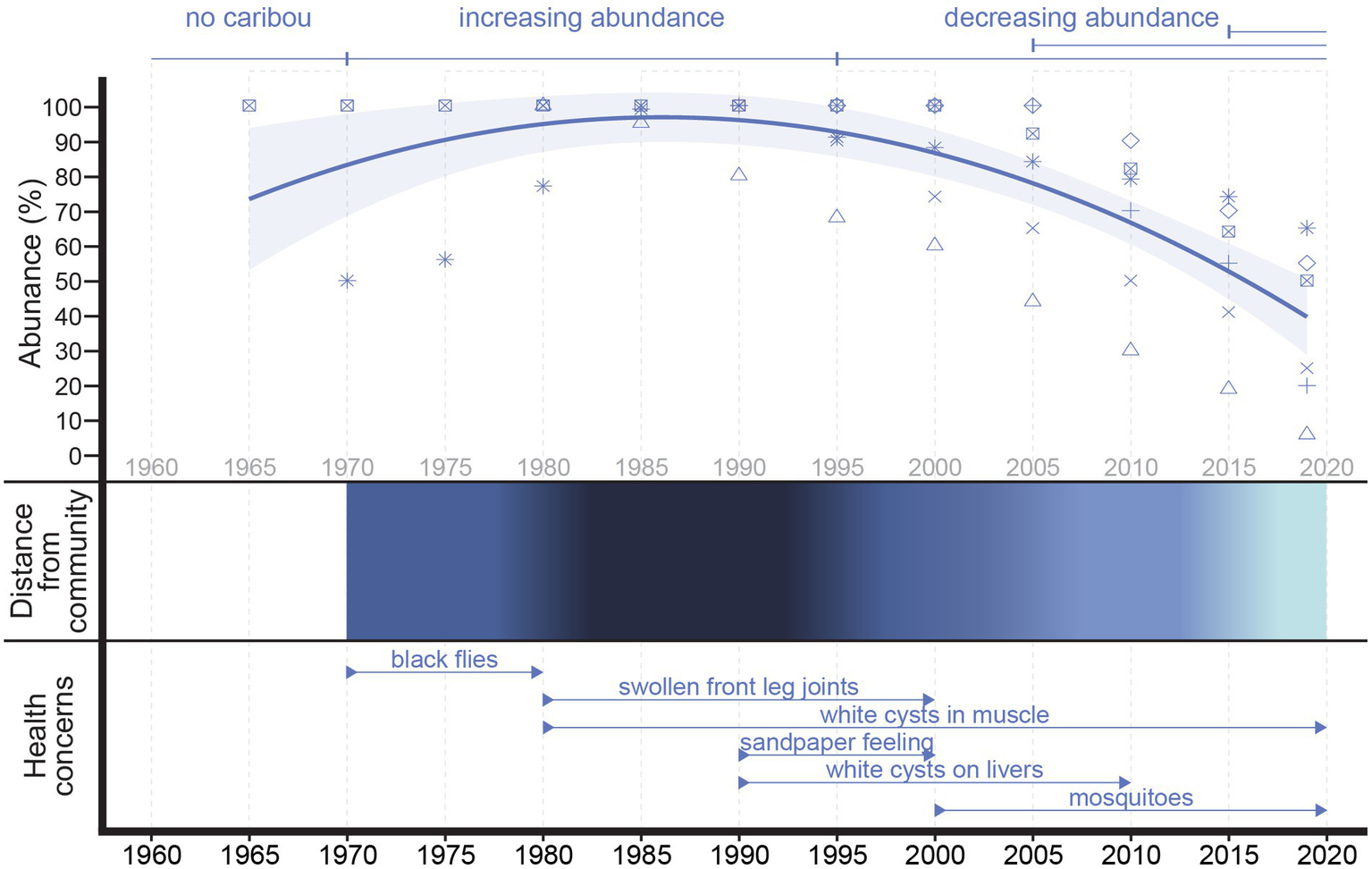
Ecological findings from Kugluktukmiut interviews showing changes in abundance, distance from community, and health concerns for the DU caribou herd over time (years). The abundance trends from interview narratives are indicated at the top of the figure. The “decreased abundance” narrative is split into three time periods representing different harvester-indicated starting points. The symbols on the graph represent abundance estimates depicted by each interview group through the proportional piling exercises (six symbols for six groups). The trend line is a smoothed quadratic linear model of the proportional piling data based on the harvester piled abundance estimates. The “distance from community” trend is from interview narratives. Its symbology is based on a hue gradient of close to far away from Kugluktuk, where the darker the colour, the closer they are to the community. The health concerns are placed along the timeline, where their lines indicate the range of time when harvesters first started seeing the disease sign and the up and down arrows indicate changes in observed prevalence.
3.1.2.1 Abundance trends: “Fewer caribou to see… for the past, maybe 15, 20 years”—Elder John Kapakatoak
Harvesters spoke about general trends in DU caribou abundance throughout their interviews (top bar in Figure 6). They said that after the population crashed in the early 1900s, caribou were not around until their return in the 1970s. Afterwards, abundance increased from the 1970s into, at least, the 1990s. Harvesters observed different beginnings to the decline in abundance (1995, 2005, or 2015), seemingly influenced by where, when, and how long they had been harvesting.
Proportional piling exercises on abundance had observations beginning in 1965 (n = 1 group), 1970 (n = 1), and the rest beginning between 1980 and 1990 (n = 4) (first panel in Figure 6). The group with the youngest harvesters chose not to do this proportional piling exercise. Although there were some differences in the timing of the abundance peak, all who completed the exercise agreed abundance had declined substantially since they began harvesting animals from the DU caribou herd until the time of the interviews. The compiled trend line showed an abundance peak in the mid-to-late 1980s and lowest abundance of approximately 40% of that peak in 2019 (first panel in Figure 6). Interviewee age was not significant in the model. During feedback sessions, harvesters not originally involved in the proportional piling exercises were hesitant to comment on the percentages associated with the trends but agreed with the overall trends. All harvesters who completed the proportional piling described annual variations in abundance, explaining that abundance fluctuates inter-annually even when there is a general increasing or decreasing trend.
3.1.2.2 Distribution trends: caribou are further away and way behind
When caribou were abundant in the past, harvesters recalled them spread over land and not in discrete groups. As the abundance declined, harvesters observed caribou in groups of 15–20 animals approximately 1–5 miles apart from other groups. Then, caribou groups became progressively smaller and further apart. At the time of the interviews, harvesters said caribou groups varied in size, sometimes in the hundreds, but more often fewer than 10 animals.
Harvesters did not expect to see caribou in the same locations every year. However, they described and mapped a gradual, substantial, and directional (eastward) shift in DU caribou locations, and subsequent harvesting ranges, over the past 40 years (Figures 4, 5, second panel in Figure 6). In the 1980s and early 1990s, on the mainland, harvesters found caribou both west and east of Kugluktuk during the winter and summer. During the late 1990s and early 2000s, people only found caribou east of Kugluktuk towards Tree River (Figure 1). During this time on Victoria Island, harvesters found caribou further north and east from their camps (further inland). In the late 2000s and early 2010s, harvesters continued to find caribou further east from Kugluktuk on the mainland, between Tree River and Grays Bay. On Victoria Island, harvesters had to travel even further north and east (further inland) and later in the summer to catch caribou. By the late 2010s, mainland harvesters said caribou were at Grays Bay, Wenzel River, and Bathurst Inlet, and Victoria Island harvesters were having less success during their summer harvesting trips.
“We used to just … go 40 miles in the ‘80s, ‘90s and get some. Now we gotta go … 120 plus miles [to Grays Bay and Wenzel River in winter] … One way, yep. That’s where everybody goes, anyway. And that’s quite a ways… Yeah. We used to just go … 40 miles over there, east. Not anymore… There’s to-we’d never even reach Tree River to get caribou … now we gotta go way past it. We would get a few west of here. Uh … Island caribou, yeah. *pause* Used to be… quite a few too that, west but … no more. Nobody goes over there anymore. Everybody’s always… east.”—Elder Stanley Carpenter
Harvesters described caribou migrating further south and north at the time of the interviews (2018–2020) than in the past. They also thought changes in the formation of sea-ice had resulted in the DU caribou herd shifting their range further east because eastern passages froze earlier than western ones. Harvesters said that sea-ice was thawing before all caribou migrated north to Victoria Island in the spring, leaving some caribou on the mainland for the summer. Several people explained it was normal for some caribou to stay on the mainland, and it had happened occasionally in the past. Others said this change in summer location seemed to happen more frequently today because caribou are migrating further south, taking them longer to return to the mainland shore in the spring.
“Year 2011, I was working for MMG, doing environment uh ungulate survey? We’re surveying all the animals that’s in that route that they’re making. And up here too. And … June, when the ice breaks up? You could see a lot of caribou along the shore along here, between Tree River and Grays Bay. That never made it. So, they’re staying here all summer. […] The ones that never made it. After, after ice break up? Sometimes they can’t make it across because of the open water all, that’s already formed? So, they’re sitting here, along the coast”—Harvester 4
3.1.2.3 Health trends: “We know the healthy caribous”—Elder Joe Allen Evyagotailak
Harvesters noted their limitations in observing signs of disease, foremost because they actively looked for healthy animals and not diseased animals. When selecting individual animals to harvest, they would look for animals in groups and said it is odd to find caribou who are alone. People would watch the caribou for external signs of sickness, i.e., poor hair condition, abnormal gait, or visible injuries. After catching a caribou, harvesters would look closer at the body for lumps and at the hooves. They would gut and skin the animal and check that everything inside is slick and “not stuck together” (Elder Bobby Anavilok). Finally, they would assess fat, colour of the meat, and bone marrow condition to see if anything seemed abnormal. Some Elders said antler size is important to evaluate for choosing older, dry cows who do not breed anymore (very large antlers) and to reduce the risk of harvesting sick animals (small antlers for body size or otherwise abnormal antlers).
Harvesters learned what is normal to find in caribou from their parents and Elders. They emphasized that if they see anything abnormal in the caribou, they are very cautious to protect their family’s health:
"Yeah, there's always that concern [for my safety when butchering], for sure… I never want to catch any sick animal and get the sickness myself, particularly… or more importantly, I never want my kids or any of my family to get sick from animals that I go out and catch myself."—Harvester 2
Harvesters would ask a respected Elder or the wildlife officers from the Government of Nunavut for advice when they detected unfamiliar abnormalities. People described some ways of dealing with common abnormalities: remove white cysts in muscle, but if there are more than a few in each cut of meat, the harvester may leave the carcass on the land; cut off legs with swollen joints and leave them on the land, butcher the remaining carcass, package it separately from other catches, and mark “cook well.”
“Some caribous would have uh, puss on their joints or in between their skins… And uh, meat. And those are the ones we have to be careful with … we don’t even know what that causes it and we don’t wanna try ‘n fin-find out through eating them. We-we would leave them because our Elders always say, ‘If you think that caribou is sick, don’t bother eating it … because it may take your life… or your family’”—Elder Joe Allen Evyagotailak
Some Elders thought less experienced harvesters do not understand some of the normal things to see in caribou, like the common nose bot and Taenia cysts, or yellowing and bubbles. They said the less experienced harvesters may unnecessarily discard a caribou carcass with these types of appearances.
“The other day, they get the caribou and says, he said ‘it’s a bad caribou’. I said ‘let me take a look … this is not a bad caribou at all’. He looked at me and said ‘look at it, it’s yellow.’ Yeah when they run around they get kind of bubbly some-some places. You know, it’s like where the muscles are… they get starts-they start to get bubbly a little bit. He said ‘kind of yellow a little bit’. I said ‘that’s nothing. Look at the fat. It’s really fat, it’s healthy.’ He said ‘oh, okay.’”—Elder Roger Hitkolok
Despite these limitations, knowledge keepers detailed various abnormalities and health concerns for the DU caribou herd and how these may have changed over the time of their harvesting experience (Tables 4–6, fourth panel in Figure 6). Observations included caribou with swollen front leg joints, white cysts in the muscle, a sandpaper feeling when skinning, white cysts on the liver, and a concerning increase in mosquito abundance. There were variations in when harvesters first started seeing/noting something as abnormal or a health concern. While these variations seemed related to harvesters’ family history, harvesting methods, and conservation ethics, there was not enough information captured in the interviews to determine location-based health trends as done with the abundance trends. Elder Allen Niptanatiak spoke about a connection between caribou health and their population cycles, where “caribou were healthier before there were more.” He explained that disease spreads as the herd approaches their peak abundance, and it contributes to the stressors causing abundance to decrease. Elder Allen Niptanatiak’s observation corresponds with panel 3 in Figure 6, where some harvesters reported seeing signs of disease before observing declines in abundance.
Table 4
| Health concern | First noticed | Possible etiology |
|---|---|---|
| Parasites | ||
| Mosquitoes (kitturiat) | Always | Culicidae spp. |
| Warble larvae (kumak) | Always | Hypoderma spp. |
| Nose bot larvae (tagiuq) | Always | Cephenemyia spp. |
| White muscle cysts | Always; started late 1980s, 1990s, 2000, or 2010s | Taenia cf. krabbei. |
| White, surface liver cysts | Started 1980s; or late 1990s–2000s | Taenia hydatigena |
| Syndromes | ||
| Hair loss on nose | Always | Besnoitia tarandi |
| Hair loss on neck | Always | Solenopotes tarandi |
| Sandpaper-like feeling | Always; started 1990 | Besnoitia tarandi |
| Swollen leg joints | Started 1980s–2000 | Brucella spp.; Erysipelothrix rhusiopathiae; Chlamydia spp.; Mycoplasma spp.; Injuries |
| Overgrown hooves | Always | Injuries; trace mineral imbalances |
Harvester reports on observed health concerns in the Dolphin and Union caribou herd when the health concern was first noticed and the possible etiology.
Observations often differed within groups because individuals harvested in different seasons and in different locations.
Table 5
| Health concern | Proportion affected and trends | Trends in severity |
|---|---|---|
| Parasites | ||
| Mosquitoes (kitturiat) | Constant 100%. | Intensity increased 50–80% since 2000s. Higher intensity on mainland versus Victoria Island. Increase attributed to higher temperatures, increased rain, and longer summers. One Elder said there are fewer mosquitoes when it is too hot. |
| Warble larvae (kumak) | Constant 85–100%. | Some said 2–5% or 50% increase since the past, varies over time, or has not changed. One group said that five to six warble larvae is considered a very light infection. |
| Nose bot larvae (tagiuq) | Once in a while, few, 5–20, 20, 50% or 100%. | Some said it varies over time, has not changed, less over time, or did not know. |
| White muscle cysts | Piled at 5–20% in general, and younger group indicated 80% on the mainland and 5% at Victoria Island. | Some said they saw a few white spots per animal to a few white spots in each cut of muscle. |
| White, surface liver cysts | Once in a while. Variable reporting: more or less common today. Some groups said this is more commonly found in Bluenose East caribou. | If seen, there are only a couple or a few (around 7) spots on the livers. |
| Syndromes | ||
| Hair loss on nose | Consistently rare. Some groups had only seen this in Bluenose East caribou. | One group also saw hair loss around the eyes. |
| Hair loss on neck | Rare to 25%. Only reported by Elders. | Varying intensity. |
| Sandpaper-like feeling | Older groups saw this once in a while, but younger groups piled infection frequency at 90–100% on the mainland. Increased since 2014; has not changed from the past; or has decreased from the past; or did not know. |
Found on the skin of the legs, abdomen, and sometimes the hindquarters. Not seen in DU caribou eyes. |
| Swollen leg joints | Once in a while, 1–20%. Peaked in the 2000s and fewer instances today. | One group said the swelling seems larger today than in the past (but other groups disagreed). |
| Overgrown hooves | Once in a while. Variable reporting on changes: has not changed or has increased since 2015. | No comment. |
Harvester reports on prevalence and trends of observed health concerns in the Dolphin and Union caribou herd.
Observations often differed within groups because individuals harvested in different seasons and in different locations. The proportion affected and trends were variably measured with proportional piling or indicated through conversation, but harvester preference was through conversation.
Table 6
| Health concern | Harvester comments |
|---|---|
| Parasites | |
| Mosquitoes (kitturiat) | Previously observed from June to September, now seen from April/late May to late September/October. |
| Warble larvae (kumak) | Observed in the spring (March–June). One person said you can see these in December–January, but they are tiny. Some said younger animal are infected worse than older animals, or bulls are infected worse than cows, or there are no differences between bulls and cows. The larvae were a source of food in the old days. |
| Nose bot larvae (tagiuq) | Observed in the spring (April) or summer (June–August). The larvae were a source of food in the old days. |
| White muscle cysts | Associated this with discoloured meat. Some people said the meat looks lighter in colour or is dark yellow/green. However, some people thought colour change is related to an injury. |
| White, surface liver cysts | Found typically in younger or older animals that are otherwise healthy. If young animals are infected, they will get more cysts as adults. Not all groups had seen this. |
| Syndromes | |
| Hair loss on nose | Observed during spring–summer months, particular ones that are hotter and have more insects/mosquitoes than normal. Thought to be caused by insects or caribou rubbing their skin against something (like sharp ice). Not all groups had seen this. |
| Hair loss on neck | Observed in spring (March–April). Some said it was worse in younger bulls than older animals or worse in middle-aged animals. Thought to be caused by insects or caribou rubbing their skin on something (like sharp ice). Not all groups had seen this. |
| Sandpaper-like feeling | Observed mostly during the spring (April) harvest on the mainland and in skinny animals, mostly bulls. Also observed in the fall. Some groups said they saw this in animals with pale livers. One Elder group said that when this progresses, it will cause the animal to lose hair. |
| Swollen leg joints | Observed in skinny bulls. Associated with abnormal antlers and limping animals with abnormal/overgrown hooves. Not all groups had seen this. |
| Overgrown hooves | Observed in bulls and cows. Seen to hinder movement. Some harvesters connected this to injuries, swollen leg joints, or diet. Not all groups had seen this. |
Epidemiological observations by harvesters on the appearance, seasonality, ecology, and impacts of parasites and disease syndromes in the Dolphin and Union caribou herd.
Observations often differed within groups because individuals harvested in different seasons and in different locations.
3.1.3 Conservation concerns and potential actions: “Wolves and grizzly bears anywhere you go.”
Harvesters’ spoke of various conservation concerns for the DU caribou herd, often including their reason for concern and some suggestions to address the concern. The impact of predators was among the top concerns by the knowledge keepers. Harvesters explained that, normally, wolves, grizzly bears, and wolverines eliminate sick and slow caribou from the population and that wolf quantity depended on caribou quantity. However, they said that there were fewer people harvesting predators today than in the past because it requires extensive time, resources (e.g., gas, food, equipment, repairs), and expert knowledge (e.g., safety, technical) and the resulting compensation (e.g., sale of fur, sample submission) rarely justified the financial and resource investment required. Related to the competing wage income, one harvester said:
"When my dad and his buddies were trapping, that was all they did… it was hard-core… you know, they'd come home, 10, 15 wolves… it meant piles of fur… and they would shoot bears… [they] kept it quite under control. In the last 20 years, nobody traps like that anymore. Nobody hunts wolves like that anymore. You have to work. Everybody's gotta work now."—Harvester 1
Knowledge keepers were concerned that declines in predator harvesting (hunting and trapping) could negatively affect the natural caribou population cycle by creating an imbalanced predator pressure on caribou (Table 7). Harvesters also noted that grizzly bears and wolverines have expanded their range northward to include Victoria Island. They were worried that this predator range expansion has also contributed to higher relative abundance of grizzly bears and wolverines within the DU caribou herd distribution today compared to the past.
Table 7
| Harvester concerns | Reason for harvester concern | |
|---|---|---|
| 1. | Harvesting | Barriers between youth and Elders that impede learning, including conflict between harvesting and employment as well as language differences. |
| 1.1. | Predators | Increased numbers of grizzly bears, wolves, and wolverines over time on the mainland and Victoria Island. This was linked to predator harvesting not being as common nor practiced the same today versus the past. |
| 1.2. | DU caribou subsistence | Poor meat management, poor sharing practices, and inexperienced harvesters having a negative impact on caribou numbers. |
| 1.3. | DU caribou outfitted hunts | Undue pressures on important breeding male caribou. Variable concern because outfitted hunts are seen as a good job and uncertainty about the impact this has at a herd-level. |
| 2. | Climate changes | Changes in rain, wind, temperature, moisture, vegetation, sun, and timing of seasonal changes. |
| 2.1. | Rain-on-snow | Forms a layer of ice over the vegetation, making it difficult for the DU caribou herd to access high-quality food. |
| 2.2. | Thin sea-ice | Observations of DU caribou drowning and their migration path changing, linked to seasonal freezing and melting of sea-ice. |
| 2.3. | Insects | Increased levels of insect harassment that prevent caribou from eating and resting. |
| 3. | Exploration and development | Including municipal disturbance, natural resource exploration, and anthropogenic development |
| 3.1. | Noise pollution | Increased over time: more helicopters, planes, and snowmobiles. |
| 3.2. | Habitat loss | Potential mining, roads, and port developments that would use important habitat for the DU caribou herd. |
| 3.3. | Grays Bay road project | Variable concerns against and for the project that were out of the scope of this research. |
Harvesters’ conservation concerns for the Dolphin and Union caribou herd, including the reason and their suggestions to address the concern.
Categories are ordered by relative importance as indicated by the harvesters.
Additionally, knowledge keepers were concerned that less experienced harvesters were missing the knowledge needed to follow proper conservation practices, and this influenced the form and depth of their interactions with caribou (Table 7). The missing knowledge manifested in poorer meat management (e.g., spoiling meat, feeding caribou meat to dogs, not knowing what meat is safe to consume), harvesting practices (e.g., harvesting the wrong animal for the season, approaching animals directly and not at an angle), and how they shared their catches (e.g., selling rather than gifting). For example, some less experienced people may discard meat when common and harmless parasites, such as the common nose bot, Cephenemyia spp., is present:
“Some youngster cooks like uh, housewives… they cook heads… they try to cook heads, but cut it up, they see this kind [nose bots] in them, in their mouth, they throw ‘em in the garbage *chuckles* They throw them out … throw the whole head out! *chuckles* They just don’t like to see those kind, I guess…”—Late Elder Tommy Noberg
As a potential solution, harvesters suggested it would be useful to have education programs on caribou harvesting that would connect harvesters who want to learn with experienced harvesters who want to teach. Topics should include selecting appropriate animals (type and species) related to season and population statuses, safe butchering and carcass handling practices, recognizing what is safe to eat, etiquette around sharing, harvest quantity, as well as general camping skills (e.g., collecting safe drinking water and travelling safely on land, water, and ice). Harvesters said these programs should include support and/or coordination by/between the Kugluktuk Angoniatit Association and Government of Nunavut. Further, they emphasized the importance of including hands-on learning activities (e.g., on-the-land camps).
“I mean … if a young hunter doesn’t know about, normal antlers? In the wintertime? If you can’t tell the difference between a, a, a bull and a … a cow? With no more antlers in it, you know, he might shoot the bull that been the breeder for, how long or whatever, you know? And he had good strong genes… you know, so they might shoot the, shoot the one that, you know … handing out his strong genes. That that hunter couldn’t tell the difference between a bull and a … and a female or whatever, you know? ‘Cause, I mean, I can tell you who I think they are, you know?”—Late harvester Jorgen Bolt
3.2 Synthesis of disparate data sources on the DU caribou herd
In the data synthesis, it became apparent that the different sources of knowledge were connected to specific areas of observation and methods. Thus, each study was connected to a particular seasonal and spatial context that aligned with a particular aspect of caribou ecology. Kugluktuk knowledge was connected to their caribou harvesting by boat and all-terrain vehicle during the late summer on Victoria Island (before rut) and on the mainland by snowmobile in the spring (before migration) and fall (after migration) (Dumond, 2007; Hanke et al., 2021). Ekaluktutiak knowledge matched with their caribou harvesting by snowmobile on Victoria Island and mainland in the spring (after migration), by snowmobile on Victoria Island in the fall (before migration), and sometimes by quad on Victoria Island in the summer (Bates, 2006; Environment and Climate Change Canada, 2018; Hanke et al., 2021). Population surveys were completed by plane along the southern coast of Victoria Island while the caribou aggregate during their fall rut (Nishi and Gunn, 2004; Dumond and Lee, 2013; Leclerc and Boulanger, 2018, 2020; Campbell et al., 2021). The context for each knowledge source functions similar to results from the interviews, that harvesters know caribou through their experience and personal background, and was needed to interpret the data and make connections for the synthesis.
The synthesized abundance data display a general abundance increase until around the 1990s and decrease after around the 2000s (Figure 7). The Traditional knowledge trends showed different peaks for Kugluktuk (approximately mid-to-late 1980s), Ekaluktutiak (approximately 1990 to mid-2000s), and Ulukhaktok (approximately 1990s), and all communities observed the most caribou when caribou were closest [this paper; Tomaselli et al., 2018; Hanke et al., 2021; Hanke and WMAC (NWT), 2023]. The synthesis of abundance and spatial data indicates that Kugluktuk (this paper; Hanke et al., 2021) and Ulukhaktok [Hanke and WMAC (NWT), 2023] saw an eastern shift in caribou distribution while Ekaluktutiak (Tomaselli et al., 2018; Hanke et al., 2021) and population censuses (Nishi and Gunn, 2004; Leclerc and Boulanger, 2018, 2020) described a western shift in the eastern edge of the caribou distribution (Figure 8). The numbered notes with spatial observations from other studies support these same shifts in distribution (Gunn et al., 1997; Thorpe et al., 2001; Nishi and Gunn, 2004; Leclerc and Boulanger, 2018, 2020; Tomaselli et al., 2018). The concurrent distribution shifts suggest that the caribou distribution contracted alongside the abundance decline after approximately the 2000s.
Figure 7
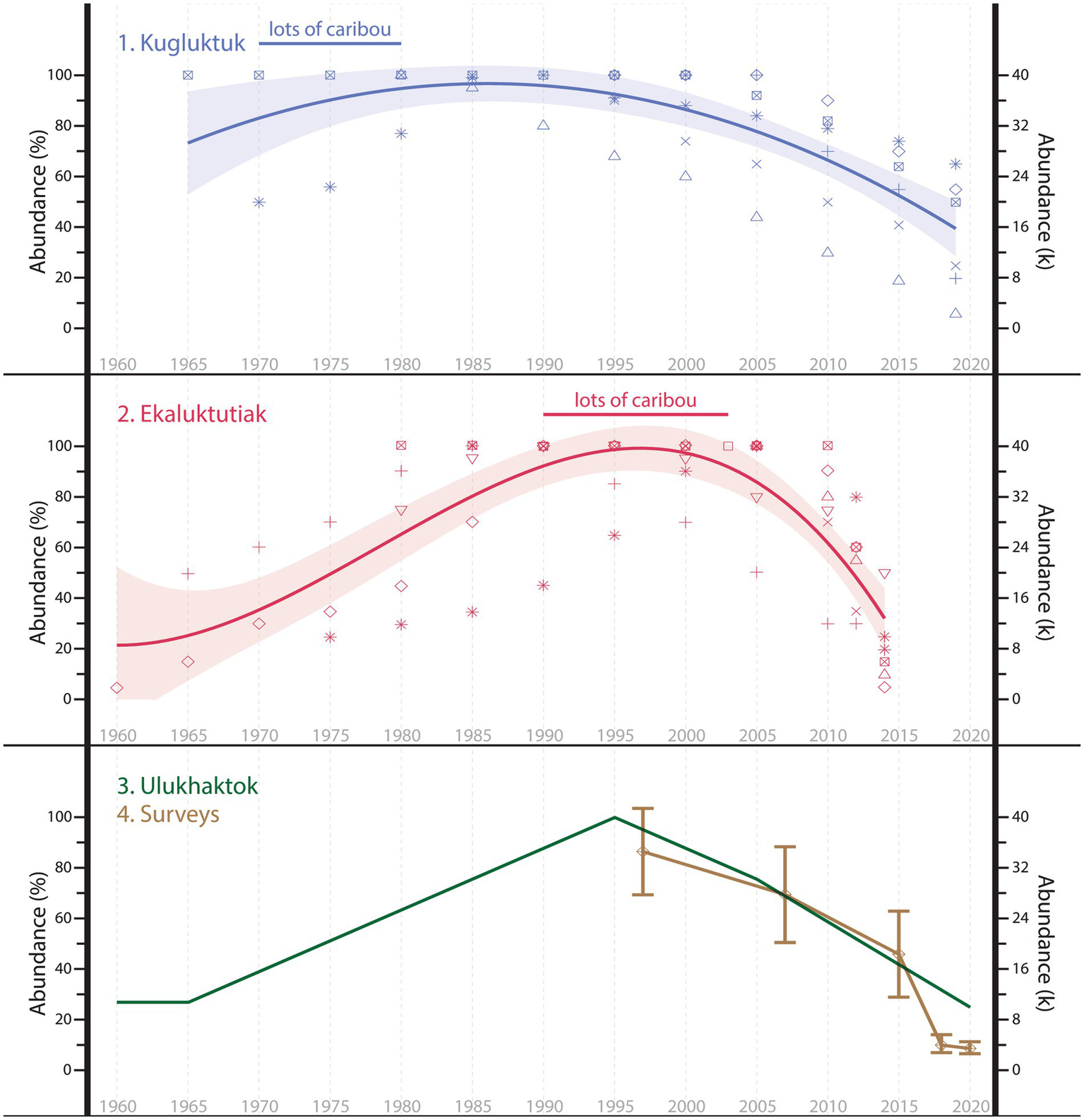
Digitized and extracted abundance data on the DU caribou herd. The top panel are relative data from Kugluktuk, including the proportional piled data and trend line from this paper and a report of a lot of DU caribou from Hanke et al. (2021). The middle panel are relative data from Ekaluktutiak, including the proportional piled data and trend line from Tomaselli et al. (2018) and a report of a lot of DU caribou from Hanke et al. (2021). The bottom panel are relative data from Ulukhaktok [Hanke and WMAC (NWT), 2023] and the survey abundance estimates from 1997 (Nishi and Gunn, 2004), 2007 (Dumond and Lee, 2013), 2015 (Leclerc and Boulanger, 2018), 2018 (Leclerc and Boulanger, 2020), and 2020 (Campbell et al., 2021).
Figure 8
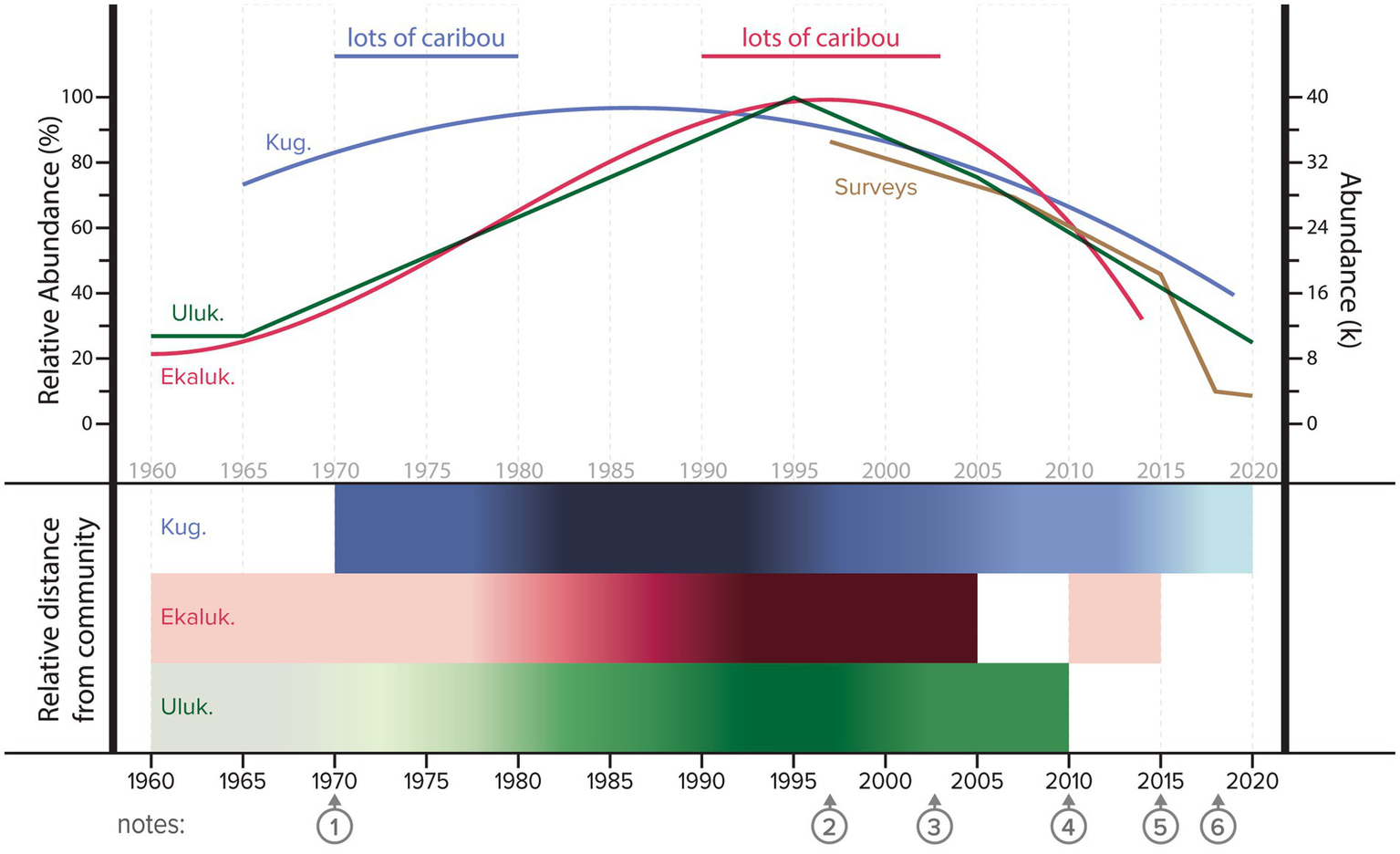
Synthesized abundance data and gradient bars showing relative DU caribou distance from community. Notes: ① Sighting on mainland near Umingmaktok (Gunn et al., 1997), ② highest density east of Ekaluktutiak (survey) (Nishi and Gunn, 2004), ③ decline in numbers near Kugluktuk (interviews) (Hanke et al., 2021), ④ decline in numbers near Ekaluktutiak (interviews) (Tomaselli et al., 2018), ⑤ lower density in eastern range (survey) (Leclerc and Boulanger, 2018), ⑥ lower density in northern and eastern range (collar data and survey) (Leclerc and Boulanger, 2020).
4 Discussion
In 1976, the Government of Canada ratified the International Covenant on Economic, Social, and Cultural Rights (United Nations General Assembly, 1999). This treaty affirms the right to adequate food as a fundamental human right, including “sufficient quantity and quality to satisfy dietary needs, free from adverse substances, and acceptable within a given culture” (United Nations Economic and Social Council, 1999). In 2015, the Inuit Circumpolar Council Alaska (2015) developed a conceptual model of Inuit food sovereignty that defines food security as environmental health determined through availability, stability, accessibility, health and wellness, Inuit culture, and decision-making power and management. These aspects of environmental health are supported by policy, knowledge sources, and co-management, held together by Sila (i.e., the spirit of everything), and uplifted by food sovereignty (Inuit Circumpolar Council Alaska, 2015). Within this context of Inuit food sovereignty, we discuss how our results contribute to each dimension of environmental health and the tools available to support their stability.
4.1 Dimensions of environmental health
Availability, stability, and accessibility are reflected in the main ecological findings of this study. The knowledge keepers’ reports on caribou abundance and if the caribou are around for harvesting comments on caribou availability (e.g., a biodiverse ecosystem). Seasonality is a big component of availability – for caribou, this may relate to their migratory, rut, and calving cycles. Caribou stability (e.g., the ability to adjust to shifts within the ecosystem) is then shown through their changing abundance, distribution, diseases, and predation. For Inuit, availability may relate to their seasonal harvesting, e.g., Kugluktukmiut harvest char in early summer (Falardeau et al., 2022), DU caribou in late summer/early fall on Victoria Island, DU caribou in late fall on the mainland (this paper), muskoxen in the winter (Di Francesco et al., 2021), and so on. Inuit adapt to these seasonal changes in availability by adjusting their harvesting locations, timing, and species, thus connecting Inuit availability to stability. The resulting ability of people to access caribou is an aspect of harvesters’ accessibility (e.g., the ability to live off the land), compounded by migratory caribou behaviour, shifting caribou range, climate change (e.g., reduced sea-ice season), and harvester resources (e.g., transportation, seasonal camps). In conjunction, the declining DU caribou abundance, reduced range, increased disease, and looming predation are all related to the caribou’s availability and accessibility. Availability, stability, and accessibility aspects of environmental health are particularly hard to discuss in isolation. Gagnon et al. (2023) had a similar conclusion, finding that Inuit ability to meet their needs in caribou was influenced by complex relationships among environmental conditions, trends in caribou demography, and cultural traditions: e.g. they found that caribou being close to community did not impact caribou availability if there wasn’t snow suitable for travel. Additionally, our results showed that economic conditions can and do limit harvester accessibility to caribou: e.g. competing harvest versus wage jobs or needing gas money for travel. Managing the DU caribou herd under the Inuit food sovereignty framework means that availability, stability, and accessibility of caribou must be understood through harvester accessibility.
Health and wellness components of environmental health are reflected in the harvesters’ reports on caribou diseases. These reports are followed by the consequential impacts on human health if the diseases can be passed to people (zoonoses) and the mental strain of discarding carcasses or worrying about their family’s safety. Knowledge keepers described several disease syndromes and concerns about diseases with respect to impacts on food safety (transmission of disease from country foods to people), mental strain (conflicts in harvesting and meat handling practices) and food availability (impacts on caribou population dynamics).
Harvesters from Kugluktuk (this paper; Hanke et al., 2021) reported observations of swollen front leg joints starting in 1980s, a description consistent with Brucella suis biovar 4. Similar observations in the DU caribou herd were reported by Ekaluktutiak harvesters (Tomaselli et al., 2018; Hanke et al., 2021). Brucella is a zoonotic bacterium (Aguilar et al., 2022), thus its apparent increase in the DU caribou herd represents a risk to food safety. On the other hand, the presence of harmless nose bot larvae or non-zoonotic Taenia (tapeworm) cysts in caribou carcasses can give the meat a displeasing appearance, and, in some cases, would lead harvesters to discard the meat. While harvesters are taught to never take risks when it comes to food safety, these larvae do not pose a risk to human health and discarding of meat in this case raised concern among Elders with respect to the knowledge base of less experienced hunters. Calls from knowledge keepers to improve/increase hands-on learning opportunities for harvesters are not unique to this work (e.g., Inuit Circumpolar Council Alaska, 2015, 2020; Mearns, 2017; McGrath, 2019), but, indeed, educational programs could help less experienced harvesters avoid unnecessary discard and ease the mental strain on more experienced harvesters who are faced with this conflict. Increasing opportunities to train harvesters connects the health and wellness dimension to the Inuit culture dimension of environmental health by contributing to the education system and the passage of knowledge, thus could support the stability of both dimensions (Inuit Circumpolar Council Alaska, 2015).
Harvesters also recognized the potential impact of diseases on caribou populations, and thus food availability. Two diseases that knowledge keepers identified as increasing near the population peak and decline, brucellosis and besnoitiosis, can have detrimental effects in caribou. Brucella suis biovar 4 can cause reproductive impairment, reduced mobility, and reduced survival, and has been documented during some caribou herd declines (Ferguson, 1997; Carlsson et al., 2018; Aguilar et al., 2022). A subset of 82 DU caribou tested in 1991 were negative for this bacterium, but more serological surveys (16.3% from 2015 to 2021) and observations by harvesters in Kugluktuk and Ekaluktutiak indicate that it is now present in the herd at a relatively high prevalence (this paper; Gunn et al., 1991; Tomaselli, 2018; Hanke et al., 2021; Fernandez Aguilar et al., 2023). Similarly, Besnoitia tarandi, a protozoan parasite, is present and increasing in the DU caribou herd, as evidenced by results from sample analyzes (7% of DU caribou sampled in 1987–1990; 41.0% of caribou sampled between 2016–2019) and harvester reports of a sandpaper-like feeling in Kugluktuk (starting in 1990s) and Ekaluktutiak (starting in 1980s–1990s with a stable or increasing rate between 1990 and 2000) (this paper; Gunn et al., 1991; Tomaselli et al., 2018; Hanke et al., 2021; Fernandez Aguilar et al., 2023). This parasite was implicated in reduced mobility, reduced survival, and reproductive impairment when it emerged in the Leaf River migratory woodland caribou herd (R. t. caribou) of Quebec, Canada (Ducrocq et al., 2013; Taillon et al., 2016). Prevalence increased from 30% of caribou sampled in 2007 to more than 80% of caribou sampled in 2011, and the herd subsequently declined from 600,000 caribou in 2001 to 199,000 in 2016 (Ducrocq et al., 2013; Taillon et al., 2016; COSEWIC, 2017b). While the roles of Besnoitia and Brucella in caribou population dynamics are not fully understood, the clear impacts on individuals and the association between their emergence and population declines warrant further consideration.
The cultural component of food sovereignty was reflected in harvesters’ detailed explanations of place-based context and understanding the world within their personal experience and background (e.g., harvesting to learn to be within and part of their environments). Their astute reflections of caribou emplaced within their own areas of observation and experience demonstrates how their Traditional knowledge is located within their understanding of themselves as apart and within their ecosystems. Country foods, and the harvesting, gathering, and preparation of, is a pedagogy – that is how Inuit learn cultural values, skills, spirituality, and to be apart and within their ecosystems (Collignon, 2006; Inuit Circumpolar Council Alaska, 2015; McGrath, 2019). Similar to the harvester variability within Kugluktuk, the data synthesis showed how communities, researchers, and biologists interact with (i.e., access) caribou at different times of the year and different parts of their range resulted in apparently contrasting information. Closer analysis found that all communities observed the most DU caribou when the DU caribou herd was closest. This finding broadens the support of an interconnection of knowledge and location as the knowledge is created and passed down within and as a part of the ecosystems (consistent with findings from Martinez-Levasseur et al., 2017; Gagnon et al., 2023). As a result, we saw variability in the reports around caribou availability, caribou accessibility, and harvester accessibility. The articulation of these nuances can help non-Inuit understand their Traditional knowledge and, additionally, help centre Traditional knowledge in decision-making.
Finally, this paper’s Inuit-described metrics of caribou status and synthesis of different information sources creates avenues and examples of how Indigenous knowledge can be centred in decision-making power and management (e.g., using Indigenous knowledge in collaboration with other knowledge systems). Monitoring wildlife is an important conservation strategy used to detect changes in the environmental health and the resulting availability, stability, and accessibility of wildlife (Inuit Circumpolar Council Alaska, 2015; Ostertag et al., 2018; Peacock et al., 2020). Changes may be assessed by indicator (e.g., abundance, distribution) and evaluated according to their metrics (e.g., aerial survey estimates, Indigenous knowledge relative abundance counts) (Peacock et al., 2020). Recent Inuit-led strategies emphasize the importance of relying on Inuit-described indicators for solution-and Inuit-driven actions (Inuit Tapiriit Kanatami, 2018; Inuit Circumpolar Council Alaska, 2020; Qanuippitaa, 2021). Researchers have responded to these calls; e.g., beluga health indicators, such as body condition, illness, and disease were developed and informed by Indigenous and Western knowledge (Fisheries Joint Management Committee, 2013; Ostertag et al., 2018). Similarly, Fox et al. (2020) co-produced environmental indicators by synthesizing information from weather stations, interviews, and discussions (Fox et al., 2020).
The Inuit-described metrics of this paper provide measures for the indicators of abundance, distribution, and health. Triangulating these sources of knowledge with others can strengthen our confidence with respect to the status of the indicator: e.g. the aerial population censuses and Traditional knowledge relative abundance data both indicated a decline in abundance since around the 2000s (Figure 7); the Traditional knowledge on signs of brucellosis and besnoitiosis suggested emergence of these two pathogens in the population, observations that were further supported by lab analyses of tissues from caribou harvested through a community-based caribou health surveillance program (Fernandez Aguilar et al., 2023). These Inuit-described metrics provide a framework that can be used to guide data collection and Traditional knowledge documentation. Alone, or combined with other information, these Inuit-described metrics provide wildlife managers with insights into caribou population status and trends. These metrics also provide specific examples to management and public health partners of how Indigenous knowledge can guide continued wildlife monitoring, and, thus, management decisions to support the longevity of wildlife populations (food security) (Zimmermann et al., 2023).
4.2 Tools to support environmental health
Policy, co-management, and knowledge sources are three tools used to support environmental health, and thus food security (Inuit Circumpolar Council Alaska, 2015). The results of our synthesis can be incorporated into existing wildlife management frameworks, like those defined in the management plan for the DU caribou herd. This policy guides the conservation of the DU caribou herd and outlines sets of management strategies for different population levels (Environment and Climate Change Canada, 2018). The population levels are spilt into low population (< 8,000 or 20% of peak abundance), increasing or decreasing population (8,000–24,000 or 20%–60%), and high population (> 24,000 or 60%) based on the report’s assumption that the peak caribou abundance was 40,000 (a.k.a. 100% of abundance) (Environment and Climate Change Canada, 2018). The synthesized abundance data presented in this study, which includes both quantitative (population censuses) and qualitative (% of maximum) data, can be superimposed over the management categories to help guide evidence-informed decisions regarding management strategies.
Knowledge keepers also described a geographic range for the DU caribou herd that is greater than that represented on the official range map (Figure 9) (Environment and Climate Change Canada, 2018); this new knowledge source can, and should, be used to update the range maps for this herd. Caribou herds with restricted distributions are of higher conservation risk (Lucas et al., 2019) and at risk of higher cortisol levels (Ewacha et al., 2017), restricted genetic flow (Thompson et al., 2019), reduced resilience to predation (Lesmerises et al., 2019), and higher susceptibility to rain-on-snow events (Macias-Fauria and Post, 2018). A range map that reflects the deep historic knowledge shared by knowledge keepers in this study is important to ensure that habitat protection extends across the entire land and water needed by the DU caribou herd throughout their annual and decadal population cycles. Encouragingly, the Species at Risk Committee (NWT) (2023) recently expanded their range map to reflect Traditional knowledge from Ulukhaktok (from Kuptana, 2022 as cited in Species at Risk Committee, 2023) and Kugluktuk (this paper).
Figure 9
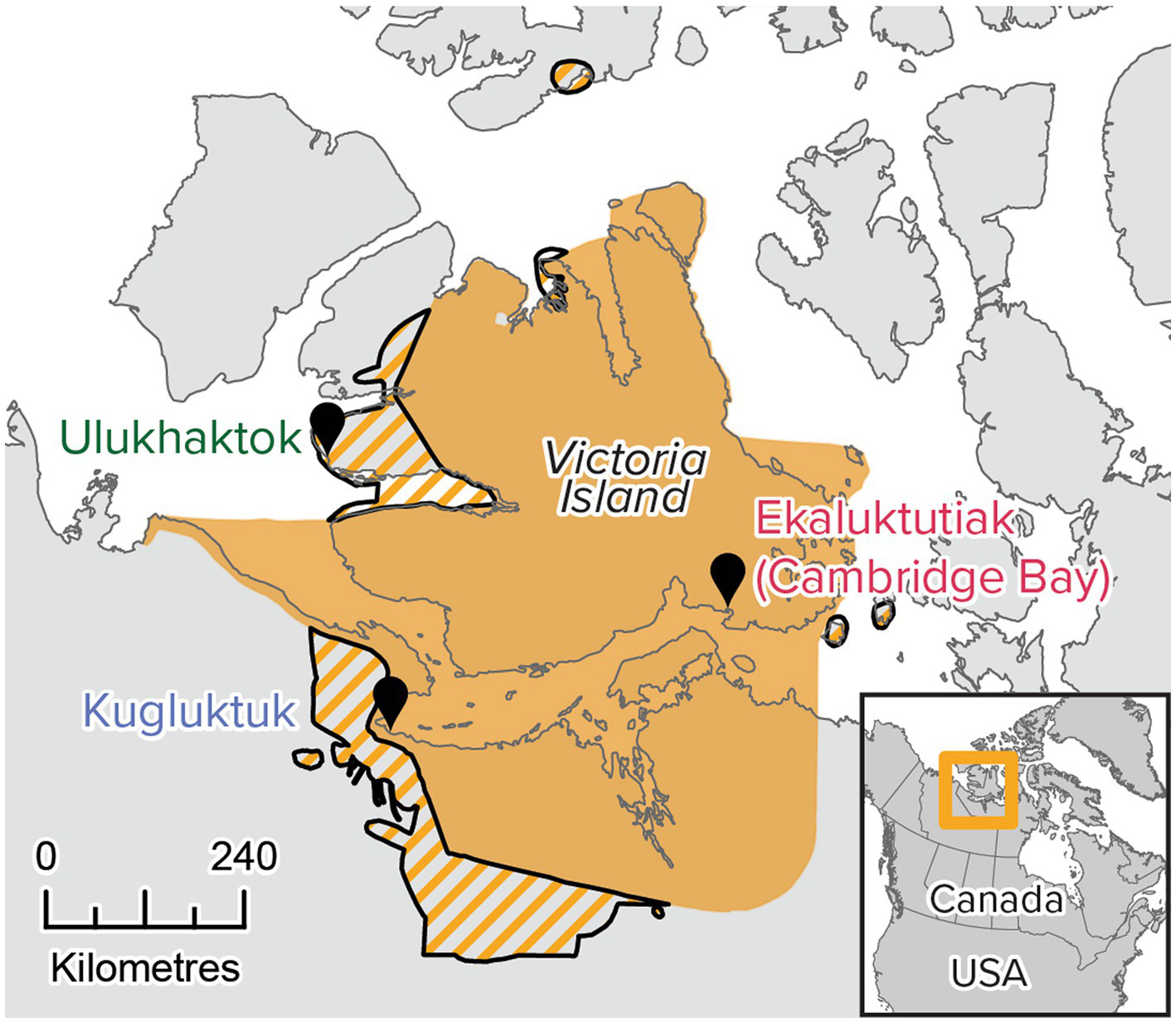
The DU caribou herd range (Environment and Climate Change Canada, 2018) with added hatched areas used by the DU caribou herd based on interviews in Kugluktuk (this paper; Hanke et al., 2021) and Ulukhaktok [Hanke and WMAC (NWT), 2023].
In relation to wildlife co-management, information must be accessible to decision-makers in order for them to incorporate it into their decisions (Inuit Circumpolar Council Alaska, 2020). We shared these observations of changing caribou behaviour and distribution throughout our numerous presentations with the co-management partners. These results, alongside many important member contributions, led to the Government of Nunavut modifying the most recent survey to include a larger area so they could see whether the survey area is representative of the herd (Campbell et al., 2021). The results between the 2018 and 2020 surveys did not differ significantly, but they found caribou in locations where results were previously only extrapolated (Victoria Island) or not included (Kent Peninsula) (Campbell et al., 2021). The collaborative process of redesigning the survey seemed to have improved relationships among co-management partners and increased community’s confidence in the survey results (Campbell et al., 2021). Additionally, Canadian Coast Guard’s (2020) Notice to Mariners adjusted their recommended shipping practices and reporting requirements to protect the sea-ice needed for travel by the DU caribou herd and harvesters (this paper; Hanke et al., 2021). This decision adopted Traditional knowledge to regulations used at the federal level to protect the migration paths of caribou and the livelihood of harvesters. These results were considered in the Nunavut Wildlife Management Board’s decision to support a Total Allowable Harvest (Nunavut Wildlife Management Board, 2020, 2022a) and the federal uplisting to Endangered (Nunavut Wildlife Management Board, 2022b) as well as the NWT Species at Risk Committee’s (2023) reassessment of the DU caribou herd as Endangered. These trio of decisions were based on the best available information generated from both Traditional and Western knowledges – connecting the tools of co-management and knowledge sources.
Going further into knowledge systems, the Species at Risk Committee in NWT recently restructured their process for assessing species-at-risk to allow for the “meaningful consideration of both Indigenous and scientific knowledge” (Singer et al., 2023, p. 2). The restructure introduced dual assessments, one component for Indigenous knowledge and one for scientific knowledge, and the final assessment recommendation is consensus-based and supported by evidence from either or both of the dual assessments (Singer et al., 2023). Importantly, this new process offers a way to validate each knowledge claim within their respective knowledge system, promotes cross-cultural communication and learning, and gives confidence to each member that their expert knowledge is included within the assessment and validated in a meaningful way (Singer et al., 2023). Our research approach perhaps complicates the division line used to separate the dual assessments. We have used quantitative, semi-quantitative, and qualitative data in this paper to learn about the DU caribou herd from Inuit and Western knowledge systems. Inuit were instrumental in sample design and collection for health analyses included in the discussion and their knowledge was central to designing the abundance survey (Nishi and Gunn, 2004; Fernandez Aguilar and Kutz, 2020; Campbell et al., 2021). Traditional knowledge was documented through interviews and analysed with different qualitative methods (e.g., this paper; Tomaselli et al., 2018). It would take a much longer discussion than there is space for in this paper to piece together the cultural differences, similarities, and merges within the data sources available for the DU caribou herd. However, these different ways of triangulating metrics can increase understanding for social-ecological system resilience (Salomon et al., 2019; Gagnon et al., 2023), provides examples of how to access multiple ways of thinking, and, ultimately, bolsters opportunities for Inuit food sovereignty through species management and recovery.
5 Conclusion
Sila, translated as “the spirit of everything,” holds together food security and environmental health, its dimensions, and the tools used to support its stability (Inuit Circumpolar Council Alaska, 2015, p. 19, 2020). Sila is a complicated term to define in English, but it could be understood as “the life-giving element, which enfolds all the world and invests all living organisms, and without which there can be no life” (Williamson, 2013, p. 22). Included in Sila is an understanding that the ecosystems exist without divisions, and impacts in one place ripple throughout – e.g. an impact to caribou availability may be felt through Inuit mental health (Cunsolo et al., 2020; Borish et al., 2021) or wolf availability (Klaczek et al., 2016). Inuit food sovereignty uplifts this entire food security system, yet there are barriers that prevent its full expression (Inuit Circumpolar Council Alaska, 2020). The Inuit Circumpolar Council Alaska (2020) used Inuit perspectives to examine the legal framework of co-management in Alaska and the Inuvialuit Settlement Region. They defined various calls-to-action including to place Inuit knowledge and Inuit rules, laws, and practices foremost in decision-making for the sake of Inuit food sovereignty (Inuit Circumpolar Council Alaska, 2020).
The results from our research respond to this call-to-action and address its various identified needs or spaces for improvement (Inuit Circumpolar Council Alaska, 2020). We wrote the Traditional knowledge down and systematically analyzed it with methodologies and methods consistent with Inuit values of respect, collaboration, and sharing. Written documentation is one strategy to make Indigenous knowledge available to more people involved in decision-making and to combat the tendency of Indigenous knowledge being considered anecdotal (Inuit Circumpolar Council Alaska, 2020; Wheeler et al., 2020). By understanding abundance through life histories of harvesters and caribou, we directly addressed a well-known methodological conflict between survey abundance counts and Indigenous knowledge understood phenomena that caribou numbers are supposed to vary annually, through sometimes unstable cycles, and as a function of migration (Martinez-Levasseur et al., 2017; Inuit Circumpolar Council Alaska, 2020). Our collaborative partnerships and guidance from knowledge keepers through the staggered interviews with multiple rounds of feedback resulted in research that was community driven. This research provides an example about equitable inclusion of Indigenous knowledge and equitable partnerships in community-based monitoring or co-management. These methods also created many opportunities for sharing, cooperation, and ensuring that the results were meaningful and accessible to communities for making decisions and to support food sovereignty. Collaborative research and assessment strategies have supported the expression of Inuit food sovereignty (this paper; Tengö et al., 2017; Gagnon et al., 2023; Singer et al., 2023). Continued collaborative, respectful, and reciprocal actions genuinely have the potential to move conservation towards a more equitable future of Indigenous self-determination.
Power relations and colonialism continue to weigh heavily on the discussion and actions towards equitable environmental governance and Inuit food sovereignty (Nadasdy, 2005; Snook et al., 2020; Zimmermann et al., 2023). These issues are well documented, including the dominance of Western cognitive processes (Collings et al., 2018; Ljubicic et al., 2018), failure to implement land claims agreements (Berger, 2005), lack of administrative independence for co-management boards (White, 2018), and the scientization of decision-making (Tester and Irniq, 2008; Hessami et al., 2021), among others. The focus of this paper on documenting what Inuit knew about DU caribou abundance, distribution, and health was its own negotiation among the research partners and contributors to the study. Ultimately, we emphasized qualities such as written knowledge (versus oral) and ecological facts (versus broader Inuit knowledge) that our team thought could be helpful to the current co-management system looking after these animals. We attempted to balance this skew towards characteristics of Western knowledge with our methodology and methods, such as having multiple sessions with the harvesters, heeding guidance offered by the harvesters and the Kugluktuk Angoniatit Association, and highlighting the interconnections among the results and to the land. While our research may act as an example of transdisciplinary research among academia, government, and Inuit, we look forward to the continuing conversations around, and improvements to, collaborative wildlife conservation.
The larger problematic power relations at play in environmental governance (i.e., Wheeler et al., 2020; Robertson et al., 2023) are set up by the formal and informal legal systems (Coates, 2020; Colombi Ciacchi and von der Pfordten, 2023). Promisingly, legal systems are psychological in nature and are constantly changing alongside society (Ogloff and Schuller, 2001; Coates, 2020). There are many calls to transform governance approaches, from Indigenous to state to international governance, introducing terms such as multispecies justice (Celermajer et al., 2021), planetary health (Redvers et al., 2022), Indigenous environmental justice (McGregor, 2018; McGregor et al., 2020), Indigenous climate justice (Whyte, 2018, 2020), ethnogeographies (Reibold, 2022), inherent dignity (Youngblood Henderson, 2019), and ecosystem-based management (Fisher et al., 2022; Wienrich et al., 2022). Commonalities among these suggestions return environmental governance to include interconnected networks of beings with no division between culture and nature. This approach is called biocultural conservation in Wheeler and Root-Bernstein (2020) and is perhaps consistent with Inuit knowledge and legal systems (Aupilaarjuk et al., 2017; Laugrand and Oosten, 2018). Continuing to attune research and the down-the-stream decision-making to politics/power relationships and emphasizing social learning may lead to unique, topic/geographic specific governance models (Bohensky and Maru, 2011; Fisher et al., 2022).
Statements
Data availability statement
The datasets presented in this article are not readily available because of the nature of this research and its focus on Indigenous knowledge. The participants of this study did not consent for their data to be shared publicly beyond what is included in the paper. Supporting data are not available. Requests to access the datasets should be directed to SK, https://vet.ucalgary.ca/contact-us/susan-kutz.
Ethics statement
The studies involving humans were approved by Conjoint Faculties Research Ethics Board at the University of Calgary (REB17-2427) and licensed by the Nunavut Research Institute (04 013 23R-M). The studies were conducted in accordance with the local legislation and institutional requirements. The participants provided their written informed consent to participate in this study. Ethical approval was not required for the study involving animals in accordance with the local legislation and institutional requirements because the primary data in this paper was obtained from humans. Written informed consent was obtained from the individual(s) for the publication of any potentially identifiable images or data included in this article.
Author contributions
AH: Conceptualization, Data curation, Formal analysis, Funding acquisition, Investigation, Methodology, Project administration, Resources, Supervision, Visualization, Writing – original draft, Writing – review & editing. AND: Conceptualization, Data curation, Formal analysis, Funding acquisition, Investigation, Methodology, Project administration, Resources, Supervision, Validation, Visualization, Writing – original draft. JDF: Data curation, Investigation, Methodology, Project administration, Resources, Validation, Writing – original draft, Writing – review & editing. CA: Conceptualization, Formal analysis, Methodology, Resources, Supervision, Validation, Visualization, Writing – original draft, Writing – review & editing. TM: Conceptualization, Data curation, Investigation, Methodology, Project administration, Validation, Writing – original draft. L-ML: Conceptualization, Data curation, Funding acquisition, Methodology, Project administration, Resources, Supervision, Visualization, Writing – original draft, Writing – review & editing. BM: Conceptualization, Methodology, Project administration, Supervision, Validation, Writing – original draft. RN: Conceptualization, Methodology, Project administration, Visualization, Writing – original draft. AR-C: Conceptualization, Methodology, Writing – original draft. GB: Conceptualization, Methodology, Writing – original draft, Writing – review & editing. SK: Conceptualization, Data curation, Funding acquisition, Methodology, Resources, Supervision, Validation, Visualization, Writing – original draft, Writing – review & editing.
Funding
The author(s) declare financial support was received for the research, authorship, and/or publication of this article. AH was funded by the Natural Sciences and Engineering Research Council of Canada (NSERC) Graduate Scholarship—Master’s, the Social Sciences and Humanities Research Council (SSHRC) Joseph-Armand Bombardier Canadian Graduate Scholarships—Doctoral, Mitacs Accelerate IT14527 internship with Thorpe Consulting Services, the Gunther Abrahamson Management Award sponsored by Beverly and Qamanirjuaq Management Board and coordinated by the Association of Canadian Universities for Northern Studies, and the Canadian Northern Studies Trust Scholarship by the Association of Canadian Universities for Northern Studies. This work was financially supported by the Government of Nunavut, Polar Knowledge Canada Grant NST-1718-0015, NSERC Discovery Grant RGPIN/04171-2014, NSERC Northern Supplement RGPNS/316244-2014, Environment and Climate Change Canada Project GCXE20C347, Canada North Outfitting, the Northern Scientific Training Program, and Irving Maritime Shipbuilding. The Kugluktuk Angoniatit Association provided generous kind-in contribution.
Acknowledgments
We extend sincere recognition and gratitude to all those who have contributed to this work. We would like to extend a heartfelt moment of gratitude to those contributors, and their families, who have passed since the beginning of this work: Elder Charlie Bolt, Elder Tommy Noberg, and Jorgen Bolt. We would like to recognize the support this work received from the following groups: the Kugluktuk Angoniatit Association, the Ekaluktutiak Hunters and Trappers Organization, the Olokhaktomiut Hunters and Trappers Committee, the Dolphin and Union Caribou User-to-Users Working Group, the Wildlife Management Advisory Council (NWT), the Kitikmeot Wildlife Management Board, the Government of Nunavut, the Government of Northwest Territories, and the Government of Canada, Environment and Climate Change Canada.
Conflict of interest
The authors declare that the research was conducted in the absence of any commercial or financial relationships that could be construed as a potential conflict of interest.
Publisher’s note
All claims expressed in this article are solely those of the authors and do not necessarily represent those of their affiliated organizations, or those of the publisher, the editors and the reviewers. Any product that may be evaluated in this article, or claim that may be made by its manufacturer, is not guaranteed or endorsed by the publisher.
Supplementary material
The Supplementary material for this article can be found online at: https://www.frontiersin.org/articles/10.3389/fsufs.2023.1306521/full#supplementary-material
References
1
Aguilar X. F. Nymo I. H. Beckmen K. Dresvyanikova S. Egorova I. Kutz S. (2022). “Brucellosis in the Arctic and northern regions” in Arctic one health challenges for northern animals and people. ed. TrylandM. (London: Springer Nature Switzerland AG), 227–267.
2
Ajibola O. O. Thomas R. Bakare B. F. (2023). Selected fermented indigenous vegetables and fruits from Malaysia as potential sources of natural probiotics for improving gut health. Food Sci. Human Wellness12, 1493–1509. doi: 10.1016/j.fshw.2023.02.011
3
Akinola R. Pereira L. M. Mabhaudhi T. de Bruin F. M. Rusch L. Environmental G. (2020). A review of indigenous food crops in Africa and the implications for more sustainable and healthy food systems. Sustainability12:3493. doi: 10.3390/su12083493
4
Anderson D. G. Nuttall M. (2004). Cultivating Arctic landscapes: knowing and managing animals in the circumpolar north. New York: Berghahn Books.
5
Armitage P. Kilburn S. (2015). Conduct of traditional knowledge research: a reference guide. (pp. 1–97). Whitehorse, YK: Wildlife Management Advisory Council (North Slope).
6
Aupilaarjuk M. Tulimaaq M. Joamie A. Imaruittuq E. Nutaraaluk L. (2017). Inuit laws: Piqujait, maligait, and tirigusuusiit (2nd edition. ed.). Iqaluit: Nunavut Arctic College Media.
7
Bates P. (2006). Knowing caribou: Inuit, ecological science and traditional ecological knowledge in the Canadian north. ProQuest Dissertations Publishing.
8
Beaulieu L. Arreak A. Holwell R. Dicker S. Qamanirq O. Moorman L. et al . (2023). Indigenous self-determination in cryospheric science: the Inuit-led Sikumik Qaujimajjuti (“tools to know how the ice is”) program in Inuit Nunangat, Canada. Front. Earth Sci.11:1076774. doi: 10.3389/feart.2023.1076774
9
Bennett J. Rowley S. (2004). Uqalurait: an oral history of Nunavut. Montreal: McGill-Queen's University Press.
10
Berger T. R. (2005). Nunavut land claims agreement implementation contract negotiations for the second planning period 2033–2013: Conciliator's interim report. Vancouver, BC: Bull, Housser & Tupper.
11
Berkes F. (2009). Evolution of co-management: role of knowledge generation, bridging organizations and social learning. J. Environ. Manag.90, 1692–1702. doi: 10.1016/j.jenvman.2008.12.001
12
Berkes F. Colding J. Folke C. (2000). Rediscovery of traditional ecological knowledge as adaptive management. Ecol. Appl.10, 1251–1262. doi: 10.1890/1051-0761(2000)010[1251:ROTEKA]2.0.CO2
13
Bohensky E. L. Maru Y. (2011). Indigenous knowledge, science, and resilience: what have we learned from a decade of international literature on "integration"?Ecol. Soc.16:6. doi: 10.5751/ES-04342-160406
14
Borish D. Cunsolo A. Snook J. Shiwak I. Wood M. Committee H. C. P. S. et al . (2021). “Caribou was the reason, and everything else happened after”: effects of caribou declines on Inuit in Labrador, Canada. Glob. Environ. Change68:102268. doi: 10.1016/j.gloenvcha.2021.102268
15
Boulanger-Lapointe N. Gérin-Lajoie J. Collier L. S. Desrosiers S. Spiech C. Henry G. H. R. et al . (2019). Berry plants and berry picking in Inuit Nunangat: traditions in a changing socio-ecological landscape. Hum. Ecol.47, 81–93. doi: 10.1007/s10745-018-0044-5
16
Braun V. Clarke V. (2020a). Can I use TA? Should I use TA? Should I not use TA? Comparing reflexive thematic analysis and other pattern-based qualitative analytic approaches. Couns. Psychother. Res.21, 37–47. doi: 10.1002/capr.12360
17
Braun V. Clarke V. (2020b). One size fits all? What counts as quality practice in (reflexive) thematic analysis?Qual. Res. Psychol.18, 328–352. doi: 10.1080/14780887.2020.1769238
18
Campbell M. Ringrose J. Boulanger J. Roberto-Charron A. Methuen K. Mutch C. et al . (2021). An aerial abundance estimate of the Dolphin and Union caribou (Rangifer tarandus groenlandicus x pearyi) herd. Kitikmeot Region, Nunavut: Government of Nunavut
19
Canadian Coast Guard . (2020). Notice to mariners 1 to 46: Annual edition 2020. Montreal, QC: Canadian Coast Guard, Fisheries and Oceans Canada
20
Carlsson A. M. Dobson A. Kutz S. J. (2018). “The impacts of infectious agents on Rangifer populations” in Reindeer and caribou: health and disease. eds. TrylandM.KutzS. J. (London: Taylor & Francis Group, LLC), 315–352.
21
Celermajer D. Schlosberg D. Rickards L. Stewart-Harawira M. Thaler M. Tschakert P. et al . (2021). Multispecies justice: theories, challenges, and a research agenda for environmental politics. Environ. Politics30, 119–140. doi: 10.1080/09644016.2020.1827608
22
Coates K. (2020). Reflections on the evolution of legal Systems in the Canadian North. Northern Rev. (Whitehorse)50, 235–244. doi: 10.22584/nr50.2020.012
23
Collignon B. (2006). Knowing places: the Inuinnait, landscapes, and the environment. Alberta: Canadian Circumpolar Institute.
24
Collings P. Pearce T. Kann J. (2018). "We don't know anything about whales": ecological knowledge and ways of knowing in Ulukhaktok, Northwest Territories, Canada. Arct.Sci.4, 223–241. doi: 10.1139/as-2017-0030
25
Colombi Ciacchi A. von der Pfordten D. (2023). Exploring the relationship between law and governance: a proposal. Theory Pract. Legis.11, 151–167. doi: 10.1080/20508840.2023.2215657
26
COSEWIC . (2004). COSEWIC assessment and update status report on the Peary caribou Rangifer tarandus pearyi and barren-ground caribou Rangifer tarandus groenlandicus Dolphin and Union population in Canada. Ottawa, ON: Committee on the Status of Endangered Wildlife in Canada.
27
COSEWIC . (2011). Designatable units for caribou (Rangifer tarandus) in Canada. Ottawa, ON: Committee on the Status of Endangered Wildlife in Canada
28
COSEWIC . (2015). COSEWIC assessment and status report on the Peary caribou Rangifer tarandus pearyi in Canada. Ottawa, ON: Committee on the Status of Endangered Wildlife in Canada.
29
COSEWIC . (2016). COSEWIC assessment and status report on the caribou Rangifer tarandus, barren-ground population, in Canada. Ottawa, ON: Committee on the Status of Endangered Wildlife in Canada.
30
COSEWIC . (2017a). Aboriginal traditional knowledge: process and protocols guidelines. Ottawa, ON: Committee on the Status of Endangered Wildlife in Canada.
31
COSEWIC . (2017b). COSEWIC assessment and status report on the caribou Rangifer tarandus, eastern migratory population and Torngat Mountains population, in Canada. Ottawa, ON: Committee on the Status of Endangered Wildlife in Canada.
32
COSEWIC . (2017c). COSEWIC assessment and status report on the caribou, Dolphin and Union population, Rangifer tarandus, in Canada. Ottawa, ON: Committee on the Status of Endangered Wildlife in Canada.
33
COSEWIC . (2021). Instructions for preparing COSEWIC status reports.
34
Cross R. Doornbos S. Cooney R. Wong P. Mead A. Lindeman K. et al . (2017). Guidance for integrating indigenous and local knowledge (ILK) in IUCN red list assessments. Gland, Switzerland: IUCN.
35
Cunsolo A. Borish D. Harper S. L. Snook J. Shiwak I. Wood M. et al . (2020). "You can never replace the caribou": Inuit experiences of ecological grief from caribou declines. Am. Imago77, 31–59. doi: 10.1353/aim.2020.0002
36
Di Francesco J. Hanke A. Milton T. Leclerc L.-M. Gerlach C. Kutz S. (2021). Documenting indigenous knowledge to identify and understand the stressors of muskoxen (Ovibos moschatus) in Nunavut, Canada. Arctic74, 418–436. doi: 10.14430/arctic73853
37
Ducrocq J. Beauchamp G. Kutz S. Simard M. Taillon J. Côté S. D. et al . (2013). Variables associated with Besnoitia tarandi prevalence and cyst density in barren-ground caribou (Rangifer tarandus) populations. J. Wildl. Dis.49, 29–38. doi: 10.7589/2012-05-125
38
Dumond M. (2007). Western Kitikmeot caribou workshop. Kugluktuk, NU: Government of Nunavut
39
Dumond M. Lee D. (2013). Dolphin and Union caribou herd status and trend. Arctic66, 329–337. doi: 10.14430/arctic4311
40
Environment and Climate Change Canada . (2018). Management plan for the barren-ground caribou (Rangifer tarandus groenlandicus), Dolphin and Union population, in Canada: Adoption of the management plan for the Dolphin and Union Caribou (Rangifer tarandus groenlandicus x pearyi) in the Northwest Territories and Nunavut. Ottawa, ON: Species at Risk Act Management Plan Series
41
Esri (n.d.). ArcGIS Pro: The world's leading GIS software.
42
Ewacha M. V. A. Roth J. D. Anderson W. G. Brannen D. C. Dupont D. L. J. (2017). Disturbance and chronic levels of cortisol in boreal woodland caribou. J. Wildl. Manag.81, 1266–1275. doi: 10.1002/jwmg.21288
43
Falardeau M. Bennett E. M. Else B. Fisk A. Mundy C. J. Choy E. S. et al . (2022). Biophysical indicators and indigenous and local knowledge reveal climatic and ecological shifts with implications for Arctic char fisheries. Glob. Environ. Chang.74:102469. doi: 10.1016/j.gloenvcha.2022.102469
44
Fawcett D. Pearce T. Notaina R. Ford J. D. Collings P. (2018). Inuit adaptability to changing environmental conditions over an 11-year period in Ulukhaktok, Northwest Territories. Polar Rec.54, 119–132. doi: 10.1017/S003224741800027X
45
Ferguson M. A. D. (1997). Rangiferine brucellosis on Baffin Island. J. Wildl. Dis.33, 536–543. doi: 10.7589/0090-3558-33.3.536
46
Fernandez Aguilar X. Kutz S. (2020). Dolphin and Union caribou health assessment: Interim results, July 2020.
47
Fernandez Aguilar X. Leclerc L.-M. Mavrot F. Roberto-Charron A. Tomaselli M. Mastromonaco G. et al . (2023). An integrative and multi-indicator approach for wildlife health applied to an endangered caribou herd. Sci. Rep.13:16524. doi: 10.1038/s41598-023-41689-y
48
Festa-Bianchet M. Ray J. C. Boutin S. Cote S. D. Gunn A. (2011). Conservation of caribou (Rangifer tarandus) in Canada: an uncertain future. Can. J. Zool.89, 419–434. doi: 10.1139/z11-025
49
Fisher K. Makey L. Macpherson E. Paul A. Rennie H. Talbot-Jones J. et al . (2022). Broadening environmental governance ontologies to enhance ecosystem-based management in Aotearoa New Zealand. Maritime Stud.21, 609–629. doi: 10.1007/s40152-022-00278-x
50
Fisheries Joint Management Committee . (2013). Beaufort Sea beluga management plan
51
Fox S. Qillaq E. Angutikjuak I. Tigullaraq D. J. Kautuk R. Huntington H. P. et al . (2020). Connecting understandings of weather and climate: steps towards co-production of knowledge and collaborative environmental management in Inuit Nunangat. Arctic Sci.6, 267–278. doi: 10.1139/AS-2019-0010
52
Freeman M. (1976). Inuit land use and occupancy project: a report. Ottawa, ON: Department of Indian and Northern Affairs.
53
Gagnon C. A. Hamel S. Russell D. E. Andre J. Buckle A. Haogak D. et al . (2023). Climate, caribou and human needs linked by analysis of indigenous and scientific knowledge. Nat. Sustain.6, 769–779. doi: 10.1038/s41893-023-01085-w
54
Gavin M. C. McCarter J. Berkes F. Mead A. T. Sterling E. J. Tang R. et al . (2018). Effective biodiversity conservation requires dynamic, pluralistic, partnership-based approaches. Sustainability10:1846. doi: 10.3390/su10061846
55
Gilbert M. J. H. Donadt C. R. Swanson H. K. Tierney K. B. (2016). Low annual fidelity and early upstream migration of anadromous Arctic char in a variable environment. Trans. Am. Fish. Soc.145, 931–942. doi: 10.1080/00028487.2016.1173095
56
Gilbert M. J. H. Harris L. N. Malley B. K. Schimnowski A. Moore J.-S. Farrell A. P. (2020). The thermal limits of cardiorespiratory performance in anadromous Arctic char. Conserv. Physiol.8:1. doi: 10.1093/conphys/coaa036
57
Government of Canada . (2011). Canada gazette part II, statutory instruments 2011 SOR/2011–5 to 30 and SI/2011–9 to 14. Ottawa, ON: Queen's Printer for Canada
58
Government of Northwest Territories . (2019). Wildlife co-management in the Northwest Territories. Yellowknife: Government of Northwest Territories
59
Government of Nunavut . (2007). Statutory report on wildlife to the Nunavut legislative assembly section 176 of the wildlife act. Iqaluit, NU: Government of Nunavut
60
Government of Nunavut . (2018). Statutory report on wildlife to the legislative assembly of Nunavut section 176 of the wildlife act. Iqaluit, NU: Government of Nunavut
61
Green J. Thorogood N . (2014). Qualitative methods for health research. Los Angeles, CA: SAGE; 3rd edition.
62
Gunn A. Buchan A. Fournier B. Nishi J. (1997). Victoria Island caribou migrations across the Dolphin and Union Strait and coronation gulf from the mainland coast, 1976–94. Yellowknife, NWT: Government of Nunavut
63
Gunn A. Leighton T. Wobeser G. (1991). Wildlife disease and parasites in the Kitikmeot region, 1984–90. N. T. R. Resources, Yellowknife.
64
Hanke A. Angohiatok M. Leclerc L.-M. Adams C. Kutz S. (2021). A caribou decline foreshadowed by Inuit in the Central Canadian Arctic: a retrospective analysis. Arctic74, 437–455. doi: 10.14430/arctic73826
65
Hanke A. N. Dumond A. Angohiatok M. Leclerc L.-M. Adams C. Kutz S. (2020). Kitikmeot traditional knowledge studies on Dolphin and Union caribou. Calgary, AB: University of Calgary.
66
Hanke A. WMAC (NWT) . (2023). A three-staged story towards caribou conservation: Ulukhaktokmiut accounts of ‘Dolphin and Union’ and Peary caribou in 2011–2014 and suggested conservation efforts in 2022. W. M. A. C. (NWT).
67
Hessami M. A. Bowles E. Popp J. N. Ford A. T. (2021). Indigenizing the North American model of wildlife conservation. Facets (Ottawa)6, 1285–1306. doi: 10.1139/facets-2020-0088
68
Honeycutt D. (2012). More adventures in overlay: Counting overlapping polygons with spaghetti and meatballs. Available at: https://www.esri.com/arcgis-blog/products/arcgis-desktop/analytics/more-adventures-in-overlay-counting-overlapping-polygons-with-spaghetti-and-meatballs/
69
Intergovernmental Panel on Climate Change . (2022). Climate change 2022: mitigation of climate change. Working group III contribution to the sixth assessment report of the Intergovernmental Panel on Climate Change. Summary for policymakers. Available at: https://www.ipcc.ch/report/ar6/wg3/
70
Inuit Circumpolar Council Alaska . (2015). Alaskan Inuit food security conceptual framework: how to assess the Arctic from an Inuit perspective. Summary and recommendations report. I. C. C. Alaska. Available at: https://iccalaska.org/our-work/inuit-food-security-project/
71
Inuit Circumpolar Council Alaska . (2020). Food sovereignty and self-governance: Inuit role in managing arctic marine resources
72
Inuit Circumpolar Council Canada . (2012). Food security across the Arctic: Background paper of the steering Committee of the Circumpolar Inuit Health Strategy.
73
Inuit Tapiriit Kanatami . (2018). National Inuit strategy on research. (9780969977421). Ottawa, ON. Available at: https://www.itk.ca/wp-content/uploads/2018/03/National-Inuit-Strategy-on-Research.pdf
74
Inuit Tapiriit Kanatami . (2021). Inuit Nunangat food security strategy. Available at: https://www.itk.ca/wp-content/uploads/2021/07/ITK_Food-Security-Strategy-Report_English_PDF-Version.pdf
75
Klaczek M. R. Johnson C. J. Cluff H. D. (2016). Wolf-caribou dynamics within the Central Canadian Arctic: wolf-Caribou dynamics. J. Wildl. Manag.80, 837–849. doi: 10.1002/jwmg.1070
76
Kutz S. Tomaselli M. (2019). "Two-eyed seeing" supports wildlife health. Science364, 1135–1137. doi: 10.1126/science.aau6170
77
Laugrand F. Oosten J. (2018). Traditions, traps and tricks: social aspects of the transfer of Inuit qaujimajatuqangit. (pp. 75–118). Edmonton: University of Alberta Press
78
Leclerc L.-M. Boulanger J. (2018). Fall population estimate of the Dolphin and Union caribou herd (Rangifer tarandus groenlandicus x pearyi) Victoria Island, October 2015 and demographic population indicators 2015–2017. Kugluktuk, NU: Government of Nunavut.
79
Leclerc L.-M. Boulanger J. (2020). Population estimate of the Dolphin and Union caribou herd (Rangifer tarandus groenlandicus x pearyi) coastal survey, October 2018 and demographic indicators. Kugluktuk, NU: Government of Nunavut, Department of Environment.
80
Lesmerises F. Johnson C. J. St-Laurent M. H. (2019). Effect of behavioral marginality on survival of an alpine ungulate. Ecosphere10:e02806. doi: 10.1002/ecs2.2806
81
Ljubicic G. Okpakok S. Robertson S. Mearns R. (2018). Inuit approaches to naming and distinguishing caribou: considering language, place, and homeland toward improved co-management. Arctic71, 309–333. doi: 10.14430/arctic4734info:doi/10.14430/arctic4734
82
Löfmarck E. Lidskog R. (2017). Bumping against the boundary: IPBES and the knowledge divide. Environ Sci Policy69, 22–28. doi: 10.1016/j.envsci.2016.12.008
83
Lucas P. M. González-Suárez M. Revilla E. (2019). Range area matters, and so does spatial configuration: predicting conservation status in vertebrates. Ecography42, 1103–1114. doi: 10.1111/ecog.03865
84
Lyver P. O. B. Richardson S. J. Gormley A. M. Timoti P. Jones C. J. Tahi B. L. (2018). Complementarity of indigenous and western scientific approaches for monitoring forest state. Ecol. Appl.28, 1909–1923. doi: 10.1002/eap.1787
85
Macias-Fauria M. Post E. (2018). Effects of sea ice on Arctic biota: an emerging crisis discipline. Biol. Lett.14:20170702. doi: 10.1098/rsbl.2017.0702
86
Martinez-Levasseur L. Furgal C. Hammill M. Burness G. (2017). Challenges and strategies when mapping local ecological knowledge in the Canadian Arctic: the importance of defining the geographic limits of participants’ common areas of observations. Polar Biol.40, 1501–1513. doi: 10.1007/s00300-016-2071-2
87
Maxwell J. A. Mittapalli K. (2011). “Realism as a stance for mixed methods research” in Sage handbook of mixed methods in social & behavioral research. eds. TashakkoriA.TeddlieC. (Thousand Oaks, CA: SAGE), 145–167.
88
McGrath T. (2019). The qaggiq model: towards a theory of Inuktut knowledge renewal. Iqaluit: Nunavut Arctic College Media.
89
McGregor D. (2018). Reconciliation and environmental justice. J. Glob. Ethics14, 222–231. doi: 10.1080/17449626.2018.1507005
90
McGregor D. Whitaker S. Sritharan M. (2020). Indigenous environmental justice and sustainability. Curr. Opin. Environ. Sustain.43, 35–40. doi: 10.1016/j.cosust.2020.01.007
91
Mearns R. (2017). Nunavut, Uqausivut, Piqqusivullu Najuqsittiarlavu (caring for our land, language and culture): the use of land camps in Inuit knowledge renewal and research. Ottawa, ON: Carleton University.
92
Muluneh M. G. (2021). Impact of climate change on biodiversity and food security: a global perspective—a review article. Agric. Food Secur.10, 1–25. doi: 10.1186/s40066-021-00318-5
93
Nadasdy P. (2005). The anti-politics of TEK: the institutionalization of co-management discourse and practice. Anthropologica47, 215–232. Available at:https://www.jstor.org/stable/25606237
94
Nishi J. Gunn A. (2004). An estimate of herd size for the migratory Dolphin and Union caribou herd during the rut (17–22 October 1997). Department of Resources, Wildlife & Economic Development, Government of Northwest Territories.
95
Nunavut Wildlife Management Board . (2020). Nunavut wildlife management Board’s review of the government of Nunavut’s interim decision regarding harvest management of the Dolphin and Union caribou herd. Available at: https://www.nwmb.com/en/list-all-site-files/decision-documents/terrestrialmammals/caribou/dolphin-union-caribou-2
96
Nunavut Wildlife Management Board . (2022a). Nunavut wildlife management board’s decision regarding the total allowable harvest for Dolphin and Union Caribou. Available at: file:///C:/Users/PC/Downloads/2022-02-08%20Dolphin%20and%20Union%20Caribou%20Total%20Allowable%20Harvest.pdf
97
Nunavut Wildlife Management Board . (2022b). NWMB decision on environment and climate change Canada’s request for approval of the proposed change in status of Dolphin and Union Caribou from special concern to endangered under the federal Species at risk act. Available at: https://www.nwmb.com/en/list-all-sitefiles/decision-documents/terrestrial-mammals/caribou/dolphin-union-caribou-2
98
Nunez S. Arets E. Alkemade R. Verwer C. Leemans R. (2019). Assessing the impacts of climate change on biodiversity: is below 2 °C enough?Clim. Chang.154, 351–365. doi: 10.1007/s10584-019-02420-x
99
Ogloff J. R. P. Schuller R. A. (2001). Introduction to psychology and law: Canadian perspectives (1 ed.). Toronto: University of Toronto Press.
100
Ostertag S. K. Loseto L. L. Snow K. Lam J. Hynes K. Gillman D. V. (2018). “That’s how we know they’re healthy”: the inclusion of traditional ecological knowledge in beluga health monitoring in the Inuvialuit settlement region. Arctic Sci.4, 1–29. doi: 10.1139/as-2017-0050
101
Panikkar B. Lemmond B. (2020). Being on land and sea in troubled times: climate change and food sovereignty in Nunavut. Land9:508. doi: 10.3390/land9120508
102
Parlee B. L. Caine K. J. (2018). When the caribou do not come: indigenous knowledge and adaptive Management in the Western Arctic. Vancouver: UBC Press
103
Peacock S. Mavrot F. Tomaselli M. Hanke A. Fenton H. Nathoo R. , … KutzS. (2020). Linking co-monitoring to co-management: bringing together local, traditional, and scientific knowledge in a wildlife status assessment framework. 6, 247–266. doi: 10.1139/AS-2019-0019
104
Pedersen C. Otokiak M. Koonoo I. Milton J. Maktar E. Anaviapik A. et al . (2020). ScIQ: an invitation and recommendations to combine science and Inuit Qaujimajatuqangit for meaningful engagement of Inuit communities in research. Arc. Sci.6, 326–339. doi: 10.1139/as-2020-0015
105
Pickens C. Braun V. (2018). “Stroppy bitches who just need to learn how to settle”? Young single women and norms of femininity and heterosexuality. Sex Roles79, 431–448. doi: 10.1007/s11199-017-0881-5
106
Polfus J. L. Heinemeyer K. Hebblewhite M. (2014). Comparing traditional ecological knowledge and western science woodland caribou habitat models. J. Wildl. Manag.78, 112–121. doi: 10.1002/jwmg.643
107
Poole K. G. Gunn A. Patterson B. R. Dumond M. (2010). Sea ice and migration of the Dolphin and Union caribou herd in the Canadian Arctic: an uncertain future. Arctic63, 414–428. doi: 10.14430/arctic3331
108
Qanuippitaa . (2021). Qanuippitaa? National Inuit health survey. Available at: https://nationalinuithealthsurvey.ca/
109
QSR International . (2022). NVivo: Best qualitative data analysis software for researchers. Available at: https://www.qsrinternational.com/nvivo-qualitative-data-analysis-software/home
110
Redvers N. Celidwen Y. Schultz C. Horn O. Githaiga C. Vera M. et al . (2022). The determinants of planetary health: an indigenous consensus perspective. Lancet Planet. Health6, e156–e163. doi: 10.1016/S2542-5196(21)00354-5
111
Reibold K. (2022). Settler colonialism, decolonization, and climate change. J. Appl. Philos.40, 624–641. doi: 10.1111/japp.12573
112
Robertson J. B. (2017). From felt tip to technology: the challenges of presenting traditional knowledge in a GIS platform to create a knowledge surface [Ryerson University]. Toronto, ON. Available at: https://digital.library.ryerson.ca/islandora/object/RULA%3A6441
113
Robertson S. Okpakok S. Ljubicic G. (2023). Territorializing piquhiit in Uqsuqtuuq (Gjoa haven, Nunavut, Canada): negotiating homeland through an Inuit normative system. Territ. Politic Gov.11, 120–139. doi: 10.1080/21622671.2020.1837664
114
Rose D. C. Amano T. González-Varo J. P. Mukherjee N. Robertson R. J. Simmons B. I. et al . (2019). Calling for a new agenda for conservation science to create evidence-informed policy. Biol. Conserv.238:108222. doi: 10.1016/j.biocon.2019.108222
115
Salomon A. K. Quinlan A. E. Pang G. H. Okamoto D. K. Vazquez-Vera L. (2019). Measuring social-ecological resilience reveals opportunities for transforming environmental governance. Ecol. Soc.24:16. doi: 10.5751/ES-11044-240316
116
Singer C. L. Routh M. R. Grabke M. J. Andrew L. Carrière S. Guile A. et al . (2023). Equal use of indigenous and scientific knowledge in species assessments: a case study from the Northwest Territories, Canada. Biol. Conserv.281:109995. doi: 10.1016/j.biocon.2023.109995
117
Snook J. Cunsolo A. Borish D. Furgal C. Ford J. D. Shiwak I. et al . (2020). “We’re made criminals just to eat off the land”: colonial wildlife management and repercussions on Inuit well-being. Sustainability12:8177. doi: 10.3390/su12198177
118
Species at Risk Committee . (2022). Species status report for Peary Caribou (Rangifer tarandus pearyi) in the Northwest Territories. Yellowknife, NWT: Species at Risk Committee
119
Species at Risk Committee . (2023). Species status report for Dolphin and Union Caribou (Rangifer tarandus groenlandicus x pearyi) in the Northwest Territories. Yellowknife, NWT: Species at Risk Committee.
120
Statistics Canada . (2021). Census profile, 2021 census of population: Kugluktuk, hamlet (HAM) Nunavut [census subdivision].
121
Statutes of Canada . The Western Arctic claim: The Inuvialuit final agreement (1984). Available at:https://www.eia.gov.nt.ca/sites/eia/files/inuvialuit_final_agreement_0.pdf
122
Statutes of Canada . Agreement between the Inuit of the Nunavut Settlement Area and Her Majesty in Right of Canada, (1993). Available at:https://laws-lois.justice.gc.ca/eng/acts/n-28.7/
123
Statutes of Nunavut (2018). Consolidation of Wildlife Act, 2003. Available at: https://www.canlii.org/en/nu/laws/stat/snu-2003-c-26/latest/snu-2003-c-26.html
124
Statutes of the Northwest Territories (2009). Species At Risk (NWT) Act, 2009. Available at: https://www.justice.gov.nt.ca/en/files/legislation/species-at-risk/species-at-risk.a.pdf
125
Swerdfager T. Armitage D. (2023). Co-management at a crossroads in Canada: issues, opportunities, and emerging challenges in fisheries and marine contexts. Facets (Ottawa)8, 1–10. doi: 10.1139/facets-2022-0217
126
Taillon J. Brodeur V. Rivard S. (2016). Biological status report of migratory caribou, Leaf River herd. G. d. Québec. Available at: https://mffp.gouv.qc.ca/documents/wildlife/biological-status-caribou-leaf-river.pdf
127
Tengö M. Hill R. Malmer P. Raymond C. M. Spierenburg M. Danielsen F. et al . (2017). Weaving knowledge systems in IPBES, CBD and beyond—lessons learned for sustainability. Curr. Opin. Environ. Sustain.26-27, 17–25. doi: 10.1016/j.cosust.2016.12.005
128
Tester F. Irniq P. (2008). Inuit qaujimajatuqangit: social history, politics and the practice of resistance. Arctic61, 48–61. doi: 10.14430/arctic101
129
The R Foundation . The R project for statistical computing. Available at: https://www.r-project.org/
130
Thompson L. M. Klütsch C. F. C. Manseau M. Wilson P. J. (2019). Spatial differences in genetic diversity and northward migration suggest genetic erosion along the boreal caribou southern range limit and continued range retraction. Ecol. Evol.9, 7030–7046. doi: 10.1002/ece3.5269
131
Thorpe N. Hakongak N. Eyegetok S. Elders K. (2001). Thunder on the tundra: Inuit qaujimajatuqangit of the Bathurst caribou. Tuktu and Nogak Project.
132
Tilley S. A. (2016). Doing respectful research: power, privilege and passion. Nova Scotia: Fernwood Publishing.
133
Tomaselli M. (2018). Improved wildlife health and disease surveillance through the combined use of local knowledge and scientific knowledge, edited by S. L. Checkley, S. Kutz, B. Elkin, C. S. Ribble, & S. C. Gerlach. Calgary, AB: Veterinary Medicine, University of Calgary.
134
Tomaselli M. Kutz S. Gerlach C. Checkley S. (2018). Local knowledge to enhance wildlife population health surveillance: conserving muskoxen and caribou in the Canadian Arctic. Biol. Conserv.217, 337–348. doi: 10.1016/j.biocon.2017.11.010
135
Tomasini S. (2018). Unpacking the red list: use (and misuse?) of expertise, knowledge, and power. Conserv. Soc.16, 505–517. doi: 10.4103/cs.cs_16_52
136
Ulicsni V. Babai D. Vadász C. Vadász-Besnyői V. Báldi A. Molnár Z. (2019). Bridging conservation science and traditional knowledge of wild animals: the need for expert guidance and inclusion of local knowledge holders. Ambio48, 769–778. doi: 10.1007/s13280-018-1106-z
137
United Nations Economic and Social Council . (1999). General comment 12: The right to adequate food (art. 11). Available at: https://undocs.org/E/C.12/1999/5.
138
United Nations General Assembly . (1999). International covenant on economic, social, and cultural rights. Available at: https://www.ohchr.org/en/professionalinterest/pages/cescr.aspx.
139
Wheeler H. C. Danielsen F. Fidel M. Hausner V. Horstkotte T. Johnson N. et al . (2020). The need for transformative changes in the use of indigenous knowledge along with science for environmental decision-making in the Arctic. People Nat.2, 544–556. doi: 10.1002/pan3.10131
140
Wheeler H. C. Root-Bernstein M. (2020). Informing decision-making with indigenous and local knowledge and science. J. Appl. Ecol.57, 1634–1643. doi: 10.1111/1365-2664.13734
141
White G. (2018). Issues of independence in northern aboriginal-state co-management boards. Can. Public Adm.61, 550–571. doi: 10.1111/capa.12302
142
White G. (2020). Indigenous empowerment through co-management: land claims boards, wildlife management, and environmental regulation (1 ed.). Vancouver, UBC Press
143
Whyte K. (2018). Settler colonialism, ecology, and environmental injustice. Environ. Soc.9, 125–144. doi: 10.3167/ares.2018.090109
144
Whyte K. (2020). Too late for indigenous climate justice: ecological and relational tipping points. Wiley Interdiscip. Rev. Clim. Change11:n/a. doi: 10.1002/wcc.603
145
Wienrich N. Buschman V. Q. Coon C. Fuller S. Hennicke J. Humrich C. et al . (2022). The ecosystem approach to marine management in the Arctic: opportunities and challenges for integration. Front. Mar. Sci.9:1034510. doi: 10.3389/fmars.2022.1034510
146
Williamson R. G. (2013). Eskimo underground: Socio-cultural change in the Canadian Central Arctic. Institutionen for allm‰n och j‰mforande etnografi vid Uppsala Universitet.
147
Youngblood Henderson J. S. K. J. (2019). “The necessity of exploring inherent dignity in indigenous knowledge systems” in Braiding legal orders: Implementing the United Nations declaration on the rights of indigenous peoples. eds. BorrowsJ.ChartrandL.FitzgeraldO.SchwartaR. (Waterloo: Centre for International Governance Innovation), 223–228.
148
Zimmermann S. Dermody B. J. Theunissen B. Wassen M. J. Divine L. M. Padula V. M. et al . (2023). A leverage points perspective on Arctic indigenous food systems research: a systematic review. Sustain. Sci.18, 1481–1500. doi: 10.1007/s11625-022-01280-2
Summary
Keywords
co-management, Indigenous knowledge, species-at-risk, Rangifer , Dolphin and Union caribou, Traditional knowledge, thematic analysis, Inuit food security
Citation
Hanke A, Niptanatiak Dumond A, Di Francesco J, Adams CL, Milton T, Leclerc L-M, Maksagak B, Nathoo R, Roberto-Charron A, Blue G and Kutz S (2024) Supporting Inuit food sovereignty through collaborative research of an at-risk caribou herd. Front. Sustain. Food Syst. 7:1306521. doi: 10.3389/fsufs.2023.1306521
Received
03 October 2023
Accepted
11 December 2023
Published
05 January 2024
Volume
7 - 2023
Edited by
Andrea Pieroni, University of Gastronomic Sciences, Italy
Reviewed by
Brian Dermody, Utrecht University, Netherlands; Peter Collings, University of Florida, United States
Updates
Copyright
© 2024 Hanke, Niptanatiak Dumond, Di Francesco, Adams, Milton, Leclerc, Maksagak, Nathoo, Roberto-Charron, Blue and Kutz.
This is an open-access article distributed under the terms of the Creative Commons Attribution License (CC BY). The use, distribution or reproduction in other forums is permitted, provided the original author(s) and the copyright owner(s) are credited and that the original publication in this journal is cited, in accordance with accepted academic practice. No use, distribution or reproduction is permitted which does not comply with these terms.
*Correspondence: Andrea Hanke, andrea.hanke1@ucalgary.ca
Disclaimer
All claims expressed in this article are solely those of the authors and do not necessarily represent those of their affiliated organizations, or those of the publisher, the editors and the reviewers. Any product that may be evaluated in this article or claim that may be made by its manufacturer is not guaranteed or endorsed by the publisher.