 Mariana Munoz-Araya1*
 Sequoia R. Williams1
 Peter Geoghan1
 Daniel Ortiz-Gonzalo1,2
 Krista N. Marshall1,3
 Kelsey M. Brewer1,4
 Eli Alston-Stepnitz5
 Sarah Rebolloso McCullough5
 Vivian M. Wauters1,3
- 1Agroecology Lab, Department of Plant Sciences, University of California, Davis, Davis, CA, United States
- 2Department of Geosciences and Natural Resource Management, Faculty of Science, University of Copenhagen, Copenhagen, Denmark
- 3University of California Agriculture and Natural Resources, Davis, CA, United States
- 4Marin Resource Conservation District, Point Reyes Station, CA, United States
- 5Feminist Research Institute, University of California, Davis, Davis, CA, United States
Industrialized agriculture, characterized by high inputs, large-scale monocultures, and confined livestock production, with a narrow focus on profit, is a major transgressor of societal and planetary boundaries. It fuels climate change, biodiversity loss, water and soil degradation, nutritional deficiencies, public health issues, cultural erosion, and socioeconomic inequalities. As early-career researchers in agricultural sciences, we are concerned about these systemic crises and recognize that participating in normative academic practices without reflection may reinforce the prevailing industrialized food system. Motivated by the dissonance between the potential impact of our work and our vision of a better future, in this paper we describe and challenge academic praxis in agricultural sciences to tackle the interconnected crises. We do this by developing a framework of two drivers of academic knowledge production, power and values, and two mechanisms, motives and relationality. We argue that in the current dominant food system, power is consolidated and hierarchical, driven by the values of growthism and reductionism, motivated by efficiency and productivism, and characterized by extractive and anthropocentric relationality. Furthermore, we highlight evidence of the negative outcomes associated with this system, including the challenges we face and may potentially contribute to as participants. We then envision transformed food systems through examples of counter-hegemonic knowledge production systems, grounded in agroecological principles, in which power is distributed and horizontal, the primary values are solidarity and holism, motives enhance sufficiency and sovereignty, and relationality is reciprocal and based on care. By examining the current system and offering examples of alternatives, we aim to help distinguish between research that upholds the statu-quo and research that fosters change. We aim to inspire ourselves and others to reconnect with our agency and contribute towards transformed knowledge systems where food systems, underpinned by the values of agroecology, are more capable of sustaining life on this planet in an equitable and just manner.
1 Introduction
“El mundo al revés nos enseña a padecer la realidad en lugar de cambiarla, a olvidar el pasado en lugar de escucharlo y a aceptar el futuro en lugar de imaginarlo: así practica el crimen, y así lo recomienda. En su escuela, la escuela del crimen, son obligatorias las clases de impotencia, amnesia y resignación. Pero está visto que no hay desgracia sin gracia, ni cara que no tenga su contracara, ni desaliento que no busque su aliento. Ni tampoco hay escuela que no encuentre su contraescuela.”
“The upside-down world teaches us to endure reality instead of changing it, to forget the past instead of listening to it, and to accept the future instead of imagining it: this is how it practices crime, and this is how it recommends it. In its school, the school of crime, the classes in impotence, amnesia, and resignation are mandatory. But it’s clear that there is no misfortune without some luck, no face without its other side, no despair that does not seek some air. Nor is there a school that does not find its counter-school.”
Eduardo Galeano, Patas arriba. La escuela del mundo al revés. 1998.
Industrialized agriculture is a major transgressor of societal and planetary boundaries (Rockström et al., 2009; Raworth, 2012; Campbell et al., 2017). This form of agriculture is typified by large-scale monocultures grown for confined animal production and biofuels, high external agrochemical inputs, and a focus on economic profit at the expense of social and environmental integrity (IPES-Food, 2016). Mounting evidence indicates that industrialized agricultural production erodes ecosystem health and reduces biodiversity (IPBES, 2018), contributes substantially to anthropogenic greenhouse gas (GHG) emissions (Crippa et al., 2021; IPCC, 2022), and degrades soils and water bodies (Foley et al., 2005). Agribusiness interests not only limit the health, autonomy, and agency of those who grow food (Altieri and Toledo, 2011), but also affect individuals’ and communities’ ability to consume a healthy diet (Neff et al., 2009; Ambikapathi et al., 2022).
The main proponents and benefactors of industrialized agriculture are multinational corporate agribusinesses (McMichael, 2009, 2012). They consolidate land and resources, and appropriate or decimate socio-cultural heritage in favor of mass capital accumulation (Cotula, 2012; Lawrence and Smith, 2020; MacDonald, 2020; Fanshel, 2021). These global agribusinesses operate within and reinforce a neoliberal capitalist paradigm which encourages market-driven privatization of food systems (Olssen and Peters, 2007; Lawrence and Smith, 2020). Corporations exert dominance over food systems by shaping the production, processing, distribution, and consumption of food, while also influencing policies that govern the food supply chain (Clapp, 2018). Through this multi-scale consolidation of power, global agribusinesses actively shape our food systems to serve their interests, with negative implications in food security, health, community sovereignty, cultures, the environment, and knowledge systems (Holt Giménez and Shattuck, 2011; Gámez-Virués et al., 2015).
Historically, academic institutions in the United States (US) reinforced the neoliberal paradigm through narrowly focused agricultural research agendas in which researchers generate knowledge that can further optimize the industrialized agricultural system (DeLonge et al., 2016). Norms that serve to maintain the dominance of the current industrialized system can be through a variety of mechanisms, such as unintended reinforcement (e.g., path dependency limiting agricultural diversification; Spangler et al., 2022), systemic pressures (e.g., funding; Frickel et al., 2010), and lack of awareness or systems-level training (e.g., effect of pesticides on bees; Kleinman and Suryanarayanan, 2013). Unfortunately, the extractive conditions of industrial agriculture are emulated by academic research culture. Research participants and early-career scientists find themselves working long hours and making difficult sacrifices which contributes to the widespread mental health crisis among graduate students and academic staff (Pretorius et al., 2019; Gallea et al., 2021). On top of that, we experience despair due to the impacts of systemic crises created and contributed to by the current food system such as climate change, injustice and inequities, food insecurity, and biodiversity loss, among others (Wallace et al., 2020).
The creation of an alternative vision for socially and environmentally just food systems is not easy or straightforward. Under dominant narratives that fail to address root causes or contribute to food systems transformation (McGreevy et al., 2022), it is challenging to discern which agricultural knowledge and research framing is fostering social-environmentally just food systems and which is reinforcing the degradation of socio-ecosystems. As agricultural researchers, we are not trained in methods for critical research praxis (i.e., the iterative combination of action and reflection in the process of research) (Freire, 1970; Nicklay et al., 2023) that can facilitate meaningful and urgently needed food systems transformations. As scientists who have worked within but want to challenge our position in this system, we work with each other to find our way in this new terrain. We feel that this is necessary if we are to ever achieve goals of sustainability and justice—goals that we feel are crucial to the ongoing thriving of human life on this planet. Continuing on traditional research trajectories does not address the urgencies of the moment for us or our communities, who suffer from climate grief, climate anxiety, as well as food insecurity and tenuous housing situations. So where do we go from here if we want to develop research programs that respond to the urgencies of this moment of vast social inequity and rapid climate change? Fortunately, alternative models challenging the dominant paradigm exist, and they are being propagated in local spaces of resistance (Archer, 2008; Anderson, 2020; Ong et al., 2024).
Feminist science studies scholars offer models that address social inequities and limitations in scholarly approaches, thus creating more equitable results that are also more accurate and impactful (Haraway, 1988; Harding, 2001; Roy, 2008; Intemann, 2010). Indigenous scholars point towards the strong stewardship legacy of tribal communities and nations, disrupted by colonial and capitalist regimes of dispossession and land management (Salmón, 2000; Roy, 2008; Smith et al., 2014; TallBear, 2014; Whyte, 2017; Lewis et al., 2018; Liboiron, 2021; McKay and Grenz, 2021; Hernandez, 2022). These and other scholars reveal how a reorientation towards a more just and equitable future requires considerable overhaul of academia including deliberate attendance to imaginative capacity (Pereira et al., 2019; Moore and Milkoreit, 2020), and different onto-epistemological approaches (ways of knowing and being) that acknowledge epistemic injustice (Cummings et al., 2023) and academics and their institutions as situated participants within broader food and knowledge systems (Haraway, 1988). The planetary challenges we face necessitate a shift beyond disciplinary expertise, and greater care given to the connections that sustain and give meaning to our existence. We believe that agroecology (Altieri, 1995; Holt-Giménez and Altieri, 2013), as a science, practice and a movement (Wezel et al., 2009), is one such framework gaining momentum that could facilitate needed food system transformations (Ong et al., 2024). Agroecological principles include embracing transdisciplinarity and other ways of knowing, which can contribute to critical, change-oriented research necessary to address escalating 21st-century challenges (Freire, 1970; Hooks, 1994b; Morin, 2001; McGreevy et al., 2022).
Thus, this paper builds upon the work of agroecologists, Indigenous practitioners, farmers, and many other peoples to offer a framework based on power, values, motives, and relationality. We use this framework to (1) challenge the current agricultural academic knowledge system, (2) envision a transformative agricultural science field oriented towards the principles of agroecology, and (3) provide a reflective process for researchers to engage with their own work.
2 Positionality statement and creation process
The core team of authors began working on this paper as graduate students and postdoctoral scholars within the Gaudin Agroecology Lab in the Department of Plant Sciences at University of California, Davis. We represent multiple nationalities (United States, Chile, Spain), two native languages (Spanish and English), multiple genders, multiple generations (from Gen X to millennial), multiple racial and ethnic identities (White, read as White by most people, Hispanic, Latina), and multiple socio-economic classes.
Writing this paper built on years of conversations among lab and department members in an agroecology journal club. We began convening the agroecology journal club online in 2020 to create community during the COVID-19 pandemic and to co-learn about agroecological theory. Most of us also engaged with the UC Davis Feminist Research Institute through a course called Asking Different Questions, led by SR. This program gave us a call to action through training in critical reflection and research praxis grounded in feminist Science and Technology Studies and ethnic studies. At the same time, many of us grew more connected to and intertwined within the communities where our research was situated. We grew in our belief that research outcomes need to benefit local communities. Some of us also began growing skeptical of the concept of the academic as “the expert.” This skepticism is supported by research that demonstrates how “expertise” has historically served to invalidate people of color, women, and others excluded from academia and influential professions (Faulkner, 2007; Hofstra et al., 2020; Grindstaff, 2022; Kozlowski et al., 2022; Weissman, 2023). The culmination of these experiences inspired us to work on an agroecological project collaboratively, and we began writing this paper in 2022. Later, the call for papers for this issue resonated with us, not as experts in academic knowledge generation, but as early-career scientists who struggle with the dissonances of normative research goals and our own personal values and perspectives as described in the introduction.
The actual writing of this paper took place through weekly writing meetings and a collaborative, iterative editing process. In an attempt to achieve equity, we followed the Civic Laboratory for Environmental Action Research (CLEAR) guidelines to discuss author order (Liboiron et al., 2017). All authors have made significant intellectual contributions to the framework we have developed, as have many people who were not directly part of the paper-writing process. We hope that we have adequately expressed our gratitude to them through the acknowledgements. The process of writing this manuscript has been an instructive and generative opportunity and we look forward to continuing to learn and grow with this work.
It is important to note that our social imaginary is limited by our western frame of reference (Vásquez-Fernández, 2020) and, as such, we welcome critiques and further transformation of the vision we present in this article. Recognizing the limited perspective that we hold as early career Western scientists, we commit to learning from the wisdom of multiple movements who are working towards and living under other paradigms, such as Indigenous peoples, on whose land we live, and who continue to steward their homelands despite continued land theft and colonization, the descendants of those who were forcibly brought to this continent and enslaved, and immigrants who have come to the US because of the international imperialist projects that the US government and agribusiness have inflicted on communities around the world (Hopkins, 2018).
3 Framework development
To inform the basis of our academic knowledge creation framework, we initially explored a series of questions to develop our own understandings of agroecology: how do socio-political factors shape the scientific question being asked and what are the implications for our work? Who benefits from the scientific question being answered? How do research methods shape the narrative of the scientific question? Our goal was not to definitively answer these questions, but to train ourselves to reflect iteratively on them throughout our research processes. We came to believe that researchers have an ethical obligation to recognize their relationality as participants in the production of knowledge and the ways in which knowledge practices shape their world (Haraway, 1988; Salmón, 2000; McKittrick, 2021; Hernandez, 2022). As Wendell Berry wrote in The One Straw Revolution by Masanobu Fukuoka: [we must pay] “attention to relationships, to causes and effects,” and that we must be “responsible for what one knows,” in this way “We cannot isolate one aspect of life from another. When we change the way we grow our food, we change our food, we change society, we change our values” (Berry, 1978).
To understand the current academic knowledge production system, we drew from our experiences and the literature to develop a framework with two drivers, power and values, and two mechanisms, motives and relationality (Figure 1). These determine a praxis of academic knowledge generation, in our case applied to the agricultural sciences. We understand power as the ability to influence the course of events (Foucault, 1980), and values as an individual’s and community’s principles and worldviews (Kenter et al., 2015). We chose power and values as drivers drawing from literature that finds these forces fundamental in shaping broad societal phenomena (Foucault, 1980; Hooks, 1994b). We understand motives as the reasons that guide decisions and actions, and relationality as the state of being connected (Tynan, 2021). Motives and relationality shape our perceptions of the world—situated within specific social, cultural, and political contexts—and, as such, are entangled throughout the processes of scientific knowledge production (Haraway, 1988). We believe that our framework can relate in different manners depending on the system’s structure and we present two different arrangements of the drivers and mechanisms in this paper, represented by Figures 1A,B.
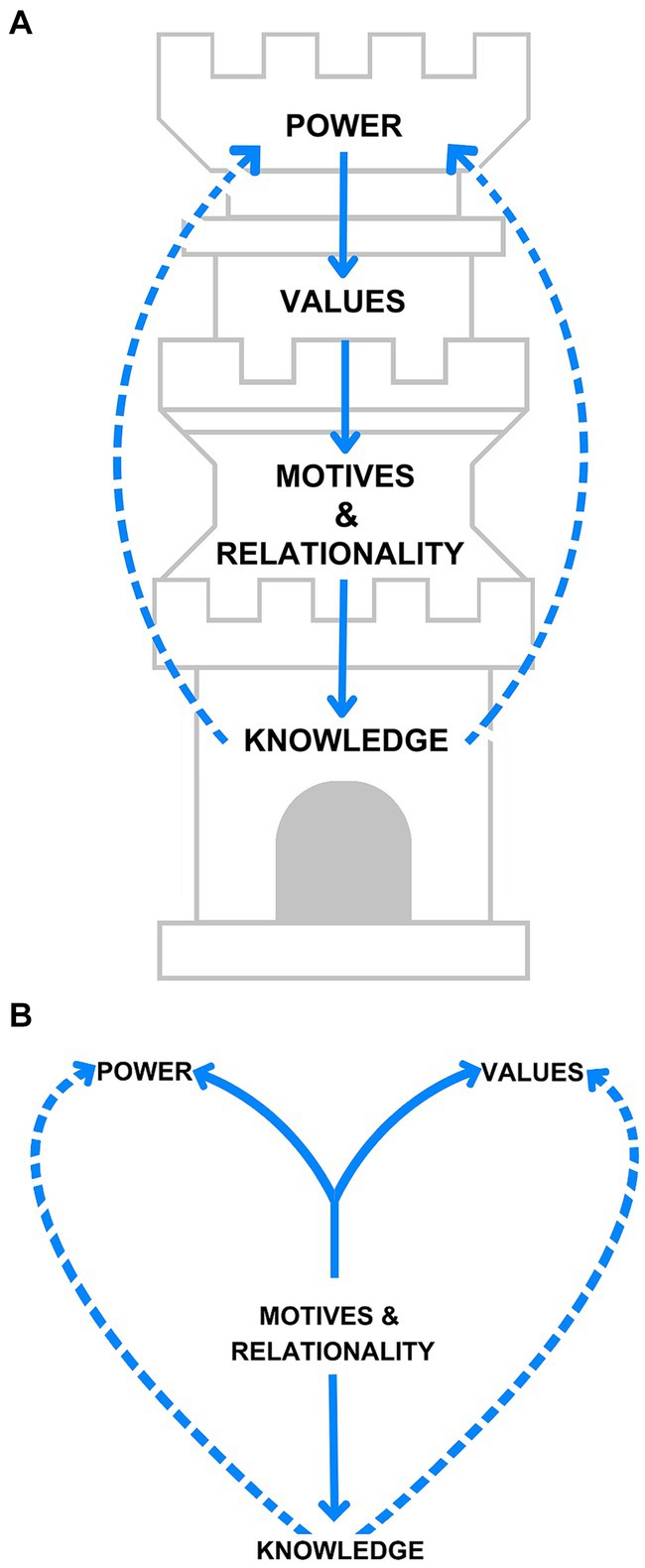
Figure 1. Two versions of our knowledge creation framework in academia. (A) The Ivory Tower that represents the current system. Power drives knowledge creation, shaping the dominant values, motives, and relationality in a hierarchical process. Knowledge informs the dominant power structure in a reinforcing way (Foucault, 1977; Haraway, 1988; Harding, 1994). (B) The Heart of Knowledge that depicts a re-imagined knowledge creation system. Motives and relationality are in the center of the diagram, shaping power, values, and knowledge. In this alternative system, knowledge is not influenced directly by power. Therefore, we envision a knowledge creation that still informs power structures, but has space to both reinforce and subvert them along with challenging or supporting the predominant values (Tynan, 2021; McGreevy et al., 2022).
In the current system (Figure 1A), power is at the top of the framework and is fundamental in shaping the downstream knowledge production. We describe how power structures dictate the rest of the knowledge system in Section IV. In our re-imagined system, the framework is rearranged such that motives and relationality are at the center of the academic knowledge creation (Figure 1B), which we describe in Section V. In both systems, knowledge can inform societal structures, through either reinforcing or challenging them.
4 Critique of the current agricultural academic knowledge creation system
4.1 Drivers of knowledge generation
4.1.1 Power
Power, defined as who is able to influence or control behavior and resources, is inextricably linked with knowledge (Foucault, 1980). In the past several centuries, Western scientific thought, and how knowledge is generated, valued and shared, has been influenced and reinforced by racism, colonialism, settler colonialism, imperialism and patriarchy, all systems of oppressive hierarchical power structures (Foucault, 1977; Haraway, 1988; Harding, 1994). We acknowledge the strengths of Western science and emphasize that criticism should be directed not at science itself but at the institutional norms and pressures that lead to its misapplication, especially in serving hierarchical power dynamics. Current agricultural research in academia operates under consolidated and hierarchical power structures that confine research agendas to focus on specific knowledge generation and synthesis (Vanloqueren and Baret, 2009; DeLonge et al., 2016; Jin and Huffman, 2016; Miles et al., 2017), as shown in the Ivory Tower in Figure 1A. Power in this system has two main consequences: (1) a limited set of knowledge and people (experts) are legitimized (Montenegro de Wit and Iles, 2016); (2) only certain groups of people benefit from the knowledge that is produced.
The narrowly defined and legitimized way of knowing – the epistemology – of Western positivist scientific thought dominates agricultural research. This epistemology stems from Enlightenment principles and is enforced by the consolidation of power among academics and the institutions in which they do research (Banerjee and Arjaliès, 2021). For example, the Land Grant University (LGU) system in the US, which was founded in the tradition of Western scientific thought, was funded by the theft and sale of Indigenous land through settler colonialism (Lee and Ahtone, 2020; Fanshel, 2021) (Box 1). Concurrently, agricultural and land stewardship knowledge of Indigenous people has been repeatedly delegitimized, stolen, and co-opted within Western academic institutions (Smith, 2012; Kimmerer, 2013; Whyte, 2017; Wilson, 2020; Hernandez, 2022). This knowledge extraction is consistent with the extractivist practices of settler colonialism, in which the university legitimizes this knowledge as their own and serves to reinforce dominant power structures (Jordan, 1997). This has contributed to the widespread loss of Indigenous knowledge and has implications for agricultural practices in the US and in the Global South where agribusiness paradigms are imposed on farmers (Magdoff and Tokar, 2010; McMichael, 2012) (Boxes 2, 3).
In the current academic agricultural knowledge system, profit is power because it is the main driver of research priorities (Ellis and Bowden, 2014), which in turn determines who the main beneficiaries of knowledge production are. For example, decades of research focused on increasing yields of crops used primarily for animal feed and/or biofuels has been well-funded, while there has been comparatively little funding for research in diversified, ecologically sound agricultural systems (DeLonge et al., 2016; Miles et al., 2017). Furthermore, public funding for agricultural research has declined since the 1980s with the neoliberalization of public institutions, while private funding has increased (Nelson and Fuglie, 2022). This has led to a trend in research that is undertaken for the benefit of moneyed stakeholders (see Box 1). For instance, there is evidence that the livestock industry invests in shaping research and climate policies, minimizing its environmental impact while advocating for strategies that serve its interests, rather than transformative solutions (Morris and Jacquet, 2024). Agricultural research at LGUs is thus a key component of public-private investment that directs the creation and extraction of knowledge generated by LGUs towards the advancement of privileged agribusiness agendas (Frickel et al., 2010; Heisey and Fuglie, 2018).
Box 1. Land grant universities in the US are top-down gatekeepers that produce commodified research.
Farming in the US was a widely distributed livelihood with associated knowledge prior to establishment of land grant universities (LGUs) and extension services by the Morrill and Hatch acts, respectively (Danbom, 1986). The LGU system is a system of public universities, funded initially through land investments, to provide education to members of the working class. As such, LGUs in the US are often held up as an example of democratization of research and knowledge production (Ross, 1941), though notably their history includes endemic issues of gender and racial inequality (Herren and Craig Edwards, 2003) as well as being founded on the theft and sale of Indigenous lands (Lee and Ahtone, 2020). Furthermore, the mission of LGUs in agricultural research is complicated by the fact that one foundational purpose of agronomy and agriculture extension programs was to “professionalize” farmers (Danbom, 1986) and thus create an elite and distinct class of agriculturalists.
In 1980, the Bayh-Dole Act reframed research for public good as inferior to a knowledge economy that promotes public good through commercialization (Kenney, 1986; Buttel and Belsky, 1987; Slaughter and Leslie, 1998; Slaughter and Rhoades, 2000; Olssen and Peters, 2007). This allowed for private patents to be registered from inventions developed through public funding at universities. The substitution of private instead of public interests has since permeated the sentiments for which LGU administrators view the purpose of public research (Ostrom and Jackson-Smith, 2005; Glenna et al., 2007), situating LGUs as one of many gatekeepers of consolidated power in our knowledge framework.
4.1.2 Values
Values refer to guiding and normative principles shared by communities that influence individual and group behavior and provide a common understanding of what is worthy (Kenter et al., 2015). Values work in tandem with power structures to shape societal motivations and our relationality (Koltko-Rivera, 2004; Buchholz, 2012). Value systems are unavoidably expressed within research narratives – whether implicit or explicit, intentional or unintentional (Dahlberg, 1988). Thus, like power, the application of personal values can reinforce or subvert the system in which they operate. The dominant values across agricultural research are founded in growthism [continuous agricultural growth and increasing affluence (Lara et al., 2023)] which is reinforced by reductionism [studying components of a system in isolation (Fuenmayor, 1991)] and individualism [prioritizing individuals without accountability to a collective (Hooks, 1994a)]. It is therefore necessary to describe and discuss these values—thereby making them explicit—so we can challenge and reconfigure current dominant value paradigms (Kenter et al., 2019).
Reductionism is a research norm in which researchers prioritize knowledge that is simple, atomized, and examinable outside of context (Fuenmayor, 1991; Schiere et al., 2004; Jordan, 2013). Reductionism is often justified as a way to identify direct causes through the isolation of factors, but this approach does not recognize that in reality those separated factors are inextricably intertwined (Gilson, 2015). As such, knowledge creation within this value system perpetuates the simplification of processes and homogenization of socio-ecologically complex systems in agricultural sciences. This reinforces repeated patterns of oppression and the delegitimization of Indigenous and traditional ecological knowledge built upon generations and, in some cases, thousands of years of observation (Kloppenburg, 1991; Kimmerer, 2002). Reductionism contributes to growthism and hinders our collective capacity for systemic adaptation and transformation because complex processes are reduced to purely biophysical aspects with no consideration of socioecological and political dimensions (Bawden, 1991; Schiere et al., 1999; International Commission on the Future of Food and Agriculture, 2009; Stetsenko, 2018).
Within a growthist value system, research focuses on unending growth of agricultural land, yields and livestock units without consideration of planetary boundaries (McGreevy et al., 2022). The growth and intensification of agriculture have led to the homogenization of natural and cultural environments (Foley et al., 2005; Altieri et al., 2015), resulting in the depletion of biodiversity (Estrada-Carmona et al., 2022), soil carbon (Sanderman et al., 2017), and local, traditional knowledge (FAO, Alliance of Biodiversity International, and CIAT, 2021). During the Green Revolution, researchers from the US and other parts of the Global North promoted homogeneous agricultural systems through the global manufacturing, distribution, and widespread utilization of hybrid seeds and chemical inputs under the justification of feeding the world (Box 2). The benefits of the Green Revolution did not necessarily improve food accessibility for vulnerable groups around the world (Kiers et al., 2008; FAO, IFAD, UNICEF, WFP and WHO, 2023), yet the accompanying loss of ecosystem function has profoundly impacted their livelihoods (López, 1998; Rasmussen et al., 2018). The resultant agro-industrial intensification can consolidate land tenure (reducing the number of farmers, particularly smallholders), destabilize local markets and processing infrastructure, and lead to widespread environmental degradation (López, 1998; MacDonald, 2020). These consequences diminish the adaptive capacity and viability of rural communities which leaves the entire human population vulnerable (Shiva, 2000; Gámez-Virués et al., 2015).
Box 2. The narrative of feeding the world has not eradicated hunger.
While often used to justify the need to increase agricultural production, the widespread “feeding the world” narrative overlooks the fact that simply producing more food does not equate to, nor ensure, the eradication of hunger (Lichtfouse, 2012). Despite global increases in productivity, the FAO reported that between 691 and 783 million people faced severe hunger worldwide in 2022 (FAO, IFAD, UNICEF, WFP and WHO, 2023), though actual numbers may be significantly higher (Holt-Giménez, 2019). Hunger continues to increase in Western Asia, the Caribbean and all subregions of Africa (FAO, IFAD, UNICEF, WFP and WHO, 2023), which shows the limitations of increased production without ensuring equitable distribution. The growthist value system that undergirds capitalism will always incentivise more production—but critically, not more access to food for those with low purchasing power (Rasmussen et al., 2018; Holt-Giménez, 2019), who may instead suffer the externalized social and environmental impacts (Hickel et al., 2022). Even with high production, a significant portion of the world’s crop calories is used for animal feed, and only a small fraction of these calories ends up in the human diet through animal products (Cassidy et al., 2013). The focus on increasing production becomes less critical when considering the massive amounts of food currently being wasted (Stuart, 2009; Mokrane et al., 2023). Thus, there is a need of shifting the focus from traditional agricultural productivity metrics to evaluating how effectively cropland feeds people (Cassidy et al., 2013), as well as embracing the agroecological principles of sufficiency, distribution, and care (McGreevy et al., 2022).
Unending growth is a value that has deep historical roots in attempts to increase efficiency of communal resources, especially land. In the enclosure of the commons (Young, 1808), laws were enacted to limit communal land management and characterized peasants as obstructing progress (Handy, 2009). Though the scale of effects and underlying motives of the Enclosure period are contested, historians broadly agree that this growthist focus came at the expense of rural livelihoods and increased inequality (Burchardt, 2002). Widely successful at increasing yields (Conway, 1997), the growthist values underlying the Green Revolution meant that increasing yield efforts were largely undertaken without consideration for regional, social, or ecological limits. As Patel (2013) points out “the scientific breeding strategy was not geared towards the requirements of poorer peasants, but instead produced seeds requiring irrigation and an intensive use of material inputs.” Thus, through the promise of increased agricultural output, the Green Revolution opened new markets for agricultural inputs and machinery, creating new forms of economic dependency for nations in the Global South (Holt-Giménez, 2019). And even as we continue to quantify continued hunger in the face of high production, we miss the opportunity to eradicate it instead, and thus remove the need to continue quantifying it.
4.2 Mechanisms of knowledge generation
4.2.1 Motives
Motives are the primary reasons guiding decisions and actions towards an objective. In our framework, motives are the “why” that underlies academic knowledge creation processes, or “why we do what we do” (Vickers, 2007). Linked with power and values, motives encompass a range of strategic socioeconomic and political considerations that contribute to specific outcomes in our current food system. Critically, the values of those with power in the current system have significant influence over which motives are considered valid (Figure 1A). Researchers and academics within the current knowledge system of agricultural sciences often include efficiency for the sake of profit and productivity as primary motives for their work. One example of these motives in action is the subfield of sustainable intensification in agriculture (Box 3).
In the positivist view of Western science, researchers consider high-yielding monocultures a tool to realize the motive of efficiency because they are highly productive under high input paradigms which rely on substitutive chemical applications that replace ecological function (Hoffman et al., 1995). This narrow framing disregards long-term impacts and socio-ecological dimensions of food systems, which might be necessary to achieve a more just and equitable society, and fails to address current system failures like high rates of global food waste (approximately one third of global food production) (Stuart, 2009; Mokrane et al., 2023; Zhu et al., 2023). Some examples of alternative framings include food sovereignty (Holt-Giménez and Altieri, 2013), agroecology (James et al., 2023; Ong et al., 2024), indigenous food systems (FAO, 2021), and taking a feminist approach to food systems (Gilson, 2015; Zaremba et al., 2021). While a narrow framing may increase the profits of multinational agribusinesses (and their shareholders) in industrialized agriculture (Lawrence and Smith, 2020; Ashwood et al., 2022), persistent failures to accomplish equitable and reliable food access around the world (recent examples include the food shortages during the beginning of the COVID-19 pandemic and the war in the Ukraine) call into question the “efficiency” of the current food system, the continual focus of agribusiness-funded research on increasing yields, and how wisely we are using resources.
A framework of efficiency may also consider the broader societal or ecological harms of industrial agriculture as externalities, without recognizing and addressing the causative motive of profit maximization. One current estimate of the “hidden” cost of the industrialized food system is $12.7 trillion, primarily due to negative public health outcomes from unhealthy food (FAO, IFAD, UNICEF, WFP and WHO, 2023; Ong et al., 2024). On the ecological front, recent capitalist frameworks for climate change offsets, such as carbon farming, have resulted in fewer benefits than claimed (West et al., 2023). Academics have shown concern about the lack of transformative motives backing regenerative agriculture (Bless et al., 2023), soil health (Lehmann et al., 2020), and sustainable intensification of agricultural production (Loos et al., 2014) (Box 3). Without serious examination, questioning, and critique the underlying power structures and associated values of these narratives may continue to support business-as-usual (McGreevy et al., 2022).
Box 3. Sustainable intensification: refeeding the world with the same underlying motives.
Sustainable intensification is a concept coined in the context of increasing productivity in smallholder farms in Africa by Pretty (1997), and was later backed by the FAO as a means of producing greater yields without bringing more land under cultivation and without greater environmental externalities (Bless et al., 2023). However, the underlying motives of this narrative might not address deeper systemic issues within the food system.
While increased production is an important component of food sovereignty and security in specific regional contexts (Gerten et al., 2020), research and recommendations for sustainable intensification are mostly high-input, technology-based, and focused on large-scale commodity production for international trade (Godfray, 2015; Mahon et al., 2017; Bless et al., 2023). The sustainable intensification narrative may reinforce the reduction of biodiverse agricultural systems into specialized, simplified landscapes dominated by monocultures—mainly for factory meat production and biofuels for the Global North—under the premise of higher productivity and efficiency per unit of product (Loos et al., 2014). While the narrative affirms sparing land for nature, there is little evidence that this rationale leads to meaningful reductions in agricultural expansion, nor that it is beneficial from a socio-ecological perspective (Ceddia et al., 2014; Kremen, 2015; Pratzer et al., 2023; Burian et al., 2024).
Sustainable intensification can be understood as a continuation of the narrative of feeding the world, backed by neoliberal policies in the form of subsidies that proliferate a narrow range of crops, mainly grains and soy (Hendrickson, 2015). It can contribute to an imbalance in food production, with farmers overproducing fats, grains for feed, and sugars, and not enough fruits, vegetables, and protein to meet nutritional needs (Kc et al., 2018). Additionally, a focus on efficiency can paradoxically lead to increased resource consumption, a phenomenon known as Jevon’s paradox (Hamant, 2020). For example, improvements in irrigation efficiency have sometimes led to increased water use overall (Paul et al., 2019; Wang et al., 2020). The US renewable fuel standard – the world’s largest biofuel program – has resulted in an increase of greenhouse gas emissions and along with increased food prices and greater environmental degradation (Lark et al., 2022). Additionally, increased agricultural yields are associated with higher deforestation in Sub-Saharan Africa and Latin America, and with farm expansion in East Asia and the Pacific (Goulart et al., 2023).
The outcomes of our dominant agricultural system suggest there may be other motives underlying this narrative, such as continued capital accumulation and the maintenance of entrenched power structures. While attempts at reforming the narrative of sustainable intensification may be possible, it currently lacks transformative solutions to shift the power dynamics, motives, and values within the dominant food system (Mahon et al., 2017; Bless et al., 2023), and may disable attempts towards agroecological transformations (Walthall et al., 2024).
4.2.2 Relationality
Relationality is a state of connection that creates attachment and responsibility; relationality can be within the self, with other humans, and with the more-than-human world (Nicklay et al., 2023). We acknowledge that the concept of relationality stems largely from Indigenous communities, and that “relationality is not a new metaphor to be reaped for academic gain, but a practice bound with responsibilities with kin and [land]” (Tynan, 2021). In the dominant food system (Figure 1A), relationality is not treated as a central component, but rather stems from power structures and value systems and is a mechanism through which knowledge is created and reinforced. Within the current system, relationality is anthropocentric (structured hierarchically to prioritize humans) and perpetuates relations of domination, extractivism, and simplification of nature.
Anthropocentric relationality stems from Western societal norms for various aspects of the human experience, and specifically from Enlightenment concepts such as the mastery of nature and rationalization being valued over experiential knowledge, which underpin much of academia (Figure 1A) (Banerjee and Arjaliès, 2021; Cubillos et al., 2022). The mechanistic worldview of Descartes and Newton, which fosters an anthropocentric perspective, perceives the Earth as a machine to be controlled and exploited by humans (Capra, 1996). This perspective isolates humans from the natural world, neglecting our origin and the intrinsic value of all life, non-life, and the interconnectedness of all ecological phenomena (Capra, 1996). Consequently, global issues are often approached in isolation, overlooking their systemic nature and interdependence, which hinders our ability to fully comprehend and address the complexities of environmental challenges (Capra, 1996).
Anthropocentric relationality in academia, particularly within the current food system, often results in the dismissal of Indigenous science and knowledge as mere folklore because of their explicit reciprocal relationship with nature. For example, if we consider the narrative discussed earlier of feeding the world, the expression more accurately means feed people in a paternalistic relationship of domination over communities whose food sovereignty has been denied through (neo-)colonialism and imperialism. This relationality of the current food system is informed by power structures, as discussed above, in which academics legitimize only a limited set of knowledges. One example of how relationality interacts with power is in the land-sparing vs. land-sharing debate (Fischer et al., 2014; Kremen, 2015; Grass et al., 2019). The dominant relationality that artificially separates humans from the rest of the world and conceives of land as “better” when it is untouched and pristine (i.e., land that is untouched by humans), despite the co-evolution of human habitation with numerous ecotypes globally (Ellis et al., 2021). Current biodiversity loss is primarily a result of appropriation, colonization, and intensification of land use in areas previously inhabited and utilized by earlier societies, rather than the disturbance of pristine ecosystems (Ellis et al., 2021). Lands in what we now call the US were managed by Indigenous peoples for millennia until settler colonists, and later the US government, occupied these territories and, often by extreme violence, dispossessed Indigenous peoples from their land. Settler colonists and the government then proposed to conserve these same lands (Mazel, 2000). And, while intensifying agriculture for commodity crops does not necessarily spare land as advertised, Indigenous land stewardships, based on relationality between humans and nature, does (Pratzer et al., 2023). The history of global land use demonstrates that supporting Indigenous peoples and local communities in their role as environmental stewards is essential for both biodiversity and agrobiodiversity conservation worldwide (Ellis et al., 2021).
Nevertheless, anthropogenic relationality to land allows agricultural researchers to view nature through an instrumentalist and extractive lens in which culture is stripped from agriculture (Flora, 2014). The same dynamic encourages early-career researchers to extract information from the communities they engage with, without reciprocity. At the same time, researchers are subjected to hierarchical structures that exploit them in many ways (Box 4).
Box 4. Academic extractivism: the journey of early career scientists.
Relations of domination, extractivism, and simplification extend to how academic spaces are structured. Relationality informs researchers’ connection to their study system and contributes to whose voices are valued and which stakeholders are included. Many disciplines, especially in the biophysical sciences, are siloed instead of working in relationship with other fields (Gardner, 2014). Lack of interdisciplinary conversation minimizes opportunities for diverse coursework, critical engagement with a diversity of ideas, and how science is reflective of dominant social, political and economic structures (Hodson, 2020). Teacher-centered classrooms institute a hierarchical, dominating classroom structure in which knowledge is presented by professors and teaching assistants and passed down to students (the banking model described by Freire, 1970), with limited opportunity for horizontal learning and critical discourse.
Once students face graduate school, their success is measured in the increasing number of manuscripts published, and programs are evaluated by growing number of students who have graduated (Slaughter and Rhoades, 2000; Chagnon et al., 2022). Early-career scientists are expected to extract information from nature and communities, while they themselves are exploited via low wages and poor working conditions (Bannister, 2005; Levecque et al., 2017; Woolston, 2019). This exploitation often occurs in hierarchical, harsh environments, in which individualism is a prevalent value to succeed under the current system (Gill, 2016). Furthermore, racial, economic, and other privileges allow historically overrepresented groups to thrive in academia, while keeping out large portions of historically excluded groups (Hooks, 1994a; Clauset et al., 2015; Matias et al., 2022). All of this contributes to the mental health crisis in science (Hall, 2023), highlighting yet another reason for transformative changes in academic spaces.
5 Discussion of a re-imagined agricultural academic knowledge creation system
As early-career researchers, we advocate for continuous and iterative societal transformations to address the global systemic crises and achieve just and equitable food systems (Kinzig et al., 2013; IPBES, 2022; IPCC, 2022). However, as Galeano (1998) describes in our preface, the upside-down world give us the impression that we must endure this reality and limit the potential impact of our work. In this section, we acknowledge his counter-school of thought, that challenges or subverts dominant paradigms. We define counter-hegemony as movements and actions aimed at disrupting the dominant food system ruled by capital accumulation (Carroll, 2010). Figure 1B illustrates the revised structure of knowledge production for agroecological transformation of food systems that we envision.
Here, motives and relationality govern academic knowledge production side by side, in a non-hierarchical structure. They shape power and values explicitly, and then both produce knowledge through a conscious praxis. Finally, we envision that the knowledge produced can challenge and provide checks on power and values systems. For comparison, we provide a summary of the drivers and mechanisms in both the current dominant academic knowledge creation system and our proposed system in Table 1. We summarize these key aspects of a re-imagined system in a set of vignettes (Boxes 5–7). These vignettes describe creative and holistic methods of alternative knowledge creation systems through stories from people working in the counter-hegemonic food movement. Stories and storytelling are widely acknowledged as culturally nuanced ways of knowing, produced within networks of relational meaning-making (Tynan, 2021).
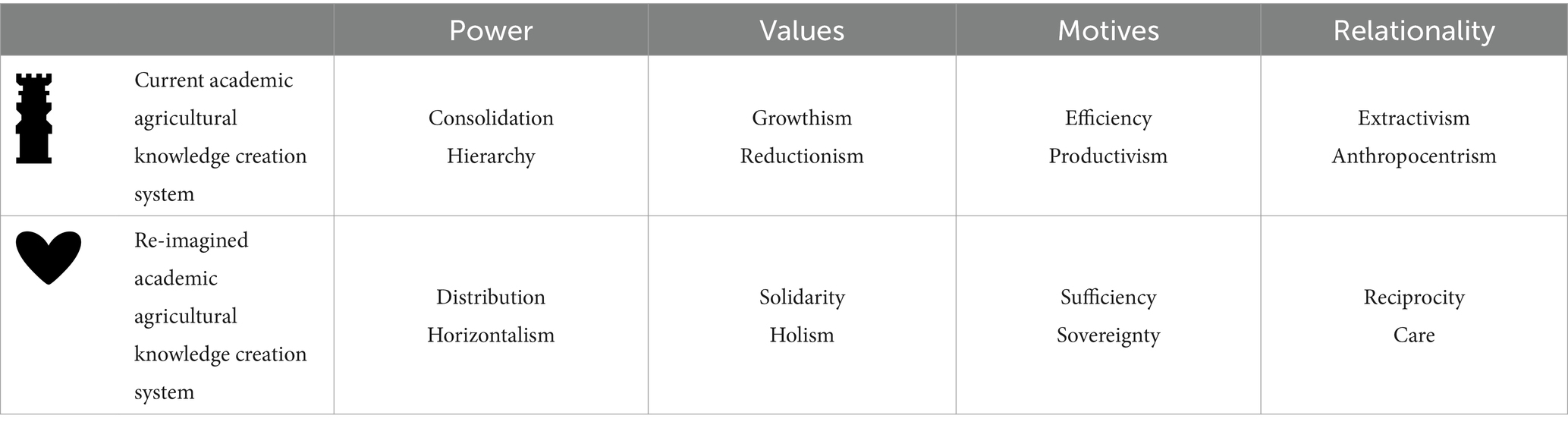
Table 1. Characteristics of how the current and re-imagined academic agricultural knowledge creation systems operate using the drivers and mechanisms from our knowledge creation framework.
The transformation of power, values, and motives requires that researchers recognize and build new patterns and priorities of relationality in a transformed system. Instead of anthropocentric extractivism, we recognize a different relationality that connects people and non-people from a place of care and responsibility, also known as reciprocity (Tynan, 2021). Reciprocal relationships are defined by interaction with and responsibility to humans, non-humans, landscapes and any part of the natural world. Reciprocity creates an increased commitment and desire to take care of our world rather than viewing the natural world through an instrumental lens in the dominant normative manner (Chan et al., 2016; Klain et al., 2017; Allen et al., 2018; Díaz et al., 2018).
As Chan et al. (2016) point out, a collective understanding of connectedness and care is the basis for several worldviews that operate with relational values at their core: back to land movements in North America, Ubuntu in South Africa, care in the ethics of feminisms, and Buen Vivir in Latin America (Box 5). Importantly, relationality based on reciprocity is a concept that we understand mainly due to the intellectual labor of Indigenous writers and activists. Our intellectual debt to them highlights the complementary need for relationality and solidarity as a core value, to support sovereignty of communities whose knowledge and power is unacknowledged within the current system. Finally, rather than prioritizing efficiency solely for profit, change-oriented food system scholars advocate for sufficiency (McGreevy et al., 2022). This viewpoint brings the importance of agroecology and producing foods that align with nutritional needs and sociocultural preferences (Van Zutphen et al., 2022). It aims not just to boost production but also to ensure fair food distribution, targeting issues like malnutrition, excessive consumption, and wastage, as well as affluent diets and lifestyles.
Box 5. Care and connectedness at the core of Indigenous worldviews and agroecology.
Care and connectedness are concepts we see in many counter-hegemonic examples, such as the book Fresh Banana Leaves, in which Dr. Jessica Hernandez explains how essential it is to shift the way we relate to our contexts and that from her Indigenous perspective:
“Taking care of nature, and nature taking care of us in return, is the greatest teaching my father has taught me. Indeed, nature protects us as long as we protect nature. This is something Western science has failed to understand or explain.” [p. 30] “(…) On top of this, as an Indigenous person, I can see how both biology and ecology are interconnected to health, education, and other systems that are deemed far removed from biology or ecology within Western academic frameworks. This is due to the holistic way of thinking and knowing that we hold as Indigenous peoples, that everything is ultimately connected to us and our environments. […] While this may be deemed as scattered, this is the way we as Indigenous peoples look at the world. Everything in our environments has a relationship with us and this is why it is hard for us to box things like Western ways of knowing does.” (pp. 11–12).
Agroecology is rooted in Indigenous perspectives, and thus connectedness is at its core. Researchers working in Canadian academic institutions developed a meta-narrative review and a framework to describe the links between agroecology and well-being, and used it to assess how grassroots actors involved in agroecological movements in southern Brazil described and defined agroecology (James et al., 2023). Their results suggest that “agroecology is a philosophy of life that promotes well-being” in the context they studied. Connectedness is highlighted as a core principle of agroecology, as described below.
“Underpinning these goals of solidarity and alliance-building across social groups and spatial scales is a commitment to collaboration and partnership, instead of competition. For example, two agroecological farmers, Leticia and Natalia, began their journey by visiting another farmer, Geraldo, known as a reference point for agroecology in the region. As fairly new farmers, they emphasized how important it was to them that Geraldo “saw us as a companion, not as competition. That was really cool.” This sense of cooperation and interdependence actually serves to bolster farmers’ perceptions of autonomy, self-determination, and resourcefulness, as they aim to rely on one another and to work with natural inputs and processes (i.e., native seeds and species, mulches, organic fertilizers), instead of relying on agribusiness and the private sector. As Eduardo stated,
Eduardo: Why are there so many poor people in the world? It’s because someone is consuming a lot. Then it centralizes that power. In agroecology we do not see this, and neither can we – the more you concentrate, the worse things work. In agroecology you reach a certain level – I have a little money, I have a few assets, I can survive, and that’s enough – I do not need any more. What am I going to create empires for? If you start creating empires within agroecology, then your philosophy has to change – it stops being agroecology … Agroecology as a concept is cooperative, not private. It is not a company that owns and that will rule everything. It is always that cooperative idea. (April 28, 2019).”
A transformed system of knowledge production requires broadening who has authority to determine what is legitimate and who the primary beneficiaries of knowledge production are. For example, academic knowledge creation must aim to meaningfully benefit a plurality of people; this is particularly true for public institutions which have a mandate to serve the public good. This can be accomplished by research decisions being made through participatory and democratic processes, which would increase accountability of those inside institutions to the greater public. Current attempts to achieve this include biocultural approaches to understanding food and land that deliberately legitimate multiple types of knowledge (Hanspach et al., 2020). Another example is knowledge co-creation within agroecological projects, which recognizes and expands whose knowledge is valued as well as who benefits from the outcomes of research (Utter et al., 2021). Community-based participatory research (CBPR), in which researchers make explicit consideration of the normative values, politics, and possibilities their work supports, can be useful for guiding research praxis (Box 6). This method is most effective when researchers are embedded within communities where they are doing research “with” instead of “on” community members and agricultural systems.
Box 6. Community-based participatory research contributes to pertinent, situated knowledge.
Community-based participatory research (CBPR) is an interdisciplinary field that was developed within public health fields to shift research from being done “on” communities to doing research “with” communities (Israel et al., 2010). CBPR also provides a fruitful set of methods for research within food systems and natural resource stewardship, as the principles are appropriate for acknowledging and uplifting Indigenous knowledge and expertise. For example, in her book Fresh Banana Leaves, Jessica Hernandez, PhD, describes community-based participatory research (CBPR) as a collaborative, bottom-up research approach. She points out how CBPR is a tool to distribute power:
“CBPR can become congruent with Indigenous communities because it attempts to dismantle some of the impacts of research and settler colonialism. It allows Indigenous peoples to serve as the leaders and consumers of the research projects meant to benefit their communities rather than just serving as research subjects. It also allows for the creation of an effective collaboration and destruction of power differentials between the researchers, community members, and relevant organizations.” (Hernandez, 2022).
Dr. Hernandez draws five principles to guide implementation of CBPR:
1. Follow and create fluid and dynamic approaches that do not follow the linear research method.
2. Respect tribal sovereignty and Indigenous autonomy.
3. Follow Indigenous protocols and their way of being and doing things in their communities.
4. Respect intellectual property.
5. Embrace all Indigenous epistemologies relevant to the community.
While Dr. Hernandez applies these principles to working directly with tribal nations and Indigenous communities in North and Central America, they can apply to other community collaborations, especially those conducted with historically oppressed communities whose knowledge has not been respected by researchers in the past.
A participatory knowledge creation system with deep relationality and distributed power requires that researchers acknowledge positionality and the inherent partial perspectives that we inhabit. The model of partial perspectives, from Feminist scholar Donna Haraway, describes a “limited location and situated knowledge, not about transcendence and splitting of subject and object.” (Haraway, 1988). In Barad (2007) words, we cannot separate the experiences of being and knowing. When we recognize partial perspective, we also recognize that scientific knowledge is not objective, but rather, situated within a context of normative power relations, values, motives, and relationality. The acknowledgement of partial perspectives can help researchers shift from siloed, hierarchical knowledge production towards egalitarian approaches, fostering transdisciplinary collaboration, and recognizing and celebrating complexity and multiple ways of knowing. This complex, horizontal transformation of knowledge production could contribute towards a world in which knowledge production is in solidarity with social movement goals. Recognition of the complexity of the reality we study may also allow us to embrace the complexity of our own nature as researchers. As a tool for addressing complexity, we have developed a set of questions for researchers to reflect on how the drivers and mechanisms we have described interact in their own work and how they can contribute to systemic transformation (Table 2).
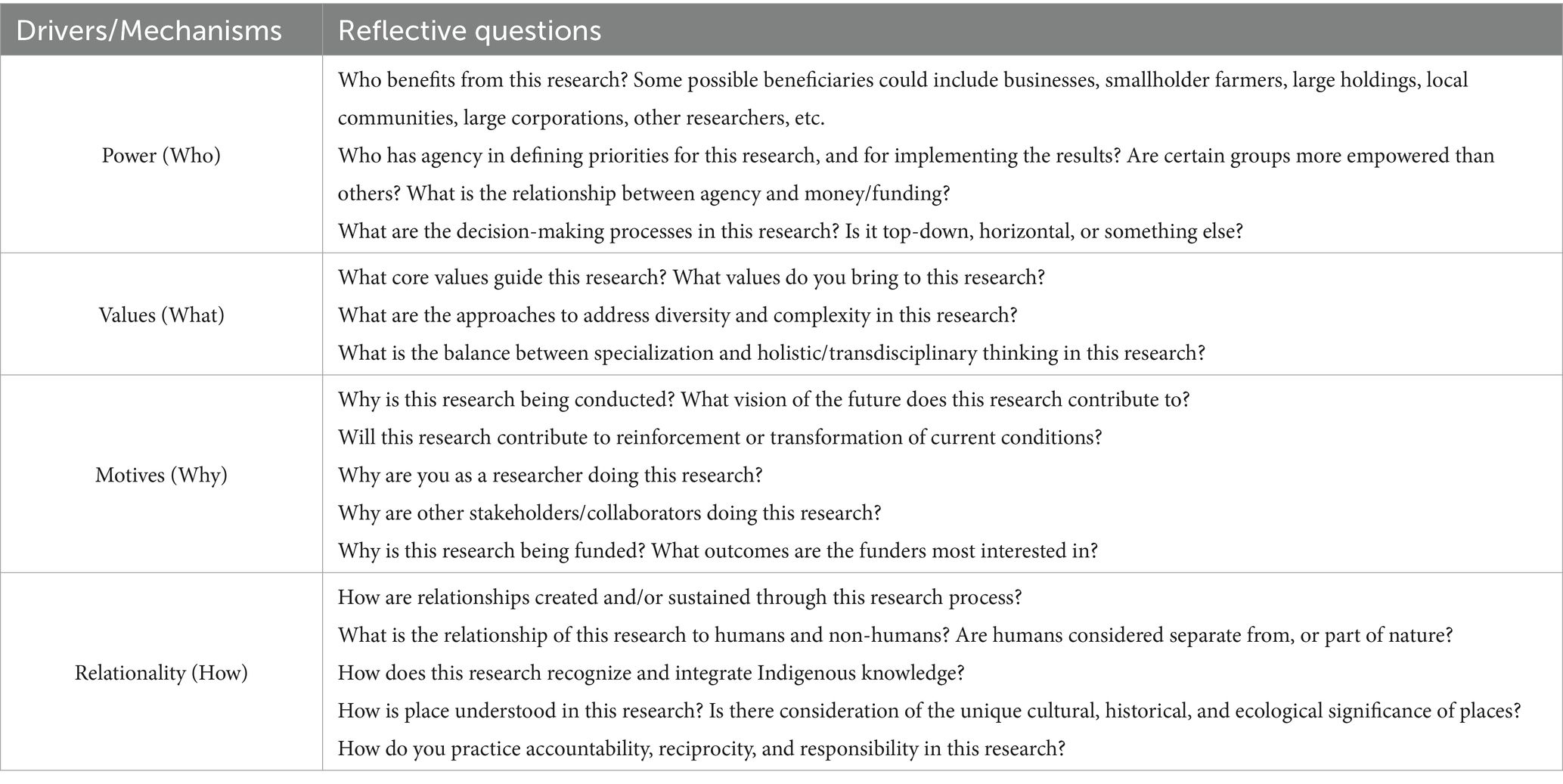
Table 2. Questions for researchers to reflect on their own academic knowledge creation.
A transformed system of knowledge production could be accompanied by concomitant shifts in how academic training is undertaken (Box 7). For example, a non-hierarchical classroom structure would encourage instructors to value relationship creation and knowledge production with and between students. Additionally, valuing students’ lived experiences creates a more horizontal knowledge creation approach, rather than a top down, teacher-centered didactic approach (Freire, 1970; Hooks, 1994b). Action-oriented classrooms also allow for students to connect their coursework holistically to the broader, local context, providing real life complexity. This allows for relationship building in the community and can encourage students to commit to sociopolitical action that aligns with their values (Hodson, 2020).
Box 7. Addressing the complexity of our food system and giving students space to reflect creates opportunity for change-oriented learning.
Researchers at University of California, Davis developed and implemented an undergraduate level Food Systems course in 2008 in which the instructors “fostered an explicitly democratic and collaborative learning environment by increasing student participation in a less hierarchical structure… by creating seven ground rules that validate everyone’s perspectives, questions, and contributions” (Galt et al., 2012). Student-centered and self-reflective learning allowed students to grapple with the tension between their values, their understanding of how they have arrived at their current worldview, the current state of the food system and what they would like the food system to look like. Through self-reflection, students came to understand the existence of multiple perspectives and the complexity of food system problems, as described below:
“Another noted the complexity: “many of the issues we have covered in examining food systems are not linear and with that it is difficult to write an essay that begs for an intro, thesis, body, and conclusion. I almost cut up my paper and pasted it on a poster, with lots of arrows” (Student 9).”
This class provides an example of how important it is to “understand, situate and change our own cognitive processes” or “think about thinking.” It is important that universities give students the space to do so as it can lead to socio-political action as described by Student 7: “I want to walk lightly, speak loudly, and be respectful and accountable to people who do not have the power, resources or desire to act in the ways that I do. I want to face the toughest challenges and join hands to overcome them.”
The food systems curriculum is one of multiple examples of exciting innovations in undergraduate education (e.g., Valley et al., 2020; Dring et al., 2022). However, there are comparatively few opportunities for students at the graduate level in agricultural research to engage with complexity and to critically reflect on their research. To address that gap, Nicklay et al. (2023) propose a pedagogical model to support critically-informed learning in agroecology within the institutional context of the University of Minnesota – Twin Cities. The model centers around a learning cohort and draws from situated knowledge, with three key components: critical inquiry, relational centering, and participatory practice. The model was developed through a 7-year long, iterative visioning process. The findings of their iterative process are as follows:
“Our findings particularly highlighted the importance of critical and collective processes/structures, and we focused on epistemological interventions because, as prior scholarship has shown, they help teachers and learners develop new vocabularies, deepen analysis, navigate discomfort and uncertainty, and overcome cognitive or emotional blocks to dialogue.”
6 Conclusion
Examining the relative centrality and relationships among relationality, motives, values and power in the knowledge creation process is an effective tool for agricultural scientists to critically engage with their work. In this paper, we demonstrate how a framework that concentrates power in limited knowledge legitimacy and money, with values, motives and relationality following that concentration of power, has led to research supporting an ecologically and socially unsustainable food system that contributes to climate change, biodiversity loss, pollution, and socioeconomic inequalities. In contrast, we offer a vision of relationality-based knowledge creation that can effectively address the urgent ecological and food access crises we see in our world by operating within ecological limits and benefitting society. Our ultimate goal is to act consciously through the praxis of our own version of a counter-hegemonic food system transformation. We want to build on and continue to co-create transdisciplinary academic spaces centered in critical reflection, where we are encouraged to value the complexity of our own identities and of the systems we live in. We envision power within the public institutions we work in to be distributed so that we can better serve public interests and to be spaces where we can imagine and contribute to more just food systems.
Author contributions
MM-A: Conceptualization, Investigation, Methodology, Project administration, Visualization, Writing – original draft, Writing – review & editing. SW: Conceptualization, Investigation, Methodology, Project administration, Visualization, Writing – original draft, Writing – review & editing. PG: Conceptualization, Investigation, Methodology, Project administration, Visualization, Writing – original draft, Writing – review & editing. DO-G: Conceptualization, Investigation, Methodology, Project administration, Visualization, Writing – original draft, Writing – review & editing. KM: Conceptualization, Investigation, Methodology, Project administration, Visualization, Writing – original draft, Writing – review & editing. KB: Conceptualization, Investigation, Methodology, Project administration, Visualization, Writing – original draft, Writing – review & editing. EA-S: Conceptualization, Visualization, Writing – review & editing. SR: Methodology, Writing – review & editing. VW: Conceptualization, Investigation, Methodology, Project administration, Visualization, Writing – original draft, Writing – review & editing.
Funding
The author(s) declare that financial support was received for the research, authorship, and/or publication of this article. Publication fees were covered by UC libraries through the Open Access Agreement.
Acknowledgments
We would like to thank Kyle Moeller, for giving us a word (and a context) to call our dissonance, the ecosystem of the Agroecology Journal Club at UC Davis, and the Asking Different Questions (ADQ) program through the Feminist Research Institute at UC Davis. We express our gratitude to the reviewers for their critical insights that have enhanced this paper.
Conflict of interest
The authors declare that the research was conducted in the absence of any commercial or financial relationships that could be construed as a potential conflict of interest.
Publisher’s note
All claims expressed in this article are solely those of the authors and do not necessarily represent those of their affiliated organizations, or those of the publisher, the editors and the reviewers. Any product that may be evaluated in this article, or claim that may be made by its manufacturer, is not guaranteed or endorsed by the publisher.
References
Allen, K. E., Quinn, C. E., English, C., and Quinn, J. E. (2018). Relational values in agroecosystem governance. Curr. Opin. Environ. Sustain. 35, 108–115. doi: 10.1016/j.cosust.2018.10.026
Altieri, M. A. (1995). Agroecology: the science of sustainable agriculture. Boulder, CO: Westview Press.
Altieri, M. A., Nicholls, C. I., Henao, A., and Lana, M. A. (2015). Agroecology and the design of climate change-resilient farming systems. Agron. Sustain. Dev. 35, 869–890. doi: 10.1007/s13593-015-0285-2
Altieri, M. A., and Toledo, V. M. (2011). The agroecological revolution in Latin America: rescuing nature, ensuring food sovereignty and empowering peasants. J. Peasant Stud. 38, 587–612. doi: 10.1080/03066150.2011.582947
Ambikapathi, R., Schneider, K. R., Davis, B., Herrero, M., Winters, P., and Fanzo, J. C. (2022). Global food systems transitions have enabled affordable diets but had less favourable outcomes for nutrition, environmental health, inclusion and equity. Nat. Food 3, 764–779. doi: 10.1038/s43016-022-00588-7
Anderson, C. R. (2020). Confronting the institutional, interpersonal and internalized challenges of performing critical public scholarship. ACME Int. J. Critic. Geographies 19, 270–302. doi: 10.14288/acme.v19i1.1786
Archer, L. (2008). The new neoliberal subjects? Young/Er academics’ constructions of professional identity. J. Educ. Policy 23, 265–285. doi: 10.1080/02680930701754047
Ashwood, L., Pilny, A., Canfield, J., Jamila, M., and Thomson, R. (2022). From big Ag to big finance: a market network approach to power in agriculture. Agric. Hum. Values 39, 1421–1434. doi: 10.1007/s10460-022-10332-3
Banerjee, S. B., and Arjaliès, D.-L. (2021). Celebrating the end of enlightenment: organization theory in the age of the Anthropocene and Gaia (and why neither is the solution to our ecological crisis). Org. Theor. 2, 263178772110367–263178772110324. doi: 10.1177/26317877211036714
Bannister, S. J. (2005). Low wages, Long hours, bad working conditions: science and engineering graduate students should be considered employees under the National Labor Relations act. The George Law Rev. 74:123.
Barad, K. (2007). Meeting the universe Halfway: quantum physics and the entanglement of matter and meaning. Durham, NC: Duke University Press.
Bawden, R. J. (1991). Systems thinking and practice in agriculture. J. Dairy Sci. 74, 2362–2373. doi: 10.3168/jds.S0022-0302(91)78410-5
Berry, W. (1978). “Preface” in The one-straw revolution, Vol. 65. ed. M. Fukuoka (Emmaus, PA: Rodale Press).
Bless, A., Davila, F., and Plant, R. (2023). A genealogy of sustainable agriculture narratives: implications for the transformative potential of regenerative agriculture. Agric. Hum. Values 40, 1379–1397. doi: 10.1007/s10460-023-10444-4
Buchholz, R. (2012). Reforming capitalism: the scientific worldview and business. London: Taylor & Francis Group.
Burchardt, J. (2002). Paradise lost: rural idyll and social change since 1800. London: I.B. Tauris & Co Ltd.
Burian, A., Kremen, C., James Shyan-Tau, W., Beckmann, M., Bulling, M., Garibaldi, L. A., et al. (2024). Biodiversity–production feedback effects lead to intensification traps in agricultural landscapes. Nat. Ecol. Evol. 8, 752–760. doi: 10.1038/s41559-024-02349-0
Buttel, F. H., and Belsky, J. (1987). Biotechnology, plant breeding, and intellectual property: social and ethical dimensions. Sci. Technol. Hum. Values 12, 31–49. doi: 10.1177/016224398701200104
Campbell, B. M., Beare, D. J., Bennett, E. M., Hall-Spencer, J. M., Ingram, J. S. I., Jaramillo, F., et al. (2017). Agriculture production as a major driver of the earth system exceeding planetary boundaries. Ecol. Soc. 22, 1–27. doi: 10.5751/ES-09595-220408
Capra, F. (1996). The web of life: a new scientific understanding of living systems. New York, NY: Anchor Books.
Carroll, W. K. (2010). Crisis, movements, counter-hegemony: in search of the new. Interface 2, 168–198.
Cassidy, E. S., West, P. C., Gerber, J. S., and Foley, J. A. (2013). Redefining agricultural yields: from tonnes to people nourished per hectare. Environ. Res. Lett. 8, 1–8. doi: 10.1088/1748-9326/8/3/034015
Ceddia, M. G., Bardsley, N. O., Gomez-Y-Paloma, S., and Sedlacek, S. (2014). Governance, agricultural intensification, and land sparing in tropical South America. Proc. Natl. Acad. Sci. USA 111, 7242–7247. doi: 10.1073/pnas.1317967111
Chagnon, C. W., Durante, F., Gills, B. K., Hagolani-Albov, S. E., Hokkanen, S., Kangasluoma, S. M. J., et al. (2022). From extractivism to global extractivism: the evolution of an organizing concept. J. Peasant Stud. 49, 760–792. doi: 10.1080/03066150.2022.2069015
Chan, K. M. A., Balvanera, P., Benessaiah, K., Chapman, M., Díaz, S., Gómez-Baggethun, E., et al. (2016). Why protect nature? Rethinking values and the environment. Proc. Natl. Acad. Sci. USA 113, 1462–1465. doi: 10.1073/pnas.1525002113
Clapp, J. (2018). Mega-Mergers on the Corporate concentration and the politics of sustainability in the global food system. GEP 18, 12–33. doi: 10.1162/glep_a_00454
Clauset, A., Arbesman, S., and Larremore, D. B. (2015). Systematic inequality and hierarchy in faculty hiring networks. Sci. Adv. 1, e1400005–e1400007. doi: 10.1126/sciadv.1400005
Conway, G. (1997). The doubly green revolution: Food for all in the twenty-first century. New York, NY: Penguin Books.
Cotula, L. (2012). The international political economy of the global land rush: a critical appraisal of trends. Scale Geogr. Drivers 39, 649–680. doi: 10.1080/03066150.2012.674940
Crippa, M., Solazzo, E., Guizzardi, D., Monforti-Ferrario, F., Tubiello, F. N., and Leip, A. (2021). Food systems are responsible for a third of global anthropogenic GHG emissions. Nat. Food 2, 198–209. doi: 10.1038/s43016-021-00225-9
Cubillos, J. J., Losada, H. F., Quintero, T., and Perea, L. J. L. (2022). Extractive logic of the coloniality of nature: feeling-thinking through agroecology as a decolonial project. Capital. Nat. Social. 34, 88–106. doi: 10.1080/10455752.2022.2127416
Cummings, S., Dhewa, C., Kemboi, G., and Young, S. (2023). Doing epistemic justice in sustainable development: applying the philosophical concept of epistemic injustice to the real world. Sustain. Dev. 31, 1965–1977. doi: 10.1002/sd.2497
Dahlberg, K. A. (1988). Ethical and value issues in international agricultural research. Agric. Hum. Values 5, 101–111. doi: 10.1007/BF02217181
Danbom, D. B. (1986). The agricultural experiment station and professionalization: scientists’ goals for agriculture. Agric. Hist. 60, 246–255.
DeLonge, M. S., Miles, A., and Carlisle, L. (2016). Investing in the transition to sustainable agriculture. Environ. Sci. Pol. 55, 266–273. doi: 10.1016/j.envsci.2015.09.013
Díaz, S., Pascual, U., Stenseke, M., Martín-López, B., Watson, R. T., Molnár, Z., et al. (2018). Assessing Nature’s contributions to people. Science 359, 270–272. doi: 10.1126/science.aap8826
Dring, C. C., Čajková, T., Mendes, W., Stein, S., Valley, W., and Clegg, D. J. (2022). Ontological awareness in food systems education. Front. Sust. Food Syst. 6:750776. doi: 10.3389/fsufs.2022.750776
Ellis, R., and Bowden, R. (2014). Performance based funding: changing the paradigm for higher education. J. Educ. Soc. Behav. Sci. 4, 942–952. doi: 10.9734/BJESBS/2014/9236
Ellis, E. C., Gauthier, N., Goldewijk, K. K., Bird, R. B., Boivin, N., Díaz, S., et al. (2021). People have shaped most of terrestrial nature for at least 12,000 years. Proc. Natl. Acad. Sci. 118, 1–8. doi: 10.1073/pnas.2023483118
Estrada-Carmona, N., Sánchez, A. C., Remans, R., and Jones, S. K. (2022). Complex agricultural landscapes host more biodiversity than simple ones: a global meta-analysis. Proc. Natl. Acad. Sci. 119, e2203385119–e2203385110. doi: 10.1073/pnas.2203385119
Fanshel, R. Z. (2021). The land in land-grant: unearthing indigenous dispossession in the founding of the University of California. Berkeley, CA: Center for Research on Native American Issues.
FAO, Alliance of Biodiversity International, and CIAT (2021). Indigenous peoples’ food systems. FAO, Alliance of Bioversity International, and CIAT. Rome: FAO.
FAO, IFAD, UNICEF, WFP and WHO (2023). The state of food security and nutrition in the world 2023. Urbanization, Agrifood systems transformation and healthy diets across the rural–urban continuum. The state of food security and nutrition in the world (SOFI). Rome: FAO; IFAD; UNICEF; WFP; WHO.
Faulkner, W. (2007). ‘nuts and bolts and people’: gender-troubled engineering identities. Soc. Stud. Sci. 37, 331–356. doi: 10.1177/0306312706072175
Fischer, J., Abson, D. J., Van Butsic, M., Chappell, J., Ekroos, J., Hanspach, J., et al. (2014). Land sparing versus land sharing: moving forward. Conserv. Lett. 7, 149–157. doi: 10.1111/conl.12084
Flora, C. B. (2014). “Social justice: preservation of cultures in traditional agriculture” in Encyclopedia of agriculture and food systems. ed. N. K. Van Alfen (Amsterdam: Elsevier), 133–139.
Foley, J. A., DeFries, R., Asner, G. P., Barford, C., Bonan, G., Carpenter, S. R., et al. (2005). Global consequences of land use. Science 309, 570–574. doi: 10.1126/science.1111772
Foucault, M. (1980). Power/knowledge: Selected interviews and other writings, 1972–79. New York, NY: Pantheon.
Frickel, S., Gibbon, S., Howard, J., Kempner, J., Ottinger, G., and Hess, D. J. (2010). Undone science: charting social movement and civil society challenges to research agenda setting. Sci. Technol. Hum. Values 35, 444–473. doi: 10.1177/0162243909345836
Fuenmayor, R. (1991). The roots of reductionism: a counter-ontoepistemology for a systems approach. Syst. Prac. 4, 419–448. doi: 10.1007/BF01104460
Galeano, E. (1998). Patas arriba, la escuela del mundo al revés. México City: Siglo Veintiuno Editores.
Gallea, J. I., Medrano, L. A., and Morera, L. P. (2021). Work-related mental health issues in graduate student population. Front. Neurosci. 15:593562. doi: 10.3389/fnins.2021.593562
Galt, R. E., Parr, D., Van Soelen, J., Kim, J. B., Lickter, M., and Ballard, H. (2012). Transformative food systems education in a land-grant college of agriculture: the importance of learner-centered inquiries. Agric. Hum. Values 30, 129–142. doi: 10.1007/s10460-012-9384-8
Gámez-Virués, S., Perović, D. J., Gossner, M. M., Börschig, C., Blüthgen, N., De Jong, H., et al. (2015). Landscape simplification filters species traits and drives biotic homogenization. Nat. Commun. 6:8568. doi: 10.1038/ncomms9568
Gardner, S. (2014). Bridging the divide: tensions between the biophysical and social sciences in an interdisciplinary sustainability science project. Environ. Nat. Resour. Res. 4:70. doi: 10.5539/enrr.v4n2p70
Gerten, D., Heck, V., Jägermeyr, J., Bodirsky, B., Fetzer, I., Jalava, M., et al. (2020). Feeding ten billion people is possible within four terrestrial planetary boundaries. Nat. Sust. 3, 1–9. doi: 10.1038/s41893-019-0465-1
Gill, R. (2016). post-postfeminism?: New feminist visibilities in postfeminist times. Fem. Media Stud. 16, 610–630. doi: 10.1080/14680777.2016.1193293
Gilson, E. C. (2015). Vulnerability, relationality, and dependency: feminist conceptual resources for food justice. IJFAB 8, 10–46. doi: 10.3138/ijfab.8.2.10
Glenna, L. L., Lacy, W. B., Welsh, R., and Biscotti, D. (2007). University administrators, agricultural biotechnology, and academic capitalism: defining the public good to promote university–industry relationships. Sociol. Q. 48, 141–163. doi: 10.1111/j.1533-8525.2007.00074.x
Godfray, H. C. (2015). The debate over sustainable intensification. Food Secur. 7, 199–208. doi: 10.1007/s12571-015-0424-2
Goulart, F., Jahi Johnson-Chappell, M., Mertens, F., and Filho, B. (2023). Sparing or expanding? The effects of agricultural yields on farm expansion and deforestation in the tropics. Biodivers. Conserv. 32, 1089–1104. doi: 10.1007/s10531-022-02540-4
Grass, I., Loos, J., Baensch, S., Batáry, P., Librán-Embid, F., Ficiciyan, A., et al. (2019). Land-sharing/−sparing connectivity landscapes for ecosystem services and biodiversity conservation. People Nat. 1, 262–272. doi: 10.1002/pan3.21
Grindstaff, L. (2022). “Barriers to inclusion: social roots and current concerns” in Uprooting bias in the academy: lessons from the field. eds. L. F. Bisson, L. Brazil-Cruz, and S. J. Barbu (Cham: Springer International Publishing), 19–44.
Hall, S. (2023). A mental-health crisis is gripping science — toxic research culture is to blame. Nature 617, 666–668. doi: 10.1038/d41586-023-01708-4
Hamant, O. (2020). Plant scientists can’t ignore Jevons paradox anymore. Nat. Plants 6, 720–722. doi: 10.1038/s41477-020-0722-3
Handy, J. (2009). ‘Almost idiotic wretchedness’: a long history of blaming peasants. J. Peasant Stud. 36, 325–344. doi: 10.1080/03066150902928306
Hanspach, J., Haider, L. J., Oteros-Rozas, E., Olafsson, A. S., Gulsrud, N. M., Raymond, C. M., et al. (2020). Biocultural approaches to sustainability: a systematic review of the scientific literature. People Nat. 2, 643–659. doi: 10.1002/pan3.10120
Haraway, D. (1988). Situated knowledges: the science question in feminism and the privilege of partial perspective. Fem. Stud. 14, 575–599. doi: 10.4324/9780203427415-40
Harding, S. G. (1994). Is science multicultural?: Challenges, resources, opportunities, uncertainties. Configurations 2, 301–330. doi: 10.1353/con.1994.0019
Harding, S. G. (2001). “Feminist standpoint epistemology” in The gender and science reader. eds. I. Bartsch and M. Lederman (London: Routledge), 145–168.
Heisey, P. W., and Fuglie, K. O. (2018). Agricultural research investment and policy reform in high-income countries. US Department Agric. Econ. 249, 1–101.
Hendrickson, M. K. (2015). Resilience in a concentrated and consolidated food system. J. Environ. Stud. Sci. 5, 418–431. doi: 10.1007/s13412-015-0292-2
Hernandez, J. (2022). Fresh Banana leaves: healing indigenous landscapes through indigenous science. Berkeley, CA: North Atlantic Books.
Herren, R. V., and Craig Edwards, M. (2003). Whence we came: the land-grant institution-origin, evolution, and implications for the 21st century. J. Agric. Educ. 43, 88–98. doi: 10.5032/jae.2002.04088
Hickel, J., Dorninger, C., Wieland, H., and Suwandi, I. (2022). Imperialist appropriation in the world economy: drain from the global south through unequal exchange, 1990–2015. Glob. Environ. Chang. 73:102467. doi: 10.1016/J.GLOENVCHA.2022.102467
Hodson, D. (2020). Going beyond STS education: building a curriculum for sociopolitical activism. Can. J. Sci. Math. Technol. Educ. 20, 592–622. doi: 10.1007/s42330-020-00114-6
Hoffman, W., Beyea, J., and Cook, J. H. (1995). Ecology of agricultural monocultures: some consequences for biodiversity in biomass energy farms. Report number: NREL/CP-200-8098; CONF-9508104. Golden, CO: National Renewable Energy Lab (NREL).
Hofstra, B., Kulkarni, V. V., Galvez, S. M.-N., He, B., Jurafsky, D., and McFarland, D. A. (2020). The diversity-innovation paradox in science. Proc. Natl. Acad. Sci. 117, 9284–9291. doi: 10.1073/pnas.1915378117
Holt Giménez, E., and Shattuck, A. (2011). Food crises, food regimes and food movements: rumblings of reform or tides of transformation? J. Peasant Stud. 38, 109–144. doi: 10.1080/03066150.2010.538578
Holt-Giménez, E. (2019). Capitalism, food, and social movements: the political economy of food system transformation. J. Agric. Food Syst. Commun. Dev. 9, 1–13. doi: 10.5304/jafscd.2019.091.043
Holt-Giménez, E., and Altieri, M. A. (2013). Agroecology, food sovereignty, and the new green revolution. Agroecol. Sustain. Food Syst. 37, 120904081412003–120904081412102. doi: 10.1080/10440046.2012.716388
Hooks, B. (1994b). Teaching to transgress: education as the practice of freedom. Choice Rev. 32:316. doi: 10.5860/choice.32-4628
Hopkins, A. G. (2018). American empire: a global history, Vol. 25. Princeton, NJ: Princeton University Press.
Intemann, K. (2010). 25 years of feminist empiricism and standpoint theory: where are we now? Hypatia 25, 778–796. doi: 10.1111/j.1527-2001.2010.01138.x
International Commission on the Future of Food and Agriculture. (2009). Manifesto on the future of knowledge systems: Knowledge sovereignty for a healthy planet. Italy: ARSIA.
IPBES (2018). Summary for policymakers of the regional assessment report on biodiversity and ecosystem services for the Americas of the intergovernmental science-policy platform on biodiversity and ecosystem services. Bonn: IPBES, 1–44.
IPBES (2022). Methodological assessment of the diverse values and valuation of nature of the intergovernmental science-policy platform on biodiversity and ecosystem services. Bonn: IPBES Secretariat.
IPCC. (2022). Climate change 2022: Impacts, adaptation and vulnerability. Contribution of working group II to the sixth assessment report of the intergovernmental panel on climate change.
IPES-Food. (2016). From uniformity to diversity: a paradigm shift from industrial agriculture to diversifed agroecological systems. Available at: https://www.ipes-food.org/_img/upload/files/UniformityToDiversity_FULL.pdf (Accessed July 9, 2024).
Israel, B. A., Coombe, C. M., Cheezum, R. R., Schulz, A. J., McGranaghan, R. J., Lichtenstein, R., et al. (2010). Community-based participatory research: a capacity-building approach for policy advocacy aimed at eliminating health disparities. Am. J. Public Health 100, 2094–2102. doi: 10.2105/AJPH.2009.170506
James, D., Wolff, R., and Wittman, H. (2023). Agroecology as a philosophy of life. Agric. Hum. Values 40, 1437–1450. doi: 10.1007/s10460-023-10455-1
Jin, Y., and Huffman, W. E. (2016). Measuring public agricultural research and extension and estimating their impacts on agricultural productivity: new insights from U.S. evidence. Agric. Econ. 47, 15–31. doi: 10.1111/agec.12206
Jordan, B. (1997). “Childbirth and authoritative knowledge” in Cross-cultural perspectives. eds. R. E. Davis-Floyd and C. F. Sargent (Berkeley, CA: University of California Press), 55–79.
Jordan, C. F. (2013). “Holism vs. reductionism in environmental science” in An ecosystem approach to sustainable agriculture: energy use efficiency in the American south (Dordrecht: Springer Netherlands), 217–244.
Kc, K. B., Dias, G. M., Veeramani, A., Swanton, C. J., Fraser, D., Steinke, D., et al. (2018). When too much isn’t enough: does current food production meet global nutritional needs? PLoS One 13:e0205683. doi: 10.1371/journal.pone.0205683
Kenney, M. (1986). Biotechnology: The university-industrial complex. New Haven, CT: Yale University Press.
Kenter, J. O., O’Brien, L., Hockley, N., Ravenscroft, N., Fazey, I., Irvine, K. N., et al. (2015). What are shared and social values of ecosystems? Ecol. Econ. 111, 86–99. doi: 10.1016/j.ecolecon.2015.01.006
Kenter, J. O., Raymond, C. M., van Riper, C. J., Azzopardi, E., Brear, M. R., Calcagni, F., et al. (2019). Loving the mess: navigating diversity and conflict in social values for sustainability. Sustain. Sci. 14, 1439–1461. doi: 10.1007/s11625-019-00726-4
Kiers, E. T., Leakey, R. R. B., Izac, A.-M., Heinemann, J. A., Rosenthal, E., Nathan, D., et al. (2008). Agriculture at a Crossroads. Science 320, 320–321. doi: 10.1126/science.1158390
Kimmerer, R. W. (2002). Weaving traditional ecological knowledge into biological education: a call to action. Bioscience 52, 432–438. doi: 10.1641/0006-3568(2002)052[0432:WTEKIB]2.0.CO;2
Kimmerer, R. W. (2013). Braiding sweetgrass: indigenous wisdom, scientific knowledge and the teachings of plants. Minneapolis, MN: Milkweed Editions.
Kinzig, A. P., Ehrlich, P. R., Alston, L. J., Arrow, K., Barrett, S., Buchman, T. G., et al. (2013). Social norms and global environmental challenges: the complex interaction of behaviors, values, and policy. Bioscience 63, 164–175. doi: 10.1525/bio.2013.63.3.5
Klain, S. C., Olmsted, P., Chan, K. M. A. A., and Satterfield, T. (2017). Relational values resonate broadly and differently than intrinsic or instrumental values, or the new ecological paradigm. PLoS One 12:e0183962. doi: 10.1371/journal.pone.0183962
Kleinman, D. L., and Suryanarayanan, S. (2013). Dying bees and the social production of ignorance. Sci. Technol. Hum. Values 38, 492–517. doi: 10.1177/0162243912442575
Kloppenburg, J. (1991). Social theory and the De/reconstruction of agricultural science: local knowledge for an alternative agriculture. Rural. Sociol. 56, 519–548. doi: 10.1111/j.1549-0831.1991.tb00445.x
Koltko-Rivera, M. E. (2004). The psychology of worldviews. Rev. Gen. Psychol. 8, 3–58. doi: 10.1037/1089-2680.8.1.3
Kozlowski, D., Larivière, V., Sugimoto, C. R., and Monroe-White, T. (2022). Intersectional inequalities in science. Proc. Natl. Acad. Sci. 119:e2113067119. doi: 10.1073/pnas.2113067119
Kremen, C. (2015). Reframing the land-sparing/land-sharing debate for biodiversity conservation. Ann. N. Y. Acad. Sci. 1355, 52–76. doi: 10.1111/nyas.12845
Lara, G., Leonie, L., Oers, J. S., Spanier, J., Raj, G., and Feola, G. (2023). Degrowth and agri-food systems: a research agenda for the critical social sciences. Sustain. Sci. 18, 1579–1594. doi: 10.1007/s11625-022-01276-y
Lark, T., Hendricks, N., Smith, A., Pates, N., Spawn-Lee, S., Bougie, M., et al. (2022). Environmental outcomes of the US renewable fuel standard. Proc. Natl. Acad. Sci. 119:e2101084119. doi: 10.1073/pnas.2101084119
Lawrence, G., and Smith, K. (2020). “Neoliberal globalization and beyond: food, farming, and the environment” in The Cambridge handbook of environmental sociology. eds. K. Legun, J. C. Keller, M. Carolan, and M. M. Bell (Cambridge: Cambridge University Press), 411–428.
Lee, R., and Ahtone, T. (2020). Land grab universities: expropriated indigenous land is the Foundation of the Land-Grant University System. High Country News, 30, 2020. Available at: https://www.hcn.org/issues/52.4/indigenous-affairs-education-land-grab-universities (Accessed September.20, 2023).
Lehmann, J., Bossio, D. A., Kögel-Knabner, I., and Rillig, M. C. (2020). The concept and future prospects of soil health. Nat. Rev. Earth Environ. 1, 544–553. doi: 10.1038/s43017-020-0080-8
Levecque, K., Anseel, F., De Beuckelaer, A., Van Der Heyden, J., and Gisle, L. (2017). Work organization and mental health problems in PhD students. Res. Policy 46, 868–879. doi: 10.1016/j.respol.2017.02.008
Lewis, J. E., Arista, N., Pechawis, A., and Kite, S. (2018). Making kin with the machines. J. Design Sci. doi: 10.21428/bfafd97b
Liboiron, M., Ammendolia, J., Winsor, K., Zahara, A., Bradshaw, H., Melvin, J., et al. (2017). Equity in author order: a feminist laboratory’s approach. Catalyst Feminism Theor. Technosci. 3, 1–17. doi: 10.28968/cftt.v3i2.28850
Lichtfouse, E. (2012). “Agroecology, a tool for the realization of the right to food” in Agroecology and strategies for climate change, sustainable agriculture reviews, Vol. 8 (Dordrecht: Springer Netherlands).
Loos, J., Abson, D. J., Jahi Chappell, M., Hanspach, J., Mikulcak, F., Tichit, M., et al. (2014). Putting meaning Back into ‘sustainable intensification. Front. Ecol. Environ. 12, 356–361. doi: 10.1890/130157
López, R. (1998). Agricultural intensification, common property resources and the farm-household. Environ. Resour. Econ. 11, 443–458. doi: 10.1023/A:1008283209675
MacDonald, J. M. (2020). Tracking the consolidation of U.S. agriculture. Appl. Econ. Perspect. Policy 42, 361–379. doi: 10.1002/aepp.13056
Magdoff, F., and Tokar, B. (2010). Agriculture and food in crisis: conflict, resistance, and renewal. New York, NY: Monthly Press Review.
Mahon, N., Crute, I., Simmons, E., and Islam, M. M. (2017). Sustainable intensification – ‘oxymoron’ or ‘third-way’? A systematic review. Ecol. Indic. 74, 73–97. doi: 10.1016/j.ecolind.2016.11.001
Matias, J. N., Lewis, N. A., and Hope, E. C. (2022). US universities are not succeeding in diversifying faculty. Nat. Hum. Behav. 6, 1606–1608. doi: 10.1038/s41562-022-01495-4
McGreevy, S. R., Rupprecht, C. D. D., Niles, D., Wiek, A., Carolan, M., Kallis, G., et al. (2022). Sustainable Agrifood systems for a post-growth world. Nat. Sust. 5, 1011–1017. doi: 10.1038/s41893-022-00933-5
McKay, A., and Grenz, J. (2021). Healing the land and the academy. Nat. Ecol. Evol. 5, 1190–1192. doi: 10.1038/s41559-021-01518-9
McKittrick, K. (2021). Dear science and other stories. Errantries. Durham, NC: Duke University Press.
McMichael, P. (2009). A food regime genealogy. J. Peasant Stud. 36, 139–169. doi: 10.1080/03066150902820354
McMichael, P. (2012). The land grab and corporate food regime restructuring. J. Peasant Stud. 39, 681–701. doi: 10.1080/03066150.2012.661369
Miles, A., DeLonge, M. S., and Carlisle, L. (2017). Triggering a positive research and policy feedback cycle to support a transition to agroecology and sustainable food systems. Agroecol. Sustain. Food Syst. 41, 855–879. doi: 10.1080/21683565.2017.1331179
Mokrane, S., Buonocore, E., Capone, R., and Franzese, P. P. (2023). Exploring the global scientific literature on food waste and loss. Sustainability 15:4757. doi: 10.3390/su15064757
Montenegro de Wit, M., and Iles, A. (2016). Toward thick legitimacy: creating a web of legitimacy for agroecology. Elementa Sci. Anthropocene 4:000115. doi: 10.12952/journal.elementa.000115
Moore, M.-L., and Milkoreit, M. (2020). Imagination and transformations to sustainable and just futures. Elementa Sci. Anthropocene 8:081. doi: 10.1525/elementa.2020.081
Morin, E. (2001). Seven complex lessons in education for the future. Education on the move. Paris: UNESCO.
Morris, V., and Jacquet, J. (2024). The animal agriculture industry, US universities, and the obstruction of climate understanding and policy. Clim. Chang. 177:41. doi: 10.1007/s10584-024-03690-w
Neff, R. A., Palmer, A. M., McKenzie, S. E., and Lawrence, R. S. (2009). Food systems and public health disparities. J. Hunger Environ. Nutr. 4, 282–314. doi: 10.1080/19320240903337041
Nelson, K. P., and Fuglie, K. (2022). Investment in U.S. public agricultural research and development has fallen by a third over past two decades, lags major trade competitors. Available at: https://www.ers.usda.gov/amber-waves/2022/june/investment-in-u-s-public-agricultural-research-and-development-has-fallen-by-a-third-over-past-two-decades-lags-major-trade-competitors/ (Accessed November 4, 2023).
Nicklay, J. A., Perrone, S. V., and Wauters, V. M. (2023). Becoming agroecologists: a pedagogical model to support graduate student learning and practice. Front. Sust. Food Syst. 7:770862. doi: 10.3389/fsufs.2023.770862
Olssen, M., and Peters, M. A. (2007). Neoliberalism, higher education and the knowledge economy: from the free market to knowledge capitalism. J. Educ. Policy 20, 313–345. doi: 10.1080/02680930500108718
Ong, T. W., Roman-Alcalá, A., Jiménez-Soto, E., Jackson, E., Perfecto, I., and Duff, H. (2024). Momentum for agroecology in the USA. Nat. Food 5, 1–3. doi: 10.1038/s43016-024-01006-w
Ostrom, M., and Jackson-Smith, D. (2005). Defining a purpose: diverse farm constituencies and publicly funded agricultural research and extension. J. Sustain. Agric. 27, 57–76. doi: 10.1300/J064v27n03_05
Patel, R. (2013). The Long green revolution. J. Peasant Stud. 40, 1–63. doi: 10.1080/03066150.2012.719224
Paul, C., Techen, A.-K., Robinson, J. S., and Helming, K. (2019). Rebound effects in agricultural land and soil management: review and analytical framework. J. Clean. Prod. 227, 1054–1067. doi: 10.1016/j.jclepro.2019.04.115
Pereira, L., Sitas, N., Ravera, F., Jimenez-Aceituno, A., and Merrie, A. (2019). Building capacities for transformative change towards sustainability: imagination in intergovernmental science-policy scenario processes. Elem. Sci. Anth. 7:35. doi: 10.1525/elementa.374
Pratzer, M., Baumann, M., Fernández-llamazares, Á., and Garnett, S. T. (2023). Agricultural intensification and land sparing in tropical dry forests. Roles Markets Indigenous Land Stewardship 49, 1–42. doi: 10.1038/s41893-023-01073-0
Pretorius, L., Macaulay, L., and De Caux, B. C. (2019). Wellbeing in doctoral education: Insights and guidance from the student experience. Singapore: Springer Nature Singapore.
Pretty, J. N. (1997). The sustainable intensification of agriculture. Nat. Res. Forum 21, 247–256. doi: 10.1111/j.1477-8947.1997.tb00699.x
Rasmussen, L. V., Coolsaet, B., Martin, A., Mertz, O., Pascual, U., Corbera, E., et al. (2018). Social-ecological outcomes of agricultural intensification. Nat. Sust. 1, 275–282. doi: 10.1038/s41893-018-0070-8
Raworth, K. (2012). A safe and just space for humanity: can we live within the doughnut? Oxfam discussion paper. 9781849776257. State of the world 2003: Progress towards a sustainable society: 20th Edition. Available at: www.oxfam.org/grow%0Ahttps://www-cdn.oxfam.org/s3fs-public/file_attachments/dp-a-safe-and-just-space-for-humanity-130212-en_5.pdf (Accessed March 9, 2023).
Rockström, J., Steffen, W., Noone, K., Persson, Å., Chapin, F. S. III, Lambin, E. F., et al. (2009). A safe operating space for humanity. Nature 461, 472–475. doi: 10.1038/461472a
Roy, D. (2008). Asking different questions: feminist practices for the natural sciences. Hypatia 23, 134–157. doi: 10.1111/j.1527-2001.2008.tb01437.x
Salmón, E. (2000). Kincentric ecology: indigenous perceptions of the human–nature relationship. Ecol. Appl. 10, 1327–1332. doi: 10.1890/1051-0761(2000)010[1327:KEIPOT]2.0.CO;2
Sanderman, J., Hengl, T., and Fiske, G. J. (2017). Soil carbon debt of 12,000 years of human land use. Proc. Natl. Acad. Sci. 114, 9575–9580. doi: 10.1073/pnas.1706103114
Schiere, J. B., Groenland, R., Vlug, A., and van Keulen, H. (2004). “System thinking in agriculture: an overview” in Emerging challenges for farming systems: lessons from Australian and dutch agriculture. ed. K. G. Rickert (Barton, ACT: RIRDC), 57–86.
Schiere, J. B., Lyklema, J., Schakel, J., and Rickert, K. G. (1999). Evolution of farming systems and system philosophy. Syst. Res. Behav. Sci. 16, 375–390. doi: 10.1002/(SICI)1099-1743(199907/08)16:4<375::AID-SRES254>3.0.CO;2-Q
Shiva, V. (2000). North-south conflicts in intellectual property rights. Peace Rev. 12, 501–508. doi: 10.1080/10402650020014573
Slaughter, S., and Leslie, L. (1998). Academic capitalism: politics, policies, and the entrepreneurial university. Choice Rev. 35:3451. doi: 10.5860/choice.35-3451
Smith, L. T. (2012). Decolonizing methodologies: Research and indigenous peoples. 2nd Edn. London: Zed Books.
Smith, J. L., Cech, E., Metz, A., Huntoon, M., and Moyer, C. (2014). Giving back or giving up: native American student experiences in science and engineering. Cultur. Divers. Ethnic Minor. Psychol. 20, 413–429. doi: 10.1037/a0036945
Spangler, K., Schumacher, B. L., Bean, B., and Burchfield, E. K. (2022). Path dependencies in US agriculture: regional factors of diversification. Agric. Ecosyst. Environ. 333:107957. doi: 10.1016/j.agee.2022.107957
Stetsenko, A. (2018). Confronting biological reductionism from a social justice agenda: transformative agency and activist stance. Literacy Res. Theor. Method Prac. 67, 44–63. doi: 10.1177/2381336918787531
TallBear, K. (2014). Standing with and speaking as faith: a feminist-indigenous approach to inquiry. J. Res. Prac. 10:N17.
Tynan, L. (2021). What is relationality? Indigenous knowledges, practices and responsibilities with kin. Cult. Geogr. 28, 597–610. doi: 10.1177/14744740211029287
Utter, A., Alissa White, V., Méndez, E., and Morris, K. (2021). Co-creation of knowledge in agroecology. Elementa Sci. Anthropocene 9:00026. doi: 10.1525/elementa.2021.00026
Valley, W., Anderson, M., Blackstone, N. T., Sterling, E., Betley, E., Akabas, S., et al. (2020). Towards an equity competency model for sustainable food systems education programs. Elementa Sci. Anthropocene 8:33. doi: 10.1525/elementa.428
Van Zutphen, K. G., Van Den Berg, S., Gavin-Smith, B., Imbo, E., Kraemer, K., Monroy-Gomez, J., et al. (2022). Nutrition as a driver and outcome of agroecology. Nat. Food 3, 990–996. doi: 10.1038/s43016-022-00631-7
Vanloqueren, G., and Baret, P. V. (2009). How agricultural research systems shape a technological regime that develops genetic engineering but locks out agroecological innovations. Res. Policy 38, 971–983. doi: 10.1016/j.respol.2009.02.008
Vásquez-Fernández, A. M. (2020). Resurgence of relationality: reflections on decolonizing and indigenizing ‘sustainable development. Curr. Opin. Environ. Sustain. 43, 65–70. doi: 10.1016/j.cosust.2020.03.005
Vickers, M. H. (2007). Reflections from an action researcher: why we do what we do. Int. J. Action Res. 3, 168–189.
Wallace, R. L., Greenburg, J., and Clark, S. G. (2020). Confronting anxiety and despair in environmental studies and sciences: an analysis and guide for students and faculty. J. Environ. Stud. Sci. 10, 148–155. doi: 10.1007/s13412-020-00609-6
Walthall, B., Vicente-Vicente, J. L., Friedrich, J., Piorr, A., and López-García, D. (2024). Complementing or co-opting? Applying an integrative framework to assess the transformative capacity of approaches that make use of the term agroecology. Environ. Sci. Pol. 156:103748. doi: 10.1016/j.envsci.2024.103748
Wang, Y., Long, A., Xiang, L., Deng, X., Zhang, P., Hai, Y., et al. (2020). The verification of Jevons’ paradox of agricultural water conservation in Tianshan District of China based on water footprint. Agric. Water Manag. 239:106163. doi: 10.1016/j.agwat.2020.106163
Weissman, S. (2023). Black scientists with STEM Ph.Ds face deep disparities. Inside Higher Ed. Available at: https://www.insidehighered.com/news/diversity/race-ethnicity/2023/11/27/new-report-finds-disparities-black-stem-phds (Accessed November 27, 2023).
West, T. A. P., Wunder, S., Sills, E. O., Börner, J., Rifai, S. W., Neidermeier, A. N., et al. (2023). Action needed to make carbon offsets from Forest conservation work for climate change mitigation. Science 381, 873–877. doi: 10.1126/science.ade3535
Wezel, A., Bellon, S., Doré, T., Francis, C., Vallod, D., and David, C. (2009). Agroecology as a science, a movement and a practice. A review. Agron. Sustain. Dev. 29, 503–515. doi: 10.1051/agro/2009004
Whyte, K. (2017). Indigenous climate change studies: indigenizing futures, decolonizing the Anthropocene. Eng. Lang. Notes 55, 153–162. doi: 10.1215/00138282-55.1-2.153
Wilson, S. (2020). Research is ceremony: Indigenous research methods. Nova Scotia: Fernwood Publishing.
Zaremba, H., Elias, M., Rietveld, A., and Bergamini, N. (2021). Toward a feminist agroecology. Sustainability 13:11244. doi: 10.3390/SU132011244
Keywords: academic praxis, agroecology, counter-hegemony, food sovereignty, power, motives, relationality, values
Citation: Munoz-Araya M, Williams SR, Geoghan P, Ortiz-Gonzalo D, Marshall KN, Brewer KM, Alston-Stepnitz E, Rebolloso McCullough S and Wauters VM (2024) A knowledge creation framework for academia toward agroecological transformations of food systems. Front. Sustain. Food Syst. 8:1336632. doi: 10.3389/fsufs.2024.1336632
Edited by:
Kim Niewolny, Virginia Tech, United StatesReviewed by:
Noa Kekuewa Lincoln, University of Hawaii at Manoa, United StatesErin Betley, American Museum of Natural History, United States
Copyright © 2024 Munoz-Araya, Williams, Geoghan, Ortiz-Gonzalo, Marshall, Brewer, Alston-Stepnitz, Rebolloso McCullough and Wauters. This is an open-access article distributed under the terms of the Creative Commons Attribution License (CC BY). The use, distribution or reproduction in other forums is permitted, provided the original author(s) and the copyright owner(s) are credited and that the original publication in this journal is cited, in accordance with accepted academic practice. No use, distribution or reproduction is permitted which does not comply with these terms.
*Correspondence: Mariana Munoz-Araya, bXVub3pAdWNkYXZpcy5lZHU=