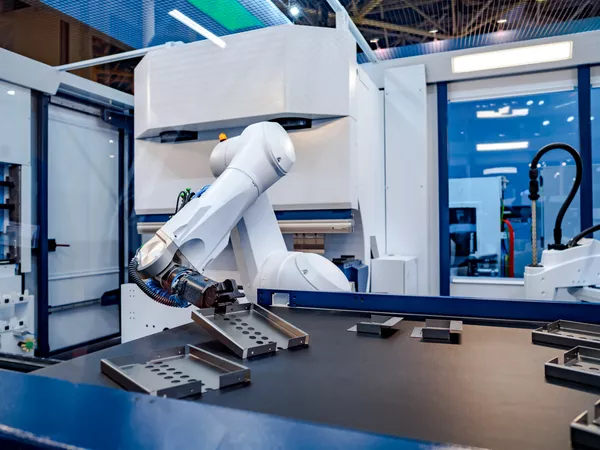
The rapid development of Artificial Intelligence (AI) has revolutionized robotic paradigms, which has led to recent advancement in the design of robotic and machinery mechanisms, actuators and sensors, as well as feedback control powered by AI. These advanced robotic systems are significantly enhancing potential applications across various domains, (e.g., industrial purposes, biomedical applications, agriculture, logistics and supply chain management, exploration of unknown environments, surveillance, etc.). Particularly noteworthy is the development of robots capable of safe and compliant interactions with unstructured environments, addressing many of the challenges that traditional mechanical and electrical systems have not been able to resolve. The motivation behind the development of these types of modern robots is to create systems that can interact seamlessly with their surroundings and make cognitive decisions based on proprioceptive and exteroceptive sensory feedback. To achieve these goals, multidisciplinary approaches have been employed, integrating material sciences, mechanical and electrical engineering, and computer science, as well as any other relevant interdisciplinary interests.
The objective of this Research Topics is to publish the latest advancements in cognitive robot design, from innovative mechanisms to sensory technologies, and signal processing, also including vision based, and transduction mechanism based sensors. More specifically, this Research Topic will aim to publish works including cutting-edge technologies and findings, covering topics such as design and modeling methodologies, hierarchical approaches to achieve desired performance, and advancements in sensory feedback and motion control.
In this Research Topic, we welcome cognitive robotics submission on topics including, not limited to:
• Actuator and Sensor
• Shape and Force sensing
• Computer vision
• 3D reconstruction and mapping
• Modeling and simulation
• Robotic application study
• Grasping and Manipulation
• Object tracking and recognition
• Multi-Object State Estimation
• Situational Awareness
• Information Fusion
This Research Topic is partnered with the workshop of the same theme which will take place at the 2025 edition of the International Conference on Control, Automation and Information Sciences (ICCAIS) taking place in Jeju, Korea, from October 27 - 29, 2025. We welcome contributions that are presented at the workshop, as well as relevant contributions from researchers who did not attend the event. Any contribution that was previously published as a conference proceeding should be extended to include 30% original content.
Article types and fees
This Research Topic accepts the following article types, unless otherwise specified in the Research Topic description:
Brief Research Report
Data Report
Editorial
FAIR² Data
FAIR² DATA Direct Submission
General Commentary
Hypothesis and Theory
Methods
Mini Review
Articles that are accepted for publication by our external editors following rigorous peer review incur a publishing fee charged to Authors, institutions, or funders.
Article types
This Research Topic accepts the following article types, unless otherwise specified in the Research Topic description:
Important note: All contributions to this Research Topic must be within the scope of the section and journal to which they are submitted, as defined in their mission statements. Frontiers reserves the right to guide an out-of-scope manuscript to a more suitable section or journal at any stage of peer review.