Embodied Intelligence for Next-Generation Agile Manufacturing

  • 1,013

    Total views and downloads

About this Research Topic

Submission deadlines

  1. Manuscript Submission Deadline 20 March 2026

  2. This Research Topic is currently accepting articles.

Background

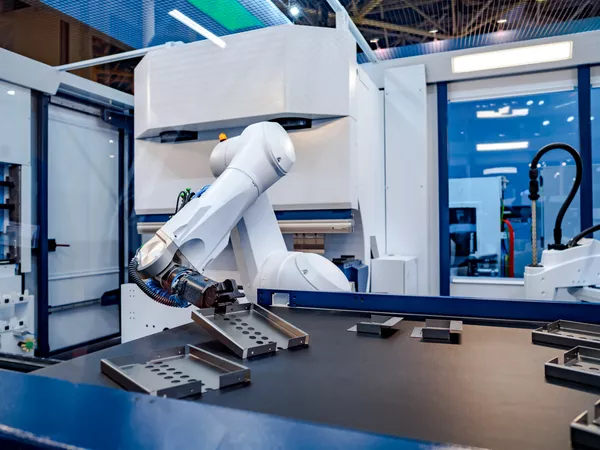
Modern manufacturing is at critical juncture that is facing unprecedented pressure from volatile supply chains, the demand for mass personalization and the need for greater operational resilience. Traditional automation while being efficient for mass production often lacks flexibility required for today’s high-mix and low-volume paradigm. The concept of Agile Manufacturing demands systems that can rapidly adapt to new products and unforeseen disruptions. Concurrently, the convergence of advanced robotics, sophisticated multi-modal sensing, and powerful AI has given rise to Physical AI Agents. These are not merely programmed machines but embodied intelligent systems that are capable of perceiving, reasoning and acting within complex and dynamic environments by offering transformative solution to these industrial challenges.

The primary goal of this Research Topic is to address the fundamental challenge of deploying autonomous and collaborative Physical AI Agents in real-world agile manufacturing settings. While recent advances in areas like deep reinforcement learning and large language models have shown immense promise in simulation, a significant gap remains in translating these successes to physical factory floors. This collection aims to bridge that gap by consolidating cutting-edge research that tackles key obstacles. We seek to explore novel learning paradigms that reduces need for extensive programming, enhance agent perception for robust operation and establish safe and intuitive protocols for human-agent collaboration thereby paving the way for truly intelligent and evolving manufacturing systems.

We invite contributions that address spectrum of challenges in Physical AI for Agile Manufacturing. Specific themes of interest include but are not limited to:
1) Learning and adaptation frameworks i.e., Robot Learning and VLA models;
2) Advanced perception and world modeling (i.e., sensor fusion, haptic sensing);
3) Safe and intuitive human-agent collaboration (i.e., shared autonomy);
4) System-level orchestration and multi-agent coordination;
5) Real-world case studies and application-driven research.

We welcome original research articles, review articles and perspective pieces that showcase novel algorithms, system architectures and tangible applications. The focus is on work that demonstrates clear progress towards creating more intelligent, autonomous and flexible manufacturing environments.

Article types and fees

This Research Topic accepts the following article types, unless otherwise specified in the Research Topic description:

  • Brief Research Report
  • Data Report
  • Editorial
  • FAIR² Data
  • Hypothesis and Theory
  • Methods
  • Mini Review
  • Original Research
  • Perspective

Articles that are accepted for publication by our external editors following rigorous peer review incur a publishing fee charged to Authors, institutions, or funders.

Keywords: Sim2Real Transfer, Deep Reinforcement Learning, Imitation Learning, Sensor Fusion, Industrial IoT, Digital Twining, Human-Robot Interaction, Fleet Management, Task and Motion Planning, Industry 4.0 Technologies, Multi-agent Sytems

Important note: All contributions to this Research Topic must be within the scope of the section and journal to which they are submitted, as defined in their mission statements. Frontiers reserves the right to guide an out-of-scope manuscript to a more suitable section or journal at any stage of peer review.

Topic editors

Manuscripts can be submitted to this Research Topic via the main journal or any other participating journal.

Impact

  • 1,013Topic views
View impact