SC
subhamoy chatterjee
Southwest Research Institute Boulder
Boulder, United States
986
Total views and downloads
Submit your idea
Select the journal/section where you want your idea to be submitted:
Manuscript Summary Submission Deadline 31 March 2026 | Manuscript Submission Deadline 31 July 2026
This Research Topic is currently accepting articles.
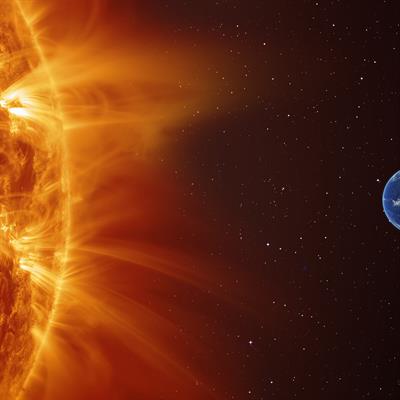
Solar Energetic Particles (SEPs) are a crucial component of space weather, presenting significant hazards to human activities and technological infrastructure both in orbit and on Earth. SEP events are characterized by substantial surges in energetic particle fluxes within the inner heliosphere, with origins primarily linked to solar flares and coronal mass ejections. The intricate and intertwined dynamics of SEP sources, acceleration, and transport render forecasting a formidable challenge. SEPs exhibit considerable variability due to diverse sources, acceleration mechanisms, and complex propagation through the heliosphere's magnetic field structures. The radiation hazard from SEPs poses risks to astronauts on space missions and to passengers on high-altitude polar flight routes. Additionally, high-energy SEPs can cause irreparable damage to spacecraft electronics, degrade solar panels, and disrupt communication systems. Despite decades of research efforts, existing SEP forecasting models continue to struggle with predicting onset times, intensity profiles, duration, and spectral characteristics, particularly for highest energy particles that pose greatest threats to modern technology and human activity in space.
This Research Topic seeks to address the pressing challenges that limit SEP forecasting capabilities, including: (1) the source population of SEPs (2) the acceleration processes under different solar and interplanetary conditions and (3) particle transport through the heliosphere's complex magnetic topology. Furthermore, accurate prediction of high-energy SEPs remains critical for effective forecasting and meeting the needs of operational priorities for space agencies and commercial space operators.
This Research Topic welcomes original research, reviews, perspectives, and technical reports addressing, but not limited to, the following themes:
• Observational challenges: Instrumentation limitations at high energies, data gaps, multi-viewpoint measurement needs, historic and Near-Real-Time observation capabilities
• SEP event characterization: Onset determination, evolution forecasting (rise time, peak flux, decay, duration), energetic storm particle (ESP) identification, and spectral evolution
• Key physical parameters: Solar source location, magnetic connectivity, behind-the-limb events, precursor activity, and early flare/CME signatures
• Forecasting methodologies: State-of-the-art models (physics-based, statistical, AI/ML, hybrid approaches) and their comparative performance
• Extreme events: Historical analysis, occurrence probability, and preparedness strategies
• Impacts and mitigation: Effects on space systems, radiation belts, human health in space and aviation, and protective measures
• Related phenomena: SEP acceleration by different drivers (CMEs vs. CIRs), electron events, and magnetospheric responses.
Conflict of Interest Statement
Dr. Kathryn Whitman is a contractor working for NASA SRAG (Space Radiation Analysis Group) and an employee of KBR Inc (Houston, TX, US).
This Research Topic accepts the following article types, unless otherwise specified in the Research Topic description:
Articles that are accepted for publication by our external editors following rigorous peer review incur a publishing fee charged to Authors, institutions, or funders.
Keywords: Solar Energetic Particles (SEPs), Operational Space Weather, Extreme SEP events, Challenges in SEP measurements, SEP effects on Geospace
Important note: All contributions to this Research Topic must be within the scope of the section and journal to which they are submitted, as defined in their mission statements. Frontiers reserves the right to guide an out-of-scope manuscript to a more suitable section or journal at any stage of peer review.

Manuscripts can be submitted to this Research Topic via the main journal or any other participating journal.
Submit your idea
Select the journal/section where you want your idea to be submitted: