
New Players on the Monoaminergic Field: Relevance to the Mental Disorders

Cover image for Research Topic "New Players on the Monoaminergic Field: Relevance to the Mental Disorders"
58kviews
Editorial: New players on the monoaminergic field: relevance to the mental disorders
Editorial14 October 2024
Editorial: New players on the monoaminergic field: relevance to the mental disorders

It is well established that monoamines, such as serotonin (5-HT), noradrenaline, and dopamine, are fundamental in emotions and mood regulation. They also play a key role in the pathophysiology and treatment of mood disorders, such as unipolar and bipolar depression, as well as anxiety disorders, such as generalized anxiety, obsessive-compulsive, panic, and post-traumatic stress disorders [1]. We may underline three factors that are of critical importance for the proper understanding of the role of monoamines in mood disorders. The first one is the autoregulatory mechanism within the monoaminergic circuits [2]. The second one is the multiple crossinteraction between different monoamines [3]. The third factor is the crosstalk between monoamines and other bioactive molecules influencing mood regulation and mental functions in general. Examples of particularly important bioactive molecules are amino acid neurotransmitters, trace amines (biological amines biochemically related to the "classical" monoamines, but present in the brain in trace concentrations, such as tyramine, octopamine, and tryptamine), corticosteroids, adenosine, endogenous opioids, and cannabinoids (Fig 1).While the auto-and cross-regulatory mechanisms of the central monoaminergic systems have been extensively studied in the last decades, the crosstalk between monoamines and specific other biomolecules involved in mood regulation received lesser attention. This collection of articles was prepared in order to diminish this gap in knowledge and to stimulate future research in this direction.The task was completed thanks to the international team of researchers, coming from different parts of the world (Asia, America, Europe) and employment sectors (universities, public hospitals and research centers, and industrial enterprises). These researchers contributed their outstanding articles addressing the abovementioned points.Sha Zhao and colleagues from the Qingdao University, Qingdao, China, provided a review article on endocannabinoid-monoamine interactions, learning, and memory. Elad Lerer and co-authors from the Hadassah Medical Center, Jerusalem, Israel, contributed original research on the neurochemical mechanisms underlying putative beneficial effect of psychedelics in mental disorders. Daniela Jezova with Eliyahu Dremencov and their co-authors from the Biomedical Research Center and Centre of Biosciences, Slovak Academy of Sciences, Bratislava, Slovakia, shared with us an original research article on functional interactions between monoamines, glutamate, and endogenous opioids, focusing on prenatal effect of the ligands of opioid receptors on monoaminergic and glutamatergic transmission. Stephen Daniels and co-authors from the Institute of Mental Health Research, University of Ottawa, Ottawa, Canada, prepared an original research paper on glutamate-monoamine interactions and their role in the rapid antidepressant effect of ketamine. Hurmat Malik and co-contributors from the COMSATS University Islamabad, Islamabad, Pakistan, shared with us the results of their research on the interactions between monoamines, adenosine, microelements and steroids, with a practical focus on the putative anxiolytic and antidepressant-like effects of a natural element, diosgenin. Karolina Kolaczynska and Legend to the Figure Figure 1: Functional interactions between monoamines and other signaling biomolecules. VTA DA, ventral tegmental area dopamine neuron, LC NA, locus coeruleus noradrenaline neuron, TMN HA, tuberomammillary nucleus histamine neuron, DRN 5-HT, dorsal raphe nucleus serotonin (5-HT) neuron, ARN BEN, arcuate nucleus β-endorphin neuron, PFC GLU, prefrontal cortex glutamate neuron, A2A, adenosine-2A receptor, D2, dopamine-2 receptor, α1/2-alpha-1/2 adrenoceptor, H1/3histamine-1/3 receptor, 5-HT1A, serotonin-1A receptor, DOR-δ-opioid receptor, GR, glucocorticoid receptor, NMDA, N-methyl-D-aspartate glutamate receptor, CB1, cannabinoid-1 receptor, TAAR1, trace amine associated receptor 1, CS, corticosteroids, EC, endocannabinoids, +, stimulatory effect, -, inhibitory effect. According to [3; 4; 5; 6; 7; 8; 9].
1,712 views

Effects of psilocybin, psychedelic mushroom extract and 5-hydroxytryptophan on brain immediate early gene expression: Interaction with serotonergic receptor modulators
BRIEF RESEARCH REPORT
18 April 2024
Effects of psilocybin, psychedelic mushroom extract and 5-hydroxytryptophan on brain immediate early gene expression: Interaction with serotonergic receptor modulators
Elad Lerer, 7 more and Tzuri Lifschytz
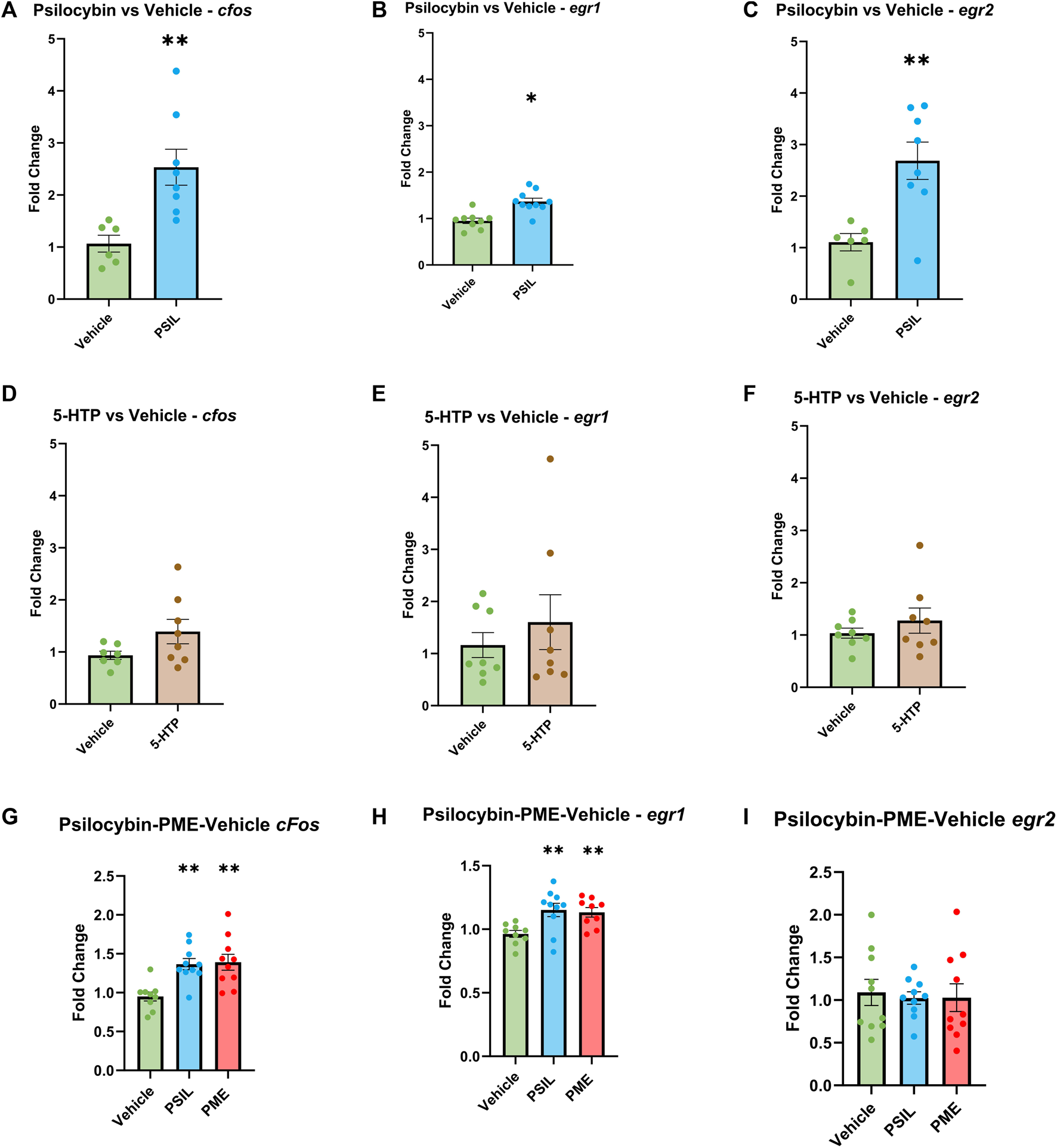
Immediate early genes (IEGs) are rapidly activated and initiate diverse cellular processes including neuroplasticity. We report the effect of psilocybin (PSIL), PSIL-containing psychedelic mushroom extract (PME) and 5-hydroxytryptophan (5-HTP) on expression of the IEGs, cfos, egr1, and egr2 in mouse somatosensory cortex (SSC). In the initial experiment, male C57Bl/6j mice were injected with PSIL 4.4mg/kg or 5-HTP 200mg/kg, alone or immediately preceded by serotonergic receptor modulators. IEG mRNA expression one hour later was determined by real time qPCR. PSIL but not 5-HTP significantly increased expression of all three IEGs. In a replication study, in which a group of mice treated with PME was added, PSIL and PME upregulated levels of egr1 and cfos, while the upregulation of egr2 was not significant. No correlation was observed between the head twitch response (HTR) induced by PSIL and its effect on the IEGs. The serotonergic receptor modulators did not significantly alter PSIL-induced IEG expression, with the exception of the 5-HT2C antagonist )RS102221(, which significantly enhanced PSIL-induced egr2 expression. 5-HTP, at a dose sufficient to induce significant HTR, did not affect any of the IEGs. We have shown that PSIL and PME but not 5-HTP induced a significant increase in cfos and egr1 expression in mouse SSC. Our findings suggest that egr1 and cfos expression may be associated with psychedelic effects.

16,155 views

17 citations

MINI REVIEW
14 August 2024
Cannabinoids and monoaminergic system: implications for learning and memory
Sha Zhao, 3 more and Yuan Dong

5,979 views

9 citations

Receptor Interaction Profiles of 4-Alkoxy-3,5-Dimethoxy-Phenethylamines (Mescaline Derivatives) and Related Amphetamines
3,4,5-Trimethoxyphenethylamine (mescaline) is a psychedelic alkaloid found in peyote cactus. Related 4-alkoxy-3,5-dimethoxy-substituted phenethylamines (scalines) and amphetamines (3C-scalines) are reported to induce similarly potent psychedelic effects and are therefore potential novel therapeutics for psychedelic-assisted therapy. Herein, several pharmacologically uninvestigated scalines and 3C-scalines were examined at key monoamine targets in vitro. Binding affinity at human serotonergic 5-HT1A, 5-HT2A, and 5-HT2C, adrenergic 1A and 2A, and dopaminergic D2 receptors, rat and mouse trace amine-associated receptor 1 (TAAR1), and human monoamine transporters were assessed using target specific transfected cells. Furthermore, activation of human 5-HT2A and 5-HT2B receptors, and TAAR1 was examined. Generally, scalines and 3C-scalines bound with weak to moderately high affinity to the 5-HT2A receptor (Ki = 150–12000 nM). 3C-scalines showed a marginal preference for the 5-HT2A vs. the 5-HT2C and 5-HT1A receptors whereas no preference was observed for the scalines. Extending the 4-alkoxy substituent increased 5-HT2A and 5-HT2C receptors binding affinities, and enhanced activation potency and efficacy at the 5-HT2A but not at the 5-HT2B receptor. Introduction of fluorinated 4-alkoxy substituents generally increased 5-HT2A and 5-HT2C receptors binding affinities and increased the activation potency and efficacy at the 5-HT2A and 5-HT2B receptors. Overall, no potent affinity was observed at non-serotonergic targets. As observed for other psychedelics, scalines and 3C-scalines interacted with the 5-HT2A and 5-HT2C receptors and bound with higher affinities (up to 63-fold and 34-fold increase, respectively) when compared to mescaline. The present in vitro data indicates that 3C-P and BZ are likely to induce psychedelic-like psychoactive effects in humans

13,580 views

15 citations