In the original article, there was a mistake in Figure 1 as published. In the age model the x-axis scale was incorrect due to an outdated calibration. The corrected Figure 1 appears below.
FIGURE 1
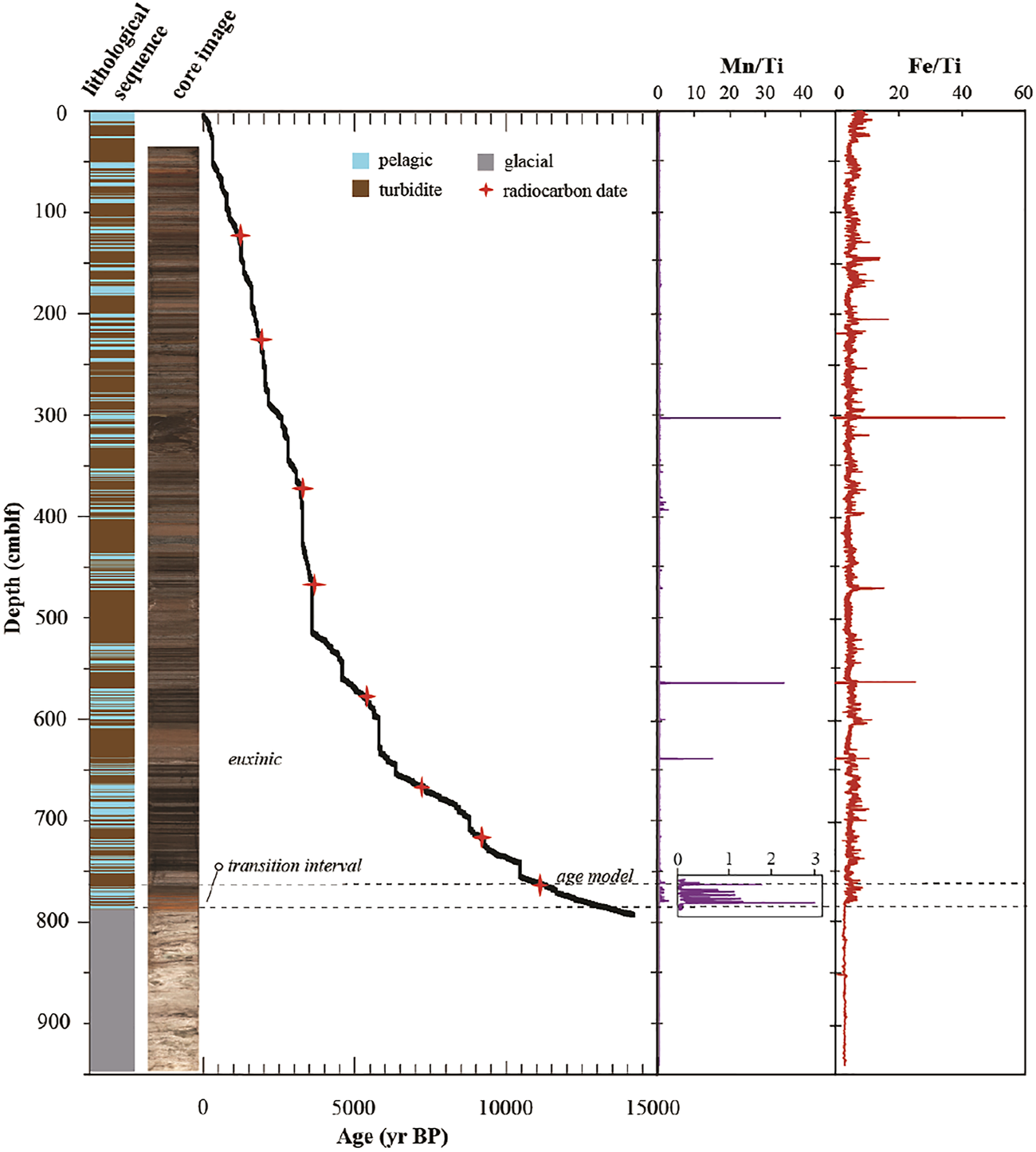
(Left) Lithological profile determined from a composite core image of the sedimentary sequence retrieved from Lake Cadagno. The age model was calibrated with previously obtained radiocarbon dates from corresponding sedimentary layers (Wirth et al., 2013). (Right) XRF profiles of Fe/Ti and Mn/Ti. Inset shows the Mn enrichment in the redox transition interval.
In the original article, there was also a mistake in Figure 6 as published. The black line delimiting surface and euxinic sections was misplaced and should lie below 44 cm. The corrected Figure 6 appears below.
FIGURE 6
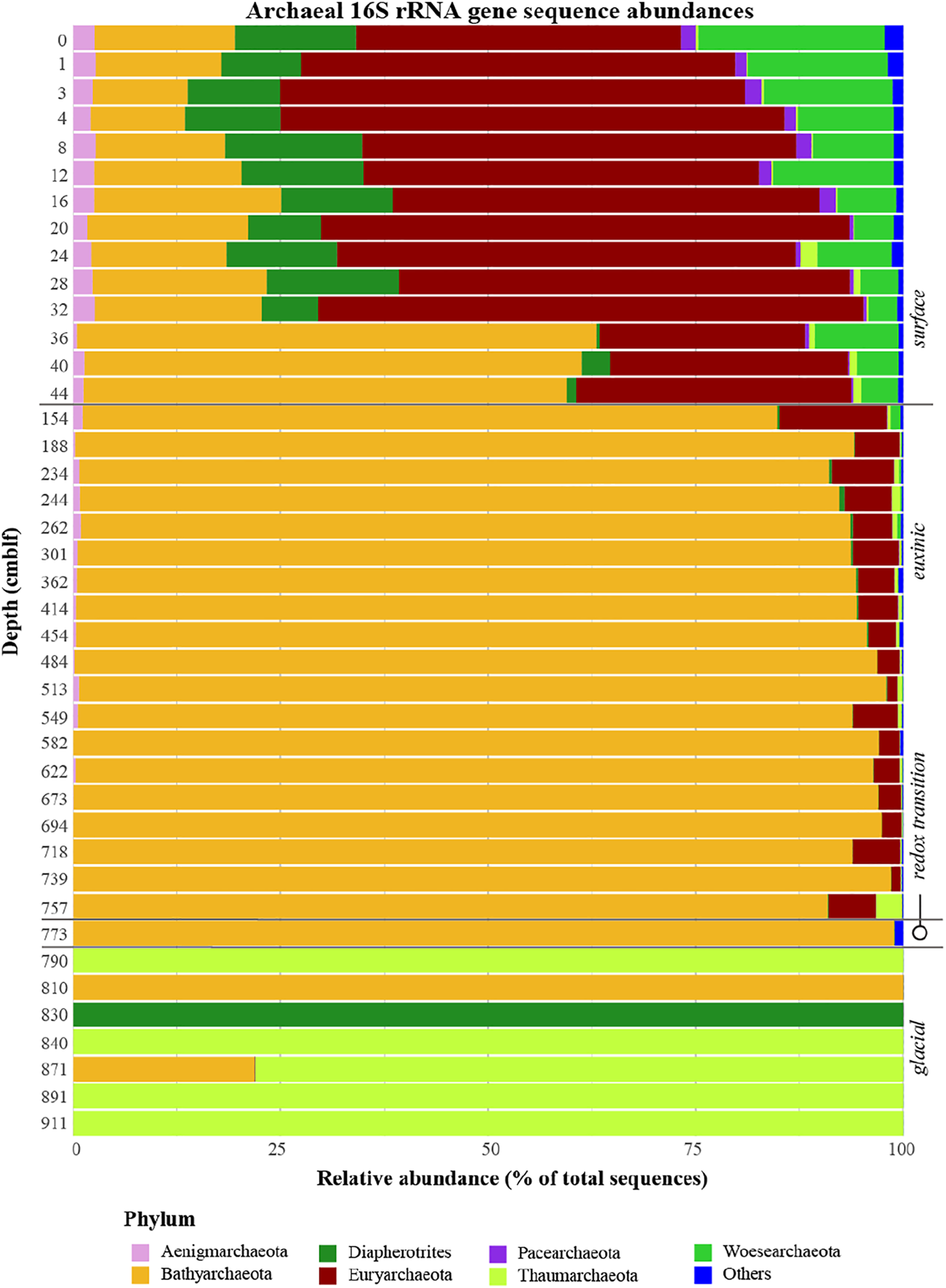
Relative abundances of Archaeal 16S rRNA gene sequences with depth. Sediment geological transitions are indicated on the right.
In the original article, there was an error in the text. The dates corresponding to sediment depth 760 and 780 cm were incorrectly transcribed throughout the text.
A correction has been made to the section Results, sub-section “Lithological description and age model for Lake Cadagno sediment cores”, Paragraph 1:
“The chronology of the 2019 core composite is based on 9 radiocarbon dates which were transferred from the previously studied 2009 Lake Cadagno core succession (Wirth et al., 2013). Transfer of dates is based on aligning the characteristic lithologies from which the dates were obtained between the two composite sediment core successions. Upon age-depth modeling using linear interpolation and the clam R software package (Version 2.4.0; Blaauw, 2010), 14C ages were converted into calibrated 14C ages (cal kyr BP) using the IntCal20 calibration curve (Reimer et al., 2020). We removed event deposits (flood layers, slumps) >2 mm prior to age-depth modelling and reinserted these into the chronostratigraphy following age-depth modeling using a constant age for each individual deposit.”
Another correction has been made to the section Results, sub-section “Lithological description and age model for Lake Cadagno sediment cores”, Paragraph 1:
“The radiocarbon ages of the lacustrine sediment succession from 780 cm to the sediment-water interface documents continuous sedimentation during the past ∼12.5 kyrs (Figure 1). Based on this age-model we estimate the duration of the transition period with Mn-oxide layer deposition to have lasted between ∼12.5 (780 cm) to ∼10.9 (760 cm) kyrs BP. Euxinic conditions persisted continuously since 10.9 (760 cm) kyrs BP.”
A correction has been made to the section Results, sub-section “Geochemical gradients across the 13.5-kyr subsurface sedimentary record”, Paragraph 3:
“The distinct chemical and isotopic changes between 670 and 790 cm appear to be associated with a lithological transition at 760–780 cm associated with a large Mn excursion (Figure 1), which corresponds to the anoxic-oxic transition period at 10.9–12.5 kyrs.”
A correction has been made to the section Discussion, Paragraph 2:
“Sediment deposited during the anoxic-oxic transition period 10.9–12.5 kyrs (780–760 cm) is rich in Mn-, carbonate, and organic matter indicating a change in lake stratification conditions.”
A correction has also been made to the section Discussion, sub-section “Euxinic and redox transition sediment geochemistry and microbiology reflect depositional conditions”, Paragraph 2:
“The Mn-rich layers just below (760–780 cm) correspond to the redox transition period from 12.5 to 10.9 kyrs. The sediment region corresponding to the onset of complete anoxia at 10.9 kyrs (760 cm) is characterized by a higher content of TOC (Figure 2A), which was likely preserved due to decreased remineralization during anoxia, enhanced primary productivity due to warming and deglaciation.”
The authors apologize for these errors and state that this does not change the scientific conclusions of the article in any way. The original article has been updated.
Statements
Publisher’s note
All claims expressed in this article are solely those of the authors and do not necessarily represent those of their affiliated organizations, or those of the publisher, the editors and the reviewers. Any product that may be evaluated in this article, or claim that may be made by its manufacturer, is not guaranteed or endorsed by the publisher.
References
1
BlaauwM. (2010). Methods and Code for 'classical' Age-Modelling of Radiocarbon Sequences. Quat. Geochronol.5, 512–518. 10.1016/j.quageo.2010.01.002
2
ReimerP. J.AustinW. E. N.BardE.BaylissA.BlackwellP. G.Bronk RamseyC.et al (2020). The IntCal20 Northern Hemisphere Radiocarbon Age Calibration Curve (0-55 Cal kBP). Radiocarbon62, 725–757. 10.1017/RDC.2020.41
Summary
Keywords
lake sediments, deep biosphere, bacteria, archaea, redox gradients
Citation
Berg JS, Lepine M, Laymand E, Han X, Vogel H, Morlock MA, Gajendra N, Gilli A, Bernasconi SM, Schubert CJ, Su G and Lever MA (2022) Corrigendum: Ancient and Modern Geochemical Signatures in the 13,500-Year Sedimentary Record of Lake Cadagno. Front. Earth Sci. 10:912255. doi: 10.3389/feart.2022.912255
Received
04 April 2022
Accepted
19 April 2022
Published
10 May 2022
Volume
10 - 2022
Edited and reviewed by
Christophe Monnin, UMR5563 Géosciences Environnement Toulouse (GET), France
Updates
Copyright
© 2022 Berg, Lepine, Laymand, Han, Vogel, Morlock, Gajendra, Gilli, Bernasconi, Schubert, Su and Lever.
This is an open-access article distributed under the terms of the Creative Commons Attribution License (CC BY). The use, distribution or reproduction in other forums is permitted, provided the original author(s) and the copyright owner(s) are credited and that the original publication in this journal is cited, in accordance with accepted academic practice. No use, distribution or reproduction is permitted which does not comply with these terms.
*Correspondence: Jasmine S. Berg, jasmine.berg@unil.ch
† Present address: Jasmine S. Berg, Institute of Earth Surface Dynamics (IDYST), University of Lausanne, Lausanne, Switzerland Xingguo Han, Federal Institute for Forest, Snow, and Landscape Research (WSL), Birmensdorf, Switzerland Marina A. Morlock, Department of Ecology and Environmental Sciences, Umeå Universitet, Umeå, Sweden
This article was submitted to Biogeoscience, a section of the journal Frontiers in Earth Science
Disclaimer
All claims expressed in this article are solely those of the authors and do not necessarily represent those of their affiliated organizations, or those of the publisher, the editors and the reviewers. Any product that may be evaluated in this article or claim that may be made by its manufacturer is not guaranteed or endorsed by the publisher.