Abstract
Microplastics are increasingly recognized as a pervasive pollutant in both aquatic and terrestrial environments, raising pressing concerns about their ecological impacts and implications for human health. Traditional detection and quantification methods—including manual microscopy and standalone spectroscopic techniques—offer reliable accuracy but are limited by labor-intensive procedures and low throughput. Recent advances in machine learning (ML) have revolutionized the field of microplastic research by automating and enhancing detection processes. In particular, algorithms such as support vector machines, random forests, and convolutional neural networks have demonstrated considerable success in classifying microplastics based on chemical signatures and visual characteristics. This review offers a comprehensive overview of ML approaches utilized for monitoring microplastic contamination across diverse aquatic settings. Spectral techniques, including infrared and Raman spectroscopy, leverage molecular vibrations to facilitate highly specific identification of polymer types, even within heterogeneous matrices. Image-based methods make use of sophisticated computer vision techniques to classify microplastics by shape, size, and color, reducing the subjectivity inherent in manual counting. Extending these capabilities further, hyperspectral imaging combines spatial and spectral data to generate comprehensive chemical maps, enabling the simultaneous assessment of polymer composition and distribution. Integrating ML algorithms into these various approaches has improved sensitivity, speed, and scalability, thereby addressing critical challenges in high-throughput and real-time monitoring. Despite these advances, key obstacles remain, including the need for larger, higher-quality datasets and the development of robust models capable of handling complex environmental conditions. Nevertheless, ongoing improvements in imaging hardware and ML methodologies hold significant promise for establishing more effective, automated, and accurate strategies for microplastic detection. By providing a comprehensive overview of current technologies and future opportunities, this review aims to guide researchers and stakeholders in developing science-based solutions for mitigating the global threat of microplastic pollution.
Introduction
The emergence of microplastics in aquatic environments has become a significant environmental challenge, posing substantial risks to marine life and human health. Microplastics are plastic particles typically smaller than 5 mm in diameter (Moore, 2008; Zarfl et al., 2011). They originate from a wide array of sources—including the fragmentation of larger plastic debris, cosmetics, synthetic textiles, and industrial activities—and have been detected in aquatic ecosystems across the globe (Andrady, 2011; Cole et al., 2011; Eriksen et al., 2014; Mao et al., 2020; Xu S. et al., 2020). These contaminants include primary microplastics (manufactured particles used in product) and secondary microplastics (fragments generated by the breakdown of large plastics) (Browne et al., 2011; Cole et al., 2011). Due to their durability and small size, these contaminants spread extensively and infiltrate diverse habitats and ecosystems, rendering microplastics persistent, pervasive pollutants (Barnes et al., 2009).
Microplastic pollution exerts adverse impacts not only on the environment but also on public health (Barnes et al., 2009; Rochman et al., 2013). Because these particles are ubiquitous in both marine and terrestrial ecosystems, they are ingested by a broad spectrum of organisms—from plankton to larger marine fauna (Barboza and Gimenez, 2015; Lusher et al., 2015; Bhatt and Chauhan, 2023). Such ingestion can cause physical damage, hinder feeding, and expose organisms to adsorbed toxins or pathogens (Rochman et al., 2013; Wright et al., 2013; Curto et al., 2021). The risks intensify as microplastics accumulate and biomagnify up the food chain. Beyond ingestion, microplastics can disrupt natural habitats, contribute to biodiversity loss, and serve as vectors for other pollutants. Human health implications are also evident: microplastics may enter our bodies through contaminated water and seafood, raising concerns about food safety and public wellbeing (Wright et al., 2013). These multifaceted ecological and health repercussions underscore the urgent need for enhanced research and robust management strategies (Barboza and Gimenez, 2015).
Effective monitoring of microplastic pollution is imperative for mitigating its ecosystem-level and public health impacts (GESAMP, 2015). As these particles disperse widely through different environments, documenting their concentrations and movements is essential for understanding their ecological footprint. Advanced predictive models are particularly valuable, as they forecast the dispersion and identify likely accumulation zones of microplastics (Löder and Gerdts, 2015). Such models play a crucial role in pinpointing high-risk areas and informing the creation of targeted environmental policies and cleanup initiatives. In tandem, monitoring programs offer real-time data on pollution levels, providing key metrics to assess the efficacy of enacted measures and to raise public awareness (Napper and Thompson, 2020). Collectively, rigorous monitoring and modeling efforts form a holistic approach to addressing the escalating challenges of microplastic pollution.
Despite progress in understanding microplastic contamination, the detection and quantification of these particles remain technically demanding. The small size and diverse chemical composition of microplastics complicate analyses, particularly in complex environmental matrices like seawater, sediments, and biota, each often requiring extensive sample preparation to isolate microplastics. Traditional approaches—such as visual sorting and manual counting—are time-intensive and prone to errors, especially when particles measure less than 1 mm. Advanced spectroscopic techniques like Fourier-transform infrared spectroscopy (FTIR) and Raman spectroscopy yield more accurate identifications but can be both expensive and time-consuming (Hidalgo-Ruz et al., 2012). Additionally, the absence of standardized protocols hampers data comparability across different investigations (Shim et al., 2016). Together, these challenges underscore the need for more efficient, reliable methods to detect and quantify microplastics, steps that are essential for accurately gauging pollution levels and guiding impactful mitigation efforts.
In light of these complexities, adopting innovative monitoring and predictive strategies is essential (Blettler et al., 2018). Machine learning (ML)—a domain of artificial intelligence—has begun to revolutionize environmental science by offering advanced tools for complex data analytics and forecasting (Koelmans et al., 2019). Owing to its capacity to handle large, complex datasets, ML is particularly well-suited to revealing patterns and anomalies that might remain hidden using conventional methods (Thompson et al., 2009; Löder and Gerdts, 2015).
The utility of ML in environmental research extends beyond microplastics, encompassing applications such as climate change modeling, biodiversity conservation, pollution assessment, and waste management (Zhang et al., 2017; Reichstein et al., 2019). These diverse case studies highlight ML’s versatility and demonstrate its transformative potential to address the most pressing environmental challenges (Olden et al., 2008; Tuia et al., 2022; Kazi, 2025). In microplastic research specifically, ML algorithms excel at uncovering correlations in large environmental datasets, enabling more accurate predictions of microplastic dispersion, concentration hotspots, and movement trajectories (Su et al., 2023). By integrating diverse data sources—from satellite imagery and water samples to chemical composition analyses—ML-based methods can significantly enhance the detection and quantification processes (Koelmans et al., 2019; Prata et al., 2020). Taken together, these capabilities offer a more comprehensive view of microplastic pollution, paving the way for stronger, evidence-based mitigation strategies.
In this review, we examine the evolving role of ML in microplastic research. We discuss a range of applications that deepen our understanding of the distribution, concentration, and biological impacts of microplastics and illustrate how data-driven insights can inform policy and management. By harnessing the power of ML, researchers can detect previously hidden patterns, develop more precise models of microplastic spread, and craft more effective interventions. We conclude by highlighting emerging directions for future work, aiming to inspire further integration of ML techniques into the study and remediation of microplastic pollution.
Machine learning methodologies in microplastic prediction
ML methodologies have become integral to predicting and understanding microplastic pollution in aquatic environments. By leveraging their capacity to process large, complex datasets, ML approaches often surpass traditional statistical methods in environmental studies (Su et al., 2023). Within the scope of microplastic research, such algorithms integrate diverse data sources—ranging from satellite imagery and oceanographic measurements to in situ field samples—to construct accurate models of microplastic distribution, concentration, and movement. In particular, supervised learning methods (e.g., random forests, support vector machines) and unsupervised techniques (e.g., clustering algorithms), along with deep learning approaches (e.g., convolutional neural networks), have been applied to identify, measure, and predict microplastic contamination across various aquatic ecosystems (Nesterovschi et al., 2023).
The incorporation of ML tools signifies a critical advancement in environmental research, equipping scientists with more powerful and nuanced analytical capabilities than conventional methods. These innovations are widely regarded as essential for robust monitoring and effective management of microplastic pollution, thereby fostering more proactive environmental stewardship (Chantry et al., 2021). For instance, real-time data from remote sensing platforms—when coupled with ML-based predictive models—can pinpoint high-risk accumulation areas, guide policy interventions, and streamline targeted cleanup efforts. However, ML approaches are used to augment, not fully replace, conventional methods. Traditional microscopy and spectroscopy without ML maintain proven accuracy but are extremely labor-intensive and time-consuming (Song et al., 2021), whereas ML-driven methods offer high-throughput automation at the expense of requiring significant data and computing resources (Sarker, 2021a).
A comprehensive evaluation of ML models typically employs a suite of performance metrics and techniques (Figures 1A–C). Metrics such as accuracy, precision, recall, F1-score, and the area under the receiver operating characteristic (ROC) curve each illuminate different strengths and limitations of a given model. Cross-validation strategies, confusion matrices, and sensitivity analyses further refine these insights by indicating how well the model generalizes to new datasets or conditions. Using multiple assessment approaches in concert not only affords a fuller understanding of each model’s capabilities but also directs researchers toward more informed decisions concerning model refinement and deployment. These rigorous evaluative practices ensure that ML-driven solutions for microplastic prediction remain both robust and adaptable to the inherent variability of natural systems. In practice, many studies apply k-fold cross-validation to ensure models perform well on unseen data and to avoid overfitting (Lee and Jhang, 2021). Additionally, hyperparameter tuning and regularization during model training are employed to optimize performance without overtraining.
FIGURE 1
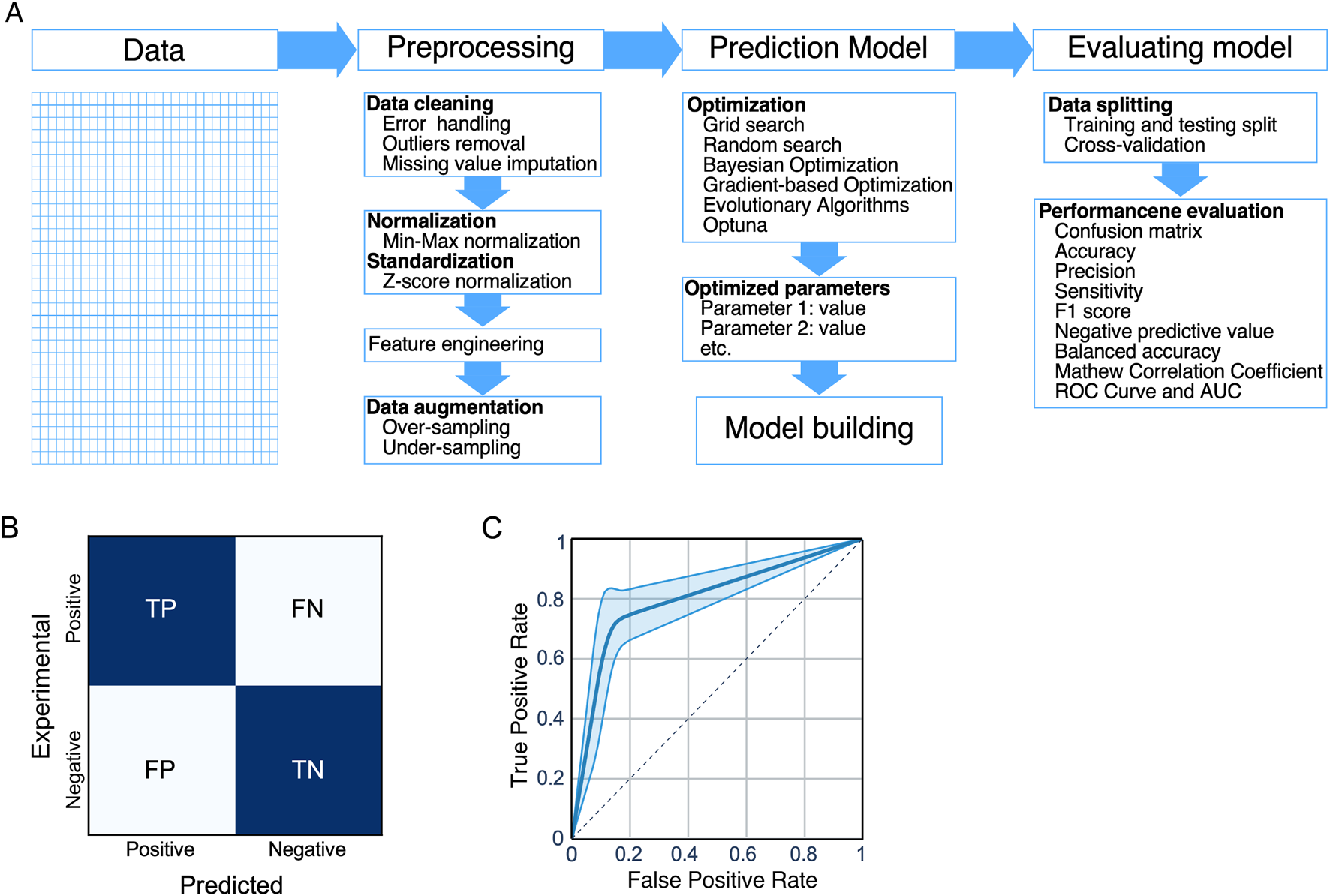
Optimization and Evaluation of Predictive Models. (A) Illustrates the comprehensive methodology for data preprocessing, including cleaning, normalization, feature engineering, and augmentation, followed by model optimization through techniques such as grid search, random search, and Bayesian optimization. This panel emphasizes the significance of preparing data and selecting optimal parameters to enhance model performance. Evaluation metrics, including accuracy, precision, sensitivity, and the ROC curve, are detailed, highlighting the rigorous assessment of model efficacy. (B) The confusion matrix depicted provides a visual comparison of experimental versus predicted values, offering insights into the model’s predictive accuracy by displaying the number of true positives, false positives, true negatives, and false negatives. This visualization aids in understanding the model’s performance in classifying data accurately. (C) Features the Receiver Operating Characteristic (ROC) curve, plotting the True Positive Rate (Sensitivity) against the False Positive Rate (1-Specificity) at various threshold settings. The area above the dashed line represents the model’s performance exceeding random chance, with points further away from the line indicating higher predictive accuracy. This curve is crucial for evaluating the trade-offs between sensitivity and specificity in model predictions.
Supervised and unsupervised learning
Supervised and unsupervised learning are two essential ML classes widely used in microplastic research (Figure 2), each distinguished by their specific methodologies and applications (Sarker, 2021b). Supervised learning algorithms are applied for tasks involving prediction or classification based on already-known output data (Rafique et al., 2021; Kazi, 2023). This application is evident in scenarios like distinguishing between different types of microplastics or predicting contamination levels based on previously analyzed samples. Unsupervised learning is highly effective in exploring data patterns where there are no pre-established categories. This approach is invaluable for uncovering unknown patterns or groupings in microplastic data, such as identifying areas with high levels of contamination or discovering new classes of microplastic pollutants based on their properties (Zhang Y. et al., 2023).
FIGURE 2
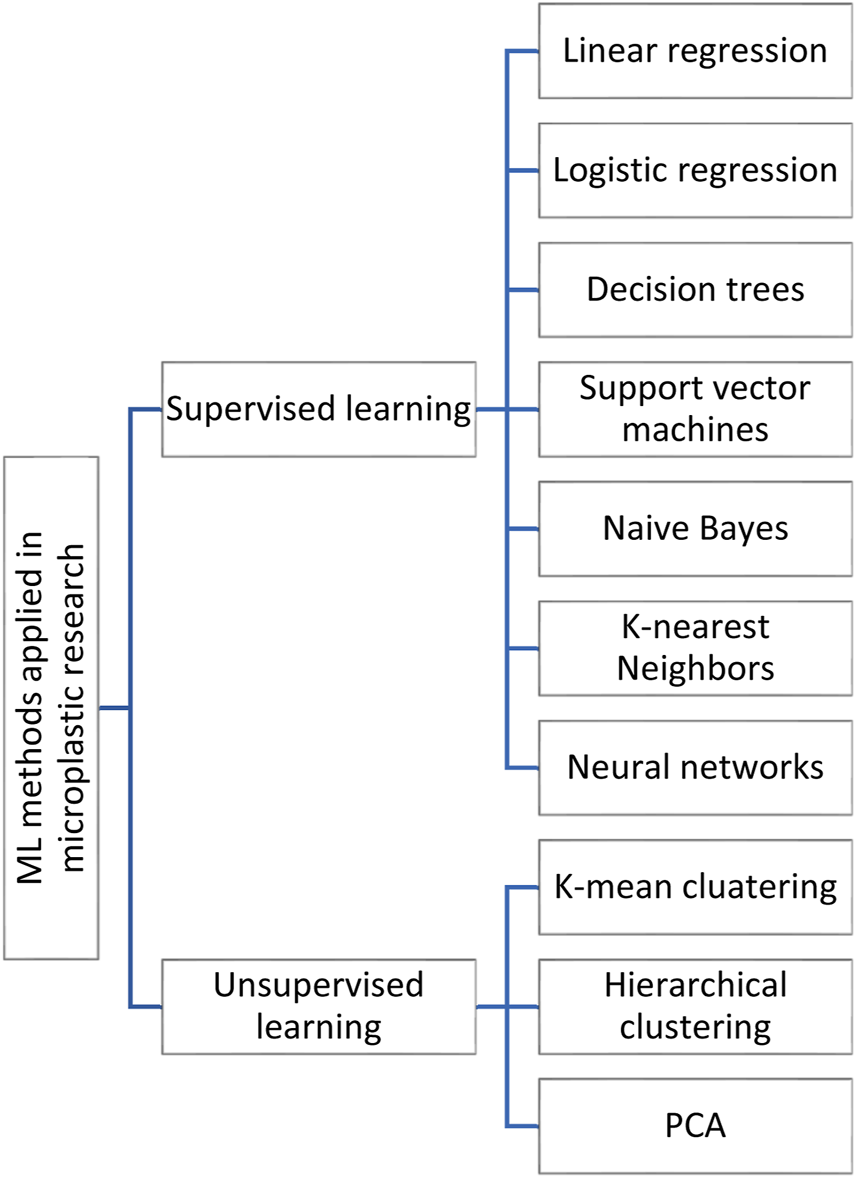
Schematic overview of ML methods commonly employed in microplastic research. Methods are categorized under supervised learning (linear regression, logistic regression, decision trees, support vector machines, naïve Bayes, k-nearest neighbors, and neural networks) and unsupervised learning (k-means clustering, hierarchical clustering, and principal component analysis). The figure highlights how supervised learning algorithms are used to predict or classify microplastic-related phenomena based on labeled data, while unsupervised methods are instrumental in uncovering hidden patterns and structures in unlabeled datasets.
Supervised learning algorithms are a diverse set of tools designed to infer a function from labeled training data, allowing for predictions or classifications on new, unseen data. Application of some prominent supervised learning algorithms in the field of microplastic including linear regression, logistic regression, decision trees, support vector machines, Naive Bayes, k-Nearest Neighbors (k-NN), and neural networks have been discussed below.
Unsupervised learning techniques, such as clustering and dimensionality reduction, have emerged as valuable tools in microplastic research because they reveal hidden patterns in large, unlabeled datasets. By using methods like k-means, hierarchical clustering, and principal component analysis (PCA), researchers can group microplastic particles based on physical features (size, shape) and chemical signatures (FTIR or Raman spectral profiles) without the need for extensive manual labeling. This is particularly advantageous given the high variability of microplastic properties and the challenge of analyzing massive sample collections. In practice, clustering allows automatic segregation of polymer types, while dimensionality reduction methods make it easier to visualize and interpret complex spectral data.
Despite these benefits, several obstacles remain. Heterogeneous data collection methods, differences in sample preparation, and the complexity of spectral measurements can limit both reproducibility and interpretability. Addressing missing values adds another layer of complexity (Younus et al., 2024; Mousafi Alasal et al., 2025). Additionally, large-scale adoption of unsupervised methods necessitates robust infrastructure capable of managing high-throughput spectral or imaging data. Future directions are likely to focus on integrating domain knowledge into algorithm design, standardizing data processing protocols, and advancing automated systems that streamline end-to-end analysis.
Data for microplastic contamination research
Research on microplastic contamination has gained prominence in environmental science due to growing evidence that microplastics represent a pervasive pollutant with potential threats to both wildlife and human health (Larue et al., 2021; Blackburn and Green, 2022). These minute plastic particles occur in a wide range of environments—from oceans and freshwater systems to terrestrial habitats—prompting extensive efforts to determine their prevalence, distribution, and ecological impacts. A cornerstone of these endeavors is the availability of diverse databases and resources that collectively advance our understanding of microplastic pollution (Kunz et al., 2023; Zhen et al., 2023).
Among the most influential global resources is the Global Microplastics Initiative, which relies on citizen science to compile and analyze data on microplastic contamination. This grassroots effort is complemented by the NOAA Microplastics Database, primarily focused on marine environments and providing insights into the impacts of microplastics on oceanic ecosystems (Jenkins et al., 2022; Nyadjro et al., 2023). Likewise, the United Nations Environment Programme (UNEP) and GRID-Arendal’s Marine Litter Database constitutes a vital repository for information on marine debris, including microplastics, enabling in-depth investigations into the complexities of marine pollution.
A significant advancement in this area is the application of ML models, which depend on robust datasets to drive the development of predictive and classification tools (Su et al., 2023). These datasets must be carefully structured—often in tabular form—and encompass a variety of data types, ranging from high-resolution imagery to categorical and numeric attributes (Coleman, 2025). Capturing the physical, chemical, and biological characteristics of microplastics is crucial, particularly features such as shape, spectral signatures, and potential pollutant adsorption (Lin et al., 2022). Reliable and high-quality datasets, typically derived from experimental research and monitoring programs, play a critical role in validating ML-based predictions. Although resource and sampling constraints can limit the size and quality of these datasets, proper selection of data sources is key to realizing the full potential of ML in microplastic research (Yu and Hu, 2022).
Microplastic contamination research inherently spans multiple scientific disciplines, drawing on expertise in environmental science, analytical chemistry, marine biology, and public health (Gray et al., 2018; Lusher et al., 2021). The databases described above thus serve as invaluable repositories of data and relevant literature, laying the groundwork for assessing the extent, origins, and ecological consequences of microplastics. They also inform the design of mitigation strategies and remediation plans. Looking ahead, the field is poised for further growth through the development of specialized databases dedicated solely to microplastic studies. These evolving resources will enable more holistic and data-driven examinations of microplastic pollution, supporting efforts to address one of the most pressing environmental challenges of our time (Table 1).
TABLE 1
| Resource/initiatives | Scope and focus | Data type | Notable features and significance | Reference |
|---|---|---|---|---|
| Global microplastics initiative | Global citizen-science platform for microplastic pollution | Geographic coordinates, contamination levels, volunteer observations | - Leverages crowdsourced data - Broad geographic coverage - Raises public awareness |
Barrows et al. (2018) |
| NOAA microplastics database | Marine-focused data on microplastic occurrence and effects | Oceanic measurements, ecological impact data, lab analyses | - Concentrates on marine environments - Provides insights into oceanic ecosystem health |
Nyadjro et al. (2023) |
| UNEP and GRID-Arendal’s marine litter database | Comprehensive repository on marine litter, including microplastics | Global surveys, remote sensing data, literature records | - Covers broad aspects of marine pollution - Facilitates cross-comparison of litter types |
UNEP (2025) |
| ML datasets for microplastic research | Structured data used to train and validate ML models | Tabular data (e.g., shape, size), spectral properties, pollutant adsorption characteristics, images | - Enables predictive and classification modeling - Data quality directly affects ML accuracy |
Lin et al. (2022), Yu and Hu (2022), Su et al. (2023) |
| Multidisciplinary research inputs | Contributions from environmental science, chemistry, marine biology, public health | Varies: e.g., chemical analyses, biological assays, monitoring records | - Provides holistic understanding of microplastic impacts - Facilitates comprehensive mitigation strategies |
Gray et al. (2018), Lusher et al. (2021) |
The various resources used in microplastic research.
Machine learning in microplastic contamination prediction
Traditional methods for detecting microplastics—including visual identification, pyrolysis gas chromatography–mass spectrometry (Py-GC-MS), Fourier-transform infrared spectroscopy (FTIR), and Raman spectroscopy—remain highly accurate but are increasingly constrained by the demand for high-throughput, real-time, and extended environmental monitoring (Phan et al., 2023). Such techniques often require intensive labor, substantial time, and considerable data processing resources. For example, visual identification can be subjective and prone to human error, while advanced approaches like FTIR and Raman spectroscopy, though capable of providing molecular-level information, necessitate extensive sample preprocessing and meticulous data analysis, making them less optimal for large-scale or continuous field assessments. Py-GC-MS, which offers detailed chemical profiles, can be destructive to samples, further complicating efforts aimed at sustained observation (Primpke et al., 2020).
Against this backdrop, ML has emerged as a transformative solution, offering automated, efficient, and scalable methods for the detection and classification of microplastic particles. By leveraging high-dimensional data, ML-based approaches can expedite and refine the identification process without compromising detection thresholds. Indeed, ML can significantly enhance monitoring systems by automating classification tasks, uncovering intricate relationships in complex datasets, and minimizing human intervention (Kida et al., 2024). Moving forward, research integrating ML with advanced sensing technologies stands to narrow the gap between the laboratory-grade precision of traditional techniques and the real-world requirement for swift, large-scale monitoring.
Moreover, ML is particularly suitable for boosting the efficiency of spectral, imaging, and hybrid spectral-imaging techniques. Emerging tools can be grouped according to the types of datasets they process—for instance, purely spectral data, purely image-based data, or a fusion of both. This categorization helps researchers select the most appropriate ML framework for their specific applications, whether they seek to identify microplastics in near-real time or analyze large, retrospective datasets to map pollution trends. We summarize a comparisons between traditional and ML methods (Table 2) and provide method-wise summaries (Table 3).
TABLE 2
| Criteria | Traditional methods | ML-based methods | References |
|---|---|---|---|
| Methodology | Visual identification, pyrolysis gas chromatography-mass spectrometry (Py-GC-MS), Fourier-transform infrared spectroscopy (FTIR), Raman spectroscopy | Automatic classification using complex datasets with high-dimensional features | Mariano et al. (2021), Coleman (2025), Zhang et al. (2025) |
| Accuracy | High accuracy, molecular-level insights | High accuracy without compromising sensitivity | |
| Processing time | Limited by capacity to process large volumes | Capable of handling large, complex datasets | |
| Data handling capacity | Subjective (visual identification), prone to human error | Reduces subjectivity by automating classification tasks | |
| Subjectivity | Subjective (visual identification), prone to human error | Reduces subjectivity by automating classification tasks | |
| Preprocessing requirements | Extensive for FTIR and Raman; destructive for Py-GC-MS | Minimal compared to traditional methods | |
| Suitability for continuous monitoring | Not suitable (especially Py-GC-MS) | More suitable due to non-destructive nature | |
| Potential for scale-up | Limited due to manual and labor-intensive processes | Highly scalable, suitable for large-scale assessments |
A comparative analysis of traditional methods and ML approaches.
TABLE 3
| Method | Key principle | Advantages | Limitations | Suitability for high-throughput | Reference |
|---|---|---|---|---|---|
| Visual Identification | Manual examination of samples (e.g., under a microscope) | - Straightforward, low-cost setup - Requires minimal equipment |
- Subjective, prone to human error - Time-intensive |
Low | Mariano et al. (2021), Lim et al. (2025) |
| Pyrolysis GC–MS (Py-GC–MS) | Thermal degradation of samples followed by GC–MS to identify polymers | - High chemical specificity - Capable of identifying polymer composition |
- Destructive to samples - Involves extensive sample prep - Not ideal for real-time |
Moderate to Low | Bouzid et al. (2022), Santos et al. (2023), Ccanccapa-Cartagena et al. (2025) |
| FTIR spectroscopy | Infrared absorption spectra used to identify molecular fingerprints | - Accurate molecular characterization - Nondestructive analysis possible |
- Requires preprocessing - Limited throughput (analysis of one sample at a time) |
Moderate | Chen et al. (2020), Campanale et al. (2023), Bin Zahir Arju et al. (2025) |
| Raman spectroscopy | Inelastic scattering of monochromatic light to determine composition | - Detailed chemical/molecular info - Minimal sample prep (in many cases) |
- Sensitive to fluorescence - Time-consuming for large datasets |
Moderate | Araujo et al. (2018), Chakraborty et al. (2023), Jung et al. (2024) |
| ML approaches | Automated classification and pattern recognition using large, high-dimensional datasets | - High scalability - Rapid classification and analysis - Reduced human bias |
- Model performance depends on quality/quantity of training data - Requires computational resources |
High | Lin et al. (2022), Campanale et al. (2023), Weber et al. (2023) |
Methods for microplastic detection.
Spectral identification of microplastics
Microplastics possess distinct molecular structures and functional groups that interact with electromagnetic radiation, giving rise to characteristic spectral signatures. These spectral features emerge when microplastics are exposed to ultraviolet (UV), visible (Vis), or infrared (IR) light via mechanisms such as electron transitions and molecular vibrations. For example, polyethylene (PE) and polystyrene (PS) exhibit unique absorption profiles in UV-Vis spectroscopy due to differences in their electronic configurations, thus allowing for preliminary differentiation based on absorption and scattering behaviors. However, more precise polymer identification often relies on vibrational spectroscopy techniques—namely IR and Raman—which measure specific molecular vibrations unique to each polymer (Xu J-L. et al., 2020). In IR spectroscopy, polymers like PE display pronounced C–H stretching vibrations, whereas PS exhibits distinct aromatic C=C vibrations. Raman spectroscopy complements IR by detecting inelastic scattering associated with molecular vibrations, making it especially valuable for discriminating microplastics in complex matrices. Although these techniques can achieve high levels of accuracy, manual interpretation of the resulting spectra is frequently labor-intensive and time-consuming.
ML is transforming the way spectral data are analyzed and interpreted, particularly by automating the detection and classification of microplastics. Rather than relying on manual comparisons, ML models are trained on extensive spectral datasets to discern features that distinguish different polymer types. Traditional ML algorithms—such as support vector machines (SVMs) and random forests—have been used effectively to classify microplastics based on their FTIR or Raman signatures. For instance, SVMs have demonstrated strong performance in differentiating PE, polypropylene (PP), and polyethylene terephthalate (PET) by leveraging their unique vibrational modes in FTIR data (Enyoh et al., 2024). Likewise, random forests have proven resilient against overfitting when classifying microplastic spectra obtained from Raman measurements.
Deep learning approaches, especially convolutional neural networks (CNNs), further streamline microplastic identification by automatically extracting salient features from raw spectral data. CNNs have been employed to classify microplastics using either direct spectral inputs or image-based representations of those spectra (Zhang W. et al., 2023). One-dimensional CNNs (1D-CNNs) show particular promise for analyzing Raman spectra (Ng et al., 2020), reliably capturing nuanced patterns and delivering high classification accuracy for multiple polymer types. These advantages become especially clear when real-time analysis of environmental samples is required—for instance, in soil or water monitoring applications. Recent studies indicate that 1D-CNN models can achieve classification accuracies exceeding 95% for polymers such as PE, PP, and polyvinyl chloride (PVC) in soil samples, surpassing many traditional ML methods (Xu et al., 2023).
In scenarios where labeled spectral data are scarce, transfer learning has emerged as a powerful strategy (Qiu et al., 2020). This technique utilizes models pre-trained on related tasks—for example, hyperspectral imaging—then adapts them to novel but similar tasks, such as near-infrared sensor data. Studies have shown that transfer learning significantly reduces both the amount of labeled data required and the computational overhead, thereby speeding up real-time detection (Zhao et al., 2021). When applied to portable NIRS systems, transfer learning not only cuts down on data collection efforts but also enhances detection accuracy. Despite the notable potential of transfer learning, more traditional ML models remain viable whenever sufficient labeled data are available, striking a balance between interpretability and performance.
The incorporation of ML—particularly deep learning and transfer learning—into existing spectral workflows is revolutionizing microplastic detection. While classic ML algorithms continue to offer a strong combination of simplicity and accuracy, deep learning approaches excel at deciphering large, intricate datasets. As these techniques advance, they will increasingly surmount the limitations of conventional spectral methods, delivering faster, more accurate, and scalable solutions for monitoring microplastic pollution across a broad range of environmental contexts (Table 4).
TABLE 4
| Technique | Key principle | Advantages | Challenges | Example ML approaches | Reference |
|---|---|---|---|---|---|
| UV-vis spectroscopy | Measures absorption/scattering of UV-Vis light due to electron transitions | - Rapid preliminary screening - Can differentiate polymers with distinct electronic configurations |
- Limited specificity (better for initial differentiation) - Susceptible to overlapping peaks |
- Logistic regression or SVM for classification based on absorption data | Tsuchida et al. (2024) |
| IR Spectroscopy | Detects absorption of IR light, causing molecular vibrations | - High chemical specificity - Non-destructive in many applications |
- Requires sample preparation and sometimes complex preprocessing - Slower throughput |
- SVM for polymer classification - Random forest models leveraging vibrational signatures |
Morgado et al. (2021), Tan et al. (2023) |
| Raman Spectroscopy | Measures inelastic scattering of monochromatic light | - Detailed chemical information - Capable of handling complex matrices (soil, water) |
- Fluorescence interference - Time-consuming for large datasets |
- Random forest for noise-resistant classification - 1D-CNN for feature extraction |
Weber et al. (2023), Sunil et al. (2024) |
| Machine Learning | Uses labeled spectra to learn decision boundaries or ensemble-based rules | - Good performance with moderate data sizes - Often more interpretable than deep learning |
- Limited for highly complex datasets - May require feature engineering |
- SVM for IR spectra classification - Random forest for Raman spectra |
Weber et al. (2023), Sunil et al. (2024) |
| Deep Learning | Learns features from raw spectral data via convolutional filters | - Excels with large, complex spectral datasets - Reduces need for hand-crafted features |
- Computationally intensive - Requires large labeled training sets |
- 1D-CNN for Raman, NIR, or FTIR data classification | Akkajit et al. (2023), Weber et al. (2023) |
| Transfer Learning | Adapts models trained on one task/domain to a related task/domain | - Reduces need for extensive labeled data - Faster model convergence for real-time detection |
- Effectiveness depends on similarity between source and target domains - Model interpretability can be lower |
- Pre-trained CNNs adapted for NIR or Raman - Transfer from hyperspectral to NIRS data |
Akkajit et al. (2023) |
Key spectral techniques and associated ML approaches for microplastic identification.
Image identification
Advances in image processing and deep learning have significantly improved the accuracy and reliability of microplastic detection, leveraging fine-grained visual attributes such as shape, size, color, and texture (Han et al., 2023). Historically, identifying and enumerating microplastics relied on visual microscopy—an approach that is both labor-intensive and subject to human bias, particularly when examining large volumes of environmental samples. These challenges often result in discrepancies between actual and recorded microplastic counts, underscoring the need for more robust and scalable methodologies. To address this gap, researchers have developed various semi-automatic and fully automated techniques that harness ML and sophisticated image processing algorithms, substantially enhancing the speed, consistency, and throughput of microplastic identification (Rodriguez Chialanza et al., 2018; El Hayany et al., 2020; Huang et al., 2023; Liu et al., 2023; Valente et al., 2023; Dacewicz et al., 2024; Grand et al., 2024; Tang et al., 2024; Vitali et al., 2024).
One notable development is the application of the Canny edge detection algorithm, a widely used method for delineating object boundaries in digital images (Mogale, 2017; Giardino et al., 2023). By focusing on the edges of particles, this approach accurately isolates microplastics based on geometric criteria. For instance, a semi-automatic protocol integrating Canny edge detection demonstrated both high accuracy and rapid analysis for detecting microplastics (Phan et al., 2023; Fritz et al., 2024). The effectiveness of this algorithm can be further boosted through Nile Red staining, a fluorescent dye that selectively binds hydrophobic particles—such as microplastics—thereby improving detection rates in complex environmental matrices (Maes et al., 2017).
Beyond semi-automated systems, deep learning architectures have exhibited strong potential for automatically identifying and classifying microplastics (Lorenzo-Navarro et al., 2020). Convolutional neural networks (CNNs), in particular, excel at extracting and learning intricate visual signatures from labeled image datasets, resulting in high classification accuracy (Lorenzo-Navarro et al., 2021; Meyers et al., 2022). Utilizing images captured by digital cameras or mobile devices, these CNN-based approaches can both expedite analyses and remove much of the subjectivity encountered in manual counting. As a result, they offer a consistent and repeatable framework that is well-suited for large-scale or remote monitoring programs.
The ability of automated image-based techniques to rapidly evaluate large datasets also expands the geographical scope of microplastic assessment. Portable systems—ranging from smartphone-enabled imaging to field-deployable devices—make it feasible to gather reliable data from diverse environments without requiring specialized equipment or trained personnel. Additionally, new research explores multi-scale image processing combined with deep learning to enhance detection accuracy in varied conditions, demonstrating improved robustness and generalizability of microplastic detection (Yang et al., 2024). Likewise, hybrid methods that integrate classic image processing algorithms (e.g., Canny edge detection) with advanced ML models (e.g., CNNs) show promise for boosting accuracy across multiple sample types (Dacewicz et al., 2024; Fritz et al., 2024; Grand et al., 2024; Tang et al., 2024; Vitali et al., 2024; Yang et al., 2024).
These continuous innovations in automated image identification methods are poised to transform the global monitoring of microplastic pollution (Table 5). By delivering superior precision, scalability, and accessibility compared to manual counting, they enable more comprehensive evaluations of contamination patterns and ecological impacts. As these technologies continue to evolve, they will play an increasingly pivotal role in understanding, managing, and ultimately mitigating the environmental risks posed by microplastics.
TABLE 5
| Method | Techniques | Advantages | Challenges | Applications | Reference |
|---|---|---|---|---|---|
| Manual counting | Visual microscopy | Traditional method, provides basic estimates | Labor-intensive, subjective, prone to error | Basic environmental sample analysis | Mariano et al. (2021), Lim et al. (2025) |
| Semi-automatic image processing | Canny edge detection, Nile Red staining | Enhances detection accuracy, reduces error, fast detection speeds | Still requires some manual oversight | Improved accuracy and speed in environmental monitoring | Phan et al. (2023), Fritz et al. (2024) |
| Deep learning (CNNs) | CNNs trained on labeled image datasets | High accuracy, automatic classification, scalable, removes subjectivity | Requires large labeled datasets, high computational resources | Extensive environmental monitoring, high-resolution analysis | Akkajit et al. (2023) |
| Mobile-based detection | Image capture via digital cameras or mobile phones | Accessible, scalable, suitable for field settings | Depends on the quality of mobile imaging and network connectivity | Real-time, large-scale environmental monitoring | Leonard et al. (2022) |
Summary of image-based approaches for microplastic detection.
Spectral imaging identification
Microplastics are pervasive pollutants in aquatic and terrestrial environments, posing potentially severe ecological and public health risks. By leveraging ML to analyze unique spectral signatures and spatial morphologies, spectral imaging represents a powerful approach for accurately identifying and characterizing microplastics across diverse ecosystems (Ai et al., 2022; Su et al., 2023). This integration of hyperspectral imaging with ML signifies a major stride in environmental monitoring, offering more efficient detection and robust analysis of microplastic contamination (Xu et al., 2023).
Hyperspectral imaging has shown exceptional promise for detecting microplastics in settings like farmland soils (Valls-Conesa et al., 2023). Because it collects spectral data over a broad wavelength range, hyperspectral imaging supports rapid, non-destructive screening, enabling timely remediation measures (Ai et al., 2022; Xu et al., 2023). By providing detailed chemical information and spatial distribution patterns of microplastics, this technique facilitates swift responses to emerging pollution concerns and helps protect soil integrity.
Recent studies have illustrated the effectiveness of combining FT-IR hyperspectral imaging with random forest algorithms to classify microplastics (Valls-Conesa et al., 2023). This approach not only boosts the efficiency and accuracy of microplastic identification but also offers a fine-grained chemical breakdown of samples, making it well-suited for environmental assessments. Furthermore, the application of laser direct infrared (LDIR) imaging in conjunction with ML methods has shown promise in overcoming traditional limitations, such as matching errors and reduced accuracy in complex samples (Cheng et al., 2022). By incorporating ML algorithms into LDIR workflows, researchers can enhance precision, minimize errors, and gain deeper insights into the distribution and properties of microplastics.
ML is particularly valuable in settings where interference from organic matter or other substances complicates microplastic detection. By learning to recognize distinct spectral profiles, ML models substantially reduce the labor and time involved in microplastic extraction (e.g., sampling, filtration, chemical digestion). In aquatic environments, factors like turbidity, refractive variability, and high attenuation rates can degrade hyperspectral data, introducing noise that obscures microplastic signatures. However, advancements in both imaging technology and ML-based analysis have shown potential for direct identification of microplastics in environmental samples without extensive preprocessing. Specifically, SVMs trained on hyperspectral data have demonstrated high accuracy in detecting microplastics in seawater and associated filtrates, even in the face of polymer variability and organic material (Shan et al., 2019).
Looking ahead, spectral imaging for microplastic detection is poised for noteworthy advances in both spatial and spectral resolution. High-resolution imaging systems will further refine the differentiation between microplastics and natural particles, improving overall detection accuracy (Table 6). Additionally, the advent of real-time or near-real-time spectral imaging promises to revolutionize environmental monitoring by enabling on-site detection and timely intervention when pollution events arise. Realizing these improvements will entail progress in algorithmic development—such as faster data processing and more sophisticated ML models—and in hardware engineering, which must support rapid data capture and analysis.
TABLE 6
| Technology | Description | Benefits | Applications | Reference |
|---|---|---|---|---|
| Hyperspectral imaging | Captures spectral data across a wide range of wavelengths, offering a non-destructive, rapid means of assessing microplastic pollution | Timely remediation measures; crucial for mitigating pollution and protecting soil health | Effective in environments like farmland soil | Ai et al. (2022), Valls-Conesa et al. (2023), Xu et al. (2023) |
| Random Forest + FT-IR hyperspectral | Captures extensive spectral data, classifying microplastics by providing a detailed chemical breakdown of samples | Improves efficiency and accuracy of microplastic identification; powerful for environmental monitoring | Suitable for classifying complex environmental samples | Valls-Conesa et al. (2023) |
| Laser Direct Infrared (LDIR) Imaging + ML | Enhances microplastic identification, traditionally faced with matching errors and reduced accuracy, by improving precision with ML algorithms | Reduces errors in identifying microplastics, offering insights into their characteristics and distribution | Promising for complex samples, including improvement over traditional LDIR challenges | Cheng et al. (2022b) |
| Hyperspectral imaging + SVM | Utilizes hyperspectral data and SVM to handle high-dimensional, nonlinear data; effective in classifying microplastics in marine environments | High accuracy and robustness in detecting microplastics despite environmental challenges | Valuable in marine environments, particularly with variations in polymer types and sizes | Shan et al. (2019) |
Overview of spectral imaging techniques and ML methods for microplastic detection.
Limitation of usage of ML techniques
While ML offers significant advantages in microplastic research, there are notable limitations that must be carefully considered. A major challenge is the significant computational power required by many ML algorithms, particularly deep learning models. Although deep learning has achieved remarkable success in diverse applications, it necessitates extensive computational resources, including specialized hardware and substantial processing time, making it infeasible for all research environments, particularly those with limited funding or infrastructure. Training deep neural networks typically involves considerable processing capabilities, often requiring specialized hardware such as Graphics Processing Units (GPUs) or Tensor Processing Units (TPUs) (Schmidhuber, 2015; Song et al., 2021). Additionally, the extensive datasets and numerous training iterations needed can result in prolonged processing periods and heightened energy consumption, posing substantial barriers for smaller research teams or institutions constrained by budget or limited computing facilities (Talaei Khoei et al., 2023). Moreover, microplastic research faces specific challenges regarding data availability, as microplastics are unevenly distributed across aquatic ecosystems and exhibit chemically diverse compositions, complicating dataset creation and training. The high energy demands associated with training large-scale models have further sparked concerns about environmental impacts, prompting calls for the development of more energy-efficient algorithms (Strubell et al., 2019). As the complexity of models grows, so too does the demand for computational resources for both training and inference, potentially limiting accessibility to these advanced tools for a broader range of researchers and industries.
Technical and practical considerations extend beyond computing resources. The requirement for high computational power and specialized hardware makes real-time or in situ analysis challenging, as portable devices must navigate trade-offs between processing capabilities and power efficiency. Another critical limitation is interpretability. Advanced deep learning models often function as “black boxes,” complicating efforts by researchers and regulatory bodies to comprehend the underlying reasons behind classification outcomes (Ali et al., 2023; Nasimian et al., 2024). This reduced transparency may impede the trust and widespread adoption of AI-driven methodologies. Thus, enhancing the explainability, interpretability, and user-friendliness of ML algorithms will be essential for validating outcomes and ensuring broader acceptance within the research community and among regulatory authorities.
Influence of polymer types and environmental conditions on accuracy of ML models
The accuracy of ML models in predicting microplastic pollution can be influenced by polymer types and environmental conditions. Different polymers, such as PE and PP, possess distinct physical and chemical properties—including density, degradation rates, and chemical composition—that affect their environmental behavior and accumulation patterns. Buoyant polymers like PE typically float, whereas denser polymers like PS are prone to sinking, leading to varied distribution patterns in aquatic environments (Thompson et al., 2009). Moreover, polymers such as PET degrade more slowly than PE, resulting in prolonged environmental persistence and varied ecological impacts (Andrady, 2011). Environmental conditions, such as temperature, UV radiation, water currents, and microbial activity, further influence the degradation dynamics and transport of microplastics. Elevated temperatures and increased UV radiation accelerate plastic degradation, altering particle size and shape, which affects mobility, detectability, and environmental persistence. Additionally, microbial activity in marine ecosystems can alter microplastic buoyancy and biodegradability, further complicating predictions of their behavior (Zettler et al., 2013). Consequently, ML models trained under specific polymer compositions or environmental settings may encounter significant accuracy limitations when generalized to diverse ecological scenarios, unless these variables are comprehensively integrated into the modeling process.
Practical detection limits further compound these challenges. Advanced spectroscopic methods commonly struggle to identify microplastic particles below approximately 10–20 μm, leaving the smallest particles largely undetected and potentially underestimated in current assessments (Cunsolo et al., 2021). Recent advances, such as ML-assisted hyperspectral imaging, have begun addressing these limitations, extending microplastic detection capabilities to soil and sediment samples following necessary preprocessing steps (Ai et al., 2022; Valls-Conesa et al., 2023; Xu et al., 2023). However, these techniques are still emerging and require further refinement. Real-time analysis and monitoring capabilities are also essential for effective response to pollution events. The complexity and variability of environmental samples pose additional obstacles; for example, factors such as water turbidity or high organic content in sediments can degrade spectral data quality, necessitating more sophisticated algorithms and enhanced preprocessing strategies to maintain robust model accuracy under challenging environmental conditions.
Conclusion
The integration of advanced ML techniques with spectral, image, and spectral imaging methods marks a transformative leap in the detection, classification, and analysis of microplastics (Shan et al., 2019; Primpke et al., 2020; Ai et al., 2022; Su et al., 2023; Valente et al., 2023; Valls-Conesa et al., 2023; Xu et al., 2023; Zhang Y. et al., 2023; Dacewicz et al., 2024; Fritz et al., 2024; Grand et al., 2024; Tang et al., 2024; Vitali et al., 2024). Traditional methods like visual microscopy and spectroscopy, while reliable in terms of accuracy, are hindered by their labor-intensive nature and limitations in processing large volumes of environmental data efficiently (Hidalgo-Ruz et al., 2012). These conventional approaches, though foundational, struggle to meet the demands of high-throughput and real-time environmental monitoring. The application of ML algorithms—such as SVM, random forests, and deep learning models like CNNs—has enabled us to overcome these limitations by automating and significantly improving the precision, speed, and scalability of microplastic identification tasks (Valls-Conesa et al., 2023; Yang et al., 2024). Spectral identification, a powerful tool for identifying microplastics, uses molecular vibration data from techniques such as IR and Raman spectroscopy to discern microplastics based on their unique chemical signatures (Liu et al., 2023; Zhang W. et al., 2023; Grand et al., 2024). This method is particularly valuable for its ability to differentiate polymers by their functional groups and molecular bonds, offering high accuracy in complex environmental matrices. Image identification, on the other hand, uses deep learning models to automate the classification of microplastics based on visual characteristics like shape, size, and color, thus reducing the human subjectivity and labor required in manual identification. These models, trained on large image datasets, can rapidly process high-resolution images, providing a more reliable and scalable solution for environmental monitoring. Spectral imaging, which combines the advantages of both spectral and spatial data acquisition, represents a comprehensive approach to microplastic detection. Hyperspectral imaging, paired with ML algorithms, allows us to simultaneously capture chemical composition and spatial distribution, enabling detailed characterization of microplastics in diverse environments (Valls-Conesa et al., 2023; Xu et al., 2023). This method not only enhances the identification accuracy of microplastics but also provides valuable insights into their ecological impact and distribution patterns, making it a critical tool for environmental monitoring programs. The Table 7 offers a comprehensive look at the evolution of ML techniques and spectral imaging identification methods for microplastics in recent years. Over the past decade, microplastic detection techniques have increasingly incorporated ML components. In the early 2010s, it was relied on traditional spectroscopy with minimal ML involvement. By the mid-2010s, initial ML techniques such as PCA were introduced to assist in interpreting spectral data. The late 2010s saw the adoption of dedicated classification algorithms like SVM and random forests, which improved the automation and accuracy of microplastic identification. In the early 2020s, deep learning models emerged, further boosting classification performance and enabling more complex analyses such as segmenting microplastics in images. This timeline highlights a clear trend: the integration of ML has evolved from simple data processing tools to advanced neural networks, significantly enhancing the speed, accuracy, and scalability of microplastic detection in recent years.
TABLE 7
| Year | Spectral techniques | ML algorithms | Microplastic types identified | Key developments | References |
|---|---|---|---|---|---|
| 2010 | FT-IR, GC-MS | NA | PE, PP | Samples collected from beaches were analyzed | Frias et al. (2010) |
| 2013 | Pyrolysis-GC-MS | N/A | PE, PP, PS | Early stages of using Pyrolysis-GC-MS for microplastic identification, but no significant ML integration yet. | Fries et al. (2013) |
| 2014 | Raman Spectroscopy | N/A | PE, PS | Introduction of Raman Spectroscopy for more detailed molecular characterization of microplastics | Cozar et al. (2014), Lusher et al. (2014), Yonkos et al. (2014) |
| 2015 | FPA-FT-IR | NA | PE, PP, PVC, PS | Multiple microplastic types were analyzed using spectral analysis | Tagg et al. (2015) |
| 2018 | Stimulated, Raman Spectroscopy | NA | PE, PS, PET, PP | Accelarated identification of several microplastic types | Zada et al. (2018) |
| 2019 | NIR hyperspectral Imaging FT-IR |
SVM Random Forest |
PE, PP, PS | SVM and FT-IR were used for classification of microplastic types based on spectral data | Hufnagl et al. (2019), Shan et al. (2019) |
| 2020 | FT-IR | PCA, UMAP, Clustering | PE, PP, PVC | PCA, UMAP and clustering were used on FT-IR spectrum | Wander et al. (2020) |
| 2021 | FT-IR | Bootstrap method | PE, PP | Identification microplastics from river sediments | Morgado et al. (2021) |
| 2022 | Raman Spectroscopy | PCA, dual PCA, MCR-ALS | PP, PE, PS | Several methods were developed to classify data from Raman spectroscopy | Cheng et al. (2022a), Luo et al. (2022), Tian et al. (2022) |
| 2023 | Multispectral Imaging, FT-IR | Neural Networks, Random Forest | PP, PE, PET, PVC | Advancements in multispectral imaging combined with ML for better identification accuracy | He et al. (2023), Valls-Conesa et al. (2023) |
| 2024 | FT-IR | Deep Learning | PE, PP, PA, PS | Quantification of microplastic using FT-IR with deep learning | Guo et al. (2024) |
Several developments in spectral identification of microplastics in aquatic environments.
Despite the significant progress in leveraging ML for microplastic detection, several challenges remain. A major limitation is the need for larger, more diverse, and high-quality datasets to train ML models comprehensively. Data scarcity currently hampers the ability of models to recognize less common polymer types or environmental scenarios. Ensuring that models generalize across various environmental conditions, polymer types, and interference from organic or other particulate matter is crucial. Furthermore, the development of real-time analysis capabilities will be essential for enabling on-site monitoring and immediate responses to pollution events. The complexity of environmental samples, particularly in water matrices where factors like turbidity and light attenuation can degrade the quality of spectral data, poses additional hurdles that require more sophisticated algorithms capable of compensating for such variances.
Standardized datasets ensure consistency in data collection, facilitating comparisons across studies and enhancing the reliability of predictions across diverse environmental contexts. Several global initiatives and organizations are actively working toward standardizing microplastic monitoring methods. For example, the International Pellet Watch provides a standardized global database for microplastic data collection and sharing (Ogata et al., 2009). Similarly, the Global Partnership on Plastic Pollution and Marine Litter (GPML) is developing unified protocols for microplastic sampling and analysis in various ecosystems. Open data platforms such as Marine Litter Watch, and NOAA’s global microplastics data portal further facilitate standardized data sharing and harmonization across the research community (Bergmann et al., 2017; Nyadjro et al., 2023). Furthermore, recent international guidelines have been proposed to unify microplastic data reporting practices, aiming to address variations in environmental conditions and polymer types that complicate data consistency (Jenkins et al., 2022). Despite these ongoing challenges, global collaboration and open-access data sharing are critical to creating robust standardized datasets, ultimately enhancing predictive accuracy and generalizability of machine learning models in microplastic pollution studies.
Integration with other approaches offers a promising path to overcome some of these limitations. One emerging direction is the combination of ML with Internet of Things (IoT) sensor networks and robotics for environmental monitoring. For instance, compact optical sensors or AI-enabled cameras deployed on drones and buoys have been tested for real-time microplastic detection (Zhao et al., 2024). Such systems feed data continuously to ML models, potentially enabling near real-time tracking of microplastics over large areas. Another approach is to couple ML models with physics-based oceanographic and transport models. By incorporating known hydrodynamic processes (e.g., currents, settling behavior) into the prediction pipeline, data-driven models can produce more physically informed forecasts of microplastic dispersion (Zhang and Choi, 2025).
Policy and implementation considerations also present challenges. Environmental regulatory frameworks have only begun to grapple with the adoption of AI-driven monitoring tools. Agencies will require validated protocols to accept ML-based methods as part of official pollution assessment, for example, verification that an ML identification of microplastics is as reliable as a human or traditional analytical method. Developing standardized validation procedures and certification for AI tools will be essential at national and international levels. Moreover, global cooperation in data sharing will be necessary to fully exploit ML capabilities, since microplastic pollution transcends borders. Initiatives like NOAA’s data portal and international working groups are steps toward this direction (Jenkins et al., 2022; Nyadjro et al., 2023). Policymakers may need to provide funding and infrastructure to deploy these advanced systems, especially in regions where technical resources are limited. In summary, addressing the policy-level challenges—through updated regulations, investment in technology, and education of stakeholders—will be key to moving AI-based microplastic detection from research into practical, widespread use (Pauna et al., 2022).
Nevertheless, ongoing advancements in ML and imaging technologies show great promise in addressing these challenges. As ML models become more robust, and imaging hardware evolves to support higher resolution and faster processing speeds, the future of microplastic monitoring will become increasingly automated, accurate, and scalable. These innovations are poised to revolutionize how we detect, classify, and monitor microplastics, ultimately contributing to better environmental management and more effective strategies for mitigating microplastic pollution. By enhancing the precision and efficiency of microplastic detection, these technologies will play a critical role in safeguarding ecosystems and addressing one of the most pressing environmental challenges of our time.
Statements
Author contributions
MK: Writing – original draft, Writing – review and editing. MU: Writing – original draft, Writing – review and editing. JK: Writing – original draft, Writing – review and editing.
Funding
The author(s) declare that no financial support was received for the research and/or publication of this article.
Conflict of interest
The authors declare that the research was conducted in the absence of any commercial or financial relationships that could be construed as a potential conflict of interest.
Generative AI statement
The author(s) declare that no Generative AI was used in the creation of this manuscript.
Publisher’s note
All claims expressed in this article are solely those of the authors and do not necessarily represent those of their affiliated organizations, or those of the publisher, the editors and the reviewers. Any product that may be evaluated in this article, or claim that may be made by its manufacturer, is not guaranteed or endorsed by the publisher.
References
1
Ai W. Liu S. Liao H. Du J. Cai Y. Liao C. et al (2022). Application of hyperspectral imaging technology in the rapid identification of microplastics in farmland soil. Sci. Total Environ.807 (Pt 3), 151030. 10.1016/j.scitotenv.2021.151030
2
Akkajit P. Sukkuea A. Thongnonghin B. (2023). Comparative analysis of five convolutional neural networks and transfer learning classification approach for microplastics in wastewater treatment plants. Ecol. Inf.78, 102328. 10.1016/j.ecoinf.2023.102328
3
Ali S. Abuhmed T. El-Sappagh S. Muhammad K. Alonso-Moral J. M. Confalonieri R. et al (2023). Explainable artificial intelligence (XAI): what we know and what is left to attain trustworthy artificial intelligence. Inf. Fusion99, 101805. 10.1016/j.inffus.2023.101805
4
Andrady A. L. (2011). Microplastics in the marine environment. Mar. Pollut. Bull.62 (8), 1596–1605. 10.1016/j.marpolbul.2011.05.030
5
Araujo C. F. Nolasco M. M. Ribeiro A. M. P. Ribeiro-Claro P. J. A. (2018). Identification of microplastics using Raman spectroscopy: latest developments and future prospects. Water Res.142, 426–440. 10.1016/j.watres.2018.05.060
6
Barboza L. G. A. Gimenez B. C. G. (2015). Microplastics in the marine environment: current trends and future perspectives. Mar. Pollut. Bull.97 (1-2), 5–12. 10.1016/j.marpolbul.2015.06.008
7
Barnes D. K. Galgani F. Thompson R. C. Barlaz M. (2009). Accumulation and fragmentation of plastic debris in global environments. Philos. Trans. R. Soc. Lond B Biol. Sci.364 (1526), 1985–1998. 10.1098/rstb.2008.0205
8
Barrows A. P. W. Cathey S. E. Petersen C. W. (2018). Marine environment microfiber contamination: global patterns and the diversity of microparticle origins. Environ. Pollut.237, 275–284. 10.1016/j.envpol.2018.02.062
9
Bergmann M. Tekman M. B. Gutow L. (2017). Marine litter: sea change for plastic pollution. Nature544 (7650), 297. 10.1038/544297a
10
Bhatt V. Chauhan J. S. (2023). Microplastic in freshwater ecosystem: bioaccumulation, trophic transfer, and biomagnification. Environ. Sci. Pollut. Res. Int.30 (4), 9389–9400. 10.1007/s11356-022-24529-w
11
Bin Zahir Arju M. Z. Hridi N. A. Dewan L. Suhaila A. M. N. Rashid T. U. Azad A. K. et al (2025). Deep-learning enabled rapid and low-cost detection of microplastics in consumer products following on-site extraction and image processing. RSC Adv.15 (14), 10473–10483. 10.1039/d4ra07991d
12
Blackburn K. Green D. (2022). The potential effects of microplastics on human health: what is known and what is unknown. Ambio51 (3), 518–530. 10.1007/s13280-021-01589-9
13
Blettler M. C. M. Abrial E. Khan F. R. Sivri N. Espinola L. A. (2018). Freshwater plastic pollution: recognizing research biases and identifying knowledge gaps. Water Res.143, 416–424. 10.1016/j.watres.2018.06.015
14
Bouzid N. Anquetil C. Dris R. Gasperi J. Tassin B. Derenne S. (2022). Quantification of microplastics by pyrolysis coupled with gas chromatography and mass spectrometry in sediments: challenges and implications. Microplastics1 (2), 229–239. 10.3390/microplastics1020016
15
Browne M. A. Crump P. Niven S. J. Teuten E. Tonkin A. Galloway T. et al (2011). Accumulation of microplastic on shorelines woldwide: sources and sinks. Environ. Sci. Technol.45 (21), 9175–9179. 10.1021/es201811s
16
Campanale C. Savino I. Massarelli C. Uricchio V. F. (2023). Fourier transform infrared spectroscopy to assess the degree of alteration of artificially aged and environmentally weathered microplastics. Polym. (Basel)15 (4), 911. 10.3390/polym15040911
17
Ccanccapa-Cartagena A. Gopakumar A. N. Salehi M. (2025). A straightforward Py-GC/MS methodology for quantification of microplastics in tap water. MethodsX14, 103173. 10.1016/j.mex.2025.103173
18
Chakraborty I. Banik S. Biswas R. Yamamoto T. Noothalapati H. Mazumder N. (2023). Raman spectroscopy for microplastic detection in water sources: a systematic review. Int. J. Environ. Sci. Technol.20 (9), 10435–10448. 10.1007/s13762-022-04505-0
19
Chantry M. Christensen H. Dueben P. Palmer T. (2021). Opportunities and challenges for machine learning in weather and climate modelling: hard, medium and soft AI. Philos. Trans. A Math. Phys. Eng. Sci.379 (2194), 20200083. 10.1098/rsta.2020.0083
20
Chen Y. Wen D. Pei J. Fei Y. Ouyang D. Zhang H. et al (2020). Identification and quantification of microplastics using Fourier-transform infrared spectroscopy: current status and future prospects. Curr. Opin. Environ. Sci. & Health18, 14–19. 10.1016/j.coesh.2020.05.004
21
Cheng F. Luo Y. Naidu R. (2022a). Raman imaging combined with an improved PCA/algebra-based algorithm to capture microplastics and nanoplastics. Analyst147 (19), 4301–4311. 10.1039/d2an00761d
22
Cheng Y. L. Zhang R. Tisinger L. Cali S. Yu Z. Chen H. Y. et al (2022b). Characterization of microplastics in sediment using stereomicroscopy and laser direct infrared (LDIR) spectroscopy. Gondwana Res.108, 22–30. 10.1016/j.gr.2021.10.002
23
Cole M. Lindeque P. Halsband C. Galloway T. S. (2011). Microplastics as contaminants in the marine environment: a review. Mar. Pollut. Bull.62 (12), 2588–2597. 10.1016/j.marpolbul.2011.09.025
24
Coleman B. R. (2025). An introduction to machine learning tools for the analysis of microplastics in complex matrices. Environ. Sci. Process Impacts27 (1), 10–23. 10.1039/d4em00605d
25
Cozar A. Echevarria F. Gonzalez-Gordillo J. I. Irigoien X. Ubeda B. Hernandez-Leon S. et al (2014). Plastic debris in the open ocean. Proc. Natl. Acad. Sci. U. S. A.111 (28), 10239–10244. 10.1073/pnas.1314705111
26
Cunsolo S. Williams J. Hale M. Read D. S. Couceiro F. (2021). Optimising sample preparation for FTIR-based microplastic analysis in wastewater and sludge samples: multiple digestions. Anal. Bioanal. Chem.413 (14), 3789–3799. 10.1007/s00216-021-03331-6
27
Curto M. Le Gall M. Catarino A. I. Niu Z. Davies P. Everaert G. et al (2021). Long-term durability and ecotoxicity of biocomposites in marine environments: a review. RSC Adv.11 (52), 32917–32941. 10.1039/d1ra03023j
28
Dacewicz E. Lobos-Moysa E. Chmielowski K. (2024). Identification tools of microplastics from surface water integrating digital image processing and statistical techniques. Mater. (Basel)17 (15), 3701. 10.3390/ma17153701
29
El Hayany B. El Fels L. Quenea K. Dignac M. F. Rumpel C. Gupta V. K. et al (2020). Microplastics from lagooning sludge to composts as revealed by fluorescent staining-image analysis, Raman spectroscopy and pyrolysis-GC/MS. J. Environ. Manage275, 111249. 10.1016/j.jenvman.2020.111249
30
Enyoh C. E. Wang Q. (2024). Automated classification of undegraded and aged polyethylene terephthalate microplastics from ATR-FTIR spectroscopy using machine learning algorithms. J. Polym. Environ.32, 4143–4158. 10.1007/s10924-024-03199-4
31
Eriksen M. Lebreton L. C. Carson H. S. Thiel M. Moore C. J. Borerro J. C. et al (2014). Plastic pollution in the world's oceans: more than 5 trillion plastic pieces weighing over 250,000 tons afloat at sea. PLoS One9 (12), e111913. 10.1371/journal.pone.0111913
32
Frias J. P. G. L. Sobral P. Ferreira A. M. (2010). Organic pollutants in microplastics from two beaches of the Portuguese coast. Mar. Pollut. Bull.60 (11), 1988–1992. 10.1016/j.marpolbul.2010.07.030
33
Fries E. Dekiff J. H. Willmeyer J. Nuelle M.-T. Ebert M. Remy D. (2013). Identification of polymer types and additives in marine microplastic particles using pyrolysis-GC/MS and scanning electron microscopy. Environ. Sci. Process. & Impacts15 (10), 1949–1956. 10.1039/c3em00214d
34
Fritz M. Deutsch L. F. Wijaya K. P. Götz T. Fischer C. B. (2024). An image-processing tool for size and shape analysis of manufactured irregular polyethylene microparticles. Microplastics3 (1), 124–146. 10.3390/microplastics3010008
35
GESAMP (2015). Sources, fate and effects of microplastics in the marine environment: a global assessment. London: International Maritime Organization.
36
Giardino M. Balestra V. Janner D. Bellopede R. (2023). Automated method for routine microplastic detection and quantification. Sci. Total Environ.859, 160036. 10.1016/j.scitotenv.2022.160036
37
Grand C. Scotte C. Prado E. El Rakwe M. Fauvarque O. Rigneault H. (2024). Fast compressive Raman micro-spectroscopy to image and classify microplastics from natural marine environment. Environ. Technol. Innov.34, 103622. 10.1016/j.eti.2024.103622
38
Gray A. D. Wertz H. Leads R. R. Weinstein J. E. (2018). Microplastic in two South Carolina Estuaries: occurrence, distribution, and composition. Mar. Pollut. Bull.128, 223–233. 10.1016/j.marpolbul.2018.01.030
39
Guo P. Wang Y. Wu S. Meng W. Bao Y. (2024). Deep learning-powered efficient characterization and quantification of microplastics. J. Hazard. Mater.480, 136241. 10.1016/j.jhazmat.2024.136241
40
Han X. L. Jiang N. J. Hata T. Choi J. Du Y. J. Wang Y. J. (2023). Deep learning based approach for automated characterization of large marine microplastic particles. Mar. Environ. Res.183, 105829. 10.1016/j.marenvres.2022.105829
41
He J. Jiang Z. Fu X. Ni F. Shen F. Zhang S. et al (2023). Unveiling interactions of norfloxacin with microplastic in surface water by 2D FTIR correlation spectroscopy and X-ray photoelectron spectroscopy analyses. Ecotoxicol. Environ. Saf.251, 114521. 10.1016/j.ecoenv.2023.114521
42
Hidalgo-Ruz V. Gutow L. Thompson R. C. Thiel M. (2012). Microplastics in the marine environment: a review of the methods used for identification and quantification. Environ. Sci. Technol.46 (6), 3060–3075. 10.1021/es2031505
43
Huang H. Cai H. Qureshi J. U. Mehdi S. R. Song H. Liu C. et al (2023). Proceeding the categorization of microplastics through deep learning-based image segmentation. Sci. Total Environ.896, 165308. 10.1016/j.scitotenv.2023.165308
44
Hufnagl B. Steiner D. Renner E. Löder M. G. J. Laforsch C. Lohninger H. (2019). A methodology for the fast identification and monitoring of microplastics in environmental samples using random decision forest classifiers. Anal. Methods11 (17), 2277–2285. 10.1039/c9ay00252a
45
Jenkins T. Persaud B. D. Cowger W. Szigeti K. Roche D. G. Clary E. et al (2022). Current state of microplastic pollution research data: trends in availability and sources of open data. Front. Environ. Sci.10. 10.3389/fenvs.2022.912107
46
Jung E. S. Choe J. H. Kim J. S. Ahn D. W. Yoo J. Choi T. M. et al (2024). Quantitative Raman analysis of microplastics in water using peak area ratios for concentration determination. npj Clean. Water7 (1), 104. 10.1038/s41545-024-00397-4
47
Kazi J. U. (2023). Artificial intelligence for disease diagnosis and prognosis in smart healthcare. Editors MostefaouiG. K.IslamS. M. R.TariqF. (Heidelbderg, Germany: CRC Press), 45–69.
48
Kazi J. U. (2025). Harnessing automation and machine learning for resource recovery and value creation. Editors SadasivuniK. K.BacaninN.KimJ.VashishtN. B. (Elsevier), 29–63.
49
Kida M. Pochwat K. Ziembowicz S. (2024). Assessment of machine learning-based methods predictive suitability for migration pollutants from microplastics degradation. J. Hazard Mater461, 132565. 10.1016/j.jhazmat.2023.132565
50
Koelmans A. A. Mohamed N. N. H. Hermsen E. Kooi M. Mintenig S. M. De France J. (2019). Microplastics in freshwaters and drinking water: critical review and assessment of data quality. Water Res.155, 410–422. 10.1016/j.watres.2019.02.054
51
Kunz A. Lowemark L. Yang J. (2023). Dataset on mesoplastics and microplastics abundances and characteristics from sandy beaches before and after typhoon events in northern Taiwan. Data Brief.49, 109317. 10.1016/j.dib.2023.109317
52
Larue C. Sarret G. Castillo-Michel H. Pradas Del Real A. E. (2021). A critical review on the impacts of nanoplastics and microplastics on aquatic and terrestrial photosynthetic organisms. Small17 (20), e2005834. 10.1002/smll.202005834
53
Lee G. Jhang K. (2021). Neural network analysis for microplastic segmentation. Sensors21 (21), 7030. 10.3390/s21217030
54
Leonard J. Koydemir H. C. Koutnik V. S. Tseng D. Ozcan A. Mohanty S. K. (2022). Smartphone-enabled rapid quantification of microplastics. J. Hazard. Mater. Lett.3, 100052. 10.1016/j.hazl.2022.100052
55
Lim K. P. Sun C. Lim P. E. (2025). Analysis of microplastics and nanoplastics. Editors ShiH.SunC. (Elsevier), 155–182.
56
Lin J.-Y. Liu H.-T. Zhang J. (2022). Recent advances in the application of machine learning methods to improve identification of the microplastics in environment. Chemosphere307, 136092. 10.1016/j.chemosphere.2022.136092
57
Liu Y. Yao W. Qin F. Zhou L. Zheng Y. (2023). Spectral classification of large-scale blended (Micro)Plastics using FT-IR raw spectra and image-based machine learning. Environ. Sci. Technol.57 (16), 6656–6663. 10.1021/acs.est.2c08952
58
Löder M. G. L. Gerdts G. (2015). Marine anthropogenic litter. Editors BargemanM.GutowG.KlagesM. (Heidelbderg, Germany: Springer Open), 201–227.
59
Lorenzo-Navarro J. Castrillón-Santana M. Sánchez-Nielsen E. Zarco B. Herrera A. Martínez I. et al (2021). Deep learning approach for automatic microplastics counting and classification. Sci. Total Environ.765, 142728. 10.1016/j.scitotenv.2020.142728
60
Lorenzo-Navarro J. Castrillón-Santana M. Santesarti E. Marsico M. D. Martínez I. Raymond E. et al (2020). SMACC: a system for microplastics automatic counting and classification. IEEE Access8, 25249–25261. 10.1109/access.2020.2970498
61
Luo Y. Zhang X. Zhang Z. Naidu R. Fang C. (2022). Dual-principal component analysis of the Raman spectrum matrix to automatically identify and visualize microplastics and nanoplastics. Anal. Chem.94 (7), 3150–3157. 10.1021/acs.analchem.1c04498
62
Lusher A. L. Burke A. O’connor I. Officer R. (2014). Microplastic pollution in the northeast atlantic ocean: validated and opportunistic sampling. Mar. Pollut. Bull.88 (1), 325–333. 10.1016/j.marpolbul.2014.08.023
63
Lusher A. L. Hernandez-Milian G. O'brien J. Berrow S. O'connor I. Officer R. (2015). Microplastic and macroplastic ingestion by a deep diving, oceanic cetacean: the True's beaked whale Mesoplodon mirus. Environ. Pollut.199, 185–191. 10.1016/j.envpol.2015.01.023
64
Lusher A. L. Hurley R. Arp H. P. H. Booth A. M. Bråte I. L. N. Gabrielsen G. W. et al (2021). Moving forward in microplastic research: a Norwegian perspective. Environ. Int.157, 106794. 10.1016/j.envint.2021.106794
65
Maes T. Jessop R. Wellner N. Haupt K. Mayes A. G. (2017). A rapid-screening approach to detect and quantify microplastics based on fluorescent tagging with Nile Red. Sci. Rep.7, 44501. 10.1038/srep44501
66
Mao R. Lang M. Yu X. Wu R. Yang X. Guo X. (2020). Aging mechanism of microplastics with UV irradiation and its effects on the adsorption of heavy metals. J. Hazard Mater393, 122515. 10.1016/j.jhazmat.2020.122515
67
Mariano S. Tacconi S. Fidaleo M. Rossi M. Dini L. (2021). Micro and nanoplastics identification: classic methods and innovative detection techniques. Front. Toxicol.3, 636640. 10.3389/ftox.2021.636640
68
Meyers N. Catarino A. I. Declercq A. M. Brenan A. Devriese L. Vandegehuchte M. et al (2022). Microplastic detection and identification by Nile red staining: towards a semi-automated, cost- and time-effective technique. Sci. Total Environ.823, 153441. 10.1016/j.scitotenv.2022.153441
69
Mogale H. (2017). High performance Canny edge detector using parallel patterns for scalability on modern multicore processors. ArXiv, abs/1710, Ithaca, NY, USA. 10.48550/arXiv.1710.07745
70
Moore C. J. (2008). Synthetic polymers in the marine environment: a rapidly increasing, long-term threat. Environ. Res.108 (2), 131–139. 10.1016/j.envres.2008.07.025
71
Morgado V. Palma C. Bettencourt Da Silva R. J. N. (2021). Microplastics identification by infrared spectroscopy – evaluation of identification criteria and uncertainty by the Bootstrap method. Talanta224, 121814. 10.1016/j.talanta.2020.121814
72
Mousafi Alasal L. Hammarlund E. U. Pienta K. J. Ronnstrand L. Kazi J. U. (2025). XeroGraph: enhancing data integrity in the presence of missing values with statistical and predictive analysis. Bioinform Adv.5 (1), vbaf035. 10.1093/bioadv/vbaf035
73
Napper I. E. Thompson R. C. (2020). Plastic debris in the marine environment: history and future challenges. Glob. Chall.4 (6), 1900081. 10.1002/gch2.201900081
74
Nasimian A. Younus S. Tatli O. Hammarlund E. U. Pienta K. J. Ronnstrand L. et al (2024). AlphaML: a clear, legible, explainable, transparent, and elucidative binary classification platform for tabular data. Patterns (N Y)5 (1), 100897. 10.1016/j.patter.2023.100897
75
Nesterovschi I. Marica I. Andrea Levei E. Bogdan Angyus S. Kenesz M. Teodora Moldovan O. et al (2023). Subterranean transport of microplastics as evidenced in karst springs and their characterization using Raman spectroscopy. Spectrochim. Acta A Mol. Biomol. Spectrosc.298, 122811. 10.1016/j.saa.2023.122811
76
Ng W. Minasny B. Mcbratney A. (2020). Convolutional neural network for soil microplastic contamination screening using infrared spectroscopy. Sci. Total Environ.702, 134723. 10.1016/j.scitotenv.2019.134723
77
Nyadjro E. S. Webster J. A. B. Boyer T. P. Cebrian J. Collazo L. Kaltenberger G. et al (2023). The NOAA NCEI marine microplastics database. Sci. Data10 (1), 726. 10.1038/s41597-023-02632-y
78
Ogata Y. Takada H. Mizukawa K. Hirai H. Iwasa S. Endo S. et al (2009). International Pellet Watch: global monitoring of persistent organic pollutants (POPs) in coastal waters. 1. Initial phase data on PCBs, DDTs, and HCHs. Mar. Pollut. Bull.58 (10), 1437–1446. 10.1016/j.marpolbul.2009.06.014
79
Olden J. D. Lawler J. J. Poff N. L. (2008). Machine learning methods without tears: a primer for ecologists. Q. Rev. Biol.83 (2), 171–193. 10.1086/587826
80
Pauna V. H. Buonocore E. Renzi M. Russo G. F. Franzese P. P. (2022). Reporting marine microplastics data: the need for a standardized protocol. J. Environ. Account. Manag.10 (3), 279–297. 10.5890/jeam.2022.09.006
81
Phan S. Torrejon D. Furseth J. Mee E. Luscombe C. (2023). Exploiting weak supervision to facilitate segmentation, classification, and analysis of microplastics (<100 μm) using Raman microspectroscopy images. Sci. Total Environ.886, 163786. 10.1016/j.scitotenv.2023.163786
82
Prata J. C. Da Costa J. P. Lopes I. Duarte A. C. Rocha-Santos T. (2020). Environmental exposure to microplastics: an overview on possible human health effects. Sci. Total Environ.702, 134455. 10.1016/j.scitotenv.2019.134455
83
Primpke S. Fischer M. Lorenz C. Gerdts G. Scholz-Bottcher B. M. (2020). Comparison of pyrolysis gas chromatography/mass spectrometry and hyperspectral FTIR imaging spectroscopy for the analysis of microplastics. Anal. Bioanal. Chem.412 (30), 8283–8298. 10.1007/s00216-020-02979-w
84
Qiu Z. Zhao S. Feng X. He Y. (2020). Transfer learning method for plastic pollution evaluation in soil using NIR sensor. Sci. Total Environ.740, 140118. 10.1016/j.scitotenv.2020.140118
85
Rafique R. Islam S. M. R. Kazi J. U. (2021). Machine learning in the prediction of cancer therapy. Comput. Struct. Biotechnol. J.19, 4003–4017. 10.1016/j.csbj.2021.07.003
86
Reichstein M. Camps-Valls G. Stevens B. Jung M. Denzler J. Carvalhais N. (2019). Deep learning and process understanding for data-driven Earth system science. Nature566 (7743), 195–204. 10.1038/s41586-019-0912-1
87
Rochman C. M. Browne M. A. Halpern B. S. Hentschel B. T. Hoh E. Karapanagioti H. K. et al (2013). Policy: classify plastic waste as hazardous. Nature494 (7436), 169–171. 10.1038/494169a
88
Rodriguez Chialanza M. Sierra I. Perez Parada A. Fornaro L. (2018). Identification and quantitation of semi-crystalline microplastics using image analysis and differential scanning calorimetry. Environ. Sci. Pollut. Res. Int.25 (17), 16767–16775. 10.1007/s11356-018-1846-0
89
Santos L. H. M. L. M. Insa S. Arxé M. Buttiglieri G. Rodríguez-Mozaz S. Barceló D. (2023). Analysis of microplastics in the environment: identification and quantification of trace levels of common types of plastic polymers using pyrolysis-GC/MS. MethodsX10, 102143. 10.1016/j.mex.2023.102143
90
Sarker I. H. (2021a). Deep learning: a comprehensive overview on techniques, taxonomy, applications and research directions. SN Comput. Sci.2 (6), 420. 10.1007/s42979-021-00815-1
91
Sarker I. H. (2021b). Machine learning: algorithms, real-world applications and research directions. SN Comput. Sci.2 (3), 160. 10.1007/s42979-021-00592-x
92
Schmidhuber J. (2015). Deep learning in neural networks: an overview. Neural Netw.61, 85–117. 10.1016/j.neunet.2014.09.003
93
Shan J. Zhao J. Zhang Y. Liu L. Wu F. Wang X. (2019). Simple and rapid detection of microplastics in seawater using hyperspectral imaging technology. Anal. Chim. Acta1050, 161–168. 10.1016/j.aca.2018.11.008
94
Shim W. J. Song Y. K. Hong S. H. Jang M. (2016). Identification and quantification of microplastics using Nile Red staining. Mar. Pollut. Bull.113 (1-2), 469–476. 10.1016/j.marpolbul.2016.10.049
95
Song Y. K. Hong S. H. Eo S. Shim W. J. (2021). A comparison of spectroscopic analysis methods for microplastics: manual, semi-automated, and automated Fourier transform infrared and Raman techniques. Mar. Pollut. Bull.173, 113101. 10.1016/j.marpolbul.2021.113101
96
Strubell E. Ganesh A. Mccallum A. (2019). Energy and policy considerations for deep learning in NLP. ArXiv, abs/1906, Ithaca, NY, USA. 10.48550/arXiv.1906.02243
97
Su J. Zhang F. Yu C. Zhang Y. Wang J. Wang C. et al (2023). Machine learning: next promising trend for microplastics study. J. Environ. Manage344, 118756. 10.1016/j.jenvman.2023.118756
98
Sunil M. Pallikkavaliyaveetil N. N M. Gopinath A. Chidangil S. Kumar S. et al (2024). Machine learning assisted Raman spectroscopy: a viable approach for the detection of microplastics. J. Water Process Eng.60, 105150. 10.1016/j.jwpe.2024.105150
99
Tagg A. S. Sapp M. Harrison J. P. Ojeda J. J. (2015). Identification and quantification of microplastics in wastewater using focal plane array-based reflectance micro-FT-IR imaging. Anal. Chem.87 (12), 6032–6040. 10.1021/acs.analchem.5b00495
100
Talaei Khoei T. Ould Slimane H. Kaabouch N. (2023). Deep learning: systematic review, models, challenges, and research directions. Neural Comput. Appl.35 (31), 23103–23124. 10.1007/s00521-023-08957-4
101
Tan A. Zhao J. Zhao Y. Li X. Su H. (2023). Determination of microplastics by FTIR spectroscopy based on quaternion parallel feature fusion and support vector machine. Chemom. Intell. Lab. Syst.243, 105018. 10.1016/j.chemolab.2023.105018
102
Tang Y. Yao J. Dong Z. Hu Z. Wu T. Zhang Y. (2024). A highly accurate and semi-automated method for quantifying spherical microplastics based on digital slide scanners and image processing. Environ. Res.250, 118494. 10.1016/j.envres.2024.118494
103
Thompson R. C. Moore C. J. Vom Saal F. S. Swan S. H. (2009). Plastics, the environment and human health: current consensus and future trends. Philos. Trans. R. Soc. Lond B Biol. Sci.364 (1526), 2153–2166. 10.1098/rstb.2009.0053
104
Tian M. Morais C. L. M. Shen H. Pang W. Xu L. Huang Q. et al (2022). Direct identification and visualisation of real-world contaminating microplastics using Raman spectral mapping with multivariate curve resolution-alternating least squares. J. Hazard Mater422, 126892. 10.1016/j.jhazmat.2021.126892
105
Tsuchida K. Imoto Y. Saito T. Hara J. Kawabe Y. (2024). A novel and simple method for measuring nano/microplastic concentrations in soil using UV-Vis spectroscopy with optimal wavelength selection. Ecotoxicol. Environ. Saf.280, 116366. 10.1016/j.ecoenv.2024.116366
106
Tuia D. Kellenberger B. Beery S. Costelloe B. R. Zuffi S. Risse B. et al (2022). Perspectives in machine learning for wildlife conservation. Nat. Commun.13 (1), 792. 10.1038/s41467-022-27980-y
107
Unep (2025). “UNEP/GRID-Arendal marine Programme,” in Presentation at the 10th Global Meeting of the Regional Seas Conventions and Action Plans, August 18, 2019.
108
Valente T. Ventura D. Matiddi M. Sbrana A. Silvestri C. Piermarini R. et al (2023). Image processing tools in the study of environmental contamination by microplastics: reliability and perspectives. Environ. Sci. Pollut. Res. Int.30 (1), 298–309. 10.1007/s11356-022-22128-3
109
Valls-Conesa J. Winterauer D. J. Kroger-Lui N. Roth S. Liu F. Luttjohann S. et al (2023). Random forest microplastic classification using spectral subsamples of FT-IR hyperspectral images. Anal. Methods15 (18), 2226–2233. 10.1039/d3ay00514c
110
Vitali C. Peters R. J. B. Janssen H. G. Undas A. K. Munniks S. Ruggeri F. S. et al (2024). Quantitative image analysis of microplastics in bottled water using artificial intelligence. Talanta266 (Pt 1), 124965. 10.1016/j.talanta.2023.124965
111
Wander L. Vianello A. Vollertsen J. Westad F. Braun U. Paul A. (2020). Exploratory analysis of hyperspectral FTIR data obtained from environmental microplastics samples. Anal. Methods12 (6), 781–791. 10.1039/c9ay02483b
112
Weber F. Zinnen A. Kerpen J. (2023). Development of a machine learning-based method for the analysis of microplastics in environmental samples using µ-Raman spectroscopy. Microplast. Nanoplast.3 (1), 9. 10.1186/s43591-023-00057-3
113
Wright S. L. Thompson R. C. Galloway T. S. (2013). The physical impacts of microplastics on marine organisms: a review. Environ. Pollut.178, 483–492. 10.1016/j.envpol.2013.02.031
114
Xu J.-L. Hassellöv M. Yu K. Gowen A. A. (2020a). Handbook of microplastics in the environment. Editors Rocha-SantosT.CostaM.MouneyracC. (Cham: Springer International Publishing), 1–33.
115
Xu L. Chen Y. Feng A. Shi X. Feng Y. Yang Y. et al (2023). Study on detection method of microplastics in farmland soil based on hyperspectral imaging technology. Environ. Res.232, 116389. 10.1016/j.envres.2023.116389
116
Xu S. Ma J. Ji R. Pan K. Miao A. J. (2020b). Microplastics in aquatic environments: occurrence, accumulation, and biological effects. Sci. Total Environ.703, 134699. 10.1016/j.scitotenv.2019.134699
117
Yang C. Xie J. Gowen A. Xu J. L. (2024). Machine learning driven methodology for enhanced nylon microplastic detection and characterization. Sci. Rep.14 (1), 3464. 10.1038/s41598-024-54003-1
118
Yonkos L. T. Friedel E. A. Perez-Reyes A. C. Ghosal S. Arthur C. D. (2014). Microplastics in Four Estuarine Rivers in the Chesapeake Bay, U.S.A. Environ. Sci. & Technol.48 (24), 14195–14202. 10.1021/es5036317
119
Younus S. Ronnstrand L. Kazi J. U. (2024). Xputer: bridging data gaps with NMF, XGBoost, and a streamlined GUI experience. Front. Artif. Intell.7, 1345179. 10.3389/frai.2024.1345179
120
Yu F. Hu X. (2022). Machine learning may accelerate the recognition and control of microplastic pollution: Future prospects. J. Hazard. Mater.432, 128730. 10.1016/j.jhazmat.2022.128730
121
Zada L. Leslie H. A. Vethaak A. D. Tinnevelt G. H. Jansen J. J. De Boer J. F. et al (2018). Fast microplastics identification with stimulated Raman scattering microscopy. J. Raman Spectrosc.49 (7), 1136–1144. 10.1002/jrs.5367
122
Zarfl C. Fleet D. Fries E. Galgani F. Gerdts G. Hanke G. et al (2011). Microplastics in oceans. Mar. Pollut. Bull.62 (8), 1589–1591. 10.1016/j.marpolbul.2011.02.040
123
Zettler E. R. Mincer T. J. Amaral-Zettler L. A. (2013). Life in the “plastisphere”: microbial communities on plastic marine debris. Environ. Sci. Technol.47 (13), 7137–7146. 10.1021/es401288x
124
Zhang H. Duan Q. Yan P. Lee J. Wu W. Zhou C. et al (2025). Advancements and challenges in microplastic detection and risk assessment: Integrating AI and standardized methods. Mar. Pollut. Bull.212, 117529. 10.1016/j.marpolbul.2025.117529
125
Zhang J. Choi C. E. (2025). Towards A universal settling model for microplastics with diverse shapes: Machine learning breaking morphological barriers. Water Res.272, 122961. 10.1016/j.watres.2024.122961
126
Zhang L. Tan J. Han D. Zhu H. (2017). From machine learning to deep learning: progress in machine intelligence for rational drug discovery. Drug Discov. Today22 (11), 1680–1685. 10.1016/j.drudis.2017.08.010
127
Zhang W. Feng W. Cai Z. Wang H. Yan Q. Wang Q. (2023a). A deep one-dimensional convolutional neural network for microplastics classification using Raman spectroscopy. Vib. Spectrosc.124, 103487. 10.1016/j.vibspec.2022.103487
128
Zhang Y. Zhang D. Zhang Z. (2023b). A Critical Review on Artificial Intelligence-Based Microplastics Imaging Technology: Recent Advances, Hot-Spots and Challenges. Int. J. Environ. Res. Public Health20 (2), 1150. 10.3390/ijerph20021150
129
Zhao B. Richardson R. E. You F. (2024). Advancing microplastic analysis in the era of artificial intelligence: From current applications to the promise of generative AI. Nexus1 (4), 100043. 10.1016/j.ynexs.2024.100043
130
Zhao S. Qiu Z. He Y. (2021). Transfer learning strategy for plastic pollution detection in soil: Calibration transfer from high-throughput HSI system to NIR sensor. Chemosphere272, 129908. 10.1016/j.chemosphere.2021.129908
131
Zhen Y. Wang L. Sun H. Liu C. (2023). Prediction of microplastic abundance in surface water of the ocean and influencing factors based on ensemble learning. Environ. Pollut.331 (Pt 2), 121834. 10.1016/j.envpol.2023.121834
Summary
Keywords
spectral imaging, deep learning, artificial intelligence, microplastic contamination, environmental monitoring, big data analytics
Citation
Khanam MM, Uddin MK and Kazi JU (2025) Advances in machine learning for the detection and characterization of microplastics in the environment. Front. Environ. Sci. 13:1573579. doi: 10.3389/fenvs.2025.1573579
Received
09 February 2025
Accepted
19 May 2025
Published
30 May 2025
Volume
13 - 2025
Edited by
Sushant K. Singh, CAIES Foundation, India
Reviewed by
Sedat Gundogdu, Çukurova University, Türkiye
Meng Chuan Ong, University of Malaysia Terengganu, Malaysia
Updates
Copyright
© 2025 Khanam, Uddin and Kazi.
This is an open-access article distributed under the terms of the Creative Commons Attribution License (CC BY). The use, distribution or reproduction in other forums is permitted, provided the original author(s) and the copyright owner(s) are credited and that the original publication in this journal is cited, in accordance with accepted academic practice. No use, distribution or reproduction is permitted which does not comply with these terms.
*Correspondence: M. Khabir Uddin, khabir88@juniv.edu; Julhash U. Kazi, kazi.uddin@med.lu.se
Disclaimer
All claims expressed in this article are solely those of the authors and do not necessarily represent those of their affiliated organizations, or those of the publisher, the editors and the reviewers. Any product that may be evaluated in this article or claim that may be made by its manufacturer is not guaranteed or endorsed by the publisher.