Abstract
Introduction:
Forest resources are an important source of products on which rural communities depend for survival. Mpanga Central Forest Reserve (CFR) is a valuable resource to adjacent communities through provision of different goods and serves for subsistence and income generation. It also serves as an important eco-tourist site. However, there is scanty information regarding the products obtained from Mpanga CFR and their contribution to livelihoods of adjacent communities.
Methods:
The study explored the provisioning services obtained from the CFR, assessed the contribution of the CFR to the surrounding communities and explored the challenges faced while obtaining these services from the forest reserve. Provisioning services are the material benefits supplied by the ecosystem. A total of 118 respondents were randomly selected from 11 villages in Kamengo sub-county Mpigi District and interviewed using semi-structured questionnaires.
Results and discussion:
The residents obtained wild foods, medicinal herbs, fuelwood, construction and carving materials. Most of the respondents used obtained products for subsistence (51%) while the rest sold them. Regression analysis revealed that 76.5% of the variability in cash income from the CFR is significantly explained by age of respondents, period of stay and education level. Increase in age and educational level of respondents reduced ability to obtain cash income from the forest by (β = −0.19) and (β = −0.625), respectively but increase in period of stay acted in the reverse (β = 0.22). Despite the importance of provisioning services in improving the livelihood of communities adjacent the forest, some challenges in accessing the forest were reported. The quantities of some extracted species had declined over a 5-year period resulting in reduction of household income. This negatively impacts on the livelihoods of the young and uneducated that depend on forest activities for income generation. It is pertinent that alternative livelihood options are sought to address this trend. Also, forest management strategies should provide a win-win situation to forest managers and communities adjacent to the forest. This will not only preserve the forest resource but will also ensure a sustainable livelihood to forest dependent communities.
1. Introduction
Globally, about 1.6 billion people living in communities adjacent to forests fully or partially depend on their products for livelihood (United Nations Department of Economic and Social Affairs [UNDESA], 2021). One of the most important forest ecosystem services that benefit such communities are provisioning services. Provisioning services are the material benefits supplied by the ecosystem. Such benefits include; food, shelter, medicine, construction materials, fodder, fiber, and fuel (Maass et al., 2005; Kibria et al., 2018) and in some cases these benefits are sold to generate income important in accessing other livelihood assets. About 67% of the African population depend on forests for both subsistence consumption and income generation (Anderson et al., 2006; Food and Agriculture Organization of the United Nations [FAO], 2020). Some studies in sub-Saharan Africa reported forest incomes ranging from 30 to 45% of the total household income (Mamo et al., 2007; Appiah et al., 2009; Kalaba et al., 2013). In Uganda, a large proportion of the rural population depends on forests for basic subsistence needs (Shepherd et al., 2013). For instance, a study in communities around Mabira Central Forest Reserve (CFR) indicated that 56% of households depended on the forest for non-timber forest products (Tugume et al., 2015).
Several studies have revealed that access to and utilization of forest products promotes community wellbeing and forest conservation. This is especially the case for the poor forest dependent communities with minimal opportunities for alternative livelihood options (Vedeld et al., 2007; Naidu, 2011; Angelsen et al., 2014; Tugume et al., 2015). Consequently, the role forests play in supporting the poor by reducing their vulnerability to economic and environmental shocks gained recognition (Food and Agriculture Organization of the United Nations [FAO], 2013). The link between livelihoods and natural forests management is of fundamental importance to national economic growth and poverty reduction (Fisher, 2004). Forest income was reported as instrumental in reducing income inequality between households (Byakagaba et al., 2019). However, the importance of forest provisioning services to forest adjacent communities is being hampered by anthropogenic activities accelerated by rapid population growth. For instance, the population of Kamengo Sub-County where this study was conducted increased at an annual rate of 2.4% from 2015 to 2020 (UBOS Statistics, 2020). This contributed to the over exploitation of forest resources in the quest to meet livelihoods. The population growth rate may not be greater than annual regeneration of the preferred species but such species take long to mature before being used to provide the required service. For instance, drum making tree species take 10–15 years for the bole to reach a usable size of 15 – 20 cm diameter at breast height (DBH) (Omeja et al., 2005). It should be noted that the older the tree the better the quality of wood for charcoal making (Castro et al., 2016). Long maturity periods of preferred species is likely to negatively impact on the livelihoods of poor households once the forest products get depleted (Tugume et al., 2015). It is therefore necessary that the contribution of provisioning services to local forest users around Mpanga CFR is assessed in order to balance utilization and conservation of the resources. This study provides an overview of the important provisioning ecosystem services from Mpanga CFR and their contribution to livelihoods of communities in Kamengo Sub-County. Specifically, the study: (i) documented the provisioning services from Mpanga CFR, (ii) assessed the material and non-material benefits from the forest reserve by adjacent communities and, and (iii) explored the challenges faced in accessing provisioning services from the forest reserve. Assessing the provisioning services from Mpanga CFR is anticipated to contribute toward promoting sustainable utilization of the forest resource. This will benefit the community as well as inform policy decisions regarding best forest management practices.
2. Materials and methods
2.1. Study area
The study was conducted in 11 villages around Mpanga Central Forest Reserve in Kamengo Sub County, Mpigi District. The reserve is located in the three Sub-Counties of Kamengo, Kiziranfumbi and Kyangwali in Mpigi district. It borders with districts of Wakiso, Mityana, Butambala, Kalangala, and Kalungu (Supplementary Figure 1). The district has a geographical area of 1,541.13 Km2, about 0.07% of Uganda’s size.
Mpanga CFR is located between 0°127′N and 32°175′E. It is characterized by gently undulating land between 1,140–1,200 m altitude to the southwest of Mpigi town and 37 km to the west of Kampala City. Mpanga CFR is a medium altitude moist evergreen forest and currently its actual size 4.5 km2 (Kazoora et al., 2020). It has a bimodal rainfall distribution. The estimated mean annual rainfall is 1,168 mm and minimum and maximum temperatures are 17.2°C and 26.1°C, respectively (NEMA, 1998). The soils are generally red and yellow latosols on hilltops and ridges, gray sandy loams on lower hill-slopes and blue-gray clays and silts on the lowermost hill-slopes. The reserve boasts of a rich biodiversity of about 500 plant species, 300 species of birds, 97 butterfly species and 112 moths (NFA, 2019). The dominant tree species are Celtis mildbraedii Engl and Bosqueia phoberos Baill (Jovanelly et al., 2012).
The forest was gazetted in 1951 by the Government of Uganda as a research reserve due to the presence of indigenous forest trees. The National Forestry Authority (NFA) was mandated to oversee its management in 2003 (Food and Agriculture Organization of the United Nations [FAO], 2013). The surrounding communities principally extract non-timber forest products from the reserve for subsistence use and trade.
Kamengo Sub County has a total population of 54,600 of which 22,800 are males and 21,800 are females (UBOS Statistics, 2020). The main ethic group is Baganda and a few others like Bakiga and Banyankole are present as a result of intermarriages (Doyle, 2006). There is also a possibility that immigrants were attracted to the area due to forest related opportunities especially drum making and eco-tourism. The economy of Mpigi district where Mpanga CFR is located is mainly dependent on subsistence farming of coffee, maize, beans, cassava, bananas, sweet potatoes, vegetables, fish, horticulture, poultry and livestock (Plumptre, 2002) in addition to drum making (NFA, 2019). The locals commercially farm ginger and coffee and grow pineapples, bananas, maize, beans, cassava, and potatoes for subsistence. They are also engaged in charcoal burning, timber harvesting, hunting and trade in both manufactured goods and agricultural produce. There are 14 established markets which deal in various food stuffs and general merchandise. The district is traversed by road infrastructure that connect to neighboring countries of Rwanda and the Democratic Republic of Congo and has well-developed feeder and community access road networks that enables linkage to markets. Many parts of the district are connected to the national power grid. The district is well covered by all telecommunication networks and has a wider coverage of both community and regional radios. Its proximity to Kampala Capital city and Entebbe airport provides an opportunity to both local and international markets.
2.2. Ethical approval
The work was approved by the Department of Plant Sciences, Microbiology and Microbiology–Makerere University, Research Ethics Committee on 10/08/2021. Written prior informed consent was obtained from all those who consented to take part in the study.
2.3. Study design
Eleven study villages were purposefully selected based on their proximity (within a 5 km radius) to the forest reserve from a total of 69 villages of Kamengo Sub County. The chosen villages consist of 170 households from which 118 were selected according to Krejcie and Morgan (1970) table for sample size determination. Proportionate stratified random sampling was used to select sample households from each village as: Butolo (N = 10), Bulembo (N = 10), Kiswa (N = 10), Luwala (N = 12), Buwe (N = 12), Nabuzzi (N = 12), Makumbi (N = 10), Mpambire (N = 10), Kamusogonya (N = 12), Kiryambidde (N = 12), and Kwemu (N = 8). A complete list of households in each village was obtained from the respective local authorities (Local council Chairpersons) and the respective target number of households randomly selected for the study.
Interviewer administered questionnaires were administered to each household head. Questions were asked in the local language Luganda. Each household head was asked whether he/she obtained any goods or services from Mpanga CFR and requested to mention them if he/she answered in affirmative. These were later classified according to use categories. Information about provisioning services obtained from Mpanga CFR was based on standard ethnobotanical methods (Maroyi, 2011; Cunningham, 2014). Males were dominant household heads given the high proportion of males (51.1%) compared to females (49.9%) in the study sub county (UBOS Statistics, 2020). Information regarding plant species used to attain each of the provisioning service was collected. This included; local names, use, life form, changes in their availability over the last 5 years, proportion of cash income obtained by households and the challenges encountered in accessing them. Voucher specimens of all the plant species were collected using standard ethnobotanical methods described in Martin (1995). The specimens were deposited at the Makerere University. The Kew Medicinal Plant Names Services (MPNS)1 accessed on 3rd August 2022 was used to validate plant scientific names, families, and authorities. Using Statistical Package for Social Scientists (SPSS ver 20), descriptive statistics were used to present the data in form of frequencies, tables and a chart. Regression analysis was done to establish the factors that predict obtaining cash income from Mpanga CFR. Households were categorized as those that derive cash income from the forest (1) or those that do not derive cash income from the forest (0). Independent variables assessed were: age, period of stay in the study area, gender, and education level of the respondents.
3. Results
3.1. Socio-demographic characteristics of respondents
Most of the respondents (57.8%) were females and majorly illiterate with only 49% having attained the primary level of education. At least 48% of the respondents had lived in the villages for more than 10 years, while 25% had lived in the area for 5–10 years. The rest (27%) had lived in the area for 0–4 years. Agriculture was the main economic activity for most (77%) of households interviewed (Table 1).
TABLE 1
| Respondent characteristics | Percentage (%) |
| Age | |
| 18–30 | 28 |
| 31–60 | 52 |
| >60 | 20 |
| Gender | |
| Male | 61 |
| Female | 39 |
| Period of stay in the study area | |
| >10 years | 48 |
| 5–10 years | 27 |
| 0–4 years | 25 |
| Educational level | |
| Non-formal education | 42 |
| Primary | 28 |
| Secondary | 17 |
| Diploma | 9 |
| University | 4 |
| Economic activity | |
| Farming | 77 |
| Retail business | 19 |
| Formal employment | 4 |
Socio-demographic characteristics of respondents (N = 118).
Respondents age, period of stay, and education level were continuous variables but later grouped for easy presentation.
Regression analysis revealed that education level, gender, period of stay and age of respondents combined were good predictors of obtaining cash income from the forest (R = 0.875). The R square value of the model was 0.765 implying that the independent variables explain 76.5% of the variability in obtaining cash income from the forest.
ANOVA revealed that education level, gender, period of stay and age of respondent significantly predicted obtaining cash income from the forest F(4,111) = 90.429, P < 0.005 (Table 2A). Gender of the respondents was not statistically significant. Unstandardized coefficient (B) for age (−0.190) implies that for each 1-year increase in the age of respondents (continuous variable), there is a decrease in cash income obtained from the forest by $0.19. Regarding period of stay in the study area, increase of 1 year in the study area results in increase in cash obtained from the forest by $0.221. Additionally, increase in education by one level for instance from primary to secondary, secondary to diploma or diploma to university reduces cash income from the forest by $0.625 (Table 2B).
TABLE 2
| (A) | ||||||||
| Model | Sum of squares | df | Mean square | F | Sig. | |||
| ANOVAb | ||||||||
| 1 | Regression | 21.392 | 4 | 5.348 | 90.429 | 0.000a | ||
| Residual | 6.565 | 111 | 0.059 | |||||
| Total | 27.957 | 115 | ||||||
| (B) | ||||||||
| Unstandardized coefficients | Standardized coefficients | t | Sig. | 95% confidence interval for B | ||||
| Model | B | Std. error | Beta | Lower bound | Upper bound | |||
| Coefficientsc | ||||||||
| 1 | (Constant) | 0.782 | 0.077 | 10.156 | 0.000 | 0.629 | 0.934 | |
| Age of respondent | −0.190 | 0.042 | −0.251 | −4.519 | 0.000 | −0.274 | −0.107 | |
| Period of stay | 0.221 | 0.056 | 0.191 | 3.979 | 0.000 | 0.111 | 0.332 | |
| Gender | 0.012 | 0.047 | 0.012 | 0.245 | 0.807 | −0.082 | 0.105 | |
| Education level | −0.625 | 0.056 | −0.636 | −11.192 | 0.000 | −0.735 | −0.514 | |
Regression analysis results.
aPredictors: (constant), education level, gender, period of stay, age of respondent.
bDependent variable: obtaining cash income from forest.
cDependent variable: dependence on forest income.
3.2. Provisioning services from Mpanga CFR
Four types of provisioning services were obtained from Mpanga CFR. These were: fuelwood (firewood and charcoal), forest foods, medicinal plants and construction materials. Fuel wood was the predominant product extracted by 55% of the households followed by forest foods (45%) and medicinal plants (41%). A total of 39 plant species distributed in 34 genera and 21 families were used by the rural community in the study area (Table 3). Trees (82%) were dominantly used as a source of provisioning services followed by herbs (10%) and shrubs (8%).
TABLE 3
| Plant family and scientific name | Local name (Luganda)/*Common name | Provisioning services | ||||
| Growth form | Fuelwood | Medicinal plants | Construction and wood carving | Wild food | ||
| Apiaceae Centella asiatica (L.) Urb. |
Kabo kamuwala/embutamu | H | – | + | – | – |
| Apocynaceae Alstonia boonei De wild |
Mubajangalabi | T | + | + | + | – |
| Funtumia africana (Benth.) Stapf | Nkago | T | + | – | + | – |
| Asparagaceae Dracaena steudneri Engl. |
Kajjolyanjovu | T | – | + | – | – |
| Asphodelaceae Aloe vera (L.) Burn f. |
Kagagi akatono | H | – | + | – | – |
| Araliaceae Polyscias fulva (Hiern) Harms |
Setala | T | + | – | + | – |
| Asteraceae | ||||||
| Bidens pilosa L. | Sere | H | – | + | – | – |
| Gymnanthemum amygdalina (Delile) Sch. Bip. | Mululuza | S | + | + | – | – |
| Bignoniaceae | ||||||
| Jacaranda mimosifolia D. Don | Jacaranda | T | + | – | + | – |
| Markhamia lutea (Benth.) K. Schum | Musambya | T | + | + | – | – |
| Spathodea campanulata P. Beav | Kifabakazi | T | + | + | – | – |
| Boraginaceae | ||||||
| Cordia africana Lam. | Mukebu | T | – | – | + | – |
| Cordia millenii Baker | Mukebu | T | – | – | + | – |
| Burseraceae | ||||||
| Canarium schweinfurthii Engl. | Muwafu | T | – | – | + | – |
| Canellaceae | ||||||
| Warburgia ugandensis Sprague | Abasi | T | + | + | – | – |
| Cucurbitaceae | ||||||
| Momordica foetida Schumach | Bombo | H | – | + | – | – |
| Fabaceae | ||||||
| Albizia coriaria Wels. ex Oliv | Mugavu | T | + | + | + | – |
| Erythrina excelsa Baker | Mubajangabo | T | – | – | + | – |
| Piptadeniastrum africanum (Hook. F) Brenan | Mpererwe | T | + | + | – | – |
| Hypericaceae | ||||||
| Harungana madagascariensis Lam. ex. Pior | Mukabiiransiko/Mukabira | T | + | + | – | – |
| Meliaceae | ||||||
| Azadirachta indica A. Juss | Neem* | T | – | + | – | – |
| Cedrela odorata L. | Brazilian mahogany* | T | + | - | + | - |
| Khaya anthotheca (Welw.) C.DC. | African mahogany* | T | + | – | + | – |
| Moraceae | ||||||
| Antiaris toxicaria (J.F. Gmel.) Lesch | Kirundu | T | + | + | + | – |
| Ficus exasperata Vahl | Luwawu | T | + | – | + | |
| Ficus mucuso Welw. Ex Facalho | Mukunyu | T | – | – | + | – |
| Ficus natalensis Hochst. | Mutuba | T | + | – | + | – |
| Ficus sur Forssk | Mukunyu | T | – | – | + | – |
| Ficus sycomorus L. | Mukunyu | T | – | – | + | – |
| Trilepisium madagascariense DC | Mukumbwe | T | + | – | – | – |
| Milicia excelsa (Welw.) C.C. Berg | Muwafu | T | + | + | – | – |
| Myrtaceae | ||||||
| Eucalyptus sp | Kalitunsi | T | + | – | + | – |
| Syzygium cumin (L.) Skeels | Jambula | T | + | – | – | – |
| Proteaceae | ||||||
| Grevillea robusta A. cunn. Ex R.Br | Silky oak* | T | – | + | + | – |
| Rhamnaceae | ||||||
| Maesopsis eminii Engl. | Musizi | T | + | – | – | – |
| Rosaceae | ||||||
| Prunus africana (Hook.f.) Kalkman | Ngwabuzito | T | – | + | – | – |
| Rubus pinnatus Wild | Nkenene | S | – | – | – | + |
| Rubiaceae | ||||||
| Vangueria apiculata K. Schum. | Matugunda | S | – | – | – | + |
| Zingiberaceae | ||||||
| Zingiber officinale Roscoe | Ntangawuzi | H | – | + | – | – |
Plants species from Mpanga CFR for different provisioning services.
S–Shrub, T–Tree; Provisioning service: + species used, – species not used. The table shows the distribution of NTFP species in different families, the habit and provisioning services they provide. The local names of the species are in Luganda the local language in the study area and a few in English.
*Means common name in English.
Most of the households (95%) harvested fire wood mainly for subsistence use while the rest harvested it for sale. Mainly fallen trees and dry branches were collected for use as firewood. Charcoal was majorly produced for sale and only small volumes were used to supplement fire wood as a source domestic fuel. Men harvested firewood for use in distillation of a local gin known as waragi. About 45% of the households reported a decrease in the supply of sources of fuel wood. This has affected the production and supply of the alcoholic beverage.
Fuelwood species that were reported to have reduced in Mpanga CFR include: Milicia excelsa, Syzygium cumin, Harungana madagascariensis, Piptadeniastrum africanum, and Warburgia ugandensis.
Forty-five percent of the households extracted forest foods from the CFR. Mushrooms and fruits were the commonest foods extracted each by 28% of the households, followed by edible insects which included grasshoppers (Ruspolia differens) and white ants (Macrotermes spp.), 18% honey and bush meat 6%. Most of the households (87%) extracted forest foods for domestic consumption and 13% for sale. Although forest foods were reported to have generally declined over time (80%), some households reported an increase (3%) or constant supply (18%).
Most households (54%) harvested medicinal plants from the forest. It was mainly women (57%) who harvested these medicinal plants. Similar to results on forest foods, 40% of the households reported reduced availability of medicinal plant species from the forest. However, 9% of the households reported an increase and 51% a constant supply of medicinal plants. Cutting tree branches was the predominant (39%) harvesting technique used for medicinal plants. Other techniques used include: debarking (28%), uprooting (24%) and plucking leaves (9%). Some of the medicinal plant species harvested from the forest include; Gymnanthemum amygdalina, Aloe spp., Spathodea campanulata., Markhamia lutea, Prunus africana, Azadirachta indica, Albizia spp., Grevillea spp., Eucalyptus spp., Dracaena steudneri, Centella asiatica, Bidens pilosa, Momordica foetida, and Zingiber officinale.
Poles mainly from young trees were harvested for use in construction and wood carving. However, this depended on their durability and strength. Poles were mainly used for construction of houses in 80% of the surveyed households. Soft wood tree species mainly from family moraceae such as Polyscias fulva, Ficus exasperata, F. sur, F. natalensis, F. mucuso and F. sycomorus are preferred for use in wood carving and mainly harvested by males. Other dominant species used in wood carving include: Milicia excelsa, Alstonia boonei, Antiaris toxicaria, Trilepisium madagascariense, Canarium schweinfurthii, Cordia africana, Cordia millenii. However, mature Polyscias fulva, one of the most preferred tree species for making drums was reported to be rare. Wood carving is a dominant economic activity in communities adjacent to Mpanga CFR and offers fulltime employment to most household members. Musical instruments such as drums, harps, tube fiddles and xylophones are their main products. These are normally sold to tourists, local schools, churches and musical groups.
3.3. Contribution of forest provisioning services to cash income surrounding communities
Forest products extracted from Mpanga CFR are mainly used for subsistence purposes (Figure 1). Despite this trend, about 49.4% of the households obtained income from sale of these products to earn income which is in turn used to fulfill other household needs. An average household earned 30% of its total income from forest products per annum. Respondents, however, reported a reduction in household income from forest products due to reduced availability of raw materials used in their production. This decline was reported across all NTFP categories by a majority of respondents. This is because most species were multi-purpose so in instances where some respondents used a species for a certain purpose, others reported another use. Hence the availability reported was inclusive of each other.
FIGURE 1
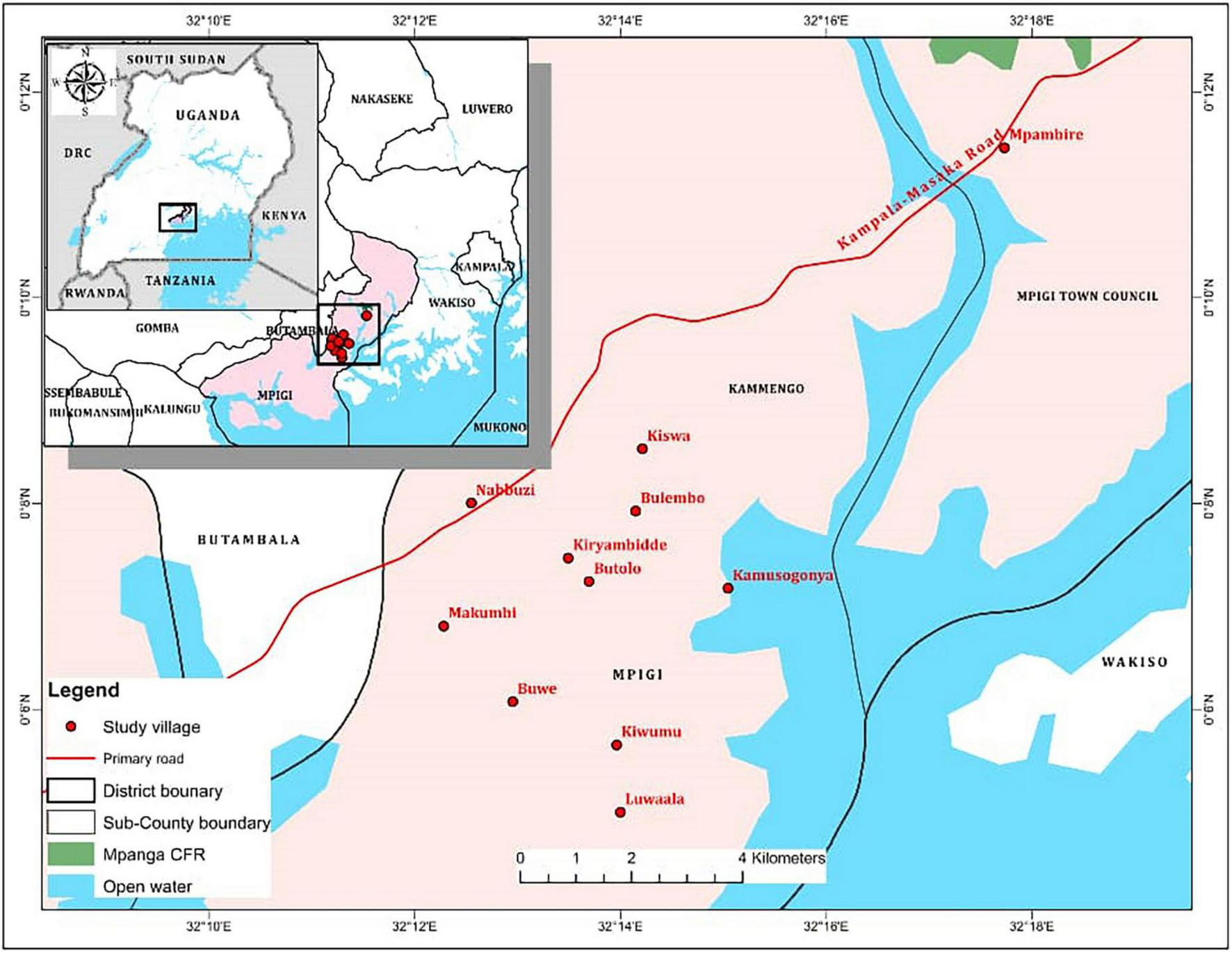
Map of the study area showing study villages.
3.4. Challenges in obtaining provisioning services from the forest
Despite the various provisioning services obtained from Mpanga CFR by surrounding communities, a lot of challenges are encountered in the process. The major challenge is official restrictions in accessing the forest reserve for forest products by the National Forestry Authority (NFA) officials while the least challenge is perishability of wild foods (Table 4). Challenges of access to medicinal plants are more pronounced than for other NTFP categories a situation that indicates high dependence on herbal medicine for primary health care. The study area has few health units that are not well equipped hence the locals especially women resort to using herbal medicine. Despite these restrictions, respondents admitted to illegally accessing the forest for extraction of goods to satisfy their livelihood. Residents in surrounding villages allege that such restrictions have resulted in increased vegetation undergrowth which makes accessibility difficult. It also hides wild animals which are a threat to the locals. Another problem encountered is the short shelf life of foods and medicinal herbs obtained from the forest given that no value addition process is done and they are for subsistence use.
TABLE 4
| Challenge | Proportion of households challenged in accessing provisioning service (%) | Average percentage | Rank | ||
| Wild food | Fuelwood | Medicinal plants | |||
| Restrictions to access | 25.0 | 40.5 | 82.9 | 49.5 | 1st |
| Thick vegetation | 38.6 | 25.5 | 0.0 | 21.4 | 2nd |
| Attack from wild animals | 20.5 | 14.9 | 5.7 | 13.7 | 3rd |
| Travelling long distances | 0.0 | 19.1 | 11.4 | 10.2 | 4th |
| Highly perishable | 15.9 | 0.0 | 0.0 | 5.3 | 5th |
Proportion of households reporting challenges of accessing provisioning services from the reserve.
Some species like Milicia excelsa, Syzygium cumin, Harungana madagascariensis, Piptadeniastrum africanum, and Warburgia ugandensis were difficult to access. Additionally, a growing scarcity of Polyscias fulva one of the preferred tree species for making drums was reported. This required travelling longer distances deep into the forest to access them and a lot of time taken locating them for harvest.
4. Discussion
4.1. Acquisition of provisioning services from Mpanga CFR
Communities of Kamengo subcounty extract firewood, charcoal, medicinal plants, wild foods, raw materials for wood carving and construction from Mpanga CFR. This depicts the importance of the reserve to sustenance of livelihoods of residents in the study area. The residents mostly depended on the CFR for firewood and medicinal plants. The importance of forests for livelihood improvement through provision of a variety of Provisioning Services (PS) to both rural and urban communities is widely acknowledged in different studies as in the current one. Shackleton (2021) study revealed that urban dwellers in the poorest and least industrialized countries mainly from the southern part of the world depended on different provisioning services such as wild food, firewood/charcoal and honey for their nutrition, energy and medicinal needs, respectively. Similar findings were reported by Drescher et al. (2021). However, use of PS is site specific and some studies have assessed the use of one or two specific PS such as firewood (Brouwer and Falcão, 2004), bush meat (Mbete et al., 2011), and medicinal plants (Messias et al., 2015). A broad scale study by Joos-Vandewalle et al. (2018) revealed that on average households in northern Botswana collected firewood, wild fruits, vegetables, fish, reeds, grass and water lilies from the wild. Households from villages in upper Kedarnath valley obtained a diversity of PS from adjacent forests that included fuelwood, fodder and leaf litter (Dhyani and Dhyani, 2016). Timber, firewood and edible plants were the most important provisioning services in Greater Letaba Municipality, in the north-eastern part of the Limpopo Province South Africa (Mensah et al., 2017) and Kopa area of Mpika district in northern Zambia (Mbata et al., 2002). In Odisha, India 100% of households collected tubers and mushrooms for food (Lakerveld et al., 2015).
Local people in the study area with low levels of education highly depend on PS for livelihood. The high reliance of rural people on forest PS many of whom are illiterate is attributed to the fact that such groups are economically marginalized because they are unsuitable for available employment options (Sunderlin et al., 2005). Thus, engaging in forest products extraction and trade which requires minimal capital investment becomes attractive to them. Debela et al. (2012) reported a non-significant relationship between forest product collection and educational status reflecting the low level of knowledge and skill required for forest product collection and sale.
The present study provides evidence about contribution of PS from Mpanga CFR to communities in Kamengo Sub County. The use of forest products is a possible means to improve rural livelihoods and conserve biodiversity in many forested areas of the world (Rasul et al., 2008; Shackleton and Gumbo, 2010). These communities obtain products from the forest for both consumption and sale. The significance of PS exceeds their role in providing consumptive resources. Access to a given PS at no financial cost means that user households do not have to purchase the same or a substitute PS from the market. This saves money that could be invested or used to meet other household needs that cannot be accessed directly from the local environment. Such cash-saving function is important for poor households. For instance, a study by Kaoma and Shackleton (2015) revealed that non-cash income from forest PS contributed about 20% of total household income.
Various plant species were collected for medicinal purposes from Mpanga CFR. The collection and wide spread use of plants for medicinal purposes reported in the current study relates to other studies elsewhere (Becerra and Inglehart, 2008; Bussmann et al., 2010; Pieroni et al., 2013; Williams and Whiting, 2016). Some species like Gymnanthemum amygdalina, Albizia sp. and Bidens pilosa which are used for medicinal purposes in the current study were reported to be used in management of diseases in elsewhere (Chekole et al., 2015; Uniyal and Rawat, 2018).
Households from the study villages mostly collected firewood from the CFR. Firewood is the major source of household’s energy in the study area as in other rural areas of Uganda. Though charcoal was reported as one of the product obtained from the CFR, its use in the study villages was limited. The limited use of charcoal as a source of energy is attributed to its high profitability thus prompting more households to sell it for income. The use of dry and fallen branches on the forest floor for firewood is because the activity is permitted by NFA. Most of the respondents that obtained forest food, fuel and medicine declared that there has been a change in the quantities of products obtained from Mpanga CFR over time with some species reducing in availability. A similar study carried out in Sub Saharan Africa and Latin America by Hermans-Neumann et al. (2016) reported that 90% of the villages experienced declining availability of forest resources over the years mainly due to forest resource degradation. Illegal tree felling of Antiaris toxicaria and Funtumia africana for wood carving was reported in Mpanga CFR by Taylor et al. (2008). Timber and fuel wood together with forest foods were the most affected. Increased product use, when combined with other factors leads to the decline of available forest resources. Some studies revealed dominant use of fuelwood as the primary source of energy (Cardoso et al., 2015; Bashistha and Garkoti, 2017) the same scenario as in the current study area. For instance, in Kedarnath fuelwood contributed above 95% of total domestic fuel requirement (Dhyani and Dhyani, 2016). Arnold et al. (2006) reported that many households in poor and least industrialized countries used charcoal or firewood as their primary energy source. In Maputo (Mozambique) 50% of affluent households used charcoal as a domestic source of energy (Brouwer and Falcão, 2004) while total dependency on fuel wood was reported in Dhauladhar mountain ranges in North west Himalaya (Uniyal and Rawat, 2018).
Forest resources were reported to be scarce in the current study area. The proposed explanation for scarcity of forest resources is their increased commercialization. For instance, the high value of charcoal accelerates the harvesting of tree species used in higher volumes and this has resulted in reduced availability of preferred species. Additionally, charcoal and firewood are the main sources of cooking energy in Uganda for the urban and rural areas, respectively (Shepherd et al., 2013) and this can partly lead to over exploitation of preferred species and hence reduction in their availability. The importance of fuelwood for energy production is exacerbated by the absence of cheaper alternative sources of energy in the country. Increased demand of wood carvings especially musical instruments and stools result in illegal tree felling of preferred species like Antiaris toxicaria Lesch. and Funtumia africana (Benth.) Stapf as reported by Taylor et al. (2008).
In rural areas herbal medicine is thought after as a cheaper alternative for primary health care by a majority of the poor who consider modern medical services expensive. Such an increased demand exerts pressure on the reserve for harvesting medicinal plants resulting in reduced availability of commonly used species. Such a scenario is promoted by the fact that the Uganda government has specifically upscaled the use of herbal medicine and is in the process of integrating it into the mainstream health care system (Uganda Gazzette, 2015). The demand for herbal medicine is also increased by lack of access to well-equipped health units in Mpigi district to offer proper health care services (Mpigi District Local Government, 2020).
Soe and Yeo-Chang (2019) noted the need to sensitize forest adjacent communities about the relevance of sustainable use of forest resources. Milicia excelsa is threatened in Uganda because it is used for many purposes and consequently appears in the Red List of threatened species of Uganda (Walter and Gillett, 1998). This status is also reflected in the results of the current study. Like in the current study, highly-preferred tree species for fuelwood from Mt. Elgon National Park forest were most depleted especially when also valued for timber (Sassen et al., 2015).
According to Obua et al. (1998) and Armitage (2005), local governance systems such as community-based resource management, might effectively reduce forest resource degradation by enabling local people to sustainably manage forest resources while satisfying their livelihood requirements. Involvement of forest adjacent communities in management of forest resources confers onto them a sense of ownership of the resources which promotes responsibility to sustainably manage them (Garekae et al., 2017).
4.2. Socio-economic contribution of Mpanga CFR to the surrounding communities
As revealed by regression analysis, age of respondents, period of stay and education level significantly influenced obtaining cash income from Mpanga CFR. Education level of respondents negatively affected derivation of cash income from the forest. This finding agrees with results of previous studies locally (Tugume et al., 2015) and elsewhere (Godoy and Contreras, 2001; Mamo et al., 2007; Lepetu et al., 2009; Fonta and Ayuk, 2013; Baiyegunhi et al., 2016; Garekae et al., 2017). Formal education empowers people to have diversified livelihood options which may generate significant income compared to sell of forest products (Masozera and Alavalapati, 2004). Education expands the opportunities for employment in other sectors and hence minimize dependence of educated people on forest cash income. In the studied villages, a majority of the population had no formal education or were less educated making them less skilled for alternative employment opportunities. Such a category of people resort to forest activities for income generation where education is not a big requirement.
Period of stay in the study villages positively affected dependence on the forest for cash income. The longer the period an individual resides in an area, the higher the chance of obtaining cash income from the forest. This could be attributed to increased familiarity with the complexities of the environment. People that have stayed in villages adjacent Mpanga CFR for a long time understand all the strategies employed by the forest patrols deployed by NFA to control illegal harvesting of products from the forest and know when to evade them. Similar results were reported in other studies which revealed that long term residents were more knowledgeable about the ecological structure, composition and seasonal patterns of the forest and thus able to collect more products for home use and sale (Pattanayak et al., 2003; Kartoolinejad et al., 2007).
Age of respondents negatively affected the ability to obtain cash income from the forest. This corroborates with findings from previous studies (Bwalya, 2011; Garekae et al., 2017). In the current study, young people were more likely to obtain cash from the forest compared the old ones. Young people are energetic and are engaged in harvesting and selling of mainly firewood and wild foods obtaining high prices. This is attributed to low levels of education that offers them no alternative employment options. Management and control of Mpanga CFR being under NFA that prohibits extraction of some forest products for commercial purposes disadvantages the elderly who are weak and unable to engage in illegal activities that require traveling long distance and evading forest guards. Extraction of forest products is a labor intensive activity that requires physical strength as reported in similar studies elsewhere (Fonta and Ayuk, 2013; Thondhlana and Muchapondwa, 2014). This favors the youth who are strong and capable of traveling long distances in search of forest products given that most species were reported to have reduced in availability.
Forest products make an important contribution to livelihoods of communities adjacent to Mpanga CFR. These communities reported depending on the CFR for cash and non-cash income. It is a common trend in such communities elsewhere to derive incomes from forests. Comparable to our results, forest and extractive incomes played a great role in income diversification, asset accumulation, and poverty mitigation in Malawi (Chilongo, 2014). In the Peruvian Amazon, forest products accounted for more than 60% of average total incomes (Roe and Naughton-treves, 2014). In Uganda, 56% of households adjacent Mabira CFR were dependent on non-timber forest products (NTFPs) and these contributed a relative income of 40% (Tugume et al., 2015). Local communities adjacent Mt. Elgon National Park reported on average environmental income of 18% of total incomes (Nakakaawa et al., 2015). The same study revealed that poor households were highly dependent on protected area environmental income which reduced income inequality by 13%. Collaborative resource management agreements (CRMAs) in Mt. Elgon national Park positively affected total park environmental income but had no significant effect on total household income and relative environmental income (Nakakaawa et al., 2015). This implies that the impact of agreements on accessing resources is still low. Recently, Mawa et al. (2022) reported that collaborative forest management (CFM) in Budongo CFR in Uganda increased access to legally obtained forest products but reduced dependence on environmental income as there were no changes in total household income after its introduction. Similar findings were reported in a study by Turyahabwe et al. (2013). However, CFM groups were instrumental in promoting access to credit, conservation of the reserve and development of alternative income options that reduced household dependence on forest income. This halted in-forest activities that were considered more superior sources of livelihood.
Seven villages surrounding two central forest reserves in mid-western Uganda were heavily dependent on forest environmental income that reduced poverty by 12.5 and 5.5% among Communal Land Associations (CLA) member and non-member households, respectively (Mawa et al., 2021). Relative income from NTFP extracted from Mabira CFR in Central Uganda was highest (53%) for poor households clearly highlighting how such income is important in improvement of livelihoods of adjacent communities (Tugume et al., 2015). Tumusiime et al. (2011) study in communities adjacent Mt Rwenzori National Park revealed that poor households with limited access to assets highly depended on forest resources which contributed about 18.6% of household income. Transition of Rwenzori Forest reserve to a national park raised its conservation status and direct use of park resources was declared illegal. This negatively affected poor households and increased illegal access to the forest in search of resources. The same study reported that poor households derived 32% of their environmental income and 12% of their total income from the park compared to the less poor at 18 and 4.5%, respectively. However, park resources reduced income inequality and poverty in the area.
Reduction in household income as the availability of forest products reduced clearly highlights the importance of the forest in meeting the needs of adjacent communities. Such reductions in income should attract the attention of stakeholders in order to provide a win-win scenario for all. It is therefore pertinent that both the local communities and forest management authorities cooperate in order to reduce unsustainable harvesting of forest products that has resulted in forest resource degradation. Thus, law enforcement by NFA alone may not protect the reserve but more interventions that allow access to the resource in the short term and creation of other income generating opportunities outside the park may be more suitable. Cooperation between local communities and forest management authorities will not only ensure preservation of the forest but will also guarantee a livelihood to the poor forest adjacent communities. The utilization of PS by communities of Kamengo is a clear indication of their contribution to rural livelihood improvement. This is attained as a direct saving through subsistence use and local trade to get cash income. The use PS frees cash resources to acquire other household needs and accumulate the necessary as set base for more secure livelihood like education, start-up capital for other economic activities and purchase of essential goods.
4.3. Challenges encountered by people in obtaining forest products and services
Although the people around the forest extract different products from the CFR, many challenges are encountered in the process. Irrespective of the independent product-specific challenges and income acquisition, official restriction by NFA guards is a major challenge encountered. This results in tension to both the forest rangers and the community members accessing the forest which sometimes results in insecurity. The Uganda forest sector reform of 2003 aimed at involving local people in decision making regarding forest use and increasing their participation in forest product markets. But in the current study, forest benefits were minimal due to regulations by NFA. A similar study in communities around Bugoma forest, reported that transfer of forest management and control to local government resulted in limited effect on livelihoods (Jagger, 2009). The study reported on average a forest income of US$ 5 with poor households losing an average income of $ 10 in contrast to wealthier households that gained an average of $30 forest income. On the other hand, forest reform had a larger impact on livelihoods of communities adjacent to Budongo CFR which is controlled and managed centrally by the NFA. Jagger (2009) reported an average increase in household forest income of $53 but with poor households losing an average of $15 and wealthier households obtaining increased forest income by $162 per year. Thus the reform favored the rich at the expense of the poor. Access to forest PS would promote community wellbeing and forest conservation given that forest dependent communities are mostly marginalized with minimal opportunities for alternative livelihoods (Vedeld et al., 2007; Naidu, 2011; Angelsen et al., 2014). As forest adjacent communities rely on the forest for PS to maintain their wellbeing, any reduction in these resources threatens their continued enjoyment of these resources. However, if access to forest resources is not controlled, it may result in competition for some provisioning services and eventually unsustainable harvesting that could eventually lead to biodiversity loss. This not only threatens the integrity of the forest but also creates challenges for sustainable management. To better mitigate such a loss, it is important to recognize the underlying reasons for harvesting of certain provisioning services (Costanza et al., 2014). Therefore, community involvement in forest management is vital as it creates a sense of resource ownership that provides access to the forest for product extraction without restrictions but with caution.
The right to manage, maintain and control the CFRs in Uganda is granted to NFA (NFTPA, 2003) which decides who can access and use specific forest resources under prescribed arrangements. Thus, NFA grants licenses and also ensures that legally prohibited activities are monitored. Consequently, the local communities are granted subsistence rights to use some resources like fallen dry wood from forest reserves free of charge. Despite this, the Ministry of Water, Lands and Environment [MLWE] (2001) identifies undefined and insecure rights of forest communities as a major underlying cause for the continued loss and degradation of Uganda’s forests. The rights of access, ownership, and management of forest resources by communities has continued to be restricted through various statutory provisions under different Community Based Forestry (CBF) regimes. According to Ministry of Water, Lands and Environment [MLWE] (2001), the Tumusiime and Vedeld (2015) and the legal framework are generally weak on protection of tenure rights of forest communities. This is more pronounced in case of Collaborative Resource Management (CRM) where communities have to negotiate their rights through signing of resource use agreements similar to what is place in Mpanga CFR. Additionally, its implementation is constrained by limited staffing capacity, low budget allocation and lack of coordination among government agencies. This has resulted in increased cases of aggressive offenders resulting in confrontations which have sometimes resulted into death of the offender or the defender of the resource. For instance, in practice, protected area managers failed to transfer power and authority to local communities, citing short term interest of resource use and their alleged failure to collectively manage natural resources (Nsita, 2010). Therefore, if communities adjacent to the CFR are to sustainably benefit from forest PS, a good relationship must exist between forest managers and users in which the rights and benefits of each party are well spelt out. This will avoid violent clashes between forest the two groups.
5. Conclusion
Residents in villages adjacent to Mpanga CFR rely on the forest for provisioning services that include: medicinal herbs, fuelwood, wild foods, construction and wood carving materials for home use and sale. Age of respondents, period of stay in the study villages and education level statistically significantly influenced obtaining cash income from the forest. However, gender of respondents was not statistically significant. Increase in age and educational level were associated with reduction in obtaining cash income from the forest while increased period of stay in study villages greatly increased ability to obtain cash income from the forest. Despite the importance of provisioning services, the quantities of forest foods, fuel wood and medicine extracted had declined overtime due to unsustainable harvesting practices perpetuated by forest access restrictions. Such restrictions result in reduced forest income due to a decline in quantities of products extracted thus negatively impacting on livelihoods of young and uneducated people that depend on the forest. Residents of Kamengo sub county face some challenges in the process of acquiring provisioning services that require designing of coping strategies. In order to address the issue of declining provisioning services within Mpanga CFR, there is an urgent need to promote an integrated conservation approach including stakeholders’ engagement and payments for ecosystem services aimed at enhancing the flow of benefits to the surrounding communities. Thus, a collaborative management effort between forest adjacent communities and forest managers is necessary in order to create a sense of forest ownership to residents that boosts their interest in preserving it.
Although the study assessed contribution of provisioning services from Mpanga CFR, it did not determine the quantities obtained and the cash and non-cash income obtained by households from the different products. The study did not utilize a variety of methods to enable triangulation of results. Therefore, we recommend that future studies conduct detailed analysis of income contributed by each provisioning service and utilization of different methods to establish the contribution of provisioning services to community livelihoods which could enable application of inferential statistical analyses.
Statements
Data availability statement
The original contributions presented in this study are included in the article/Supplementary material, further inquiries can be directed to the corresponding author.
Ethics statement
The studies involving human participants were reviewed and approved by the Department of Plant Sciences, Microbiology and Biotechnology Research Committee. The patients/participants provided their written informed consent to participate in this study.
Author contributions
MG conceptualized this study, collected the data, and drafted the manuscript. PT conceptualized the study and drafted and reviewed the manuscript. GA drafted and reviewed the manuscript. All authors contributed to the article and approved the submitted version.
Acknowledgments
We are grateful to the communities of Mpanga CFR (Mpigi District) and Kamengo subcounty for sharing their knowledge with us and helping in plant collection. We are also grateful to the staff at Makerere University Herbarium that helped in plant species identification.
Conflict of interest
The authors declare that the research was conducted in the absence of any commercial or financial relationships that could be construed as a potential conflict of interest. The reviewer DT declared a shared affiliation with the author’s PT and MG to the handling editor at the time of review.
Publisher’s note
All claims expressed in this article are solely those of the authors and do not necessarily represent those of their affiliated organizations, or those of the publisher, the editors and the reviewers. Any product that may be evaluated in this article, or claim that may be made by its manufacturer, is not guaranteed or endorsed by the publisher.
Supplementary material
The Supplementary Material for this article can be found online at: https://www.frontiersin.org/articles/10.3389/ffgc.2023.1021664/full#supplementary-material
Footnotes
References
1
Anderson J. Benjamin C. Campbell B. Tiveau D. (2006). Forests, poverty and equity in africa: New perspectives on policy and practice.Int. For. Rev.844–53. 10.1505/ifor.8.1.44
2
Angelsen A. Jagger P. Babigumira R. Belcher B. Hogarth N. J. Bauch S. et al (2014). Environmental income and rural livelihoods: A global-comparative analysis.World Dev.64S12–S28. 10.1016/j.worlddev.2014.03.006
3
Appiah M. Blay D. Damnyag L. Dwomoh F. Pappinen A. Luukkanen O. (2009). Dependence on forest resources and tropical deforestation in Ghana.Environ. Dev. Sustain.11471–487. 10.1007/s10668-007-9125-0
4
Armitage D. (2005). Adaptive capacity and community-based natural resource management.Environ. Manag.35703–715. 10.1007/s00267-004-0076-z
5
Arnold J. M. Köhlin G. Persson R. (2006). Woodfuels, livelihoods, and policy interventions: Changing perspectives. World Dev. 34, 596–611. 10.1016/j.worlddev.2005.08.008
6
Baiyegunhi L. J. S. Oppong B. B. Senyolo M. G. (2016). Socio-economic factors influencing mopane worm (Imbrasia belina) harvesting in Limpopo Province, South Africa.J. For. Res.27443–452. 10.1007/s11676-015-0168-z
7
Bashistha M. Garkoti S. C. (2017). Assessing the provisioning services of forest ecosystem in a Bhuj forest, Gujarat. Sci. Educ. 2, 1–4. 10.12691/aefs-2-1-1
8
Becerra R. M. Inglehart A. P. (2008). Folk medicine use: Diverse populations in a metropolitan area.Soc. Work Health Care2137–58. 10.1300/J010v21n04_03
9
Brouwer R. Falcão M. P. (2004). Wood fuel consumption in Maputo, Mozambique.Biomed. Bioenerg.27233–245. 10.1016/j.biombioe.2004.01.005
10
Bussmann R. W. Glenn A. Sharon D. (2010). Healing the body and soul: Traditional remedies for “magical” ailments, nervous system and psychosomatic disorders in Northern Peru.Afr. J. Pharm. Pharmacol.4580–629.
11
Bwalya S. M. (2011). Household dependence on forest income in rural Zambia.Zambia Soc. Sci. J.2:6.
12
Byakagaba P. Mugagga F. Nnakayima D. (2019). The socio-economic and environmental implications of oil and gas exploration: Perspectives at the micro level in the Albertine region of Uganda.Extr. Ind. Soc.6358–366. 10.1016/j.exis.2019.01.006
13
Cardoso M. B. Ladio A. H. Dutrus S. M. Lozada M. (2015). Preference and calorific value of fuelwood species in rural populations in northwestern Patagonia. Biomass Bioenerg. 81, 514–520. 10.1016/j.biombioe.2015.08.003
14
Castro A. F. N. M. Castro R. V. O. Carneiro A. D. C. O. Santos R. C. D. Carvalho A. M. M. L. Trugilho P. F. et al (2016). Correlations between age, wood quality and charcoal quality of eucalyptus clones.Rev. Árvore40551–560. 10.1590/0100-67622016000300019
15
Chekole G. Asfaw Z. Kelbessa E. (2015). Ethnobotanical study of medicinal plants in the environs of tara-gedam and amba remnant forests of Libo Kemkem District, Northwest Ethiopia.J. Ethnobiol. Ethnomed.111–38. 10.1186/1746-4269-11-4
16
Chilongo T. (2014). Livelihood strategies and forest reliance in Malawi.For. Trees Livelihoods23188–210. 10.1080/14728028.2014.922449
17
Costanza R. de Groot R. Sutton P. van der Ploeg S. Anderson S. J. Kubiszewski I. et al (2014). Changes in the global value of ecosystem services.Glob. Environ. Change26152–158. 10.1016/j.gloenvcha.2014.04.002
18
Cunningham A. B. (2014). Applied ethnobotany: People, wild plant use and conservation.Abingdon: Routledge. 10.4324/9781849776073
19
Debela B. Shively G. Angelsen A. Wik M. (2012). Economic shocks, diversification, and forest use in Uganda.Land Econ.88139–154. 10.3368/le.88.1.139
20
Dhyani S. Dhyani D. (2016). Significance of provisioning ecosystem services from moist temperate forest ecosystems: Lessons from upper Kedarnath valley, Garhwal, India.Energy Ecol. Environ.1109–121. 10.1007/s40974-016-0008-9
21
Doyle S. (2006). From Kitara to the lost counties: Genealogy, land and legitimacy in the kingdom of Bunyoro, Western Uganda.Soc. Identit.12457–470. 10.1080/13504630600823684
22
Drescher A. W. Isendahl C. Caridad C. M. Karg H. Menakanit A. (2021). “Urban and peri-urban agriculture in the Global South,” in Urban ecology in the global south, edsShackletonC.CilliersS.DavorenE.du ToitM. (Cham: Springer), 293–324. 10.1007/978-3-030-67650-6_12
23
Fisher M. (2004). Household welfare and forest dependence in Southern Malawi.Environ. Dev. Econ.9135–154. 10.1017/S1355770X03001219
24
Fonta W. M. Ayuk E. T. (2013). Measuring the role of forest income in mitigating poverty and inequality: Evidence from South-Eastern Nigeria.For. Trees Livelihoods.2286–105. 10.1080/14728028.2013.785783
25
Food and Agriculture Organization of the United Nations [FAO] (2020). The State of the World’s Forests 2020.Rome: FAO
26
Food and Agriculture Organization of the United Nations [FAO] (2013). FAOSTAT Forestry data 1961–2011.Rome: FAO
27
Garekae H. Thakadu O. T. Lepetu J. (2017). Socio-economic factors influencing household forest dependency in Chobe enclave, Botswana.Ecol. Process.61–10. 10.1186/s13717-017-0107-3
28
Godoy R. Contreras M. (2001). A comparative study of education and tropical deforestation among lowland of bolivian amerindians; forest values, environmental externality and school subsidies.Econ. Dev. Cult. Change49555–579. 10.1086/452515
29
Hermans-Neumann K. Gerstner K. Geijzendorffer I. R. Herold M. Seppelt R. Wunder S. (2016). Why do forest products become less available? A pan-tropical comparison of drivers of forest-resource degradation.Environ. Res. Lett.11:125010. 10.1088/1748-9326/11/12/125010
30
Jagger W. U. P. (2009). “Forest Sector Reforms, Livelihoods and Sustainability in Western Uganda: Pamela Jagger,” in Governing Africa’s forests in a globalized world, edsGermanL.KarsentyA.TianiA. M. (Abingdon: Routledge), 126–148.
31
Joos-Vandewalle S. Wynberg R. Alexander K. A. (2018). Dependencies on natural resources in transitioning urban centers of northern Botswana.Ecosyst. Serv.30342–349. 10.1016/j.ecoser.2018.02.007
32
Jovanelly T. J. Okot-Okumu J. Godwin E. (2012). A preliminary investigation to water and soil quality in four forest reserves near Kampala, Uganda.J. Environ. Hydrol.61–9.
33
Kalaba F. K. Quinn C. H. Dougill A. J. (2013). Contribution of forest provisioning ecosystem services to rural livelihoods in the Miombo woodlands of Zambia.Popul. Environ.35159–182. 10.1007/s11111-013-0189-5
34
Kaoma H. Shackleton C. M. (2015). The direct-use value of urban tree non-timber forest products to household income in poorer suburbs in South African towns.For. Pol. Econ.61104–112. 10.1016/j.forpol.2015.08.005
35
Kartoolinejad D. Hosseini S. M. Mirnia S. K. Akbarinia M. Shayanmehr F. (2007). The Relationship among infection intensity of Viscum album sp with some ecological parameters of host trees.Int. J. Environ. Res.1143–149.
36
Kazoora C. Irumba D. Smith N. Campese J. (2020). A review of collaborative forest management in Uganda.Kampala: National Forestry Authority.
37
Kibria A. S. Costanza R. Groves C. Behie A. M. (2018). The interactions between livelihood capitals and access of local communities to the forest provisioning services of the Sundarbans Mangrove Forest, Bangladesh.Ecosyst. Serv.3241–49. 10.1016/j.ecoser.2018.05.003
38
Krejcie R. V. Morgan D. W. (1970). Determining sample size for research activities.Educ. Psychol. Meas.30607–610. 10.1177/001316447003000308
39
Lakerveld R. P. Lele S. Crane T. A. Fortuin K. P. J. Springate-Baginski O. (2015). The social distribution of provisioning forest ecosystem services: Evidence and insights from Odisha, India.Ecosyst. Serv.1456–66. 10.1016/j.ecoser.2015.04.001
40
Lepetu J. Alavalapati J. Nair P. K. (2009). Forest dependency and its implication for protected areas management: A case study from Kasane Forest Reserve, Botswana.Int. J. Environ. Res.3525–536.
41
Maass J. M. Balvanera P. Castillo A. Daily G. C. Mooney H. A. Ehrlich P. et al (2005). Ecosystem services of tropical dry forests: Insights from long-term ecological and social research on the Pacific Coast of Mexico.Ecol. Soc.10:23. 10.5751/ES-01219-100117
42
Mamo G. Sjaastad E. Vedeld P. (2007). Economic dependence on forest resources: A case from Dendi District, Ethiopia.For. Policy Econ.9916–927. 10.1016/j.forpol.2006.08.001
43
Maroyi A. (2011). An ethnobotanical survey of medicinal plants used by the people in Nhema communal area, Zimbabwe.J. Ethnopharmacol.136347–354. 10.1016/j.jep.2011.05.003
44
Martin G. J. (1995). Ethnobotany: A methods manual. London: Chapaman and Hill, 1–251.
45
Masozera M. K. Alavalapati J. R. (2004). Forest dependency and its implications for protected areas management: A case study from the Nyungwe Forest Reserve, Rwanda.Scand. J. For. Res.1985–92. 10.1080/14004080410034164
46
Mawa C. Babweteera F. Tumusiime D. M. (2022). Livelihood outcomes after two decades of co-managing a state forest in Uganda.For. Policy Econ.135:102644. 10.1016/j.forpol.2021.102644
47
Mawa C. Tumusiime D. M. Babweteera F. (2021). Are community forests delivering livelihood benefits? Insights from Uganda.For. Trees Livelihoods30133–150. 10.1080/14728028.2021.1904010
48
Mbata K. J. Chidumayo E. N. Lwatula C. M. (2002). Traditional regulation of edible caterpillar exploitation in the Kopa area of Mpika district in northern Zambia.J. Insect. Conserv.6115–130. 10.1023/A:1020953030648
49
Mbete R. A. Banga-Mboko H. Racey P. Mfoukou-Ntsakala A. Nganga I. Vermeulen C. et al (2011). Household bushmeat consumption in Brazzaville, the Republic of the Congo.Trop. Conserv. Sci.4187–202. 10.1177/194008291100400207
50
Mensah S. Veldtman R. Assogbadjo A. E. Ham C. Kakaï R. G. Seifert T. (2017). Ecosystem service importance and use vary with socio-environmental factors: A study from household-surveys in local communities of South Africa.Ecosyst. Serv.231–8. 10.1016/j.ecoser.2016.10.018
51
Messias M. C. Menegatto M. F. Prado A. C. Santos B. R. Guimarães M. F. (2015). Popular use of medicinal plants and the socioeconomic profile of the users: A study in the urban area of Ouro Preto, Minas Gerais, Brazil.Rev. Brasil Plant. Med.1776–104. 10.1590/1983-084X/12_139
52
Ministry of Water, Lands and Environment [MLWE] (2001). The Uganda forestry policy. Kampala: Ministry of Water, Lands and Environment.
53
Mpigi District Local Government (2020). Health Department.Mpigi: Mpigi District Local Government.
54
Naidu S. C. (2011). Access to benefits from forest commons in the Western Himalayas.Ecol. Econ.71202–210. 10.1016/j.ecolecon.2011.09.007
55
Nakakaawa C. Moll R. Vedeld P. Sjaastad E. Cavanagh J. (2015). Collaborative resource management and rural livelihoods around protected areas: A case study of Mount Elgon National Park, Uganda.For. Pol. Econ.571–11. 10.1016/j.forpol.2015.04.002
56
NEMA (1998). State of the Environment Report for Uganda.Kampala: Ministry of Natural Resources, 239.
57
NFA (2019). Mpanga Forest Reserve.Kampala: National Forestry Authority.
58
NFTPA (2003). National Forestry &Tree Planting Act, Uganda.Rome: FAO.
59
Nsita S. (2010). “In search of forest governance reform in Uganda,” in Paper presented at the Background Paper for the Workshop On Forest Governance, (Uganda).
60
Obua J. Banana A. Y. Turyahabwe N. (1998). Attitudes of local communities towards forest management practices in Uganda: The case of Budongo forest reserve.Commonw. For. Rev.77113–118.
61
Omeja P. Obua J. Cunningham A. B. (2005). Demand and supply of wood for drum making in central Uganda.Int. For. Rev.721–26. 10.1505/ifor.7.1.21.64156
62
Pattanayak S. K. Sills E. O. Mehta A. D. Kramer R. A. (2003). Local uses of parks: Uncovering patterns of household production from forests of Siberit, Indonesia.Cons. Soc.1209–222.
63
Pieroni A. Pardo-De-Santayana M. Firenzuoli F. Quave C. L. (2013). The European heritage of folk medicines and medicinal foods: Its contribution to the CAMs of tomorrow.Evid. Based Complem. Altern. Med.2013:827521. 10.1155/2013/827521
64
Plumptre A. (2002). Extent and status of the forests in the Ugandan Albertine Rift.New York, NY: Wildlife Conservation Society.
65
Rasul G. Karki M. Sah R. P. (2008). The role of non-timber forest products in poverty reduction in India: Prospects and problems.Dev. Pract.18779–788. 10.1080/09614520802386876
66
Roe J. L. Naughton-treves L. (2014). Effects of a policy-induced income shock on forest-dependent households in the Peruvian Amazon.Ecol. Econ.971–9. 10.1016/j.ecolecon.2013.10.017
67
Sassen M. Sheil D. Giller K. E. (2015). Fuelwood collection and its impacts on a protected tropical mountain forest in Uganda.For. Ecol. Manag.35456–67. 10.1016/j.foreco.2015.06.037
68
Shackleton C. M. (2021). “Ecosystem provisioning services in Global South cities,” in Urban ecology in the global south, edsShackletonC. M.CilliersS. S.DavorenE.du ToitM. J. (Cham: Springer), 203–226. 10.1007/978-3-030-67650-6_8
69
Shackleton S. Gumbo D. (2010). “Contribution of non-wood forest products to livelihoods and poverty alleviation,” in The Dry Forests and Woodlands of Africa, edsChidumayoE. N.GumboD. J. (Abingdon: Routledge), 73–101.
70
Shepherd G. Kazoora C. Müller D. (2013). “Forests, livelihoods and Poverty Alleviation: The case of Uganda,” in Forestry Policy and Institutions Working Paper (Rome: FAO), 32.
71
Soe K. T. Yeo-Chang Y. (2019). Livelihood dependency on non-timber forest products: Implications for REDD+.Forests10:427. 10.3390/f10050427
72
Sunderlin W. D. Angelsen A. Belcher B. Burgers P. Nasi R. Santoso L. et al (2005). Livelihoods, forests, and conservation in developing countries: An overview.World Dev.331383–1402. 10.1016/j.worlddev.2004.10.004
73
Taylor D. Hamilton A. C. Lewis S. L. Nantale G. (2008). Thirty-eight years of change in a tropical forest: Plot data from Mpanga Forest Reserve, Uganda.Afr. J. Ecol.46655–667. 10.1111/j.1365-2028.2008.00955.x
74
Thondhlana G. Muchapondwa E. (2014). Dependence on environmental resources and implications for household welfare: Evidence from the Kalahari drylands, South Africa.Ecol. Econ.10859–67. 10.1016/j.ecolecon.2014.10.003
75
Tugume P. Buyinza M. Namaalwa J. Kakudidi E. K. Mucunguzi P. Kalema J. et al (2015). Socio-economic predictors of dependence on Non-timber forest products: Lessons from Mabira Central Forest Reserve Communities.J. Agric. Environ. Sci.4195–214. 10.15640/jaes.v4n2a23
76
Tumusiime D. M. Vedeld P. (2015). Can biodiversity conservation benefit local people? Costs and benefits at a strict protected area in Uganda.J. Sustain. For.34761–786. 10.1080/10549811.2015.1038395
77
Tumusiime D. M. Vedeld P. Gombya-Ssembajjwe W. (2011). Breaking the law? Illegal livelihoods from a Protected Area in Uganda.For Policy Econ.13273–283. 10.1016/j.forpol.2011.02.001
78
Turyahabwe N. Tumusiime D. M. Byakagaba P. Tumwebaze S. B. (2013). Impact of collaborative forest management on forest status and local perceptions of contribution to livelihoods in Uganda.J. Sustain. Dev.61–10. 10.5539/jsd.v6n10p36
79
UBOS Statistics (2020). Uganda bureau of statistics 2020 statistical abstract.Environ. Stat.501–04.
80
Uganda Gazzette (2015). Indigenous and complementary medicine bill, VIII: Bill No. 7.Entebbe: Uganda Printing and Publishing Corporation (UPPC).
81
United Nations Department of Economic and Social Affairs [UNDESA] (2021). United nations forum on forests secretariat. the global forest goals report.New York, NY: United Nations Department of Economic and Social Affairs.
82
Uniyal A. Rawat G. S. (2018). Energy–food–water; the fundamental provisioning services from the Himalayan forests: A case study from Dhauladhar Mountain Range, Northwest Himalaya.Indian J. For.4117–26. 10.54207/bsmps1000-2018-E13093
83
Vedeld P. Angelsen A. Bojö J. Sjaastad E. Berg G. K. (2007). Forest environmental incomes and the rural poor.For. Policy Econ.9869–879. 10.1016/j.forpol.2006.05.008
84
Walter K. S. Gillett H. J. (eds) (1998). 1997 IUCN red list of threatened plants.Gland: IUCN.
85
Williams V. L. Whiting M. J. (2016). A picture of health? Animal use and the Faraday traditional medicine market, South Africa.J. Ethnopharm.179265–273. 10.1016/j.jep.2015.12.024
Summary
Keywords
Mpanga, provisioning services, livelihood, ecosystem services, forest products
Citation
Gumoshabe M, Anywar G and Tugume P (2023) Access to provisioning services by local communities from Mpanga central forest reserve in central Uganda. Front. For. Glob. Change 6:1021664. doi: 10.3389/ffgc.2023.1021664
Received
17 August 2022
Accepted
23 May 2023
Published
08 June 2023
Volume
6 - 2023
Edited by
Moira Michaela Maria Moeliono, Center for International Forestry Research (CIFOR), Indonesia
Reviewed by
David Mwesigye Tumusiime, Makerere University, Uganda; Muhammad Arif, Southwest University, China; Swetha Peteru, Center for International Forestry Research (CIFOR), Indonesia
Updates
Copyright
© 2023 Gumoshabe, Anywar and Tugume.
This is an open-access article distributed under the terms of the Creative Commons Attribution License (CC BY). The use, distribution or reproduction in other forums is permitted, provided the original author(s) and the copyright owner(s) are credited and that the original publication in this journal is cited, in accordance with accepted academic practice. No use, distribution or reproduction is permitted which does not comply with these terms.
*Correspondence: Patience Tugume, patiebeys@gmail.com, patience.tugume@mak.ac.ug
Disclaimer
All claims expressed in this article are solely those of the authors and do not necessarily represent those of their affiliated organizations, or those of the publisher, the editors and the reviewers. Any product that may be evaluated in this article or claim that may be made by its manufacturer is not guaranteed or endorsed by the publisher.