 Paige Van de Vuurst
 Luis E. Escobar
- Department of Fish and Wildlife Conservation, Virginia Polytechnic Institute and State University, Blacksburg, VA, United States
Indonesia has recently announced the relocation of the country’s capital from the island of Java to the island of Borneo. Java’s limited sustainability is evident from extreme deforestation, biodiversity loss, intense road traffic, and high pollution. Jakarta, Indonesia’s current capital on Java, is both one of the most densely populated cities in the world, and one of the most threatened by climate change. Negative impacts upon Jakarta due to climate change could affect its economy, human health, and biodiversity. These negative factors could be transferred from Jakarta to Borneo, at least partially, during the early stages of moving the capital. Borneo currently houses one of the largest remaining forested areas in Southeast Asia and is considered to be a biodiversity hotspot. However, despite its biological importance, ∼30% of Borneo has been deforested in the last 50 years. Borneo also has high rates of biological endemism, but some of its emblematic endemic species are critically endangered. We argue that Indonesia’s announcement to re-locate the capital is one of the first examples of systematic, mass migration expected to occur linked to the climate change crisis. Unless a multidisciplinary and sustainable transition is implemented, the establishment of a new capital in Borneo could be a major biodiversity catastrophe. Research is urgently needed in Borneo to determine the status quo of its ecosystems for a large-scale, before-after assessment of the human-footprint to better understand processes in the Anthropocene.
Indonesia is a country composed of volcanic islands located off the coast of mainland Southeast Asia (Figure 1), resulting in a diverse nation in terms of ethnic groups, culture, and biodiversity (Mavridis, 2015). Indonesia has also been identified as a vulnerable country in the face of climate change, in part due to its geographic location (Measey, 2010). Jakarta, Indonesia’s current capital, is both one of the most densely populated cities in the world, and one of the most threatened due to environmental instability (Ward et al., 2013). Jakarta functions as both a political and economic hub for the Southeast Asia region. Nearly two thirds of the Indonesia’s Gross Domestic Product is generated within Jakarta, and both the parliament building and presidential palace are located there (Salim and Firman, 2011; The World Bank, 2019). As a result, Jakarta demonstrates a high human density (>4000 people/km2) (World Population Review, 2019). Recent estimates show that over 10.6 million people live within the city, and that number is only growing (World Population Review, 2019). World Bank estimates that over seven million individuals will have immigrated into the city within the last decade (The World Bank, 2015). This rapid increase of people and other factors, such as poor or unsafe walking paths, have generated overwhelming road traffic (Salim and Firman, 2011). Increased emissions from motor vehicles, numerous nearby coal-fired power plants, frequent and sustained forest fires, and a history of open waste burning have also caused air quality in Jakarta to decline (The World Bank, 2016; Wati and Nasution, 2018; Edwards et al., 2020). Currently, Jakarta’s air pollutant particulate concentration is 28.3% above World Health Organization guidelines (45.3 μg/m3 annual average of atmospheric particulate matter) (IQAir, 2019). These factors are worsened by the island’s susceptibility to recurring inundation due to excessive rain. In fact, in early 2020, over 400,000 residents were displaced and over 60 deaths were attributed to extreme flooding (Berlinger and Yee, 2020; Suhartono and Goldman, 2020).
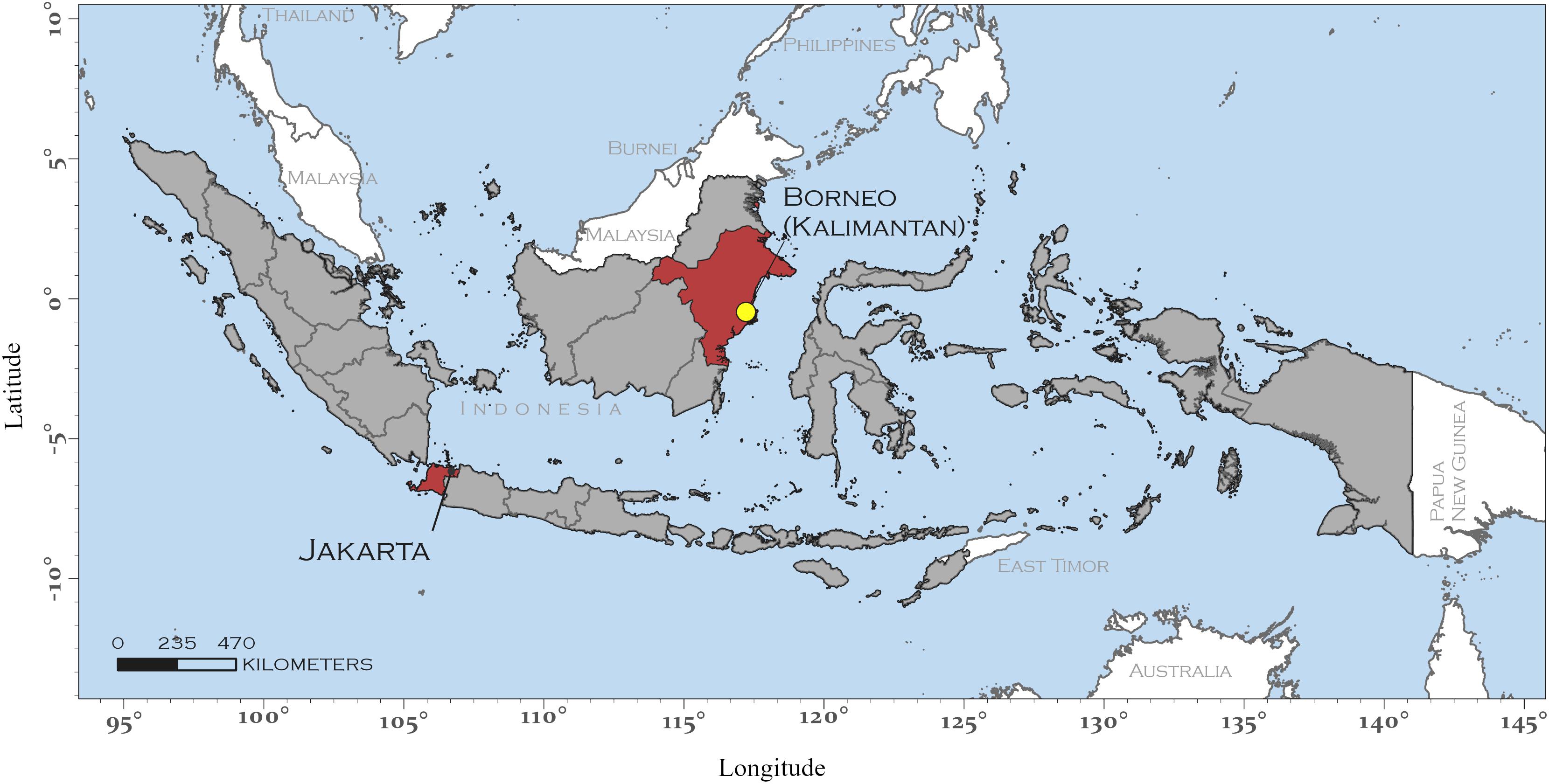
Figure 1. Map of South Asia. Location of Indonesia’s current capital, Jakarta, on the Java Island and potential location of the new capital (yellow point) on the island of Borneo. Country borders from Hijmans (2017).
The potential negative impacts of climate change upon Jakarta have, and could continue to affect its economy, human health, and biodiversity (Measey, 2010). This is worrying notion of concern, particularly for the ∼400,000 impoverished individuals living in Jakarta who are considered to be more vulnerable (Thiede and Gray, 2017). Compounding its exposure to climate change, Jakarta is also one of the fastest sinking cities in the world, with parts of the city having sunk by up to 4 m since leveling surveys began in 1978 (Abidin et al., 2001, 2011). This sinking makes Jakarta vulnerable to flooding, tsunamis, and intense coastal storms expected to increase in frequency in this area due to climate change (Knutson et al., 2012; Siagian et al., 2014; Thiede and Gray, 2017; Watts et al., 2019). Furthermore, Jakarta is located on the island of Java where there is overall limited sustainability. The deforestation rate in Java (3,415 ± 290 km2 from 1990 to 2015) corresponds to ∼40% of the island’s forest (Higginbottom et al., 2019; Figure 2). This accelerated deforestation has generated extensive biodiversity loss with projections estimating the extinction of up to 42% of species within the next decades (Sodhi et al., 2004).
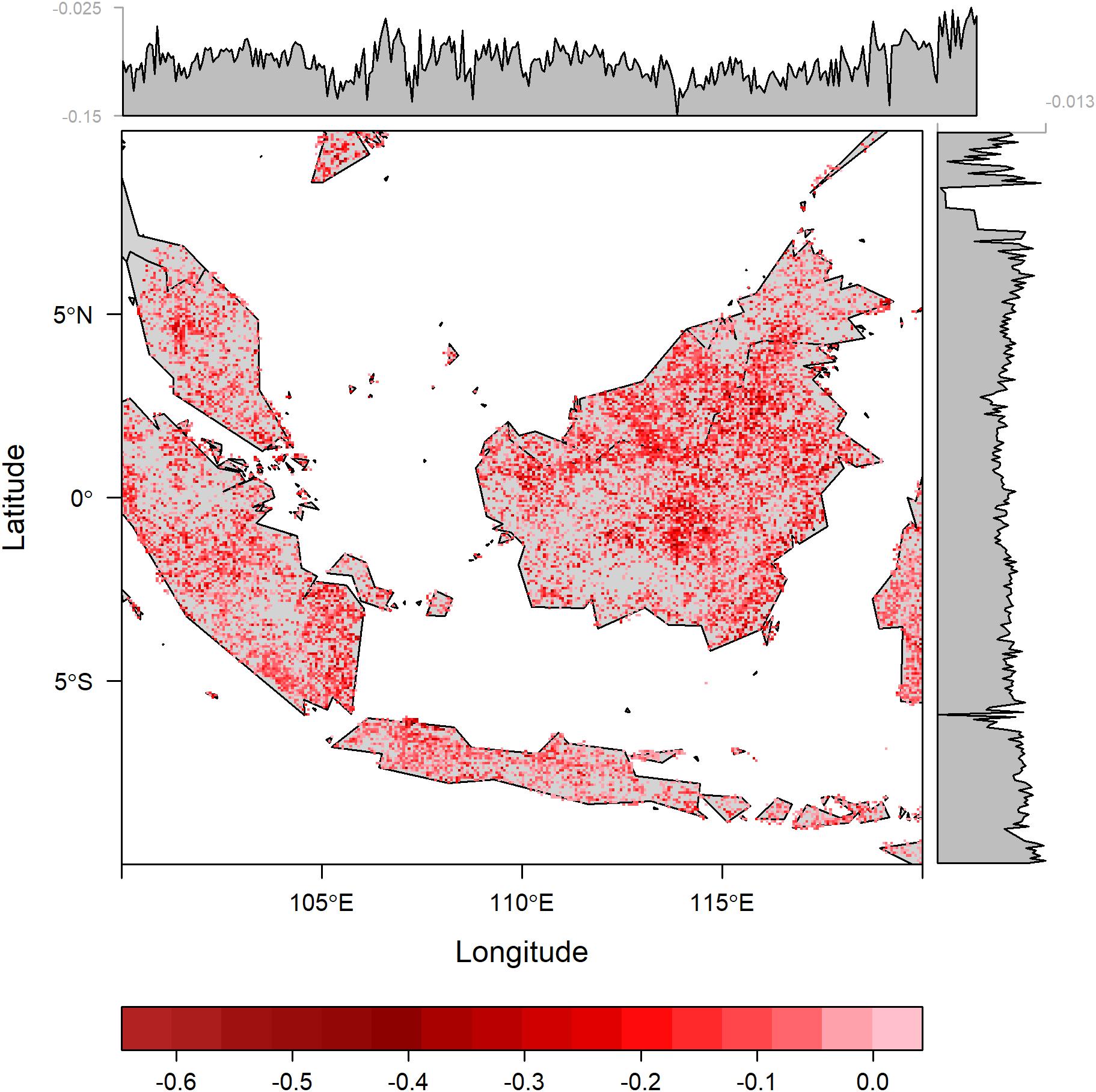
Figure 2. Deforestation across Indonesian islands 2000–2019. Changes in vegetation phenologies as measured by Enhanced Vegetation Index (EVI) values from the Moderate Resolution Imaging Spectroradiometer (MODIS) sensor of the Terra satellite for the month of April in 2000 and 2019 at 16-day temporal resolution and 250 m spatial resolution (LP DAAC, 2019). Vegetation loss: areas from moderated (pink) to severe (dark red) vegetation loss based on EVI values. Note that deforestation is scattered across the Indonesian territory. Areas without vegetation loss detected are shown in gray. Map generated using the maptools package in R (Bivand and Lewin-Koh, 2019; R Core Team, 2019).
In response to the considerable sociological issues, pollution, traffic, climate change risks, and political influences, the government of Indonesia has recently announced plans to relocate the country’s political capital to the more sparsely inhabited island of Borneo (Figure 1), potentially within the eastern Kalimantan region (Ritter, 2019; Watts, 2019). This move is estimated to cost nearly $33 billion (US), and could signal a new wave of forced relocation or development in tropical areas across the world due to environmental collapse (Thiede and Gray, 2017; Lyons, 2019). This initiative, though made in the good faith of relieving Jakarta of its human burden, could mean that the negative factors driving poor sustainability on Java could be transferred from Jakarta to Borneo, especially during the early stages of moving the capital. We argue that Indonesia’s announcement to relocate their political capital is one of the first examples of government sanctioned, systematic, tractable, mass migration expected to occur in the modern Anthropocene.
The island of Borneo has one of the largest remaining forested areas in Southeast Asia and is considered to be a global biodiversity hotspot (Myers et al., 2000). In fact, Borneo has played a key role in the development of the theoretical bases of evolution. For instance, biogeographer Alfred Russel Wallace proposed his first admission of evolution, the Sarawak Law, after his expedition to the Sarawak region in Borneo during the mid 1800s (Wallace, 1855; van Wyhe, 2016). Furthermore, Borneo has high rates of endemism, with over 700 endemic species of vertebrates alone existing on the island (Myers et al., 2000).
Despite its ecological importance, ∼30% of Borneo has been deforested in the last 50 years, with primary forests being the most heavily affected (Margono et al., 2014; Higginbottom et al., 2019). Indeed, Indonesia has struggled to reduce forest degradation in Borneo caused principally by infrastructure expansion, logging, commercial agriculture (e.g., oil palm and wood-pulp), mining, and wildfires associated to recent droughts (Gaveau et al., 2016; Edwards et al., 2020). In 2019 alone Borneo suffered a loss of more than 9,400 km2 of forests and agricultural land (Suroyo and Diela, 2019). In an economic sense, this corresponds to roughly 0.5% of the country’s gross domestic product (Suroyo and Diela, 2019). This loss also comes just 4 years after the extreme fires of 2015 in Indonesia, which burned an area larger than the state of Vermont in the United States, or more than twice the size of London, in the United Kingdom, and Tokyo, in Japan, combined (The World Bank, 2016). The effects of these fires also lead to more than 100,000 premature human deaths (Edwards et al., 2020).
Furthermore, a significant number of Borneo’s endemic species of megafauna have been listed as critically endangered (e.g., Bornean Orangutan, Pogo pygmaeus) (IUCN, 2019) or have become extinct just recently in all other areas besides Borneo (Sumatran Rhinoceros, Dicerorhinus sumatrensis, declared extinct in Malaysia November 24th, 2019) (Bittel, 2019). It has been estimated that, even without the establishment of a new capital in Borneo, even seemingly large populations of Bornean Orangutans will become locally extinct within the next 50 years (Abram et al., 2015). Other threatened or endangered species include the pygmy elephant (Elephas maximus borneensis), sunda pangolin (Manis javanica), sun bear (Helarctos malayanus), and the clouded leopard (Neofelis diardi) (IUCN, 2019). More efforts are necessary to better understand the conservation status of other taxa of potential economic and conservation importance, including arthropods, fish, plants, and fungi.
The Indonesian government’s decision to move its capital from Jakarta to Borneo is by no means a new idea. The move has been proposed in the past, and has mostly been attributed to an ongoing effort to centralize the location of governance, or other sociopolitical and economic reasons (Lyons, 2019; Ritter, 2019). The timeline for this endeavor, however, has been accelerated under growing pressures linked to environmental collapse that include flooding and coastal storms in Jakarta (Lyons, 2019; Watts, 2019). The location of the new capital seems to have been specifically selected to minimize the effects of natural disasters as well (Sofyan, 2019; Watts, 2019). For example, East Kalimantan is buffered by the islands of Java to the south and Sulawesi to the east. These geographic features could aid in protecting the city from intense coastal storms in the future. This strategic decision, compounded with the climate change-linked causes for this move in the first place, presents concerning new insights into the current and future effects of the climate crisis.
Considerable uncertainty exists regarding the location, direction, and magnitude of mass human migration due to climate change, as this type of migration is heavily contingent upon the demographics of the affected population (Thiede and Gray, 2017). However, this type of uncertainty could be reduced in this region by analyzing the migration projected to occur in Indonesia, where the government plans to relocate ∼1.5 M federal workers from Jakarta to Borneo by the year 2024 (Lyons, 2019; Watts, 2019). This migration alone could have vast impacts upon Borneo’s natural resources, but could also facilitate the study of sustainable development and mass migration linked in part to the negative effects of climate change. Demographic studies on the relocation process could also help to inform policy and decision making during the critical phases of the transition. As environmental extremes continue to occur throughout the Anthropocene these types of global-change driven human migrations may become more common, and understanding the tangled web of sociological, economic, environmental, and societal variables triggering mass migration will become even more crucial (Zalasiewicz et al., 2010; Loon et al., 2016).
Unless a multidisciplinary and sustainable transition is implemented, the establishment of a new capital in Borneo will be a major biodiversity catastrophe in modern time. The expected translocation of the city requires immediate research efforts to document the current biotic and abiotic conditions of the area receiving the new capital, to better understand the effects of anthropogenic perturbation in the biological and physical properties of Borneo. These assessments would require a large-scale, before-after study of the human foot print, which have been conducted retrospectively (Mckinney, 2008; Barlow et al., 2016; Hafsi et al., 2016; Luo et al., 2018; Lu et al., 2019; Marvel et al., 2019) but rarely in near real-time. Defaunation has emerged as a global concern in the Anthropocene, and has been linked to ecosystem imbalances (Pérez-Méndez et al., 2016; Young et al., 2016). This type of biodiversity loss should be mitigated and prevented to retain ecosystem health in Borneo. Some evidence suggests that biodiversity loss could augment the burden of zoonotic diseases, at least at the local level (Rohr et al., 2020). Thus, assessing the levels of biodiversity loss that generate the minimum disease transmission risk (i.e., biodiversity-disease relationship) could help to prevent disease transmission within areas of human-wildlife interface.
Furthermore, more study into the social and economic issues currently effecting Jakarta is needed to prevent these same issues from affecting the new capital. Though environmental issues and climate change could have vast impacts upon this relocation, the original drivers of human migration, such as pollution, inundation due to flooding, and high road traffic must be addressed as well. This will allow for the development of more sustainable cities, and will offer a better understanding of development in resources limited contexts. Sustainable development in the region would also aid in the prevention of many deleterious impacts upon local ecosystem that often come as a consequence of development, urbanization, and population growth (Carley and Christie, 2000). For example, the unsustainable extraction of ground water in Jakarta is linked to the sinking of the city, which makes it prone to flooding (Abidin et al., 2011; Rahman et al., 2018). By developing sustainable management in land use (e.g., agriculture, forestry, water systems, etc.), such over extraction could be prevented, ensuring long-term ecological functions and services (Carley and Christie, 2000). Sustainability has also been called for in this region, both to prevent the over extraction of resources, and to promote equitable dispersal of ownership and power among stakeholders (Kadarusman and Herabadi, 2018; Kurniawan and Managi, 2018).
Studying the relocation of Indonesia’s capital to Borneo will provide a unique opportunity to better understand the Anthropocene epoch. This phenomenon is an opportunity to inform mitigation plans regarding ecosystem impacts before they occur. The scientific community should be made aware of this transition, and should direct attention toward documenting and aiding this landmark event in the modern Anthropocene.
Data Availability Statement
The datasets generated for this study are available on request to the corresponding author.
Author Contributions
PV and LE wrote the manuscript and conducted the analysis.
Conflict of Interest
The authors declare that the research was conducted in the absence of any commercial or financial relationships that could be construed as a potential conflict of interest.
Acknowledgments
The authors thank Steven N. Winter and Mariana Castaneda-Guzman for their assistance in the development of the figures. Fang Su, Agung Wardana, and Juan-Pablo Castaneda provided critical suggestions that improved this manuscript.
References
Abidin, H. Z., Andreas, H., Gumilar, I., and Fukuda, Y. (2011). Land subsidence of Jakarta (Indonesia) and its relation with urban development. Nat. Hazards 59, 1753–1771. doi: 10.1007/s11069-011-9866-9
Abidin, H. Z., Djaja, R., Darmawan, D., Hadi, S., Akbar, A., Rajiyowiryono, H., et al. (2001). Land subsidence of Jakarta (Indonesia) and its geodetic monitoring system. Nat. Hazards 23, 365–387. doi: 10.1023/A:1011144602064
Abram, N. K., Meijaard, E., Wells, J. A., Ancrenaz, M., Pellier, A. S., Runting, R. K., et al. (2015). Mapping perceptions of species’ threats and population trends to inform conservation efforts: the Bornean orangutan case study. Divers. Distrib. 21, 487–499. doi: 10.1111/ddi.12286
Barlow, J., Lennox, G. D., Ferreira, J., Berenguer, E., Lees, A. C., Nally, R., et al. (2016). Anthropogenic disturbance in tropical forests can double biodiversity loss from deforestation. Nature 535, 144–147. doi: 10.1038/nature18326
Berlinger, J., and Yee, I. (2020). 66 People Now Killed by Flooding in Jakarta, and More Rain Appears to be on the Way. Available at: https://www.cnn.com/2020/01/06/asia/jakarta-floods-intl-hnk/index.html. (accessed January, 2020).
Bittel, J. (2019). Last Sumatran Rhino in Malaysia Dies. Available at: https://www.nationalgeographic.com/animals/2019/05/last-sumatran-rhino-malaysia-dies/ (accessed November, 2019).
Bivand, R., and Lewin-Koh, N. (2019). Maptools: Tools for Handling Spatial Objects. R package version 0.9.8. Available at: http://maptools.r-forge.r-project.org/ (accessed November, 2019).
Carley, M., and Christie, I. (2000). Managing Sustainable Development: Second Edition. New York, NY: Earthscan, 12–177.
Edwards, R. B., Naylor, R. L., Higgins, M. M., and Falcon, W. P. (2020). Causes of Indonesia’s forest fires. World Dev. 127:104717.
Gaveau, D. L. A., Sheil, D., Salim, M. A., Arjasakusuma, S., Ancrenaz, M., Pacheco, P., et al. (2016). Rapid conversions and avoided deforestation: examining four decades of industrial plantation expansion in Borneo. Nat. Sci. Rep. 6, 1–13. doi: 10.1038/srep32017
Hafsi, R., Ouerdachi, L., Kriker, A. E. O., and Boutaghane, H. (2016). Assessment of urbanization/impervious effects on water quality in the urban river Annaba (Eastern Algeria) using physicochemical parameters. Water Sci. Technol. 74, 2051–2059. doi: 10.2166/wst.2016.350
Higginbottom, T. P., Collar, N. J., Symeonakis, E., and Marsden, S. J. (2019). Deforestation dynamics in an endemic-rich mountain system: conservation successes and challenges in West Java 1990 – 2015. Biol. Conserv. 229, 152–159. doi: 10.1016/j.biocon.2018.11.017
Hijmans, R. J. (2017). DIVA-GIS (2017) Free Spatial Data by Country. Available at: http://www.diva-gis.org/gdata (accessed October, 2019).
IQAir (2019). Jakarta Air Quality Analysis and Statistics. Jakarta. Available at: https://www.airvisual.com/indonesia/jakarta (accessed September, 2019).
IUCN (2019). The IUCN Red List of Threatened Species. 2. Available at: https://www.iucnredlist.org/ (accessed September, 2019).
Kadarusman, Y. B., and Herabadi, A. G. (2018). Improving sustainable development within Indonesian palm oil: the importance of the reward system. Sustain. Dev. 26, 422–434. doi: 10.1002/sd.1715
Knutson, T. R., McBride, J. L., Chan, J., Emanuel, K., Holland, G., Landsea, C., et al. (2012). Tropical cyclones and climate change. Nat. Geosci. 3, 157–163. doi: 10.1002/wcc.371
Kurniawan, R., and Managi, S. (2018). Economic growth and sustainable development in Indonesia: an assessment. Bull. Indones Econ. Stud. 54, 339–361. doi: 10.1080/00074918.2018.1450962
Loon, A. F.. Van, Gleeson, T., Clark, J., Dijk, A. I. J. M., Van, et al. (2016). Drought in the Anthropocene. Nat. Geosci. 9, 89–91. doi: 10.1038/ngeo2646
LP DAAC (2019). MOD13Q1 MODIS/Terra Vegetation Indices 16-Day L3 Global 250m SIN Grid V006 [Data set]. NASA EOSDIS Land Processes DAAC. Available at: https://lpdaac.usgs.gov/products/mod13q1v006/ (accessed September, 2019).
Lu, X., Lin, C., Li, W., Chen, Y., Huang, Y., Fung, J. C. H., et al. (2019). Analysis of the adverse health effects of PM2.5 from 2001 to 2017 in China and the role of urbanization in aggravating the health burden. Sci. Total Environ. 652, 683–695. doi: 10.1016/j.scitotenv.2018.10.140
Luo, K., Hu, X., He, Q., Wu, Z., Cheng, H., Hu, Z., et al. (2018). Impacts of rapid urbanization on the water quality and macroinvertebrate communities of streams: a case study in Liangjiang New Area. China Sci. Total Environ. 621, 1601–1614. doi: 10.1016/j.scitotenv.2017.10.068
Lyons, K. (2019). Why is Indonesia Moving its Capital City? Everything you Need to Know. Available at: https://www.theguardian.com/world/2019/aug/27/why-is-indonesia-moving-its-capital-city-everything-you-need-to-know (accessed November, 2019).
Margono, B. A., Potapov, P. V., Turubanova, S., Stolle, F., and Hansen, M. C. (2014). Primary forest cover loss in Indonesia over 2000–2012. Nat. Clim. Chang. 4, 730–735. doi: 10.1038/nclimate2277
Marvel, K., Cook, B. I., Bonfils, C. J. W., Durach, P. J., Smerdon, J. E., and Williams, A. P. (2019). Twentieth-century hydroclimate changes consistent with human influence. Nature 569, 59–65. doi: 10.1038/s41586-019-1149-8
Mavridis, D. (2015). Ethnic diversity and social capital in Indonesia. World Dev. 67, 376–395. doi: 10.1016/j.worlddev.2014.10.028
Mckinney, M. L. (2008). Effects of urbanization on species richness: a review of plants and animals. Urban Ecosyst. 11, 161–176. doi: 10.1007/s11252-007-0045-4
Measey, M. (2010). Indonesia: a vulnerable country in the face of climate change. Glob. Major E-J. 1, 31–45.
Myers, N., Mittermeier, R. A., Mittermeier, C. G., Fonseca, G. A. B., and Kent, J. (2000). Biodiversity hotspots for conservation priorities. Nature 403, 853–882. doi: 10.1038/35002501
Pérez-Méndez, N., Jordano, P., García, C., and Valido, A. (2016). The signatures of Anthropocene defaunation: cascading effects of the seed dispersal collapse. Sci. Rep. 6:24820. doi: 10.1038/srep24820
R Core Team (2019). R: A Language and Environment for Statistical Computing. Vienna, Austria: R Foundation for Statistical Computing. Available at: http://www.R-project.org/ (accessed September, 2019).
Rahman, S., Sumotarto, U., and Pramudito, H. (2018). Influence the condition land subsidence and groundwater impact of Jakarta coastal area. IOP Conf. Ser. Earth Environ. Sci. 106:012006. doi: 10.1088/1755-1315/106/1/012006
Ritter, M. (2019). “President Joko Widodo: new captial city will be on Borneo,” in Proceedings of the Palace Press Conference Aug. 26, 2019, (Jakarta).
Rohr, J. R., Civitello, D. J., Halliday, F. W., Hudson, P. J., Lafferty, K. D., Wood, C. L., et al. (2020). Towards common ground in the biodiversity– disease debate. Nat. Ecol. Evol. 4, 24–33. doi: 10.1038/s41559-019-1060-6
Salim, W., and Firman, T. (2011). “Governing the Jakarta city-region: history, challenges, risks and strategies,” in Planning Asian Cities: Risks and Resilience, eds S. Hamnett, and D. Forbes, (London: Routledge), 240–263.
Siagian, T., Tinggi, S., Statistik, I., Purhadi, P., and Suhartono, S. (2014). Social vulnerability to natural hazards in Indonesia: driving factors and policy implications. Nat. Hazards 70, 1603–1617. doi: 10.1007/s11069-013-0888-3
Sodhi, N. S., Koh, L. P., Brook, B. W., and Ng, P. K. L. (2004). Southeast Asian biodiversity: an impending disaster. Trends Ecol. Evol. 19, 654–660. doi: 10.1016/j.tree.2004.09.006
Sofyan, L. (2019). Indonesia to Move Capital to Borneo. Digital Media Nusantara. ASEAN Post 2019:2–5. Available at: https://theaseanpost.com/article/indonesia-move-capital-borneo (accessed September, 2019).
Suhartono, M., and Goldman, R. (2020). Flash Floods in Indonesia Leave Hundreds of Thousands Homeless. Available at: https://www.nytimes.com/2020/01/02/world/asia/indonesia-jakarta-rain-floods.html?auth=link-dismiss-google1tap (accessed January, 2020).
Suroyo, G., and Diela, T. (2019). World Bank Says Indonesia Forest Fires Cost $5.2 Billion in Economic Losses. Available at: https://www.reuters.com/article/us-indonesia-environment/world-bank-says-indonesia-forest-fires-cost-5-2-billion-in-economic-losses-idUSKBN1YF0FJ (accessed January, 2020).
The World Bank (2015). Urban Expansion in East Asia – Indonesia. Jakarta. Available at: https://www.worldbank.org/en/news/feature/2015/01/26/urban-expansion-in-east-asia-indonesia (accessed January, 2020).
The World Bank (2016). The Cost of Fire: An Econimic Analysis of Indonesia’s 2015 Fire Crisis. In: Indonesia Sustainable Landscapes Knowledge Note:1. Washington DC: The World Bank Group, 7–12.
The World Bank (2019). East Asia and Pacific Economic Update October 2019: Weathering Growing Risks. Washington DC: World Bank Group, 17–180.
Thiede, B. C., and Gray, C. L. (2017). Heterogeneous climate effects on human migration in Indonesia. Popul. Environ. 39, 173–195. doi: 10.1007/s11111-017-0282-2
van Wyhe, J. (2016). The impact of A. R. Wallace’s Sarawak Law paper reassessed. Stud. Hist. Philos. Biol. Biomed. Sci. 60, 56–66. doi: 10.1016/j.shpsc.2016.09.004
Wallace, A. R. (1855). On the law which has regulated the introduction of new species. Ann. Mag. Nat. Hist. 2, 184–196. doi: 10.1080/037454809495509
Ward, P. J., Pauw, W. P., Buuren, M. W., Van, and Marfai, M. A. (2013). Governance of flood risk management in a time of climate change: the cases of Jakarta and Rotterdam. Env. Polit. 22, 518–536. doi: 10.1080/09644016.2012.683155
Wati, T., and Nasution, R. (2018). Evaluation of urban pollution and bio-climate using total suspended particles and discomfort index in Jakarta City. IOP Conf. Ser. Earth Envrion. Sci. 203:012003. doi: 10.1088/1755-1315/203/1/012003
Watts, J. (2019). Indonesia Announces Site of Capital City to Replace Sinking Jakarta. Available at: https://www.theguardian.com/world/2019/aug/26/indonesia-new-capital-city-borneo-forests-jakarta (accessed September, 2019).
Watts, N., Amann, M., Arnell, N., Ayeb-karlsson, S., Belesova, K., Boykoff, M., et al. (2019). The 2019 report of The Lancet Countdown on health and climate change: ensuring that the health of a child born today is not defined by a changing climate. Lancet 6736, 1–43. doi: 10.1016/S0140-6736(19)32596-6
World Population Review (2019). Jakarta Population 2019. Walnut. Available at: http://worldpopulationreview.com/world-cities/jakarta-population/ (accessed September, 2019).
Young, H. S., Mccauley, D. J., Galetti, M., and Dirzo, R. (2016). Patterns, causes, and consequences of Anthropocene defaunation. Annu. Rev. Ecol. Evol. Syst. 47, 333–358. doi: 10.1146/annurev-ecolsys-112414-054142
Keywords: Anthropocene, biodiversity, flooding, impacts, Indonesia
Citation: Van de Vuurst P and Escobar LE (2020) Perspective: Climate Change and the Relocation of Indonesia’s Capital to Borneo. Front. Earth Sci. 8:5. doi: 10.3389/feart.2020.00005
Received: 28 November 2019; Accepted: 14 January 2020;
Published: 30 January 2020.
Edited by:
Liangcheng Tan, Institute of Earth Environment (CAS), ChinaReviewed by:
Fang Su, Shaanxi University of Science and Technology, ChinaAgung Wardana, Gadjah Mada University, Indonesia
Copyright © 2020 Van de Vuurst and Escobar. This is an open-access article distributed under the terms of the Creative Commons Attribution License (CC BY). The use, distribution or reproduction in other forums is permitted, provided the original author(s) and the copyright owner(s) are credited and that the original publication in this journal is cited, in accordance with accepted academic practice. No use, distribution or reproduction is permitted which does not comply with these terms.
*Correspondence: Luis E. Escobar, ZXNjb2JhcjFAdnQuZWR1