 Catherine Hirst1*
 Sophie Opfergelt1
 François Gaspard1
 Katharine R. Hendry2
 Jade E. Hatton2
 Susan Welch3
 Diane M. McKnight4
 W. Berry Lyons3
- 1Earth and Life Institute, Environmental Sciences, Université catholique de Louvain, Louvain-la-Neuve, Belgium
- 2School of Earth Sciences, University of Bristol, Bristol, United Kingdom
- 3School of Earth Sciences, Byrd Polar and Climate Research Center, The Ohio State University, Columbus, OH, United States
- 4Institute of Arctic and Alpine Research, University of Colorado Boulder, Boulder, CO, United States
In high latitude environments, silicon is supplied to river waters by both glacial and non-glacial chemical weathering. The signal of these two end-members is often obscured by biological uptake and/or groundwater input in the river catchment. McMurdo Dry Valleys streams in Antarctica have no deep groundwater input, no connectivity between streams and no surface vegetation cover, and thus provide a simplified system for us to constrain the supply of dissolved silicon (DSi) to rivers from chemical weathering in a glacial environment. Here we report dissolved Si concentrations, germanium/silicon ratios (Ge/Si) and silicon isotope compositions (δ30SiDSi) in Crescent Stream, McMurdo Dry Valleys for samples collected between December and February in the 2014−2015, 2015−2016, and 2016−2017 austral seasons. The δ30SiDSi compositions and DSi concentrations are higher than values reported in wet-based glacial meltwaters, and form a narrow cluster within the range of values reported for permafrost dominated Arctic Rivers. High δ30SiDSi compositions, ranging from +0.90‰ to +1.39‰, are attributed to (i) the precipitation of amorphous silica during freezing of waters in isolated pockets of the hyporheic zone in the winter and the release of Si from unfrozen pockets during meltwater-hyporheic zone exchange in the austral summer, and (ii) additional Si isotope fractionation via long-term Si uptake in clay minerals and seasonal Si uptake into diatoms superimposed on this winter-derived isotope signal. There is no relationship between δ30SiDSi compositions and DSi concentrations with seasonal and daily discharge, showing that stream waters contain DSi that is in equilibrium with the formation of secondary Si minerals in the hyporheic zone. We show that δ30SiDSi compositions can be used as tracers of silicate weathering in the hyporheic zone and possible tracers of freeze-thaw conditions in the hyporheic zone. This is important in the context of the ongoing warming in McMurdo Dry Valleys and the supply of more meltwaters to the hyporheic zone of McMurdo Dry Valley streams.
Introduction
McMurdo Dry Valleys (MDV), the largest ice-free area of Antarctica, is covered in continuous permafrost, with low surface temperatures and low rates of precipitation. Under these polar desert conditions, groundwater and surface soil water reservoirs are absent (Conovitz et al., 1998), and first-order streams and their surrounding hyporheic zones are isolated conduits for supra-glacial meltwater transport and a loci of weathering (Lyons et al., 1998; McKnight et al., 1998, 1999, 2004).
A wealth of evidence using dissolved element concentrations and ratios (Lyons et al., 1998; Nezat et al., 2001), Sr and Li isotope analysis (Lyons et al., 2002; Witherow et al., 2010; Dowling et al., 2013) and mineralogical studies (Gooseff et al., 2002; Maurice et al., 2002) shows that Si is supplied to the streams by weathering of stream sediments with silicate mineral weathering rates an order of magnitude greater than rates in lower latitude, warmer locations (Gooseff et al., 2002). These studies demonstrate that chemical weathering of silicates occurs in MDV streams (Lyons et al., 2002), despite the cold temperatures, lack of precipitation and low abundance of complexing organic material (Burkins et al., 2001), and thereby contribute to the atmospheric CO2 draw down over geological timescales (Berner and Berner, 1997).
Taylor Valley streams in MDV are characterized by extensive hyporheic zones, which comprise the sediment pore spaces adjacent to and underneath the stream through which stream water exchanges. This zone also is the accommodation space that must be filled before stream flow occurs. Mineral dissolution in the hyporheic zone is the commonly accepted contributor to stream geochemistry (Gooseff et al., 2002), but the model of Gooseff et al. (2002) assumes no precipitation reactions of secondary weathering products, including only the net release of solutes from weathering reactions. Secondary weathering products such as clay minerals may form, but the extent to which this occurs within streams is unknown (Lyons et al., 1998; Gooseff et al., 2002). Considering only the net release of solutes from weathering reactions, and not accounting for the formation of secondary weathering products in the near and extended hyporheic zone in MDV streams may contribute to an underestimation of actual weathering rates in this polar region and associated atmospheric CO2 consumption.
The hyporheic zones in Antarctic streams include near-stream zones where rapid stream-water exchange occurs within hours to days, and extended hyporheic zones, where stream-water exchange occurs over weeks to months (Gooseff et al., 2003). During the austral summer months (November−February), glacial meltwaters, with low Si concentrations (Lyons et al., 2003) are transported through the near and extended hyporheic zone sediments and rapidly react with mineral surfaces (Gooseff et al., 2002) resulting in DSi concentrations that are in near equilibrium with minerals and independent of flow rates (Wlostowski et al., 2018). The questions arise: (i) is the Si released from weathering within the hyporheic zone transferred to the stream with limited formation of secondary weathering products; and (ii) are the controlling factors of the Si transfer from the hyporheic zone to the stream constant, or do they change through the summer with the changing contribution of waters from the extended hyporheic zone and near-stream hyporheic zone? To answer these questions we use dissolved silicon isotope composition (δ30SiDSi) and the germanium/silicon ratios (Ge/Si) to pull apart primary silicate weathering processes, biotic processes and abiotic secondary weathering processes in a permafrost-dominated stream in Antarctica.
The δ30SiDSi composition of river waters reflect the processes occurring after silicate mineral dissolution (Opfergelt and Delmelle, 2012; Frings et al., 2016) resulting from secondary mineral formation and dissolution (Georg et al., 2006), adsorption of Si onto Al and Fe (oxy)hydroxides (Delstanche et al., 2009; Oelze et al., 2014), diatom uptake (Alleman et al., 2005; Opfergelt et al., 2011) and dissolution (Demarest et al., 2009; Egan et al., 2012; Wetzel et al., 2014) and phytolith formation (Opfergelt et al., 2008) and dissolution (Ziegler et al., 2005) in vascular plants during dissolved silicon transport in the river basin. At present, δ30SiDSi compositions in large Arctic rivers are used to constrain the drivers of terrestrial-ocean silicon supply in high latitude permafrost-dominated systems with an average flux-weighted Arctic River δ30SiDSi composition of +1.3‰ (Pokrovsky et al., 2013; Mavromatis et al., 2016; Sun et al., 2018). During winter months, δ30SiDSi compositions are higher than average values, attributed to aluminosilicate dissolution and secondary mineral precipitation in groundwater systems (Pokrovsky et al., 2013). During spring flood, the δ30SiDSi compositions are lower than or similar to silicate rock values, attributed to the dissolution of suspended matter within rivers and leaching of biomass (Pokrovsky et al., 2013; Mavromatis et al., 2016; Sun et al., 2018). During summer months, δ30SiDSi compositions show a wide range in values resulting from Si uptake into vascular plants and phytoplankton alongside the mixing of tributaries with different Si isotope compositions (Sun et al., 2018). In these large river basins, the role of secondary mineral precipitation and its impact on riverine δ30SiDSi compositions is often obscured by biological and plant uptake and/or mixing of surface and sub-surface waters in the river basin.
The simplified and well characterized MDV streams, with no vegetation and no groundwater supply to streams, provides an ideal natural laboratory to test whether the silicate mineral weathering release is affected by the formation secondary weathering products or by biological uptake of diatoms in a permafrost environment. To disentangle biogenic and non-biogenic contributions to rivers, the germanium/silicon ratio (Ge/Si) of river waters is complementary to Si isotopes (Cornelis et al., 2011). During weathering, Ge substitutes for Si during clay mineral formation resulting in soils with higher Ge/Si ratios and soil porewaters and rivers with lower Ge/Si ratios than the silicate parent material (Murnane and Stallard, 1990; Kurtz et al., 2002). During biological Si uptake by plants and diatoms, Ge is either unfractionated or fractionated with respect to Si to form biogenic amorphous silica with a Ge/Si ratio the same or lower than the starting solution (Froelich et al., 1992; Derry et al., 2005; Delvigne et al., 2009).
The δ30SiDSi composition and the Ge/Si ratios are determined on waters in Crescent Stream, collected during three different seasons between 2014 and 2017, and at different times of day in order to understand the effect of daily and seasonal variations in hydrology on silicate weathering in the hyporheic zone. Crescent Stream is one of the longest streams in Taylor Valley, resulting in longer water residence times in the hyporheic zone, increased chemical weathering and higher long-term solute concentrations compared to shorter streams in Taylor Valley (Wlostowski et al., 2018). Using these findings as a basis, we discuss how δ30SiDSi compositions could be used to monitor changes in hyporheic zone functioning in response to future increases in stream flow (Doran et al., 2008), active layer depth (Doran et al., 2008), permafrost temperature (Biskaborn et al., 2019; Obu et al., 2020), and thermokarst erosion (Levy et al., 2013) in MDV.
Study Site
Samples were collected from Crescent Stream in Fryxell Basin, McMurdo Dry Valleys, Antarctica. The McMurdo Dry Valleys (77°S, 162°E) are located on the western coast of McMurdo Sound and have a polar desert environment with mean annual temperatures less than −15°C and mean annual precipitation less than 100 mm (Doran et al., 2002). Soils are developed on glacial tills that were deposited by the grounded Ross Sea Ice Sheet in the Last Glacial Maximum, 19,000 to 23,000 years ago (Hall et al., 2000) and derived from granitic, sandstone and dioritic parent lithologies (Campbell and Claridge, 1987). There is 3−7% contribution of mafic material to Taylor Valley glacial tills derived from the McMurdo Volcanic Group and Ferrar Dolerite (e.g., Cooper et al., 2007). Soils are distinguished by the amount and distribution of salts and degree of chemical weathering. Permafrost is present across the McMurdo Dry Valleys with 43% characterized as dry frozen, 55% characterized as ice-cemented and 2% characterized as massive ice bodies (Bockheim, 2002). Active layer depths range from 45 to 70 cm in coastal areas to 20−45 cm in the polar plateau (Bockheim et al., 2007). There is no vascular vegetation in McMurdo Dry Valleys (Campbell and Claridge, 1987) and soil organic carbon concentrations are <0.5 mg C g soil–1 (Burkins et al., 2001).
Dry-based glaciers are the main source of liquid water to McMurdo Dry Valleys. Supra-glacial meltwaters are transported via first-order streams to confined lake basins. Streams range from 1 to 11.2 km in length, are typically 5−10 m wide and incised in some places by up to 3 m (Conovitz et al., 1998). The extensive hyporheic zones of the streams are characterized by loose, unconsolidated sediments (Bockheim, 2002) and active layer depths up to 75 cm (Conovitz et al., 2006). The hyporheic zone extends several meters either side of the streambed, with a lateral cross section of ∼ 12 m2 at maximum thaw during the austral summer months (Gooseff et al., 2003). Microbial mats are abundant in MDV streams and are mainly found in streambed areas with flowing water and along stream margins that are submerged at occasional high flows (McKnight and Tate, 1997). The mats are dominated by filamentous cyanobacteria, with varying abundances of diatoms, chlorophytes and other microorganisms (Alger, 1997).
McMurdo Dry Valley stream flow occurs for approximately 6−10 weeks per year during the austral summer between December and February and is characterized by inter-annual, seasonal and daily variations in discharge. Streams typically exhibit a low flow in December, maximum flow in January and low flow again at the start of February (McKnight et al., 1999). During cold and cloudy periods, there is intermittent stream flow and water is mainly accommodated in the hyporheic zone; whereas, warm and sunny periods drive more surface glacier melt and a larger volume of water is transported as stream flow (Conovitz et al., 1998). Daily diel flood pulses result in a 5−10 fold variation in stream flow depending on the solar aspect, insolation and air temperature (Conovitz et al., 1998).
Crescent Stream in the south Fryxell Basin, Taylor Valley (77°37′8.6″S, 163°11′4.1″E) transports meltwater from Crescent Glacier along two branches (east and west) that converge about 500 m upstream of where Crescent Stream discharges into Lake Fryxell (Figure 1).
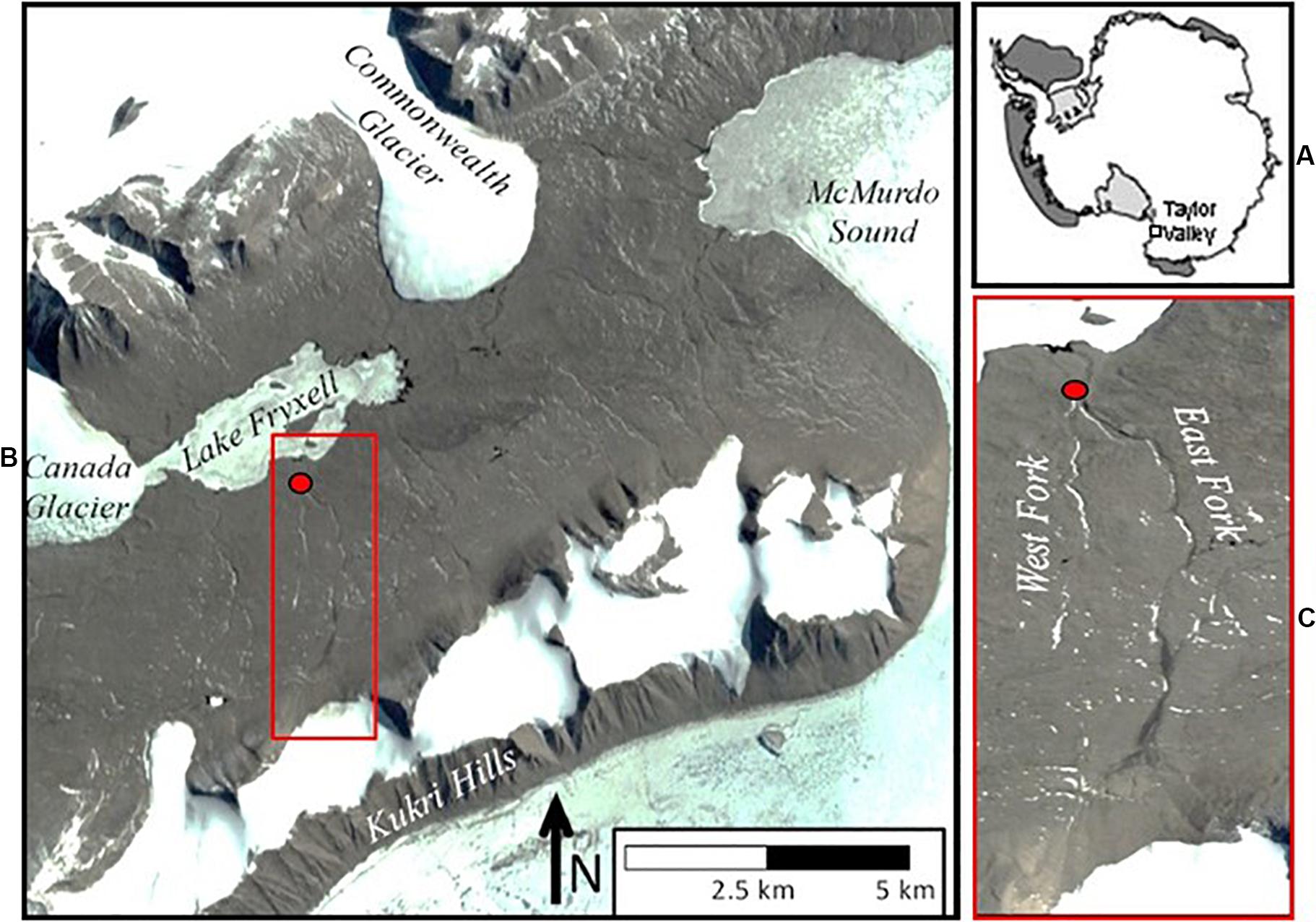
Figure 1. Crescent Stream is located in Taylor Valley in the Lake Fryxell basin, McMurdo Dry Valleys (A). Crescent Stream is supplied by glacial meltwaters in the Kukri Hills and drains into Lake Fryxell (B). Samples were collected during the Austral summer in 2014–2017 at the F8 gauge (red circle), located 150 meters above the 1999 Lake Fryxell lake level (C). Figure adapted from Gooseff et al. (2002, 2016).
Materials and Methods
Sample Collection
Water samples were collected at gauging stage F8 (Figure 1), located 5.5 km downstream from Crescent Glacier (Gooseff and McKnight, 2019), during three austral seasons: 2014−2015 (2/1/2015 to 17/1/2015); 2015−2016 (11/12/2015 to 18/1/2016); and 2016−2017 (17/12/2016 to 24/1/2017) and at different times of day from 10.13 am to 11.58 pm. Water samples were collected in 1 L polyethylene bottles and filtered through 0.4 μm Nucleopore filters using an Antlia filtration unit within 4–6 h after collection. Water samples were stored at >8°C, but not frozen.
Discharge, conductivity and water temperature were measured at 15-min intervals at gauging stage F8 during the three austral seasons. Data are available on the LTER McMurdo Dry Valleys database, collecting data since 1990 (Gooseff and McKnight, 2019).
Silicon Concentrations Analysis
Dissolved Si concentrations were determined on the water samples from Crescent Stream (austral summer seasons 2014−2015, 2015−2016, and 2016−2017) using a Skalar San++ nutrient analyzer at The Ohio State University, following the protocols of Mullin and Riley (1955). The precision of the Si concentrations and check standards, calculated as the average percent difference between duplicate samples, is <2%. Blank values for DI water processed as a sample and stored in our clean bottles were always below the detection limit of the method.
Germanium Concentrations Analysis
Ge concentrations were determined on the water samples from Crescent Stream (austral seasons 2014−2015, 2015−2016, and 2016−2017) by ICP-mass spectrometry (ICP-MS, ICAPQ Thermo Fisher Scientific) using the 74Ge isotope at Earth & Life Institute, UCLouvain, Belgium. Indium was used as the internal standard to correct for both instrumental (i.e., mass) drift, and sensitivity drift potentially arising from the sample matrix (Pretorius et al., 2006). The accuracy and long-term reproducibility of the analysis were assessed by measuring two international riverine standards, namely SLRS-5 ([Ge] = 0.083 ± 0.014 nmol.l–1; n = 3) and SLRS-6 ([Ge] = 0.097 ± 0.0069 nmol.l–1; n = 3) (Yeghicheyan et al., 2001). The limit of detection for Ge was 0.04 nmol.l–1, and the precision on Ge/Si ratio is 10%.
Silicon Isotope Analysis
Silicon isotope compositions were determined on the water samples from Crescent Stream (austral seasons 2014−2015, 2015−2016, and 2016−2017). Si was pre-concentrated using MAGIC brucite precipitation (Brzezinski et al., 2003) with Si recoveries of 85 to 100%. Si was separated from the remaining anion-rich matrix with a two stage column chemistry procedure using an anion exchange resin (Biorad AG MP-1; Gaspard et al., 2019) followed by a cation exchange resin (Biorad AG50W-X12; Georg et al., 2006). Si recoveries were >95% and Na+, SO42– and Cl– concentrations were below detection limit following the two-stage column chemistry. The combined procedural Si blank for MAGIC and column chemistry was below 0.36 μmol.l–1.
δ30SiDSi composition was analyzed by MC-ICP-MS (Neptune PlusTM High Resolution Multicollector ICP-MS, Thermo Fisher Scientific, Earth & Life Institute, UCLouvain, Belgium) in wet plasma mode in medium resolution (Δm/m∼6000) using a PFA nebulizer of 100 μl/min uptake rate. The instrumental mass bias was corrected using the standard-sample bracketing technique and an external Mg doping (Cardinal et al., 2003). The analyses were performed in 2% HNO3 matrix, with a typical sensitivity of 7V for 2ppm Si and an instrumental blank <30 mV. δ30SiDSi compositions are expressed in relative deviations of 30Si/28Si ratio from the NBS-28 reference standard using the common δ-notation (‰) as follows: δ30Si = [(30Si/28Si)sample/(30Si/28Si)NBS–28 -1] × 1000. One measurement comprises 30 cycles with 4.2s integration time corrected by blank in a 2% HNO3 matrix. Each single δ-value (n) represents one sample run and two bracketing standards. δ30Si-values are reported as the mean of isotopic analyses from multiple analytical sessions (Table 1). The δ30Si and δ29Si measurements fit within error onto the theorical mass dependent fractionation array (Young et al., 2002) supporting the interference-free determination of all three Si isotopes via MC-ICP-MS (Supplementary Figure 1). The long-term precision and accuracy of the MC-ICP-MS δ30Si values was assessed from multiple measurements within each analytical session on reference materials: the values obtained for Diatomite (δ30Si = 1.31 ± 0.08‰, SD, n = 21) and Quartz Merck (δ30Si = −0.01 ± 0.08‰, SD, n = 8) are consistent with previously reported values for these standards [Quartz Merck: δ30Si = −0.01 ± 0.12‰ (Abraham et al., 2008); Diatomite: δ30Si = 1.26 ± 0.10‰ (Reynolds et al., 2007)].
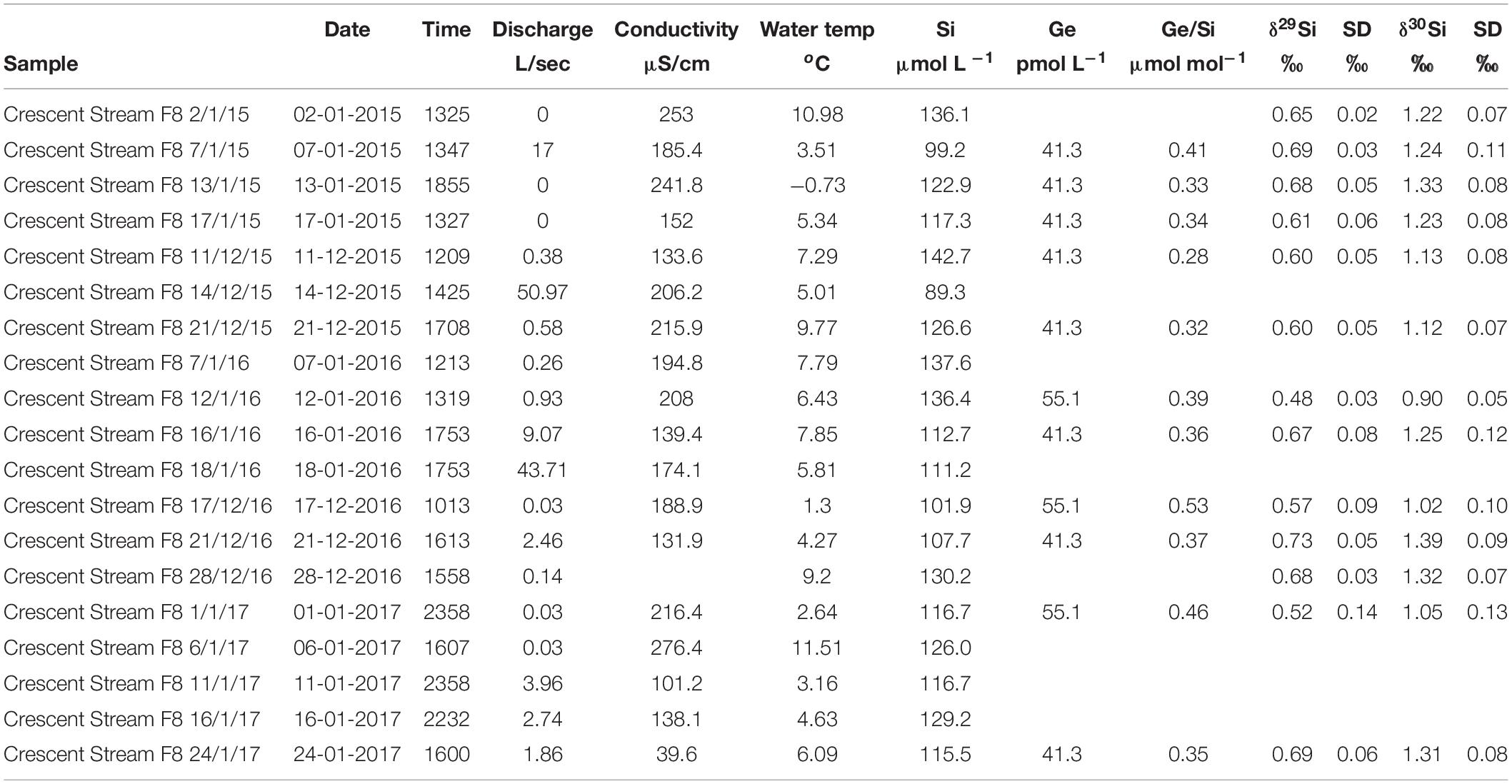
Table 1. Sampling date, time, field measurements (discharge, conductivity, and water temperature), dissolved silicon and dissolved germanium concentrations, Ge/Si ratios, and silicon isotope compositions (SD) for all samples in this study collected in the austral seasons: 2014−2015, 2015−2016, and 2016−2017.
Scanning Electron Microscopy
Sediment for SEM imaging was collected from Crescent Stream during the 2002−2003 austral summer, as described in Dowling et al. (2019). Briefly, samples were stored at room temperature after collection and were allowed to air dry. Samples were placed on carbon tape on an aluminum stub and then coated with gold/palladium with a Denton Desk V precious metal coater. Scanning electron microscopy was done with an FEI Quanta FEG 250 Field Emission SEM equipped with a Bruker EDX detector. Images were collected at 15 kV using either a secondary electron (SE) or back scattered electron detector (BSE).
Results
Seasonal Variations in Field Parameters in Crescent Stream
For the austral seasons between 2014 and 2017, discharge, conductivity, and water temperature measurements ranged from 0 to 153 L/sec, 25−290 μS/cm, and –2 to +12°C, respectively (Table 1). These values lie within the range of long-term (1994−2014) measurements in Crescent Stream (Figure 2A, LTER McMurdo Dry Valleys database, Gooseff and McKnight, 2019). Discharge values were lowest during 2016−2017, when stream flow did not exceed 8.20 L/sec and highest during 2015−2016 when discharge reached 146 L/sec (Supplementary Figure 2A). The range of water temperature and conductivity values were similar for the three seasons (Supplementary Figures 2B,C). For the samples collected, discharge values ranged from 0.0 to 57 L/sec (Table 1) and do not correspond with the pulses of peak seasonal discharge.
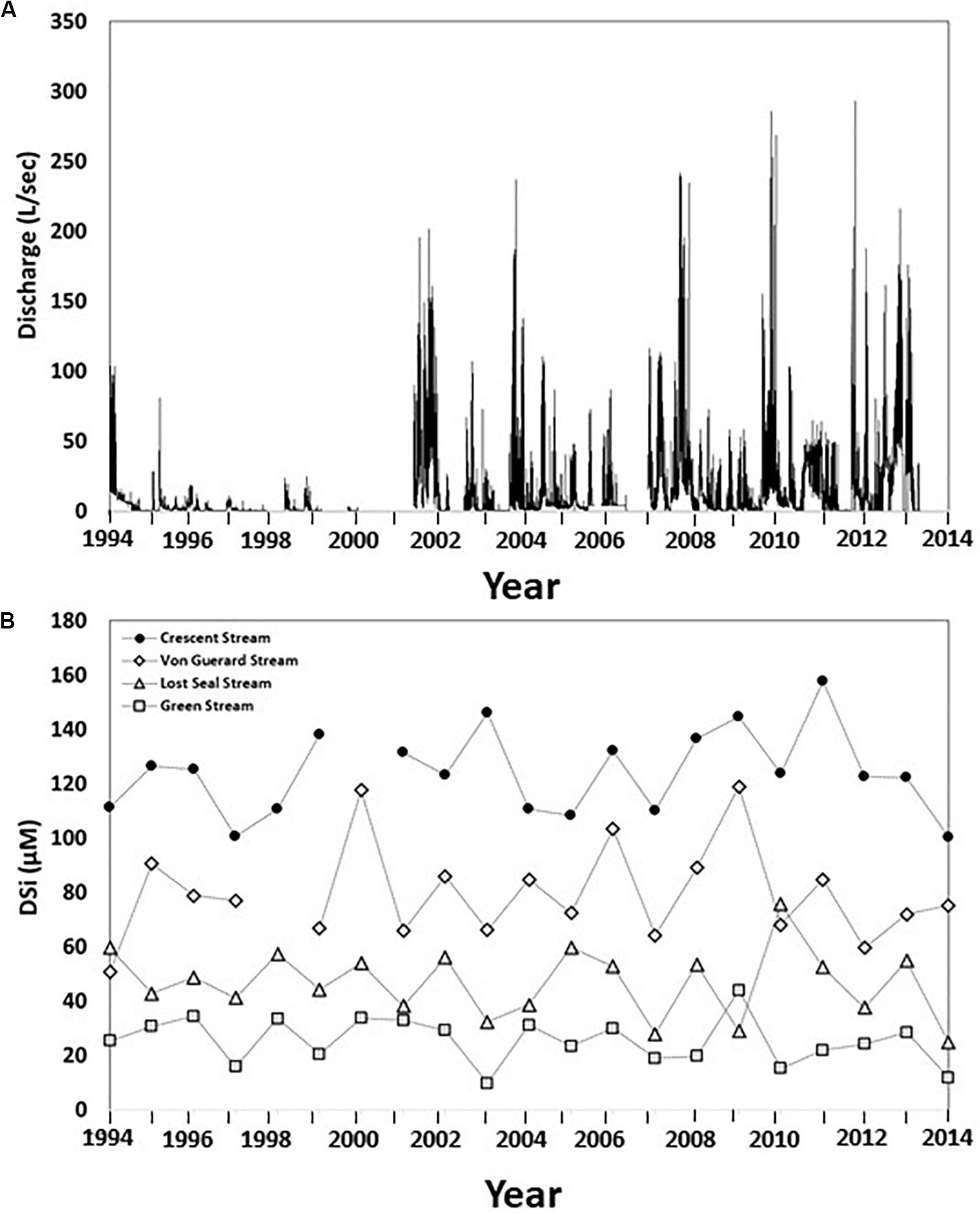
Figure 2. (A) Long-term (1994–2014) discharge data at gauge F8 in Crescent Steam, from Gooseff and McKnight (2019). There are two main trends: (i) decreasing discharge during the 1990–2000, (ii) sharp increase in discharge in 2001–2002. (B) Long-term (1994–2014) dissolved silicon (DSi, <0.4 μm filtered water) concentrations in Crescent Stream compared with other streams in Taylor Valley, McMurdo Dry Valleys, using average concentrations for each year from Lyons and Welch (2015). Crescent Stream is one of the longest streams in Taylor Valley with elevated Si concentrations compared with other Taylor Valley streams.
Si Concentrations and Ge/Si Ratios in Crescent Stream
Si concentrations for samples collected in Crescent Stream ranged from 89 to 136 μM between 2014 and 2017 (Figure 3 and Table 1). These values lie within the long-term (1994−2014) range of values measured in Crescent Stream, 83 to 163 μM (LTER McMurdo Dry Valleys database, Lyons and Welch, 2015; Figure 2B). DSi concentrations show no relationship with long-term stream discharge data (R2 = 0.01) (Supplementary Figure 3) and no relationship with discharge data in the 2014−2017 austral summers (R2 = 0.00).
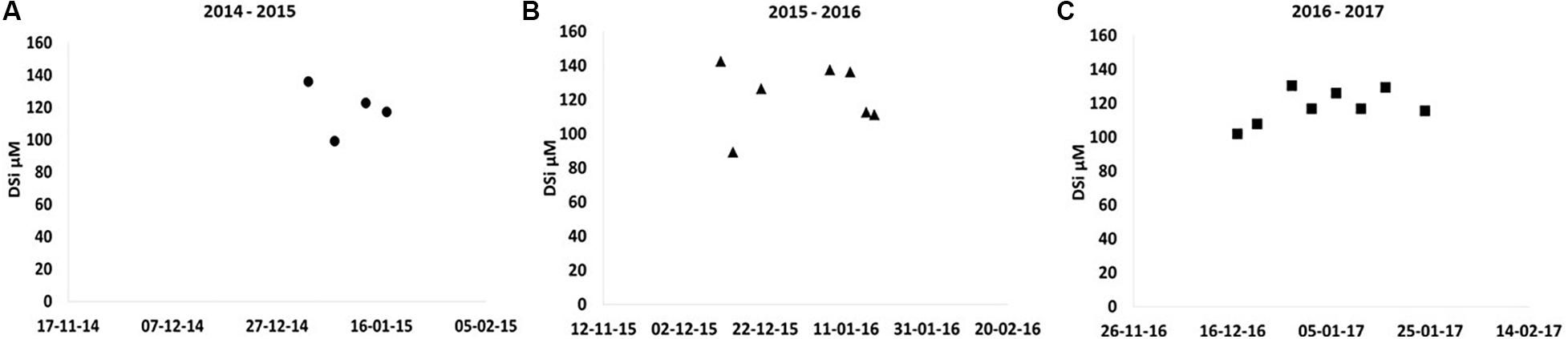
Figure 3. Dissolved silicon concentrations in <0.4 μm filtered water from Crescent Stream. Samples were collected between December and February 2014–2015 (A); 2015–2016 (B); 2016–2017 (C).
Germanium/silicon ratios (Ge/Si) in Crescent Stream ranged from 0.28 to 0.46 μmol mol–1 for samples collected between 2014 and 2017 (Figure 4 and Table 1), lower than the range of Ge/Si values expected in silicate rocks (Bernstein, 1985). There was no significant variation in Si concentrations and Ge/Si ratios during the three austral summers, and no significant variation between these seasons.
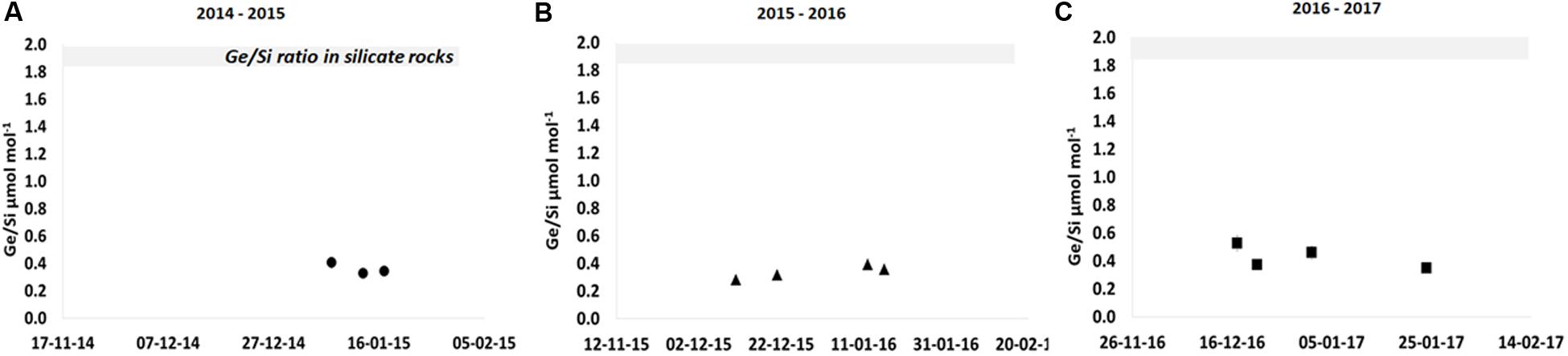
Figure 4. Ge/Si ratios in <0.4 μm filtered water from Crescent Stream for samples collected between December and February 2014–2015 (A); 2015–2016 (B); 2016–2017 (C). The gray bar represents the lower bound for Ge/Si ratios in silicate rocks (Bernstein, 1985). The precision on Ge/Si ratios (10%) is included in the marker size.
Silicon Isotope Compositions of Crescent Stream
Si isotope compositions (δ30Si) in Crescent Stream ranged from +1.22‰ to +1.33‰ in 2014−2015, +0.90‰ to +1.25‰ in 2015−2016 and +1.02‰ to +1.39‰ in 2016−2017 (Figure 5 and Table 1), higher than δ30Si values in silicate rocks (Opfergelt and Delmelle, 2012). There was no significant variation in δ30Si compositions during the three austral summers, and no significant variation between these seasons.
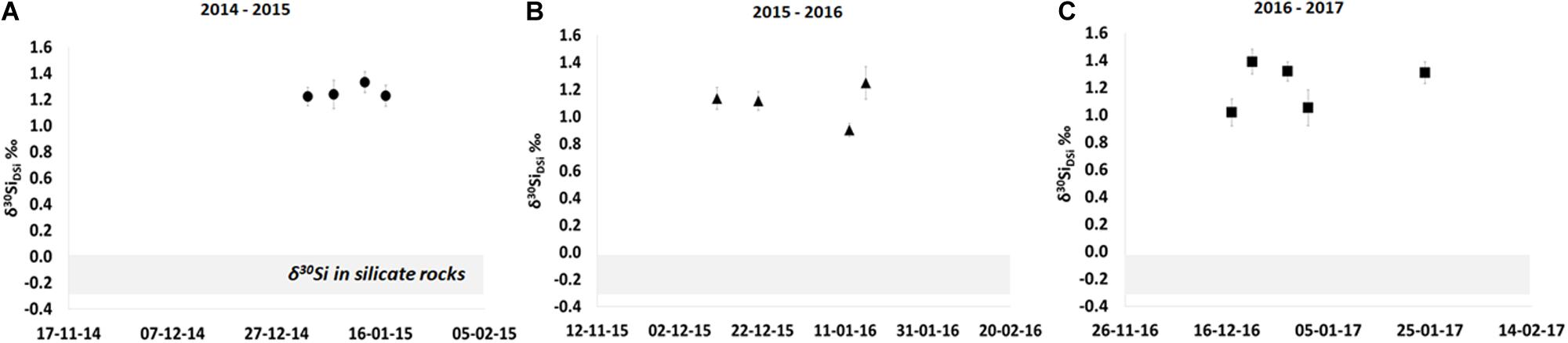
Figure 5. Dissolved silicon isotope composition (δ30SiDSi) in <0.4 μm filtered water from Crescent Stream. Samples were collected between December and February 2014–2015 (A); 2015–2016 (B); 2016–2017 (C). The gray band shows the range of δ30Si in silicate rocks (Georg et al., 2007b; Savage et al., 2010, 2011; Armytage et al., 2011). The error bars correspond to the standard deviation for silicon isotope measurements (2SD).
Scanning Electron Microscope Images of Stream Sediment
Scanning Electron Microscope images of mineral grains from Crescent Stream sediments show that the sediment is composed of silicate-bearing minerals such as pyroxene, biotite, olivine and volcanic glass with preserved vesicles and non-silicate bearing minerals, including apatite grains and calcite grains (Figure 6). All minerals show evidence for chemical and physical alteration of the mineral surface including linear etching over pyroxene and apatite mineral surfaces (Figures 6A,E), exfoliation of biotite minerals along a crystal plane (Figure 6B), etch pits and rounded facets on olivine mineral surfaces (Figure 6C), or extensive etching over calcite mineral surfaces (Figure 6D).
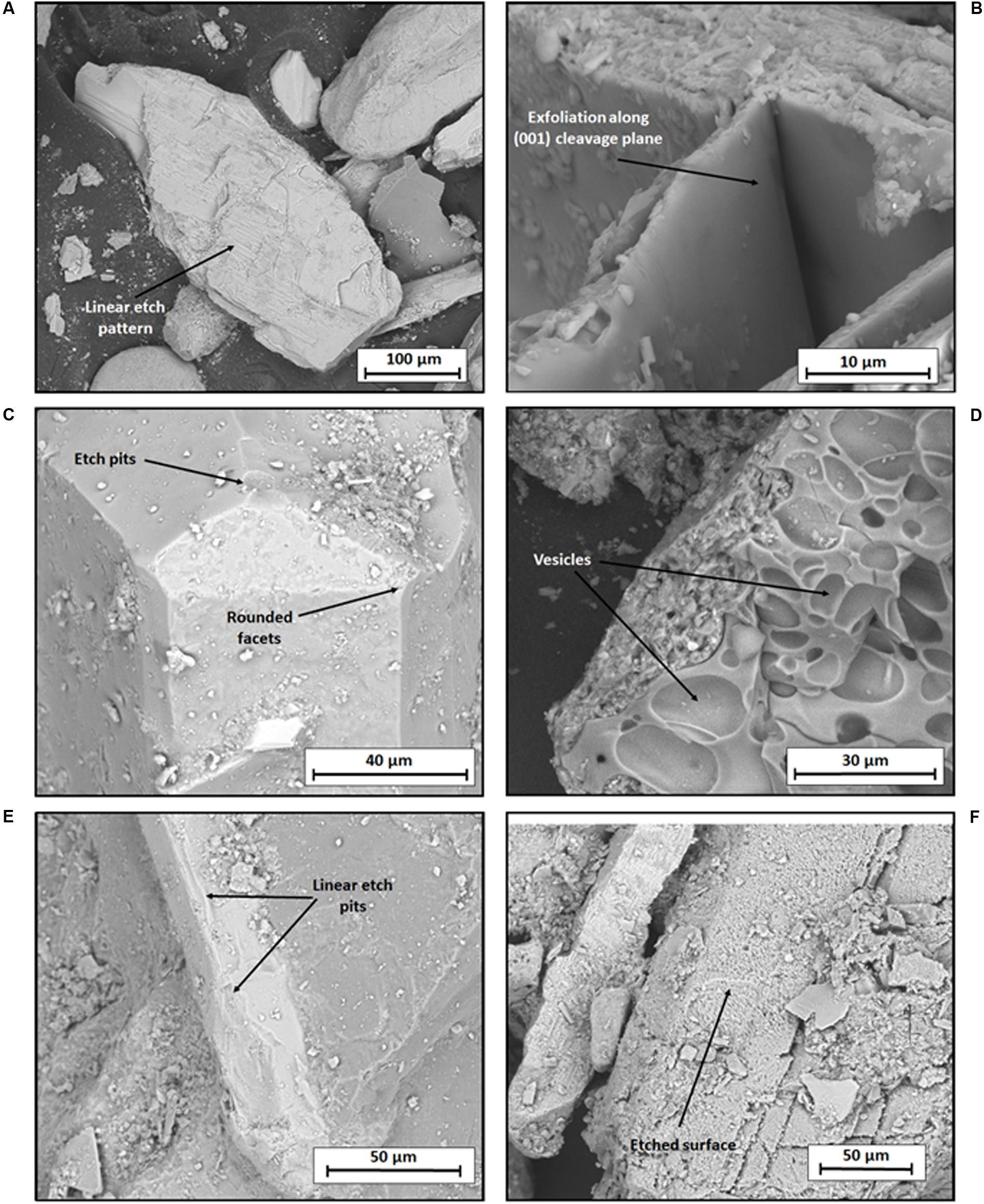
Figure 6. SEM images of minerals in the hyporheic zone sediments of Crescent Stream, including silicate-bearing minerals (A–D) and calcium and phosphate bearing minerals (E,F). (A) shows a large (300 μm long) euhedral pyroxene grain with physical abrasions and linear etched pattern on the surface; (B) shows a biotite grain with physical alteration and exfoliation along the (001) cleavage plane; (C) shows an olivine grain with a euhedral surface, slightly rounded facets and few small etch pits on the surfaces; (D) shows volcanic glass and ash with a vesicular surface and coating of fine grained amorphous-nanocrystalline on the left side of the glassy particle surface; (E) shows an elongate apatite grain with crystallographically controlled etch pits; (F) shows calcite minerals with extensively etched surfaces.
More specifically, volcanic ash spherules are associated with chemical alteration products in Crescent Stream sediments (Figure 7). SEM images show that spherules about 100 to 200 μm wide may present long cracks (∼120 μm; Figure 7A) and a surface with a “sugary” texture, indicative of an alteration crust (Figure 7B). This crust is composed of micron-nano sized amorphous to poorly crystalline secondary minerals. There is evidence of chemical alteration in fractured spherules, with coating patches on euhedral, ∼5 −10 μm long minerals (Figure 7C). A high-resolution SEM image of these patches indicates that these are hydrous or amorphous phases coating the surface of the euhedral minerals (Figure 7D).
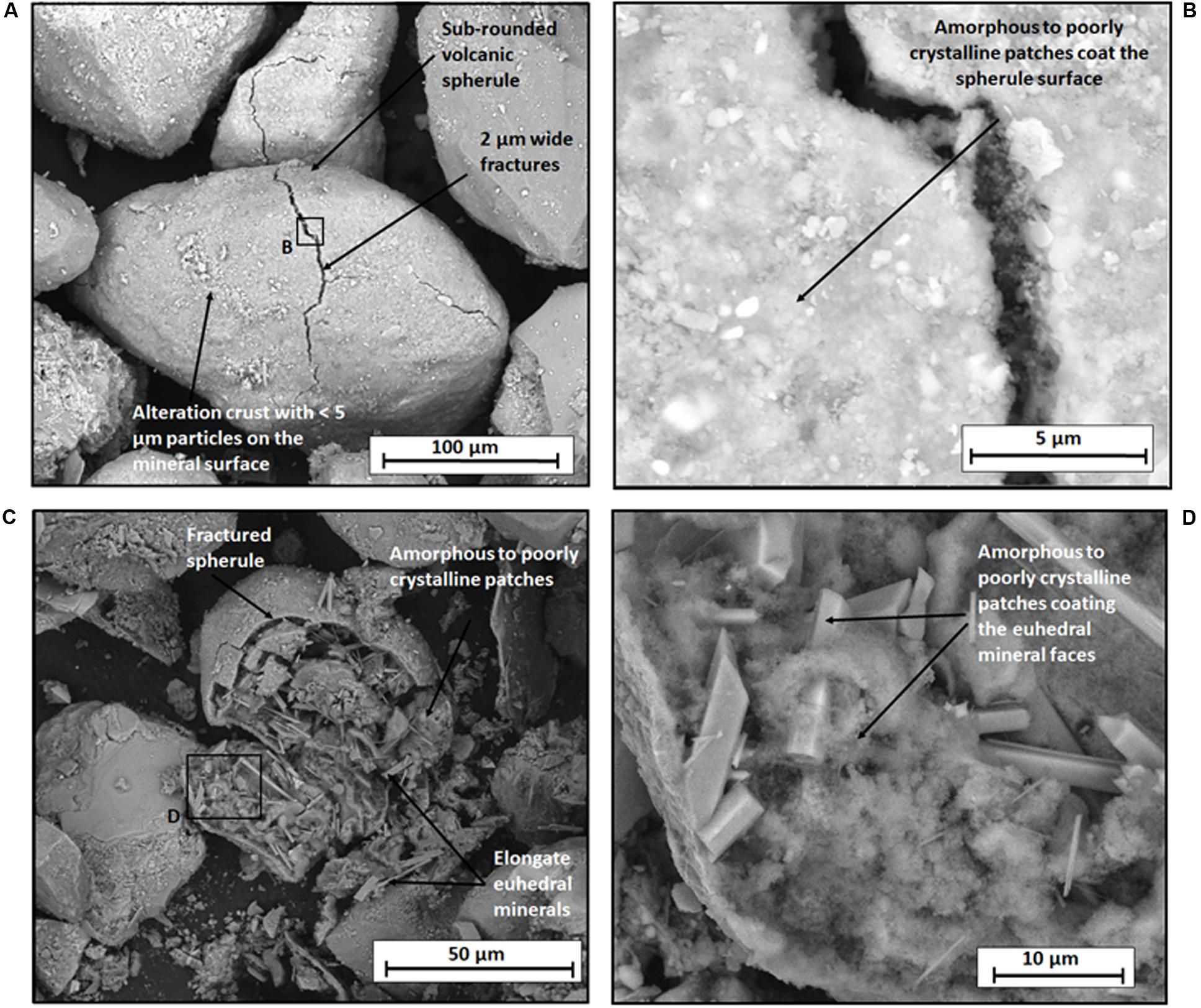
Figure 7. SEM images showing the chemical alteration of volcanic ash spherules in the hyporheic zone sediments of Crescent Stream, (A) shows a ∼200 μm long spherule of volcanic ash with rounded edges, fractures over the grain surface and micron-nano sized alteration crust on the grain surface; (B) shows a high resolution backscatter electron (BSE) image of the spherule surface in panel (A) showing an amorphous to poorly crystalline “sugary” texture on the spherule surface; (C) shows a ∼70 μm long volcanic spherule that has chemically altered to form secondary mineral products. These products include euhedral elongate minerals and amorphous to poorly crystalline minerals; (D) shows a high resolution BSE image of the secondary mineral products in panel (C) showing that the poorly crystalline to amorphous material coats the surface of euhedral mineral faces.
Discussion
Comparison Between Si Isotope Compositions in Crescent Stream, Permafrost-Dominated Rivers and Sub-Glacial Rivers
Glacial and permafrost-dominated river basins have contrasting weathering regimes (Anderson et al., 1997) resulting in contrasting dissolved silicon isotope compositions (Pokrovsky et al., 2013; Mavromatis et al., 2016; Sun et al., 2018; Hatton et al., 2019a, b). Figure 8A shows the Si concentrations and Si isotope composition of waters in sub-glacial meltwaters, permafrost-dominated Arctic Rivers and Crescent Stream (this study). Sub-glacial meltwaters have low DSi concentrations ranging from 3 to 94 μM and δ30SiDSi compositions ranging from −0.58‰ to +0.87‰, attributed to amorphous Si and clay mineral dissolution during sub-glacial water-mineral interaction (Hatton et al., 2019a, b). Permafrost-dominated large Arctic Rivers have higher DSi concentrations ranging from 25 to 310 μM, and δ30SiDSi compositions ranging from +0.39‰ to +2.72‰ (Pokrovsky et al., 2013; Mavromatis et al., 2016; Sun et al., 2018). The wide scatter of compositions in large permafrost-dominated rivers prevents the isolation of a δ30SiDSi signal from mineral weathering in permafrost soils.
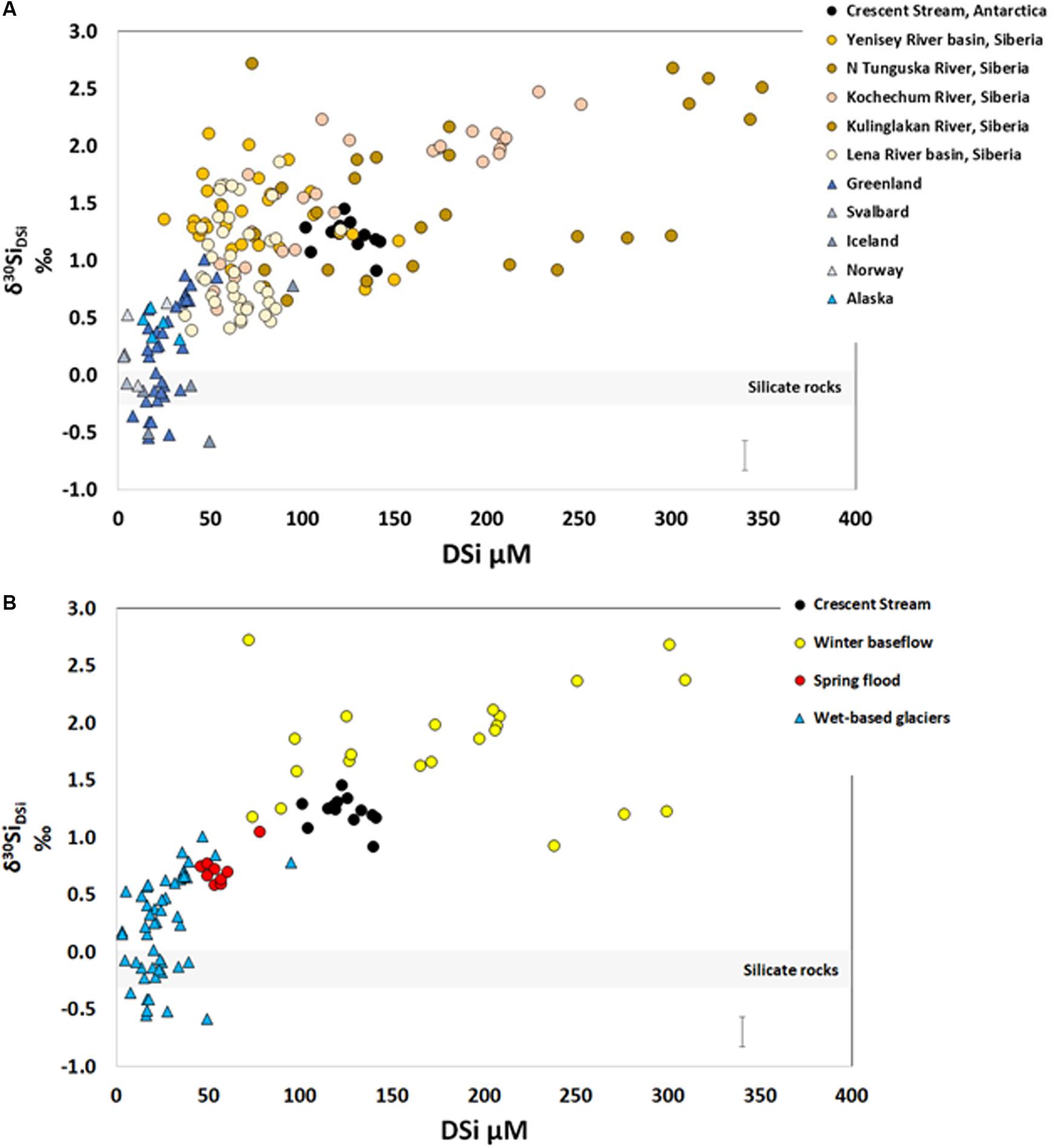
Figure 8. (A) Synthesis of dissolved silicon isotope (δ30SiDSi) compositions in glacial rivers (different blue colors), non-glacial permafrost-dominated river basins (different brown colors), and Crescent Stream for 2014–2015, 2015–2016, 2016–2017 seasons (black). Data sources: Pokrovsky et al., 2013; Mavromatis et al., 2016; Sun et al., 2018; Hatton et al., 2019b. (B) Comparison between δ30SiDSi compositions in Crescent Stream, with those in (i) permafrost-dominated rivers during winter baseflow, (ii) permafrost-dominated rivers during spring flood (Pokrovsky et al., 2013; Sun et al., 2018), and (iii) wet-based glacial rivers (Hatton et al., 2019b), showing that δ30SiDSi compositions in Crescent Steam during the austral summer months correspond to δ30SiDSi compositions in Arctic rivers during winter baseflow. The gray band shows the range of δ30Si in silicate rocks (Georg et al., 2007b; Savage et al., 2010, 2011; Armytage et al., 2011). The error bar corresponds to the maximum standard deviation (2SD) for silicon isotope measurements.
Crescent Stream, MDV has a narrow range of DSi and δ30SiDSi compositions, falling in a tight cluster within the range of values reported for Arctic Rivers (Figure 8A) showing that non-glacial weathering processes are contributing to δ30SiDSi compositions in this Antarctic stream. In an attempt to connect permafrost-weathering conditions in Arctic and Antarctic streams, we compare δ30SiDSi compositions in Crescent Stream with the δ30SiDSi compositions for (i) wet-based glacial streams, (ii) Arctic rivers during winter baseflow, and (iii) Arctic rivers during the spring flood period (Figure 8B). Samples from the summer period (included in Figure 8A) are omitted because Si isotope fractionation during Si plant uptake obscures the weathering signal (Sun et al., 2018), a process that is not relevant in Antarctica. In the Arctic, δ30SiDSi compositions during spring flood reflect DSi derived from dissolution of minerals and vegetation in the suspended load (Pokrovsky et al., 2013; Mavromatis et al., 2016; Sun et al., 2018) and so represent the bulk δ30Si composition of permafrost surface soils washed into the river during river ice-break up. In Figure 8B, the δ30SiDSi compositions and DSi concentrations fall on a line that passes through this spring flood δ30SiDSi composition, with the lowest δ30SiDSi compositions in wet-based glacial streams attributed to secondary mineral dissolution (Hatton et al., 2019a) and highest δ30SiDSi compositions during winter baseflow attributed to secondary mineral formation in sub-permafrost groundwaters (Pokrovsky et al., 2013). The δ30SiDSi compositions in Crescent Stream during the austral summer also fall on this line and are similar to δ30SiDSi compositions for winter baseflow in Siberian rivers (Pokrovsky et al., 2013; Sun et al., 2018) suggesting that processes driving Si isotope fractionation during winter baseflow in Arctic Rivers likely also occur in Crescent Stream, Antarctica.
The Arctic River basins span a range of lithology, from basaltic (Kochehumo River, Pokrovsky et al., 2013) to terrigenous siliciclastic sediments (Lena River tributaries, Sun et al., 2018). However the distribution of DSi and δ30SiDSi compositions during winter baseflow does not reflect lithology specific silicate-mineral weathering signatures but rather reflects the extent of secondary mineral formation and dissolution processes occurring in sub and supra-permafrost groundwaters in these Arctic basins (Pokrovsky et al., 2013).
The main pool of DSi entering Crescent Stream is derived from silicate mineral weathering in the hyporheic zone (Nezat et al., 2001; Gooseff et al., 2002; Maurice et al., 2002). The initial supra-glacial meltwaters have Si concentrations ranging from 4 to 8 μM (Lyons et al., 1998; Nezat et al., 2001), contributing <10% of the Si transported in Crescent Stream between 2014 and 2017. This glacially derived Si in MDV originates from stratospheric aerosols, aeolian salt and dust deposition onto glacier surfaces blown from the valley floor (Lyons et al., 2003). Assuming no isotope fractionation during mineral dissolution on the glacier surface, the DSi contribution to Crescent Stream from glacial waters will have δ30SiDSi compositions within the array of basaltic to granitic δ30SiDSi compositions (Savage et al., 2011). This allows us to use Si isotopes and Ge/Si ratios as a tracer of biotic and abiotic secondary mineral formation in the hyporheic zone and stream bed to constrain the processes that trap Si in the terrestrial system after being released from mineral dissolution.
Si Cycling and Isotope Fractionation in the Hyporheic Zone of Crescent Stream
Biotic Processes
Diatom growth preferentially incorporates the lighter Si isotopes, with an isotope fractionation factor, 30ε, of−1.1‰ for Si uptake in fresh water systems (Alleman et al., 2005; Opfergelt et al., 2011). Diatoms are substantial contributors to microbial mats in most Taylor Valley streams (McKnight et al., 1998; Pugh et al., 2002; Esposito et al., 2008) with biogenic silica in modern and paleo diatoms making up 2−8% dry weight of stream sediments in meanders, pools and riffles (Heindel et al., personal communication). The microbial mats remain dormant during the winter months, are photosynthetically active within hours of the return of flow at the start of the austral summer (Howard-Williams et al., 1986) and mat biomass varies with seasonal flow patterns with loss due to scouring of the mats occurring during high flow (Stanish et al., 2011; Cullis et al., 2014) over the austral summer. In streams with lower annual discharge, which are generally longer and have higher DSi concentrations, the larger more silicified diatom taxa, such as Hantzchia spp. (about 100 μm in length), are more abundant; whereas Psammothidium spp. and other smaller taxa (about 12 μm in length) are common in streams which have higher annual flows and are usually shorter with lower DSi concentrations (Stanish et al., 2011). In general, because smaller cells have a higher surface area to volume ratio and would be better able to meet their Si requirement for growth, this suggests that DSi availability may influence the diatom community composition, but the DSi does not limit diatom growth rate. Diatom growth can therefore contribute to the uptake of a fraction of mineral-derived DSi over the austral summer months.
The diatom community composition at the study site in the lower reaches of Crescent Stream was similar in the summer of 2014 and 2016 for both the black mats that grow at the stream margin and the orange mats that grow in the main channel (Supplementary Table 1). The species richness of these samples ranged from 9 to 20, which is typical for microbial mats in Dry Valley streams. A distinctive aspect of the diatom community in these mats was the consistent dominance by the monoraphid diatom Achnanthes taylorensis, which accounted for 41% or more of the total diatom cells counted. This species ranges in length from 25 to 38 μm and is commonly present at relatively low abundance (a few percent or less) in microbial mats in streams adjacent to Crescent Streams (Spaulding et al., 2020). However, this species has been found to be more abundant in microbial mats in the nearby Spaulding Pond at the base of the Howard Glacier and in a few ponds at Cape Royds across McMurdo Sound. Furthermore, A. taylorensis was common in the hyporheic sediments studied in the adjacent Von Guerard Stream (Heindel, unpublished data). Another distinctive aspect of the diatom community is the relatively low abundance of Hantzschia species, which are large highly silicified taxa commonly abundant in mats in adjacent streams. There were a total of 11 species of the genus Luticola found in these mat samples, which is typical for these streams. It is interesting that L. dolia and L. elegans were relatively more abundant among the Luticola species than is typical for the diatom communities in adjacent streams. Overall, these results confirm that benthic diatoms were present in microbial mats in Crescent Stream during the sampling period and that the dominant diatom taxa is known to accumulate in hyporheic sediments in another adjacent stream. Here we discuss the extent to which DSi incorporation into diatoms contributes to the sequestration of primary mineral derived-DSi and the high δ30SiDSi compositions in Crescent Stream.
The extent to which Si isotope fractionation during DSi uptake is sufficient to impact the δ30SiDSi in the stream water depends on the Si demand from the diatom growth relative to the rate of silicate mineral dissolution in the hyporheic zone. If the rate of production from silicate mineral dissolution is greater than the rate of uptake by diatoms, the Si concentration would still increase in the downstream direction but at a lower rate. Thus, the DSi concentration would not necessarily decrease downstream if diatom uptake were influencing the δ30SiDSi composition. A synoptic study of downstream patterns of Si concentrations in Von Guerard Stream shows that Si weathering rates were similar for moderate and low flow streams (Gooseff et al., 2002) suggesting that an additional process, such as increased microbial mat growth during low to moderate stream flow (Stanish et al., 2011) sequesters a portion of the DSi in streams. This is evidence to show that diatoms incorporate a relatively significant portion of the DSi released from silicate weathering in hyporheic zone sediments in MDV stream. Diatom growth rates in the laboratory are slow and independent of temperature for four of the dominant diatoms isolated from the MDV, which could support a stable biotic Si uptake rate per area of microbial mat in the streams (Darling et al., 2017) over the duration of the austral summer, consistent with the relatively constant δ30SiDSi compositions (Figure 5).
Here we use Ge/Si ratios to understand the extent to which the DSi, released via silicate weathering, is taken up into diatoms in Crescent Stream. Diatoms generally do not discriminate between Ge and Si during growth i.e., the Ge/Si ratio of diatom opal reflects that of ambient water (Froelich et al., 1992). The exception to this occurs at low DSi concentrations where diatoms might start to discriminate against Ge, therefore raising the Ge/Si ratio in water (Sutton et al., 2010). The use of Ge/Si ratios to understand Si uptake into diatoms is difficult in Arctic river basins draining organic-rich permafrost soils because a portion of the Ge released from silicate weathering can form complexes with dissolved organic carbon (DOC) (Pokrovski and Schott, 1998). The contribution of Ge-organic complexes can be considered as limited in Crescent Stream given that the DOC concentrations in the MDV is low (<50 μM; Gooseff et al., 2002), except for an initial pulse when the streams are first wetted. Therefore, we can be confident to use the Ge/Si ratio in this Antarctic stream without being concerned about Ge-Si fractionation by organic colloids, such as in boreal rivers (Pokrovski and Schott, 1998). If only diatom uptake is mediating the net DSi concentrations and δ30SiDSi compositions, Ge/Si should stay the same (Froelich et al., 1992) or increase relative to the silicate rock ratio at low DSi concentrations (Sutton et al., 2010). However, Ge/Si ratios are lower than in silicate rocks (Figure 4; Bernstein, 1985) showing that DSi uptake into diatoms could contribute to increase δ30Si compositions relative to the signature of silicate rocks but is not the only mechanism behind the heavy δ30SiDSi compositions in Crescent Stream.
An additional supply of DSi from diatom dissolution in hyporheic zone sediments must also be accounted for when considering the net contribution of diatoms to the silicate weathering flux. Diatom dissolution preferentially releases the lighter Si isotope, with an isotope fractionation factor, 30ε, of −0.55‰ (Demarest et al., 2009) in fresh water systems. Thus the dissolution of diatoms in the hyporheic zone would act to lower δ30SiDSi compositions in streams. During the austral summer months, there is a continuous input of diatoms in the particulate organic matter entering the hyporheic zone from upstream scouring events (Cullis et al., 2014). From a mass balance perspective, the present-day quantity of modern diatoms in hyporheic zone sediments can be explained by (i) the continuous supply of diatoms to sediments from microbial mats upstream and (ii) dissolution of diatoms in the hyporheic zone sediments. However, the high δ30SiDSi compositions in Crescent Stream indicate that diatom dissolution likely had a negligible contribution to silicate weathering rates in Crescent Stream between 2014 and 2017.
The combined evidence shows that only a fraction of DSi released from silicate mineral weathering is taken up by diatoms growing on the stream bed, resulting in a constant background supply of DSi (in equilibrium with diatoms) with higher δ30SiDSi compositions to Crescent Stream during austral summer months.
Abiotic Processes
Silicon incorporation in secondary weathering products
Clay minerals preferentially incorporate the lighter Si isotopes, with isotope fractionation factors varying from −1.8‰ to −2.0‰ (Opfergelt and Delmelle, 2012) driving δ30SiDSi compositions in soil porewaters to heavier values (Georg et al., 2007a). In MDV, hyporheic waters are oversaturated with respect to kaolinite (Gooseff et al., 2002) and some secondary products (kaolinite, illite and smectite) have been observed in the fine fraction (<2 μm) of hyporheic zone sediments (Lyons et al., 1998; Gooseff et al., 2002), with some controversy raised about their extent (Lyons et al., 1998). SEM images of sediments in Crescent Stream show micron-sized clay minerals on the surface and within broken volcanic spherules (Figures 7A,C), suggesting that a fraction of DSi released during primary mineral weathering is incorporated into clay minerals on altered mineral surfaces. Volcanic spherules contribute <1% of Crescent Stream sediments (Dowling et al., 2019) but are subject to extensive chemical and physical alteration (Figure 7) and are likely an important site for secondary clay mineral formation in Crescent Stream sediments.
Here we use Ge/Si ratios to confirm that clay mineral formation is occurring during meltwater-sediment exchange in Crescent Stream between 2014 and 2017. Ge/Si ratios in Crescent Stream range from 0.28 to 0.53 μmol mol–1 (Figure 4) which is lower than Ge/Si ratios in silicate rocks (1−3 μmol mol–1, Bernstein, 1985) suggesting that a fraction of DSi released from parent materials is incorporated into clay minerals during water transport in Crescent Stream. Ge/Si ratios would also decrease if amorphous silica (ASi) dissolution occurs providing Si and not Ge to stream waters. However, it is unlikely that significant ASi dissolution occurs because this would also decrease the δ30Si of DSi (Li et al., 1995).
The Ge/Si ratios in the samples collected between 2014 and 2017 were relatively similar, with no obvious trends throughout the season or over the 3 years of samples collected. There are no seasonal or daily variation in Ge/Si ratios (Figure 4), consistent with the evidence showing that meltwaters are in chemical equilibrium with mineral surfaces during transport in the hyporheic zone (Wlostowski et al., 2018). Under these weathering conditions, any changes in Ge and Si supply from the water-clay mineral interface during the austral summer are dependent on water transit times rather than variations in clay mineral formation showing that DSi is in equilibrium with clay minerals and supplies a constant background δ30SiDSi composition to Crescent Stream during the 2014−2017 austral summers.
Additional Si isotope fractionation may occur via preferential absorption of lighter Si isotopes onto Fe and Al (oxy)hydroxides (Delstanche et al., 2009; Opfergelt et al., 2009; Oelze et al., 2014). Moreover, Ge may be sequestered on Fe (oxy)hydroxides (Scribner et al., 2006) and also contribute to the low Ge/Si ratios in Crescent Stream. The quantity of Fe (oxy)hydroxides and Al oxides in stream sediments and conditions for element absorption during glacial meltwater-sediment exchange are poorly understood. However, the fine sediment fraction (<2 μm) is made up of 40−65% by weight of amorphous weathering products (Gooseff et al., 2002). This amorphous fraction only represents 0.3 wt% of the bulk sediment (Gooseff et al., 2002) but is distributed over the primary mineral surfaces in Crescent Stream sediments (Dowling et al., 2019). That fraction may contain amorphous to poorly crystalline Fe oxy-hydroxides that contribute to the high δ30SiDSi compositions in Crescent Stream.
Cryogenic amorphous silica precipitation
In Crescent Stream, MDV, the high δ30SiDSi compositions cannot be controlled by silicate mineral dissolution only and clay mineral formation likely contributes to modify the silicate rock signal. Amorphous silica precipitation is an additional important process that has to be considered in this environment, which is subjected to sub-zero temperatures for the majority of the year with mean annual temperatures between −17°C and −20°C (Doran et al., 2002).
At the freezing point of waters in soils and sediments, ice formation occurs and DSi is concentrated in the surrounding brines (Channing and Butler, 2007). If Si saturation occurs, up to 90 mol% of the starting DSi can be precipitated as amorphous silica (Dietzel, 2005) and Si is fractionated with an isotope fractionation factor, 30ε, of−1.0‰ (Li et al., 1995). This occurs either by a steady-state fractionation where the final solid has the same Si isotope composition as the starting fluid (assuming all DSi precipitates), Δ30Sisolid–hyporheic zone solution = [δ30Sisolid−δ30Sihyporheic zone solution] ≈ 0‰; or by unidirectional kinetic isotope fractionation where the final solid has a lighter isotope composition than the starting fluid, Δ30Sisolid–hyporheic zone solution ≈<0‰ (Frings et al., 2016 and references therein). This is assuming no re-equilibration of Si isotopes in amorphous silica after precipitation (Fernandez et al., 2019). Unidirectional kinetic isotope fractionation occurs if (i) there is a closed system with no Si inputs or outputs; (ii) there is no change to the δ30Si composition of DSi in the starting solution; (iii) dissolved Al concentrations are greater than 0.1 mM (Li et al., 1995; Oelze et al., 2015; Frings et al., 2016). Under these conditions, amorphous silica precipitation during cryogenic precipitate formation in permafrost soils can fractionate Si isotopes and drive riverine δ30SiDSi compositions to heavier values. This process has been invoked to explain the heavier Si isotope compositions in large Arctic rivers during winter months (Pokrovsky et al., 2013) and heavy Si isotope in soils porewaters in seasonally frozen Icelandic soils (Opfergelt et al., 2017).
In Crescent Stream, glacial meltwaters are transported along preferential flow paths in isolated areas of the hyporheic zone (Cozzetto et al., 2013) and water can collect in these isolated pockets at periods of high flow during the austral summer and when flow stops at the end of the austral summer (Cozzetto et al., 2006). The waters in the hyporheic zone and active layer soils freeze, likely at temperatures below 0°C because of the high concentrations of salts. During freezing and ice formation, dissolved Si accumulates in surrounding unfrozen waters and dissolved Si becomes saturated with respect to amorphous silica. Si isotope fractionation occurs by unidirectional kinetic isotope fractionation preferentially incorporating the light isotopes in amorphous silica and leaving a heavy Si isotope composition in surrounding waters. SEM images of sediments in Crescent Stream (Figures 7B,C) suggest the presence of an amorphous mineral phase on the surface of primary minerals. This phase may be composed of amorphous silica suggesting that amorphous silica precipitation occurs in hyporheic zone sediments in Crescent Stream. Assuming there are no freeze-thaw cycles, the heavy isotope signal remains trapped in the isolated pockets during the winter months and this preserved signal may contribute to the high δ30SiDSi compositions of Crescent Stream in the austral summer months.
The contribution of a winter-derived δ30SiDSi signal to stream water δ30SiDSi over the austral summer months depends on the rate at which these winter waters exchange with Crescent Stream waters. Evidence from δ18O and δD compositions suggests that winter waters are flushed from the hyporheic zone at the start of the austral summer and not continuously supplied over the summer months (Gooseff et al., 2003). In early December, water in the extended hyporheic zone have enriched δ18O and δD compositions resulting from evaporation and sublimation in the previous winter and summer. At the start of the austral summer, this enriched signal is transferred to stream waters providing evidence for early season hyporheic-stream water exchange. Gooseff et al. (2003) show that stream water δ18O and δD enrichment decreased substantially between the first sampling date (Dec 7) at the beginning of flow, and the subsequent dates during the main flow period (Dec 21 and Jan 7), indicating that the relative contribution of waters from the extended hyporheic decreases in the 1st weeks of the austral summer.
Further, we can place physical constraints on how much water with a heavy δ30SiDSi can enter the stream from the hyporheic zone. The volumetric content of unfrozen water in the hyporheic zone was 10% at the end of the summer (Wlostowski et al., 2018). We can calculate a high estimate for the potential volume of the hyporheic zone for Crescent Stream as 5 km × 0.2 m × 10 m (stream length × hyporheic zone depth × width) to be 10 × 106 L. Using these estimates of unfrozen water content and hyporheic zone volume we estimate that 106 L of water is present in the hyporheic zone at the end of the Austral summer months. Given the rapid hyporheic exchange, we can estimate how fast that volume would be flushed out of the near and extended hyporheic zone contributing 10% of the water at a low flow rate in the stream of 10 L/sec (Supplementary Figure 2), corresponding to 1 L/sec. As a result, it can be estimated 106 L of water would take 106 sec or about 12 days to be flushed out at a flow rate of 1 L/sec. The 10 L/sec flow rate is a low value and flushing could happen more rapidly with higher flows. These constraints are consistent with evidence from δ18O and δD compositions (Gooseff et al., 2003) and show that winter waters are flushed out of the extended hyporheic zone at the beginning of the austral summer.
Consistent with this evidence for an early season flushing of winter waters, we could therefore expect to observe an increase in DSi and δ30SiDSi compositions at the start of summer. However, this early season pulse is not observed in the samples collected at the start of the austral season (December 11th to December 28th, Table 1). One scenario is that early season sampling did not coincide with the release of waters stored in the hyporheic zone over the austral winter. For all seasons, sampling began 0−6 days after the onset of river discharge (Supplementary Figure 2A, LTER McMurdo Dry Valleys database, Gooseff and McKnight, 2019). Considering that active layer thaw coincides with glacial surface melt at the start of the austral summer (Gooseff et al., 2002), the collected samples likely coincided with the onset of hyporheic zone development and thus would capture the early release of waters stored during winter months. To improve on this effort, a high resolution (e.g., daily) sampling during early season thaw is required to detect a winter-derived δ30SiDSi signal. A second scenario is that the winter-derived DSi made up a relatively small fraction of the total DSi in Crescent Stream, and the pulse of DSi with high δ30SiDSi compositions did not affect the relatively constant stream Si isotope composition. Alternatively, to explain a constant supply of winter-derived high δ30SiDSi compositions to Crescent Stream, we consider the entire hyporheic zone as individual “nested storage zones with unique timescales of exchange” (Gooseff et al., 2003). In this scenario, the nested storage zones each represent pockets of frozen sediment at the start of the austral summer. During gradual thaw over several weeks between December and January (Conovitz, 2000), the pockets of unfrozen water associated with amorphous silica are incrementally unlocked and the unfrozen water is connected to the stream during sediment-stream water exchange. In this hypothesis, the high δ30Si compositions are gradually added to the stream waters as the hyporheic zone is established over the summer months. Further work is required to understand the development of winter-derived δ30SiDSi compositions and their contribution to summer river waters in permafrost dominated-basins.
A conceptual model of these processes is presented in Figure 9, highlighting the processes driving Si isotope fractionation in the hyporheic zone, which are visualized as individual segments of water−mineral interactions. The δ30SiDSi compositions in waters collected at Gauge F8 in Crescent Stream results from the mixing of DSi from pockets of the hyporheic zone, influenced by amorphous silica formation during winter months, by diatom growth during summer months and ongoing clay mineral formation in these sediments. In this system, DSi concentrations increase as hyporheic zone pockets are connected with stream water but there is no evolution of the silicon isotope signal.
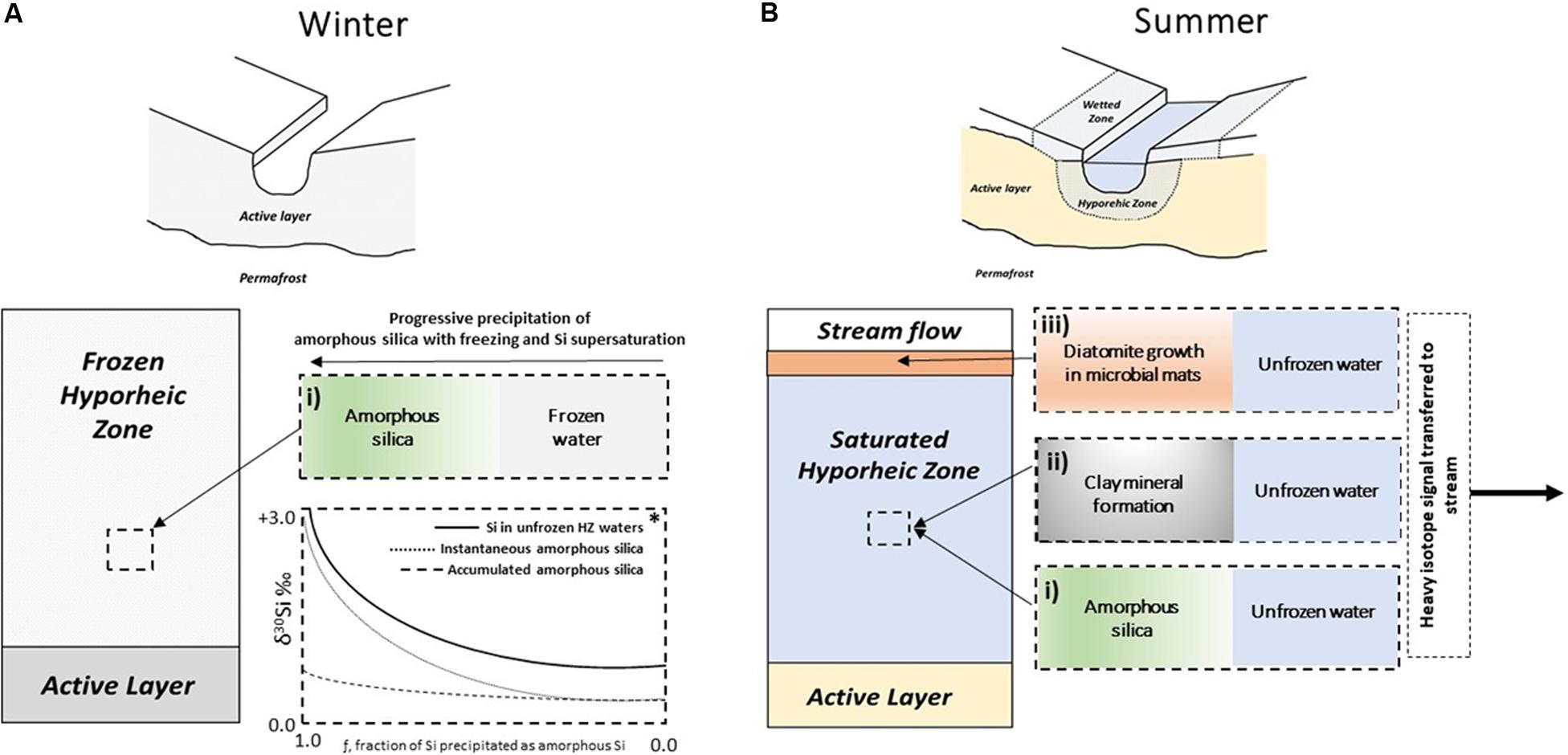
Figure 9. Schematic showing the principal processes controlling dissolved Si isotope compositions in Crescent Stream during the austral winter (A) and summer (B) months. The initial pool of Si(OH)4 is supplied by primary mineral dissolution (Gooseff et al., 2002) in the hyporheic zone. Si isotope fractionation occurs during subsequent secondary inorganic and biologically mediated Si phases formation. During winter (A) waters in isolated pockets of the hyporheic zone freeze, resulting in supersaturation of Si(OH)4 and precipitation of amorphous silica (i). Under these conditions, unidirectional kinetic isotope fractionation occurs in accordance with the Rayleigh fractionation model (*) and amorphous silica preferentially incorporates the light isotopes (30ε = –1.0‰), leaving the remaining unfrozen water with relatively high δ30Si compositions. With progressive amorphous silica formation, the Si isotope composition of Si(OH)4 in unfrozen water evolves to heavier values. During summer (B), ice in the hyporheic zone thaws and the remaining DSi (in equilibrium with amorphous Si) presenting high δ30SiDSi compositions is released from the isolated pockets into Crescent Stream. In addition, diatoms are actively forming in microbial mats (ii) in the hyporheic zone during summer months, preferentially taking up light Si isotopes, providing a background contribution of higher δ30SiDSi compositions in Crescent Stream. These processes are superimposed onto clay mineral formation (iii), also preferentially taking up light Si isotopes.
Dissolved Stream Si Isotope Composition as a Tool to Monitor Future Hyporheic Zone Functioning
Given the consistency of the DSi concentrations, Ge/Si ratios and δ30SiDSi compositions during three austral summers and our understanding of these Si isotopes compositions in Crescent Stream, we can assess the potential use of stream water δ30SiDSi compositions to trace future changes in hyporheic zone functioning in response to predicted scenarios in McMurdo Dry Valleys (Doran et al., 2008; Fountain et al., 2014).
Increased air temperatures in Antarctica (Bekryaev et al., 2010) are driving increased glacial melting with subsequent impact on stream flow with exceptionally high flow events reported in 2001−2002, 2008−2009, and 2011−2012 (Doran et al., 2008). In this study, we observe no relationship between δ30SiDSi values and stream flow in Crescent Stream between 2014 and 2017 suggesting that δ30SiDSi values will not respond to increased stream water flow in the future. However, increases in stream flow and decreases in fluid transit time in MDV streams will likely move the hyporheic zone toward a weathering limited regime (Wlostowski et al., 2018) where secondary clay minerals are dissolved and removed faster than they can be replaced via incongruent silicate mineral dissolution. This change in weathering regime may alter the δ30SiDSi composition of waters in contact with clay minerals during summer months.
Soil and water temperatures are predicted to increase in MDV (Fountain et al., 2014). Under future conditions, saline waters may not reach the low temperatures required for cryogenic precipitates to form, leaving a larger pool of silicon unfrozen during winter months and altering the isotope composition of DSi released into Crescent Stream during the summer. One scenario might be that in earlier warming stages, more regular freeze-thaw cycles would promote higher proportions of amorphous silica precipitation and therefore enhance Si isotope fractionation towards heavier values in the residual solution (Dietzel, 2005). In later stages, increased soil temperatures and induced thaw are likely to connect hyporheic zone pockets. Under these conditions, amorphous silica precipitation would no longer occur in a closed system and the heavy δ30SiDSi would not be preserved in the isolated pockets during the winter months.
Thermokarst erosion is also predicted to increase in MDV streams (Levy et al., 2013). In January 2012, thermokarst erosion in the west fork of Crescent Stream resulted in a brief (hours to days) increase in DSi concentrations (Gooseff et al., 2016), suggesting that more frequent thermokarst events may increase the supply of Si to streams. During these events, Si may be transported as particulate and colloidal amorphous silica and clay minerals and so contribute silicon with silicate rock to lower δ30SiDSi values. Increased thermokarst may also lead to increased disturbance of the stream bed and transport of diatoms in particulate organic matter (McKnight et al., 1999; Cullis et al., 2014) as has been observed during the 2001−2002, 2008−2009, and 2011−2012 high flow seasons (Kohler et al., 2015). In this study water samples were filtered at 0.4 μm. At this pore size, colloids can pass through 0.4 μm filters and contribute to the dissolved Si concentration. In the future, the silicon concentrations and Si isotope compositions of separate particulate, colloidal and truly dissolved fractions would be required to fully capture variations in the supply of silicon to MDV streams in response to these erosion events.
Conclusion
This study reports the first δ30SiDSi isotope compositions and Ge/Si ratios of dissolved Si in Crescent Stream, Antarctica during three austral seasons between 2014 and 2017. The δ30SiDSi isotope compositions and Si concentrations in Antarctica streams are higher than reported in northern latitude wet-based glaciers and form a narrow cluster within the values reported in permafrost-dominated Arctic rivers, evidence for a non-glacial silicate weathering in Antarctica.
The δ30SiDSi compositions in Crescent Stream are higher than δ30Si compositions in silicate rocks showing that no direct weathering signal from primary mineral dissolution is transferred to the stream. Instead, the δ30SiDSi and Ge/Si data highlight that biotic and abiotic interactions occur within the hyporheic zone and influence the dissolved silicon released to the stream. Stream water-derived silicate mineral weathering rates in high latitudes are likely underestimated because a fraction of DSi is incorporated into secondary weathering products (i.e., clay minerals and amorphous silica) in the hyporheic zone. Amorphous silica precipitation within isolated pockets of hyporheic zone during winter months likely contributes to the stream δ30SiDSi isotope compositions showing that a winter process can affect the summer-dissolved signal.
δ30SiDSi values, Ge/Si ratios and Si concentrations show no seasonal or diurnal variation because glacial meltwaters are in equilibrium with these secondary Si products on the water transit timescales of hours to days. The constant δ30SiDSi compositions through the summer demonstrates a homogeneous functioning of the hyporheic zone, whether it is a near-stream zone or an extended zone.
The ongoing summer warming of the glacial surfaces of dry based glaciers and increased soil surface temperatures in McMurdo Dry Valleys is leading to increased glacial meltwater supply, changing hyporheic zone capacity and possible thermokarst erosion in streams. Here we show that Si isotopes are a useful tool to monitor possible shifts in the formation of secondary weathering products in the hyporheic zone of the McMurdo Dry Valley streams.
Data Availability Statement
All datasets generated for this study are included in the article/Supplementary Material.
Author Contributions
SO, CH, WB, and DM conceived the project. CH, FG, and SO analyzed the samples. All authors contributed to the discussion of data and manuscript writing.
Funding
This project received funding from the European Union’s Horizon 2020 research and innovation program under grant agreement Nos. 714617 and 678371. FG and SO acknowledge funding from the National Funds for Scientific Research FNRS (Grant Nos. 26043653 and FC69480). JH and KH acknowledge funding from the Royal Society Enhancement Award (Grant RGF\EA\181036). SW, DM, and WB acknowledge the NSF grant to the MCM LTER project OPP-ANT 1115249.
Conflict of Interest
The authors declare that the research was conducted in the absence of any commercial or financial relationships that could be construed as a potential conflict of interest.
Acknowledgments
We would like to thank Anne Iserentant, Claudine Givron, Elodie Devos, and Hélène Dailly from the analytical platform MOCA at UCLouvain. The McMurdo Dry Valleys LTER team is acknowledged for their long-term collection of gauge data and sample collection during 2014−2017 field seasons at Crescent Stream, MDV. We acknowledge Joshua Darling for the identification of diatom taxa in microbial mats in Crescent Stream. We also acknowledge the Subsurface Energy Materials Characterization and Analysis Laboratory (SEMCAL), School of Earth Sciences, The Ohio State University for SEM images.
Supplementary Material
The Supplementary Material for this article can be found online at: https://www.frontiersin.org/articles/10.3389/feart.2020.00229/full#supplementary-material
References
Abraham, K., Opfergelt, S., Fripiat, F., Cavagna, A.-J., de Jong, J., Foley, S. F., et al. (2008). δ30Si and δ29Si determinations on USGS BHVO-1 and BHVO-2 reference materials with a new configuration on a Nu Plasma Multi-Collector ICP-MS. Geostand. Geoanal. Res. 32, 193–202. doi: 10.1111/j.1751-908x.2008.00879.x
Alger, A. S. (1997). Ecological Processes in a Cold Desert Ecosystem: The Abundance and Species Distribution of Algal Mats in Glacial Meltwater Streams in Taylor Valley, Antarctica. Boulder: University of Colorado.
Alleman, L. Y., Cardinal, D., Cocquyt, C., Plisnier, P. D., Descy, J. P., Kimirei, I., et al. (2005). Silicon isotopic fractionation in Lake Tanganyika and its main tributaries. J. Great Lakes Res. 31, 509–519. doi: 10.1016/s0380-1330(05)70280-x
Anderson, S. P., Drever, J. I., and Humphrey, N. F. (1997). Chemical weathering in glacial environments. Geology 25, 399–402.
Armytage, R. M. G., Georg, G. R. B., Savage, P. S., Williams, H. M., and Halliday, A. N. (2011). Silicon isotopes in meteorites and planetary core formation. Geochim. Cosmochim. Acta 75, 3662–3676. doi: 10.1016/j.gca.2011.03.044
Bekryaev, R. V., Polyakov, I. V., Vladimir, A., and Alexeev, V. A. (2010). Role of polar amplification in long-term surface air temperature variations and modern Arctic warming. J. Clim. 23, 3888–3906. doi: 10.1175/2010jcli3297.1
Berner, R. A., and Berner, E. K. (1997). “Silicate weathering and climate,” in Tectonic Uplift and Climate Change, ed. W. F. Ruddiman (Boston, MA: Springer), 353–365. doi: 10.1007/978-1-4615-5935-1_15
Bernstein, L. R. (1985). Germanium geochemistry and mineralogy. Geochim. Cosmochim. Acta 49, 2409–2422. doi: 10.1016/0016-7037(85)90241-8
Biskaborn, B. K., Smith, S. L., Noetzli, J., Matthes, H., Vieira, G., Streletskiy, D. A., et al. (2019). Permafrost is warming at a global scale. Nat. Commun. 10:264.
Bockheim, J. G. (2002). Landform and soil development in the McMurdo Dry Valleys, Antarctica: a regional synthesis. Arctic Antarctic Alpine Res. 34, 308–317. doi: 10.1080/15230430.2002.12003499
Bockheim, J. G., Campbell, I. B., and McLeod, M. (2007). Permafrost distribution and active−layer depths in the McMurdo Dry Valleys, Antarctica. Permafr. Periglac. Process. 18, 217–227. doi: 10.1002/ppp.588
Brzezinski, M. A., Jones, J. L., Bidle, K. D., and Azam, F. (2003). The balance between silica production and silica dissolution in the sea: insights from Monterey Bay, California, applied to the global data set. Limnol. Oceanogr. 48, 1846–1854. doi: 10.4319/lo.2003.48.5.1846
Burkins, M. B., Virginia, R. A., and Wall, D. H. (2001). Organic carbon cycling in Taylor Valley, Antarctica: quantifying soil reservoirs and soil respiration. Glob. Change Biol. 7, 113–125. doi: 10.1046/j.1365-2486.2001.00393.x
Campbell, I. B., and Claridge, G. G. C. (1987). Antarctica: Soils, Weathering Processes and Environment, Vol. 16. Amsterdam: Elsevier.
Cardinal, D., Alleman, L. Y., De Jong, J., Ziegler, K., and André, L. (2003). Isotopic composition of silicon measured by multicollector plasma source mass spectrometry in dry plasma mode. J. Anal. Atom. Spectr. 18, 213–218. doi: 10.1039/b210109b
Channing, A., and Butler, I. B. (2007). Cryogenic opal-A deposition from Yellowstone hot springs. Earth Planet. Sci. Lett. 257, 121–131. doi: 10.1016/j.epsl.2007.02.026
Conovitz, P. A. (2000). Active Layer Dynamics and Hyporheic Zone Storage in Three Streams in the McMurdo Dry Valleys, Antarctica. Doctoral dissertation, Colorado State University, Fort Collins.
Conovitz, P. A., MacDonald, L. H., and McKnight, D. M. (2006). Spatial and temporal active layer dynamics along three glacial meltwater streams in the McMurdo Dry Valleys, Antarctica. Arctic Antarctic Alpine Res. 38, 42–53. doi: 10.1657/1523-0430(2006)038[0042:satald]2.0.co;2
Conovitz, P. A., McKnight, D. M., MacDonald, L. H., and Fountain, A. G. (1998). Fryxell Basin, Antarctica, Vol. 72. Washington, DC: American Geophysical Union, 93.
Cooper, A. F., Adam, L. J., Coulter, R. F., Eby, G. N., and McIntosh, W. C. (2007). Geology, geochronology and geochemistry of a basanitic volcano, White Island, Ross Sea, Antarctica. J. Volcanol. Geother. Res. 165, 189–216. doi: 10.1016/j.jvolgeores.2007.06.003
Cornelis, J. T., Delvaux, B., Georg, R., Lucas, Y., Ranger, J., and Opfergelt, S. (2011). Tracing the origin of dissolved silicon transferred from various soil-plant systems towards rivers: a review. Biogeosci. Discuss. 8, 89–112. doi: 10.5194/bg-8-89-2011
Cozzetto, K., McKnight, D. M., Nylen, T., and Fountain, A. (2006). Experimental investigations into processes controlling stream and hyporheic temperatures, Fryxell Basin, Antarctica. Adv. Water Res. 29, 130–153. doi: 10.1016/j.advwatres.2005.04.012
Cozzetto, K. D., Bencala, K. E., Gooseff, M. N., and McKnight, D. M. (2013). The influence of stream thermal regimes and preferential flow paths on hyporheic exchange in a glacial meltwater stream. Water Resour. Res. 49, 5552–5569. doi: 10.1002/wrcr.20410
Cullis, J. D., Stanish, L. F., and McKnight, D. M. (2014). Diel flow pulses drive particulate organic matter transport from microbial mats in a glacial meltwater stream in the McMurdo Dry Valleys. Water Resour. Res. 50, 86–97. doi: 10.1002/2013wr014061
Darling, J. P., Garland, D. D., Stanish, L. F., Esposito, R. M., Sokol, E. R., and McKnight, D. M. (2017). Thermal autecology describes the occurrence patterns of four benthic diatoms in McMurdo Dry Valley streams. Polar Biol. 40, 2381–2396. doi: 10.1007/s00300-017-2151-y
Delstanche, S., Opfergelt, S., Cardinal, D., Elsass, F., André, L., and Delvaux, B. (2009). Silicon isotopic fractionation during adsorption of aqueous monosilicic acid onto iron oxide. Geochim. Cosmochim. Acta 73, 923–934. doi: 10.1016/j.gca.2008.11.014
Delvigne, C., Opfergelt, S., Cardinal, D., Delvaux, B., and André, L. (2009). Distinct silicon and germanium pathways in the soil-plant system: Evidence from banana and horsetail. J. Geophys. Res. 114:G02013. doi: 10.1029/2008JG000899
Demarest, M. S., Brzezinski, M. A., and Beucher, C. P. (2009). Fractionation of silicon isotopes during biogenic silica dissolution. Geochim. Cosmochim. Acta 73, 5572–5583. doi: 10.1016/j.gca.2009.06.019
Derry, L. A., Kurtz, A. C., Ziegler, K., and Chadwick, O. A. (2005). Biological control of terrestrial silica cycling and export fluxes to watersheds. Nature 433, 728–731. doi: 10.1038/nature03299
Dietzel, M. (2005). Impact of cyclic freezing on precipitation of silica in Me–SiO2–H2O systems and geochemical implications for cryosoils and-sediments. Chem. Geol. 216, 79–88. doi: 10.1016/j.chemgeo.2004.11.003
Doran, P. T., McKay, C. P., Fountain, A. G., Nylen, T., McKnight, D. M., Jaros, C., et al. (2008). Hydrologic response to extreme warm and cold summers in the McMurdo Dry Valleys, East Antarctica. Antarctic Sci. 20, 499–509. doi: 10.1017/s0954102008001272
Doran, P. T., Priscu, J. C., Lyons, W. B., Walsh, J. E., Fountain, A. G., McKnight, D. M., et al. (2002). Antarctic climate cooling and terrestrial ecosystem response. Nature 415:517. doi: 10.1038/nature710
Dowling, C. B., Lyons, W. B., and Welch, K. A. (2013). Strontium isotopic signatures of streams from Taylor Valley, Antarctica, revisited: the role of carbonate mineral dissolution. Aquat. Geochem. 19, 231–240. doi: 10.1007/s10498-013-9189-4
Dowling, C. B., Welch, S. A., and Lyons, W. B. (2019). The geochemistry of glacial deposits in Taylor Valley, Antarctica: comparison to upper continental crustal abundances. Appl. Geochem. 107, 91–104. doi: 10.1016/j.apgeochem.2019.05.006
Egan, K. E., Rickaby, R. E., Leng, M. J., Hendry, K. R., Hermoso, M., Sloane, H. J., et al. (2012). Diatom silicon isotopes as a proxy for silicic acid utilisation: a Southern Ocean core top calibration. Geochim. Cosmochim. Acta 96, 174–192. doi: 10.1016/j.gca.2012.08.002
Esposito, R. M. M., Spaulding, S. A., McKnight, D. M., Van de Vijver, B. A. R. T., Kopalová, K., Lubinski, D., et al. (2008). Inland diatoms from the McMurdo dry valleys and James Ross Island, Antarctica. Botany 86, 1378–1392. doi: 10.1139/b08-100
Fernandez, N. M., Zhang, X., and Druhan, J. L. (2019). Silicon isotopic re-equilibration during amorphous silica precipitation and implications for isotopic signatures in geochemical proxies. Geochim. Cosmochim. Acta 262, 104–127. doi: 10.1016/j.gca.2019.07.029
Fountain, A. G., Levy, J. S., Gooseff, M. N., and Van Horn, D. (2014). The McMurdo Dry Valleys: a landscape on the threshold of change. Geomorphology 225, 25–35. doi: 10.1016/j.geomorph.2014.03.044
Frings, P. J., Clymans, W., Fontorbe, G., Christina, L., and Conley, D. J. (2016). The continental Si cycle and its impact on the ocean Si isotope budget. Chem. Geol. 425, 12–36. doi: 10.1016/j.chemgeo.2016.01.020
Froelich, P. N., Blanc, V., Mortlock, R. A., Chillrud, S. N., Dunstan, W., Udomkit, A., et al. (1992). River fluxes of dissolved silica to the ocean were higher during glacials: Ge/Si in diatoms, rivers, and oceans. Paleoceanography 7, 739–767. doi: 10.1029/92pa02090
Gaspard, F., Opfergelt, S., Amerijeiras-Marino, Y., Dessert, C., Derry, L., and Delmelle, P. (2019). “Si isotopes and Ge/Si ratios as weathering proxy in streams of Guadeloupe: methodological development and first results,” in Symposium «Non-Traditional Stable Isotopes in Glacial and Non-Glacial Environments», 7th January 2019 (Louvain-la-Neuve: UCLouvain).
Georg, R. B., Halliday, A. N., Schauble, E. A., and Reynolds, B. C. (2007b). Silicon in the Earth’s core. Nature 447, 1102–1106.
Georg, R. B., Reynolds, B. C., Frank, M., and Halliday, A. N. (2006). New sample preparation techniques for the determination of Si isotopic compositions using MC-ICP-MS. Chem. Geol. 235, 95–104. doi: 10.1016/j.chemgeo.2006.06.006
Georg, R. B., Reynolds, B. C., West, A. J., Burton, K. W., and Halliday, A. N. (2007a). Silicon isotope variations accompanying basalt weathering in Iceland. Earth Planet. Sci. Lett. 261, 476–490. doi: 10.1016/j.epsl.2007.07.004
Gooseff, M., and McKnight, D. (2019). McMurdo Dry Valleys LTER: High Frequency Seasonal Stream Gage Measurements from Crescent Stream at F8 in Taylor Valley, Antarctica from 1990 to present. Environmental Data Initiative. Available online at: https://doi.org/10.6073/pasta/86bce67070a2e3b37bf5ca805059feee (accessed June 1, 2020).
Gooseff, M. N., McKnight, D. M., Lyons, W. B., and Blum, A. E. (2002). Weathering reactions and hyporheic exchange controls on stream water chemistry in a glacial meltwater stream in the McMurdo Dry Valleys. Water Resour. Res. 38, 15–11.
Gooseff, M. N., McKnight, D. M., Runkel, R. L., and Vaughn, B. H. (2003). Determining long time−scale hyporheic zone flow paths in Antarctic streams. Hydrol. Process. 17, 1691–1710. doi: 10.1002/hyp.1210
Gooseff, M. N., Van Horn, D., Sudman, Z., McKnight, D. M., Welch, K. A., and Lyons, W. B. (2016). Stream biogeochemical and suspended sediment responses to permafrost degradation in stream banks in Taylor Valley, Antarctica. Biogeosciences 13, 1723–1732. doi: 10.5194/bg-13-1723-2016
Hall, B. L., Denton, G. H., and Hendy, C. H. (2000). Evidence from Taylor Valley for a grounded ice sheet in the Ross Sea, Antarctica. Geografiska Annaler Ser. A Phys. Geogr. 82, 275–303. doi: 10.1111/1468-0459.00126
Hatton, J. E., Hendry, K. R., Hawkings, J. R., Wadham, J. L., Kohler, T. J., Stibal, M., et al. (2019). Investigation of subglacial weathering under the Greenland Ice Sheet using silicon isotopes. Geochim. Cosmochim. Acta 247, 191–206. doi: 10.1016/j.gca.2018.12.033
Hatton, J. E., Hendry, K. R., Hawkings, J. R., Wadham, J. L., Opfergelt, S., Kohler, T. J., et al. (2019). Silicon isotopes in Arctic and sub-Arctic glacial meltwaters: the role of subglacial weathering in the silicon cycle. Proc. R. Soc. A 475, 20190098. doi: 10.1098/rspa.2019.0098
Howard-Williams, C., Vincent, C. L., Broady, P. A., and Vincent, W. F. (1986). Antarctic stream ecosystems: variability in environmental properties and algal community structure. Int. Rev. Gesamten Hydrobiol. Hydrogr. 71, 511–544. doi: 10.1002/iroh.19860710405
Kohler, T. J., Stanish, L. F., Crisp, S. W., Koch, J. C., Liptzin, D., Baeseman, J. L., et al. (2015). Life in the main channel: long-term hydrologic control of microbial mat abundance in McMurdo Dry Valley streams, Antarctica. Ecosystems 18, 310–327. doi: 10.1007/s10021-014-9829-6
Kurtz, A. C., Derry, L. A., and Chadwick, O. A. (2002). Germanium-silicon fractionation in the weathering environment. Geochim. Cosmochim. Acta 66, 1525–1537. doi: 10.1016/s0016-7037(01)00869-9
Levy, J. S., Fountain, A. G., Dickson, J. L., Head, J. W., Okal, M., Marchant, D. R., et al. (2013). Accelerated thermokarst formation in the McMurdo Dry Valleys, Antarctica. Sci. Rep. 3, 1–8.
Li, Y., Tiping, D., and Defang, W. (1995). Experimental study of silicon isotope dynamic fractionation and its application in geology. Chin. J. Geochem. 14, 212–219. doi: 10.1007/bf02842044
Lyons, W., and Welch, K. (2015). McMurdo Dry Valleys LTER: stream chemistry and ion concentrations. Environ. Data Initiat. doi: 10.6073/pasta/be9f781814330116f68844a8957962e4
Lyons, W. B., Nezat, C. A., Benson, L. V., Bullen, T. D., Graham, E. Y., Kidd, J., et al. (2002). Strontium isotopic signatures of the streams and lakes of Taylor Valley, Southern Victoria Land, Antarctica: chemical weathering in a polar climate. Aquat. Geochem. 8, 75–95.
Lyons, W. B., Welch, K. A., Fountain, A. G., Dana, G. L., Vaughn, B. H., and McKnight, D. M. (2003). Surface glaciochemistry of Taylor Valley, southern Victoria Land, Antarctica and its relationship to stream chemistry. Hydrol. Process. 17, 115–130. doi: 10.1002/hyp.1205
Lyons, W. B., Welch, K. A., Neumann, K., Toxey, J. K., Mcarthur, R., Williams, C., et al. (1998). Geochemical linkages among glaciers, streams and lakes within the Taylor Valley, Antarctica. Antarctic Res. Ser. 72, 77–92. doi: 10.1029/ar072p0077
Maurice, P. A., McKnight, D. M., Leff, L., Fulghum, J. E., and Gooseff, M. (2002). Direct observations of aluminosilicate weathering in the hyporheic zone of an Antarctic Dry Valley stream. Geochim. Cosmochim. Acta 66, 1335–1347. doi: 10.1016/s0016-7037(01)00890-0
Mavromatis, V., Rinder, T., Prokushkin, A. S., Pokrovsky, O. S., Korets, M. A., Chmeleff, J., et al. (2016). The effect of permafrost, vegetation, and lithology on Mg and Si isotope composition of the Yenisey River and its tributaries at the end of the spring flood. Geochim. Cosmochim. Acta 191, 32–46. doi: 10.1016/j.gca.2016.07.003
McKnight, D. M., Alger, A. S., Tate, C. M., Shupe, G., and Spaulding, S. (1998). “Longitudinal patterns in algal abundance and species distribution in meltwater streams in Taylor Valley, Southern Victoria Land, Antarctica,” in Ecosystem Dynamics in a Polar Desert: The McMurdo Dry Valleys, Antarctica: Antarctic Research Series, Vol. 73, ed. J. C. Priscu (Washington, DC: American Geophysical Union), 109–128.
McKnight, D. M., Niyogi, D. K., Alger, A. S., Bomblies, A., Conovitz, P. A., and Tate, C. M. (1999). Dry Valley streams in Antarctica: ecosystems waiting for water. BioScience 49, 985–995.
McKnight, D. M., Runkel, R. L., Duff, J. H., Tate, C. M., and Moorhead, D. (2004). Inorganic nitrogen and phosphorous dynamics of Antarctic glacial meltwater streams as controlled by hyporheic exchange and benthic autotrophic communities. J. N. Am. Benthol. Soc. 23, 171–188. doi: 10.1899/0887-3593(2004)023<0171:inapdo>2.0.co;2
McKnight, D. M., and Tate, C. M. (1997). Canada stream: a glacial meltwater stream in Taylor Valley, south Victoria Land, Antarctica. J. N. Am. Benthol. Soc. 16, 14–17. doi: 10.2307/1468224
McKnight, D. M., Tate, C. M., Andrews, E. D., Niyogi, D. K., Cozzetto, K., Welch, K., et al. (2007). Reactivation of a cryptobiotic stream ecosystem in the McMurdo Dry Valleys, Antarctica: a long-term geomorphological experiment. Geomorphology 89, 186–204. doi: 10.1016/j.geomorph.2006.07.025
Mortlock, R. A., and Froelich, P. N. (1996). Determination of germanium by isotope dilution-hydride generation inductively coupled plasma mass spectrometry. Anal. Chim. Acta 332, 277–284. doi: 10.1016/0003-2670(96)00230-9
Mullin, J., and Riley, J. P. (1955). The colorimetric determination of silicate with special reference to sea and natural waters. Anal. Chim. Acta 12, 162–176. doi: 10.1016/s0003-2670(00)87825-3
Murnane, R. J., and Stallard, R. F. (1990). Germanium and silicon in rivers of the Orinoco drainage basin. Nature 344, 749–752. doi: 10.1038/344749a0
Nezat, C. A., Lyons, W. B., and Welch, K. A. (2001). Chemical weathering in streams of a polar desert (Taylor Valley, Antarctica). Geol. Soc. Am. Bull. 113, 1401–1408. doi: 10.1130/0016-7606(2001)113<1401:cwisoa>2.0.co;2
Obu, J., Westermann, S., Vieira, G., Abramov, A., Balks, M., Bartsch, A., et al. (2020). Pan-Antarctic map of near-surface permafrost temperatures at 1 km2 scale. Cryosphere 14, 497–519. doi: 10.5194/tc-14-497-2020
Oelze, M., Von Blanckenburg, F., Bouchez, J., Hoellen, D., and Dietzel, M. (2015). The effect of Al on Si isotope fractionation investigated by silica precipitation experiments. Chem. Geol. 397, 94–105. doi: 10.1016/j.chemgeo.2015.01.002
Oelze, M., von Blanckenburg, F., Hoellen, D., Dietzel, M., and Bouchez, J. (2014). Si stable isotope fractionation during adsorption and the competition between kinetic and equilibrium isotope fractionation: Implications for weathering systems. Chem. Geol. 380, 161–171. doi: 10.1016/j.chemgeo.2014.04.027
Opfergelt, S., Bournonville, G., Cardinal, D., André, D., Delstanche, S., and Delvaux, B. (2009). Impact of soil weathering degree on silicon isotopic fractionation during adsorption onto iron oxides in basaltic ash soils, Cameroon. Geochim. Cosmochim. Acta 73, 7226–7240. doi: 10.1016/j.gca.2009.09.003
Opfergelt, S., and Delmelle, P. (2012). Silicon isotopes and continental weathering processes: Assessing controls on Si transfer to the ocean. Comptes Rend. Geosci. 344, 723–738. doi: 10.1016/j.crte.2012.09.006
Opfergelt, S., Delvaux, B., André, L., and Cardinal, D. (2008). Plant silicon isotopic signature might reflect soil weathering degree. Biogeochemistry 91, 163–175. doi: 10.1007/s10533-008-9278-4
Opfergelt, S., Eiriksdottir, E. S., Burton, K. W., Einarsson, A., Siebert, C., Gislason, S. R., et al. (2011). Quantifying the impact of freshwater diatom productivity on silicon isotopes and silicon fluxes: Lake Myvatn, Iceland. Earth Planet. Sci. Lett. 305, 73–82. doi: 10.1016/j.epsl.2011.02.043
Opfergelt, S., Williams, H. M., Cornelis, J.-T., Guicharnaud, R. A., Georg, R. B., Siebert, C., et al. (2017). Iron and silicon isotope behaviour accompanying weathering in Icelandic soils, and the implications for iron export from peatlands. Geochim. Cosmochim. Acta 217, 273–291. doi: 10.1016/j.gca.2017.08.033
Pokrovski, G. S., and Schott, J. (1998). Experimental study of the complexation of silicon and germanium with aqueous organic species: implications for germanium and silicon transport and Ge/Si ratio in natural waters. Geochim. Cosmochim. Acta 62, 3413–3428. doi: 10.1016/s0016-7037(98)00249-x
Pokrovsky, O. S., Reynolds, B. C., Prokushkin, A. S., Schott, J., and Viers, J. (2013). Silicon isotope variations in Central Siberian rivers during basalt weathering in permafrost-dominated larch forests. Chem. Geol. 355, 103–116. doi: 10.1016/j.chemgeo.2013.07.016
Pretorius, W., Weis, D., Williams, G., Hanano, D., Kieffer, B., and Scoates, J. (2006). Complete trace elemental characterisation of granitoid (USGS G−2, GSP−2) reference materials by high resolution inductively coupled plasma−mass spectrometry. Geostand. Geoanal. Res. 30, 39–54. doi: 10.1111/j.1751-908x.2006.tb00910.x
Pugh, H. E., Welch, K. A., Lyons, W. B., Priscu, J. C., and McKnight, D. M. (2002). The biogeochemistry of Si in the McMurdo Dry Valley lakes, Antarctica. Int. J. Astrobiol. 1, 401–413. doi: 10.1017/s1473550403001332
Reynolds, B. C., Aggarwal, J., André, L., Baxter, D., Beucher, C., Brzezinski, M. A., et al. (2007). An inter-laboratory comparison of Si isotope reference materials. J. Anal. AtomicSpectrometry 22, 561–568.
Savage, P. S., Georg, R. B., Armytage, R. M. G., Williams, H. M., and Halliday, A. N. (2010). Silicon isotope homogeneity in the mantle. Earth Planet. Sci. Lett. 295, 139–146. doi: 10.1016/j.epsl.2010.03.035
Savage, P. S., Georg, R. B., Williams, H. M., Burton, K. W., and Halliday, A. N. (2011). Silicon isotope fractionation during magmatic differentiation. Geochim. Cosmochim. Acta 75, 6124–6139. doi: 10.1016/j.gca.2011.07.043
Scribner, A. M., Kurtz, A. C., and Chadwick, O. A. (2006). Germanium sequestration by soil: targeting the roles of secondary clays and Fe-oxyhydroxides. Earth Planet. Sci. Lett. 243, 760–770. doi: 10.1016/j.epsl.2006.01.051
Spaulding, S., Esposito, R., Lubinski, D., Horn, S., Cox, M., McKnight, D., et al. (2020). Antarctic Freshwater Diatoms Website. Available online at: http://huey.colorado.edu/diatoms/about/index.php (accessed June 9, 2020)Google Scholar
Stanish, L. F., Nemergut, D. R., and McKnight, D. M. (2011). Hydrologic processes influence diatom community composition in Dry Valley streams. J. N. Am. Benthol. Soc. 30, 1057–1073. doi: 10.1899/11-008.1
Sun, X., Mörth, C. M., Porcelli, D., Kutscher, L., Hirst, C., Murphy, M. J., et al. (2018). Stable silicon isotopic compositions of the Lena River and its tributaries: implications for silicon delivery to the Arctic Ocean. Geochim. Cosmochim. Acta 241, 120–133. doi: 10.1016/j.gca.2018.08.044
Sutton, J., Ellwood, M. J., Maher, W. A., and Croot, P. L. (2010). Oceanic distribution of inorganic germanium relative to silicon: germanium discrimination by diatoms. Glob. Biogeochem. Cycles 24, 1–13. doi: 10.1029/2009GB003689
Wetzel, F., De Souza, G. F., and Reynolds, B. C. (2014). What controls silicon isotope fractionation during dissolution of diatom opal? Geochim. Cosmochim. Acta 131, 128–137. doi: 10.1016/j.gca.2014.01.028
Witherow, R. A., Lyons, W. B., and Henderson, G. M. (2010). Lithium isotopic composition of the McMurdo Dry Valleys aquatic systems. Chem. Geol. 275, 139–147. doi: 10.1016/j.chemgeo.2010.04.017
Wlostowski, A. N., Gooseff, M. N., McKnight, D. M., and Lyons, W. B. (2018). Transit times and rapid chemical equilibrium explain chemostasis in glacial meltwater streams in the McMurdo Dry Valleys, Antarctica. Geophys. Res. Lett. 45, 13–322.
Yeghicheyan, D., Carignan, J., Valladon, M., Le Coz, M. B., Cornec, F. L., Castrec−Rouelle, M., et al. (2001). A compilation of silicon and thirty one trace elements measured in the natural river water reference material SLRS−4 (NRC−CNRC). Geostand. Newsl. 25, 465–474. doi: 10.1111/j.1751-908x.2001.tb00617.x
Young, E. D., Galy, A., and Nagahara, H. (2002). Kinetic and equilibrium mass-dependent isotope fractionation laws in nature and their geochemical and cosmochemical significance. Geochim. Cosmochim. Acta 66, 1095–1104. doi: 10.1016/s0016-7037(01)00832-8
Keywords: silicon isotopes, hyporheic zone, permafrost, weathering, Antarctica
Citation: Hirst C, Opfergelt S, Gaspard F, Hendry KR, Hatton JE, Welch S, McKnight DM and Berry Lyons W (2020) Silicon Isotopes Reveal a Non-glacial Source of Silicon to Crescent Stream, McMurdo Dry Valleys, Antarctica. Front. Earth Sci. 8:229. doi: 10.3389/feart.2020.00229
Received: 09 March 2020; Accepted: 28 May 2020;
Published: 26 June 2020.
Edited by:
Andrew Jonathan Hodson, The University Centre in Svalbard, NorwayReviewed by:
Yigal Erel, Hebrew University of Jerusalem, IsraelMartin Guitreau, Université Clermont Auvergne, France
Copyright © 2020 Hirst, Opfergelt, Gaspard, Hendry, Hatton, Welch, McKnight and Berry Lyons. This is an open-access article distributed under the terms of the Creative Commons Attribution License (CC BY). The use, distribution or reproduction in other forums is permitted, provided the original author(s) and the copyright owner(s) are credited and that the original publication in this journal is cited, in accordance with accepted academic practice. No use, distribution or reproduction is permitted which does not comply with these terms.
*Correspondence: Catherine Hirst, Y2F0aGVyaW5lLmhpcnN0QHVjbG91dmFpbi5iZQ==