 Jin Zhang1
 Hai Xu1*
 Jianghu Lan2
 Li Ai2Enguo Sheng2
 Dongna Yan2
 Kang’en Zhou2Keke Yu2Yunping Song1
 Shuang Zhang1
 Adi Torfstein3
- 1Institute of Surface-Earth System Science, Tianjin University, Tianjin, China
- 2State Key Laboratory of Loess and Quaternary Geology, Institute of Earth Environment, Chinese Academy of Sciences, Xi’an, China
- 3Institute of Earth Sciences, The Hebrew University of Jerusalem, Jerusalem, Israel
Dust storms occur frequently in arid central Asia (ACA) and greatly influence the regional ecology/environment, human health, and security, as well as the global climate. To date, neither the patterns nor the underlying mechanisms of dust storms in ACA are fully understood, partly due to the lack of long-term historical records. Here, we reconstruct a dust storm history of the past ∼160 years in northwest China, based on high-resolution sedimentary proxies retrieved from Lake Karakul (located in the core zone of ACA). We find that changes in the sedimentary coarse fraction (grain size > 64 μm) in Lake Karakul are correlated with both historical and modern observed dust storms. The reconstructed dust storm intensity shows a decreasing trend since AD 1850s, with three high occurrence intervals at AD 1870s–1910s, AD 1930s–1940s, and AD 1960s–1980s. We contend that changes in temperature and wind speed could have dominated the frequency and intensity of dust storms in northwest China during the record periods: temperature controls the wind speed and then the dust storm frequency/intensity; lower temperature corresponding to higher wind speed, and higher dust storm frequency/intensity, and vice versa. The observed anthropogenic global warming could have led to a decrease in atmospheric temperature gradients and decline in wind speed and then decreasing dust storm frequency/intensity. Providing this stands, less and weaker dust storms are expected under a continuously anthropogenic warming scenario.
Key Points
- A 160-year dust storm history over arid central Asia was reconstructed based on high-resolution (0.8-year per sample) sedimentary records.
- Both the dust storm frequency and intensity are attenuated against the recent global warming.
- Temperature-sensitive wind speed is the controlling factor of arid central Asia dust storms.
Introduction
The dust storms over arid central Asia (ACA), including their frequency/intensity, sources, and transport paths, are widely concerned in studies on global dust and climate changes. Dust emitted from ACA accounts for ∼25% of total global dust emissions, which may exert significant influences on global climate and hydrological and biogeochemical cycles (Jickells et al., 2005; Uno et al., 2009; Booth et al., 2012), by altering the Earth’s solar radiation budget (Booth et al., 2012), and oceanic primary productivity through iron fertilization (Jickells et al., 2005), etc. However, to date, the patterns and the underlying mechanisms of dust storms over ACA are not fully understood. Viewpoints are divergent with regards to the relationship between the dust storms (frequency, intensity, etc.) and climate factors (e.g., precipitation, temperature, and wind speed). For example, several studies contend that changes in dust storm frequency/intensity over central Asia could possibly be attributed to precipitation (Liu et al., 2004; Wang, 2005; Tenzin et al., 2016), whereas other studies, based on modeling, lake sediment, and ice core records, suggest that the dust storm activity could be largely influenced by temperature (Wang et al., 2006; Liu et al., 2014b; Grigholm et al., 2015; Zhou et al., 2019). The role of temperature is also under debate. A large number of researchers contend that dust storms frequently occur in cold conditions (Wang et al., 2006; Chen et al., 2013; Wu et al., 2013; Zhou et al., 2019), whereas some others, like Liu et al. (2014b), argued that the increased temperatures may also lead to intensified dust activity. Therefore, it is necessary to develop more solid long-term high-resolution records to understand how dust storms respond to climate changes over ACA.
Lake sediments in arid/semiarid areas are one of the most important archives to record the dust storm history (Wang et al., 2009; Huang et al., 2011; Chen et al., 2013, 2020; Qiang et al., 2014). Wang et al. (2009) reconstructed a past 4,000-year dust storm history in northern Tibetan Plateau, based on the coarse fraction (>64 μm) retrieved from Lake Kusai. Huang et al. (2011) recovered a 2,000-year history of wind intensity/dust storm in western central Asia, using both the grain-size fraction ratio (6–32/2–6 μm) and Ti contents from Aral Sea sediments. Here, we reconstruct a ∼160-year history of dust storm frequency/intensity at Lake Karakul, ACA, based on a high-resolution (∼0.8-year per sample) sedimentary grain size sequence, with an attempt to explore the possible driving mechanisms of dust storms over ACA.
Background and Method
Lake Karakul (38°25′50″–38°27′34″N; 75°02′16″–75°04′10″E; 3,650 m asl; Figures 1a,b) is a semiclosed alpine moraine lake located in the Pamir Plateau, surrounded by the Karakum and Kyzylkum deserts in the west, the Taklimakan desert in the east, and the Thar desert in the south (Figure 1a). The lake currently has a surface area of ∼10 km2, with a maximum depth of 20 m (Yan et al., 2019). According to meteorological records from Tashkurghan station (Figure 1a; ∼75 km southwards to Lake Karakul; altitude, 3,090 m; 1957–2015 AD), annual temperature around the study area ranges between 2.15 and 5.25°C, with an average of 3.61°C; annual precipitation varies between 20.1 and 141.8 mm, with a mean of 74.9 mm, and 65% of the rainfall occurs from May to September (Yan et al., 2019). Annual evaporation around the study area is over 1,500 mm (Yan et al., 2019), much higher than annual precipitation. The seasonal distribution of temperature indicates that the ice cover in Lake Karakul should be melted before April (Supplementary Figure S1). Lake water is mainly fed by snowmelt from Muztagh Glacier in the southeast (Liu et al., 2014a). Lake Karakul watershed has sparse vegetation, and 90% of the land in the catchment is desert (Adilijiang et al., 2016; Figure 1b). Modern observations show that the high average wind speed, strong winds (≥10 m/s), and dust storm events mainly occur during spring (Figure 1c and Supplementary Figure S2).
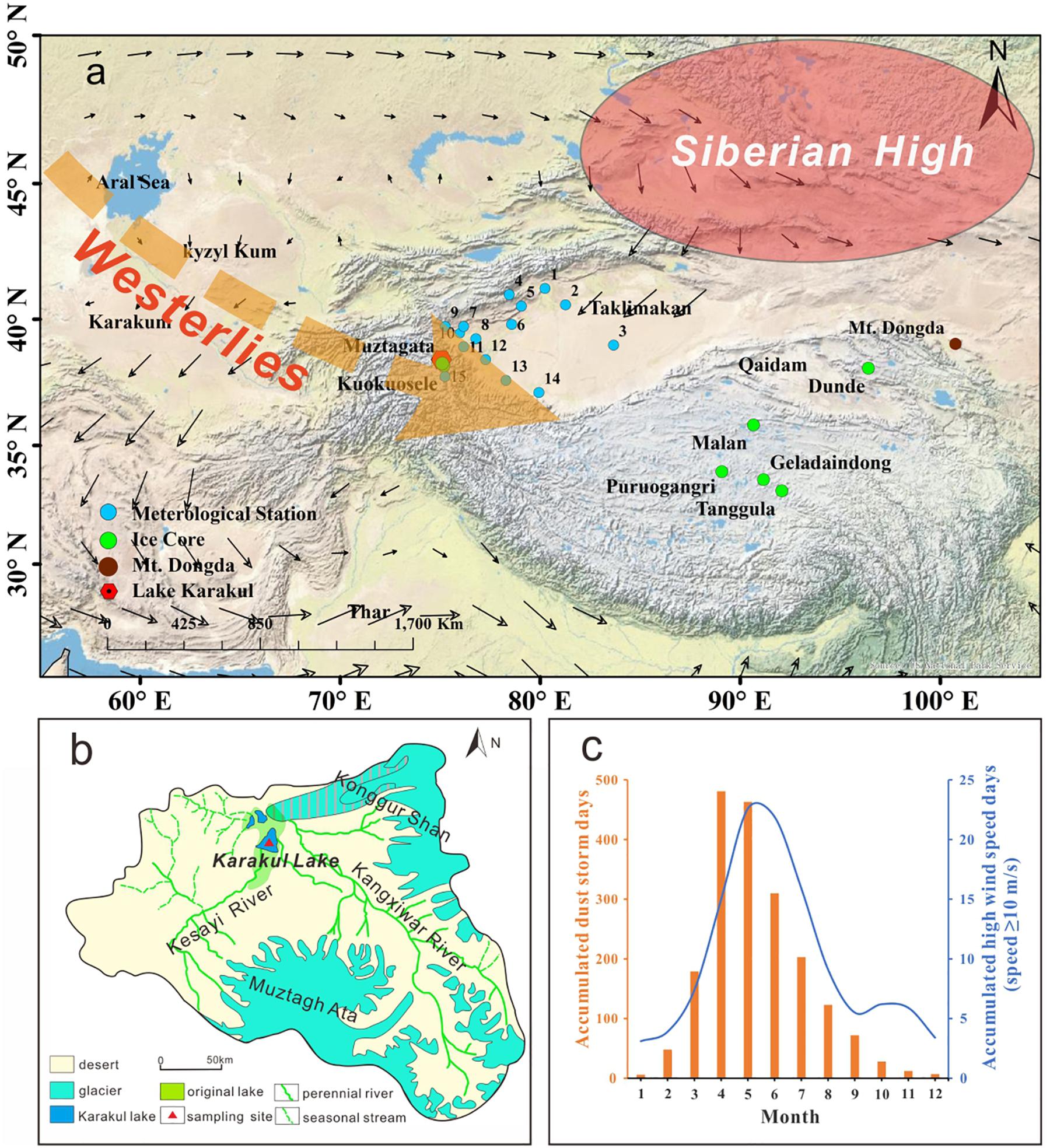
Figure 1. Panel (a) Overview map showing the location of Lake Karakul (red hexagon) and ice core sites (green circles) and tree ring site (purple circle) mentioned in the text. Site numbers in panel a denote meteorological stations (blue circles; Supplementary Table S1). Arrows show wind field of April-June [850 hPa; 1979–2008 NCEP (National Centers for Environmental Prediction) reanalysis data]. Panel (b) shows the Lake Karakul catchment (redrawn from Yan et al., 2019), and the sampling site (red triangle). Panel (c) shows seasonal distribution of dust storm and high wind speed days (speed ≥ 10 m/s) in the central and western Tarim Basin. The dust storm days in panel (c) are the accumulated monthly dust storm days of 9 stations during 1960–2005 AD (Supplementary Table S1); and the accumulated high wind speed days are the monthly high wind speed days of 5 stations during 1981–2010 AD (Supplementary Table S1).
In August 2013, a 1.11-m surface sediment core (KLKL 13-2) was retrieved from the deepest part of Lake Karakul, using a 60-mm UWITEC gravity corer (100% sediment recovery; N 38.4428°, E 75.06104°; and water depth, ∼19.5 m; Figure 1b). The core was subsampled in situ at 0.5-cm intervals, and an accurate age model was established by 210Pb–137Cs dating method (Yan et al., 2019). Considering the great and variable old carbon effects that widely existed in lake sediments in northwest China (Zhou et al., 2020), we did not use the 14C ages to augment our age model (Yan et al., 2019). The average sedimentation rate is ∼0.7 cm/year, and such a high sedimentation rate enables a potential reconstruction of a high-resolution dust storm history. The sedimentary grain size and total organic carbon content (TOC) of this core were previously determined (Yan et al., 2019). The fine fraction (<10 μm) of the last 60 years has been used to support the viewpoint that temperature variations dominated by changes in solar activity could have influenced the local glacier sizes and hydroclimatic conditions (Yan et al., 2019). In this study, we use the coarse fraction (>64 μm) to trace the dust storms and discuss the potential dust source and forcing mechanisms. The observed dust storm days, temperature, and wind speed data of surrounding stations are obtained from the Chinese Meteorological Administration.
Results
Grain Size Fractions Analysis
As shown in Figure 2A, the grain-size frequency distributions of core KLKL13-2 at different depths were characterized by trimodal, including three obvious peaks approximately at 0.8, 8, and 500 μm. Overall, the sedimentary particles of core KLKL13-2 are mainly composed of three apparent grain-size fractions, namely, clay fraction (<4 μm), silt fraction (4–64 μm), and sand fraction (>64 μm), and the variations of these three fractions versus depth are shown in Figure 2B. Thereinto, the silt (4–64 μm), and clay (<4 μm) are the major fractions, accounting for 63.5% (ranging from 51.6 to 85.5%), and 33.5% (ranging from 14.5 to 48.1%) on average, respectively (Figure 2B). The proportion of sand fraction (>64 μm) is relatively low, only contributing 3% on average (varying from 0 to 14.8%; Figure 2B). The sand fraction shows three obvious high stages, namely, AD 1870s–1910s, AD 1930s–1940s, and AD 1960s–1980s. Among those high stages, AD 1870s–1900s is the most striking one, during which the >64 μm fraction increased dramatically from approximately 0 up to 14%, indicating that a large number of coarse particles were reloaded into the lake at that time.
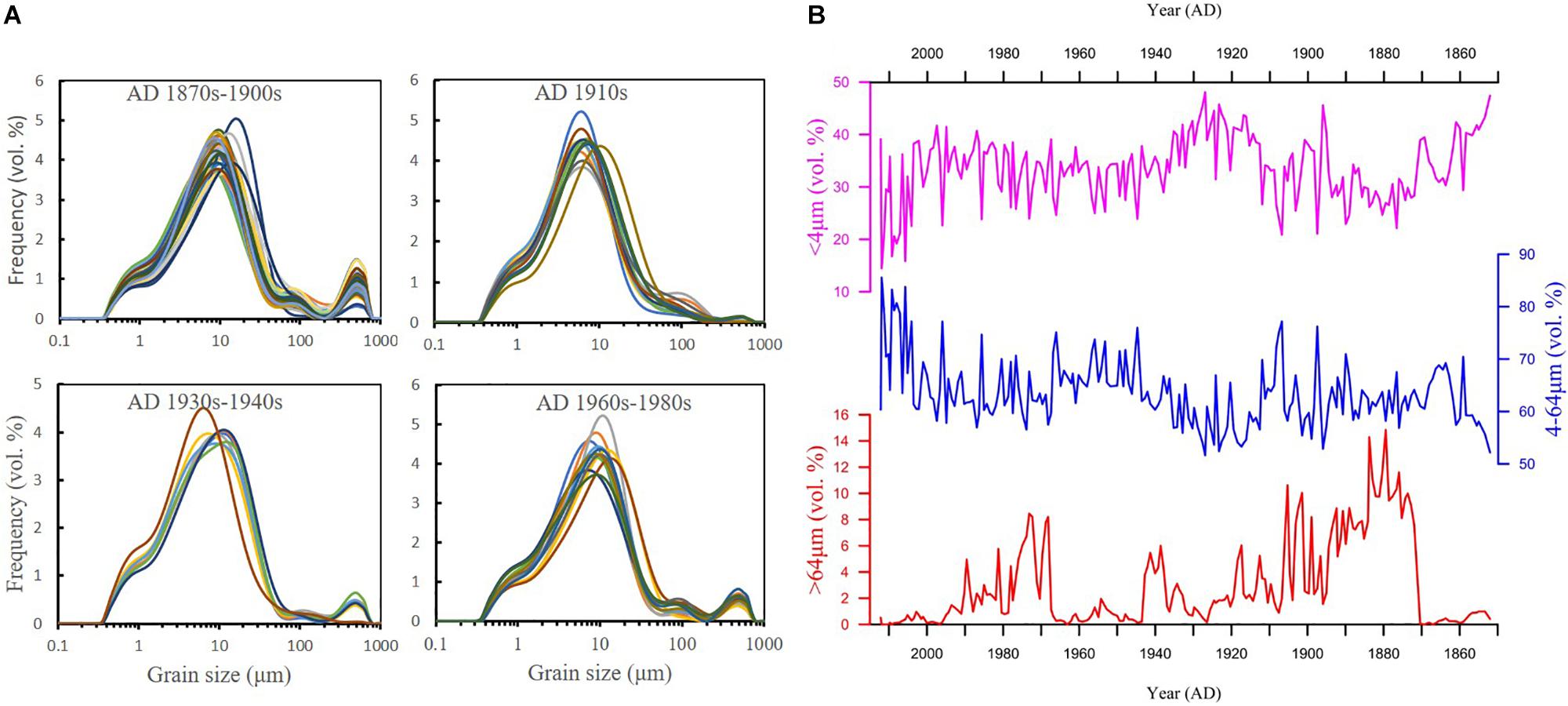
Figure 2. (A) Grain-size frequency distribution patterns of sediments of core KLKL13-2 during the intervals of AD 1870s–1900s, AD1910s, AD 1930s–1940s, and AD 1960s–1980s (the relevant dust storm events are shown in Figure 4); (B) Proportions of three major fractions: clay (<4 μm, pink), silt (4–64 μm, blue), sand (>64 μm, red) fraction in core KLKL13-2.
Proxy for Dust Storm and Comparison With Metrological Records
The grain-size trimodal distribution patterns in core KLKL13-2 reflect that the particles were transported by different processes. Around the lake, there is no evident surface runoff except the glacier-fed streams; coarse particles can hardly be brought to the central deepest basin except through the air. The contribution of ice-trapped sand particles as suggested by Chen et al. (2013, 2020) cannot be excluded, but it could be insignificant because dust particles deposited on ice surface can hardly be accumulated and kept for a long time; they tend to be quickly moved away by winds. Recent studies suggest that the dust particles with diameters >75 μm could be transported by a long distance (even > 1,000 km; Maring et al., 2003; van der Does et al., 2018). Meteorological observations confirm that the sand fraction accounts for more than 60% of deposits during dust storms, with a modal grain size mainly distributed between 100 and 300 μm (Qiang et al., 2010). We examined the components of >64 and 64–300 μm in lake sediment of Lake Karakul and found that they are similar in trends (Supplementary Figure S3), suggesting that the >300 μm component could also share similar behavior with the 64–300 μm component in this case study. Previous studies also interpret such sand-sized particles as products of episodic suspension dust from adjacent sources during strong dust outbreaks (Chen et al., 2013; Qiang et al., 2014; Han et al., 2019) and frequently use the variations of the coarse components to trace dust storm history. The observed dust storm events of seven stations in the western Tarim Basin do not synchronize very well with one another during 1960–2005 AD (see Supplementary Figure S4), which possibly suggests that the dust storm occurrences are somewhat regional on short-term scales, like seasonal to annual scales. However, almost all the stations show a decreasing long-term trend in dust storm occurrences, suggesting that although the dust storm events are rather regional, the long-term trends are similar for adjacent sites. As shown in Figure 3, the sedimentary proportion of sand fraction (>64 μm) in core KLKL13-2 exhibits a similarly decreasing trend with the observed dust storm days in northwest China over the past 45 years (Zhou et al., 2006; Li et al., 2008), suggesting that the sand fraction (>64 μm) in core KLKL13-2 can be used as an indicator of dust storm activity.
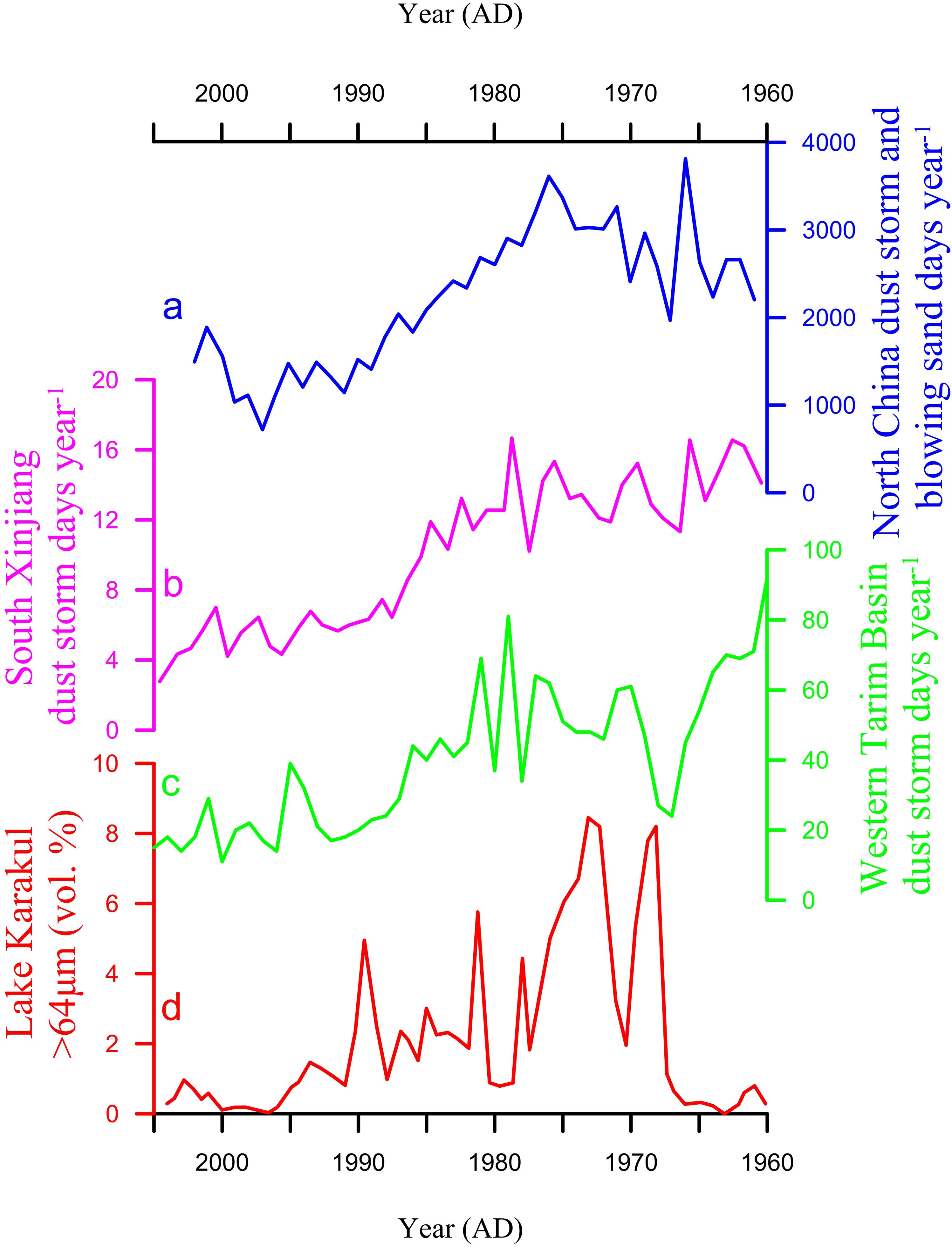
Figure 3. Comparison of the volume percentage of the >64 μm fraction in Lake Karakul sediments (curve d, red, and this study) with observed dust storm days in arid northwest China (curve a–c). Curve a (blue) accumulated dust storm and blowing sand days at 175 stations in north China from 1962 to 2002 AD (Zhou et al., 2006). Curve b (pink) averaged dust storm days of 38 stations in south Xinjiang from 1961 to 2005 AD (Li et al., 2008). Curve c (green) dust storm days at 7 stations in western Tarim Basin from 1960 to 2005 AD (the dust storm time series of each station are provided in Supplementary Figure S4).
Reconstruction of Dust Storm History in Arid Central Asia
The dust storm frequency/intensity changes inferred from the sedimentary sand fraction at Lake Karakul show an obvious decreasing trend over the past 160 years, characterized by three obvious strengthened periods, namely, AD 1870s–1910s, AD 1930s–1940s, and AD 1960s–1980s (Figure 4i). These high dust storm intervals are broadly correlated with those captured in ice cores in ACA, such as Kuokuosele in the Pamirs (Figure 4b; Tenzin et al., 2016), and Geladaindong (Figure 4c; Grigholm et al., 2015), Tanggula (Figure 4d; Wu et al., 2013), and Malan (Figure 4f; Wang, 2005) in the Tibetan Plateau.
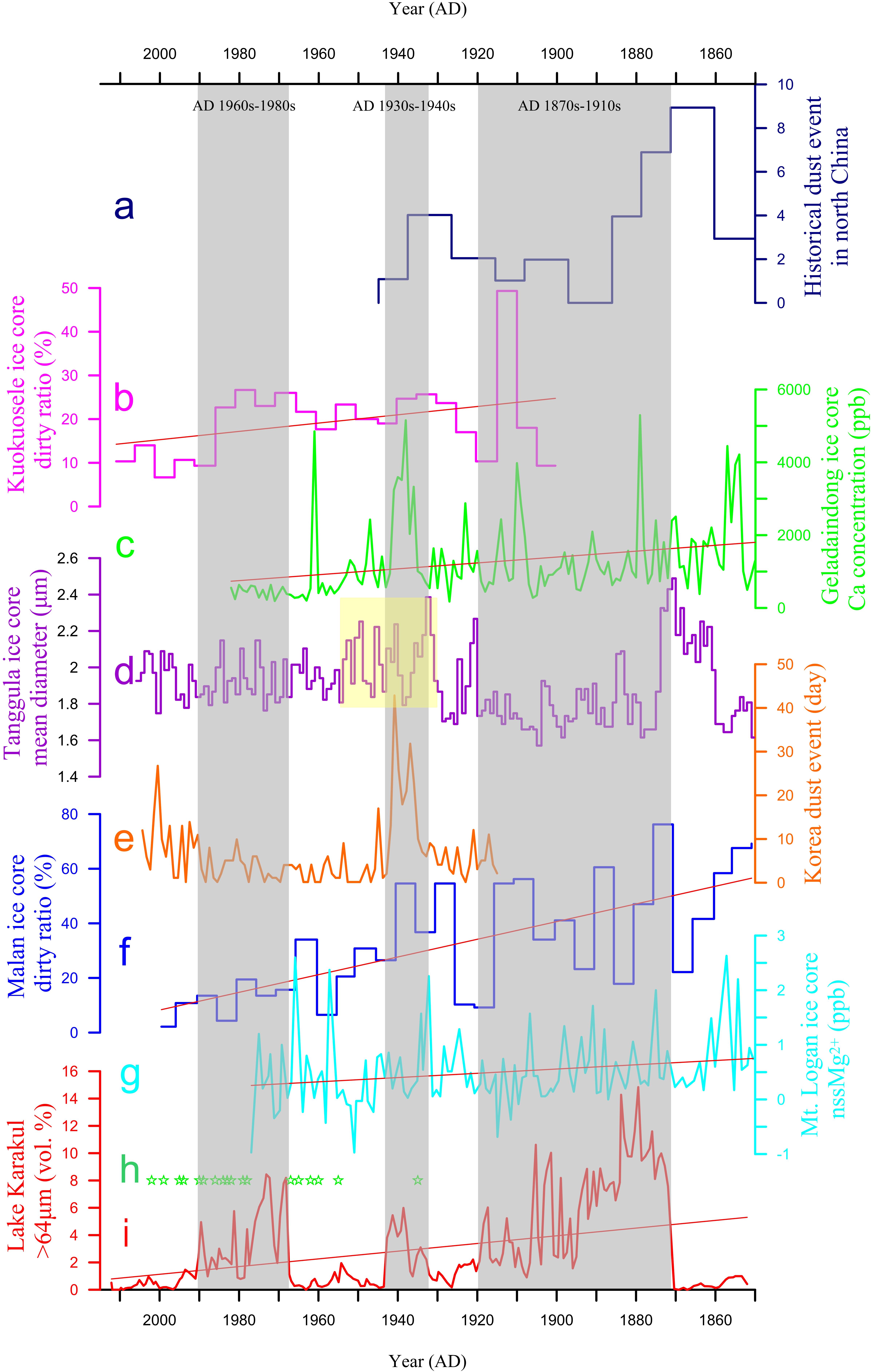
Figure 4. Comparison between dust storm history at Lake Karakul (curve i; inferred from the >64 μm sedimentary gain-size fraction; this study), historical dust events frequency records in northern China (curve a; Zhang, 1984), dirty ratio in the Kuokuosele ice core (curve b; Tenzin et al., 2016), Ca concentrations in the Geladaindong ice core (curve c; Grigholm et al., 2015), mean diameter of dust in the Tanggula ice core (curve d; Wu et al., 2013), historical dust events in Korea (curve e; Chun et al., 2008), dirty ratio in the Malan ice core (curve f; Wang et al., 2007), nssMg2+ from ice core in Mt. Logan, Canada (curve g; Kang et al., 2003), and historical dust event records around Lake Karakul (curve h; He et al., 2004). Red thin lines in plots b, c, f, g, and i show the linear trends; the vertical gray shaded bars indicate high frequent/intensive dust storm stages; the pale-yellow rectangle in curve d shows the AD 1930s–1950s dustiness period recorded in Tanggula ice core.
The Little Ice Age (LIA) cold climate and the twentieth century warming are global phenomena, and lines of evidence indicate that the LIA approximately ended at the beginning of the twentieth century around the study area (Yan et al., 2019). The proportion of sand fraction (>64 μm) was distinctively higher before AD 1910s, suggesting high dust storm frequency/intensity at the end of the LIA, which is also recorded by the Chinese historical literatures (Zhang, 1984; Figure 4a), and by the dirty ratio in the Kuokuosele ice core (Tenzin et al., 2016; Figure 4b), while the relative higher sand fraction during AD 1930s–1940s is documented by the variations in Ca concentrations of the Geladaindong ice core (Grigholm et al., 2015; Figure 4c), by the mean diameter of dust in the Tanggula ice core (Wu et al., 2013; Figure 4d), and by the observed dust event records in Korea (Chun et al., 2008; Figure 4e). Dust records from the Malan ice core (Figure 4f) also show that dust events in northern China frequently occurred during the period 1930–1940 AD (Wang et al., 2007). The proportion of sand fraction (>64 μm) shows an obviously decreasing trend over the past 50 years, suggesting generally low dust storm activity. The grain size-inferred dust storms from AD 1960s to AD 1980s broadly coincided with the observed windstorm disasters around the study area during 1960–1990 AD (He et al., 2004; see stars in Figure 4h).
Discussion
Correlation of Dust Storm Activity With Climate Factors
Climate elements (e.g., precipitation, wind speed, and temperature) are important factors influencing the dust storm occurrence or frequency/intensity (Qian et al., 2002; Gao et al., 2003; Kurosaki and Mikami, 2003; Zhang et al., 2017). However, which climate element dominates remains controversial. In fact, most dust sources in northwest China are located in superarid regions, where annual evaporation is significantly higher than annual precipitation. Although several studies have shown that precipitation may impact dust storm activity by changing soil moisture and vegetation coverage (Gao et al., 2003; Liu et al., 2004; Tenzin et al., 2016), whether the increase in precipitation can significantly improve the surface moisture contents in arid zone is still uncertain (Zhou et al., 2019) because the increases in evaporation could be larger than those in precipitation. The sedimentary TOC content in Lake Karakul has been documented to be well correlated with precipitation (Yan et al., 2019); higher TOC content generally corresponding to increased precipitation, and vice versa (Figures 5f,g). The comparison between the sand fraction and TOC content in Lake Karakul shows a loose connection (Figures 5g,h), implying a weak linkage between the dust storm frequency/intensity and precipitation in this area. According to Adilijiang et al. (2016), the proportion of vegetation coverage in Lake Karakul area had a limited increase, growing from 3.61% in 1990 AD to 3.79% in 2010 AD. Therefore, the increase in precipitation can hardly obviously change the surface conditions (e.g., soil moisture and vegetation coverage) in the dust source areas, at least in the Lake Karakul area. Consequently, contrasting to the previous studies, we infer that precipitation may not be the primary controlling factor of dust storm outbreaks in the study area.
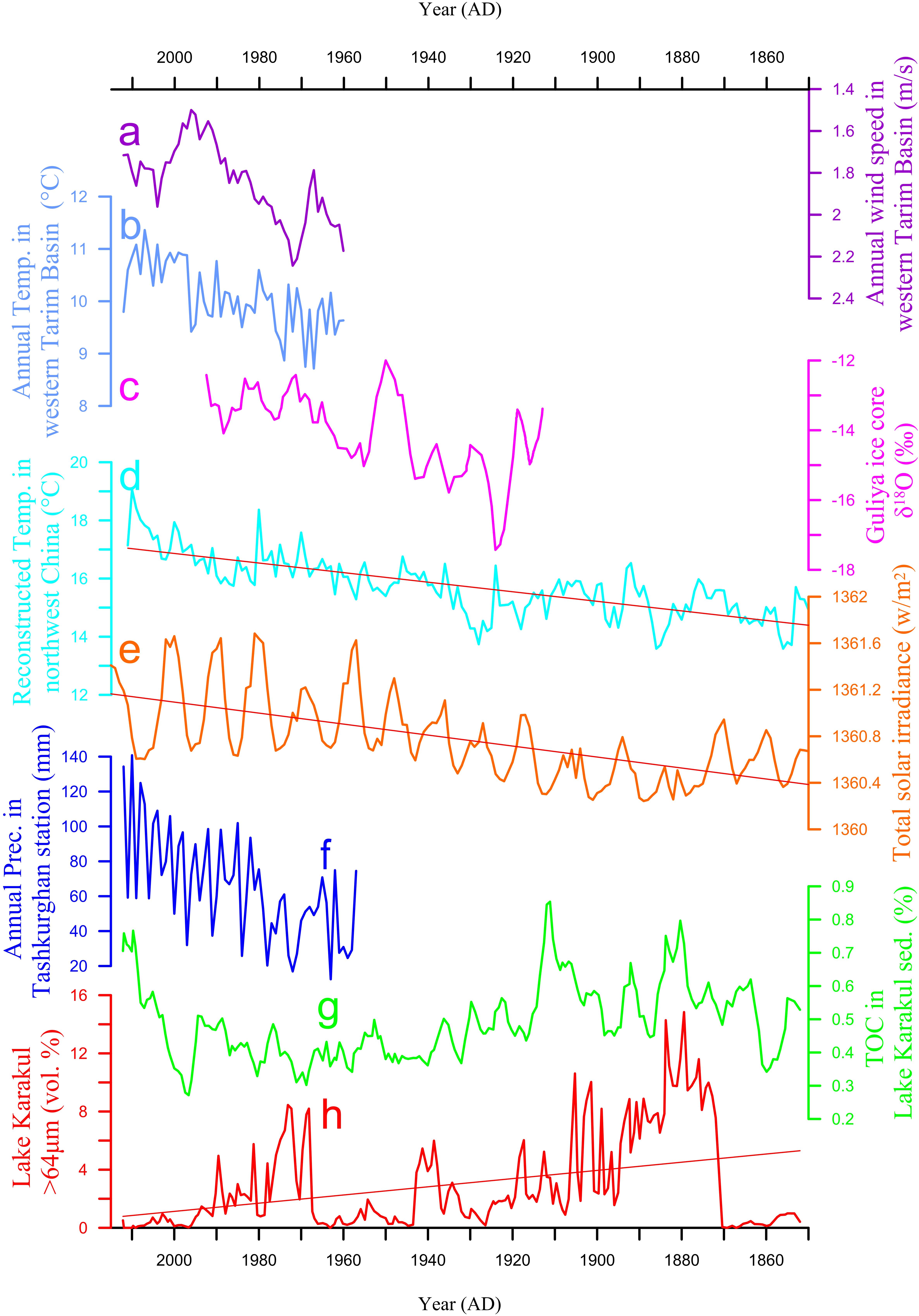
Figure 5. Comparison between the dust storm records at Lake Karakul (curve h; this study), annual mean wind speed (curve a; note it is inversely plotted), and temperature (curve b) recorded by 11 stations in the western Tarim Basin (Supplementary Table S1 and Figure 1a), δ18O in Guliya ice core (curve c; Yao et al., 2006), the reconstructed temperature in northwest China by tree-ring width (curve d; Liu et al., 2016), total solar irradiance (curve e; Coddington et al., 2016), annual precipitation recorded at Tashkurghan station (curve f), and sedimentary TOC in Lake Karakul sediments (curve g; Yan et al., 2019). Red thin lines in plots d, e, and h show the linear trends.
Wind speed is also suggested to have a positive correlation with dust storm frequency/intensity across northern China (Kurosaki and Mikami, 2003; Liu et al., 2004; Zhou et al., 2006; Chen et al., 2013; Grigholm et al., 2015). According to the meteorological observations around Lake Karakul, the dust storms most frequently occurred during spring (from March to June; Figure 1c), coinciding with those along the path of Northern Hemisphere dust transport, such as north China (Wang et al., 2005), Korea (Kurosaki and Mikami, 2003), Japan (Kurosaki and Mikami, 2003), north America (Hahnenberger and Nicoll, 2012), and Greenland (Bory et al., 2003). The temporal consistency among dust storms may be related to wind speed at a global scale (Mahowald et al., 2007). Whereas, the wind speed threshold value of dust storm outbreaks is closely related to the land surface conditions, including the vegetation coverage and soil moisture (Yang et al., 2017). Considering the sparse vegetation cover around Lake Karakul, the wind speed of 10 m/s was used as a threshold value of dust storm outbreaks in this study. As mentioned in Background and Method, the seasonal distribution of the observed dust storms and strong winds (≥10 m/s) are similar with the maximal peak in spring over the past decades (Figure 1c). Furthermore, the sand fraction (>64 μm) in Lake Karakul correlated well with the average annual wind speed in the west of Tarim Basin (Figures 5a,h; r = 0.46), supporting again that the wind speed could significantly influence the dust storm frequency/intensity, which has been further substantiated in studies in Xinjiang and the Tibetan Plateau (Li et al., 2008; Grigholm et al., 2015).
Temperature is an important controlling factor for wind speed and then for the dust storm activity (Wang et al., 2006; Grigholm et al., 2015; Han et al., 2019). Based on the oxygen isotope and grain size records retrieved from the Tanggula ice core in Tibetan Plateau, Wu et al. (2013) pointed out that dust storms frequently occurred in cold conditions. A recent study by Han et al. (2019) also suggested that the decreasing temperature could have led to the outbreak of dust storms in the Tarim Basin. Dust storm activities revealed by the grain size of the sediments of Lake Karakul show a negative correlation to the total solar irradiance (Coddington et al., 2016; Figure 5e), to temperatures in northwest China reconstructed by tree-ring width (Liu et al., 2016; Figure 5d), and to temperatures inferred from δ18O in the Guliya ice core (Yao et al., 2006; Figure 5c), suggesting that the decreasing trend of dust storm activity in northwest China might be attributed to the rising temperature. According to meteorological data, the average annual wind speed in the west of Tarim Basin is negatively correlated with temperature over the past 50 years (1960–2012 AD; r = -0.324; Figures 5a,b). The decreased temperature could greatly promote the surface pressure gradient, hence increase the wind speed, and eventually leading to the outbreak of dust storms, as supported by the meteorological data in north China and dust records in Tarim Basin and Tibetan Plateau (Zhou et al., 2006; Grigholm et al., 2015; Han et al., 2019). To summarize, a lower temperature corresponds to higher wind speed and higher dust storm frequency/intensity over the study area, and vice versa.
Possible Dust Sources
The sources of dust over ACA are complex. Recent researches generally argued that the sand fraction (>64 μm) mainly derived from local sources with relatively limited transport distance (Chen et al., 2013; Qiang et al., 2014; Han et al., 2019). Based on the geographical and geological setting of Lake Karakul, the sand-sized particles may primarily originate from the surrounding high-altitude mountains via glacial grinding, frost, and salt weathering. These mountain processes can produce abundant detritus sediments (Sun, 2002); once formed, the coarse sediments were deflated by strong winds and transported to the lake. Consequently, the local moraine may be a primary source of the sedimentary coarse particles. However, besides partly contributed from proximal areas, the sedimentary fine fraction could have distant source regions. According to back trajectory analysis, the major air mass trajectories at Lake Karakul come from the west (Yan et al., 2019), suggesting that the deserts in ACA areas such as Karakum and Kyzylkum could be the potential dust sources. On the other hand, dust storm events in northwest China occur frequently in the south Xinjiang (Tarim) region (Wang et al., 2005), and dust clouds produced from the dust events in Taklimakan desert can be lifted up to the Tibetan Plateau (Uno et al., 2009). From the dust transport routes proposed by Sun et al. (2001), an eastward branch of the cold air mass might contribute dust particles from the Tarim Basin (Taklimakan desert) to Lake Karakul. Based on the Sr–Nd isotopic compositions of insoluble particles, Xu et al. (2012) also suggested that the Taklimakan desert may be a potential dust source for the Muztagata glacier area. Tenzin et al. (2016) presented a significant positive correlation between the Kuokuosele ice core dirty ratio and the observed dust storms over ACA as well as those over northern Tibetan Plateau, suggesting both sources could have contributed dust to the ice core. Lake Karakul, the Muztagata glacier, and the Kuokuosele glacier are all located in the eastern Pamirs, sharing a similar atmospheric circulation background and therefore could have similar dust sources. To summarize, the fine dust particles in Lake Karakul area likely originate from both the deserts over ACA areas to its west, such as the Karakum, Kyzylkum, and the Taklimakan desert to its east.
Possible Forcing for Dust Storm Frequency/Intensity Changes
Some studies proposed that the Siberian High could play an important role in dominating the dust storm occurrence at ACA (Sun et al., 2001; Chen et al., 2013; Zhou et al., 2019). For example, Chen et al. (2013) suggested that occurrence of dust storms in northwest China is largely related to the strengthening of Siberian High. However, some others contend that the dust storm activity could be possibly correlated to the changes in the westerly jet stream (Wang, 2005; Zhong and Li, 2005; Han et al., 2019), i.e., strengthened westerlies during colder climatic conditions could increase surface wind speed by facilitating downward transfer of high-level momentum to near earth surface, and hence intensified dust storm activities (Han et al., 2019), vice versa. Recent studies show that wind speed is reduced gradually with the decrease in temperature gradient caused by recent warming in northwest China (Wang, 2005; Grigholm et al., 2015; Zhang et al., 2017), which may lead to reduced dust outbreaks. For instance, some studies have ascribed the declined dust storm activity on the Tibetan Plateau over the past 200 years (Wang, 2005) and that in north China over the past 50 years (Zhu et al., 2008) to the weakening in wind speed.
The arid southwestern United States is also identified as a dust source for the Atlantic coast and Greenland (Donarummo et al., 2003; Park et al., 2007). The dust fall events in North America also showed a decreasing trend for the past 150 years, as inferred from the dust records from an ice core in Yukon Territory of Canada (Kang et al., 2003; Figure 4g). We propose that the similarly decreasing dust storm trends between Lake Karakul area, ACA areas, and north America possibly suggest similar changes in northern hemisphere westerly jet stream.
As temperature gradients may influence the location of the westerly jet stream and hydroclimatic conditions across the westerly route (Xu et al., 2019), they may also potentially influence the location and occurrence of dust storms. Therefore, factors that modulate regional or global temperature gradients are also expected to influence global dust storm occurrence. One hot issue is that whether the recent decreasing dust storm frequency is related to the greenhouse-gas-triggered global warming. Numerical simulations suggest that, in contrast to the natural solar forced warming, the greenhouse-gas-triggered warming may lead to a decrease in zonal sea surface temperature gradient and a noticeable increase in atmospheric static stability (Vecchi et al., 2006; Liu et al., 2013), which is therefore potentially conducive to decreasing wind speed and dust storm frequency/intensity. Therefore, providing the anthropogenic global warming continues, the dust storm frequency/intensity over ACA is expected to remain low or further decrease.
Conclusion
We reconstructed an approximately 160-year long dust storm history using high-resolution sedimentary sand fraction (>64 μm) retrieved from a core in Lake Karakul, ACA, and examined the relationship between dust storms, climate factors, and general atmospheric circulations. Our results show that the sand fraction (>64 μm) in lake sediments significantly decreased over the past 160 years, suggesting an obvious decrease in dust storm frequency/intensity during the recent/modern epoch. The dust storm frequency/intensity generally became high during the cold conditions (AD 1870s–1910s), and remained relatively low in the current warm period. The decrease in dust storm frequency/intensity was tentatively attributed to the rising temperature and decreasing wind speed. We contend that the dust storm activity may remain low or further decrease over the ACA area in the context of continued global warming.
Data Availability Statement
The raw data supporting the conclusions of this article will be made available by the authors, without undue reservation.
Author Contributions
HX designed the research. JZ and HX wrote the manuscript. JZ, HX, JL, ES, DY, KZ, KY, YS, and SZ performed the research. JZ, HX, and JL analyzed the data. LA and AT collaborated with the corresponding author in the development of the manuscript. All authors read and approved the final manuscript.
Funding
This work is funded by the program (No. 41672169) and by the joint NSFC-ISF research program (NSFC grant no. 41761144070 and ISF grant no. 2487/17) supported by the National Natural Science Foundation of China.
Conflict of Interest
The authors declare that the research was conducted in the absence of any commercial or financial relationships that could be construed as a potential conflict of interest.
Supplementary Material
The Supplementary Material for this article can be found online at: https://www.frontiersin.org/articles/10.3389/feart.2020.00284/full#supplementary-material
References
Adilijiang, K., Chu, X. Z., and Yusupujiang, A. (2016). Dynamic change of landscape spatial pattern in karakul lake region in Xinjiang. Chin. Agric. Sci. Bull. 32, 78–84.
Booth, B. B., Dunstone, N. J., Halloran, P. R., Andrews, T., and Bellouin, N. (2012). Aerosols implicated as a prime driver of twentieth-century North Atlantic climate variability. Nature 484, 228–232. doi: 10.1038/nature10946
Bory, A. J. M., Biscaye, P. E., and Grousset, F. E. (2003). Two distinct seasonal Asian source regions for mineral dust deposited in Greenland (NorthGRIP). Geophys. Res. Lett. 30:L016446. doi: 10.1029/2002gl016446
Chen, F. H., Chen, S. Q., Zhang, X., Chen, J. H., Wang, X., Gowan, E. J., et al. (2020). Asian dust-storm activity dominated by Chinese dynasty changes since 2000 BP. Nat. Commun. 11:992. doi: 10.1038/s41467-020-14765-4
Chen, F. H., Qiang, M. R., Zhou, A. F., Xiao, S., Chen, J. H., and Sun, D. H. (2013). A 2000-year dust storm record from Lake Sugan in the dust source area of arid China. J. Geophys. Res. Atmos. 118, 2149–2160. doi: 10.1002/jgrd.50140
Chun, Y., Cho, H., Chung, H., and Lee, M. (2008). Historical records of Asian dust events (Hwangsa) in Korea. Bull. Amer. Meteorol. Soc. 89, 823–828. doi: 10.1175/2008BAMS2159.1
Coddington, O., Lean, J. L., Pilewskie, P., Snow, M., and Lindholm, D. (2016). A solar irradiance climate data record. Bull. Amer. Meteorol. Soc. 97, 1265–1282. doi: 10.1175/bams-d-14-00265.1
Donarummo, J., Ram, M., and Stoermer, E. F. (2003). Possible deposit of soil dust from the 1930’s U.S. dust bowl identified in Greenland ice. Geophys. Res. Lett. 30:L016641. doi: 10.1029/2002gl016641
Gao, T., Su, L. J., Ma, Q. X., Li, H. Y., Li, X. C., and Yu, X. (2003). Climatic analyses on increasing dust storm frequency in the springs of 2000 and 2001 in inner Mongolia. Int. J. Climatol. 23, 1743–1755. doi: 10.1002/joc.970
Grigholm, B., Mayewski, P. A., Kang, S., Zhang, Y., Morgenstern, U., Schwikowski, M., et al. (2015). Twentieth century dust lows and the weakening of the westerly winds over the Tibetan Plateau. Geophys. Res. Lett. 42, 2434–2441. doi: 10.1002/2015gl063217
Hahnenberger, M., and Nicoll, K. (2012). Meteorological characteristics of dust storm events in the eastern Great Basin of Utah, U.S.A. Atmos. Environ. 60, 601–612. doi: 10.1016/j.atmosenv.2012.06.029
Han, W. X., Lü, S., Appel, E., Berger, A., Madsen, D., Vandenberghe, J., et al. (2019). Dust storm outbreak in central Asia After ~3.5 kyr BP. Geophys. Res. Lett. 46, 7624–7633. doi: 10.1029/2018gl081795
He, J. H., Cheng, H. X., Liu, Y. J., and Chang, A. (2004). Kizilsu Kirghiz Autonomous Prefecture. Urumqi: Xinjiang People’s Publishing House.
Huang, X. T., Oberhänsli, H., von Suchodoletz, H., and Sorrel, P. (2011). Dust deposition in the Aral Sea: implications for changes in atmospheric circulation in central Asia during the past 2000 years. Quat. Sci. Rev. 30, 3661–3674. doi: 10.1016/j.quascirev.2011.09.011
Jickells, T. D., An, Z. S., Andersen, K. K., Baker, A. R., Bergametti, G., Brooks, N., et al. (2005). Global iron connections between desert dust, ocean biogeochemistry, and climate. Science 308, 67–71. doi: 10.1126/science.1105959
Kang, S. C., Mayewski, P. A., Yan, Y. P., Qin, D. H., Yao, T. D., and Ren, J. W. (2003). Dust records from three ice cores: relationships to spring atmospheric circulation over the Northern Hemisphere. Atmos. Environ. 37, 4823–4835. doi: 10.1016/j.atmosenv.2003.08.010
Kurosaki, Y., and Mikami, M. (2003). Recent frequent dust events and their relation to surface wind in East Asia. Geophys. Res. Lett. 30:1736. doi: 10.1029/2003gl017261
Li, H. J., Li, J., and He, Q. (2008). Study on sandstorm trend and abrupt change in Xinjiang. J. Desert. Res. 28, 915–919.
Liu, J., Wang, B., Cane, M. A., Yim, S. Y., and Lee, J. Y. (2013). Divergent global precipitation changes induced by natural versus anthropogenic forcing. Nature 493, 656–659. doi: 10.1038/nature11784
Liu, X. D., Yin, Z. Y., Zhang, X. Y., and Yang, X. C. (2004). Analyses of the spring dust storm frequency of northern China in relation to antecedent and concurrent wind, precipitation, vegetation, and soil moisture conditions. J. Geophys. Res. Atmos. 109:D16210. doi: 10.1029/2004jd004615
Liu, X. Q., Herzschuh, U., Wang, Y. B., Kuhn, G., and Yu, Z. T. (2014a). Glacier fluctuations of Muztagh Ata and temperature changes during the late holocene in westernmost Tibetan Plateau, based on glaciolacustrine sediment records. Geophys. Res. Lett. 41, 6265–6273. doi: 10.1002/2014gl060444
Liu, X. Q., Yu, Z. T., Dong, H. L., and Chen, H. F. (2014b). A less or more dusty future in the Northern Qinghai-Tibetan plateau? Sci. Rep. 4:6672. doi: 10.1038/srep06672
Liu, Y., Sun, C. F., Li, Q., and Cai, Q. F. (2016). A Picea crassifolia tree-ring width-based temperature reconstruction for the Mt. Dongda Region, Northwest China, and its relationship to large-scale climate forcing. PLoS One 11:e0160963. doi: 10.1371/journal.pone.0160963
Mahowald, N. M., Ballantine, J. A., Feddema, J., and Ramankutty, N. (2007). Global trends in visibility: implications for dust sources. Atmos. Chem. Phys. 7, 3309–3339. doi: 10.5194/acp-7-3309-2007
Maring, H., Savoie, D. L., Izaguirre, M. A., and Custals, L. (2003). Mineral dust aerosol size distribution change during atmospheric transport. J. Geophys. Res. Atmos. 108:8592. doi: 10.1029/2002jd002536
Park, S. H., Gong, S. L., Zhao, T. L., Vet, R. J., Bouchet, V. S., Gong, W., et al. (2007). Simulation of entrainment and transport of dust particles within North America in April 2001 (“Red Dust Episode”). J. Geophys. Res. Atmos. 112:8443. doi: 10.1029/2007jd008443
Qian, W. H., Quan, L. S., and Shi, S. Y. (2002). Variations of the dust storm in China and its climatic control. J. Clim. 15, 1216–1229. doi: 10.1175/1520-0442(2002)015<1216:votdsi>2.0.co;2
Qiang, M., Lang, L., and Wang, Z. (2010). Do fine-grained components of loess indicate westerlies: insights from observations of dust storm deposits at Lenghu (Qaidam Basin. China). J. Arid. Environ. 74, 1232–1239. doi: 10.1016/j.jaridenv.2010.06.002
Qiang, M. R., Liu, Y. Y., Jin, Y. X., Song, L., Huang, X. T., and Chen, F. H. (2014). Holocene record of eolian activity from Genggahai Lake, northeastern Qinghai-Tibetan Plateau, China. Geophys. Res. Lett. 41, 589–595. doi: 10.1002/2013gl058806
Sun, J. M. (2002). Provenance of loess material and formation of loess deposits on the Chinese Loess Plateau. Earth Planet. Sci. Lett. 203, 845–859. doi: 10.1016/S0012-821X(02)00921-4
Sun, J. M., Zhang, M. Y., and Liu, T. S. (2001). Spatial and temporal characteristics of dust storms in China and its surrounding regions, 1960-1999: relations to source area and climate. J. Geophys. Res. Atmos. 106, 10325–10333. doi: 10.1029/2000jd900665
Tenzin, D., Yao, T. D., Yao, P., Deji, L., Xu, B. Q., Zhao, H. B., et al. (2016). Variation of atmospheric dust over the past 100 years recorded by visible dusty layers of the Kuokuosele ice core, western Tibetan Plateau. Chin. Sci. Bull. 61, 1695–1705. doi: 10.1360/n972015-01309
Uno, I., Eguchi, K., Yumimoto, K., Takemura, T., Shimizu, A., Uematsu, M., et al. (2009). Asian dust transported one full circuit around the globe. Nat. Geosci. 2, 557–560. doi: 10.1038/ngeo583
van der Does, M., Knippertz, P., Zschenderlein, P., Harrison, R. G., and Stuut, J. B. W. (2018). The mysterious long-range transport of giant mineral dust particles. Sci. Adv. 4:eaau2768. doi: 10.1126/sciadv.aau2768
Vecchi, G. A., Soden, B. J., Wittenberg, A. T., Held, I. M., Leetmaa, A., and Harrison, M. J. (2006). Weakening of tropical Pacific atmospheric circulation due to anthropogenic forcing. Nature 441, 73–76. doi: 10.1038/nature04744
Wang, N. L. (2005). Decrease trend of dust event frequency over the past 200 years recorded in the Malan ice core from the northern Tibetan Plateau. Chin. Sci. Bull. 50, 2866–2871. doi: 10.1360/982005-237
Wang, N. L., Yao, T. D., Pu, J. C., Zhang, Y. L., and Sun, W. Z. (2006). Climatic and environmental changes over the last millennium recorded in the Malan ice core from the northern Tibetan Plateau. Sci. Chin. Ser. D Earth Sci. 49, 1079–1089. doi: 10.1007/s11430-006-1079-9
Wang, N. L., Yao, T. D., Yang, X. D., Shen, J., and Wang, Y. (2007). Variations in dust event frequency over the past century reflected by ice-core and lacustrine records in north China. Sci. Chin. Ser. D Earth Sci. 50, 736–744. doi: 10.1007/s11430-007-0037-5
Wang, S. G., Wang, J. Y., Zhou, Z. J., and Shang, K. Z. (2005). Regional characteristics of three kinds of dust storm events in China. Atmos. Environ. 39, 509–520. doi: 10.1016/j.atmosenv.2004.09.033
Wang, Y. B., Liu, X. Q., Zhang, E. L., Yang, X. D., and Yao, B. (2009). Dust-storm events in Kekexili Area, Northern Tibetan Plateau during the past 4000 years: evidence from grain-size analysis of lacustrine sediments in Kusai Lake. Acta Sedimentol. Sin. 27:691.
Wu, G. J., Zhang, C. L., Xu, B. Q., Mao, R., Joswiak, D., Wang, N. L., et al. (2013). Atmospheric dust from a shallow ice core from Tanggula: implications for drought in the central Tibetan Plateau over the past 155 years. Quat. Sci. Rev. 59, 57–66. doi: 10.1016/j.quascirev.2012.10.003
Xu, H., Zhou, K. E., Lan, J. H., Zhang, G. L., and Zhou, X. Y. (2019). Arid central Asia saw mid-Holocene drought. Geology 47, 255–258. doi: 10.1130/g45686.1
Xu, J. Z., Yu, G. M., Kang, S. C., Hou, S. G., Zhang, Q. G., Ren, J. W., et al. (2012). Sr-Nd isotope evidence for modern aeolian dust sources in mountain glaciers of western China. J. Glaciol. 58, 859–865. doi: 10.3189/2012JoG12J006
Yan, D. N., Xu, H., Lan, J. H., Zhou, K. E., Ye, Y. D., Zhang, J. X., et al. (2019). Solar activity and the westerlies dominate decadal hydroclimatic changes over arid Central Asia. Glob. Planet. Chang. 173, 53–60. doi: 10.1016/j.gloplacha.2018.12.006
Yang, X. H., He, Q., Matimin, A., Yang, F., Huo, W., Liu, X. C., et al. (2017). Threshold velocity for saltation activity in the Taklimakan desert. Pure Appl. Geophys. 174, 4459–4470. doi: 10.1007/s00024-017-1644-5
Yao, T. D., Guo, X. J., Thompson, L., Duan, K. Q., Wang, N. L., Pu, J. C., et al. (2006). δ18O record and temperature change over the past 100 years in ice cores on the Tibetan Plateau. Sci. Chin. Ser. D Earth Sci. 49, 1–9. doi: 10.1007/s11430-004-5096-2
Zhang, D. E. (1984). Synoptic-climatic studies of dust fall in China since historic times. Sci. Chin. Ser. B Chem. 27, 825–836. doi: 10.1360/yb1984-27-8-825
Zhang, W. B., Hou, S. G., Liu, Y. P., Wu, S. Y., An, W. L., Pang, H. X., et al. (2017). A high-resolution atmospheric dust record for 1810-2004 AD derived from an ice core in eastern Tien Shan, central Asia. J. Geophys. Res. Atmos. 122, 7505–7518. doi: 10.1002/2017JD026699
Zhong, H. L., and Li, D. L. (2005). Relationship between sand dust storm in northern China in April and westerly circulation. Plate. Meteor. 24, 104–111. doi: 10.3321/j.issn:1000-0534.2005.01.016
Zhou, G. P., Huang, X. Z., Wang, Z. L., Zhang, J., and Xie, H. C. (2019). Eolian activity history reconstructed by bosten lake grain size data over the Past ~2000 years. J. Desert. Res. 39, 86–95.
Zhou, K. E., Xu, H., Lan, J. H., Yan, D. N., Sheng, E. G., Yu, K. K., et al. (2020). Variable late holocene 14C reservoir ages in lake Bosten, Northwestern China. Front. Earth Sci. 7:328. doi: 10.3389/feart.2019.00328
Zhou, Z. J., Zhang, G. C., Ai, W. X., Zhang, H. Z., and Niu, R. Y. (2006). Time series of spring dust emission and its correlative climatic factors in northern China. J. Desert. Res. 26, 935–941. doi: 10.3321/j.issn:1000-694X.2006.06.013
Keywords: dust storm, global warming, arid central Asia, Lake Karakul, grain size
Citation: Zhang J, Xu H, Lan J, Ai L, Sheng E, Yan D, Zhou K, Yu K, Song Y, Zhang S and Torfstein A (2020) Weakening Dust Storm Intensity in Arid Central Asia Due to Global Warming Over the Past 160 Years. Front. Earth Sci. 8:284. doi: 10.3389/feart.2020.00284
Received: 27 April 2020; Accepted: 18 June 2020;
Published: 21 July 2020.
Edited by:
Gary E. Stinchcomb, Murray State University, United StatesReviewed by:
Fahu Chen, Institute of Tibetan Plateau Research (CAS), ChinaZongli Wang, Lanzhou University, China
Copyright © 2020 Zhang, Xu, Lan, Ai, Sheng, Yan, Zhou, Yu, Song, Zhang and Torfstein. This is an open-access article distributed under the terms of the Creative Commons Attribution License (CC BY). The use, distribution or reproduction in other forums is permitted, provided the original author(s) and the copyright owner(s) are credited and that the original publication in this journal is cited, in accordance with accepted academic practice. No use, distribution or reproduction is permitted which does not comply with these terms.
*Correspondence: Hai Xu, eHVoYWlAdGp1LmVkdS5jbg==