 Haiyan Li1
 Jue Sun1
 Chunmei Ma1,2*
 Dongsheng Zhao3*
 Yongning Li4Fengya Ding4Jia Sun1Zhenhui Huang1Guangchun Shang1Yunkai Deng1
- 1School of Geography and Ocean Science, Nanjing University, Nanjing, China
- 2Jiangsu Collaborative Innovation Center for Climate Change, Nanjing, China
- 3School of History, Nanjing University, Nanjing, China
- 4Ningbo Municipal Institute of Cultural Heritage Management, Ningbo, China
The eastern China coastal plain is an ideal area for studying the human–environment interaction during the Neolithic period as there are multiple Neolithic sites in this area. Located in the Ningshao Coastal Plain of the south bank of Hangzhou Bay in eastern China, the Hejia Site is part of the late Hemudu Culture sites and includes the late Hemudu Culture, the Liangzhu Culture, and the Qianshanyang Culture. Based on palynology, charcoal, X-ray fluorescence (XRF), and magnetic susceptibility (χ), combined with accelerator mass spectrometry 14C dating and analysis of the archaeological cultural layers, we explored the paleoenvironmental evolution and human activities at the Hejia Site. 1) Pollen records suggest that the vegetation type was evergreen and deciduous broad-leaved mixed forest during the Middle Holocene. Cr/Cu and low-frequency magnetic susceptibility (χlf) reveal that the climate underwent through warm and wet (Hemudu Culture Period IV)–cool and dry (Liangzhu Culture Period)–warm and wet (Qianshanyang Culture Period) periods. 2) During the Middle Holocene, the intensity of human activities, related to the transformation of the natural environment, increased obviously. The increasing Poaceae pollen (>37 μm) indicates that the ability of prehistoric humans in managing crop fields gradually increased from the late Hemudu Culture Period to the Liangzhu Culture Period. The charcoal concentration results suggest that the occurrence of high-intensity fire events during the late Hemudu Culture Period might be caused by the slash-and-burn operation, while those that occurred during the middle Liangzhu Culture Period might be caused by the increasing fire demand owing to the greater ancestors’ lives and production activities in the Liangzhu Culture Period.
Introduction
The eastern China coastal plain contains a large amount of paleoenvironmental information, for its sensitivity to sea-level fluctuations and climate change. The Middle Holocene (8,200–4,200 cal a BP) experienced a significant deceleration, both in sea-level rise and climate warming (An et al., 2000; Xiong et al., 2020), which also witnessed the most prosperous cultural development and rapidest population growth in the eastern China coastal plain, including the Hemudu Culture (7,000–5,000 cal a BP), the Majiabang Culture (7,000–5,800 cal a BP), the Songze Culture (5,800–5,000 cal a BP), the Liangzhu Culture (5,000–4,300 cal a BP), the Qianshanyang Culture (4,300–4,100 cal a BP), and the Guangfulin Culture (4,100–3,900 cal a BP) (Stanley and Chen, 1996; Chen, 2006; Li et al., 2007a; Zong et al., 2007; Xu, 2015; Hou, 2016; He et al., 2020a).
Environmental archaeology studies specifically focus on the interplay between human activities and paleoenvironmental changes (Liu et al., 2018; Xia and Zhang, 2019). The Ningshao Coastal Plain, located on the south bank of Hangzhou Bay in eastern China, is considered as an ideal area for studying the prehistoric human–environment interaction. In the past few decades, multiple studies have been conducted on the Ningshao Coastal Plain, ranging from climate change and environmental evolution to the rise and fall of Neolithic Culture (Chen et al., 2005; Yu et al., 2010; Innes et al., 2014). Studies show that the Hemudu Culture was developed in the context of regression in the Ningshao Coastal Plain and then was affected by sea-level fluctuation and climate change (He et al., 2018, He et al., 2020b; Liu et al., 2020). He et al. (2020a) conclude that the Hemudu Culture diffused from the Yaojiang Valley northward to the Zhoushan Islands and southward to the Ningbo Plain owing to a transgression during 6,200–5,600 cal a BP. The remains of rice and farming tools in the Hemudu Culture sites indicate that rice was farmed in this period. The phytolith and pollen data of the Hemudu Culture sites show that rice domestication was completed by approximately 5,600 cal a BP (Li et al., 2010a; He et al., 2020a), and after that, at approximately 5,000 cal a BP, the Liangzhu Culture replaced the Hemedu Culture. Previous studies state that the Liangzhu Culture, as the paramount one of prehistoric cultures in the lower reaches of the Yangtze River (Wu et al., 2012), developed a mature rice farming system when the primitive society was disintegrating and the embryonic state of the country was forming (Li et al., 2010c; Wang et al., 2017). The Liangzhu Culture disappeared at approximately 4,300 cal a BP, and several studies attribute that it was caused by the catastrophic events, such as rapid climate cooling, transgression, and floods (Stanley and Chen, 1996; Innes et al., 2014; Kajita et al., 2018; Wang et al., 2018; Wang et al., 2020). Some studies also suggest that the demise of the Liangzhu Culture may be the result of social factors (Zong et al., 2011). It can be seen that the factors causing the disappearance of Liangzhu Culture are still controversial. The later Qianshanyang and Guangfulin Cultures were less organized and developed (Xu, 2015).
Archaeological sites are the ideal material for exploring human–environment interactions that occurred during the Neolithic period, as they record the activities of prehistoric human life and production as well as paleoenvironmental changes (Cai et al., 2017; Li et al., 2017; Xia and Zhang, 2019). Recently, studies on the human–environment interaction in the Ningshao Coastal Plain focus on the Hemudu Culture Period in the Yaojiang Valley (He et al., 2018; Liu et al., 2018; Liu et al., 2019). However, few studies focus on the Hemudu Culture and later cultural periods for other areas of the Ningshao Plain. The Hejia Site, excavated in 2017, is located in the Fenghua River basin, Ningshao Coastal Plain, the southern bank of Hangzhou Bay, eastern China. The sedimentary layer of this site covers the late Hemudu Culture, the Liangzhu Culture (early, middle, and late), the Qianshanyang Culture, and the Eastern Zhou Dynasty; thus, the Hejia Site is of great significance for the late Hemudu Culture study. On the other hand, the relatively complete stratum of the Hejia Site is an ideal material for studying human–environment interactions. Besides, we expect that cultural responses to paleoenvironmental changes during the Middle Holocene in the Ningshao Coastal Plain could be revealed. In this study, multi-proxy indicators including pollen, charcoal, X-ray fluorescence, and environmental magnetism from the profile of the Hejia Site were analyzed to explore the environmental evolution and human activities in the Middle Holocene on the Ningshao Coastal Plain in eastern China, which provides a more comprehensive understanding of the environmental background of the prehistoric culture and the cultural responses to the environmental changes.
Geographical Background and Site Description
The Ningshao Coastal Plain is located in the subtropical region of the south bank of Hangzhou Bay in eastern China and is under the influence of the East Asian Monsoon. The average annual temperature and average annual precipitation are approximately 16.3°C and 1,400 mm, respectively (Ningbo Chorography Codification Committee, 1995; Zheng et al., 2016). Regional vegetation is characterized by subtropical mixed forests of evergreen and deciduous trees, including Cyclobalanopsis, Castanopsis sclerophylla, Castanopsis, Liquidambar formosana, Quercus aliena, Quercus acutissima, and Pinus massoniana (Wu, 1980).
The Hejia Site (latitude 29°45′6″N and longitude 121°26′30″E) lies in the Hejia village beside the Fenghua River, in the Ningshao Coastal Plain, on the south bank of Hangzhou Bay in eastern China. The cultural layer of the Hejia Site was approximately 140 cm and divided into four cultural periods: the Hemudu Culture IV (5,500–5,000 cal a BP), the Liangzhu Culture (5,000–4,300 cal a BP), the Qianshanyang Culture (4,300–4,100 cal a BP), and the Eastern Zhou Dynasty (2,171–2,720 cal a BP) (Luo and Zhao, 2019; He et al., 2020a; Huang, et al., 2021; Hou, 2016; Luo et al., 2020).
Material and Methods
Material
We sampled from the north wall of unit T0103 (referred to as T0103N) of the Hejia Site using U-shaped pipes in the field, with a length of 140 cm divided into 7 cultural layers (Figure 1C). Then, the samples contained in U-shaped pipes were sent to the X-ray fluorescence (XRF) core scanning laboratory of the Nanjing Institute of Geography and Limnology, Chinese Academy of Sciences, for scanning it. After that, it was sent to the laboratory of Palynology and Paleocology of the School of Geography and Ocean Science, Nanjing University. The upper 55 cm combined historic and modern sediment included layers 1–3 (not collected). The lower 85 cm included layers 4–7 and was subsampled at 1 cm intervals. A total of 85 samples were collected.
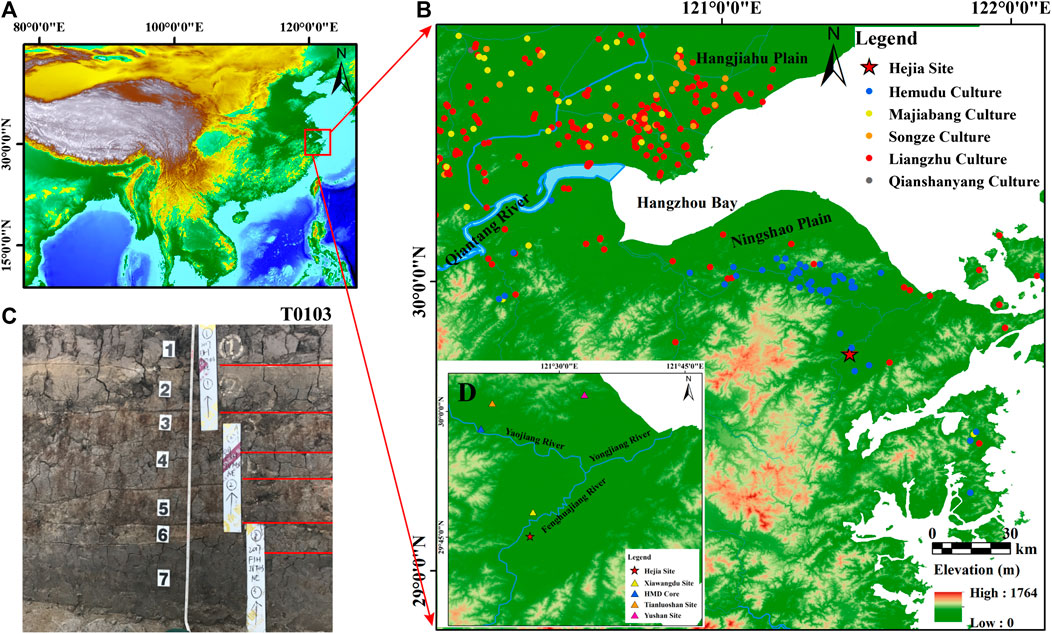
FIGURE 1. Location maps and the photograph of the Hejia Site. (A) Location of the study area. (B) Location of the Hejia Site (red star) and the distribution of archaeological sites of the Hemudu Culture, Majiabang Culture, Songze Culture, Liangzhu Culture, and Qianshanyang Culture (Li et al., 2012; Liu et al., 2016; Luo and Zhao, 2019; He et al., 2020a). (C) The sampled profile in the north wall of unit T0103 of the Hejia Site. (D) Distribution of core and key archaeological sites of Hemudu Culture.
Methods
Accelerator Mass Spectrometry 14C Dating
Four samples were collected from the north wall of the Hejia profile, and the plant residues or charcoal in the samples were selected as the dating materials. For samples from which plant residues or charcoal could not be recovered, we used HF treatment to process the pollen concentrate as the dating material (Li et al., 2007b). After pretreatment, the materials were sent to the Beta Analytic Laboratory (USA) for accelerator mass spectrometry (AMS) radiocarbon dating. The ages were calibrated using the IntCal13 data set (Reimer et al., 2013).
Magnetic Susceptibility
Magnetic susceptibility is an important proxy for the reconstruction of paleoclimate, especially the low-frequency magnetic susceptibility (χlf) (Han et al., 1996; Li and Yang, 2001). The samples were successively separated, oven-dried at 40°C for 24 h, and weighed. The values of the magnetic susceptibility (χ) were measured on 10 g samples. The χ of all 85 samples was measured at a low frequency (χlf) using a Bartington MS2 meter at the Earth Surface Process and Environmental Evolution Laboratory of the School of Geography and Ocean Science, Nanjing University.
X-Ray Fluorescence Scanning
Geochemical element analysis is an important method to study the environmental evolution and human activity information in sediments (Li et al., 2010b; Wu et al., 2017). Although the element intensity obtained by XRF scanning cannot obtain the absolute content of the element, it can well reflect the change of the relative content of the element (Yao, 2016). The samples were scanned with a Multi-Sensor Core Logger (MSCL-S) in the X-ray fluorescence (XRF) core scanning laboratory of the Nanjing Institute of Geography and Limnology, Chinese Academy of Sciences, at a resolution of 1 cm. The initial data were analyzed by using the bAxil Batch software to obtain the relative value of the element peak surface area that reflects the trends of the elements in the sediment of the Hejia Site.
Pollen and Charcoal Analysis
Studies reveal that the pollen assemblage from the natural sedimentary layers of archaeological sites can reflect the information of past vegetation evolution, and the pollen sources from the cultural layer can be used to reconstruct information about environmental changes and human activities of archaeological sites to a certain extent (Xu et al., 2002; Li et al., 2009). Pollen and charcoal samples were performed at approximately 6-intervals at depths of 55–103 cm, except for the 103–140 cm, at 3 cm, yielding 19 samples in total. Samples were processed according to the standard procedure developed by Moore et al. (1991). The identification of pollen and spores was performed under a 400× microscope regarding modern and Quaternary atlases (Institute of Botany and South China Institute of Botany, 1982; Wang et al., 1995; Tang et al., 2016). For each sample, 150–300 grains were counted because of the low concentration in some samples. The pollen concentration was calculated by adding Lycopodium spores to each sample as a marker. Pollen percentages for trees, shrubs, and upland herbs were calculated based on the terrestrial pollen taxa, and the pollen percentages for wetland herbs and fern spores were calculated based on the sums of all counted palynomorphs.
Poaceae pollen was divided into two size categories (<37 μm and >37 μm), and the larger size category (>37 μm) was identified as the cultivated crop (Tweddle et al., 2005). The pollen diagrams were constructed with Tilia 2.0 software. A stratigraphically constrained cluster analysis was applied by CONSISS incorporated in Tilia 2.0 to help pollen zonation, combined with the analysis of the archaeological cultural layers.
Charcoal in each sample was counted following the method of Millspaugh and Whitlock (1995). Two size categories, macro-charcoal (>125 μm) and micro-charcoal (<125 μm), were identified to indicate local and regional fires, respectively (Carcaillet et al., 2001).
Results
Lithology and Chronology
We divided the lower 85 cm section of the Hejia profile into four parts according to the soil properties and cultural attributes of the strata, as determined by archaeological teams from Nanjing University and Ningbo Municipal Institute of Cultural Heritage Management. From the bottom to the top, zone 1 (140–103 cm) consists of white-gray silt clay and belongs to the late Hemudu Culture Period, zone 2 (103–95 cm) consists of red-brown clay silt that belongs to the early Liangzhu Culture Period, zone 3 (95–77 cm) consists of blue-gray silt clay belonging to the middle Liangzhu Culture Period, and zone 4 (77–55 cm) consists of black-brown clay silt that belonging to periods from the late Liangzhu Culture to the Qianshanyang Culture.
The 14C dating results are shown in Table 1 and Figure 2A. Two of the samples were charcoal, and the other two were pollen concentrates. There are many reasons for the notable deviation of the dating results, such as biological disturbance, cross-contamination of old carbon during sampling, erosion, and re-sedimentation (Stanley and Chen, 2000; Pederson et al., 2005; Liu and Deng, 2009; Liu et al., 2009). When compared with other sites in the vicinity and the archaeological cultural stratification, we observe that the dating results from the pollen concentrates were older, which was speculated to be the influence of “old charcoal” in the organic matter of the sediment. Besides, the problematic dating data might also be caused by human activities due to the archaeological site selected in this study.

TABLE 1. AMS 14C dating results of the unit T0103 of the Hejia Site.
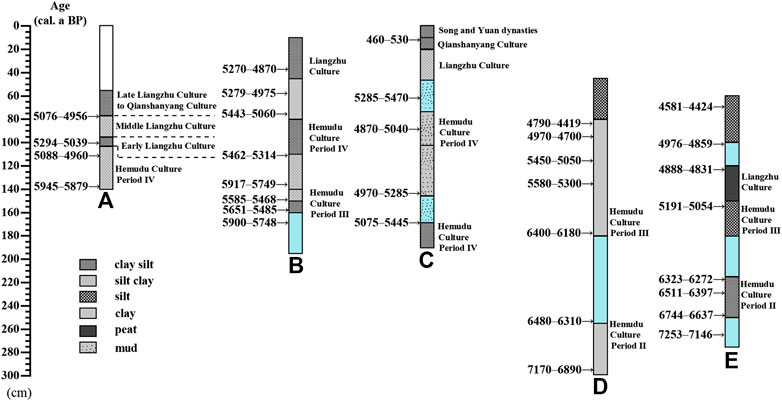
FIGURE 2. Comparisons of the litho-chronostratigraphy and archaeological layers in this study area: (A) the Hejia Site (this study), (B) the profile T0602W of the Xiawangdu Site (He et al., 2020a), (C) the profile T0103W of the Xiawangdu Site (Huang et al., 2021), (D) the Tianluoshan Site (Zheng, et al., 2012), and (E) the Yushan Site (He et al., 2018). The marine intrusion or extreme event is displayed in blue shadow according to the references (Zheng, et al., 2012; He et al., 2018; He et al., 2020a; Huang et al., 2021).
Previous studies demonstrate that the late Hemudu Culture developed from 6,000 to 5,000 cal a BP, the Liangzhu Culture ranged from 5,000 to 4,300 cal a BP (Liu et al., 2016; He et al., 2020a), and the Qianshanyang Culture ranged from 4,300 to 4,100 cal a BP (Hou, 2016). Compared with the dating results of nearby sites in the study area, we find that the corresponding age of the strata all had the phenomenon of some errors or age inversion due to the difference in dating materials. But overall, the basic framework of the strata is correct. The dating results of the samples of HJ 100–101 and HJ 110–111 are 5,294–5,039 cal a BP and 5,088–4,960 cal a BP, respectively, and are consistent with the late Hemudu Culture. When compared with the strata of nearby sites and with the stratification of archaeological cultures (Figure 2), it can be observed that the Hejia Site belongs to the sedimentary strata of the Middle Holocene.
Pollen Assemblage
A total of 53 pollen taxa (genera and family) were identified including 30 arboreal taxa, 18 herbaceous taxa, and 5 fern taxa. No algae were found. The pollen assemblages of the Hejia profile can be divided into four pollen zones from the bottom to the top. The divisions are based on the sediment and cluster analysis of pollen using CONISS by Tilia 2.0 software and the chronological framework of the Hejia Site established by archaeological cultural dating (Figure 3).
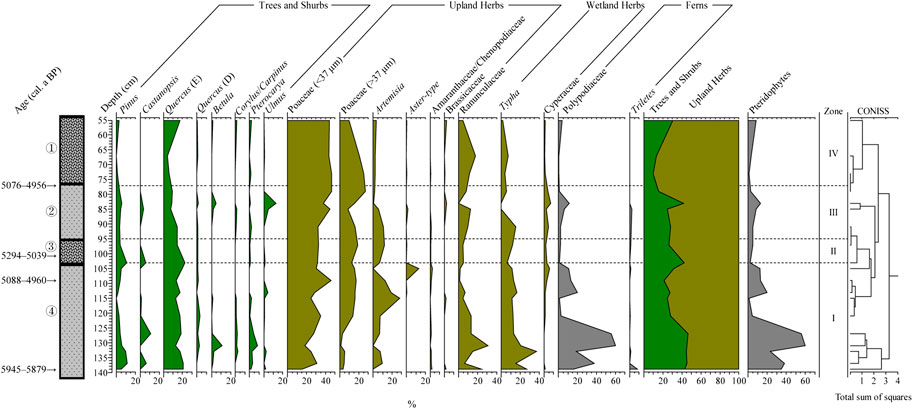
FIGURE 3. Sporopollen percentage of the Hejia Site. ① the late Liangzhu Culture to the Qianshanyang Culture Period, ② the middle Liangzhu Culture Period, ③ the early Liangzhu Culture Period, and ④ the Hemudu Culture Period Ⅳ.
Zone I (140–103 cm, the Hemudu Culture Period IV): the trees and shrubs accounted for 35.7% (average) and were dominated by the evergreen Quercus (17.6%), Castanopsis (1.93%), deciduous Quercus (1.1%), and Pinus (4.85%). The proportion of upland herbs (64.3%) exceeded that of the trees and shrubs and was mainly composed of Poaceae, Artemisia, and Ranunculaceae. Poaceae was dominated by the smaller size category (<37 μm, 28%) and exhibited an increasing trend. The larger size category of Poaceae (>37 μm) accounted for 9.6%. Ranunculaceae accounted for 11.7%. Wetland herbs were mainly composed of Typha (17.6%), and the ferns were dominated by Polypodiaceae (23.6%).
Pollen zone II (103–95 cm, the early Liangzhu Culture Period): the proportion of trees and shrubs (34.2%) decreased. Evergreen Quercus, deciduous Quercus, and Pinus accounted for 18.7%, 0.9%, and 7.3%, respectively. Poaceae was the main species of upland herbs. Compared with Zone I, Poaceae (<37 μm and >37 μm) increased, accounting for 32.1% and 15.8%, respectively. Ranunculaceae decreased to 4.7%. Typha (9.2%) was the dominant wetland herb, and ferns (3.3%) accounted for a relatively small proportion.
Pollen zone III (95–77 cm, the middle Liangzhu Culture Period): trees and shrubs decreased by approximately 6.6% compared with the former zone. Evergreen Quercus and Pinus fell to 10.1% and 4.0%, respectively. Ulmus increased to 4.5%. The upland herbs (72.4%) were dominated by Poaceae, with a greater increase in smaller-sized Poaceae (<37 μm, 40.4%). Brassicaceae increased to 1.0%, and Ranunculaceae increased to 7.6%. The wetland herbs were mainly composed of Cyperaceae and Typha and accounted for 4.5% and 5.2%, respectively. Ferns were dominated by Polypodiaceae (5.4%).
Zone IV (77–55 cm, the late Liangzhu Culture to the Qianshanyang Culture Period): trees and shrubs (17.8%) decreased significantly and then increased. Evergreen Quercus showed an increasing trend. The proportion of upland herbs increased to 82.2%. Smaller-sized Poaceae (<37 μm) increased by 4%, while there was a downward trend in larger-sized Poaceae (>37 μm). Brassicaceae, Artemisia, and Ranunculaceae accounted for 1.1%, 2.7%, and 11.2%, respectively. Typha and Polypodiaceae accounted for 4.1% and 1.7%, respectively.
Magnetic Susceptibility, XRF, and Charcoal Analysis
Based on the variations in magnetic susceptibility, high-resolution XRF elemental records of Cr/Cu, Mn, Ca, P, and charcoal concentration, combined with archaeological and cultural stratification, the profile can be divided into four stages from the bottom to the top (Figure 4).
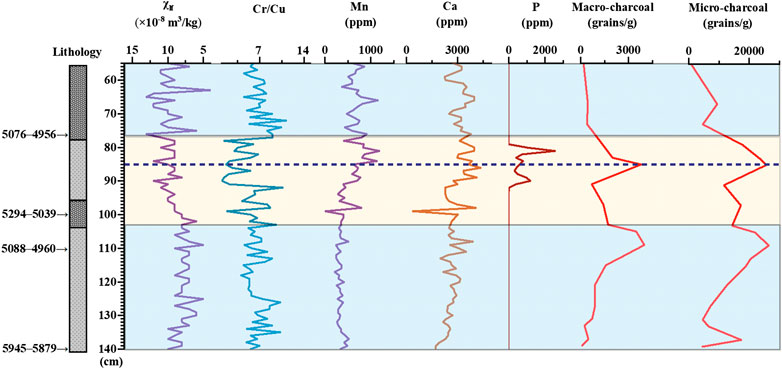
FIGURE 4. The low-frequency magnetic susceptibility (χlf), XRF scanning results (Cr/Cu, Mn, Ca, and P), concentrations of macro-charcoal and micro-charcoal in profile T0103 of the Hejia Site.
Stage I (140–103 cm, the Hemudu Culture Period IV): the χlf was initially at a low level of 7.76 × 10⁻⁸ m3/kg and then increased slightly. The Cr/Cu value was high (6.5) initially and then decreased where the relative values of Mn and P were 339 and 0 ppm, respectively. The Ca value fluctuated near the average value of 2,600 ppm and then experienced a small growth. The average value of the micro-charcoal concentration was 13,901 grains/g, with two successive peaks at 137 and 109 cm. The average value of the macro-charcoal concentration was 1,478 grains/g and gradually reached the highest point at 109 cm. The average value of the micro-charcoal concentration was 14,051 grains/g.
Stage II (103–95 cm, the early Liangzhu Culture Period): the average value of χlf was 8.4 × 10⁻⁸ m3/kg, with an upward trend. The values of Cr/Cu, Mn, and Ca fluctuated substantially. The relative value of P was 0 ppm. The average values of the micro-charcoal and macro-charcoal concentrations were 15,797 and 1,579 grains/g, respectively, and both of them displayed an overall upward trend.
Stage III (95–77 cm, the middle Liangzhu Culture Period): the value of χlf (9.8 × 10⁻⁸ m3/kg) was high. Cr/Cu was at a low value of 4.1. Mn and Ca values were 670 and 3,056 ppm, respectively, and both of them are relatively high. The peak P value was 551 ppm in the profile. The trends of the micro-charcoal and macro-charcoal concentrations were the same and simultaneously peaked at 85 cm.
Stage IV (77–55 cm, the late Liangzhu Culture to the Qianshanyang Culture Period): the value of χlf (10 × 10−8 m3/kg) was still high. Cr/Cu was 7.2. Mn and Ca values were 681 and 3,180 ppm, respectively. The P value was low. The micro-charcoal and macro-charcoal concentrations were 4,970 and 353 grains/g, respectively, both of which are low with minor fluctuations.
Discussion
Vegetation and Climate Background of the Hejia Site During the Middle Holocene
Previous studies show that the transgression during the Hemudu Culture IV (5,000–5,500 cal a BP) subsided, and the Ningshao Plain was in a freshwater environment (Figure 2) (He et al., 2020a; Wang et al., 2020), which provided an inhabitable environment for the development of the Hemudu Culture. Pollen data from the Hejia Site show that terrestrial herbs were the overwhelmingly dominant species. In the palynological analysis, arboreal pollen is generally used to reconstruct regional vegetation, while herbaceous pollen can represent local ones (Shu, 2007). The sporopollen assemblage from the sites is characterized by a high proportion of herbs, which is suitable for the reconstruction of local vegetation and the living environment of prehistoric ancestors (Shu, 2007). The trees and shrubs in the Hejia Site were dominated by Quercus (E), Castanopsis, and Quercus (D), which reflects that the vegetation in the study area during the Hemudu Culture IV was evergreen and deciduous broad-leaved mixed forest, and the pollen composition of evergreen broad-leaved trees was higher. As the super-representation of Pinus pollen and the relatively long spreading distance pointed out via previous studies, the low percentage Pinus (<20%) in this study is insufficient to indicate the existence of pine forests around it (Xiao, 1996). After comparison, the natural core in the study area (without cultural layers), such as HMD Core where pollen of trees and shrubs was dominated by Quercus (E) and Quercus (D), also reveals that the regional vegetation was dominated by evergreen and deciduous broad-leaved mixed forest (Figure 5D) (Liu et al., 2016). During the early Hemudu Culture IV, the Poaceae pollen (<37 μm) at the Hejia Site was dominant, and the proportion of Typha and Polypodiaceae reached the peak. The sporopollen data of the sites near the Hejia Site show that Typha and Cyperaceae were relatively high (Figure 5). Furthermore, Huang et al. (2021) infer that the Neolithic Hemudu people at the Xiawangdu Site were located in the low-salinity backswamp based on the analysis of organic and alkaline-earth metal geochemistry of the Xiawangdu Site. The χlf value of this layer was at a low level (Figure 6). Balsam et al. (2011) reveal that on a worldwide basis, magnetic susceptibility (MS) of soils increases with increasing average annual precipitation (AAP) from about 200 mm to 1,100–1,200 mm, and it decreases as AAP increases up to about 1,200 mm. And, studies also show that magnetic susceptibility (MS) in the area south of the Yangtze River decreases as AAP increases up to about 1,100 mm, 12°C, respectively (Han et al., 1996; Gu et al., 2019). The correspondence between surface soil magnetic susceptibility and modern climate has been well applied to the paleoenvironment (Lu et al., 1994). According to Li and Yang’s (2001) research on the Xiashu loess profile, the MS value of the sediment was reduced under a hot and humid climate. The average annual temperature and AAP of the study area are approximately 16.3°C and 1,400 mm, respectively (Zheng et al., 2016). Therefore, the low value of χlf in this profile of the Hejia Site indicates a warm and humid climate rather than a cold and dry climate. The Cr/Cu value is the maximum value of the entire profile. Previous studies show that the change of Cr/Cu has universal significance as an indicator of the environment humidity changes, and the high value of Cr/Cu indicates a humid environment and vice versa (Li et al., 2008, Li et al., 2017). Therefore, the high value of Cr/Cu and the low value of χlf at the Hejia Site reflect the relatively humid environment in this period. We speculate that the study area may be in a freshwater marsh environment during this period, and the environment is relatively humid. During the late Hemudu Culture IV in the Hejia Site, Poaceae pollen (<37 μm) still possessed an advantage. Meanwhile, the proportions of Typha and Polypodiace declined rapidly, and the proportion of Poaceae pollen (>37 μm) and Artemisia increased significantly, which reflects that the environment of the Hejia Site may be transformed from a freshwater marsh to grassland in this period. At the same time, the Cr/Cu value decreased and χlf increased, suggesting that the climate became dry and cool during the late Hemudu Culture IV at the Hejia Site. The multiple indicators of the Hejia Site profile indicate that the study area has extensive vegetation coverage under the warmer and humid climate, with a shift to a cool and dry trend during the Hemudu Culture IV.
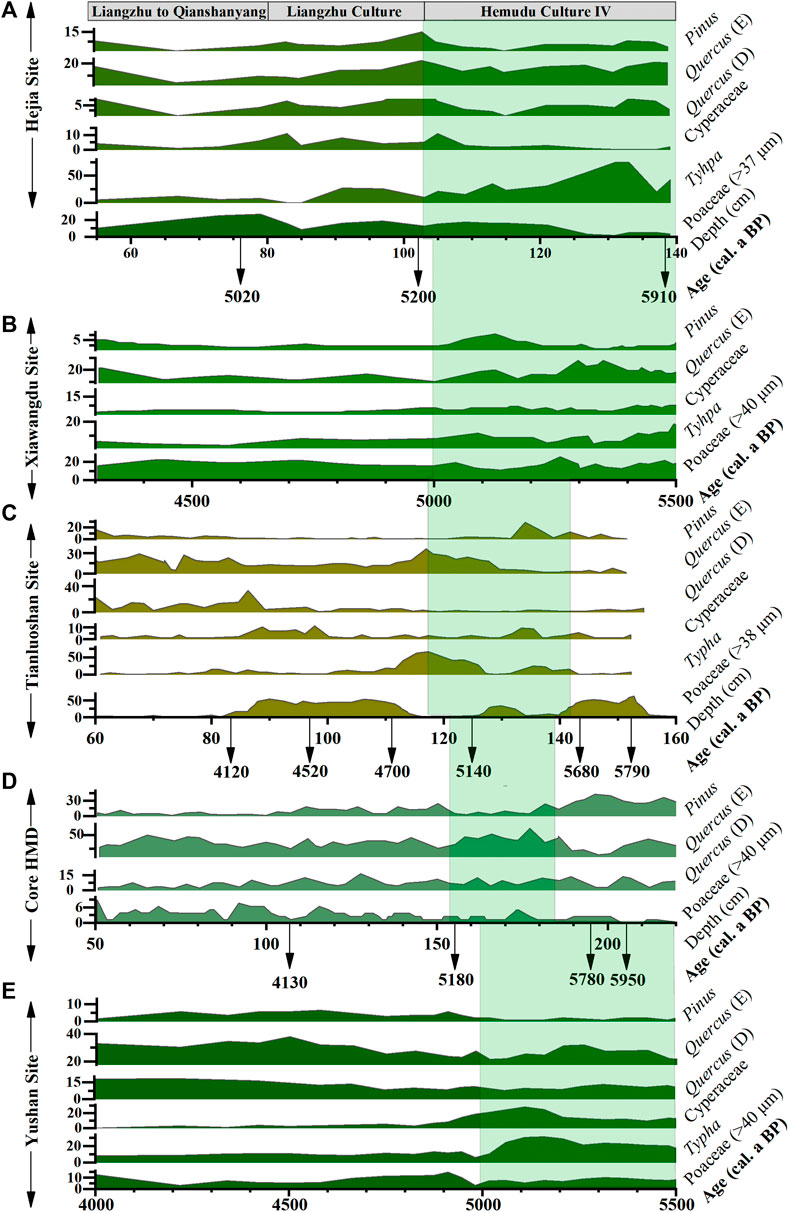
FIGURE 5. Pollen record comparisons from the nearby sites and core. (A) the Hejia Site (this study), (B) the Xiawangdu Site (He, et al., 2020a), (C) the Tianluoshan Site (Li et al., 2012), (D) HMD sediment core (Liu et al., 2016), and (E) the Yushan Site (He et al., 2018). Hemudu Culture IV is displayed in green shadow.
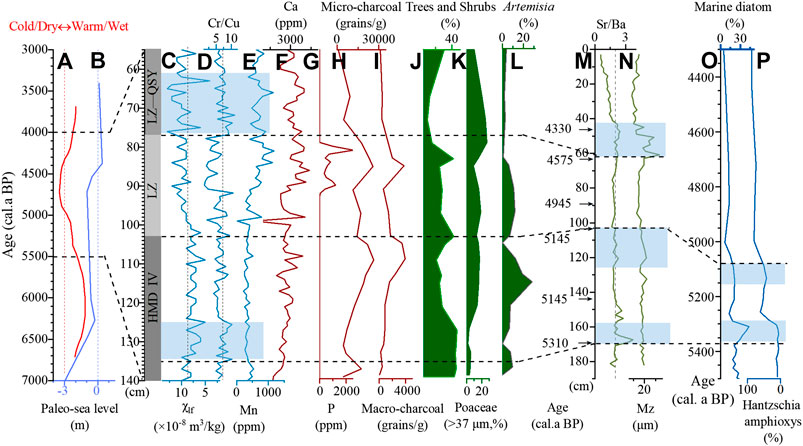
FIGURE 6. Records of the study area: (A) the climate fluctuation curve on the south bank of the Yangtze River Delta (Chen et al., 2005), (B) the relative sea-level change in the study area (Wang et al., 2018), and (C)–(L) χlf, Cr/Cu, Mn, Ca, P, micro-charcoal, macro-charcoal concentrations, Tree and Shrubs percentage, Poaceae (>37 μm) and Artemisia percentage, respectively (this study). (M)–(N) mean grain size (Mz) and Sr/Ba ratios in profile T0103W of the Xiawangdu Site (Huang et al., 2021). (O)–(P) the abundances of marine diatoms and the aerophilic freshwater diatom Hantzschia amphioxys in profile T0602W of the Xiawangdu Site (He et al., 2020a).
During the Liangzhu Culture Period (5,000–4,300 cal a BP), the trees and shrubs in the Hejia Site were still dominated by Quercus (E), Castanopsis, and Quercus (D). The proportion of them decreased significantly, yet the content of Pinus increased. The pollen records of the nearby sites and natural core during this period also reflect that Quercus (E) decreased as a whole during the early Liangzhu Culture (Figure 5). Also, pollen record from Chaohu Lake adjacent to the study area reveals the characteristics of climate cooling after 4,860 cal a BP (Wang et al., 2008). The changes in palynological content during this period reflect that the Liangzhu Culture was in the context of the overall cool climate. Compared with the former stage, the Cr/Cu value reduced, and the χlf value increased significantly, which together reflect that the climate turned dry during the Liangzhu Culture. Mn, which is mainly enriched in an oxidizing environment, was at a high level during this period. The well consistency between the oxide layer and the peak of Mn indicates the long-time exposure of the strata during the Liangzhu Culture Period (Yao, 2016; Huang et al., 2019). Statistic analysis shows that the number of water wells from the Yangtze River Delta reached its peak at about 134 during the Liangzhu Culture Period (Gao, 2003; Wu and Xu, 2009). This trend was in agreement with our study, reflecting the relatively low water level and relatively dry climate in the study area during the Liangzhu Culture.
From the late Liangzhu Culture to the Qianshanyang Culture when the rising sea-level rose (Figure 6B), the percentage of trees and shrubs at the Hejia Site decreased at first and then increased. The regional vegetation type was still evergreen and deciduous broad-leaved mixed forest, and the proportion of Quercus (E) generally increased. Quercus (E) from the nearby sites also increased, which reveals that the climate was warmer in the study area. Cr/Cu value increased sharply and then showed a downward trend, reflecting a gradual decrease after a sudden increase in humidity. Two valleys appeared in the χlf values fluctuating substantially, which suggests that the violent climate change to warm and humid. Furthermore, the high value of Sr/Ba and mean grain size (Mz) of profile T0103W of Xiawangdu profile indicate the occurrence of high-energy events during the late Liangzhu Culture (Figure 6), providing evidence for this study. No storm deposits during the late Liangzhu Culture are identified in profile T0602W of Xiawangdu profile, owing to its higher elevation at that time (Huang et al., 2021). The increasing frequency of natural disasters, as a result of sea-level rise in the late Liangzhu Culture Period, led to the demise of the Liangzhu civilization (Zhang et al., 2004; Zhu et al., 2011). We propose that the disappearance of the Liangzhu Culture was caused by sea-level rise and extreme weather events.
Human Activities in Relation to Environment Change at the Hejia Site during the Middle Holocene
During the Hemudu Culture IV, the influence of seawater in the Ningshao Plain subsided. Therefore, the study area was in a freshwater environment with a large amount of bare ground (Figure 2, 6B), providing a broader space for human activities. The Hemudu Culture's subsistence strategy transitioned from gathering and hunting to an agricultural economy (Zheng et al., 2019). The domestication of rice was completed during the late Hemudu Culture (He et al., 2020a; He et al., 2018). Established in the context of freshwater marsh, the Hejia Site is conducive to rice cultivation (Ma et al., 2020). Because the pollen structure of rice is similar to other grasses and hard to distinguish, there are differences from the perspective of identification, which also leads to different standards for the identification of the cultivated rice in the study of archaeological sites. Tweddle et al. (2005) evaluate and analyze the pollen in Yorkshire during the Holocene and conclude that Poaceae pollen (>37 μm) has a certain correlation with prehistoric agricultural activities. Charcoal, as a record of fire events, provides useful information for reconstructing human activities (Zhang and Lu, 2006; Scott, 2010; Liu et al., 2020). The increase in the charcoal concentration indicates intensified fire events and vice versa (Zhang and Lu, 2006). During the early Hemudu Culture IV, the proportion of Poaceae (>37 μm) and the concentration of the macro-charcoal of the Hejia Site were extremely low, which reveals the low intensity of human activity. Previous research reveals that an extreme storm event happened in the Xiawangdu Site during the early Hemudu Culture IV due to the peak value of Sr/Ba ratio coincident with the increase in marine diatoms and reduction in the abundance of Hantzschia amphioxys in the profile of the Xiawangdu Site (Figure 6) (He et al., 2020a; Huang et al., 2021). Therefore, we speculate that extreme storm events may impede the process of daily activities and rice cultivation of the prehistoric ancestors at the Hejia Site. During the late Hemudu Culture IV, the steep increase in the larger size Poaceae (>37 μm) corresponding to the increasing Artemisia, indicating that the area was in the vicinity of paddy fields (Ma et al., 2020). At around 5,230–5,150 cal a BP, the sedimentary record of the Xiawangdu Site showed a relatively short extreme storm event, but there was no relevant evidence in the Hejia Site. We suggest that the Hejia Site may be located relatively further from the river and was not been affected by it. The higher concentration of charcoal corresponding to the decreasing proportion of trees and shrubs also substantiates our assumption. The regular rice cultivation method in the Middle Holocene in the Yangtze River Delta was slash-and-burn (Zong et al., 2007; Shu et al., 2010). Because of the warm and humid climate during this period, the wildfire incidents were infrequent. Therefore, it could be the direct result of the slash-and-burn operation that the increase in charcoal concentration (micro and macro), the decreasing percentage of trees and shrubs, and the increasing percentage of Poaceae (>37 μm). Compared with the proportion of rice pollen in the nearby sites (Figure 5), the proportion of rice was generally not high. Besides, the Chenghu Site in the Taihu area is a Songze Culture site at the same time as the Hemudu Culture IV, and the discovery of the rice field at this site provides evidence for the prehistoric people in the Yangtze River Delta to master rice cultivation during that period (Ding and Zhang, 2004). We speculate that the Hemudu ancestors basically mastered rice cultivation, and rice was one of the food sources during the Hemudu Culture IV.
The early and middle Liangzhu Culture was the heyday of the Liangzhu Culture. Studies show that the prosperity occurred when the sea-level was lower and the climate was cool and dry (Chen et al., 2005; Wang et al., 2018). During this period, human beings gained a spacious living field, and the development of the Liangzhu Culture reached its peak. Poaceae was identified as the cultivated crop and accounted for an overall high pollen proportion in the area (Figure 5), which reveals that there was mature rice farming during the early and middle Liangzhu Culture (Li et al., 2012; He et al., 2018, He et al., 2020a). Additionally, studies show that the abnormally high P value in the paleostratigraphic deposits might be caused by the accumulation of kitchen debris and other residues that can be used to indicate the living areas of prehistoric humans or indicate that the site was proximal to the living area (Dong et al., 2007; Arrhenius, 2010). In the early and middle Liangzhu Culture, the Ca and P values indicating the intensity of human activities were high. Studies show that the high value of Ca in the stratum of the archaeological sites might be caused by human and animal bones and their excrement (Ma et al., 2006; Li et al., 2017). The P value, especially, suggests that this was a residential zone of the Liangzhu ancestors. Meanwhile, the macro-charcoal concentration reached its peak, revealing that the fire intensity related to the activities of human life and production was relatively high. Slash-and-burn was the common rice cultivation method in the Yangtze River Delta during the Middle Holocene (Zong et al., 2007), but it appears that the concentration of charcoal peaks at the same time when the percentage of Poaceae (>37 μm) reached the lowest point during the middle Liangzhu Culture speculated that those paddy fields were far from here due to the expansion of human residential areas in this period.
From the late Liangzhu Culture to the Qianshanyang Culture, the climate fluctuated obviously, and the sea-level began to rise (Figure 6), which may lead to frequent extreme events. The proportion of larger-sized Poaceae (>37 μm) pollen showed a downward trend, and the concentrations of micro-charcoal and macro-charcoal were lower. The trends suggest a lower intensity of human activities and further indicate that the organization and development of the Qianshanyang Culture were relatively lower than those of the Liangzhu Culture (Xu, 2015).
Conclusion
In this study, pollen, charcoal, XRF, and magnetic susceptibility analysis were carried out on the T0103 profile of the Hejia Site, and the conclusions are as follows:
1 A suitable natural environment laid the foundation for the development and the prosperity of the prehistoric culture in the Middle Holocene in the study area. The Middle Holocene vegetation mainly consisted of evergreen and deciduous broad-leaved mixed forests. The climate experienced the warm and wet (Hemudu Culture Period IV)–cool and dry (Liangzhu Culture Period)–warm and wet (Qianshanyang Culture) periods.
2 It is supported by combined human activity proxy indicators including Ca, P, larger-sized Poaceae (>37 μm) pollen, and charcoal concentrations that the enhanced ability of humans to manage crop fields from the late Hemudu Culture Period to the Liangzhu Culture Period. At the Hejia Site, the occurrence of high-intensity fire events during the late Hemudu Culture Period might be caused by slash-and-burn operations, while those that occurred during the middle Liangzhu Culture Period might be caused by the increasing fire demand owing to the greater ancestors’ lives and production activities.
Data Availability Statement
The original contributions presented in the study are included in the article/Supplementary Material; further inquiries can be directed to the corresponding authors.
Author Contributions
CM and DZ designed the research. HL, JS, and CM completed writing. YL, FD, and DZ completed the excavation and archaeological cultural dating of the Hejia Site. HL, JS, JS, ZH, GS, and YD completed the experiment, data analysis and sampling in the field.
Funding
This study was supported by the collaborative project between the Ningbo Municipal Institute of Cultural Heritage Management and Nanjing University, the National Natural Science Foundation of China (41671196 and 41977389), and Major Social Science Project (20&ZD247).
Conflict of Interest
The authors declare that the research was conducted in the absence of any commercial or financial relationships that could be construed as a potential conflict of interest.
Acknowledgments
We are deeply indebted to archaeological teams from the Nanjing University and Ningbo Municipal Institute of Cultural Heritage Management for their help during the fieldwork. We are grateful to two anonymous reviewers for their constructive comments. We are also grateful to Lin Zhao of the School of Geography Science, Nanjing University of Information Science & Technology, for her valuable suggestions about this paper. Our deepest gratitude goes to Lingyu Tang of the Nanjing Institute of Geology and Palaeonotology, Chinese Academy of Sciences, for his guidance on pollen identification.
Supplementary Material
The Supplementary Material for this article can be found online at: https://www.frontiersin.org/articles/10.3389/feart.2020.609912/full#supplementary-material.
References
An, Z. S., Porter, S. C., Kutzbach, J. E., Wu, X. H., Wang, S. M., Liu, X. D., et al. (2000). Asynchronous Holocene optimum of the east asian monsoon. Quat. Sci. Rev. 19, 743–762. doi:10.1016/S0277-3791(99)00031-1
Arrhenius, O. (2010). Chemical denudation in Sweden. Tellus 6, 326–341. doi:10.1111/j.2153-3490.1954.tb01128.x
Balsam, W. L., Ellwood, B. B., Ji, J. F., Williams, E. R., Long, X. Y., and El Hassani, A. (2011). Magnetic susceptibility as a proxy for rainfall: worldwide data from tropical and temperate climate. Quat. Sci. Rev. 30, 2732–2744. doi:10.1016/j.quascirev.2011.06.002
Cai, T. S., Zhu, C., Sun, Z. B., Zheng, C. G., Ma, C. M., Zhu, G. Y., et al. (2017). Palaeoenvironments of Holocene archaeological sites in the Yangtze gorges area. J. Stratigr. 41, 32–38.
Carcaillet, C., Bouvier, M., Frechette, B., Larouche, A. C., and Richard, P. J. H. (2001). Comparison of pollen-slide and sieving methods in lacustrine charcoal analyses for local and regional fire history. Holocene 11, 467–476. doi:10.1191/095968301678302904
Chen, Z. Y., Wang, Z. H., Schneiderman, J., Tao, J., and Cai, Y. L. (2005). Holocene climate fluctuations in the Yangtze delta of eastern China and the Neolithic response. Holocene 15, 915–924. doi:10.1191/0959683605hl862rr
Chen, J. (2006). Initial comment on Guangfulin culture. Cultural Relics in Southern China 53–63. doi:10.3969/j.issn.1004-6275.2006.04.011
Ding, J. L., and Zhang, T. J. (2004). Rice paddy of Songze culture unearthed at Chenghu site. China Cult. Herit 1, 70–71.
Dong, G. H., Xia, Z. K., Liu, D. C., Wu, Q. L., and Wang, Z. T. (2007). The impact of human activities on the chemical properties of paleosol in Mengjin, Henan Province during civilization. J. Lanzhou Univ. 43, 6–10. doi:10.3321/j.issn:0455-2059.2007.01.002
Gao, M. H. (2003). An environmental study on the lower reaches of the Yangtze River based on archaeological sequence. PhD dissertation. Shanghai (China): Fudan University.
Gu, Y. J., Li, Y. M., Han, L., and Su, X. (2019). Relationships between surface soil magnetic susceptibility and modern climatic factors in eastern China and their environmental significance. J. Univ. Chin. Aca. Sciences 36, 498–509.
Han, J. M., Lu, H. Y., Wu, N. Q., and Guo, Z. T. (1996). The magnetic susceptibility of modern soils in China and its use for paleoclimate reconstruction. Studia Geophys. Geod. 40, 262–275. doi:10.1007/BF02300742
He, K. Y., Lu, H. Y., Zheng, Y. F., Zhang, J. P., Xu, D. K., Huan, X. J., et al. (2018). Middle-Holocene sea-level fluctuations interrupted the developing Hemudu culture in the lower Yangtze River, China. Quat. Sci. Rev. 188, 90–103. doi:10.1016/j.quascirev.2018.03.034
He, K. Y., Lu, H. Y., Li, Y. N., Ding, F. Y., Zhang, J. P., and Wang, C. (2020a). Cultural response to Middle Holocene sea-level fluctuations in eastern China: a multi‐proxy approach. Boreas 49, 71–88. doi:10.1111/bor.12421
He, K. Y., Lu, H. Y., Zheng, H. B., Yang, Q., Sun, G. P., Zheng, Y. F., et al. (2020b). Role of dynamic environmental change in sustaining the protracted process of rice domestication in the lower Yangtze River. Quat. Sci. Rev. 242, 106456. doi:10.1016/j.quascirev.2020.106456
Hou, N. N. (2016). A study on the Qianshanyang culture. PhD dissertation. Changchun (China): Jilin University.
Huang, X. R., Zheng, H. B., Hu, Z. J., Yang, Q., Sun, G. P., Ling, G. J., et al. (2019). The changes of hydrological environment recorded in the section of Tianluoshan Site in Zhejiang Province. Chin. Sci. Bull. 64, 963–976.
Huang, J., Li, Y. N., Ding, F. Y., Zheng, T. T., Meadows, M. E., and Wang, Z. H. (2021). Sedimentary records of mid-Holocene coastal flooding at a Neolithic site on the southeast plain of Hangzhou Bay, east China. Mar. Geol. 431. doi:10.1016/j.margeo.2020.106380
Innes, J. B., Zong, Y. Q., Wang, Z. H., and Chen, Z. Y. (2014). Climatic and palaeoecological changes during the mid-to-Late Holocene transition in eastern China: high-resolution pollen and non-pollen palynomorph analysis at Pingwang, Yangtze coastal lowlands. Quat. Sci. Rev. 99, 164–175. doi:10.1016/j.quascirev.2014.06.013
Institute of Botany and South China Institute of Botany, (1982). Angiosperm pollen flora of tropical and subtropical China. Beijing, China: Science Press.
Kajita, H., Kawahata, H., Wang, K., Zheng, H. B., Yang, S. Y., Ohkouchi, N., et al. (2018). Extraordinary cold episodes during the mid-Holocene in the Yangtze delta: interruption of the earliest rice cultivating civilization. Quat. Sci. Rev. 201, 418–428. doi:10.1016/j.quascirev.2018.10.035
Li, X. S., and Yang, D. Y. (2001). Magnetic susceptibility records of the Xiashu loess since S2 and their comparisons with the marine oxygen isotope records. Journal of Nanjing University (Natural Sciences) 37, 766–772. doi:10.3321/j.issn:0469-5097.2001.06.018
Li, C. H., Zhang, G. Y., Yang, L. Z., Lin, X. G., Hu, Z. Y., Dong, Y. H., et al. (2007a). Pollen and phytolith analyses of ancient paddy fields at Chuodun site, the Yangtze River Delta. Pedosphere 17, 209–218. doi:10.1016/S1002-0160(07)60027-7
Li, Y. Y., Wei, F., and Zhou, L. P. (2007b). AMS 14C dating using bulk samples, plant residues and pollen concentrates from a peat profile at Kulun, Inner Mongolia. Quat. Sci. 27, 499–506. doi:10.3321/j.issn:1001-7410.2007.04.004
Li, Z. X., Zhu, C., Zhu, Q., Ma, C. M., Zhang, G. S., and Ou, Y. J. (2008). Variation of Cr/Cu ratios in Zhongba profile and its indication on palaeo-environment over last 5 ka. Sci. Geogr. Sin. 799–803. doi:10.3969/j.issn.1000-0690.2008.06.015
Li, Y. Y., Hou, S. F., and Mo, D. W. (2009). Records for pollen and charcoal from Qujialing archaeological site of Hubei and ancient civilization development. J. Palaeogeogr. 11, 702–710. doi:10.7605/gdlxb.2009.06.011
Li, M. L., Mo, D. W., Mao, L. J., Sun, G. P., and Zhou, K. S. (2010a). Paleosalinity in the Tianluoshan site and the correlation between the Hemudu culture and its environmental background. J. Geogr. Sci. 20, 441–454. doi:10.1007/s11442-010-0441-1
Li, X. Q., Ji, M., Zhou, X. Y., Zhao, K. L., Sun, N., and Yang, Q. (2010b). Records of element geochemistry on human activity during 3700 ∼ 3400 cal BP at Donghuishan Site, Gansu, China. Journal of Earth Environment 1, 48–51.
Li, Y. Y., Wu, J., Hou, S. F., Shi, C. X., Mo, D. W., and Liu, B. (2010c). Palaeoecological records of environmental change and cultural development from the Liangzhu and Qujialing archaeological sites in the middle and lower reaches of the Yangtze River. Quat. Int. 227, 29–37. doi:10.1016/j.quaint.2010.05.015
Li, C. H., Zheng, Y. F., Yu, S. Y., Li, Y. X., and Shen, H. D. (2012). Understanding the ecological background of rice agriculture on the Ningshao Plain during the Neolithic Age: pollen evidence from a buried paddy field at the Tianluoshan cultural site. Quat. Sci. Rev. 35, 131–138. doi:10.1016/j.quascirev.2012.01.007
Li, Z. X., Wu, G. X., Sun, Y. L., Zhang, M., and Gu, L. (2017). Environmental and anthropogenic records of late longshan period at the wadian site. Mar. Geol. Quat. Geol. 180–186.
Liu, Q. S., and Deng, C. L. (2009). Magnetic susceptibility and its environmental significances. Chin. J. Geophys. 52, 1041–1048. doi:10.3969/j.issn.0001-5733.2009.04.021
Liu, J. F., Chen, J., Lei, S. X., and Hou, K. M. (2009). Preliminary dating results for Qianhuai palaeochannel sediments in Nanjing city. Quat. Sci. 837–844. doi:10.3969/j.issn.1001-7410.2009.04.21
Liu, Y., Sun, Q. L., Fan, D. D., Lai, X. H., Xu, L. C., Finlayson, B., et al. (2016). Pollen evidence to interpret the history of rice farming at the Hemudu site on the Ningshao coast, eastern China. Quat. Int. 426, 195–203. doi:10.1016/j.quaint.2016.05.016
Liu, Y., Sun, Q. L., Fan, D. D., Dai, B., Ma, F. W., and Xu, L. C. (2018). Early to middle Holocene sea level fluctuation, coastal progradation and the neolithic occupation in the Yaojiang Valley of southern Hangzhou Bay, eastern China. Quat. Sci. Rev. 189, 91–104. doi:10.1016/j.quascirev.2018.04.010
Liu, R., Mei, X., Zhang, J., and Zhao, D. B. (2019). Characteristics of clay minerals in sediments of Hemudu area, Zhejiang, China in Holocene and their environmental significance. China Geology 2, 8–15. doi:10.31035/cg2018069
Liu, Y., Deng, L. J., He, J., Jiang, R., Fan, D. D., Jiang, X. Z., et al. (2020). Early to middle Holocene rice cultivation in response to coastal environmental transitions along the South Hangzhou Bay of eastern China. Palaeogeogr. Palaeoclimatol. Palaeoecol. 555, 109872. doi:10.1016/j.palaeo.2020.109872
Lu, H. Y., Han, J. M., Wu, N. Q., and Guo, Z. T. (1994). Analysis of surface soil magnetic susceptibility in China and their paleoclimatic significance. Science China 24, 1290–1297.
Luo, P., and Zhao, D. S. (2019). Excavation report on Hejia site in Fenghua, Ningbo, Zhejiang. Cult. Rel. in South. China 1, 56–73.
Luo, W. G., Song, G. D., Hu, Y. Q., and Chen, D. (2020). Tentative determination of a special bronze material by multiple technological test on a xuan-liu dagger-axe from the Xujialing Site, the Eastern Zhou period, Henan Province, China. J. Cult. Herit. doi:10.1016/j.culher.2020.06.016
Ma, C. M., Zhu, C., Zhu, G. Y., Wang, J. H., Huang, R., and Gu, W. W. (2006). Magnetic susceptibility and elemental geochemistry analysis of the archaeological strata at the Yuchisi site, Anhui. J. Stratigr. doi:10.1007/s11442-006-0415-5
Ma, T., Rolett, B. V., Zheng, Z., and Zong, Y. Q. (2020). Holocene coastal evolution preceded the expansion of paddy field rice farming. Proc. Natl. Acad. Sci. Unit. States Am. doi:10.1073/pnas. 1919217117
Millspaugh, S. H., and Whitlock, C. (1995). A 750-year fire history based on lake sediment records in central Yellowstone National Park, USA. Holocene 5, 283–292. doi:10.1177/095968369500500303
Ningbo Chorography Codification Committee (1995). Ningbo Chorography. Beijing, China: Zhonghua Book Company.
Moore, P. D., Webb, J. A., and Collinson, M. E. (1991). Pollen analysis. J. Ecol. 80, 216. doi:10.2307/2260877
Pederson, D. C., Peteet, D. M., Kurdyla, D., and Guilderson, T. (2005). Medieval warming, little ice age, and European impact on the environment during the last millennium in the lower hudson valley, New York, USA. Quaternary Research 63, 238–249. doi:10.1016/j.yqres.2005.01.001
Reimer, P. J., Baillie, M. G. L., Bard, E., Bayliss, A., Beck, J. W., Blackwell, P. G., et al. (2013). Intcal13 and marine13 radiocarbon age calibration curves 0–50 000 years cal BP. Radiocarbon 55, 1869–1887. doi:10.1017/S0033822200048864
Scott, A. C. (2010). Charcoal recognition, taphonomy and uses in palaeoenvironmental analysis. Palaeogeogr. Palaeoclimatol. Palaeoecol. 291, 11–39. doi:10.1016/j.palaeo.2009.12.012
Shu, J. W., Wang, W. M., Jiang, L. P., and Takahara, H. (2010). Early Neolithic vegetation history, fire regime and human activity at Kuahuqiao, Lower Yangtze River, East China: new and improved insight. Quat. Int. 227, 10–21. doi:10.1016/j.quaint.2010.04.010
Shu, J. W. (2007). Holocene vegetation history, environment changes, and human activity in the Taihu Lake area. PhD dissertation. Nanjing (East China): Nanjing Institute of Geology and Palaeontology, Chinese Academy of Sciences.
Stanley, D. J., and Chen, Z. Y. (1996). Neolithic settlement distributions as a function of sea level-controlled topography in the Yangtze delta, China. Geology 24, 1083–1086. doi:10.1130/0091-7613(1996)0242.3.CO;2
Stanley, D. J., and Chen, Z. Y. (2000). Radiocarbon dates in China’s Holocene Yangtze Delta: record of sediment storage and reworking, not timing of deposition. J. Coast Res. 16, 1126–1132. doi:10.2307/4300129
Tang, L. Y., Mao, L. M., Shu, J. W., Li, C. H., Shen, C. M., and Zhou, Z. Z. (2016). Hand of quaternary pollen and spores in China. Beijing, China: Science Press.
Tweddle, J. C., Edwards, K. J., and Fieller, N. R. J. (2005). Multivariate statistical and other approaches for the separation of cereal from wild Poaceae pollen using a large Holocene dataset. Veg. Hist. Archaeobotany 14, 15–30.
Wang, F. X., Qian, N. F., and Yang, H. Q. (1995). Pollen flora of China. Beijing, China: Science Press.
Wang, X. Y., Mo, D. W., Wu, L., Zhang, G. S., Xiao, X. Y., and Han, W. G. (2008). Pollen record from Chaohu Lake in the lower reaches of the Yangtze River and environmental changes since 9870 cal. a BP. Quat. Sci. 28, 649–658. doi:10.3321/j.issn:1001-7410.2008.04.017
Wang, X. C., Mo, D. W., Li, C. H., Yu, S. Y., Xue, B., Liu, B., et al. (2017). Environmental changes and human activities at a fortified site of the Liangzhu culture in eastern China: evidence from pollen and charcoal records. Quat. Int. 438, 189–197. doi:10.1016/j.quaint.2017.05.001
Wang, Z. H., Ryves, D. B., Lei, S., Nian, X. M., Lv, Y., Tang, L., et al. (2018). Middle Holocene marine flooding and human response in the south Yangtze coastal plain, East China. Quat. Sci. Rev. 187, 80–93. doi:10.1016/j.quascirev.2018.03.001
Wang, S., Ge, J. Z., Kilbourne, K. H., and Wang, Z. H. (2020). Numerical simulation of mid-Holocene tidal regime and storm-tide inundation in the south Yangtze coastal plain, East China. Mar. Geol. 423, 106134. doi:10.1016/j.margeo.2020.106134
Wu, R. Z., and Xu, J. J. (2009). The rise and fall of Liangzhu Culture. Beijing, China: Social Sciences Academic Press.
Wu, L., Shao, S. X., Zhou, Y., He, T. T., Zhu, C., Zheng, C. G., et al. (2012). Response of prehistoric culture to climatic environmental changes since Holocene in Zhejiang, east China. Acta Geograph. Sin. 67, 903–916. doi:10.11821/xb201207004
Wu, L., Zhu, C., Ma, C. M., Li, F., Meng, H. P., Liu, H., et al. (2017). Mid-holocene palaeoflood events recorded at the Zhongqiao neolithic cultural site in the jianghan plain, middle Yangtze River valley, China. Quat. Sci. Rev. 173, 145–160. doi:10.1016/j.quascirev.2017.08.018
Xia, Z. K., and Zhang, J. N. (2019). The rise, development and outlook of Huanjingkaogu (environmental archaeology in China). J. Palaeogeogr. 21, 175–188. doi:10.7605/gdlxb.2019.01.010
Xiao, J. Y. (1996). Analysis of plant pollen and phytolith from the fifth excavation at the Xudun site. South. Cult. 1, 47–50.
Xiong, H. X., Zong, Y. Q., Li, T. H., Long, T. W., Huang, G. Q., and Fu, S. Q. (2020). Coastal GIA processes revealed by the early to middle Holocene sea-level history of east China. Quat. Sci. Rev. 233, 106249. doi:10.1016/j.quascirev.2020.106249
Xu, Q. H., Yang, Z. J., Cui, Z. J., Yang, X. L., and Liang, W. D. (2002). A study on pollen analysis of Qiguoshan Section and ancestor living environment in Chifeng Area. Sci. Geogr. Sin. 22 (4), 453–457. doi:10.3969/j.issn.1000-0690.2002.04.014
Xu, P. F. (2015). The post-liangzhu culture: a discussion based on the features of the late phase of Liangzhu culture. South. Cult. 247, 75–85.
Yao, X. Y. (2016). Application of XRF core scanning technology in sea-level change reconstruction during the Holocene in Ningshao Plain. PhD dissertation. Nanjing (China): Nanjing Normal University.
Yu, S. Y., Zhu, C., Song, J., and Qu, W. Z. (2010). Role of climate in the rise and fall of Neolithic cultures on the Yangtze Delta. Boreas 29, 157–165. doi:10.1111/j.1502-3885.2000.tb01208.x
Zhang, J. P., and Lu, H. Y. (2006). Preliminary study of charcoal morphology and its environmental significance. Quat. Sci. 26, 7. doi:10.3321/j.issn:1001-7410.2006.05.022
Zhang, Q., Jiang, T., Shi, Y. F., King, L., Liu, C. L., and Metzler, M. (2004). Paleo-environmental changes in the Yangtze Delta during past 8000 years. J. Geogr. Sci. 14, 105–112. doi:10.1007/BF02873097
Zheng, Y. F., Sun, G. P., and Chen, X. G. (2012). Response of rice cultivation to fluctuating sea level during the Mid-Holocene. Chin. Sci. Bull. 57, 370–378. doi:10.1007/s11434-011-4786-3
Zheng, L. B., Hao, X. D., Zhuo, B., Liu, Y. L., Wang, X. L., Zhu, L. X., et al. (2016). Holocene palaeoenvironment evolution and human activity of the hemudu-tianluoshan sites in yuyao of Zhejiang province. J. Palaeogeogr. 894. doi:10.7605/gdlxb.2016.05.067
Zheng, X. Q., Lei, S., Wang, J. H., and Zhao, Z. J. (2019). Analysis of flotation results from the Yushan Site in Ningbo city. Agricultural Archaeology 6, 21–27.
Zhu, L. D., Feng, Y. X., Ye, W., Wang, T. Y., Li, F. Q., and Li, L. X. (2011). Culture development and sea-level change during Liangzhu period. Prog. Geogr. 30, 121–128.
Zong, Y., Chen, Z., Innes, J. B., Chen, C., Wang, Z., and Wang, H. (2007). Fire and flood management of coastal swamp enabled first rice paddy cultivation in east China. Nature 449, 459–462. doi:10.1038/nature06135
Keywords: pollen, charcoal, XRF, paleoenvironment, human activities, Middle Holocene, Hejia Site
Citation: Li H, Sun J, Ma C, Zhao D, Li Y, Ding F, Sun J, Huang Z, Shang G and Deng Y (2021) Paleoenvironmental Evolution and Human Activities at the Hejia Site on the Ningshao Coastal Plain in Eastern China. Front. Earth Sci. 8:609912. doi: 10.3389/feart.2020.609912
Received: 24 September 2020; Accepted: 14 December 2020;
Published: 18 January 2021.
Edited by:
Guanghui Dong, Lanzhou University, ChinaReviewed by:
Xianyong Cao, Institute of Tibetan Plateau Research (CAS), ChinaQianli Sun, East China Normal University, China
Copyright © 2021 Li, Sun, Ma, Zhao, Li, Ding, Sun, Huang, Shang and Deng. This is an open-access article distributed under the terms of the Creative Commons Attribution License (CC BY). The use, distribution or reproduction in other forums is permitted, provided the original author(s) and the copyright owner(s) are credited and that the original publication in this journal is cited, in accordance with accepted academic practice. No use, distribution or reproduction is permitted which does not comply with these terms.
*Correspondence: Chunmei Ma, Y2h1bm1laW1hQG5qdS5lZHUuY24=; Dongsheng Zhao, Y2hlbmd6aXlhQG5qdS5lZHUuY24=