 Wei Zhang
 Ming Luo
 Si Gao
 Weilin Chen
 Vittal Hari
 Abdou Khouakhi
- 1Department of Plants, Soils and Climate, Utah State University, Logan, UT, United States
- 2School of Geography and Planning, Sun Yat-sen University, Guangzhou, China
- 3Guangdong Key Laboratory for Urbanization and Geo-simulation, Guangdong Provincial Engineering Research Center for Public Security and Disaster, Guangzhou, China
- 4School of Atmospheric Sciences, Sun Yat-sen University, Zhuhai, China
- 5Southern Marine Science and Engineering Guangdong Laboratory (Zhuhai), Zhuhai, China
- 6Joint International Research Laboratory of Climate and Environment Change, Collaborative Innovation Center on Forecast and Evaluation of Meteorological Disasters, Nanjing University of Information Science and Technology, Nanjing, China
- 7UFZ-Helmholtz Centre for Environmental Research, Leipzig, Germany
- 8Centre for Environmental and Agricultural Informatics, School of Water, Energy and Environment, Cranfield University, Cranfield, United Kingdom
Compound extremes pose immense challenges and hazards to communities, and this is particularly true for compound hydrometeorological extremes associated with deadly floods, surges, droughts, and heat waves. To mitigate and better adapt to compound hydrometeorological extremes, we need to better understand the state of knowledge of such extremes. Here we review the current advances in understanding compound hydrometeorological extremes: compound heat wave and drought (hot-dry), compound heat stress and extreme precipitation (hot-wet), cold-wet, cold-dry and compound flooding. We focus on the drivers of these extremes and methods used to investigate and quantify their associated risk. Overall, hot-dry compound extremes are tied to subtropical highs, blocking highs, atmospheric stagnation events, and planetary wave patterns, which are modulated by atmosphere-land feedbacks. Compared with hot-dry compound extremes, hot-wet events are less examined in the literature with most works focusing on case studies. The cold-wet compound events are commonly associated with snowfall and cold frontal systems. Although cold-dry events have been found to decrease, their underlying mechanisms require further investigation. Compound flooding encompasses storm surge and high rainfall, storm surge and sea level rise, storm surge and riverine flooding, and coastal and riverine flooding. Overall, there is a growing risk of compound flooding in the future due to changes in sea level rise, storm intensity, storm precipitation, and land-use-land-cover change. To understand processes and interactions underlying compound extremes, numerical models have been used to complement statistical modeling of the dependence between the components of compound extremes. While global climate models can simulate certain types of compound extremes, high-resolution regional models coupled with land and hydrological models are required to simulate the variability of compound extremes and to project changes in the risk of such extremes. In terms of statistical modeling of compound extremes, previous studies have used empirical approach, event coincidence analysis, multivariate distribution, the indicator approach, quantile regression and the Markov Chain method to understand the dependence, greatly advancing the state of science of compound extremes. Overall, the selection of methods depends on the type of compound extremes of interests and relevant variables.
Introduction
Extreme weather and climate events can have devastating consequences on human societies and the environment (Troy et al., 2015; Zscheischler et al., 2020b). A combination of extreme events can exacerbate the damages by cascading individual natural hazard (AghaKouchak et al., 2018), leading to compound events. Compound extremes events are defined as “1) two or more extreme events occurring simultaneously or successively, 2) combinations of extreme events with underlying conditions that amplify the impact of the events, or 3) combinations of events that are not themselves extremes but lead to an extreme event or impact when combined. The contributing events can be of similar (clustered multiple events) or different type(s)” (Seneviratne et al., 2012). Recently, a more general definition of compound extremes has been developed as “A compound event is an extreme impact that depends on multiple statistically dependent variables or events” (Leonard et al., 2014). Under this definition, compound events may be interpreted as extreme impacts that depend on multiple variables or events.
Over the past several years, major efforts have been devoted to advancing the science of compound extremes, evidenced by several review articles in the literature (Leonard et al., 2014; Hao et al., 2018; Zscheischler et al., 2018; AghaKouchak et al., 2020; Raymond et al., 2020a; Zscheischler et al., 2020a). For example, compound events have been organized into four themes: preconditioned, multivariate, temporally compounding, spatially compounding, and temporal connections (Zscheischler et al., 2020a). This structuring of compound events facilitates the unravelling of their physical mechanisms and societal impacts, marking a big step in scientific advancements. As a global investigation of compound extremes, Ridder et al. (2020) identified twenty-seven pairs of compound events (e.g., extreme precipitation and temperatures) that provide the first spatial estimates of their occurrences at the global scale.
Compound hydrometeorological extremes are the most deadly and dangerous compound events in terms of damages and impacts (Martius et al., 2016; Hao et al., 2018; Sedlmeier et al., 2018; Li et al., 2020a). Overall, compound hydrometeorological extremes may be subdivided into five categories: hot-dry (Mazdiyasni and AghaKouchak, 2015; Schumacher et al., 2019; Tavakol et al., 2020a), hot-wet (Fischer and Knutti, 2013; Russo et al., 2017; Tavakol and Rahmani, 2019a), cold-wet (Bisci et al., 2012; Hao et al., 2018; Hochman et al., 2019; De Luca et al., 2020), cold-dry (Dabhi et al., 2018; Wu Y. et al., 2021), and compound flood (e.g., storm surge and rainfall) (Wahl et al., 2015; Moftakhari et al., 2017a). First, compound hot and dry (or heat wave and drought) events have been evaluated globally and regionally (Feng et al., 2020), including Europe (Ionita et al., 2017; Liu et al., 2020), China (Chen L. et al., 2019; Kong et al., 2020; Xu et al., 2021; Yu and Zhai, 2020), Australia (Cowan et al., 2014; Herold et al., 2016), northern hemisphere (Vogel et al., 2019), the United States (Mazdiyasni and AghaKouchak, 2015; Hao et al., 2020c; Tavakol et al., 2020a), southern Africa (Hao Y. et al., 2020) and at the global scale (Zscheischler and Seneviratne, 2017; Feng et al., 2020; Wu et al., 2021). Overall, this type of compound extreme is manifested by drought, heat and aridity events in which there are usually low soil moisture, high temperature and high vapor pressure deficit (Zhou et al., 2019). Second, compound hot and wet extremes have been reported across the globe, including hot-humid events (Fischer and Knutti, 2013; Li et al., 2020; Poppick and McKinnon, 2020; Yuan et al., 2020; Luo and Lau, 2021). The main driver of this compound is that heat stress is associated with high humidity, which is conducive to precipitation. In order to better quantify the future change of precipitation extremes, dew point temperature may be used (Zhang et al., 2019b), highlighting the role of humidity in formulating the compound hot and wet extremes. For example, extreme heat stress events are followed by flooding in the central United States (Zhang and Villarini, 2020). Third, compound cold-wet extreme events were documented over the Mediterranean (Bisci et al., 2012; Hao et al., 2018; Hochman et al., 2019; De Luca et al., 2020), associated with snowfall and cold frontal systems. Fourth, compound cold-dry events have been reported across China (Miao et al., 2016; Zhou and Liu, 2018), Europe (Potopová et al., 2021) and the globe (Dabhi et al., 2018; Wu Y. et al., 2021). Fifth, compound flooding arising from storm surge and rainfall has received attention (Wahl et al., 2015; Moftakhari et al., 2017a; Paprotny et al., 2018; Bevacqua et al., 2019; Marsooli et al., 2019; Bevacqua et al., 2020; Couasnon et al., 2020; Gori et al., 2020a, 2020b). Compound floods include storm surge and heavy rainfall, storm surge and sea level rise, storm surge and high discharge, and sea level rise and river flow. Compound flooding in the coastal regions may be caused by tropical cyclones and other weather systems (e.g., frontal systems, atmospheric rivers and low-pressure systems). Associated with strong wind and torrential precipitation (Khouakhi et al., 2017; Rios Gaona et al., 2018; Zhang et al., 2018), tropical cyclones play a central role in causing compound flooding (Wahl et al., 2015; Gori et al., 2020a, 2020b). Table 1 summarizes compound hot and dry, hot and wet, cold and dry, cold and wet and compound flooding, which fall into the four categories documented in (Zscheischler et al., 2020) (i.e., preconditioned, multivariate, temporally compounding and spatially compounding).

TABLE 1. Types of compound hydrometeorological extremes under the four categories documented in (Zscheischler et al., 2020). “X” represents that the compound extreme type falls into a category based on literature.
Despite substantial progress in understanding compound extremes, there is still no review summarizing the drivers, mechanisms, and methods employed for their evaluation. A previous review article by Hao et al. (2018) did summarize advancements in the study of compound hydrometeorological extremes, but the present work, in contrast, focuses on physical mechanisms and drivers. Here, we review the status of recent scientific advancements and suggest potential future directions for studying compound extremes and extremes in general. We additionally assess recent advancements in understanding compound hydrometeorological extremes in terms of their fundamental drivers, underpinning mechanisms, and methods employed.
Compound Hot and Dry Extremes
Compound hot and dry extreme is among the first investigated compound hydrometeorological extremes in the literature (Chang and Wallace, 1987; Easterling et al., 2000; Ciais et al., 2005). Back to the 1980s, drought and heat wave in Kansas City have been identified to occur together, associated with circulation patterns and moisture conditions (Chang and Wallace, 1987). This type of compound is featured by two variables: temperature and precipitation, which are closely associated with one another due to the well-known thermodynamic relationship (Held and Soden, 2006). The land-atmospheric feedbacks are commonly used to interpret this compound mechanism (Miralles et al., 2019).
Overall, there are two physical mechanisms used to explain compound hot and dry extremes in the literature. The first concept is that there are persistent atmospheric circulation patterns which are responsible for both drought and heat waves (Vautard et al., 2007; Rowell, 2009; Mueller and Seneviratne, 2012; Quesada et al., 2012; Schneidereit et al., 2012; Seager and Hoerling, 2014). The large-scale circulation patterns related to drought or heat wave consist of blocking highs (Schneidereit et al., 2012; Horton et al., 2014; Dong et al., 2018; Luo et al., 2020; Luo and Lau, 2020), atmospheric stagnation events (Horton et al., 2014), planetary wave patterns (Teng et al., 2013; Screen and Simmonds, 2014; Mann et al., 2017) and subtropical highs (Luo and Lau, 2017; Zhang Y. et al., 2019; Li et al., 2019; Liu et al., 2019; Kong et al., 2020). For example, blocking highs and ridge patterns sit on the atmosphere for a long period of time, increasing temperature and evapotranspiration and suppressing precipitation (Matsueda, 2011; Schneidereit et al., 2012; Hoskins and Woollings, 2015; Dong et al., 2018; Schumacher et al., 2019). Moreover, atmospheric stagnation events not only influence temperature and precipitation—because of lack of convection and atmospheric movement and transport (Tressol et al., 2008; Zou et al., 2020)—but they can also deprive the air quality (Kerr and Waugh, 2018; Toro et al., 2019; Zou et al., 2020). Subtropical high/anticyclonic patterns are known as a strong high-pressure system that drives drought and heat waves over East Asia and North America, responsible for the compound hot-dry extreme.
n addition to large-scale circulation patterns, atmosphere-land feedbacks are also responsible for the compound heat waves and droughts (Lansu et al., 2020, 2020; Zhou et al., 2021). Overall, dry soil and plants tend to reduce evaporation, leading to dry atmospheric condition and suppressed precipitation, thereby resulting in meteorological droughts (Dickinson, 1995; Seneviratne et al., 2006). On the other hand, the reduced evapotranspiration can also be associated with more solar radiation and sensible heat that increase temperatures on the earth surface, leading to or magnifying the heat wave. The atmosphere-land feedback is known as a fundamental mechanism for interpreting compound heat wave and drought. For example, the severity of atmospheric aridity is dramatically decreased if the feedback from soil to atmosphere state does not exist (Zhou et al., 2019). Moreover, surface albedo change induced by drought conditions may also be coupled with heat waves (Eltahir, 1998). However, the impacts of albedo on the land-atmosphere coupling may be limited and secondary (Teuling and Seneviratne, 2008).
The evaporation and transpiration on land play a central role in the land-atmosphere feedback, which is influenced by changes in radiation and temperature, shapes cloud feedback and water vapor variability, and acts as a bridge between water and carbon cycles through its connection to photosynthesis. In other words, evapotranspiration modulates the surface energy partitioning by affecting key meteorological variables including air temperature and precipitation. Observing evaporation is still quite challenging and the capability of observing evaporation is limited (Wang and Dickinson, 2012). Although some evaporation data have been released over the years, these data are not directly sensed from space or in situ. Rather, they are produced by simple physical or statistical models (Fisher et al., 2008; Jung et al., 2010; Miralles et al., 2011; Mu et al., 2011). The evaporation is associated with land conditions and plant physiology during droughts and heat waves, potentially modulating the atmospheric boundary layer state (Betts et al., 1996; Holtslag and Ek, 1996; Ek and Holtslag, 2004). Under increased vapor pressure deficit (VPD), plants tend to close the stomata to avoid water loss (Figure 1), thereby reducing evapotranspiration (Rigden and Salvucci, 2017; Massmann et al., 2019). Compound hot extremes consist of both daytime and nighttime heat extremes (Wang et al., 2020). The spatially compound dry events have been identified to cause damages to agriculture (Singh et al., 2021). The schematic of compound hot-dry extremes is illustrated from the perspective of land-atmosphere feedbacks (Figure 1).
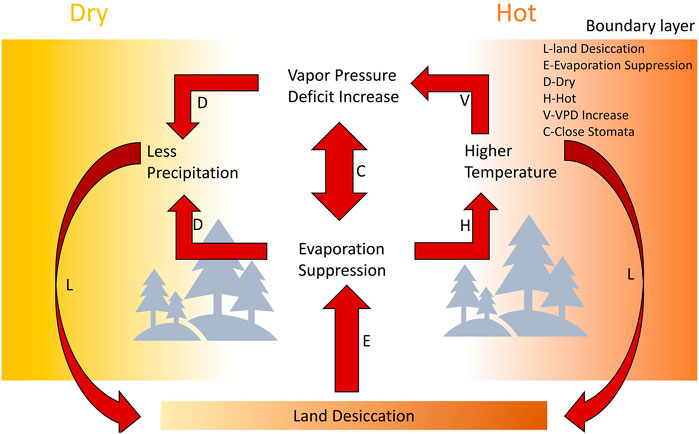
FIGURE 1. Physical mechanisms of compound hot-dry extremes and land-atmosphere interactions. The physical mechanisms are based on previous studies on compound hot-dry extremes (e.g., Mazdiyasni and AghaKouchak, 2015; Massmann et al., 2019; Miralles et al., 2019; Schumacher et al., 2019; Tavakol et al., 2020a).
Compound Heat and Wet Extremes
Compared with compound hot and dry extremes, compound heat and wet extremes are less explored in the literature (Figure 2). This type of extreme is manifested by flooding and heat wave (Soneja et al., 2016; Wang S. S.-Y. et al., 2019; Imada et al., 2019; Zhang and Villarini, 2020; Chen et al., 2021) and heat wave and humid events (Fischer and Knutti, 2013; Li et al., 2020; Poppick and McKinnon, 2020; Yuan et al., 2020). We will elaborate on these compound extremes in the following discussion.

FIGURE 2. Schematic of compound hydrometeorological extremes: (A) heat-wet (Soneja et al., 2016; Wang S. S.-Y. et al., 2019; Imada et al., 2019; Zhang and Villarini, 2020; Chen et al., 2021), (B) heat-humid extremes (Fischer and Knutti, 2013; Li et al., 2020; Poppick and McKinnon, 2020; Yuan et al., 2020), (C) cold-wet (Bisci et al., 2012; Hao et al., 2018; Hochman et al., 2019; De Luca et al., 2020) and (D) cold-dry (Dabhi et al., 2018; Wu Y. et al., 2021; Potopová et al., 2021). The Clausius-Clapeyron scaling represents the water holding capacity of the atmosphere corresponding to air temperature changes (Held and Soden, 2006).
Flooding/Precipitation and Heat Wave/Stress
This type of compound can be classified into temporal compounding (e.g., occur sequentially) (Raymond et al., 2020a; Zscheischler et al., 2020a). The compound flooding and heat waves are featured by heat waves followed by floods or vice versa. The understanding of this compound extreme is still limited and previous research has mainly focused on case studies. No theories have been proposed to formulate these compounds. There are compound summer heat and precipitation extremes reported over central Europe (Beniston, 2009; Sedlmeier et al., 2018), Spain (Morán-Tejeda et al., 2013) and China (Hao et al., 2013; Wu S. et al., 2021; Wang P. et al., 2021). Moreover, floods that follow heat waves have been identified across the central United States (Zhang and Villarini, 2020), and this compound is manifested by the fact that heat stress may set the stage for extreme precipitation and flooding due to increasing sensible heat flux and moisture convergence under extreme heat stress. Similarly, the floods followed by elevated heat have also been identified across China during 1961–2018, exhibiting an increasing trend (Chen et al., 2021). Western Japan experienced catastrophic floods followed by a record-breaking heatwave during early July 2018 (Wang S. S.-Y. et al., 2019; Imada et al., 2019) and this catastrophic compound event caused an estimated 10 billion USD in damage. Based on climate projections, this type of compound will be more frequent under global warming (Wang S. S.-Y. et al., 2019). Currently, the compound flooding and heat waves are still under investigation, and furtherunderstanding of their drivers and mechanisms is required in the near future.
Heat Wave and Humid Event
The combined humidity and temperature extremes have been discussed in the literature and identified by climate models and observations (Fischer and Knutti, 2013) and the joint behavior of temperature and humidity extremes arises from the Clausius-Clapeyron (C-C) relationship. Overall, surface humidity increases as temperatures increase over open water bodies. However, this relationship may not hold over land due to the lack of soil moisture (Fischer and Knutti, 2013). Many factors may influence the risk of such humid heat extremes, including irrigation (Lobell et al., 2008; Krakauer et al., 2020), external forcing that contains both natural (e.g., volcanic eruption) and anthropogenic (e.g., greenhouse gases) sources (Fischer and Knutti, 2013; Russo et al., 2017; Lutsko, 2021), and urbanization (Oleson et al., 2015; Luo and Lau, 2018; Wang Y. et al., 2019).
While the heat and humid events have been projected to increase under global warming (Russo et al., 2017; Byrne and O’Gorman, 2018; Chen X. et al., 2019; Tavakol and Rahmani, 2019b; Wang P. et al., 2021), the combination of heat and relative humidity in the future is still uncertain (Byrne and O’Gorman, 2018). We commonly use wet bulb temperature or apparent temperature to quantify the compound heat-humid events (Russo et al., 2017), although the wet bulb temperature exhibits nonlinear relationship between temperature and relative humidity which is magnified by an increase in temperature (Coffel et al., 2019).
Compound Cold-Dry and Cold-Wet Extremes
Cold-wet compound extreme events have been reported over the Mediterranean (Bisci et al., 2012; Hao et al., 2018; Hochman et al., 2019; De Luca et al., 2020). The wintertime cold-wet compound events are commonly associated with snowfall and cold frontal systems. For example, the polar air outbreak associated with a cold front tends to cause heavy snowfall and rainfall. In contrast, compound cold-dry events have been found in China (Miao et al., 2016; Zhou and Liu, 2018), Europe (Potopová et al., 2021) and the globe (Dabhi et al., 2018; Wu Y. et al., 2021). Compound cold/dry and cold/wet extremes have decreased over the vast majority of the world, and are projected to be less frequent using CMIP6 model projection (Wu Y. et al., 2021).
Compound Flooding
Rising attention has been paid to compound flooding that arises from storm surge and rainfall (Wahl et al., 2015; Moftakhari et al., 2017a; Paprotny et al., 2018; Bevacqua et al., 2019; Marsooli et al., 2019; Bevacqua et al., 2020; Couasnon et al., 2020; Gori et al., 2020a, 2020b). Compound flooding includes storm surge and high rainfall, storm surge and mean sea level rise, storm surge and riverine flooding, and coastal and riverine flooding. Tropical cyclones, atmospheric rivers and extratropical cyclones play a central role in causing the compound flooding (Wahl et al., 2015; Gori et al., 2020a, 2020b) because these storms associated with strong wind are responsible for storm surge and heavy precipitation (Khouakhi and Villarini 2016a; Khouakhi et al., 2017; Rios Gaona et al., 2018; Zhang et al., 2018, 2019a; 2021) in the coastal regions (Figure 3). Tropical cyclones have been projected to intensify under climate change, thereby probably leading to higher storm surge (Knutson et al., 2010, 2015; Bhatia et al., 2019). Meanwhile, rainfall caused by tropical cyclones has also been projected to increase in the future (Knutson et al., 2010; Wright et al., 2015; Scoccimarro et al., 2017; Liu et al., 2018). The changes in the intensity of tropical cyclones in concert with the increase in rainfall suggest a higher future risk of compound extremes caused by storms.
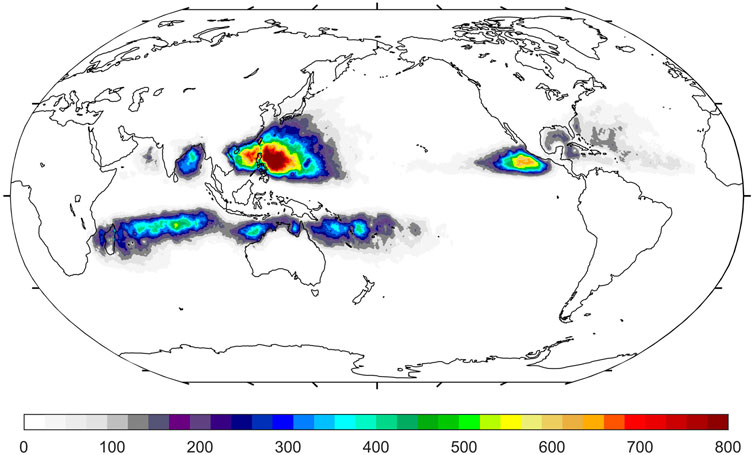
FIGURE 3. Annual average tropical cyclone precipitation (unit: mm/year) in observations based on the International Best Track Archive for Climate Stewardship (IBTrACS; Knapp et al., 2010) dataset and the Multi-Source Weighted-Ensemble Precipitation Version 2 (MSWEP v2, Beck et al., 2017a; 2017b) precipitation data.
Storm Surge and Heavy Rainfall
Storm surge is defined as a rise in sea level during tropical/extratropical cyclones due to strong winds that force the sea water on shore (Lin and Chavas, 2012; Waliser and Guan, 2017; Veatch and Villarini, 2020), leading to coastal flooding (Khouakhi and Villarini, 2016b; Garner et al., 2017; Herdman et al., 2018; Xu et al., 2019). When storm surge is accompanied by heavy rainfall associated with tropical cyclones, the resulting damages would be exacerbated. Strong dependence has been found between extreme rainfall and storm surge in coastal regions (Zheng et al., 2013; Mohanty et al., 2020). Overall, the compound storm surge and heavy rainfall events are associated with tropical cyclones, atmospheric rivers (Lin et al., 2010a), medicanes (Amores et al., 2020; Davolio et al., 2020; Zhang et al., 2020), and extreme extratropical cyclones (Danard et al., 2004; Colle et al., 2015; Mäll et al., 2017; Lin et al., 2019).
This type of compound has also been reported in many parts of the world including the Netherlands (van den Hurk et al., 2015; Ridder et al., 2018), in coastal and estuarine regions of Australia (Wu et al., 2018), Morocco (Zellou and Rahali, 2019), the United States (Lin et al., 2010b; Gori et al., 2020a), China (Xu et al., 2018; Fang et al., 2021), Britain (Svensson and Jones, 2002, 2004), and Europe in general (Bevacqua et al., 2019). In particular, the catastrophic impacts of the compound storm surge and heavy precipitation are marked in urban watershed (Joyce et al., 2018).
The risk of compound flooding resulting from storm surge and heavy rainfall has been increasing in major coastal cities of the United States (Wahl et al., 2015). The risk of compound storm surge and heavy rainfall is projected to increase in the future (Karim and Mimura, 2008; Bevacqua et al., 2019; Bates et al., 2020; Hsiao et al., 2021). However, there are still large uncertainties in quantifying changes in the risk of compound flooding due to the insufficient skill of climate models in simulating extreme precipitation caused by storms (Zhang et al., 2019a; Roberts et al., 2020; Vannière et al., 2020). Alternatively, previous efforts have been made to develop parametric tropical cyclone rainfall models (Marks and DeMaria, 2003; Lonfat et al., 2007; Langousis and Veneziano, 2009; Zhu et al., 2013; Emanuel, 2017; Brackins and Kalyanapu, 2020; Xi et al., 2020). The parametric tropical cyclone rainfall models are listed in Table 2, including R-CLIPER (Marks and DeMaria, 2003; Tuleya et al., 2007), IPET (IPET 2006), PHRaM (Lonfat et al., 2007), MSR (Langousis and Veneziano, 2009), RMS (Grieser and Jewson, 2012) and TCRM (Zhu et al., 2013; Emanuel, 2017; Xi et al., 2020). The parametric models are very useful to quantify the future risk of tropical cyclone rainfall and coastal flooding (Zheng et al., 2014; Geoghegan et al., 2018).

TABLE 2. Parametric models for tropical cyclone rainfall.
Storm surge caused by tropical/extratropical cyclones will be exacerbated by the rise of sea level, magnifying the coastal flood hazards (Little et al., 2015; Haigh et al., 2016; Muis et al., 2016; Vousdoukas et al., 2018; Marsooli et al., 2019). Indeed, sea level rise can greatly increase the risk of coastal flooding caused by storm surge (McInnes et al., 2003; Karim and Mimura, 2008; Hallegatte et al., 2011; Tebaldi et al., 2012; Zhang et al., 2013; Arns et al., 2015).
Storm Surge and Riverine Floods
While storm surge can be compounded with extreme rainfall, it is also dangerous when storm surge is in concert with riverine flooding. Many studies have analyzed the co-occurrence of storm surge and riverine/fluvial floods (Kew et al., 2013; Klerk et al., 2015; Khanal et al., 2019), including simulations using global coupled river-coast flood model (Ikeuchi et al., 2017). The effect of compound storm surge and riverine flooding has also been examined using remote sensing technologies in western coastal Louisiana (Ramsey et al., 2011), in a tidal river in Rhode Island (Teng et al., 2017), the Rhine–Meuse Delta (Klerk et al., 2015), the United Kingdom (Hendry et al., 2019), the Netherlands (Khanal et al., 2019), the USA (Dietrich et al., 2010; Couasnon et al., 2018) and Italy (Bevacqua et al., 2017). In addition to regional scale analysis of this compound extreme, some studies have examined the dependence of storm surge and extreme discharge at the global scale (Ward et al., 2018). The compound flooding is caused by the interactions between physical drivers from oceanographic, hydrological, and meteorological processes in coastal areas, leading to highly complex interplays (Couasnon et al., 2020). Overall, the compound flooding is based on their drivers, including storm surge, precipitation, and river discharges. While many compound flood events are associated with tropical cyclones, some are related to typical synoptic weather systems (Couasnon et al., 2020).
Statistical methods and coupled modeling have been used to quantify the compound storm surge and riverine flood (Dietrich et al., 2010). For example, a global river routing model forced by global hydrological models and bounded downstream by a global tide and surge model has been used to assess the effect of storm surge on riverine flood (Eilander et al., 2020). Hydrologic and hydrodynamic models are combined to assess compound flooding caused by the 2016 tropical storm Matthew (Zhang and Najafi, 2020). In addition, joint probabilities and copula have been widely used to examine the compounds (Czajkowski et al., 2013; Petroliagkis et al., 2016; Couasnon et al., 2018).
Sea Level Rise and Coastal Flooding
Sea level rise may reduce the gap between high tidal datum and flood stage, increasing the frequency of coastal flooding (Andersen and Shepherd, 2013; Kriebel and Geiman, 2014; Schindelegger et al., 2018). When riverine and coastal floods occur back-to-back, their impacts would be stronger than they happen in isolation (Ward et al., 2018, 2018). Overall, sea level rise can double the frequency of coastal flooding in the next few decades (Mousavi et al., 2011; Woodruff et al., 2013; Karegar et al., 2017; Vitousek et al., 2017). For example, due to sea level rise, there is increased coastal flooding in California (Heberger et al., 2011; Garcia and Loáiciga, 2014), Mekong Delta (Takagi et al., 2015), Italian coastal plains (Rinaldo et al., 2008; Antonioli et al., 2017), Mediterranean (Reimann et al., 2018), the US East Coast (Ezer and Atkinson, 2014; Dahl et al., 2017), Miami Beach, Florida (Wdowinski et al., 2016), Latin America (Reguero et al., 2015), China (Fang et al., 2016). Sea level rise is found to be compounded with fluvial flooding using a bivariate flood hazard assessment (Moftakhari et al., 2017a). Sea level rise can influence cyclonic storm surge floods in Bangladesh (Karim and Mimura, 2008). Future sea level rise can not only increase the probability of infrastructure failure, but it can also increase the compounding flood drivers (Moftakhari et al., 2017a). Climate change will increase the potential to cause higher frequency and magnitude of coastal flooding due to hurricane intensification and sea level rise (Figure 4) (Mousavi et al., 2011).
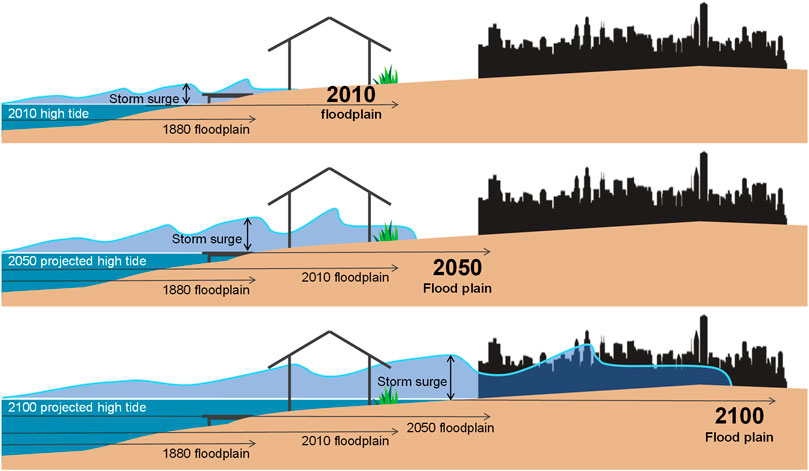
FIGURE 4. Schematic illustrating the risk of coastal flooding under the present and future climates (Andersen and Shepherd, 2013; Kriebel and Geiman, 2014; Moftakhari et al., 2017a; Schindelegger et al., 2018).
Coastal and Riverine Floods
Riverine and coastal floods characterized by the simultaneous or successive occurrence of high sea levels and high river flows can be life threatening and cause infrastructures damage (Nadal et al., 2010; Ganguli et al., 2020; Khanam et al., 2021). This type of flooding was remarkable during hurricane Harvey in Houston-Galveston Bay (Valle-Levinson et al., 2020; Huang et al., 2021b). For example, around 600 million people in coastal regions may be exposed to this type of compound flood by 2,100 (Kulp and Strauss, 2019). Over the years, the location in a river system where riverine and coastal flood drivers can contribute to the water level has been defined as the transition zone (Bilskie and Hagen, 2018). For example, the 2016 Louisiana flood was caused by excessive rainfall and coastal floods (Wang et al., 2016).
Numerical Modeling
Climate models have been used to quantify compound extremes and their distributions (Sherwood, 2018; Raymond et al., 2020b; Xu et al., 2021; Yuan et al., 2020). Given the five types of compound extremes (Table 1), it is still quite challenging to represent the extremes in numerical models (Table 3). Due to the key role of land-atmosphere feedbacks in shaping the compound dry-hot events, fully-coupled models are desirable for performing simulations (Fischer et al., 2007; Stéfanon et al., 2014; Keune et al., 2016; Sillmann et al., 2017). Current numerical models have been used to simulate the compound extremes, including large eddy simulators (Cioni and Hohenegger, 2017), column models (Van Heerwaarden et al., 2010; Miralles et al., 2014), regional climate models and global climate models (Vautard et al., 2013; Chung et al., 2014; Stegehuis et al., 2015). While regional climate models are extremely useful in resolving land conditions (Fischer et al., 2007; Stéfanon et al., 2014; Keune et al., 2016; Sillmann et al., 2017), global climate models are commonly used to assess changes in land conditions on extreme weather (e.g., drought and heat wave) (Hauser et al., 2016; Kala et al., 2016; Rasmijn et al., 2018). The models in the Coupled Model Intercomparison Project Phase 6 (CMIP6) exhibit some skill in simulating the co-occurrence of hot and dry compound events in North America and Europe (Ridder et al., 2021). Because the numerical models’ outputs are limited by the climatological biases, univariate and multivariate bias correction methods have been used to correct the biases, and thus improving the performance and usability of the models (Maraun, 2016; Vezzoli et al., 2017; Vrac, 2018; Zscheischler et al., 2018; François et al., 2020). While univariate bias correction operates well in a single variable, multivariate bias correction methods aim to reduce biases that depend on multiple variables, which is an important feature of compound extreme events. Climate model evaluation is usually univariate without considering the multivariate nature of multiple hazards, it is thus important to evaluate the biases in the dependence between the contributing variables in climate models (Vezzoli et al., 2017). However, rare studies have evaluated the climate model multivariate representation of hazard indicators (Bevacqua et al., 2019; Villalobos-Herrera et al., 2021; Zscheischler et al., 2021).
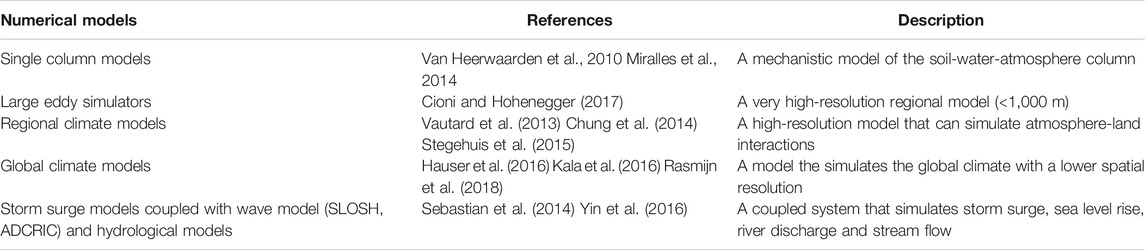
TABLE 3. Numerical models for studying compound extremes.
Regional climate models also take initial and boundary conditions from the output of global climate models and can resolve small-scale processes, thereby perform well in simulating single events simulations (Fischer et al., 2007; Stéfanon et al., 2014; Keune et al., 2016; Sillmann et al., 2017). Therefore, regional climate models depend heavily on the simulation of global climate models, which are commonly used to simulate a longer simulation (e.g., years or decades) with a coarser spatial resolution (∼1–2°) (Orlowsky and Seneviratne, 2013; Cook et al., 2020; Ridder et al., 2020, 2021; Ukkola et al., 2020; Vogel et al., 2020; Su et al., 2021).
Numerical models have also been used to study compound flooding. Ideally, an earth system model that resolves tropical cyclones, waves, ocean circulation, and hydrological cycle can simulate all the processes and interactions at play (Flato, 2011). However, the current generation of earth system models cannot resolve or simplify the processes responsible for the compound flooding (Meehl et al., 2020). To quantify the impacts of sea level rise on storm surge, previous studies have used three methods: numerical simulation of storm surge with sea level rise using the Sea, Lake, and Overland Surges from Hurricanes (SLOSH) model (Glahn et al., 2009) or the Advanced Circulation (ADCIRC) model (Sebastian et al., 2014; Yin et al., 2016), the simple linear addition method (Kleinosky et al., 2007; Frazier et al., 2010) and Linear addition by expansion method (McInnes et al., 2013). The storm surge model and hydrological model are forced with high-resolution climate model outputs for analyzing the joint occurrence of coastal water levels and river peaks (Ganguli et al., 2020).
Statistical Modeling
Statistical models and observations have been used to investigate compound hydrological extremes. For example, a theoretical framework has been developed to examine compound extremes (Leonard et al., 2014). Recently, much attention has been paid to understand the dependence between multiple relevant variables associated with compound extremes, particularly from a statistical perspective. Overall, the statistical methods employed across the literature consist of empirical approach, event coincidence analysis (ECA), multivariate distribution, the indicator approach, quantile regression and the Markov Chain method (Table 4) (Hao et al., 2018).
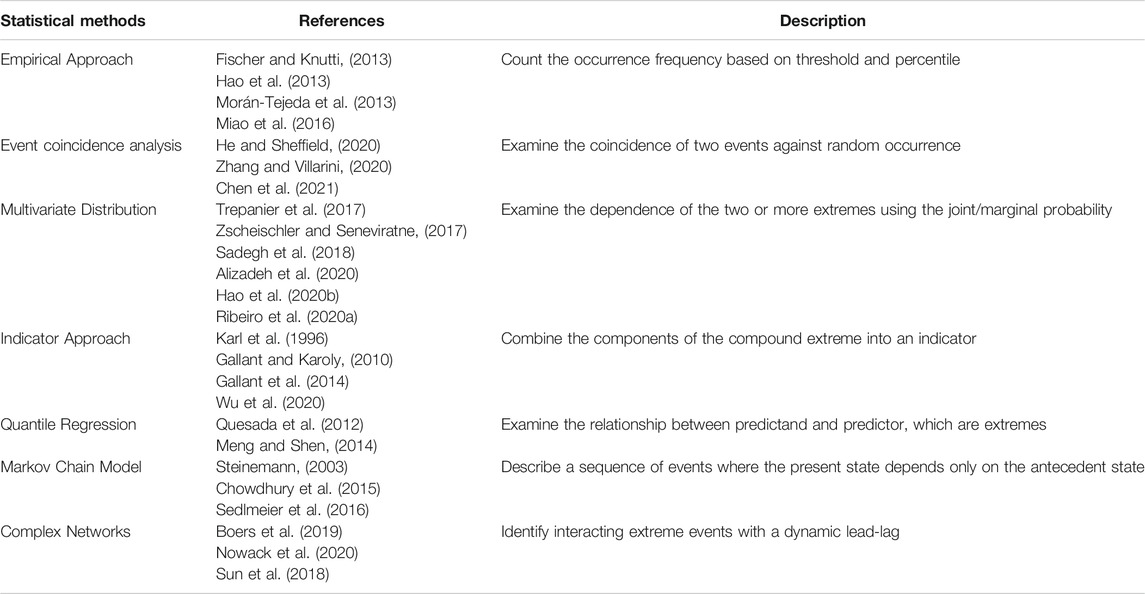
TABLE 4. Statistical methods for studying compound extremes.
Empirical Approach
The empirical approach is performed by counting the simultaneous or sequential frequency/occurrence of the extremes based on the definition (e.g., maxima, threshold or percentile). This approach has been used to examine the compound temperature and precipitation extremes (Fischer and Knutti, 2013; Hao et al., 2013; Morán-Tejeda et al., 2013; Miao et al., 2016, 1961–2011), air pollution and temperature extremes (Schnell and Prather, 2017), storm surge and rainfall (Wahl et al., 2015). Based on the frequency/occurrence of the compound events, the trend and change point of the time series has been commonly examined to identify temporal change patterns (Dabhi et al., 2021; Feng and Hao, 2020).
Event Coincidence Analysis
Event coincidence analysis (e.g., events synchronization) has been used to formulate and test null hypotheses on the origin of the observed relationship (Donges et al., 2016). In the analysis of temporal compound extremes (e.g., floods that follow heat stress) (Zscheischler et al., 2020a), it is important to test the null hypothesis that whether this lagged association between floods and heat stress is randomly distributed (Zhang and Villarini, 2020). This method has been used to quantify the lagged compound droughts and pluvial floods (He and Sheffield, 2020), the association between precipitation and soil moisture extremes (Sun et al., 2018), and flood-heatwave events (Chen et al., 2021).
Multivariate Distribution
As discussed before, an essential element of the compound extreme is the dependence between different drivers (Leonard et al., 2014). In order to quantify the dependence, multivariable distribution has been widely used in applications (Trepanier et al., 2017; Zscheischler and Seneviratne, 2017). The multivariate distribution has been employed to quantify the joint distribution of temperature and precipitation extremes (Hawkes, 2008; Tebaldi and Sansó, 2009; Rodrigo, 2015; Zscheischler and Seneviratne, 2017). Different ways have been proposed to construct the multivariate distribution, including parametric distribution, copula, entropy, and nonparametric models.
Copula theory has been employed to characterize the bivariate and trivariate joint distribution and assess complex dependence structures, e.g., in the case of upper tail dependence (Bevacqua et al., 2017; Ribeiro et al., 2020b; Tavakol et al., 2020b).
The copula models can be used to calculate the joint probability and/or bivariate return periods of compound extremes, thereby quantifying their risk (Sadegh et al., 2018; Alizadeh et al., 2020; Ribeiro et al., 2020a; Hao et al., 2020b). In addition, the copula theory has also been used in multivariate bias correction methods to adjust dependencies among variables in climate models’ output (Vezzoli et al., 2017).
The multivariate distribution approach can also quantify the conditional association among different extremes. A common compound extreme (hot-dry event) is characterized by the dependence of high temperatures on precipitation deficit (Alizadeh et al., 2020; Hao et al., 2020b) due to land-atmospheric feedbacks. Different from previous methods in which the extremes were selected prior to analysis, some compound extremes may happen when not all components are defined as extreme. The conditional probability approach can solve this problem (Heffernan and Tawn, 2004; Zhang and Singh, 2007).
Indicator Approach
In defining compound extremes, it is extremely difficult to define a “threshold” for identifying extremes in a multivariate situation (Salvadori et al., 2013). The indicator approach develops an indicator based on the information of multiple variables by formulating a function F, which could be a linear combination or joint distribution of these variables.
Previous studies have developed such indicators for compound extremes (Karl et al., 1996; Gallant and Karoly, 2010; Gallant et al., 2014; Wu et al., 2020). Similar indicators have been developed to characterize drought and flood conditions (Kao and Govindaraju, 2010; Hao and AghaKouchak, 2013; Hao and Singh, 2015; Paprotny et al., 2018; Wang L. et al., 2019).
Quantile Regression, Markov chain Model and Complex Networks
The quantile regression enables the quantification of the relationship between the extremes of two variables (i.e., predictand and predictor). The quantile regression is therefore useful to study the compound extremes (e.g., drought and temperature extremes) (Quesada et al., 2012; Meng and Shen, 2014) and humidity and temperature extremes (Poppick and McKinnon, 2020; Huang et al., 2021), compound cool/dry and cool/wet events (Zhou and Liu, 2018). The Markov Chain model is another method to examine the connections between a sequence of extreme events. Previous works have used this method to examine the temporal change of drought (Steinemann, 2003) and heavy precipitation (Chowdhury et al., 2015; Sedlmeier et al., 2016). Complex networks are a powerful tool to unravel the connections between nodes of the network (Boers et al., 2019; Nowack et al., 2020). Complex networks are capable of driving the casual relationship between two or more variables (Sun et al., 2018). In addition, Bayesian network (Couasnon et al., 2018; Tilloy et al., 2019; Sanuy et al., 2020) and Artificial Neural Network (Kabir et al., 2020; Feng et al., 2021; Huang et al., 2021a) have been used to understand compound extremes (e.g., compound flooding).
Conclusion and Discussion
Compound hydrometeorological extremes (e.g., hot and drought compound) exert profound impacts on agriculture and water irrigation demand (Zampieri et al., 2017; Lu et al., 2018; Ribeiro et al., 2020b; Haqiqi et al., 2021; Vogel et al., 2021). For example, the compound drought and heatwave events may affect socio-ecological systems (Mukherjee et al., 2020), wildfires (Abatzoglou and Williams, 2016; AghaKouchak et al., 2020; Sutanto et al., 2020), air pollution (Tressol et al., 2008; Zhang H. et al., 2017; Wang et al., 2017; Lin et al., 2020), heat-related deaths (D’Ippoliti et al., 2010; Mitchell et al., 2016). Hot and dry weather conditions may lead to outbreaks of extreme fire due to low humidity and dry vegetation (AghaKouchak et al., 2020).
To mitigate and adapt to compound hydrometeorological extremes, we need to better understand the current state of the science of such extremes. Here, we have reviewed the current understanding of hydrometeorological extremes focusing on heat waves and drought (hot-dry events), heat stress and extreme precipitation (hot-wet events), compound flooding, dynamical models, and statistical methods.
Overall, there are two physical mechanisms used to explain compound hot and dry extreme in the literature. The first concept is that there are persistent atmospheric circulation patterns which are responsible for both drought and heat waves, and land-atmosphere feedbacks which are also responsible for the compound heat waves and droughts. Compared with compound hot and dry extremes, compound hot and wet extremes are less visited in the literature with case studies. We have summarized compound flooding events that include storm surge and high rainfall, storm surge and sea level rise, storm surge and riverine flooding, and coastal and riverine flooding. Looking ahead, there is a rising risk of compound flooding in the future because of changes in sea level rise, storm intensity and precipitation, land-use-land-cover change in the future (Slater et al., 2021).
In terms of methods, numerical modeling and statistical methods have been used to investigate compound extremes. Overall, climate models alone or coupled with land models, hydrological models, hydrodynamic models and wave models are common tools to investigate compound floods by complementing statistical modeling tools. Climate models still lack skill in simulating dynamical compound extremes, although they perform well in simulating some thermodynamic aspects. Overall, the statistical methods consist of empirical approaches, event coincidence analysis, multivariate distributions, the indicator approach, quantile regression and the Markov Chain method. These methods have greatly advanced our understanding of such extremes, providing a quantification of risk associated with the extremes. Over the decades, machine learning algorithms have advanced many research fields in recent years including climate science. However, while machine learning research has been used to examine individual extreme events (e.g. Grazzini et al., 2019; Bruneau et al., 2020; Chattopadhyay et al., 2020), work on compound extremes is still in its infancy. At the time of writing this article, there were hardly any published studies harnessing machine learning or deep learning to better understand compound hydrometeorological extremes. Therefore, machine learning and its recent algorithmic advances can provide an opportunity and a promising avenue to improve our understanding of compound extreme events.
It would be extremely valuable to build prediction systems for compound hydrometeorological extremes. Indeed, a statistical prediction system has been built to predict compound hot-dry extremes (Hao et al., 2019). Building a statistical prediction model for compound extremes requires the identification of predictors and the evaluation of the predictability of the predictors, which are still challenging tasks (Sillmann et al., 2017). Hybrid statistical-dynamical prediction systems which combine statistical modelling with outputs from dynamical climate models would be promising for predicting compound extremes. Specifically, hybrid statistical-dynamical prediction systems train the relationship between predictors and predictands based on statistical modeling and make predictions based on predictors based on dynamical models. Indeed, several hybrid prediction systems have been developed for individual extremes such as tropical cyclones in the western North Pacific and North Atlantic (Murakami et al., 2016; Zhang W. et al., 2017) and more recently for flood prediction in the USA (Slater and Villarini, 2018). Future research may use Subseasonal to Seasonal (S2S) forecasts such as the products of the North American Multi-Model Ensemble (NMME) or the C3S system of the European Centre for Medium-Range Weather Forecasts (ECMWF) and Copernicus to develop an enhanced prediction of compound extremes.
Given the strong impacts of compound extremes on society, the bottom-up approach is used to examine the compound extremes (Culley et al., 2016; Zscheischler et al., 2018), by identifying the drivers and/or hazards that lead to large impacts. This approach usually begins with a strong impact (e.g., disaster), followed by identifying underlying factors, processes or phenomena shaping the outcome. This includes identifying which factors lead to large impacts. This bottom-up approach has been widely used to study compound weather and climate events. While the bottom-up approach is relevant, the perspective of the present study lies in the physical hazards associated with compound events.
Finally, we have identified several future research directions for compound hydrometeorological extremes, including:
• projecting the risk of compound extremes for different levels of future warming (Zscheischler et al., 2018; Wang et al., 2020);
• evaluating the impacts of the compound extremes on natural and built environments (AghaKouchak et al., 2020; Zhang and Najafi, 2020);
• developing adaptation measures to the changing risk of compound extremes (Weber et al., 2020; Clarke et al., 2021);
• enhancing subseasonal-to-seasonal prediction of these extremes (Zamora et al., 2021; Zou, 2021);
• improving the representation and evaluation of compound extremes in fully-coupled climate models (Ridder et al., 2021; Zscheischler et al., 2021) and developing multivariate bias correction for these models (Vezzoli et al., 2017; Zscheischler et al., 2019);
• applying machine learning to understand these extremes (Wang L. et al., 2021; Zou, 2021).
Author Contributions
WZ, SG, and ML designed the research. All the authors contribute to writing and reviewing the manuscript.
Funding
This study was jointly supported by the National Key R&D Program of China (2019YFC1510400), the National Natural Science Foundation of China (41871029), and the Science and Technology Program of Guangzhou (202102020489). The appointment of ML at Sun Yat-sen University is partially supported by the Pearl River Talent Recruitment Program of Guangdong Province, China (2017GC010634). WZ is supported by USDA NIFA Hatch Project (1026229), the UAES Seed Grant and the startup fund of Utah State University.
Conflict of Interest
The authors declare that the research was conducted in the absence of any commercial or financial relationships that could be construed as a potential conflict of interest.
Publisher’s Note
All claims expressed in this article are solely those of the authors and do not necessarily represent those of their affiliated organizations, or those of the publisher, the editors and the reviewers. Any product that may be evaluated in this article, or claim that may be made by its manufacturer, is not guaranteed or endorsed by the publisher.
References
Abatzoglou, J. T., and Williams, A. P. (2016). Impact of Anthropogenic Climate Change on Wildfire across Western US Forests. Proc. Natl. Acad. Sci. USA 113, 11770–11775. doi:10.1073/pnas.1607171113
AghaKouchak, A., Chiang, F., Huning, L. S., Love, C. A., Mallakpour, I., Mazdiyasni, O., et al. (2020). Climate Extremes and Compound Hazards in a Warming World. Annu. Rev. Earth Planet. Sci. 48, 519–548. doi:10.1146/annurev-earth-071719-055228
AghaKouchak, A., Huning, L. S., Chiang, F., Sadegh, M., Vahedifard, F., Mazdiyasni, O., et al. (2018). How Do Natural Hazards Cascade to Cause Disasters. 561, 458–460.
Alizadeh, M. R., Adamowski, J., Nikoo, M. R., AghaKouchak, A., Dennison, P., and Sadegh, M. (2020). A century of Observations Reveals Increasing Likelihood of continental-scale Compound Dry-Hot Extremes. Sci. Adv. 6. eaaz4571. doi:10.1126/sciadv.aaz4571
Amores, A., Marcos, M., Carrió, D. S., and Gómez-Pujol, L. (2020). Coastal Impacts of Storm Gloria (January 2020) over the north-western Mediterranean. Nat. Hazards Earth Syst. Sci. 20, 1955–1968. doi:10.5194/nhess-20-1955-2020
Andersen, T. K., and Marshall Shepherd, J. (2013). Floods in a Changing Climate. Geogr. Compass 7, 95–115. doi:10.1111/gec3.12025
Antonioli, F., Anzidei, M., Amorosi, A., Lo Presti, V., Mastronuzzi, G., Deiana, G., et al. (2017). Sea-level Rise and Potential Drowning of the Italian Coastal plains: Flooding Risk Scenarios for 2100. Quat. Sci. Rev. 158, 29–43. doi:10.1016/j.quascirev.2016.12.021
Arns, A., Wahl, T., Dangendorf, S., and Jensen, J. (2015). The Impact of Sea Level Rise on Storm Surge Water Levels in the Northern Part of the German Bight. Coastal Eng. 96, 118–131. doi:10.1016/j.coastaleng.2014.12.002
Bates, P. D., Quinn, N., Sampson, C., Smith, A., Wing, O., Sosa, J., et al. (2020).Combined Modelling of US Fluvial, Pluvial and Coastal Flood hazard under Current and Future Climates. Water Resources Research, e2020WR028673.
Beck, H. E., Van Dijk, A. I. J. M., Levizzani, V., Schellekens, J., Miralles, D. G., Martens, B., et al. (2017a). MSWEP: 3-hourly 0.25° Global Gridded Precipitation (1979-2015) by Merging Gauge, Satellite, and Reanalysis Data. Hydrol. Earth Syst. Sci. 21, 589–615. doi:10.5194/hess-21-589-2017
Beck, H. E., Vergopolan, N., Pan, M., Levizzani, V., van Dijk, A. I. J. M., Weedon, G. P., et al. (2017b). Global-scale Evaluation of 22 Precipitation Datasets Using Gauge Observations and Hydrological Modeling. Hydrol. Earth Syst. Sci. 21, 6201–6217. doi:10.5194/hess-21-6201-2017
Beniston, M. (2009). Trends in Joint Quantiles of Temperature and Precipitation in Europe since 1901 and Projected for 2100. Geophys. Res. Lett. 36, L07707. doi:10.1029/2008gl037119
Betts, A. K., Ball, J. H., Beljaars, A. C. M., Miller, M. J., and Viterbo, P. A. (1996). The Land Surface-Atmosphere Interaction: A Review Based on Observational and Global Modeling Perspectives. J. Geophys. Res. 101, 7209–7225. doi:10.1029/95jd02135
Bevacqua, E., Maraun, D., Vousdoukas, M. I., Voukouvalas, E., Vrac, M., Mentaschi, L., et al. (2019). Higher Probability of Compound Flooding from Precipitation and Storm Surge in Europe under Anthropogenic Climate Change. Sci. Adv. 5, eaaw5531. doi:10.1126/sciadv.aaw5531
Bevacqua, E., Vousdoukas, M. I., Zappa, G., Hodges, K., Shepherd, T. G., Maraun, D., et al. (2020). More Meteorological Events that Drive Compound Coastal Flooding Are Projected under Climate Change. Commun. Earth Environ. 1, 47–11. doi:10.1038/s43247-020-00044-z
Bevacqua, E., Maraun, D., Hobæk Haff, I., Widmann, M., and Vrac, M. (2017). Multivariate Statistical Modelling of Compound Events via Pair-Copula Constructions: Analysis of Floods in Ravenna (Italy). Hydrol. Earth Syst. Sci. 21, 2701–2723. doi:10.5194/hess-21-2701-2017
Bhatia, K. T., Vecchi, G. A., Knutson, T. R., Murakami, H., Kossin, J., Dixon, K. W., et al. (2019). Recent Increases in Tropical Cyclone Intensification Rates. Nat. Commun. 10, 635. doi:10.1038/s41467-019-08471-z
Bilskie, M. V., and Hagen, S. C. (2018). Defining Flood Zone Transitions in Low‐Gradient Coastal Regions. Geophys. Res. Lett. 45, 2761–2770. doi:10.1002/2018gl077524
Bisci, C., Fazzini, M., Beltrando, G., Cardillo, A., and Romeo, V. (2012). The February 2012 Exceptional Snowfall along the Adriatic Side of Central Italy. metz 21, 503–508. doi:10.1127/0941-2948/2012/0536
Boers, N., Goswami, B., Rheinwalt, A., Bookhagen, B., Hoskins, B., and Kurths, J. (2019). Complex Networks Reveal Global Pattern of Extreme-Rainfall Teleconnections. Nature 566, 373–377. doi:10.1038/s41586-018-0872-x
Brackins, J. T., and Kalyanapu, A. J. (2020). Evaluation of Parametric Precipitation Models in Reproducing Tropical Cyclone Rainfall Patterns. J. Hydrol. 580, 124255. doi:10.1016/j.jhydrol.2019.124255
Bruneau, N., Polton, J., Williams, J., and Holt, J. (2020). Estimation of Global Coastal Sea Level Extremes Using Neural Networks. Environ. Res. Lett. 15 (7). doi:10.1088/1748-9326/ab89d6
Byrne, M. P., and O’Gorman, P. A. (2018). Trends in continental Temperature and Humidity Directly Linked to Ocean Warming. Proc. Natl. Acad. Sci. USA 115, 4863–4868. doi:10.1073/pnas.1722312115
Chang, F.-C., and Wallace, J. M. (1987). Meteorological Conditions during Heat Waves and Droughts in the United States Great Plains. Mon. Wea. Rev. 115, 1253–1269. doi:10.1175/1520-0493(1987)115<1253:mcdhwa>2.0.co;2
Chattopadhyay, A., Nabizadeh, E., and Hassanzadeh, P. (2020). Analog Forecasting of Extreme-Causing Weather Patterns Using Deep Learning. J. Adv. Model. Earth Syst. 12, e2019MS001958. doi:10.1029/2019MS001958
Chen, L., Chen, X., Cheng, L., Zhou, P., and Liu, Z. (2019a). Compound Hot Droughts over China: Identification, Risk Patterns and Variations. Atmos. Res. 227, 210–219. doi:10.1016/j.atmosres.2019.05.009
Chen, X., Li, N., Liu, J., Zhang, Z., and Liu, Y. (2019b). Global Heat Wave hazard Considering Humidity Effects during the 21st century. Ijerph 16, 1513. doi:10.3390/ijerph16091513
Chen, Y., Liao, Z., Shi, Y., Tian, Y., and Zhai, P. (2021). Detectable Increases in Sequential Flood‐heatwave Events across China during 1961‐2018. Geophys. Res. Lett. 48, e2021GL092549. doi:10.1029/2021gl092549
Chowdhury, Afmk., Lockart, N., Willgoose, G., Kuczera, G., Kiem, A. S., and Manage, N. P. (2015). Modelling Daily Rainfall along the East Coast of Australia Using a Compound Distribution Markov Chain Model. In 36th Hydrology and Water Resources Symposium: The art and science of water. Hobart, Australia: Engineers Australia, 625.
Chung, U., Gbegbelegbe, S., Shiferaw, B., Robertson, R., Yun, J. I., Tesfaye, K., et al. (2014). Modeling the Effect of a Heat Wave on maize Production in the USA and its Implications on Food Security in the Developing World. Weather Clim. Extremes 5-6, 67–77. doi:10.1016/j.wace.2014.07.002
Ciais, P., Reichstein, M., Viovy, N., Granier, A., Ogée, J., Allard, V., et al. (2005). Europe-wide Reduction in Primary Productivity Caused by the Heat and Drought in 2003. Nature 437, 529–533. doi:10.1038/nature03972
Cioni, G., and Hohenegger, C. (2017). Effect of Soil Moisture on Diurnal Convection and Precipitation in Large-Eddy Simulations. J. Hydrometeorology 18, 1885–1903. doi:10.1175/jhm-d-16-0241.1
Clarke, B. J., E. L. Otto, F. F., and Jones, R. G. (2021). Inventories of Extreme Weather Events and Impacts: Implications for Loss and Damage from and Adaptation to Climate Extremes. Clim. Risk Manag. 32, 100285. doi:10.1016/j.crm.2021.100285
Coffel, E. D., Horton, R. M., Winter, J. M., and Mankin, J. S. (2019). Nonlinear Increases in Extreme Temperatures Paradoxically Dampen Increases in Extreme Humid-Heat. Environ. Res. Lett. 14, 084003. doi:10.1088/1748-9326/ab28b7
Colle, B. A., Booth, J. F., and Chang, E. K. M. (2015). A Review of Historical and Future Changes of Extratropical Cyclones and Associated Impacts along the US East Coast. Curr. Clim. Change Rep. 1, 125–143. doi:10.1007/s40641-015-0013-7
Cook, B. I., Mankin, J. S., Marvel, K., Williams, A. P., Smerdon, J. E., and Anchukaitis, K. J. (2020). Twenty‐first century Drought Projections in the CMIP6 Forcing Scenarios. Earth’s Future 8, e2019EF001461. doi:10.1029/2019ef001461
Couasnon, A., Eilander, D., Muis, S., Veldkamp, T. I. E., Haigh, I. D., Wahl, T., et al. (2020). Measuring Compound Flood Potential from River Discharge and Storm Surge Extremes at the Global Scale. Nat. Hazards Earth Syst. Sci. 20, 489–504. doi:10.5194/nhess-20-489-2020
Couasnon, A., Sebastian, A., and Morales-Nápoles, O. (2018). A Copula-Based Bayesian Network for Modeling Compound Flood hazard from Riverine and Coastal Interactions at the Catchment Scale: An Application to the houston Ship Channel. Tex. Water 10, 1190.
Cowan, T., Purich, A., Perkins, S., Pezza, A., Boschat, G., and Sadler, K. (2014). More Frequent, Longer, and Hotter Heat Waves for Australia in the Twenty-First century. J. Clim. 27, 5851–5871. doi:10.1175/jcli-d-14-00092.1
Culley, S., Noble, S., Yates, A., Timbs, M., Westra, S., Maier, H. R., et al. (2016). A Bottom-Up Approach to Identifying the Maximum Operational Adaptive Capacity of Water Resource Systems to a Changing Climate. Water Resour. Res. 52, 6751–6768. doi:10.1002/2015wr018253
Czajkowski, J., Kunreuther, H., and Michel-Kerjan, E. (2013). Quantifying Riverine and Storm-surge Flood Risk by Single-Family Residence: Application to Texas. Risk. Anal. 33, 2092–2110. doi:10.1111/risa.12068
Dabhi, H., Dubrovsky, M., and Rotach, M. (2018). Simulation of Extreme Events Using a Stochastic Weather Generator in View of its Ability to deal with Compound Events. 19857.
Dabhi, H., Rotach, M. W., Dubrovský, M., and Oberguggenberger, M. (2021). Evaluation of a Stochastic Weather Generator in Simulating Univariate and Multivariate Climate Extremes in Different Climate Zones across Europe. Meteorologische Z. 30, 127–151. doi:10.1127/metz/2020/1021
Dahl, K. A., Fitzpatrick, M. F., and Spanger-Siegfried, E. (2017). Sea Level Rise Drives Increased Tidal Flooding Frequency at Tide Gauges along the U.S. East and Gulf Coasts: Projections for 2030 and 2045. PloS one 12, e0170949. doi:10.1371/journal.pone.0170949
Danard, M. B., Dube, S. K., Gönnert, G., Munroe, A., Murty, T. S., Chittibabu, P., et al. (2004). Storm Surges from Extra-tropical Cyclones. Nat. Hazards 32, 177–190. doi:10.1023/b:nhaz.0000031312.98231.81
Davolio, S., Della Fera, S., Laviola, S., Miglietta, M. M., and Levizzani, V. (2020). Heavy Precipitation over Italy from the Mediterranean Storm “Vaia” in October 2018: Assessing the Role of an Atmospheric River. Monthly Weather Rev. 148, 3571–3588. doi:10.1175/mwr-d-20-0021.1
De Luca, P., Messori, G., Faranda, D., Ward, P. J., and Coumou, D. (2020). Compound Warm-Dry and Cold-Wet Events over the Mediterranean. Earth Syst. Dynam. 11, 793–805. doi:10.5194/esd-11-793-2020
Dickinson, R. E. (1995). Land-atmosphere Interaction. Rev. Geophys. 33, 917–922. doi:10.1029/95rg00284
Dietrich, J. C., Bunya, S., Westerink, J. J., Ebersole, B. A., Smith, J. M., Atkinson, J. H., et al. (2010). A High-Resolution Coupled Riverine Flow, Tide, Wind, Wind Wave, and Storm Surge Model for Southern Louisiana and Mississippi. Part II: Synoptic Description and Analysis of Hurricanes Katrina and Rita. Monthly Weather Rev. 138, 378–404. doi:10.1175/2009mwr2907.1
D’Ippoliti, D., Michelozzi, P., Marino, C., de’Donato, F., Menne, B., Katsouyanni, K., et al. (2010). The Impact of Heat Waves on Mortality in 9 European Cities: Results from the EuroHEAT Project. Environ. Health 9, 1–9.
Dong, L., Mitra, C., Greer, S., and Burt, E. (2018). The Dynamical Linkage of Atmospheric Blocking to Drought, Heatwave and Urban Heat Island in southeastern US: A Multi-Scale Case Study. Atmosphere 9, 33. doi:10.3390/atmos9010033
Donges, J. F., Schleussner, C.-F., Siegmund, J. F., and Donner, R. V. (2016). Event Coincidence Analysis for Quantifying Statistical Interrelationships between Event Time Series. Eur. Phys. J. Spec. Top. 225, 471–487. doi:10.1140/epjst/e2015-50233-y
Easterling, D. R., Meehl, G. A., Parmesan, C., Changnon, S. A., Karl, T. R., and Mearns, L. O. (2000). Climate Extremes: Observations, Modeling, and Impacts. Science 289, 2068–2074. doi:10.1126/science.289.5487.2068
Eilander, D., Couasnon, A., Ikeuchi, H., Muis, S., Yamazaki, D., Winsemius, H. C., et al. (2020). The Effect of Surge on Riverine Flood hazard and Impact in Deltas Globally. Environ. Res. Lett. 15, 104007. doi:10.1088/1748-9326/ab8ca6
Ek, M. B., and Holtslag, A. A. M. (2004). Influence of Soil Moisture on Boundary Layer Cloud Development. J. Hydrometeor 5, 86–99. doi:10.1175/1525-7541(2004)005<0086:iosmob>2.0.co;2
Eltahir, E. A. B. (1998). A Soil Moisture-Rainfall Feedback Mechanism: 1. Theory and Observations. Water Resour. Res. 34, 765–776. doi:10.1029/97wr03499
Emanuel, K. (2017). Assessing the Present and Future Probability of Hurricane Harvey's Rainfall. Proc. Natl. Acad. Sci. USA 114, 12681–12684. doi:10.1073/pnas.1716222114
Ezer, T., and Atkinson, L. P. (2014). Accelerated Flooding along the U.S. East Coast: On the Impact of Sea‐level Rise, Tides, Storms, the Gulf Stream, and the North Atlantic Oscillations. Earth's Future 2, 362–382. doi:10.1002/2014ef000252
Fang, J., Wahl, T., Fang, J., Sun, X., Kong, F., and Liu, M. (Forthcoming 2020). Compound Flood Potential from Storm Surge and Heavy Precipitation in Coastal China. Hydrol. Earth Syst. Sci. Discuss.
Fang, Y., Yin, J., and Wu, B. (2016). Flooding Risk Assessment of Coastal Tourist Attractions Affected by Sea Level Rise and Storm Surge: a Case Study in Zhejiang Province, China. Nat. Hazards 84, 611–624. doi:10.1007/s11069-016-2444-4
Feng, S., and Hao, Z. (2020). Quantifying Likelihoods of Extreme Occurrences Causing maize Yield Reduction at the Global Scale. Sci. Total Environ. 704, 135250. doi:10.1016/j.scitotenv.2019.135250
Feng, S., Wu, X., Hao, Z., Hao, Y., Zhang, X., and Hao, F. (2020). A Database for Characteristics and Variations of Global Compound Dry and Hot Events. Weather Clim. Extremes 30, 100299. doi:10.1016/j.wace.2020.100299
Feng, Y., Maulik, R., Wang, J., Balaprakash, P., Huang, W., Rao, V., et al. (2021). Characterization of Extremes and Compound Impacts: Applications of Machine Learning and Interpretable Neural Networks. AI4ESP. doi:10.2172/1769686
Fischer, E. M., and Knutti, R. (2013). Robust Projections of Combined Humidity and Temperature Extremes. Nat. Clim Change 3, 126–130. doi:10.1038/nclimate1682
Fischer, E. M., Seneviratne, S. I., Vidale, P. L., Lüthi, D., and Schär, C. (2007). Soil Moisture-Atmosphere Interactions during the 2003 European Summer Heat Wave. J. Clim. 20, 5081–5099. doi:10.1175/jcli4288.1
Fisher, J. B., Tu, K. P., and Baldocchi, D. D. (2008). Global Estimates of the Land-Atmosphere Water Flux Based on Monthly AVHRR and ISLSCP-II Data, Validated at 16 FLUXNET Sites. Remote Sensing Environ. 112, 901–919. doi:10.1016/j.rse.2007.06.025
Flato, G. M. (2011). Earth System Models: an Overview. Wires Clim. Change 2, 783–800. doi:10.1002/wcc.148
François, B., Vrac, M., Cannon, A. J., Robin, Y., and Allard, D. (2020). Multivariate Bias Corrections of Climate Simulations: Which Benefits for Which Losses. Earth Syst. Dynam. 11, 537–562. doi:10.5194/esd-11-537-2020
Frazier, T. G., Wood, N., Yarnal, B., and Bauer, D. H. (2010). Influence of Potential Sea Level Rise on Societal Vulnerability to hurricane Storm-Surge Hazards, Sarasota County, Florida. Appl. Geogr. 30, 490–505. doi:10.1016/j.apgeog.2010.05.005
Gallant, A. J. E., and Karoly, D. J. (2010). A Combined Climate Extremes index for the Australian Region. J. Clim. 23, 6153–6165. doi:10.1175/2010jcli3791.1
Gallant, A. J. E., Karoly, D. J., and Gleason, K. L. (2014). Consistent Trends in a Modified Climate Extremes index in the United States, Europe, and Australia. J. Clim. 27, 1379–1394. doi:10.1175/jcli-d-12-00783.1
Ganguli, P., Paprotny, D., Hasan, M., Güntner, A., and Merz, B. (2020). Projected Changes in Compound Flood hazard from Riverine and Coastal Floods in Northwestern Europe. Earth’s Future 8, e2020EF001752. doi:10.1029/2020ef001752
Garcia, E. S., and Loáiciga, H. A. (2014). Sea-level Rise and Flooding in Coastal Riverine Flood plains. Hydrological Sci. J. 59, 204–220. doi:10.1080/02626667.2013.798660
Garner, A. J., Mann, M. E., Emanuel, K. A., Kopp, R. E., Lin, N., Alley, R. B., et al. (2017). Impact of Climate Change on New York City's Coastal Flood hazard: Increasing Flood Heights from the Preindustrial to 2300 CE. Proc. Natl. Acad. Sci. USA 114, 11861–11866. doi:10.1073/pnas.1703568114
Geoghegan, K. M., Fitzpatrick, P., Kolar, R. L., and Dresback, K. M. (2018). Evaluation of a Synthetic Rainfall Model, P-CLIPER, for Use in Coastal Flood Modeling. Nat. Hazards 92, 699–726. doi:10.1007/s11069-018-3220-4
Glahn, B., Taylor, A., Kurkowski, N., and Shaffer, W. A. (2009). The Role of the SLOSH Model in National Weather Service Storm Surge Forecasting. Natl. Weather Dig. 33, 3–14.
Gori, A., Lin, N., and Smith, J. (2020a). Assessing Compound Flooding from Landfalling Tropical Cyclones on the North Carolina Coast. Water Resour. Res. 56, e2019WR026788. doi:10.1029/2019wr026788
Gori, A., Lin, N., and Xi, D. (2020b). Tropical Cyclone Compound Flood hazard Assessment: from Investigating Drivers to Quantifying Extreme Water Levels. Earth’s Future 8, e2020EF001660. doi:10.1029/2020ef001660
Grazzini, F., Craig, G. C., Keil, C., Antolini, G., and Pavan, V. (2019). Extreme Precipitation Events over Northern Italy. Part I: A Systematic Classification with Machine‐learning Techniques. Q. J. R. Meteorol. Soc. 146, 69–85. doi:10.1002/qj.3635
Grieser, J., and Jewson, S. (2012). The RMS TC-Rain Model. metz 21, 79–88. doi:10.1127/0941-2948/2012/0265
Haigh, I. D., Wadey, M. P., Wahl, T., Ozsoy, O., Nicholls, R. J., Brown, J. M., et al. (2016). Spatial and Temporal Analysis of Extreme Sea Level and Storm Surge Events Around the Coastline of the UK. Sci. Data 3, 160107–160114. doi:10.1038/sdata.2016.107
Hallegatte, S., Ranger, N., Mestre, O., Dumas, P., Corfee-Morlot, J., Herweijer, C., et al. (2011). Assessing Climate Change Impacts, Sea Level Rise and Storm Surge Risk in Port Cities: a Case Study on Copenhagen. Climatic Change 104, 113–137. doi:10.1007/s10584-010-9978-3
Hao, Y., Hao, Z., Feng, S., Zhang, X., and Hao, F. (2020a). Response of Vegetation to El Niño-Southern Oscillation (ENSO) via Compound Dry and Hot Events in Southern Africa. Glob. Planet. Change 195, 103358. doi:10.1016/j.gloplacha.2020.103358
Hao, Z., and AghaKouchak, A. (2013). Multivariate Standardized Drought Index: A Parametric Multi-index Model. Adv. Water Resour. 57, 12–18. doi:10.1016/j.advwatres.2013.03.009
Hao, Z., AghaKouchak, A., and Phillips, T. J. (2013). Changes in Concurrent Monthly Precipitation and Temperature Extremes. Environ. Res. Lett. 8, 034014. doi:10.1088/1748-9326/8/3/034014
Hao, Z., Hao, F., Singh, V. P., Ouyang, W., Zhang, X., and Zhang, S. (2020b). A Joint Extreme index for Compound Droughts and Hot Extremes. Theor. Appl. Climatol 142, 321–328. doi:10.1007/s00704-020-03317-x
Hao, Z., Hao, F., Xia, Y., Singh, V. P., and Zhang, X. (2019). A Monitoring and Prediction System for Compound Dry and Hot Events. Environ. Res. Lett. 14, 114034. doi:10.1088/1748-9326/ab4df5
Hao, Z., Li, W., Singh, V. P., Xia, Y., Zhang, X., and Hao, F. (2020c). Impact of Dependence Changes on the Likelihood of Hot Extremes under Drought Conditions in the United States. J. Hydrol. 581, 124410. doi:10.1016/j.jhydrol.2019.124410
Hao, Z., Singh, V., and Hao, F. (2018). Compound Extremes in Hydroclimatology: a Review. Water 10, 718. doi:10.3390/w10060718
Hao, Z., and Singh, V. P. (2015). Drought Characterization from a Multivariate Perspective: A Review. J. Hydrol. 527, 668–678. doi:10.1016/j.jhydrol.2015.05.031
Haqiqi, I., Grogan, D. S., Hertel, T. W., and Schlenker, W. (2021). Quantifying the Impacts of Compound Extremes on Agriculture. Hydrol. Earth Syst. Sci. 25, 551–564. doi:10.5194/hess-25-551-2021
Hauser, M., Orth, R., and Seneviratne, S. I. (2016). Role of Soil Moisture versus Recent Climate Change for the 2010 Heat Wave in Western Russia. Geophys. Res. Lett. 43, 2819–2826. doi:10.1002/2016gl068036
Hawkes, P. J. (2008). Joint Probability Analysis for Estimation of Extremes. J. Hydraulic Res. 46, 246–256. doi:10.1080/00221686.2008.9521958
He, X., and Sheffield, J. (2020). Lagged Compound Occurrence of Droughts and Pluvials Globally over the Past Seven Decades. Geophys. Res. Lett. 47, e2020GL087924. doi:10.1029/2020gl087924
Heberger, M., Cooley, H., Herrera, P., Gleick, P. H., and Moore, E. (2011). Potential Impacts of Increased Coastal Flooding in California Due to Sea-Level Rise. Climatic Change 109, 229–249. doi:10.1007/s10584-011-0308-1
Heffernan, J. E., and Tawn, J. A. (2004). A Conditional Approach for Multivariate Extreme Values (With Discussion). J. R. Stat. Soc B 66, 497–546. doi:10.1111/j.1467-9868.2004.02050.x
Held, I. M., and Soden, B. J. (2006). Robust Responses of the Hydrological Cycle to Global Warming. J. Clim. 19, 5686–5699. doi:10.1175/jcli3990.1
Hendry, A., Haigh, I. D., Nicholls, R. J., Winter, H., Neal, R., Wahl, T., et al. (2019). Assessing the Characteristics and Drivers of Compound Flooding Events Around the UK Coast. Hydrol. Earth Syst. Sci. 23, 3117–3139. doi:10.5194/hess-23-3117-2019
Herdman, L., Erikson, L., and Barnard, P. (2018). Storm Surge Propagation and Flooding in Small Tidal Rivers during Events of Mixed Coastal and Fluvial Influence. Jmse 6, 158. doi:10.3390/jmse6040158
Herold, N., Kala, J., and Alexander, L. V. (2016). The Influence of Soil Moisture Deficits on Australian Heatwaves. Environ. Res. Lett. 11, 064003. doi:10.1088/1748-9326/11/6/064003
Hochman, A., Alpert, P., Harpaz, T., Saaroni, H., and Messori, G. (2019). A New Dynamical Systems Perspective on Atmospheric Predictability: Eastern Mediterranean Weather Regimes as a Case Study. Sci. Adv. 5, eaau0936. doi:10.1126/sciadv.aau0936
Holtslag, A. A. M., and Ek, M. (1996). Simulation of Surface Fluxes and Boundary Layer Development over the pine forest in HAPEX-MOBILHY. J. Appl. Meteorol. 35, 202–213. doi:10.1175/1520-0450(1996)035<0202:sosfab>2.0.co;2
Horton, D. E., Skinner, C. B., Singh, D., and Diffenbaugh, N. S. (2014). Occurrence and Persistence of Future Atmospheric Stagnation Events. Nat. Clim Change 4, 698–703. doi:10.1038/nclimate2272
Hoskins, B., and Woollings, T. (2015). Persistent Extratropical Regimes and Climate Extremes. Curr. Clim. Change Rep. 1, 115–124. doi:10.1007/s40641-015-0020-8
Hsiao, S.-C., Chiang, W.-S., Jang, J.-H., Wu, H.-L., Lu, W.-S., Chen, W.-B., et al. (2021). Flood Risk Influenced by the Compound Effect of Storm Surge and Rainfall under Climate Change for Low-Lying Coastal Areas. Sci. Total Environ. 764, 144439. doi:10.1016/j.scitotenv.2020.144439
Huang, W. K., Monahan, A. H., and Zwiers, F. W. (2021a). Estimating Concurrent Climate Extremes: A Conditional Approach. Weather Clim. Extremes 33, 100332. doi:10.1016/j.wace.2021.100332
Huang, W., Ye, F., Zhang, Y. J., Park, K., Du, J., Moghimi, S., et al. (2021b). Compounding Factors for Extreme Flooding Around Galveston Bay during Hurricane Harvey. Ocean Model. 158, 101735. doi:10.1016/j.ocemod.2020.101735
Ikeuchi, H., Hirabayashi, Y., Yamazaki, D., Muis, S., Ward, P. J., Winsemius, H. C., et al. (2017). Compound Simulation of Fluvial Floods and Storm Surges in a Global Coupled River-Coast Flood Model: Model Development and its Application to 2007 Cyclone Sidr in Bangladesh. J. Adv. Model. Earth Syst. 9, 1847–1862. doi:10.1002/2017ms000943
Imada, Y., Watanabe, M., Kawase, H., Shiogama, H., and Arai, M. (2019). The July 2018 High Temperature Event in Japan Could Not Have Happened without Human-Induced Global Warming. SOLA, 15A, 8–12. doi:10.2151/sola.15a-002
Interagency Performance Evaluation Task Force (IPET), 2006. “Performance Evaluation of the New Orleans and Southeast Louisiana Hurricane Protection System Draft Final Report of the Interagency Performance Evaluation Task Force Volume VIII – Engineering and Operational Risk and Reliability Analysis”.
Ionita, M., Tallaksen, L. M., Kingston, D. G., Stagge, J. H., Laaha, G., Van Lanen, H. A. J., et al. (2017). The European 2015 Drought from a Climatological Perspective. Hydrol. Earth Syst. Sci. 21, 1397–1419. doi:10.5194/hess-21-1397-2017
Joyce, J., Chang, N.-B., Harji, R., Ruppert, T., and Singhofen, P. (2018). Cascade Impact of hurricane Movement, Storm Tidal Surge, Sea Level Rise and Precipitation Variability on Flood Assessment in a Coastal Urban Watershed. Clim. Dyn. 51, 383–409. doi:10.1007/s00382-017-3930-4
Jung, M., Reichstein, M., Ciais, P., Seneviratne, S. I., Sheffield, J., Goulden, M. L., et al. (2010). Recent Decline in the Global Land Evapotranspiration Trend Due to Limited Moisture Supply. Nature 467, 951–954. doi:10.1038/nature09396
Kabir, S., Patidar, S., Xia, X., Liang, Q., Neal, J., and Pender, G. (2020). A Deep Convolutional Neural Network Model for Rapid Prediction of Fluvial Flood Inundation. J. Hydrol. 590, 125481. doi:10.1016/j.jhydrol.2020.125481
Kala, J., De Kauwe, M. G., Pitman, A. J., Medlyn, B. E., Wang, Y.-P., Lorenz, R., et al. (2016). Impact of the Representation of Stomatal Conductance on Model Projections of Heatwave Intensity. Sci. Rep. 6, 1–7. doi:10.1038/srep23418
Kao, S.-C., and Govindaraju, R. S. (2010). A Copula-Based Joint Deficit index for Droughts. J. Hydrol. 380, 121–134. doi:10.1016/j.jhydrol.2009.10.029
Karegar, M. A., Dixon, T. H., Malservisi, R., Kusche, J., and Engelhart, S. E. (2017). Nuisance Flooding and Relative Sea-Level Rise: The Importance of Present-Day Land Motion. Sci. Rep. 7, 11197–11199. doi:10.1038/s41598-017-11544-y
Karim, M., and Mimura, N. (2008). Impacts of Climate Change and Sea-Level Rise on Cyclonic Storm Surge Floods in Bangladesh. Glob. Environ. Change 18, 490–500. doi:10.1016/j.gloenvcha.2008.05.002
Karl, T. R., Knight, R. W., Easterling, D. R., and Quayle, R. G. (1996). Indices of Climate Change for the United States. Bull. Amer. Meteorol. Soc. 77, 279–292. doi:10.1175/1520-0477(1996)077<0279:ioccft>2.0.co;2
Kerr, G. H., and Waugh, D. W. (2018). Connections between Summer Air Pollution and Stagnation. Environ. Res. Lett. 13, 084001. doi:10.1088/1748-9326/aad2e2
Keune, J., Gasper, F., Goergen, K., Hense, A., Shrestha, P., Sulis, M., et al. (2016). Studying the Influence of Groundwater Representations on Land Surface‐atmosphere Feedbacks during the European Heat Wave in 2003. J. Geophys. Res. Atmospheres 121 (13), 301–313. doi:10.1002/2016jd025426
Kew, S. F., Selten, F. M., Lenderink, G., and Hazeleger, W. (2013). The Simultaneous Occurrence of Surge and Discharge Extremes for the Rhine delta. Nat. Hazards Earth Syst. Sci. 13, 2017–2029. doi:10.5194/nhess-13-2017-2013
Khanal, S., Ridder, N., de Vries, H., Terink, W., and van den Hurk, B. (2019). Storm Surge and Extreme River Discharge: a Compound Event Analysis Using Ensemble Impact Modeling. Front. Earth Sci. 7, 224. doi:10.3389/feart.2019.00224
Khanam, M., Sofia, G., Koukoula, M., Lazin, R., Nikolopoulos, E. I., Shen, X., et al. (2021). Impact of Compound Flood Event on Coastal Critical Infrastructures Considering Current and Future Climate. Nat. Hazards Earth Syst. Sci. 21, 587–605. doi:10.5194/nhess-21-587-2021
Khouakhi, A., and Villarini, G. (2016a). Attribution of Annual Maximum Sea Levels to Tropical Cyclones at the Global Scale. Int. J. Climatol. 37, 540–547. doi:10.1002/joc.4704
Khouakhi, A., and Villarini, G. (2016b). On the Relationship between Atmospheric Rivers and High Sea Water Levels along the U.S. West Coast. Geophys. Res. Lett. 43, 8815–8822. doi:10.1002/2016gl070086
Khouakhi, A., Villarini, G., and Vecchi, G. A. (2017). Contribution of Tropical Cyclones to Rainfall at the Global Scale. J. Clim. 30, 359–372. doi:10.1175/jcli-d-16-0298.1
Kleinosky, L. R., Yarnal, B., and Fisher, A. (2007). Vulnerability of Hampton Roads, Virginia to Storm-Surge Flooding and Sea-Level Rise. Nat. Hazards 40, 43–70. doi:10.1007/s11069-006-0004-z
Klerk, W. J., Winsemius, H. C., Van Verseveld, W. J., Bakker, A. M. R., and Diermanse, F. L. M. (2015). The Co-incidence of Storm Surges and Extreme Discharges within the Rhine-Meuse Delta. Environ. Res. Lett. 10, 035005. doi:10.1088/1748-9326/10/3/035005
Knapp, K. R., Kruk, M. C., Levinson, D. H., Diamond, H. J., and Neumann, C. J. (2010). The International Best Track Archive for Climate Stewardship (IBTrACS). Bull. Amer. Meteorol. Soc. 91, 363–376. doi:10.1175/2009bams2755.1
Knutson, T. R., McBride, J. L., Chan, J., Emanuel, K., Holland, G., Landsea, C., et al. (2010). Tropical Cyclones and Climate Change. Nat. Geosci 3, 157–163. doi:10.1038/ngeo779
Knutson, T. R., Sirutis, J. J., Zhao, M., Tuleya, R. E., Bender, M., Vecchi, G. A., et al. (2015). Global Projections of Intense Tropical Cyclone Activity for the Late Twenty-First Century from Dynamical Downscaling of CMIP5/RCP4.5 Scenarios. J. Clim. 28, 7203–7224. doi:10.1175/jcli-d-15-0129.1
Kong, Q., Guerreiro, S. B., Blenkinsop, S., Li, X.-F., and Fowler, H. J. (2020). Increases in Summertime Concurrent Drought and Heatwave in Eastern China. Weather Clim. Extremes 28, 100242. doi:10.1016/j.wace.2019.100242
Krakauer, N. Y., Cook, B. I., and Puma, M. J. (2020). Effect of Irrigation on Humid Heat Extremes. Environ. Res. Lett. 15, 094010. doi:10.1088/1748-9326/ab9ecf
Kriebel, D. L., and Geiman, J. D. (2014). A Coastal Flood Stage to Define Existing and Future Sea-Level Hazards. J. Coastal Res. 297, 1017–1024. doi:10.2112/jcoastres-d-13-00068.1
Kulp, S. A., and Strauss, B. H. (2019). New Elevation Data Triple Estimates of Global Vulnerability to Sea-Level Rise and Coastal Flooding. Nat. Commun. 10, 4844. doi:10.1038/s41467-019-12808-z
Langousis, A., and Veneziano, D. (2009). Theoretical Model of Rainfall in Tropical Cyclones for the Assessment of Long‐term Risk. J. Geophys. Res. Atmospheres 114. doi:10.1029/2008jd010080
Lansu, E. M., van Heerwaarden, C. C., Stegehuis, A. I., and Teuling, A. J. (2020). Atmospheric Aridity and Apparent Soil Moisture Drought in European forest during Heat Waves. Geophys. Res. Lett. 47, e2020GL087091. doi:10.1029/2020gl087091
Leonard, M., Westra, S., Phatak, A., Lambert, M., van den Hurk, B., McInnes, K., et al. (2014a). A Compound Event Framework for Understanding Extreme Impacts. Wires Clim. Change 5, 113–128. doi:10.1002/wcc.252
Li, D., Yuan, J., and Kopp, R. E. (2020). Escalating Global Exposure to Compound Heat-Humidity Extremes with Warming. Environ. Res. Lett. 15, 064003. doi:10.1088/1748-9326/ab7d04
Li, M., Yao, Y., Luo, D., and Zhong, L. (2019). The Linkage of the Large-Scale Circulation Pattern to a Long-Lived Heatwave over Mideastern China in 2018. Atmosphere 10, 89. doi:10.3390/atmos10020089
Lin, M., Horowitz, L. W., Xie, Y., Paulot, F., Malyshev, S., Shevliakova, E., et al. (2020). Vegetation Feedbacks during Drought Exacerbate Ozone Air Pollution Extremes in Europe. Nat. Clim. Chang. 10, 444–451. doi:10.1038/s41558-020-0743-y
Lin, N., and Chavas, D. (2012). On hurricane Parametric Wind and Applications in Storm Surge Modeling. J. Geophys. Res. Atmospheres 117. doi:10.1029/2011jd017126
Lin, N., Emanuel, K. A., Smith, J. A., and Vanmarcke, E. (2010a). Risk Assessment of hurricane Storm Surge for New York City. J. Geophys. Res. Atmospheres 115. doi:10.1029/2009jd013630
Lin, N., Marsooli, R., and Colle, B. A. (2019). Storm Surge Return Levels Induced by Mid-to-late-twenty-first-century Extratropical Cyclones in the Northeastern United States. Climatic change 154, 143–158. doi:10.1007/s10584-019-02431-8
Lin, N., Smith, J. A., Villarini, G., Marchok, T. P., and Baeck, M. L. (2010b). Modeling Extreme Rainfall, Winds, and Surge from Hurricane Isabel (2003). Weather Forecast. 25, 1342–1361. doi:10.1175/2010waf2222349.1
Little, C. M., Horton, R. M., Kopp, R. E., Oppenheimer, M., Vecchi, G. A., and Villarini, G. (2015). Joint Projections of US East Coast Sea Level and Storm Surge. Nat. Clim Change 5, 1114–1120. doi:10.1038/nclimate2801
Liu, M., Vecchi, G. A., Smith, J. A., and Murakami, H. (2018). Projection of Landfalling-Tropical Cyclone Rainfall in the Eastern United States under Anthropogenic Warming. J. Clim. 31, 7269–7286. doi:10.1175/jcli-d-17-0747.1
Liu, Q., Zhou, T., Mao, H., and Fu, C. (2019). Decadal Variations in the Relationship between the Western Pacific Subtropical High and Summer Heat Waves in East China. J. Clim. 32, 1627–1640. doi:10.1175/jcli-d-18-0093.1
Liu, X., He, B., Guo, L., Huang, L., and Chen, D. (2020). Similarities and Differences in the Mechanisms Causing the European Summer Heatwaves in 2003, 2010, and 2018. Earth’s Future 8, e2019EF001386. doi:10.1029/2019ef001386
Lobell, D. B., Bonfils, C. J., Kueppers, L. M., and Snyder, M. A. (2008). Irrigation Cooling Effect on Temperature and Heat index Extremes. Geophys. Res. Lett. 35. doi:10.1029/2008gl034145
Lonfat, M., Rogers, R., Marchok, T., and Marks, F. D. (2007). A Parametric Model for Predicting hurricane Rainfall. Monthly Weather Rev. 135, 3086–3097. doi:10.1175/mwr3433.1
Lu, Y., Hu, H., Li, C., and Tian, F. (2018). Increasing Compound Events of Extreme Hot and Dry Days during Growing Seasons of Wheat and maize in China. Sci. Rep. 8, 16700–16708. doi:10.1038/s41598-018-34215-y
Luo, M., and Lau, N.-C. (2017). Heat Waves in Southern China: Synoptic Behavior, Long-Term Change, and Urbanization Effects. J. Clim. 30, 703–720. doi:10.1175/jcli-d-16-0269.1
Luo, M., and Lau, N.-C. (2018). Increasing Heat Stress in Urban Areas of Eastern China: Acceleration by Urbanization. Geophys. Res. Lett. 45, 13060–13069. doi:10.1029/2018gl080306
Luo, M., and Lau, N.-C. (2021). Increasing Human-Perceived Heat Stress Risks Exacerbated by Urbanization in China: A Comparative Study Based on Multiple Metrics. Earth’s Future 9, e2020EF001848. doi:10.1029/2020EF001848
Luo, M., and Lau, N.-C. (2020). Summer Heat Extremes in Northern Continents Linked to Developing ENSO Events. Environ. Res. Lett. 15, 074042. doi:10.1088/1748-9326/ab7d07
Luo, M., Ning, G., Xu, F., Wang, S., Liu, Z., and Yang, Y. (2020). Observed Heatwave Changes in Arid Northwest China: Physical Mechanism and Long-Term Trend. Atmos. Res. 242, 105009. doi:10.1016/j.atmosres.2020.105009
Lutsko, N. J. (2021). The Relative Contributions of Temperature and Moisture to Heat Stress Changes under Warming. J. Clim. 34, 901–917. doi:10.1175/jcli-d-20-0262.1
Mäll, M., Suursaar, Ü., Nakamura, R., and Shibayama, T. (2017). Modelling a Storm Surge under Future Climate Scenarios: Case Study of Extratropical Cyclone Gudrun (2005). Nat. Hazards 89, 1119–1144. doi:10.1007/s11069-017-3011-3
Mann, M. E., Rahmstorf, S., Kornhuber, K., Steinman, B. A., Miller, S. K., and Coumou, D. (2017). Influence of Anthropogenic Climate Change on Planetary Wave Resonance and Extreme Weather Events. Scientific Rep. 7, 1–12. doi:10.1038/srep45242
Maraun, D. (2016). Bias Correcting Climate Change Simulations - a Critical Review. Curr. Clim. Change Rep. 2, 211–220. doi:10.1007/s40641-016-0050-x
Marks, F. D., and DeMaria, M. (2003). Development of a Tropical Cyclone Rainfall Climatology and Persistence (R-CLIPER) Model. Technical report, NOAA/OAR/AOML/HurricaneResearch Division.
Marsooli, R., Lin, N., Emanuel, K., and Feng, K. (2019). Climate Change Exacerbates hurricane Flood Hazards along US Atlantic and Gulf Coasts in Spatially Varying Patterns. Nat. Commun. 10, 3785–3789. doi:10.1038/s41467-019-11755-z
Martius, O., Pfahl, S., and Chevalier, C. (2016). A Global Quantification of Compound Precipitation and Wind Extremes. Geophys. Res. Lett. 43, 7709–7717. doi:10.1002/2016gl070017
Massmann, A., Gentine, P., and Lin, C. (2019). When Does Vapor Pressure Deficit Drive or Reduce Evapotranspiration. J. Adv. Model. Earth Syst. 11, 3305–3320. doi:10.1029/2019ms001790
Matsueda, M. (2011). Predictability of Euro‐Russian Blocking in Summer of 2010. Geophys. Res. Lett. 38. doi:10.1029/2010gl046557
Mazdiyasni, O., and AghaKouchak, A. (2015). Substantial Increase in Concurrent Droughts and Heatwaves in the United States. Proc. Natl. Acad. Sci. USA 112, 11484–11489. doi:10.1073/pnas.1422945112
McInnes, K. L., Macadam, I., Hubbert, G., and O'Grady, J. (2013). An Assessment of Current and Future Vulnerability to Coastal Inundation Due to Sea-Level Extremes in Victoria, Southeast Australia. Int. J. Climatol. 33, 33–47. doi:10.1002/joc.3405
McInnes, K. L., Walsh, K. J. E., Hubbert, G. D., and Beer, T. (2003). Impact of Sea-Level Rise and Storm Surges on a Coastal Community. Nat. Hazards 30, 187–207. doi:10.1023/a:1026118417752
Meehl, G. A., Senior, C. A., Eyring, V., Flato, G., Lamarque, J.-F., Stouffer, R. J., et al. (2020). Context for Interpreting Equilibrium Climate Sensitivity and Transient Climate Response from the CMIP6 Earth System Models. Sci. Adv. 6, eaba1981. doi:10.1126/sciadv.aba1981
Meng, L., and Shen, Y. (2014). On the Relationship of Soil Moisture and Extreme Temperatures in East China. Earth Interactions 18, 1–20. doi:10.1175/2013ei000551.1
Miao, C., Sun, Q., Duan, Q., and Wang, Y. (2016). Joint Analysis of Changes in Temperature and Precipitation on the Loess Plateau during the Period 1961-2011. Clim. Dyn. 47, 3221–3234. doi:10.1007/s00382-016-3022-x
Miralles, D. G., Gentine, P., Seneviratne, S. I., and Teuling, A. J. (2019). Land-atmospheric Feedbacks during Droughts and Heatwaves: State of the Science and Current Challenges. Ann. N.Y. Acad. Sci. 1436, 19–35. doi:10.1111/nyas.13912
Miralles, D. G., Holmes, T. R. H., De Jeu, R. A. M., Gash, J. H., Meesters, A. G. C. A., and Dolman, A. J. (2011). Global Land-Surface Evaporation Estimated from Satellite-Based Observations. Hydrol. Earth Syst. Sci. 15, 453–469. doi:10.5194/hess-15-453-2011
Miralles, D. G., Teuling, A. J., Van Heerwaarden, C. C., and Vilà-Guerau de Arellano, J. (2014). Mega-heatwave Temperatures Due to Combined Soil Desiccation and Atmospheric Heat Accumulation. Nat. Geosci 7, 345–349. doi:10.1038/ngeo2141
Mitchell, D., Heaviside, C., Vardoulakis, S., Huntingford, C., Masato, G., P Guillod, B., et al. (2016). Attributing Human Mortality during Extreme Heat Waves to Anthropogenic Climate Change. Environ. Res. Lett. 11, 074006. doi:10.1088/1748-9326/11/7/074006
Moftakhari, H. R., Salvadori, G., AghaKouchak, A., Sanders, B. F., and Matthew, R. A. (2017a). Compounding Effects of Sea Level Rise and Fluvial Flooding. Proc. Natl. Acad. Sci. USA 114, 9785–9790. doi:10.1073/pnas.1620325114
Mohanty, M. P., Sherly, M. A., Ghosh, S., and Karmakar, S. (2020). Tide-rainfall Flood Quotient: an Incisive Measure of Comprehending a Region's Response to Storm-Tide and Pluvial Flooding. Environ. Res. Lett. 15, 064029. doi:10.1088/1748-9326/ab8092
Morán-Tejeda, E., Herrera, S., Ignacio López-Moreno, J., Revuelto, J., Lehmann, A., and Beniston, M. (2013). Evolution and Frequency (1970-2007) of Combined Temperature-Precipitation Modes in the Spanish Mountains and Sensitivity of Snow Cover. Reg. Environ. Change 13, 873–885. doi:10.1007/s10113-012-0380-8
Mousavi, M. E., Irish, J. L., Frey, A. E., Olivera, F., and Edge, B. L. (2011). Global Warming and Hurricanes: the Potential Impact of hurricane Intensification and Sea Level Rise on Coastal Flooding. Climatic Change 104, 575–597. doi:10.1007/s10584-009-9790-0
Mu, Q., Zhao, M., and Running, S. W. (2011). Improvements to a MODIS Global Terrestrial Evapotranspiration Algorithm. Remote sensing Environ. 115, 1781–1800. doi:10.1016/j.rse.2011.02.019
Mueller, B., and Seneviratne, S. I. (2012). Hot Days Induced by Precipitation Deficits at the Global Scale. Proc. Natl. Acad. Sci. 109, 12398–12403. doi:10.1073/pnas.1204330109
Muis, S., Verlaan, M., Winsemius, H. C., Aerts, J. C. J. H., and Ward, P. J. (2016). A Global Reanalysis of Storm Surges and Extreme Sea Levels. Nat. Commun. 7, 11969. doi:10.1038/ncomms11969
Mukherjee, S., Ashfaq, M., and Mishra, A. K. (2020). Compound Drought and Heatwaves at a Global Scale: The Role of Natural Climate Variability‐associated Synoptic Patterns and Land‐surface Energy Budget Anomalies. J. Geophys. Res. Atmospheres 125, e2019JD031943. doi:10.1029/2019jd031943
Murakami, H., Villarini, G., Vecchi, G. A., Zhang, W., and Gudgel, R. (2016). Statistical-Dynamical Seasonal Forecast of North Atlantic and U.S. Landfalling Tropical Cyclones Using the High-Resolution GFDL FLOR Coupled Model. Monthly Weather Rev. 144, 2101–2123. doi:10.1175/mwr-d-15-0308.1
Nadal, N. C., Zapata, R. E., Pagán, I., López, R., and Agudelo, J. (2010). Building Damage Due to Riverine and Coastal Floods. J. Water Resour. Plann. Manage. 136, 327–336. doi:10.1061/(asce)wr.1943-5452.0000036
Nowack, P., Runge, J., Eyring, V., and Haigh, J. D. (2020). Causal Networks for Climate Model Evaluation and Constrained Projections. Nat. Commun. 11, 1–11. doi:10.1038/s41467-020-15195-y
Oleson, K. W., Monaghan, A., Wilhelmi, O., Barlage, M., Brunsell, N., Feddema, J., et al. (2015). Interactions between Urbanization, Heat Stress, and Climate Change. Climatic Change 129, 525–541. doi:10.1007/s10584-013-0936-8
Orlowsky, B., and Seneviratne, S. I. (2013). Elusive Drought: Uncertainty in Observed Trends and Short- and Long-Term CMIP5 Projections. Hydrol. Earth Syst. Sci. 17, 1765–1781. doi:10.5194/hess-17-1765-2013
Paprotny, D., Vousdoukas, M. I., Morales-Nápoles, O., Jonkman, S. N., and Feyen, L. (2018). Compound Flood Potential in Europe. Hydrol. Earth Syst. Sci. Discuss. 1–34.
Petroliagkis, T. I., Voukouvalas, E., Disperati, J., and Bidlot, J. (2016). Joint Probabilities of Storm Surge, Significant Wave Height and River Discharge Components of Coastal Flooding Events. Italia: European Commission-JRC Technical Reports. Available at: http://bookshop.europa.eu/en/joint-probabilities-of-storm-surge-significant-wave-height-and-river-discharge-components-of-coastal-flooding-eventspbLBNA27824.
Poppick, A., and McKinnon, K. A. (2020). Observation-based Simulations of Humidity and Temperature Using Quantile Regression. J. Clim. 33, 10691–10706. doi:10.1175/jcli-d-20-0403.1
Potopová, V., Lhotka, O., Možný, M., and Musiolková, M. (2021). Vulnerability of Hop-Yields Due to Compound Drought and Heat Events over European Key-Hop Regions. Int. J. Climatology 41, E2136–E2158. doi:10.1002/joc.6836
Quesada, B., Vautard, R., Yiou, P., Hirschi, M., and Seneviratne, S. I. (2012). Asymmetric European Summer Heat Predictability from Wet and Dry Southern winters and Springs. Nat. Clim Change 2, 736–741. doi:10.1038/nclimate1536
Ramsey, E., Lu, Z., Suzuoki, Y., Rangoonwala, A., and Werle, D. (2011). Monitoring Duration and Extent of Storm-Surge and Flooding in Western Coastal Louisiana Marshes with Envisat ASAR Data. IEEE J. Sel. Top. Appl. Earth Observations Remote Sensing 4, 387–399. doi:10.1109/jstars.2010.2096201
Rasmijn, L. M., Van der Schrier, G., Bintanja, R., Barkmeijer, J., Sterl, A., and Hazeleger, W. (2018). Future Equivalent of 2010 Russian Heatwave Intensified by Weakening Soil Moisture Constraints. Nat. Clim Change 8, 381–385. doi:10.1038/s41558-018-0114-0
Raymond, C., Horton, R. M., Zscheischler, J., Martius, O., AghaKouchak, A., Balch, J., et al. (2020a). Understanding and Managing Connected Extreme Events. Nat. Clim. Chang. 10, 611–621. doi:10.1038/s41558-020-0790-4
Raymond, C., Matthews, T., and Horton, R. M. (2020b). The Emergence of Heat and Humidity Too Severe for Human Tolerance. Sci. Adv. 6, eaaw1838. doi:10.1126/sciadv.aaw1838
Reguero, B. G., Losada, I. J., Díaz-Simal, P., Méndez, F. J., and Beck, M. W. (2015). Effects of Climate Change on Exposure to Coastal Flooding in Latin America and the Caribbean. PLoS One 10, e0133409. doi:10.1371/journal.pone.0133409
Reimann, L., Vafeidis, A. T., Brown, S., Hinkel, J., and Tol, R. S. (2018). Mediterranean UNESCO World Heritage at Risk from Coastal Flooding and Erosion Due to Sea-Level Rise. Nat. Commun. 9, 1–11. doi:10.1038/s41467-018-06645-9
Ribeiro, A. F. S., Russo, A., Gouveia, C. M., Páscoa, P., and Zscheischler, J. (2020b). Risk of Crop Failure Due to Compound Dry and Hot Extremes Estimated with Nested Copulas. Biogeosciences 17, 4815–4830. doi:10.5194/bg-17-4815-2020
Ribeiro, A. F. S., Russo, A., Gouveia, C. M., and Pires, C. A. L. (2020a). Drought-related Hot Summers: A Joint Probability Analysis in the Iberian Peninsula. Weather Clim. Extremes 30, 100279. doi:10.1016/j.wace.2020.100279
Ridder, N., de Vries, H., and Drijfhout, S. (2018). The Role of Atmospheric Rivers in Compound Events Consisting of Heavy Precipitation and High Storm Surges along the Dutch Coast. Nat. Hazards Earth Syst. Sci. 18, 3311–3326. doi:10.5194/nhess-18-3311-2018
Ridder, N. N., Pitman, A. J., and Ukkola, A. M. (2021). Do CMIP6 Climate Models Simulate Global or Regional Compound Events Skillfully. Geophys. Res. Lett. 48, e2020GL091152. doi:10.1029/2020gl091152
Ridder, N. N., Pitman, A. J., Westra, S., Ukkola, A., Do, H. X., Bador, M., et al. (2020). Global Hotspots for the Occurrence of Compound Events. Nat. Commun. 11, 5956. doi:10.1038/s41467-020-19639-3
Rigden, A. J., and Salvucci, G. D. (2017). Stomatal Response to Humidity and CO 2 Implicated in Recent Decline in US Evaporation. Glob. Change Biol. 23, 1140–1151. doi:10.1111/gcb.13439
Rinaldo, A., Nicotina, L., Alessi Celegon, E., Beraldin, F., Botter, G., Carniello, L., et al. (2008). Sea Level Rise, Hydrologic Runoff, and the Flooding of Venice. Water Resour. Res. 44. doi:10.1029/2008wr007195
Rios Gaona, M. F., Villarini, G., Zhang, W., and Vecchi, G. A. (2018). The Added Value of IMERG in Characterizing Rainfall in Tropical Cyclones. Atmos. Res. 209, 95–102. doi:10.1016/j.atmosres.2018.03.008
Roberts, M. J., Camp, J., Seddon, J., Vidale, P. L., Hodges, K., Vannière, B., et al. (2020). Projected Future Changes in Tropical Cyclones Using the CMIP6 HighResMIP Multimodel Ensemble. Geophys. Res. Lett. 47, e2020GL088662. doi:10.1029/2020GL088662
Rodrigo, F. S. (2015). On the Covariability of Seasonal Temperature and Precipitation in Spain, 1956-2005. Int. J. Climatol. 35, 3362–3370. doi:10.1002/joc.4214
Rowell, D. P. (2009). Projected Midlatitude continental Summer Drying: North America versus Europe. J. Clim. 22, 2813–2833. doi:10.1175/2008jcli2713.1
Russo, S., Sillmann, J., and Sterl, A. (2017). Humid Heat Waves at Different Warming Levels. Sci. Rep. 7, 7477–7. doi:10.1038/s41598-017-07536-7
Sadegh, M., Moftakhari, H., Gupta, H. V., Ragno, E., Mazdiyasni, O., Sanders, B., et al. (2018). Multihazard Scenarios for Analysis of Compound Extreme Events. Geophys. Res. Lett. 45, 5470–5480. doi:10.1029/2018gl077317
Salvadori, G., Durante, F., and De Michele, C. (2013). Multivariate Return Period Calculation via Survival Functions. Water Resour. Res. 49, 2308–2311. doi:10.1002/wrcr.20204
Sanuy, M., Rigo, T., Jiménez, J. A., and Llasat, M. C. (2020). Classifying Compound Coastal Storm and Heavy Rainfall Events in the north-western Spanish Mediterranean. Hydrol. Earth Syst. Sci. Discuss. 1–24.
Schindelegger, M., Green, J. A. M., Wilmes, S. B., and Haigh, I. D. (2018). Can We Model the Effect of Observed Sea Level Rise on Tides. J. Geophys. Res. Oceans 123, 4593–4609. doi:10.1029/2018jc013959
Schneidereit, A., Schubert, S., Vargin, P., Lunkeit, F., Zhu, X., Peters, D. H. W., et al. (2012). Large-scale Flow and the Long-Lasting Blocking High over Russia: Summer 2010. Monthly Weather Rev. 140, 2967–2981. doi:10.1175/mwr-d-11-00249.1
Schnell, J. L., and Prather, M. J. (2017). Co-occurrence of Extremes in Surface Ozone, Particulate Matter, and Temperature over Eastern North America. Proc. Natl. Acad. Sci. USA 114, 2854–2859. doi:10.1073/pnas.1614453114
Schumacher, D. L., Keune, J., Van Heerwaarden, C. C., Vilà-Guerau de Arellano, J., Teuling, A. J., and Miralles, D. G. (2019). Amplification of Mega-Heatwaves through Heat Torrents Fuelled by Upwind Drought. Nat. Geosci. 12, 712–717. doi:10.1038/s41561-019-0431-6
Scoccimarro, E., Villarini, G., Gualdi, S., Navarra, A., Vecchi, G., Walsh, K., et al. (2017).Tropical Cyclone Rainfall Changes in a Warmer Climate. In Hurricanes and Climate Change. Springer, 243–255. doi:10.1007/978-3-319-47594-3_10
Screen, J. A., and Simmonds, I. (2014). Amplified Mid-latitude Planetary Waves Favour Particular Regional Weather Extremes. Nat. Clim Change 4, 704–709. doi:10.1038/nclimate2271
Seager, R., and Hoerling, M. (2014). Atmosphere and Ocean Origins of North American Droughts*. J. Clim. 27, 4581–4606. doi:10.1175/jcli-d-13-00329.1
Sebastian, A., Proft, J., Dietrich, J. C., Du, W., Bedient, P. B., and Dawson, C. N. (2014). Characterizing hurricane Storm Surge Behavior in Galveston Bay Using the SWAN+ADCIRC Model. Coastal Eng. 88, 171–181. doi:10.1016/j.coastaleng.2014.03.002
Sedlmeier, K., Feldmann, H., and Schädler, G. (2018). Compound Summer Temperature and Precipitation Extremes over central Europe. Theor. Appl. Climatol 131, 1493–1501. doi:10.1007/s00704-017-2061-5
Sedlmeier, K., Mieruch, S., Schädler, G., and Kottmeier, C. (2016). Compound Extremes in a Changing Climate - a Markov Chain Approach. Nonlin. Process. Geophys. 23, 375–390. doi:10.5194/npg-23-375-2016
Seneviratne, S. I., Lüthi, D., Litschi, M., and Schär, C. (2006). Land-atmosphere Coupling and Climate Change in Europe. Nature 443, 205–209. doi:10.1038/nature05095
Seneviratne, S., Nicholls, N., Easterling, D., Goodess, C., Kanae, S., Kossin, J., et al. (2012). Changes in Climate Extremes and Their Impacts on the Natural Physical Environment.
Sherwood, S. C. (2018). How Important Is Humidity in Heat Stress. J. Geophys. Res. Atmospheres 123 (11), 808–811. doi:10.1029/2018jd028969
Sillmann, J., Thorarinsdottir, T., Keenlyside, N., Schaller, N., Alexander, L. V., Hegerl, G., et al. (2017). Understanding, Modeling and Predicting Weather and Climate Extremes: Challenges and Opportunities. Weather Clim. Extremes 18, 65–74. doi:10.1016/j.wace.2017.10.003
Singh, J., Ashfaq, M., Skinner, C. B., Anderson, W. B., and Singh, D. (2021). Amplified Risk of Spatially Compounding Droughts during Co-occurrences of Modes of Natural Ocean Variability. npj Clim. Atmos. Sci. 4, 1–14. doi:10.1038/s41612-021-00161-2
Slater, L. J., Anderson, B., Buechel, M., Dadson, S., Han, S., Harrigan, S., et al. (2021). Nonstationary Weather and Water Extremes: a Review of Methods for Their Detection, Attribution, and Management. Hydrol. Earth Syst. Sci., 1–54. doi:10.5194/hess-25-3897-2021
Slater, L. J., and Villarini, G. (2018). Enhancing the Predictability of Seasonal Streamflow with a Statistical‐Dynamical Approach. Geophys. Res. Lett. 45 (13), 6504–6513. doi:10.1029/2018gl077945
Soneja, S., Jiang, C., Fisher, J., Upperman, C. R., Mitchell, C., and Sapkota, A. (2016). Exposure to Extreme Heat and Precipitation Events Associated with Increased Risk of Hospitalization for Asthma in Maryland, U.S.A. Environ. Health 15, 57–7. doi:10.1186/s12940-016-0142-z
Stéfanon, M., Drobinski, P., D’Andrea, F., Lebeaupin-Brossier, C., and Bastin, S. (2014). Soil Moisture-Temperature Feedbacks at Meso-Scale during Summer Heat Waves over Western Europe. Clim. Dyn. 42, 1309–1324. doi:10.1007/s00382-013-1794-9
Stegehuis, A. I., Vautard, R., Ciais, P., Teuling, A. J., Miralles, D. G., and Wild, M. (2015). An Observation-Constrained Multi-Physics WRF Ensemble for Simulating European Mega Heat Waves. Geosci. Model. Dev. 8, 2285–2298. doi:10.5194/gmd-8-2285-2015
Steinemann, A. (2003). Drought Indicators and Triggers: a Stochastic Approach to Evaluation. J. Am. Water Resour. Assoc 39, 1217–1233. doi:10.1111/j.1752-1688.2003.tb03704.x
Su, B., Huang, J., Mondal, S. K., Zhai, J., Wang, Y., Wen, S., et al. (2021). Insight from CMIP6 SSP-RCP Scenarios for Future Drought Characteristics in China. Atmos. Res. 250, 105375. doi:10.1016/j.atmosres.2020.105375
Sun, A. Y., Xia, Y., Caldwell, T. G., and Hao, Z. (2018). Patterns of Precipitation and Soil Moisture Extremes in Texas, US: A Complex Network Analysis. Adv. Water Resour. 112, 203–213. doi:10.1016/j.advwatres.2017.12.019
Sutanto, S. J., Vitolo, C., Di Napoli, C., D’Andrea, M., and Van Lanen, H. A. J. (2020). Heatwaves, Droughts, and Fires: Exploring Compound and Cascading Dry Hazards at the Pan-European Scale. Environ. Int. 134, 105276. doi:10.1016/j.envint.2019.105276
Svensson, C., and Jones, D. A. (2002). Dependence between Extreme Sea Surge, River Flow and Precipitation in Eastern Britain. Int. J. Climatol. 22, 1149–1168. doi:10.1002/joc.794
Svensson, C., and Jones, D. A. (2004). Dependence between Sea Surge, River Flow and Precipitation in South and West Britain. Hydrol. Earth Syst. Sci. 8, 973–992. doi:10.5194/hess-8-973-2004
Takagi, H., Ty, T. V., Thao, N. D., and Esteban, M. (2015). Ocean Tides and the Influence of Sea-Level Rise on Floods in Urban Areas of the Mekong Delta. J. Flood Risk Manage. 8, 292–300. doi:10.1111/jfr3.12094
Tavakol, A., and Rahmani, V. (2019a).Changes in the Frequency of Hot, Humid Conditions in the Mississippi River Basin. In 2019 ASABE Annual International Meeting, 1. American Society of Agricultural and Biological Engineers. doi:10.13031/aim.201901502
Tavakol, A., and Rahmani, V. (2019b). Changes in the Frequency of Hot, Humid Conditions in the Mississippi River Basin. ASABE Paper No. 1901502, 1. St. Joseph, MI: ASABE. doi:10.13031/aim.201901502
Tavakol, A., Rahmani, V., and Harrington, J. (2020a). Evaluation of Hot Temperature Extremes and Heat Waves in the Mississippi River Basin. Atmos. Res. 239, 104907. doi:10.1016/j.atmosres.2020.104907
Tavakol, A., Rahmani, V., and Harrington Jr., J. (2020b). Probability of Compound Climate Extremes in a Changing Climate: a Copula-Based Study of Hot, Dry, and Windy Events in the central United States. Environ. Res. Lett. 15, 104058. doi:10.1088/1748-9326/abb1ef
Tebaldi, C., and Sansó, B. (2009). Joint Projections of Temperature and Precipitation Change from Multiple Climate Models: a Hierarchical Bayesian Approach. J. R. Stat. Soc. Ser. A (Statistics Society) 172, 83–106. doi:10.1111/j.1467-985x.2008.00545.x
Tebaldi, C., Strauss, B. H., and Zervas, C. E. (2012). Modelling Sea Level Rise Impacts on Storm Surges along US Coasts. Environ. Res. Lett. 7, 014032. doi:10.1088/1748-9326/7/1/014032
Teng, F., Shen, Q., Huang, W., Ginis, I., and Cai, Y. (2017). Characteristics of River Flood and Storm Surge Interactions in a Tidal River in Rhode Island, USA. Proced. IUTAM 25, 60–64. doi:10.1016/j.piutam.2017.09.009
Teng, H., Branstator, G., Wang, H., Meehl, G. A., and Washington, W. M. (2013). Probability of US Heat Waves Affected by a Subseasonal Planetary Wave Pattern. Nat. Geosci 6, 1056–1061. doi:10.1038/ngeo1988
Teuling, A. J., and Seneviratne, S. I. (2008). Contrasting Spectral Changes Limit Albedo Impact on Land‐atmosphere Coupling during the 2003 European Heat Wave. Geophys. Res. Lett. 35. doi:10.1029/2007gl032778
Tilloy, A., Malamud, B. D., Winter, H., and Joly-Laugel, A. (2019). A Review of Quantification Methodologies for Multi-hazard Interrelationships. Earth-Science Rev. 196, 102881. doi:10.1016/j.earscirev.2019.102881
Toro A, R., Kvakić, M., Klaić, Z. B., Koračin, D., Morales S, R. G. E., and Leiva G, M. A. (2019). Exploring Atmospheric Stagnation during a Severe Particulate Matter Air Pollution Episode over Complex Terrain in Santiago, Chile. Environ. Pollut. 244, 705–714. doi:10.1016/j.envpol.2018.10.067
Trepanier, J. C., Yuan, J., and Jagger, T. H. (2017). The Combined Risk of Extreme Tropical Cyclone Winds and Storm Surges along the U.S. Gulf of Mexico Coast. J. Geophys. Res. Atmos. 122, 3299–3316. doi:10.1002/2016jd026180
Tressol, M., Ordonez, C., Zbinden, R., Brioude, J., Thouret, V., Mari, C., et al. (2008). Air Pollution during the 2003 European Heat Wave as Seen by MOZAIC Airliners. Atmos. Chem. Phys. 8, 2133–2150. doi:10.5194/acp-8-2133-2008
Troy, T. J., Kipgen, C., and Pal, I. (2015). The Impact of Climate Extremes and Irrigation on US Crop Yields. Environ. Res. Lett. 10, 054013. doi:10.1088/1748-9326/10/5/054013
Tuleya, R. E., DeMaria, M., and Kuligowski, R. J. (2007). Evaluation of GFDL and Simple Statistical Model Rainfall Forecasts for U.S. Landfalling Tropical Storms. Weather Forecast. 22, 56–70. doi:10.1175/waf972.1
Ukkola, A. M., De Kauwe, M. G., Roderick, M. L., Abramowitz, G., and Pitman, A. J. (2020). Robust Future Changes in Meteorological Drought in CMIP6 Projections Despite Uncertainty in Precipitation. Geophys. Res. Lett. 47, e2020GL087820. doi:10.1029/2020gl087820
Valle-Levinson, A., Olabarrieta, M., and Heilman, L. (2020). Compound Flooding in Houston-Galveston Bay during Hurricane Harvey. Sci. Total Environ. 747, 141272. doi:10.1016/j.scitotenv.2020.141272
van den Hurk, B., van Meijgaard, E., de Valk, P., van Heeringen, K.-J., and Gooijer, J. (2015). Analysis of a Compounding Surge and Precipitation Event in the Netherlands. Environ. Res. Lett. 10, 035001. doi:10.1088/1748-9326/10/3/035001
Van Heerwaarden, C. C., Vilà-Guerau de Arellano, J., Gounou, A., Guichard, F., and Couvreux, F. (2010). Understanding the Daily Cycle of Evapotranspiration: A Method to Quantify the Influence of Forcings and Feedbacks. J. Hydrometeorology 11, 1405–1422. doi:10.1175/2010jhm1272.1
Vannière, B., Roberts, M., Vidale, P. L., Hodges, K., Demory, M.-E., Caron, L.-P., et al. (2020). The Moisture Budget of Tropical Cyclones in HighResMIP Models: Large-Scale Environmental Balance and Sensitivity to Horizontal Resolution. J. Clim. 33, 8457–8474. doi:10.1175/jcli-d-19-0999.1
Vautard, R., Gobiet, A., Jacob, D., Belda, M., Colette, A., Déqué, M., et al. (2013). The Simulation of European Heat Waves from an Ensemble of Regional Climate Models within the EURO-CORDEX Project. Clim. Dyn. 41, 2555–2575. doi:10.1007/s00382-013-1714-z
Vautard, R., Yiou, P., D’andrea, F., De Noblet, N., Viovy, N., Cassou, C., et al. (2007). Summertime European Heat and Drought Waves Induced by Wintertime Mediterranean Rainfall Deficit. Geophys. Res. Lett. 34. doi:10.1029/2006gl028001
Veatch, W., and Villarini, G. (2020). Modeling the Seasonality of Extreme Coastal Water Levels with Mixtures of Circular Probability Density Functions. Theor. Appl. Climatol 140, 1199–1206. doi:10.1007/s00704-020-03143-1
Vezzoli, R., Salvadori, G., and De Michele, C. (2017). A Distributional Multivariate Approach for Assessing Performance of Climate-Hydrology Models. Sci. Rep. 7, 12071. doi:10.1038/s41598-017-12343-1
Villalobos-Herrera, R., Bevacqua, E., Ribeiro, A. F. S., Auld, G., Crocetti, L., Mircheva, B., et al. (2021). Towards a Compound-Event-Oriented Climate Model Evaluation: a Decomposition of the Underlying Biases in Multivariate Fire and Heat Stress Hazards. Nat. Hazards Earth Syst. Sci. 21, 1867–1885. doi:10.5194/nhess-21-1867-2021
Vitousek, S., Barnard, P. L., Fletcher, C. H., Frazer, N., Erikson, L., and Storlazzi, C. D. (2017). Doubling of Coastal Flooding Frequency within Decades Due to Sea-Level Rise. Sci. Rep. 7, 1399–9. doi:10.1038/s41598-017-01362-7
Vogel, J., Rivoire, P., Deidda, C., Rahimi, L., Sauter, C. A., Tschumi, E., et al. (2021). Identifying Meteorological Drivers of Extreme Impacts: an Application to Simulated Crop Yields. Earth Syst. Dynam. 12, 151–172. doi:10.5194/esd-12-151-2021
Vogel, M. M., Hauser, M., and Seneviratne, S. I. (2020b). Projected Changes in Hot, Dry and Wet Extreme Events' Clusters in CMIP6 Multi-Model Ensemble. Environ. Res. Lett. 15, 094021. doi:10.1088/1748-9326/ab90a7
Vogel, M. M., Zscheischler, J., Wartenburger, R., Dee, D., and Seneviratne, S. I. (2019). Concurrent 2018 Hot Extremes across Northern Hemisphere Due to Human‐Induced Climate Change. Earth's Future 7, 692–703. doi:10.1029/2019ef001189
Vousdoukas, M. I., Mentaschi, L., Voukouvalas, E., Verlaan, M., Jevrejeva, S., Jackson, L. P., et al. (2018). Global Probabilistic Projections of Extreme Sea Levels Show Intensification of Coastal Flood hazard. Nat. Commun. 9, 1–12. doi:10.1038/s41467-018-04692-w
Vrac, M. (2018). Multivariate Bias Adjustment of High-Dimensional Climate Simulations: the Rank Resampling for Distributions and Dependences (R2D2) Bias Correction. Hydrol. Earth Syst. Sci. 22, 3175–3196. doi:10.5194/hess-22-3175-2018
Wahl, T., Jain, S., Bender, J., Meyers, S. D., and Luther, M. E. (2015). Increasing Risk of Compound Flooding from Storm Surge and Rainfall for Major US Cities. Nat. Clim Change 5, 1093–1097. doi:10.1038/nclimate2736
Waliser, D., and Guan, B. (2017). Extreme Winds and Precipitation during Landfall of Atmospheric Rivers. Nat. Geosci 10, 179–183. doi:10.1038/ngeo2894
Wang, J., Chen, Y., Tett, S. F. B., Yan, Z., Zhai, P., Feng, J., et al. (2020). Anthropogenically-driven Increases in the Risks of Summertime Compound Hot Extremes. Nat. Commun. 11, 528. doi:10.1038/s41467-019-14233-8
Wang, K., and Dickinson, R. E. (2012). A Review of Global Terrestrial Evapotranspiration: Observation, Modeling, Climatology, and Climatic Variability. Rev. Geophys. 50. doi:10.1029/2011rg000373
Wang, L., Yu, H., Yang, M., Yang, R., Gao, R., and Wang, Y. (2019a). A Drought index: The Standardized Precipitation Evapotranspiration Runoff index. J. Hydrol. 571, 651–668. doi:10.1016/j.jhydrol.2019.02.023
Wang, L., Zhao, Q., Gao, S., Zhang, W., and Feng, L. (2021). A New Extreme Detection Method for Remote Compound Extremes in Southeast China. Front. Earth Sci. 9. doi:10.3389/feart.2021.630192
Wang, P., Yang, Y., Tang, J., Leung, L. R., and Liao, H. (2021). Intensified Humid Heat Events under Global Warming. Geophys. Res. Lett. 48, e2020GL091462. doi:10.1029/2020gl091462
Wang, S.-Y. S., Zhao, L., and Gillies, R. R. (2016). Synoptic and Quantitative Attributions of the Extreme Precipitation Leading to the August 2016 Louisiana Flood. Geophys. Res. Lett. 43 (11), 805–811. doi:10.1002/2016gl071460
Wang, S. S.-Y., Kim, H., Coumou, D., Yoon, J.-H., Zhao, L., and Gillies, R. R. (2019b). Consecutive Extreme Flooding and Heat Wave in Japan: Are They Becoming a Norm. Atmos. Sci. Lett. 20, e933. doi:10.1002/asl.933
Wang, Y., Chen, L., Song, Z., Huang, Z., Ge, E., Lin, L., et al. (2019c). Human-perceived Temperature Changes over South China: Long-Term Trends and Urbanization Effects. Atmos. Res. 215, 116–127. doi:10.1016/j.atmosres.2018.09.006
Wang, Y., Xie, Y., Dong, W., Ming, Y., Wang, J., and Shen, L. (2017). Adverse Effects of Increasing Drought on Air Quality via Natural Processes. Atmos. Chem. Phys. 17, 12827–12843. doi:10.5194/acp-17-12827-2017
Ward, P. J., Couasnon, A., Eilander, D., Haigh, I. D., Hendry, A., Muis, S., et al. (2018). Dependence between High Sea-Level and High River Discharge Increases Flood hazard in Global Deltas and Estuaries. Environ. Res. Lett. 13, 084012. doi:10.1088/1748-9326/aad400
Wdowinski, S., Bray, R., Kirtman, B. P., and Wu, Z. (2016). Increasing Flooding hazard in Coastal Communities Due to Rising Sea Level: Case Study of Miami Beach, Florida. Ocean Coastal Manag. 126, 1–8. doi:10.1016/j.ocecoaman.2016.03.002
Weber, T., Bowyer, P., Rechid, D., Pfeifer, S., Raffaele, F., Remedio, A. R., et al. (2020). Analysis of Compound Climate Extremes and Exposed Population in Africa under Two Different Emission Scenarios. Earth's Future 8, e2019EF001473. doi:10.1029/2019EF001473
Woodruff, J. D., Irish, J. L., and Camargo, S. J. (2013). Coastal Flooding by Tropical Cyclones and Sea-Level Rise. Nature 504, 44–52. doi:10.1038/nature12855
Wright, D. B., Knutson, T. R., and Smith, J. A. (2015). Regional Climate Model Projections of Rainfall from U.S. Landfalling Tropical Cyclones. Clim. Dyn. 45, 3365–3379. doi:10.1007/s00382-015-2544-y
Wu, S., Chan, T. O., Zhang, W., Ning, G., Wang, P., Tong, X., et al. (2021a). Increasing Compound Heat and Precipitation Extremes Elevated by Urbanization in South China. Front. Earth Sci. 9. doi:10.3389/feart.2021.636777
Wu, W., McInnes, K., O'Grady, J., Hoeke, R., Leonard, M., and Westra, S. (2018). Mapping Dependence between Extreme Rainfall and Storm Surge. J. Geophys. Res. Oceans 123, 2461–2474. doi:10.1002/2017jc013472
Wu, X., Hao, Z., Tang, Q., Singh, V. P., Zhang, X., and Hao, F. (2021). Projected Increase in Compound Dry and Hot Events over Global Land Areas. Int. J. Climatol 41, 393–403. doi:10.1002/joc.6626
Wu, X., Hao, Z., Zhang, X., Li, C., and Hao, F. (2020). Evaluation of Severity Changes of Compound Dry and Hot Events in China Based on a Multivariate Multi-index Approach. J. Hydrol. 583, 124580. doi:10.1016/j.jhydrol.2020.124580
Wu, Y., Miao, C., Sun, Y., AghaKouchak, A., Shen, C., and Fan, X. (2021b). Global Observations and CMIP6 Simulations of Compound Extremes of Monthly Temperature and Precipitation. GeoHealth 5, e2021GH000390. doi:10.1029/2021GH000390
Xi, D., Lin, N., and Smith, J. (2020). Evaluation of a Physics-Based Tropical Cyclone Rainfall Model for Risk Assessment. J. Hydrometeorology 21, 2197–2218. doi:10.1175/jhm-d-20-0035.1
Xu, F., Chan, T. O., and Luo, M. (2021). Different Changes in Dry and Humid Heat Waves over China. Int. J. Climatol 41, 1369–1382. doi:10.1002/joc.6815
Xu, H., Xu, K., Bin, L., Lian, J., and Ma, C. (2018). Joint Risk of Rainfall and Storm Surges during Typhoons in a Coastal City of Haidian Island, China. Ijerph 15, 1377. doi:10.3390/ijerph15071377
Xu, H., Xu, K., Lian, J., and Ma, C. (2019). Compound Effects of Rainfall and Storm Tides on Coastal Flooding Risk. Stoch Environ. Res. Risk Assess. 33, 1249–1261. doi:10.1007/s00477-019-01695-x
Yin, J., Lin, N., and Yu, D. (2016). Coupled Modeling of Storm Surge and Coastal Inundation: A Case Study in New York City during Hurricane Sandy. Water Resour. Res. 52, 8685–8699. doi:10.1002/2016wr019102
Yu, R., and Zhai, P. (2020). Changes in Compound Drought and Hot Extreme Events in Summer over Populated Eastern China. Weather Clim. Extremes 30, 100295. doi:10.1016/j.wace.2020.100295
Yuan, J., Stein, M. L., and Kopp, R. E. (2020). The Evolving Distribution of Relative Humidity Conditional upon Daily Maximum Temperature in a Warming Climate. J. Geophys. Res. Atmospheres 125, e2019JD032100. doi:10.1029/2019jd032100
Zamora, R. A., Zaitchik, B. F., Rodell, M., Getirana, A., Kumar, S., Arsenault, K., et al. (2021). Contribution of Meteorological Downscaling to Skill and Precision of Seasonal Drought Forecasts. J. Hydrometeorology 1. doi:10.1175/jhm-d-20-0259.1
Zampieri, M., Ceglar, A., Dentener, F., and Toreti, A. (2017). Wheat Yield Loss Attributable to Heat Waves, Drought and Water Excess at the Global, National and Subnational Scales. Environ. Res. Lett. 12, 064008. doi:10.1088/1748-9326/aa723b
Zellou, B., and Rahali, H. (2019). Assessment of the Joint Impact of Extreme Rainfall and Storm Surge on the Risk of Flooding in a Coastal Area. J. Hydrol. 569, 647–665. doi:10.1016/j.jhydrol.2018.12.028
Zhang, H., Wang, Y., Park, T.-W., and Deng, Y. (2017a). Quantifying the Relationship between Extreme Air Pollution Events and Extreme Weather Events. Atmos. Res. 188, 64–79. doi:10.1016/j.atmosres.2016.11.010
Zhang, K., Li, Y., Liu, H., Xu, H., and Shen, J. (2013). Comparison of Three Methods for Estimating the Sea Level Rise Effect on Storm Surge Flooding. Climatic Change 118, 487–500. doi:10.1007/s10584-012-0645-8
Zhang, L., and Singh, V. P. (2007). Bivariate Rainfall Frequency Distributions Using Archimedean Copulas. J. Hydrol. 332, 93–109. doi:10.1016/j.jhydrol.2006.06.033
Zhang, W., Vecchi, G. A., Villarini, G., Murakami, H., Gudgel, R., and Yang, X. (2017b). Statistical-Dynamical Seasonal Forecast of Western North Pacific and East Asia Landfalling Tropical Cyclones Using the GFDL FLOR Coupled Climate Model. J. Clim. 30, 2209–2232. doi:10.1175/jcli-d-16-0487.1
Zhang, W., and Villarini, G. (2020). Deadly Compound Heat Stress‐flooding hazard across the central United States. Geophys. Res. Lett. 47, e2020GL089185. doi:10.1029/2020gl089185
Zhang, W., Villarini, G., Scoccimarro, E., and Napolitano, F. (2020). Examining the Precipitation Associated with Medicanes in the High‐resolution ERA‐5 Reanalysis Data. Int. J. Climatology.
Zhang, W., Villarini, G., Scoccimarro, E., Roberts, M., Vidale, P. L., Vanniere, B., et al. (2021). Tropical Cyclone Precipitation in the HighResMIP Atmosphere-Only Experiments of the PRIMAVERA Project. Clim. Dyn. 57, 253–273. doi:10.1007/s00382-021-05707-x
Zhang, W., Villarini, G., Vecchi, G. A., and Murakami, H. (2019a). Rainfall from Tropical Cyclones: High-Resolution Simulations and Seasonal Forecasts. Clim. Dyn. 52, 5269–5289. doi:10.1007/s00382-018-4446-2
Zhang, W., Villarini, G., Vecchi, G. A., and Smith, J. A. (2018). Urbanization Exacerbated the Rainfall and Flooding Caused by hurricane Harvey in Houston. Nature 563, 384–388. doi:10.1038/s41586-018-0676-z
Zhang, W., Villarini, G., and Wehner, M. (2019b). Contrasting the Responses of Extreme Precipitation to Changes in Surface Air and Dew point Temperatures. Climatic Change 154, 257–271. doi:10.1007/s10584-019-02415-8
Zhang, Y., and Najafi, M. R. (2020). Probabilistic Numerical Modeling of Compound Flooding Caused by Tropical Storm Matthew over a Data-Scarce Coastal Environment. Water Resour. Res. 56, e2020WR028565. doi:10.1029/2020wr028565
Zhang, Y., You, Q., Mao, G., Chen, C., and Ye, Z. (2019c). Short-term Concurrent Drought and Heatwave Frequency with 1.5 and 2.0 °C Global Warming in Humid Subtropical Basins: a Case Study in the Gan River Basin, China. Clim. Dyn. 52, 4621–4641. doi:10.1007/s00382-018-4398-6
Zheng, F., Westra, S., Leonard, M., and Sisson, S. A. (2014). Modeling Dependence between Extreme Rainfall and Storm Surge to Estimate Coastal Flooding Risk. Water Resour. Res. 50, 2050–2071. doi:10.1002/2013wr014616
Zheng, F., Westra, S., and Sisson, S. A. (2013). Quantifying the Dependence between Extreme Rainfall and Storm Surge in the Coastal Zone. J. Hydrol. 505, 172–187. doi:10.1016/j.jhydrol.2013.09.054
Zhou, P., and Liu, Z. (2018). Likelihood of Concurrent Climate Extremes and Variations over China. Environ. Res. Lett. 13, 094023. doi:10.1088/1748-9326/aade9e
Zhou, S., Williams, A. P., Berg, A. M., Cook, B. I., Zhang, Y., Hagemann, S., et al. (2019). Land-atmosphere Feedbacks Exacerbate Concurrent Soil Drought and Atmospheric Aridity. Proc. Natl. Acad. Sci. USA 116, 18848–18853. doi:10.1073/pnas.1904955116
Zhou, S., Williams, A. P., Lintner, B. R., Berg, A. M., Zhang, Y., Keenan, T. F., et al. (2021). Soil Moisture–Atmosphere Feedbacks Mitigate Declining Water Availability in Drylands. Nat. Clim. Change, 1–7.
Zhu, L., Quiring, S. M., and Emanuel, K. A. (2013). Estimating Tropical Cyclone Precipitation Risk in Texas. Geophys. Res. Lett. 40, 6225–6230. doi:10.1002/2013gl058284
Zou, Y. (2021). Hybridizing Machine Learning and Physically-Based Earth System Models to Improve Prediction of Multivariate Extreme Events (AI Exploration of Wildland Fire Prediction). Oak Ridge, TN (United States): Oak Ridge National Lab. ORNL.
Zou, Y., Wang, Y., Xie, Z., Wang, H., and Rasch, P. J. (2020). Atmospheric Teleconnection Processes Linking winter Air Stagnation and Haze Extremes in China with Regional Arctic Sea Ice Decline. Atmos. Chem. Phys. 20, 4999–5017. doi:10.5194/acp-20-4999-2020
Zscheischler, J., Fischer, E. M., and Lange, S. (2019). The Effect of Univariate Bias Adjustment on Multivariate hazard Estimates. Earth Syst. Dynam. 10, 31–43. doi:10.5194/esd-10-31-2019
Zscheischler, J., Martius, O., Westra, S., Bevacqua, E., Raymond, C., Horton, R. M., et al. (2020a). A Typology of Compound Weather and Climate Events. Nat. Rev. Earth Environ. 1, 333–347. doi:10.1038/s43017-020-0060-z
Zscheischler, J., Naveau, P., Martius, O., Engelke, S., and Raible, C. C. (2021). Evaluating the Dependence Structure of Compound Precipitation and Wind Speed Extremes. Earth Syst. Dynam. 12, 1–16. doi:10.5194/esd-12-1-2021
Zscheischler, J., and Seneviratne, S. I. (2017). Dependence of Drivers Affects Risks Associated with Compound Events. Sci. Adv. 3, e1700263. doi:10.1126/sciadv.1700263
Zscheischler, J., van den Hurk, B., Ward, P. J., and Westra, S. (2020b). “Multivariate Extremes and Compound Events,” in In Climate Extremes and Their Implications for Impact and Risk Assessment. Editors J. Sillmann, S. Sippel, and S. Russo (Elsevier), 59–76. doi:10.1016/b978-0-12-814895-2.00004-5
Keywords: compound hydrometeorological extremes, hot-dry, hot-wet, storm surge, tropical cyclones, floods/droughts, cold-dry, cold-wet
Citation: Zhang W, Luo M, Gao S, Chen W, Hari V and Khouakhi A (2021) Compound Hydrometeorological Extremes: Drivers, Mechanisms and Methods. Front. Earth Sci. 9:673495. doi: 10.3389/feart.2021.673495
Received: 27 February 2021; Accepted: 28 September 2021;
Published: 13 October 2021.
Edited by:
Gert-Jan Steeneveld, Wageningen University and Research, NetherlandsReviewed by:
Wei-Bo Chen, National Science and Technology Center for Disaster Reduction(NCDR), TaiwanGeorge Varlas, Hellenic Centre for Marine Research (HCMR), Greece
Copyright © 2021 Zhang, Luo, Gao, Chen, Hari and Khouakhi. This is an open-access article distributed under the terms of the Creative Commons Attribution License (CC BY). The use, distribution or reproduction in other forums is permitted, provided the original author(s) and the copyright owner(s) are credited and that the original publication in this journal is cited, in accordance with accepted academic practice. No use, distribution or reproduction is permitted which does not comply with these terms.
*Correspondence: Wei Zhang, dy56aGFuZ0B1c3UuZWR1; Ming Luo, bHVvbTM4QG1haWwuc3lzdS5lZHUuY24=