 Fei Han1*
 Jean-Jacques Bahain2Qingfeng Shao3
 Xuefeng Sun4Pierre Voinchet2Ping Xiao5Manchen Huang1Mengqi Li1Gongming Yin6
- 1Yunnan Key Laboratory of Earth System Science, Yunnan University, Kunming, China
- 2Histoire Naturelle de l’Homme Préhistorique (HNHP)—UMR 7194, Département Homme et Environnement du MNHN, Paris, France
- 3College of Geography Science, Nanjing Normal University, Nanjing, China
- 4School of Geography and Ocean Science, Nanjing University, Nanjing, China
- 5College of Teacher Education, Yuxi Normal University, Yuxi, China
- 6Institute of Geology, China Earthquake Administration, Beijing, China
The Three Gorges region (TGR) located in the geographic center of China, is a transition zone between mountain and plain areas, and a probable migration corridor for hominins and other mammals between South and North China. Detailed chronological information of paleoanthropological evidence in this area could help us better understand the human evolution in East Asia. The OSL and U-series dating methods are two conventional dating methods generally adopted to date such sites; however, their applications were limited by the dating range—restricted to several hundred of millennia and ambiguous stratigraphic relationship between the archaeological remains and the dating target materials. Cosmogenic nuclide burial dating of quartzite stone artifacts and coupled electron spin resonance and uranium series dating (ESR/U-series) of fossil teeth have the potential to date Early–Middle Pleistocene hominin sites in Asia and were applied increasingly in China in recent years. However, the application of cosmogenic 26Al/10Be burial dating is limited in TGR because most sites are dominated by limestone, leading to the scarcity of the quartz component. In this case, the coupled ESR/U-series method plays a more important role in the establishment of the chronology of human settlement. In TGR, by using the coupled ESR/U-series method, we have dated seven important Early and Middle Pleistocene hominin settlement sites, including Longgupo, Jianshi, Yunxian, Meipu, Bailongdong, Changyang, and Yumidong sites. Based on our dating results, we propose that hominins were settled in TGR probably from the early stage of Early Pleistocene (∼2.5−2.2 Ma) at the Longgupo site to the late Middle Pleistocene to Late Pleistocene of the Yumidong site (∼274−14 ka) and very likely to spread to other parts of East Asia during this time period. In view of the potential of coupled ESR/U-series dating on fossil teeth from the hominin sites in the TGR, future work may consider the micro damage or non-destructive analysis of enamel fragment with the ESR method and laser ablation ICP-MS techniques that will make possible the direct dating of precious human fossils in China.
Introduction
In recent years, numerous new fossil hominin findings in the Three Gorges region (TGR) have reshaped our understanding of the human settlement and evolution in China and East Asia. However, it was difficult to put these discoveries in a precise temporal context due to the lack of suitable dating methods. Published data on these sites were mainly based on fauna assemblage or paleomagnetic method, only a few radiometric dating works were carried out on the materials associated with the human remains, such as charcoals, speleothems, or sediments rather than the fossils itself. Such way of dating is problematic sometimes because of the ambiguous stratigraphic relationship between the associated materials and the target specimen. Meanwhile, some commonly used techniques were limited by their dating range, such as radiocarbon dating (<50 ka), OSL dating (<500 ka), and U-series dating (<700 ka); as a consequence, many questions about human survival and evolution cannot be fully addressed. Cosmogenic nuclides 26Al/10Be burial dating is a technique developed in the last two decades and shows the potential of dating quartz minerals, especially in the sediments of the cave site. However, in the TGR, the geological setting of limestone makes the extraction of enough quartz for 26Al/10Be burial dating rather difficult or even unsuccessful in many cases. Coupled electron spin resonance and uranium-series dating method (ESR/U-series) evolve from the traditional ESR fossil dating and were successfully applied to some significant paleoanthropological sites in recent years (Gran Dolina, Falguères et al., 1999; Kalinga, Ingicco et al., 2018; Jebel Irhoud, Richter et al., 2017; Misliya, Hershkovitz et al., 2018; Broken Hill, Grün et al., 2020). The advantage of this method is not only the wide dating range that almost covers the entire Quaternary period but also its various dating targets, including the animal fossils, which sometimes have preserved the direct evidence of human activities. In this article, we present a detailed introduction of the coupled ESR/U-series dating method on fossil teeth and its application to the Middle and Early Pleistocene hominin sites in the TGR, requirements and limitations of this dating approach are also discussed.
Coupled ESR/U-series Dating on Fossil Teeth
The electron spin resonance (ESR) dating is a trapped charge dating technique similar to luminescence dating, which is based on the accumulation of unpaired electrons or holes in the crystal lattices of minerals caused by the exposure to natural radiation (Grün, 1989; Rink, 1997). The number of traps is functional related to the received radiation dose and is reflected by the measured ESR signal intensity. It depends not only on the dose rate (annual dose) but also on the duration of radiation which corresponds to the ESR age of the dated sample. The total dose the sample received in the past is called equivalent dose (DE) or paleodose, and it could be expressed as the following function:
In the case the dose rate is a constant, the aforementioned equation could be simplified as
where the ESR age T can be calculated by DE/D(t) directly, and it is a basic formula used for quartz grains ESR dating.
In the case of fossil teeth dating, the situation is quite more complex. The fossil teeth which are composed of different dental tissues (enamel, dentine, and cementum) will absorb the uranium from the surrounding environment after burial. The radioactive decay from the uranium series isotopes will contribute to the dose rate as internal dose and makes the dose rate vary with time. In order to model the uranium migration process in the fossil tooth and the evolution of the internal dose rate, U-series analysis needs to be combined with the ESR measurement, and the US model was proposed by Grün et al. (1988) by using a U-uptake parameter p to describe the U-uptake history:
where U(t) is the uranium concentration at time t, Um is the measured U concentration at present-day, and T is the age of the samples.
The age calculation process of the US model is shown in Figure 1, and the mathematical basis was described by Shao et al. (2015). When p values equal to −1 and 0, it corresponds to early uptake (EU) and linear (LU) models, respectively, which assumes that uranium is absorbed in the early stage or constantly after the burial of fossil teeth. The EU and LU models were generally adopted in the early years of ESR age calculation and used to bracket the fossil age. However, recent uptake of uranium (p > 0) can also occur in the fossil samples as well as U-leaching which was indicated by 230Th/234U ratio higher than unity. In such case of U loss, the US model cannot calculate the fossil age, and the acceleration uptake (AU) model was proposed to stimulate the uranium migration process (Shao et al., 2012). The AU model describes the uranium uptake in the dental tissues as an accelerating process by introducing an initial uptake rate (f) and the acceleration of this initial uptake rate (a). The a/f ratio is then defined as a U-uptake parameter n for computation. This model also necessitates the U-series analysis of the different dental tissues, and it can be used to calculate the age of the sample with a measured 230Th/234U ratio higher than one (system beyond equilibrium) by a negative n value when the US model cannot be applied.
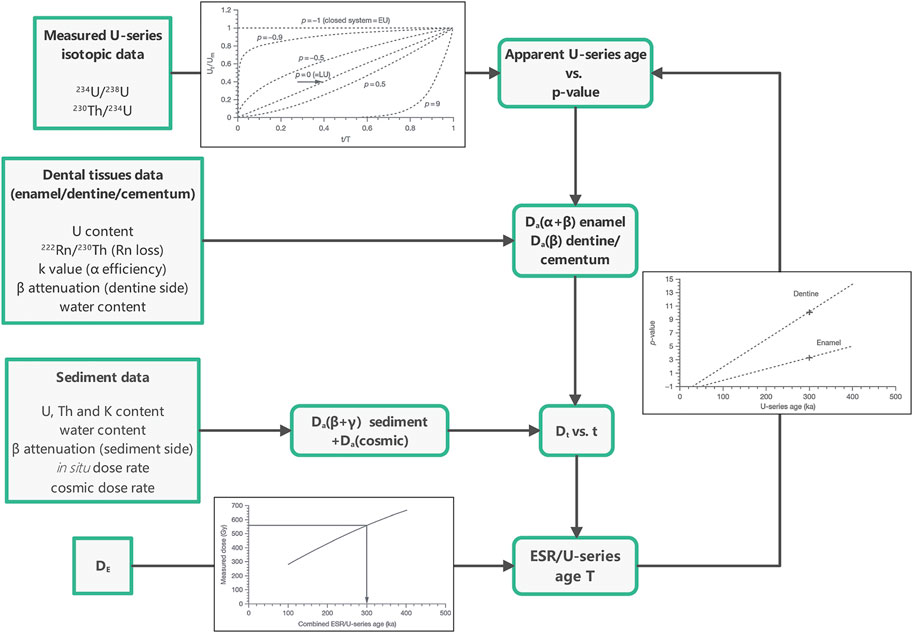
FIGURE 1. Flowchart of the ESR/U-series age calculation process with the US model (p-value) (after Grün et al., 1988).
In the present study, both US and AU models were used to obtain the ESR/U-series ages of the fossil samples from hominin sites in the TGR.
Three Gorges Region
The uplift of the Tibetan Plateau is the most distinguished tectonic movement in the Cenozoic, and it promoted to shape present landscape of China with three geomorphologic steps. The highest step is the Tibetan Plateau (average altitude >4,000 m a.s.l.), the Mongolian Plateau–Loess Plateau–Yunnan Plateau forms the second step (average altitude 1,000–2,000 m a.s.l.), and the lowest eastern plain is the third one (average altitude <500 m a.s.l.). The TGR, composed by Qutang Gorge (∼8 km long), Wu Gorge (∼46 km long) and Xiling Gorge (∼66 km long) from Fengjie County, Chongqing Municipality in the west to Yichang city, Hubei Province in the east, is the transition region between the second and third geomorphologic steps. Numerous hominin sites are distributed along the TGR in a broad sense, which covers the area along the Yangtze River, but also the sites close to the Han River, one of the largest tributaries of the Yangtze River and Danjiang River, a tributary of the Han River in the western Hubei area, both originated and flowing through the Qinling Mountains (Figure 2) (Table 1). As the western Hubei and TGR were located in the geographic center of China, it is a crucial passage area of the hominin settlement and migration between South and North China.
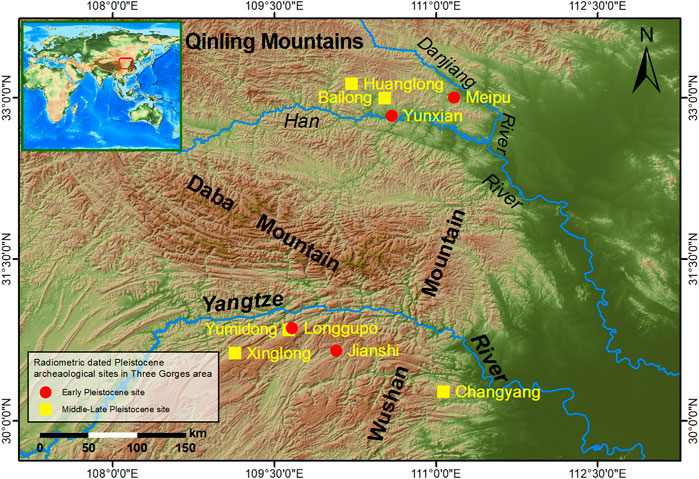
FIGURE 2. Location map of the hominin settlement sites in the Three Gorges region mentioned in the text.
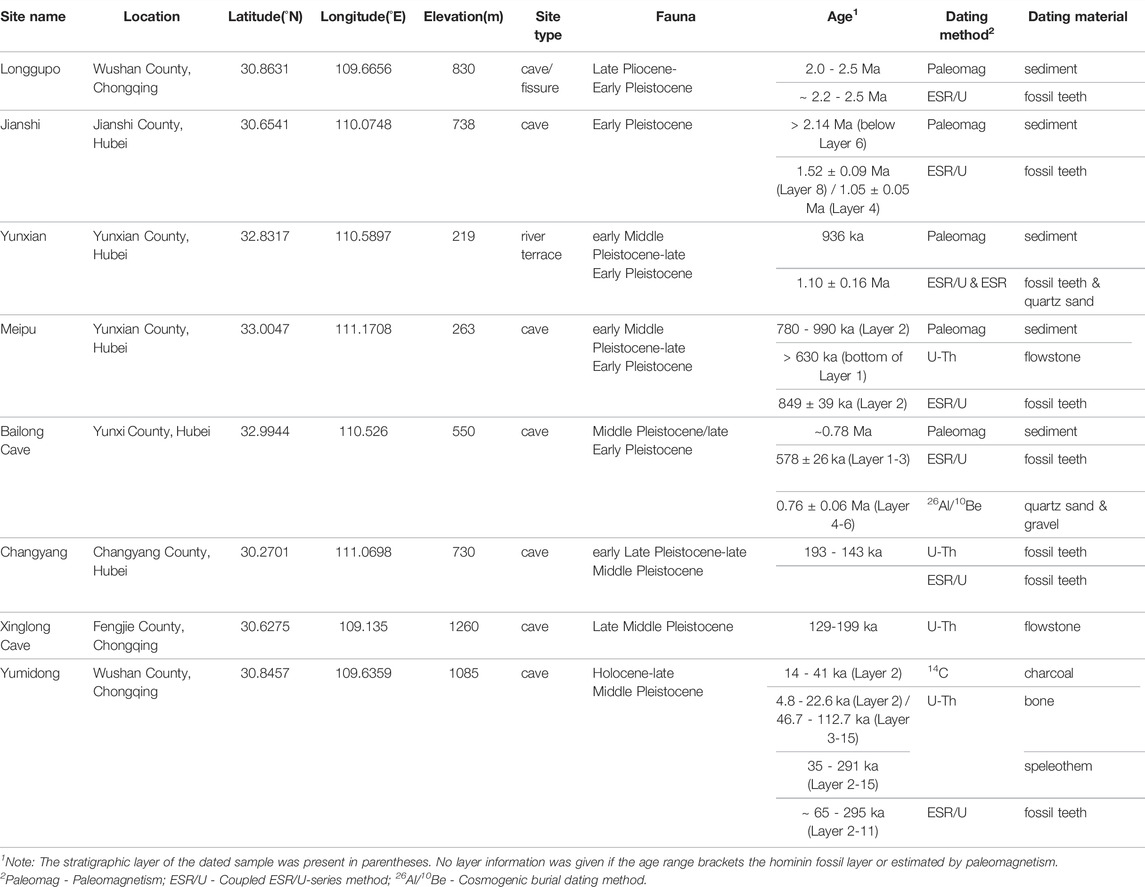
TABLE 1. A summary of the hominin sites in Three Gorge area mentioned in the text.
The Three Gorges was formed by severe incision along narrow fault zones, in response to the tectonic uplift of massive limestone formations of late Paleozoic and Mesozoic age (Zheng et al., 2013; Zhang et al., 2021). The Yangtze River transects the Huangling anticline at the eastern margin of the Three Gorges (Richardson et al., 2010). The region is dominated by a subtropical humid climate nowadays, which is warm in winter and cool in summer. Sedimentological and geochemical studies of the river terrace deposits in the TGR indicate a warm–wet climate during the Early and Middle Pleistocene period and gradually change to a cold–dry environment since the late Middle Pleistocene probably in relation to the uplift of Qinghai–Tibet Plateau (Gonghe Movement), which enhances the plateau monsoon and weaken and block the Indian monsoon (Xiang et al., 2020).
Evidence of the environmental changes mentioned above is also proven by the occurrence of Gigantopithecus blacki, a representative primate once lived in Southeast Asia and South China. A carbon stable isotopic composition analysis of the enamel of Gigantopithecus blacki teeth indicates their habit was limited to a forested environment with a general vegetarian diet (Bocherens et al., 2017). Due to the climatic shifts during the Pleistocene, Gigantopithecus blacki were forced to migrate from the TGR which had a warm and humid climate during the Early Pleistocene period (e.g., Longgupo and Jianshi sites) to the more southern region, such as Guangxi and Guizhou provinces in China and Southeast Asia, and probably became extinct at the late Middle Pleistocene or early Late Pleistocene period because of the reduction of forest environment and food shortage. Although some mammalian species of North China appeared in the sites of South China, the evidence of the highest altitude of Gigantopithecus blacki were found only in the south of the Yangtze River, which indicates the natural barrier of the Yangtze River may already exist at the beginning of the Quaternary period, and it could be partially supported by the recent ESR dating study of the sand lenses in the Yichang Gravel Layer, which indicate the Three Gorges valley incision and the channelization of the Yangtze River began probably before ∼1 Ma (Wei et al., 2020).
The fauna assemblage found in Three Gorges hominin sites belong to the main types of the Oriental Realm and was represented by the Ailuropoda–Stegodon fauna (sensu lato). The early stage of the Ailuropoda–Stegodon fauna include the typical Gigantopithecus-bearing assemblage, which can be found in two Early Pleistocene sites—Longgupo and Jianshi. The Middle Pleistocene Ailuropoda–Stegodon fauna (sensu stricto) is commonly found in the karstic deposits of caves and fissures, and the most representative assemblage is the Yanjinggou fauna, which was found by Walter Granger during the 1920s in Sichuan Province (now allocated to Chongqing municipality) (Colbert and Hooijer, 1953). Three karst caves discovered in the later time in Guangxi Province—Daxin, Wuming, and Bama yielded not only Ailuropoda–Stegodon fauna but also Gigantopithecus remains. The fauna assemblage comparison of our studied Bailongdong site near the Han River with Gongwangling and Yunxian sites indicate an early stage of the Middle Pleistocene. Last, the Late Pleistocene Ailuropoda–Stegodon fauna (sensu lato) recorded in the TGR contains few archaic forms; meanwhile, it shows the features similar to the Middle Pleistocene Ailuropoda–Stegodon fauna and modern Oriental Realm (Wu and Olsen, 1985). The presence of Hyaena ultima in Changyang site indicates its relatively early age in comparison with some other typical Late Pleistocene sites in South China (e.g., Maba site in Guangdong Province or Tongzi site in Guizhou Province). As the TGR is a transitional zone between South and North China, the fossiliferous assemblages from some of the sites in this region show a mixed characteristic of both northern and southern faunas. A detailed comparison of the fauna assemblage from the hominin sites in the TGR with two hominin sites nearby—Gongwangling (Early Pleistocene) and Chenjiawo (Middle Pleistocene) in Shaanxi Province is shown in Supplementary Table S1.
The stone artifacts found in the early hominin sites in western Hubei and TGR are not as sophisticated as those unearthed in North China for the same period. This phenomenon may contribute partly to the limitation of the raw materials since a large number of the sites are situated in the limestone area, and the characteristics of the lithic made by limestone sometimes are difficult to distinguish from the traces formed by the natural process. The use of bamboo tools may be another reason to explain the relatively lagging lithic techniques in the vast area of South China and Southeast Asia compared with Europe and even North China. A recent experimental study shows that the tools made by bamboo could almost completely replace the basic function of some stone tools to cut the meat (Bar-Yosef et al., 2012). The primitive stone artifacts unearthed from the early sites in the TGR therefore may not reflect the real technology level at that time, since the wide spread of bamboo and other arbores in South China could be good materials for making tools and were used by local people even nowadays. However, the woodworks were not easy to be preserved for a long time in the warm and humid environment, except for some special conservation environment (e.g., Gantangqing site, Yunnan Province) (Gao et al., 2021).
Chronological Study of the Hominin Settlement Sites in the Three Gorges Region
Due to the relatively survivable climate and natural environment in South China during almost the entire Pleistocene period, the chronology of the hominin sites in the TGR is difficult to be established only rely on fauna and lithic culture evidences. Meanwhile, most of the sites discovered in this region are associated with cave or fissure environments with limestone parent rock, in which the optimal dating materials for some routine optical dating methods (e.g., OSL dating) are limited. For the Early Pleistocene and early Middle Pleistocene sites, which are beyond the dating range of the U–Th method, cosmogenic 26Al/10Be burial dating may works occasionally if enough quartz minerals can be extracted from the sites. Because of the complexity and interruption of the deposition in some cave sites, the paleomagnetic dating study is only valid if other radiometric dates are available to provide a constraint. In most cases, coupled ESR/U-series dating of fossil teeth is the only feasible chronological method to study the early human settlement in the TGR.
Here, we give a brief introduction of the hominin settlement sites in the TGR that we have dated by the coupled ESR/U-series dating method in recent years (based on the chronological sequence), the limitations and cautions of this method are also addressed in the discussion part in order to call attention to its application in archaeological dating.
Longgupo
Discovered in the 1980s, the Longgupo site (“Longgu” is literally translated as “dragon bone” in Chinese, which are the mammalian fossils used in Chinese medicine, and “po” means hillside) is about 16 km south of the Yangtze River (Figure 2). It is located on a limestone hill slope (830 m a.s.l.) filled with Plio–Pleistocene deposits. The Longgupo site was once a cave but carpeted by collapsed breccias during the Pleistocene period (Rasse et al., 2011). It is well known because of the discovery of a mandible fragment with two teeth and an upper incisor, which show affinities with African early Homo specimens. The site was previously dated to ∼ 1.9 Ma by both paleomagnetism and ESR methods and was thought as the earliest evidence of human occurrence in Asia challenging the “Out-of-Africa” theory (Huang et al., 1995). Although the fossil specimens were questioned by a batch of scholars and considered as ape instead of Homo (Schwartz and Tattersall, 1996; Ciochon, 2009; Etler, 2009), the stone artifacts recovered from the stratigraphic layers were identified and confirmed by the specialists (Huang et al., 1995; Boёda and Hou, 2011) and led to speculation of the status of the tool-makers (Dennell, 2009).
From 2003 to 2006, a Sino-Franco joint excavation recovered thousands of stone artifacts from re-divided stratigraphic layers of the south and north walls (Boёda and Hou, 2011). A new chronological study was conducted during the joint excavation by using paleomagnetism and ESR/U-series methods. The coupled ESR/U-series method was applied to 17 fossil teeth from different layers and it was possible to reconstruct the uranium migration history more precisely. The US-ESR age results of Longgupo fossil teeth range from ∼2.2–2.5 Ma (Han et al., 2017), which confirms the site as one of the earliest evidences of hominin settlement in East Asia.
Jianshi
The Jianshi hominin site (also called Longgudong site, “dong” means cave in Chinese) is a cave site located in the west of Hubei Province, about 400 km west of Wuhan and 50 km south of Three Gorges (Figure 2). The specimens of Gigantopithecus blacki and three hominin teeth were discovered in 1970 (Gao, 1975; Li et al., 2017). The cave has two entrances, facing east and west, and the paleomagnetic dating work conducted by two teams gives different results and interpretations (Cheng et al., 2003; Shi, 2006), which made the age of Jianshi debatable. The fauna analysis and comparison with some Early Pleistocene sites of China indicate that Jianshi assemblage corresponds probably to an early stage of Early Pleistocene, younger than the Longgupo site nearby but older than Gongwangling and Yunxian sites (Zheng, 2004).
Our coupled ESR/U-series dating of two mammalian fossil teeth from the lower layer 8 gives a weight mean age of 1,521 ± 92 ka, while another two teeth from the upper layer 4 yield a mean age of 1,052 ± 49 ka (Han et al., submitted). Our ESR/U-series dating results are younger than previous paleomagnetic dating interpretation which proposes that the hominin fossil layer in the Jianshi site was older than the Reunion event (>2.14 Ma) (Cheng et al., 2003), but in agreement with the fauna record which suggests Jianshi is younger than the neighboring Longgupo site dated by the ESR/U-series method and paleomagnetism (Han et al., submitted).
Meipu
The Meipu site is located in Meipu Commune, Yunxian County, Hubei Province (about 90 km northeast of Yunxian Man site) (Figure 2). Four human teeth were found in 1975 and during the excavations in the following years, including two incisors, one molar, and one premolar. The human teeth fossils show similarity with Zhoukoudian Homo erectus teeth according to Wu and Dong (1980). More than 20 species of mammalian fossils and one stone core were also unearthed with the human fossils. Most of the species found in the Meipu site belong to Ailuropoda–Stegodon fauna typical in South China. The identified fossils also include Gomphotherium and Hyaena brevirostris licenti, which indicates a late Early Pleistocene to early Middle Pleistocene age.
The deposition in the Meipu cave was divided into three layers: the upper flowstone layer (∼0.3 m thick), the intermediate yellow sandy clay layer (∼0.5–2.5 m thick), and the lower firm yellow deposit with small breccias (∼0.6 m) (Xu, 1978). We carried out the coupled ESR/U-series dating study on nine fossil teeth collected from the intermediate layer where hominin remains were unearthed. The fossil dating provided two main age groups at 541 ± 48 ka and 849 ± 39 ka, respectively; the older age group is in agreement with the U-series age (>630 ka) of the flowstone overlying the fossil layer and the paleomagnetic data, which placed the Brunhes–Matuyama boundary in the fossil layer (Xing et al., 2021; Han et al., 2022). The reason for this age difference is probably caused by the U-content discrepancy in the enamel of the dated fossil samples. This study exhibits the limitation of ESR/U-series fossil dating and the importance of using multiple dating approaches when it is possible in order to identify the problematic ages (Han et al., 2022).
Yunxian (Quyuanhekou)
The Yunxian site is located on the fourth terrace of the left bank of the Han River in Hubei Province, China (Figure 2). The top of the terrace is about 50 m above the water level, and two deformed hominin skulls were discovered in its fluvial sediments in 1989 in association with a number of stone artifacts, including choppers, chopping tools, and bifaces. Most of them were made by the large gravels from the river beach (Li and Etler, 1992). Abundant animal fossils were found in the site and showed a mixing of typical species from both North and South China, which may indicate the geographic barrier of the Qinling Mountains was not formed sufficiently to hinder the migration of mammals. The fauna assemblage of the Yunxian site exhibits the similarity with the Lantian Gongwangling site in Shaanxi Province, which represents a typical Early Pleistocene record (Dong, 2016).
Initial paleomagnetic dating of the Yunxian Man site placed the hominin layer at 870−830 ka (Yan, 1993). A subsequent ESR dating study of nine fossil teeth from the fossil layer 3 by assuming the EU model for age calculation gave a mean age of 581 ± 93 ka (Chen et al., 1997), and the authors argued that the ESR ages were underestimated due to the very high U-content in enamel. Magnetostratigraphic study of the geological section of the Yunxian site was resumed in 2000 by a Sino-French archaeological team, and the B/M boundary was observed on the top of the stratigraphic sequence. Based on this study, the archaeological layer of the Yunxian site was placed at 936 ka (de Lumley and Li, 2008). The succeeding chronological studies of the Yunxian Man site conducted an ESR/U-series dating work on two herbivorous teeth from the hominin layer and the quartz sands from the fluvial sediment of the fossil layers and obtained a mean age of 1.10 ± 0.16 Ma, which confirmed the Early Pleistocene age of the Yunxian Man site (Tissoux et al., 2008). Recent studies of the ESR fossil dating show that the single saturation exponential function commonly used for paleodose determination of fossil enamel samples will cause dose overestimation (Duval and Grün, 2016), and the U-series analysis of Yunxian samples also indicate the possibility of uranium leaching in the dental tissues. Therefore, aforementioned ESR/U-series dating results of the Yunxian samples should be considered as the maximum age of the site (Bahain et al., 2017).
Bailong Cave
The Bailong Cave site (called “Bailongdong” in Chinese), discovered in 1976, was located in Yunxi County, Hubei Province (Figure 2). Six human teeth were found in the excavation of the 1970s and 1980s, and one more tooth unearthed in 2008. Several mammalian teeth collected from the hominin fossil layer were dated by the coupled ESR/U-series dating method (Han et al., 2019). Both gamma and beta external dose rates were reconstructed from the laboratory analysis of the sediment around the fossil samples. This may sometimes cause the bias of the gamma dose estimation due to the heterogeneous depositional environment of the site. In order to reconstruct the external dose rate of the dated samples more precisely, we therefore revisited the site in 2019 in order to realize in situ gamma dose measurement using a portable gamma spectrometer. The sample ages were recalculated with the new measured in situ dose rate values.
The recalculated ESR/U-series ages of the fossil samples from the Bailongdong site were generally older than the ones in the previous study from 5.6% to 25.4%. This is due to the in situ measured gamma dose rates by portable gamma spectrometer, which were significantly lower than the values measured in the laboratory by HpGe gamma spectrometer between 19.3% and 47.6% (Supplementary Table S2). Although the updated ESR/U-series ages of Bailongdong fossil samples became older as a whole, they are still in agreement with the cosmogenic 26Al/10Be burial age of the quartz sands and gravels from the sediment beneath (<0.76 ± 0.06 Ma) (Liu et al., 2015), the mid-Middle Pleistocene age of the fauna record (Tong et al., 2019) and the magnetostratigraphic results which dates the hominin-bearing layer to the early Brunhes Chron (Kong et al., 2018). The ESR/U-series dating of the Bailongdong site reemphasized; hence, the importance of the in situ measurement of the external gamma dose for the fossil age calculation.
Changyang
The Changyang hominin site, a cave site in Changyang County, Hubei Province, is located about 40 km south of the Yangtze River (Figure 2). A maxillary fragment was first discovered in 1956 by a local farmer, and a lower human premolar and abundant mammalian fossils were found in 1957 during the following investigation of the IVPP team. The morphological features of the Changyang hominin fossils were described by Chia (1957) and were considered close to the modern human than Zhoukoudian Homo erectus. Changyang was the first Middle Pleistocene hominin site discovered in South China, and an initial dating study by alpha-spectrometer U-series analysis of two fossil teeth gives the 230Th age of 196 ± 20/17 ka and 194 ± 24/20 ka, respectively (Yuan et al., 1986). Most recent re-dating work on carbonate crystals and tooth fossils by the ICP-MS U-series technique suggests the age of Changyang site range from 196 to 143 ka, which conforms with the previous results (Lu et al., 2020). As the U–Th analysis of the fossil bone could only obtain the apparent age because of its open system behavior, coupled ESR/U-series dating study of the fossil teeth from the site is currently underway in order to establish a more reliable chronology of the Changyang hominin site.
Yumidong
The Yumidong Cave, about 4 km southwest of the Longgupo site, is located in Miaoyu Town, Wushan County, Chongqing Municipality (Figure 2). The site is a horizontal limestone cave with a skylight about 3 m in diameter, at ∼20 m distance from the cave entrance. The site was discovered in 2004 and a large number of stone artifacts and mammalian fossils were unearthed during the excavations conducted in 2011–2013 (Wei et al., 2017).
The cave deposits are mainly composed of brown karstic sandy clay and limestone breccia and the stratigraphic sequence was divided into five layers initially by Wei et al. (2017) and further subdivided in detail into 18 layers (Shao et al., 2022). Two fossil teeth and three calcite samples collected from Layer 2, 3 and 4 were dated by the U-series method at the University of Queensland, the tooth sample from Layer 2 gives an age of ∼8.4 ka, while another tooth sample and one calcite sample from Layer 3 were dated to ∼78.5 ka and ∼75.2 ka, respectively. The other two calcite samples from Layer four yield distant U-series ages of 198 ± 51 ka and 398 ± 30 ka, respectively, and put the deposits of the Yumidong site range from ∼400 ka to ∼ 8 ka (Wei et al., 2017).
To better constrain the chronology of the Yumidong depositional sequence, a multimethod dating study was realized including coupled ESR/U-series analyses on six fossil teeth from L2 to L12, and a Bayesian approach was used to refine the chronostratigraphy of the Yumidong site (Shao et al., 2022). Based on this study, a ∼300 ka long history of human occupation in the Yumidong site was established, and it indicates a continuous human settlement in the TGR during cold and warm stages from late Middle Pleistocene to the Late Pleistocene period.
Xinglong Cave
Xinglong Cave, located about 90 km south of the Yangtze River in Fengjie County, Chongqing municipality (Figure 2), was discovered in 2001 by a Chinese expedition team (Gao et al., 2004). One human molar was unearthed from the site, and an engraved tusk of Stegodon orientalis was found in the same layer. It was considered the intentional engravings and may relate to the earliest art form in East Asia.
The deposition of Xinglong Cave was divided into six layers, and more than 50 species of mammalian fossils and 20 stone artifacts came from layer 2, which bears the human remains. The fauna assemblage suggests a late Middle Pleistocene age of the Xinglong site, and U-series analysis of the enamel and dentine tissues from a molar of Stegodon orientalis gave the age of the cultural layer of the Xinglong site between 120 and 150 ka (Gao et al., 2004). The updated U-series ages obtained by MC-ICPMS dating on the flowstone samples collected above and beneath the fossil layer show the weighted mean of 129 ± 5 ka and 199 ± 16 ka, respectively, which could bracket the age of the human remains in Xinglong Cave (Peng et al., 2014). In future, direct dating of the fossil teeth from the human fossil-bearing layer by coupled ESR/U-series method may constrain the age of the Xinglong site more precisely.
Results and Discussion
The ESR/U-series ages and modeled uranium uptake history of five hominin sites in the TGR (no hominin fossils found in the Yumidong site) are shown in Table 1; Figure 3. Not like our previously dated Paleolithic open sites in the Nihewan Basin, which has intensive surface erosion and complex hydrodynamic conditions that may cause repeat U uptake and loss in the dental tissues (Han et al., 2015), most of the hominin sites we analyzed in the TGR are cave sites with a geological limestone background except Yunxian Man site which is situated on Han river terrace. However, even preserved in a similar cave deposition environment, the fossil teeth collected in different caves show the distinct variation of the U-migration process. In the Longgupo site, the majority of the analyzed teeth display a very recent U-uptake history (p > 0) (Figure 3A), which may indicate a dramatic hydrological change during the Last Pleistocene in relation with the collapse of the cave ceiling, making the Longgupo site look like a fissure site rather than a cave nowadays (Rasse et al., 2011; Han et al., 2012, 2017). The p-values of four teeth from the Jianshi cave range between −1 and 0, which indicate a relatively early uptake of uranium in the dental tissues (Figure 3B) (Han et al., submitted). The fossil samples from the youngest Yumidong site show different uranium uptake behaviors which both relatively early and recent uptake history were indicated by p-values (Figure 3E) (Shao et al., 2022). Three fossil samples from the Bailongdong site exhibit early U-uptake history, while the other five experienced U loss based on their U-series data, and the ESR/U-series ages can be obtained only using the AU model (Figure 3D) (Han et al., 2019). The Meipu samples have the most variable U-migration history in which early, recent, and approximately linear uptake of uranium were all present, and the dentine tissue of one sample also exists in the U-loss (Figure 3C) (Han et al., 2022). Last, the only site with an open environment in this study—the Yunxian site displays an obviously different U-migration history from other sites, in which the uranium leaching process was present in all the fossil samples except one (Bahain et al., in progress) (Figure 3F). The coupled ESR/U-series analysis of teeth from the aforementioned sites indicates that there is no certain rule of uranium migration history in the fossil teeth even from the same site. The fossil teeth ESR ages of a majority of hominin sites in China obtained previously by assuming specific U-uptake models, in which the uptake history was postulated (e.g., EU and LU models) should be cited with great caution and need to be re-evaluated in the future.
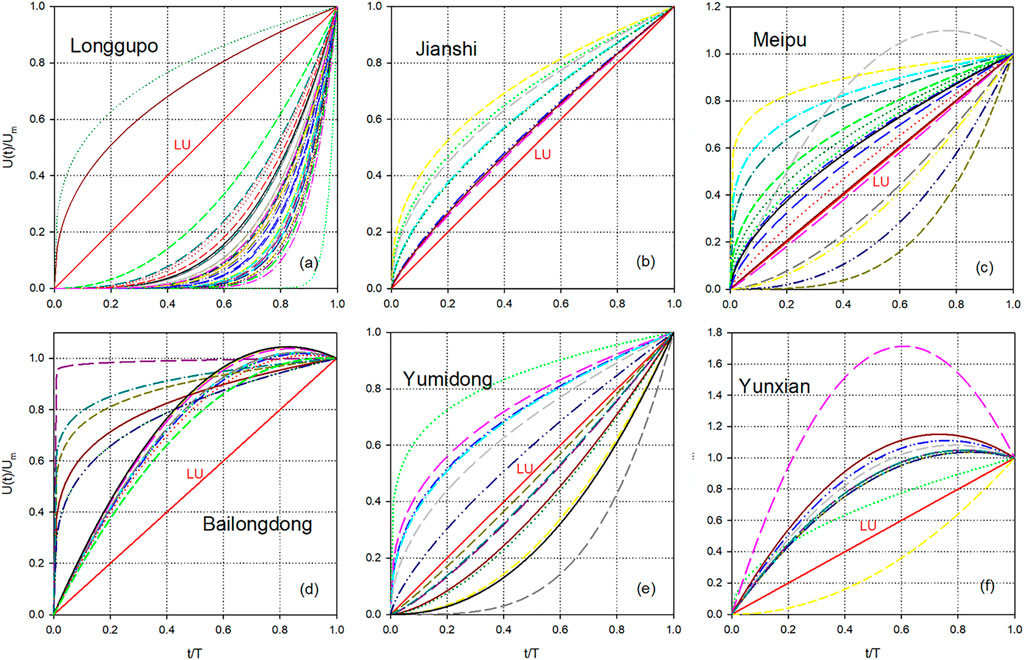
FIGURE 3. Uranium migration process of the dated fossil samples by the ESR/U-series method from six sites in the Three Gorges region reconstructed by US (p-value) or AU model (n-value) (the U-uptake history of both enamel and dentine tissues of each sample from the site were present in the same figure with different colors.
Which Fitting Function Should be Used for DE Determination?
In the early study of ESR dating, the single saturation exponential fitting (SSE) function was commonly used for DE determination. It is based on the assumption of the exponential growth of a single paramagnetic center with the increase of radiation dose. The fossil teeth fragment ESR study in recent years indicates that the ESR signal of enamel tissues is generated by at least two CO2− radicals, which has different dose responses with natural and artificial radiation. A double saturation exponential (DSE) function which was first used for the coral samples has been proposed for the DE determination of fossil enamel, and it has been proven to fit the dose points better than SSE, especially for the old fossil samples (Duval et al., 2009; Han et al., 2011). However, in order to use the DSE function for DE determination, it needs at least 15 aliquots and irradiated with a high maximum dose (>10 kGy) to ensure the fitting precision, which is difficult to be achieved sometimes by the small fossil teeth and irradiation facilities without a well-established calibration curve in the high dose range. To find the better fitting function for DE determination, we compared the goodness of fit of two functions quantitatively by analyzing the fossil enamel samples from the Early and Middle Pleistocene sites in the TGR. For the Early Pleistocene sites of Longgupo and Jianshi, our study shows that the DSE function indeed fits the dose points better than the SSE one in case the requisite of 15 aliquots irradiated up to 50 kGy can be met. For the Middle Pleistocene sites, the DE are usually less than 2,000 Gy, it could be obtained by irradiating 10 aliquots up to 5 kGy, and the fitting results are in consistent with the DSE ones in the error range (Figure 4). According to our study, the conventional SSE fitting function could provide a reliable DE in case the maximum irradiation dose is no more than 5 kGy, and it has an advantage over DSE function when the sample volumes are limited and could be only divided into less than 15 aliquots.
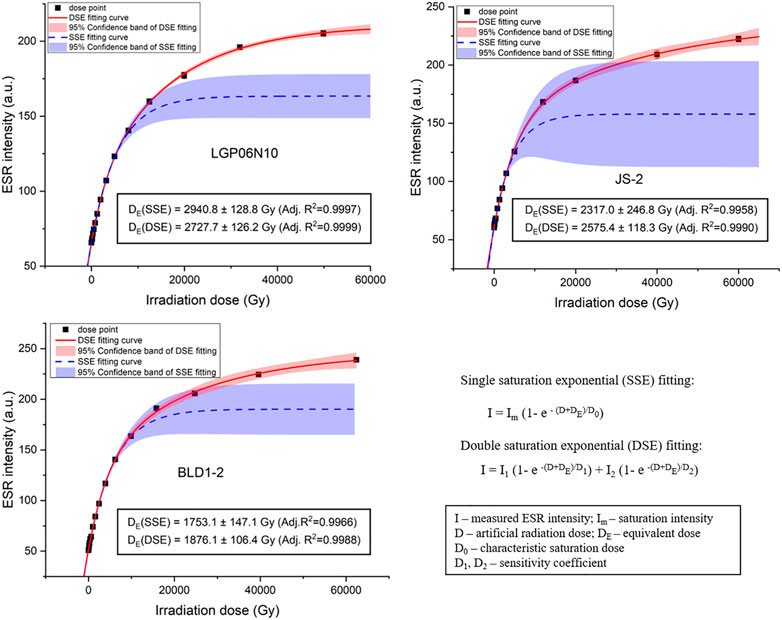
FIGURE 4. Equivalent dose (DE) of fossil samples from Three Gorges sites (LGP06N10 from the Longgupo site, JS-2 from Jianshi site, and BLD1-2 from Bailongdong site) determined by single saturation exponential (SSE) function (blue-dashed line and confidence band) with 10 dose points up to 5 kGy and double saturation exponential (DSE) function (red solid line and confidence band) with 15 dose points up to 60 kGy.
Reconstruction of the External Dose Rate
The reconstruction of the external dose rate of the fossil teeth which are contributed by the surrounding sediments in their burial environment is crucial for obtaining reliable ESR/U-series age. The reliability of the fossil ages was greatly affected by the external dose rate, particularly in the case that the external dose rate account for a large portion of the total dose rate. However, the accuracy of external dose rate reconstruction was hindered by several cases mentioned as follows: 1) the absence of the provenance information of the fossil samples. This is the worst situation for reconstructing the external dose and making it even impossible. However, it is not an uncommon situation, especially for some hominin sites in China excavated in the early years, in which detailed records of the position of the archaeological remains were lacking. Fortunately, the fossil teeth from the Three Gorges sites we used for coupled ESR/U-series dating were all collected in situ or from the formal excavation with definite unearthed position records, which significantly reduces the uncertainty of external dose rate reconstruction; 2) inaccessibility of the fossil section or incapability to provide in situ dose rate measurement. This issue may be due to natural or man-made causes such as the rainy season (Han et al., 2019) or road construction, in which the original section did not survive (Han et al., 2016). In most cases, revisiting the site is necessary to fulfill or refine the in situ measurement, and only in this way more reliable ESR/U-series ages of the fossil samples could be obtained, like our dating work on Longgupo (see the impact on results in Han et al., 2012, 2017) and Bailongdong sites (Han et al., 2019, this study); and 3) the inhomogeneous deposition environment in the surrounding area of the dated fossil samples. This is the most common case in the archaeological sites in which different kinds of deposits and remains were present in the fossil layer, and make it a typical “lumpy” environment. Some scholars proposed different ways to stimulate the gamma dose rates in such environment (Brennan et al., 1997; Nathan and Grün, 2003) and model the external dose rates variation by the absorption of uranium in the surrounding fossil fragments (Blackwell and Blickstein, 2000; Guibert et al., 2009). However, none of them could completely replace the in situ measurement with a portable gamma spectrometer or TL dosimeter, and sometimes measuring the gamma dose rate in variable positions surrounding the dated fossil sample and using the averaged values for the age calculation is the most straightforward way. In the case in situ measurement is not possible, the sediment attached on the surface of the fossil may provide the only choice for external dose rate reconstruction, and the distribution of gamma dose rates may be discussed in order to give a reasonable range of the fossil ESR/U-series ages (Duval et al., 2019).
The ESR isochron dating of the fossil teeth may be another solution for the external dose rate reconstruction. It plots the DE vs. internal dose rate of several subsamples from one single tooth to build the isochron, the intercept is the external dose the fossil sample received from the surrounding sediments, and the slope of the isochron could give the fossil age (Blackwell and Schwarcz, 1993). To build an ideal isochron, it needs the subsamples to experience the same external dose during the burial history and have a discrepancy of uranium content in the enamel tissue; the variation of the internal dose rate of subsamples ensures the precision of isochron construction. Most of the isochron ESR dating studies were realized through the EU and LU models for calculating the internal dose rate of subsamples (Blackwell and Blickstein, 2000; Blackwell et al., 2016).
We have tried to combine the US model with the isochron technique to calculate the isochron age of five fossil samples from the adjacent squares in layer C III′6 of the Longgupo site (Han et al., 2012). It should be noted that the assumption of applying the isochron method on the fossil teeth is that all the subsamples analyzed shared the same external dose rate. However, the external dose rate not only includes the gamma dose rate from the surrounding sediments which is considered identical to the subsamples but also the beta dose rate which is contributed by the beta radiation (attenuation depth ∼2 mm) from the sediments attached on the surface of enamel (or cementum if existing). This beta dose rate component may vary from each subsample, which makes their external dose rate not exactly the same. That might explain why the isochron does not works so well in some cases even though the subsamples were collected from the same place and have variable U contents.
Uranium Distribution in the Enamel
During our ESR/U-series dating study on the fossil teeth from the Three Gorges sites, the age results of some of the samples were obviously underestimated (Han et al., 2022), and it could not be attributed to a problematic DE determination or a bias linked to the external dose rate estimation. We observed that in such cases the U content in the enamel tissues was often much higher than in other samples even about one order, and it could not be explained simply to the contamination of dentine tissues on the enamel surface because the DE value is generally high and dentine contribute little to the ESR signal and DE. Bahain et al. (1992) noticed the high U content in the enamel samples of Isernia, Italy, and they supposed that uranium is concentrated in the impure zones of the enamel, which capture the most electrons created by ionization, and this may lead to inverse correlation of the U concentration and alpha efficiency due to the irradiation sensitivity change. Chen et al. (1997) also mentioned the similar situation of high U-content in Yunxian enamel samples and suggested that it may cause the age underestimation by micro-regional saturation of the paramagnetic centers in the enamel. The fossil dating works were carried out again in the years later on the aforementioned two sites by the coupled ESR/U-series method (Shao et al., 2011; Bahain et al., 2017; Bahain et al., 2021, in progress). Although the age underestimation of Isernia was considered to be mainly attributed to the variation of the environmental gamma dose rate related to the recent U-uptake of bones in the archaeological level, the Yunxian fossil samples again show very high uranium concentration in the enamel samples and significantly younger than the paleomagnetic results. This is also the case of Meipu samples we analyzed in the recent study (Han et al., 2022), the distribution of ESR/U-series ages of fossil samples collected from the same fossil layer was divided into two groups, and the younger one with much high enamel U-content was obviously underestimated based on another independent age constraint. In recent years, the laser ablation ICP-MS technique was developed to investigate the spatial distribution of uranium in dental tissues (Grün et al., 2014). However, at present high-resolution U-series data could be obtained only on the flat cross-section of the fossil teeth. Few studies of uranium distribution were carried out on the irregular surface of the enamel, and the non-destructive 3D U-mapping may help to select the optimal part of the enamel with low uranium concentration for the further dating study.
Combined Multiple Dating Techniques Approach
The dating study of hominin sites in the TGR does show the great potential of the ESR dating method. However, the limitation of ESR/U-series dating on fossil teeth was also discussed above in order to call attention to the questionable age results. If the sampling condition permits, applying multiple dating methods to different kinds of dating materials is preferable, and they could complement each other and eliminate the disadvantages and limits due to the assumption or requirement of the methods. The study of the Yumidong site shows clearly the advantages and interests of such multi-methods approach to provide a single unified chronological framework (Shao et al., 2022).
For the Early and Middle Pleistocene sites, cosmogenic 26Al/10Be burial dating on the quartz sands and gravels could be combined with coupled ESR/U-series dating on the fossil teeth. It was attempted to date Bailongdong and Meipu sites, but the extraction of quartz minerals in these two cave sites was tough due to the limestone background. U-series dating of the speleothem may constrain the age of the interested archaeological remains if their stratigraphic relationship could be clarified. In Meipu cave, the U-series dating of the flowstone layer overlain helps to identify the problematic ESR/U-series ages of the fossil teeth samples from the fossil layer beneath (Han et al., 2022). Due to the open system behavior of fossil bones, their apparent U-series age should always be considered as the minimum age limit in the case of no U-loss occurred.
Archaeological Perspectives
At the time of writing this article, five archaeological sites with hominin fossils were dated by the coupled ESR/U-series method in the TGR and western Hubei area: Jianshi, Yunxian, Meipu, Bailongdong, and Changyang sites mentioned above. Although the phylogenetic status of the fossil specimen found in Longgupo and Jianshi sites on the hominin evolutionary relationship is still controversial, the morphological features of the hominin fossils from Yunxian, Meipu, Bailongdong, and Changyang sites do represent different stages of human evolution in East Asia, and the most recent study of the Meipu hominin fossil teeth shows their features are intermediate between early Homo specimens in Africa and Dmanisi in Georgia, and Middle Pleistocene hominins in East Asia which represent by Zhoukoudian Homo erectus (Xing et al., 2021). The two skulls from the Yunxian Man site were seriously deformed by the strata compression, and the reconstructions of the fossils by 3D virtual imaging techniques confirmed the specimens to Homo erectus and also indicate the variability of this species (Vialet et al., 2010). More detailed 3D reconstruction work of the Yunxian Man skulls is ongoing in order to specify their evolutionary position. The Bailongdong fossil specimens were also classified as Homo erectus, but the more in-depth morphological study was limited because only fossil teeth were found in the site. The Changyang hominin was classified previously as archaic Homo sapiens (Wu and Poirier, 1995), and recent studies of the premolar from Changyang specimen show the features aligned with Asian Homo erectus and probably indicate a late representative of an East Asian Homo erectus lineage (Pan et al., 2019). Due to its late Middle Pleistocene age and other non-Homo erectus evidence (Denisovans probably) found in China (e.g. Panxian Dadong, Tongzi and Xujiayao hominin sites), it may support a multi-lineage and discontinuous settlement of hominin in East Asia (Pan et al., 2020).
The lithic industry of the Longgupo site is difficult to compare with other sites in China because of its old age and the majority of the raw materials of tools were cobbles or blocks of local limestone, which could explain the choice of variable operational processes and high rate of presence of knapping accidents (Boёda and Hou, 2011). In numerous of Middle–Late Pleistocene Paleolithic sites found in the TGR and Han River valley, the raw materials were selected water-rounded cobbles from the river beds, and the operative schemes of lithic production show continuity and stability (Pei et al., 2013), and distinct from those of the West, which suggest the Paleolithic cultures in this region may follow an independent trajectory (Li et al., 2014, 2018).
The distribution statistics of hominin sites in China from Early Pleistocene to Late Pleistocene show that the Homo sites during the period of Early Pleistocene were more restricted to central and southern China, and gradually present in the east and northern China since the Middle Pleistocene (Bae et al., 2018). This pattern may be driven by the paleoclimatic variation during the Early and early Middle Pleistocene and the ability to transport portable water. In the last two decades, some new hominin sites were discovered successively in the western Hubei and TGR (e.g., Huanglong Cave, Leiping, Migong, and Caotang sites) (Liu et al., 2006, 2010; Wu et al., 2006; Shen et al., 2013), more detailed excavation and dating works of the sites are still in progress. In a word, we believe that the TGR in central China which found abundant hominin sites from the Early Pleistocene to the Late Pleistocene may not only be the migration corridor of hominins and other mammals between southern and northern China, but probably also a diffusion center for the Middle and Late Pleistocene Homo appeared in the north and east of China (Figure 5).
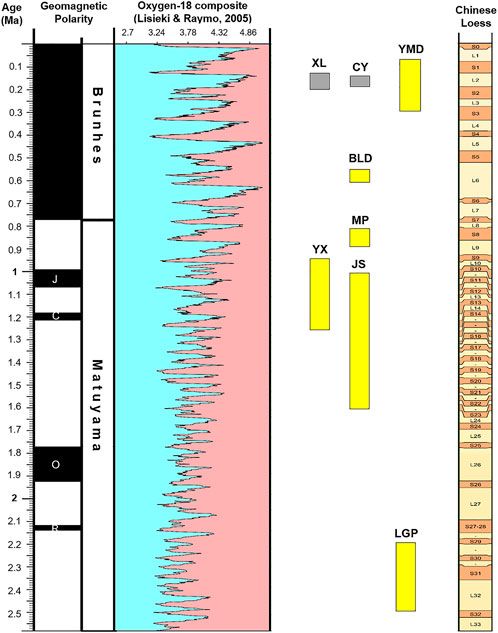
FIGURE 5. Chronological and paleoenvironmental summary of the hominin sites in the TGR dated by radiometric methods. The age bars with golden color are obtained by the coupled ESR/U-series method, and the gray color was yielded by other radiometric dating methods (the chart was generated by TimeScale Creator GTS 2020).
Conclusion and Perspective
At present, the earliest hominin site in East Asia is the Yuanmou site in Yunnan Province, South China. It was dated to ∼ 1.7 Ma by the paleomagnetic method (Zhu et al., 2008), and this age was recently confirmed by cosmogenic 26Al/10Be isochron burial dating in a recent study (Luo et al., 2020). In North China, although there is still a debate about the age of the Lantian Man site, which was dated about 1.6 Ma by 26Al/10Be burial dating (Tu et al., 2017), some recent discoveries and restudies of the paleolithic sites do show the early evidence of hominin settlement at the early stage of Early Pleistocene (Shangchen, ∼ 2.12 Ma, Zhu et al., 2018; Xihoudu, ∼2.43 Ma Shen et al., 2020). Although we could not entirely exclude the possibility that a separate migration route may exist along the high latitude area in North China during the Early and Middle Pleistocene, our chronological studies of the hominin sites in the TGR indicate that the hominin activities already existed in this corridor zone between South and North China during the Early Pleistocene period. The Longgupo site, though the fossil species identification is still in debate (Dalton, 2009), the stone artifacts with distinct characters and the updated ESR/U-series age of the site at ∼2.2–2.5 Ma make it as old as the earliest evidence in North China. Other hominin sites of the Early Pleistocene age have also been discovered in recent years in South China, some of them were found associated with another giant primate—Gigantopithecus blacki in the same living place, and coupled ESR/U-series dating on the mammalian fossil teeth has shown a great potential to apply on these cave sites. The combination of ESR measurement of the enamel fragment and Laser-ablation ICP-MS analysis of the dental tissues highlight the possibility of minimum or non-destructive analysis of the precious human fossils, with accurate and detailed measurement of the external dose rate of the fossil specimen, the ESR dating method will continue to make a significant contribution to our understanding of the history of human evolution in China and East Asia.
Data Availability Statement
The original contributions presented in the study are included in the article/Supplementary Material; further inquiries can be directed to the corresponding author.
Author Contributions
FH and J-JB conducted the ESR/U-series dating work of the fossil teeth samples from Longgupo, Jianshi, Meipu, Yunxian, and Bailongdong sites, and FH wrote the first draft; QS conducted the ICP-MS U-series analysis and dating work of Yumidong site; XS conducted the dating study of Changyang site; J-JB and PV conducted the in situ gamma dose rate measurement; and PX and MH assisted in illustration and text processing. All authors participated in compiling the manuscript.
Funding
This work is supported by the National Natural Science Foundation of China (Grant nos. 41772174 and 41877430), the NSFC-CNRS Sino-French cooperation project (Grant no. 41911530235), the Sino-French Cai Yuanpei Program (Project no. 41378UF), and Yunnan Fundamental Research Project (Project no. 202201AT070211).
Conflict of Interest
The authors declare that the research was conducted in the absence of any commercial or financial relationships that could be construed as a potential conflict of interest.
Publisher’s Note
All claims expressed in this article are solely those of the authors and do not necessarily represent those of their affiliated organizations, or those of the publisher, the editors, and the reviewers. Any product that may be evaluated in this article, or claim that may be made by its manufacturer, is not guaranteed or endorsed by the publisher.
Acknowledgments
Our thanks to Luo Yunbin, Lu Chengqiu, and He Cunding for their help with our field work. We thank Darryl Granger (Purdue University) for supporting the chemical separation and AMS measurement of 10Be and 26Al samples. We also thank Huili Yang (IGCEA) for helping the HpGe gamma spectrometer measurement of the sediment.
Supplementary Material
The Supplementary Material for this article can be found online at: https://www.frontiersin.org/articles/10.3389/feart.2022.939766/full#supplementary-material
References
Bae, C. J., Li, F., Cheng, L., Wang, W., and Hong, H. (2018). Hominin Distribution and Density Patterns in Pleistocene China: Climatic Influences. Palaeogeogr. Palaeoclimatol. Palaeoecol. 512, 118–131. doi:10.1016/j.palaeo.2018.03.015
Bahain, J.-J., Shao, Q., Han, F., Sun, X., Voinchet, P., Liu, C., et al. (2017). Contribution des méthodes ESR et ESR/U-Th à la datation de quelques gisements pléistocènes de Chine. L'Anthropologie 121, 215–233. doi:10.1016/j.anthro.2017.06.001
Bahain, J.-J., Voinchet, P., Vietti, A., Shao, Q., Tombret, O., Pereira, A., et al. (2021). ESR/U-Series and ESR Dating of Several Middle Pleistocene Italian Sites: Comparison with 40Ar/39Ar Chronology. Quat. Geochronol. 63, 101151. doi:10.1016/j.quageo.2021.101151
Bahain, J.-J., Yokoyama, Y., Falguères, C., and Sarcia, M. N. (1992). ESR Dating of Tooth Enamel: A Comparison with KAr Dating. Quat. Sci. Rev. 11, 245–250. doi:10.1016/0277-3791(92)90069-k
Bar-Yosef, O., Eren, M. I., Yuan, J., Cohen, D. J., and Li, Y. (2012). Were Bamboo Tools Made in Prehistoric Southeast Asia? An Experimental View from South China. Quat. Int. 269, 9–21. doi:10.1016/j.quaint.2011.03.026
Blackwell, B. A. B., and Blickstein, J. I. B. (2000). Considering Sedimentary U Uptake in External Dose Rate Determinations for ESR and Luminescent Dating. Quat. Int. 68-71, 329–343. doi:10.1016/s1040-6182(00)00056-2
Blackwell, B. A. B., Skinner, A. R., Blickstein, J. I. B., Montoya, A. C., Florentin, J. A., Baboumian, S. M., et al. (2016). ESR in the 21st Century: From Buried Valleys and Deserts to the Deep Ocean and Tectonic Uplift. Earth-Science Rev. 158, 125–159. doi:10.1016/j.earscirev.2016.01.001
Blackwell, B. A., and Schwarcz, H. P. (1993). ESR Isochron Dating for Teeth: A Brief Demonstration in Solving the External Dose Calculation Problem. Appl. Radiat. Isotopes 44, 243–252. doi:10.1016/0969-8043(93)90227-2
Bocherens, H., Schrenk, F., Chaimanee, Y., Kullmer, O., Mörike, D., Pushkina, D., et al. (2017). Flexibility of Diet and Habitat in Pleistocene South Asian Mammals: Implications for the Fate of the Giant Fossil Ape Gigantopithecus. Quat. Int. 434, 148–155. doi:10.1016/j.quaint.2015.11.059
Brennan, B. J., Schwarcz, H. P., and Rink, W. J. (1997). Simulation of the Gamma Radiation Field in Lumpy Environments. Radiat. Meas. 27, 299–305. doi:10.1016/s1350-4487(96)00133-3
Chen, T.-M., Yang, Q., Hu, Y.-Q., Bao, W.-B., and Li, T.-Y. (1997). ESR Dating of Tooth Enamel from Yunxian homo Erectus Site, China. Quat. Sci. Rev. 16, 455–458. doi:10.1016/s0277-3791(96)00095-9
Cheng, J., Gao, Z., Zheng, S., Zhang, Z., Liu, L., Feng, X., et al. (2003). Study on the Sediments of the Longgu Cave with Gigantopithecus at Gaoping, Western Hubei, China. Geoscience 17 (3), 268–274. (In Chinese with English Abstract).
Cheng, J., Gao, Z., Zheng, S., Zhang, Z., Liu, L., Feng, X., et al. (2004). The Gaoping Formation—A New Stratigraphic Unit with the Gigantopithecus Fossils from West Hubei. J. Stratigr. 28, 223–229. (In Chinese with English Abstract).
Chia, L. P. (1957). Notes on the Human and Some Other Mammalian Remains from Changyang, Hupei. Vertebr. Palasiat. 1, 247–257.
Ciochon, R. L. (2009). The Mystery Ape of Pleistocene Asia. Nature 459, 910–911. doi:10.1038/459910a
Colbert, E. H., and Hooijer, D. A. (1953). Pleistocene Mammals from the Limestone Fissures of Szechwan, China. Bull. Am. Mus. Nat. Hist. 102, 1–134.
de Lumley, H., and Li, T. (2008). Le site de l’homme de Yunxian, Quyuanhekou, Quingqu, Yunxian, Province du Hubei. Paris: CNRS Éditions, 592.
Dong, W. (2016). Biochronological Framework of Homo Erectus Horizons in China. Quat. Int. 400, 47–57. doi:10.1016/j.quaint.2015.09.019
Duval, M., Fang, F., Suraprasit, K., Jaeger, J.-J., Benammi, M., Chaimanee, Y., et al. (2019). Direct ESR Dating of the Pleistocene Vertebrate Assemblage from Khok Sung Locality, Nakhon Ratchasima Province, Northeast Thailand. Palaeontol. Electron 22 (3), 69 1–25. doi:10.26879/941
Duval, M., and Grün, R. (2016). Are Published ESR Dose Assessments on Fossil Tooth Enamel Reliable? Quat. Geochronol. 31, 19–27. doi:10.1016/j.quageo.2015.09.007
Duval, M., Grün, R., Falguères, C., Bahain, J.-J., and Dolo, J.-M. (2009). ESR Dating of Lower Pleistocene Fossil Teeth: Limits of the Single Saturating Exponential (SSE) Function for the Equivalent Dose Determination. Radiat. Meas. 44, 477–482. doi:10.1016/j.radmeas.2009.03.017
Etler, D. A. (2009). Mystery Ape: Other Fossils Suggest that It's No Mystery at All. Nature 460, 684. doi:10.1038/460684a
Falguères, C., Bahain, J. J., Bischoff, J. L., Pérez-González, A., Ortega, A. I., Ollé, A., et al. (2013). Combined ESR/U-Series Chronology of Acheulian Hominid-Bearing Layers at Trinchera Galería Site, Atapuerca, Spain. J. Hum. Evol. 65, 168–184. doi:10.1016/j.jhevol.2013.05.005
Falguères, C., Bahain, J. J., Yokoyama, Y., Arsuaga, J. L., Bermudez de Castro, J. M., Carbonell, E., et al. (1999). Earliest Humans in Europe: The Age of TD6 Gran Dolina, Atapuerca, Spain. J. Hum. Evol. 37, 343–352. doi:10.1006/jhev.1999.0326
Gao, J. (1975). Australopithecine Teeth Associated with Gigantopithecus. Certebrata Palasiat. (In Chinese with English Abstract).
Gao, X., Huang, W. B., Xu, Z. Q., Ma, Z. B., and Olsen, W. (2004). 120-150 Ka Human Tooth and Ivory Engravings from Xinglongdong Cave, Three Gorges Region, South China. Chin. Sci. Bull. 48, 2466–2472. doi:10.1360/03wd0214
Gao, X., Liu, J.-H., Ruan, Q.-J., Ge, J., Huang, Y., Liu, J., et al. (2021). 300,000-Year-Old Wooden Tools from Gantangqing, Southwest China. 16 February 2021, PREPRINT (Version 1) Available at Research Square. doi:10.21203/rs.3.rs-226285/v1
Grün, R., Pike, A., McDermott, F., Eggins, S., Mortimer, G., Aubert, M., et al. (2020). Dating the Skull from Broken Hill, Zambia, and its Position in Human Evolution. Nature 580, 372–375. doi:10.1038/s41586-020-2165-4
Grün, R., Eggins, S., Kinsley, L., Moseley, H., and Sambridge, M. (2014). Laser Ablation U-Series Analysis of Fossil Bones and Teeth. Palaeogeogr. Palaeoclimatol. Palaeoecol. 416, 150–167.
Grün, R., Schwarcz, H. P., and Chadam, J. (1988). ESR Dating of Tooth Enamel: Coupled Correction for U-Uptake and U-Series Disequilibrium. Int. J. Radiat. Appl. Instrum. Part D. Nucl. Tracks Radiat. Meas. 14, 237–241.
Guibert, P., Lahaye, C., and Bechtel, F. (2009). The Importance of U-Series Disequilibrium of Sediments in Luminescence Dating: A Case Study at the Roc de Marsal Cave (Dordogne, France). Radiat. Meas. 44, 223–231. doi:10.1016/j.radmeas.2009.03.024
Han, F., Bahain, J.-J., Boëda, É., Hou, Y., Huang, W., Falguères, C., et al. (2012). Preliminary Results of Combined ESR/U-Series Dating of Fossil Teeth from Longgupo Cave, China. Quat. Geochronol. 10, 436–442. doi:10.1016/j.quageo.2012.03.006
Han, F., Bahain, J.-J., Deng, C., Boëda, É., Hou, Y., Wei, G., et al. (2017). The Earliest Evidence of Hominid Settlement in China: Combined Electron Spin Resonance and Uranium Series (ESR/U-Series) Dating of Mammalian Fossil Teeth from Longgupo Cave. Quat. Int. 434, 75–83. doi:10.1016/j.quaint.2015.02.025
Han, F., Bahain, J.-J., Liu, C., and Yin, G. (2015). Testing Mathematical Uranium Migration Models in Combined ESR/U-series Dating of Fossil Teeth from Open-Air Sites. Quat. Geochronol. 30, 519–523. doi:10.1016/j.quageo.2015.05.009
Han, F., Bahain, J.-J., Voinchet, P., Jin, M., and Yin, G. (2022). Radiometric Dating of Meipu Hominin Site in China by Coupled ESR/U-Series and Cosmogenic 26Al/10Be Burial Dating Methods. Quat. Geochronol., 101295. doi:10.1016/j.quageo.2022.101295
Han, F., Bahain, J.-J., Voinchet, P., Shao, Q., and Yin, G. (2022). Dating the Northernmost Evidence of the Coexistence of Hominin and Gigantopithecus from Jianshi Longgudong Cave, China. J. Hum. Evol. (Submitted).
Han, F., Bahain, J.-J., Yin, G., and Liu, C. (2012). Combined ESR and U-Series Isochron Dating of Fossil Tooth from Longgupo Cave. Nucl. Tech. 35 (12), 923–928. (In Chinese with English Abstract).
Han, F., Shao, Q., Bahain, J.-J., Sun, X., and Yin, G. (2019). Coupled ESR and U-Series Dating of Middle Pleistocene Hominin Site Bailongdong Cave, China. Quat. Geochronol. 49, 291–296. doi:10.1016/j.quageo.2018.02.004
Han, F., Sun, C., Bahain, J.-J., Zhao, J., Lin, M., Xing, S., et al. (2016). Coupled ESR and U-Series Dating of Fossil Teeth from Yiyuan Hominin Site, Northern China. Quat. Int. 400, 195–201. doi:10.1016/j.quaint.2015.05.052
Han, F., Yin, G., Bahain, J.-J., Garcia, T., Liu, C., Gao, L., et al. (2011). The Influence of Different Fitting Functions on Paleodose Determination in ESR Dating of Tooth Enamel – Taking Longgupo Tooth Fossils as an Example. Nucl. Tech. 34 (2), 116–120. (in Chinese with English abstract).
Hershkovitz, I., Weber, G. W., Quam, R., Duval, M., Grün, R., Kinsley, L., et al. (2018). The Earliest Modern Humans Outside Africa. Science 359, 456–459. doi:10.1126/science.aap8369
Huang, W., Ciochon, R., Gu, Y., Larick, R., Qiren, F., Schwarcz, H., et al. (1995). Early Homo and Associated Artefacts from Asia. Nature 378, 275–278. doi:10.1038/378275a0
Huang, W., and Fang, Q. (1991). Wushan Hominid Site. Beijing: Ocean. (In Chinese with English Abstract).
Ingicco, T., van den Bergh, G. D., Jago-on, C., Bahain, J.-J., Chacón, M. G., Amano, N., et al. (2018). Earliest Known Hominin Activity in the Philippines by 709 Thousand Years Ago. Nature 557, 233–237. doi:10.1038/s41586-018-0072-8
Kong, Y., Deng, C., Liu, W., Wu, X., Pei, S., Sun, L., et al. (2018). Magnetostratigraphic Dating of the Hominin Occupation of Bailong Cave, Central China. Sci. Rep. 8, 9699. doi:10.1038/s41598-018-28065-x
Li, H., Li, C., and Kuman, K. (2017). Longgudong, an Early Pleistocene Site in Jianshi, South China, with Stratigraphic Association of Human Teeth and Lithics. Sci. China Earth Sci. 60, 452–462. doi:10.1007/s11430-016-0181-1
Li, T., and Etler, D. A. (1992). New Middle Pleistocene Hominid Crania from Yunxian in China. Nature 357, 404–407. doi:10.1038/357404a0
Li, Y., Sun, X., and Bodin, E. (2014). A Macroscopic Technological Perspective on Lithic Production from the Early to Late Pleistocene in the Hanshui River Valley, Central China. Quat. Int. 347, 148–162. doi:10.1016/j.quaint.2014.05.044
Li, Y., Zhou, Y., Sun, X., and Li, H. (2018). New Evidence of a Lithic Assemblage Containing In Situ Late Pleistocene Bifaces from the Houfang Site in the Hanshui River Valley, Central China. Comptes Rendus Palevol 17, 131–142. doi:10.1016/j.crpv.2015.12.005
Lisiecki, L. E., and Raymo, M. E. (2005). Pliocene-Pleistocene Stack of Globally Distributed Benthic Stable Oxygen Isotope Records, Supplement To: Lisiecki, LE; Raymo, ME (2005): A Pliocene-Pleistocene Stack of 57 Globally Distributed Benthic d18O Records. Paleoceanography 20, PA1003. doi:10.1029/2004pa001071
Liu, W., Gao, X., Pei, S., Wu, X., and Huang, W. (2006). Research Progress of Paleoanthropology in West Hubei and the Three Gorges Region. Quat. Sci. 26 (4), 514–521. (In Chinese with English Abstract).
Liu, W., Wu, X., Pei, S., Wu, X., and Norton, C. J. (2010). Huanglong Cave: A Late Pleistocene Human Fossil Site in Hubei Province, China. Quat. Int. 211, 29–41. doi:10.1016/j.quaint.2009.06.017
Liu, X., Shen, G., Tu, H., Lu, C., and Granger, D. E. (2015). Initial 26Al/10Be Burial Dating of the Hominin Site Bailong Cave in Hubei Province, Central China. Quat. Int. 389, 235–240. doi:10.1016/j.quaint.2014.10.028
Lu, C., Xu, X., and Sun, X. (2020). Re-Dating Changyang Cave in Hubei Province, Southern China. Quat. Int. 537, 1–8. doi:10.1016/j.quaint.2020.02.001
Luo, L., Granger, D. E., Tu, H., Lai, Z., Shen, G., Bae, C. J., et al. (2020). The First Radiometric Age by Isochron 26Al/10Be Burial Dating for the Early Pleistocene Yuanmou Hominin Site, Southern China. Quat. Geochronol. 55, 101022. doi:10.1016/j.quageo.2019.101022
Nathan, R., and Grün, R. (2003). Gamma Dosing and Shielding of a Human Tooth by a Mandible and Skull Cap. Anc. TL 21, 79–84.
Pan, L., Dumoncel, J., Mazurier, A., and Zanolli, C. (2020). Hominin Diversity in East Asia During the Middle Pleistocene: A Premolar Endostructural Perspective. J. Hum. Evol. 148, 102888. doi:10.1016/j.jhevol.2020.102888
Pan, L., Dumoncel, J., Mazurier, A., and Zanolli, C. (2019). Structural Analysis of Premolar Roots in Middle Pleistocene Hominins from China. J. Hum. Evol. 136, 102669. doi:10.1016/j.jhevol.2019.102669
Pei, S., Gao, X., Wu, X., Li, X., and Bae, C. J. (2013). Middle to Late Pleistocene Hominin Occupation in the Three Gorges Region, South China. Quat. Int. 295, 237–252. doi:10.1016/j.quaint.2012.04.016
Peng, H., Ma, Z., Huang, W., and Gao, J. (2014). 230Th/U Chronology of a Paleolithic Site at Xinglong Cave in the Three-Gorge Region of South China. Quat. Geochronol. 24, 1–9. doi:10.1016/j.quageo.2014.07.001
Rasse, M., Huang, W., and Boëda, É. (2011). Le site de Longgupo dans son environnement géologique et géomorphologique. L'Anthropologie 115, 23–39. doi:10.1016/j.anthro.2010.11.001
Richardson, N. J., Densmore, A. L., Seward, D., Wipf, M., and Yong, L. (2010). Did Incision of the Three Gorges Begin in the Eocene? Geology 38, 551–554. doi:10.1130/g30527.1
Richter, D., Grün, R., Joannes-Boyau, R., Steele, T. E., Amani, F., Rué, M., et al. (2017). The Age of the Hominin Fossils from Jebel Irhoud, Morocco, and the Origins of the Middle Stone Age. Nature 546, 293–296. doi:10.1038/nature22335
Rink, W. J. (1997). Electron Spin Resonance (ESR) Dating and ESR Applications in Quaternary Science and Archaeometry. Radiat. Meas. 27, 975–1025. doi:10.1016/s1350-4487(97)00219-9
Shao, Q., Bahain, J.-J., Falguères, C., Dolo, J.-M., and Garcia, T. (2012). A New U-Uptake Model for Combined ESR/U-Series Dating of Tooth Enamel. Quat. Geochronol. 10, 406–411. doi:10.1016/j.quageo.2012.02.009
Shao, Q., Bahain, J.-J., Falguères, C., Peretto, C., Arzarello, M., Minelli, A., et al. (2011). New ESR/U-Series Data for the Early Middle Pleistocene Site of Isernia la Pineta, Italy. Radiat. Meas. 46, 847–852. doi:10.1016/j.radmeas.2011.03.026
Shao, Q., Chadam, J., Grün, R., Falguères, C., Dolo, J.-M., and Bahain, J.-J. (2015). The Mathematical Basis for the US-ESR Dating Method. Quat. Geochronol. 30, 1–8. doi:10.1016/j.quageo.2015.07.002
Shao, Q., Philippe, A., He, C., Jin, M., Huang, M., Jiao, Y., et al. (2022). Applying a Bayesian Approach for Refining the Chronostratigraphy of the Yumidong Site in the Three Gorges Region, Central China. Quat. Geochronol. 70, 101304. doi:10.1016/j.quageo.2022.101304
Shen, G., Wang, Y., Tu, H., Tong, H., Wu, Z., Kuman, K., et al. (2020). Isochron 26Al/10Be Burial Dating of Xihoudu: Evidence for the Earliest Human Settlement in Northern China. L'Anthropologie 124, 102790. doi:10.1016/j.anthro.2020.102790
Shen, G., Wu, X., Wang, Q., Tu, H., Feng, Y.-x., and Zhao, J.-x. (2013). Mass Spectrometric U-Series Dating of Huanglong Cave in Hubei Province, Central China: Evidence for Early Presence of Modern Humans in Eastern Asia. J. Hum. Evol. 65, 162–167. doi:10.1016/j.jhevol.2013.05.002
Shi, L. F. (2006). Comments on “The Gaoping Formation——A New Stratigraphic Unit with the Gigantopithecus Fossils from West Hubei”. J. Stratigr. 2. (In Chinese with English Abstract).
Sun, L., Deng, C. L., Liu, C. C., Ge, J. Y., Yang, S. X., Zhang, S., et al. (2022). Reassessing the Age of the Early Pleistocene Longgupo Fauna, Southern China: An Updated Magnetostratigraphic Perspective. Quat. Int. (Submitted).
Tissoux, H., Bahain, J. J., de Lumley, H., Li, T., Feng, X., and Li, W. (2008). Le site de l'homme de Yunxian: Quyuanhekou, Qingqu, Yunxian, Province du Hebei, 237–252. Essai de datation par les methods de la résonance paramagnétique électronique et du déséquillibre dans les familles de l'uranium combines (RPE/U-Th) de dents d'herbivores et par résonance paramagnétique électronique (RPE)
Tong, H. W., Zhang, B., Wu, X. Z., and Qu, S. M. (2019). Mammalian Fossils from the Middle Pleistocene Human Site of Bailongdong in Yunxi, Hubei. Acta Anthropol. Sin. 38 (4), 613–640. (In Chinese with English Abstract).
Tu, H., Shen, G., Granger, D., Yang, X., and Lai, Z. (2017). Isochron 26Al/10Be Burial Dating of the Lantian Hominin Site at Gongwangling in Northwestern China. Quat. Geochronol. 41, 174–179. doi:10.1016/j.quageo.2017.04.004
Vialet, A., Guipert, G., Jianing, H., Xiaobo, F., Zune, L., Youping, W., et al. (2010). Homo Erectus from the Yunxian and Nankin Chinese Sites: Anthropological Insights Using 3D Virtual Imaging Techniques. Comptes Rendus Palevol 9, 331–339. doi:10.1016/j.crpv.2010.07.017
Wei, C., Voinchet, P., Zhang, Y., Bahain, J.-J., Liu, C., Kang, C., et al. (2020). Chronology and Provenance of the Yichang Gravel Layer Deposits in the Jianghan Basin, Middle Yangtze River Valley, China: Implications for the Timing of Channelization of the Three Gorges Valley. Quat. Int. 550, 39–54. doi:10.1016/j.quaint.2020.03.020
Wei, G., Huang, W., Boëda, E., Forestier, H., He, C., Chen, S., et al. (2017). Recent Discovery of a Unique Paleolithic Industry from the Yumidong Cave Site in the Three Gorges Region of Yangtze River, Southwest China. Quat. Int. 434, 107–120. doi:10.1016/j.quaint.2014.11.048
R. K. Wu, and J. W. Olsen (Editors) (1985). Paleoanthropology and Paleolithic Archaeology in the People's Republic of China. 1st ed. (Walnut Creek: Routledge). doi:10.4324/9781315423135
Wu, R. K., and Dong, X. R. (1980). The fossil human teeth from Yunxian, Hubei. Vertebr. Palasiat. 18, 142–179. (in Chinese with English abstract).
Wu, X., Liu, W., Gao, X., and Yin, G. (2006). Huanglong Cave, a New Late Pleistocene Hominid Site in Hubei Province, China. Chin. Sci. Bull. 51, 2493–2499. doi:10.1007/s11434-006-2125-x
Wu, X. Z., and Poirier, F. E. (1995). Human Evolution in China: A Metric Description of the Fossils and a Review of the Sites. New York: Oxford University Press.
Xiang, F., Huang, H., Ogg, J. G., Zhu, H., and Kang, D. (2020). Quaternary Sediment Characteristics and Paleoclimate Implications of Deposits in the Three Gorges and Yichang Areas of the Yangtze River. Geomorphology 351, 106981. doi:10.1016/j.geomorph.2019.106981
Xing, S., Martinón-Torres, M., Deng, C., Shao, Q., Wang, Y., Luo, Y., et al. (2021). Early Pleistocene Hominin Teeth from Meipu, Southern China. J. Hum. Evol. 151, 102924. doi:10.1016/j.jhevol.2020.102924
Xu, C. H. (1978). “The Excavation at Fossil Hominin Site of Yunxian, Hubei,” in Proceedings of Paleoanthropology (Beijing: Science Press), 175–179. (In Chinese).
Yan, G. L. (1993). A Preliminary Study on Magnetic Stratigraphy of the Geological Section with the Fossil Bed of Yunxian Homo of Hubei. Earth Sci. – J. China Univ. Geosciences 18 (2), 221–226. (In Chinese with English Abstract).
Yuan, S. X., Chen, T. M., and Gao, S. J. (1986). Uranium Series Chronological Sequence of Some Palaeolithic Sites in South China. Acta Anthropol. Sin. 5, 179–190. (In Chinese with English Abstract).
Zhang, Z., Daly, J. S., Li, C. a., Tyrrell, S., Sun, X., Badenszki, E., et al. (2021). Formation of the Three Gorges (Yangtze River) No Earlier Than 10 Ma. Earth-Science Rev. 216, 103601. doi:10.1016/j.earscirev.2021.103601
Zheng, H., Clift, P. D., Wang, P., Tada, R., Jia, J., He, M., et al. (2013). Pre-Miocene Birth of the Yangtze River. Proc. Natl. Acad. Sci. U.S.A. 110, 7556–7561. doi:10.1073/pnas.1216241110
Zheng, S. H. (2004). Jianshi Hominid Site. In Series Monograph I 412. Beijing: Science Press. (In Chinese with English Abstract).
Zhu, R. X., Potts, R., Pan, Y. X., Yao, H. T., Lü, L. Q., Zhao, X., et al. (2008). Early Evidence of the Genus Homo in East Asia. J. Hum. Evol. 55, 1075–1085. doi:10.1016/j.jhevol.2008.08.005
Keywords: ESR/U-series dating, fossil teeth, hominin, Three Gorges, China
Citation: Han F, Bahain J-J, Shao Q, Sun X, Voinchet P, Xiao P, Huang M, Li M and Yin G (2022) The Chronology of Early Human Settlement in Three Gorges Region, China—Contribution of Coupled Electron Spin Resonance and Uranium-Series Dating Method. Front. Earth Sci. 10:939766. doi: 10.3389/feart.2022.939766
Received: 09 May 2022; Accepted: 20 June 2022;
Published: 25 July 2022.
Edited by:
Yuxin Fan, Lanzhou University, ChinaReviewed by:
Hua Tu, Shantou University, ChinaTongyan Lyu, Chinese Academy of Geological Sciences (CAGS), China
Copyright © 2022 Han, Bahain, Shao, Sun, Voinchet, Xiao, Huang, Li and Yin. This is an open-access article distributed under the terms of the Creative Commons Attribution License (CC BY). The use, distribution or reproduction in other forums is permitted, provided the original author(s) and the copyright owner(s) are credited and that the original publication in this journal is cited, in accordance with accepted academic practice. No use, distribution or reproduction is permitted which does not comply with these terms.
*Correspondence: Fei Han, aGFuZmVpQHludS5lZHUuY24=