 Arijeet Dutta
 J. M. Neena
- Department of Earth and Climate Science, Indian Institute of Science Education and Research, Pune, India
The Northern hemispheric circum global teleconnection (CGT) pattern is thought to be maintained by two main forcings—viz-diabatic heating associated with the Indian summer monsoon (ISM) and barotropic instability generation over the jet exit region over the North Atlantic. The CGT and ISM impacts one another through the circulation responses over West central Asia (WCA). In this study we revisit the CGT-ISM interactions focusing on the WCA region and try to understand whether the downstream impact of CGT on ISM dominates over the ISM feedback on CGT. Analysis indicates that the Atlantic forced CGT responses play a lead role in modulating the ISM in the interannual timescale, by modulating the upper-level anticyclones over WCA and in turn affecting the ISM easterly vertical wind shear. Atlantic multi-decadal oscillation (AMO) is a major driver of ISM variability in the multi-decadal time scale and the AMO is associated with an arching wave-train of teleconnection across Eurasia. Our analysis indicates significant modulation of WCA anomalies by the AMO in the multi-decadal time scale, implying that the Atlantic-CGT-WCA-ISM pathway of teleconnection has a low frequency counterpart. We further demonstrate that the observed out of phase relationship between AMO and ISM in the recent decades, may be attributed to the relatively stronger high latitude warming over the north Atlantic during the recent AMO warm phase. The equivalent barotropic responses to the extra-tropical north Atlantic sea surface temperature (SST) anomalies alter the entire downstream teleconnection pattern producing cyclonic anomalies over WCA and in turn weakening the ISM.
Introduction
The Northern hemispheric subtropical jet stream and its seasonal variability plays an important role in the atmospheric teleconnections (Beverley et al., 2021). The subtropical jet stream exhibits strong interannual variability over a number of geographic locations, and these locations gain significant prominence in the zonal teleconnection pattern observed in the midlatitude upper atmosphere (popularly known as circum-global teleconnection or the CGT) (Branstator, 2002; Ding and Wang, 2005). The pattern consists of prominent vortex centers extending from the north Atlantic to north America across Asia (He et al., 2018, 2020). Barotropic instability of the summer mean flow over the North Atlantic jet exit region is considered to be one of the main triggering mechanisms for the quasi-stationary Rossby waves and it gives rise to upper-level anticyclones over west central Asia (WCA hereafter), east of the Caspian Sea (Ding and Wang 2005; Yasui and Watanabe 2010; Borah et al., 2020). Studies (e.g., Sato and Takahashi 2006; Kosaka et al., 2009) show that the quasi-stationary wave trains which originates over the north Atlantic gets anchored over WCA through barotropic energy conversions from the Asian Jet. Upper level anticyclonic (cyclonic) anomalies over WCA are of particular relevance to the Indian summer monsoon (ISM) as it is known to enhance (weaken) the easterly shear over the ISM domain and lead to stronger (weaker) monsoon instability (Ding and Wang, 2005, 2007). The midlatitude-ISM interaction via the WCA has been reported by several earlier studies (Kripalani et al., 1997; Krishnan et al., 2009).
Downstream from the North Atlantic domain, the diabatic heating associated with the ISM is considered as another important forcing mechanism which helps in maintaining the CGT (Ding and Wang 2005; Beverley et al., 2021). ISM diabatic heating triggers westward propagating Rossby waves which cause upper-level divergence anomalies over the Mediterranean and WCA. These anomalies contribute to the downstream CGT pattern (Rodwell and Hoskins 1996; Stephan et al., 2019; Son et al., 2021; Beverley et al., 2021). The downstream component of the CGT pattern, extending from WCA, across the Pacific is also known as the Silk Road Pattern (Lu et al., 2002; Enomoto et al., 2003; Kosaka et al., 2009). Thus, the upper-level circulation anomalies over WCA features both in the CGT impact on ISM and the ISM impact on CGT. While an equivalent barotropic structure is observed over the major centers of action of CGT over the Atlantic, western Europe, east Asia, north Pacific, and north America, the structure is baroclinic over WCA, implying that the region is also influenced by the diabatic heating effect of ISM.
In one of the main studies examining CGT-ISM interactions, Ding and Wang (2005), proposed two mechanisms. One in which the barotropic instabilities over the North Atlantic jet exit region triggering the CGT and the ISM playing a secondary role in reinforcing the downstream cells through Rossby wave energy dispersion. Alternately, the ISM might play the lead role in maintaining the CGT and the Atlantic instabilities might be helping in reinforcing and maintaining the downstream anomalies. Using lagged singular value decomposition analysis between outgoing longwave radiation (OLR) fields over India and 200 hPa geopotential height fields over Eurasia, Ding and Wang, (2007), showed that the teleconnection pattern originating over the north Atlantic leads the ISM variability by 10–15 days. Ding and Wang, (2005), suggest that during early summer, the ISM might have an upper hand in maintaining the CGT, while mutually reinforced feedback between the CGT and ISM might be at play during late summer. The first question we explore in this study is whether the ISM plays a primary/secondary role in the Atlantic-ISM interactions in the seasonal timescale, focusing on the WCA region which forms the middle ground for the ISM-CGT interactions.
It is well known that the dominant internal mode of Atlantic variability—the Atlantic multi-decadal oscillation (AMO), is a major driver of ISM variability in the multidecadal timescale (e.g., Goswami et al., 2006; Zhang and Delworth, 2006; Joshi and Pandey, 2011; Krishnamurthy and Krishnamurthy, 2016; Luo et al., 2018a; Svendsen, 2021; Joshi et al., 2022). The AMO can impact the ISM by changing the meridional temperature gradient between the Indian landmass and Indian Ocean (Goswami et al., 2006; Msadek et al., 2011; Joshi and Rai, 2015). AMO warm (cold) phase can lead to the northward (southward) shift of the inter-tropical convergence zone (ITCZ) over the ISM domain, which in turn strengthen (weaken) the ISM (Zhang and Delworth, 2006; Ratna et al., 2020). Studies have also shown that the SST anomalies associated with AMO can trigger upper-level teleconnection responses which eventually impacts the ISM (Wang et al., 2009; Luo et al., 2011; Joshi and Ha, 2019; Ratna et al., 2020). Studies using both observation and modelling experiments, suggest that the interdecadal variability of northern hemispheric CGT has a strong association with the AMO (Lin et al., 2016; Wu et al., 2019). The 200 hPa geopotential height anomalies associated with AMO shows significant variability over WCA (Wang et al., 2009; Luo et al., 2011; Gao et al., 2019; Sandeep et al., 2022). As the Atlantic modulation of CGT—circulation responses over WCA—modulation of ISM, is considered as a major pathway for Atlantic-ISM interactions in the intraseasonal and interannual timescale (e.g., Ding and Wang 2007; Saeed et al., 2011), in this study we also explore the Atlantic, ISM and WCA multidecadal variability and examine whether the Atlantic impact on the ISM via WCA may be an effective mode of teleconnection in the multidecadal timescale as well.
Data and methodology
The main datasets used in the study are monthly mean fields of air temperature, geopotential height and zonal and meridional wind data from 20th century reanalysis (20CR V2, Compo et al., 2011), available from National Oceanic and Atmospheric Administration (NOAA), for the period 1871-2012. These datasets are available at 20 vertical levels and have a horizontal resolution of 2° x 2°. The Japanese 55-year Reanalysis (JRA-55, Kobayashi et al., 2015) products for the period 1958–2012 are also used in the study. The JRA-55 dataset is available at 37 vertical levels and have a horizontal resolution of 1.25° x 1.25°. Monthly timeseries of all-India rainfall for the period 1871-2012 is obtained from the Indian Institute of Tropical Meteorology (https://tropmet.res.in/static_pages.php?page_id=53). The June-September mean all India rainfall time series is used as the ISM index. Monthly gridded precipitation data of 1° x 1° horizontal resolution for the period 1901-2012 from Climate Research Unit (CRU) (Harris et al., 2020) is also used in the study. Monthly climatology is computed for the entire span of the datasets and the monthly anomalies are computed by removing the climatology from the monthly mean fields. The seasonal (June to September) anomalies are computed from the monthly anomalies and to bring out the interannual signal, a 8 years high-pass Lanczos filter (Duchon, 1979) is applied to the seasonal anomalies. The multi-decadal signal is isolated by applying a 11-year running mean.
The upper-level analysis of different fields is performed at the 200 hPa pressure level. To measure the strength of the upper-tropospheric anti-cyclone over WCA, a WCA index is defined by area averaging the 200 hPa geopotential height seasonal anomalies over WCA (60°-70°E, 30°-40°N) and normalizing the timeseries with its standard deviation. The zonal mean is removed from the geopotential anomalies before area averaging, so that the index captures the eddy component of the geopotential field over WCA. While the domain is slightly different from the choice of WCA domain followed by Ding and Wang, (2005) and Watanabe and Yamazaki (2014), the region is chosen as it shows the strongest association with rainfall over India (Supplementary Figure S1B). The results of the study are found not to be too sensitive to the choice of the domain. Easterly shear of zonal winds is estimated as the difference between seasonal mean winds at 200 hPa and 700 hPa pressure levels. The mean tropospheric temperature (TT) anomalies are calculated by vertically averaging the air temperature (TT) anomalies between 200 hPa and 500 hPa pressure levels. In order to bring out the planetary scale wave pattern, the zonal mean is removed from the stream function and TT fields, and the resultant anomalies are hereafter referred to as the eddy fields.
The AMO index is calculated using the Hadley centre SST monthly data (Rayner et al., 2003), of 1° x 1° horizontal resolution, for the period 1871–2017, following the methodology discussed in Trenberth and Shea (2006). The SST anomalies are area averaged over the north Atlantic (80°W-0°E, 0°-60°N) and the global mean (60°S-60°N) SST anomaly is removed from the time series to remove the global warming signal. A 11-year running mean is applied to the timeseries and it is normalised by dividing by the standard deviation of the time series, to produce the AMO index. Other SST datasets used are the NOAA Extended Reconstructed Sea Surface Temperature, V4 (Huang et al., 2015) and COBE SST2 from the Japanese Meteorological Center (Hirahara et al., 2014).
Results
The upper-level circulation anomalies over WCA represents a significant component of the circum-global teleconnection (CGT) pattern (Branstator, 2002; Ding and Wang, 2005) and it exhibits large variability in the interannual time scale (e.g., Ding and Wang, 2005). Supplementary Figure S1A shows the one-point correlation map of the WCA index with the 200 hPa geopotential height anomalies at all the grid points over the northern hemisphere during boreal summer season. It clearly brings out the co-variability of WCA anomalies with circulation anomalies over north Atlantic, east Asia, north Pacific and north America, consistent with the CGT pattern reported by several earlier studies. WCA represents the region of interaction between midlatitude westerlies and the monsoon circulation (e.g., Ding and Wang, 2005, 2007; Krishnan et al., 2009), and hence upper-level circulation anomalies over WCA holds significant relevance for the ISM. The WCA index from 1871 to 2012 shows a significant correlation of 0.33 (at 99% confidence level) with the ISM precipitation index, indicating a strong association between the two. Seasonal (JJAS) precipitation anomalies over the ISM domain regressed on to the normalised WCA index (Supplementary Figure S1B) further brings out the significant association of WCA circulation anomalies with the precipitation anomalies over central India, north-west India, and the Himalayan foothills.
To bring out the circulation and heating responses over the ISM domain associated with extreme circulation anomalies over WCA in interannual timescale, strong and weak WCA years were identified using the WCA index. Strong (weak) WCA years were identified as years when the normalised WCA index was greater (less) than 1.0 (−1.0) standard deviation. From the 142 years of data, 25 strong WCA years and 23 weak WCA years were identified. Seasonal eddy fields of 200 hPa stream function, TT, and easterly shear of zonal winds are composited for the strong and weak WCA years (Figure 1). Figures 1A,B shows the 200 hPa eddy stream function composites for strong and weak WCA years. Composite mean wind fields vectors are overlaid to further bring out the circulation patterns. Cyclonic (anticyclonic) anomalies are observed over northwest Europe and over the Great plains of China, while anticyclonic (cyclonic) anomalies are observed over WCA and East Asia during strong (weak) WCA years. The anticyclonic (cyclonic) anomalies over WCA are associated with positive (negative) tropospheric temperature anomalies over the ISM domain (Figures 1C,D). Tropospheric temperature anomalies during strong/weak WCA years can affect the convection over northwest India and Pakistan (Saeed et al., 2011). Associated with the anticyclonic (cyclonic) anomalies during strong (weak) WCA years, upper-level easterly (westerly) wind anomalies are observed over central and northwest India (Figures 1A,B). Ding and Wang, (2007), hypothesised that the strengthening of easterly wind shear associated with the strong upper-level anticyclones over WCA can strengthen the monsoon instability and lead to higher precipitation. Figures 1E,F shows the composite mean of easterly vertical shear over the ISM domain for strong and weak WCA years. Strong (weak) easterly vertical shear is observed over the ISM domain during strong (weak) WCA years. The analysis was repeated using JRA 55 dataset (Supplementary Figure S5) and the results are consistent.
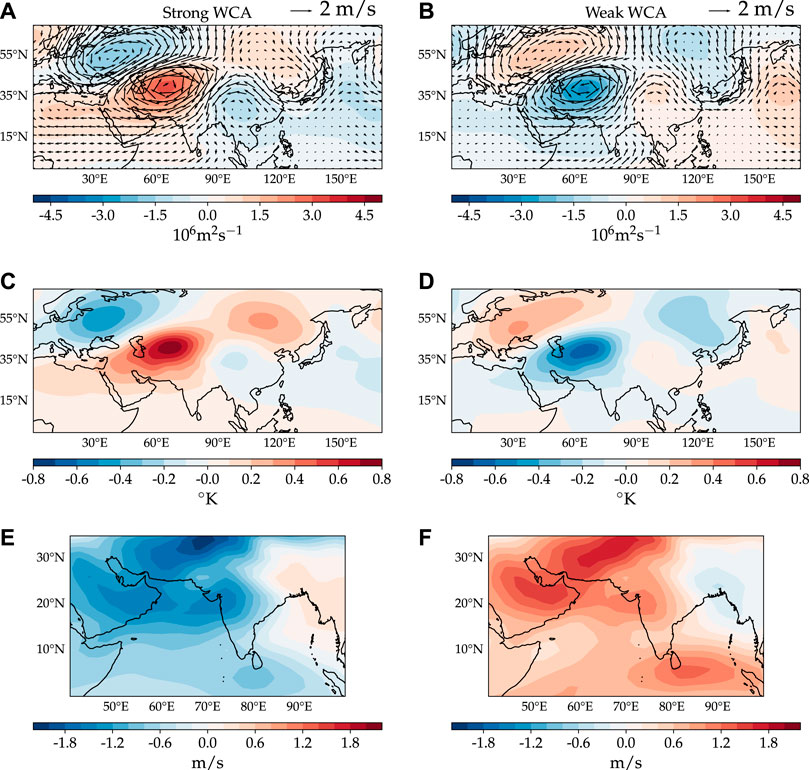
FIGURE 1. Composites of 200 hPa eddy stream function (shaded) and wind vectors (A,B), tropospheric temperature (C,D) and easterly shear (E,F) for strong (left panel) and weak (right panel) WCA years.
The analysis affirms that upper-level circulation anomalies over WCA is an integral part of the CGT-ISM teleconnection, and it has a significant impact on the ISM rainfall in the interannual time scale. On the other hand, the ISM (being a strong source of diabatic heating) can generate upper-level circulation anomalies over WCA and the Mediterranean region by the monsoon-desert mechanism (Rodwell and Hoskins, 1996; Stephan et al., 2019; Beverley et al., 2021). To explore the role of ISM in generating circulation anomalies over WCA, composites of 200 hPa eddy stream function field are examined for strong and weak ISM years (Supplementary Figure S2). Years when the normalized ISM index amplitude is greater than 0.7 (less than −0.7) are identified as strong (weak) ISM years. We have chosen a threshold of 0.7 so that strong and moderately strong ISM years are included in the analysis. The results remain the same for higher thresholds. 36 strong ISM years and 30 weak ISM years are identified. The composites clearly bring out the circulation anomalies over the Mediterranean and WCA. The upper-level circulation anomalies observed in Supplementary Figure S2 are a product of the interactions between the subtropical jet stream with the westward propagating Rossby waves forced by monsoon diabatic heating and its downstream responses (Rodwell and Hoskins, 1996).
To isolate the Atlantic impact on WCA circulation anomalies via the CGT, it is important to remove the ISM feedback on WCA circulation anomalies. A positive correlation (0.33) exists between the WCA and ISM indices in the interannual timescale. The correlation and our mechanistic understanding indicate that strong (weak) WCA years will invariably be associated with strong (weak) ISM years respectively. Of the 25 (23) strong (weak) WCA years, 14 (8) are also strong (weak) ISM years. Composites of eddy stream function at 200 hPa, TT and easterly shear of zonal winds are constructed for the strong (weak) WCA years, excluding the years when the ISM is concurrently strong (weak). Since we have chosen a ± 0.7 threshold for identifying strong/weak ISM years, we believe that removing these years will remove the influence of even moderately strong/weak ISM. However, it is possible that some feedback associated with ISM may persist. The strong WCA and weak WCA difference composites are shown in Figure 2 along with the difference composites, when the ISM influence is excluded. The difference composites bring out the positive stream function and TT anomalies over WCA and the associated negative wind shear response over the ISM domain. Comparing the difference composites of wind and TT anomalies with (Figures 2A,C,E) and without (Figures 2B,D,F) ISM feedback, it can be inferred that even without the ISM feedback, the upper-level circulation anomalies are prominent over WCA (Figures 2B,D,F). These findings indicate that, while the WCA region might be under the influence of circulation responses associated with ISM diabatic heating, the circulation anomalies over the region have an existence more or less independent of the ISM. It also means that the north Atlantic may be considered as the major source for the zonal teleconnection pattern and the WCA anomalies. It can be inferred that the summertime CGT is primarily driven by the Atlantic and it impacts the ISM through the WCA circulation anomalies. The circulation responses to the ISM diabatic heating further acts as positive feedback reinforcing the upper-level anticyclones over WCA and forcing the downstream CGT.
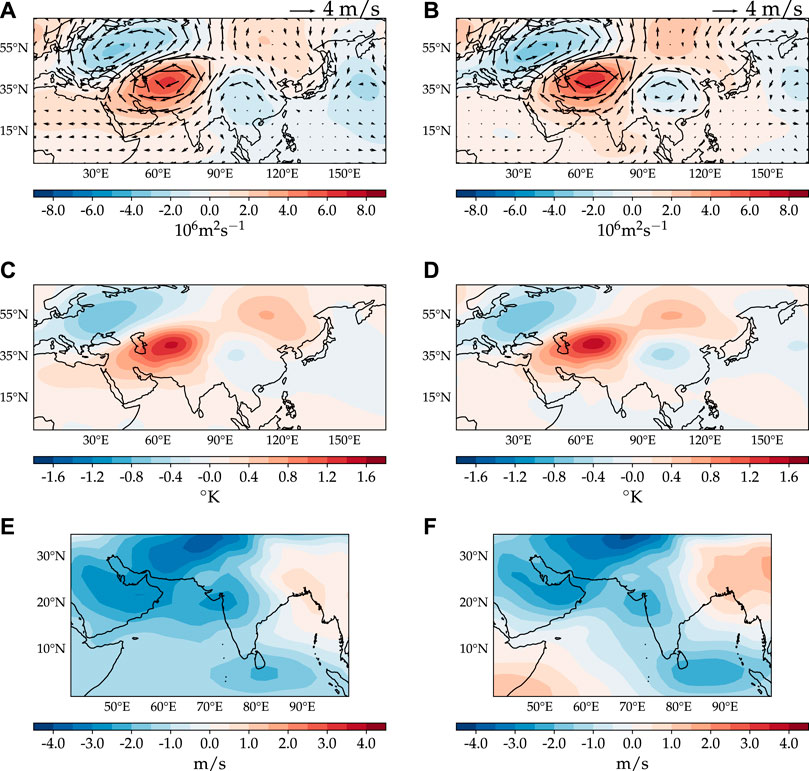
FIGURE 2. Left panel shows the difference between strong and weak WCA composites of 200 hPa eddy stream function (shaded) and wind vectors (A), tropospheric temperature (C) and easterly shear (E). Right panel shows the same difference in composites for 200 hPa eddy streamfunction and wind vectors (B), tropospheric temperature (D) and easterly shear (F), but the strong (weak) WCA composites were constructed by excluding the cases when the ISM was concurrently strong (weak).
The Atlantic multidecadal oscillations (AMO) and the ISM exhibit similar variability in the multidecadal timescale, and the Atlantic is considered as a major forcing for the ISM multidecadal variability. Since the WCA emerges as a major juncture in the Atlantic-ISM interactions in the interannual timescale, the feasibility of this mode of teleconnection is next explored in the multidecadal timescale. Multidecadal filtered 200 hPa eddy stream function fields are regressed on to the AMO index to bring out the upper-level teleconnection pattern associated with the AMO (Figure 3A). Luo et al. (2011), showed the presence of a similar teleconnection pattern associated with the AMO in climate model simulations, which was interpreted as a manifestation of atmospheric Rossby waves, forced by extra-tropical north Atlantic SST anomalies. The arching wave pattern from the Atlantic forcing region across Eurasia is evident in Figure 3A. A similar Rossby wave-train was also reported by Joshi and Ha (2019) characterized by alternate positive and negative polarity centers, extending from the North Atlantic to South Asia through Europe, acting as a pathway for the extra-tropical signals to extend its influence up to the Indian monsoon region. Positive regression anomalies observed over WCA implies that the region bears significance in the Atlantic-ISM teleconnection in the multidecadal time scale as well. Climate model simulations by Sandeep et al., 2022, also showed that a positive AMO phase can induce upper-level anticyclonic anomalies over WCA. The AMO, WCA and ISM indices exhibit coherent multi-decadal variability (Figure 3B), and significant positive correlations are observed between the three indices (AMO and WCA—0.34; AMO and ISM—0.41; WCA and ISM—0.47; all are statistically significant at 99% confidence level).
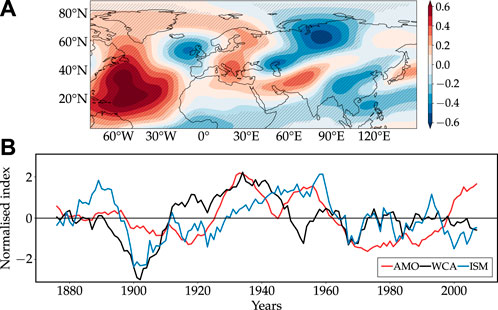
FIGURE 3. (A) Multidecadal 200 hPa eddy stream function field regressed on to the AMO index. The regression coefficients are significant at 95% confidence level in the hatched regions. (B) Multidecadal AMO, WCA and ISM indices from 1871-2012.
Figure 3B shows that during the recent AMO warm phase, the AMO is out-of-phase with both the WCA and the ISM. The AMO-ISM out-of-phase relationship in the recent decades has been reported by several earlier studies (Sankar et al., 2016; Luo et al., 2018b; Naidu et al., 2020; Ahmad et al., 2022; Sandeep et al., 2022). While the exact mechanism still remains an open research problem, Indian Ocean warming and associated weakening of meridional thermal contrast over the monsoon domain is considered a plausible explanation for the observed weakening of monsoon in the recent AMO warm phase (Luo et al., 2018a; Sandeep et al., 2022). Sabeerali et al. (2019) reported that the inverse relationship between the Atlantic Zonal mode and the ISM has strengthened in the recent decades, while based on climate model simulations Ahmad et al. (2022) suggest that the natural SST variability over subtropical western North Pacific might be at play in changing the AMO-ISM relationship. On the other hand, Naidu et al., 2020, attribute the weakening of monsoon in the recent decades to the impact of aerosols and land use changes. Wang et al. (2021) and Sandeep et al. (2022) showed that the weakening of ISM during the recent AMO warm phase is associated with cyclonic anomalies over WCA. We further explore the AMO induced upper-level teleconnection and recent out-of-phase association between the AMO and ISM. To understand this further, we examine the upper-level teleconnection pattern during two positive AMO epochs, P1 (1926–1961) and P2 (1999–2012) (Figures 4A,B). It is evident that the geopotential height anomalies over WCA are anti-cyclonic during the first epoch P1 and cyclonic in the recent epoch P2. It is not just over WCA, the entire teleconnection pattern from the Atlantic sector to Asia is very different during the two epochs. Apart from WCA, the circulation anomalies over subtropical north Atlantic, the Mediterranean and East Asia, all show opposite anomalies during the recent epoch. The teleconnection pattern is very similar in the 200 hPa eddy geopotential height field composite during the P2 epoch in the JRA-55 dataset (Supplementary Figure S6).
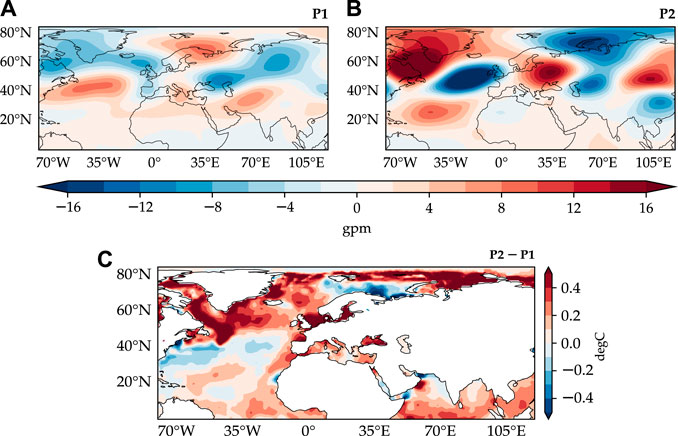
FIGURE 4. Composites of 200 hPa eddy geopotential height field during the two AMO warm epochs (A), P1 (1926–1961) and (B) P2 (1999–2012); (C) Difference between SST composites for the two epochs (P2-P1).
As the Atlantic is the main forcing domain for the teleconnection pattern, we further examined the SST anomalies over the north Atlantic during the two epochs in three different SST datasets (Supplementary Figure S3). The SST difference composite for the two phases (P2-P1) (Figure 4C, HadISST) brings out the relatively warmer subpolar north Atlantic and the relatively cooler subtropical north Atlantic in the recent epoch. Using intermediate complexity model experiments, Ratna et al. (2021), demonstrated the sensitivity of atmospheric responses to the pattern and extent of SST anomalies over the north Atlantic and the Arctic regions. From the composite maps of 850 hPa and 200 hPa eddy geopotential height fields during the two epochs (Supplementary Figure S4), it is evident that the high latitude warming alters the equivalent barotropic response over north Atlantic region. Equivalent barotropic responses to extra-tropical north Atlantic SST results from the interaction between local baroclinic response to heating and transient eddy vorticity fluxes (Kushnir et al., 2002). Such structures can alter the downstream teleconnection and the circulation anomalies over WCA (Borah et al., 2020). Therefore, the changes in the north Atlantic SST anomalies might explain the observed differences in the downstream responses and the overall teleconnection pattern changes (Figures 4A,B). While earlier studies (Luo et al., 2018a; Sandeep et al., 2022) attribute the recent out-of-phase relationship between AMO and ISM to Indian ocean warming, we show that changes in the upper-level teleconnection associated with the AMO may also play a key role in modulating the circulation anomalies over WCA, and the cyclonic anomalies over WCA might in turn weaken the ISM by modulating the easterly vertical shear and tropospheric temperature over the region.
Conclusion
Barotropic instability over the jet exit region over the north Atlantic and the Indian summer monsoon diabatic heating are identified as the two main forcings which maintain the Northern hemispheric summertime CGT. The ISM is influenced by the CGT through the strong upper-level anticyclonic circulation anomalies over WCA and the ISM diabatic heating can also produce similar circulation responses over WCA and thus affect the CGT. Although it appears as a mutually reinforcing mechanism, it is not clear whether the ISM plays a primary or secondary role in maintaining the CGT in a seasonal timescale. This question is explored in the study, focusing on the WCA region which forms a critical juncture in the AMO-ISM interactions. Understanding the relative role of north Atlantic and monsoon diabatic heating in generating the WCA anomalies is a very important aspect of midlatitude-ISM interactions. As expected, a strong association is observed between the WCA and ISM variability, as anticyclonic anomalies over WCA, lead to strengthened easterly shear, higher tropospheric temperature and instability over the ISM domain. Analysis of the WCA composites, including and excluding the ISM feedbacks, indicate that the circulation anomalies over WCA can have an existence more or less independent of the strength of the ISM. While the Rossby wave response associated with the monsoon may act as positive feedback in strengthening the WCA anomalies, the upstream forcing from the north Atlantic may have an upper hand in generating the WCA anomalies. As the influence of the Atlantic on the ISM via the WCA is evident in the interannual timescale, the feasibility of this mode of teleconnection is also explored in the multidecadal time scale. The significant co-variability of the AMO, WCA and ISM indices in the multidecadal timescale clearly supports this notion. Analysis of the upper-level teleconnection pattern associated with the AMO indicate that the multidecadal changes in circulation over WCA might play an important role in the Atlantic-ISM interactions in the multidecadal timescale as well.
Many studies have reported that the AMO-ISM association has weakened and become out-of-phase in recent decades. Earlier studies have reported that during the recent positive AMO phase, upper-level anomalies are cyclonic over WCA and this has been attributed to the weakened meridional thermal contrast over the ISM domain, induced by Indian Ocean warming. Our analysis of the upper-level teleconnection patterns during the recent and previous AMO positive epochs reveals that it is not just the WCA anomalies that are different in the recent AMO positive epoch. The entire teleconnection pattern extending from the north Atlantic forcing domain has undergone major changes in the recent decade, which is found to be associated with the high latitude warming over the north Atlantic. We propose that the equivalent barotropic responses to the extra-tropical north Atlantic SST anomalies, in turn alter the downstream teleconnection and the circulation anomalies over WCA. The cyclonic anomalies over WCA might in turn weaken the ISM by modulating the easterly vertical shear and tropospheric temperature over the region. Nevertheless, considering the limited span of observational records, we believe that more comprehensive modelling studies need to be carried out in future to understand the teleconnection responses to different Atlantic SST configurations in interannual and multidecadal timescales.
Data availability statement
Publicly available datasets were analyzed in this study. This data can be found here: https://climatedataguide.ucar.edu/climate-data/noaa-20th-century-reanalysis-version-2-and-2c, https://tropmet.res.in/static_pages.php?page_id=53, https://climatedataguide.ucar.edu/climate-data/cru-ts-gridded-precipitation-and-other-meteorological-variables-1901, https://www.metoffice.gov.uk/hadobs/hadisst/data/download.html, https://www.ncei.noaa.gov/products/extended-reconstructed-sst, https://climatedataguide.ucar.edu/climate-data/jra-55, https://psl.noaa.gov/data/gridded/data.cobe2.html.
Author contributions
JN perceived the idea and AD carried out the analysis. Both the authors contributed to the writing and presentation of the manuscript.
Acknowledgments
AD acknowledges the INSPIRE research fellowship from Department of Science and Technology, Government of India, for funding his doctoral research work. JN acknowledges the DST Climate Change grant for funding her research and IISER Pune for the infrastructure and support.
Conflict of interest
The authors declare that the research was conducted in the absence of any commercial or financial relationships that could be construed as a potential conflict of interest.
Publisher’s note
All claims expressed in this article are solely those of the authors and do not necessarily represent those of their affiliated organizations, or those of the publisher, the editors and the reviewers. Any product that may be evaluated in this article, or claim that may be made by its manufacturer, is not guaranteed or endorsed by the publisher.
Supplementary material
The Supplementary Material for this article can be found online at: https://www.frontiersin.org/articles/10.3389/feart.2022.973468/full#supplementary-material
References
Ahmad, A., Li, S., Luo, F., and Gao, Y. (2022). The unstable connection between atlantic multidecadal oscillation and Indian summer monsoon in CESM-LE. Clim. Dyn. 58, 1525–1537. doi:10.1007/s00382-021-05976-6
Beverley, J. D., Woolnough, S. J., Baker, L. H., Johnson, S. J., and Weisheimer, A. (2019). The northern hemisphere circumglobal teleconnection in a seasonal forecast model and its relationship to European summer forecast skill. Clim. Dyn. 52, 3759–3771. doi:10.1007/s00382-018-4371-4
Beverley, J. D., Woolnough, S. J., Baker, L. H., Johnson, S. J., Weisheimer, A., and O’Reilly, C. H. (2021). Dynamical mechanisms linking Indian monsoon precipitation and the circumglobal teleconnection. Clim. Dyn. 57, 2615–2636. doi:10.1007/s00382-021-05825-6
Borah, P. J., Venugopal, V., Sukhatme, J., Muddebihal, P., and Goswami, B. N. (2020). Indian monsoon derailed by a North Atlantic wavetrain. Science 370, 1335–1338. doi:10.1126/science.aay6043
Branstator, G. (2002). Circumglobal teleconnections, the jet stream waveguide, and the North Atlantic Oscillation. J. Clim. 15, 1893–1910. doi:10.1175/1520-0442(2002)015<1893:cttjsw>2.0.co;2
Compo, G. P., Whitaker, J. S., Sardeshmukh, P. D., Matsui, N., Allan, R. J., Yin, X., et al. (2011). The twentieth century reanalysis project. Q. J. R. Meteorol. Soc. 137, 1–28. doi:10.1002/qj.776
Ding, Q., and Wang, B. (2005). Circumglobal teleconnection in the northern hemisphere summer. J. Clim. 18, 3483–3505. doi:10.1175/JCLI3473.1
Ding, Q., and Wang, B. (2007). Intraseasonal teleconnection between the summer Eurasian wave train and the Indian Monsoon. J. Clim. 20, 3751–3767. doi:10.1175/JCLI4221.1
Duchon, C. E. (1979). Lanczos filtering in one and two dimensions. J. Appl. Meteorol. 18, 10162–11022. doi:10.1175/1520-0450(1979)018<1016:LFIOAT>2.0.CO;2
Enomoto, T., Hoskins, B. J., and Matsuda, Y. (2003). The formation mechanism of the Bonin high in August. Q. J. R. Meteorol. Soc. 129, 157–178. doi:10.1256/qj.01.211
Gao, M., Yang, J., Gong, D., Shi, P., Han, Z., and Kim, S. J. (2019). Footprints of Atlantic multidecadal oscillation in the low-frequency variation of extreme high temperature in the Northern Hemisphere. J. Clim. 32, 791–802. doi:10.1175/JCLI-D-18-0446.1
Goswami, B. N., Madhusoodanan, M. S., Neema, C. P., and Sengupta, D. (2006). A physical mechanism for North Atlantic SST influence on the Indian summer monsoon. Geophys. Res. Lett. 33, L02706. doi:10.1029/2005GL024803
Harris, I., Osborn, T. J., Jones, P., and Lister, D. (2020). Version 4 of the CRU TS monthly high-resolution gridded multivariate climate dataset. Sci. Data 7, 109. doi:10.1038/s41597-020-0453-3
He, S., Gao, Y., Furevik, T., Wang, H., and Li, F. (2018). Teleconnection between sea ice in the barents sea in June and the silk road, pacific–Japan and east asian rainfall patterns in august. Adv. Atmos. Sci. 35, 52–64. doi:10.1007/s00376-017-7029-y
He, S., Wang, H., Li, F., Li, H., and Wang, C. (2020). Solar-wind-magnetosphere energy influences the interannual variability of the northern-hemispheric winter climate. Natl. Sci. Rev. 7, 141–148. doi:10.1093/nsr/nwz082
Hirahara, S., Ishii, M., and Fukuda, Y. (2014). Centennial-scale sea surface temperature analysis and its uncertainty. J. Clim. 27, 57–75. doi:10.1175/JCLI-D-12-00837.1
Huang, B., Banzon, V. F., Freeman, E., Lawrimore, J., Liu, W., Peterson, T. C., et al. (2015). Extended reconstructed sea surface temperature version 4 (ERSST.v4). Part I: Upgrades and intercomparisons. J. Clim. 28, 911–930. doi:10.1175/JCLI-D-14-00006.1
Joshi, M. K., and Ha, K. J. (2019). Fidelity of CMIP5-simulated teleconnection between Atlantic multidecadal oscillation and Indian summer monsoon rainfall. Clim. Dyn. 52, 4157–4176. doi:10.1007/s00382-018-4376-z
Joshi, M. K., and Pandey, A. C. (2011). Trend and spectral analysis of rainfall over India during 1901-2000. J. Geophys. Res. 116, D06104. doi:10.1029/2010JD014966
Joshi, M. K., and Rai, A. (2015). Combined interplay of the Atlantic multidecadal oscillation and the interdecadal Pacific oscillation on rainfall and its extremes over Indian subcontinent. Clim. Dyn. 44, 3339–3359. doi:10.1007/s00382-014-2333-z
Joshi, M. K., Rai, A., and Kulkarni, A. (2022). Global-scale interdecadal variability a skillful predictor at decadal-to-multidecadal timescales for Sahelian and Indian Monsoon Rainfall. npj Clim. Atmos. Sci. 5, 2. doi:10.1038/s41612-021-00227-1
Kobayashi, S., Ota, Y., Harada, Y., Ebita, A., Moriya, M., Onoda, H., et al. (2015). The JRA-55 reanalysis: General specifications and basic characteristics. J. Meteorological Soc. Jpn. 93, 5–48. doi:10.2151/jmsj.2015-001
Kosaka, Y., Nakamura, H., Watanabe, M., and Kimoto, M. (2009). Analysis on the dynamics of a wave-like teleconnection pattern along the summertime Asian jet based on a reanalysis dataset and climate model simulations. J. Meteorological Soc. Jpn. 87, 561–580. doi:10.2151/jmsj.87.561
Kripalani, R. H., Kulkarni, A., and Singh, S. V. (1997). Association of the Indian summer monsoon with the northern hemisphere mid-latitude circulation. Int. J. Climatol. 17, 1055–1067. doi:10.1002/(sici)1097-0088(199708)17:10<1055::aid-joc180>3.0.co;2-3
Krishnamurthy, L., and Krishnamurthy, V. (2016). Teleconnections of Indian monsoon rainfall with AMO and Atlantic tripole. Clim. Dyn. 46, 2269–2285. doi:10.1007/s00382-015-2701-3
Krishnan, R., Kumar, V., Sugi, M., and Yoshimura, J. (2009). Internal feedbacks from monsoon-midlatitude interactions during droughts in the Indian summer monsoon. J. Atmos. Sci. 66, 553–578. doi:10.1175/2008JAS2723.1
Kushnir, Y., Robinson, W. A., Bladé, I., Hall, N. M. J., Peng, S., and Sutton, R. (2002). Atmospheric GCM response to extratropical SST anomalies: Synthesis and evaluation. J. Clim. 15, 2233–2256. doi:10.1175/1520-0442(2002)015<2233:agrtes>2.0.co;2
Lin, J. S., Wu, B., and Zhou, T. J. (2016). Is the interdecadal circumglobal teleconnection pattern excited by the Atlantic multidecadal Oscillation? Atmos. Ocean. Sci. Lett. 9, 451–457. doi:10.1080/16742834.2016.1233800
Lu, R. Y., Oh, J. H., and Kim, B. J. (2002). A teleconnection pattern in upper-level meridional wind over the North African and Eurasian continent in summer. Tellus A 54, 44–55. doi:10.1034/j.1600-0870.2002.00248.x
Luo, F., Li, S., and Furevik, T. (2011). The connection between the atlantic multidecadal oscillation and the Indian summer monsoon in bergen climate model version 2.0. J. Geophys. Res. 116, D19117–D19119. doi:10.1029/2011JD015848
Luo, F., Li, S., Gao, Y., Keenlyside, N., Svendsen, L., and Furevik, T. (2018a). The connection between the Atlantic multidecadal oscillation and the Indian summer monsoon in CMIP5 models. Clim. Dyn. 51, 3023–3039. doi:10.1007/s00382-017-4062-6
Luo, F. F., Li, S., and Furevik, T. (2018b). Weaker connection between the Atlantic Multidecadal Oscillation and Indian summer rainfall since the mid-1990s. Atmos. Ocean. Sci. Lett. 11, 37–43. doi:10.1080/16742834.2018.1394779
Msadek, R., Frankignoul, C., and Li, L. Z. X. (2011). Mechanisms of the atmospheric response to north atlantic multidecadal variability: A model study. Clim. Dyn. 36, 1255–1276. doi:10.1007/s00382-010-0958-0
Naidu, P. D., Ganeshram, R., Bollasina, M. A., Panmei, C., Nürnberg, D., and Donges, J. F. (2020). Coherent response of the Indian monsoon rainfall to atlantic multi-decadal variability over the last 2000 years. Sci. Rep. 10, 1302. doi:10.1038/s41598-020-58265-3
Ratna, S. B., Osborn, T. J., Joshi, M., and Luterbacher, J. (2020). The influence of atlantic variability on Asian summer climate is sensitive to the pattern of the sea surface temperature anomaly. J. Clim. 33, 7567–7590. doi:10.1175/JCLI-D-20-0039.1
Rayner, N. A., Parker, D. E., Horton, E. B., Folland, C. K., Alexander, L. V., Rowell, D. P., et al. (2003). Global analyses of sea surface temperature, sea ice, and night marine air temperature since the late nineteenth century. J. Geophys. Res. 108, 4407. doi:10.1029/2002jd002670
Rodwell, M. J., and Hoskins, B. J. (1996). Monsoons and the dynamics of deserts. Q. J. R. Meteorol. Soc. 122, 1385–1404. doi:10.1002/qj.49712253408
Sabeerali, C. T., Ajayamohan, R. S., Bangalath, H. K., and Chen, N. (2019). Atlantic zonal mode: An emerging source of Indian summer monsoon variability in a warming world. Geophys. Res. Lett. 46, 4460–4467. doi:10.1029/2019GL082379
Saeed, S., Müller, W. A., Hagemann, S., and Jacob, D. (2011). Circumglobal wave train and the summer monsoon over northwestern India and Pakistan: The explicit role of the surface heat low. Clim. Dyn. 37, 1045–1060. doi:10.1007/s00382-010-0888-x
Sandeep, N., Swapna, P., Krishnan, R., Farneti, R., Kucharski, F., Modi, A., et al. (2022). On the weakening association between South asian monsoon and atlantic multidecadal oscillation. Clim. Dyn. doi:10.1007/s00382-022-06224-1
Sankar, S., Svendsen, L., Gokulapalan, B., Joseph, P. V., and Johannessen, O. M. (2016). The relationship between Indian summer monsoon rainfall and Atlantic multidecadal variability over the last 500 years. Tellus, Ser. A Dyn. Meteorol. Oceanogr. 68, 31717. doi:10.3402/tellusa.v68.31717
Sato, N., and Takahashi, M. (2006). Dynamical processes related to the appearance of quasi-stationary waves on the subtropical jet in the midsummer northern hemisphere. J. Clim. 19, 1531–1544. doi:10.1175/JCLI3697.1
Son, J. H., Seo, K. H., Son, S. W., and Cha, D. H. (2021). How does Indian monsoon regulate the northern hemisphere stationary wave pattern? Front. Earth Sci. 8, 1–10. doi:10.3389/feart.2020.599745
Stephan, C. C., Klingaman, N. P., and Turner, A. G. (2019). A mechanism for the recently increased interdecadal variability of the silk road pattern. J. Clim. 32, 717–736. doi:10.1175/JCLI-D-18-0405.1
Svendsen, L. (2021). The atlantic multidecadal oscillation and Indian summer monsoon variability: A revisit. Indian Summer Monsoon Var. El Niño-Teleconnections Beyond, 353–374. doi:10.1016/B978-0-12-822402-1.00001-6
Trenberth, K. E., and Shea, D. J. (2006). Atlantic hurricanes and natural variability in 2005. Geophys. Res. Lett. 33, L12704. doi:10.1029/2006GL026894
Wang, Y., Li, S., and Lu, D. (2009). Seasonal response of asian monsoonal climate to the atlantic multidecadal oscillation. J. Geophys. Res. 114, D02112. doi:10.1029/2008JD010929
Wang, X., Lu, R., and Hong, X. (2021). Reduction of mid-summer rainfall in northern India after the late-1990s induced by the decadal change of the Silk Road pattern. Environ. Res. Lett. 16, 104051. doi:10.1088/1748-9326/ac2cea
Watanabe, T., and Yamazaki, K. (2014). The upper-level circulation anomaly over Central Asia and its relationship to the Asian monsoon and mid-latitude wave train in early summer. Clim. Dyn. 42, 2477–2489. doi:10.1007/s00382-013-1888-4
Wu, B., Zhou, T., Li, C., Müller, W. A., and Lin, J. (2019). Improved decadal prediction of Northern-Hemisphere summer land temperature. Clim. Dyn. 53, 1357–1369. doi:10.1007/s00382-019-04658-8
Yasui, S., and Watanabe, M. (2010). Forcing processes of the summertime circumglobal teleconnection pattern in a dry AGCM. J. Clim. 23, 2093–2114. doi:10.1175/2009JCLI3323.1
Keywords: Indian summer monsoon, circum-global teleconnection, Atlantic multidecadal oscillation, multidecadal variability, west central Asia
Citation: Dutta A and Neena JM (2022) Exploring the circum-global teleconnection—Indian summer monsoon interactions in the interannual and multidecadal timescales. Front. Earth Sci. 10:973468. doi: 10.3389/feart.2022.973468
Received: 20 June 2022; Accepted: 20 September 2022;
Published: 05 October 2022.
Edited by:
Arathy Menon, Met Office, United KingdomReviewed by:
Manish K. Joshi, Genesis Ray Energy, India Pvt. Ltd, IndiaShengping He, University of Bergen, Norway
Copyright © 2022 Dutta and Neena. This is an open-access article distributed under the terms of the Creative Commons Attribution License (CC BY). The use, distribution or reproduction in other forums is permitted, provided the original author(s) and the copyright owner(s) are credited and that the original publication in this journal is cited, in accordance with accepted academic practice. No use, distribution or reproduction is permitted which does not comply with these terms.
*Correspondence: J. M. Neena, bmVlbmFAaWlzZXJwdW5lLmFjLmlu