 Guo-Chao Sun
 You-Shan Xia1
 Qing-Yang Xu
 Li-Qun Dai
 Zi-Fu Zhao
- 1CAS Key Laboratory of Crust-Mantle Materials and Environments, School of Earth and Space Sciences, University of Science and Technology of China, Hefei, China
- 2Center of Excellence for Comparative Planetology, Chinese Academy of Sciences (CAS), Hefei, China
Post-collisional alkaline intrusive rocks from the Dabie orogen were studied for their whole-rock major-trace elements and Sr-Nd-Hf-Pb isotopes, as well as zircon U-Pb ages and Hf-O isotopes. The results provide geochemical constraints on the nature of their mantle sources and thus insight into crust-mantle interaction in the continental collision zone. The alkaline intrusive rocks are composed of syenite and nepheline syenite. Syn-magmatic zircon U-Pb dating by LA-ICP-MS for them yielded Early Cretaceous ages of 131.3 ± 1.4 Ma to 122.6 ± 0.6 Ma, coeval with the post-collisional magmatism in the Dabie orogen. One relict zircon with U-Pb age of 211 Ma is consistent with the timing of metamorphism for the ultrahigh-pressure (UHP) metamorphic rocks in this orogen. They have arc-like trace element distribution patterns, such as enrichment in LILE (large ion lithophile element) and LREE (light rare earth element) but depletion in HFSE (high field strength element), and enriched whole-rock Sr-Nd-Hf isotope compositions with high (87Sr/86Sr)i ratios of 0.7077–0.7131 but negative εNd(t) values of −16.0 to −9.4 and εHf(t) values of −17.5 to −12.7. Their syn-magmatic zircons have three groups of Hf-O isotope compositions comparable to those of UHP metamorphic rocks in Central-South Dabie and North Dabie, which represent the upper and middle continental crust of the subducted South China Block, respectively. In this regard, slab–mantle interaction is evident during the Triassic continental collision. We suggest that the melts derived from the subducted South China Block reacted with the lithospheric mantle wedge of the North China Block, resulting in phlogopite-bearing metasomatites, whose partial melting would generate the post-collisional alkaline intrusive rocks during the Early Cretaceous.
1 Introduction
Post-collisional igneous rocks are widespread within continental collision orogens, which are frequently associated with an extensional tectonic stage after collision event (Zheng et al., 2020 and references therein). Silicic alkaline igneous rocks, though accounting for a small volume among post-collisional igneous rocks, have received considerable attention about their petrogenesis due to their high alkalis, incompatible elements and volatile species (e.g., Sørensen, 1974; Marks and Markl, 2017). A number of models have been proposed, including the mantle derivation model, the fractional crystallization model, the crust derivation model, and the mixing model. The mantle derivation model suggests that they are produced by low degrees of partial melting of metasomatized mantle (Halama, 2004; Berger et al., 2014; Hou et al., 2015), which is supported by the presence of mantle-derived xenoliths and silica- and alkali-rich melt inclusions in their minerals, and the lack of evidence for low-pressure differentiation (Schiano and Clocchiatti, 1994; Schiano et al., 1998; Grant et al., 2013). The fractional crystallization model suggests that their high SiO2 parts are produced by fractional crystallization of primitive alkaline magma with or without crustal assimilation based on the coexistence of ultramafic to mafic rocks (Yang J.-H. et al., 2012; Berger et al., 2014; Hou et al., 2015; Zhu et al., 2020). For the crustal derivation model, it is suggested that they are formed by remelting of mafic alkaline rocks or other crustal rocks (Hay and Wendlandt, 1995; Kaszuba and Wendlandt, 2000; Legendre et al., 2005; Dai et al., 2017), which is also supported by the experimental phonolitic melt from the carbonated pelites at 2.5–5 GPa (Thomsen and Schmidt, 2008). The mixing model, on the other hand, suggests that they are produced by the mixing of crustal anatectic granitic and mantle-derived mafic magma followed by crystal differentiation (Barker et al., 1995; Litvinovsky et al., 2002). In this regard, it is still challenging to determine the origin of evolved alkaline rocks in the presence or absence of associated ultramafic to mafic rocks.
The Dabie-Sulu orogenic belt was formed by the collision between the South China Block and North China Block during the Triassic (Li et al., 1993; 1999; Zheng, 2008). Except for widespread high-pressure (HP) and ultrahigh-pressure (UHP) metamorphic rocks, voluminous post-collisional igneous rocks of Late Jurassic to Early Cretaceous are exposed in this orogenic belt (Huang et al., 2007; He et al., 2011; Zhao et al., 2013; Zhao et al., 2017). Different from the Sulu orogen with both Late Jurassic and Early Cretaceous post-collisional igneous rocks, the Dabie orogen contains only Early Cretaceous post-collisional igneous rocks (Zhao and Zheng, 2009; Zhao et al., 2017). A large portion of these igneous rocks are felsic intrusive rocks and a small portion are mafic intrusive rocks, with volcanic rocks only sporadically found in the North Dabie and Beihuaiyang zones (Dai et al., 2017; Zhao et al., 2017). The Beihuaiyang zone contains various types of Early Cretaceous igneous rocks, such as granite, syenite, phonolite, trachyte, andesite and dacite. The Beihuaiyang alkaline intrusive rocks, though outcrop in a small area, provide good samples for understanding the cycling of subducted continental crust and tectonic evolution of this orogen. Nevertheless, it is still controversial with respect to the nature of their magma source. Zhou et al. (1995) suggested that the ancient continental crust has played a major role in the genesis of these rocks, whose whole-rock Sr-Nd isotope compositions are similar to the North China Block. In contrast, it has also been suggested that these alkaline intrusive rocks were derived from a lithospheric mantle metasomatized by the subducted continental crust materials (Yang et al., 2002; Fan et al., 2004; Xu et al., 2008; Zhou et al., 2014).
This paper presents a combined study of whole-rock major-trace elements and Sr–Nd–Pb isotopes as well as zircon U–Pb ages and Hf-O isotopes for the post-collisional alkaline intrusive rocks in the Beihuaiyang zone of the Dabie orogen. The studied rocks exhibit whole-rock Sr-Nd-Pb isotope compositions and zircon in situ Hf-O isotope compositions comparable to the upper and middle continental crust of the subducted South China Block, indicating their origination from the orogenic lithospheric mantle metasomatized by melts from the subducted continental crust. Therefore, our results provide insights into the nature of magma source and crust-mantle interaction for the post-collisional alkaline intrusive rocks in collisional orogens.
2 Geological setting and samples
The Dabie-Sulu orogenic belt (Figure 1A), located in east-central China, is a typical continental collision orogen formed by the collision between the South China Block and the North China Block in the Triassic (e.g., Cong, 1996; Faure et al., 2003; Zheng et al., 2003). Influenced by the Tanlu fault zone (a left-lateral strike-slip fault), the Sulu orogen has been displaced northward by about 500 km in relation to the Dabie orogen (Figure 1A; Okay, 1993; Zhu et al., 2005). The presence of ultrahigh-pressure (UHP) metamorphic minerals such as coesite (Okay et al., 1989; Wang et al., 1989; 1992) and diamond (Xu et al., 1992; 2003; 2005; Xu et al., 1998; Liu et al., 2007) in the metamorphic rocks of this orogenic belt indicate that crustal rocks have subducted to mantle depths of >100 km and subsequently exhumated to the crustal level. The UHP metamorphic rocks in the Dabie orogen are dominated by orthogneiss with subordinate eclogite, granulite, amphibolite, migmatite and marble (Zheng et al., 2003). Previous studies on zircon U-Pb geochronology and mineral O isotopes have shown that the subducted continental crust is primarily composed of the Precambrian basement and its overlying sediment of the South China Block (Zheng et al., 2005; 2006). The Dabie UHP metamorphic belt can be divided into five zones based on their different metamorphic P-T conditions. From north to south, they are the Beihuaiyang low-T/low-P greenschist-facies zone (BHY), the North Dabie high-T/UHP granulite-facies zone (NDB), the Central Dabie middle-T/UHP eclogite-facies zone (CDB), the South Dabie low-T/UHP eclogite-facies zone (SDB), and the Susong low-T/HP blueschist-facies zone (SSZ) (Figure 1B; Xu et al., 2005; Zheng et al., 2005). All of these units were intruded by the post-collisional igneous rocks composed mainly of felsic granitoids and minor mafic-ultramafic rocks (e.g., Zhao and Zheng, 2009). Geochronological studies show that post-collisional magmatism occurred in the Early Cretaceous (Zhao et al., 2017; Yan et al., 2021; and references therein).
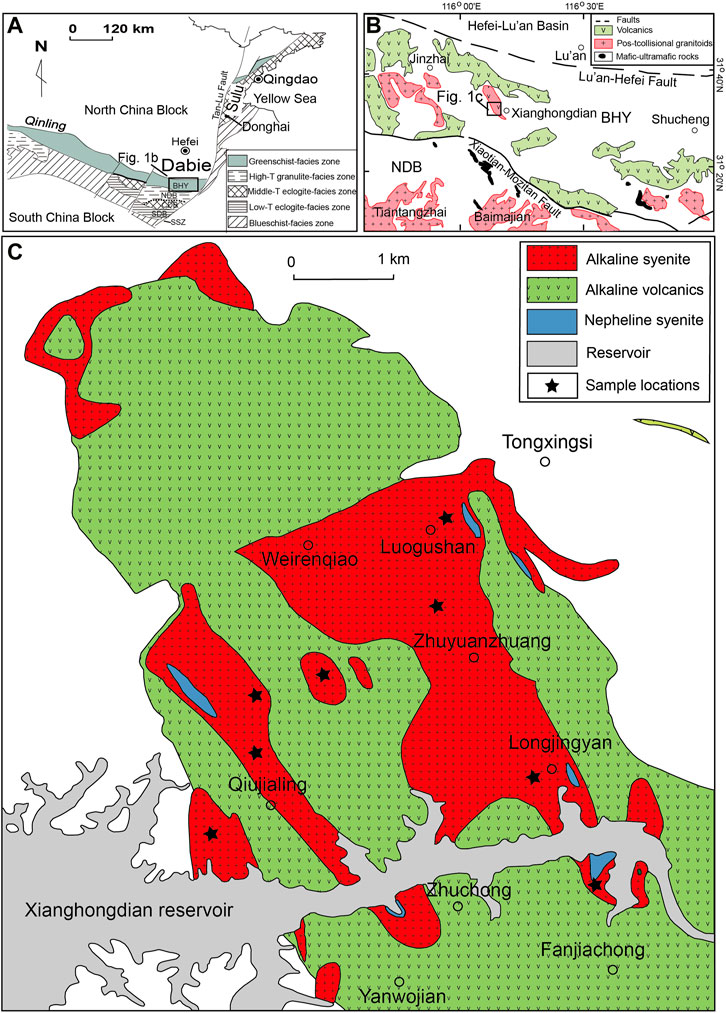
FIGURE 1. (A) Geological sketch map of the Dabie-Sulu orogenic belt and the study area in the Dabie orogen; (B) Distribution of post-collisional igneous rocks in the Beihuaiyang and North Dabie zones (modified after Dai et al., 2017); (C) Geological map of the alkaline complex in the Beihuaiyang zone (modified after Zhou et al., 2014; Dai et al., 2017). Abbreviations: BHY= Beihuaiyang low-T/low-P greenschist-facies zone, NDB = North Dabie high-T/UHP granulite-facies zone, CDB = Central Dabie Mid-T/UHP eclogite-facies zone, SDB = South Dabie low-T/UHP eclogite-facies zone, SSZ = Susong low-T/HP blueschist-facies zone.
The Beihuaiyang zone, located between the Xiaotian-Mozitan Fault and the Lu’an-Hefei Fault (Figure 1B), is composed of Late Neoproterozoic to Early Paleozoic flysch sediments of the Foziling Group and the Neoproterozoic Luzhenguan Complex, which have experienced greenschist-facies low grade metamorphism (Zheng et al., 2005; 2007). A series of alkaline igneous rocks were intruded in the Foziling Group schist, constituting an alkaline complex at Xianghongdian in the Beihuaiyang zone (Figure 1C). The alkaline volcanic rocks consist of phonolite and trachyte, while the alkaline intrusive rocks are syenite and nepheline syenite. The alkaline volcanic rocks in the Dabie orogen were suggested to be derived from partial melting of the subducted lower continental crust of the South China Block based on whole-rock Sr-Nd-Hf and zircon in situ O isotope compositions (Dai et al., 2017). However, the petrogenesis of the alkaline intrusive rocks is still controversial.
The alkaline intrusive rocks in this study, including syenite and nepheline syenite, were collected from the Beihuaiyang zone in the Dabie orogen (Figure 1C). Syenite is mainly composed of alkaline feldspar (∼55%), quartz (∼15%), biotite (∼20%), hornblende (∼10%) and a small amount of accessory minerals such as epidote, titanite and zircon (Figures 2A, D). Alkaline feldspar is granular and subhedral (0.5 mm–2 mm in length) with dirt-brown color (Figure 2A). Hornblende, biotite and aegirine with a yellowish-brown color are the dominant mafic minerals. Hornblende (0.5 mm–2 mm in length) and biotite (0.5 mm–1.5 mm in length) generally show subhedral plate-like shape. In contrast, aegirine has small sizes (0.2 mm–0.5 mm) and its edge is partially altered into chlorite. Nepheline syenite (Figures 2B, C) is mainly composed of alkaline feldspar and nepheline with variable degrees of alteration (Figure 2C). Alkaline feldspar (0.2 mm–0.5 mm in diameter) is subhedral plate in shape (Figure 2D), some of which are altered into clay minerals (Figure 2C). Nepheline (1 mm–3 mm in diameter) displays first-order gray interference color and has cracks, along which minerals such as calcite and albite are filled.
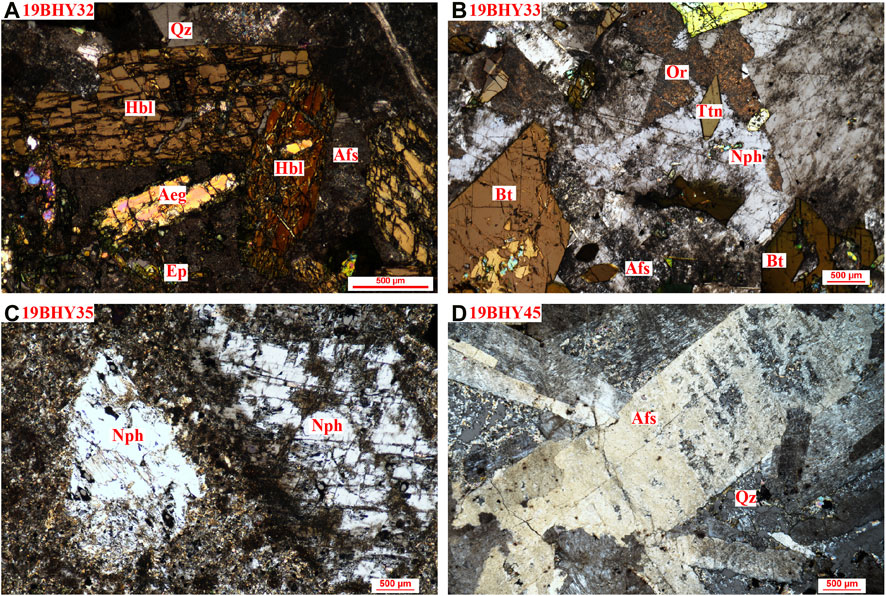
FIGURE 2. Photomicrographs (under crossed polarized light) for the Beihuaiyang alkaline intrusive rocks in the Dabie orogen. Mineral abbreviations are after Whitney and Evans (2010).
3 Analytical methods
3.1 Whole-rock major and trace elements
The alkaline intrusive rocks analyzed in this study are fresh with no apparent alteration. These samples were crushed to powders of 200 mesh before analysis. Whole-rock major element analysis was carried out at the Chinese Academy of Sciences (CAS) Key Laboratory of Crust-Mantle Materials and Environments at the University of Science and Technology of China (USTC), Hefei, China. A ceramic crucible with 0.5 g dried sample powder was heated in a muffler at 1050°C for 8 hours. After cooling, the loss on ignition (LOI) was calculated by the weight difference before and after heating. A mixture with 0.8 g powder and 8 g Li2Bi4O7 was fused in an auto fluxer at 1050°C–1100°C, the yielded flat molten glass disk was used to take major element analysis by an X-ray fluorescence spectrometer. The analytical precision of this procedure is better than ±1%–2%. Whole-rock trace element analysis was carried out at ALS Chemx Co. Ltd. (Guangzhou, China). To determine the trace element contents, 0.2 g whole-rock powder was mixed with 0.9 g lithium metaborate flux and then melted in a furnace at 1000°C. After cooling, the resulting glass was dissolved in 100 mL of 4% nitric acid, and the yielding solution was then analyzed by ICP-MS. The analytical precision is better than ±5% for trace elements.
3.2 Whole-rock Sr–Nd–Hf-Pb isotope analyses
Whole-rock Sr, Nd, Hf and Pb isotope ratios were determined using a Thermo Scientific Neptune multi-collector (MC)–ICP–MS at the CAS Key Laboratory of Crust-Mantle Materials and Environments at USTC, Hefei, China. Chemical separation prior to analysis was undertaken using conventional ion-exchange approaches, with details of the protocol can be found elsewhere (Yang et al., 2010; 2011; Yang et al., 2012 Y.-H.; Li et al., 2016a; Chu et al., 2019; Ma et al., 2022). About 100–150 mg fine sample powder was dissolved in a mixture of 2.5 mL concentrated HF, 0.2 mL HNO3 and HClO4 in a steel-jacketed Teflon bomb and then placed in an oven at 190°C for 1 week. After complete dissolution, each sample was dried at high temperature (fuming HClO4) on a hot plate, followed by treatment with 14 M HNO3, evaporation overnight, and subsequent taking up in 3 M HNO3 + 3% m/v H3BO3. After resealing the capsule, it was heated on a hot plate at 100°C overnight for chemical purification.
Using Eichrom DGA resin (50–100 μm, 2 mL), Sr, Nd, and Pb were first separated from the matrix. After eluting and collecting the major elements fraction with 3 M HNO3+3% m/v H3BO3, Sr and Pb fractions were collected for further purification. The column was then rinsed with 12 M HNO3 to remove any residual Ca effectively before the Hf fraction was collected, followed by separation of the Hf fraction using 3.5 M HNO3 and 0.2 M HF. A 2 M HCl was finally used to elute the Nd fraction. Further purification of the Sr and Pb fraction was performed with a Sr-specific resin (100–150 μm, 0.2 mL) prior to mass spectrometer analysis (Yang Y.-H. et al., 2012; Li et al., 2016a; Ma et al., 2022).
An analysis of Sr, Nd, Hf and Pb isotope ratios was conducted at the CAS Key Laboratory of Crust-Mantle Materials and Environments in USTC, Hefei, China, using a Neptune Plus MC-ICP-MS. Whole procedural blanks were less than 100 pg for Sr, 50 pg for Nd and 50 pg for Pb. The 87Sr/86Sr, 143Nd/144Nd and 176Hf/177Hf ratios were normalized to 86Sr/88Sr = 0.1194, 146Nd/144Nd = 0.7219 and 179Hf/177Hf = 0.7325, respectively, using the exponential law. During the period of data acquisition, standard analyses yielded results of 87Sr/86Sr = 0.710266 ± 12 (2σ, n=12) for NBS987, 143Nd/144Nd = 0.512097 ± 6 (2σ, n=12) for JNdi, 176Hf/177Hf = 0.282185 ± 6 (2σ, n=12) for Alfa Hf, and 206Pb/204Pb = 16.9397 ± 8 (2σ, n=8), 207Pb/204Pb = 15.4969 ± 8 (2σ, n=8), 208Pb/204Pb = 36.7156 ± 2 (2σ, n=8) for NBS981. In addition, USGS reference material BHVO-2 was also processed for Sr-Nd-Hf-Pb isotope analyses, giving ratios of 0.703474 ± 10 (2σ, n=2) for 87Sr/86Sr, 0.512982 ± 6 (2σ, n=2) for 143Nd/144Nd, 0.283084 ± 6 (2σ, n=2) for 176Hf/177Hf, and 18.6485 ± 8 (2σ, n=2), 15.5288 ± 20 (2σ) and 38.2379 ± 2 (2σ, n=2) for 206Pb/204Pb, 207Pb/204Pb, and 208Pb/204Pb, respectively, which are consistent with the recommended values within analytical errors (Weis et al., 2005; 2006; 2007).
3.3 Zircon in situ U-Pb and Hf isotopes
Zircon grains were mounted in an epoxy resin and polished to reveal their inner centers. Cathodoluminescence (CL) imaging was conducted to select positions before in situ U-Pb dating and Hf isotope analysis. The zircon U–Pb analyses were conducted using a LA–ICP–MS at the CAS Key Laboratory of Crust–Mantle Materials and Environments, USTC, Hefei, China. According to the approach outlined by Yuan et al. (2004), a GeoLasHD ablation system equipped with a 193 nm excimer laser was employed with an Agilent 7900 ICP-MS. A carrier gas was used, helium, which was combined with argon in a homogenizer before entering the ICP. The zircon standards 91500 and GJ-1, along with the standard glasses BHVO-2G, BCR-1G, and BIR-2G, were evaluated for isotopic fractionation and trace element determinations. ICPMSDataCal (Liu et al., 2008) was used to reduce the resulting data and Isoplot version 3.0 was used to calculate ages (Ludwig, 2003). Age uncertainties are quoted at the 95% confidence level, and the GJ-1 standard zircon analysis gave an age of 602.3 ± 4.6 Ma (2 SD, n = 30).
Zircon Lu-Hf isotope analysis was undertaken using a Thermo Scientific Neptune multi-collector (MC–ICP–MS) coupled with a 193 nm ArF excimer laser ablation system at the CAS Key Laboratory of Crust-Mantle Materials and Environments at USTC, Hefei, China. The analysis used the approach outlined by Gu et al. (2019). Analysis spots were chosen within or close to the exact zircon domains for U–Pb dating with a laser spot diameter of 44 μm and a repetition rate of 10 Hz. Analytical quality was monitored by repeat analysis of the Qinghu and 91500 standard zircons, yielding a mean 176Hf/177Hf ratio of 0.282990 ± 20 (2σ, n=5) and 0.282290 ± 22 (2σ, n=4), respectively, consistent with the reference values for these standards (Blichert-Toft, 2008; Morel et al., 2008; Sláma et al., 2008; Li et al., 2013).
3.4 SIMS zircon O isotope analysis
Zircon in situ O analysis for samples 19BHY30, 19BHY49 and 19BHY59 was conducted by a Cameca IMS 1280-HR at the State Key Laboratory of Isotope Geochemistry, Guangzhou Institute of Geochemistry, CAS, Guangzhou. Analytical procedures are identical to those described by Li et al. (2010a) and Yang et al. (2018, 2020). The Cs+ primary ion beam with an intensity of ∼2 nA was accelerated to 10 kV and rasterized over 10 μm in size diameter. For the correction of the instrumental mass fractionation (IMF), the zircon standard Penglai was used, with a recommended δ18O value of 5.31‰ ± 0.10‰ (Li et al., 2010b). The internal precision of every single analysis of δ18O value is generally better than ±0.20‰. As assessed by the reproducibility of repeated analyses of the Penglai standard, the external precision during this study is 0.17‰ (2 SD, n = 25). Accordingly, the measured δ18O value of Qinghu, which is used as a reference value to verify the validity of the IMF, is 5.38‰ ± 0.12‰ (2 SD, n = 26), which is consistent with the reference value within analytical error (Li et al., 2013).
4 Results
4.1 Zircon U-Pb ages
In situ zircon U-Pb dating was performed on zircon grains from six alkaline intrusive rocks, and the results are listed in Supplementary Table S1. Zircon grains generally display oscillatory, band or unclear zonings in CL images, which are typical of magmatic origin (Figure 3). These samples yield U–Pb ages of 122.6 ± 0.6 Ma (n = 25, MSWD = 1.2) to 131.3 ± 1.4 Ma (n = 18, MSWD = 1.6) for the syn-magmatic zircons. One residual metamorphic zircon core with an age of 211 Ma is also observed with a Th/U ratio of 0.02.

FIGURE 3. Representative zircon CL images and concordia diagrams of LA-ICP-MS U–Pb isotopic data for the Beihuaiyang alkaline intrusive rocks in the Dabie orogen. The inside smallest circles denote the analytical spots for O isotopes; the middle and outside circles denote the analytical spots for U–Pb ages and Hf isotopes. The numbers below zircon grains denote U-Pb ages, εHf(t) and δ18O values in order.
4.2 Whole-rock major and trace elements
A total of nineteen alkaline intrusive rocks from the Beihuaiyang zone were analyzed for whole-rock major and trace elements, and the results are presented in Supplementary Table S2. All major element contents have been normalized to 100% on a loss of ignition free basis prior to plotting.
These samples display high Na2O+K2O contents of 11.1–11.8 wt% and plot into the syenite and nepheline syenite fields in the total alkali-silica (TAS) classification diagram (Figure 4A). They also have high K2O/Na2O ratios of 1.30–2.69, except for 19BHY25 with a low K2O/Na2O ratio of 0.62. On the diagram of K2O versus Na2O (Figure 4B), they fall into the shoshonitic and ultrapotassic fields. In the chondrite-normalized rare earth element (REE) diagram (Figure 4C), the Beihuaiyang alkaline intrusive rocks are characterized by strong LREE enrichment relative to heavy REE (HREE) with high (La/Yb)N ratios of 31.7–218.3, and either negative or positive Eu anomalies (Eu/Eu* = 0.51–1.17). In the primitive mantle-normalized trace element diagram (Figure 4D), they are characterized by the enrichment of LILE (Rb, K and Pb) but depletion of P and high field strength elements (HFSE), such as Nb, Ta and Ti.
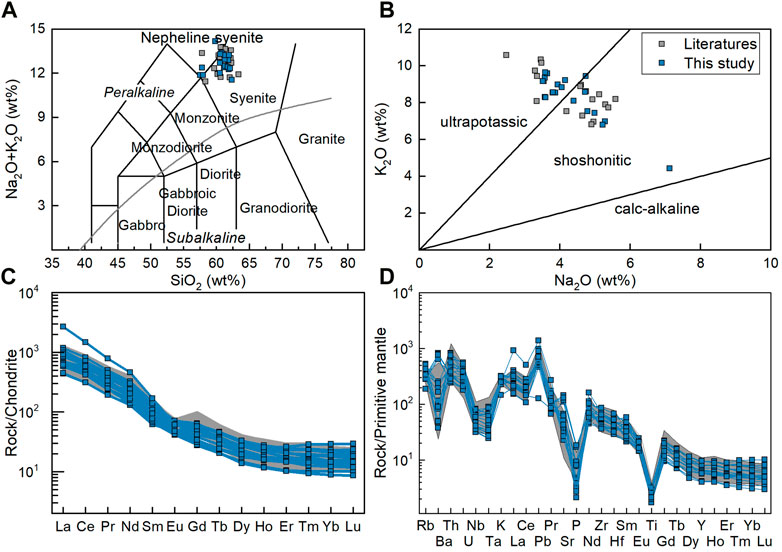
FIGURE 4. Diagrams of SiO2 versus total alkali contents (A), Na2O contents versus K2O contents (B), chondrite-normalized REE (C) and primitive mantle-normalized trace element (D) distribution for the Early Cretaceous Beihuaiyang alkaline intrusive rocks in the Dabie orogen. The classification in (A) is after Middlemost (1994), the classification in (B) is after Turner et al. (1996), the chondrite REE contents and the primitive mantle trace element contents are from McDonough and Sun (1995). The literature data are from Zhou et al. (1995), Yang et al. (2002), and Zhou et al. (2014).
Generally, the Fe2O3T, TiO2, MgO and P2O5 contents of these alkaline intrusive rocks show roughly decreasing trends with increasing SiO2 (Figures 5A, C, E), whereas the K2O content shows an increasing trend with increasing SiO2 (Figure 5B). These samples have high Sr (480–3040 ppm) content and display a decreasing trend with increasing SiO2 content (Figure 5F).
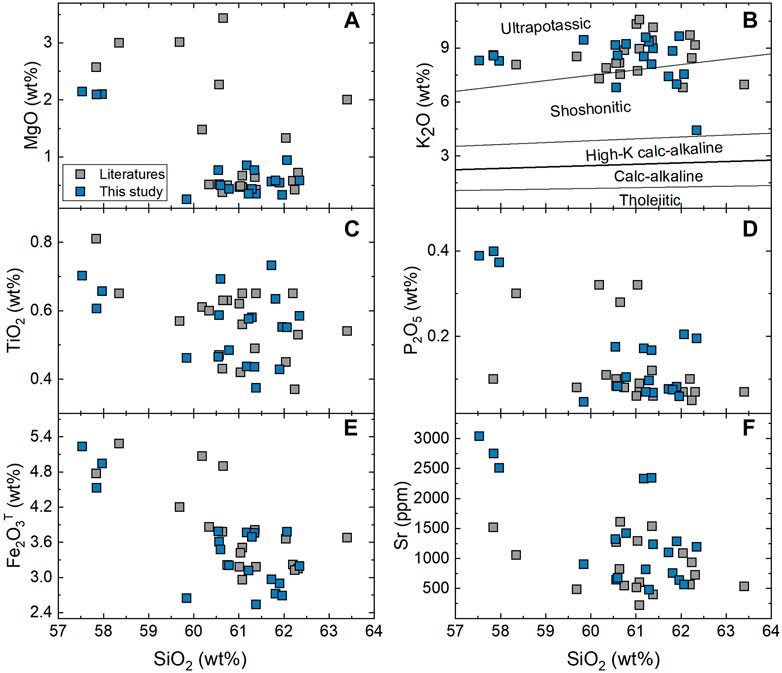
FIGURE 5. Harker plots of SiO2 versus major and trace elements for the Beihuaiyang alkaline intrusive rocks in the Dabie orogen. Literature data are same as those in Figure 4.
4.3 Whole-rock Sr-Nd-Hf-Pb isotopes
The Sr-Nd-Hf isotope analyses were performed on nineteen Beihuaiyang alkaline intrusive rocks, and seventeen of them were also performed for Pb isotope analysis (Supplementary Table S3). The initial (87Sr/86Sr)i ratios, εNd(t) values, εHf(t) values and initial Pb isotope ratios of the Beihuaiyang alkaline intrusive rocks were calculated back to 126 Ma based on zircon U-Pb dating results (Figure 3). These rocks have relatively high (87Sr/86Sr)i ratios of 0.7092–0.7098, negative εNd(t) values of −16.0 to −14.4 (Figure 6A), corresponding to two-stage Nd model ages of 2230–2096 Ma (Supplementary Table S3). They also show negative εHf(t) values of −17.5 to −15.6 (Figure 6B), corresponding to two-stage Hf model ages of 2303–2185 Ma. As shown in Figure 6B, the samples are plotted near the Nd-Hf Terrestrial Array (εHf(t) = 1.55 × εNd(t) + 1.21; Vervoort et al., 2011) and do not exhibit significant Hf-Nd isotope decoupling. The (206Pb/204Pb)i (207Pb/204Pb)i and (208Pb/204Pb)i ratios of the Beihuaiyang alkaline intrusive rocks are 17.232–17.452, 15.501–15.529 and 37.710–38.018, respectively. On the (207Pb/204Pb)i versus (206Pb/204Pb)i diagram, these alkaline intrusive rocks are plotted left of the Earth Geochron and above the Northern Hemisphere Reference Line (NHRL) (Figure 6C; Hart, 1984). In addition, they also fall above the NHRL on the (208Pb/204Pb)i versus (206Pb/204Pb)i diagram (Figure 6D).
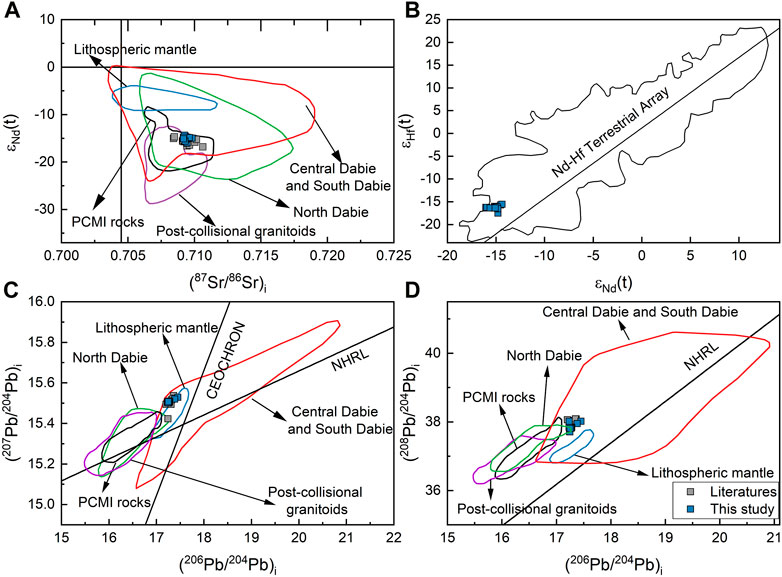
FIGURE 6. (A) Diagram of (87Sr/86Sr)i ratios versus εNd(t) values for the Early Cretaceous Beihuaiyang alkaline intrusive rocks in the Dabie orogen. The Sr-Nd isotope compositions for the lithospheric mantle of the North China Block (Zhang and Yang, 2007), ultra-high pressure metamorphic rocks in Central Dabie and South Dabie (Ames et al., 1996; Chavagnac and Jahn, 1996; Chen and Jahn, 1998; Li et al., 2000; Ma et al., 2000; Xia et al., 2008), ultra-high pressure metamorphic rocks in North Dabie (Ma et al., 2000; Zheng et al., 2000; Liu et al., 2005), post-collisional granitoids (Chen et al., 2002; Zhang et al., 2002; 2010; Wang et al., 2007; Huang et al., 2008; Xu et al., 2008), and post-collisional mafic-ultramafic instrusives (PCMI) (Chen and Jahn, 1998; Li et al., 1998; Jahn et al., 1999; Wang et al., 2005; Zhao et al., 2005; Huang et al., 2007; Dai et al., 2012) are also plotted for comparison. (B) Plot of whole-rock εHf(t) versus εNd(t) for the Beihuaiyang alkaline intrusive rocks in the Dabie orogen. The Terrestrial Array is after Vervoort et al. (2011). All data are calculated at t =126 Ma. Diagrams of initial 206Pb/204Pb ratios versus initial 207Pb/204Pb ratios (C) and initial 206Pb/204Pb ratios versus initial 208Pb/204Pb ratios (D) for the Early Cretaceous Beihuaiyang alkaline intrusive rocks in the Dabie orogen. The Pb isotope compositions for the lithospheric mantle of the North China Block (Zhang et al., 2002), ultra-high pressure metamorphic rocks in Central Dabie and South Dabie (Zhang et al., 2002; Li et al., 2003; Shen et al., 2014), ultra-high pressure metamorphic rocks in North Dabie (Zhang et al., 2002; Li et al., 2003; Shen et al., 2014), post-collisional granitoids (Zhang et al., 2002; Huang et al., 2008), and post-collisional mafic-ultramafic intrusives (PCMI) (Wang et al., 2005; Huang et al., 2007; Dai et al., 2012) are also plotted for comparison. NHRL-Northern Hemisphere reference line (207Pb/204Pb)NHRL = 0.1084 × (206Pb/204Pb)i + 13.491 (208Pb/204Pb)NHRL = 1.209 × (206Pb/204Pb)i + 15.627 (Hart, 1984). The literature data are from Zhou et al. (1995) and Yang (2002).
4.4 Zircon in situ Hf-O isotopes
The zircons from the six samples that were dated by LA-ICP-MS were also analyzed for Lu–Hf isotopes by LA-MC-ICP-MS, and four samples were selected to perform zircon in situ O isotopes by SIMS. The analyzed domains for in situ U-Pb and Hf-O isotopes are the same or close to each other. The syn-magmatic zircon domains display three groups of δ18O values and εHf(t) values (Figure 7A). Group I has low δ18O values of 3.00‰–3.82‰, high εHf(t) values of −5.1 to 5.6 and young two-stage Hf model ages of 1497 to 820 Ma; Group II has medium δ18O values of 4.42‰–5.17‰, variable and negative εHf(t) values of −22.5 to −4.5 and variable old two-stage Hf model ages of 2595 to 1463 Ma; Group III has high δ18O values of 5.87‰–6.74‰, negative εHf(t) values of −6.9 to −14.0 and medium two-stage Hf model age of 2061 to 1615 Ma (Figures 7A, B). The relict zircon with U-Pb age of 211 Ma has εHf(t) value of −15.0 and two-stage Hf model age of 2187 Ma.
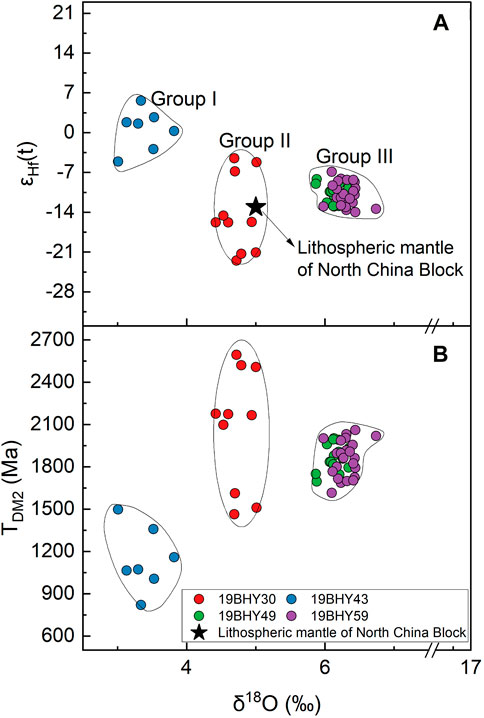
FIGURE 7. Zircon Hf and O isotope relationships for the Beihuaiyang alkaline intrusive rocks in the Dabie orogen. (A) δ18O versus εHf(t), (B) δ18O versus TDM2.
5 Discussion
The LA-ICP-MS zircon U-Pb dating for the Beihuaiyang alkaline intrusive rocks yielded concordant ages of 131.3 ± 1.4 Ma to 122.6 ± 0.6 Ma (Figure 3), which agree well with those dating results by previous studies (Zhou et al., 1995; Yang et al., 1999; Zhou et al., 2014). These ages are coeval with the Early Cretaceous post-collisional magmatism in the Dabie orogen, but postdate the UHP metamorphism due to the collision between the South China Block and North China Block (Zhao and Zheng, 2009). In this respect, these alkaline intrusive rocks belong to post-collisional igneous rocks.
These post-collisional alkaline intrusive rocks have arc-like trace element distribution patterns, such as enrichment in LREE and LILE but depletion in HREE and HFSE, and enriched radiogenic whole-rock Sr-Nd-Hf isotopes with high initial (87Sr/86Sr)i and negative εNd(t) and εHf(t) values. These geochemical compositions show a strong affinity to the continental crust, which is generally characterized by arc-like trace element distribution patterns and enriched radiogenic isotope compositions. Furthermore, one residual zircon core with U–Pb age of 211 Ma was observed in this study, consistent with the Triassic metamorphic age for the UHP rocks in the Dabie–Sulu orogenic belt (Zheng et al., 2004; Tang et al., 2008a; Tang et al., 2008b; Zheng et al., 2009). Therefore, the geochemical compositions of the Early Cretaceous Beihuaiyang alkaline intrusive rocks suggest that continental crust materials have played an important role in their petrogenesis.
5.1 Influence of syn/post-magmatic processes
Syn/post-magmatic processes, such as fractional crystallization and/or crustal assimilation (AFC process) and water-rock interaction, would influence the geochemical compositions of magmas after they were formed in their sources. It is necessary to evaluate these factors before discussing their petrogenesis and the nature of their magma source. The low loss on ignition (LOI) contents of 1.18–3.24 wt% and the poor relationship between the LOI and fluid-mobile element contents (not shown) indicate that later alteration has a negligible influence on the geochemical compositions of the alkaline intrusive rocks in this study.
It is generally accepted that the continental crust is characterized by high SiO2 content, high incompatible element contents and high (87Sr/86Sr)i ratios but low εNd(t) values and compatible element contents. Once influenced by crustal assimilation, the igneous rocks would exhibit covariant trends between their SiO2 contents and trace element contents or isotopes mentioned above. Although the Beihuaiyang alkaline intrusive rocks have variable major and trace elements, they have consistent REE and trace element distribution patterns and restricted Sr-Nd-Hf-Pb isotope compositions. Additionally, there are no obvious correlations between their initial (87Sr/86Sr)i ratios (Figure 8A) or εNd(t) values (Figure 8B) and their SiO2 contents. All these pieces of evidence indicate that crustal assimilation has played a negligible role in their geochemical compositions.
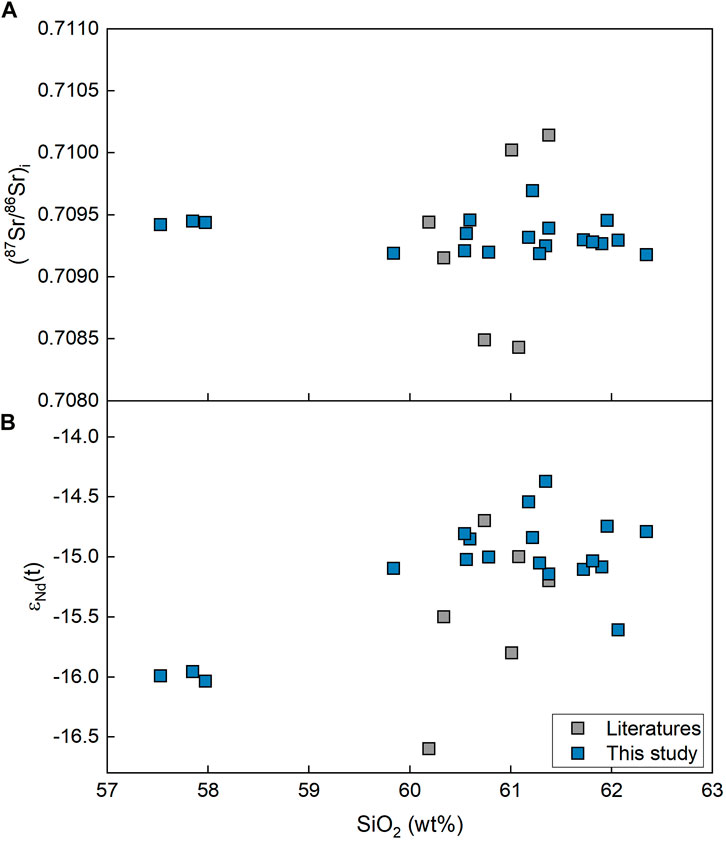
FIGURE 8. Diagrams of SiO2 contents versus initial 87Sr/86Sr ratios (A) and SiO2 contents versus εNd(t) values for the Beihuaiyang alkaline intrusive rocks in the Dabie orogen. The literature data sources are same as those in Figure 6.
The Beihuaiyang alkaline intrusive rocks have moderate SiO2 contents of 55.5–60.4 wt%, low MgO contents of 0.25–2.07 wt% and variable Mg# number of 17.57–50.44, indicating they may experience fractional crystallization during their emplacement. The decreasing Fe2O3T, TiO2 and P2O5 contents with increasing SiO2 content (Figures 5C–E) together with negative P and Ti anomalies (Figure 4D) suggest Fe-Ti oxides and apatite may be fractionated. In addition, the decreasing Sr content with increasing SiO2 content and negative Eu, Ba and Sr anomalies for most samples (Figure 4D) indicate the fractionation of K-feldspar and plagioclase. This is because Ba is dominant in K-feldspar while Sr and Eu are mainly hosted by plagioclase. Notably, a few samples also show positive Eu, Ba and Sr anomalies and high contents of these elements, which may indicate that they did not undergo fractional crystallization but accumulation of K-feldspar and plagioclase (Figure 4D).
In summary, the alkaline intrusive rocks from the Beihuaiyang zone do not appear to be significantly affected by crustal assimilation, but they did undergo considerable crystal fractionation during magma ascent. Although the crystal fractionation can significantly affect whole-rock major and trace element compositions, it does not significantly affect their radiogenic Sr-Nd-Hf-Pb and zircon in situ O isotope compositions. This may explain why they show a wide range of whole-rock major and trace elements content but a restricted range of isotope compositions. As a result, their isotopic characteristics are primarily determined by magma source and can be used to constrain the nature of magma source.
5.2 The source nature of the beihuaiyang syenites
Numerous petrological, geochemical and experimental studies have shown that alkaline intrusive rocks can be produced either by fractional crystallization of alkaline basaltic magma (e.g., Irving and Price, 1981; Eby et al., 1998) or partial melting of crustal rocks caused by an influx of volatiles and alkalis (e.g., Hay and Wendlandt, 1995; Kaszuba and Wendlandt, 2000; Legendre et al., 2005) or low degrees of partial melting of metasomatized lithosphere mantle (e.g., Laporte et al., 2014; Ashwal et al., 2016). Due to the lack of contemporaneous alkaline mafic igneous rock, we can exclude the first possibility. Despite their variable Mg# values, a few Beihuaiyang alkaline intrusive rocks have high Mg# values (up to 50.44) and MgO contents (2.02–2.07 wt%) as well as positive zircon εHf(t) values, indicating their derivation from mantle rocks rather than crustal rocks. According to previous studies (Jung et al., 2007; Ding et al., 2011), K-rich alkaline intrusive rocks produced by partial melting of mafic lower continental crust under high pressure generally have high Al2O3 and Sr contents but low Y and HREE contents, resulting in significantly high Sr/Y ratios. However, the high K2O contents (>4 wt%), together with negative correlations between Al2O3, Y contents and Sr/Y ratios (Figure 9), suggest that they are unlikely to be the product of partial melting of mafic lower continental crust.
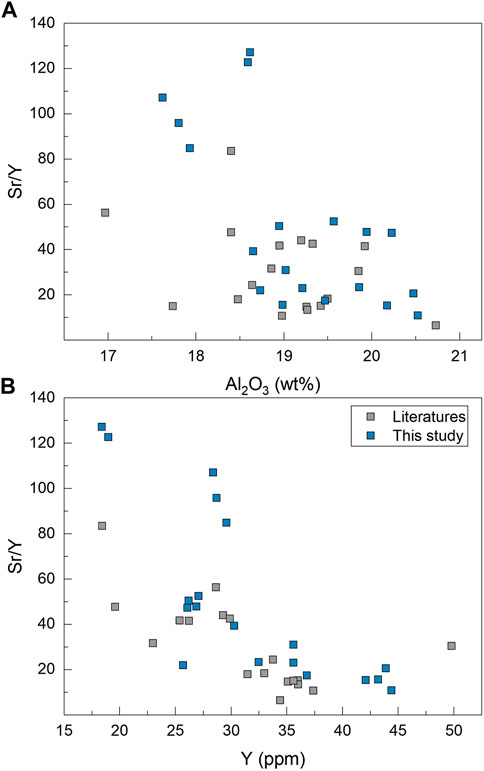
FIGURE 9. Diagrams of Al2O3 contents versus Sr/Y ratios (A) and Y contents versus Sr/Y ratios (B) for the Beihuaiyang alkaline intrusive rocks in the Dabie orogen. The literature data sources are same as those in Figure 5.
Low-degree partial melting of pre-enriched lherzolite at pressures of 1.0–1.5 GPa can produce phonolitic melts with Mg# of 50–60 (Irving and Price, 1981; Draper and Green, 1997; Laporte et al., 2014). Because of the lack of feldspar fractionation at mantle pressures, Ba and Sr concentrations are typically very high and range from several hundred to thousands of ppm (Irving and Price, 1981). These features are consistent with those of the Beihuaiyang alkaline intrusive rocks, supporting their origination from the mantle rather than ancient continental crust (Zhou et al., 1995). Based on the enriched radiogenic isotope compositions and arc-like trace element distribution patterns, it has been suggested that these alkaline intrusive rocks originated from the enriched lithospheric mantle metasomatized by the subducted continental crust materials (Yang et al., 2002; Xia et al., 2008; Zhou et al., 2014). Nevertheless, the origin and the nature of the subducted crustal material are still less constrained.
The Early Cretaceous Beihuaiyang alkaline intrusive rocks in the Dabie orogen have more enriched Sr-Nd isotope compositions than the North China lithospheric mantle (Figure 6A), suggesting that they were not directly derived from the unmetasomatized North China lithospheric mantle. The Beihuaiyang alkaline intrusive rocks are located within the Dabie orogen, which was built by the northward subduction of the South China Block beneath the North China Block during the Triassic (e.g., Cong, 1996; Faure et al., 2003; Zheng et al., 2003). These facts suggest that the crustal materials metasomatized the overlying lithospheric mantle of North China most likely come from the subducted South China Block. Previous studies on the post-collisional mafic igneous rocks in the Dabie-Sulu orogenic belt and the southeastern margin of North China have demonstrated that the subducted continental crust materials were involved in their mantle sources (Zhao et al., 2013; 2015). A three-layer crustal architecture was proposed for the Dabie orogen before the Early Cretaceous magmatism according to Sr-Nd-Hf-Pb isotope compositions of the metamorphic rocks and post-collisional granites (Zhang et al., 2002; Li et al., 2003; Zhao et al., 2008; 2011; Shen et al., 2014), with Central Dabie and South Dabie representing the upper layer, North Dabie representing the middle layer and the source of the post-collisional granites representing the lower layer of the subducted South China Block. The Sr-Nd-Hf isotope compositions are gradually enriched from the upper to lower layers, while the Pb isotope composition progressively becomes depleted (Figure 6).
The Sr-Nd isotope compositions of these alkaline intrusive rocks fall within the fields of the Central-South Dabie and North Dabie metamorphic rocks (Figure 6A). However, in the Pb isotope composition diagrams (Figures 6C,D), most of them fall within the fields of the Central and South Dabie metamorphic rocks, with only a few samples in the North Dabie field. In this regard, the mantle source of the alkaline intrusive rocks would be metasomatized by materials from the subducted upper and middle continental crust of the South China Block. It is generally accepted that the metasomatic agents in subduction zones are generally aqueous solutions and hydrous melts, the former is only capable of carrying water-mobile elements, such as LILE, while the latter carries not only water-mobile elements but water-immobile elements, such as REE and HFSE (Zheng, 2019). Given that the Beihuaiyang alkaline intrusive rocks have similar Sr-Nd-Pb isotope compositions comparable to the subducted upper and middle crust of the South China Block and that their Nd-Hf isotope compositions are not decoupled (Figure 6), we suggest that the mantle source of the Early Cretaceous Beihuiayang alkaline intrusive rocks is the lithospheric mantle of the North China Block metasomatized by the melts from the subducted upper and middle continental crust of the South China Block during the Triassic.
The zircons in these alkaline intrusive rocks have three groups of Hf-O isotope compositions, suggesting the mantle source contains crustal materials with both low to high εHf(t) and δ18O values. Group I zircon has low δ18O values of 3.00‰–3.82‰, high εHf(t) values of −5.1 to 5.6 and young two-stage Hf model ages of 1497 to 820 Ma, which are comparable to the metaigneous rocks in the Central Dabie (Figures 10A, B). Based on the result of Li et al. (2011), the εHf(t) value (t = 126 Ma) of the lithospheric mantle beneath the North China Block is about −13.1. As its O isotope composition was unconstrained, we assume that it has the normal mantle zircon δ18O values of 5.3‰ ± 0.3‰ (Valley et al., 1998). Therefore, the Hf-O isotope compositions of Group I zircon can be mainly attributed to the recycling of the subducted upper crust of the South China Block, which have undergone high-T water-rock interaction during the Neoproterozoic (Zheng et al., 2003; 2004; 2009; Chen et al., 2007; 2010; Tang et al., 2008a; 2008b; He et al., 2016). Although Group II and Group III zircons have different δ18O values of 4.42‰–5.17‰ and 5.87‰–6.74‰, they have similar two-stage Hf model ages of 2595 to 1463 Ma, which are comparable to the metaigneous rocks in North Dabie (Figures 10C, D) but different from those of the lithospheric mantle beneath the North China Block. The lower zircon εHf(t) values and older Hf model ages as well as higher δ18O values for Group II and III zircons suggest their origination from the recycled middle crust as represented by the North Dabie UHP rocks. In addition, materials from the different layers of the subducted South China Block were also suggested to be incorporated into the mantle source of post-collisional mafic to ultramafic igneous rocks in the Dabie orogen based on their zircon Hf-O isotope compositions (Dai et al., 2011).
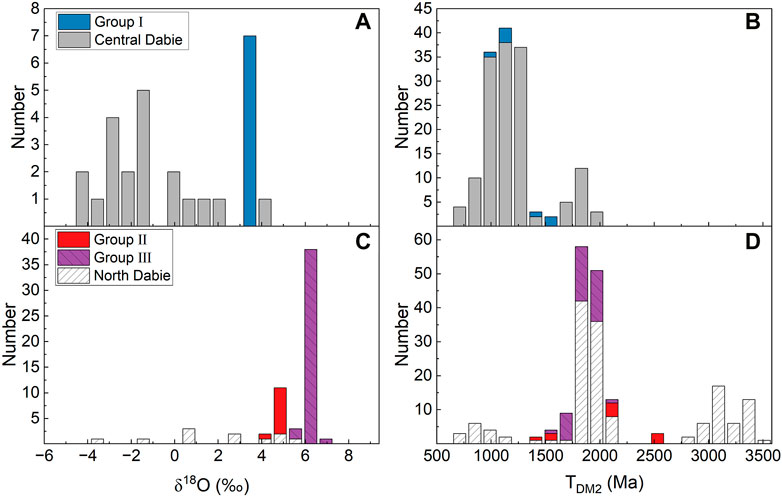
FIGURE 10. Comparisons of zircon Hf and O isotope compositions between the Beihuaiyang alkaline intrusive rocks and the UHP metamorphic rocks in the Dabie orogen. Data sources: the UHP granitic gneisses and eclogites in Central Dabie (Zheng et al., 2004; Zheng et al., 2005; Zheng et al., 2006); the UHP granitic gneisses and granulites in North Dabie (Zheng et al., 2004; Zhao et al., 2005; 2008; Lei and Wu, 2008). Groups I (A, B) and Group II and III (C, D) zircon δ18O values and Hf model ages for the Beihuaiyang alkaline intrusive rocks are comparable to those of the subducted continental crust in Central Dabie (upper layer) and North Dabie (middle layer), respectively.
The Early Cretaceous Beihuaiyang alkaline intrusive rocks in the Dabie orogen have moderate SiO2 contents (55.5–60.4 wt%), high K2O contents (4.26–9.40 wt%) and high K2O/Na2O ratios (0.62–2.69), which require the presence of potassium-rich minerals in their mantle source (Wang H. et al., 2014). It is generally acknowledged that phlogopite and amphibole are the two major potassium-rich phases in the lithospheric mantle (Spāth et al., 1996; Turner et al., 1996; Sun et al., 2014; Conticelli et al., 2015). According to the results of previous studies (Furman and Graham, 1999), melts from phlogopite-bearing mantle source have high Rb/Sr ratios (>0.1) but low Ba/Rb ratios (<20), while melts from amphibole-bearing mantle source have low Rb/Sr ratios (<0.05) but high Ba/Rb ratios (>30). The Early Cretaceous Beihuaiyang alkaline intrusive rocks in the Dabie orogen show high Rb/Sr (0.06–0.70) and low Ba/Rb (0.89–30.16) ratios (Figure 11), indicating that phlogopite is the dominant potassium-rich phase in their mantle source. Experimental studies have shown that partial melting of phlogopite-bearing mantle peridotite can directly produce potassic magmas with SiO2 contents of 52–64 wt% (Condamine and Médard, 2014; Mallik et al., 2015; Förster et al., 2019). Therefore, the Early Cretaceous Beihuaiyang alkaline intrusive rocks may originate from partial melting of the phlogopite-bearing mantle source. Meanwhile, the presence of phlogopite in the mantle source suggests that the mantle source was enriched in potassium by metasomatism before magmatism (Laporte et al., 2014). Combined with the element and isotope compositions of the Early Cretaceous Beihuaiyang alkaline intrusive rocks, we suggest that they originated from low degrees of partial melting of the lithospheric mantle metasomatized by the melts from the subducted upper and middle crust of the South China Block.
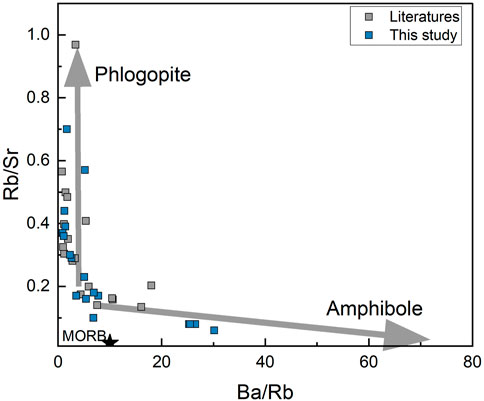
FIGURE 11. Diagram of Ba/Rb ratios versus Rb/Sr ratios for the Beihuaiyang alkaline intrusive rocks in the Dabie orogen. The literature data sources are same as those in Figure 5.
5.3 Crust-mantle interaction during the continental collision
The Early Cretaceous (131.3–122.6 Ma) Beihuaiyang alkaline intrusive rocks are coeval with the post-collisional magmatism in the Dabie orogen (e.g., Zhao and Zheng, 2009), indicating that they are post-collisional igneous rocks. As discussed above, they originated from partial melting of the enriched lithospheric mantle, which was metasomatized by melts from the subducted upper and middle crust of the South China Block in the Triassic. Thus, the melt-peridotite reaction would be the mechanism for producing the enriched mantle source.
Previous studies on UHP metamorphic rocks in the Dabie-Sulu orogenic belt have confirmed that the subducted continental crust were partially melted at varying degrees during the continental subduction/collision in the Triassic (Xia et al., 2008; Zheng et al., 2011; Liu et al., 2012; 2014; Chen et al., 2013; Wang L. et al., 2014). Furthermore, M-type peridotites in the Dabie-Sulu orogenic belt also record extensive evidence of melt/fluid metasomatism (Zhang et al., 2011; Zheng et al., 2011), which was demonstrated by many petrological and geochemical evidence, such as the metasomatism-generated zircons with 206Pb/238U ages ranging from 220 ± 2 Ma to 231 ± 4 Ma (Zhang et al., 2005; Li et al., 2016b), their whole-rock arc-type trace element signatures and enriched Sr-Nd isotope compositions, and the occurrence of water-bearing minerals (e.g., auriferous mica and Ti-plagioclase magnesite). All these pieces of evidence suggest that during the collision between the South China Block and North China Block in the Triassic, the continental lithospheric mantle wedge of the North China Block was metasomatized by the melts/fluids released from the subducted South China Block, forming a fertile and enriched orogenic lithospheric mantle (Zheng, 2012; Zheng and Hermann, 2014). For the Early Cretaceous Beihuaiyang alkaline intrusive rocks, the involvement of the subducted crustal materials into their mantle source can explain their arc-like trace element distribution patterns (i.e., enrichment in LREE and LILE but depletion in HREE and HFSE) and enriched radiogenic isotope compositions (i.e., high initial (87Sr/86Sr)i ratios and negative εNd(t) and εHf(t) values, Figures 6A,B). Meanwhile, the (87Sr/86Sr)i ratios, εNd(t) values and initial Pb isotope compositions of the Early Cretaceous Beihuaiyang alkaline intrusive rocks in the Dabie orogen fall within the fields of the Central Dabie, South Dabie and North Dabie UHP metamorphic rocks (Figure 6), which represent the upper and middle continental crust of the subducted South China Block (Zheng et al., 2005; Zheng et al., 2006; Liu and Li, 2008; Liu, 2018). This suggests that the crustal materials involved in the mantle source of the Early Cretaceous Beihuaiyang alkaline intrusive rocks mainly originated from the upper and middle continental crust of the South China Block.
Collectively, the subducted upper and middle continental crust of the South China Block was partially melted during the Triassic, resulting in felsic melts that were enriched in LREE, LILE and radiogenic isotopes, but depleted in HREE and HFSE. These melts have reacted with the lithospheric mantle wedge of the North China Block, resulting in phlogopite-bearing metasomatites that were stored for about 100 Myr (Figure 12A). During the post-collisional stage in Early Cretaceous (Figure 12B), the metasomatized lithospheric mantle was partially melted to form the Beihuaiyang alkaline intrusive rocks due to the extension of the continental lithospheric and the collapse of the orogen (Zheng and Zhao, 2017).
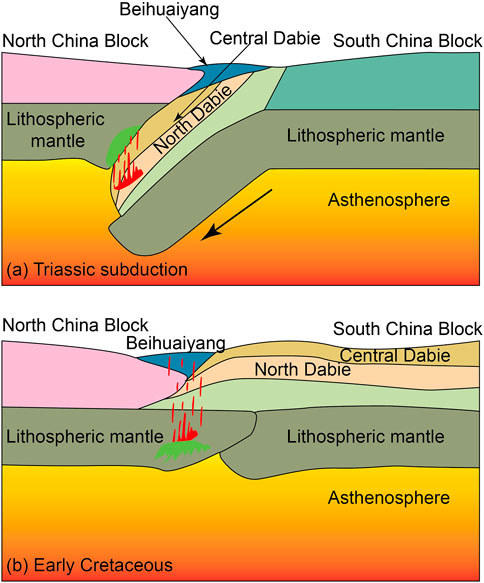
FIGURE 12. Schematic cartoon illustrating interaction between the overlying lithospheric mantle and the subducted continental crust, and the formation of Beihuaiyang alkaline intrusive rocks in the Dabie orogen. (A) Metasomatism of the overlying lithospheric mantle wedge peridotite by hydrous silicate melts derived from the upper (Central Dabie) and middle layers (Noth Dabie) of the subducted South China Block to form the orogenic lithospheric mantle in the Triassic. (B) Partial melting of the metasomatized mantle to form the Beihuaiyang alkaline intrusive rocks due to the extension of the continental lithosphere and the collapse of the orogen in the Early Cretaceous.
6 Conclusion
The Early Cretaceous Beihuaiyang alkaline intrusive rocks were formed at 123–131 Ma, which are consistent with the time of significant post-collisional magmatism in the Dabie orogen. They were produced by low degrees of partial melting of the enriched lithospheric mantle based on their element and isotope characteristics. During the continental collision between the South China Block and the North China Block in the Triassic, the subducted upper and middle continental crust of the South China Block was partially melted, and the resulting felsic melts have reacted with the lithospheric mantle of the North China Block to produce the enriched mantle metasomatites. As the lithosphere of the orogen was thinned and extended in the post-collisional stage, partial melting of these mantle metasomatites resulted in the formation of the Early Cretaceous Beihuaiyang alkaline intrusive rocks. Therefore, the Early Cretaceous Beihuaiyang alkaline intrusive rocks in the Dabie orogen provide a new perspective for understanding the crust-mantle interaction and the post-collisional magmatism in the continental collision orogen.
Data availability statement
The original contributions presented in the study are included in the article/Supplementary Material, further inquiries can be directed to the corresponding author.
Author contributions
G-CS: Conceptualization, data curation, experiments, investigation, methodology, visualization, and writing—original draft. Y-SX: Investigation and experiments. GW: Writing, zircon in situ Hf data processing and identification of thin sections. LQ: Zircon in situ Hf data processing. Xu Qingyang: writing and editing. L-QD: Writing, review and editing. Z-FZ: Conceptualization, investigation, methodology, and writing—review and editing.
Funding
This study was supported by funds from the Strategic Priority Research Program (B) of the Chinese Academy of Sciences (XDB41000000), the Natural Science Foundation of China (92055209, 41888101).
Acknowledgments
We appreciate the assistance of Qi Chen with field sampling, Ting Liang with LA-ICP-MS zircon U–Pb isotope analysis and Xiao-Ping Xia with SIMS zircon U–Pb and O isotope analysis.
Conflict of interest
The authors declare that the research was conducted in the absence of any commercial or financial relationships that could be construed as a potential conflict of interest.
Publisher’s note
All claims expressed in this article are solely those of the authors and do not necessarily represent those of their affiliated organizations, or those of the publisher, the editors and the reviewers. Any product that may be evaluated in this article, or claim that may be made by its manufacturer, is not guaranteed or endorsed by the publisher.
Supplementary material
The Supplementary Material for this article can be found online at: https://www.frontiersin.org/articles/10.3389/feart.2023.1194555/full#supplementary-material
References
Ames, L., Gaozhi, Z., and Baocheng, X. (1996). Geochronology and isotopic character of ultrahigh-pressure metamorphism with implications for collision of the Sino-Korean and Yangtze cratons, central China. Tectonics 15 (2), 472–489. doi:10.1029/95tc02552
Ashwal, L., Torsvik, T., Horváth, P., Harris, C., Webb, S., Werner, S., et al. (2016). A mantle-derived origin for mauritian trachytes. J. Petrol. 57, egw052–1676. doi:10.1093/petrology/egw052
Baker, M. B., Hirschmann, M. M., Ghiorso, M. S., and Stolper, E. M. (1995). Compositions of near-solidus peridotite melts from experiments and thermodynamic calculations. Nature 375 (6529), 308–311. doi:10.1038/375308a0
Berger, J., Ennih, N., and Liégeois, J.-P. (2014). Extreme trace elements fractionation in Cenozoic nephelinites and phonolites from the Moroccan Anti-Atlas (Eastern Saghro). Lithos 210-211, 69–88. doi:10.1016/j.lithos.2014.09.018
Blichert-Toft, J. (2008). The Hf isotopic composition of zircon reference material 91500. Chem. Geol. 253 (3-4), 252–257. doi:10.1016/j.chemgeo.2008.05.014
Chen, B., Jahn, B. M., and Wei, C. (2002). Petrogenesis of mesozoic granitoids in the dabie UHP complex, central China: Trace element and Nd–Sr isotope evidence. Lithos 60 (1-2), 67–88. doi:10.1016/s0024-4937(01)00077-9
Chen, J., and Jahn, B. M. (1998). Crustal evolution of southeastern China: Nd and Sr isotopic evidence. Tectonophysics 284 (1-2), 101–133. doi:10.1016/s0040-1951(97)00186-8
Chen, R.-X., Zheng, Y.-F., Gong, B., Zhao, Z.-F., Gao, T.-S., Chen, B., et al. (2007). Origin of retrograde fluid in ultrahigh-pressure metamorphic rocks: Constraints from mineral hydrogen isotope and water content changes in eclogite–gneiss transitions in the Sulu orogen. Geochimica Cosmochimica Acta 71 (9), 2299–2325. doi:10.1016/j.gca.2007.02.012
Chen, R.-X., Zheng, Y.-F., and Xie, L. (2010). Metamorphic growth and recrystallization of zircon: Distinction by simultaneous in-situ analyses of trace elements, U–Th–Pb and Lu–Hf isotopes in zircons from eclogite-facies rocks in the Sulu orogen. Lithos 114 (1-2), 132–154. doi:10.1016/j.lithos.2009.08.006
Chen, Y.-X., Zheng, Y.-F., and Hu, Z. (2013). Synexhumation anatexis of ultrahigh-pressure metamorphic rocks: Petrological evidence from granitic gneiss in the Sulu orogen. Lithos 156-159, 69–96. doi:10.1016/j.lithos.2012.10.008
Chu, Z.-Y., Wang, M.-J., Li, C.-F., Yang, Y.-H., Xu, J.-J., Wang, W., et al. (2019). Separation of Nd from geological samples by a single TODGA resin column for high precision Nd isotope analysis as NdO + by TIMS. J. Anal. Atomic Spectrom. 34 (10), 2053–2060. doi:10.1039/c9ja00200f
Condamine, P., and Médard, E. (2014). Experimental melting of phlogopite-bearing mantle at 1 GPa: Implications for potassic magmatism. Earth Planet. Sci. Lett. 397, 80–92. doi:10.1016/j.epsl.2014.04.027
Cong, B. (1996). Ultrahigh-pressure metamorphic rocks in the dabieshan-sulu region of China. Beijing: Science Press.
Conticelli, S., Avanzinelli, R., Ammannati, E., and Casalini, M. (2015). The role of carbon from recycled sediments in the origin of ultrapotassic igneous rocks in the Central Mediterranean. Lithos 232, 174–196. doi:10.1016/j.lithos.2015.07.002
Dai, L.-Q., Zhao, Z.-F., Zheng, Y.-F., An, Y.-J., and Zheng, F. (2017). Geochemical distinction between carbonate and silicate metasomatism in generating the mantle sources of alkali basalts. J. Petrology 58 (5), 863–884. doi:10.1093/petrology/egx038
Dai, L.-Q., Zhao, Z.-F., Zheng, Y.-F., Li, Q., Yang, Y., and Dai, M. (2011). Zircon Hf–O isotope evidence for crust–mantle interaction during continental deep subduction. Earth Planet. Sci. Lett. 308 (1-2), 229–244. doi:10.1016/j.epsl.2011.06.001
Dai, L.-Q., Zhao, Z.-F., Zheng, Y.-F., and Zhang, J. (2012). The nature of orogenic lithospheric mantle: Geochemical constraints from postcollisional mafic–ultramafic rocks in the dabie orogen. Chem. Geol. 334, 99–121. doi:10.1016/j.chemgeo.2012.10.009
Ding, L.-X., Ma, C.-Q., Li, J.-W., Robinson, P. T., Deng, X.-D., Zhang, C., et al. (2011). Timing and Genesis of the adakitic and shoshonitic intrusions in the laoniushan complex, southern margin of the North China craton: Implications for post-collisional magmatism associated with the qinling orogen. Lithos 126 (3-4), 212–232. doi:10.1016/j.lithos.2011.07.008
Draper, D. S., and Green, T. H. (1997). P–T phase relations of silicic, alkaline, aluminous mantlexenolith glasses under anhydrous and C–O–H fluid-saturated conditions. J. Petrol. 38, 1187–1224. doi:10.1093/petroj/38.9.1187
Eby, G. N., Woolley, A. R., Din, V., and Platt, G. (1998). Geochemistry and petrogenesis of nepheline syenites: Kasungu-chipala, ilomba, and ulindi nepheline syenite intrusions, north nyasa alkaline province, Malawi. J. Petrology 39 (8), 1405–1424. doi:10.1093/petroj/39.8.1405
Fan, W.-M., Guo, F., Wang, Y.-J., and Zhang, M. (2004). Late mesozoic volcanism in the northern huaiyang tectono-magmatic belt, central China: Partial melts from a lithospheric mantle with subducted continental crust relicts beneath the dabie orogen? Chem. Geol. 209 (1-2), 27–48. doi:10.1016/j.chemgeo.2004.04.020
Faure, M., Lin, W., Schärer, U., Shu, L., Sun, Y., and Arnaud, N. (2003). Continental subduction and exhumation of UHP rocks. Structural and geochronological insights from the Dabieshan (East China). Lithos 70 (3-4), 213–241. doi:10.1016/s0024-4937(03)00100-2
Förster, M. W., Prelević, D., Buhre, S., Mertz-Kraus, R., and Foley, S. F. (2019). An experimental study of the role of partial melts of sediments versus mantle melts in the sources of potassic magmatism. J. Asian Earth Sci. 177, 76–88. doi:10.1016/j.jseaes.2019.03.014
Furman, T., and Graham, D. (1999). Erosion of lithospheric mantle beneath the east african rift system: Geochemical evidence from the kivu volcanic province. Lithos 48 (1-4), 237–262. doi:10.1016/s0024-4937(99)00031-6
Grant, T. B., Milke, R., Pandey, S., and Jahnke, H. (2013). The Heldburg Phonolite, Central Germany: Reactions between phonolite and xenocrysts from the upper mantle and lower crust. Lithos 182-183, 86–101. doi:10.1016/j.lithos.2013.09.012
Gu, H.-O., Sun, H., Wang, F.-Y., Ge, C., and Zhou, T.-F. (2019). A new practical isobaric interference correction model for the in situ Hf isotopic analysis using laser ablation-multi-collector-ICP-mass spectrometry of zircons with high Yb/Hf ratios. J. Anal. Atomic Spectrom. 34 (6), 1223–1232. doi:10.1039/c9ja00024k
Halama, R. (2004). The gronnedal-ika carbonatite-syenite complex, south Greenland: Carbonatite formation by liquid immiscibility. J. Petrology 46 (1), 191–217. doi:10.1093/petrology/egh069
Hart, S. R. (1984). A large-scale isotope anomaly in the Southern Hemisphere mantle. Nature 309 (5971), 753–757. doi:10.1038/309753a0
Hay, D. E., and Wendlandt, R. F. (1995). The origin of Kenya rift plateau-type flood phonolites: Results of high-pressure/high-temperature experiments in the systems phonolite-H2O and phonolite-H2O-CO2. J. Geophys. Res. Solid Earth 100 (B1), 401–410. doi:10.1029/94jb02160
He, Q., Zhang, S.-B., and Zheng, Y.-F. (2016). High temperature glacial meltwater–rock reaction in the Neoproterozoic: Evidence from zircon in-situ oxygen isotopes in granitic gneiss from the Sulu orogen. Precambrian Res. 284, 1–13. doi:10.1016/j.precamres.2016.07.012
He, Y.-S., Li, S.-G., Hoefs, J., Huang, F., Liu, S.-A., and Hou, Z. (2011). Post-collisional granitoids from the Dabie orogen: New evidence for partial melting of a thickened continental crust. Geochimica Cosmochimica Acta 75 (13), 3815–3838. doi:10.1016/j.gca.2011.04.011
Hou, T., Zhang, Z.-C., Keiding, J. K., and Veksler, I. V. (2015). Petrogenesis of the ultrapotassic fanshan intrusion in the North China craton: Implications for lithospheric mantle metasomatism and the origin of apatite ores. J. Petrology 56 (5), 893–918. doi:10.1093/petrology/egv021
Huang, F., Li, S., Dong, F., He, Y., and Chen, F. (2008). High-Mg adakitic rocks in the dabie orogen, central China: Implications for foundering mechanism of lower continental crust. Chem. Geol. 255 (1-2), 1–13. doi:10.1016/j.chemgeo.2008.02.014
Huang, F., Li, S., Dong, F., Li, Q., Chen, F., Wang, Y., et al. (2007). Recycling of deeply subducted continental crust in the Dabie Mountains, central China. Lithos 96 (1-2), 151–169. doi:10.1016/j.lithos.2006.09.019
Irving, A. J., and Price, R. C. (1981). Geochemistry and evolution of Iherzolite-bearing phonolitic lavas from Nigeria, Australia, East Germany and New Zealand. Geochimica Cosmochimica Acta 45 (8), 1309–1320. doi:10.1016/0016-7037(81)90224-6
Jahn, B. M., Wu, F., Lo, C. H., and Tsai, C. H. (1999). Crust-mantle interaction induced by deep subduction of the continental crust: Geochemical and Sr-Nd isotopic evidence from post-collisional mafic–ultramafic intrusions of the northern dabie complex, central China. Chem. Geol. 157 (1-2), 119–146. doi:10.1016/s0009-2541(98)00197-1
Jung, S., Hoffer, E., and Hoernes, S. (2007). Neo-proterozoic rift-related syenites (northern damara belt, Namibia): Geochemical and Nd-Sr-Pb-O isotope constraints for mantle sources and petrogenesis. Lithos 96 (3-4), 415–435. doi:10.1016/j.lithos.2006.11.005
Kaszuba, J. P., and Wendlandt, R. F. (2000). Effect of carbon dioxide on dehydration melting reactions and melt compositions in the lower crust and the origin of alkaline rocks. J. Petrology 41 (3), 363–386. doi:10.1093/petrology/41.3.363
Laporte, D., Lambart, S., Schiano, P., and Ottolini, L. (2014). Experimental derivation of nepheline syenite and phonolite liquids by partial melting of upper mantle peridotites. Earth Planet. Sci. Lett. 404, 319–331. doi:10.1016/j.epsl.2014.08.002
Legendre, C., Maury, R. C., Caroff, M., Guillou, H., Cotten, J., Chauvel, C., et al. (2005). Origin of exceptionally abundant phonolites on ua pou island (marquesas, French polynesia): Partial melting of basanites followed by crustal contamination. J. Petrology 46 (9), 1925–1962. doi:10.1093/petrology/egi043
Lei, N.-Z., and Wu, Y.-B. (2008). Zircon U–Pb age, trace element, and Hf isotope evidence for Paleoproterozoic granulite-facies metamorphism and Archean crustal remnant in the Dabie orogen. J. China Univ. Geosci. 19, 110–134. doi:10.1016/s1002-0705(08)60031-x
Li, C.-F., Chen, R.-X., Zheng, Y.-F., and Hu, Z. (2016b). The crust-mantle interaction in continental subduction channels: Zircon evidence from orogenic peridotite in the Sulu orogen. J. Geophys. Res. Solid Earth 121 (2), 687–712. doi:10.1002/2015jb012231
Li, C.-F., Wang, X.-C., Guo, J.-H., Chu, Z.-Y., and Feng, L.-J. (2016a). Rapid separation scheme of Sr, Nd, Pb, and Hf from a single rock digest using a tandem chromatography column prior to isotope ratio measurements by mass spectrometry. J. Anal. Atomic Spectrom. 31 (5), 1150–1159. doi:10.1039/c5ja00477b
Li, Q.-L., Wu, F.-Y., Li, X.-H., Qiu, Z.-L., Liu, Y., Yang, Y., et al. (2011). Precisely dating Paleozoic kimberlites in the North China Craton and Hf isotopic constraints on the evolution of the subcontinental lithospheric mantle. Lithos 126 (1-2), 127–134. doi:10.1016/j.lithos.2011.07.001
Li, S.-G., Huang, F., Zhou, H.-M., and Li, H.-M. (2003). U-Pb isotopic compositions of the ultrahigh pressure metamorphic (UHPM) rocks from Shuanghe and gneisses from Northern Dabie zone in the Dabie Mountains, central China: Constraint on the exhumation mechanism of UHPM rocks. Sci. China Ser. D Earth Sci. 46 (3), 200–209. doi:10.1360/03yd9019
Li, S.-G., Jagoutz, E., Chen, Y., and Li, Q.-L. (2000). Sm-Nd and Rb-Sr isotopic chronology and cooling history of ultrahigh pressure metamorphic rocks and their country rocks at Shuanghe in the Dabie Mountains, Central China. Geochimica Cosmochimica Acta 64 (6), 1077–1093. doi:10.1016/s0016-7037(99)00319-1
Li, S.-G., Jagoutz, E., Lo, C.-H., Chen, Y.-Z., Li, Q.-L., and Xiao, Y.-L. (1999). Sm/Nd, Rb/Sr, and 40Ar/39Ar isotopic systematics of the ultrahigh-pressure metamorphic rocks in the dabie-sulu belt, central China: A retrospective view. Int. Geol. Rev. 41 (12), 1114–1124. doi:10.1080/00206819909465195
Li, S.-G., Xiao, Y.-L., Liou, D.-L., Chen, Y.-Z., Ge, N.-J., Zhang, Z.-C., et al. (1993). Collision of the North China and yangtse blocks and formation of coesite-bearing eclogites: Timing and processes. Chem. Geol. 109 (1-4), 89–111. doi:10.1016/0009-2541(93)90063-o
Li, S., Nie, Y., Hart, S., and Zhang, Z. (1998). Interaction between subducted continental crust and the mantle. Sci. China Ser. D Earth Sci. 41 (6), 632–638. doi:10.1007/bf02878746
Li, X.-H., Li, W.-X., Li, Q.-L., Wang, X.-C., Liu, Y., and Yang, Y.-H. (2010a). Petrogenesis and tectonic significance of the ∼850 Ma Gangbian alkaline complex in South China: Evidence from in situ zircon U–Pb dating, Hf–O isotopes and whole-rock geochemistry. Lithos 114 (1-2), 1–15. doi:10.1016/j.lithos.2009.07.011
Li, X.-H., Long, W.-G., Li, Q.-L., Liu, Y., Zheng, Y.-F., Yang, Y.-H., et al. (2010b). Penglai zircon megacrysts: A potential new working reference material for microbeam determination of Hf-O isotopes and U-Pb age. Geostand. Geoanalytical Res. 34 (2), 117–134. doi:10.1111/j.1751-908x.2010.00036.x
Li, X.-H., Tang, G.-Q., Gong, B., Yang, Y.-H., Hou, K.-J., Hu, Z.-C., et al. (2013). Qinghu zircon: A working reference for microbeam analysis of U-Pb age and Hf and O isotopes. Chin. Sci. Bull. 58 (36), 4647–4654. doi:10.1007/s11434-013-5932-x
Litvinovsky, B. A., Jahn, B., Zanvilevich, A. N., Saunders, A., Poulain, S., Kuzmin, D. V., et al. (2002). Petrogenesis of syenite–granite suites from the bryansky complex (transbaikalia, Russia): Implications for the origin of A-type granitoid magmas. Chem. Geol. 189 (1-2), 105–133. doi:10.1016/s0009-2541(02)00142-0
Liu, F.-L., Robinson, P. T., and Liu, P.-H. (2012). Multiple partial melting events in the Sulu UHP terrane: Zircon U-Pb dating of granitic leucosomes within amphibolite and gneiss. J. Metamorph. Geol. 30 (8), 887–906. doi:10.1111/j.1525-1314.2012.01005.x
Liu, P.-L., Wu, Y., Liu, Q., Zhang, J.-F., Zhang, L., and Jin, Z.-M. (2014). Partial melting of UHP calc-gneiss from the dabie mountains. Lithos 192-195, 86–101. doi:10.1016/j.lithos.2014.01.012
Liu, X.-Q., 2018. Petrogenesis and tectonic setting of the late Mesozoic magmatic rocks in the Dabie orogen. PhD dissertation.
Liu, Y.-C., and Li, S.-G. (2008). Detachment within subducted continental crust and multi-slice successive exhumation of ultrahigh-pressure metamorphic rocks: Evidence from the Dabie-Sulu orogenic belt. Sci. Bull. 53 (20), 3105–3119. doi:10.1007/s11434-008-0387-1
Liu, Y.-C., Li, S.-G., Xu, S.-T., Jahn, B. M., Zheng, Y.-F., Zhang, Z.-Q., et al. (2005). Geochemistry and geochronology of eclogites from the northern Dabie Mountains, central China. J. Asian Earth Sci. 25 (3), 431–443. doi:10.1016/j.jseaes.2004.04.006
Liu, Y.-C., Li, S.-G., and Xu, S.-T. (2007). Zircon SHRIMP U–Pb dating for gneisses in northern Dabie high T/P metamorphic zone, central China: Implications for decoupling within subducted continental crust. Lithos 96 (1-2), 170–185. doi:10.1016/j.lithos.2006.09.010
Liu, Y.-S., Hu, Z.-C., Gao, S., Günther, D., Xu, J., Gao, C.-G., et al. (2008). In situ analysis of major and trace elements of anhydrous minerals by LA-ICP-MS without applying an internal standard. Chem. Geol. 257 (1-2), 34–43. doi:10.1016/j.chemgeo.2008.08.004
Ludwig, K. R. (2003). User's manual for isoplot 3.00, a geochronlogical toolkit for microsoft excel. Berkeley Geochronlogy Cent. Spec. Publ. 4, 25–32.
Ma, C., Ehlers, C., Xu, C., Li, Z., and Yang, K. (2000). The roots of the dabieshan ultrahigh-pressure metamorphic terrane: Constraints from geochemistry and Nd–Sr isotope systematics. Precambrian Res. 102 (3-4), 279–301. doi:10.1016/s0301-9268(00)00069-3
Ma, L.-T., Dai, L.-Q., Zheng, Y.-F., Zhao, Z.-F., Fang, W., and Zhao, K., 2022. Geochemical evidence for incorporation of subducting sediment-derived melts into the mantle source of Paleozoic high-Mg andesites from northwestern Tianshan in Western China. GSA Bull., 135, 310–330. doi:10.1130/B36341.1
Mallik, A., Nelson, J., and Dasgupta, R., 2015. Partial melting of fertile peridotite fluxed by hydrous rhyolitic melt at 2–3 GPa: Implications for mantle wedge hybridization by sediment melt and generation of ultrapotassic magmas in convergent margins. Contributions Mineralogy Petrology, 169 48, doi:10.1007/s00410-015-1139-25).
Marks, M. A., and Markl, G. (2017). A global review on agpaitic rocks. Earth-Science Rev. 173, 229–258. doi:10.1016/j.earscirev.2017.06.002
McDonough, W. F., and Sun, S. S. (1995). The composition of the Earth. Chem. Geol. 120 (3-4), 223–253. doi:10.1016/0009-2541(94)00140-4
Middlemost, E. (1994). Naming materials in the magma/igneous rock system. Earth-Science Rev. 37 (3-4), 215–224. doi:10.1016/0012-8252(94)90029-9
Morel, M., Nebel, O., Nebel-Jacobsen, Y. J., Miller, J. S., and Vroon, P. Z. (2008). Hafnium isotope characterization of the GJ-1 zircon reference material by solution and laser-ablation MC-ICPMS. Chem. Geol. 255 (1-2), 231–235. doi:10.1016/j.chemgeo.2008.06.040
Okay, A. I. (1993). Petrology of a diamond and coesite-bearing metamorphic terrain; Dabie Shan, China. Eur. J. Mineralogy 5, 659–676. doi:10.1127/ejm/5/4/0659
Okay, A. I., Xu, S., and Sengor, A. M. C. (1989). Coesite from the dabie Shan eclogites, central China. Eur. J. Mineralogy 1 (4), 595–598. doi:10.1127/ejm/1/4/0595
Schiano, P., Bourdon, B., Clocchiatti, R., Massare, D., Varela, M. E., and Bottinga, Y. (1998). Low-degree partial melting trends recorded in upper mantle minerals. Earth Planet. Sci. Lett. 160 (3-4), 537–550. doi:10.1016/s0012-821x(98)00109-5
Schiano, P., and Clocchiatti, R. (1994). Worldwide occurrence of silica-rich melts in sub-continental and sub-oceanic mantle minerals. Nature 368 (6472), 621–624. doi:10.1038/368621a0
Shen, J., Wang, Y., and Li, S.-G. (2014). Common Pb isotope mapping of UHP metamorphic zones in Dabie orogen, Central China: Implication for Pb isotopic structure of subducted continental crust. Geochimica Cosmochimica Acta 143, 115–131. doi:10.1016/j.gca.2013.10.042
Sláma, J., Košler, J., Condon, D. J., Crowley, J. L., Gerdes, A., Hanchar, J. M., et al. (2008). Plešovice zircon — a new natural reference material for U–Pb and Hf isotopic microanalysis. Chem. Geol. 249 (1-2), 1–35. doi:10.1016/j.chemgeo.2007.11.005
Spāth, A., Le Roex, A. P., and Duncan, R. A. (1996). The geochemistry of lavas from the gomores archipelago, western Indian ocean: Petrogenesis and mantle source region characteristics. J. Petrology 37 (4), 961–991. doi:10.1093/petrology/37.4.961
Sun, Y., Ying, J., Zhou, X., Shao, J., Chu, Z., and Su, B. (2014). Geochemistry of ultrapotassic volcanic rocks in Xiaogulihe NE China: Implications for the role of ancient subducted sediments. Lithos 208-209, 53–66. doi:10.1016/j.lithos.2014.08.026
Tang, J., Zheng, Y.-F., Gong, B., Wu, Y.-B., Gao, T.-S., Yuan, H., et al. (2008a). Extreme oxygen isotope signature of meteoric water in magmatic zircon from metagranite in the Sulu orogen, China: Implications for Neoproterozoic rift magmatism. Geochimica Cosmochimica Acta 72 (13), 3139–3169. doi:10.1016/j.gca.2008.04.017
Tang, J., Zheng, Y.-F., Wu, Y.-B., Gong, B., Zha, X., and Liu, X. (2008b). Zircon U–Pb age and geochemical constraints on the tectonic affinity of the Jiaodong terrane in the Sulu orogen, China. Precambrian Res. 161 (3-4), 389–418. doi:10.1016/j.precamres.2007.09.008
Thomsen, T. B., and Schmidt, M. W. (2008). Melting of carbonated pelites at 2.5–5.0 GPa, silicate–carbonatite liquid immiscibility, and potassium–carbon metasomatism of the mantle. Earth Planet. Sci. Lett. 267 (1-2), 17–31. doi:10.1016/j.epsl.2007.11.027
Turner, S., Arnaud, N., Liu, J., Rogers, N., Hawkesworth, C., Harris, N., et al. (1996). Post-collision, shoshonitic volcanism on the Tibetan plateau: Implications for convective thinning of the lithosphere and the source of ocean island basalts. J. Petrology 37 (1), 45–71. doi:10.1093/petrology/37.1.45
Valley, J. W., Kinny, P. D., Schulze, D. J., and Spicuzza, M. J. (1998). Zircon megacrysts from kimberlite: Oxygen isotope variability among mantle melts. Contributions Mineralogy Petrology 133 (1-2), 1–11. doi:10.1007/s004100050432
Vervoort, J. D., Plank, T., and Prytulak, J. (2011). The Hf–Nd isotopic composition of marine sediments. Geochimica Cosmochimica Acta 75 (20), 5903–5926. doi:10.1016/j.gca.2011.07.046
Wang, H., Wu, Y.-B., Li, C.-R., Zhao, T.-Y., Qin, Z.-W., Zhu, L.-Q., et al. (2014a). Recycling of sediment into the mantle source of K-rich mafic rocks: Sr–Nd–Hf–O isotopic evidence from the fushui complex in the qinling orogen. Contributions Mineralogy Petrology 168 (4), 1062. doi:10.1007/s00410-014-1062-y
Wang, L., Kusky, T. M., Polat, A., Wang, S., Jiang, X., Zong, K., et al. (2014b). Partial melting of deeply subducted eclogite from the Sulu orogen in China. Nat. Commun. 5, 5604. doi:10.1038/ncomms6604
Wang, Q., Wyman, D. A., Xu, J.-F., Jian, P., Zhao, Z.-H., Li, C.-F., et al. (2007). Early cretaceous adakitic granites in the northern dabie complex, central China: Implications for partial melting and delamination of thickened lower crust. Geochimica Cosmochimica Acta 71 (10), 2609–2636. doi:10.1016/j.gca.2007.03.008
Wang, X.-M., Liou, J. G., and Mao, H. K. (1989). Coesite-bearing eclogite from the dabie mountains in central China. Geology 17 (12), 1085. doi:10.1130/0091-7613(1989)017<1085:cbeftd>2.3.co;2
Wang, X.-M., Liou, J. G., and Maruyama, S. (1992). Coesite-bearing eclogites from the dabie mountains, central China: Petrogenesis, P-T paths, and implications for regional tectonics. J. Geol. 100 (2), 231–250. doi:10.1086/629585
Wang, Y., Fan, W., Peng, T., Zhang, H., and Guo, F. (2005). Nature of the mesozoic lithospheric mantle and tectonic decoupling beneath the dabie orogen, central China: Evidence from 40Ar/39Ar geochronology, elemental and Sr–Nd–Pb isotopic compositions of early cretaceous mafic igneous rocks. Chem. Geol. 220 (3-4), 165–189. doi:10.1016/j.chemgeo.2005.02.020
Weis, D., Kieffer, B., Hanano, D., Nobre Silva, I., Barling, J., Pretorius, W., et al. (2007). Hf isotope compositions of U.S. Geological Survey reference materials. Geochem. Geophys. Geosystems 8 (6). doi:10.1029/2006gc001473
Weis, D., Kieffer, B., Maerschalk, C., Barling, J., Jong, J., Williams, G. A., et al. (2006). High-precision isotopic characterization of USGS reference materials by TIMS and MC-ICP-MS. Geochem. Geophys. Geosystems 7 (8). doi:10.1029/2006gc001283
Weis, D., Kieffer, B., Maerschalk, C., Pretorius, W., and Barling, J. (2005). High-precision Pb-Sr-Nd-Hf isotopic characterization of USGS BHVO-1 and BHVO-2 reference materials. Geochem. Geophys. Geosystems 6 (2). doi:10.1029/2004gc000852
Whitney, D. L., and Evans, B. W. (2010). Abbreviations for names of rock-forming minerals. Am. Mineralogist 95 (1), 185–187. doi:10.2138/am.2010.3371
Xia, Q.-X., Zheng, Y.-F., and Zhou, L.-G. (2008). Dehydration and melting during continental collision: Constraints from element and isotope geochemistry of low-T/UHP granitic gneiss in the Dabie orogen. Chem. Geol. 247 (1-2), 36–65. doi:10.1016/j.chemgeo.2007.09.013
Xu, H.-J., Ye, K., and Ma, C.-Q. (2008). Early cretaceous granitoids in the North Dabie and their tectonic implications: Sr-Nd and zircon Hf isotopic evidences. Acta Petrol. Sin. 24 (1), 87–103.
Xu, S.-T., Liu, Y.-C., Chen, G.-B., Compagnoni, R., Rolfo, F., He, M.-C., et al. (2003). New finding of micro-diamonds in eclogites from Dabie-Sulu region in central-eastern China. Chin. Sci. Bull. 48 (10), 988–994. doi:10.1007/bf03184213
Xu, S.-T., Liu, Y.-C., Chen, G.-B., Ji, S.-Y., Ni, P., and Xiao, W.-S. (2005). Microdiamonds, their classification and tectonic implications for the host eclogites from the Dabie and Su-Lu regions in central eastern China. Mineral. Mag. 69 (4), 509–520. doi:10.1180/0026461056940267
Xu, S.-T., Wen, S., Yican, L., Laili, J., Okay, A. I., Sengör, A. M., et al. (1992). Diamond from the dabie Shan metamorphic rocks and its implication for tectonic setting. Science 256 (5053), 80–82. doi:10.1126/science.256.5053.80
Xu, Z.-Q., Yang, W.-C., Zhang, Z.-M., and Yang, T.-N. (1998). Scientific significance and site-selection researches of the first Chinese continental scientific deep drillhole. Cont. Dyn. 3, 1–13.
Yan, J., Liu, X.-Q., Wang, S.-N., Xie, J.-C., and Liu, J.-M. (2021). Metallogenic type controlled by magma source and tectonic regime: Geochemical comparisons of mesozoic magmatism between the middle–lower yangtze river belt and the dabie orogen, eastern China. Ore Geol. Rev. 133, 104095. doi:10.1016/j.oregeorev.2021.104095
Yang, J.-H., Sun, J.-F., Zhang, M., Wu, F.-Y., and Wilde, S. A. (2012a). Petrogenesis of silica-saturated and silica-undersaturated syenites in the northern North China Craton related to post-collisional and intraplate extension. Chem. Geol. 328, 149–167. doi:10.1016/j.chemgeo.2011.09.011
Yang, Q., Xia, X.-P., Zhang, L., Zhang, W.-F., Zhang, Y.-Q., Chen, L.-L., et al. (2020). Oxygen isotope homogeneity assessment for apatite U-Th-Pb geochronology reference materials. Surf. Interface Analysis 52 (5), 197–213. doi:10.1002/sia.6717
Yang, Q., Xia, X.-P., Zhang, W.-F., Zhang, Y.-Q., Xiong, B.-X., Xu, Y.-G., et al. (2018). An evaluation of precision and accuracy of SIMS oxygen isotope analysis. Solid Earth Sci. 3 (3), 81–86. doi:10.1016/j.sesci.2018.05.001
Yang, Y.-H., Chu, Z.-C., Wu, F.-Y., Xie, L.-W., and Yang, J.-H. (2011). Precise and accurate determination of Sm, Nd concentrations and Nd isotopic compositions in geological samples by MC-ICP-MS. J. Anal. Atomic Spectrom. 26 (6), 1237. doi:10.1039/c1ja00001b
Yang, Y.-H., Wu, F.-Y., Liu, Z.-C., Chu, Z.-Y., Xie, L.-W., and Yang, J.-H. (2012b). Evaluation of Sr chemical purification technique for natural geological samples using common cation-exchange and Sr-specific extraction chromatographic resin prior to MC-ICP-MS or TIMS measurement. J. Anal. Atomic Spectrom. 27 (3), 516. doi:10.1039/c2ja10333h
Yang, Y.-H., Zhang, H.-F., Chu, Z.-Y., Xie, L.-W., and Wu, F.-Y. (2010). Combined chemical separation of Lu, Hf, Rb, Sr, Sm and Nd from a single rock digest and precise and accurate isotope determinations of Lu–Hf, Rb–Sr and Sm–Nd isotope systems using Multi-Collector ICP-MS and TIMS. Int. J. Mass Spectrom. 290 (2-3), 120–126. doi:10.1016/j.ijms.2009.12.011
Yang, Z.-L., Shen, J.-L., Shen, W.-Z., Xie, F.-G., and Tao, K.-Y. (2002). Sr and Nd isotopic composition and material sources of Mesozoic volcano-intrusive rocks in the northern margin of Dabie Mountains. Acta Petrologica Mineralogica 22, 223–230.
Yang, Z.-L., Shen, W.-Z., Xie, F.-G., Tao, K.-Y., and Shen, J.-L. (1999). Lead isotopic composition and its geological significance for Mesozoic volcano-intrusive rocks from the northern margin of Dabie mountains. Geological Journal of China Universities 5, 384–389. doi:10.16108/j.issn1006-7493.1999.04.004
Yuan, H.-L., Gao, S., Liu, X.-M., Li, H.-M., Günther, D., and Wu, F.-Y. (2004). Accurate U-Pb age and trace element determinations of zircon by laser ablation-inductively coupled plasma-mass spectrometry. Geostand. Geoanalytical Res. 28 (3), 353–370. doi:10.1111/j.1751-908x.2004.tb00755.x
Zhang, H.-F., Gao, S., Zhong, Z.-Q., Zhang, B.-R., Zhang, L., and Hu, S.-H. (2002). Geochemical and Sr–Nd–Pb isotopic compositions of cretaceous granitoids: Constraints on tectonic framework and crustal structure of the dabieshan ultrahigh-pressure metamorphic belt, China. Chem. Geol. 186 (3-4), 281–299. doi:10.1016/s0009-2541(02)00006-2
Zhang, H.-F., and Yang, Y.-H. (2007). Emplacement age and Sr-Nd-Hf isotopic characteristics of the diamondiferous kimberlites from the eastern North China Craton. Acta Petrol. Sin. 23 (2), 285–294.
Zhang, J., Zhao, Z.-F., Zheng, Y.-F., and Dai, M.-N. (2010). Postcollisional magmatism: Geochemical constraints on the petrogenesis of Mesozoic granitoids in the Sulu orogen, China. Lithos 119 (3-4), 512–536. doi:10.1016/j.lithos.2010.08.005
Zhang, R.-Y., Yang, J.-S., Wooden, J. L., Liou, J. G., and Li, T.-F. (2005). U–Pb SHRIMP geochronology of zircon in garnet peridotite from the Sulu UHP terrane, China: Implications for mantle metasomatism and subduction-zone UHP metamorphism. Earth Planet. Sci. Lett. 237 (3-4), 729–743. doi:10.1016/j.epsl.2005.07.003
Zhang, Z.-M., Dong, X., Liu, J.-G., Liu, F., Wang, W., and Yui, F. (2011). Metasomatism of garnet peridotite from jiangzhuang, southern Sulu UHP belt: Constraints on the interactions between crust and mantle rocks during subduction of continental lithosphere. J. Metamorph. Geol. 29 (9), 917–937. doi:10.1111/j.1525-1314.2011.00947.x
Zhao, Z.-F., Dai, L.-Q., and Zheng, Y.-F. (2013). Postcollisional mafic igneous rocks record crust-mantle interaction during continental deep subduction. Sci. Rep. 3, 3413. doi:10.1038/srep03413
Zhao, Z.-F., Dai, L.-Q., and Zheng, Y.-F. (2015). Two types of the crust-mantle interaction in continental subduction zones. Sci. China Earth Sci. 58 (8), 1269–1283. doi:10.1007/s11430-015-5136-0
Zhao, Z.-F., Liu, Z.-B., and Chen, Q. (2017). Melting of subducted continental crust: Geochemical evidence from Mesozoic granitoids in the Dabie-Sulu orogenic belt, east-central China. J. Asian Earth Sci. 145, 260–277. doi:10.1016/j.jseaes.2017.03.038
Zhao, Z.-F., and Zheng, Y.-F. (2009). Remelting of subducted continental lithosphere: Petrogenesis of Mesozoic magmatic rocks in the Dabie-Sulu orogenic belt. Sci. China Ser. D Earth Sci. 52 (9), 1295–1318. doi:10.1007/s11430-009-0134-8
Zhao, Z.-F., Zheng, Y.-F., Wei, C.-S., Chen, F.-K., Liu, X., and Wu, F.-Y. (2008). Zircon U–Pb ages, Hf and O isotopes constrain the crustal architecture of the ultrahigh-pressure Dabie orogen in China. Chem. Geol. 253 (3-4), 222–242. doi:10.1016/j.chemgeo.2008.05.011
Zhao, Z.-F., Zheng, Y.-F., Wei, C.-S., and Wu, F.-Y. (2011). Origin of postcollisional magmatic rocks in the Dabie orogen: Implications for crust–mantle interaction and crustal architecture. Lithos 126 (1-2), 99–114. doi:10.1016/j.lithos.2011.06.010
Zhao, Z.-F., Zheng, Y.-F., Wei, C.-S., Wu, Y.-B., Chen, F., and Jahn, B.-M. (2005). Zircon U–Pb age, element and C–O isotope geochemistry of post-collisional mafic–ultramafic rocks from the Dabie orogen in east-central China. Lithos 83, 1–28. doi:10.1016/j.lithos.2004.12.014
Zheng, X.-S., Jin, C.-W., Zhai, M.-G., and Shi, Y.-H. (2000). Approach to the source of the gray gneisses in North Dabie terrain: Sm-Nd isochron age and isotope composition. Acta Petrol. Sin. 16 (2), 194–198.
Zheng, Y.-F. (2008). A perspective view on ultrahigh-pressure metamorphism and continental collision in the Dabie-Sulu orogenic belt. Sci. Bull. 53 (20), 3081–3104. doi:10.1007/s11434-008-0388-0
Zheng, Y.-F., Chen, R.-X., and Zhao, Z.-F. (2009). Chemical geodynamics of continental subduction-zone metamorphism: Insights from studies of the Chinese Continental Scientific Drilling (CCSD) core samples. Tectonophysics 475 (2), 327–358. doi:10.1016/j.tecto.2008.09.014
Zheng, Y.-F., Fu, B., Gong, B., and Li, L. (2003). Stable isotope geochemistry of ultrahigh pressure metamorphic rocks from the dabie–sulu orogen in China: Implications for geodynamics and fluid regime. Earth-Science Rev. 62 (1-2), 105–161. doi:10.1016/s0012-8252(02)00133-2
Zheng, Y.-F., and Hermann, J. (2014). Geochemistry of continental subduction-zone fluids. Earth, Planets Space 66 (1), 93. doi:10.1186/1880-5981-66-93
Zheng, Y.-F. (2012). Metamorphic chemical geodynamics in continental subduction zones. Chem. Geol. 328, 5–48. doi:10.1016/j.chemgeo.2012.02.005
Zheng, Y.-F. (2019). Subduction zone geochemistry. Geosci. Front. 10 (4), 1223–1254. doi:10.1016/j.gsf.2019.02.003
Zheng, Y.-F., Wu, Y.-B., Chen, F.-K., Gong, B., Li, L., and Zhao, Z.-F. (2004). Zircon U-Pb and oxygen isotope evidence for a large-scale 18O depletion event in igneous rocks during the Neoproterozoic. Geochimica Cosmochimica Acta 68 (20), 4145–4165. doi:10.1016/j.gca.2004.01.007
Zheng, Y.-F., Wu, Y.-B., Gong, B., Chen, R.-X., Tang, J., and Zhao, Z.-F. (2007). Tectonic driving of Neoproterozoic glaciations: Evidence from extreme oxygen isotope signature of meteoric water in granite. Earth Planet. Sci. Lett. 256 (1-2), 196–210. doi:10.1016/j.epsl.2007.01.026
Zheng, Y.-F., Xia, Q.-X., Chen, R.-X., and Gao, X.-Y. (2011). Partial melting, fluid supercriticality and element mobility in ultrahigh-pressure metamorphic rocks during continental collision. Earth-Science Rev. 107 (3-4), 342–374. doi:10.1016/j.earscirev.2011.04.004
Zheng, Y.-F., Xu, Z., Chen, L., Dai, L.-Q., and Zhao, Z.-F. (2020). Chemical geodynamics of mafic magmatism above subduction zones. J. Asian Earth Sci. 194, 104185. doi:10.1016/j.jseaes.2019.104185
Zheng, Y.-F., and Zhao, Z.-F. (2017). Introduction to the structures and processes of subduction zones. J. Asian Earth Sci. 145, 1–15. doi:10.1016/j.jseaes.2017.06.034
Zheng, Y.-F., Zhao, Z.-F., Wu, Y.-B., Zhang, S.-B., Liu, X., and Wu, F.-Y. (2006). Zircon U–Pb age, Hf and O isotope constraints on protolith origin of ultrahigh-pressure eclogite and gneiss in the Dabie orogen. Chem. Geol. 231 (1-2), 135–158. doi:10.1016/j.chemgeo.2006.01.005
Zheng, Y.-F., Zhou, J.-B., Wu, Y.-B., and Xie, Z. (2005). Low-grade metamorphic rocks in the dabie-sulu orogenic belt: A passive-margin accretionary wedge deformed during continent subduction. Int. Geol. Rev. 47 (8), 851–871. doi:10.2747/0020-6814.47.8.851
Zhou, T.-X., Chen, J.-F., Zhang, X., and Li, X.-M. (1995). Geochemistry of the Huaiyang granite-syenite zone and its tectonic implication. Geol. Rev. 41 (2), 144–151.
Zhou, W.-W., Cai, J.-F., Yan, G.-H., Wang, Y.-Y., Y, X.-G., and Yan, Z.-J. (2014). Geochronology and petrochemistry of Xianghongdian alkaline intrusion in. JinZhai Cty. Anhui Prov. its significance 33 (01), 104–122. (in Chinese with English abstract).
Zhu, G., Wang, Y.-S., Liu, G.-S., Niu, M.-L., Xie, C.-L., and Li, C.-C. (2005). 40Ar/39Ar dating of strike-slip motion on the Tan–Lu fault zone, East China. J. Struct. Geol. 27 (8), 1379–1398. doi:10.1016/j.jsg.2005.04.007
Zhu, Y.-S., Yang, J.-H., Wang, H., Xu, L., Li, R., and Wu, Y.-D. (2020). Geochemical and Sr–Nd–Hf–O isotopic constraints on the source and petrogenesis of the Xiangshuigou silicic alkaline igneous complex from the northern margin of the North China Craton. Lithos 378-379, 105866. doi:10.1016/j.lithos.2020.105866
Keywords: alkaline intrusive rocks, subducted continental crust, crust-mantle interaction, Dabie orogen, post-collisional
Citation: Sun G-C, Xia Y-S, Wen G, Qin L, Xu Q-Y, Dai L-Q and Zhao Z-F (2023) Recycling of continental crust materials: Geochemical constraints from post-collisional alkaline intrusive rocks in the Dabie orogen. Front. Earth Sci. 11:1194555. doi: 10.3389/feart.2023.1194555
Received: 27 March 2023; Accepted: 17 April 2023;
Published: 09 May 2023.
Edited by:
Shengyao Yu, Ocean University of China, ChinaReviewed by:
Jianghong Deng, Chinese Academy of Sciences (CAS), ChinaJia Liu, Zhejiang University, China
Copyright © 2023 Sun, Xia, Wen, Qin, Xu, Dai and Zhao. This is an open-access article distributed under the terms of the Creative Commons Attribution License (CC BY). The use, distribution or reproduction in other forums is permitted, provided the original author(s) and the copyright owner(s) are credited and that the original publication in this journal is cited, in accordance with accepted academic practice. No use, distribution or reproduction is permitted which does not comply with these terms.
*Correspondence: Zi-Fu Zhao, emZ6aGFvQHVzdGMuZWR1LmNu