 Fengyuan Sun
 Qiang Zhang3
- 1School of Electronic Engineering, Xidian University, Xi’an, Shaanxi, China
- 2School of Information and Communication, Guilin University of Electronic Technology, Guilin, Guangxi, China
- 3Xi’an Institute of Electronic Engineering, Xi’an, Shaanxi, China
- 4The China State Shipbuilding Corporation Limited, Yangzhou, Jiangsu, China
- 5Xi’an Engineering Investigation and Design Research Institute of China National Nonferrous Metals Industry Co., Ltd., Xi’an, Shaanxi, China
The compressed sensing (CS) method, commonly utilized for restructuring sparse signals, has been extensively used to attenuate the random noise in seismic data. An important basis of CS-based methods is the sparsity of sparse coefficients. In this method, the sparse coefficient vector is acquired by minimizing the
1 Introduction
Random noise is frequently present in raw seismic data, which disrupts the continuity of seismic events and reduces the signal-to-noise ratio (SNR) of seismic data. Low SNR and discontinuous seismic events can blur the stratigraphic information in seismic profiles, reduce the interpretability of seismic data, and lead to incorrect identification of subsurface targets. Hence, it is essential to perform seismic noise separation and attenuation during both prestack and poststack seismic data processing (Wu et al., 2019; Dong et al., 2022a; 2022b; Liu et al., 2022a; Liu et al., 2022b; Wu B Y et al., 2022; Zhong et al., 2022; Zhong et al., 2023).
In recent years, numerous signal processing methods have emerged for the separation and suppression of seismic noise (Yuan et al., 2012; Li et al., 2014; 2022; Zhang et al., 2021; Ni et al., 2022; Sun et al., 2022; Wu H et al., 2022). These methods include singular spectrum analysis (Oropeza and Sacchi, 2011), empirical mode decomposition-based techniques (Bekara and Baan, 2009), wavelet transform (Yang et al., 2018), and curvelet transform (Qu et al., 2016). Most of these methods are typically developed based on the distinguishing characteristics of seismic signals and specific types of noise in transform domains. Notably, sparse representation-based techniques have gained significant popularity (Candès et al., 2006; Chen et al., 2017; Wu B Y et al., 2022). While seismic data is not inherently sparse, it can be effectively transformed into a sparse signal by sparse transformation (Siahsar et al., 2016). Random noise cannot be transformed into a sparse signal due to lacking sparsity. Then, during sparse transformation, the noisy seismic signal is separated into a sparse signal and random noise. Subsequently, the denoised seismic signal is reconstructed using the sparse signal, thereby the separation of the seismic signal and random noise is achieved by sparse transformation and sparse signal reconstruction. In practical applications, the denoising effectiveness of sparse transformation is linked to the sparsity of the resulting sparse signal. Greater sparsity leads to improved denoising performance. Thus, enhancing the sparsity of sparse transformation is crucial for its denoising applications (Wu H et al., 2022).
Compressed sensing (CS) is a well-established method that combines sparse transformation and signal reconstruction (Donoho, 2006). In contrast to the conventional Nyquist–Shannon sampling theory, the CS method can reconstruct signals without higher sampling rates and has received significant attention and been widely applied in separating random noise. Regrettably, obtaining sparse signals through the
Thus, a novel algorithm leveraging norm minimization with
In the subsequent sections of this article, we provide a detailed description of the proposed workflow. Subsequently, a synthetic dataset and a field dataset containing noise are utilized to demonstrate the effectiveness of the approach. The results show that our method can suppress noise from seismic reflections effectively and results in a seismic profile with good continuity of seismic events and high resolution.
2 Compressed sensing with the limit form
Compressed sensing (CS), which challenges the traditional Nyquist–Shannon sampling theory, has emerged as a hot topic in the field of signal processing (Donoho, 2006.). Although many studies on the applications of CS have been conducted, there is still value in exploring how to enhance its performance (Candès and Wakin, 2008; Yang et al., 2009). In this paper, we will explore how to enhance the sparsity of sparse signals in the CS method and apply the related research to seismic signal denoising.
If a signal
where the matrix
In Eq. 2
Then, the CS theory can be described by
In practice, the matrix
Eq. 3 presented above is an NP-hard problem that is challenging to solve. To overcome this NP-hard problem, the optimization of
where
Although the convex relaxation in Eq. 4 reduces the complexity of the original NP-hard problem, it unfortunately yields a solution
In which
in Eq. 6 N is the length of the sparse signal
Presented above corresponds to a non-convex optimization and exhibits superior sparsity performance compared to the
According to L’Hôspital’s rule (Caiafa and Cichocki, 2013),
where
in which the logarithmic sum
Note that Eq. 9 is non-convex due to the non-convexity of its log-sum. According to recent progress in non-convex optimization, the non-convex problem can be solved efficiently. In this paper, we incorporate the alternating direction method of the majorization-minimization (MM) algorithm into our workflow to ensure faster convergence (Fazel et al., 2003; Foo et al., 2009). The MM algorithm transforms the original non-differentiable, non-convex function into a differentiable and convex surrogate function, facilitating the retrieval of optimal solutions. Then, Eq. 9 can be equivalently expressed as Eq. 10 based on the MM algorithm as
where
Eq. 10 can also be rewritten as
in Eq. 11
3 Seismic denoising by the CS-LHR
Section 2 suggests that the CS-LHR can achieve the optimal sparse signal through the limit norm minimization. The resulting optimal sparse signal complies with the constraints and is well-suited for signal reconstruction. This paper focuses on the application of the CS-LHR method to seismic signal denoising. A general form of an observed seismic signal
in Eq. 12
According to the CS theory, the sparse basis matrix
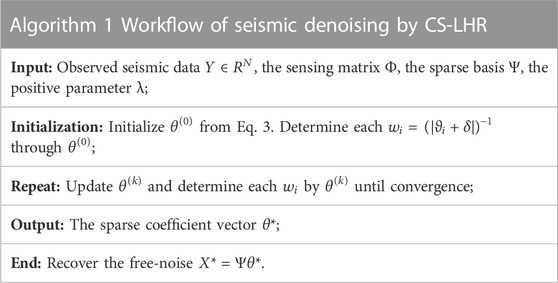
TABLE 1. The workflow of seismic denoising by CS-LHR.
4 Synthetic and real data examples
In order to illustrate the effectiveness of the proposed CS-LHR method, we initially apply it to synthetic seismic data with different levels of signal noise ratios (SNRs). Then, the proposed method is utilized for field data denoising. Figure 1 displays a 2-D synthetic seismic trace without noise. Figure 2 shows the 2-D synthetic trace with different SNRs (5dB, 5dB, -3dB, and 3 dB). Figure 3 exhibits a 3-D noisy field data acquired over the Scotian shelf, offshore Canada, and termed Penobscot. For comparison, the traditional CS method based on
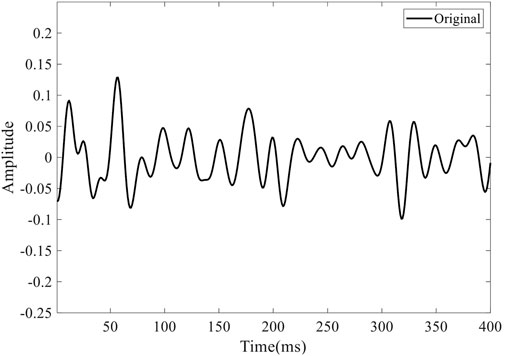
FIGURE 1. A 2-D synthetic seismic trace without noise.
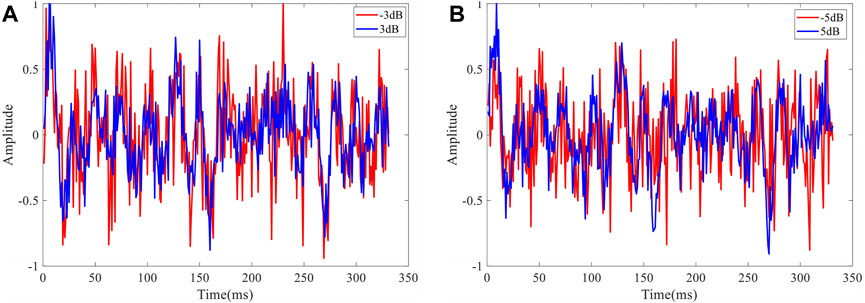
FIGURE 2. (A) The 2-D synthetic seismic trace with SNRs −3dB, 3dB. (B) The 2-D synthetic seismic trace with SNRs −5dB, 5dB.
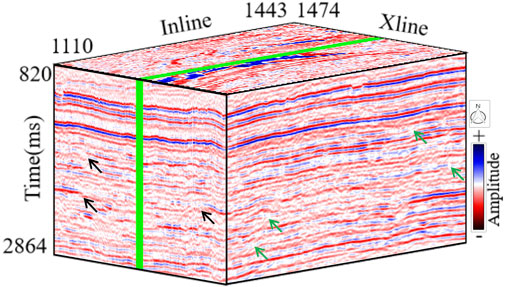
FIGURE 3. A 3-D noise-contaminated field data acquired over the Scotian shelf, offshore Canada, comprised 401 inlines and 401 crosslines, with a time sampling interval of 4 ms. Discontinuous seismic events are indicated by black arrows, seismic artifacts caused by random noises are represented by green arrows. The green lines correspond to the location of X-line 1273.
4.1 Seismic signal enhancement with different SNRs
The denoising results for noisy 2-D synthetic data using the traditional CS method are depicted in Figures 4A,B, while those obtained from the CS-LHR method are presented in Figures 5A,B. It is clear that the traditional CS method can effectively attenuate noise in smooth areas of noisy synthetic data; however, it introduces artifacts and exhibits a poor denoising effect in the oscillatory areas marked by black ellipses. Although the traditional CS method based on
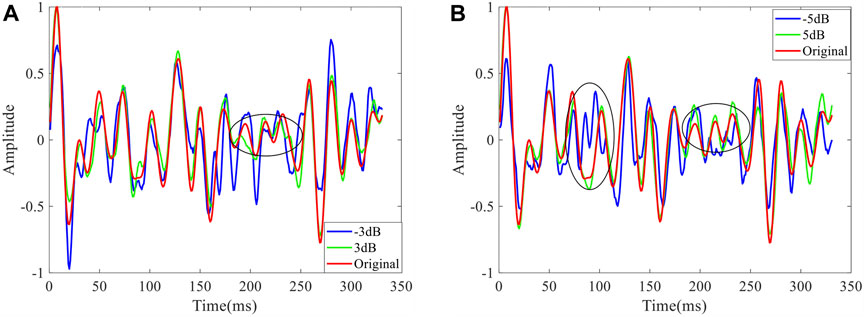
FIGURE 4. The denoising results of 2-D synthetic seismic traces by the traditional CS model with 0<p<1. (A) The denoising results for SNRs −3dB and 3dB. (B) The denoising results for SNRs −5dB and 5dB. From these results, we can see that the traditional CS model with 0<p<1 effectively attenuates noise in smooth areas of noisy synthetic data; however, it introduces artifacts and exhibits a poor denoising effect in oscillatory areas marked by black ellipses.
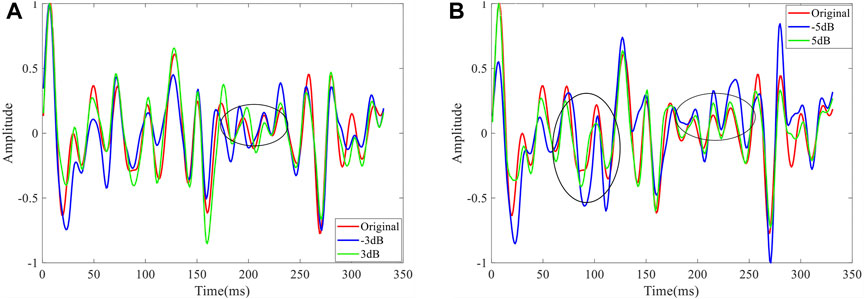
FIGURE 5. The denoising results of 2-D synthetic seismic trace by the CS-LHR method. (A) The denoising results for SNRs −3dB and 3dB. (B) The denoising results for SNRs −5dB and 5dB. Compared to Figure 4, Figure 5 illustrates the random noises are successfully removed while the seismic events are preserved well.
4.2 Field data applications
To verify the effectiveness of the proposed method, 3-D noise-contaminated field data obtained from the Scotian shelf, offshore Canada, referred to as Penobscot, are shown in Figure 3. The 3-D field data comprise 401 inlines and 401 crosslines, with a time sampling interval of 4 ms.
In Figure 3, black arrows indicate discontinuous seismic events, while green arrows represent seismic artifacts caused by random noise. The green lines correspond to the location of X-line 1273, as depicted in Figure 6A. Obviously, this seismic volume contains significant random noises which hinder subsequent seismic data processing and interpretation. Our method’s denoising result is shown in Figure 6B, where the improved resolution and well-preserved reflection events are evident. Regions marked by the black ellipses demonstrate efficient attenuation of random noise, enhanced continuity, and resolution of seismic events. Additionally, the seismic fault structures indicated by black arrows are preserved well. Further, Figure 6C shows no useful information in the difference profile.
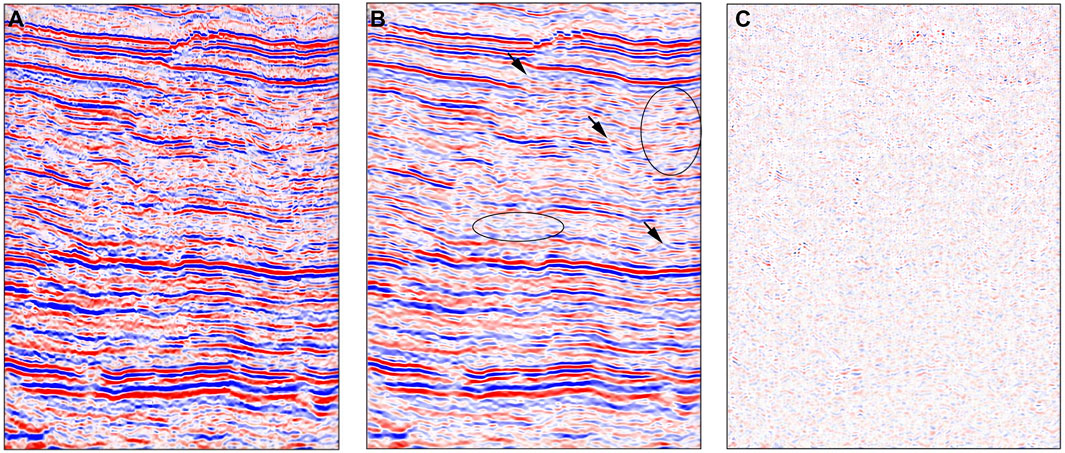
FIGURE 6. (A) The noise-contaminated field section, which is marked by green lines in 3-D field data, contains significant random noises. (B) From the denoising result by CS-LHR, we can see that the improved resolution and well-preserved reflection events are evident. (C) The difference profile between Figures 6A, B; there is no useful information in this difference profile.
To further demonstrate the effectiveness of our method, we compare it with the traditional CS method with 0<p<1 on the same field data. The corresponding results are presented in Figure 7. Figure 7A shows the denoising result, and Figure 7B represents the related difference profile. We can observe that valid seismic events are generally preserved in Figure 7A. However, compared to the CS-LHR result, the fault structures and seismic events, indicated by black arrows and black ellipses in Figure 7A, respectively, are less subtle. Additionally, some valuable information that can improve the resolution of the denoising result is contained in the difference profile Figure 7B.
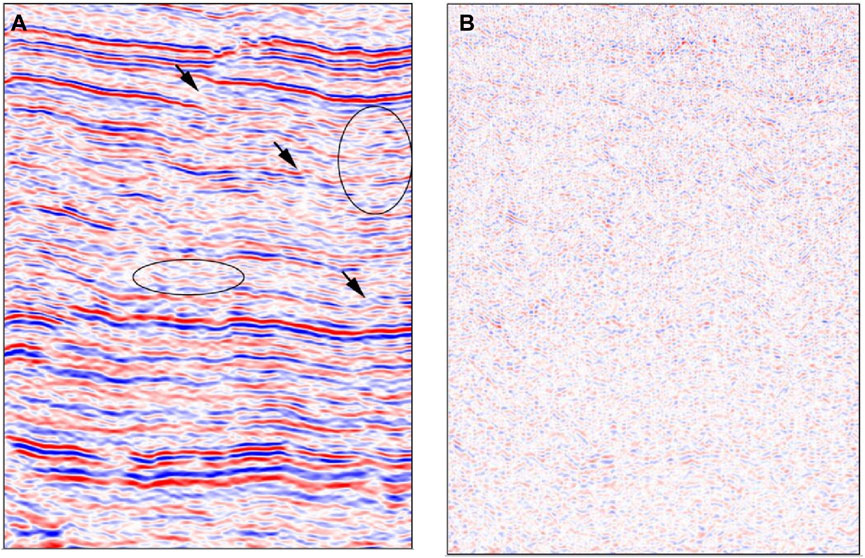
FIGURE 7. (A) Denoising result of Figure 6A by CS with
5 Conclusion
This paper proposes the CS-LHR method, a novel method for seismic noise attenuation. Compared to the traditional CS methods with 0<p
The CS method can be used for denoising, but its primary contribution to the scientific domain lies in accomplishing the compression and reconstruction of original signals via sparse signal representation. This process facilitates the reduction of data acquisition and transmission costs while preserving data quality, essential for diverse applications including medical imaging, remote diagnosis, earth observation, and wireless transmission. The CS-LHR method introduced in this paper can achieve the optimal sparsity of the sparse signal, leading to additional reductions in storage and transmission costs. This holds particular significance for industrial applications driven by cost considerations.
Data availability statement
The raw data supporting the conclusion of this article will be made available by the authors, without undue reservation.
Author contributions
FS: Conceptualization, Methodology, Writing–original draft. QZ: Formal Analysis, Writing–review and editing. ZW: Validation, Writing–review and editing. WH: Validation, Improving the quality, Writing–review and editing, Formal Analysis.
Funding
The author(s) declare financial support was received for the research, authorship, and/or publication of this article. This research was supported by the Natural Science Foundation of Guangxi (2021GXNSFBA196071 and 2021JJA170177), Guangxi Key Laboratory of Precision Navigation Technology and Application, and Key Laboratory of Microwave and Optical Wave Application Technology, Guilin University of Electronic Technology.
Acknowledgments
The authors would like to thank the dGB Earth Sciences, Nova Scotia Department of Energy, Canada-Nova Scotia Offshore Petroleum Board, for providing the 3-D field data used in this study.
Conflict of interest
Author ZW was employed by The china state shipbuilding corporation limited.
Author WH was employed by Xi’an Engineering Investigation and Design Research Institute of China National Nonferrous Metals Industry Co., Ltd.
The remaining authors declare that the research was conducted in the absence of any commercial or financial relationships that could be construed as a potential conflict of interest.
Publisher’s note
All claims expressed in this article are solely those of the authors and do not necessarily represent those of their affiliated organizations, or those of the publisher, the editors and the reviewers. Any product that may be evaluated in this article, or claim that may be made by its manufacturer, is not guaranteed or endorsed by the publisher.
References
Bekara, M., and Baan, M. V. D. (2009). Random and coherent noise attenuation by empirical mode decomposition. Geophysics 74 (5), 89–98. doi:10.1190/1.3157244
Caiafa, C. F., and Cichocki, A. (2013). Multidimensional compressed sensing and their applications. Wires Data Min. Knowl. Discov. 3, 355–380. doi:10.1002/widm.1108
Candès, E. J., Romberg, J., and Tao, T. (2006). Robust uncertainty principles: exact signal reconstruction from highly incomplete frequency information. IEEE Trans. Inf. Theory 52, 489–509. doi:10.1109/TIT.2005.862083
Candès, E. J., and Wakin, M. B. (2008). An introduction to compressive sampling. IEEE Signal Process. Mag. 25, 21–30. doi:10.1109/MSP.2007.914731
Chen, Y. K., Zhou, Y. T., Chen, W., Zu, S., Huang, W., and Zhang, D. (2017). Empirical low-rank approximation for seismic noise attenuation. IEEE Trans. Geoscience Remote Sens. 55 (8), 4696–4711. doi:10.1109/TGRS.2017.2698342
Deng, Y., Liu, Y. B., Dai, Q. H., Zhang, Z., and Wang, Y. (2012). Noisy depth maps fusion for multiview stereo via matrix completion. IEEE J. Sel. Top. Signal Process. 6, 566–582. doi:10.1109/JSTSP.2012.2195472
Dong, X. T., Lin, J., Lu, S. P., Huang, X., Wang, H., and Li, Y. (2022a). Seismic shot gather denoising by using a supervised-deep-learning method with weak dependence on real noise data: a solution to the lack of real noise data. Surv. Geophys. 43 (5), 1363–1394. doi:10.1007/s10712-022-09702-7
Dong, X. T., Lin, J., Lu, S. P., Wang, H., and Li, Y. (2022b). Multiscale spatial attention network for seismic data denoising. IEEE Trans. Geoscience Remote Sens. 60, 1–17. doi:10.1109/TGRS.2022.3178212
Donoho, D. L. (2006). Compressed sensing. IEEE Trans. Inf. Theory 52, 1289–1306. doi:10.1109/TIT.2006.871582
Fazel, M., Hindi, H., and Boyd, S. P. (2003). “Log-det heuristic for matrix rank minimization with applications to Hankel and Euclidean distance matrices,” in The 2003 American Control Conference, Denver, CO, USA, 04-06 June 2003, 2156–2172.
Foo, C. S., Do, C. B., and Ng, A. Y. (2009). “A majorization-minimization algorithm for (multiple) hyper-parameter learning,” in The 26th annual international conference on machine learning (Montreal, Quebec, CA: Association for Computing Machinery), 321–328. doi:10.1145/1553374.1553415
Li, F. Y., Sun, F. Y., Liu, N. H., and Xie, R. (2022). Denoising seismic signal via resampling local applicability functions. IEEE Geoscience Remote Sens. Lett. 19, 1–5. doi:10.1109/LGRS.2020.3048110
Li, F. Y., Zhang, B., Marfurt, K. J., and Hall, I. (2014). “Random noise suppression using normalized convolution filter,” in The SEG technical program expanded abstracts 2014 (Denver, USA: SEG). doi:10.1190/segam2014-1478.1
Liu, N. H., Lei, Y. B., Liu, R. C., Yang, Y., Wei, T., and Gao, J. (2023a). Sparse time-frequency analysis of seismic data: sparse representation to unrolled optimization. IEEE Trans. Geoscience Remote Sens. 61, 1–10. doi:10.1109/TGRS.2023.3300578
Liu, N. H., Lei, Y. B., Yang, Y., Wang, Z., Liu, R., Gao, J., et al. (2023b). Sparse time-frequency analysis of seismic data via convolutional neural network. Interpretation 12 (1), T47–T62. doi:10.1190/int-2023-0020.1
Liu, N. H., Wang, J. L., Gao, J. H., Chang, S., and Lou, Y. (2022a). Similarity-informed self-learning and its application on seismic image denoising. IEEE Trans. Geoscience Remote Sens. 60, 1–13. doi:10.1109/tgrs.2022.3210217
Liu, N. H., Wang, J. L., Gao, J. H., Yu, K., Lou, Y., Pu, Y., et al. (2022b). NS2NS: self-learning for seismic image denoising. IEEE Trans. Geoscience Remote Sens. 60, 1–11. doi:10.1109/TGRS.2022.3217289
Ni, W. D., Lou, Y. H., Xu, X. L., Xue, A., and Wang, W. (2022). “Seismic random noise attenuation via noise assisted-multivariate EMD based MSSA,” in The 2022 International Conference on Automation, Robotics and Computer Engineering (ICARCE), Wuhan, China, 16-17 December 2022. doi:10.1109/ICARCE55724.2022.10046637
Oropeza, V., and Sacchi, M. (2011). Simultaneous seismic data denoising and reconstruction via multichannel singular spectrum analysis. Geophysics 76 (3), 25–32. doi:10.1190/1.3552706
Qu, S., Zhou, H., Liu, R. W., Chen, Y., Zu, S., Yu, S., et al. (2016). Deblending of Simultaneous-source seismic data using fast iterative shrinkage-thresholding algorithm with firm-thresholding. Acta Geophys. 64 (4), 1064–1092. doi:10.1515/acgeo-2016-0043
Siahsar, M. A. N., Gholtashi, S., Kahoo, A. R., Marvi, H., and Ahmadifard, A. (2016). Sparse time-frequency representation for seismic noise reduction using low-rank and sparse decomposition. Geophysics 81 (2), 117–124. doi:10.1190/geo2015-0341.1
Sun, F. Y., Liao, G. S., Lou, Y. H., and Jiang, X. (2022). Seismic data denoising with correlation feature optimization via S-mean. IEEE Geoscience Remote Sens. Lett. 19, 1–5. doi:10.1109/LGRS.2021.3117965
Wang, Y. Q., Peng, Z. M., and He, Y. M. (2016). “Time-frequency representation for seismic data using sparse S transform,” in The2nd IEEE International Conference on Computer and Communications (ICCC), Chengdu, China, 14-17 October 2016. doi:10.1109/CompComm.2016.7925036
Wu, B. Y., Yu, J. Y., Ren, H. R., Lou, Y. H., and Liu, N. H. (2022). Seismic traffic noise attenuation using $l_{p}$ -norm robust PCA. IEEE Geoscience Remote Sens. Lett. 17, 1998–2001. doi:10.1109/lgrs.2019.2955737
Wu, H., Zhang, B., Lin, T. F., Li, F., and Liu, N. (2019). White noise attenuation of seismic trace by integrating variational mode decomposition with convolutional neural network. Geophysics 84 (5), 307–317. doi:10.1190/geo2018-0635.1
Wu H, H., Zhang, B., and Liu, N. H. (2022). Self-adaptive denoising net: self-supervised learning for seismic migration artifacts and random noise attenuation. J. Petroleum Sci. Eng. 214, 110431. doi:10.1016/j.petrol.2022.110431
Yang, J. Y., Peng, Y. G., Xu, W. L., and Dai, Q. H. (2009). Ways to sparse representation: an overview. Sci. China (Series F:Information Sci. 52, 695–703. doi:10.1007/s11432-009-0045-5
Yang, Y., Lei, Y. B., Liu, N. H., Wang, Z., Gao, J., and Ding, J. (2022). Sparse TFNet: a physically informed auto encoder for sparse time–frequency analysis of seismic data. IEEE Trans. Geoscience Remote Sens. 60, 1–12. doi:10.1109/TGRS.2022.3213851
Yang, Y., Li, D. Q., Tong, T. G., Zhang, D., Zhou, Y., and Chen, Y. (2018). Denoising controlled-source electromagnetic data using least-squares inversion. Geophysics 83 (4), 229–244. doi:10.1190/geo2016-0659.1
Yuan, S. Y., Wang, S. X., and Li, G. F. (2012). Random noise reduction using Bayesian inversion. J. Geophys. Eng. 9, 60–68. doi:10.1088/1742-2132/9/1/007
Zhang, Y. J., Zhang, H. R., and Yang, Y. (2021). Seismic random noise separation and attenuation in based on MVMD and MSSA. IEEE Trans. Geoscience Remote Sens. 60, 5908916. doi:10.1109/TGRS.2021.3131655
Zhong, T., Cheng, M., and Dong, X. T. (2023). RMCHN: a residual modular cascaded heterogeneous network for noise suppression in DAS-VSP records. IEEE Geoscience Remote Sens. Lett. 20, 7500205. doi:10.1109/LGRS.2022.3229556
Zhong, T., Cheng, M., Dong, X. T., Li, Y., and Wu, N. (2022). Seismic random noise suppression by using deep residual U-Net. J. Petroleum Sci. Eng. 209, 109901. doi:10.1016/j.petrol.2021.109901
Keywords: compressed sensing, log-sum heuristic recovery, seismic denoising, lp norm, the log-sum heuristic recovery (LHR)
Citation: Sun F, Zhang Q, Wang Z and Hou W (2024) Compressed sensing with log-sum heuristic recover for seismic denoising. Front. Earth Sci. 11:1285622. doi: 10.3389/feart.2023.1285622
Received: 30 August 2023; Accepted: 18 December 2023;
Published: 09 January 2024.
Edited by:
Xintong Dong, Jilin University, ChinaReviewed by:
Hao Wu, China University of Geosciences Wuhan, ChinaYihuai Lou, Zhejiang University, China
Copyright © 2024 Sun, Zhang, Wang and Hou. This is an open-access article distributed under the terms of the Creative Commons Attribution License (CC BY). The use, distribution or reproduction in other forums is permitted, provided the original author(s) and the copyright owner(s) are credited and that the original publication in this journal is cited, in accordance with accepted academic practice. No use, distribution or reproduction is permitted which does not comply with these terms.
*Correspondence: Fengyuan Sun, ZnlzdW5AZ3VldC5lZHUuY24=