 María Ortuño
 Magdalena Scheck-Wenderoth
 Sarah Jaye Oliva
- 1Department of Earth and Ocean Dynamics, Risknat-Institute Geomodels, University of Barcelona, Barcelona, Spain
- 2GFZ German Research Centre for Geosciences, Potsdam, Germany
- 3Faculty of Georesources and Materials Engineering, RWTH Aachen University, Aachen, Germany
- 4School of Earth and Ocean Sciences, University of Victoria, Victoria, BC, Canada
Editorial on the Research Topic
Women in science: structural geology and tectonics 2022
Introduction
Gender Equality is the fifth of the Sustainable Development Goals (SDGs) proclaimed by the United Nations for the 2030 Agenda (UN General Assembly, 2015). We are only a few years away from 2030 and we still have much work to do to achieve gender equality, also in academia. In particular in the experimental and technical careers (the so-called STEM fields), women still account for only 28% and 40% of engineering and computer science graduates, respectively and according to the United Nations. In academia, women in science contend with shorter and less well-paid careers, only 12% representation in national science academies, and underrepresentation in high-profile journals both as authors and as editors (UNESCO et al., 2021).
Women in structural geology and tectonics
Many studies of structural geology involve expeditions to rough and sometimes remote terrain that has traditionally been dominated by men. However, it can be argued that women have been making significant contributions to structural studies for a considerable period. In fact, if we broaden the scope beyond traditional academia, it is worth acknowledging that in rural and nomadic societies, women played a significant role in spending their lives in the mountains. For example, they worked as shepherds (Gonzalez-Samperiz, 2023), which involved observing and interpreting the landscape, becoming familiar with varied rock formations and fossils. Additionally, women have been actively engaging in mountaineering and climbing since the early 19th century (Andrews et al., 2023). These are testaments to women being perfectly capable outdoors, despite those who deem the task to be unladylike.
In academia, early contributions of women to Tectonics and Structural Geology in the western legacy were often not made visible, reflecting the societal outlook on women during those times. Sometimes supervisors, who are predominantly male, “forget” to acknowledge female scientists who do the grunt work of collecting and analysing the data, making the discovery, and writing the paper. A prominent example of this is Marie Tharp who drew up the first seafloor maps in the 1950s but only received credit later in her lifetime (Blakemore, 2016). Not only did she discover the Mid-Atlantic spreading ridge, but her seafloor maps were instrumental to establishing the theory of plate tectonics.
Even though women geoscientists have been increasing in number since the late eighties, the general notion that Earth sciences, especially structural geology, is a masculine career path still prevails. However, female structural geologists are increasingly beginning to conquer the field (Figure 1). Women are still culturally expected to shoulder a lot of home and family responsibilities, which might limit time available to devote to fieldwork, which represents a large component in structural geology research. When it comes to securing tenure-track positions, women with children are much less successful compared to women without children and men with children (Mason et al., 2013). The situation was exacerbated during the pandemic when women published less as they stepped back to take charge of care duties related to lockdown, closed schools and day cares (Viglione, 2020). To make things even worse, abandonment of the scientific career, also often has to do with harassment, which is especially frequent in scientific fields involving field work (Clancy et al., 2014). All these represent the “glass ceiling” (Rosser, 2004) or the barriers, which then contribute to the “leaky pipeline” (Popp et al., 2019) which means there are fewer women as one moves up the academic hierarchy. Less representation and fewer role models provide yet another challenge that may have a negative impact in women’s career development.
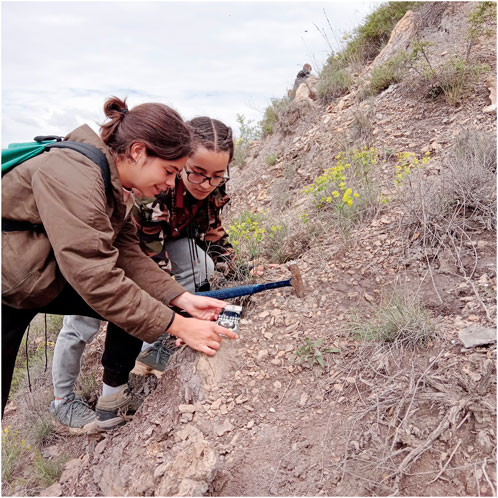
FIGURE 1. Two young women students learning how to measure the orientation of layered rocks in the Pyrenees, as part of the University of Barcelona-Geology Degree field training. Photo by María Ortuño.
In this editorial we cannot fully assess the statistics, reasons, and mechanisms related to why women are less visible in the scientific landscape, covered by several specific papers (e.g., (Rosser, 2004; Mason et al., 2013; Clancy et al., 2014; Popp et al., 2019; Viglione, 2020; Spoon et al., 2023)).
Overview of the Research Topic
The compilation starts with an optimistic and comprehensive overview of the goals and opportunities in planetary structural geology and tectonics from an early career perspective. Crane and Galluzzi take the reader through the open questions driving current investigations, shedding light on how technological improvements, machine learning analyses, and availability of increased quantity and quality of planetary space mission data could provide new insights into planetary surface deformation.
This is followed by a range of papers that focus on active faulting covering a wide perspective.
Wang et al. report on active tectonics and paleo-earthquakes in the northern Tibetan Plateau using field mapping, structural analysis of active anticline folding, and radiocarbon dating to infer that lacustrine records of a major flood event were related to a Holocene earthquake. They propose a fault-related fold model with active blind thrust faulting in the northern margin of the plateau resulting in fault-related anticline folding. The related geomorphic bulges are interpreted as acting as flood-retaining dams with hinterland deposition of lacustrine sediments. In their model, seismogenic blind thrust faulting is responsible for the uplift and northward growth of the Tibetan Plateau and the present-day definition of its northern margin.
The role of fluids in active faulting is considered from a different angle in the paper by Gabrielli et al. proposing that fast changes in upper crustal seismic attenuation can be related to fracturing and fluid migration which likely triggered the 2016–2017 Central Italy seismic sequence. Determining seismic scattering and absorption before and during the sequence, they observed that the structural discontinuities and lithology control the scattering losses at all frequencies but not absorption. A high absorption spatial anomaly is instead attributed to the deep migration of CO2-bearing fluids across the fault network.
Pro-Diaz et al. constrain earthquake fault sources in the Betic Cordillera in southern Spain via an alternative method to paleoseismological analyses. Using macroseismic intensity data and reports on geological effects, calibrated against a modern earthquake, they attempt and successfully identify the most likely fault source for one of the two historical earthquakes considered.
We close the compilation with a study located in the Eastern part of the Betic Cordillera, with the study of a travertine system that recorded the transpressional activity of the Alhama de Murcia Fault. Through morphological and geochemical studies, Canora et al. analyse the record of Quaternary alluvial fans, travertines, and a pop-up structure which indicate that the carbonate deposits are hydrothermal and that crustal hydrothermal circulation is facilitated by tectonic activity. They conclude that the deep waters rising and interacting with the meteoric waters cause the travertine formation, and thus carbonate deposits can be used as proxies to analyse the seismogenic cycle of the fault.
Concluding remarks
We have curated this Research Topic to claim our space and provide current women scientists in structural geology and tectonics a platform to showcase and share their work. This Research Topic is necessarily only a first step, and maybe it is worth considering the Research Topic as an open forum that can be complemented in the future. All articles in this Research Topic are first-authored by women scientists and we proudly present it covering some trending topics in structural geology and tectonics.
Author contributions
MO: Writing–original draft. MS-W: Writing–original draft. SJO: Writing–original draft.
Funding
The author(s) declare financial support was received for the research, authorship, and/or publication of this article. Funding was provided by the universities and institutons paying our salaries. SJO is supported by the Dr. Margaret “Marmie” Perkins Hess Research Fellowship. MO is also supported by the Ollin IGCP-669, spanish national project N-Sources (PID2020-119772RB-I00) and EU project TREAD (101072699).
Conflict of interest
The authors declare that the research was conducted in the absence of any commercial or financial relationships that could be construed as a potential conflict of interest.
Publisher’s note
All claims expressed in this article are solely those of the authors and do not necessarily represent those of their affiliated organizations, or those of the publisher, the editors and the reviewers. Any product that may be evaluated in this article, or claim that may be made by its manufacturer, is not guaranteed or endorsed by the publisher.
References
Andrews, K. (2023). “‘That is the lady I saw ascending snowdon, alone’: pioneering women mountaineers of the nineteenth century,” in Gender, politics and change in mountaineering. Global culture and sport series. Editors J. Hall, E. Boocock, and Z. Avner (Cham: Palgrave Macmillan). doi:10.1007/978-3-031-29945-2_2
Blakemore, E. (2016). Seeing is believing: how Marie Tharp changed geology forever. Washington, DC: Smithsonian Magazine. Available at: https://www.smithsonianmag.com/history/seeing-believing-how-marie-tharp-changed-geology-forever-180960192/ (Accessed November 21, 2023).
Clancy, K. B., Nelson, R. G., Rutherford, J. N., and Hinde, K. (2014). Survey of academic field experiences (SAFE): trainees report harassment and assault. PloS one 9 (7), e102172. doi:10.1371/journal.pone.0102172
Gonzalez-Samperiz, P. (2023). PASTORA: an example of inclusion of gender perspective in geosciences research. Rome: XXI INQUA Congress.
Mason, M. A., Wolfinger, N. H., and Goulden, M. (2013). Do babies matter? gender and family in the ivory tower. Ithaca, NY: Rutgers University Press. doi:10.36019/9780813560823
Popp, A. L., Lutz, S. R., Khatami, S., Van Emmerik, T. H., and Knoben, W. J. (2019). A global survey on the perceptions and impacts of gender inequality in the Earth and space sciences. Earth Space Sci. 6 (8), 1460–1468. doi:10.1029/2019ea000706
Rosser, S. V. (2004). The science glass ceiling: academic women scientists and the struggle to succeed. New York, NY: Routledge, 192.
Spoon, K., LaBerge, N., Wapman, K. H., Zhang, S., Morgan, A. C., Galesic, M., et al. (2023). Gender and retention patterns among US faculty. Sci. Adv. 9 (42), eadi2205. doi:10.1126/sciadv.adi2205
UNESCO (2021). in UNESCO Science Report: the race against time for smarter development. Editors S. Schneegans, T. Straza, and J. Lewis (Paris: UNESCO Publishing).
UN General Assembly (2015). Transforming our world: the 2030 Agenda for sustainable development. 21 October 2015, A/RES/70/1, Available at: https://www.refworld.org/docid/57b6e3e44.html (Accessed November 21, 2023).
Keywords: gender balance, history of science, planetary science, tectonics, structural geology
Citation: Ortuño M, Scheck-Wenderoth M and Oliva SJ (2023) Editorial: Women in science: structural geology and tectonics 2022. Front. Earth Sci. 11:1344815. doi: 10.3389/feart.2023.1344815
Received: 26 November 2023; Accepted: 04 December 2023;
Published: 29 December 2023.
Edited and Reviewed by:
Derek Keir, University of Southampton, United KingdomCopyright © 2023 Ortuño, Scheck-Wenderoth and Oliva. This is an open-access article distributed under the terms of the Creative Commons Attribution License (CC BY). The use, distribution or reproduction in other forums is permitted, provided the original author(s) and the copyright owner(s) are credited and that the original publication in this journal is cited, in accordance with accepted academic practice. No use, distribution or reproduction is permitted which does not comply with these terms.
*Correspondence: María Ortuño, bWFyaWEub3J0dW5vQHViLmVkdQ==