 Peng Qian1,2*
 Yunjie Wu
- 1School of Geography Science, Nantong University, Nantong, China
- 2School of Transportation and Civil Engineering, Nantong University, Nantong, China
- 3Department of Geography, East China Normal University, Shanghai, China
The Xiashu loess is an important aeolian deposit in eastern China. Research on the provenance of the Xiashu loess, located along the lower reaches of the Yangtze River, has entered into a new stage, compelling us to review the previous research findings in order to provide direction for future research. In this study, we enumerate three different viewpoints regarding the major sources of the loess in eastern China, including distant sources, proximal sources, and mixed sources. We also discuss disturbance factors, methods, and research on the provenance of the Xiashu loess. Previous research has showed that, on the basis of geochronology and meticulous grain grading data, good results as to the loess’ provenance can be obtained using immobile geochemical index tracers that are not affected by chemical weathering or grain size effects. Examples include detrital zircon U-Pb age spectra, major and trace element ratios, stable isotopic composition, and slowly weatherable minerals. However, differences in the data do exist, e.g., for the immobile geochemical provenance tracing indexes of the loess. Also still under debate is the age of the lower boundary of the loess. Therefore, exploring the spatial-temporal variations of the provenance, along with the coupling relationship between the paleoclimate environment evolution and the onset of the loess accumulation, should be comprehensively considered in future research.
1 Introduction
Loess in China is considered to be the most complete continental geological proxy, having recorded comprehensive information regarding global climate changes (Guo, et al., 1999; Ding, et al., 2001; Chen et al., 2006; Aleinikoff, et al., 2008), neotectonic movements (Shen, et al., 2017), and human evolution (Feng, et al., 2024). Loess deposits in China record within the data on regional and global climate changes, since ca. 2.6 Ma (Liu, 1985). The Xiashu loess in the lower reaches of the Yangtze River, is an important part of eolian loess in eastern China (Zheng, 1999). It mainly covers the landscape and river terraces in the Ningzhen mountain area, especially in Nanjing and Zhenjiang, Jiangsu province, China (Figure 1). Studies regarding the sources of the Asian dust (Duce et al., 1980; Colin et al., 1997; Aleon, et al., 2002; Chen et al., 2007; Chen and Li, 2011; Lee, et al., 2010a; 2010b; Maher, et al., 2010; Ferrat, et al., 2011; Chow, et al., 2014), the loess (Gallet, et al., 1996; Nugteren and Vandenberghe, 2004; Sheldon and Tabor, 2009; Gao, et al., 2021), are helpful for understanding past atmospheric circulations (including the directions and intensities of ancient winds). The provenance research of the Xiashu loess in the lower reaches of the Yangtze River has made significant progress in recent years. The research initials from a stage of a simple dispute between distal and proximal sources (Zheng, 1999; Hao et al., 2010; Liu et al., 2014), and spread out to a new stage of integration, as researchers examine the age of the lowermost loess, as well as the impact of northern aridity evolution (Han et al., 2019) and sea level changes on the eolian system (Yi et al., 2022). In addition, research on this loess has grown to the point where we may be able to establish a coupling relationship between the loess system and global climate (Zhang and Jia, 2019). This study’s goals were to summarize and review the previous research and academic views on the Xiashu loess, in order to provide valuable direction for future study.
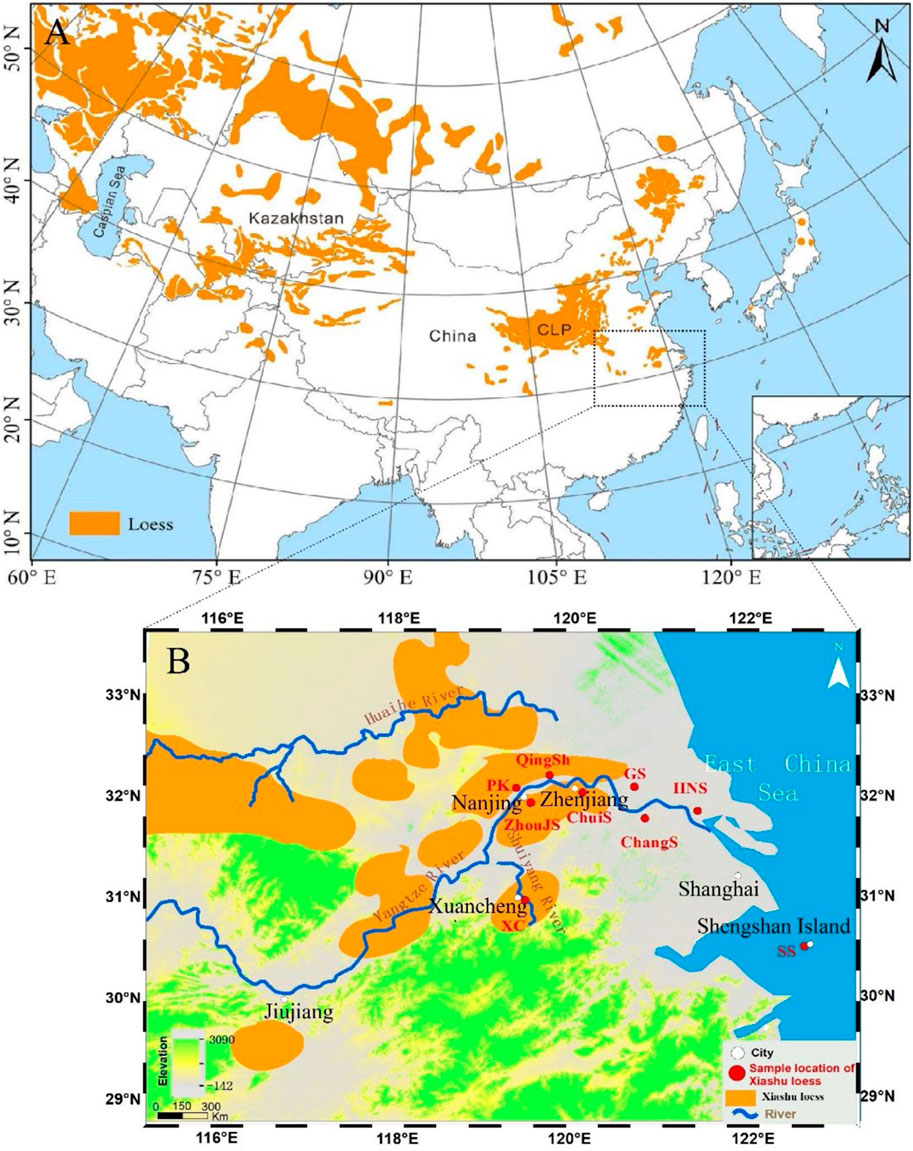
Figure 1. DEM showing the profile locations mentioned in this review and the distribution of the Xiashu loess. Note: SS, Shengshan Island; HNS, Huangnishan Hill; Changs, Changshan Hill; GS, Gushan Hill; Qingsh, Qingshan Hill; ChuiS, Chuishan Hill; ZhouJS, Zhoujiashan; TSXC, Taishanxincun; XC, Xuancheng. (A) modified from Lu et al., 2022; (B) modified from Wu et al., 2021.
2 Different viewpoints regarding the provenance of loess in eastern China
Since the 1980s, the physical, chemical, and biological indexes of the loess strata in the Shandong and Liaodong Peninsulas (Li et al., 1992; 2008), the Miaodao Archipelago (Cao et al., 1987; 1994; Zhang et al., 2012), the floors of the Yellow and Bohai Seas (Liu and Zhao, 1995), and the East China Sea islands (Zheng and Liu, 2006), which are distributed across the eastern plain of China and on the continental shelf, have been investigated by Quaternary scientists. The aeolian origin of the loess distributed in those regions has been widely accepted. However, there are differing opinions regarding its provenance.
Firstly, the viewpoint of distant sources for this loess refers to the belief that the loess in eastern China was formed by fine-grained material from northwestern arid areas in China. Under dry and cold climate conditions, dust carried by strong winds generally tends to accumulate across the entire region of the Jiangsu Plains, as well on exposed submarine shelf areas. Therefore, it has been suggested that the northwestern winter monsoons during glacial periods may have transported fine grained materials from the Central Asia areas to the downwind areas, i.e., over long distances (Zheng, 1999).
Secondly, the viewpoint of more localized sources for the loess in eastern China stems from the belief that the loess originated from late Pleistocene “desertified” coastal shelves, or paleo-floodplains near the Yangtze River. Desert loess sedimentary systems of different sizes were common on the continental shelf-island region of eastern China during the late Pleistocene Epoch (Zhao, 1991). Li (2006) argued that the loess sediment distributed in the Liaodong and Shandong Peninsulas (Zhao, 1991; Yu, 1999), the loess strata of the East China Sea islands, the Xiashu loess itself, and the hard clay layers distributed in Yangtze River Delta all originated from these “desertified” coastal shelves during the Late Pleistocene. In recent years, some researchers have analyzed the provenance indicators of the major and trace elements of the <20 µm fractions in the aeolian sediment (including the Xiashu loess) in the lower reaches of the Yangtze River. Based on this research, the aeolian sediment was mainly transported from the Jianghuai floodplain (Hao et al., 2010; Han et al., 2019). The detrital zircon U-Pb age spectrum of the Xiashu loess in Nanjing has been found to be very similar to that of the modern Yangtze River sediment (Liu et al., 2014). These studies also provided strong evidences for the viewpoint that the Xiashu loess is mainly of the proximal-source sediment.
Thirdly, the viewpoint that the loess in eastern China contains a mixture of materials from both distant and proximal sources assumes that distant source material was potentially transported from the interior regions of Asia, even as proximal source materials originated from the nearby regions. This viewpoint is supported by data from detrital zircon U-Pb age spectra, rare earth elements, and strontium (Sr)-neodymium (Nd) isotopes (Qian et al., 2018; Wu et al., 2021).
3 Disturbance factors in the provenance tracing of the Xiashu loess
3.1 Strong secondary transformation
The Xiashu loess near the lower reaches of the Yangtze River, deposited during the last glacial period of the Late Pleistocene, underwent strong chemical weathering processes due to its long-term exposure to warm and humid climatic environmental conditions. The weathering here has assumedly been stronger than the loess in northwestern China underwent. some of the original minerals and elemental components, especially those with weak weathering resistance, appear to have reformed (Yang et al., 2004), some as clay minerals and fine-grained components. The aforementioned changes weaken the assumption that the chemical tracers in Xiashu loess could potentially be used as an effective provenance proxy. For example, if the tracer index of provenance is determined from the bulk loess and paleosol, the obtained conclusions of provenance may be prone to deviations.
3.2 Multiple solutions and particle size effects of geochemical indexes
Although geochemical and conventional mineralogical methods can sometimes indicate the initial sources of dust clastic and chemical components, they have limited abilities for determining contributions from different source regions. Loess deposits are often a mixture of dust from multiple source regions, and if so, its chemical components are often close to the average value of the upper crust (Liu, 1985; Gallet et al., 1996; Ding et al., 2001; Jahn et al., 2001). When geochemical methods are used to trace loess provenance, if the geochemical characteristics are between the characteristic values of several possible source regions, then such materials may have originated from a single source region, or two or more source regions. Therefore, avoiding multiple solutions of data should be the focus of loess provenance research.
Because dust deposition in the lower reaches of the Yangtze River is known to have been strongly affected by secondary transformations, pedogenesis and chemical weathering processes, which are controlled by the sediment grain size, must be taken into consideration (Xiong et al., 2008). At the same time, the geochemical composition of the sediment may also have changed correspondingly, i.e., an obvious geochemical grain-size effect exists (Zhao and Yan, 1994). This issue has added a great deal of uncertainty into the comparative analysis of the sources of aeolian dust (Du et al., 2003).
3.3 Incomplete chronological framework and stratigraphic sequence
In order to trace the provenance of loess, it is necessary to compare the physical and chemical properties of loess samples and sediment in potential source areas (Wang et al., 2017; Sun et al., 2020). Therefore, determining the stratigraphic position of each sample in the stratigraphic sequence of the Xiashu loess was the prerequisite for provenance index comparisons in the peer layer, and also a necessary condition for the identification of the provenance of loess of different ages.
Thermoluminescence methods (Huang et al., 1988; Liu, 1988), as well as electron spin resonance (Li et al., 1993; Yang et al., 1996), photoluminescence (Lai et al., 2001; 2010), 14C dating (Li and Fang, 1993), and paleomagnetism methods (Qiao et al., 2003) have been used by some researchers to date the Xiashu loess. These studies have resulted in many significant achievements in the dating of the Xiashu loess in the lower reaches of the Yangtze River. For example, quartz SAR OSL and potassium feldspar pIRIR were used to test the dating samples of the Xiashu loess section in the Nanjing area. It was determined that the two dating methods were consistent within 50 ka years, and the reliable age of 200 ka was obtained by a potassium feldspar pIRIR dating method (Yi et al., 2018).
The lowermost boundary of the Xiashu loess could potentially provide sediment for examining the sedimentary sequence of aeolian dust during late Quaternary Period (Li et al., 2017). However, a consensus on the dating of the bottom boundary of the Xiashu loess has not yet emerged. The early opinion was that the lowermost Xiashu loess was Late Pleistocene in age (Li et al., 1978). Then, based on data from loess profiles at Fangniushan and Laohushan in Nanjing, ESR dating results have revealed that the aeolian dust accumulation occurred at ca. 400 Ka B.P. (Zhang et al., 2005). The magnetic susceptibility curve can be compared in detail with the deep-sea oxygen isotope curves at Stages 1–7 (Wu et al., 2006). In addition, through the absolute dating and correlation analysis of climatic stratigraphy, the majority of researchers have concluded that the Xiashu loess may have started to accumulate during the Middle Pleistocene, approximately 0.5 Ma ago (Lai et al., 2010). Among the most commonly used methods, infrared luminescence (IRSL) was used to test thirteen age samples from a nearly 20 m thick strata in the upper part of a Xiashu loess section in Lijiagang, Nanjing, China in order to obtain age data for the Xiashu loess over the last 0.11Ma (Zhang et al., 2011).
In recent years, researchers have discovered that the Brunhes/Matayama paleomagnetic boundary (at ca. 0.78 Ma) is within the Xiashu loess, confirming that the earliest accumulations of the Xiashu loess occurred prior to the Middle Pleistocene. Therefore, when combined with the OSL dating results of the upper part of the loess profile, the basal age of the Xiashu loess has been estimated to be approximately 0.85–0.9 Ma (Li et al., 2018; Wang et al., 2018). Recent paleomagnetic studies indicate that the loess accumulations in the subtropical areas of China began to form at least 1.1 Ma ago, when the East Asian winter monsoons were intensifying (Gao et al., 2021). However, despite those findings, the age of the bottom boundary of the Xiashu loess (0.9 Ma to 1.1 Ma) has not been generally recognized by the academic community, and requires further examination, in combination with paleoclimatic data.
Field investigations have shown that the loess sections in the lower reaches of the Yangtze River and islands in East China Sea are all that remains of lower loess deposits (due to erosion), with the underlying layers composed of bedrock or gravel (Figure 2; Li et al., 2018; Wang et al., 2018). Beneath the loess sections in the Xiashu area and Shengshan Island lies syenite-granite bedrock. Beneath the loess sections in the Pukou, Huangnishan, Changshan areas lies quartz-rich, sandstone bedrock, while the underlayers of the loess sections in the Qinshan and Zhoujiashan areas are fluvial gravels. Above the fluvial gravel layers in the Zhoujiashan section are red soil layers. Therefore, all these research findings told us that both of the red soil and the Xiashu loess may have originated from the same stage, which might be the Middle Pleistocene Transition (MPT) between 0.9 and 1.1 Ma B.P. (Li et al., 2018; Wang et al., 2018). Furthermore, this age is inconsistent with the conclusions of some previous studies (An et al., 1990) in which the red soil was believed to have formed earlier than the Xiashu loess. Therefore, the ages of the underlying gravel layers of the aeolian sections should be examined first when determining the onset of loess accumulation for the Xiashu loess.
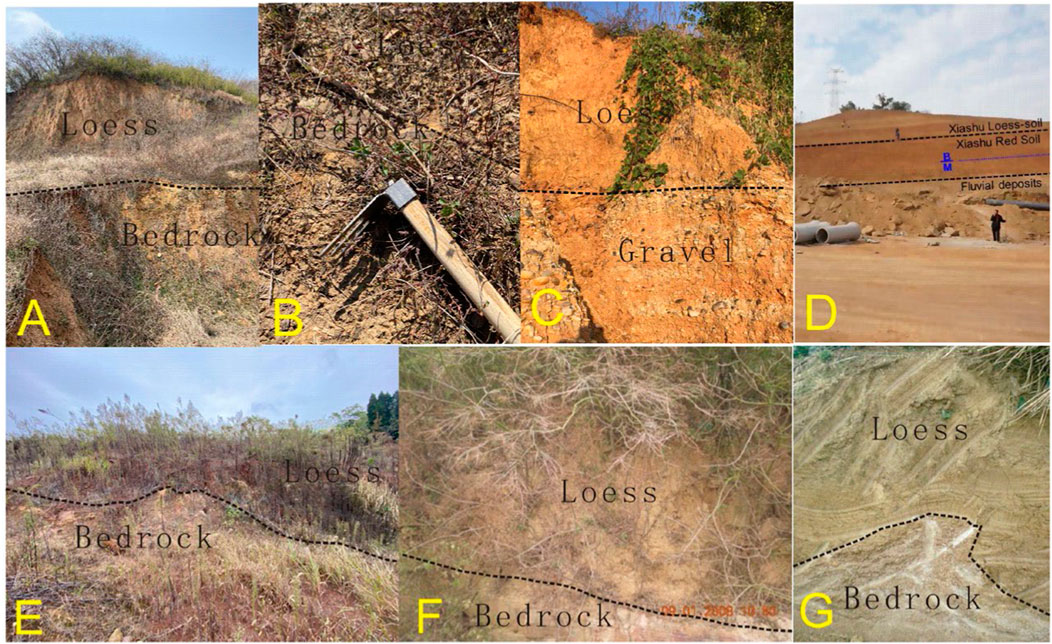
Figure 2. Bottom boundary profiles and the underlying layers of the Xiashu loess in the lower reaches of the Yangtze River and the eastern China Sea Islands. Note: (A–G) represent sections in Xiashu, Changshan, Qingshan, Zhoujiashan, Pukou, Huangnishan, and Shengshan, respectively; (D) is from the study conducted by Wang et al. (2017), and the other images are from this study.
Additionally, researcher Zheng (1999) utilized a thermoluminescence test method to determine that the bottom age of the Shengshan loess section was 48.1 ±4.5 Ka B.P., which differed greatly from that of the Xiashu loess near Nanjing. It has been inferred that the lower reaches of the Yangtze River were characterized with high precipitation levels during this time, which resulted in erosion of some of the earliest loess strata. Therefore, there may have been depositional gaps in the formation process of the island loess.
In summary, it was concluded that uncertainties in the temporal framework of the Xiashu loess have been greatly influenced by its scattered spatial distribution, its small thicknesses, difficulties in accurate dating, stratigraphic discontinuities, and other factors, resulting in there being no complete stratigraphic sequence at the present time.
4 Provenance tracing methods of the Xiashu loess
4.1 Source tracing with grain-size fractionated characteristics
Most research has shown that changes in loess grain size components are closely related to the distances from the sources (Rutledge et al., 1975; Yin et al., 2008), transportation power (monsoon intensities) (Lu and An, 1997), and the degree of drought in the source areas (Qiao et al., 2006). Therefore, examining changes in grain size is an important direction to investigate in the exploration of the loess source areas.
Under moderate wind field conditions, dust particles with diameters <16 μm can be transported over long distances by suspension. The coarse-grained components of loess, on the other hand, are known to be mainly transported by saltation (Tsoar and Pye, 1987). Strong winter winds (in China) lead to increases in the coarse particle components in loess deposits downwind (Schaetzl and Attig, 2013). Meanwhile, weaker winter winds will only be able to transport fine particles, leading to increases in the fine particle components in the loess (Chen et al., 2006). Therefore, it can be concluded that the fine particles with diameters <16 μm in the Chinese loess mainly represent the dust particles transported by long-distance suspension under the actions of winter winds, with some of those particles originating from near source materials under weak wind field conditions (Chen et al., 2006). However, the coarse particles (>32 μm) mainly represent the dust transported by short distance saltation.
Chinese loess contains large amounts of fine particles. In the southern part of the CLP (Chinese Loess Plateau), for example, >60% of the loess is composed of <16 μm dia. particles (Nugteren and Vandenberghe, 2004). Particle sizes <16 μm were confirmed to be the main grain size components of the Xiashu loess in the lower reaches of the Yangtze River, and were the main information carrier for the identification of the remote source materials (Hao et al., 2010).
Furthermore, for the particle with diameters >32 μm, the detrital zircon U-Pb age spectrum was best used to differentiate the source regions. This was due to the fact that after the formation of zircons by magmatism, these grains are only minimally affected by surficial processes, and thus, their U-Pb age spectra can be used to indicate the initial source areas of the loess (Xie et al., 2012).
In other cases, grain size fractions of <5μm, 10–20μm, 20–50 μm of the Xiashu loess were extracted, and immobile element ratios in these grain size fractions were used in tracing the provenance of the Xiashu loess in Xuancheng, Chuishan, Changshan, Gushan sections. Then, reliable results were reached by this method (Wu et al., 2021; 2023a).
4.2 Immobile source tracing indexes
For provenance studies, the influence of chemical weathering and pedogenesis should be considered in the identification of material sources. Only immobile tracer indices can accurately indicate the material sources of the Xiashu loess. The main tracer indicators are listed in the following section.
4.2.1 Detrital zircons U-Pb age spectrum
Zircon minerals have very strong resistances to weathering. Single-particle zircon U-Pb dating techniques with LA-ICP-MS have been rapidly developed in recent years and detrital zircon U-Pb ages can reflect multiple stages of protolith formation, which provide new methods for tracing aeolian dust sediment sources (Xiao et al., 2012; Stevens et al., 2013; Shang et al., 2018). When compared with the average characteristics represented by the geochemical characteristics of an entire rock sample, the U-Pb ages of detrital zircon tend to be a more robust characteristic index when resolving multiple provenances. Such methods have also been widely used in desert (Stevens et al., 2010), fluvial (He et al., 2013; Deng et al., 2017) and marine sources (Choi et al., 2013), with good provenance tracing effects achieved.
In recent years, detrital zircon age data have played important roles in the provenance tracing of the Xiashu loess. The zircon ages of the Xiashu loess are indistinguishable from the fluvial sediments of the Yangtze River, indicating the dominance of proximal dust source (Liu et al., 2014). Because the laser spot beam diameter of LA-ICP-MS technology is generally 30 μm, only coarse-grained particles with diameters >30 µm can be used for the determination of detrital zircon U-Pb ages, using laser denudation methods. However, when using detrital zircons as the targeted heavy minerals, it has been determined that coarse detrital zircons are difficult to transport over long distances except under extremely windy conditions. Therefore, the use of the coarse detrital zircon U-Pb dating spectrum would only be an important method in the identification of proximal-source materials (Formenti et al., 2011; Nie et al., 2015).
4.2.2 Immobile geochemical tracers of major and trace elements
The ratios of immobile major and trace elements have been widely used in provenance tracing research (Dou et al., 2015; Hu and Yang, 2016; Qian et al., 2018), since they have low dissolution rates in nature (Broecker and Peng, 1982; Sugitani et al., 1996) due to the relative stability of certain surface environments. Therefore, element ratios derived from stable minerals may also represent the compositional characteristics of rock in the source areas (Fralick and Kronberg, 1997). For example, Ti contents may vary greatly among different types of rock, while Al contents have been observed to basically remain constant among different rock types (Li, 2000). Therefore, it can be concluded that the utilization of the TiO2/Al2O3 ratios to analyze the material sources of loess (Ferrat et al., 2011;Sheldon and Tabor, 2009; Xu, 2007) has potentially important reference utility.
Rare earth elements have similar chemical characteristics and relatively low solubilities (Taylor and McLennan, 1985). Also, rare earth elements are less prone to fractionation in upper continental crust environments (Rollinson, 1993). During weathering, transport, deposition, and diagenesis processes, the content levels and distribution patterns of rare earth elements are not easily changed, thereby preserving the characteristics of the parent material. Therefore, it is reasonable to assume that rare earth elements can be used for the provenance tracing of detritus materials (Muhs et al., 2016; Dou et al., 2015; Li et al., 2020).
It was considered that since the components of the fine particles in the Xiashu loess may have been affected by chemical weathering, the geochemical characteristics of the elements may have produced grain size effects (Cullers et al., 1987). Therefore, it is particularly important to select immobile element ratios that are not affected by grain size in order to identify the provenance of the fine particles (Qian et al., 2018). Such major elements as Al2O3, Fe2O3, MnO, MgO, and K2O, were mainly enriched in <4 μm fractions (Yang et al., 2006). Therefore, it was feasible to use immobile tracer ratio TiO2/Al2O3 vs K2O/Al2O3 scatter plots and (CaO*+Na2O+MgO)/TiO2 vs K2O/Al2O3 scatter plots in the determination of provenance, since they are not affected by particle size (Hao, 2001; Hao et al., 2010). Large ion lithophile elements (LILEs) and high field strength elements (HFSEs) were considered to be the most suitable for provenance tracing due to their relatively low activities during deposition (Hao et al., 2010). In addition, when the element ratios Th/U and La/Th were used as source tracers, it was found that the ratios in the whole rock and different grain sizes did not differ significantly, and they were only minorly affected by sedimentary sorting (Gallet et al., 1998).
The ratios of Sc/Th, Cr/Th, Ta/Th have been used for provenance tracing of the Xiashu loess in Chuishan, Changshan, and Gushan sections (Wu et al., 2021) and Xuancheng section (Wu et al., 2023a) (e.g., Figure 3). The results show that the Xiashu loess in these sections has multiple local material sources. The provenance of loess in Chuishan, Changshan, and Gushan sections are mainly from Yangtze River sediment and loess in Xuancheng section from Shuiyang River sediment. Beyond that, the ratios of Zr/Sc, Eu/Eu*, LaN/YbN have been used for provenance tracing of the Chuishan, Changshan, and Gushan loess sections (Wu et al., 2021), and the ratios of La/Sc, Nb/Ta, and Ti/Nb have been used for provenance tracing of the Xuancheng loess (Wu et al., 2023a). Those elemental ratios could also be used to reliably trace the sources of the Xiashu loess. While, the provenance tracing indexes of these loess sections were not exactly the same. Therefore, in different areas along the lower reaches of the Yangtze River, the geochemical characteristics may be affected by local source materials.
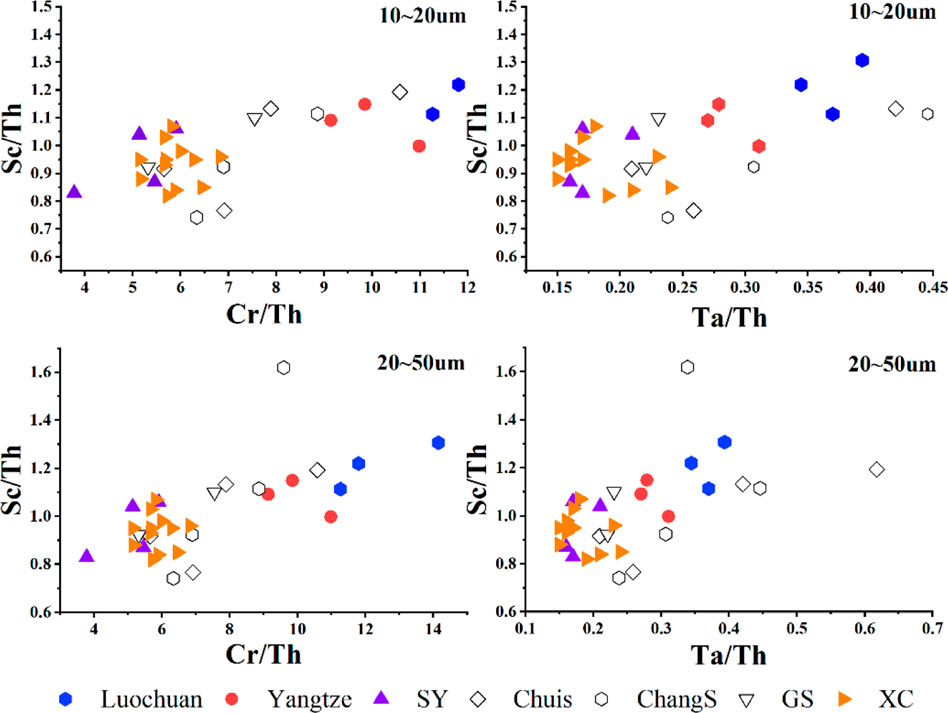
Figure 3. Tracing the provenance of the Xiashu loess in Xuancheng, Chuishan, Changshan, Gushan sections of 10∼20 μm, 20∼50 μm grain fractions using trace element ratios (Modified from Wu et al. (2021, 2023a)).
4.2.3 Stable isotope geochemical tracer
Sr and Nd isotopes are regarded as effective tracers for the accurate identification of dust sources (Grousset and Biscaye, 2005; Chen et al., 2007; Sun, 2005; Yang et al., 2009; Rao et al., 2014; Shen et al., 2017; Beny et al., 2018). The mechanism is that the minerals and rock have different Sr-Nd isotopic compositions (87Sr/86Sr, εNd(0)) due to different provenance. The isotope ratios remain almost constant during atmospheric transport and accumulation (Yokoo et al., 2004). Therefore, Sr-Nd isotopic compositions are widely used as a stability index in the provenance tracing of loess (Gallet et al., 1998; Jahn et al., 2001; Chen et al., 2007; Zhang et al., 2012). That index has also been applied in the provenance tracing of the Xiashu loess (Chen et al., 2007; Chen and Li, 2011; Qian et al., 2018).
The Sr–Nd isotope data εNd(0) of the Xiashu loess from Huangnishan, Shengshan are of −10.98 to −10.69, −11.49 to −10.90, respectively, which are very similar to the loess on the CLP (e.g., −10.10 to −9.6 0 for the Luochuan loess). Data of 87Sr/86Sr ratio of the Xiashu loess from Huangnishan, Shengshan are of 0.715925–0.716824, 0.717857–0.718585 respectively, which are similar to the loess on the CLP (e.g., 0.715078–0.718258 for the Luochuan loess). They are consistent with those of sediments from the north margin of the Tibetan Plateau, which belongs to the young upper crust range. Nevertheless, the data of Yangtze River have higher 87Sr/86Sr ratios (0.721058–0.72562) than that of the Xiashu loess and the CLP loess. Sr-Nd isotopic compositions indicates that Xiashu loess has an identical material source to both CLP loess and Yangtze River sediments (Qian et al., 2018).
Other stable isotope ratios, such as uranium isotope ratios (U-234/U-238) (Li et al., 2018), potassium feldspar Pb isotope ratios (Aleinikoff et al., 2008), and Hafnium isotope ratios (Fenn et al., 2022) have also been used as new source tracer indexes of loess. Those methods should also be suitable for the provenance tracing of the Xiashu loess.
4.2.4 Mineralogical index tracer
Quartz contents in the Xiashu loess are more representative of the characteristics of the source region than are the bulk samples, because quartz is a very weathering-resistant mineral (Sun et al., 2008). Thus, provenance signals contained in the quartz component will be different from that of the silicate mineral component in loess. For example, under the same wind conditions, due to different densities, coarser light mineral particles can have the same sorting characteristics as fine heavy mineral particles and be deposited in the same formation (Garzanti et al., 2009). While, quartz is the main mineral component of most loess deposits, even as heavy minerals account for less than 1% of the mineral volume of loess. Therefore, quartz monocrystalline particles can be utilized to better distinguish different source information than will heavy mineral data. Therefore, quartz oxygen isotopes (Yang et al., 2008; Yan et al., 2014; Yan et al., 2017), electron spin resonance signal intensities, and crystallinity indexes (Aleon et al., 2002; Sun et al., 2007; 2008; 2013; Ma et al., 2015; Li et al., 2007) are now considered to be reliable tracers for the provenance of loess. In addition, it is possible to quantitatively assess the fraction contents of the distant and proximal source components of the Xiashu loess using quartz single minerals with strong resistance to weathering (Wu et al., 2021).
4.3 Examination of the modern dust transport paths
Dust particles can be transported via wind over long distances. For example, on the Qinghai-Tibet Plateau during the months of March and April, dust particles generated by sandstorms in this arid and semi-arid region are transported to eastern China and the eastern sea areas under the action of the Mongolia and Siberia Highs (Quan, 1993; Lee M. K. et al., 2010). Many of those dust particles precipitate as loess on the CLP (Zhao and Yan, 1994), even as some are transported to eastern China (Quan, 1993), Japan (Arao and Ishizaka, 1986; Liu et al., 2003), Korea (Lee Y. C. et al., 2010), and the North Pacific (Duce et al., 1980; Arnold et al., 1998), or to North America and Greenland via westerlies, or to the Arctic region by meridional circulation (Colin et al., 1997).
Many geochemical, mineralogical, and other research methods have been applied to the study of the migration routes and material sources of dust particles (Liu et al., 2002). Commonly adopted methods include elemental ratios, isotope compositions, and the forms of the elements in the atmospheric dust which could help determine the source regions of the sandstorms that produce the dust. Previous studies that have utilized those type of methods have attracted increasing attention from researchers (Zhang et al., 2004; Han et al., 2005; Xu et al., 2008). The characterizations of the surface element chemical morphology of atmospheric dust in Beijing and Inner Mongolia, for example, have provided important evidence of an iron-sulfur coupling mechanism in the long-distance transportation of atmospheric dust, further confirming the possible important influence of dust storms to global environmental changes (Zhang et al., 2004). The results of previous studies have shown that, through the continuous systematic study of atmospheric dust, more sensitive material composition indexes can be identified, and that these new indices might help researchers to better understand possible dust sources and their relationships with atmospheric circulation and climate. If both the atmospheric dust sources and the loess source tracing results are combined, they may be able to verify the source and thus, complement each other, providing reliable provenance tracer indexes and more accurate conclusions.
5 Prospects of the provenance research of the Xiashu loess
5.1 Source signals of the fine particles
The coarser particles in the Xiashu loess have been determined to be proximal source sediment (Hao et al., 2010; Han et al., 2019; Liu et al., 2014). However, it remains questionable as to whether all the fine particles in the loess also originated from proximal source areas. There is no doubt that dust particles originating from the central Asian desert regions can be deflated, transported, and deposited to the CLP (Sun et al., 2013) and far beyond (Yamamoto et al., 2013; Zhang et al., 2016; Bory et al., 2003). The particle sizes of the atmospheric dust deposition in the North Pacific are <10 μm, and the particle sizes of mineral dust in Greenland’s ice core are <5 µm (Bory et al., 2003). In addition, it has been determined that particles with sizes less than 2 μm can be transported over very long distances (>> 1,000 Km) in the atmosphere (Maher et al., 2010).
Wu et al. (2021) determined, base don quartz single mineral components in samples, that the <5 µm dust fraction in the Xiashu loess could be divided into distant source materials from the northwestern arid areas, which accounted for 9.64% of the overall sample. However, the 5–10 µm components could not be identified as proximal-source materials. Modern meteorological data and sandstorm records also have indicated that the Xiashu loess may have been derived from the transport of sandstorm dust particles in the arid regions of inland China (Qian et al., 2012; 2013; Chow et al., 2014). Therefore, further exploration of the source signals of the fine particles in the Xiashu loess must be undertaken to determine the complete material sources of the Xiashu loess.
5.2 Spatial-temporal variations of the provenance and its coupling relationship with paleoclimate evolution
Transport of dust particles in China is largely influenced by the changes in the East Asian monsoons and westerly circulations under the control of Tibetan Plateau Uplift (Liu, 1985; An et al., 1990). Loess that formed under paleoclimate environmental conditions during different geological periods will have obvious differences in composition (Guo et al., 1999). It has been found that modern sandstorms in the lower reaches of the Yangtze River have similar provenance to loess in the CLP (Qian et al., 2013). Therefore, it can be assumed that under the dry and cold climate conditions of the last glacial period, dust particles from inland areas may have been transported to the lower reaches of the Yangtze River by strong winter monsoon activities (Wu et al., 2021). Thus, the East Asian Winter Monsoon continuously provided aeolian dust to the lower reaches of the Yangtze River. This resulted in the northwestern inland areas of China becoming the main material source of the loess when the East Asian Winter Monsoons were strong during the last glacial period. However, under the actions of local wind fields during shorter, more specific climate intervals, large quantities of dust may have derived from exposed continental shelf of the Yellow Sea and the East China Sea (Zhao, 1991), and the Yangtze River (Liu et al., 2014). Particles from the ancient river beaches of the Yellow River (Yang and Li, 1999) may also have been transported to the southeastern coastal areas, thereby becoming the main material source of the dust accumulation. Those theories suggest that the Xiashu loess in the lower reaches of the Yangtze River may have had various main material sources under different paleoclimatic environmental conditions.
The geochemical characteristics of the Xiashu loess in different areas of the lower reaches of the Yangtze River have been examined by many researchers, and it has been found that the provenance of the Xiashu loess had obvious spatial heterogeneity, and multiple local dust sources exists (Han et al., 2019; Zhang and Jia, 2019). For example, the silicate fraction of the Xiashu loess in Nanjing has εNd value of −11.14 and a 87Sr/86Sr ratio of 0.71948 (Chen and Li, 2011); this is very similar to the loess on the CLP, but is distinguishable from the eolian deposits in the middle reaches of the Yangtze River (Hong et al., 2013; Qiao et al., 2011). However, the Nd and Sr isotopic compositions of the Xiashu loess in Nanjing cannot be totally distinguished from those of modern sediments in the Yangtze River (Mao et al., 2011). Thus, it is possible that the Xiashu loess in the lower reaches might have a different source than is found in the eolian deposits of the middle reaches.
It has also been reported that the distal provenance proportion of the Xiashu loess may have been relatively higher in the paleosol strata, which formed moreso during the interglacial periods (Wu et al., 2021). This may be ascribed to the low local aeolian dust flux during the interglacial period under the conditions of the constant transport flux of the distant material. These conclusions indicated that the material sources of the Xiashu loess had obviously varied during different time periods (Figure 5).
Furthermore, the spatial variation characteristics of local source in the lower reaches of the Yangtze River and Shengshan Island have also been determined according to the comparison results of the detrital zircon U-Pb age spectrums (Qian et al., 2018). In Figure 4, it can be seen that the detrital zircon U-Pb age spectrums in the Shenshan (SS) and Xuancheng (XC) loess sections are mainly consistent with each other, while each curve has its own unique peak. For example, the age peak at 90 to 120 Ma of SS sample was similar to peak at 90 to 110 Ma in the QSI+PTS age distribution (Wu et al., 2023b). Those results suggested that part of the reason of multiple local dust sources may have been due to material provided to the overlying loess by the local bedrock. The peak at 136 Ma for the XC age distribution was consistent with the peak at 136 Ma for the Shuiyang River (SY) distribution, which suggested that part of the loess in the Xuancheng section originated from the sediment of the SY River (Wu et al., 2023a). Those spatial changes revealed that the Shengshan and Xuancheng loess were the products of independent dust transport processes (Figure 5). Therefore, multiple local dust sources in the Xiashu loess may be a widespread phenomenon in the lower reaches of the Yangtze River. Therefore, it has also been recommended that the temporal and spatial differences in the material sources of the Xiashu loess should be explored in order to fully reveal its provenance characteristics and its coupling relationships with paleoclimate evolution and the depositional model (Zhang and Jia, 2019).
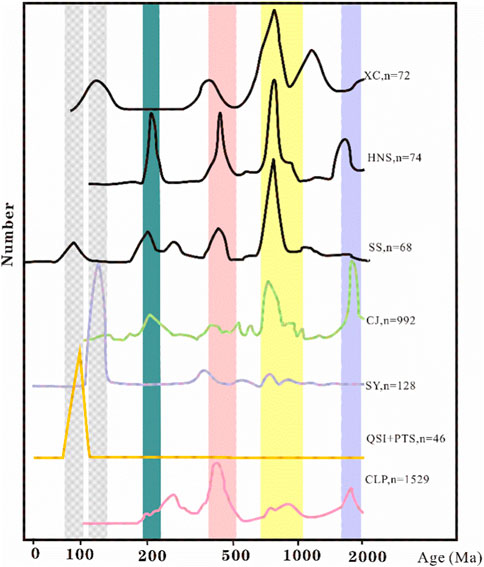
Figure 4. Comparison of the detrital zircons U-Pb age spectrums. The detrital zircons U-Pb age spectrum of Shuiyang River (SY) sediment is from the study conducted by Wu et al. (2023a); detrital zircons U-Pb age spectrums of the Changjiang River (CJ) sediment, Shenshan Island (SS) loess, Huangnishan Hill (HNS) loess, and Xuancheng loess (XC) are from the research conducted by Qian et al. (2018); and the Yanshanian granite of Qushan Island and Putuo Shan (QSI+ PTS) are from Wu et al. (2023b)
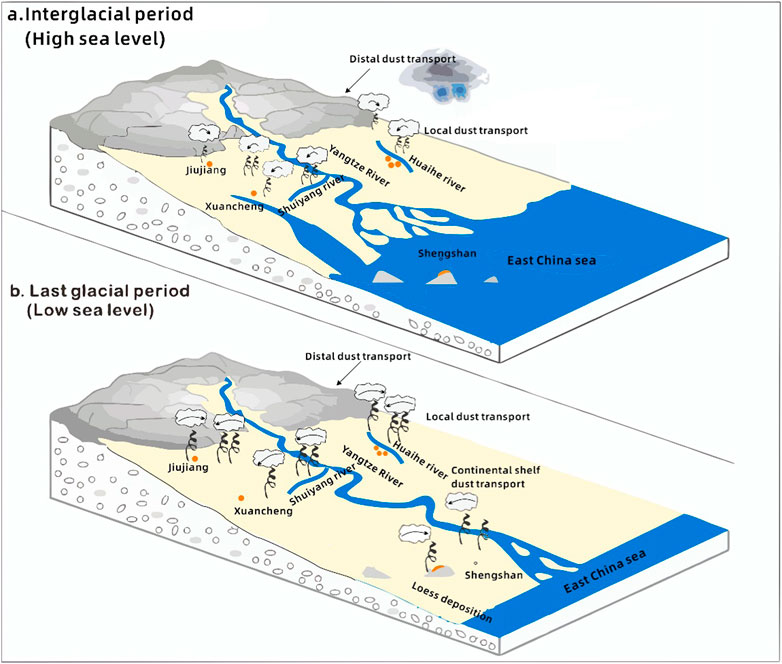
Figure 5. Various main material sources of the Xiashu loess under different paleoclimatic environmental conditions.
6 Summary
The study of the provenance of the Xiashu loess in the lower reaches of the Yangtze River is beneficial to the exploration of paleoclimate evolution in eastern China and is of major significance to the understanding of the East Asian monsoon evolution, global environmental evolution, and its driving mechanisms. With the major progress of provenance tracing methods, researchers have put forward their own views on the provenance of the Xiashu loess. These studies have concluded that more consistent data are obtained from the source tracers of the coarser particles. It has been determined that the source material for this loess mainly originated from proximal areas, such as Yangtze River Valley. However, there are still obvious disputes regarding whether there are remote signals in the composition of the fine particles. Consequently, it is suggested that further studies should be carried out on the source characteristics of the fine particle components and the coupling relationships between the paleoenvironment and the spatial and temporal variations of the material sources.
Author contributions
PQ: Writing–original draft, Writing–review and editing. YW: Writing–review and editing. ZT: Writing–review and editing. LY: Writing–review and editing. XZ: Writing–review and editing. JL: Writing–review and editing.
Funding
The author(s) declare that financial support was received for the research, authorship, and/or publication of this article. This research was funded by the National Natural Science Foundation of China (Grant numbers 42371018 and 41671003) and Innovative Training Program for College Students of Nantong University (Grant number 202410304146Y).
Conflict of interest
The authors declare that the research was conducted in the absence of any commercial or financial relationships that could be construed as a potential conflict of interest.
Publisher’s note
All claims expressed in this article are solely those of the authors and do not necessarily represent those of their affiliated organizations, or those of the publisher, the editors and the reviewers. Any product that may be evaluated in this article, or claim that may be made by its manufacturer, is not guaranteed or endorsed by the publisher.
References
Aleinikoff, J., Muhs, E., Bettis, E., Johnson, W., Fanning, C., and Benton, R. (2008). Isotopic evidence for the diversity of late Quaternary loess in Nebraska: glaciogenic and non-glaciogenic sources. Geol. Soc. Am. Bull. 120, 1362–1377. doi:10.1130/b26222.1
Aleon, J., Chaussidon, M., Marty, B., Schutz, L., and Jaenicke, R. (2002). Oxygen isotopes in single micrometer-sized quartz grains: tracing the source of Saharan dust over long-distance atmospheric transport. Geochim. Cosmochim. Acta 66, 3351–3365. doi:10.1007/s12583-013-0331-4
An, Z. S., Liu, T. S., Lu, Y. C., Porter, S. C., Kukla, G., Wu, X. H., et al. (1990). The long-term paleo-monsoon variation recorded by the Chinese loess-paleosol sequence in central China. Quat. Int. 7, 91–98.
Arao, K., and Ishizaka, Y. (1986). Volume and mass of yellows and dust in the air over Japan as estimated from atmospheric turbidity. J. Meteorological Soc. Jpn. 64 (1), 79–94. doi:10.2151/jmsj1965.64.1_79
Arnold, E., Merrill, J., Leinen, M., and King, J. (1998). The effect of source area and atmospheric transport on mineral aerosol collected over the North Pacific Ocean. Glob. Planet Change 18, 137–159. doi:10.1016/s0921-8181(98)00013-7
Beny, F., Toucanne, S., Skonieczny, C., Bayon, G., and Ziegler, M. (2018). Geochemical provenance of sediments from the northern East China Sea document a gradual migration of the Asian Monsoon belt over the past 400,000 years. Quat. Sci. Rev. 190, 161–175. doi:10.1016/j.quascirev.2018.04.032
Bory, A. J. M., Biscaye, P. E., and Grousset, F. E. (2003). Two distinct seasonal Asian source regions for mineral dust deposited in Greenland (North GRIP). Geophys. Res. Lett. 30, 1–4. doi:10.1029/2002gl016446
Cao, J. X., Li, P. Y., and Shi, N. (1987). The loess in Miaodao island, Shandong province. Sci. China (Series B) 18, 1116–1123. doi:10.1360/zb1987-17-10-1116
Cao, J. X., Yan, R. E., and Wang, H. (1994). Red weathering crust and brown-red soil of the Miaodao Archipelago, Shandong Province and their paleoclimate significance. Sci. China (Series B) 24 (2), 216–224. doi:10.1360/zb1994-24-2-216
Chen, J., Chen, Y., Liu, L. W., Ji, J. F., Balsam, W., Sun, Y. B., et al. (2006). Zr/Rb ratio in the Chinese loess sequences and its implication for changes in the East Asian winter monsoon strength. Geochimica Cosmochimica Acta 70 (6), 1471–1482. doi:10.1016/j.gca.2005.11.029
Chen, J., and Li, G. J. (2011). Geochemical studies on the source region of Asian dust. Sci. China Earth Sci. 54, 1279–1301. doi:10.1007/s11430-011-4269-z
Chen, J., Li, G. J., Yang, J. D., Rao, W. B., Lu, H. Y., Balsam, W., et al. (2007). Nd and Sr isotopic characteristics of Chinese deserts: implications for the provenances of Asian dust. Geochimica Cosmochimica Acta 71 (15), 3904–3914. doi:10.1016/j.gca.2007.04.033
Choi, T., Lee, Y., Orihashi, Y., and Yi, H. (2013). The provenance of the southeastern Yellow Sea sediments constrained by detrital zircon U-Pb age. Mar. Geol. 337, 182–194. doi:10.1016/j.margeo.2013.01.007
Chow, K., Su, L., Jimmy, C. H. F., Ma, H., and Alexis, K. H. L. (2014). Numerical modeling of a strong dust event over the south China region in March 2010. Meteorology Atmos. Phys. 126, 119–138. doi:10.1007/s00703-014-0338-0
Colin, J. L., Lim, B., Herms, E. F., Genet, F., Drab, E., Jaffrezo, J., et al. (1997). Air to snow mineral transfer-crustal elements in aerosols, fresh snow and snow pits on the Greenland ice sheet. Atmos. Environ. 31 (20), 3395–3406. doi:10.1016/s1352-2310(97)00122-2
Cullers, R., Barrett, T., Carlson, R., and Robinson, B. (1987). Rare-earth element and mineralogic changes in Holocene soil and stream sediment: A case study in the Wet Mountains, Colorado, U.S.A. Chem. Geol. 63 (3), 275–297. doi:10.1016/0009-2541(87)90167-7
Deng, K., Yang, S. Y., Li, C., Su, N., Bi, L., Chang, Y., et al. (2017). Detrital zircon geochronology of river sands from Taiwan: Implications for sedimentary provenance of Taiwan and its source link with the east China mainland. Earth-Science Rev. 164, 31–47. doi:10.1016/j.earscirev.2016.10.015
Ding, Z. L., Sun, J. M., Yang, S. L., and Liu, T. S. (2001). Geochemistry of the Pliocene red clay formation in the Chinese loess Plateau and implications for its origin, source provenance and paleoclimate change. Geochimica Cosmochimica Acta 65, 901–913. doi:10.1016/s0016-7037(00)00571-8
Dou, Y., Yang, Y. G., Lim, S., and Dhong-Il, J. (2015). Provenance discrimination of last deglacial and Holocene sediments in the southwest of Cheju Island, East China Sea. Palaeogeogr. Palaeoclimatol. Palaeoecol. 422, 25–35. doi:10.1016/j.palaeo.2015.01.016
Du, D. W., Shi, X. F., Meng, X. W., Cheng, Z. B., Chen, Z. H., and Xiong, Y. Q. (2003). Geochemical granularity effect of sediment in the Yellow Sea. Adv. Mar. Sci. 21 (1), 78–82. doi:10.3969/j.issn.1671-6647.2003.01.009
Duce, R. A., Unni, C. K., Ray, B. J., Prospero, J. M., and Merrill, J. T. (1980). Long-Range Atmospheric Transport of Soil Dust from Asia to the Tropical North Pacific: Temporal Variability. Science 209, 1522–1524. doi:10.1126/science.209.4464.1522
Feng, L., Jing, Z., Jincheng, R., Fuyou, C., Xinying, Z., John, W., et al. (2024). Environmental reconstruction and dating of Shixiakou Locality 1 on China’s West Loess Plateau: implications for human adaptive changes apparent during the Last Glacial Maximum (LGM) and post-LGM periods. Archaeol. Anthropol. Sci. 16, 15. doi:10.1007/s12520-023-01922-1
Fenn, K., Millar, I. L., Durcan, J. A., Thomas, D. S. G., Banak, A., Markovic, S. B., et al. (2022). The provenance of Danubian loess. Earth-Science Rev. 226, 103920. doi:10.1016/j.earscirev.2022.103920
Ferrat, M., Weiss, D. J., Strekopytov, S., Dong, S. F., Chen, H. Y., Najorka, J., et al. (2011). Improved provenance tracing of Asian dust sources using rare earth elements and selected trace elements for palaeomonsoon studies on the eastern Tibetan Plateau. Geochimica Cosmochimica Acta 75 (21), 6374–6399. doi:10.1016/j.gca.2011.08.025
Formenti, P., Schutz, L., Balkanski, Y., Desboeufs, K., Ebert, M., Kandler, K., et al. (2011). Recent progress in understanding physical and chemical properties of African and Asian mineral dust. Atmos. Chem. Phys. 11 (16), 8231–8256. doi:10.5194/acp-11-8231-2011
FraLick, P. W., and Kronberg, B. I. (1997). Geochemical discrimination of clastic sedimentary rock sources. Sediment. Geol. 113, 111–124. doi:10.1016/s0037-0738(97)00049-3
Gallet, S., Jahn, B. M., Lanoe, B. V. V., Dia, A., and Rossello, E. (1998). Loess geochemistry and its implications for particle origin and composition of upper continental crust. Earth Planet. Sci. Lett. 156, 157–172. doi:10.1016/s0012-821x(97)00218-5
Gallet, S., Jahn, B. M., and Morii, M. (1996). Geochemical characterization of the Luochuan loess-paleosol sequence, China, and paleoclimatic implications. Chem. Geol. 133, 67–88. doi:10.1016/s0009-2541(96)00070-8
Gao, X., Hao, Q., Qiao, Y., Peng, S., Li, N., Zhang, W., et al. (2021). Precipitation thresholds for iron oxides dissolution and the enhanced Eurasian aridity across the Mid-Pleisocene Transition: Evidence from loess deposits in subtropical China. Glob. Planet. Change 204, 1–14. doi:10.1016/j.gloplacha.2021.103580
Garzanti, E., Andò, S., and Vezzoli, G. (2009). Grain-size dependence of sediment composition and environmental bias in provenance studies. Earth Planet Sci. Lett. 277, 422–432. doi:10.1016/j.epsl.2008.11.007
Grousset, F. E., and Biscaye, P. E. (2005). Tracing dust sources and transport patterns using Sr, Nd and Pb isotopes. Chem. Geol. 222, 149–167. doi:10.1016/j.chemgeo.2005.05.006
Guo, Z. T., Wei, L. Y., Lu, H. Y., Wu, N. Q., Jiang, W. Y., and Liu, T. S. (1999). Changes in the composition of late Pleistocene aeolian dust and the environmental significance. Quat. Sci. 19 (1), 41–48. doi:10.1088/0256-307X/15/11/025
Han, L. H., Hao, Q. Z., Qian, Y. S., Wang, L., Peng, S. Z., Li, N., et al. (2019). Geochemical evidence for provenance diversity of loess in southern China and its implications for glacial aridification of the northern subtropical region. Quat. Sci. Rev. 212, 149–163. doi:10.1016/j.quascirev.2019.04.002
Han, L. H., Zhuang, G. S., Sun, Y. L., and Wang, Z. F. (2005). Differentiation of Local and external sources of atmospheric particulate matter pollution in Beijing: The contribution of mineral aerosols to external sources estimated by the Mg/Al tracking method. Sci. China (Series B) 35 (3), 237–246.
Hao, Q. (2001). A stratigraphical study on the late tertiary eolian deposit in western Loess Plateau, northern China(D). Beijing, China: Institute of Geology and Geophysics, Chinese Academy of Sciences.
Hao, Q. Z., Guo, Z. T., Qiao, Y. S., Xu, B., and Oldfield, F. (2010). Geochemical evidence for the provenance of middle Pleistocene loess deposits in southern China. Quat. Sci. Rev. 29, 3317–3326. doi:10.1016/j.quascirev.2010.08.004
He, M. Y., Zheng, H. B., and Clift, P. D. (2013). Zircon U-Pb geochronology and Hf isotope data from the Yangtze River sands: Implications for major magmatic events and crustal evolution in Central China. Chem. Geol. 360, 186–203. doi:10.1016/j.chemgeo.2013.10.020
Hong, H. L., Wang, C. W., Zeng, K. F., Gu, Y. S., Wu, Y. B., Yin, K., et al. (2013). Geochemical constraints on provenance of the mid-Pleistocene red earth sediments in subtropical China. Sediment. Geol. 290, 97–108. doi:10.1016/j.sedgeo.2013.03.008
Hu, F. G., and Yang, X. P. (2016). Geochemical and geomorphological evidence for the provenance of aeolian deposits in the Badain Jaran Desert, northwestern China. Quat. Sci. Rev. 131, 179–192. doi:10.1016/j.quascirev.2015.10.039
Huang, J. N., Fang, J. H., Shao, J. J., and Yang, D. Y. (1988). Study on the depositional age of the Xiashu loess in Nanjing. Geol. Rev. 34 (3), 240–247. doi:10.3321/j.issn:0371-5736.1988.03.006
Jahn, B. M., Gallet, S., and Han, J. M. (2001). Geochemistry of the Xining, Xifeng and Jixian sections, Loess Plateau of China: Eolian dust provenance and paleosol evolution during the last 140 ka. Chem. Geol. 178, 71–94. doi:10.1016/s0009-2541(00)00430-7
Lai, Z., Zhou, J., Xia, Y., Zhang, J., and Chen, J. (2001). Thermo luminescence dating of Xiashu Loess in Nanjing. Adv. Nat. Sci. 11, 203–207.
Lai, Z. P., Zhang, W. G., Chen, X., Jia, Y. L., Liu, X. J., Fan, Q. S., et al. (2010). OSL chronology of loess deposits in East China and its implications for East Asian monsoon history. Quat. Geochronol. 5 (2), 154–158. doi:10.1016/j.quageo.2009.02.006
Lee, M. K., Lee, Y. L., and Yi, H. L. (2010a). Provenances of atmospheric dust over Korea from Sr-Nd isotopes and rare earth elements in early 2006. Atmos. Environ. 44, 2401–2414. doi:10.1016/j.atmosenv.2010.04.010
Lee, Y. C., Yang, X., and Wen, I. M. (2010b). Transport of dusts from East Asian and non-East Asian sources to Hong Kong during dust storm related events 1996-2007. Atmos. Environ. 44, 3728–3738. doi:10.1016/j.atmosenv.2010.03.034
Li, G. J., Chen, J., Chen, Y., Yang, J. D., Ji, J. F., and Liu, L. W. (2007). Dolomite as a tracer for the source regions of Asian dust. Geophys. Res. 112, D17201. doi:10.1029/2007jd008676
Li, L., Chen, J., Chen, Y., Hedding, D. W., Li, T., Li, L. F., et al. (2018). Uranium isotopic constraints on the provenance of dust on the Chinese Loess Plateau. Geology 46, 747–750. doi:10.1130/g45130.1
Li, L. W. (2006). The Xiashu Loess and gravel layer nearby Nanjing city. Nanjing: Nanjing Normal University Press, 1–232.
Li, L. W., and Fang, Y. S. (1993). Study on the Xiashu loess in Nanjing area. J. Nanjing Normal Univ. 16, 3–21.
Li, L. W., Fang, Y. S., and Qiu, S. Z. (1978). Discovery and significance of deer and cattle fossils in the Xiashu Formation calcrete nodules in the Tiger Mountain, northern suburb of Nanjing. J. Nanjing Normal Univ. Nat. Sci. (1), 22–26.
Li, P. Y., Cheng, Z. B., Lu, H. Y., and Liu, G. H. (1992). The loess along coastal zone of Liaoning Province. Acta Geol. Sin. 66 (1), 82–94.
Li, P. Y., Xu, X. Y., and Zhao, S. L. (2008). Coastal Loess and paleo-glacial remnants. Beijing: China Ocean Press.
Li, X. G., He, J. H., Li, D. S., and Li, L. W. (1993). A preliminary study on electron spin resonance dating of the Xiashu Loess. J. Nanjing Norm. Univ. 16 (3), 86–91.
Li, X. S., Han, Z. Y., Lu, H. Y., Chen, Y. Y., Li, Y., Yuan, X. K., et al. (2018). Onset of Xiashu loess deposition in southern China by 0.9 Ma and its implications for regional aridification. Earth Sci. 61, 256–269. doi:10.1007/s11430-017-9134-2
Li, X. S., Han, Z. Y., Lu, H. Y., Li, Y., Yuan, X. K., Zhou, Y. W., et al. (2017). Onset of Xiashu loess deposition in Southern China by 0.9 Ma and its implications for regional aridification. Sci. China Earth Sci. 47, 256–269. doi:10.1007/s11430-017-9134-2
Li, Y. H. (2000). A compendium of Geochemistry: from solar nebula to the human brain. Princeton: Princeton Univ Press.
Li, Y. R., Shi, W. H., Adnan, A., Mary, A. B., and Gao, G. H. (2020). Loess genesis and worldwide distribution. Earth-Science Rev. 201, 102947. doi:10.1016/j.earscirev.2019.102947
Liu, C. L., Zhang, J., and Liu, S. M. (2002). Physical and chemical characters of materials from several mineral aerosol sources in China. Environ. Sci. 23 (4), 28–32.
Liu, F., Li, G. J., and Chen, J. (2014). U-Pb ages of zircon grains reveal a proximal dust source of the Xiashu loess, Lower Yangtze River region, China. Chin. Sci. Bull. 59, 2391–2395. doi:10.1007/s11434-014-0318-2
Liu, J. P., and Zhao, S. L., 1995. Origin of the buried loess in the Bohai sea bottom and the exposed loess along the coastal zone, 26(4): 63–68.
Lu, H. Y., and An, Z. S. (1997). Palaeoclimate significance of grain size composition of Luochuan loess. Chin. Sci. Bull. 42 (1), 66–69. doi:10.1360/csb1997-42-1-66
Lu, H. Y., Wang, X. Y., Wang, Y., Zhang, X. J., Yi, S. W., Wang, X. Y., Stevens, T., Kurbanov, R., and Marković, S. B. (2022). Chinese loess and the Asian monsoon: What we know and what remains unknown. Quat. Int., 620, 85–97. doi:10.1016/j.quaint.2021.04.027
Ma, L., Sun, Y. B., Tada, R., Yan, Y., Chen, H. Y., Lin, M., et al. (2015). Provenance fluctuations of aeolian deposits on the Chinese Loess Plateau since the Miocene. Aeolian Res. 18, 1–9. doi:10.1016/j.aeolia.2015.05.002
Maher, B. A., Prospero, J. M., Mackie, D., Hesse, P. P., and Balkanski, Y. (2010). Global connections between aeolian dust, climate and ocean biogeochemistry at the present day and at the last glacial maximum. Earth-Science Rev. 99 (1), 61–97. doi:10.1016/j.earscirev.2009.12.001
Mao, C. P., Chen, J., Yuan, X. Y., Yang, Z. F., and Ji, J. F. (2011). Seasonal variations in the Sr-Nd isotopic compositions of suspended particulate matter in the lower Changjiang River: Provenance and erosion constraints. Chin. Sci. Bull. 56, 2371–2378. doi:10.1007/s11434-011-4589-6
Muhs, D., Budahn, S. M., Skipp, G. L., and McGeehin, J. P. (2016). Geochemical evidence for seasonal controls on the transportation of Holocene loess, Matanuska Valley, southern Alaska, USA. Aeolian Res. 21, 61–73. doi:10.1016/j.aeolia.2016.02.005
Nie, J., Stevens, R., Stockli, G., Limonta, B., Andò, V., Saylor, L. H. Y., et al. (2015). Loess plateau storage of northeastern Tibetan plateau-derived Yellow River sediment. Nat. Commun. 6, 1–8. doi:10.1038/ncomms9511
Nugteren, G.Vandenberghe (2004). Spatial climatic variability on the Central Loess Plateau (China) as recorded by grain size for the last 250 kyr. Glob. Planet. Change 41 (3), 185–206. doi:10.1016/j.gloplacha.2004.01.005
Qian, P., Zheng, X. M., Cheng, J., Han, Y. J., Dong, Y., and Zhang, J. G. (2018). Tracing the provenance of aeolian loess in the Yangtze River Delta through zircon U–Pb age and geochemical investigations. J. Mt. Sci. 15, 708–721. doi:10.1007/s11629-017-4437-5
Qian, P., Zheng, X. M., and Zhou, L. M. (2013). Geochemical characteristics and sources of atmospheric particulates in Shanghai during dust storm event. Environ. Sci. 34 (5), 2010–2017.
Qian, P., Zhou, L. M., Zheng, X. M., and Yang, J. E. (2012). Characteristics of color index and it’s source indicator significant for atmospheric particulate matters. J. Arid Land Resour. Environ. 26 (9), 143–148.
Qiao, Y. S., Guo, Z. T., Hao, Q. Z., Wu, W. X., Jiang, W. Y., Yuan, B. Y., et al. (2003). Loess-soil sequences in southern Anhui province: magneto stratigraphy and paleoclimatic significance. Chin. Sci. Bull. 48 (19), 2088–2099. doi:10.1360/03wd0183
Qiao, Y. S., Guo, Z. T., Hao, Q. Z., Yin, Q. Z., Yuan, B. Y., and Liu, D. S. (2006). Grain size characteristics of loess-paleosol sequence in Miocene and its implications for genesis. Sci. China (Series D) 36 (7), 646–653. doi:10.1007/s11430-006-0731-8
Qiao, Y. S., Hao, Q. Z., Peng, S. S., Wang, Y., Li, J. W., and Liu, Z. X. (2011). Geochemical characteristics of the eolian deposits in southern China, and their implications for provenance and weathering intensity. Palaeogeogr. Palaeoclimatol. Palaeoecol. 308, 513–523. doi:10.1016/j.palaeo.2011.06.003
Quan, H. (1993). Study on the high-altitude Transport route of Sandstorm and yellow-sand aerosol over Northwest China. Environ. Sci. 14 (5), 60–65.
Rao, W. B., Chen, J., Tan, B., and Wang, Y. X. (2014). Nd-Sr isotopic and REE geochemical compositions of Late Quaternary deposits in the desert–loess transition, north-central China: Implications for their provenance and past wind systems. Quat. Int. 334-335, 197–212. doi:10.1016/j.quaint.2013.06.009
Rollinson, H. (1993). Using geochemical data: evaluation, presentation, interpretation. Edinburgh gate. Longman, 1–352.
Rutledge, E. M., Holowaychuk, N., Hall, G. F., and Wilding, L. P. (1975). Loess in Ohio in relation to several possible source areas: I. Physical and chemical properties. Soil Sci. Soc. Am. J. 39, 1125–1132. doi:10.2136/sssaj1975.03615995003900060031x
Schaetzl, R. J., and Attig, J. W. (2013). The loess cover of northeastern Wisconsin. Quat. Res. 79, 199–214. doi:10.1016/j.yqres.2012.12.004
Shang, Y., Prins, B., Kaakinen, L., Dijkstra, R., Wang, B., Zheng, H. B., et al. (2018). Aeolian dust supply from the Yellow River floodplain to the Pleistocene loess deposits of the Mangshan Plateau, central China: Evidence from zircon U-Pb age spectra. Quat. Sci. Rev. 182, 131–143. doi:10.1016/j.quascirev.2018.01.001
Sheldon, N. D., and Tabor, N. J. (2009). Quantitative paleoenvironmental and paleoclimatic reconstruction using paleosols. Earth-Science Rev. 95, 1–52. doi:10.1016/j.earscirev.2009.03.004
Shen, X., Wan, F.-L., Shi, X. F., Zhao, D. B., Liu, Y. G., Yin, X. B., et al. (2017). History of Asian eolian input to the Sea of Japan since 15 Ma: Links to Tibetan uplift or global cooling. Earth Planet. Sci. Lett. 474, 296–308. doi:10.1016/j.epsl.2017.06.053
Stevens, T., Adamiec, G., Bird, A. F., and Lu, H. Y. (2013). An abrupt Shift in dust source on the Chinese Loess Plateau revealed through high sampling resolution OSL dating. Quat. Sci. Rev. 82, 121–132. doi:10.1016/j.quascirev.2013.10.014
Stevens, T., Palk, C., Carter, A., Lu, H., and Clift, P. D. (2010). Assessing the provenance of loess and desert sediments in northern China using U-Pb dating and morphology of detrital zircons. Geol. Soc. Am. Bull. 122 (7-8), 1331–1344. doi:10.1130/b30102.1
Sugitani, K., Horiuchi, Y., Adachi, M., and Sugisaki, R. (1996). Anomalously low Al2O3/TiO2 values for Archean cherts from the Pilbara Block, Western Australiae possible evidence for extensive chemical weathering on the early earth. Precambrian Res. 80 (1-2), 0–76. doi:10.1016/S0301-9268(96)00005-8
Sun, J. M. (2005). Nd and Sr isotopic variations in Chinese eolian deposits during the past 8 Ma: Implications for provenance change. Earth Planet. Sci. Lett. 240 (2), 454–466. doi:10.1016/j.epsl.2005.09.019
Sun, Y., Yan, Y., Nie, J., Li, G., An, Z., Qiang, X., et al. (2020). Source-to-sink fluctuations of Asian aeolian deposits since the late Oligocene. Earth-Science Rev. 200, 102963. doi:10.1016/j.earscirev.2019.102963
Sun, Y. B., Chen, H., Tada, R., Weiss, D., Lin, M., Toyoda, S., et al. (2013). ESR signal intensity and crystallinity of quartz from Gobi and sandy deserts in East Asia and implication for tracing Asian dust provenance. Geochem. Geophys. Geosystems 14, 2615–2627. doi:10.1002/ggge.20162
Sun, Y. B., Tada, R., Chen, J., Chen, H. Z., Toyoda, S., Tani, A., et al. (2007). Distinguishing the sources of Asian dust based on electron spin resonance signal intensity and crystallinity of quartz. Atmos. Environ. 41 (38), 8537–8548. doi:10.1016/j.atmosenv.2007.07.014
Sun, Y. B., Tada, R., Chen, J., Liu, Q., Toyoda, S., Tani, A., et al. (2008). Tracing the provenance of fine-grained dust deposited on the central Chinese Loess Plateau. Geophys. Res. Lett. 35 (1), L01804. doi:10.1029/2007gl031672
Taylor, S., and Mclennan, S. M. (1985). The Continental crust: its composition and evolution. Oxford: Black wells, 1–190.
Tsoar, H., and Pye, K. (1987). Dust transport and the question of desert loess formation. Sedimentology 34 (1), 139–153. doi:10.1111/j.1365-3091.1987.tb00566.x
Wang, G., Li, J., Ravi, S., Scott, V., Costa, P., and Dukes, D. (2017). Tracer techniques in aeolian research: Approaches, applications, and challenges. Earth-Science Rev. 170, 1–16. doi:10.1016/j.earscirev.2017.05.001
Wang, X. Y., Lu, H. Y., Zhang, H. Z., Wu, J., Hou, X. X., Fu, F., et al. (2018). Distribution, provenance, and onset of the Xiashu Loess in Southeast China with paleoclimatic implications. J. Asian Earth Sci. 155, 180–187. doi:10.1016/j.jseaes.2017.11.022
Wu, C., Wang, Z. G., Wang, Q., Qian, P., Zheng, X. M., and Wei, G. J. (2023b). Sedimentary provenance and age of the Shengshan Island loess on the continental shelf of the East China Sea: Implications for windblown dust transport during the Last Glaciation. Geomorphology 427, 108624. doi:10.1016/j.geomorph.2023.108624
Wu, C., Zheng, X. M., Qian, P., Qu, P., He, M. H., and Wei, G. J. (2023a). Provenances of the Oldest Xiashu loess and Xuancheng loess in southern China: Implications for dust transport and dust proxies of the East Asian winter monsoon. Palaeogeogr. Palaeoclimatol. Palaeoecol. 614, 111440. doi:10.1016/j.palaeo.2023.111440
Wu, C., Zheng, X. M., Zhou, L. M., Ren, S. F., and Qian, P. (2021). Quantitative estimation of provenance contributions to loess deposits in Eastern China and implication for paleo-dust storm activity. Geomorphology 373 (15), 107489. doi:10.1016/j.geomorph.2020.107489
Wu, C. L., Zhu, C., Lu, H. Y., Ma, C. M., Zhu, G. Y., Zheng, C. G., et al. (2006). Magneto stratigraphical dating of the Xiashu loess in Nanjing area and its paleoenvironmental interpretation. J. Stratigr. 30 (2), 116–123. doi:10.3969/j.issn.1674-7240.2006.07.005
Xiao, G., Zong, K., Li, G., Hu, Z., Dupont-Nivet, G., Peng, S., et al. (2012). Spatial and glacial-interglacial variations in provenance of the Chinese Loess Plateau. J. Geophys. Res. Lett. 39 (20), 120715. doi:10.1029/2012gl053304
Xie, J., Yang, S. L., and Ding, Z. L. (2012). Methods and application of using detrital zircons to trace the provenance of loess. Sci. China Earth Sci. 55 (11), 1837–1846. doi:10.1007/s11430-012-4428-x
Xiong, S. F., Zhu, Y. J., Zhou, R., Lu, H. J., and Ding, Z. L. (2008). Chemical weathering intensity and it’s grain-size dependence for the loess red clay deposit of the Baishui section in Chinese Loess Plateau. Quat. Sci. 28 (5), 812–821.
Xu, H. H., Wang, Y. S., Yang, Y. J., Zhao, Y. N., Wen, T. X., and Wu, F. K. (2008). Concentrations and size distributions of water soluble ions of atmospheric aerosol at the summit of mount Tai. Environ. Sci. 29 (2), 305–309.
Xu, Z. K. (2007). Origin and paleoceanographic environments response of ferromanganese crusts (nodules) in the east Philippine Sea[D]. Qingdao: Institute of Oceanology, Chinese Academy of Sciences.
Yamamoto, Y., Toyoda, S., Nagasima, K., IgaraShi, Y., and Tada, R. (2013). Investigation of the temporal change of the sources of Aeolian dust delivered to East Asia using electron spin resonance signals in quartz. Geochronometria 40, 355–359. doi:10.2478/s13386-013-0121-x
Yan, Y., Ma, L., and Sun, Y. B. (2017). Tectonic and climatic controls on provenance changes of fine-grained dust on the Chinese Loess Plateau since the late Oligocene. Geochimica Cosmochimica Acta 200, 110–122. doi:10.1016/j.gca.2016.12.009
Yan, Y., Sun, Y. B., Chen, H. Y., and Ma, L. (2014). Oxygen isotope signatures of quartz from major Asian dust sources: implications for changes in the provenance of Chinese loess. Geochimica Cosmochimica Acta 139, 399–410. doi:10.1016/j.gca.2014.04.043
Yang, H., Zhao, Q. G., Li, X. P., and Xia, Y. F. (1996). ESR dating of eolian sediment and red earth series from Xuancheng profile in Anhui province. Acta Pearthen Sci. 33 (3), 293–300.
Yang, J. D., Li, G. J., Rao, W. B., and Ji, J. F. (2009). Isotopic evidences for provenance of East Asian Dust. Atmos. Environ. 43 (29), 4481–4490. doi:10.1016/j.atmosenv.2009.06.035
Yang, S., Ding, F., and Ding, Z. (2006). Pleistocene chemical weathering history of Asian arid and semi-arid regions recorded in loess deposits of China and Tajikistan. Geochimica Cosmochimica Acta 70, 1695–1709. doi:10.1016/j.gca.2005.12.012
Yang, S. Y., and Li, C. X. (1999). REE geochemistry and tracing application in the Yangtze River and the Yellow River sediments. Geochemistry 28 (4), 374–380.
Yang, X. P., Liu, Y. S., Li, C. Z., Song, Y. L., Zhu, H. P., and Jin, X. D. (2004). Rare earth elements of aeolian deposits in Northern China and their implications for determining the provenance of dust storms in Beijing. Geomorphology 87, 365–377. doi:10.1016/j.geomorph.2006.10.004
Yang, X. P., Zhang, F., Fu, X. D., and Wang, X. M. (2008). Oxygen isotopic compositions of quartz in the sand seas and sandy lands of northern China and their implications for understanding the provenances of aeolian sands. Geomorphology 102 (2), 278–285. doi:10.1016/j.geomorph.2008.05.007
Yi, S., Li, X., Han, Z., Lu, H., Liu, J., and Wu, J. (2018). High resolution Luminescence chronology for Xiashu Loess deposits of South-eastern China. J. Asian Earth Sci. 155, 188–197. doi:10.1016/j.jseaes.2017.11.027
Yi, S. W., Zeng, L., Xu, Z. W., Wang, Y., Wang, X. Y., Wu, J., et al. (2022). Sea-level changes in the Bohai Sea, northern China, constrained by coastal loess accumulation over the past 200 ka. Quat. Sci. Rev. 277, 107368. doi:10.1016/j.quascirev.2021.107368
Yin, Z. Q., Qin, X. G., Li, Y. M., and Ning, B. (2008). Influence of the dust source distance on the multimodal grain-size distribution characteristics of loess. Geol. China 35 (5), 1037–1044.
Yokoo, Y., Nakano, T., NiShikawa, M., and Quan, H. (2004). Mineralogical variation of Sr-Nd isotopic and elemental compositions in loess and desert sand from the central Loess Plateau in China as a provenance tracer of wet and dry deposition in the northwestern Pacific. Chem. Geol. 204, 45–62. doi:10.1016/j.chemgeo.2003.11.004
Yu, H. J. (1999). A New Exploration on the origin of loess in the shelf area of the Eastrn China Seas. Quat. Sci. 4, 366–372.
Zhang, M. H., Meng, J. W., Xia, Y. F., Lai, Z. P., and Wang, Y. J. (2011). Records of orbit and millennial-scale climate variability of East Asian monsoon in Xiashu Loess, Nanjing, China during the last 110,000 years. J. Stratigr. 35 (3), 321–327. doi:10.1360/csb2004-49-24-2544
Zhang, Q., Zhu, C., Jiang, T., and Becker, S. (2005). Mid-Pleistocene environmental reconstruction based on Xiashu loess deposits in the Yangtze Delta, China. Quat. Int. 135 (1), 131–137. doi:10.1016/j.quaint.2004.10.028
Zhang, W., Chen, J., Ji, J., and Li, G. (2016). Evolving flux of Asian dust in the North Pacific Ocean since the late Oligocene. Aeolian Res. 23, 11–20. doi:10.1016/j.aeolia.2016.09.004
Zhang, W. G., Dong, C. Y., Ye, L. P., Ma, H. L., and Yu, L. Z. (2012). Magnetic properties of coastal loess on the Midao islands, northern China: Implications for provenance and weathering intensity. Palaeogeogr. Palaeoclimatol. Palaeoecol. 333-334, 160–167. doi:10.1016/j.palaeo.2012.03.026
Zhang, X. Y., Zhuang, G. S., Chen, J. M., and Xue, H. X. (2004). Morphology and composition of elements on the surface of dust particles. Chin. Sci. Bull. 49 (24), 2544–2550. doi:10.1360/csb2004-49-24-2544
Zhang, Z., and Jia, Y. L. (2019). Different provenance of separate loess sites in Yangtze River Basin and its paleoenvironmental implications. J. Mt. Sci. 16 (7), 1616–1628. doi:10.1007/s11629-018-5278-6
Zhao, S. L. (1991). China shelf sea desertization and its derived deposits during the last Stage of Late Pleistocene. Ocean Limnol. 22 (3), 285–293.
Zhao, Y. Y., and Yan, M. C. (1994). Sedimentary Geochemistry of shallow sea in China. Beijing: Science Press, 1–174.
Zheng, X. M. (1999). Aeolian deposition and environment in Changjiang Delta and extending sea areas. Shanghai: East China Normal University Press, 102–108.
Keywords: provenance, geochemistry, detrital zircon U-Pb age, the Xiashu loess, sources
Citation: Qian P, Wu Y, Tian Z, Yang L, Zheng X and Luo J (2024) Provenance of the Xiashu loess in the lower reaches of the Yangtze River, China: a review. Front. Earth Sci. 12:1426389. doi: 10.3389/feart.2024.1426389
Received: 01 May 2024; Accepted: 16 September 2024;
Published: 14 November 2024.
Edited by:
Davide Tiranti, Agenzia Regionale per la Protezione Ambientale del Piemonte (Arpa Piemonte), ItalyReviewed by:
Li Wu, Anhui Normal University, ChinaNosir Shukurov, Institute of Geology and Geophysics (Uzbekistan), Uzbekistan
Copyright © 2024 Qian, Wu, Tian, Yang, Zheng and Luo. This is an open-access article distributed under the terms of the Creative Commons Attribution License (CC BY). The use, distribution or reproduction in other forums is permitted, provided the original author(s) and the copyright owner(s) are credited and that the original publication in this journal is cited, in accordance with accepted academic practice. No use, distribution or reproduction is permitted which does not comply with these terms.
*Correspondence: Peng Qian, dGVtcG9AbnR1LmVkdS5jbg==