 Hu Li
Hu Li Pengju Li1,2,3*
 Ahmed E. Radwan
 Haijun Wang
- 1School of Economics, Sichuan University of Science and Engineering, Zigong, China
- 2Research Center of Industrial Transformation and Innovation, Sichuan University of Science and Engineering, Zigong, China
- 3Sichuan Key Provincial Research Base of Intelligent Tourism, Sichuan University of Science and Engineering, Zigong, China
- 4National Key Laboratory of Oil and Gas Reservoir Geology and Exploitation (Southwest Petroleum University), Chengdu, China
- 5Faculty of Geography and Geology, Institute of Geological Sciences, Jagiellonian University, Kraków, Poland
Editorial on the Research Topic
Differences in shale oil and gas reservoirs across various sedimentary environments: theories and applications
1 Introduction
The United States Geological Survey (USGS) classifies shale oil and gas plays as “continuous petroleum accumulations.” These reservoirs are not discrete, conventional traps formed by hydrocarbon migration and accumulation but rather represent widespread, pervasive hydrocarbon resources, typically found within rocks characterized by relatively low matrix permeability (McMahon et al., 2024). Shale oil and gas, hydrocarbons stored within shale formations, constitute a significant unconventional resource crucial for optimizing the global energy mix and achieving carbon peaking and neutrality goals.
The United States pioneered shale oil and gas development, completing its first commercial natural gas well in 1825, drawing from Upper Devonian shales near Fredonia, New York (McMahon et al., 2024). The United States possesses abundant shale oil and gas resources, with estimated geological resources exceeding 0.246 × 10¹² t of shale oil and 290 × 1012 m3 of shale gas. Two decades of exploration, development, and technological advancement have resulted in sophisticated extraction techniques, including three-dimensional (3D) development strategies, refracturing technologies, enhanced oil recovery (EOR) methods, and extended-reach (“U”-shaped) well designs. From 2007 to 2023, the United States shale oil and gas production surged from approximately 11.2 × 10⁴ t/d to over 300.0 × 10⁴ t/d, surpassing conventional oil and gas production in 2017. By 2023, shale oil and gas accounted for over 60% of total oil and gas production and are projected to remain a major contributor to energy production for the foreseeable future.
Inspired by the successful North American experiences in shale gas plays such as the Barnett, Marcellus, Haynesville, Fayetteville, Woodford, and Eagle Ford, China’s shale gas exploration has accelerated significantly since 2005 (Li, 2023a; Li J. et al., 2024). Unconventional resources, particularly shale gas, are expected to extend the productive life of China’s oil and gas industry. Over a decade of dedicated research, development, and field trials has yielded significant breakthroughs in shale oil and gas exploration and development in China, achieving commercial-scale production from marine shale gas formations in the south and continental shale oil resources nationwide (Chen et al., 2019; Dang et al., 2022). National-level demonstration zones, such as Fuling for marine shale gas and Daqing Gulong for continental shale oil, along with the Ordos Basin shale oil development pilot area, have been established, marking the beginning of a shale revolution in China (Jia et al., 2024). In 2022, global natural gas production reached 4.03 × 10¹² m3, with unconventional gas contributing 28.62%. Shale gas production increased by 704.34 × 10⁸ m3. According to data released by China’s National Energy Administration, technically recoverable shale gas resources in China are estimated at 21.80 × 10¹² m3, establishing shale gas as a key driver of future natural gas production growth (He et al., 2024). China holds substantial shale oil resources, with 16 prospective shale formations identified across more than ten sedimentary basins. These predominantly lacustrine shale oil reservoirs are characterized by strong heterogeneity, significant cumulative thickness, limited areal extent, relatively low thermal maturity, and diverse organic matter types. The latest resource assessment by the Ministry of Natural Resources estimates China’s geological shale oil resource potential at 397.46 × 10⁸ t, with technically recoverable resources estimated at 34.98 × 10⁸t. Onshore medium-to high-maturity shale oil resources, approximated at 283 × 108t, represent a strategically vital area for securing China’s long-term oil supply.
Exploring unconventional resources has demonstrably proven that the successful development of shale oil and gas hinges on innovative geological theories and advancements in engineering technologies. Geological innovations, spurred by breakthroughs in laboratory analytical techniques, have laid a crucial foundation for this success (Fan et al., 2020; Abolghasemi and Andersen, 2021). Experimental analyses focusing on shale source rock evaluation, pore structure characterization, gas content analysis, physical property measurements, brittleness evaluation, fluid flow mechanisms, and geomechanical properties provide critical scientific data supporting geological assessments, target selection, reserve estimation, development planning, and policy formulation (Li et al., 2023c; Peng et al., 2024). Globally, exploration and development efforts targeting shale oil and gas in marine-continental transitional and terrestrial formations have yielded significant breakthroughs, driving the development of numerous geological theories and technologies for shale oil and gas extraction (Li J. et al., 2022).
To systematically summarize these global advancements in shale oil and gas exploration and development, comprehensively document practical achievements, further delineate exploration directions and resource prospects, and inform policy and decision-making, we organized this research topic entitled “Differences in Shale Oil and Gas Reservoirs across Various Sedimentary Environments: Theories and Applications,” soliciting high-quality contributions from researchers worldwide. We received 30 submissions. Following a rigorous peer-review process, evaluation by guest associate editors, and final review by the editor-in-chief, eleven papers were accepted for publication, representing an acceptance rate of 36.7%. These papers comprehensively reflect theoretical and technological innovations in shale oil and gas exploration and development, with a focus on shale pore structure (three papers), hydraulic fracturing (four papers), and depositional environments (three papers). This Research Topic provides valuable guidance for global shale oil and gas exploration and development, particularly in China.
2 Shale pore structure
Quantitative characterization of shale pore structure is crucial for efficient shale gas exploration and development. In recent years, a suite of qualitative and quantitative characterization methods has been developed, including scanning electron microscopy (SEM), mercury intrusion porosimetry (MIP), low-temperature gas adsorption (LTGA), computed tomography (CT) scanning, and nuclear magnetic resonance (NMR) analysis (Guo et al., 2019; Shan et al., 2022; Wang et al., 2022). SEM provides direct, qualitative visualization of pore morphology and geometry. Other methods offer quantitative insights into critical parameters such as porosity, pore size distribution, pore volume, and specific surface area, but often lack the resolution to differentiate these parameters by specific pore types. Three papers on this research topic systematically investigate pore structure, quantitatively characterizing the complexity of shale pore networks (Figure 1A) (Li H. et al., 2024).
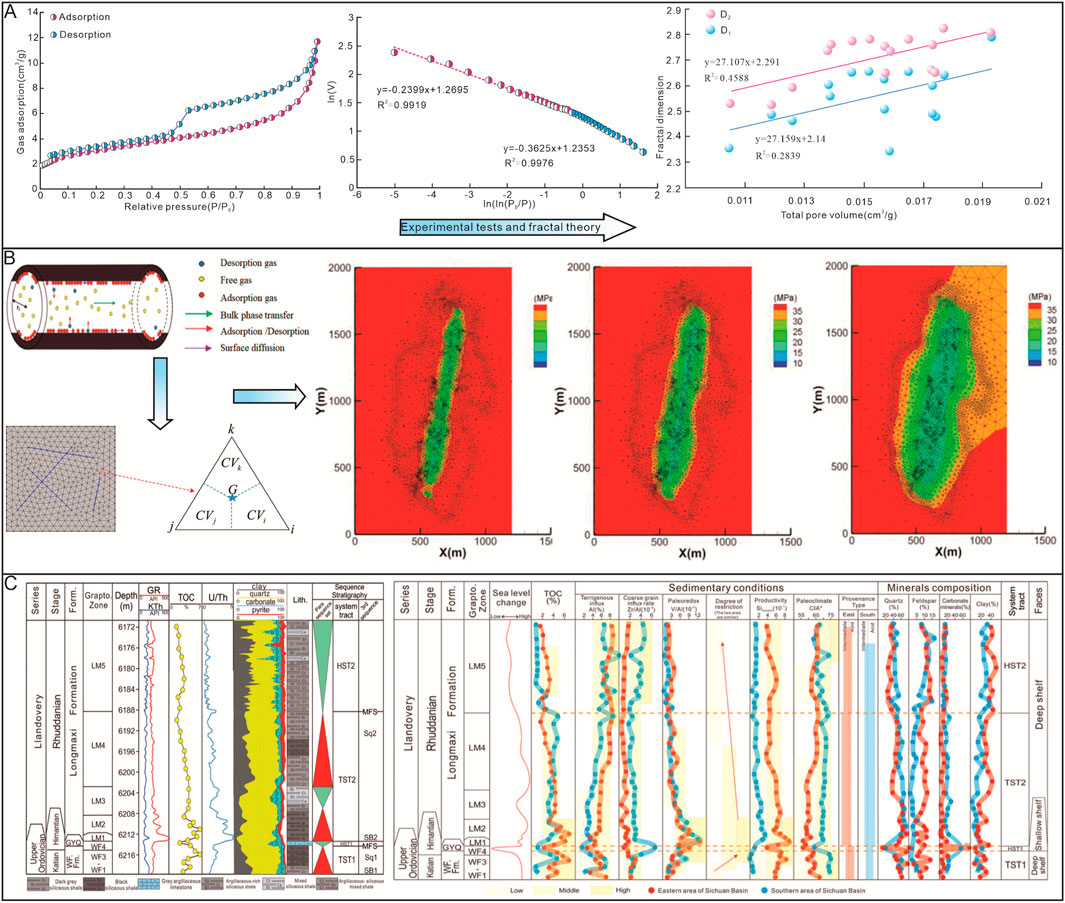
Figure 1. The main research methods involved in the research topic. (A) Shale pore structure characterization based on fractal theory (Li H. et al., 2024); (B) Production simulation of fractured horizontal well based on an unstructured grid Xiao et al.; (C) Evaluation of shale sedimentary environment based on elemental analysis Yang et al.
Leveraging organic geochemistry, mineralogy, nitrogen adsorption, physical property analyses, and SEM, Wang et al. (Manuscript ID: 1368326) investigated the pore structure characteristics of Lower Cambrian shales in the southeastern Upper Yangtze Platform. Their study reveals a strong correlation between total organic carbon (TOC) content and the abundance of quartz and clay minerals, underscoring the critical role of TOC in controlling pore structure development. TOC exhibited positive correlations with pore volume, specific surface area, and porosity, and negative correlations with average pore diameter. Furthermore, they observed significant variations in shale pore structures under different gas content and preservation conditions. Employing fractal theory to characterize pore structure complexity, they concluded that the Lower Cambrian shales exhibit complex pore networks, with fractal dimensions D1 and D2 negatively correlated with average pore diameter and positively correlated with TOC, specific surface area, and total pore volume. This methodological framework applies to other shale plays. An et al. (Manuscript ID: 1365516) utilized low-temperature carbon dioxide and nitrogen adsorption, coupled with high-pressure mercury injection, to investigate the complexity and controlling factors of pore structure in the Shuijingtuo Formation shale, employing a fractal dimension approach. Using the V-S, FHH, and Menger sponge models to calculate fractal dimensions, they determined distinct values for micropores, mesopores, and macropores. Their results indicate positive TOC and vitrinite reflectance (Ro) correlations with D1 and D2 and negative correlations with D3. Similarly, pore volume and specific surface area showed positive correlations with D1 and D2, and negative correlations with D3.
It is important to note that fractal theory is not the sole method for characterizing the complexity of pore structures (Li H. et al., 2022). Alternative techniques offer complementary approaches, such as moment estimation, machine learning, and deep learning algorithms. An integrated approach leveraging multiple experimental techniques and mathematical methods represents the future for comprehensively characterizing shale pore structure. Recognizing the multifaceted factors influencing shale pore characteristics, Sun et al. (Manuscript ID: 1375241) focused on typical overpressured shale gas wells in the Yongchuan, Luzhou, and Dazu areas. Through an integrated analysis of well logs, fluid inclusion data, and numerical simulations, they identified the dominant mechanisms responsible for the development of significant overpressure and characterized the history of the evolution of pressure from early burial to late uplift. They concluded that hydrocarbon generation and associated expansion are the primary drivers of overpressure development and that variations in organic matter pore morphology, structure, and connectivity exist within the deep Wufeng-Longmaxi shale (Chen et al., 2022; Dang et al., 2022). Moreover, their findings suggest that higher overpressure conditions are conducive to preserving larger organic-matter-hosted pores and enhanced overall reservoir porosity.
3 Shale hydraulic fracturing
Shale, a thinly laminated, brittle, and ultra-low permeability rock, necessitates large-scale hydraulic fracturing to achieve commercial gas flow rates due to the unique mechanisms governing natural gas adsorption and storage within its complex pore network (Shan et al., 2021; Wang and Wang, 2021; Fan et al., 2022; Li, 2022; 2023b). The fundamental principle of hydraulic fracturing lies in injecting high-pressure fluids to create fractures within the target formation, establishing conductive pathways for gas migration to the wellbore. Zhang et al. (Manuscript ID: 1326861), leveraging mineral composition and pore structure analyses, developed a multi-mineral equivalent model applicable to complex lithologies, enabling the accurate calculation of compressional wave velocity (Vp) and shear wave velocity (Vs.). These velocities serve as the foundation for pre-stack seismic inversion and the prediction of elastic parameters, including Poisson’s ratio and Young’s modulus. This research demonstrated successful application in the fine-grained, heterogeneous lithologies of the Lucaogou Formation within the Jimsar Sag, Junggar Basin, providing essential data for optimizing hydraulic fracture design. Recognizing the multi-faceted factors influencing hydraulic fracture effectiveness, Wang et al. (Manuscript ID: 1334175) simplified a layered reservoir system into a transversely isotropic medium and developed a model to estimate borehole deformation precisely. Based on this estimated deformation, they constructed a predictive model for fracture initiation pressure. Their results reveal that circular boreholes in layered reservoirs deform into elliptical shapes under the influence of in-situ stresses, with the ellipse’s major axis deviating from the principal stress direction. This underscores the significant influence of rock anisotropy on borehole deformation and subsequent fracture propagation. Xiao et al. (Manuscript ID: 1257219) characterized fracture geometry and complex boundary conditions using microseismic data integrated within a discrete fracture model (Figure 1B). Subsequently, they established a comprehensive seepage flow model for fractured wells with complex fracture networks, based on a dual-porosity-discrete fracture conceptualization (Yin et al., 2018; Li J. J. et al., 2022). Numerical solutions were obtained by combining unstructured grids and the control volume finite element method. Furthermore, it acknowledges the critical importance of in-situ stress and formation pressure in shale gas development, parameters that directly influence wellbore stability, horizontal well trajectory planning, and hydraulic fracturing effectiveness. Zhang et al. (Manuscript ID: 1225920) developed a sophisticated finite element simulation model for the Longmaxi Formation shale in the Nanchuan area. This model, informed by a comprehensive dataset of seismic, logging, and experimental rock mechanics data, elucidates the coupled relationships between in-situ stress, formation strain, and formation pressure, enabling the prediction of the spatial distribution of formation pressure and pore pressure coefficients. This integrated approach provides valuable insights for optimizing well design and completion strategies in challenging shale gas reservoirs.
4 Sedimentary environment of organic-rich shale
Shale deposition is inextricably linked to its depositional environment, which is, in turn, governed by a complex interplay of factors, including basin tectonics, sediment supply, paleoclimate, water salinity, and redox conditions (Liu and Xie, 2017; Zhai et al., 2019). Shale deposition is particularly sensitive to fluctuations in these environmental parameters, often preserving a record of high-frequency variations. Yang et al. (Manuscript ID: 1391445) investigated the Wufeng-Longmaxi Formation shales of the eastern and southern Sichuan basin to elucidate the influence of the depositional environment and its evolution on organic matter content and mineral composition. Using key elemental geochemical proxies, they reconstructed the marine depositional environment of these shales, revealing the impact of paleoenvironmental evolution on reservoir heterogeneity (Figure 1C). Zhang et al. contributed two important studies to this research topic (Manuscript ID: 1403575 and 1277359), focusing on shale depositional environments. In their first study, based on major and trace element geochemistry, they characterized the depositional setting of the Dawuba Formation in Well CY1 within the Middle and Upper Yangtze areas. An index of compositional variability (ICV) value below 1, coupled with elevated chemical index of alteration (CIA) and Th/U values, points to deposition under warm, humid climatic conditions characterized by intense chemical weathering. Furthermore, V/(V+Ni), Cu/Zn, and Ce/La ratios suggest that the organic-rich intervals of the Dawuba Formation accumulated under predominantly dysoxic bottom-water conditions. This warm, humid paleoclimate likely supported high biological productivity, while the dysoxic conditions facilitated the preservation of organic matter within the accumulating sediments. In their second contribution, focusing on the Permian Capitanian-Changhsingian black shales of the Nanpanjiang intra-platform basin, they integrated geochemical data, encompassing TOC, major, trace, and rare earth element (REE) concentrations from 62 outcrop samples, to decipher the depositional conditions and organic matter accumulation characteristics. The integrated approach, combining paleontological analyses, major and trace element geochemistry, and stable carbon and oxygen isotope data, provides a robust framework for reconstructing paleo-depositional environments and understanding the controls on organic matter enrichment in shales.
In addition to these contributions focused on shale, this research topic also features a study investigating the relationship between structural characteristic and tight gas accumulation in sandstones. Yang et al. (Manuscript ID: 1296459), integrating core and outcrop observations, seismic interpretations, and burial history reconstructions, analyzed the hydrocarbon source rocks, sedimentary characteristics, reservoir properties, and structural framework of the Qiulin structure. Their work explores the influence of the Yanshan-Himalayan tectonic events on tight gas accumulation within the Shaximiao Formation.
5 Summary
Shale oil and gas reservoirs exhibit diverse characteristics due to their depositional environment variations. Effective development of these resources requires a thorough understanding of how these environments influence reservoir quality. This research topic focuses on the variability of shale oil and gas reservoirs across diverse depositional settings and its implications for both fundamental geological understanding and practical applications. From marine to lacustrine and terrestrial environments, the depositional setting exerts a primary control on key reservoir parameters, including organic matter type and abundance, thermal maturity, mineralogical composition, pore structure, and geomechanical properties, especially brittleness (Fan et al., 2024). For example, marine shales typically exhibit higher organic content and well-developed lamination, whereas lacustrine shales often display more complex lithofacies variations and a wider range of organic matter types. These inherent differences ultimately dictate reservoir fracability, permeability, and consequently, hydrocarbon production potential.
Accurate identification and characterization of depositional environments are paramount for successfully evaluating and developing shale oil and gas resources. Conventional reservoir characterization techniques often prove inadequate for capturing the complexities arising from variable depositional settings. Therefore, an integrated, multidisciplinary approach incorporating sedimentology, geochemistry, and geophysics is essential. High-resolution sedimentological facies analysis enables more accurate prediction of favorable reservoir distribution, while rock physics investigations can illuminate the pore structure and mechanical properties of shales deposited in different environments. Integrating these diverse datasets facilitates the optimization of horizontal well trajectories, hydraulic fracturing designs, and other production enhancement strategies, ultimately leading to improved hydrocarbon recovery factors and reduced development costs.
The eleven papers comprising this research topic focus on three key areas: characterization of shale pore structure, hydraulic fracturing in shales, and the influence of depositional environments on shale properties. However, these represent only a subset of the broader research landscape necessary to comprehensively understand shale oil and gas reservoir variability across diverse depositional settings. Future research should prioritize the detailed characterization of depositional environments, quantifying the impact of these environments on reservoir properties, and exploring how this knowledge can inform and optimize shale gas exploration strategies. Advanced experimental techniques coupled with sophisticated mathematical and numerical modeling approaches are crucial for advancing our understanding and maximizing the efficient development of shale oil and gas and other unconventional hydrocarbon resources to meet the ever-increasing global energy demand. To further advance this critical area of research, we are pleased to announce a second volume of this research topic and encourage wider participation from the scientific community, especially contributions from international researchers.
Author contributions
HuL: Conceptualization, Data curation, Formal Analysis, Funding acquisition, Methodology, Project administration, Supervision, Writing–original draft, Writing–review and editing. PL: Data curation, Formal Analysis, Methodology, Supervision, Writing–review and editing. JL: Conceptualization, Resources, Supervision, Validation, Writing–review and editing, Funding acquisition, Project administration, Visualization. AR: Formal Analysis, Methodology, Resources, Writing–review and editing, Conceptualization, Data curation, Supervision, Validation. HW: Formal Analysis, Software, Writing–review and editing, Investigation, Methodology, Project administration, Resources. HoL: Conceptualization, Data curation, Formal Analysis, Software, Writing–review and editing.
Funding
The author(s) declare that financial support was received for the research, authorship, and/or publication of this article. This study was financially supported by the Key Research Base for Social Sciences of Zigong Social Science Federation, Research Center of Industrial Transformation and Innovation (No. CZ24B01), the Open Fund of Sichuan Key Provincial Research Base of Intelligent Tourism (No. ZHYR24-05), the Open Fund of the National Key Laboratory of Oil and Gas Reservoir Geology and Exploitation (Southwest Petroleum University) (No. PLN 2023-31), the Open Fund of the Shale Gas Evaluation and Exploitation Key Laboratory of Sichuan Province (No. YSK2023001).
Conflict of interest
The authors declare that the research was conducted without any commercial or financial relationships that could be construed as a potential conflict of interest.
Publisher’s note
All claims expressed in this article are solely those of the authors and do not necessarily represent those of their affiliated organizations, or those of the publisher, the editors and the reviewers. Any product that may be evaluated in this article, or claim that may be made by its manufacturer, is not guaranteed or endorsed by the publisher.
References
Abolghasemi, E., and Andersen, P. Ø. (2021). The influence of adsorption layer thickness and pore geometry on gas production from tight compressible shales. Adv. Geo-Energy Res. 6 (1), 4–22. doi:10.46690/ager.2022.01.02
Chen, Y. H., Zhu, Z. W., and Zhang, L. (2019). Control actions of sedimentary environments and sedimentation rates on lacustrine oil shale distribution, an example of the oil shale in the Upper Triassic Yanchang Formation, southeastern Ordos Basin (NW China). Mar. Petrol. Geol. 102, 508–520. doi:10.1016/j.marpetgeo.2019.01.006
Chen, Z. P., Liao, Y., Li, L., Chen, L., Wang, P., Zuo, Y., et al. (2022). Implication of alkane carbon and hydrogen isotopes for genesis and accumulation of over-mature shale gas: a case study of Longmaxi Formation shale gas in Upper Yangtze area. Front. Earth Sci. 10, 901989. doi:10.3389/feart.2022.901989
Dang, W., Nie, H. K., Zhang, J. C., Tang, X., Jiang, S., Wei, X., et al. (2022). Pore-scale mechanisms and characterization of light oil storage in shale nanopores: New method and insights. Geosci. Front. 13 (5), 101424. doi:10.1016/j.gsf.2022.101424
Fan, C. H., Li, H., Qin, Q. R., He, S., and Zhong, C. (2020). Geological conditions and exploration potential of shale gas reservoir in Wufeng and Longmaxi Formation of southeastern Sichuan Basin, China. J. Petrol. Sci. Eng. 191, 107138. doi:10.1016/j.petrol.2020.107138
Fan, C. H., Nie, S., Li, H., Radwan, A. E. *., Pan, Q. C., Shi, X. C., et al. (2024). Quantitative prediction and spatial analysis of structural fractures in deep shale gas reservoirs within complex structural zones: a case study of the Longmaxi Formation in the Liuzhou area, southern Sichuan Basin, China. J. Asian Earth Sci. 263, 106025. doi:10.1016/j.jseaes.2024.106025
Fan, C. H., Xie, H. B., Li, H., Zhao, S. X., Shi, X. C., Liu, J. F., et al. (2022). Complicated fault characterization and its influence on shale gas preservation in the southern margin of the Sichuan basin, China. Lithosphere 2022, 8035106. doi:10.2113/2022/8035106
Guo, X. B., Huang, Z. L., Zhao, L. B., Han, W., Ding, C., Sun, X., et al. (2019). Pore structure and multi-fractal analysis of tight sandstone using MIP, NMR and NMRC methods: a case study from the Kuqa depression, China. J. Petrol. Sci. Eng. 178, 544–558. doi:10.1016/j.petrol.2019.03.069
He, X. P., Cai, X., Gao, Y. Q., Ding, A. X., Jiang, Z. G., He, G. S., et al. (2024). Experimental technologies of shale gas exploration and development:Research progress and development direction. Nat. Gas. Ind. 44 (7), 12–26. doi:10.3787/j.issn.1000-0976.2024.07.002
Jia, C. Z., Wang, Z. G., Jiang, L., and Zhao, W. (2024). Progress and key scientific and technological problems of shale oil exploration and development in China. World Petrol. Ind. 31, 1–11. doi:10.20114/j.issn.1006-0030.20240530001
Li, H. (2022). Research progress on evaluation methods and factors influencing shale brittleness: a review. Energy Rep. 8, 4344–4358. doi:10.1016/j.egyr.2022.03.120
Li, H. (2023a). Coordinated development of shale gas benefit exploitation and ecological environmental conservation in China: a mini review. Front. Ecol. Evol. 11, 1232395. doi:10.3389/fevo.2023.1232395
Li, H. (2023b). Deciphering the formation period and geological implications of shale tectonic fractures: a mini review and forward-looking perspectives. Front. Energy Res. 11, 1320366. doi:10.3389/fenrg.2023.1320366
Li, H., He, S., Radwand, A. E., Xie, J. T., and Qin, Q. R. (2024b). Quantitative analysis of pore complexity in lacustrine organic-rich shale and comparison to marine shale: insights from experimental tests and fractal theory. Energy Fuel 38 (17), 16171–16188. doi:10.1021/acs.energyfuels.4c03095
Li, H., Zhou, J. L., Mou, X. Y., Guo, H. X., Wang, X. X., An, H. Y., et al. (2022b). Pore structure and fractal characteristics of the marine shale of the Longmaxi Formation in the Changning area, southern Sichuan basin, China. Front. Earth Sci. 10, 1018274. doi:10.3389/feart.2022.1018274
Li, J., Li, H., Jiang, W., Cai, M. L., He, J., Wang, Q., et al. (2024a). Shale pore characteristics and their impact on the gas-bearing properties of the Longmaxi Formation in the Liuzhou area. Sci. Rep. 14, 16896. doi:10.1038/s41598-024-66759-7
Li, J., Li, H., Yang, C., Ren, X. H., and Li, Y. D. (2023c). Geological characteristics of deep shale gas and their Effects on shale fracability in the Wufeng-Longmaxi formations of the southern Sichuan basin, China. China. Lithosphere 2023 (1), 4936993. doi:10.2113/2023/4936993
Li, J., Li, H., Yang, C., Wu, Y. J., Gao, Z., and Jiang, S. L. (2022a). Geological characteristics and controlling factors of deep shale gas enrichment of the Wufeng- Longmaxi Formation in the southern Sichuan basin, China. Lithosphere 2022, 4737801. doi:10.2113/2022/4737801
Li, J. J., Qin, Q. R., Li, H., and Wan, Y. F. (2022c). Numerical simulation of the stress field and fault sealing of complex fault combinations in Changning area, Southern Sichuan Basin, China. Energy Sci. Eng. 10 (2), 278–291. doi:10.1002/ese3.1044
Liu, C., and Xie, Q. B. (2017). Depositional, sedimentary, and diagenetic controls on reservoir quality in carbonate successions: a case study from the carbonate gas reservoirs of the Lower Triassic Feixianguan Formation, eastern Sichuan Basin, China. J. Petrol. Sci. Eng. 163, 484–500. doi:10.1016/j.petrol.2017.12.063
Mcmahon, T. P., Larson, T. E., Zhang, T., and Shuster, M. (2024). Geologic characteristics, exploration and production progress of shale oil and gas in the United States: an overview. Petrol. expl. Dev. 51 (4), 925–948. doi:10.1016/s1876-3804(24)60516-1
Peng, Y. Y., Li, Y. F., Yu, H., Han, P. R., Zhu, C., and He, M. C. (2024). Mechanical properties of coal and rock with different dip angles based on true triaxial unloading test. J. Min. Strata Control Eng. 6 (2), 023037. doi:10.13532/j.jmsce.cn10-1638/td.20231222.001
Shan, C., Ye, C., Zhang, Z., Zou, C., He, F., Zhang, H., et al. (2022). Reservoir characteristics and resource potential analysis of transitional shale gas in Southern Sichuan Basin. Front. Earth Sci. 10, 909469. doi:10.3389/feart.2022.909469
Shan, S. C., Wu, Y. Z., Fu, Y. K., and Zhou, P. H. (2021). Shear mechanical properties of anchored rock mass under impact load. J. Min. Strata Control Eng. 3 (4), 043034. doi:10.13532/j.jmsce.cn10-1638/td.20211014.001
Wang, J., and Wang, X. L. (2021). Seepage characteristic and fracture development of protected seam caused by mining protecting strata. J. Min. Strata Control Eng. 3 (3), 033511. doi:10.13532/j.jmsce.cn10-1638/td.20201215.001
Wang, X., Li, J., Jiang, W., Zhang, H., Feng, Y., and Yang, Z. (2022). Characteristics, current exploration practices, and prospects of continental shale oil in China. Adv. Geo-Energy Res. 6 (6), 454–459. doi:10.46690/ager.2022.06.02
Yin, S., Jia, Q., and Ding, W. L. (2018). 3D paleotectonic stress field simulations and fracture prediction for marine-continental transitional facies forming a tight-sandstone reservoir in a highly deformed area. J. Geophys. Eng. 15 (4), 1214–1230. doi:10.1088/1742-2140/aaad97
Zhai, G. Y., Li, J., Jiao, Y., Wang, Y., Liu, G., Xu, Q., et al. (2019). Applications of chemostratigraphy in a characterization of shale gas sedimentary microfacies and predictions of sweet spots -taking the Cambrian black shales in Western Hubei as an example. Mar. Petrol. Geol. 109, 547–560. doi:10.1016/j.marpetgeo.2019.06.045
Keywords: shale oil and gas, reservoir characteristics, pore structure, geological theories, experimental geological technology, sedimentary environment
Citation: Li H, Li P, Luo J, Radwan AE, Wang H and Li H (2024) Editorial: Differences in shale oil and gas reservoirs across various sedimentary environments: theories and applications. Front. Earth Sci. 12:1514734. doi: 10.3389/feart.2024.1514734
Received: 21 October 2024; Accepted: 22 October 2024;
Published: 05 November 2024.
Edited and reviewed by:
Alexander Kokhanovsky, German Research Centre for Geosciences, GermanyCopyright © 2024 Li, Li, Luo, Radwan, Wang and Li. This is an open-access article distributed under the terms of the Creative Commons Attribution License (CC BY). The use, distribution or reproduction in other forums is permitted, provided the original author(s) and the copyright owner(s) are credited and that the original publication in this journal is cited, in accordance with accepted academic practice. No use, distribution or reproduction is permitted which does not comply with these terms.
*Correspondence: Hu Li, bGlodTg2MDYyOEAxMjYuY29t, bGlodUBzdXNlLmVkdS5jbg==; Pengju Li, Mzc4NzM3NDY2QHFxLmNvbQ==