 Paterno R. Castillo
- Scripps Institution of Oceanography, University of California San Diego, La Jolla, CA, United States
A new general perspective on the long-standing problem of continental crust formation is presented in this study. Unlike prevailing models for continental crust formation that rely heavily on the behavior of major and trace elements in silicate melts in solidus and subsolidus pressure and temperature conditions, this study emphasizes the additional behavior of almost all elements in hydrothermal fluids in subsolidus and above solidus geochemical reactions at or near the Earth’s surface. Based on the latter concept, post-Archaean continental crust is formed along subduction zones by materials from the mantle wedge fluxed by saline metamorphic fluids released from the hydrothermally altered oceanic slab. Archaean continental crust, on the other hand, is formed atop Archaean “lithospheric blocks” by materials from the mantle and from within the middle to lower section of such blocks fluxed by saline metamorphic fluids released from the hydrothermally altered proto-oceanic crust. Although the two formation processes are different, continental crust has a fairly homogeneous andesitic composition because the respective attendant fluid in either process enriches it with fluid-mobile elements. In sum, the significant role of saline fluids in continental crust formation in present, post-Archaean subduction zones is key to that in the past, within Archaean lithosphere and mantle.
1 Introduction
Understanding the formation of continental crust is extremely important because the crust is a planetary feature that makes Earth a unique habitat for humanity. Accordingly, continental crust formation has received considerable attention and the literature abounds with this topic (e.g., Brown et al., 2020; Laurent et al., 2020; Johnson and Wing, 2020; Halla, 2020; Touret, 2021; Rollinson, 2021; Byrne et al., 2021; Chowdhury et al., 2021; Samuel et al., 2021; Hernández-Montenegro et al., 2021; Cawood et al., 2022; Wang et al., 2023; Li et al., 2023; Frost et al., 2023; Copley and Weller, 2024; Smit et al., 2024; Reimink and Smye, 2024; Hawkesworth et al., 2024; and references therein). Despite such numerous studies, however, continental crust formation remains enigmatic.
This study presents a new general perspective on continental crust formation. Although it revisits many familiar subjects on the topic, it does not present a comprehensive review of all available publications. Instead, it is a direct and unabashed re-interpretation of many existing data in the context of the recent proposal that “the mobility, or immobility, of almost all elements in hydrothermal fluids at or near the Earth’s surface is mainly dependent upon the amount of Cl in the fluids” (Castillo, 2022; see also Castillo, 2021; Castillo, 2023). The proposal that was previously introduced and used to transfer fluid-mobile elements from subducted slab to arc magmas and ore deposits is termed the “new concept” hereafter. This study additionally relies heavily on previous results, particularly on the critical role of other volatiles especially H2O in continent formation. Simply, there would be no saline fluids without H2O. Also similar to prior studies, the study focuses on how the bulk major and trace element composition of post-Archaean continental crust is generated in subduction zones (e.g., Taylor and White, 1965; Taylor and McLennan, 1985; Rudnick, 1995; Plank and Langmuir, 1998; Kelemen et al., 2014; Hawkesworth et al., 2020; Hawkesworth et al., 2024). Then, it presents an analogous mechanism to generate the Archaean continental crust from fragments of Earth’s proto-lithosphere mixed with materials from the Archaean mantle (e.g., Campbell and Hill, 1988; Smithies et al., 2005; Bédard, 2006; Bénard et al., 2017; Bédard et al., 2013).
2 Continental crust formation along post-Archaean subduction zones
The average composition of continental crust is andesitic (e.g., Taylor and White, 1965; Taylor, 1967; Kelemen, 1995; Tatsumi, 2006; Kelemen et al., 2014; Hawkesworth et al., 2020). Specifically, the continental crust is calc-alkalic and medium-K, has a relatively high Mg# (molar Mg/[Mg + Fe2+] × 100) of ca. 50, and its incompatible trace element concentration patterns are similar to those of the bulk of arc lavas (Figures 1, 2; see also, e.g.; Taylor and White, 1965; Taylor and McLennan, 1985; Kelemen, 1995; Kelemen et al., 2014). Thus, there is a general consensus that younger segments of the continental crust form from arc magmas and/or that modern subduction zones are major sites of continent formation. A better understanding of arc magmatism, particularly the genesis of calc-alkalic lavas, therefore, is key to continental crust formation.
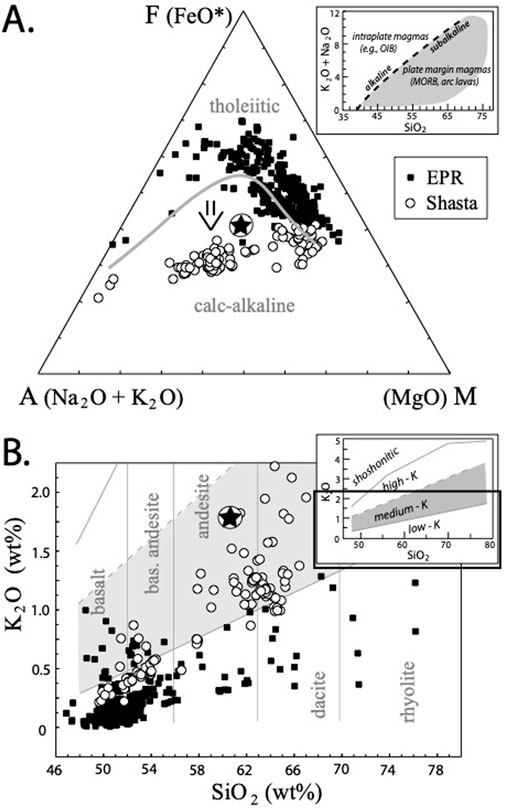
Figure 1. (A) Total alkali-total FeO-MgO (AFM) diagram showing the distinct differentiation trends of East Pacific Rise (EPR) tholeiitic MORB (Gale et al., 2013) and Mount Shasta calc-alkalic lavas, representing the bulk of arc lavas (Baker et al., 1994; Grove et al., 2005). Downward arrow represents removal of some FeO* by Fe-Cl and, then, Fe-S complexes (Castillo, 2021). Inset shows that both lava suites belong to the sub-alkalic lava series in the total alkalis (Na2O+ K2O) versus SiO2 diagram. (B) K2O versus SiO2 for the same two sample suites shown in (A) Inset shows the entire range of volcanic lavas based on this classification scheme. Shown for reference in both diagrams is the average continental crust (star inside circle - Rudnick and Gao, 2014). Figure after Castillo (2023).
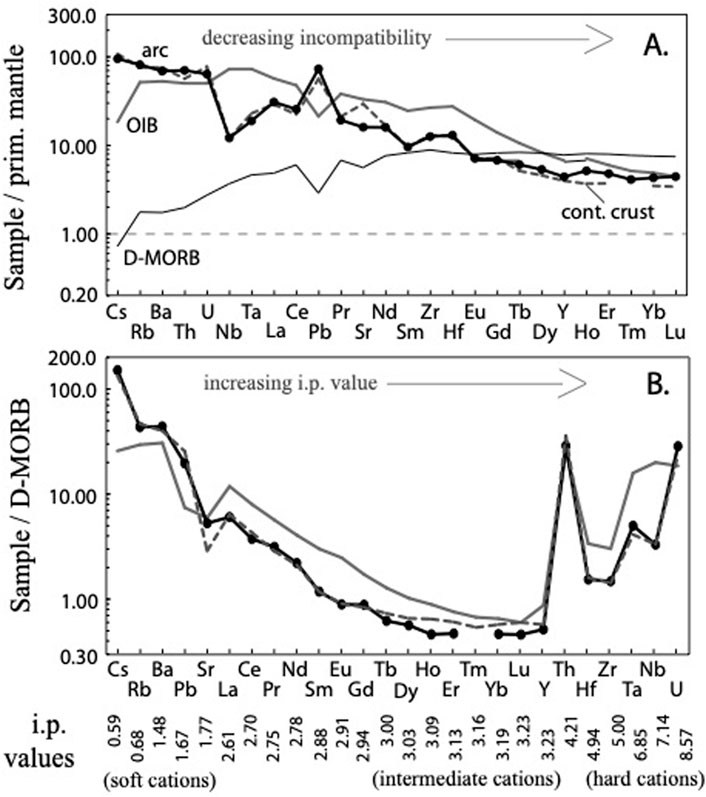
Figure 2. (A) Primitive mantle-normalized incompatible trace element concentration patterns for depleted-type MORB (Gale et al., 2013), OIB (Sun and McDonough, 1989), average continental crust (Rudnick and Gao, 2014), and average primitive continental arc andesites with M Mg#>60 (Kelemen et al., 2014) arranged in decreasing incompatibility. (B) Depleted MORB-normalized incompatible trace element concentration patterns arranged in increasing i.p. values for OIB, average continental crust and average primitive continental arc andesites. The i.p. values of the most dominant cations (Railsback, 2003; 2004; see also Table 2 in Castillo, 2022) are listed under individual elements. Figure after Castillo (2023). See text for discussion.
2.1 The petrogenesis of arc lavas
The voluminous tholeiitic mid-ocean ridge basalts (MORB) have a relatively smooth, highly incompatible trace element depleted pattern (except for Pb) whereas intraplate lavas, best represented by ocean island basalts (OIB), have a distinctive, enriched pattern (again, except for Pb), both relative to primitive mantle values (Figure 2A; McDonough and Sun, 1995). Arc lavas also exhibit a highly incompatible trace element enriched pattern, but more so than OIB in terms of large ion lithophile elements (LILE, e.g., Cs, Rb, Ba, Sr). This enriched group of highly incompatible trace elements together with volatiles, especially H2O, is collectively termed the subduction component. Moreover, arc lavas exhibit a jagged or more irregular concentration pattern as the high field strength elements (HFSE: Ta, Zr, Hf, Th, and especially Nb) are less enriched or show “negative” concentration anomalies relative to adjacent highly incompatible elements, and the rare earth elements (REE), particularly the middle-to heavy-REE, are relatively depleted. Significantly, the trace element concentration pattern of average continental crust is similar that of arc lavas (Figure 2A; see also, e.g.; Taylor and White, 1965; Taylor and McLennan, 1985; Kelemen, 1995; Kelemen et al., 2014).
There is some consensus that the systemic enrichment of the subduction component in arc lavas can be ascribed to its high mobility in the slab-derived, hot aqueous fluid (e.g., Tatsumi and Eggins, 1995; Castillo et al., 1999; Stern, 2002). Conversely, the systemic less-enrichment of HFSE and middle-to heavy-REE relative to other incompatible trace elements can be due to their hydrothermal fluid-immobility such that they are retained in the source(s) of primary arc magmas. The exact transfer mechanism for the subduction component, however, is still intensely debated as hydrothermal fluids appear incapable of transferring some of the aforementioned fluid-immobile HFSE, particularly Th, that are sometimes also enriched in arc lavas, especially those associated with thickly-sedimented subducting slabs (e.g., Elliot et al., 1997; Plank, 2005; Kelemen et al., 2014). Some trace element features of arc lavas, e.g., high Ba/Th, U/Th and LILE/REE, may also be due to partial melting of the sediment ± oceanic crust atop the subducting slab in the presence of residual accessory mineral phases like epidote (e.g., Carter et al., 2015) or allanite (Klimm et al., 2008).
2.2 A modified model for the petrogenesis of arc lavas
The new concept posits that Cl makes slab-derived hydrothermal fluids an effective solvent, and that the purported less-immobility of HFSE in such fluids generally disappears with increasing Cl contents (e.g., Kawamoto et al., 2013; Rustioni et al., 2019; Castillo, 2022; Castillo, 2023). The mobility or immobility of almost all elements in Cl-rich fluids is guided by the ionic potentials (i.p. = z/r) of their respective dominant cations (Castillo, 2022; see also Railsback, 2003; Railsback, 2004). Cations of highly fluid-mobile elements such as LILE (e.g., i.p. of Cs+ = 0.59, Rb+ = 0.68), Ba2+ = 1.48, Sr2+ = 1.77) have low i.p. values and are “soft cations” that readily dissolve and form stepwise Cl-complexes in Cl-rich slab-derived fluids. In contrast, cations of middle-to heavy-REE (e.g., Tb3+ = 3.00, Yb3+ = 3.19, Lu3+ = 3.23) as well as of Y (Y3+ = 3.23) have intermediate i.p. values and are “intermediate cations” that are generally insoluble in Cl-rich fluids. However, cations of the other incompatible elements with high i.p. values are “hard cations” (e.g., Th4+ = 4.21, Ta5+ = 6.85; U6+ = 8.57) are variably soluble, depending upon the Cl and radical ligand content of the fluids (Railsback, 2003). Notably, the concentration of radical ligands is directly proportional to those of Cl and H2O as they all primarily originate from subducted seawater.
In addition to the traditional subduction component, therefore, ore metals such as Cu, Au and Ag, HFSE as well as major elements particularly Si, K and some Fe, although to variable extents, are also fluid-mobile in highly saline or briny fluids. Moreover, these elements can possibly be recycled at lower pressure and temperature as their mobility in Cl-rich fluids occurs through dissolution in subsolidus (i.e., high grade metamorphic) to above solidus (e.g., hydrothermal, weathering, alteration, diagenetic, metasomatic) conditions. The final destinations of fluid-mobile lithophile plus some atmophile and chalcophile-siderophile plus some atmophile element groups, however, differ. Whereas the former generally ends up in arc volcanic and intrusive rocks and atmosphere, the bulk of the latter ends up in Fe- and ore metal-sulfides in discrete ore deposits that are spatially and, to a certain extent, temporally associated with arc volcanism (Castillo, 2021; Castillo, 2022; Castillo, 2023).
The general concentration pattern of incompatible trace elements in arc lavas can, thus, be also illustrated by plotting them against depleted MORB, the most abundant direct partial melts of the mantle and ubiquitous top section of subducting slabs, and arranging the incompatible trace elements in increasing i.p. values (Figure 2B). By doing so, the incompatible trace element concentrations of arc lavas, represented herein by the average primitive continental arc andesite (Kelemen et al., 2014), exhibit a generally convex up or U-shape pattern that illustrates how their respective dominant cations behave systematically, from fluid-mobile (soft cations), to -immobile (intermediate cations) and, then, back to -mobile (hard cations) in the presence of Cl and complex ligand-rich slab-derived fluids (Castillo, 2022). Again, the amount of Cl is proportional to the amounts of, e.g., H2O and complex ligands as they all primarily originate from seawater. Although OIB display a somewhat similar pattern, the new concept can explain why they are generally relatively less-enriched in highly fluid-mobile Cs, Rb, Pb, and U whereas more enriched in less fluid-mobile REE and HFSE.
2.3 Petrologic implications
The new concept posits Cl-rich, acidic slab-derived fluids solubilize fluid-mobile major, trace, volatile, and ore metal elements from the subducting slab and lower portion of the mantle wedge. During flux melting of the hottest, ca middle portion of the mantle wedge, lithophile and some atmophile solutes in the hydrothermal solutions are transferred to primary arc magmas whereas siderophile, chalcophile (e.g., including some Fe) and remainder of atmophile solutes are retained primarily as Cl-complexes in the excess subduction component or briny non-silicate fluid phase upwelling with arc magmas (Blundy et al., 2015; Castillo, 2022). The presence of saline fluids in the mantle source of arc magmas is indeed evident directly in fluid inclusions in ultramafic xenoliths in arc lavas (Kawamoto et al., 2013; Bénard et al., 2017) and indirectly in the electrical conductivity of forearc regions (Huang et al., 2019). Accordingly, a hypothetical, typical primary arc magma derived from partial melting of the mantle wedge, or a melt in equilibrium with peridotitic mantle, should be MgO-rich, more oxidized and enriched in fluid-mobile elements including volatiles particularly H2O, ore metals and variable amounts of HFSE, but relatively depleted in heavy-REE including Y compared to the anhydrous, primary tholeiitic MORB magma (Figure 2). In terms of major elements, the hypothetical primary arc magma is predicted to be also enriched in, e.g., Si and K (Figure 1B).
Due to its high SiO2 content, a typical primary arc silicate melt should be andesitic, an artifact of the SiO2-centric rock classification scheme (Castillo, 2022). It should also have a high Mg# value because of its nominally high-MgO but low-FeO* content due to the partitioning of some of its Fe, together with ore metals, to the non-silicate briny fluid phase. In other words, the Mg# ratio of a silicate melt increases when the amount of Fe in the denominator decreases. Thus, it should be either a primitive high-Mg or -Mg# (i.e., with Mg# ca. 70) andesite (HMA) or boninite (Figure 3), which rarely reach the surface unmodified (e.g., Kelemen et al., 2014; Castillo, 2023). Differentiation of such primary andesitic magma should generate the bulk of arc lavas with low FeO*, or calc-alkalic lavas (Figure 1A). (Miyashiro, 1974) that are more oxidized than tholeiitic MORB (e.g., Kelley and Cottrell, 2012; Brounce et al., 2014). The new concept, therefore, emphasizes the additional, significant role of saline slab-derived fluids in generating the characteristic geochemical features of arc lavas, particularly of calc-alkalic ones and, ultimately, as will be discussed further later the post-Archaean continental crust.
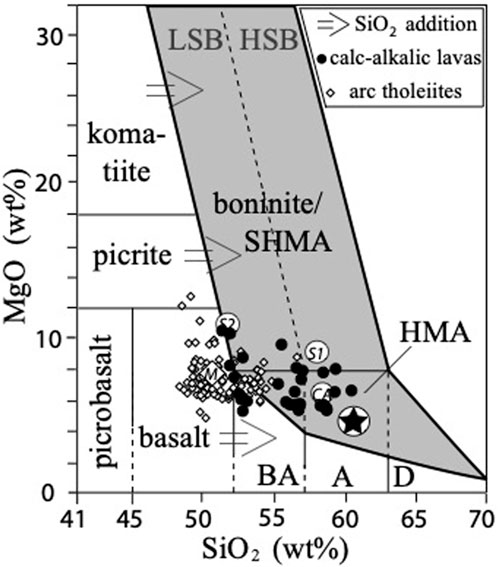
Figure 3. MgO versus SiO2 diagram for clasifying boninites (after Pearce and Reagan, 2019). Average continental crust (star inside circle - Rudnick and Gao, 2014) and examples of primitive, near primary continental arc magmas (average primitive continental arc lavas: CA inside circle - Kelemen et al., 2014; Mount Shasta primitive arc lavas: S1 and S2 inside circles, respectively–Grove et al., 2005) and average depleted MORB (M inside diamond–Gale et al., 2013) are shown for reference. Arrows indicate that SiO2 addition is a simple, general explanation why arc lavas are different from tholeiitic lavas in this classification scheme. Figure after Castillo (2023). See text for discussion.
3 Archaean continental crust formation
In contrast to the widely accepted subduction zone origin of post-Archaean continental crust, the origin of Archaean continental crust is controversial. A major topic of contention is that cores of Archaean continental terranes consist of trondhjemite-tonalite-granodiorite (TTG) suites of granitoids. The formation of such granitoid suites is generally considered to be key to the development and growth of andesitic continental crust (Martin et al., 2005; Arndt, 2013; Smit et al., 2024; and references therein). As such, this study focuses on the origin of Archaean TTG suites and specifically, on their compositional features that are very similar, if not identical, to those of adakites. Adakites are rare, volumetrically insignificant, post-Archaean arc rocks with distinctively high Sr/Y and La/Yb for given Y and Yb, respectively, compared to normal arc rocks (Figures 4A, B; Defant and Drummond, 1990).
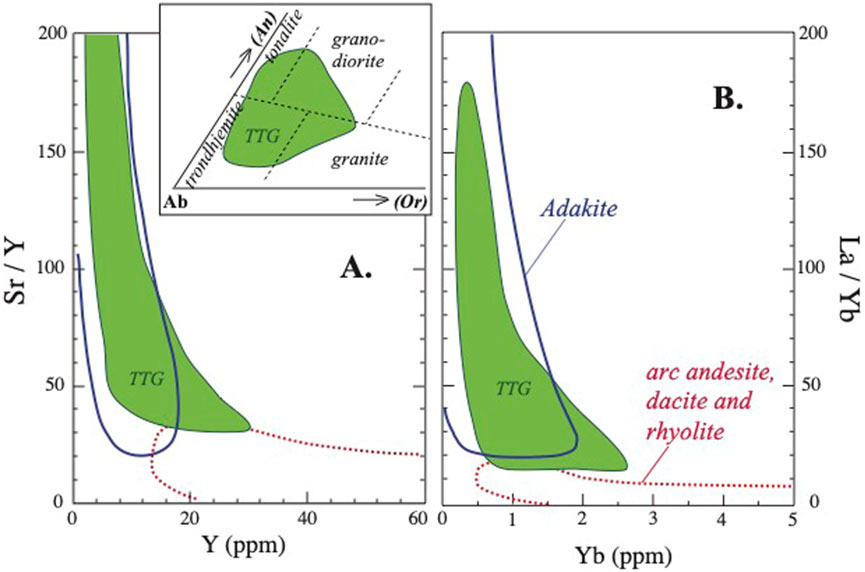
Figure 4. (A) Sr/Y versus Y (ppm) and (B) La/Yb versus Yb (ppm) showing the most distinctive geochemical features of adakites (blue field) compared to normal arc andesites, dacites and rhyolites (red field). The field for low, medium and high pressure TTG suites compiled by Moyen (2011); all suites are combined into one green field for simplicity) is also shown. Inset in (A) is the albite (Ab) corner of the Ab-orthoclase (Or)-anorthite (An) ternary diagram for classifying granitoids; the TTG field is also shown.
3.1 Adakites versus TTG lithologic suites
Adakites sensu stricto are intermediate to silicic (SiO2 ≥54 wt%) arc volcanic and plutonic rocks possessing geochemical features of primary melts from hydrous basalt transformed to eclogite (Figure 4; e.g.; Rapp et al., 1991; Moyen and Martin, 2012). They are widely accepted to be direct partial melts of subducted MORBs ± sediments in a number of unusual subduction settings (e.g., Defant and Drummond, 1990; Polat et al., 2002; Martin et al., 2005; Moyen and Martin, 2012; Arndt, 2013). However, adakites do not have distinctive mineralogical and textural features and igneous rocks with similar compositional characteristics (or adakitic rocks) have been reported in non-arc settings (e.g., Martin et al., 2005; Castillo, 2012). Several additional alternative mechanisms have been proposed for the origins of such adakitic rocks, including: 1) partial melting of thickened or delaminated mafic lower crust (Wang et al., 2023 and references therein); 2) crustal contamination and fractional crystallization of basaltic parent magma (e.g., Castillo et al., 1999; Chen et al., 2016); 3) mafic and felsic magma mixing (Li et al., 2023 and references therein); and 4) fluid-fluxed melting in garnet amphibolite facies (e.g., Castillo et al., 1999; Wang et al., 2023). Therefore, the term adakite clearly does not refer to a distinctive rock or rock suite lithology, but instead to a class or group of arc igneous rocks with distinctive geochemical features that are shared with adakitic rocks. Nonetheless, the general perception that adakites are a distinct tracer of plate subduction persists.
The TTG suites in the cores of Archaean continental crust, on the other hand, consist of a large though distinct lithologic group of granitic or high-silica (SiO2 >64 wt%, but commonly ≥70 wt%) plutonic rocks that typically consist of quartz, feldspars that are dominated by plagioclase and little or no K-feldspar (inset in Figure 4A), biotite, hornblende, and magmatic epidote. Unlike adakites, TTG suites clearly experience high degrees of crystal fractionation (e.g., Liou and Guo, 2019; Rollinson, 2021) although they indeed have the distinctive geochemical features of adakites (Figures 4A, B; e.g., Martin et al., 2005; Moyen, 2011; Moyen and Martin, 2012; Arndt, 2013). Thus, TTG suites are a type of adakitic rocks that share the distinctive geochemical features of adakites. As such, the suites can be products of petrogenetic process (or processes) in a variety of geologic settings (e.g., Moyen, 2011) that may or may not be related to plate tectonics.
As there is a general consensus that adakites are formed by partial melting of hydrous basalts (e.g., Rapp et al., 1991; Moyen and Martin, 2012), TTG suites are, therefore, derived from partial melting of hydrous Archaean mafic rocks. Incidentally, existing Archaean rock outcrops indicate that almost none of the Earth’s protocrust, which holds the key to TTG generation, survived and/or the primordial features of such outcrops that may have survived are difficult to interpret. Direct evidence for the protocrust composition and, hence, TTG generation, is therefore missing. As a result, there are a number of hypotheses on the composition and nature of Earth’s protocrust (e.g., Arndt, 2013; Smithies et al., 2005; Hamilton, 2008; Bédard et al., 2013); investigators have to rely on present geologic processes to recreate the past TTG generation process. In general, the adakite-TTG connection as it relates to Archaean continental crust formation can be summarized into two major schools of thought: 1) the Archaean TTG suite was generated through partial melting of previously subducted proto-oceanic crust (adakite model) and, 2) the Earth’s protocrust was mafic or ultramafic and was subsequently transformed to TTG (within plate model).
3.2 A brief overview of the adakite versus within plate model
The two models have been described exhaustively in the literature and, thus, will only be briefly summarized here. The adakite model of continental crust formation can be easily conceptualized as a uniformitarian process intimately associated with plate subduction or a consequence of plate tectonics that started early in Earth’s history. That is, Archaean continental crust formation is an ancient manifestation of post-Archaean arc magmatism described earlier in Section 2, except the young Earth was hotter and offered more tectonic settings to form adakites than today (e.g., Polat et al., 2002; Nagel et al., 2012; Martin et al., 2005; Moyen and Martin, 2012; Arndt, 2013).
The within plate model, on the other hand, posits that the Earth’s protocrust crystallized from originally mafic to ultramafic melts from the mantle (e.g., from larger and longer-lived Archaean mantle plumes than post-Archaean ones - Campbell and Hill, 1988; Smithies et al., 2005; Bédard, 2006; 2017; Griffin and O’Reilly, 2007). The protocrust subsequently went through a long and complex magmatic differentiation process including but not limited to fractional crystallization, re-melting, and metasomatism. Some of such differentiated rocks additionally mixed with mantle-derived melts to form TTG suites. Unlike the uniformitarian adakite model, however, the within plate mechanism to transform the mafic or ultramafic protocrust into a TTG suite is still debated. Such mechanism ranges from, e.g., basal melting of thickened basaltic crust or delaminated lower crust to reworking of basalts from the upwelling mantle during periodic destabilization of a “stagnant lid” crust system (e.g., Campbell and Hill, 1988; Smithies et al., 2005; Bédard, 2006; 2017; Sizova et al., 2015; Van Kranendonk et al., 2015).
It is important to emphasize that H2O plays a critical role in all mafic/ultramafic rock to granitoid and/or TTG transformation process (e.g., Campbell and Taylor, 1983; Whitney, 1988; Arndt, 2013). For example, in a prominent within plate model H2O was supplied to the lower crust and deeper mantle by fragments of hydrothermally altered protocrust that were caught or “sagducted” in the down-welling zones around upwelling plumes that generated the Archaean continental crust (Bédard, 2006; Bédard, 2017). Such fragments and the affected middle to lower crust were regionally metamorphosed to amphibolite facies and, then partially melted locally when underplated by mafic/ultramafic sills and, more widely, during regional anatectic melting of the amphibolites (e.g., Campbell and Hill, 1988; Smithies et al., 2005; Bédard, 2006; Bedard, 2017). Detailed studies indeed indicate that anatectic melting of amphibolitic middle to lower crust can occur, although most likely through a fluid-absent melting as the only available H2O was coming from metamorphic dehydration of mainly (Na-bearing) amphibole and, to a lesser extent, (K-bearing) biotite (Aranovich et al., 2013) and produce a sodic (high Na2O/K2O) TTG suite.
A major drawback of such dehydration melting of the amphibolitic middle to lower protocrust is that TTG suites could have not formed in relatively low temperature and activity of H2O (e.g., dash curve with negative slope at low mole fraction H2O in Figure 5). As noted above, anatectic melting of amphibolite most likely occur through a fluid-absent melting as the only available H2O was coming from metamorphic dehydration of mainly amphibole and, to a lesser extent, biotite. Thus, it cannot generate large quantities of granitoid in continent interiors (Arndt, 2013). Such melting is also inconsistent with the highly depleted trace element features of the granulite residue from such dehydration melting (e.g., Aranovich et al., 2013; Newton et al., 2019). Moreover, garnet that has stronger affinities for both Y and Yb relative to Sr and La should be a residual phase in the TTG source, similar to the eclogitic source of adakite (e.g., Martin et al., 2005; Moyen and Martin, 2012; Arndt, 2013). The required garnet restite, however, does not generally occur in TTG outcrops as it is only possible at depths greater than the relatively low P (20–25 km depth) environment of amphibolite facies, which is also well beyond the limit of penetration of surface waters (e.g., Arndt, 2013).
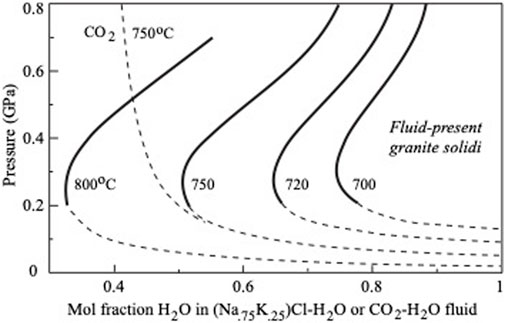
Figure 5. Saline fluid-saturated solidus curves of simple granite as functions of pressure compared with melting in the presence of CO2-H2O solutions at 750°C (modified after Aranovich et al., 2013; Newton et al., 2019). Saline fluid solutions induce a decrease of H2O activity with increasing pressure, thereby reversing the negative pressure versus temperature slopes of hydrous melting curves that are commonly assumed to be typical during partial melting at depth. See text for discussion.
Notably, amphibolite dehydration fluids are CO2- and alkali Cl-rich such that despite the low activity of water, large volumes of granite can be produced because experimental data show the back-bending of calculated solidus curves of a saline fluid-saturated simple granite at 700°C–800°C as functions of pressure (Figure 5; Aranovich et al., 2013; Aranovich, 2017; Newton et al., 2019). This means that although an increase of H2O is needed to advance partial fusion to produce granitic melt initially, less of it is needed as the degree of melting progresses in the presence of saline fluids. Notably, however, this scenario is envisioned to occur in an open-system lower crust, where the critical H2O plus halogens and other volatiles, some granitic components and necessary heat for large scale melting of the crust provided by underplated basalts all come from an enriched, underlying mantle. The enrichment of such upper mantle conceivably comes from subducted surficial materials such as limestone and altered seafloor sediments (Litvinovsky and Podladchikov, 1993; Newton et al., 2019). In other words, although saline fluids are involved in this variant of within plate formation model, these fluids are also causally linked to the early onset of plate subduction, blurring the distinction between adakite and within plate Archaean continental formation models.
4 A proposed unified continental crust formation process
4.1 A modified post-Archaean continental crust formation process
Similar to all continental formation models, the herein proposed continental crust formation process posits that post-Archaean continental crust forms in subduction zones. The proposed process, however, concurs with the aforementioned within plate model that only ca. one-quarter to no more than half of continental crust is formed through the subduction process as plate tectonics may have not commenced until ca. 3 Ga (e.g., Taylor and White, 1965; Taylor, 1967; Condie and Behn, 2006; Cawood et al., 2006; Nebel-Jacobsen et al., 2018) although others propose that it can be as late as ca. 800 Ma (e.g., Stern, 2008; Hamilton, 2008). Moreover, as presented in Section 2, slab-derived, saline hydrothermal fluids play a significant role in generating the compositional features post-Archaean arc lavas, particularly the calc-alkalic ones. This is further illustrated herein by the high SiO2 content or andesitic lithology, but still relatively high Mg# (ca. 50) of post-Archaean continental crust (e.g., Kelemen et al., 2014; Wang et al., 2019). Majority of current models for continental crust generation along subduction zones assume primary arc magmas are basaltic and subsequently fractionate a substantial amount of olivine and clinopyroxene cumulates that then delaminate to account for the higher SiO2 of continental crust. In other words, the differentiated, post-Archaean andesitic continental crust is a product of mantle-derived basalt differentiation, a process that should have produced a fourfold volume of mafic cumulates (e.g., Cameron et al., 1980; Ruiz et al., 1988). Moreover, as these cumulates should settle at the bottom of the crust, they could delaminate (e.g., Herzberg et al., 1983; Kay and Mahlburg-Kay, 1991).
As noted earlier, the herein proposed process posits that both the high SiO2 and Mg# of post-Archaean andesitic continental crust are inherent features of their parental magmas. Primitive HMA and/or boninites are already inherently high in SiO2 (e.g., simple “addition” of SiO2; Figure 3) but low in FeO* (Figure 1A); their differentiation would generate typical HMA and/or continental crust (Mg# from ca. 70 reduced to ca. 50) relatively “faster” than that of typical, mantle-derived primitive basalts (see also Kelemen et al., 2014). Corollary to this, primary arc andesitic magmas (e.g., Grove et al., 2005; Kelemen et al., 2014) need only to fractionate a “lesser” than normal volume of ultramafic cumulates (cf. Cameron et al., 1980; Ruiz et al., 1988) to generate typical high-SiO2 but high-Mg# arc batholiths, as is commonly observed (e.g., Kelemen et al., 2014; Wang et al., 2019). This notion is highly consistent with the similarity and/or relatively close proximity of the bulk continental crust to some of the primitive, near primary continental arc magmas in geochemical diagrams (Figures 1–3). In other words, a significant amount of ultramafic cumulates beneath subduction zone-generated, post-Archaean continental crust is not “missing” as most of it should not be there to begin with. Hence, although lithospheric delamination occurs, on average post-Archaean continental crust is thicker than undisturbed Archaean continental crust (e.g., Jordan, 1975; Abbott et al., 2013).
4.2 A common enrichment process links TTG suites, adakites and adakitic rocks
The proposed process is a variant of the within plate model. That is, many TTG suites comprising the cores of Archaean continental crust are formed through a protracted, multistage reworking of a hydrated, mafic to ultramafic protolith (e.g., Smithies, 2000; Taylor and McLennan, 1985; Bédard, 2006; Bédard, 2017; Condie, 2018; Kamber, 2015; Sizova et al., 2015; Van Kranendonk et al., 2015). This topic has been discussed exhaustibly in the literature and will not be repeated here. Instead, this study simply extends the new concept described in Section 2 in order to generate arc-like lavas in the Archaean. First, it must be noted that the new concept does not apply to a single geochemical reaction, but instead provides the basic principle behind the behavior of many elements in Cl-rich hydrothermal fluids in, perhaps, all subsolidus to above solidus geochemical reactions affecting silicates, ore deposits and atmosphere. For example, although the movement of elements into the subarc mantle is governed by the mobility of elements in Cl-rich fluids derived from the subducting oceanic slab, such subducting slab is already enriched in fluid-mobile elements due to the action of similarly Cl-rich seawater involved in the hydrothermal alteration of oceanic slab (Castillo, 2022; Castillo, 2023). In other words, subduction zones represent a giant, complex hydrothermal system. Note that in addition to the inherent differences in pressure, temperature and geologic materials involved in these hydrothermal fluid-present subsolidus to above solidus geochemical reactions, the amounts of Cl in their respective fluids are variable, with the Cl content generally correlating with reaction efficacy (e.g., Harlov, 2012; Aranovich, 2017; Manning, 2018; Rustioni et al., 2019).
Second, the proposed process does not invalidate the consensus that there is no continental granitoids without H2O (Section 3.2; e.g.; Campbell and Taylor, 1983; Whitney, 1988; Arndt, 2013). On the contrary, it reinforces the notion except the quintessential H2O, together with Cl, comprise the saline solvent in the hydrothermal solution containing fluid-mobile solutes that become enriched in, e.g., adakites and TTG suites. However, it is not the high amount of H2O but the amount of Cl in the hydrous solution that is crucial in the transformation of mafic protoliths into TTG suites (Figure 5). Thus, the foremost ingredient of the proposed process of generating Archaean TTG suites is saline hydrothermal fluids.
4.2.1 Saline hydrothermal fluids in Archaean lithospheric blocks
Fluids circulating in the Earth’s crust are typically described as saline to hyper-saline as they contain variable amounts of Cl (e.g., Harlov, 2012; Seward et al., 2014; Barnes et al., 2018; Manning, 2018; see also Samuel et al., 2021); these crustal fluids are henceforth described as saline sensu lato. Saline fluids are also most likely present in Archaean lithospheric blocks and although their ultimate source is the Earth’s interior through outgassing or volcanism, their main bulk, as is today, comes from seawater that is present throughout most of the Earth’s history (e.g., Mojzsis et al., 2001; Watson and Harrison, 2005). Evidence for the existence of a primordial hydrosphere is clearly preserved in Archaean lava flows, pillow lavas, komatiites, cherts, and other sedimentary rocks in primordial ocean basins that had been variably hydrothermally altered and had almost all vanished (e.g., McCall et al., 2010; de Wit and Furnes, 2016; Johnson and Wing, 2020). Possible remnants of these include those that had been metamorphosed to greenschist facies, tectonically compressed and, hence, may have been vertically stacked and/or sagducted (Bédard, 2006; Bédard, 2017), later sheared and are preserved in metamorphic belts around TTG cores that are commonly referred to as Archaean “greenstone belts” (see further discussion in Section 5). Such greenstone belts wrap around lithospheric blocks from the surface extending all the way down to the mantle and, thus, serve as pathways for seawater to hydrate the blocks as well as the underlying mantle. Direct evidence of ancient saline fluids comes from briny fluid inclusions in the “dry” (H2O-poor) granites or charnokites in the lower Precambrian crustal section in Southern India by Touret (2021); see also Newton et al., 2019); it is also indirectly evident in the presence of Cl in accessory phases in Neoarchaean lower crustal rocks (e.g., Samuel et al., 2021). Thus, although H2O is indeed important in granitoid formation, the reworking of lithospheric blocks into TTG suite also relies heavily on the Cl content of hydrous fluids (Figures 1–5; see also Harlov, 2012; Aranovich et al., 2013; Aranovich, 2017; Manning, 2018; Newton et al., 2019; Touret, 2021; Samuel et al., 2021).
4.2.2 Origin of the adakitic geochemical features of TTG suites
A major premise in the herein proposed TTG transformation process is that all subsolidus to above solidus geochemical reactions involving saline crustal fluids solubilize many elements according to their i.p. values and Cl content of attendant hydrothermal fluids (e.g., Harlov, 2012; Aranovich, 2017; Castillo, 2022; Castillo, 2023). The crux of the process is highlighted herein by a non-plate tectonic mechanism to generate the high SiO2 and particularly the high Sr/Y and La/Yb ratios but low Y and Yb of adakites and TTG suites (Figure 4). As discussed in Section 2, the bulk of parental arc magmas is andesitic, or has relatively high SiO2 content to begin with, and the increase in or addition of Si is proportional to the increase of salinity in hydrothermal fluids attendant to primary magma generation. Silica is fluid-mobile because Si4+ has an i.p. value (9.76) close to that of U (8.57; Figure 2), which is a soluble hard cation. Thus, it is present in seawater, riverine water and in variable amounts in ground water such that it ends up as opaline silica in the tissue of some plants (Railsback, 2003). Silicon (as quartz) is also abundant in pegmatites, aplites, and epithermal veins as well as ore deposits that are all formed by residual magmatic and/or hydrothermal fluids. Along the same line, the high Sr/Y and La/Yb ratios of both adakite and TTG primary melts can be attributed to the more mobile behavior of the soft cations Sr2+ (i.p. = 1.77) and La3+ (i.p. = 2.61) but relatively immobile behavior of intermediate cations Y2+ (i.p. = 3.23) and Yb3+ (i.p. = 3.19) in Cl-richer fluids (Figure 2B; Castillo, 2022). That is, Sr and La are highly mobile in saline hydrothermal fluids whereas Y and Yb are not (cf., Defant and Drummond, 1990; Martin et al., 2005; Moyen and Martin, 2012; Arndt, 2013; Kelemen et al., 2014). This rationale is consistent with experimental results of showing that Sr/Y and La/Yb ratios increase with increasing Cl-contents in the fluids (Rustioni et al., 2019).
Accordingly, TTG suites, adakites and adakitic rocks should occur in geologic settings where saline fluid plays a significant role (i.e., with increasing salinity of hydrothermal fluid and/or saline fluid/source rock ratio) in their magma genesis. Strictly in post-Archaean subduction zones, for example, adakites should occur when the sub-arc mantle is sandwiched between two opposing subduction zones (e.g., most Philippine arc segments) or is volumetrically diminished because of an unusually thick subducting slab (e.g., Panama segment of the Central American volcanic arc) or a shallow, flat lying slab (e.g., some segments of the Andean continental arc). Adakites should also occur when the volcanic arc is underlain by a subducting spreading center, which is a quintessential site of hydrothermally activity (e.g., southern Andean continental arc segment above the subducting Chile Rise) or by an old and highly hydrothermally altered subducting slab - particularly along its fracture zones (e.g., western segment of the Aleutian arc). Adakites should also be generated during end-stages of fractional crystallization of saline fluid-rich primary arc magmas (e.g., Castillo et al., 1999; Liou and Guo, 2019). Such magmas promote early crystallization of amphibole that is highly compatible with heavy- and middle-REE that include Yb and Y, and delay crystallization of plagioclase that is highly compatible with Sr. Although the proposed geochemical process still lacks many details, there is currently no justification for dismissing it completely. Along the same line, therefore, saline hydrothermal fluids in the aforementioned Archaean greenstone belts are also inherently high in SiO2 and Sr/Y and La/Yb for given Y and Yb, respectively, and can saturate the Archaean lithospheric blocks plus underlying mantle and ultimately impart the distinctive geochemical features of adakites to TTG suites (Figure 4).
In detail, the herein proposed TTG transformation process consists of two parts. One part of the process is generation of granitoid fluid through intense metamorphic interaction of saline hydrothermal fluids and country rocks; this is not new as it is similar to the granitization process (e.g., Grout, 1941; Korzhinskii, 1946; Aranovich, 2017; Touret, 2021). However, the former differs from the latter in that it utilizes the new concept to rationalize which, why and how certain elements (e.g., alkaline earths, light-REE, U, Si, and possibly Na, Ca, and Al) are enriched in Archaean TTG. The other part of the process is generation of TTG primary melt from pre-existing, hydrothermally altered/intensely metamorphosed country rocks and metasomatized upper mantle through flux melting. Both sub-processes rely on geochemical reactions involving saline hydrothermal fluids; the recycling of elements in subduction zones is the modern showcase of the process (Castillo, 2021; Castillo, 2022; Castillo, 2023).
5 A proposed tectono-petrologic model for the formation of Archaean continental crust
To put the afore discussed non-plate tectonic origin of TTG suites into the context of Archaean continental crust formation, it is integrated in the tectono-petrologic model described below and schematically illustrated in Figure 6.
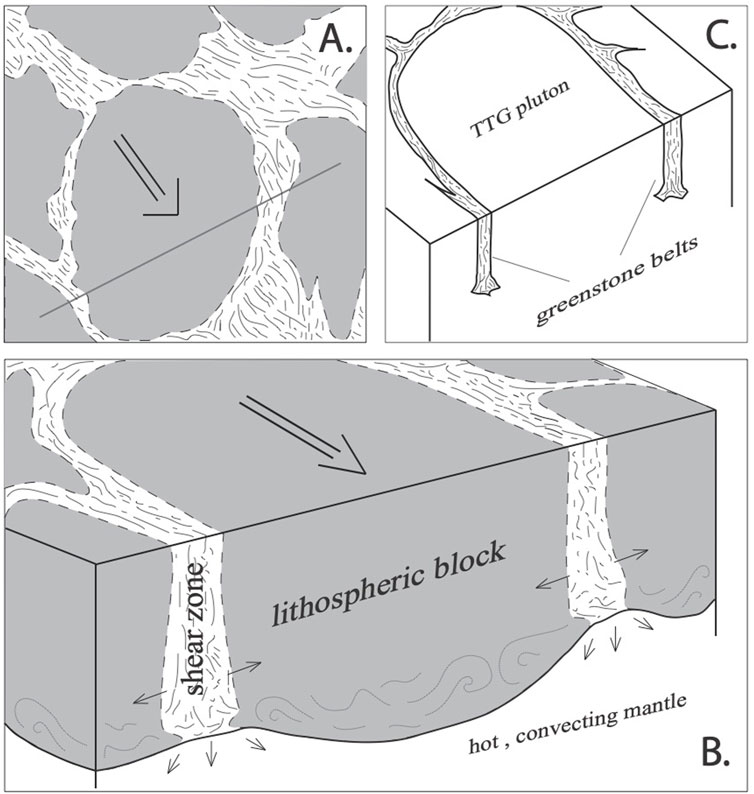
Figure 6. Schematic illustration of the proposed tectonic model for continental crust formation in the Archaean (drawn not to scale). (A) A plan view of Archaean lithospheric blocks (grey areas) separated by regional shear zones (wiggly lines; modified after Harris and Bédard, 2014; Harris and Bédard, 2015; Byrne et al., 2021); these zones are most probably locations of primordial oceans and, hence, intensely hydrothermally altered. Large arrow shows the sense of crustal movement relative to the hot, convecting mantle; diagonal line represents cross-section line. (B) Block diagram illustrating the deep extent of shear zones and dynamic nature of the interface between the hot, viscous bottoms of laterally-moving lithospheric blocks and hot, convecting mantle. Small arrows show relative movement of Cl-rich hydrothermal fluids (or solutions) from shear zones to lithospheric blocks and underlying mantle. (C) Block diagram of a highly eroded Archaean terrane, representing the remnant of Archaean continental crust formation process: a domal TTG pluton flanked by greenstone belts. See text for discussion.
5.1 General tectonic features of the Archaean lithosphere
Most of young Earth’s surface is most likely similar to that of its sister planet Venus, where evidence for modern plate tectonics is equivocal or non-existent (e.g., Harris and Bédard, 2014; Harris and Bédard, 2015; Byrne et al., 2021). A possibility is that young Earth is covered by a single undeforming lithospheric shell or stagnant lid similar to that existing on Mars at present (Nimmo and Stevenson, 2000). It is also possible that the lithosphere undergoes little deformation because of the presence of “heat pipes” (e.g., Moore and Webb, 2013) or has regions of internal deformation or undergoes periods of planet-wide deformation because it acts as a “squishy lid” (e.g., Bédard, 2017; Cawood et al., 2022). Fairly recent modeling, however, indicates that Venusian lowlands contain tectonically active and relatively stronger blocks, resembling pieces of pack ice on a frozen lake that, similar to some continent-like highland crustal blocks, are jostling and sliding past each other because of the traction of underlying, hot convecting mantle (Figure 6A; Harris and Bédard, 2014; Harris and Bédard, 2015; Byrne et al., 2021). These lithospheric blocks are separated by regional “shear zones” that contain highly folded, faulted and thrusted metamorphic rocks. Such a general surface model is adopted herein for young Earth, with lithospheric blocks equated to post-Archaean lithospheric plates that can be thermally defined as part of the Earth that transfers heat by conduction instead of convection (e.g., Parsons and Sclater, 1978; McKenzie et al., 2005). The uppermost section of these blocks becomes the Archaean continental crust. The blocks are separated by shear zones that must have been very deep, all the way to the mantle, in order to define or serve as boundaries between individual sliding blocks. As noted earlier, the zones, now greenstone belts, most likely represent locations of “softer” proto-oceanic lithosphere Archaean oceanic lithosphere hosting the Earth’s primordial hydrosphere. Unlike post-Archaean lithospheric plates, the lithospheric blocks are decoupled from the Archaean mantle (e.g., Harris and Bédard, 2014; Harris and Bédard, 2015; Byrne et al., 2021). Thus, the underlying convecting mantle most likely remains relatively hot as, e.g., unlike in the post-Archaean, none of it becomes part of lithospheric plates that thicken and cool with age.
5.2 Hydrothermal alteration of the Archaean lithospheric blocks and underlying mantle
The shear zones or greenstone belts around lithospheric blocks are wet and, because these are highly and deeply tectonized, also serve as pathways for ancient saline seawater to infiltrate the blocks all the way down into the uppermost mantle (Figure 6B). Heat from the convecting and presumably hotter Archaean mantle, underplated plus intruded mantle-derived magmas and concomitant cooling or crystallization of such magmas generates lithosphere-scale hydrothermal systems where saline fluids, or more appropriately, solutions enriched in fluid-mobile elements (i.e., fluids are geochemically enriched and/or have arc-like composition - cf., Litvinovsky and Podladchikov, 1993; Newton et al., 2019) are vigorously convecting. Such solutions metasomatize or precondition the middle to lower section of individual blocks and uppermost mantle. With time and increasing metamorphic condition, the ratio of solute (saline fluid-mobile elements) over solvent (saline fluid) increases (e.g., Harlov, 2012; Aranovich, 2017; Touret, 2021), and most likely enhances the acidity of the solvent (e.g., Samuel et al., 2021).
5.3 Generation of Archaean granitoid fluids and TTG melts
By the time that ultrametamorphic differentiation or migmatization is attained within the lithospheric blocks, the metasomatizing fluids should be very viscous, conceivably heavily laden with solutes and form metamorphic differentiates. As a result, some granitoid fluids sensu lato are already being formed during the end stages of regional metamorphism, as evidently shown by patches of metamorphically differentiated granitic leucosomes typically observed in Archaean amphibolite terranes (e.g., Aranovich et al., 2013; Halla, 2020). Such granitization process is contemporaneous with or an extension of the proposed mantle metasomatism and melting of the protocrust (e.g., Newton et al., 2019; Touret, 2021; Samuel et al., 2021). This is because almost concurrent with granitization, dehydration anatectic melting occurs in the amphibolitic middle to lower Archaean blocks (e.g., Aranovich et al., 2013; Newton et al., 2019), generating the bulk of primary TTG melts (e.g., Bédard, 2006; 2017; Touret, 2021). All granitoid fluids and anatectic melts, through a long and complex process of accumulation, storage, homogenization, and differentiation form large TTG plutons (e.g., Halla, 2020; Hernández-Montenegro et al., 2021). This is consistent with the observation that such plutons are actually not primary magmas but are crystal-rich “cumulates” (Laurent et al., 2020; see also Hernández-Montenegro et al., 2021).
Although the herein mechanism predicts that a significant portion of Archaean continental crust is formed through the proposed TTG formation process, it does not rule out that magmas directly coming from Archaean mantle that generate calc-alkalic lavas and those coming from mantle plumes do not contribute to the formation of Archaean continental crust (e.g., Smithies et al., 2005; Hernández-Montenegro et al., 2021; Frost et al., 2023). For instance, through shear zones the hot, viscous bottom of lithospheric blocks and underlying Archaean mantle are hydrated and/or metasomatized, in the same manner that the mantle wedge in modern subduction zones and asthenosphere beneath modern transform faults are locally hydrated and metasomatized (e.g., Nonnotte et al., 2005). Accordingly, flux-melting of such metasomatized mantle generates Archaean boninitic and/or arc-like magmas.
It is also important to note that Mesoarchaean and older (>2.8 Ga) TTG suites, commonly termed as “grey gneisses,” are mostly sodic (K2O/Na2O ≤ 0.7; e.g., Moyen and Martin, 2012 and references therein). Also in general, grey gneisses together with associated mafic rocks comprise the Mesoarchaean and older upper continental crust with >11 wt% MgO (Tang et al., 2016). In contrast, Neoarchaean granitoid suites are potassium-rich (K2O >2.0%, K2O/Na2O ≥ 0.7) and primarily comprise the upper continental crust with ca. 4 wt% MgO. Of particular interest among Neoarchaean K-rich rocks are sanukitoids because these also occur, albeit rarely, in post-Archaean subduction zones (e.g., Tatsumi, 2006; Arndt, 2013). Thus, similar to TTG suites, prevailing models for the origin of Neoarchaean sanukitoids gravitate toward subduction zones and include partial melting of a mantle wedge metasomatized by the subduction component mainly derived from sediments, or the modification of adakitic melts that continuously react with mantle peridotite during accent (e.g., Tatsumi, 2006; Arndt, 2013). However, Archaean sanukitoids and other potassic rock suites also do not have to be related to plate subduction.
In the herein proposed model, the earliest granitic crust generated from granitoid fluids and anatectic melts derived from mafic or ultramafic lithospheric blocks plus mantle-derived magmas leaves behind a highly melt-depleted and dehydrated (Lee et al., 2011), highly fluid-mobile element depleted (Aranovich et al., 2013; Newton et al., 2019) and ultramafic (e.g., SiO2-deficient) cumulate that becomes part of the Archaean lithospheric mantle (e.g., Abbott et al., 2013; Bédard, 2017; Smit et al., 2024). This mass transfer creates an Archaean continental crust consisting of greenstone belt-TTG suite terranes underlain by a lithospheric mantle consisting of such cumulates and pre-existing lower lithospheric mantle. On average, an undisturbed Archaean continental crust is relatively thinner, although the entire cratonic lithosphere is thicker, than disturbed Archaean and post-Archaean terranes (e.g., Jordan, 1975; Abbott et al., 2013).
Although there are earlier episodes of continent emergence above the ocean (Chowdhury et al., 2021), most of the continental grey gneisses are emergent towards the end of Archaean, subjecting them to large-scale weathering and erosion (e.g., Bindemanm et al., 2018; Hawkesworth et al., 2020; Hawkesworth et al., 2024; Johnson and Wing, 2020; Reimink and Smye, 2024). These generate terrestrial sediments including K-rich clays (e.g., Kennedy et al., 2006). The Neoarchaean terrestrial sediments also end up in ancient ocean basins that eventually become tectonized as greenstone belts. Such embedded sediments are again acted upon by saline hydrothermal fluids and, thus, the resultant Neoarchaean fluids that granitize and assist in the anatexis of lithospheric blocks are enriched locally with K. In other words, in the proposed tectonic model, the Neoarchaean metasomatizing K-rich fluids are not indicators of subduction zone magmatism, but instead are hydrothermal fluids emanating from metamorphosed Neoarchaean K-richer sediments locally concentrated in pockets in greenstone belts. Accordingly, the nature of continental crust switches from initially sodic (high Na2O/K2O) in Paleoarchaean-Mesoarchaean to potassic (low Na2O/K2O) by Neoarchaean. Penecontemporanenously with the enhanced stabilization of cratons by the end of Archaean, continental lithospheric blocks of uneven strengths and thicknesses are formed, thereby causing the initiation of slab subduction (e.g., Ganne et al., 2018; Brown et al., 2020; Hawkesworth et al., 2020; Hawkesworth et al., 2024; Copley and Weller, 2024). That is, the combined thickening and strengthening of the crust and/or lithosphere causes the loci of continental crust formation to shift from margins of ancient lithospheric blocks to margins of modern tectonic plates.
5.4 Greenstone belts and TTG suites are pieces of Archaean tectonic history
In the proposed model, the granitoid fluids from intense metamorphism, TTG melts from widespread anatexis and mafic magmas from the metasomatized uppermost as well as ambient, hotter Archaean mantle accumulate at the top section of lithospheric blocks where they begin the long and complex process of mixing, homogenization, differentiation, volcanic plumbing and re-working or assimilation of the protocrust. During such process, an inverted density stratification develops where lighter felsic granitoids underlie denser mafic volcanic rocks (e.g., Rudnick and Fountain, 1995; Griffin and O’Reilly, 2007). Notably, such inverted stratification structure, with mafic arc volcanics over low seismic-velocity, differentiated plutonic middle crust, is also detected in post-Archaean arcs (e.g., Tatsumi et al., 2008; Tamura et al., 2019). With time, Archaean continental crust formation progresses such that, again analogous to post-Archaean granitic batholiths (e.g., Peninsular Range batholith along the western margin of North America), Archaean within plate granitoids are unroofed; i.e., their relatively more mafic covers are removed by weathering and erosion, exposing TTG suites surrounded by greenstone belts (Figure 6C). Hence, unlike proposed origins of greenstone belts such as intermittent plate subduction (Polat et al., 2002), partial convective overturn (Van Kranendonk, 2011), or vertical tectonics (Hickman, 2004) among others, it is proposed herein instead that such belts are primarily highly-tectonized, ancient oceanic lithosphere in regional shear zones or “keels” flanking granitized upper section of Archaean lithospheric blocks or “domes”. Unsurprisingly, the shear zones inherit or contain the highly-tectonized structural fabric of laterally moving blocks (Harris and Bédard, 2014; Harris and Bédard, 2015; Byrne et al., 2021). Although their current sizes, shapes and orientations are mostly initially defined by the variable tectonic features of individual lithospheric blocks, these are later modified by post-Archaean plate tectonic processes; i.e., these are now highly compressed or shortened due to lithospheric plate collisions. Significantly, such origin of greenstone belt-TTG suite terranes can provide a viable answer to the fundamental question of why TTG suites are abundant in the Archaean whereas adakites are rare in the post-Archaean. Continental crust formation evolves through time. Archaean TTG suites were generated in a hotter and non-plate tectonic setting where intense and lithosphere-scale hydrothermal activities occurred. In contrast, adakites are generated in rare and unique hydrothermal environs within the relatively colder post-Archaean plate convergent margins.
6 Summary and conclusion
In this study, the newly proposed dependence of the mobility, or immobility, of almost all elements in hydrothermal fluids to the amount of Cl in the fluids in modern subduction zones is used to modify and unify previously proposed formation models for the bulk of continental crust initially from within Archaean lithospheric blocks and later in post-Archaean subduction zones. In both post-Archaean arc magma generation and Archaean granitoid fluid and TTG anatectic melt generation, the unified model emphasizes the additional mobility of many elements in saline hydrothermal fluids in subsolidus to above solidus geochemical reactions to generate the first order, bulk major and trace element composition of continental crust. The source of the bulk of Archaean continental crust is the middle to lower lithospheric block fluxed by fluids squeezed from metamorphosed, hydrothermally altered greenstone belts and breakdown of its amphibole plus metasomatized upper mantle. The source of the bulk of post-Archaean continental crust generated in subduction zones, on the other hand, is the metasomatized mantle wedge fluxed by fluids released from metamorphosed, hydrothermally altered oceanic slab and breakdown of serpentinites. Both sources ultimately generate crusts with a high magnesian andesite bulk composition. Modern subduction zones and Archaean shear zones are mega-tectonic structures where Cl-rich fluids feed giant, complex hydrothermal systems wherein saline fluid-mobile elements are solubilized and recycled to continental crust. Clearly, the herein proposed continental crust formation process is qualitative and lacks many details; thus, further more detailed studies are needed to test and/or refine the model.
Data availability statement
The original contributions presented in the study are included in the article/Supplementary Material; further inquiries can be directed to the corresponding author.
Author contributions
PC: Conceptualization, Formal Analysis, Investigation, Resources, Validation, Writing–original draft, Writing–review and editing.
Funding
The author(s) declare that no financial support was received for the research, authorship, and/or publication of this article.
Acknowledgments
I sincerely thank Y. Zeng, Y.-X. Chen and Z. Cheng for their very helpful comments and suggestions that greatly improve this version of the manuscript. I also thank M. Gregoire and M. D’Antoni for their invitation for this contribution and Z. Zhang for editorial handling.
Conflict of interest
The author declares that the research was conducted in the absence of any commercial or financial relationships that could be construed as a potential conflict of interest.
The author(s) declared that they were an editorial board member of Frontiers, at the time of submission. This had no impact on the peer review process and the final decision.
Generative AI statement
The author(s) declare that no Generative AI was used in the creation of this manuscript.
Publisher’s note
All claims expressed in this article are solely those of the authors and do not necessarily represent those of their affiliated organizations, or those of the publisher, the editors and the reviewers. Any product that may be evaluated in this article, or claim that may be made by its manufacturer, is not guaranteed or endorsed by the publisher.
References
Abbott, D. H., Mooney, W. D., and Van Tongeren, J. A. (2013). The character of the Moho and lower crust within Archean cratons and the tectonic implications. Tectonophysics 609, 690–705. doi:10.1016/j.tecto.2013.09.014
Aranovich, L. Y. (2017). The role of brines in high-temperature metamorphism and granitization. Petrology 25, 486–497. doi:10.1134/s0869591117050022
Aranovich, L. Y., Newton, R. C., and Manning, C. E. (2013). Brine-assisted anatexis: experimental melting in the system haplogranite–H2O–NaCl–KCl at deep-crustal conditions. Earth Planet. Sci. Lett. 374, 111–120. doi:10.1016/j.epsl.2013.05.027
Arndt, N. T. (2013). Formation and evolution of the continental crust. Geochem. Perspect. 2 (3), 405–533. doi:10.7185/geochempersp.2.3
Baker, M. B., Grove, T. L., and Price, R. (1994). Primitive basalts and andesites from the Mt. Shasta region N. California: products of varying melt fraction and water content. Contributions Mineralogy Petrology 118, 111–129. doi:10.1007/bf01052863
Barnes, J. D., Manning, C. E., Scambelluri, M., and Selverstone, J. (2018). “The behaviour of halogens during subduction-zone processes,” in The role of halogens in terrestrial and extraterrestrial processes. Editors D. E. Harlov, and L. Y. Aranovich (Springer).
Bédard, J. H. (2006). A catalytic delamination-driven model for coupled genesis of Archaean crust and sub-continental lithospheric mantle. Geochimica Cosmochimica Acta 70, 1188–1214. doi:10.1016/j.gca.2005.11.008
Bédard, J. H. (2017). Stagnant lids and mantle overturns: implications for Archaean tectonics, magmagenesis, crustal growth, mantle evolution, and the start of plate tectonics. Geosci. Front. 9, 19–49. doi:10.1016/j.gsf.2017.01.005
Bédard, J. H., Harris, L. B., and Thurston, P. (2013). The hunting of the snArc. Precambrian Res. 229, 20–48. doi:10.1016/j.precamres.2012.04.001
Bénard, A., Koga, K. T., Shimizu, N., Kendrick, M. A., Ionov, D. A., Nebel, O., et al. (2017). Chlorine and fluorine partition coefficients and abundances in sub-arc mantle xenoliths (Kamchatka, Russia): implications for melt generation and volatile recycling processes in subduction zones. Geochim. Cosmochim. Acta 199, 324–350. doi:10.1016/j.gca.2016.10.035
Bindemanm, I. N., Zakharov, D. O., Palandri, J., Greber, N. D., Dauphas, N., Retallack, G. J., et al. (2018). Rapid emergence of subaerial landmasses and onset of a modern hydrologic cycle 2.5 billion years ago. Nature 557, 545–548. doi:10.1038/s41586-018-0131-1
Blundy, J., Mavrogenes, J., Tattitch, B., Sparks, S., and Gilmer, A. (2015). Generation of porphyry copper deposits by gas–brine reaction in volcanic arcs. Nat. Geosci. 8, 235–240. doi:10.1038/ngeo2351
Brounce, M., Kelley, K. A., and Cottrell, E. (2014). Fe3+/ΣFe variations in Mariana Arc basalts and primary fO2 of the mantle wedge. Jour. Pet. 55, 2513–2536. doi:10.1093/petrology/egu065
Brown, M., Johnson, T., and Gardiner, N. J. (2020). Plate tectonics and the archean earth. Annu. Rev. Earth Planet. Sci. 48, 291–320. doi:10.1146/annurev-earth-081619-052705
Byrne, P., Ghail, R. C., Sengör, A. M. C., James, P. B., Klimczak, C., and Solomon, S. C. (2021). A globally fragmented and mobile lithosphere on Venus. Proc. Natl. Acad. Sci. 118, e2025919118. doi:10.1073/pnas.2025919118
Cameron, M., Bagby, W. C., and Cameron, K. L. (1980). Petrogenesis of voluminous mid-tertiary ignimbrites of the sierra madre Occidental, chihuahua, Mexico. Contributions Mineralogy Petrology 74, 271–284. doi:10.1007/bf00371697
Campbell, I. H., and Hill, R. I. (1988). A two-stage model for the formation of the granite-greenstone terrains of the Kalgoorlie-Norseman area, Western Australia. Earth Planet. Sci. Lett. 90, 11–25. doi:10.1016/0012-821x(88)90107-0
Campbell, I. H., and Taylor, S. R. (1983). No water, no granites-no oceans, no continents. Geophys. Res. Lett. 10, 1061–1064. doi:10.1029/gl010i011p01061
Carter, L. B., Skora, S., Blundy, J. B., De Hoog, J. C. M., and Elliot, T. (2015). An experimental study of trace element fluxes from subducted oceanic crust. J. Petrology 56, 1585–1606. doi:10.1093/petrology/egv046
Castillo, P. R. (2012). Adakite petrogenesis. Lithos 134-135, 304–316. doi:10.1016/j.lithos.2011.09.013
Castillo, P. R. (2021). Chlorine from seawater is key to the generation of calc-alkaline lavas. J. Asian Earth Sci. 213, 104753. doi:10.1016/j.jseaes.2021.104753
Castillo, P. R. (2022). Arc magmatism and porphyry-type ore deposition are primarily controlled by chlorine from seawater. Chem. Geol. 58, 120683. doi:10.1016/j.chemgeo.2021.120683
Castillo, P. R. (2023). An alternative new view of convergent margin magmatism. J. Asian Earth Sci. 256, 105834. doi:10.1016/j.jseaes.2023.105834
Castillo, P. R., Janney, P. E., and Solidum, R. (1999). Petrology and geochemistry of Camiguin Island, southern Philippines: insights to the source of adakites and other lavas in a complex arc setting. Contributions Mineralogy Petrology 134, 33–51. doi:10.1007/s004100050467
Cawood, P. A., Chowdhury, P., Mulder, J. A., Hawkesworth, C. J., Capitanio, F. A., Gunawardana, P. M., et al. (2022). Secular evolution of continents and the earth system. Rev. Geophys. 60, e2022RG000789. doi:10.1029/2022rg000789
Cawood, P. A., Kröner, A., and Pisarevsky, S. (2006). Precambrian plate tectonics: criteria and evidence. GSA Today 16, 4–11. doi:10.1130/gsat01607.1
Chen, S., Niu, Y. L., Li, J. Y., Sun, W. L., Zhang, Y., Hu, Y., et al. (2016). Syn-collisional adakitic granodiorites formed by fractional crystallization: insights from their enclosed mafic magmatic enclaves (MMEs) in the Qumushan pluton, North Qilian Orogen at the northern margin of the Tibetan Plateau. Lithos 248, 455–468. doi:10.1016/j.lithos.2016.01.033
Chowdhury, P., Mulder, J. A., Cawood, P. A., Bhattacharjee, S., Roy, S., Wainwright, A. N., et al. (2021). Magmatic thickening of crust in non–plate tectonic settings initiated the subaerial rise of Earth’s first continents 3.3 to 3.2 billion years ago. Proc. Natl. Acad. Sci. 118, e2105746118. doi:10.1073/pnas.2105746118
Condie, K. C. (2018). A planet in transition: the onset of plate tectonics on Earth between 3 and 2 Ga. Geosci. Front. 9, 51–60. doi:10.1016/j.gsf.2016.09.001
Condie, K. C., and Behn, K. (2006). Archean geodynamics: similar to or different from modern geodynamics? Am. Geophys. Union Monogr. 164, 47–59. doi:10.1029/164gm05
Copley, A., and Weller, O. M. (2024). Modern-style continental tectonics since the early Archean. Precambrian Res. 403, 107324. doi:10.1016/j.precamres.2024.107324
de Wit, M. J., and Furnes, H. (2016). 3.5-Ga hydrothermal fields and diamictites in the Barberton Greenstone Belt—Paleoarchean crust in cold environments. Sci. Adv. 2, e1500368. Available at: http://advances.sciencemag.org
Defant, M. J., and Drummond, M. S. (1990). Derivation of some modern arc magmas by melting of young subducted lithosphere. Nature 347, 662–665. doi:10.1038/347662a0
Elliot, T., Plank, T., Zindler, A., White, W., and Bourdon, B. (1997). Element transport from slab to volcanic front at the Mariana arc. J. Geophys. Res. 102, 14991–15019. doi:10.1029/97JB00788
Frost, C. D., Mueller, P. A., Mogk, D. W., Frost, B. R., and Henry, D. J. (2023). Creating continents: archean cratons tell the story. Gelogical Soc. Am. Today 33, 4–10. doi:10.1130/GSATG541A.1
Gale, A., Dalton, C. A., Langmuir, C. H., Su, Y., and Schilling, J.-G. (2013). The mean composition of ocean ridge basalts. Geochem. Geophys. Geosystems 14, 489–518. doi:10.1002/ggge.20038
Ganne, J., Feng, X., McFarlane, H., Macouin, M., Rousse, S., Naba, S., et al. (2018). When proterozoic crusts became thick: new insights from magma petrology. Geosciences 8, 428. doi:10.3390/geosciences8120428
Griffin, W. L., and O’Reilly, S. Y. (2007). Cratonic lithospheric mantle: is anything subducted? Episodes 30, 43–53. doi:10.18814/epiiugs/2007/v30i1/006
Grout, F. F. (1941). Formation of igneous-looking rocks by metasomatism: a critical review and suggested research. Geol. Soc. Am. Bull. 52, 1525–1576. doi:10.1130/gsab-52-1525
Grove, T. L., Baker, M. B., Price, R. C., Parman, S. W., Elkins-Tanton, L. T., Chatterjee, N., et al. (2005). Magnesian andesite and dacite lavas from Mt. Shasta, northern California: products of fractional crystallization of H2O-rich mantle melts. Contributions Mineralogy Petrology 148, 542–565. doi:10.1007/s00410-004-0619-6
Halla, J. (2020). The TTG-amphibolite terrains of arctic fennoscandia: infinite networks of amphibolite metatexite-diatexite transitions. Front. Earth Sci. 8, 252. doi:10.3389/feart.2020.00252
Hamilton, W. B. (2008). Archean magmatism and deformation were not products of plate tectonics. Precambrian Res. 91, 143–179. doi:10.1016/s0301-9268(98)00042-4
Harlov, D. E. (2012). The potential role of fluids during regional granulite-facies dehydration in the lower crust. Geosci. Front. 3, 813–827. doi:10.1016/j.gsf.2012.03.007
Harris, L. B., and Bédard, J. H. (2014). “Interactions between continent-like ‘drift’, rifting,and mantle flow on Venus? Gravity interpretations and Earth analogues,”. Geol. Soc. Sp. Pub. Editors T. Platz, M. Massironi, P. Byrne, and H. Hiesinger (London: Geological Society of London), 401, 327–356. doi:10.1144/SP401.9
Harris, L. B., and Bédard, J. H. (2015). Interactions between continent-like “drift,” rifting andmantle flow on Venus: gravity interpretations and Earth analogues. Geol. Soc. Lond. Spec. Publ. 401, 327–356. doi:10.1144/sp401.9
Hawkesworth, C., Cawood, P. A., and Dhuime, B. (2020). The evolution of the continental crust and the onset of plate tectonics. Front. Earth Sci. (Lausanne) 8, 326. doi:10.3389/feart.2020.00326
Hawkesworth, C., Cawood, P. A., Dhuime, B., and Kemp, T. (2024). Tectonic processes and the evolution of the continental crust. J. Geol. Soc. 181, jgs2024–027. doi:10.1144/jgs2024-027
Hernández-Montenegro, J. D., Palin, R. M., Zuluaga, C. A., and Hernández-Uribe, D. (2021). Archean continental crust formed by magma hybridization and voluminous partial melting. Sci. Rep. 11, 5263. doi:10.1038/s41598-021-84300-y
Herzberg, C. T., Fyfe, W. S., and Carr, M. J. (1983). Density constraints on the formation of the continental Moho and crust. Contributions Mineralogy Petrology 84, 1–5. doi:10.1007/bf01132324
Hickman, A. H. (2004). Two contrasting granite-greenstone terranes in the Pilbara Craton, Australia: evidence for vertical and horizontal tectonic regimes prior to 2900 Ma. Precambrian Res. 131, 153–172. doi:10.1016/j.precamres.2003.12.009
Huang, Y., Nakatani, T., Nakamura, M., and McCammon, C. (2019). Saline aqueous fluid circulation in mantle wedge inferred from olivine wetting properties. Nat. Commun. 10, 5557. doi:10.1038/s41467-019-13513-7
Johnson, B. W., and Wing, B. A. (2020). Limited archaean 18O-enriched ocean. Nat. Geosci. 13, 243–248. doi:10.1038/s41561-020-0538-9
Jordan, T. H. (1975). The continental tectosphere. Rev. Geophys. 13, 1–12. doi:10.1029/rg013i003p00001
Kamber, B. S. (2015). The evolving nature of terrestrial crust from the Hadean, through the Archaean, into the Proterozoic. Precambrian Res. 258, 48–82. doi:10.1016/j.precamres.2014.12.007
Kawamoto, T., Yoshikawa, M., Kumagai, Y., Mirabueno, Ma.H. T., Okuno, M., and Kobayashi, T. (2013). Mantle wedge infiltrated with saline fluids from dehydration and decarbonation of subducting slab. Proc. Natl. Acad. Sci. 110, 9663–9668. doi:10.1073/pnas.1302040110
Kay, R. W., and Mahlburg-Kay, S. M. (1991). Creation and destruction of lower continental crust. Geol. Rundsch. 80, 259–278. doi:10.1007/bf01829365
Kelemen, P. B. (1995). Genesis of high Mg# andesites and the continental crust. Contributions Mineralogy Petrology 120, 1–19. doi:10.1007/bf00311004
Kelemen, P. B., Hanghoj, K., and Greene, A. R. (2014). “One view of the geochemistry of subduction-related magmatic arcs, with an emphasis on primitive andesite and lower crust,” in Treatise of geochemistry 2, the crust (Amsterdam: Elsevier), 593–659.
Kelley, K., and Cottrell, E. (2012). The influence of magmatic differentiation on the oxidation state of Fe in a basaltic arc magma. Earth Planet. Sci. Lett. 329-330, 109–121. doi:10.1016/j.epsl.2012.02.010
Kennedy, M., Droser, M., Meyer, L. M., Pevear, D., and Mrofka, D. (2006). Late Precambrian oxygenation: inception of the clay mineral factory. Science 311, 1446–1449. doi:10.1126/science.1118929
Klimm, K., Blundy, J. D., and Green, T. H. (2008). Trace element paritioning and acessory phase saturation during H2O-saturated melting of basalt withy implications for subduction zone chemical fluxes. J. Petrology 49, 523–553. doi:10.1093/petrology/egn001
Korzhinskii, D. S. (1946). “The principle of alkali mobility during magmatic phenomena,” in Belyankinu k70-letiyu so dnya rozhdeniya (On the 70th Anniversary of the Academician D.S. Belyankin). Editor D. S. Akademiku (Moscow: AN SSSR), 242–261.
Laurent, O., Björnsen, J., Wotzlaw, J.-F., Bretscher, S., Silva, M. P., Moyen, J. F., et al. (2020). Earth’s earliest granitoids are crystal-rich magma reservoirs tapped by silicic eruptions. Nat. Geosci. 13, 163–169. doi:10.1038/s41561-019-0520-6
Lee, C.-T., Luffi, P., and Chin, E. J. (2011). Building and destroying continental mantle. Annu. Rev. Earth Planet. Sci. 39, 59–90. doi:10.1146/annurev-earth-040610-133505
Li, Z. H., Li, B. L., Li, P., Sun, Y. M., and Shi, Y. F. (2023). Petrogenesis and magma fertility of the Heishishan skarn deposit, East Kunlun, NW China: insights from geochronology, mineralogy, geochemistry, and Sr-Nd-Hf isotopes. Ore Geol. Rev. 157, 105436. doi:10.1016/j.oregeorev.2023.105436
Liou, P., and Guo, J. (2019). Generation of Archaean TTG gneisses through amphibole-dominated fractionation. J. Geophys. Res. Solid Earth 124, 3605–3619. doi:10.1029/2018jb017024
Litvinovsky, B. A., and Podladchikov, Y. Y. (1993). Crustal anatexis during the influx of mantle volatiles. Lithos 30, 93–107. doi:10.1016/0024-4937(93)90009-2
Manning, C. E. (2018). Fluids of the lower crust: deep is different. Annu. Rev. Earth Planet. Sci. 46, 67–97. doi:10.1146/annurev-earth-060614-105224
Martin, H., Smithies, R. H., Rapp, R., Moyen, J. F., and Champion, D. (2005). An overview of adakite, tonalite–trondhjemite–granodiorite (TTG), and sanukitoid: relationships and some implications for crustal evolution. Lithos 79, 1–24. doi:10.1016/j.lithos.2004.04.048
McCall, G. J. H. (2010). New paradigm for the early Earth: did plate tectonics as we know it not operate until the end of the Archean? Aust. J. Earth Sci. 57, 349–355. doi:10.1080/08120091003677579
McDonough, W. F., and Sun, S.-s. (1995). The composition of the Earth. Chem. Geol. 120, 223–253. doi:10.1016/0009-2541(94)00140-4
McKenzie, D., Jackson, J., and Priestley, K. (2005). Thermal structure of oceanic and continental lithosphere. Earth Planet. Sci. Lett. 233, 337–349. doi:10.1016/j.epsl.2005.02.005
Miyashiro, A. (1974). Volcanic rock series in island arcs and active continental margins. Amer. J. Sci. 274, 321–355. doi:10.2475/ajs.274.4.321
Mojzsis, S., Harrison, T., and Pidgeon, R. (2001). Oxygen-isotope evidence from ancient zircons for liquid water at the Earth’s surface 4,300 Myr ago. Nature 409, 178–181. doi:10.1038/35051557
Moyen, J.-F. (2011). The composite Archaean grey gneisses: petrological significance, and evidence for a non-unique tectonic setting for Archaean crustal growth. Lithos 123, 21–36. doi:10.1016/j.lithos.2010.09.015
Moyen, J.-F., and Martin, H. (2012). Forty years of TTG research. Lithos 148, 312–336. doi:10.1016/j.lithos.2012.06.010
Nagel, T. J., Hoffmann, J. E., and Münker, C. (2012). Generation of Eoarchean tonalite-trondhjemite-granodiorite series from thickened mafic arc crust. Geology 40, 375–378. doi:10.1130/g32729.1
Nebel-Jacobsen, Y., Nebel, O., Wille, M., and Cawood, P. A. (2018). A non-zircon Hf isotope record in Archean black shales from the Pilbara craton confirms changing crustal dynamics ca. 3 Ga ago. Sci. Rep. 8, 922. doi:10.1038/s41598-018-19397-9
Newton, R. C., Aranovich, L. Y., and Touret, J. L. R. (2019). Streaming of saline fluids through Archean crust: another view of charnockite-granite relations in southern India. Lithos 346–347, 105157. doi:10.1016/j.lithos.2019.105157
Nimmo, F., and Stevenson, D. J. (2000). Influence of early plate tectonics on the thermal evolution and magnetic field of mars. J. Geophys. Res. Planets 105, 11969–11979. doi:10.1029/1999JE001216
Nonnotte, P., Ceuleneer, G., and Benoit, M. (2005). Genesis of andesitic–boninitic magmas at mid-ocean ridges by melting of hydrated peridotites: geochemical evidence from DSDP Site 334 gabbronorites. Earth Planet. Sci. Lett. 236, 632–653. doi:10.1016/j.epsl.2005.05.026
Parsons, B., and Sclater, J. G. (1978). An analysis of the variation of ocean floor bathymetry and heat flow with age. J. Geophys. Res. 83, 803–827. doi:10.1029/jb082i005p00803
Pearce, J. A., and Reagan, M. K. (2019). Identification, classification, and interpretation of boninites from Anthropocene to Eoarchean using Si-Mg-Ti systematics. Geosphere 15, 1008–1037. doi:10.1130/GES01661.1
Plank, T. (2005). Constraints from thorium/lanthanum on sediment recycling at subduction zones and the evolution of the continents. J. Petrology 46, 921–944. doi:10.1093/petrology/egi005
Plank, T., and Langmuir, C. H. (1998). The chemical composition of subducting sediment and its consequences for the crust and mantle. Chem. Geol. 145, 325–394. doi:10.1016/s0009-2541(97)00150-2
Polat, A., Hofmann, A. W., and Rosing, M. (2002). Boninite-like volcanic rocks in the 3.7 – 3.8 Ga Isua greenstone belt, West Greenland: geochemical evidence for intra-oceanic subduction zone processes in the early Earth. Chem. Geol. 184, 231–254. doi:10.1016/s0009-2541(01)00363-1
Railsback, L. B. (2003). An earth scientist’s periodic table of the elements and their ions. Geology 31, 737–740. doi:10.1130/g19542.1
Railsback, L. B. (2004). An earth scientist's periodic table of the elements and their ions. Geol. Soc. Am. Map Chart Ser. item MCH 092.
Rapp, R., Watson, E., and Miller, C. (1991). Partial melting of amphibolite/eclogite and the origin of Archean trondhjemites and tonalites. Precambrian Res. 51, 1–25. doi:10.1016/0301-9268(91)90092-o
Reimink, J. R., and Smye, A. J. (2024). Subaerial weathering drove stabilization of continents. Nature 629, 609–615. doi:10.1038/s41586-024-07307-1
Rollinson, H. (2021). Do all Archaean TTG rock compositions represent former melts? Precambrian Res. 367, 106448. doi:10.1016/j.precamres.2021.106448
Rudnick, R., and Gao, S. (2014). “Composition of the continental crust,” in The crust. Editors H. Holland, and K. Turekian (Elsevier-Pergamon, Treatise on Geochemistry), 3, 1–64. doi:10.1016/b0-08-043751-6/03016-4
Rudnick, R. L., and Fountain, D. M. (1995). Nature and composition of the continental crust: a lower crustal perspective. Rev. Geophys. 33, 267–309. doi:10.1029/95rg01302
Ruiz, J., Patchett, P. J., and Ortega-Gutierrez, F. (1988). Proterozoic and Phanerozoic basement terranes of Mexico from Nd isotopic studies. Geol. Soc. Am. Bull. 100, 274–281. doi:10.1130/0016-7606(1988)100<0274:papbto>2.3.co;2
Rustioni, G., Audétat, A., and Keppler, H. (2019). Experimental evidence for fluid-induced melting in subduction zones. Geochem. Perspect. Lett. 11, 49–54. doi:10.7185/geochemlet.1925
Samuel, V. O., Santosh, M., Jang, Y., and Kwon, S. (2021). Acidic fluids in the Earth’s lower crust. Sci. Rep. 11, 21146. doi:10.1038/s41598-021-00719-3
Seward, T. M., Williams-Jones, A. E., and Migdisov, A. A. (2014). “The chemistry of metal transport and deposition by ore-forming hydtrothermal fluids,” in Geochemistry of mineral deposits. Treatise on geochemistry 2, the crust. Editor S. D. Scott (Amsterdam: Elsevier), 29–57.
Sizova, E., Gerya, T., Stüwe, K., and Brown, M. (2015). Generation of felsic crust in the Archean: a geodynamic modeling perspective. Precambrian Res. 271, 198–224. doi:10.1016/j.precamres.2015.10.005
Smit, M. A., Musiyachenko, K. A., and Goumans, J. (2024). Archaean continental crust formed from mafic cumulates. Nat. Commun. 15, 692. doi:10.1038/s41467-024-44849-4
Smithies, R. H. (2000). The Archaean tonalite-trondhjemite-granodiorite (TTG) series is not an analogue of Cenozoic adakite. Earth Planet. Sci. Lett. 182, 115–125. doi:10.1016/s0012-821x(00)00236-3
Smithies, R. H., Van Kranendonk, M. J., and Champion, D. C. (2005). It started with a plume - early Archaean basaltic proto-continental crust. Earth Planet. Sci. Lett. 238, 284–297. doi:10.1016/j.epsl.2005.07.023
Stern, R. A. (2008). “Modern-Style plate tectonics began in neoproterozoic time: an alternative interpretation of Earth’s tectonic history,” in Geol. Soc. Am. Sp. Pap Editors K. Condie, and V. Pease (Denver: Geological Society of America), 440, 265–280. doi:10.1130/2008.2440(13)
Sun, S.-S., and McDonough, W. (1989). “Chemical and isotopic systematics of oceanic basalts: implications for mantle compositions and processes,” in Geol. Soc. Sp. Pub. Editors A. D. Saunders, and M. J. Norry (London: Geological Society of London), 42, 313–345.
Tamura, Y., Sato, T., Fujiwara, T., Kodaira, S., and Nichols, A. (2019). Advent of continents: a new hypothesis. Sci. Rep. 6, 33517. doi:10.1038/srep33517
Tang, M., Chen, K., and Rudnick, R. L. (2016). Archean upper crust transition from mafic to felsic marks the onset of plate tectonics. Science 351, 372–375. doi:10.1126/science.aad5513
Tatsumi, Y. (2006). High-Mg andesites in the Setouchi volcanic belt, SW Japan: analogy to Archean magmatism and continental crust formation? Annu. Rev. Earth Planet. Sci. 34, 467–499. doi:10.1146/annurev.earth.34.031405.125014
Tatsumi, Y., Shukuno, H., Tani, K., Takahashi, N., Kodaira, S., and Kogiso, T. (2008). Structure and growth of the Izu-Bonin-Mariana arc crust: 2. Role of crust-mantle transformation and the transparent Moho in arc crust evolution. J. Geophys. Res. 113, B02203. doi:10.1029/2007JB005121
Taylor, S. R. (1967). The origin and growth of continents. Tectonophysics 4, 17–34. doi:10.1016/0040-1951(67)90056-x
Taylor, S. R., and McLennan, S. M. (1985). The continental crust: its composition and evolution. Oxford: Blackwell, 312.
Taylor, S. R., and White, A. J. R. (1965). Geochemistry of andesites and the growth of continents. Nature 208, 271–273. doi:10.1038/208271a0
Touret, J. (2021). “Fluid regime during the formation of continental crust,”. Academia Letters 655. doi:10.20935/AL655.1608
Van Kranendonk, M. J. (2011). Cool greenstone drips and the role of partial convective overturn in Barberton Greenstone Belt evolution. J. Afr. Earth Sci. 60, 346–352. doi:10.1016/j.jafrearsci.2011.03.012
Van Kranendonk, M. J., Smithies, R. H., Griffin, W. L., Huston, D. L., Hickman, A. H., Champion, D. C., et al. (2015). “Making it thick: a volcanic plateau origin of Palaeoarchean continental lithosphere of the Pilbara and Kaapvaal cratons,”. Geol. Soc. Sp. Pub. Editors N. M. W. Roberts, M. Van Kranendonk, S. Parman, S. Shirey, and P. D. Clift (London: Geological Society of London), 389, 83–111. doi:10.1144/sp389.12
Wang, J., Wang, Q., Dan, W., Yang, J.-H., Yang, Z.-W., Sun, P., et al. (2019). The role of clinopyroxene in amphibole fractionation of arc magmas: evidence from mafic intrusive rocks within the Gangdese arc, southern Tibet. Lithos 338–339, 174–188. doi:10.1016/j.lithos.2019.04.013
Wang, Z. Z., Zhao, Z. D., Wang, S. S., Li, X. P., Meng, Y. K., Liu, 720 D., et al. (2023). Early cretaceous volcanic rocks in Sandaowanzi area constrain the geodynamics and magma fertility. Ore Geol. Rev. 158, 105473. doi:10.1016/j.oregeorev.2023.105473
Watson, E., and Harrison, T. (2005). Zircon thermometer reveals minimum melting conditions on earliest earth. Science 308, 841–844. doi:10.1126/science.1110873
Keywords: saline fluid-mobile elements, granitization, element mobile-enriched continental crust, unified continental crust formation, adakite-TTG formation
Citation: Castillo PR (2025) Saline fluids play a major role in continental crust formation. Front. Earth Sci. 13:1547196. doi: 10.3389/feart.2025.1547196
Received: 17 December 2024; Accepted: 03 February 2025;
Published: 26 February 2025.
Edited by:
Zhaochong Zhang, China University of Geosciences, ChinaReviewed by:
Yi-Xiang Chen, University of Science and Technology of China, ChinaZhiguo Cheng, China University of Geosciences, China
Yunchuan Zeng, China University of Geosciences, China
Copyright © 2025 Castillo. This is an open-access article distributed under the terms of the Creative Commons Attribution License (CC BY). The use, distribution or reproduction in other forums is permitted, provided the original author(s) and the copyright owner(s) are credited and that the original publication in this journal is cited, in accordance with accepted academic practice. No use, distribution or reproduction is permitted which does not comply with these terms.
*Correspondence: Paterno R. Castillo, cGNhc3RpbGxvQHVjc2QuZWR1