Abstract
Shanxi Province carries a profound historical and cultural accumulation and diversified regional and cultural characteristics. Comprehensive research on the spatial Characteristics of intangible cultural heritage in Shanxi Province and its influencing factors is of great academic significance for the protection and inheritance of China’s traditional cultural. This research focuses on 1,178 items of intangible cultural heritage in Shanxi Province, utilizing GIS spatial analysis techniques such as nearest neighbor index, kernel density estimation, and geographical detecto to investigate the spatial distribution patterns, and influencing factors of 1,178 intangible cultural heritage items documented across 11 municipal-level administrative units within Shanxi Province. Research shows: Shanxi’s intangible cultural heritage is generally distributed in a significant cluster state, and its spatial distribution characteristics are highly dense in central Shanxi, significantly clustered in southern Shanxi, and relatively dispersed in northern Shanxi, forming an overall structural feature of “four-core and two-belt”. In terms of influencing factors, cultural environmental factors have the most significant impact on the distribution of intangible cultural heritage, followed by socioeconomic factors. Natural geographic factors have a relatively minor direct impact on the distribution of intangible cultural heritage, but they indirectly influence it through interactions with other factors, which indicates that the distribution of intangible cultural heritage is the result of the joint action of natural support, social and economic evolution and cultural ecological construction. Finally, research proposes: the sustainable development of intangible cultural heritage in Shanxi Province should be realized by strengthening the construction of cultural institutions, improving the standard of education and promoting the integration of culture and tourism.
1 Introduction
Intangible cultural heritage (ICH) refers to practices, shows, performance forms, knowledge, and skills of cultural heritage and includes associated tools, objects, handicrafts, and cultural sites (Unesco, 2003). The protection of ICH has a positive impact on the public (Vondolia et al., 2022). ICH is the “living gene” of the continuation of human civilization, which carries the historical memory, cultural wisdom and spiritual identity of specific social groups. It is not only the core carrier of the national spirit inheritance, but also the concentrated embodiment of cultural diversity and human creativity. From oral traditions, festival ceremonies to handicrafts and performing arts, ICH connects traditional knowledge with modern life in the form of dynamic practice, maintaining the continuity and adaptability of culture. ICH plays an important role in promoting social cohesion, enhancing community identity and cultural pride, all of which contribute to the sustainable development of society. By protecting and passing on ICH, communities can be strengthened in resilience and adaptability, enabling them to better cope with social and environmental changes. ICH is the key to ensure cultural diversity and human creativity, and its survival is directly related to the balance of cultural ecology and the harmonious development of society.
Under the impact of rapid urbanization and digital technology, the living inheritance of ICH is facing the risk of fracture, and its spatial distribution and survival state have become an important dimension to observe cultural resilience and formulate protection strategies. The academic research on the protection and inheritance of ICH has achieved fruitful results. Scholars from the perspective of anthropology, sociology, folklore, tourism (Qiu et al., 2023; Xiao et al., 2023) and other disciplines and technical level, the definition (Vecco, 2010; Melis and Chambers, 2021) of ICH, authenticity (Su, 2018; Zhang and Lee, 2022), inheritor (Gao et al., 2022), experience landscape (Chen, 2022), education inheritance (Wang, 2019; Escorihuela et al., 2025), digital development (Xue et al., 2019; Hou et al., 2022; Skublewska-Paszkowska et al., 2022; Cui and Fu, 2023; Fan, 2024), inheritance (Zhang, 2024), protection (Luo, 2021; Yan and Chiou, 2021; Gwerevende and Mthombeni, 2023; Zhang and Ran, 2024), disseminate (DeSoucey et al., 2019; Xue et al., 2019), and sustainable development analysis (Naguib, 2013; Yan and Li, 2023; Cui et al., 2024).
In recent years, scholars have increasingly emphasized the importance of geographical perspectives in cultural heritage research (Shen et al., 2024). Studies using GIS-based methods to explore the spatial distribution of cultural heritage resources have grown rapidly, focusing on historical settlements (Yuan et al., 2024), old canal cities (Xia et al., 2024), and major cultural regions such as the Beijing–Tianjin–Hebei (Pang and Wu, 2023), the Yellow River Basin (Zhang et al., 2022), the Grand Canal (Zhang S. et al., 2024), the Yangtze River Basin (Wang et al., 2023), Fujian Province (Han et al., 2024), the Dongting Lake Basin (He et al., 2024), as well as the spatial distribution of China’s tangible and intangible cultural heritage resources (Zhang Z. W. et al., 2024). A growing body of work has also highlighted the influence of natural geographic conditions, socioeconomic structures, and cultural environments on ICH development and spatial patterns (Zhang et al., 2022; Shen et al., 2024). Natural factors such as climate and topography shape the environmental foundation for the formation of traditional crafts and practices, while socioeconomic conditions—including urbanization, transportation accessibility (Valjarević, 2025), and economic development—significantly affect the vitality and dissemination of cultural activities. Cultural-environmental variables, such as educational and cultural institutions, further influence the transmission capacity and sustainability of ICH.
Shanxi Province, with its deep historical accumulation and strong regional cultural identity, has nurtured a rich and diverse body of ICH. As of June 2024, it contains 182 national-level and 996 provincial-level representative ICH items. Due to long-term historical evolution and varied regional environments, the spatial distribution of ICH in the province exhibits remarkable heterogeneity. The central region, shaped by historical commerce, is characterized by traditional arts influenced by trade culture; the southern region, grounded in agrarian civilization, is rich in folk festivals; and the northern region, influenced by frontier culture, demonstrates highly distinctive artistic forms. These spatial patterns reflect not only environmental constraints but also the complex interactions of socioeconomic development, cultural exchange, and historical processes.
Despite the richness of Shanxi’s ICH, systematic studies examining how its spatial distribution relates to natural, socioeconomic, and cultural factors remain insufficient. Understanding these patterns and underlying mechanisms is essential for improving targeted conservation, strengthening heritage management, and supporting sustainable cultural development. Against this background, the present study aims to address the following scientific questions:
What are the spatial distribution characteristics of ICH resources in Shanxi Province?
How do different categories of ICH exhibit spatial differentiation?
How do natural geographical conditions, socioeconomic structures, and cultural environments jointly shape these spatial patterns?
To answer these questions, this study integrates geographic information system (GIS) techniques with multivariate statistical analysis. Specifically, nearest neighbor index analysis and kernel density estimation are used to reveal the spatial configuration of ICH resources, while the geographical detector model is employed to quantify the explanatory power of natural, socioeconomic, and cultural factors and to assess their interaction effects. This methodological framework provides a comprehensive approach to uncovering the spatial heterogeneity and underlying mechanisms of ICH distribution in Shanxi Province.
2 Materials and methods
2.1 Study area
Shanxi Province is located in the west of the North China Plain, the east of the middle reaches of the Yellow River, close to the southern edge of the Inner Mongolia Plateau, its unique geographical shape, surrounded by mountains and rivers, the overall map is a parallelogram from northeast to southwest, and the boundary with neighboring provinces is very clear. In the east and southeast of Shanxi Province, the Taihang Mountains are the natural boundary, bordering Hebei Province and Henan Province. Its west and southwest are adjacent to the periphery of China, facing Shaanxi and Henan provinces across the Yellow River. The north, relying on the Great Wall as an important defense line, is closely connected with the Inner Mongolia Autonomous Region. The ICH of Shanxi Province is widely distributed and rich in content, with high historical and cultural connotation and times value. It involves important cultural forms such as the Ancestor-root culture of Chinese humanity, Nonggeng culture, Youmu culture, Jinshang culture, Biansai culture and Yellow River culture. Southern Shanxi, located on the east bank of the Yellow River, boasts a rich cultural heritage and significant historical status. It is said that the emperors Yao, Shun, and Yu all established their capitals here, making it one of the important cradles of Chinese civilization. This region has nurtured many industrious, loyal, culturally inclined, and morally upright people who have long maintained the traditions of ancient Chinese culture and agrarian culture, ensuring the preservation of numerous ICHs characteristic of agrarian culture to this day. Central Shanxi was once the political, economic, and cultural center of several dynasties. Especially during the Ming and Qing periods, the economy of central Shanxi experienced unprecedented prosperity, with places like Pingyao and Qixian becoming renowned for their merchants, leaving behind a wealth of commercial cultural legacies. Northern Shanxi, as the intersection between the Han people and nomadic tribes, borders the northern grasslands and lies at the frontier between Han and ethnic minorities. During the Northern Wei period, it was also under the rule of ethnic minorities. Due to its unique geographical location, this region has historically been a strategic military area, with most wars in history having direct or indirect ties to it. It is both national and regional, and represents the unique spiritual symbol of Shanxi region. At the level of administrative division, Shanxi Province has a total of 11 municipal-level city administrative units such as Taiyuan, Datong, Shuozhou, Yangquan, Changzhi, Xinzhou, Luliang, Jinzhong, Linfen, Yuncheng, Jincheng (Figure 1). These municipal-level cities are further divided into 117 county-level administrative units (80 counties, 11 county-level cities and 26 municipal districts). A well-structured administrative management system has been formed.
FIGURE 1

Location of the study area in China.
2.2 Data sources
2.2.1 ICH data
For the effective protection and inheritance of diverse ICH items, China has established a hierarchical system of national, provincial, municipal, and country-level ICH (Zhang S. et al., 2024). The study collected attribute information such as name, region, category and year of the national-level and provincial-level ICH of Shanxi Province through the website of China’s ICH and the website of Culture and Tourism Department of Shanxi Province (https://www.ihchina.cn/project.html#target1) (https://wlt.shanxi.gov.cn/xwzx/tzgg/202406/t20240614_9588360.shtml).
The resulting data were preprocessed for: (1) The highest level should be applied to the same ICH item at different levels. (2) Remove the same items declared in the same region. (3) Increase the data of ICH contained at the national-level but not at the provincial-level. (4) The resulting data include 1178 items in five national-level groups and six provincial-level groups. Among them, there are 182 national-level ICH items and 996 provincial-level ICH items (Table 1). And then obtains its geographic coordinate data through Baidu coordinate picker. Finally, Arcgis10.8 software is used to process the attribute data and coordinate data of ICH into vector data of ICH.
TABLE 1
| Prefecture-level city | National-level | Provincial-level | Total | Percentage |
|---|---|---|---|---|
| Yuncheng | 27 | 174 | 201 | 17.06% |
| Datong | 8 | 43 | 51 | 4.33% |
| Shuozhou | 6 | 25 | 31 | 2.63% |
| Yangquan | 5 | 39 | 44 | 3.74% |
| Jinzhong | 22 | 118 | 140 | 11.88% |
| Changzhi | 24 | 112 | 136 | 11.54% |
| Lvliang | 16 | 67 | 83 | 7.05% |
| Xinzhou | 16 | 62 | 78 | 6.62% |
| Linfen | 21 | 142 | 163 | 13.84% |
| Jincheng | 18 | 81 | 99 | 8.40% |
| Taiyuan | 19 | 133 | 152 | 12.90% |
| Total | 182 | 996 | 1178 | 100.00% |
Statistics on ICH in Shanxi.
2.2.2 Influencing factors data
The data types used in the research mainly include three aspects: (1) Administrative division and basic geographic information data, remote sensing data (annual precipitation, annual average temperature, potential evaporation), and Point of Interest (POI) data for cultural institutions and higher education institutions (such as the Shanxi Provincial Museum, Cultural Center, Memorial Hall, Art Museum, Cultural Station, Art Gallery, Cultural Center, Cultural Square, Art Performance Venue, Art Performance Troupe, Art Education Industry, and Cultural Research Institutions) all come from the Resource and Environmental Science Data Platform (https://www.resdc.cn/Default.aspx). (2) Historical and Cultural Towns Data. Collect information on the names and regions of China’s National Historical and Cultural Towns and Villages from the National Cultural Heritage Administration (http://www.ncha.gov.cn/), use Arcgis10.8 software to process the attribute data of historical and cultural towns, and convert coordinate data into vector data for these towns. (3) Statistical yearbook data. The permanent resident population and Gross Domestic Product (GDP) statistics of each city in Shanxi Province in 2024 are derived from the Statistical Yearbook of Shanxi Province (https://tjj.shanxi.gov.cn/).
2.3 Methods
2.3.1 Nearest neighbor index (NNI)
The nearest neighbor index is a geographical index indicating the degree of proximity of point elements to each other in geographical space (Feng et al., 2023).
In the formula: n represents the number of ICH within the area; A is the area of the study area; R is the nearest neighbour index; the actual nearest neighbor distance in space; is the theoretical closest distance. When R > 1, the features tend to be uniformly distributed; when R = 1, they tend to be randomly distributed; and when R < 1, it indicates that the point elements are clustered.
2.3.2 Kernel density estimation (KDE)
Kernel density estimation method can be used to study the spatial distribution characteristics of points within a region. Kernel density analysis visualizes the degree of concentration of ICH points of Shanxi by calculating the density of points around the output raster (Zhang Z. W. et al., 2024). The detailed calculation formula is as follows:
In the formula: h is the bandwidth, n is the total number of ICH sites, (x-xi) denotes the distance from ICH site x to xi, and k is a coefficient; fn(x) is the kernel density estimate at location X.
2.3.3 Geographical detector
Geographical detector is an effective tool for exploring the causes and mechanisms of spatial patterns of geographical elements (Wang and Xu, 2017). It is a statistical tool for spatial analysis.
In the formula: N is the total number of samples in the study area; L is the number of layers divided by the independent variable (X); Nh is the number of samples in layer h; σh2 is the variance of the dependent variable (Y) in the layer h; and σ2 is the total variance of the dependent variable (Y) in the whole area. SSW is the weighted sum of all within-layer variance reflecting the intra-layer uniformity; SST is the global total variance reflecting the overall difference. If the variance within the layer is smaller (i.e., the Y value within the layer is highly consistent), the q value approaches 1, indicating the strong explanatory power of X to Y; on the contrary, if the variance is close to the global variance, q approaches 0 and X has no explanatory power for Y.
The interaction detector is used to identify the interaction between the influence factors (Song et al., 2020). The core purpose is to determine whether the interaction of the two independent variables (drivers) will significantly enhance or change their explanatory power to the dependent variables. The interaction detector allows for a more comprehensive understanding of the multifactor synergistic mechanism underlying complex geographic phenomena.
The interaction detector principle are as follows:
If q(X1∩X2)<min(q(X1), q(X2)), it is nonlinear weaken;
if min(q(X1), q(X2))<q(X1∩X2)<max(q(X1), q(X2)), it is univariate weaken;
if max(q(X1), q(X2))< q(X1∩X2)<q(X1) + q(X2), it is bivariate enhance;
if q(X1∩X2) = q(X1) + q(X2), it is independent;
if q(X1∩X2) > q(X1) + q(X2), it is nonlinear enhance.
3 Results and analysis
3.1 General characteristics of ICH in Shanxi Province
Shanxi Province is divided into three regions: southern Shanxi, central Shanxi and northern Shanxi (Table 2). It was found through analysis, the number of ICH in southern Shanxi is the most abundant, with a total of 599 items (accounting for 50.85%), followed by central Shanxi with 419 items (accounting for 35.57%), while the number of ICH in northern Shanxi is relatively small, with only 160 items (accounting for 13.58%). From the distribution of provinces, there are more ICH in Yuncheng City, Linfen City and Taiyuan (Figure 2), which is closely related to their unique regional culture. Among the categories of ICH in Shanxi, traditional skill projects occupy the dominant position, totaling 357. Traditional dance, traditional art and folk custom ICH projects all exceed 100.
TABLE 2
| Geographic area | Southern shanxi | Central shanxi | Northern shanxi | Total | ||||||||
|---|---|---|---|---|---|---|---|---|---|---|---|---|
| Prefecture-level city | Yuncheng | Linfen | Jincheng | Changzhi | Taiyuan | Jinzhong | Yangquan | Lvliang | Xin zhou | Datong | Shuo zhou | |
| Folklore | 25 | 11 | 12 | 12 | 5 | 6 | 1 | 6 | 1 | 2 | 3 | 84 |
| Traditional music | 9 | 12 | 3 | 9 | 9 | 7 | 1 | 9 | 9 | 5 | 1 | 74 |
| Traditional dance | 11 | 23 | 15 | 7 | 6 | 14 | 6 | 5 | 7 | 3 | 4 | 101 |
| Traditional drama | 13 | 12 | 8 | 9 | 8 | 7 | 0 | 8 | 6 | 11 | 7 | 89 |
| Opera | 8 | 7 | 7 | 13 | 1 | 1 | 1 | 2 | 0 | 1 | 0 | 41 |
| Traditional sports, recreation, and acrobatics | 5 | 6 | 1 | 2 | 9 | 11 | 2 | 3 | 3 | 1 | 0 | 43 |
| Traditional art | 39 | 19 | 14 | 23 | 21 | 23 | 7 | 12 | 13 | 6 | 7 | 184 |
| Traditional skill | 55 | 42 | 24 | 43 | 60 | 37 | 17 | 29 | 27 | 18 | 5 | 357 |
| Traditional medicine | 19 | 8 | 2 | 3 | 21 | 24 | 3 | 1 | 2 | 2 | 1 | 86 |
| Folk custom | 17 | 23 | 13 | 15 | 12 | 10 | 6 | 8 | 10 | 2 | 3 | 119 |
| Quantity/percentage (%) | 201/17.06 | 163/13.84 | 99/8.4 | 136/11.55 | 152/12.9 | 140/11.88 | 44/3.74 | 83/7.05 | 78/6.62 | 51/4.33 | 31/2.63 | 1178/100 |
Distribution of cities ICH types in Shanxi.
FIGURE 2

Distribution number of ICH at the city in Shanxi.
3.2 Distribution characteristics of ICH in Shanxi Province
3.2.1 Overall distribution characteristics
The nearest neighbor index can be used to reveal the spatial distribution characteristics of ICH in Shanxi Province. When NNI <1, it indicates a clustering trend in spatial distribution; when NNI = 1, it suggests a random state of spatial distribution; and when NNI> 1, the spatial distribution tends to be dispersed. Based on nearest neighbor analysis, the overall nearest neighbor index for ICH projects in Shanxi Province is calculated as 0.436 (Table 3), revealing that the spatial configuration of ICH in Shanxi Province has showed a significant overall aggregated distribution. From the perspective of cultural types, the spatial distribution of different categories of ICH in Shanxi Province exhibits significant differences (Figure 3). Folklore, traditional music, traditional dance, traditional sports, recreation and acrobatics, traditional art, traditional skill, traditional medicine, and folk custom all show clustering phenomena. In contrast, the nearest neighbor index for opera is 1.088, indicating a tendency towards dispersed distribution.
TABLE 3
| Types | Mean observation distance | Expected mean distance | Nearest neighbor index | Z | P | Types of distribution |
|---|---|---|---|---|---|---|
| Total | 2826.034 | 6480.015 | 0.436 | −37.025 | 0.000 | Agglomeration |
| Folklore | 18888.766 | 21950.436 | 0.861 | −2.446 | 0.014 | Agglomeration |
| Traditional music | 18404.361 | 23116.817 | 0.796 | −3.355 | 0.001 | Agglomeration |
| Traditional dance | 14371.865 | 20266.219 | 0.709 | −5.592 | 0.000 | Agglomeration |
| Traditional drama | 16162.612 | 22972.924 | 0.704 | −5.350 | 0.000 | Agglomeration |
| Opera | 33729.916 | 31001.850 | 1.088 | 1.078 | 0.281 | Random |
| Traditional sports, recreation, and acrobatics | 22451.045 | 29328.094 | 0.766 | −2.942 | 0.003 | Agglomeration |
| Traditional art | 8407.490 | 15274.773 | 0.550 | −11.667 | 0.000 | Agglomeration |
| Traditional skill | 5501.117 | 11320.329 | 0.486 | −18.581 | 0.000 | Agglomeration |
| Traditional medicine | 9132.341 | 19089.406 | 0.478 | −9.254 | 0.000 | Agglomeration |
| Folk custom | 14214.796 | 18779.250 | 0.757 | −5.072 | 0.000 | Agglomeration |
Types of spatial distribution of ICH in Shanxi.
FIGURE 3

Kernel density of ICH in shanxi.
The spatial distribution characteristics exhibit high concentration in the central Shanxi, significant clustering in southern Shanxi, and relative dispersion in the northern Shanxi, forming an overall “four-core two-belt” structural feature (Figure 3). The “four-core” structure consists of one high-density core area and three sub-density core areas. The high-density core area centers around Taiyuan, extending to the southeastern and southwestern parts of Shanxi Province, forming weak-density distribution zones known as “two belts,” which then extend into two sub-density core areas. The third sub-density core area is centered around Yangquan, radiating outwards to surrounding regions. Additionally, Lvliang City, Xinzhou City, Shuozhou City, and Datong City all have weak-density core areas with lower density values but are also home to ICH. The core aggregation areas of ICH in Shanxi Province are mainly located in developed cities and cultural development zones, revealing that urban economic development and the degree of folk culture development significantly influence the spatial configuration pattern of ICH.
3.2.2 Distribution patterns of each ICH type
By analyzing the core density found that these heritages exhibit distinct clustering areas (Figure 4). Considering multiple factors such as origin, cultural background, local economic conditions, and dissemination intensity, ICH is widely distributed in southern and northern Shanxi.
FIGURE 4

Kernel Density of types of ICH in Shanxi Province. (A) Folklore; (B) Traditional music; (C)Traditional dance: (D) Traditional drama; (E)Opera; (F) Traditional sports, recreation, and acrobatics; (G)Traditional art; (H) Traditional skill (I) Traditional medicine; (J) Folk custom.
Specifically, folklore, opera, and folk custom are mainly distributed in the southern and central regions of Shanxi. Traditional music, traditional drama, traditional art, and traditional skill are primarily concentrated in the border areas between Taiyuan City, Linfen City, and Yuncheng City, as well as the border areas between Changzhi City and Jincheng City. There is also a relatively dense distribution in northern Shanxi. Traditional sports, recreation, and acrobatics are mainly concentrated in the border area between Taiyuan and central Shanxi, with Yuncheng City also having a relatively dense cluster. Traditional dances are widely distributed throughout Shanxi Province, especially concentrated in Jincheng City and the border areas between Linfen City and Yuncheng City. Traditional medicine is mainly concentrated in Taiyuan and its surrounding areas, with Yuncheng City and Linfen City also having relatively dense clusters.
3.3 Analysis of influencing factors
3.3.1 Single factor analysis
According to previous study, three factors of natural geography and socioeconomic and cultural environment factors were selected as the analytical framework (Table 4). The natural geography factors includes 6 aspects of elevation, topography, hydrology, average annual precipitation, average annual temperature, potential evapotranspiration. Socioeconomic factors includes 4 aspects of resident population, economic development, urbanization level, traffic. Cultural environment factors includes 3 aspects of historical settlement, cultural institutions and education level.
TABLE 4
| Categories | Factor variable | Index definition and unit | |
|---|---|---|---|
| Natural geographical factors | X1 | Elevation | The elevation of the city where the ICH is located (m) |
| X2 | Slope | The slope of the ICH (°) | |
| X3 | Hydrology | The distance of ICH to the nearest water system (m) | |
| X4 | Average annual precipitation | mm | |
| X5 | Average annual temperature | °C | |
| X6 | Potential evapotranspiration | mm | |
| Socioeconomic factors | X7 | Resident population | Resident population of each region (per km2) |
| X8 | Economic development | Regional GDP (100 thousand yuan) | |
| X9 | Urbanization level | Urbanization rate of each city (%) | |
| X10 | Traffic | The distance between ICH and the nearest main road traffic route (m) | |
| Cultural environment factors | X11 | Historical settlement | Density of traditional villages (per km2) |
| X12 | Cultural institutions | Density of cultural institutions (per km2) | |
| X13 | Education level | Density of educational facilities (per km2) | |
The Factor influencing the Shanxi ICH distribution.
The impact factors of geographical detector technology on the ICH of Shanxi Province are analyzed (Table 5). The research results show that natural geographic factors, socioeconomic factors, and cultural environment factors all have significant correlations with the spatial distribution of ICH in Shanxi. Cultural environment factors have the most significant impact on the ICH of Shanxi Province, followed by socioeconomic factors, and natural geographical factors have a relatively small impact on the ICH of Shanxi Province. The ranking of the influencing factors is: cultural institutions (0.887)>education level (0.8226)>urbanization level (0.4214)>average annual precipitation (0.3638)>resident Population (0.2935)>elevation (0.2669)>historical settlement (0.263)>economic development (0.254)>average annual temperature (0.1569)>slope (0.1406)>potential evapotranspiration (0.0424)>traffic (0.0322)>hydrology (0.0159).
TABLE 5
| Categories | Factor variable | q | p | |
|---|---|---|---|---|
| Natural geographical factors | X1 | Elevation | 0.2669 | <0.01 |
| X2 | Slope | 0.1406 | <0.01 | |
| X3 | Hydrology | 0.0159 | <0.01 | |
| X4 | Average annual precipitation | 0.3638 | <0.01 | |
| X5 | Average annual temperature | 0.1569 | <0.01 | |
| X6 | Potential evapotranspiration | 0.0424 | <0.01 | |
| Socioeconomic factors | X7 | Resident population | 0.2935 | <0.01 |
| X8 | Economic development | 0.254 | <0.01 | |
| X9 | Urbanization level | 0.4214 | <0.01 | |
| X10 | Traffic | 0.0322 | <0.01 | |
| Cultural environment factors | X11 | Historical settlement | 0.263 | <0.01 |
| X12 | Cultural institutions | 0.887 | <0.01 | |
| X13 | Education level | 0.8226 | <0.01 | |
Detection results of ICH factors in Shanxi.
In terms of natural geographical factors, elevation (0.2669) and average annual precipitation (0.3638) have high explanatory power for the distribution of ICH, indicating that topography and precipitation conditions to some extent shape the spatial pattern of ICH in Shanxi Province. Among socioeconomic factors, resident population, economic development, and urbanization level are closely related to the distribution of ICH. The q-value for urbanization level is as high as 0.4214. This reveals the foundational role of economic vitality and human capital in the inheritance of ICH, indicating that urbanization indirectly promotes the survival of ICH through resource concentration and population aggregation. Cultural environmental factors play a particularly prominent role, with historical settlements, cultural institutions, and educational levels all closely related to the distribution of ICH. The high correlation between cultural institutions (0.887) and educational levels (0.8226) highlights that a rich cultural atmosphere and educational environment form the core support for the protection of ICH. This support promotes spatial clustering of ICH through strengthening cultural identity and intergenerational transmission mechanisms.
In addition, although the direct impact of other variables is relatively weak, the statistical significance (p < 0.01) still indicates that other factors can influence the distribution of ICH through indirect pathways. Overall, the spatial pattern of ICH in Shanxi Province is the outcome of the interaction between multiple elements, where the dominant role of cultural environment and the synergistic effect of natural, social, and economic conditions jointly shape the spatial differentiation characteristics of ICH.
3.3.2 Interaction analysis
The detection results showed two types of interaction (Figure 5): bivariate enhance and nonlinear enhance, indicating that the interaction between any two factors was greater than the influence degree of a single factor, revealing the complex interaction relationship among the influencing factors of ICH distribution in Shanxi Province. From the perspective of q value, cultural institutions and education level, as core cultural environment variables, are not only strongly positively correlated with natural geographic factors such as annual average precipitation and temperature, but also significantly amplified their effects through the bivariate enhance effect, indicating that natural geographic conditions indirectly support the agglomeration of cultural infrastructure by shaping a warm and moist climate. In the socioeconomic dimension, urbanization rates and economic development strengthen the networked layout of cultural institutions through resource integration. Notably, while transportation accessibility has a low direct correlation with most variables, its interaction with urbanization levels and the density of cultural institutions highlights an intermediary effect. This improves regional cultural vitality by promoting population mobility and economic interaction. In addition, the close connection between educational facilities and historical settlements, as well as cultural institutions, reveals the interconnectivity of internal elements within the cultural environment. The survival of ICH depends on the education system’s cultivation of cultural identity, while also relying on cultural institutions to professionalize the carriers of transmission. Multi-dimensional interactions indicate that cultural environmental factors form the core driving force, socioeconomic factors provide basic guarantees, and natural conditions establish cultural space. These three elements work together to shape the regional distribution pattern of ICH in Shanxi Province.
FIGURE 5
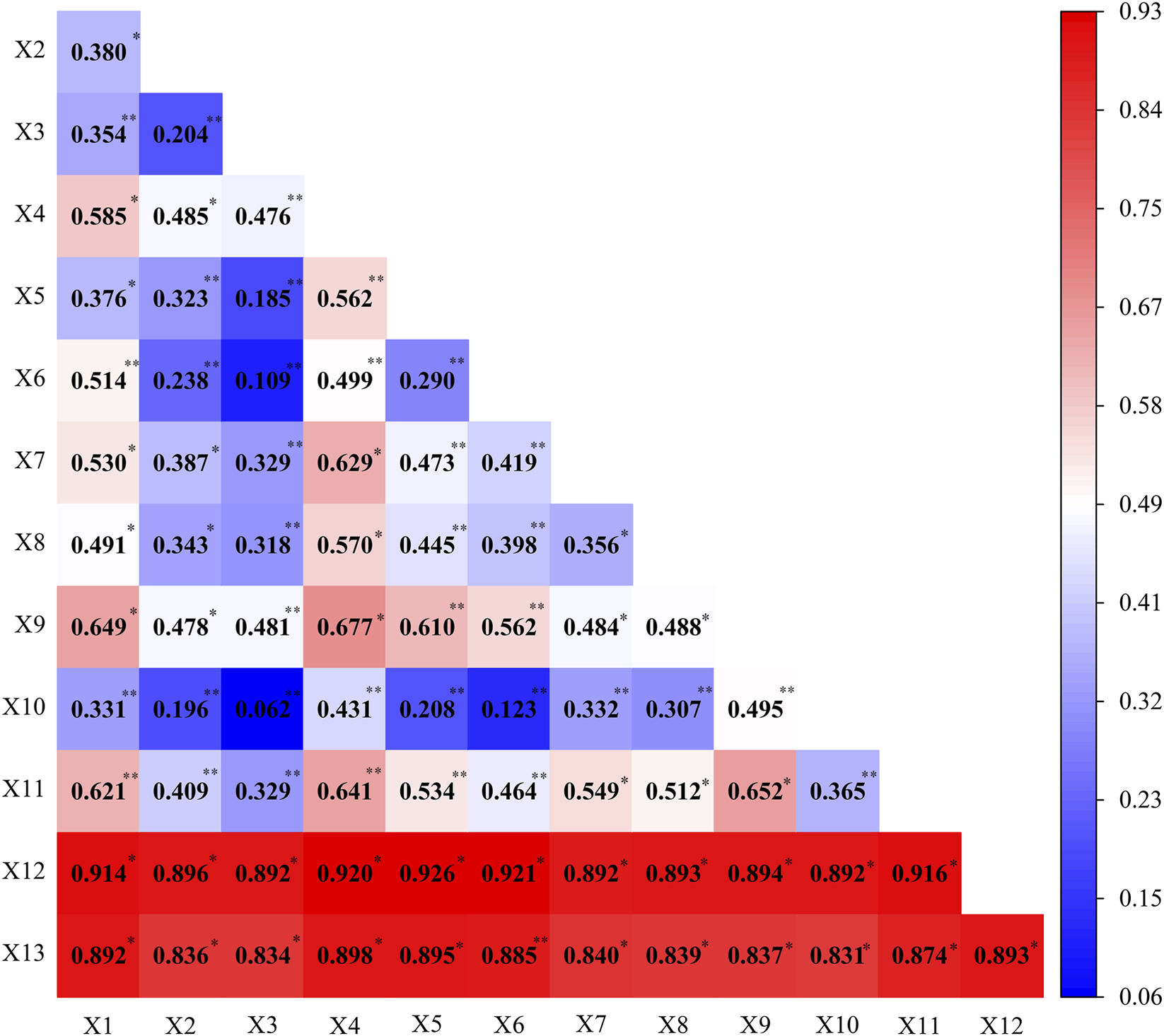
Interaction results of the influencing factors. Note: Colors and values in the legend indicate the magnitude of interaction values between factors. The larger the value (the closer to red), the lager the interaction value. Different numbers of “*” represent the types of interactions between factors. “*” indicates bivariate enhance, while “**” denotes nonlinear enhance.
4 Discussion
4.1 Analysis of the spatial distribution pattern of ICH in Shanxi Province
The research findings indicate that the ICH of Shanxi exhibits a significant clustering distribution, which is closely related to its profound historical and cultural heritage. As one of the important cradles of Chinese civilization, Shanxi Province has nurtured a rich variety of cultural forms over the long course of history (Min, 2024). These cultures have gradually formed a clustering effect in geographical space. For example, Central Shanxi, as an important commercial and cultural center during the Ming and Qing dynasties, has provided fertile ground for the emergence and transmission of ICH due to its prosperous economy and active commercial activities, forming a high-density core cluster. Meanwhile, places like Yuncheng and Linfen, due to the long-term stable development of agrarian civilization, have preserved a large number of ICHs associated with folk festivals, forming prominent clusters. The formation of this spatial distribution pattern not only reflects the impact of natural geographic environments on human activities but also results from the combined effects of social and economic development and historical and cultural inheritance.
4.2 Comprehensive discussion on the influencing factors of ICH in Shanxi Province
Natural geographical factors have a certain impact on the distribution of ICH in Shanxi Province (Ping and Min, 2020). The explanatory power of altitude and annual average precipitation is relatively high, possibly because different altitudes and rainfall conditions shape diverse natural environments, which in turn influence human production and lifestyle as well as cultural creation. For example, the terrain in mountainous areas may encourage local residents to develop unique mountain cultures, including traditional skills and folk legends related to mountain production; while regions with abundant rainfall are conducive to agricultural development, thus giving rise to ICHs closely linked to agricultural activities, such as festival cultures.
In socioeconomic factors, indicators such as urbanization levels and regional GDP significantly influence the distribution of ICH (Xiaoyu et al., 2025). Higher levels of urbanization often mean more concentrated populations and resource aggregation, providing more opportunities and platforms for the inheritance and development of ICH. For example, abundant cultural facilities, educational institutions, and various cultural exchange activities in cities facilitate the dissemination and promotion of ICH, leading to its clustering in surrounding areas. At the same time, regions with higher economic development can offer greater financial support and policy guarantees, promoting the protection and inheritance of ICH.
Cultural environmental factors are key determinants of the distribution of ICH in Shanxi Province (Xue, 2025). The explanatory power of cultural institutions and educational levels is the strongest, highlighting the critical position of cultural atmosphere and educational environment in the inheritance of ICH. Cultural institutions such as museums and art galleries are not only venues for the display and preservation of ICH but also important platforms for cultural transmission and exchange. Improved educational standards help cultivate interest in traditional culture and protect consciousness, ensuring that ICH can be passed down and promoted through the education system (Si, 2025). Additionally, historic towns and villages provide significant spatial carriers for the inheritance of ICH. These places preserve a large number of historical buildings and traditional customs, creating a unique cultural ecological environment that supports the survival and development of ICH.
The study also found that there are complex interrelationships among the influencing factors. The distribution of ICH is the result of the combined effects of natural support, socio-economic evolution, and cultural ecological construction. Among these, cultural environmental factors are the core driving force, socio-economic factors provide basic guarantees, and natural conditions construct cultural spaces. These three elements work together to shape the regional distribution pattern of ICH in Shanxi Province.
4.3 Toward sustainable cultural heritage conservation in Shanxi Province
The study delves into the spatial distribution patterns of ICH in Shanxi Province and examines the underlying influencing factors, providing a solid scientific basis for developing more refined conservation and inheritance strategies. The results indicate the need for differentiated protection approaches that align with the principles of sustainable development and the pursuit of harmonious coexistence between humans and the environment. In the future, targeted strategies should be formulated according to the specific types of ICH, their spatial characteristics, and the socio-environmental factors shaping their distribution, while efforts should also be directed toward strengthening cultural institution construction, improving educational and training systems for ICH bearers, and enhancing public awareness. Promoting the integration of culture and tourism—through experiential, immersive, and regionally distinctive cultural products—can further stimulate the vitality of ICH resources and support their sustainable transmission. Additionally, deeply exploring the contemporary value embedded in Yellow River culture and other cultural elements can enrich the cultural connotations and modern expression paths of ICH, thereby contributing not only to the long-term inheritance and innovative development of Shanxi’s cultural heritage but also to the broader creative transformation of China’s excellent traditional culture.
5 Conclusion
Based on the spatial analysis of 1,178 ICH items across 11 municipal-level cities in Shanxi Province, this study provides a comprehensive understanding of the regional differentiation, driving mechanisms, and interaction patterns of ICH distribution. The main findings can be summarized as follows.
Shanxi’s ICH exhibits a pronounced clustered distribution, forming an overall spatial structure characterized by “four cores and two belts”. High-density areas are mainly concentrated in the central region, with significant agglomeration in the southern part of the province, while the northern region presents a relatively scattered pattern. This spatial structure reflects the long-term accumulation of historical cultural resources and the differentiation of cultural ecological foundations across regions.
Clear spatial heterogeneity is identified across ICH categories. Folklore and traditional music, which rely heavily on cultural inheritance systems and localized ethnic traditions, are concentrated in the southern and central regions where historical settlements and ritual traditions are well-preserved. Traditional sports, recreation, and acrobatics form a distinctive cluster at the border of Taiyuan and Jinzhong, while traditional dance is widely distributed across the province with notable clusters in Jincheng and the Linfen–Yuncheng border area. Traditional medicine resources, benefiting from medical institutions and knowledge transmission networks, are mainly concentrated in Taiyuan and its surrounding municipalities. These patterns reveal the differentiated cultural landscapes shaped by ecological environments, and socio-cultural foundations.
The analysis shows that cultural environmental factors exert the strongest influence on the spatial distribution of ICH. Variables such as the density of cultural institutions, educational level, and cultural activity systems serve as key drivers. Socioeconomic factors (e.g., economic development, population size, and urbanization) play a secondary yet essential role by shaping the demand, accessibility, and institutional support for cultural heritage. Natural geographic factors have a relatively weaker direct impact but influence ICH distribution indirectly through their interactions with cultural and socioeconomic variables.
The identified interaction effects highlight the complexity of ICH formation mechanisms. For example, the enhancement effect between cultural institutions and educational level, as well as between natural geographic conditions, suggests that heritage clusters result from the synergy of cultural ecological construction, social and economic evolution, and natural environmental support. The interaction between urbanization and economic development with cultural institutions further indicates that ICH distribution is not shaped by single factors, but by multi-dimensional, dynamic processes embedded in both historical and contemporary contexts.
Overall, the findings enrich the understanding of regional cultural systems and provide empirical insights for ICH protection planning. They demonstrate that conserving ICH resources requires integrated strategies that consider cultural ecology, socioeconomic development, and environmental contexts.
6 Limitations
This study primarily relies on quantitative analysis and lacks sufficient exploration of qualitative information, such as the humanistic historical narratives behind ICH, the oral histories of bearers, and community-level cultural perceptions. Such qualitative insights are essential for deepening the understanding of cultural connotations, transmission mechanisms, and interactions between ICH and local communities. For instance, the origins, evolution, and emotional identification associated with certain traditional festivals cannot be fully captured through quantitative data alone.
Although the study integrates multiple influencing factors—including natural geography, socioeconomic conditions, and cultural environment—other important dynamic factors may also shape the spatial distribution of ICH but were not fully examined. Changes in government policies, fluctuations in cultural market demand, and the expanding role of digital and new-media dissemination can all influence the inheritance and development of ICH to varying degrees. Future studies should incorporate these modern and rapidly evolving variables to construct a more comprehensive explanatory framework.
The GIS techniques applied in this study do not fully capture the complex spatiotemporal evolution or nonlinear characteristics of ICH. Due to data limitations, the research does not incorporate diachronic or multi-period comparative analysis, which restricts the understanding of long-term dynamics. Future research should integrate historical-stage datasets, adopt spatiotemporal modeling approaches, and identify key turning points and drivers in the evolution of ICH distribution to provide scientific support for dynamic protection and sustainable transmission.
In addition, the present analysis focuses solely on Shanxi Province, without incorporating cross-regional comparisons with other provinces or cultural regions. Such comparative research would help determine whether the spatial patterns identified in Shanxi are region-specific or reflective of broader national trends. Conducting cross-regional analyses could reveal heterogeneity caused by variations in historical development, cultural ecology, and policy environments, thereby enhancing the generalizability and benchmarking value of the findings.
Future research should therefore integrate mixed-method approaches, combining spatial analysis with fieldwork, interviews, and historical documentation to provide a more holistic interpretation of ICH formation mechanisms. Incorporating dynamic data and exploring temporal changes will help deepen the understanding of cultural resilience and policy effectiveness in heritage protection.
Statements
Data availability statement
The raw data supporting the conclusions of this article will be made available by the authors, without undue reservation.
Author contributions
LZ: Conceptualization, Data curation, Investigation, Project administration, Writing – original draft. ML: Formal Analysis, Funding acquisition, Investigation, Methodology, Software, Validation, Writing – original draft. SZ: Formal Analysis, Resources, Supervision, Visualization, Writing – review and editing. XY: Project administration, Resources, Supervision, Validation, Visualization, Writing – review and editing.
Funding
The author(s) declared that financial support was not received for this work and/or its publication.
Conflict of interest
The author(s) declared that this work was conducted in the absence of any commercial or financial relationships that could be construed as a potential conflict of interest.
Generative AI statement
The author(s) declared that generative AI was not used in the creation of this manuscript.
Any alternative text (alt text) provided alongside figures in this article has been generated by Frontiers with the support of artificial intelligence and reasonable efforts have been made to ensure accuracy, including review by the authors wherever possible. If you identify any issues, please contact us.
Publisher’s note
All claims expressed in this article are solely those of the authors and do not necessarily represent those of their affiliated organizations, or those of the publisher, the editors and the reviewers. Any product that may be evaluated in this article, or claim that may be made by its manufacturer, is not guaranteed or endorsed by the publisher.
Abbreviations
ICH, Intangible cultural heritage; GIS, Geographic information system; GDP, Gross Domestic Product; POI, Point of Interest; NNI, Nearest Neighbor Index; KDE, Kernel Density Estimation Method.
References
1
Chen Z. Y. (2022). Visualizing experiencescape - from the art of intangible cultural heritage. Curr. Issues Tour.25 (4), 559–578. 10.1080/13683500.2021.1892040
2
Cui J. H. Fu L. M. (2023). Multimedia display of wushu intangible cultural heritage based on interactive system and artificial intelligence. Soft Comput. 10.1007/s00500-023-08481-6
3
Cui Y. Y. Wang Y. J. Jiang J. S. (2024). Sustainable development of China's intangible cultural heritage in rural revitalization based on experience perspective. Probl. Ekorozwoju19 (2), 265–271. 10.35784/preko.5809
4
DeSoucey M. Elliott M. A. Schmutz V. (2019). Rationalized authenticity and the transnational spread of intangible cultural heritage. Poetics75, 101332. 10.1016/j.poetic.2018.11.001
5
Escorihuela M. B. Barado S. I. Solé-Llussà A. Jové A. F. (2025). Intangible cultural heritage and education: analysis of the UNESCO safeguarding good practices register. Rev. De. Educ.407, 167–191. 10.4438/1988-592x-re-2025-407-655
6
Fan Q. (2024). Research on intangible cultural heritage resource description and knowledge fusion based on linked data. Electron. Libr.42 (4), 521–535. 10.1108/el-01-2023-0018
7
Feng Y. Wei H. Huang Y. Li J. Mu Z. Kong D. (2023). Spatiotemporal evolution characteristics and influencing factors of traditional villages: the yellow river basin in Henan Province, China. Herit. Sci.11 (1), 97. 10.1186/s40494-023-00939-y
8
Gao Y. Li M. M. Li Q. N. Huang K. J. Shen S. W. (2022). Inheritors' happiness and its relevant factors in intangible cultural heritage. Sustainability14 (21), 14084. 10.3390/su142114084
9
Gwerevende S. Mthombeni Z. M. (2023). Safeguarding intangible cultural heritage: exploring the synergies in the transmission of Indigenous languages, dance and music practices in Southern Africa. Int. J. Herit. Stud.29 (5), 398–412. 10.1080/13527258.2023.2193902
10
Han Q. L. Tao F. Hong Z. H. Qin G. H. Wei Y. X. Chen Y. Z. et al (2024). Research on the spatiotemporal distribution and factors influencing intangible cultural heritage in Fujian province from a multiscale perspective. Herit. Sci.12 (1), 239. 10.1186/s40494-024-01359-2
11
He C. Liang Y. W. Zhang S. Y. (2024). A study on the spatial structures and mechanisms of intangible cultural heritage and traditional villages in the Dongting Lake basin. Buildings14 (6), 1736. 10.3390/buildings14061736
12
Hou Y. M. Kenderdine S. Picca D. Egloff M. Adamou A. (2022). Digitizing intangible cultural heritage embodied: state of the art. Acm J. Comput. Cult. Herit.15 (3), 20. 10.1145/3494837
13
Luo Y. (2021). Safeguarding intangible heritage through edutainment in China's creative urban environments. Int. J. Herit. Stud.27 (2), 170–185. 10.1080/13527258.2020.1780463
14
Melis C. Chambers D. (2021). The construction of intangible cultural heritage: a Foucauldian critique. Ann. Tour. Res.89, 103206. 10.1016/j.annals.2021.103206
15
Min G. (2024). Research on the protection and inheritance strategies of intangible cultural heritage in historical and cultural districts: a case study of Shanxi province. Cult. Mon. (12), 35–37.
16
Naguib S. A. (2013). Museums, diasporas and the sustainability of intangible cultural heritage. Sustainability5 (5), 2178–2190. 10.3390/su5052178
17
Pang L. Wu L. A. (2023). Distribution characteristics and influencing factors of intangible cultural heritage in beijing-tianjin-hebei. Herit. Sci.11 (1), 19. 10.1186/s40494-023-00862-2
18
Ping W. Min L. (2020). Spatial traces of geographical elements in the inheritance of traditional intangible culture: a case study of intangible cultural heritage in Shanxi Province. Geogr. Res.39 (8), 1807–1821. 10.11821/dlyj020191072
19
Qiu Q. H. Liang X. M. Zuo Y. F. (2023). Identifying European and Chinese styles of creating tourist destinations with intangible cultural heritage: a comparative perspective. Int. J. Tour. Res.25 (2), 266–278. 10.1002/jtr.2567
20
Shen W. Chen Y. Cao W. Yu R. Rong P. Cheng J. (2024). Spatial pattern and its influencing factors of national-level cultural heritage in China. Herit. Sci.12 (1), 384. 10.1186/s40494-024-01508-7
21
Si J. Y. (2025). Exploration of integrating intangible cultural Heritage lntoTalent cultivation practice in vocational Colleges-A CaseStudy of lntangible cultural Heritage in Shanxi province. J. Jincheng Inst. Technol.18 (3), 17–22.
22
Skublewska-Paszkowska M. Milosz M. Powroznik P. Lukasik E. (2022). 3D technologies for intangible cultural heritage preservation-literature review for selected databases. Herit. Sci.10 (1), 3. 10.1186/s40494-021-00633-x
23
Song Y. Wang J. Ge Y. Xu C. (2020). An optimal parameters-based geographical detector model enhances geographic characteristics of explanatory variables for spatial heterogeneity analysis: cases with different types of spatial data. Giscience & Remote Sens.57 (5), 593–610. 10.1080/15481603.2020.1760434
24
Su J. J. (2018). Conceptualising the subjective authenticity of intangible cultural heritage. Int. J. Herit. Stud.24 (9), 919–937. 10.1080/13527258.2018.1428662
25
UNESCO (2003). Convention for the safeguarding of the intangible cultural heritage. Available online at: https://unesdoc.unesco.org/ark:/48223/pf0000132540 (Accessed February 13, 2025).
26
Valjarević A. (2025). GIS and remote sensing methods in predicting the dissipation time of rural settlements under the influence of climate change in the Republic of Serbia. J. Urban Manag.14 (2), 500–511. 10.1016/j.jum.2024.12.002
27
Vecco M. (2010). A definition of cultural heritage: from the tangible to the intangible. J. Cult. Herit.11 (3), 321–324. 10.1016/j.culher.2010.01.006
28
Vondolia G. K. Kusi A. M. King S. R. Navrud S. (2022). Valuing intangible cultural heritage in developing countries. Sustainability14 (8), 4484. 10.3390/su14084484
29
Wang C. Y. (2019). Building a network for preserving intangible cultural heritage through education: a study of Indonesian batik. Int. J. Art & Des. Educ.38 (2), 398–415. 10.1111/jade.12200
30
Wang J. Xu C. (2017). Geodetector: principle and prospective. Acta Geogr. Sin.72 (1), 116–134.
31
Wang J. C. Chen M. Zhang H. Y. Ye F. (2023). Intangible cultural heritage in the yangtze river basin: its spatial distribution characteristics and influencing factors. Sustainability15 (10), 7960. 10.3390/su15107960
32
Xia R. Genovese P. V. Li Z. Zhao Y. (2024). Analyzing spatiotemporal features of Suzhou's old canal city: an optimized composite space syntax model based on multifaceted historical-modern data. Herit. Sci.12 (1), 391. 10.1186/s40494-024-01499-5
33
Xiao J. H. Wu Y. H. Wang M. Zhao Y. Z. (2023). Using choice experiments to assess tourist values for intangible cultural heritage-the case of changdao fishermen?s work song in China. J. Cult. Herit.60, 50–62. 10.1016/j.culher.2023.01.008
34
Xiaoyu W. Shan W. Huan Y. Si J. Yi L. Xia P. (2025). Spatial relationship between traditional villages and intangiblecultural heritage sites and the influencing factors: case study inshanxi-shaanxi-lnner Mongolia region. J. Arid Land Resour. Environ.39 (4), 189–198. 10.13448/j.cnki.jalre.2025.073
35
Xue Y. (2025). Research on the development of cultural and creative products in Shanxi under the background of cultural and tourism integration: taking “Jin Li” as an example. J. Jinzhong Univ.42 (5), 60–66.
36
Xue K. Li Y. F. Meng X. X. (2019). An evaluation model to assess the communication effects of intangible cultural heritage. J. Cult. Herit.40, 124–132. 10.1016/j.culher.2019.05.021
37
Yan W. J. Chiou S. C. (2021). The safeguarding of intangible cultural heritage from the perspective of civic participation: the informal education of Chinese embroidery handicrafts. Sustainability13 (9), 4958. 10.3390/su13094958
38
Yan W. J. Li K. R. (2023). Sustainable cultural innovation practice: heritage education in universities and creative inheritance of intangible cultural heritage craft. Sustainability15 (2), 1194. 10.3390/su15021194
39
Yuan S. Mu N. Bai J. Zhang H. (2024). Spatial heterogeneity analysis on distribution patterns and underlying determinants of historical rural settlements: a case study in taihang baxing. Herit. Sci.12 (1), 395. 10.1186/s40494-024-01486-w
40
Zhang H. Y. (2024). Recognising menhu as a community within wushu intangible cultural Heritage. Int. J. Herit. Stud.30 (1), 28–41. 10.1080/13527258.2023.2281769
41
Zhang Y. Lee T. J. (2022). Alienation and authenticity in intangible cultural heritage tourism production. Int. J. Tour. Res.24 (1), 18–32. 10.1002/jtr.2478
42
Zhang W. Ran H. (2024). Research on the driving mechanism of tourists' ecological protection behavior in intangible cultural heritage sites. Front. Psychol.15, 1514482. 10.3389/fpsyg.2024.1514482
43
Zhang Z. W. Li Q. Hu S. X. (2022). Intangible cultural Heritage in the yellow river basin: its spatial-temporal distribution characteristics and differentiation causes. Sustainability14 (17), 11073. 10.3390/su141711073
44
Zhang S. Zhang X. Liu J. (2024). Spatial distribution and pedigree age of intangible cultural heritage along the grand canal of China. Herit. Sci.12 (1), 246. 10.1186/s40494-024-01357-4
45
Zhang Z. W. Cui Z. Fan T. S. Ruan S. Y. Wu J. M. (2024). Spatial distribution of intangible cultural heritage resources in China and its influencing factors. Sci. Rep.14 (1), 4960. 10.1038/s41598-024-55454-2
Summary
Keywords
geographic information system, influencing factors, intangible cultural heritage, kernel density estimation, Shanxi Province, spatial distribution
Citation
Zhao L, Liu M, Zhang S and Yan X (2026) Spatial distribution characteristics and influencing factors of intangible cultural heritage in Shanxi Province, China. Front. Earth Sci. 13:1632434. doi: 10.3389/feart.2025.1632434
Received
21 May 2025
Revised
02 December 2025
Accepted
09 December 2025
Published
05 January 2026
Volume
13 - 2025
Edited by
Aleksandar Valjarević, University of Belgrade, Serbia
Reviewed by
Vladyslav Zakharovskyi, Massey University, New Zealand
Dragica Živković, University of Belgrade, Serbia
Updates
Copyright
© 2026 Zhao, Liu, Zhang and Yan.
This is an open-access article distributed under the terms of the Creative Commons Attribution License (CC BY). The use, distribution or reproduction in other forums is permitted, provided the original author(s) and the copyright owner(s) are credited and that the original publication in this journal is cited, in accordance with accepted academic practice. No use, distribution or reproduction is permitted which does not comply with these terms.
*Correspondence: Min Liu, lium@sxu.edu.cn
Disclaimer
All claims expressed in this article are solely those of the authors and do not necessarily represent those of their affiliated organizations, or those of the publisher, the editors and the reviewers. Any product that may be evaluated in this article or claim that may be made by its manufacturer is not guaranteed or endorsed by the publisher.