 Andrew J. Constable
 Jess Melbourne-Thomas
 Monica M. C. Muelbert
 Anne B. Hollowed
- 1Centre for Marine Socioecology, University of Tasmania, Hobart, TAS, Australia
- 2CSIRO Environment, Hobart, TAS, Australia
- 3Instituto de Oceanografia, Universidade Federal do Rio Grande, Rio Grande, Brazil
- 4College of the Environment, School of Aquatic and Fisheries Sciences, University of Washington, Seattle, WA, United States
Editorial on the Research Topic
Marine Ecosystem Assessment for the Southern Ocean: meeting the challenge for conserving earth ecosystems in the long term
Introduction and rationale
Southern Ocean ecosystems are unique, diverse, and globally valued (Stoeckl et al., 2024, Murphy et al., Roberts et al.) but are also very vulnerable to climate-driven habitat changes (Swadling et al., Cavanagh et al., Pinkerton et al., Morley et al.) and to other human impacts (Grant et al.). Indeed, recent years have seen rapid and dramatic changes, particularly in Antarctic sea ice environments (Purich and Doddridge, 2023), with implications for species and marine ecosystems. Managers of Southern Ocean ecosystems, together with national and international research agencies, need robust and regular assessments of the status and change of these systems in order to protect ecosystem services, to identify options for mitigating impacts, and to understand the likelihood of different future trajectories for these systems (Constable et al., 2014; Press). Regular assessments facilitate the setting and review of priority research activities to enhance future assessments and to provide science directed towards the needs of policy makers.
Our Research Topic Marine Ecosystem Assessment for the Southern Ocean: Meeting the Challenge for Conserving Earth Ecosystems in the Long Term addresses this need by providing the first circumpolar interdisciplinary assessment of Southern Ocean ecosystem status and trends. This first Marine Ecosystem Assessment for the Southern Ocean (MEASO) has been a core activity of Integrating Climate and Ecosystem Dynamics in the Southern Ocean (ICED; https://www.iced.ac.uk/). ICED is a regional program of Integrated Marine Biosphere Research (IMBeR, a joint program of the Scientific Committee on Oceanic Research [SCOR] and Future Earth), and co-sponsored by the Scientific Committee on Antarctic Research (SCAR). MEASO was also supported by the Southern Ocean Observing System (SOOS), a joint program of SCAR and SCOR.
MEASO was a five-year inclusive international program, modelled on a working group of the Intergovernmental Panel on Climate Change (IPCC). It involved 203 scientists from across the Antarctic and Southern Ocean scientific community (19 countries, 51% female, 30% early career), contributing to 24 research articles published in this Research Topic.
Development of the first Marine Ecosystem Assessment for the Southern Ocean
MEASO has been a bridge across many science communities (Constable et al., 2014) including: working groups of the Commission for the Conservation of Antarctic Marine Living Resources (CCAMLR), SCAR and its science groups, the global program of IMBeR in which ICED is the regional Antarctic program, SCOR and the SOOS, and many different groups within the IPCC and Intergovernmental Panel on Biodiversity and Ecosystem Services (IPBES). It was formally initiated in 2018 at an International Conference in Hobart, Australia which included a one-day Policy Forum for framing the policy objectives of the assessment. A planning workshop to progress the first MEASO was held in Woking in the United Kingdom in 2019. At this workshop, MEASO participants agreed: to a systematic and integrated ecological, sociological, and policy framework for considering Southern Ocean ecosystems and supporting management advice (Figure 1A); to identify ecoregions that capture variation in ecosystem attributes around the Southern Ocean including their physical and topographical differences (Figure 1B); and to use these areas and frameworks to enable assessments of dynamics and change at ecologically relevant spatial scales within those areas.
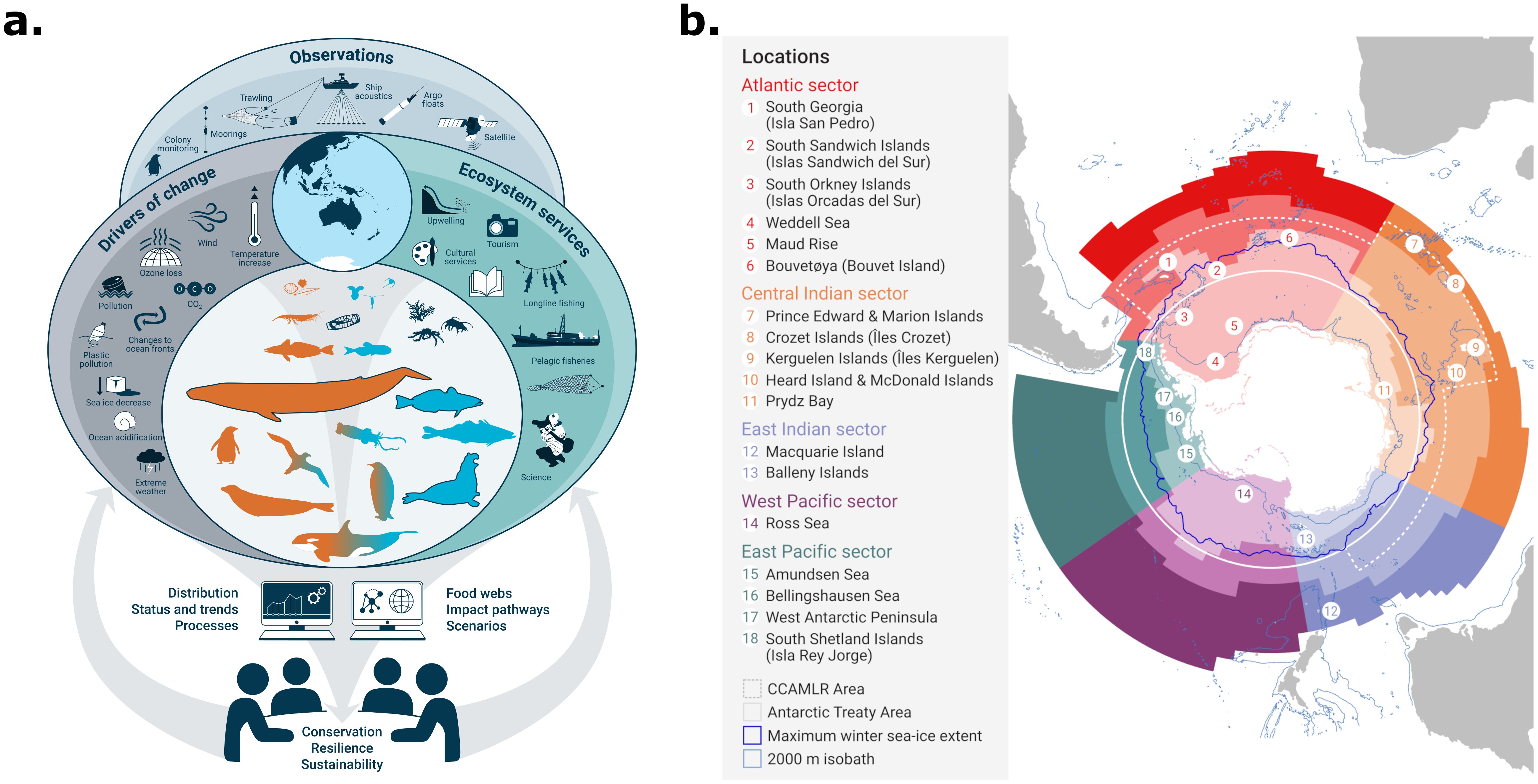
Figure 1. Systematic and integrated approach to the first Marine Ecosystem Assessment for the Southern Ocean. (A) Diagram showing the scope of MEASO (from Constable et al., 2023) – status and trends for habitats (drivers of habitat change shown as icons on the left), species and food webs (central icons with colours denoting the two main pathways of energy flow through krill in orange and through fish in blue; species icons with both colours are part of both pathways; icons with solid outlines show species recovering from past exploitation, including blue whales, groundfish and seals), and ecosystem services (icons on the right). Example observation platforms delivering data to underpin assessments are shown at the top. The assessment and modelling process is shown at the bottom, which in turn informs decision-making for conservation, resilience and sustainability. Decisions impact on the trajectories of drivers and the ecosystem (arrows looping back up to the central ellipse). (B) MEASO assessment areas formed from 5 meridional sectors (Atlantic, Central Indian, East Indian, West Pacific, and East Pacific) and 3 zones (Antarctic – extending from the coast to the Southern Antarctic Circumpolar Current Front [SACCF], Subantarctic extending from SACCF to the Subantarctic Front [SAF], Northern extending from SAF to the Subtropical Front). (adapted from McCormack et al.).
MEASO areas were intended to reflect regions within which the dynamics of sea ice, ocean and benthic habitats remained similar across the region, from east to west. Connectivity arising from the large-scale currents and gyres makes it difficult to define more-or-less isolated marine regions. While the MEASO areas are similar to existing areas designed for particular disciplines and for management of fisheries in CCAMLR, they do not match because of the intention in MEASO to reflect ecological and ecosystem properties (i.e., across many disciplines) within an area. For this reason, they are often larger than areas designed to coordinate field research activities across nations operating in a given area, such as those adopted by the Southern Ocean Observing System (https://www.soos.aq/activities/rwg).
The activities and outputs of MEASO have been guided by an International Steering Committee and supported by research support staff (see Table 1). Information and knowledge synthesis and management for MEASO was undertaken through the Southern Ocean Knowledge and Information wiki (SOKI).
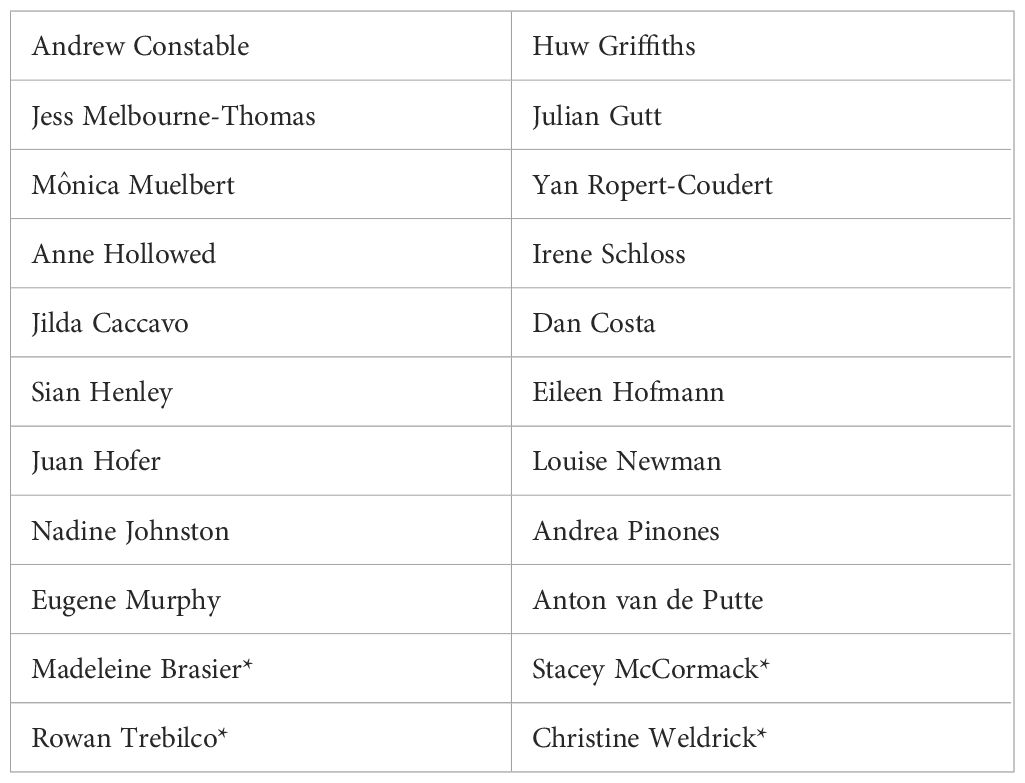
Table 1. Steering committee members and research support(*).
Framing and delivery of findings
The aim of the MEASO Steering Committee was to not only deliver a synthesis of the science (background, general understanding, the assessment of status, change and causes, and future science priorities) but also to make it accessible to non-scientists, including summaries for policymakers. Each of the papers in the MEASO Research Topic includes a summary infographic, designed by Stacey McCormack of VisualKnowledge, with a consistent theme and style. This Research Topic achieved its goal of providing a set of papers on all aspects of the integrated approach of Figure 1A.
Important context for this assessment was provided on the role of Southern Ocean ecosystems in the global system (Murphy et al.) and the provision of data underpinning the current and future assessments (van de Putte et al.; Bonnet-Lebrun et al.). Core assessments of status and change included: habitats (driven by global drivers – Morley et al.), biogeochemistry (Henley et al.) and primary productivity (Pinkerton et al.); several species groups (benthos – Brasier et al., krill and zooplankton – Johnston et al., fish and squid – Caccavo et al., marine mammals and birds – Bestley et al.); the sea ice system (Swadling et al.); and food webs generally (McCormack et al.). These were supplemented by contributions on subsurface chlorophyll maxima (Baldry et al.) and control of phytoplankton blooms (Kauko et al.), impacts of ocean acidification on marine calcifiers (Figuerola et al.), and food web effects of seamounts (Sergi et al.).
For policy- and decision-makers, core assessments evaluated historical and current pressures on the ecosystem from human activities in the region (local drivers – Grant et al.), global and local pressures on ecosystem services more generally (Cavanagh et al.), and pathways of influence and types of stakeholder engagement to manage for ecosystem services (Solomonsz et al.). These assessments were supplemented by outcomes from the MEASO conference and its Policy Forum on the importance of the interaction between science and policy (Press). Authors considered the great potential for cultural arts practices to enable enduring evidence-based policy in the region (Roberts et al.), and elaborated a framework, adopted by the Scientific Committee of CCAMLR, to assess spatial risks to ecosystems from krill fisheries (Constable et al.) and its implementation (Warwick-Evans et al.). Lastly, early career researchers developed their perspectives and strategies for ensuring future robust marine ecosystem science in the Southern Ocean (Brasier et al.).
A MEASO summary for policymakers (Constable et al., 2023) was developed by members of the Steering Committee and the lead authors of the core papers as a synthesis of key findings from papers in the Research Topic, in plain language and developed for policy- and decision-makers in managing Southern Ocean ecosystems. Assessment statements in the summary for policymakers are assigned confidence levels (as per the IPCC reporting process) and cross-referenced to the original source in the Research Topic. Infographics from the original papers were adapted and presented as part of the summary for policymakers. The text of the key findings is being translated to increase accessibility (https://soos.aq/partnerships/measo-2023/measo-2023-translations; at time of publication this included Dutch, French, Portuguese and Spanish).
Key messages
Key messages from the MEASO Research Topic and the summary for policymakers are:
● Southern Ocean ecosystems are an integral part of the Earth System, including being valued highly by people in many parts of the world.
● Changes in Southern Ocean ecosystems will impact ecosystem services, including cultural services, and have impacts throughout the world’s oceans and climate system, and vice versa.
● Southern Ocean ecosystems are being impacted now by climate change. Moreover, sufficient evidence and tools are available for designing strategies to safeguard these ecosystems and to facilitate their resilience to future climate change and ocean acidification.
● Long-term maintenance of Southern Ocean ecosystems, particularly polar-adapted Antarctic species and coastal systems, can only be achieved by urgent global action to curb climate change and ocean acidification.
Meeting the challenge into the future
MEASO and the outcomes of this Research Topic provide an integrated framework, including a spatial partition at ecologically relevant scales, for assessing long term trends of Southern Ocean ecosystems. Regular updates and syntheses of status and prognoses for the future are needed for adjusting management strategies and, particularly, for providing advice globally on the future of this important region. Thus, their regularity would best align with, at least, the assessment review cycles of the IPCC. The outcomes of this first MEASO shows that a timely second assessment could be achieved by 2028, drawing on the research from the UN Decade of the Oceans and integrating new initiatives in science, policy, management, and civil society.
While knowledge of physical and chemical systems is well advanced in the Southern Ocean, studies of the implications of physical-chemical change on ecological systems needs to be substantially enhanced to have equivalent coverage across all MEASO areas and to satisfy the global demand for prognoses for ecosystems as a whole, from protists to top predators, in this era of rapidly changing environments. This can be readily achieved by investing in (i) sustained, year-round and ocean-wide scientific monitoring and assessment of the health of these biological systems, and (ii) developing coupled bio-physical, end-to-end models of Southern Ocean ecosystems suitable for assessing what future habitat changes and human impacts will mean to different ecosystems, communities and species.
Author contributions
AC: Conceptualization, Project administration, Writing – original draft, Writing – review & editing. JM: Conceptualization, Project administration, Writing – original draft, Writing – review & editing. MM: Conceptualization, Project administration, Writing – original draft, Writing – review & editing. AH: Conceptualization, Project administration, Writing – original draft, Writing – review & editing.
Conflict of interest
The authors declare that the research was conducted in the absence of any commercial or financial relationships that could be construed as a potential conflict of interest.
Publisher’s note
All claims expressed in this article are solely those of the authors and do not necessarily represent those of their affiliated organizations, or those of the publisher, the editors and the reviewers. Any product that may be evaluated in this article, or claim that may be made by its manufacturer, is not guaranteed or endorsed by the publisher.
References
Constable A., Costa D., Murphy E., Hofmann E., Schofield O., Press A., et al. (2014). “Assessing status and change in Southern Ocean ecosystems,” in Biogeographic Atlas of the Southern Ocean. Eds. Broyer C., Koubbi P. K., Griffiths H. J., Raymond B., D’udekem D’acoz C., Van De Putte A., Danis B., David B., Grant S., Gutt J., Held C., Hosie G., Huettmann F., Post A., Ropert-Coudert Y. (Scientific Committee on Antarctic Research, Cambridge UK), 404–407.
Constable A., Melbourne-Thomas J., Muelbert M., Mccormack S., Brasier M., Caccavo J., et al. (2023). Marine Ecosystem Assessment for the Southern Ocean: Summary for Policymakers (Hobart: SCAR, SCOR, IMBeR). doi: 10.5281/zenodo.8359585
Purich A., Doddridge E. W. (2023). Record low Antarctic sea ice coverage indicates a new sea ice state. Commun. Earth Environ. 4, 314. doi: 10.1038/s43247-023-00961-9
Keywords: Southern Ocean ecosystems, MEASO, ecosystem assessment, ecosystem-based management, climate change, Antarctic Treaty System, Antarctica
Citation: Constable AJ, Melbourne-Thomas J, Muelbert MMC and Hollowed AB (2024) Editorial: Marine Ecosystem Assessment for the Southern Ocean: meeting the challenge for conserving earth ecosystems in the long term. Front. Ecol. Evol. 12:1507045. doi: 10.3389/fevo.2024.1507045
Received: 07 October 2024; Accepted: 18 November 2024;
Published: 10 December 2024.
Edited and Reviewed by:
Mark A. Elgar, The University of Melbourne, AustraliaCopyright © 2024 Constable, Melbourne-Thomas, Muelbert and Hollowed. This is an open-access article distributed under the terms of the Creative Commons Attribution License (CC BY). The use, distribution or reproduction in other forums is permitted, provided the original author(s) and the copyright owner(s) are credited and that the original publication in this journal is cited, in accordance with accepted academic practice. No use, distribution or reproduction is permitted which does not comply with these terms.
*Correspondence: Andrew J. Constable, YS5jb25zdGFibGVAdXRhcy5lZHUuYXU=