 Yutao Wang
 Lars Olof Björn
- 1Key Laboratory of Ecology and Environmental Science in Guangdong Higher Education, School of Life Science, South China Normal University, Guangzhou, China
- 2Department of Biology, Molecular Cell Biology, Lund University, Lund, Sweden
Guangdong Province in China runs a risk of gradually increasing pollution of its agricultural land and, as a consequence, toxic agricultural products. We concentrate here on the situation for cadmium, copper, and lead. For these metals we describe the toxicology, the current pollution and its sources, and what can be done to improve the situation by cleaning the soil from pollutants, by choice of crops that allocate a minimum of the metals to edible parts, and by switching to non-food crops when other measures do not guarantee food safety.
Introduction
China has made outstanding economic progress since 1990, and the most developed of its provinces is Guangdong in the south-east. While air pollution is worst in northern China, the south is “leading” when it comes to pollution of agricultural soil. China cannot afford to abandon contaminated soil; she needs it for her growing population. Guangdong province alone has well over 100 million inhabitants and a mean population of about 600 inhabitants per km2, and it is heavily contaminated not only by heavy metals, but by virtually all organic substances produced by man: polycyclic biphenols, hormone disrupting compounds, antibiotics, pesticides, brominated flame retardants, and the like.
In this review we shall start by describing the properties and toxicologies of lead, cadmium, and copper, which are the most problematic heavy metals in Guangdong. We then describe their occurrence in agricultural soils and their accumulation in vegetation and food products, and we end by describing the strategies for coming to terms with the difficult situations we are facing today. The problems with air and water pollution have been reviewed by Zhang et al. (2010).
Toxicity Mechanisms
Cadmium Toxicity
The toxicity of cadmium is to a large extent due to its affinity for and replacement of the metal in sites in zinc proteins and in some other metal proteins, with impeded function as a result. While there are examples of functioning Cd-enzymes and of growth stimulation by Cd (Lane and Morel, 2000), in the overwhelming number of organisms the effect of Cd is deleterious.
Cd can displace Zn, Fe, and Mn from superoxide dismutase, reducing or eliminating its activity. This, in combination with its affinity for glutathione (Glusic et al., 2013), contributes to its ability to elicit oxidative stress. Cd can also displace Zn from zinc finger transcription factors, interfering with gene expression. The displacement of ionic cofactors from signaling proteins (e.g., calcium from calmodulin and zinc from transcription factors) modulates their ability to function correctly in signal transduction and transcriptional regulation. If Cd replaces Ca in calmodulin, there is interference with the intracellular level of the important signal transmitter, calcium. Cd can also interfere with microtubule dynamics (Ledda et al., 2013) and disrupt several pathways of hormonal signaling (Stasenko et al., 2010; Silva et al., 2012; Buha et al., 2013; Kluxen et al., 2013).
At the human organismal level, main risks with long-term Cd exposure are the initiation of cancer and kidney damage. Kippler et al. (2012) found that early-life low-level cadmium exposure was associated with lower child intelligence scores. Interactions between Cd and other molecules and ions, such as PCB (Buha et al., 2013) or zink (Jara and Aránguiz-Acuña, 2013), may lead to enhanced Cd toxicity.
Lead Toxicity
Lead, as Pb2+, has a tendency to bind to calcium and zinc binding sites in proteins and thereby disturb their functions (Jarzecki, 2007). One of the earliest molecular lead effects described is the inhibition of the enzyme 5-aminolevulinic dehydratase, leading to impaired porphyrin synthesis. Lowered activity of this enzyme has been used as an indicator of lead poisoning. More recently attention has turned toward effects on the nervous system and on the developing human brain in particular. The blood threshold level of Pb should be <10 μg/dL (Jarzecki, 2007), but that reflects only incidental (not chronic) exposure to lead (Rosin, 2009). Because of the similarity between the divalent lead and calcium ions, more than 90% of body lead is stored in bone. Attention is also turning more and more toward the long-term effects of low-level lead exposure; these include telomere instability (Pottier et al., 2009), and impaired cognitive function and behavior (Mansouri et al., 2013). Older information concerning lead toxicity is reviewed by Needleman (2004).
Lead poisoning has been common during specific historical periods. Most famous is the use by the classical Romans of lead in water pipes and food vessels, and their habit of spicing wine, fish sauce, etc. with “sapa” containing lead acetate (De Muynck et al., 2008), (but it is not likely that this was an important reason for the fall of the Roman Empire as has sometimes been claimed). The nobility of the Chinese Shang dynasty was likely heavily poisoned by rice wine etc. kept in lead-containing bronze containers (Woolf et al., 2010). During the Edo period in Japan, upper-class women used lead-containing cosmetics and poisoned not only themselves but their children (Nakashima et al., 2011). In recent times use of lead in solder for food cans, and of tetraethyl lead in gasoline from 1920 till 1970 has caused lead loading of whole populations. As lead in gasoline was phased out, average blood levels in the population were found in one study to fall from above 100 to below 10 μg/dL (Needleman, 2004).
Copper Toxicity
High concentrations of Cu in soil can have negative effects on microbial mediated soil processes (Wright and Welbourn, 2002).
In humans, copper, which is an essential nutrient, is unusual in that it causes acute toxicity with gastrointestinal symptoms at lower exposure levels than those that cause chronic toxicity (Seeley et al., 2013). Experiments with rats reveal that chronic intoxication with copper results in neurological effects and memory impairment (Pal et al., 2013). A mutation in the gene for a copper-transporting ATPase causes Wilson's disease, a kind of genetic copper intoxication even in the absence of excess copper intake (Tanzi et al., 1993). Use of copper in water pipes leads to copper in tap water, particularly in hot tap water.
When metal and metal oxides occur as very small particles, in the micrometer and nanometer ranges, new environmental dangers appear. Special attention has been given to widely produced silver nanoparticles (“nanosilver”) and copper. In vitro experiments with lung epithelial and red blood cells showed that nanoparticles of the Cu metal and the Cu-Zn alloy were both highly membrane damaging and caused a rapid increase in such damage at a particle mass dose of 20 μg/mL, whereas the CuO nanoparticles and the μm-sized Cu metal particles showed no such effect (Karlsson et al., 2013). At similar nanoparticle surface area doses, the nano and micron-sized Cu particles showed similar effects. Both Cu and Cu-Zn nanoparticles caused hemoglobin aggregation.
Sources and Distribution of Metal Pollution
Electronic Industry
Extensive electronic manufacturing is carried out in Guangdong, especially in the most developed Pearl River Delta (PRD) area, including the cities of Guangzhou, Shenzhen, Dongguan, Foshan, Huizhou, Zhongshan, Zhuhai, Jiangmen, and Zhaoqing. Large amounts of wastewater containing high levels of Cr, Zn, Cu, Pb, Ni, Cd are produced by numerous electroplate and electronic instrument factories in these areas. This wastewater is sometimes directly discharged into the surrounding environment without treatment (Wang et al., 2013 and field observation) and may sometimes be loaded into agricultural soils by its use for irrigation (Li et al., 2013; Wang et al., 2013). Cai et al. (2010, 2012) analyzed the source of heavy metal contamination in the agricultural soil of Dongguan and Huizhou and found that industrial activities are the main sources of Pb and Hg in the farmland of both areas. Uncontrolled electronic waste recycling/dismantling activities have also contributed to the input of heavy metals (Cd, Cu, Pb, Zn) to the agricultural lands, especially in Qingyuan and Shantou cities (Luo et al., 2011; Zheng et al., 2011). Huo et al. (2007) reported elevated blood lead levels in the children of Guiyu, an e-waste recycling area located in Shantou. A primitive e-waste processing facility in Longtang and Shijiao towns in Qingyuan has caused serious heavy metal pollution (Cd, Cu, Pb, and Zn) in local agricultural soils and vegetables (Luo et al., 2011; Liu et al., 2013a).
Mining and Smelting Activities
Mining and smelting activities take place in Guangdong, especially in the north and west regions (Qingyuan, Shaoguan), where several large-scale metal mines, including the Dabaoshan, Lechang, and Fankou mines, are located. Large areas of surrounding farmland have been heavily polluted by Cd, Pb, Cu, and Zn (Zhao et al., 2012; Tai et al., 2013; Zhuang et al., 2013). High concentrations of heavy metals have been reported in the agricultural products, including rice and vegetables, harvested in this area (Dong et al., 2011; Zhao et al., 2012). An ecologic investigation performed in the Dabaoshan mine area even revealed probable associations between long-term environmental exposure to Cd and Pb and an increased risk of cancer mortality (Wang et al., 2011a,b).
Agricultural Practices
Increased heavy metal accumulation induced by application of inorganic fertilizers (especially phosphate fertilizer) has been reported from many places (Cakmak et al., 2010; Nacke et al., 2013). This pollution is due to high levels of heavy metals in these commercial fertilizers (Atafar et al., 2010; Nacke et al., 2013). In Guangdong, most farmland soil belongs to the acidic red-soil type, with comparatively low nutrient (especially P) levels. Therefore, organic or inorganic fertilizers have been commonly applied to the farmland (Wong et al., 2002; Chang et al., 2014). According to the official data from the Chinese government, the annual application rate of inorganic fertilizers in Guangdong was over 400 kg ha−1 during 2008–2012, far higher than the world average. Although the content of toxic elements in most of the fertilizers in this area is generally lower than in those from the USA and European countries (Luo et al., 2009), the intensive application of inorganic fertilizer is an important cause of Guangdong farmland heavy metals. In addition, the huge annual applications of organic manure, the traditional agricultural fertilizer, could also cause elevated heavy metal concentrations in the environment (Liu et al., 2013b). Luo et al. (2009) proposed that in China, livestock manure accounts for more than half of the total Cd, Cu, and Zn inputs in agricultural soils. Chang et al. (2014) found that fertilizer application is the main source of heavy metals in leaf vegetables grown in the Pearl River Delta area.
In Guangdong large amounts of pesticides [especially organochlorine pesticides (Yu et al., 2013)] are commonly applied by farmers to guarantee the harvest and are deemed to be needed due to the suitability of the climate for growth of many agricultural pests. As some pesticides, such as the extensively used fungicide, Bordeaux mixture, usually contain high levels of toxic metal elements, pesticide application should not be ignored as an important source of heavy metals. Based on their field investigation Cai et al. (2010, 2012) analyzed the sources of heavy metal contamination in the agricultural soil of Dongguan and Huizhou and found that in both areas, such agricultural practices, as application of pesticides and fertilizers, contributed most to the input of Cd.
Atmospheric Deposition
Atmospheric deposition of trace elements, especially Pb, Cd, and Hg, is known to be an important cause of contamination in polluted areas (Douay et al., 2008). In Europe, atmospheric deposition is the main factor determining the accumulation of Cd and Pb in mosses (Holy et al., 2010). In China, Pb-containing gasoline has been prohibited since 2002; however, as the main accompanying element of Zn in mining, Pb is elevated in the atmospheric deposition in many areas (Luo et al., 2009). In addition, fossil fuel combustion, including oil consumption, also contributes to the atmospheric deposition of Pb. Cu, Ni, and Zn are commonly used in such vehicle-related products as tires, brakes or automotive radiators, and are therefore emitted into the atmosphere.
Luo et al. (2009) analyzed the inputs of trace elements to agricultural soils in China and proposed that the atmospheric deposition is responsible for 43–85% of the total As, Cr, Hg, Ni, and Pb inputs. Considering the frequent industrial activities (such as mining, smelting, electroplating, etc.) and the many motor vehicles in this area, atmospheric deposition in Guangdong is an important cause of heavy metal input to agricultural soils. Thus, Wong et al. (2003) found that atmospheric deposition of heavy metals (Cu, Cr, Pb, and Zn) in the Pearl River Delta was significantly elevated in comparison with that in North America and Europe. They also reported that soil Pb in the Pearl River Delta came mainly from vehicle exhaust emissions. Zhang et al. (2011) found that vehicle exhausts could be important inputs of Cd to the soil in Guangdong. It has also been proposed that vehicle exhaust provides important Pb and Hg inputs to the agricultural soils in Huizhou (Cai et al., 2012) and Dongguan (Cai et al., 2010) cities in Guangdong.
Spatial Distribution of Cadmium, Copper, and Lead in Guangdong
Yang et al. (2013a) have studied the spatial distribution of toxic elements in Guangdong soils. Figure 1 shows part of their results for Cd, Cu, and Pb. Only sites with concentrations exceeding 0.5 mg kg−1 of Cd, 70 mg kg−1 of lead, and 40 mg kg−1 of Cu are colored as indicated, but more than half of the province has Cd levels exceeding 0.05 mg kg−1 and almost the whole province Cu levels exceeding 10 mg kg−1. Not surprisingly, lead occurs around Lechang (E) and Fankou (F). Lead also occurs, often together with copper, in high concentration in several other places. The red spot near the north-east border of the province is associated with the Tapu Pb/Zn deposit, where exploitation is in an initial phase. South-west of it is the Yushui Cu/Pb deposit, which has been heavily exploited since the 1980s. The blue color in the south, on the border of the Pearl River Delta area is due to the Shilu mine (http://mineralresourcemap.com/). The copper in the south-west could be a result of use of copper in aquaculture: copper sulfate is used for control of algae and parasites, and copper is a component in paint used for wood structures. The high copper concentration could also have some connection to the trade and processing of copper nearby. In paddy soil in Guiyu (D in Figure 1) there is, according to Li et al. (2011), up to 1.6 mg/kg of Cd, 140 of Cu, and 93 of Pb, although this is not apparent in the data of Yang et al. (2013a). Also, according to Yang et al. (2013a) Cd concentrations in agricultural soils within the city limit of Guangzhou do not exceed 0.5 mg/kg, while Cai et al. (2013) report up to 0.88 mg kg−1, Cheng et al. (2014) up to 0.928 mg kg−1, and Lu et al. (2007) up to 2.41 mg kg−1. These latter authors, as well as Bi et al. (2013) give values for Cu and Pb which are compatible with those of Yang et al. (2013a).
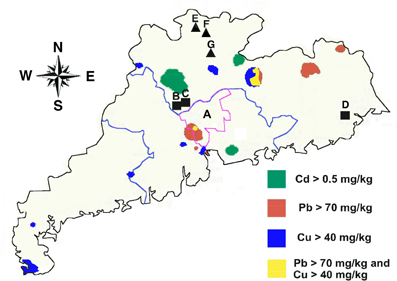
Figure 1. Distribution of cadmium (Cd), copper (Cu), and lead (Pb) in the surface soil in Guangdong. The lower concentration limits for coloring indicated in the color key below the map. White areas have lower concentrations than these of all three elements. The pink line around the letter A indicates the city limit of Guangzhou, and the blue line the limit of the Pearl River Delta area. The other letters indicate the following electronic waste/disposing centers (■) and mining areas (▲): B, Shijiao; C, Longtang; D, Guiyu; E, Lechang; F, Fankou; G, Dabaoshan. Guiyu (D) is marked here because high Cd, Cu, and Pb concentrations were observed in the farmland in this area (Li et al., 2011; Lin et al., 2011). The coloring of the map is based on information in Yang et al. (2013a), who have missed the heavy contamination in Guiyu (except that by Hg).
Strategies for Handling Heavy Metal Contamination of Agricultural Soils
With greater public awareness of the implications of heavy metal contaminated farmlands for human health, there has been increasing interest in developing technologies to clean up contaminated soils, or at least to prevent heavy metals from entering into the food chain.
Heavy Metal Clean-Up
Physicochemical remediation
Such physicochemical remediation of heavy metals as soil washing and chelate extraction was used early and has been successfully commercialized in some areas (Mulligan et al., 2001; Jankaitë and Vasarevièius, 2005). During the remediation procedure, such synthetic heavy metal chelators as ethylenediamine-tetraacetic acid, [S,S]-ethylenediaminedisuccinic acid, or methylglycinediacetic acid (Epelde et al., 2008; Arwidsson et al., 2010), or sorbents are commonly applied to reduce the solubility and bioavailability of heavy metals in soil.
This physicochemical remediation has proved to be a practical and efficient way for fast remediation of heavy metal contaminated soil, but such technologies need not only expensive chemical reagents and machines but also extensive labor (Wu et al., 2010; Yao et al., 2012). In addition, excessive use of chemical chelators results in adverse effects on soil structure, biological activity, and fertility (Yang et al., 2013b). Worse, the toxic chelators, together with the mobilized metals, may even be transported to the groundwater, making the disadvantage of chelating reagent usage outweigh its advantage (Nowack et al., 2006).
A partial solution to these problems is to develop more suitable heavy metal chelators or sorbents instead of those currently used. In paddy fields, heavy metals (Pb, Zn, Cu, and Cd) resulting from irrigation with mining wastewater can be largely removed by clean water irrigation for sufficient time (Tai et al., 2013). Soluble humic substances can be used as washing agents for Cd and Cu contaminated soils (Borggaard et al., 2011). Some other agricultural waste-derived sorbents may also be used (Sud et al., 2008; Wan Ngah and Hanafiah, 2008). Due to their biodegradability and low toxicity, biosurfactants produced by microorganisms have been proposed for use in environmental biotechnologies (Pacwa-Plociniczak et al., 2011). Compared to EDTA, the application of lipopeptide biosurfactants, which are obtained from Bacillus subtilis, can be an efficient and environment-friendly method for removing metals (Cd, Pb, Cu, Zn, Ni, Co) from contaminated soil (Singh and Cameotra, 2013).
Phytoextraction
Using plants to clean-up target heavy metals (phytoextraction) in soil seems to be an eco-friendly, economically feasible technology (Cunningham and Berti, 1993; Cunningham et al., 1995), especially after the discovery of heavy metal hyperaccumulators in nature. Hyperaccumulation of heavy metals may have evolved as a defense mechanism against natural enemies (Boyd, 2007). Mechanisms involved include high expression of heavy metal transporter proteins, excretion of natural chelators, and detoxification. Many studies have investigated the potential for use of hyperaccumulators in remediation of heavy metal polluted farmlands. The maximum Cd phytoremediation efficiency by Beta vulgaris L. var. cicla in paddy fields was found to be 144.6 mg ha−1 during one growing season (Song et al., 2012). Planting density had a significant effect on Cd phytoextraction efficiency, and double cropping can significantly increase the amount of Cd extracted by Solanum nigrum (Ji et al., 2011). About 500 hyperaccumulators have been discovered, but most of these have low biomass and slow growth. So far, only Alyssum, a hyperaccumulator species for Ni phytoremediation, has been developed as a commercial technology (Chaney et al., 2007). On the other hand, some fast-growing plants, such as poplar (Algreen et al., 2013), willow (Algreen et al., 2013; Van Slycken et al., 2013b), and vetiver grass, Chrysopogon zizanioides (Punamiya et al., 2010), have been studied for phytoextraction of heavy metal- contaminated farmland. Despite the lower metal concentrations in their tissues, the final metal extraction for these species is equal to or even higher than that of the hyperaccumulating plants (Punamiya et al., 2010; Lettens et al., 2011; Van Slycken et al., 2013b). So far, for various reasons, hyperaccumulators or fast-growing species have not been much used in practice (Wu et al., 2010).
The increased understanding of the molecular mechanisms of heavy metal accumulation and detoxification has opened a window to overcome the limitation of these “imperfect” species. Genetic engineering technology provides a powerful tool for improving phytoextraction by introducing genes into qualified species to get the “perfect” heavy metal hyperaccumulator, which should provide high rates of heavy metal uptake, fast root-to-shoot translocation and great ability to detoxify and sequester heavy metals in leaves. The target genes for the engineered plants are usually those important for metal uptake, translocation, compartmentalization, or those leading to enhanced metal ligand or metal-binding protein production (Kotrba et al., 2009; Shao et al., 2010). Genetically modified plants have been generated in a few laboratories (Grispen et al., 2011; Ivanova et al., 2011; Zhang et al., 2013b), and some of them have shown high phytoextraction potential in practice (Baňuelos et al., 2007; Zhang et al., 2013b). The true phytoremediation potential of genetically modified plants must be further tested in field trials, and before the introduction of these genetically modified plants into the environment, a strict risk assessment of the possibility of genetic pollution is needed. Unlike genetically modified crops, food safety or allergenicity are not relevant issues when transgenic plants are considered for use in phytoremediation. However, transgenic methods sometimes cause interspecies transfer of genes, which is a latent risk.
Besides selection of plants, several other methods have been developed for improving phytoextraction. Such beneficial microorganisms of plants as plant growth promoting bacteria and arbuscular mycorrhizal fungi can be used to facilitate phytoextraction and growth of plants in heavy metal contaminated soil. Babu et al. (2013) found that inoculating the native Pb-hyperaccumulator Alnus firma with endophytic bacteria (Bacillus thuringiensis GDB-1) improved the growth of the plants and enhanced the efficiency of phytoremediation of soil contaminated with Pb, Cd, and other metals. Chen et al. (2008) developed a novel metal biosorption system consisting of the symbiotic combination of an indigenous metal-resistant rhizobial strain, Cupriavidus taiwanensis TJ208, and its host plant Mimosa pudica for the removal of heavy-metal pollutants. They found that M. pudica with TJ208 nodules displayed a 71, 81, and 33% enhancement in metal adsorption efficiency for Pb, Cu, and Cd, respectively. Punamiya et al. (2010) reported that vetiver plants in association with arbuscular mycorrhizal fungi (AMF) can be used for improved phytoextraction of Pb. In their experiment, vetiver plants colonized by the AMF not only exhibit better growth, but also significantly increase Pb uptake in roots and higher translocation to shoots at all given treatments. Hu et al. (2013b) found that AMF inoculation not only accelerated the phytoextraction efficiency of Cd by 78% for Alfred stonecrop (Sedum alfredii Hance), but also decreased phytoavailable Cd concentrations by 21–38% via elevating soil pH. Application of organic or inorganic materials has also proved to be useful in improving phytoextraction. Leung et al. (2010) found that the synergistic effect of AMF inoculum and phosphate rock could affect As subcellular distribution of the As-hyperaccumulator Pteris vittata and thereby improve its As removal efficiency under well-watered conditions. Brassica napus can be used for the decontamination of affected soils, and EDTA addition increases the ability of B. napus to accumulate heavy metals (Zaier et al., 2010).
Inhibition of the Absorption of Heavy Metals in the Edible Parts of Crops
Removing the heavy metals from contaminated farmland is a priority in reducing the risk of heavy metals entering the food chain. But considering that large areas of farmland have been contaminated by heavy metals, this seems to be an unrealistic short-term goal. Therefore, alternative strategies have been developed to minimize the accumulation of heavy metals in the edible parts of crops.
Pollution-safe cultivar selection and breeding
There is considerable natural variation in the uptake and distribution of essential and non-essential trace elements both between and within species (Wang et al., 2007). Cultivar selection and breeding programs aim at obtaining varieties (cultivars) possessing heritable low-accumulation of heavy metals as a way of reducing the risk of heavy metals entering human food chains through dietary intake (Grant et al., 2008). “Variety selection” as a means for reducing such potentially harmful trace elements as Cd, Pb, and As in edible plant organs has been conducted in a wide range of crops, especially grain crops, including rice (Yu et al., 2006; Liu et al., 2007), wheat (Greger and Löfstedt, 2004), maize (Dai et al., 2007), potato (Dunbar et al., 2003), water spinach (Wang et al., 2007), Chinese cabbage (Liu et al., 2009, 2010), Chinese flowering cabbage (Qiu et al., 2011b), peanut (Su et al., 2013) and hot pepper (Xin et al., 2013). Pollution-safe cultivars, i.e., cultivars in which edible parts accumulate specific pollutants at a level low enough for safe consumption even when grown in contaminated soil (Yu et al., 2006), and pollution-free cultivars (Liu et al., 2012) appear to be within reach. The first commercially-successful low-Cd cultivar in durum wheat (Triticum turgidum L. var durum, Strongfield), which combines high yield, high grain protein concentration, and low grain cadmium concentration (Clarke et al., 2005), was released in 2004 and is now sown on more than 25% of the durum area in Canada (Grant et al., 2008). Breeding programs for rice, water spinach, and soybean have also been initialized.
While breeding and variety selection reduce risks posed by heavy metal contamination (Grant et al., 2008), it is very time-consuming, especially for out-crossed crops. Therefore, molecular techniques have been designed to produce crops that do not accumulate or accumulate very little of any toxic metal, without reduction of the fitness and nutritional value (Clemens et al., 2013). For example, the rice quantitative trait locus (QTL) can be applied in marker-assisted breeding, which could avoid the high costs of phenotyping Cd uptake. The low Cd-accumulating grain QTL in durum wheat (Wiebe et al., 2010) has successfully been exploited to achieve substantial reduction of grain Cd in Canadian durum wheat (Clarke et al., 2010). “Molecular breeding” is dependent on the molecular understanding of the underlying heavy metal accumulating mechanisms.
Recently, rapid and substantial progress has been made in understanding the molecular mechanisms for uptake and distribution of heavy metals in rice (Sasaki et al., 2012). Yamaji et al. (2013) reported that rice heavy metal ATPase2 (OsHMA2), a member of the P-type ATPases, is involved in preferential delivery of zinc to developing tissues in rice. OsHMA5, another member of the heavy metal P-type ATPase, is involved in loading Cu to the xylem of the roots and other organs (Deng et al., 2013). Over-expression of OsHMA3 can lead to lower levels of Cd accumulation in the grain of a low Cd-accumulating cultivar (Ueno et al., 2010). Ishikawa et al. (2012) identified the OsNRAMP5 gene, which encodes a member of the natural resistance-associated macrophage protein family that is responsible for reduced Cd uptake, and developed a strategy for marker-assisted selection of low-Cd cultivars. Further research demonstrated that the OsNAMP5 is the main Cd uptake pathway in rice, providing a practical choice for low-Cd rice production worldwide. Compared to rice, much less information is available for such other major food sources as wheat, potato, soybean, barley, and maize; and the molecular components determining heavy metal movement and their respective contributions under different soil conditions are also far from understood (Clemens et al., 2013). Therefore, basic research programs regarding mechanisms involving heavy metal uptake and distribution in different crops are urgently needed. While transgenetic methods provide effective assistance in crop breeding, there is much concern and controversy regarding the safety of transgenetic foods (DeFrancesco, 2013). There is still a long way to go before the genetically modified crops can be widely used to decrease the risk of heavy metals entering the human food chain.
Heavy metal stabilization
Besides the breeding program, the soil stabilization technique can reduce the risk of heavy metals entering the human food chain. The application of immobilizing amendments to the farmland can decrease the bioavailability of toxic heavy metals via adsorption, precipitation, and complexation, thereby reducing their toxicity and accumulation in crops (Udeigwe et al., 2011).
In agriculture, such various inorganic or organic amendments as animal manure and compost are frequently used to improve the soil properties. Some of these can significantly modify the phytoavailability of heavy metals and may be applied for heavy metal immobilization (Janoš et al., 2010). Ok et al. (2011) found that the use of rapeseed residue as a green manure in the Cd- and Pb-contaminated rice paddy soils can improve the soil chemical and biological properties, and decrease the heavy metal phytoavailability. Farrell and Jones (2010) demonstrated that several types of compost, including green waste-derived compost, green waste and catering waste-derived compost, green waste, catering waste and paper waste-derived compost, and municipal solid waste-derived compost, are all well suited for revegetation of highly contaminated sites, as their application can reduce soil solution levels of Cu, Zn, Pb, and raise soil pH and nutrient levels.
The application of biochar (chicken manure and green waste), which is produced by low-temperature (400–500°C) pyrolysis of biomass in an oxygen-free or low-oxygen environment, can improve the biological and physiochemical properties of agricultural soil. More than that, as a typically alkaline material, it can increase soil pH and contribute to stabilization of such heavy metals as Cd, Cu, Pb, etc (Tang et al., 2013; Zhang et al., 2013a). Soybean stover-derived biochar is effective in immobilizing Pb in contaminated firing range soil (Moon et al., 2013). Park et al. (2011) evaluated the immobilization and phytoavailability effects of biochar on Cd, Cu and Pb, and found that application of biochar was effective in immobilization of these metals. On the other hand, several studies have reported the increased mobility of As with biochar in soil (Beesley et al., 2010), which was mainly attributed to the rise in soil pH as well as to As competition with soluble P in biochar. Therefore, before the application of biochar in heavy metal contaminated farmland, one should take into account the types of heavy metals present in the contaminated soil and the types and characteristics of biochars used.
Besides the agricultural materials, numerous industrial by-products of an inorganic nature (red mud, fly ash), or naturally occurring minerals (zeolites, goethite, ferrihydrite) can serve as immobilizing agents for some metals. Liming is the most common method of treatment and can lead to the precipitation of heavy metals as metal-carbonates and significantly reduce the exchangeable fraction of heavy metals within soils. Abd El-Azeem et al. (2013) found that the application of natural liming materials led to an increase in soil pH, leading to decreased heavy metal availability. They concluded that the application of natural liming materials offers a cost-effective way to immobilize heavy metals and metalloids in soils. Avelar Ferreira et al. (2013) found that the application of limestone induced a significant increase in soil pH, with reductions in Zn and Cd availability of 99 and 94%, respectively, and increased the production of dry matter of several leguminous plants.
Rizwan et al. (2012) found that significant plant-available silicon in soil contributes to decreased Cd concentrations in wheat shoots and could be implemented in a general scheme aiming at controlling Cd concentrations in wheat. Fly ash has also been reported to be useful in aiding the phytostabilization of heavy metal-contaminated agricultural lands (Ukwattage et al., 2013). Several studies have demonstrated that the amendment of fly ash can cause the reduction of heavy metal mobility in soil, leading to decreased heavy metal accumulation in crops (Gu et al., 2011; Masto et al., 2013). Ram and Massto (2014) further proposed that the performance of fly ash mixed with organic and inorganic materials is better than treatment by fly ash alone. However, it should be noted that the properties of fly ash should be analyzed before its usage, as potentially toxic elements may be present in some of the fly ashes (Pandey, 2013). Besides, the rate of application, the type and composition of the soil also have important effects on the carryover of heavy metals to crop produce (Ukwattage et al., 2013; Ram and Massto, 2014).
Change of the Crop System to Produce Non-Food Products
Although various methods (as mentioned above) could be applied to reduce the accumulation of toxic heavy metals in plants, the heavy metal concentration in the edible parts of crops planted in contaminated farmland can still exceed the legal threshold. In such cases a change to non-food crop production appears unavoidable.
Phytomanagement is the combination of profitable crop production with the gradual reduction of soil contamination by phytoextraction (Van Slycken et al., 2013a). The potential plant harvests in this system are usually such non-food products as biofuel, fiber, wood or, depending on the contamination level, animal feed. Fässler et al. (2010) investigated the long-term effectiveness of phytomanagement to deal with moderately metal-contaminated agricultural land. In a 6-year field experiment, they grew maize (Zea mays L.), sunflowers (Helianthus annuus L.), and tobacco (Nicotiana tabacum L.) in crop rotation and found that while phytoextraction for soil cleansing would require centuries, this land could be used to generate profitable crops, including safe (low Cd) stock fodder fortified with Zn, green manure for micronutrient-deficient soils, or bioenergy.
Meers et al. (2005) found that among the four tested biomass producing crops (Brassica rapa, Cannabis sativa, Helianthus annuus and Zea mays), Zea mays has the highest biomass potential on moderately metal contaminated land. Based on a field experiment conducted on a Cd, Zn, and Pb moderately contaminated farmland, Meers et al. (2010) reported that the cultivation of energy maize could result in 33,000–46,000 kW h of renewable energy (electrical and thermal) per hectare per year which, by substitution for fossil energy would imply a reduction of up to 21 × 103 kg ha−1 y−1 CO2 if used to substitute a coal fed power plant. They also introduced the concept of “phytoattenuation,” in which the main objective of the conversion of land use is risk-reduction combined with generation of an alternative income for the farmer, while decontamination comes as a bonus (Meers et al., 2010). Van Slycken et al. (2013a) found that the biogas production potential did not differ between energy maize grown on Cd contaminated and non-contaminated soils.
While energy maize seems to be the most promising crop in phytomanagement of heavy metal contaminated farmland, such other fast-growing species as poplar (Algreen et al., 2013) and willow (Witters et al., 2012; Van Slycken et al., 2013b) should also be well suited in this system. In order to facilitate the phytomanagement/phytoattenuation strategy, energy maize cultivars are being selected to optimize their biogas production and heavy metal extraction potentials (Meers et al., 2010). Similar selection work was also reported for willow (Van Slycken et al., 2013b). Molecular technologies have also been applied in assisting the development of phytomanagement systems. Ivanova et al. (2011) found that over-expressing the genes gsh1 encoding γ-glutamylcysteine synthetase in the cytosol of poplars induced a twofold increase of intrafoliar GSH concentration and influenced the photosynthetic apparatus, leading to higher tolerance to heavy metal stress under field conditions. Metal-resistant and plant growth-promoting bacteria may be exploited for promoting energy maize biomass production and Cu phytoremediation in a natural highly Cu-contaminated soil (Sheng et al., 2012). The difference in the Cd and Zn accumulation capacity among willow clones might be at least partly related to differences in associated bacterial populations, implying that there is potential use of plant growth-promoting bacteria in improving the performance of willows in phytoextraction (Weyens et al., 2013).
Against the background of global change, it can be expected that energy plant cultivation in heavy metal polluted agricultural soils will become more important for both energy generation and for phytoremediation of heavy metal-contaminated soils. Currently, its combination with other techniques (as mentioned in the earlier part of this paper) should be an urgently needed research focus.
Suggestions for Future Action
In spite of the existence of various technologies for the remediation of heavy metal contaminated agricultural soils, some are still difficult to put into practice in polluted farmland in Guangdong. This is because of the high demand for food production and the low efficiency and high costs of remediation. Furthermore, in Guangdong the heavy metal contamination in much of the polluted farmland is not monitored, so the quality of the soil is often unknown and pollution is often overlooked (Qiu et al., 2011b). To reduce the potential health risks of heavy metal pollutants entering the human food chain from contaminated soils via agricultural products, there are several actions that are urgently needed.
Reduce the Heavy Metal Inputs into the Farmland
Investigation and monitoring of heavy metal pollution
There is a high need to conduct a comprehensive investigation of heavy metal contamination levels in the farmland of this area, especially of farmland close to mining areas or industrial centers. For the most contaminated farmlands, long-term programs should be established for monitoring and evaluating the potential risks to human beings and surrounding environments. Besides, the government should make heavy metal pollution information available to the public in a timely fashion. In July 2013, the Guangdong government released the official data on the soil heavy metal contamination levels in the Pearl River Delta (Lin and Song, 2013). This is probably the first official release of heavy metal contamination information in the mainland of China (Lin and Song, 2013).
Strict law enforcement
China has rigorous laws for environmental protection, but these laws need to be more strictly executed (Zhang et al., 2010). As the main source of toxic heavy metals in Guangdong comes from inappropriate and illegal human activities, it is urgently needed to control such activities. For example, the local government needs to improve its supervision of the monitoring of sewage discharge and solid waste disposal. Illegal disposal of pollutants should be punished. The government should also encourage the public to help in monitoring illegal pollutant discharge, especially since most of the electronic electroplating enterprises in Guangdong have been moved to the suburbs or to rural areas.
Conversion to environmentally friendly cultivation systems
The intensive applications of pesticides, inorganic phosphorus fertilizer, and manure to the farmlands are important reasons for heavy metal pollution (especially Cd) in most areas of Guangdong. The development of environmentally friendly cultivation systems is therefore of great importance in reducing the risks of heavy metals entering to the food chain. This will be a systematic task that will need a series of actions.
Safe Use of Heavy Metal Polluted Agricultural Soils
For the farmlands that are seriously polluted by heavy metals: conversion to a non-food production system
For the farmlands that are seriously polluted by heavy metals, the non-food production systems should be developed and introduced in order to reduce levels of heavy metals entering into human food chains. Using biomass produced by such highly-contaminated farmland as feedstock for energy production seems to be an attractive option, provided smoke and ashes are properly handled, since it could even turn phytoremediation into a profit-making operation in some areas (Ghosh and Singh, 2005). However, as the bio-energy industry is still in its infancy in China, the cultivation of energy crops is not yet a profitable option for farmers. Considering that the Chinese government is currently trying to encourage the development of the bio-energy industry, the Guangdong government could consider providing some temporary economic compensation to farmers for cultivation of energy crops. Such compensation would not be needed when the bio-energy industry in Guangdong has been developed. On the other hand, it is also necessary for scientists to develop additional non-food production systems, such as those for wood or pasture-production.
Cultivar selection or breeding program for rice
For the farmlands that are under middle- or mild-level heavy metal contamination, there are several options. The preferred strategy is to breed the low-accumulating varieties of the target crops without damage to their quality and yields. This strategy has been demonstrated to be effective both theoretically and practically (Grant et al., 2008) and therefore should be highly recommended. In many Asian countries such as Japan, Korea and China, the dietary consumption of rice and vegetables is the main pathway for heavy metal (especially Cd) intake (UNEP, 2008; FAO/WHO, 2010). As the predominant grain crop in Guangdong is rice, the breeding of low-accumulative rice cultivars is a priority. So far, the selection of such low-accumulative cultivars of rice has been reported (Yu et al., 2006; Liu et al., 2007) and a breeding program for them has been initiated (Ishikawa et al., 2012). The increased understanding of the mechanisms of heavy metal absorption and translocation in rice should facilitate the breeding program (Clemens et al., 2013), but a strict safety evaluation should be conducted before the application of transgenetic technology in any food crops. In addition, one of the concerns regarding the cultivar selection or breeding of low-accumulative rice is that with increased use of monoculture there might be a higher risk for damage from plant disease or pests (Matson et al., 1997).
Selection of low-accumulating vegetable crops
The potential risk of heavy metal contamination of nearly all types of vegetables has been evaluated (Hu et al., 2013a; Liu et al., 2013b). There are huge differences among vegetable species in their heavy metal accumulation (Wang et al., 2007; Liu et al., 2013b). Generally, leafy, root and tuber vegetables are more easily polluted by heavy metals, while accumulation is lower in fruit and seed crops (Liu et al., 2007; Hu et al., 2013a). Therefore, one strategy in dealing with the heavy metal contamination in farmland is to cultivate low-accumulative vegetable species in the polluted or un-monitored agricultural soils. This conversion of crop types should be particularly practical on a large-area scale, since the farmers can cultivate “high-risk” plants in the unpolluted farmland. Indeed, the selection of low-accumulative cultivars of vegetables should also be helpful in reducing risk, considering that most vegetables in Guangdong are produced by local farmers, who usually only own a small area of farmland. So far, the screening of low-accumulative cultivars has been conducted for many vegetables that are easily be contaminated, including Chinese cabbage (Liu et al., 2009), Chinese flowering cabbage (Qiu et al., 2011b), water spinach (Wang et al., 2009; Xin et al., 2010), edible amaranth (Zhou et al., 2013), pakchoi (Xue et al., 2014), etc. How to generalize the low-accumulative cultivars should be one of the important tasks in the near future.
Application of organic or inorganic amendments
The applications of organic or inorganic amendments that can inhibit the phytoavailability of heavy metals should also be used in combination with the strategies mentioned above. For example, Qiu et al. (2011a) found that the use of low-Cd cultivars of Chinese flowering cabbage in conjunction with P supply is a very useful way to reduce the pollution risk of Cd in the food chain. Liming is currently the most accepted practice in improving the soil structures in Guangdong. Some low-cost agricultural materials or industrial by-products that could play roles similar to lime should be developed within the cultivation systems and then be introduced to the farmers. The candidates should include biochar, composts, and some silicon-rich amendments.
Final Comments
Although China's Ministry of Environment and Ministry of Land and Resources has conducted a “Special Program of National Soil Survey and Pollution Control” and a report has been produced, it has not been made public (Liu et al., 2013c). The existing scientific literature in Chinese and English is extensive, and we have made an attempt to present here the most important facts about cadmium, copper, and lead pertinent to the situation in Guangdong Province.
Conflict of Interest Statement
The authors declare that the research was conducted in the absence of any commercial or financial relationships that could be construed as a potential conflict of interest.
Acknowledgments
The authors are grateful to Dr. Qiu Qiu (Guangzhou Water Quality Monitoring Center) for reference formatting and to Prof. Helen Ghiradella (The University at Albany) for language correction. Yutao Wang is financially supported by the Foundation for Distinguished Young Talents in Higher Education of Guangdong Province (2012LYM_0049) and the Science Foundation on Cultivating Young Teachers From South China Normal University.
References
Abd El-Azeem, S. A. M., Ahmad, M., Usman, A. R. A., Kim, K. R., Oh, S. E., Lee, S. S., et al. (2013). Changes of biochemical properties and heavy metal bioavailability in soil treated with natural liming materials. Environ. Earth Sci. 70, 3411–3420. doi: 10.1007/s12665-013-2410-3
Algreen, M., Trapp, S., and Rein, A. (2013). Phytoscreening and phytoextraction of heavy metals at Danish polluted sites using willow and poplar trees. Environ. Sci. Pollut. Res. doi: 10.1007/s11356-013-2085-z. [Epub ahead of print].
Arwidsson, Z., Elgh-Dalgren, K., von Kronhelm, T., Sjöberg, R., Allard, B., and van Hees, P. (2010). Remediation of heavy metal contaminated soil washing residues with amino polycarboxylic acids. J. Hazard. Mater. 173, 697–704. doi: 10.1016/j.jhazmat.2009.08.141
Atafar, Z., Mesdaghinia, A., Nouri, J., Homaee, M., Yunesian, M., Ahmadimoghaddam, M., et al. (2010). Effect of fertilizer application on soil heavy metal concentration. Environ. Monit. Assess. 160, 83–89. doi: 10.1007/s10661-008-0659-x
Avelar Ferreira, P. A., Lopes, G., Bomfeti, C. A., de Oliveira Longatti, S. M., de Sousa Soares, C. R. F., Guimarães Guilherme, L. R., et al. (2013). Leguminous plants nodulated by selected strains of Cupriavidus necator grow in heavy metal contaminated soils amended with calcium silicate. World J. Microb. Biotechnol. 29, 2055–2066. doi: 10.1007/s11274-013-1369-2
Babu, A. G., Kim, J. D., and Oh, B. T. (2013). Enhancement of heavy metal phytoremediation by Alnus firma with endophytic Bacillus thuringiensis GDB-1. J. Hazard. Mater. 250–251, 477–483. doi: 10.1016/j.jhazmat.2013.02.014
Baňuelos, G., LeDuc, D. L., Pilon-Smits, E. A. H., and Terry, N. (2007). Transgenic Indian mustard overexpressing selenocysteine lyase or selenocysteine methyltransferase exhibit enhanced potential for selenium phytoremediation under field conditions. Environ. Sci. Technol. 41, 599–605. doi: 10.1021/es061152i
Beesley, L., Jiménez, E. M., and Eyles, J. L. G. (2010). Effects of biochar and greenwaste compost amendments on mobility, bioavailability and toxicity of inorganic and organic contaminants in a multi-element polluted soil. Environ. Pollut. 158, 2282–2287. doi: 10.1016/j.envpol.2010.02.003
Bi, X. Y., Liang, S. Y., and Li, X. D. (2013). Trace metals in soil, dust, and tree leaves of the urban environment, Guangzhou, China. Chin. Sci. Bull. 58, 222–230. doi: 10.1007/s11434-012-5398-2
Borggaard, O. K., Holm, P. E., Jensen, J. K., Soleimani, M., and Strobel, B. W. (2011). Cleaning heavy metal contaminated soil with soluble humic substances instead of synthetic polycarboxylic acids. Acta Agric. Scand. 61, 577–581. doi: 10.1080/09064710.2010.515602
Boyd, R. S. (2007). The defence hypothesis of elemental hyperaccumulation: status, challenges and new directions. Plant Soil 293, 153–176. doi: 10.1007/s11104-007-9240-6
Buha, A., Antonijevic, B., Bulat, Z., Jacevic, V., Milovanovic, V., and Matovic, V. (2013). The impact of prolonged cadmium exposure and co-exposure with polychlorinated biphenyls on thyroid function in rats. Toxicol. Lett. 221, 83–90. doi: 10.1016/j.toxlet.2013.06.216
Cai, L. M., Huang, L. C., Zhou, Y. Z., Xu, Z. C., Peng, X. C., Yao, L. A., et al. (2010). Heavy metal concentrations of agricultural soils and vegetables from Dongguan, Guangdong. J. Geogr. Sci. 20, 121–134. doi: 10.1007/s11442-010-0121-1
Cai, L. M., Xu, Z. C., Ren, M. Z., Guo, Q. W., Hua, X. B., Hua, G. C., et al. (2012). Source identification of eight hazardous heavy metals in agricultural soils of Huizhou, Guangdong Province, China. Ecotoxicol. Environ. Saf. 78, 2–8. doi: 10.1016/j.ecoenv.2011.07.004
Cai, Q. Y., Mo, C. H., Li, H. Q., Luĺ, H. X., Zeng, Q. Y., Li, Y. W., et al. (2013). Heavy metal contamination of urban soils and dusts in Guangzhou, South China. Environ. Monit. Assess. 185, 1095–1106. doi: 10.1007/s10661-012-2617-x
Cakmak, D., Saljnikov, E., Mrvic, V., Jakovljevic, M., Marjanovic, Z., Sikiric, B., et al. (2010). Soil properties and trace elements contents following 40 years of phosphate fertilization. J. Environ. Qual. 39, 541–547. doi: 10.2134/jeq2009.0216
Chaney, R. L., Angle, J. S., Broadhurst, C. L., Peters, C. A., Tappero, R. V., and Sparks, D. L. (2007). Improved understanding of hyperaccumulation yields commercial phytoremediation and phytomining technologies. J. Environ. Qual. 36, 1429–1443. doi: 10.2134/jeq2006.0514
Chang, C. Y., Yu, H. Y., Chen, J. J., Li, F. B., Zhang, H. H., and Liu, C. P. (2014). Accumulation of heavy metals in leaf vegetables from agricultural soils and associated potential health risks in the Pearl River Delta, South China. Environ. Monit. Assess. 186, 1547–1560. doi: 10.1007/s10661-013-3472-0.
Chen, W. M., Wu, C. H., James, E. K., and Chang, J. S. (2008). Metal biosorption capability of Cupriavidus taiwanensis and its effects on heavy metal removal by nodulated Mimosa pudica. J. Hazard. Mater. 151, 364–371. doi: 10.1016/j.jhazmat.2007.05.082
Cheng, H., Li, M., Zhao, C., Li, K., Peng, M., Qin, A., et al. (2014). Overview of trace metals in the urban soil of 31 metropolises in China. J. Geochem. Explor. 139, 31–52. doi: 10.1016/j.gexplo.2013.08.012
Clarke, J. M., Clarke, F. R., and Pozniak, C. J. (2010). Forty-six years of genetic improvement in Canadian durum wheat cultivars. Can. J. Plant Sci. 90, 791–801. doi: 10.4141/CJPS10091
Clarke, J. M., McCaig, T. N., DePauw, R. M., Knox, R. E., Clarke, F. R., Fernandez, M. R., et al. (2005). Strongfield durum wheat. Can. J. Plant Sci. 85, 651–654. doi: 10.4141/cjps2013-094
Clemens, S., Aarts, M. G. M., Thomine, S., and Verbruggen, N. (2013). Plant science: the key to preventing slow cadmium poisoning. Trends Plant Sci. 18, 92–99. doi: 10.1016/j.tplants.2012.08.003
Cunningham, S. D., and Berti, W. R. (1993). Remediation of contaminated soils with green plants: an overview. In Vitro Cell. Dev. Biol. 29, 207–212. doi: 10.1007/BF02632036
Cunningham, S. D., Berti, W. R., and Huang, J. W. (1995). Phytoremediation of contaminated soils. Trends Biotechnol. 13, 393–397. doi: 10.1016/s0167-7799(00)88987-8
Dai, Q. L., Yuan, J. G., Fang, W., and Yang, Z. Y. (2007). Differences on Pb accumulation among plant tissues of 25 varieties of maize (Zea mays). Front. Biol. China 2:303–308. doi: 10.1007/s11515-007-0044-0
DeFrancesco, L. (2013). How safe does transgenic food need to be? Nat. Biotechnol. 31, 794–802. doi: 10.1038/nbt.2686
De Muynck, D., Cloquet, C., Smits, E., de Wolff, F. A., Quitté, G., Moens, L., et al. (2008). Lead isotopic analysis of infant bone tissue dating from the Roman era via multicollector ICP–mass spectrometry. Anal. Bioanal. Chem. 390, 477–486. doi: 10.1007/s00216-007-1679-z
Deng, F. L., Yamaji, N., Xia, J. X., and Ma, J. F. (2013). A member of the heavy metal P-type ATPase OsHMA5 is involved in xylem loading of copper in rice. Plant Physiol. 163, 1353–1362. doi: 10.1104/pp.113.226225
Dong, J., Yang, Q. W., Sun, L. N., Zeng, Q., Liu, S. J., Pan, J., et al. (2011). Assessing the concentration and potential dietary risk of heavy metals in vegetables at a Pb/Zn mine site, China. Environ. Earth Sci. 64, 1317–1321. doi: 10.1007/s12665-011-0992-1
Douay, F., Roussel, H., Pruvot, C., and Waterlot, C. (2008). Impact of a smelter closedown on metal contents of wheat cultivated in the neighbourhood. Environ. Sci. Pollut. Res. 15, 162–169. doi: 10.1065/espr2006.12.366
Dunbar, K. R., McLaughlin, M. J., and Reid, R. J. (2003). The uptake and partitioning of cadmium in two cultivars of potato (Solanum tuberosum L.). J. Exp. Bot. 54, 349–354. doi: 10.1093/jxb/erg016
Epelde, L., Hernández-Allica, J., Becerril, J. M., Blanco, F., and Garbisu, C. (2008). Effects of chelates on plants and soil microbial community: comparison of EDTA and EDDS for lead phytoextraction. Sci. Total Environ. 401, 21–28. doi: 10.1016/j.scitotenv.2008.03.024
FAO/WHO, Food and Agriculture Organization/World Health Organization. (2010). Evaluation of Certain Food Additives and Contaminants (Seventy-third Report of the Joint FAO/WHO Expert Committee on Food Additives). WHO Technical Report Series, No. 960. Available online at: http://whqlibdoc.who.int/trs/WHO_TRS_960_eng.pdf
Farrell, M., and Jones, D. L. (2010). Use of composts in the remediation of heavy metal contaminated soil. J. Hazard. Mater. 175, 575–582. doi: 10.1016/j.jhazmat.2009.10.044
Fässler, E., Robinson, B. H., Stauffer, W., Gupta, S. K., Papritz, A., and Schulin, R. (2010). Phytomanagement of metal-contaminated agricultural land using sunflower, maize and tobacco. Agric. Ecosyst. Environ. 136, 49–58. doi: 10.1016/j.agee.2009.11.007
Ghosh, M., and Singh, S. P. (2005). A review on phytoremediation of heavy metals and utilization of its byproducts. Asian J. Energy Environ. 6, 214–231.
Glusic, M., Ropret, P., Vogel-Mikus, K., and Grdadolnik, J. (2013). The binding sites of cadmium to a reduced form of glutathione. Acta Chim. Slov. 60, 61–69.
Grant, C. A., Clarke, J. M., Duguid, S., and Chaney, R. L. (2008). Selection and breeding of plant cultivars to minimize cadmium accumulation. Sci. Total Environ. 390, 301–310. doi: 10.1016/j.scitotenv.2007.10.038
Greger, M., and Löfstedt, M. (2004). Comparison of uptake and distribution of cadmium in different cultivars of bread and durum wheat. Crop Sci. 44, 501–507. doi: 10.2135/cropsci2004.5010
Grispen, V. M. J., Hakvoort, H. W. J., Bliek, T., Verkleij, J. A. C., and Schat, H. (2011). Combined expression of the Arabidopsis metallothionein MT2b and the heavy metal transporting ATPase HMA4 enhances cadmium tolerance and the root to shoot translocation of cadmium and zinc in tobacco. Environ. Exp. Bot. 72, 71–76. doi: 10.1016/j.envexpbot.2010.01.005
Gu, H. H., Qiu, H., Tian, T., Zhan, S. S., Deng, T. H. B., Chaney, R. L., et al. (2011). Mitigation effects of silicon rich amendments on heavy metal accumulation in rice (Oryza sativa L.) planted on multi-metal contaminated acidic soil. Chemosphere 83, 1234–1240. doi: 10.1016/j.chemosphere.2011.03.014
Holy, M., Pesch, R., Schröder, W., Harmens, H., Ilyin, I., Alber, R., et al. (2010). First thorough identification of factors associated with Cd, Hg and Pb concentrations in mosses sampled in the European Surveys 1990, 1995, 2000 and 2005. J. Atmos. Chem. 63, 109–124. doi: 10.1007/s10874-010-9160-3
Hu, J. L., Wu, F. Y., Wu, S. C., Cao, Z. H., Lin, X. G., and Wong, M. H. (2013a). Bioaccessibility, dietary exposure and human risk assessment of heavy metals from market vegetables in Hong Kong revealed with an in vitro gastrointestinal model. Chemosphere 91, 455–461. doi: 10.1016/j.chemosphere.2012.11.066
Hu, J. L., Wu, S. C., Wu, F. Y., Leung, H. M., Lin, X. G., and Wong, M. H. (2013b). Arbuscular mycorrhizal fungi enhance both absorption and stabilization of Cd by Alfred stonecrop (Sedum alfredii Hance) and perennial ryegrass (Lolium perenne L.) in a Cd-contaminated acidic soil. Chemosphere 93, 1359–1365. doi: 10.1016/j.chemosphere.2013.07.089
Huo, X., Peng, L., Xu, X. J., Zheng, L. K., Qiu, B., Qi, Z. L., et al. (2007). Elevated blood lead levels of children in Guiyu, an electronic waste recycling town in China. Environ. Health Perspect. 115, 1113–1117. doi: 10.1289/ehp.9697
Ishikawa, S., Ishimaru, Y., Igura, M., Kuramata, M., Abe, T., Senoura, T., et al. (2012). Ion-beam irradiation, gene identification, and marker-assisted breeding in the development of low-cadmium rice. Proc. Natl. Acad. Sci. U.S.A. 109, 19166–19171. doi: 10.1073/pnas.1211132109
Ivanova, L. A., Ronzhina, D. A., Ivanov, L. A., Stroukova, L. V., Peuke, A. D., and Rennenberg, H. (2011). Over-expression of gsh1 in the cytosol affects the photosynthetic apparatus and improves the performance of transgenic poplars on heavy metal-contaminated soil. Plant Biol. 13, 649–659. doi: 10.1111/j.1438-8677.2010.00422.x
Jankaitë, A., and Vasarevièius, S. (2005). Remediation technologies for soils contaminated with heavy metals. J. Environ. Eng. Landsc. Manag. 13, 109–113. doi: 10.1080/16486897.2005.9636854
Janoš, P., Vávrová, J., Herzogová, L., and Pilaøová, V. (2010). Effects of inorganic and organic amendments on the mobility (leachability) of heavy metals in contaminated soil: a sequential extraction study. Geoderma 159, 335–341. doi: 10.1016/j.geoderma.2010.08.009
Jara, O., and Aránguiz-Acuña, A. (2013). Effects of indirect toxicity of interacting Cd–Zn in a planktonic marine system. Aquat. Biol. 19, 19–28. doi: 10.3354/ab00507
Jarzecki, A. A. (2007). Lead-poisoned zinc fingers: quantum mechanical exploration of structure, coordination, and electronic excitations. Inorg. Chem. 46, 7509–7521. doi: 10.1021/ic700731d
Ji, P. H., Sun, T. H., Song, Y. F., Ackland, M. L., and Liu, Y. (2011). Strategies for enhancing the phytoremediation of cadmium-contaminated agricultural soils by Solanum nigrum L. Environ. Pollut. 159, 762–768. doi: 10.1016/j.envpol.2010.11.029
Karlsson, H. L., Cronholm, P., Hedberg, Y., Tornberg, M., De Battice, L., Svedhem, S., et al. (2013). Cell membrane damage and protein interaction induced by copper containing nanoparticles—Importance of the metal release process. Toxicology 313, 59–69. doi: 10.1016/j.tox.2013.07.012
Kippler, M., Tofail, F., Hamadani, J. D., Gardner, R. M., Grantham-McGregor, S. M., Bottai, M., et al. (2012). Early-life cadmium exposure and child development in 5-year-old girls and boys: a cohort study in rural Bangladesh. Environ. Health Perspect. 120, 1462–1468. doi: 10.1289/ehp.1104431
Kluxen, F. M., Diel, P., Höfer, N., Becker, E., and Degen, G. H. (2013). The metallohormone cadmium modulates AhR-associated gene expression in the small intestine of rats similar to ethinyl-estradiol. Arch. Toxicol. 87, 633–643. doi: 10.1007/s00204-012-0971-7
Kotrba, P., Najmanova, J., Macek, T., Ruml, T., and Mackova, M. (2009). Genetically modified plants in phytoremediation of heavy metal and metalloid soil and sediment pollution. Biotechnol. Adv. 27, 799–810. doi: 10.1016/j.biotechadv.2009.06.003
Lane, T. W., and Morel, F. M. M. (2000). A biological function for cadmium in marine diatoms. Proc. Natl. Acad. Sci. U.S.A. 97, 4627–4631. doi: 10.1073/pnas.090091397
Ledda, F. D., Ramoino, P., Ravera, S., Perino, E., Bianchini, P., Diaspro, A., et al. (2013). Tubulin posttranslational modifications induced by cadmium in the sponge Clathrina clathrus. Aquat. Toxicol. 140–141, 98–105. doi: 10.1016/j.aquatox.2013.05.013
Lettens, S., Vandecasteele, B., De Vos, B., Vansteenkiste, D., and Verschelde, P. (2011). Intra- and inter-annual variation of Cd, Zn, Mn and Cu in foliage of poplars on contaminated soil. Sci. Total Environ. 409, 2306–2316. doi: 10.1016/j.scitotenv.2011.02.029
Leung, H. M., Wu, F. Y., Cheung, K. C., Ye, Z. H., and Wong, M. H. (2010). Synergistic effects of arbuscular mycorrhizal fungi and phosphate rock on heavy metal uptake and accumulation by an arsenic hyperaccumulator. J. Hazard. Mater. 181, 497–507. doi: 10.1016/j.jhazmat.2010.05.042
Li, F., Zeng, X. Y., Wu, C. H., Duan, Z. P., Wen, Y. M., Huang, G. R., et al. (2013). Ecological risks assessment and pollution source identification of trace elements in contaminated sediments from the pearl river delta, China. Biol. Trace Elem. Res. 155, 301–313. doi: 10.1007/s12011-013-9789-2
Li, J. H., Duan, H. B., and Shi, P. (2011). Heavy metal contamination of surface soil in electronic waste dismantling area: site investigation and source-apportionment analysis. Waste Manag. Res. 29, 727–738. doi: 10.1177/0734242X10397580
Lin, C. T., and Song, Y. B. (2013), July 17). Thirty percent of soils exceed the safe standard of heavy metals in Pearl River Delta area. China Business News (In Chinese). Available online at: http://www.yicai.com/news/2013/07/2865385.html
Lin, W. J., Wu, R. H., Zheng, Z. C., and Lin, D. S. (2011). Heavy metals in sediments and soils contaminated by electronic waste recycling in Guiyu town. Ecol. Environ. Sci. 20, 160–163. (In Chinese with English abstract).
Liu, J., Qian, M., Cai, G., Yang, J., and Zhu, Q. (2007). Uptake and translocation of Cd in different rice cultivars and the relation with Cd accumulation in rice grain. J. Hazard. Mater. 143, 443–447. doi: 10.1016/j.jhazmat.2006.09.057
Liu, L., Hu, L., Tang, J., Li, Y., Zhang, Q., and Chen, X. (2012). Food safety assessment of planting patterns of four vegetable-type crops grown in soil contaminated by electronic waste activities. J. Environ. Manag. 93, 22–30. doi: 10.1016/j.jenvman.2011.08.021
Liu, M., Huang, B., Bi, X. H., Ren, Z. F., Sheng, G. Y., and Fu, J. M. (2013a). Heavy metals and organic compounds contamination in soil from an e-waste region in South China. Environ. Sci. 15, 919–929. doi: 10.1039/c3em00043e
Liu, X. M., Song, Q. J., Tang, Y., Li, W. L., Xu, J. M., Wu, J. J., et al. (2013b). Human health risk assessment of heavy metals in soil-vegetable system: a multi-medium analysis. Sci. Total Environ. 463–464, 530–540. doi: 10.1016/j.scitotenv.2013.06.064
Liu, Y., Wen, C., and Liu, X. (2013c). China's food security soiled by contamination. Science 339, 1382–1383. doi: 10.1126/science.339.6126.1382-b
Liu, W., Zhou, Q., Sun, Y., and Liu, R. (2009). Identification of Chinese cabbage genotypes with low cadmium accumulation for food safety. Environ. Pollut. 157, 1961–1967. doi: 10.1016/j.envpol.2009.01.005
Liu, W. T., Zhou, Q. X., Zhang, Y. L., and Wei, S. H. (2010). Lead accumulation in different Chinese cabbage cultivars and screening for pollution-safe cultivars. J. Environ. Manag. 91, 781–788. doi: 10.1016/j.jenvman.2009.10.009
Lu, Y., Zhu, F., Chen, J., Gan, H., and Guo, Y. (2007). Chemical fractionation of heavy metals in urban soils of Guangzhou, China. Environ. Monit. Assess. 134, 429–439. doi: 10.1007/s10661-007-9634-1
Luo, C. L., Liu, C. P., Wang, Y., Liu, X., Li, F. B., Zhang, G., et al. (2011). Heavy metal contamination in soils and vegetables near an e-waste processing site, south China. J. Hazard. Mater. 186, 481–490. doi: 10.1016/j.jhazmat.2010.11.024
Luo, L., Ma, Y., Zhang, S., Wei, D., and Zhu, Y. G. (2009). An inventory of trace element inputs to agricultural soils in China. J. Environ. Manag. 90, 2524–2530. doi: 10.1016/j.jenvman.2009.01.011
Mansouri, M. T., Naghizadeh, B., López-Larrubia, P., and Cauli, O. (2013). Behavioral deficits induced by lead exposure are accompanied by serotonergic and cholinergic alterations in the prefrontal cortex. Neurochem. Int. 62, 232–239. doi: 10.1016/j.neuint.2012.12.009
Masto, R. E., Ansari, M. D. A., George, J., Selvi, V. A., and Ram, L. C. (2013). Co-application of biocharand lignite fly ash on soil nutrients and biological parameters at different crop growthstages of Zea mays. Ecol. Eng. 58, 314–322. doi: 10.1016/j.ecoleng.2013.07.011
Matson, P. A., Parton, W. J., Power, A. G., and Swift, M. J. (1997). Agricultural intensification and ecosystem properties. Science 277, 504–509. doi: 10.1126/science.277.5325.504
Meers, E., Ruttens, A., Hopgood, M., Lesage, E., and Tack, F. M. G. (2005). Potential of Brassica rapa, Cannabis sativa, Helianthus annuus and Zea mays for phytoextraction of heavy metals from calcareous dredged sediment derived soils. Chemosphere 61, 561–572. doi: 10.1016/j.chemosphere.2005.02.026
Meers, E., Van Slycken, S., Adriaensen, K., Ruttens, A., Vangronsveld, J., Du Laing, G., et al. (2010). The use of bio-energy crops (Zea mays) for phytoattenuation of heavy metals on moderately contaminated soils: a field experiment. Chemosphere 78, 35–41. doi: 10.1016/j.chemosphere.2009.08.015
Moon, D. H., Park, J. W., Chang, Y. Y., Ok, Y. S., Lee, S. S., Ahmad, M., et al. (2013). Immobilization of lead in contaminated firing range soil using biochar. Environ. Sci. Pollut. Res. 20, 8464–8471. doi: 10.1007/s11356-013-1964-7
Mulligan, C. N., Yong, R. N., and Gibbs, B. F. (2001). Remediation technologies for metal-contaminated soils and groundwater: an evaluation. Eng. Geol. 60, 193–207. doi: 10.1016/s0013-7952(00)00101-0
Nacke, H., Gonçalves, A. C. Jr. Schwantes, D., Nava, I. A., Strey, L., and Coelho, G. F. (2013). Availability of heavy metals (Cd, Pb, and Cr) in agriculture from commercial fertilizers. Arch. Environ. Contam. Toxicol. 64, 537–544. doi: 10.1007/s00244-012-9867-z
Nakashima, T., Matsuno, K., Matsushita, M., and Matsushita, T. (2011). Severe lead contamination among children of samurai families in Edo period Japan. J. Archaeol. Sci. 38, 23–28. doi: 10.1016/j.jas.2010.07.028
Needleman, H. (2004). Lead poisoning. Annu. Rev. Med. 55, 209–222. doi: 10.1146/annurev.med.55.091902.103653
Nowack, B., Schulin, R., and Robinson, B. H. (2006). Critical assessment of chelant enhanced metal phytoextraction. Environ. Sci. Technol. 40, 5225–5232. doi: 10.1021/es0604919
Ok, Y. S., Usman, A. R. A., Lee, S. S., Abd El-Azeem, S. A. M., Choi, B., Hashimoto, Y., et al. (2011). Effects of rapeseed residue on lead and cadmium availability and uptake by rice plants in heavy metal contaminated paddy soil. Chemosphere 85, 677–682. doi: 10.1016/j.chemosphere.2011.06.073
Pacwa-Plociniczak, M., Plaza, G. A., Piotrowska-Seget, Z., and Cameotra, S. S. (2011). Environmental applications of biosurfactants: recent advances. Int. J. Mol. Sci. 12, 633–654. doi: 10.3390/ijms12010633
Pal, A., Kumari Badyal, R., Kumar Vasishta, R., Attri, S. V., Babu Ram Thapa, B. R., and Prasad, R. (2013). Biochemical, histological, and memory impairment effects of chronic copper toxicity: a model for non-Wilsonian brain copper toxicosis in Wistar Rat. Biol. Trace Elem. Res. 153, 257–268. doi: 10.1007/s12011-013-9665-0
Pandey, V. C. (2013). Suitability of Ricinus communis L. cultivation for phytoremediation of fly ash disposal sites. Ecol. Eng. 57, 336–341. doi: 10.1016/j.ecoleng.2013.04.054
Park, J. H., Choppala, G. K., Bolan, N. S., Chung, J. W., and Cuasavathi, T. (2011). Biochar reduces the bioavailability and phytotoxicity of heavy metals. Plant Soil 348, 439–451. doi: 10.1007/s11104-011-0948-y
Pottier, G., Viau, M., Ricoul, M., Shim, G., Bellamy, M., Cuceu, C., et al. (2009). Lead exposure induces telomere instability in human cells. PLoS ONE 8:e67501. doi: 10.1371/journal.pone.0067501
Punamiya, P., Datta, R., Sarkar, D., Barber, S., Patel, M., and Das, P. (2010). Symbiotic role of Glomus mosseae in phytoextraction of lead in vetiver grass [Chrysopogon zizanioides (L.)]. J. Hazard. Mater. 177, 465–474. doi: 10.1016/j.jhazmat.2009.12.056
Qiu, Q., Wang, Y. T., Yang, Z. Y., and Yuan, J. G. (2011a). Effects of phosphorus supplied in soil on subcellular distribution and chemical forms of cadmium in two Chinese flowering cabbage (Brassica parachinensis L.) cultivars differing in cadmium accumulation. Food Chem. Toxicol. 49, 2260–2267. doi: 10.1016/j.fct.2011.06.024
Qiu, Q., Wang, Y. T., Yang, Z. Y., Xin, J. L., Yuan, J. G., Wang, J. B., et al. (2011b). Responses of different Chinese flowering cabbage (Brassica parachinensis L.) cultivars to cadmium and lead exposure: screening for Cd+Pb pollution-safe cultivars. Clean Soil Air Water 39, 925–932. doi: 10.1002/clen.201000275
Ram, L. C., and Massto, R. E. (2014). Fly ash for soil amelioration: a review on the influence of ash blending with inorganic and organic amendments. Earth Sci. Rev. 128, 52–74. doi: 10.1016/j.earscirev.2013.10.003
Rizwan, M., Meunier, J. D., Miche, H., and Keller, C. (2012). Effect of silicon on reducing cadmium toxicity in durum wheat (Triticum turgidum L. cv. Claudio W.) grown in a soil with aged contamination. J. Hazard. Mater. 209–210, 326–334. doi: 10.1016/j.jhazmat.2012.01.033
Rosin, A. (2009). The long-term consequences of exposure to lead. Israel Med. Assoc. J. 11, 689–694.
Sasaki, A., Yamaji, N., Yokosho, K., and Ma, J. F. (2012). Nramp5 is a major transporter responsible for manganese and cadmium uptake in rice. Plant Cell 24, 2155–2167. doi: 10.1105/tpc.112.096925
Seeley, M., Wells, C. S., Wannamaker, E. J., Mattuck, R. L., Shijin Ren, S., and Beck, B. D. (2013). Determining soil remedial action criteria for acute effects: the challenge of copper. Regul. Toxicol. Pharm. 65, 47–59. doi: 10.1016/j.yrtph.2012.10.011
Shao, H. B., Chu, L. Y., Ruan, C. J., Li, H., Guo, D. G., and Li, W. X. (2010). Understanding molecular mechanisms for improving phytoremediation of heavy metal-contaminated soils. Crit. Rev. Biotechnol. 30, 23–30. doi: 10.3109/07388550903208057
Sheng, X. F., Sun, L. N., Huang, Z., He, L. Y., Zhang, W. H., and Chen, Z. J. (2012). Promotion of growth and Cu accumulation of bio-energy crop (Zea mays) by bacteria: implications for energy plant biomass production and phytoremediation. J. Environ. Manag. 103, 58–64. doi: 10.1016/j.jenvman.2012.02.030
Silva, N., Peiris-John, R., Wickremasinghe, R., Senanayake, H., and Sathiakumar, N. (2012). Cadmium a metalloestrogen: are we convinced? J. Appl. Toxicol. 32, 318–332. doi: 10.1002/jat.1771
Singh, A. K., and Cameotra, S. S. (2013). Efficiency of lipopeptide biosurfactants in removal of petroleum hydrocarbons and heavy metals from contaminated soil. Environ. Sci. Pollut. Res. 20, 7367–7376. doi: 10.1007/s11356-013-1752-4
Song, X. Y., Hu, X. J., Ji, P. H., Li, Y. S., Chi, G. Y., and Song, Y. F. (2012). Phytoremediation of cadmium-contaminated farmland soil by the hyperaccumulator Beta vulgaris L. var. cicla. Bull. Environ. Contam. Toxicol. 88, 623–626. doi: 10.1007/s00128-012-0524-z
Stasenko, S., Bradford, E. M., Piasek, M., Henson, M. C., Varnai, V. M., Jurasoviæ, J., et al. (2010). Metals in human placenta: focus on the effects of cadmium on steroid hormones and leptin. J. Appl. Toxicol. 30, 242–253. doi: 10.1002/jat.1490
Su, Y., Wang, X., Liu, C., and Shi, G. (2013). Variation in cadmium accumulation and translocation among peanut cultivars as affected by iron deficiency. Plant Soil 363, 201–213. doi: 10.1007/s11104-012-1310-8
Sud, D., Mahajan, G., and Kaur, M. P. (2008). Agricultural waste material as potential adsorbent for sequestering heavy metal ions from aqueous solutions – A review. Bioresour. Technol. 99, 6017–6027. doi: 10.1016/j.biortech.2007.11.064
Tai, Y. P., Lu, H. P., Li, Z. A., Zhuang, P., Zou, B., Xia, H. P., et al. (2013). Purification of contaminated paddy fields by clean water irrigation over two decades. Environ. Geochem. Health 35, 657–666. doi: 10.1007/s10653-013-9548-5
Tang, J. C., Zhu, W. Y., Kookana, R., and Katayama, A. (2013). Characteristics of biochar and its application in remediation of contaminated soil. J. Biosci. Bioeng. 116, 653–659. doi: 10.1016/j.jbiosc.2013.05.035
Tanzi, R. E., Petrukhin, K., Chernov, I., Pellequer, J. L., Wasco, W., Ross, B., et al. (1993). The Wilson disease gene is a copper transporting ATPase with homology to the Menkes disease gene. Nat. Genet. 5, 344–350. doi: 10.1038/ng1293-344
Udeigwe, T. K., Eze, P. N., Teboh, J. M., and Stietiya, M. H. (2011). Application, chemistry, and environmental implications of contaminant-immobilization amendments on agricultural soil and water quality. Environ. Int. 37, 258–267. doi: 10.1016/j.envint.2010.08.008
Ueno, D., Yamaji, N., Kono, I., Huang, C. F., Ando, T., Yano, M., et al. (2010). Gene limiting cadmium accumulation in rice. Proc. Natl. Acad. Sci. U.S.A. 107, 16500–16505. doi: 10.1073/pnas.1005396107
Ukwattage, N. L., Ranjith, P. G., and Bouazza, M. (2013). The use of coal combustion fly ash as a soil amendment in agricultural lands (with comments on its potential to improve food security and sequester carbon). Fuel 109, 400–408. doi: 10.1016/j.fuel.2013.02.016
UNEP, United Nations Environment Programme. (2008). Draft final Review of Scientific Information on Cadmium. Available online at: http://www.unep.org/hazardoussubstances/Portals/9/Lead_Cadmium/docs/Interim_reviews/Final_UNEP_Cadmium_review_Nov_2008.pdf
Van Slycken, S., Witters, N., Meers, E., Peene, A., Michels, E., Adriaensen, K., et al. (2013a). Safe use of metal-contaminated agricultural land by cultivation of energy maize (Zea mays). Environ. Pollut. 178, 375–380. doi: 10.1016/j.envpol.2013.03.032
Van Slycken, S., Witters, N., Meiresonne, L., Meers, E., Ruttens, A., Van Peteghem, P., et al. (2013b). Field evaluation of willow under short rotation coppice for phytomanagement of metal-polluted agricultural soils. Int. J. Phytoremediat. 15, 677–689. doi: 10.1080/15226514.2012.723070
Wang, J. L., Fang, W., Yang, Z. Y., Yuan, J. G., Zhu, Y., and Yu, H. (2007). Inter- and intraspecific variations of cadmium accumulation of 13 leafy vegetable species in a greenhouse experiment. J. Agric. Food Chem. 55, 9118–9123. doi: 10.1021/jf0716432
Wang, J. L., Yuan, J. G., Yang, Z. Y., Huang, B. F., Zhou, Y. H., Xin, J. L., et al. (2009). Variation in cadmium accumulation among 30 cultivars and cadmium subcellular distribution in 2 selected cultivars of water spinach (Ipomoea aquatica Forsk.). J. Agric. Food Chem. 57, 8942–8949. doi: 10.1021/jf900812s
Wang, M., Song, H., Chen, W. Q., Lu, C. Y., Hu, Q. S., Ren, Z. F., et al. (2011a). Cancer mortality in a Chinese population surrounding a multi-metal sulphide mine in Guangdong province: an ecologic study. BMC Public Health 11:319. doi: 10.1186/1471-2458-11-319
Wang, M., Xu, Y. J., Pan, S. X., Zhang, J. X., Zhong, A. M., Song, H., et al. (2011b). Long-term heavy metal pollution and mortality in a Chinese population: an ecologic study. Biol. Trace Elem. Res. 142, 362–379. doi: 10.1007/s12011-010-8802-2
Wang, Y. T., Qiu, Q., Xin, G. R., Yang, Z. Y., Zheng, J., Ye, Z. H., et al. (2013). Heavy metal contamination in a vulnerable mangrove swamp in South China. Environ. Monit. Assess. 185, 5775–5787. doi: 10.1007/s10661-012-2983-4
Wan Ngah, W. S., and Hanafiah, M. A. K. M. (2008). Removal of heavy metal ions from wastewater by chemically modified plant wastes as adsorbents: a review. Bioresour. Technol. 99, 3935–3948. doi: 10.1016/j.biortech.2007.06.011
Weyens, N., Beckers, B., Schellingen, K., Ceulemans, R., Croes, S., Janssen, J., et al. (2013). Plant-associated bacteria and their role in the success or failure of metal phytoextraction projects: first observations of a field-related experiment. Microb. Biotechnol. 6, 288–299. doi: 10.1111/1751-7915.12038
Wiebe, K., Harris, N. S., Faris, J. D., Clarke, J. M., Knox, R. E., Taylor, G. J., et al. (2010). Targeted mapping of Cdu1, a major locus regulating grain cadmium concentration in durum wheat (Triticum turgidum L. var durum). Theor. Appl. Genet. 121, 1047–1058. doi: 10.1007/s00122-010-1370-1
Witters, N., Mendelsohn, R., Van Passel, S., Van Slycken, S., Weyens, N., Schreurs, E., et al. (2012). Phytoremediation, a sustainable remediation technology? II: Economic assessment of CO2 abatement through the use of phytoremediation crops for renewable energy production. Biomass Bioenerg. 39, 470–477. doi: 10.1016/j.biombioe.2011.11.017
Wong, C. S. C., Li, X. D., Zhang, G., Qi, S. H., and Peng, X. Z. (2003). Atmospheric deposition of heavy metals in the Pearl River Delta, China. Atmos. Environ. 37, 767–776. doi: 10.1016/S1352-2310(02)00929-9
Wong, S. C., Li, X. D., Zhang, G., Qi, S. H., and Min, Y. S. (2002). Heavy metals in agricultural soils of the Pearl River Delta, South China. Environ. Pollut. 119, 33–44. doi: 10.1016/S0269-7491(01)00325-6
Woolf, A. D., Law, T., Yu, H. Y. E., Woolf, N., and Kellogg, M. (2010). Lead poisoning from use of bronze drinking vessels during the late Chinese Shang dynasty: an in vitro experiment. Clin. Toxicol. 48, 757–761. doi: 10.3109/15563651003749290
Wright, D. A., and Welbourn, P. (2002). Environmental Toxicology. Cambridge: Cambridge University Press.
Wu, G., Kang, H. B., Zhang, X. Y., Shao, H. B., Chu, L. Y., and Ruan, C. J. (2010). A critical review on the bio-removal of hazardous heavy metals from contaminated soils: issues, progress, eco-environmental concerns and opportunities. J. Hazard. Mater. 174, 1–8. doi: 10.1016/j.jhazmat.2009.09.113
Xin, J. L., Huang, B. F., Liu, A. Q., Zhou, W. J., and Liao, K. B. (2013). Identification of hot pepper cultivars containing low Cd levels after growing on contaminated soil: uptake and redistribution to the edible plant parts. Plant Soil 373, 415–425. doi: 10.1007/s11104-013-1805-y
Xin, J. L., Huang, B. F., Yang, Z. Y., Yuan, J. G., Dai, H. W., and Qiu, Q. (2010). Responses of different water spinach cultivars and their hybrid to Cd, Pb and Cd–Pb exposures. J. Hazard. Mater. 175, 468–476. doi: 10.1016/j.jhazmat.2009.10.029
Xue, M., Zhou, Y. H., Yang, Z. Y., Lin, B. Y., Yuan, J. G., and Wu, S. S. (2014). Comparisons in subcellular and biochemical behaviors of cadmium between low-Cd and high-Cd accumulation cultivars of pakchoi (Brassica chinensis L.). Front. Env. Sci. Eng. 8:226–238. doi: 10.1007/s11783-013-0582-4
Yamaji, N., Xia, J. X., Mitani-Ueno, N., Yokosho, K., and Ma, J. F. (2013). Preferential delivery of zinc to developing tissues in rice is mediated by P-type heavy metal ATPase OsHMA2. Plant Physiol. 162, 927–939. doi: 10.1104/pp.113.216564
Yang, C. L., Guo, R. P., Yue, L., Zhou, K., and Wu, Z. F. (2013a). Environmental quality assessment and spatial pattern of potentially toxic elements in soils of Guangdong Province, China. Environ. Earth Sci. 70, 1903–1910. doi: 10.1007/s12665-013-2282-6
Yang, L., Wang, G. P., Cheng, Z. N., Liu, Y., Shen, Z. G., and Luo, C. L. (2013b). Influence of the application of chelant EDDS on soil enzymatic activity and microbial community structure. J. Hazard. Mater. 262, 561–570. doi: 10.1016/j.jhazmat.2013.09.009
Yao, Z. T., Li, J. H., Xie, H. H., and Yu, C. H. (2012). Review on remediation technologies of soil contaminated by heavy metals. Proc. Environ. Sci. 16, 722–729. doi: 10.1016/j.proenv.2012.10.099
Yu, H., Wang, J. L., Fang, W., Yuan, J. G., and Yang, Z. Y. (2006). Cadmium accumulation in different rice cultivars and screening for pollution-safe cultivars of rice. Sci. Total Environ. 370, 302–309. doi: 10.1016/j.scitotenv.2006.06.013
Yu, H. Y., Li, F. B., Yu, W. M., Li, Y. T., Yang, G. Y., Zhou, S. G., et al. (2013). Assessment of organochlorine pesticide contamination in relation to soil properties in the Pearl River Delta, China. Sci. Total Environ. 447, 160–168. doi: 10.1016/j.scitotenv.2012.12.070
Zaier, H., Ghnaya, T., Rejeb, K. B., Lakhdar, A., Rejeb, S., and Jemal, F. (2010). Effects of EDTA on phytoextraction of heavy metals (Zn, Mn and Pb) from sludge-amended soil with Brassica napus. Bioresour. Technol. 101, 3978–3983. doi: 10.1016/j.biortech.2010.01.035
Zhang, H. H., Chen, J. J., Zhu, L., Li, F. B., Wu, Z. F., Yu, W. M., et al. (2011). Spatial patterns and variation of soil cadmium in Guangdong Province, China. J. Geochem. Explor. 109, 86–91. doi: 10.1016/j.gexplo.2010.10.014
Zhang, J., Mauzerall, D. L., Zhu, T., Liang, S., Ezzati, M., and Remais, J. V. (2010). Environmental health in China: progress towards clean air and safe water. Lancet 375, 1110–1119. doi: 10.1016/S0140-6736(10)60062-1
Zhang, X. K., Wang, H. L., He, L. Z., Lu, K. P., Sarmah, A., Li, J. W., et al. (2013a). Using biochar for remediation of soils contaminated with heavy metals and organic pollutants. Environ. Sci. Pollut. Res. 20, 8472–8483. doi: 10.1007/s11356-013-1659-0
Zhang, Y. Y., Liu, J. H., Zhou, Y. M., Gong, T. Y., Wang, J., and Ge, Y. L. (2013b). Enhanced phytoremediation of mixed heavy metal (mercury)–organic pollutants (trichloroethylene) with transgenic alfalfa co-expressing glutathione S-transferase and human P450 2E1. J. Hazard. Mater. 206, 1100–1107. doi: 10.1016/j.jhazmat.2013.06.065
Zhao, H. R., Xia, B. C., Fan, C., Zhao, P., and Shen, S. L. (2012). Human health risk from soil heavy metal contamination under different land uses near Dabaoshan Mine, Southern China. Sci. Total Environ. 417–418, 45–54. doi: 10.1016/j.scitotenv.2011.12.047
Zheng, J., Luo, X. J., Yuan, J. G., Wang, J., Wang, Y. T., Chen, S. J., et al. (2011). Levels and sources of brominated flame retardants in human hair from urban, e-waste, and rural areas in South China. Environ. Pollut. 159, 3706–3713. doi: 10.1016/j.envpol.2011.07.009
Zhou, Y. H., Xue, M., Yang, Z. Y., Gong, Y. L., Yuan, J. G., Zhou, C. Y., et al. (2013). High cadmium pollution risk on vegetable amaranth and a selection for pollution-safe cultivars to lower the risk. Front. Environ. Sci. Eng. 7, 219–230. doi: 10.1007/s11783-012-0469-9
Keywords: cadmium, copper, lead, Guangdong, agricultural soil, pollution
Citation: Wang Y and Björn LO (2014) Heavy metal pollution in Guangdong Province, China, and the strategies to manage the situation. Front. Environ. Sci. 2:9. doi: 10.3389/fenvs.2014.00009
Received: 27 January 2014; Accepted: 09 April 2014;
Published online: 29 April 2014.
Edited by:
Eduardo Alves Almeida, São Paulo State University, BrazilReviewed by:
Camilo Dias Seabra Pereira, Federal University of São Paulo, BrazilDenis Moledo De Souza Abessa, Universidade Estadual Paulista - UNESP, Brazil
Copyright © 2014 Wang and Björn. This is an open-access article distributed under the terms of the Creative Commons Attribution License (CC BY). The use, distribution or reproduction in other forums is permitted, provided the original author(s) or licensor are credited and that the original publication in this journal is cited, in accordance with accepted academic practice. No use, distribution or reproduction is permitted which does not comply with these terms.
*Correspondence: Lars Olof Björn, Department of Biology, Molecular Cell Biology, Lund University, Sölvegatan 35, SE-22362 Lund, Sweden e-mail:bGFyc19vbG9mLmJqb3JubEBiaW9sLmx1LnNl