 Sreenath Subrahmanyam
- Assistant Professor of Climate Change, School of Biological Sciences, Queen's University Belfast, Belfast, UK
Introduction
Effective Climate Change (CC) adaptation strategies for biodiversity conservation have been heavily discussed recently. Currently, there are ~650 CC adaptation recommendations such as managing healthy vegetation on slopes (Veech, 2003), terrestrial and inland water systems (Settele et al., 2014), landscape restoration efforts (Pradhan and Shrestha, 2007), creation and protection of climate refuges (Lindenmayer et al., 2010), wildlife conservation (Mawdsley et al., 2009) among several others (Grabherr, 2009; Khattak et al., 2010). However, they are vague, lack specific solutions with limited analysis of significant benefits, advantages and disadvantages. Over the last few years, I have been developing a database which critically evaluates a variety of CC adaptation strategies, for several biodiversity conservation scenarios. After performing extensive analysis of the existing recommendations, and comparing them against the database that I have been populating, I have critically identified and analyzed 13 effective adaptation strategies for biodiversity conservation that confer significant ecological benefits, and therefore, I discuss them here as most effective. They are segmented under [1] identification and analysis of existing stressors, [2] initiation of strategic zoning of land uses, [3] better preparation for major disturbances, [4] identification and designation of reserves, and [5] increased communication of knowledge to stakeholders. Intended benefits of such adaptation strategies include [a] improved capacity of decision makers to adapt to CC; [b] ability to adapt CC with specific reference to the interactions between ecosystems, communities and populations; [c] ability to device most appropriate adaptation strategies for different CC scenarios; [d] increased flow of communication; [e] ability to device proactive adaptive strategies for different habitat; [f] establish cross-national collaboration among the organizations; [g]ability to develop guidelines for adapting to CC that is specific for regions prone to extremities of stress, and [h] quantify environmental susceptibility against adaptive capacity, for effective biodiversity conservation (see Table 1).
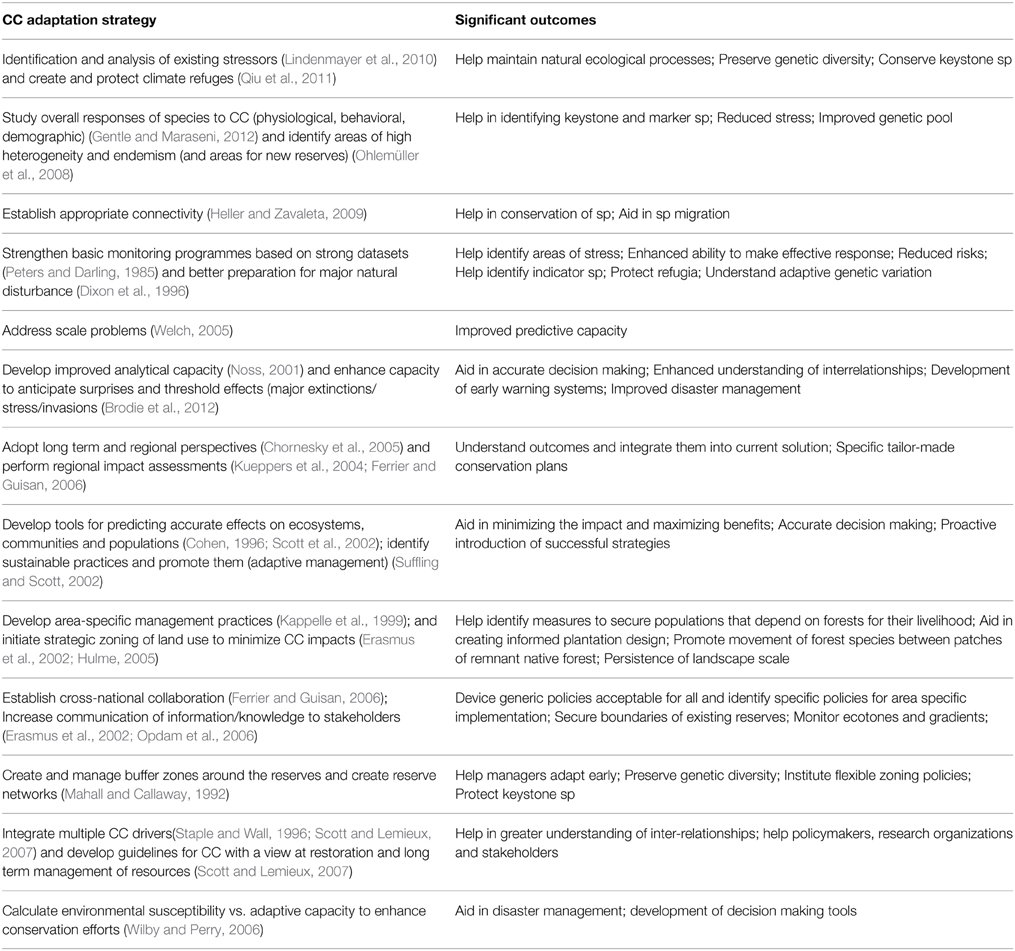
Table 1. Important CC adaptation strategies for biodiversity conservation and their significant outcomes.
Identification and Analysis of Existing Stressors
Identification and analysis of existing stressors with a view at understanding their interactions with ecosystem is one of the important factors for successful adaptation (Pradhan et al., 2006), because CC is linked to rainfall patterns and their effect on vegetation (Martin et al., 2010; Reuter et al., 2013) and socio economic factors, further impacting overall biodiversity (Tsay and Holben, 2007). The stressors once identified will help us understand the inter relationships between complex ecological processes, upon which human societies depend (Huntington, 2010), to device effective adaptation techniques, and to develop restoration programs including for threatened ecosystems and species (Mischke et al., 2008; Roy et al., 2012). This will enhance co-operation between the researchers, by promoting collaborative data analysis. One of the significant outcomes of this adaptation strategy is that, it will lead to greater understanding of CC and the importance of conservation, providing information on how different environmental factors are interlinked, where a small change in one factor will have tremendous implications on other factors in locations far away.
Initiation of Strategic Zoning of Land Uses
Several research studies have confirmed that an important adaptation technique for CC would be to sequester and store carbon in the terrestrial biosphere through better land management, particularly through improved native forest management (Mirza, 2002); establishing tree plantations (Hoorn et al., 2000) and revegetation programs, especially on cleared agricultural land (Hoorn et al., 2000), leading to enhanced benefits. Minimizing human disturbance such as logging will be important, not only for maximizing carbon storage potential, but also for conserving forest biodiversity, as has been shown elsewhere (Xu et al., 2008). Establishment of new areas of plantations on what was formerly agricultural land also can effectively help conserve biodiversity. The benefits include the promotion of the movement of forest-associated species between patches of remnant native forest, further contributing to their persistence at the landscape scale (USAID, Accessed 20121).
Better Preparation for Major Disturbances
Research studies confirm that natural disturbances such as flooding, cyclones, forest fires and land nutrient changes will be more frequent in the coming years as a direct consequence of CC (NSIDC, 20142). It is important to take an adaptive approach that is proactive, and better preparation for a disaster is vital for the conservation of biodiversity. It is further important to anticipate timing, exact location, the extent and severity of the disturbances. Direct benefits to such a pro-active adaptive approach are [a] enhanced ability to make management responses to major natural disturbance and [b] reduced risks of such responses on biodiversity (Millar et al., 2007). Such adaptive approaches have been successfully followed in Australia (Lindenmayer et al., 2010). There are a number of parallel benefits of these adaptive ecological impact studies, including identification of indicator species, understanding of short and long term effects on species (Lawler, 2009) better protection of refuges, better prediction of future, and greater understanding of adaptive genetic variation.
Identification and Designation of Reserves
Reserves are an important aspect of CC adaptation strategies with definite benefits (Rawat and Rawat, 1994; Tiwari, 2000) primarily because of stresses that affect biodiversity (Umina et al., 2005). Adapting CAR principle (comprehensive, adequate and representative) to identify and secure reserves have been suggested as an important adaptive biodiversity conservation strategy (Phillips et al., 2002; Pratchett et al., 2006). Major benefits of securing the reserves are to [a] help managers in early adaptation [b] preserve genetic diversity [c] institute flexible zoning policies in and around the reserves, and [d] protect functional groups and keystone species.
Increased Communication of Knowledge to Stakeholders
Establishment of International collaboration centers in unified action is being discussed more often as it leads to [a] identification of already existing common adaptive strategies among people from the region (Sanchez et al., 2010), [b] secure boundaries of existing reserves (Seabrook et al., 2011), [c] monitor ecotones and gradients (Keane et al., 2008), and [d] study process of change at multiple spatial and temporal scales (Butler, 2009).
Conflict of Interest Statement
The author declares that the research was conducted in the absence of any commercial or financial relationships that could be construed as a potential conflict of interest.
Footnotes
1. ^USAID. http://nepal.usaid.gov/component/content/article/56-in-the-spotlight/337-usaid-and-nasa-partner-to-establish-servir-himalaya.html [Accessed November 12, 2013].
2. ^NSIDC. http://nsidc.org/glims/ [Accessed November 12, 2013].
References
Brodie, J., Post, E., and Laurance, W. F. (2012). Climate Change and tropical biodiversity: a new focus. Trends Ecol. Evol. 27, 145–150. doi: 10.1016/j.tree.2011.09.008
PubMed Abstract | Full Text | CrossRef Full Text | Google Scholar
Butler, D. W. (2009). Planning iterative investment for landscape restoration: choice of biodiversity indicator makes a difference. Biol. Conserv. 142, 2202–2216. doi: 10.1016/j.biocon.2009.04.023
Chornesky, E. A., Bartuska, A. M., Aplet, G. H., Britton, K. O., Cummings-Carlson, J., Davis, F. W., et al. (2005). Science priorities for reducing the threat of invasive species. Bioscience 55, 335–348. doi: 10.1641/0006-3568(2005)055[0335:SPFRTT]2.0.CO;2
Cohen, S. J. (1996). Integrated regional assessment of global climatic change: lessons from the Mackenzie Basin Impact Study (MBIS). Glob. Planet. Change 11, 179–185. doi: 10.1016/0921-8181(95)00051-8
Dixon, R. K., Perry, J. A., and Vanderklein, E. L. (1996). Vulnerability of forest resources to global climate change: case study of Cameroon and Ghana. Clim. Res. 6, 127–133. doi: 10.3354/cr006127
Erasmus, B. F. N., Jaarsveld, A. S. V., Chown, S. L., Kshatriy, M., and Wessels, K. J. (2002). Vulnerability of South African animal taxa to climate change. Glob. Change Biol. 8, 679–693. doi: 10.1046/j.1365-2486.2002.00502.x
PubMed Abstract | Full Text | CrossRef Full Text | Google Scholar
Ferrier, S., and Guisan, A. (2006). Spatial modelling of biodiversity at the community level. J. App. Ecol. 43, 393–404. doi: 10.1111/j.1365-2664.2006.01149.x
Gentle, P., and Maraseni, T. N. (2012). Climate change, poverty and livelihoods: adaptation practices by rural mountain communities in Nepal. Environ. Sci. Pol. 21, 24–34. doi: 10.1016/j.envsci.2012.03.007
Grabherr, G. (2009). Biodiversity in the high ranges of the Alps: ethnobotanical and climate change perspectives. Glob. Environ. Change 19, 167–172. doi: 10.1016/j.gloenvcha.2009.01.007
Heller, N. E., and Zavaleta, E. S. (2009). Biodiversity management in the face of climate change: a review of 22 years of recommendations. Biol. Conserv. 142, 14–32. doi: 10.1016/j.biocon.2008.10.006
Hoorn, C., Ohja, T., and Quade, J. (2000). Palynological evidence for vegetation development and climatic change in the Sub-Himalayan Zone (Neogene, Central Nepal). Palaeogeogr. Palaeoclimatol. Palaeoecol. 163, 133–161. doi: 10.1016/S0031-0182(00)00149-8
Hulme, P. E. (2005). Adapting to climate change: is there scope for ecological management in the face of a global threat? J. Appl. Ecol. 42, 784–794. doi: 10.1111/j.1365-2664.2005.01082.x
Huntington, T. G. (2010). Chapter one—climate warming-induced intensification of the hydrologic cycle: an assessment of the published record and potential impacts on agriculture. Adv. Agron. 109, 1–53. doi: 10.1016/B978-0-12-385040-9.00001-3
Kappelle, M., van Vuuren, M. M. I., and Baas, P. (1999). Effects of climate change on biodiversity: a review and identification of key research issues. Biodiv. Conserv. 8, 1383–1397. doi: 10.1023/A:1008934324223
PubMed Abstract | Full Text | CrossRef Full Text | Google Scholar
Keane, R. E., Holsinger, L. M., Parsons, R. A., and Gray, K. (2008). Forest Climate change effects on historical range and variability of two large landscapes in western Montana, USA. Ecol. Manage. 254, 375–389. doi: 10.1016/j.foreco.2007.08.013
Khattak, G. A., Owen, L. A., Kamp, U., and Harp, E. L. (2010). Evolution of earthquake-triggered landslides in the Kashmir Himalaya, northern Pakistan. Geomorphology 115, 102–108. doi: 10.1016/j.geomorph.2009.09.035
Kueppers, L., Baer, P., Harte, J., Haya, B., Koteen, L., and Smith, M. (2004). A decision matrix approach to evaluating the impacts of land-use activities undertaken to mitigate climate change. Clim. Change 63, 247–257. doi: 10.1023/B:CLIM.0000018590.49917.50
Lawler, J. L. (2009). Climate change adaptation strategies for resource management and conservation planning. Ann. N.Y. Acad. Sci. 1162, 79–98. doi: 10.1111/j.1749-6632.2009.04147.x
PubMed Abstract | Full Text | CrossRef Full Text | Google Scholar
Lindenmayer, D. B., Steffen, W., Burbidge, W. A., Hughes, L., Kitching, R. L., Musgrave, W., et al. (2010). Conservation strategies in response to rapid climate change: Australia as a case study. Biol. Conserv. 143, 1587–1593. doi: 10.1016/j.biocon.2010.04.014
Mahall, B. E., and Callaway, R. M. (1992). Root communication mechanisms and intracommunity distributions of two mojave desert shrubs. Ecology 73, 2145–2151 doi: 10.2307/1941462
Martin, D., Lal, T., Sachdev, C. B., and Sharma, J. P. (2010). Soil organic carbon storage changes with climate change, landform and land use conditions in Garhwal hills of the Indian Himalayan mountains. Agric. Ecosys. Environ. 138, 64–73. doi: 10.1016/j.agee.2010.04.001
Mawdsley, J. R., O'Malley, R., and Ojima, D. S. (2009). A review of climate-change adaptation strategies for wildlife management and biodiversity conservation. Conserv. Biol. 23, 1080–1089 doi: 10.1111/j.1523-1739.2009.01264.x
PubMed Abstract | Full Text | CrossRef Full Text | Google Scholar
Millar, C. I, Stephenson, N. L., and Stephens, S. L. (2007). Climate Change and Forest of the future: managing in the face of Uncertainty. Ecol. Appl. 17, 2145–2151. doi: 10.1890/06-1715.1
PubMed Abstract | Full Text | CrossRef Full Text | Google Scholar
Mirza, M. M. Q. (2002). Global warming and changes in the probability of occurrence of floods in Bangladesh and implications. Glob. Environ. Change 12, 127–138. doi: 10.1016/S0959-3780(02)00002-X
Mischke, S., Kramer, M., Zhang, C., Shang, H., Herzschuh, U., and Erzinger, J. (2008). Reduced early Holocene moisture availability in the Bayan Har Mountains, northeastern Tibetan Plateau, inferred from a multi-proxy lake record. Palaeogeogr. Palaeoclimatol. Palaeoecol. 267, 59–76. doi: 10.1016/j.palaeo.2008.06.002
Noss, R. F. (2001). Beyond Kyoto: forest management in a time of rapid climate change. Conserv. Biol. 15, 578–590. doi: 10.1046/j.1523-1739.2001.015003578.x
Ohlemüller, R., Anderson, B. J., Araújo, B. M., Butchart, S. H. M., Kudrna, O., Ridgely, R. S., et al. (2008). The coincidence of climatic and species rarity: high risk to small-range species from climate change. Biol. Lett. 4, 568–572. doi: 10.1098/rsbl.2008.0097
PubMed Abstract | Full Text | CrossRef Full Text | Google Scholar
Opdam, P., Steingrover, E., and van Rooij, S. (2006). Ecological networks: a spatial concept for multi-actor planning of sustainable landscapes. Landsc. Urban Plan 75, 322–332. doi: 10.1016/j.landurbplan.2005.02.015
Peters, R. L., and Darling, J. D. S. (1985). The green house effect and nature reserves. Bioscience 35, 707–717. doi: 10.2307/1310052
Phillips, O. L., Martínez, R. V., Arroyo, L., Baker, T. R., Killeen, T., Lewis, S. L., et al. (2002). Increasing dominance of large lianas in Amazonian forests. Nature 418, 770–774. doi: 10.1038/nature00926
PubMed Abstract | Full Text | CrossRef Full Text | Google Scholar
Pradhan, B., Singh, R. P., and Buchroithner, M. F. (2006). Estimation of stress and its use in evaluation of landslide prone regions using remote sensing data. Adv. Space Res. 37, 698–709. doi: 10.1016/j.asr.2005.03.137
Pradhan, B. B., and Shrestha, B. (2007). Global changes and sustainable development in the Hindu Kush–Karakoram–Himalaya. Dev. Earth Surf. Processes 10, 281–290. doi: 10.1016/S0928-2025(06)10031-0
Pratchett, M. S., Wilson, S. K., and Baird, A. H. (2006). Declines in the abundance of Chaetodon butterflyfishes following extensive coral depletion. J. Fish Biol. 69, 1269–1280. doi: 10.1111/j.1095-8649.2006.01161.x
Qiu, Y.-X., Fu, C.-X., and Comes, H. P. (2011). Plant molecular phylogeography in China and adjacent regions: tracing the genetic imprints of Quaternary climate and environmental change in the world's most diverse temperate flora. Molec. Phylogen. Evol. 59, 225–244. doi: 10.1016/j.ympev.2011.01.012
PubMed Abstract | Full Text | CrossRef Full Text | Google Scholar
Rawat, J. S., and Rawat, M. S. (1994). Accelerated erosion in the Nana Kosi watershed, Central Himalaya, India. Part II: human impacts on stream runoff Mountain Res. Dev. 14, 25–38. doi: 10.2307/3673736
Reuter, M., Kern, A. K., Harzhauser, M., Kroh, A., and Piller, W. E. (2013). Global warming and South Indian monsoon rainfall—lessons from the Mid-Miocene. Gondwana Res. 23, 1172–1177. doi: 10.1016/j.gr.2012.07.015
Roy, N. G., Sinha, R., and Gibling, M. R. (2012). Aggradation, incision and interfluve flooding in the Ganga Valley over the past 100,000 years: testing the influence of monsoonal precipitation. Palaeogeogr. Palaeoclimatol. Palaeoecol. 356–357, 38–53. doi: 10.1016/j.palaeo.2011.08.012
Sanchez, G., Rolland, Y., Corsini, M., Braucher, R., Bourles, D., Arnold, M., et al. (2010). Relationships between tectonics, slope instability and climate change: cosmic ray exposure dating of active faults, landslides and glacial surfaces in the SW Alps. Geomorphology 117, 1–13. doi: 10.1016/j.geomorph.2009.10.019
Scott, D., and Lemieux, C. (2007). Climate change and protected areas policy, planning and management in Canada's boreal forest. Forest Chron. 83, 347–357. doi: 10.5558/tfc83347-3
Scott, D., Malcolm, J. R., and Lemieux, C. (2002). Climate change and modeled biome representation in Canada's national park system: implications for systems planning and park mandates. Glob. Ecol. Biogeogr. 11, 475–484. doi: 10.1046/j.1466-822X.2002.00308.x
Seabrook, L., McAlpine, C. A., and Bowen, M. E. (2011). Restore, repair or reinvent: options for sustainable landscapes in a changing climate. Landsc. Urban Plan 100, 407–410. doi: 10.1016/j.landurbplan.2011.02.015
Settele, J., Scholes, R., Betts, R., Bunn, S. E., Leadley, P., Nepstad, D., et al. (2014). “Terrestrial and inland water systems,” in Climate Change: Impacts, Adaptation, and Vulnerability. Part A: Global and Sectoral Aspects. Contribution of Working Group II to the Fifth Assessment Report of the Intergovernmental Panel on Climate Change. Available online at: https://www.ipcc.ch/pdf/assessment-report/ar5/wg2/WGIIAR5-FrontMatterA_FINAL.pdf
Staple, T., and Wall, G. (1996). Climate change and recreation in nahanni national park reserve. Can. Geogr. 40, 109–120. doi: 10.1111/j.1541-0064.1996.tb00439.x
Suffling, R., and Scott, D. (2002). Assessment of climate change effects on Canada's national park system. Environ. Monit. Assess. 74, 117–139. doi: 10.1023/A:1013810910748
PubMed Abstract | Full Text | CrossRef Full Text | Google Scholar
Tiwari, P. C. (2000). Land-use changes in Himalaya and their impact on the plains ecosystem: need for sustainable land use. Land Use Policy 17, 101–111. doi: 10.1016/S0264-8377(00)00002-8
Tsay, S. C., and Holben, B. N. (2007). 5 Radiation, aerosol joint observations—monsoon experiment in Gangetic-Himalayan area (RAJO-MEGHA): synergy of satellite-surface observations. Dev. Earth Surf Processes 10, 25–26. doi: 10.1016/S0928-2025(06)10005-X
Umina, P. A., Weeks, A. R., Kearney, M. R., McKechnie, S. W., and Hoffmann, A. A. (2005). A rapid shift in a classic clinal pattern in drosophila reflecting climate change. Science 308, 691–693. doi: 10.1126/science.1109523
PubMed Abstract | Full Text | CrossRef Full Text | Google Scholar
Veech, J. A. (2003). Incorporating socioeconomic factors into the analysis of biodiversity hotspots. Appl. Geogr. 23, 73–88. doi: 10.1016/S0143-6228(02)00071-1
Welch, D. (2005). What should protected areas managers do in the face of climate change? George Wright Forum. 22, 75–93.
Wilby, R. L., and Perry, G. L. W. (2006). Climate change, biodiversity and the urban environment: a critical review based on London, UK. Prog. Phys. Geogr. 30, 73–98. doi: 10.1191/0309133306pp470ra
Xu, J. C., Sharma, R., Fang, J., and Xu, Y. F. (2008). Critical linkages between land-use transition and human health in the Himalayan region. Environ. Internat. 34, 239–247. doi: 10.1016/j.envint.2007.08.004
PubMed Abstract | Full Text | CrossRef Full Text | Google Scholar
Keywords: climate change, adaptation, biodiversity, conservation, sustainable development
Citation: Subrahmanyam S (2015) Effective climate change adaptation strategies for biodiversity conservation. Front. Environ. Sci. 3:32. doi: 10.3389/fenvs.2015.00032
Received: 07 January 2015; Accepted: 01 April 2015;
Published: 21 April 2015.
Edited by:
Veerasamy Sejian, Indian Council of Agricultural Research, IndiaReviewed by:
Cemal Turan, Mustafa Kemal University, TurkeyCopyright © 2015 Subrahmanyam. This is an open-access article distributed under the terms of the Creative Commons Attribution License (CC BY). The use, distribution or reproduction in other forums is permitted, provided the original author(s) or licensor are credited and that the original publication in this journal is cited, in accordance with accepted academic practice. No use, distribution or reproduction is permitted which does not comply with these terms.
*Correspondence: Sreenath Subrahmanyam,cy5zdWJyYWhtYW55YW1AcXViLmFjLnVr
;c3JpbmF0aDE4MThAZ21haWwuY29t