 Abad Chabbi
 Henry W. Loescher
 Margaux S. Dillon
- 1Institut National de la Recherche Agronomique, Lusignan, France
- 2Institut National de la Recherche Agronomique, Ecosys, Thiverval-Grignon, France
- 3National Ecological Observatory Network (Battelle), Boulder, CO, United States
- 4Institute of Alpine and Arctic Research, University of Colorado, Boulder, CO, United States
The present paper is a preliminary analysis of the funding, organizational culture, environmental, and innovation challenges that are currently faced by Environmental Research Infrastructures (ERI) and private enterprises working together. We contend there is a strong case for building creative collaboration models across these sectors that also require to new management tools to effectively generate economically-driven solutions to the global society at large in the face of climate change. To that end, public/private stakeholders that are likely to partner to address climate change also face new frontiers in how they will structurally and organizationally work together. We explore these issues around changing political, scientific, commercial environments; partnerships models; barriers in bridging these communities; and the role of formal project management processes. There is no one solution to fit all conditions that can bring together a specific public/private enterprise that incorporates a research infrastructure. However, we have provided two examples of collaborative models of public/private enterprises to highlight how these issues can be addressed, and to foster future dynamic and creative solutions to this problem.
Introduction
The economic exploitation of ecosystem services now threatens our food security, the stability of natural and managed ecosystems, and global biodiversity. Environmental Research Infrastructures (ERI) have emerged to fill important gaps in our understanding of ecological processes, in response to the drivers of change the likes of climate, extreme climate events, invasive species, and land use change (Table 1, Heinz Foundation, 2006, 2008; Peters et al., 2014). While ERIs are designed to fill such gaps, their potential to transform other sectors of the economy and decision-making patterns remains largely untapped worldwide. Moreover, meeting societal needs in a changing environmental landscape provides a new context for the private sector to explore emerging business opportunities. Academicians (who utilize ERIs) and the private sector increasingly recognize they may need to move toward less conventional partnerships to address societal needs, and to justify ERIs operational budgets (Buhmann, 2016). Because these are still nascent ERIs, emerging economies and the corresponding opportunity are also still novel, and the means to establish public/private partnerships likewise requires creative models of engagement.
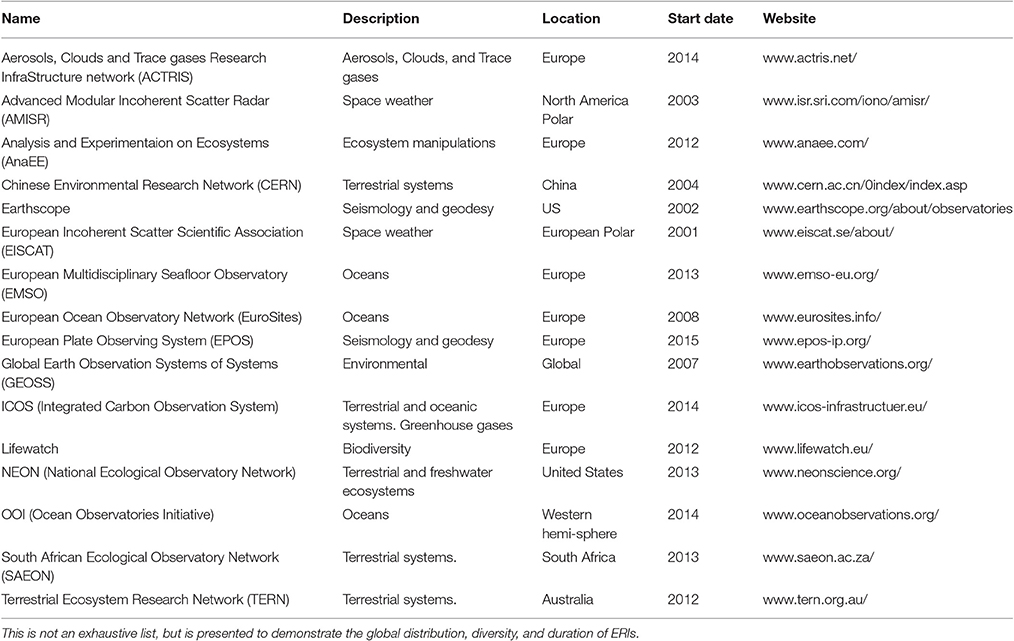
Table 1. Environmental Research Infrastructures (ERIs) that are borad in both temporal and spatial scale and designed to address societal challenges, e.g., Loescher et al. (2017).
ERIs were established to address unprecedented ecological research questions, such as, the deep-rooted causes and equally far-reaching consequences of the rising threats to global ecosystems (Soranno and Schimel, 2014). They now have a unique opportunity to contribute to new economies, natural resource management, and meet the needs of private enterprises. ERIs, however, are structurally more akin to university and large research structures. Likewise, the private sector and corporate structures function quite differently from ERIs, universities, and public enterprises. For instance, the ability for ERIs to collect data, challenge our current knowledge and provide (model) analytics would allow them to effectively forecast ecological states, i.e., decision spaces (Schimel and Keller, 2015; Chabbi et al., 2017; Loescher et al., 2017). The financial and intellectual capital brought to bear in this example typically cannot be afforded by the private sector. Likewise, the internal science scope and fiduciary responsibilities of ERIs do not necessarily allow for the development of market-driven endeavors. The accuracy, precision, and timescales to deliver research data (seasons to years) to academicians differ from the near real-time need for actionable data capable of yielding a competitive advantage to the private sector. Hence, ERIs, private enterprises, and other decision-makers must embrace a creative frontier in the variety of innovative partnerships models, identify and overcome barriers to work together and achieve sustainable new economies. Here, we explore these frontiers, barriers, and present actionable solutions to link ERIs, private enterprises and other decision-makers toward developing new economies, e.g., integrated information services for real-time environmental management across a wide market-sector of research, State and Local governments, natural resource managers, and other novel businesses.
Current Political, Scientific, and Private Sector Environments
The Political Environment
Governmental and non-governmental organizations alike stress the growing importance of environmental risks on national economies around the world (NRC, 2007; PCSAT, 2011; WEF, 2017). Climate change, climate-change mitigation and adaptation failure, man-made environmental disasters, extreme weather events, natural disasters, biodiversity loss, and ecosystem collapse rank as high-risk and high-likelihood (WEF, 2017). Governmental bodies must therefore not fail to address the threats to both the environmental and the economic aspects of quality of life that derive from the accelerating degradation of the environmental capital—the Nation's ecosystems and the biodiversity they harbor—and—from which ecosystem services flow (Dilling and Lemos, 2011; Holdren et al., 2014). The economic and environmental dimensions of societal well-being are as indispensable as well as they are tightly intertwined (PCSAT, 2011; Adams, 2015). Governmental planning is inherently complex, as are the prioritization of budgets to address the linkage between environments and economies, and the funding of research infrastructures competing for governmental budgets (Sanz-Menéndez and Cruz-Castro, 2003). The financial crisis of 2008 and the resulting degrees of economic recession have placed additional strain in governmental resource planning and the prioritization of budgets (Geels, 2013). It also severely eroded public trust in public organizations and businesses (Edelman Intelligence, 2017). Moreover, the public and political interest in addressing climate change has ebbed and flowed over the past decade (Lorenzoni and Pidgeon, 2006), whereas solutions have to be consistent over decades in order to be successful (IPCC, 2014). The need for governments to adapt to a changing environment requires robust decision-making tools to inform policy and regulatory bodies and protect human health and food security by moving toward a more sustainable management of natural resources (UNCSD, 1987; Lozano et al., 2016; The European Commission, 2016).
The Scientific Environment
Current disparities in political reasoning for funding commitments of ERIs and correspondingly uneven national funding instruments across ministries and agencies have resulted in a fragmented research landscape (PCSAT, 2011). Funding for large-scale science infrastructures has typically fared better under conservative governments, compared to more liberal administrations. This funding also tends to favor projects that are apolitical in nature, that is to say, projects which outcomes do not affect political decisions (i.e., high-energy particle accelerators, telescopes, ocean vessels, etc.; Miller pers. commun., 2009; T. Beasley pers. commun., 2009).
Though, ERIs are designed for basic research, they produce information relative to the state of the environment, and as such, are actionable and politically responsible. In addition, the legitimacy of environmental data often comes under political scrutiny (Mooney, 2005; McCright and Dunlap, 2011), rekindling the same argument made by Ernst Mayr made that biology cannot be simply reducible to mathematical formulae or the laws of chemistry and physics, and establishing it as a legitimate science in the eyes of many national academies (Mayr, 1965, 1969). Moreover, traditional methods of extrapolating on environmental observations either prove too limited for commercialization, or provide justification for climate deniers (McCright and Dunlap, 2011; Howard-Grenville et al., 2014). Emblematic of such tensions, ERIs stand to deliver key solutions to societal challenges by harnessing the opportunities provided by advanced analytics (Hey et al., 2009; Soranno and Schimel, 2014). Even though, their long-term sustainability is still in question.
There is a need to reconcile the resources to meet a ERIs' core mission of under ongoing budgetary challenges and political agendas (Campbell et al., 2015; Beltrán-Esteve and Picazo-Tadeo, 2017). One strategy consists in ERIs working with governmental structures, to advocate their mission and align with legislation, planning documents, strategic roadmaps (NRC, 2004; NSF, 2014; ESFRI, 2016) in order to secure formal, long-term commitments. To solidify such commitments, it is also the responsibility of ERIs to adopt formal business management and project management tools for status, reporting and future resource planning (Loescher et al., 2017). This in turn depends on funding agencies to provide the appropriate oversight to ensure the responsible use of public funds and alignment to their respective strategic roadmaps and political mandates (NRC, 2001; NSF, 2015; ESFRI, 2016).
Additional strategies are needed to secure diversified funding for ERIs in today's often negative political climate toward actionable science (Brown, 1997; Heritage Foundation, 2017; Malakoff and Cornwall, 2017). Diversification of funding resources is one strategy that ERIs can implement to assuage the lack of current political resolve. Funding agencies often point to the need for ERIs to partner with the private sector, more as a rationale to show that jobs and economies can be developed and less so to justify operational budgets. There are in fact grants and loan mechanisms to support innovation partnerships with the private sector, e.g., InnovFin, as coordinated by the European Investment Bank or the US Small Business Innovation Research Grants and Technology Transfer Grants. In Europe, for example, ~100 projects under FP7 cost 100B € since 2014 and another ~1.4 B € in loan guarantees (The European Commission, 2016; The European Investment Bank, 2017). Although this was considered a solution to cover construction costs, the European Commission itself recognizes the difficulty for ERIs to apply for loans, given they are programmatically ill-equipped to generate the funds to repay the bank. Overall, these programs are met with limited success as their development models tend to be structurally inflexible and their targeted efforts appear to lack the ability to align with entrepreneurial priorities. The European Commission nevertheless supports private sector investment in co-designed products and services as a means to bridge ERI's funding gap. Other (tax) incentives are likewise under consideration to strengthen private sector investments and encourage collaboration with ERIs. In other words, the challenge in creating public/private ventures is increasingly being addressed by governmental program officers as they too are becoming advocates in developing creative engagement models.
The Private Sector
From a corporate viewpoint, environmental challenges are associated to the additional and often unforeseen costs they generate (Eceiza et al., 2017). Planning and mitigation of such risks constitute an active area of development (Lash and Wellington, 2007)—as well as the business and innovation opportunities this creates. Market competition remains the primary motivation to mitigate these risks and their associated costs. Corporations that seek cost mitigation solutions often rely on in-house efforts or external consultancies (excluding stand-alone efforts for the time being). It is therefore still uncommon for the full breath of scientific expertise and resources to be brought to bear.
Global environmental changes create new entrepreneurial opportunities for profitable enterprises, products, services, value creation, and markets. At the frontier of such efforts, York et al. (2016) found that “environmental entrepreneurs” are motivated by both commercial and ecological concepts and prioritize their development efforts based on the strength and linkages between these two concepts. Organizational theories also recognize a level of social responsibility, along with the creation of novel hybrid organizations (Battilana et al., 2012; Smith et al., 2013; Hockerts, 2015). The linkage (organizational identity) among commercial ecological and social interests arise as a key motivation in relation to unique products that public ERIs may contribute toward. This requires dispelling the sense that ERI are competitors in knowledge production and value creation and instead promote their inherent and mandated identity as collaborators (Schillo and Kinder, 2017). Linking commercial, ecological, and social interests in new innovative ventures should therefore be a cornerstone of any ERI business plan (Porter and Kramer, 2011; Liu and Brody, 2016).
Working Together
Building on the Millenium Report (MEA, 2005), the United Nations identified 17 Sustainable Goals to address climate change, water resources, sustainable management of the oceans and land and food security—and the economic systems that support this sustainability (UN, 2016 and others the likes of KPMG, 2014). Tangible and actionable efforts to address these goals could amount to 60% of the immediate economy and could yield well beyond $12 T US per year by 2030 and up to 380 million jobs globally—90% of which in developing countries (Héraud, 2016). It would indeed require an injection of public and commercial finance, and in particular (Héraud, 2016) estimated an additional investment of $2.4T US in global infrastructure would be needed. Here, we focus on establishing a development strategy to link commercial ventures with the products and services provided by ERIs as part of their public mandate.
Seeking Solutions in Hybrid Funding Models for ERIs
To date, the scientific knowledge derived from ERIs typically makes its way into scientific publications by researchers exploring basic and applied science. This flow of knowledge-based systems is a common paradigm for funding agencies (Stocker, 2017), where the justification of ERIs operations directly supports scientific research and indirectly, the economics of research institutions, e.g., universities, agencies, and ministries. In today's current political environment, there are implicit and explicit mandates to enhance the public resources spent on science for societal relevance, value-added efforts and innovative types of engagement with the private sector to create new economies and jobs (PCSAT, 2011; Chabbi et al., 2017). It may stand to reason that new value created by leveraging scientific expertise to co-develop new knowledge and services may be beneficial to the private sector. This results in a fundamental difference in funding mechanisms (public vs. corporate finance) and motivation (advancement of knowledge vs. competitive advantage and profit). In other words, few within the private sector would consider a direct investment in research solely based on publication performance (Lin and Bozeman, 2006). A business model that is likely to bring these two disparate communities together has yet to be established and with it, the necessary common language to bridge these communities. Indeed, capturing the value added of scientific research through metrics traditionally found in business models and adjacent marketing strategies is difficult (Ehret et al., 2013).
The timelines that correspond to funding and project lifecycles are different for scientists and entrepreneurs. Public funding mechanisms typically invest in research projects within a 1–5 year timeframe, whereas entrepreneurial projects often develop over much longer periods of time. There are cultural barriers in the different ways these partners think about their roles and responsibilities in reaching innovation milestones, e.g., researchers forgo their academic calling to advance frontier science, or be unclear as to their advisory/leadership role in relations to their corporate counterparts. On the other hand, entrepreneurs may struggle with the notion that “better” is often the enemy of “good” (Rodrigo et al., 2013). The lack of a formalized structure or process to bring these communities together around innovational ideas creates a disjunct relation at best and a disincentive at worse.
In an effort to bridge this gap, governments have encouraged universities to become innovation incubators in association with industries, through public incentives for cross-sector technological transfer and public/private partnerships (Perkmann and Walsh, 2004). Moreover, capital investments return to the universities in a business model which has proven fruitful (Youtie and Shapira, 2008). Universities provide the environment, the structure and functions needed to foster innovation and start-up companies. Innovations typically come from within the university faculty or student body. The core functions they support include legal support; management of intellectual property rights (IPR); physical development space; access to engineering, design, manufacturing and marketing expertise, market analyses, access to venture capital (VC), and ongoing mentorship in the development process (Figure 1). In some instances, the private sector can also partner with universities to tap into promising scientific advances and universities' developmental concepts, which cannot be generated in-house. Through these types of business partnerships, universities can also access other means of capital that would otherwise not be available, e.g., seed funds, other VC and access to external “private” datasets (Bozeman and Gaughan, 2007). This “non-zero sum game” continues to provide unexpected advantages and opportunities to all parties involved, e.g., new innovations/products capable of assisting decision-makers, anticipating regulatory pressures, and identify additional public funds (Boardman and Corley, 2008). A key strength of this university model is that it can support a large range of innovation projects with needs and markets yet to be determined.
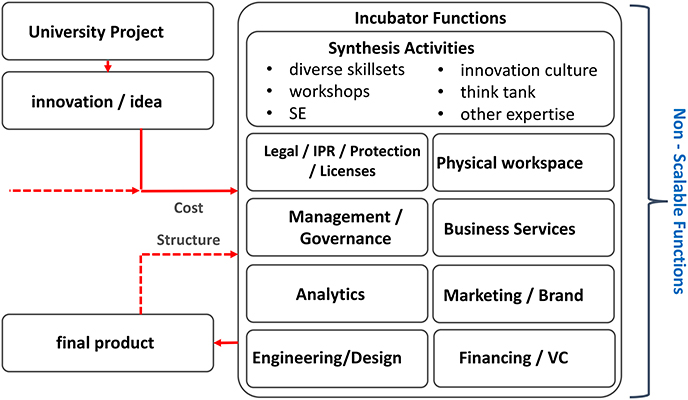
Figure 1. University-based innovation incubator hub model. With core, internal incubator functions on the right, and external activities on the left. SE, system engineering; VC, Venture capital. Description of “synthesis activities” can be found in Specht (2017).
Examples of university-based investments in such a model are numerous. As such, the capabilities of their core functions have limits. Universities cannot incorporate all ideas and innovations through their processes and often rely on an application process by way to prioritize partners/ideas most likely to succeed, and make periodic evaluations to determine the ongoing project validity and manage the corresponding risk portfolio. While this proves a sustainable model, it also results in key limitation in scaling such functions beyond what is fiscally (cost-return structure) and physically feasible in such a setting (Figure 1).
An alternative model is to develop a cyber infrastructure, analytical tools, and adaptive capacity, to augment new capabilities based on the ongoing needs of the client base (private sector; Figure 2). This value-added model is more service-oriented, targeted at decision-making and utilizes open data sources. Key to this models' success is the use of synthesis centers to bring together diverse stakeholder communities (e.g., researchers, educators, decision-makers, managers, agencies/ministries, corporations, and entrepreneurs) and distill the needs and capabilities of a novel project. This business model is also based on the notion that analytics for decision-making are most effective and critical within a 2–3-year planning window. This is true for governments and municipalities charged with managing public economics and growth models, but also for private enterprises seeking to maintain their competitive advantage. This helps develop a clear, concise, and constrained project definition (use case) that can be managed and articulated into contractual form. It also identifies the needs, skillsets, and level-of-effort needed to complete the deliverable(s) required by the client. The needs for each (private) client will be different and a tailored approach is required.
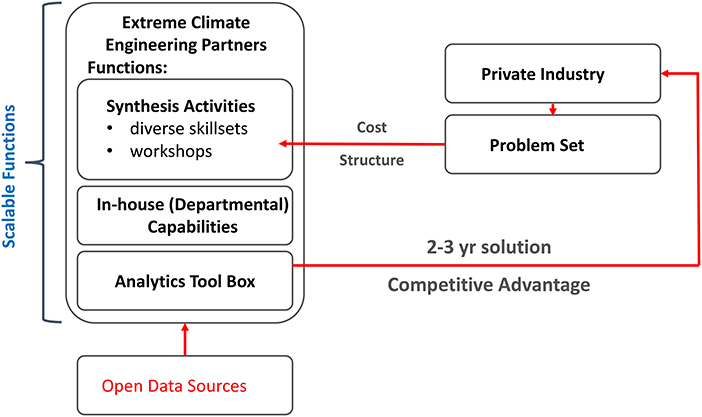
Figure 2. The National Center for Atmospheric Research's Engineering for Extreme Climate Partnerships value-added model (www.ncar.ecep.edu), with core, internal incubator functions on the left, and external activities on the right.
Developing a competitive advantage in natural resource management (supply chain) is only effective within a 2–3-year planning window (Christopher and Peck, 2004; Tietenberg and Lewis, 2012). Moreover, the nuance with public environmental data (and ERIs) is that they provide data that is free and openly available to research and educational communities. While advanced applied analytics for private enterprises are not included in this model, there is a social imperative in making these products available to the public at some point in time, when competitive advantage is no longer a contractual requirement (after the above-mentioned 2–3-year window). A 2–3-year competitive advantage, if successful, provides the opportunity for private and public enterprises to return to the partnership and develop the next analytic that can generate their next 2–3-year window of competitive advantage. This model has been proven successful by public/private partnerships in the National Center for Atmospheric Research; Extreme Climate Engineering Partnerships (www.ecep.ucar.edu; Figure 2).
Generally, environmental open-data represents an untapped resource for innovation worldwide. The need to better integrate large-scale “Big Data” science into the private sector is articulated as a “must do” by stakeholders, governments, and the public at large (Pulwarty and Maia, 2015). Yet, opportunities to do so are limited and successes even less common. Often, success occurs by happenstance rather than targeted consideration of the joint interests of public and private entities (see Figure 1.3 in Chabbi et al., 2017). In this instance, changing the current (low success) paradigm of scientist-initiated innovation lies in developing the stakeholder-based needs first, then engaging in development pathways. One of the roles of ERIs is therefore to create the forum to change the current paradigm of how public and private enterprises interact, in order to facilitate innovation (Chabbi et al., 2017; Specht, 2017).
There are clear strengths and weaknesses with both the university-based and value-added models for academia and private sector to partner. A potential middle-ground model might be a more holistic partnership with a public-private enterprise that incorporates all the functional attributes of both models and is directed toward key environmental markets. The scalability issue in the university model can be addressed by federating existing physical capabilities from ERIs, universities, private enterprises, and synthesis centers. Providing a sustainable structure to bring together innovators and academicians will be instrumental in generating successful outcomes and effectively modifying the current paradigm (see above). Pilot projects are needed to provide proof-of-concept and lessons learned in an adaptive structure. Training, joint strategic planning, and stakeholder engagement efforts will play an essential role in bridging gaps in cultures, languages and approaches—and ultimately foster innovation.
In all models, there is a persistent issue in managing the IPR and data sovereignty (DS) challenges that inevitably arise from working across geopolitical borders and other public and private protection frameworks. The mandate for open-source data is required of all governmentally-funded projects, i.e., the European Commission, US National Science Foundation, US Department of Energy, etc. While managing IPR and DS are not novel, new specific challenges arise in relation to environmental sciences. For example, DS issues may arise when developing new ventures in crop futures, food security and or in incentives for shifting agronomic economics that have competitive implications across borders and governments (Teece, 2010). There are nevertheless encouraging approaches to address IPR and DS and open-data access mandates, grounded in the delivery of added-value analytics, decision-space tools and federated web services tailored to the private client needs—though this will have to be further developed through use cases and prototype activities.
Programmatic Tools to Foster the Development of Public Private Enterprises
It is difficult for traditional grant structures based on the research capacity of principle investigators (PI) to provide consistent, long-term, quality-controlled, multi-dimensional data designed to provide data for services, and decision-making. This is particularly true as most PI-based research is targeted for their specific hypotheses, and funding horizons are typically 1–5 years. Nevertheless, ERIs stand to provide novel solutions to foster long-term sustainability in designing deliverables for commercialization. Because of the large public expenditures for ERIs (often > $200 M US investments), they are subject to stringent governmental oversight. This in turn requires the use of formal project management, system engineering, and corporate planning tools (Loescher et al., 2017).
These corporate planning tools help ERIs define science scope, budget, identify and mitigate risk, resource load, define internal roles and responsibilities, integrated resource loaded schedules and ultimately, provide reporting metrics to their sponsors (Lozano et al., 2016). Moving from PI-based hypothesis testing to a requirements-based framework is novel for the academic environmental community (Loescher et al., 2017). This approach paves the way in to justify and delineate the scope of large governmental projects. The potential of large-scale, integrated science requirements are however, only now being acknowledged outside the ERI framework, which has large implications for commercialization. For example, ERI's can clearly provide the physical and cyber-infrastructure interfaces to ingest real-time data and its associated metadata.
Other planning tools currently used by ERIs include classic SWOT analyses (Hill and Westbrook, 1997; Humphrey, 2005), stakeholder engagement (Herremans et al., 2016), sigma six (Tennat, 2001), PmBok (PMI, 2013), verification and validation engineering, commissioning processes, and the like (Bartocci and Picciaia, 2013). There are often heated debates on the types of software and specific reporting analytics used in project management, but the corresponding variance is approximatively ~10% among these tools (T. Beasley, pers. commun., 2009). These tools accomplish a “linearization” of the inherently “non-linear” and time-variant problems that face all project development at such a large scale. These planning tools provide the scope, the institutional health metrics, human resource planning, resources prioritization, market viability (Calabrese et al., 2016), key performance indicators, and organizational goals (Maas et al., 2016) necessary for ERIs to make the case to private entities, for them to integrate their relevance and eventually engage and develop collaborative planning horizons (Braama et al., 2016).
Uncertainty Measures and Decision-Making Trade Spaces
Research quality data relies on mean trend estimates relative to the processes in question (the signal) and variance measures (potential noise) in order to perform more advanced analytics. The general public often looks toward science to provide answers to environmental problems (Miller et al., 2014). Yet providing uncertainty estimates intended for decision-makers differs in approach to the classic production of statistics to test scientific hypotheses (JCGM, 2008). ERIs provide statistically and “International Standards Organization (ISO)” defensible measures of uncertainty (Taylor and Loescher, 2013; rf. Csavina et al., 2017). But the lack of statistical approaches capable of underpinning a range of probabilities given a specific decision about natural resource management that has to be made today. Important to note, that it is also imperative to attribute to causality, not just trend and variance estimates, and not to confuse a cause and a consequence of a particular process of interest. This is a particularly salient for any service-oriented collaboration that utilizes ERI data. The crux of this issue lies with the ability of private entities to articulate their constraints to address a specific problem—and the level of uncertainty needed to design a valuable commercial product, and in terms that scientists can understand. On the other hand, scientists struggle in communicating “what uncertainty means” in layman terms and are challenged to provide new statistical approaches to meet the growing societal demand for actionable results.
The question of bringing together ERIs and the private sector in an entrepreneurial venture is not novel. However, both ERIs and individual private entities must be mature enough in their approach toward engagement with the other partner, and have the appropriate skillsets and vocabulary (Chabbi et al., 2017; for a list of ERIs, see Table 1, and Tables 1–3 in Peters et al., 2014). Road mapping activities have identified early adopters presenting the skillsets likely to facilitate joint ventures (Table 2). Additional unforeseen and serendipitous opportunities may well arise as a result.
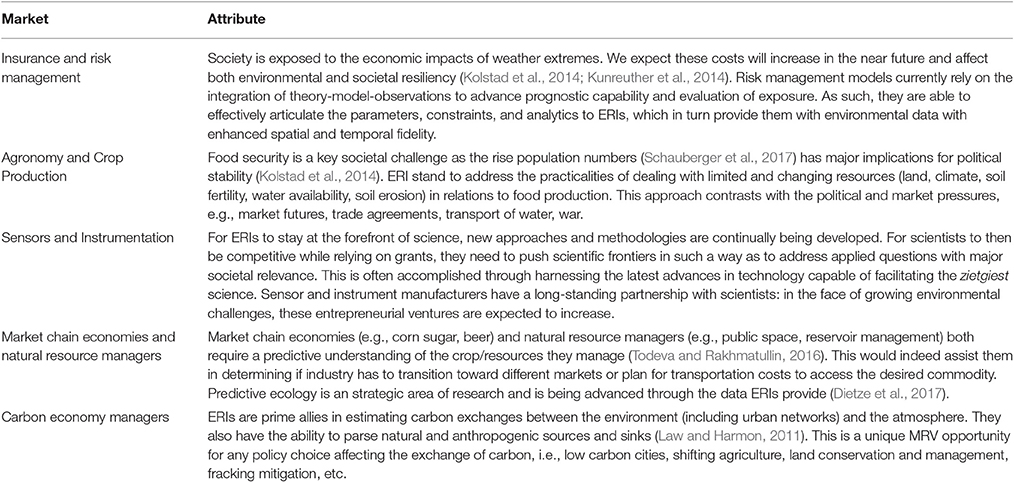
Table 2. Key markets, early adopters, and their attributes.
Conclusion
Overcoming the current challenges to bridge science and private enterprises are underpinned by the strong sense of social responsibility of all parties to co-develop strategic products and services. The frontier to tackle future environmental problems as well as the needed structure between public and private enterprise is unknown, and requires creative solutions. At the crux of this issue lies the shared responsibilities in demonstrating how advanced environmental analytics identify and structure priorities in organizational changes toward long-term, sustainable value to society at large. Secondary to the strong societal imperative to tackle these issues, are also the cultural barriers that have to be overcome to link public and private enterprises together. Successful programmatic tools and organizational models do exist to help overcome these barriers that should be part of the explicit planning for any specific project. Each innovation project is different, and as such, require unique solutions. Yet we highlight some common issues external and internal, that have to be addressed and cognizant of in the development of public/private enterprises. Here, we have provided the current scientific, commercial, and political landscape by which these solutions will develop, and we have outlined some, creative, and successful models for such endeavors.
We would also contend that knowledge-based economies should bring together all the actors involved (broad stakeholder involvement) are more likely to harness the diversity of such wide-ranging challenges. At the same time, such collaborations cannot be everything to everyone, and each specific collaborative project should be well constrained and scoped. The benefit for ERI lies principally in building upon publically-funded, bottom-up science, whereas the added valued of the use of public funds in developing market-driven solutions also builds economic resilience (rather than the detrimental impacts of environmental change alone).
Author Contributions
AC initiated the writing of the paper and led the work. HL contributed substantially with the overall concept, ideas, and writing of the paper. MD participated in the writing of the paper.
Conflict of Interest Statement
The authors declare that the research was conducted in the absence of any commercial or financial relationships that could be construed as a potential conflict of interest.
Acknowledgments
This work was supported by the European Commission through the FP7 project Analysis and Experimentation in Ecosystems Grant Agreement (AnaEE) Number 312690 and, the H2020 ENVRIplus Grant Agreement number 654182 who funded MD. HL acknowledges the National Science Foundation (NSF) for ongoing support. NEON is a project sponsored by the NSF and managed under cooperative support agreement (EF-1029808) to Battelle. Any opinions, findings, and conclusions or recommendations expressed in this material are those of the authors and do not necessarily reflect the views of our sponsoring agencies.
References
Adams, C. A. (2015). The international integrated reporting council: a call to action. Crit. Perspect. Account. 27, 23–28. doi: 10.1016/j.cpa.2014.07.001
Bartocci, L., and Picciaia, F. (2013). “Towards integrated reporting in the public sector,” in Integrated Reporting, eds C. Busco, M. Frigo, A. Riccaboni, and P. Quattrone (Cham: Springer), 191–204. doi: 10.1007/978-3-319-02168-3_12
Battilana, J., Lee, M., Walker, J., and Dorsey, C. (2012). In search of the hybrid ideal. Stanford Soc. Innov. Rev. 10, 50–55.
Beltrán-Esteve, M., and Picazo-Tadeo, A.-J. (2017). Assessing environmental performance in the European Union: eco-innovation versus catching-up. Energy Policy 104, 240–252. doi: 10.1016/j.enpol.2017.01.054
Boardman, P. C., and Corley, E. A. (2008). University research centers and the composition of research collaborations. Res. Policy 37, 900–913. doi: 10.1016/j.respol.2008.01.012
Bozeman, B., and Gaughan, M. (2007). Impacts of grants and contracts on academic researchers' interactions with industry. Res. Policy 36, 694–707. doi: 10.1016/j.respol.2007.01.007
Braama, G., Uit de Weerdb, L., Hauckc, M., and Huijbregtsc, M. (2016). Determinants of corporate environmental reporting: the importance of environmental performance and assurance. J. Clean. Prod. 129, 724–734. doi: 10.1016/j.jclepro.2016.03.039
Brown, G. E. Jr. (1997). Environmental science under siege in the U.S. Congress. Environ. Sci. Policy Sustain. Dev. 9, 12–31. doi: 10.1080/00139159709604359
Buhmann, K. (2016). Public regulators and CSR: the ‘social licence to operate’ in recent united nations instruments on business and human rights and the juridification of CSR. J. Bus. Ethics 136, 699–714. doi: 10.1007/s10551-015-2869-9
Calabrese, A., Costa, R., Levialdi, N., and Menichini, T. (2016). A fuzzy analytic hierarchy process method to support materiality assessment in sustainability reporting. J. Clean. Prod. 121, 248–264. doi: 10.1016/j.jclepro.2015.12.005
Campbell, C. A., Lefroy, E. C., Caddy-Retalic, S., Bax, N., Doherty, P. J., Douglas, M. M., et al. (2015). Designing environmental research for impact. Sci. Total Environ. 534, 4–13. doi: 10.1016/j.scitotenv.2014.11.089
Chabbi, A., Loescher, H. W., Tye, M., and Hudnut, D. (2017). “Integrated experimental research infrastructures as a paradigm shift to face an uncertain world,” in Terrestrial Ecosystem Research Infrastructures: Challenges and Opportunities, eds A. Chabbi and H. W. Loescher (Boca Raton, FL: CRC Press; Taylor & Francis Group), 3–23.
Christopher, M., and Peck, H. (2004). Building the resilient supply chain. Int. J. Logist. Manage. 15, 1–13. doi: 10.1108/09574090410700275
Csavina, J., Roberti, J. A., Taylor, J. R., and Loescher, H. W. (2017). Uncertainty primer for a traceable ecological sensor calibration. Ecosphere 8:e01683. doi: 10.1002/ecs2.1683
Dietze, M. C., Fox, A., Betancourt, J., Hooten, M., Jarnevich, C., Keitt, T., et al. (2017). Iterative Ecological Forecasting: Needs, Opportunities, and Challenges. National Ecological Observatory Network Workshop Report.
Dilling, L., and Lemos, M. C. (2011). Creating usable science: opportunities and constraints for climate knowledge use and their implications for science policy. Glob. Environ. Changes 21, 680–689. doi: 10.1016/j.gloenvcha.2010.11.006
Eceiza, J., Kaminski, P., and Poppensieker, T. (2017). Nonfinancial Risk Today: Getting Risk and the Business Aligned. Available onlne at: http://www.mckinsey.com/business-functions/risk/our-insights/nonfinancial-risk-today-getting-risk-and-the-business-aligned?cid=other-soc-lkn-mip-mck-oth-1702&kui=jf5TIl1J_14AG_OWmF58ww (Accessed February 13, 2017).
Edelman Intelligence (2017). The Edelman Trust Barometer; an on Online Survey. Available online at: http://www.edelman.com/global-results. Accessed February 21, 2017).
Ehret, M., Kashyap, V., and Wirtz, J. (2013). Business models: impact on business markets and opportunities for marketing research. Ind. Market. Manage. 42, 649–655. doi: 10.1016/j.indmarman.2013.06.003
Geels, F. W. (2013). The impact of the financial-economic crisis on sustainability transitions: financial investment, governance and public discourse. Environ. Innov. Soc. Trans. 6, 67–95. doi: 10.1016/j.eist.2012.11.004
Heinz Foundation (2008). The State of the Nation's Ecosystems: Measuring the Lands, Waters, and Living Resources of the United States and Filling the Gaps: Priority Data Needs and Key Management Challenges for National Reporting on Ecosystem Condition. Available online at: http://www.heinzctr.org/ecosystems (Accessed February 6, 2017).
Heinz Foundation (2006). Filling the Gaps: Priority Data Needs and Key Management Challenges for National Reporting on Ecosystem Condition. Available online at: http://www.heinzctr.org/ecosystem
Heritage Foundation (2017). Blueprint for Balance, a Federal Budget for 2017. Available online at: http://thf-reports.s3.amazonaws.com/2016/BlueprintforBalance.pdf
Héraud, J. A. (2016). A new approach of innovation: from the knowledge economy to the theory of creativity applied to territorial development. J. Knowl. Econ. 1–17. doi: 10.1007/s13132-016-0393-5
Herremans, I., Nazari, J., and Mahmoudian, F. (2016). Stakeholder relationships, engagement, and sustainability reporting. J. Bus. Ethics 138, 417–435.
Hey, T., Tansley, S., and Tolle, K. (2009). The fourth paradigm. Redmond, WA: Microsoft Research. 284.
Hill, T., and Westbrook, R. (1997). SWOT analysis: it's time for a product recall. Long Range Plann. 30, 46–52. doi: 10.1016/S0024-6301(96)00095-7
Hockerts, K. (2015). How hybrid organizations turn antagonistic assets into complementarities. Calif. Manage. Rev. 57, 83–106. doi: 10.1525/cmr.2015.57.3.83
Holdren, J., Lander, E., Press, W., Savitz, M., Bierbaum, R., Cassel, C., et al. (2014). National Plan for Earth Observations. National Science and Technology Council, Executive Office of the President, p. 71.
Howard-Grenville, J., Buckle, S., Hoskins, B., and George, G. (2014). Climate change and management: from the editors. Acad. Manage. J. 57, 615–623. doi: 10.5465/amj.2014.4003
Humphrey, A. (2005). SWOT Analysis for Management Consulting. SRI Alumni Newsletter. SRI International.
Intergovernmental Panel on Climate Change (IPCC) (2014). “Climate Change 2014: mitigation of climate change,” in Contribution of Working Group III to the Fifth Assessment, Report of the Intergovernmental Panel on Climate Change, eds O. Edenhofer, R. Pichs-Madruga, Y. Sokona, E. Farahani, S. Kadner, K. Seyboth, A. Adler, I. Baum, S. Brunner, P. Eickemeier, B. Kriemann, J. Savolainen, S. Schlömer, C. von Stechow, T. Zwickel, and J. C. Minx (Cambridge, UK; New York, NY: Cambridge University Press), 1246.
Joint Committee for Guidelines in Metrology (JCGM) (2008). Evaluation of Measurement Data - Guide to the Expression of Uncertainty in Measurement (GUM). Genève: International Organization for Standardization.
Kolstad, C., Urama, K., Broome, J., Bruvoll, A., Cari-o Olvera, M., Fullerton, D., et al. (2014). “Social, economic and ethical concepts and methods,” in Climate Change 2014: Mitigation of Climate Change. Contribution of Working Group III to the Fifth Assessment Report of the Intergovernmental Panel on Climate Change, eds O. Edenhofer, R. Pichs-Madruga, Y. Sokona, E. Farahani, S. Kadner, K. Seyboth, A. Adler, I. Baum, S. Brunner, P. Eickemeier, B. Kriemann, J. Savolainen, S. Schlömer, C. von Stechow, T. Zwickel and J. C. Minx (Cambridge, UK; New York, NY: Cambridge University Press), 173–248.
KPMG International (2014). Future State 2030: The Global Megatrends Shaping Governments. 80. Available online at: https://assets.kpmg.com/content/dam/kpmg/pdf/2014/02/future-state-2030-v3.pdf (accessed January 18, 2017).
Kunreuther, H., Gupta, S., Bosetti, V., Cooke, R., Dutt, V., Ha-Duong, M., et al. (2014). “Integrated risk and uncertainty assessment of climate change response policies,” in Climate Change 2014: Mitigation of Climate Change. Contribution of Working Group III to the Fifth Assessment Report of the Intergovernmental Panel on Climate Change. eds O. Edenhofer, R. Pichs-Madruga, Y. Sokona, E. Farahani, S. Kadner, K. Seyboth, A. Adler, I. Baum, S. Brunner, P. Eickemeier, B. Kriemann, J. Savolainen, S. Schlömer, C. von Stechow, T. Zwickel and J. C. Minx (Cambridge, UK; New York, NY: Cambridge University Press), 151–205.
Lash, J., and Wellington, F. (2007). Competitive advantage on a warming planet. Harv. Bus. Rev. 85, 94–102.
Law, B. E., and Harmon, M. (2011). Forest sector carbon management, measurement and verification, and discussion of policy related to mitigation and adaptation of forests to climate change. Carbon Manag. 2, 73–84. doi: 10.4155/cmt.10.40
Lin, M.-W., and Bozeman, B. (2006). Researchers' industry experience and productivity in university-industry research centers: a “scientific and technical human capital” explanation. J. Technol. Transf. 31, 269–290. doi: 10.1007/s10961-005-6111-2
Liu, J., and Brody, P. (2016). Is Collaboration the New Innovation?, A Harvard Business Review Analytics Services Report in Association with EY (Brighton, MA: Harvard Business School Publishing), 12.
Loescher, H. W., Kelly, E., and Lea, R. (2017). “National ecological observatory network: beginnings, programmatic and scientific challenges, and ecological forecasting,” in Terrestrial Ecosystem Research Infrastructures: Challenges and Opportunities, eds A. Chabbi and H. W. Loescher (Boca Raton, FL: CRC Press; Taylor & Francis Group), 27–48.
Lorenzoni, I., and Pidgeon, N. F. (2006). Public views on climate change: European and USA perspectives. Clim. Change 77, 73–94. doi: 10.1007/s10584-006-9072-z
Lozano, R., Nummert, B., and Ceulemans, K. (2016). Elucidating the relationship between sustainability reporting and organizational change management for sustainability. J. Clean. Prod. 125, 168–188. doi: 10.1016/j.jclepro.2016.03.021
Maas, K., Schaltegger, S., and Crutzen, N. (2016). Advancing the integration of corporate sustainability measurement, management and reporting. J. Clean. Prod. 133, 859–862. doi: 10.1016/j.jclepro.2016.06.006
Malakoff, D., and Cornwall, W. (2017). Trump targets environmental science for cuts. Science 355, 1000–1001. doi: 10.1126/science.355.6329.1000
Mayr, E. (1965). Comments. in Proceedings of the Boston Colloguium for the Philosophy of Science, 1962–1964. Boston Stud. Philos. Sci. 2, 151–156.
Mayr, E. (1969). Discussion: footnotes on the philosophy of biology. Philos. Sci. 36, 197–202. doi: 10.1086/288246
McCright, A. M., and Dunlap, R. E. (2011). Cool dudes: the denial of climate change among conservative white males in the United States. Global Environ. Change 21, 1163–1172. doi: 10.1016/j.gloenvcha.2011.06.003
Millennium Ecosystem Assessment (MEA) (2005). Ecosystems and Human Well-Being: Synthesis. Washington, DC: Island Press.
Miller, T. R., Wiek, A., Sarewitz, D., Robinson, J., Olsson, L., Kriebel, D., et al. (2014). The future of sustainability science: a solutions-oriented research agenda. Sustain. Sci. 9, 239–246. doi: 10.1007/s11625-013-0224-6
National Research Council (NRC) (2001). Grand Challenges in Environmental Sciences. Washington DC: The National Academies Press. 106.
NRC (2004). Setting Priorities for Large Research Facility Projects Supported by the National Science Foundation, Committee on Setting Priorities for NSF-Sponsored Large Research Facility Projects. National Research Council. 23.
NRC (2007). Understanding Multiple Environmental Stresses: Report of a Workshop. Washington DC: The National Academies Press. 154.
National Science Foundation (NSF) (2015). Large Facilities Manual: NSF 15-089 (June 2015) Prepared by the Large Facilities Office in the Budget, Finance, and Award Management Office (BFA-LFO). 228 Availaable online at: https://www.nsf.gov/pubs/2015/nsf15089/nsf15089.pdf
NSF (2014). National Science Foundation Strategic Plan for 2014 – 2018: Investing in Science, Engineering, and Education for the Nation's Future. Arlington, VA: National Science Foundation. Available online at: https://www.nsf.gov/pubs/2014/nsf14043/nsf14043.pdf
Peters, D. P. C., Loescher, H. W., SanClements, M., and Havstad, K. M. (2014). Taking the pulse of a continent: role of observatories and long-term research networks to fill critical knowledge gaps. Ecosphere 5, 1–23. doi: 10.1890/ES13-00295.1
Perkmann, M., and Walsh, K. (2004). University–industry relationships and open innovation: towards a research agenda. Int. J. Manage. Rev. 9, 259–280. doi: 10.1111/j.1468-2370.2007.00225.x
Porter, M., and Kramer, M. (2011). Creating shared value: how to reinvent capitalism—and unleash a wave of innovation and growth. The Harvard Business Review. Brighton, MA: Harvard Business School Publishing. p. 17.
President's Council of Advisors on Science and Technology (PCSAT). (2011). Sustaining Environmental Capital: Protecting Society and the Economy. Report to the President. Available online at: http://www.whitehouse.gov/ostp/pcast
Project Management Institute (PMI) (2013). A Guide to the Project Management Body of Knowledge (PMBOK® Guide), 5th Edn. 589. Newton Square, PA.
Pulwarty, R. S., and Maia, R. (2015). Adaptation challenges in complex rivers around the world: the guadiana and the colorado basins. Water Resour. Manage. 29, 273–293. doi: 10.1007/s11269-014-0885-7
Rodrigo, A., Alberts, S., Cranston, K., Kingsolver, J., Lapp, H., McClain, C., et al. (2013). Science incubators: synthesis centers and their role in the research ecosystem. PLoS Biol. 11:e1001468. doi: 10.1371/journal.pbio.1001468
Sanz-Menéndez, L., and Cruz-Castro, L. (2003). Coping with environmental pressures: public research organization's responses to funding crises. Res. Policy 32, 1293–1308. doi: 10.1016/S0048-7333(02)00120-8
Schauberger, B., Archontoulis, S., Arneth, A., Balkovic, J., Ciais, P., Deryng, D., et al. (2017). Consistent negative response of US crops to high temperatures in observations and crop models. Nat. Commun. 8:13931. doi: 10.1038/ncomms13931
Schillo, S., and Kinder, J. (2017). Delivering on societal impacts through open innovation: a framework for government laboratories. J. Technol. Transfer 42, 1–20. doi: 10.1007/s10961-016-9521-4
Schimel, D., and Keller, M. (2015). Big questions, big science: meeting the challenges of global ecology. Oecologia 177, 925–934. doi: 10.1007/s00442-015-3236-3
Smith, W. K., Gonin, M., and Besharov, M. L. (2013). Managing social-business tensions: a review and research agenda for social enterprise. Bus. Ethics Q. 23, 407–442. doi: 10.5840/beq201323327
Soranno, P., and Schimel, D. (2014). Macrosystems ecology: big data, big ecology. Ecol. Soc. Am. Bull. 12:3. doi: 10.1890/1540-9295-12.1.3
Specht, A. (2017). “Synthesis centers: their relevance to and importance in the anthropocene,” in Terrestrial Ecosystem Research Infrastructures: Challenges, New Developments and Perspectives, eds A. Chabbi, H. W. Loescher (Boca Raton, FL: CRC Press Taylor & Francis Group), 469–488.
Stocker, M. (2017). “Advancing the software systems of environmental knowledge infrastructures,” in Terrestrial Ecosystem Research Infrastructures: Challenges and Opportunities, eds A. Chabbi, H. W. Loescher (Boca Raton, FL: CRC Press, Taylor & Francis Group), 399–423.
Taylor, J., and Loescher, H. W. (2013). Automated quality control methods for sensor data: a novel observatory approach. Biogeosciences 10, 4957–4971. doi: 10.5194/bg-10-4957-2013
Teece, D. J. (2010). Business models, business strategy and innovation. Long Range Plan. 43, 172–194. doi: 10.1016/j.lrp.2009.07.003
Tennat, G. (2001). Six Sigma: SPC and TOM in Manufacturing and Services. New York, NY: Gower Pub, p. 139.
The European Commission (2016). Report on the Consultation on the Long-Term Sustainability of Research Infrastructures. Publications Office of the European Union. 46.
The European Investment Bank (2017). InnovFin Presentation Leaflet. Available online at: http://www.eib.europa.eu/attachments/thematic/innovfin_eu_finance_for_innovators_en.pdf (Accessed February 21, 2017).
The European Strategy Forum on Research Infrastructures (ESFRI) (2016). Strategy Report on Research Infrastructure: A 2016 Roadmap. Science and Technology Facilities Council Publications. 210.
The United Nations Commission on Sustainable Development (UNCSD) (1987). Framing Sustainable Development: The Brundtland Report – 20 Years On (referencing the Seminal United Nations World Commission on Environment and Development 1987 Report Originally Entitled Our Common Future and Referred to as the Brundtland Report). 2.
The World Economic Forum (WEF) (2017). Global Risks Perception Survey, 12th Edn. Available online at: http://www3.weforum.org/docs/GRR17_Report_web.pdf (Accessed on January 25, 2017).
Tietenberg, T., and Lewis, L. (2012). Environmental and Natural Resource Economics, 9th Edn. Upper Saddle River, NJ: Pearson Education Inc. Pub. 666.
Todeva, E., and Rakhmatullin, R. (2016). Industry Global Value Chains, Connectivity and Regional Smart Specialisation in Europe: An Overview of Theoretical Approaches and Mapping Methodologies. Science for Policy report by the Joint Research Centre. 54.
United Nations (UN) (2016). The Sustainable Development Goals Report 2016. Issued by the Department of Economic and Social Affairs (DESA). New York, NY: United Nations Publications. 52.
York, J. G., O'Neil, I., and Sarasvathy, S. D. (2016). Exploring environmental entrepreneurship: identity coupling, venture goals, and stakeholder incentives. J. Manage. Studies 53, 695–737. doi: 10.1111/joms.12198
Keywords: research infrastructures, environmental science, private sector, ecosystem services, funding models, public private enterprises, programmatic tools, uncertainty measures
Citation: Chabbi A, Loescher HW and Dillon MS (2017) Integrating Environmental Science and the Economy: Innovative Partnerships between the Private Sector and Research Infrastructures. Front. Environ. Sci. 5:49. doi: 10.3389/fenvs.2017.00049
Received: 19 March 2017; Accepted: 27 July 2017;
Published: 21 August 2017.
Edited by:
Christophe Darnault, Clemson University, United StatesReviewed by:
Wilfred Otten, Cranfield University, United KingdomAndrey S. Zaitsev, Justus Liebig Universität Gießen, Germany
Copyright © 2017 Chabbi, Loescher and Dillon. This is an open-access article distributed under the terms of the Creative Commons Attribution License (CC BY). The use, distribution or reproduction in other forums is permitted, provided the original author(s) or licensor are credited and that the original publication in this journal is cited, in accordance with accepted academic practice. No use, distribution or reproduction is permitted which does not comply with these terms.
*Correspondence: Abad Chabbi, YWJhZC5jaGFiYmlAaW5yYS5mcg==