 Susanne Halbedel1,2*
- 1Independent Scientist, Wernigerode, Germany
- 2Helmholtz Centre for Environmental Research - UFZ, Magdeburg, Germany
According to the Directive 2000/60/EC of the European Parliament and of the Council (short EU Water Framework Directive; Union, 2000) phosphorus is one of the main water pollutants. But it is also one of the main plant nutrients, essential for diverse biochemical processes. Thus, in vegetated bodies of water, aquatic plants play an important role in nutrient turnover processes (Reddy, 1983; Reddy and De Busk, 1985; Bowden et al., 2007; Angelstein and Schubert, 2008; Volkmann et al., 2016) and become increasingly recognized within water quality management strategies (Union, 2000; Vermaat and Gross, 2016).
However, different authors described a significant release of phosphorus by diverse aquatic vascular plant species (for instance McRoy and Barsdate, 1970; DeMarte and Hartman, 1974; Twilley et al., 1977; Angelstein and Schubert, 2008). This secreted phosphorus is partially bioavailable and become thus again part of aquatic turnover processes, including via absorption by epiphytic biofilms or macrophytes itself. Thereby, a substantial release of phosphorus might first take place above a specific threshold of the phosphorus content in the plant tissue, as it was exemplarily shown for Elodea nuttallii (Angelstein and Schubert, 2008; Angelstein, 2009) (Figure 1). The achievement of this threshold level seems to depend on the specific phosphorus-uptake kinetic and the phosphorus content in the plant-tissue. Since the phosphorus concentration in the tissue itself mainly depends on the bioavailable phosphorus of the surrounding media (water or sediment) (Angelstein and Schubert, 2008; Baldy et al., 2015), it becomes clear, that the importance of released phosphorus as a possible phosphorus source (recycling) increase with increasing nutrient concentrations, and thus under meso- and eutrophic conditions.
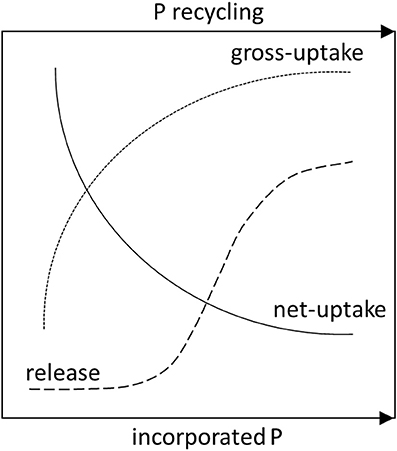
Figure 1. The concept of phosphorus recycling based on the balance-scheme of phosphorus uptake by Elodea nuttallii (adapted from Angelstein, 2009): The measureable net-uptake and release (secretion) of phosphorus by E. nuttallii plants seems to depend on the phosphorus content in the plant tissue and the recycling of already released phosphorus. Thereby, a substantial phosphorus release (broken line) might first take place above a specific threshold of the incorporated phosphorus. The net-uptake rate (black line) of phosphorus decrease or become stable with increasing recycling and thus with an increase of phosphorus incorporated in the plant tissue. In parallel the gross-uptake rate (dotted line) might increase up to a specific level of incorporated phosphorus. The presented concept is a simplified scheme, and thus contains neither units, nor any data.
This concept of phosphorus recycling (Figure 1) highlights the importance to distinguish between net- and gross-uptake, especially in such cases where a theoretical nutrient uptake by macrophytes, or aquatic plants in general should be estimated for aquatic ecosystems like lakes, reservoirs, wetlands, estuaries, ocean bays and waste waters treatment plants. However, in the moment only net-uptake processes can be estimated, since it is actually impossible to distinguish between different phosphorus sources. The development of new, non-hazardous techniques or experimental approaches is a challenge for the future.
In conclusion, phosphorus recycling processes exist, and—as it was exemplarily shown for E. nuttallii—might become significant with an increasing phosphorus content in the plant-tissue. Phosphorus recycling is a complex mechanism, difficult to analyse. The extent of phosphorus release as well as the kinetic of phosphorus uptake (including recycling) itself is affected by divers environmental and plant internal parameters. However, the existence of mechanisms like recycling processes highlight that we need to rethink our understanding on nutrient uptake rates in general, since they are not as clear as commonly assumed. The detection of the gross-uptake rate is a challenge for the future, since the distinction between gross- und net-uptake rates is important, especially in the glance of future water management strategies.
Author Contributions
This manuscript was written by SH and is based on parts of her own work. SH had also the idea to this opinion article.
Funding
This statement based on work done by SH during her dissertation at the Helmholtz Centre for Environmental Research—UFZ GmbH, Magdeburg, Germany. Article fees were paid by SH.
Conflict of Interest Statement
The author declares that the research was conducted in the absence of any commercial or financial relationships that could be construed as a potential conflict of interest.
Acknowledgments
I thank A. Melzer, H. Schubert, W. Geller, and S. Georgiadou for helpful hints. My PhD thesis (dissertation, Angelstein, 2009) is the only medium where this content has appeared in and its publication is in line with the University's policy.
References
Angelstein, S. (2009). Experimental Studies on Light Acclimation and Phosphorus Uptake Strategies of Elodea nuttallii (Planchon) St. John. Dissertation, University of Rostock, Rostock, DDC-notation: 584.73142 [DDC22ger].
Angelstein, S., and Schubert, H. (2008). Elodea nuttallii: uptake, translocation and release of phosphorus. Aquat. Biol. 3, 209–216. doi: 10.3354/ab00080
Baldy, V., Thiebaut, G., Fernandez, C., Sagova-Mareckova, M., Korboulewsky, N., Monnier, Y., et al. (2015). Experimental assessment of the water quality influence on the phosphorus uptake of an invasive aquatic plant: biological responses throughout its phenological stage. PLoS ONE 10:e0118844. doi: 10.1371/journal.pone.0118844
Bowden, W. B., Glime, J., and Riis, T. (2007). “Stream Biota,” in Methods in Stream Ecology, eds F. R. Hauer and G. A. Lamberti (London; San Diego: Academic Press), 877.
DeMarte, J., and Hartman, R. (1974). Studies on absorption of 33P, 59Fe, and 45Ca by water-milfoil (Myriophyllum exalbescens Fernald). Ecology 55, 188–194. doi: 10.2307/1934635
McRoy, C., and Barsdate, R. (1970). Phosphorus absorption in eelgrass. Limnol. Ocean. 15, 6–13. doi: 10.4319/lo.1970.15.1.0006
Reddy, K. R. (1983). Fate of nitrogen and phosphorus in a waste-water retention reservoir containing aquatic macrophytes. J. Environ. Qual. 12, 137–141. doi: 10.2134/jeq1983.00472425001200010025x
Reddy, K. R., and De Busk, W. F. (1985). Nutrient removal potential of selected aquatic macrophytes. J. Environ. Qual. 14, 459–462. doi: 10.2134/jeq1985.00472425001400040001x
Twilley, R., Brinson, M., and David, G. (1977). Phosphorus absorption, translocation, and secretion in Nuphur luteum. Limnol. Ocean. 22, 1022–1032. doi: 10.4319/lo.1977.22.6.1022
Union, E. (2000). Directive 2000/60/EC of the European Parliament and of the Council of 23 October 2000 Establishing a Framework for Communities in the Field of Water Policy. Available online at: https://www.eea.europa.eu/policy-documents/directive-2000-60-ec-of
Vermaat, J. E., and Gross, E. M. (2016). Aquatic botany since 1975: have our views changed? Aquat. Bot. 135, 1–2. doi: 10.1016/j.aquabot.2016.07.001
Keywords: phosphorus, recycling, nutrient removal, water quality, aquatic plants, P-uptake budget
Citation: Halbedel S (2018) Secretion of Phosphorus by Aquatic Plants Has an Impact on Their Phosphorus Uptake Budget. The Concept of Phosphorus Recycling. Front. Environ. Sci. 6:23. doi: 10.3389/fenvs.2018.00023
Received: 13 November 2017; Accepted: 11 April 2018;
Published: 26 April 2018.
Edited by:
Hong Yang, Swiss Federal Institute of Aquatic Science and Technology, SwitzerlandReviewed by:
Luiz Ubiratan Hepp, Universidade Regional Integrada do Alto Uruguai e das Missões, BrazilCopyright © 2018 Halbedel. This is an open-access article distributed under the terms of the Creative Commons Attribution License (CC BY). The use, distribution or reproduction in other forums is permitted, provided the original author(s) and the copyright owner are credited and that the original publication in this journal is cited, in accordance with accepted academic practice. No use, distribution or reproduction is permitted which does not comply with these terms.
*Correspondence: Susanne Halbedel, c3VzYW5uZS5oYWxiZWRlbEBnbXguZGU=