 R. T. Kingsford1*
 G. Bino1
 C. M. Finlayson1,2
 D. Falster3
 J.A. Fitzsimons4,5
 D. E. Gawlik6
 N. J. Murray7
 P. Grillas8R. C. Gardner9,10T. J. Regan11,12
 D. J. Roux13,14R. F. Thomas1,15
- 1Centre for Ecosystem Science, School of Biological, Earth and Environmental Sciences, UNSW Sydney, Sydney, NSW, Australia
- 2IHE Delft Institute for Water, Institute for Water Education, Delft, Netherlands
- 3Evolution and Ecology Research Centre, School of Biological, Earth and Environmental Sciences, UNSW Sydney, Sydney, NSW, Australia
- 4The Nature Conservancy, CarltonVIC, Australia
- 5School of Life and Environmental Sciences, Deakin University, Burwood, VIC, Australia
- 6Harte Research Institute, Texas A&M University Corpus Christi, Corpus Christi, TX, United States
- 7College of Science and Engineering, James Cook University, Townsville, QLD, Australia
- 8Tour du Valat, Institute for the conservation of Mediterranean wetlands, Arles, France
- 9Institute for Biodiversity Law and Policy, Stetson University College of Law, Gulfport, FL, United States
- 10Institute for Land, Water & Society, Charles Sturt University, Albury, NSW, Australia
- 11Arthur Rylah Institute for Environmental Research, Department of Environmental, Land, Water and Planning, Heidelberg, VIC, Australia
- 12School of Biosciences, The University of Melbourne, Parkville, VIC, Australia
- 13Scientific Services, South African National Parks, George, South Africa
- 14Sustainability Research Unit, Nelson Mandela University, George, South Africa
- 15Environment, Energy, and Science, NSW Department of Planning, Industry and Environment, Lidcombe, NSW, Australia
The Ramsar Convention (or the Convention on Wetlands), signed in 1971, was one of the first international conservation agreements, promoting global wise use of wetlands. It has three primary objectives: national designation and management of wetlands of international importance; general wise use of wetlands; and international cooperation. We examined lessons learnt for improving wetland conservation after Ramsar’s nearly five decades of operation. The number of wetlands in the Ramsar Site Network has grown over time (2,391 Ramsar Sites, 2.5 million km2, as at 2020-06-09) but unevenly around the world, with decreasing rate of growth in recent decades. Ramsar Sites are concentrated in countries with a high Gross Domestic Product and human pressure (e.g., western Europe) but, in contrast, Ramsar Sites with the largest wetland extent are in central-west Africa and South America. We identified three key challenges for improving effectiveness of the Ramsar Site Network: increasing number of sites and wetland area, improved representation (functional, geographical and biological); and effective management and reporting. Increasing the number of sites and area in the Ramsar network could benefit from targets, implemented at national scales. Knowledge of representativeness is inadequate, requiring analyses of functional ecotypes, geographical and biological representativeness. Finally, most countries have inadequate management planning and reporting on the ecological character of their Ramsar Sites, requiring more focused attention on a vision and objectives, with regular reporting of key indicators to guide management. There are increasing opportunities to rigorously track ecological character, utilizing new tools and available indicators (e.g., remote sensing). It is critical that the world protect its wetlands, with an effective Ramsar Convention or the Convention on Wetlands at the core.
Introduction
Water crises and the collapse of biodiversity and ecosystems are among the top global risks to human well-being (World Economic Forum, 2019). Globally, wetlands have declined by 35% from 1970 to 2015, where data are available (Darrah et al., 2019). Such loss and degradation of wetlands and their ecosystem services is increasingly expressed in global initiatives (e.g., Convention on Biological Diversity Aichi targets, Sustainable Development Goals 6 and 15 and associated targets). The Ramsar Convention (the Convention on Wetlands), signed in 1971 and legally effected in 1975, was one of the first modern multilateral environmental agreements advancing protection of wetlands through international collaboration and effective management.
The Convention includes palustrine, riverine, estuarine, lacustrine wetlands and near shore systems, including reefs. Over nearly five decades, 171 (as at 2020-06-09) contracting parties (i.e., countries) have prioritized the conservation and wise use of wetlands, and by listing wetlands assessed as internationally important and committing to maintaining their ecological character (Gardner and Davidson, 2011; Davidson et al., 2019). However, ecological character, the combination of ecosystem components, processes and benefits (Davidson et al., 2019), is increasingly deteriorating in Ramsar Sites (Davidson et al., 2020). These can be tracked by measuring key ecological indicators, including threats, which cause degradation (Davis and Brock 2008).
The Ramsar Strategic Plan 2016–2024 has three strategic goals, to: 1) address the drivers of wetland loss and degradation; 2) effectively conserve and manage the Ramsar Site Network; and 3) wisely use all wetlands (Ramsar Convention Secretariat, 2016). Targets include increasing the area, numbers, and ecological connectivity of Ramsar Sites, focusing on under-represented regions or types, and effective management. We provide a perspective on achieving these goals and targets, focusing on two key objectives: 1) identification of biases in the current global distribution of the Ramsar Site Network and 2) a conceptual adaptive management framework, linking maintenance of ecosystem dynamics with drivers of change.
Ramsar Site Network
The number of Ramsar Sites (2,391) and their area (2.54 million km2 as at June 2020) have increased, but the rate of increase in area has slowed, contrasting a steady growth in protected area (Figure 1A), reflected in various regional analyses (Mauerhofer et al., 2015; Fritz et al., 2017). Given that effective management of most inland wetlands is dependent on flow and flooding regimes of rivers (Saunders et al., 2002; Kingsford et al., 2016), we examined the distribution of Ramsar Sites and their areas, at the river basin scale (Lehner and Grill, 2013), relative to maximum extent of inland surface water between 1984 and 2018 (https://www.ngdc.noaa.gov/mgg/shorelines/gshhs.html; Pekel et al., 2016, Source: EC JRC/Google). Such mapping generally excluded vegetative flooded areas, while Ramsar Site areas included terrestrial ecosystems.
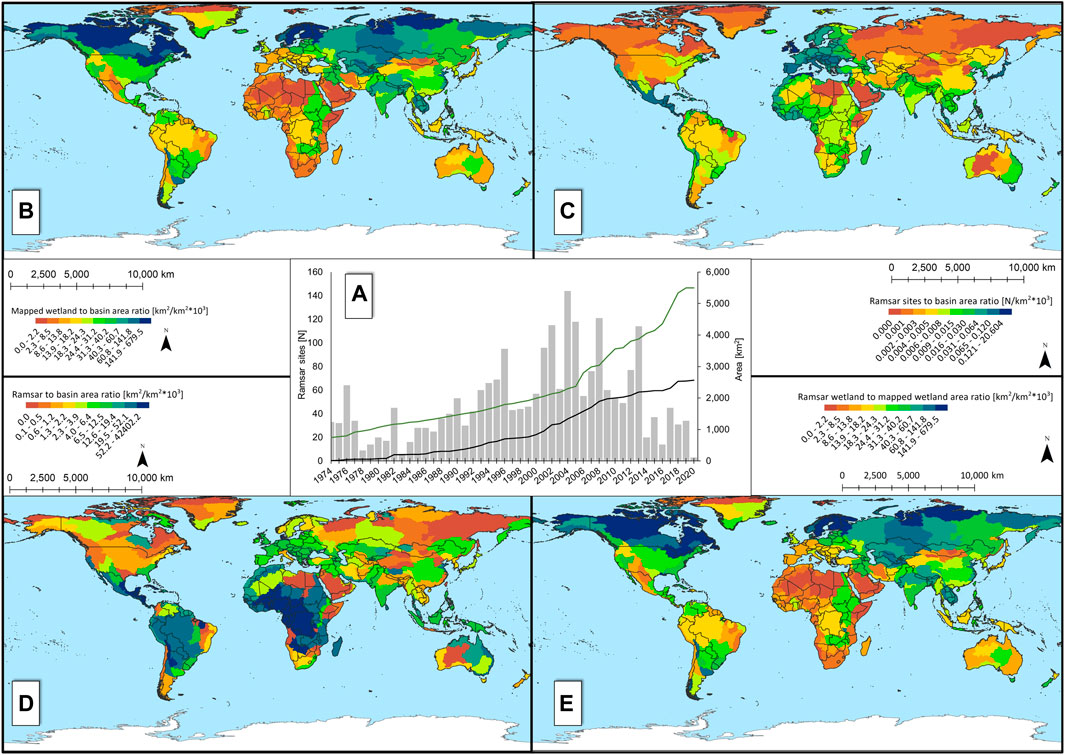
FIGURE 1. (A) Cumulative wetland area in the Ramsar Site Network (black line, km2 × 103) and terrestrial protected areas (green line, km2 × 104), with annual new numbers of Ramsar Sites (gray histograms), 1974–2020, with maps showing national borders (https://datacatalog.worldbank.org/dataset/world-bank-official-boundaries) and relative estimates of number or area of Ramsar Sites within river basins (Level 3 (Lehner and Grill, 2013)), including (B) ratio of mapped wetland area to basin area (km2/km2 × 103, 1984–2018, (Pekel et al., 2016), Source: EC JRC/Google); (C) number of Ramsar Sites relative to basin area ratio (N/km2 × 1103); (D) ratio of Ramsar Site area to basin area (km2/km2 × 103) and; (E) ratio of Ramsar Site area to mapped wetland area (km2/km2 × 103). Data also provided for each country (Supplementary Table S1).
The world’s mapped wetlands are predominantly in the Northern Hemisphere (Figure 1B; Supplementary Table S1), different to the distribution of numbers of Ramsar Sites (Figure 1C) with relatively higher numbers of Ramsar Sites in Europe, parts of South America, Central America, Northern, Central and Western Africa, Southern Asia and eastern Australia (Supplementary Table S1), reflecting Northern Hemisphere bias (Rebelo et al., 2009). Growth in numbers of Ramsar Sites has continued linearly in Europe since the beginning of the Convention on Wetlands, contrasting most other regions of the world where significant growth only began after about 2000 (Supplementary Figure S1). In contrast, Ramsar Site area, relative to basin area, is higher in the Southern Hemisphere (Figure 1D; Supplementary Table S1) and at a higher density relative to mapped wetland area (Figure 1E; Supplementary Table S1). Much of this growth in Ramsar Site area has occurred in Africa and Latin America (Supplementary Figure S1). Numbers and area of Ramsar Sites has continued to grow in Europe, Africa, Asia and Latin America but plateaued in North America and Oceania (Supplementary Figure S1).
We also explored possible associations among countries between the number and area of Ramsar Sites, area of mapped inland surface water (Pekel et al., 2016), area of protected areas (UNEP-WCMC and IUCN, 2020), Gross Domestic Product (GDP) (GIS processing World Bank DECRG, 2010) and Human Footprint Index (HFP, sum and mean, (Venter et al., 2018); Supplementary Figure S2). The number of Ramsar Sites was also positively related to HFP and surface water area (Pekel et al., 2016), slightly correlated to protected area and not to GDP (Supplementary Figure S2). This could reflect the high number of Ramsar Sites in the Northern Hemisphere, with relatively high HFP, contrasting to Ramsar Site area potentially associated with countries with lower GDP and HFP.
Adaptive Management Framework
Effective management and reporting is a significant challenge, given many Ramsar Sites lack management plans, and there is inadequate reporting of ecological character trajectories (Davidson et al., 2019; Davidson et al., 2020). Social-ecological interconnectedness and feedbacks are essential for hydrologically connected freshwater ecosystems, requiring collaboration of managers, scientists and stakeholders (Lee, 1999; Huitema et al., 2009; Novellie et al., 2016). Conceptually, adaptive management of a Ramsar Site needs a vision of a desired future state, involving stakeholders, clear objectives, triggers, risk assessment supported by co-design and co-management actions, and transdisciplinary science, with evaluation, reporting and updating (Kingsford et al., 2011; Westgate et al., 2013; Davidson et al., 2019; Davidson et al., 2020; Figure 2A).
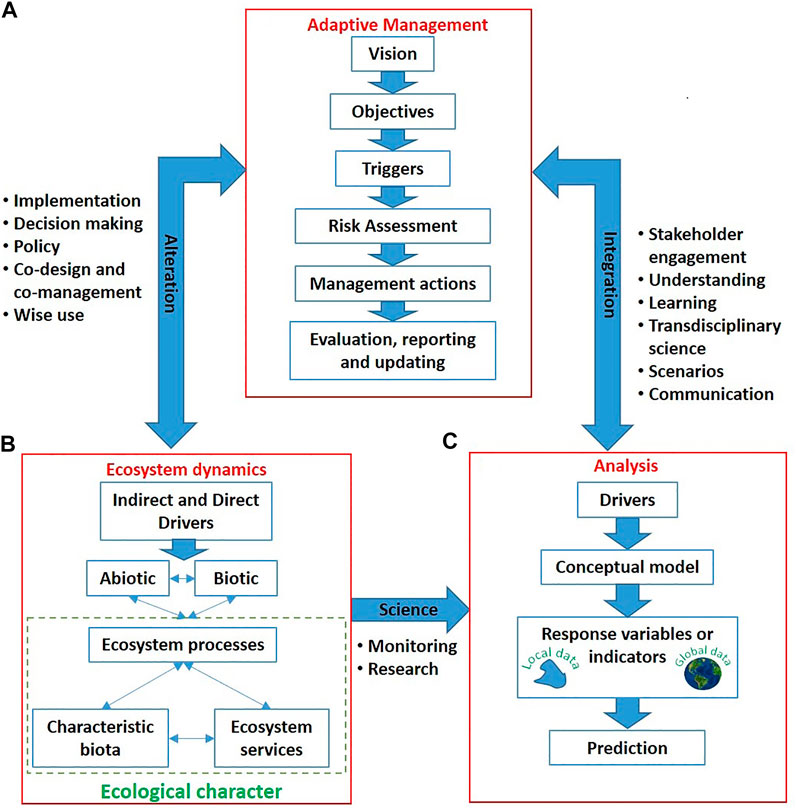
FIGURE 2. Conceptual framework for three integrated processes aimed at tracking change for reporting and guiding and maintaining ecological character of Ramsar Sites: (A) adaptive management, (B) ecosystem dynamics (capturing ecological character) and (C) analysis of indicators (using local and global data).
Direct and indirect biotic and abiotic (natural and anthropogenic) drivers affecting ecosystem processes, characteristic biota and ecosystem services need to be incorporated (Figure 2B). In social-ecological systems such as Ramsar Sites, there should also be a focus on how demographic, economic, sociopolitical and cultural factors link to natural biotic and abiotic drivers, incorporated into management (Figure 2B; Carpenter et al., 2006). Scientific analysis can then track change, diagnosing causes, and informing management, informed by understanding of the interactions of these drivers on changes to ecological character (Figure 2C). Ecosystem dynamics need to be conceptually simplified, characterizing requisite simplicity of an ecosystem (Holling, 2001; Stirzaker et al., 2010). Simple conceptual models can be used to identify primary drivers (Keith et al., 2020), which usually include flow (surface and ground water) and/or flooding regimes, nutrients and water quality. Such models guide choice of indicators, with data available locally (e.g., waterbirds, fish), regionally (e.g., rainfall, river flows) or globally (e.g., remote sensed inundation and land cover) (Figure 2C). Indicator data can be used to report on the condition of the wetland or ecological character over time, guiding management. For example, loss of a key bird species, a measure of ecological character, in a Ramsar wetland in Chile was was legally judged to have been caused by paper mill discharge impacting an aquatic plant, the bird’s main food supply (Marín et al., 2018).
Discussion
After nearly five decades, the listing of 2,391 Ramsar sites is an impressive contribution to global biodiversity conservation (Figure 1A). Over the same period, our population has more than doubled, increasingly threatening fresh water for wetlands, diverted for drinking, irrigation and energy. Many ecosystem services provided by wetlands are in decline (Gardner and Finlayson, 2018; Darrah et al., 2019; McInnes et al., 2020). A declining rate of growth in Ramsar Site area in some regions (Figure 1A; Supplementary Figure S1) may reflect this inability to maintain ecological character, highly dependent on flow and flooding regimes (Kingsford et al., 2016), potentially hampering achievement of Aichi Biodiversity Target 11 (Juffe-Bignoli et al., 2016).
More effective implementation of the Convention on Wetlands is urgent (Geijzendorffer et al., 2019), particularly given the relatively poor condition of the world’s wetlands, compared to other realms (Gardner and Finlayson, 2018). This can be done by increasing the area and number of Ramsar Sites; improving representativeness (geographically, functionally, biologically); and implementing effective adaptive management. These issues areas are not new (e.g., Davidson et al., 2019; Davidson et al., 2020; Gaget et al., 2020), undermining the goals and targets of the Ramsar Strategic Plan (Ramsar Convention Secretariat, 2016).
Increases in the Ramsar Site Network could be achieved by adopting national representative targets. This could be informed by using typological classifications (e.g., new IUCN typology: Keith et al., 2020, https://global-ecosystems.org/) to improve representativeness (Figures 1B–E; recognising mapping shortcomings, such as those in Pekel et al., 2016). Although highly dependent on national will (Davidson et al., 2019), opportunities exist to integrate targets across different commitments (e.g., United Nations Sustainable Development Goals and Aichi targets and Convention on Biological Diversity targets).
To improve management, we recommend implementing adaptive management frameworks, with stakeholders, targeting measurable indicators responsive to drivers that guide management and track ecological character effectively (Figure 2). This means incorporating social-ecological dynamics (Cilliers et al., 2013), with indicators representing ecological character (Figure 2), tracking ecosystem change (Keith et al., 2013; Bland et al., 2017). With globally available historical data (e.g., palaeoecological, remote sensing), past and future scenario analyses can guide management choices (Kopf et al., 2015).
The Convention on Wetlands provides nearly five decades of commitment to sustainable development and wise use of wetlands, but considerable challenges remain for the world’s wetlands. There are significant opportunities to improve national and global wetland conservation by better incorporating representativeness and implementing adaptive management. This would improve effectiveness and streamline and improve transparent reporting, which guides management for conservation.
Data Availability Statement
The raw data supporting the conclusions of this article will be made available by the authors, without undue reservation.
Author Contributions
RK conceived the idea and led the writing of the paper, supported initially by GB, including data analyses, and CMF, and by other authors, listed alphabetically.
Funding
The Australian Research Council Linkage Grant (LP180100159), identifying a standard for reporting on ecological character of Ramsar Sites, and the Australian Research Council Australian Discovery Early Career Award (DE190100101, NM) supported us.
Conflict of Interest
The authors declare that the research was conducted in the absence of any commercial or financial relationships that could be construed as a potential conflict of interest.
Acknowledgments
We thank the environment agencies (Australian, New South Wales, Queensland, South Australian, Victorian governments), South Australian Arid Lands Board, The Nature Conservancy and the Lake Eyre Basin Partnership for support. Our views do not necessarily reflect those of supporting governments and our other partners.
Supplementary Material
The Supplementary Material for this article can be found online at: https://www.frontiersin.org/articles/10.3389/fenvs.2021.643367/full#supplementary-material.
References
Bland, L. M., Regan, T. J., Dinh, M. N., Ferrari, R., Keith, D. A., Lester, R., et al. (2017). Using multiple lines of evidence to assess the risk of ecosystem collapse. Proc. R. Soc. B 284, 20170660. doi:10.1098/rspb.2017.0660
Carpenter, S. R., DeFries, R., Dietz, T., Mooney, H. A., Polasky, S., Reid, W. V., et al. (2006). Millennium ecosystem assessment: research needs. Science 314, 257–258. doi:10.1126/science.1131946
Cilliers, P., Biggs, H. C., Blignaut, S., Choles, A. G., Hofmeyr, J.-H. S., Jewitt, G. P. W., et al. (2013). Complexity, modeling, and natural resource management. Ecol. Soc. 18 (3), 1. doi:10.5751/ES-05382-180301
Darrah, S. E., Shennan-Farpón, Y., Loh, J., Davidson, N. C., Finlayson, C. M., Gardner, R. C., et al. (2019). Improvements to the Wetland Extent Trends (WET) index as a tool for monitoring natural and human-made wetlands. Ecol. Indic. 99, 294–298. doi:10.1016/j.ecolind.2018.12.032
Davidson, N. C., Dinesen, L., Fennessy, S., Finlayson, C. M., Grillas, P., Grobicki, A., et al. (2019). A review of the adequacy of reporting to the Ramsar Convention on change in the ecological character of wetlands. Mar. Freshw. Res. 71, 117–126. doi:10.1071/MF18328
Davidson, N. C., Dinesen, L., Fennessy, S., Finlayson, C. M., Grillas, P., Grobicki, A., et al. (2020). Trends in the ecological character of the world’s wetlands. Mar. Freshw. Res. 71, 127–138. doi:10.1071/MF18329
Davis, J., and Brock, M. (2008). Detecting unacceptable change in the ecological character of Ramsar wetlands. Ecol. Manage. Restor. 9, 26–32. doi:10.1111/j.1442-8903.2008.00384.x
Fritz, K., Cid, N., and Autrey, B. (2017). “Governance, legislation, and protection of intermittent rivers and ephemeral streams,” in Intermittent rivers and ephemeral streams. Editors T. Datry, N. Bonada, and A. Boulton (London: Elsevier Science Publishing Co.), 477–507.
Gaget, E., Le Viol, I., Pavón-Jordán, D., Cazalis, V., Kerbiriou, C., Jiguet, F., et al. (2020). Assessing the effectiveness of the Ramsar Convention in preserving wintering waterbirds in the Mediterranean. Biol. Conserv. 243, 108485. doi:10.1016/j.biocon.2020.108485
Gardner, R., and Davidson, N. (2011). “The Ramsar Convention,” in Wetlands: integrating multidisciplinary concepts, Editor B. LePage. (Dordrecht: Springer), 189–203.
Gardner, R., and Finlayson, C. M. (2018). Global wetland outlook: state of the world’s wetlands and their services to people. Gland, Switzerland: Ramsar Convention.
Geijzendorffer, I. R., Beltrame, C., Chazee, L., Gaget, E., Galewski, T., Guelmami, A., et al. (2019). A more effective Ramsar Convention for the conservation of Mediterranean wetlands. Front. Ecol. Evol. 7, 21. doi:10.3389/fevo.2019.00021
GIS processing World Bank DECRG (2010). Gross Domestic Product extrapolation UNEP/GRID-Geneva. Washington, DC: GIS processing World Bank DECRG. Available at: https://datacatalog.worldbank.org/dataset/gross-domestic-product-2010
Holling, C. S. (2001). Understanding the complexity of economic, ecological, and social systems. Ecosystems 4, 390–405. doi:10.1007/s10021-001-0101-5
Huitema, D., Mostert, E., Egas, W., Moellenkamp, S., Pahl-Wostl, C., and Yalcin, R. (2009). Adaptive water governance: assessing the institutional prescriptions of adaptive (Co-) management from a governance perspective and defining a research agenda. Ecol. Soc. 14 (1), 26. doi:10.5751/ES-02827-140126
Juffe-Bignoli, T. M., Brooks, C., Butchart, S. H. M., Jenkins, R. B., Hoffmann, M., et al. (2016). Assessing the cost of global biodiversity and conservation knowledge. Plos One 11 (8). doi:10.1371/journal.pone.0160640
Keith, D. A., Ferrer-Paris, J. R., Nicholson, E., and Kingsford, R. T. (2020). IUCN Global Ecosystem Typology v2.0: descriptive profiles for biomes and ecosystem functional groups. Available at: https://portals.iucn.org/library/node/49250 (Accessed December 18, 2020).
Keith, D. A., Rodriguez, J. P., Rodriguez-Clark, K. M., Nicholson, E., Aapala, K., Alonso, A., et al. (2013). Scientific foundations for an IUCN Red List of Ecosystems. PLoS One 8, e62111. doi:10.1371/journal.pone.0062111
Kingsford, R. T., Basset, A., and Jackson, L. (2016). Wetlands: conservation’s poor cousins. Aquat. Conserv. Mar. Freshw. Ecos. 26, 892–916. doi:10.1002/aqc.2709
Kingsford, R. T., Biggs, H. C., and Pollard, S. R. (2011). Strategic Adaptive Management in freshwater protected areas and their rivers. Biol. Conserv. 144, 1194–1203. doi:10.1016/j.biocon.2010.09.022
Kopf, R. K., Finlayson, C. M., Humphries, P., Sims, N. C., and Hladyz, S. (2015). Anthropocene baselines: assessing change and managing biodiversity in human-dominated aquatic ecosystems. BioScience 65, 798–811. doi:10.1093/biosci/biv092
Lee, K. N. (1999). Appraising adaptive management. Conserv. Ecol. 3 (2), 3. doi:10.5751/ES-00131-030203
Lehner, B., and Grill, G. (2013). Global river hydrography and network routing: baseline data and new approaches to study the world’s large river systems. Hydrol. Proc. 27, 2171–2186. doi:10.1002/hyp.9740
Marín, V. H., Delgado, L. E., Tironi-Silva, A., and Finlayson, C. M. (2018). Exploring social-ecological complexities of wetlands of international importance (Ramsar sites): the Carlos Anwandter Sanctuary (Valdivia, Chile) as a case study. Wetlands 38, 1171–1182. doi:10.1007/s13157-017-0935-z
Mauerhofer, V., Kim, R. E., and Stevens, C. (2015). When implementation works: a comparison of Ramsar Convention implementation in different continents. Environ. Sci. Pol. 51, 95–105. doi:10.1016/j.envsci.2015.03.016
McInnes, R. J., Davidson, N. C., Rostron, C. P., Simpson, M., and Finlayson, C. M. (2020). A citizen science state of the world’s wetlands survey. Wetlands 40, 1577–1593. doi:10.1007/s13157-020-01267-8
Novellie, P., Biggs, H., and Roux, D. (2016). National laws and policies can enable or confound adaptive governance: examples from South African national parks. Environ. Sci. Pol. 66, 40–46. doi:10.1016/j.envsci.2016.08.005
Pekel, J. F., Cottam, A., Gorelick, N., and Belward, A. S. (2016). High-resolution mapping of global surface water and its long-term changes. Nature 540, 418–422. doi:10.1038/nature20584
Ramsar Convention Secretariat (2016). The fourth strategic plan 2016-2024. Ramsar handbooks for wise use of wetlands, Gland, Switzerland: Ramsar Convention Secretariat, 5th Edn, Vol. 2.
Rebelo, L. M., Finlayson, C. M., and Nagabhatla, N. (2009). Remote sensing and GIS for wetland inventory, mapping and change analysis. J. Environ. Manage. 90, 2144–2153. doi:10.1016/j.jenvman.2007.06.027
Saunders, D. L., Meeuwig, J. J., and Vincent, A. C. J. (2002). Freshwater protected areas: strategies for conservation. Conserv. Biol. 16, 30–41. doi:10.1046/j.1523-1739.2002.99562.x
Stirzaker, R., Biggs, H., Roux, D., and Cilliers, P. (2010). Requisite simplicities to help negotiate complex problems. Ambio 39, 600–607. doi:10.1007/s13280-010-0075-7
UNEP-WCMC and IUCN (2020). “Protected planet: the world database on protected areas (WDPA),” (Cambridge). Available at: https://www.protectedplanet.net/en/thematic-areas/wdpa, (Accessed August 9, 2020).
Venter, O., Sanderson, E. W., Magrach, A., Allan, J. R., Beher, J., Jones, K. R., et al. (2018). Last of the wild project, version 3 (LWP-3): 2009 human footprint, 2018 release. Palisades, NY: SEDAC.
Keywords: Ramsar Convention, International agreement, ecological character, river conservation, risk assessment
Citation: Kingsford RT, Bino G, Finlayson CM, Falster D, Fitzsimons J, Gawlik DE, Murray NJ, Grillas P, Gardner RC, Regan TJ, Roux DJ and Thomas RF (2021) Ramsar Wetlands of International Importance–Improving Conservation Outcomes. Front. Environ. Sci. 9:643367. doi: 10.3389/fenvs.2021.643367
Received: 18 December 2020; Accepted: 08 February 2021;
Published: 22 March 2021.
Edited by:
Sergi Sabater, University of Girona, SpainReviewed by:
Ileana Espejel, Autonomous University of Baja California, MexicoNidhi Nagabhatla, United Nations University Institute for Water Environment and Health, Canada
Copyright © 2021 Kingsford, Bino, Finlayson, Falster, Fitzsimons, Gawlik, Murray, Grillas, Gardner, Regan, Roux and Thomas. This is an open-access article distributed under the terms of the Creative Commons Attribution License (CC BY). The use, distribution or reproduction in other forums is permitted, provided the original author(s) and the copyright owner(s) are credited and that the original publication in this journal is cited, in accordance with accepted academic practice. No use, distribution or reproduction is permitted which does not comply with these terms.
*Correspondence: R. T. Kingsford, cmljaGFyZC5raW5nc2ZvcmRAdW5zdy5lZHUuYXU=