 Kai Ren1
 Muhammad Imran
 Arshad Khan Bangash
- 1School of Finance and Economics, Jiangsu University, Zhenjiang, China
- 2Information Research Institute of Shandong Academy of Sciences, Jinan, China
- 3Department of Sociology and Political Science, Bacha Khan University, Charsadda, Pakistan
“Porter Hypothesis” believes that moderate environmental regulation can promote the growth of green technology innovation. Voluntary environmental agreements are a typical type of environmental regulation and theoretically promote green technology innovation. In 1964, Japan was the first country in the world to implement a voluntary environmental agreement, with good results. Subsequently, European Union countries began to implement the “fifth Environmental Action Plan” on 1 January 1993, which effectively combined voluntary environmental agreements with corporate self-regulation. The prior empirical work assists the idea that environmental regulation has diverse impacts on the environment. However, China’s voluntary environmental agreements have a short implementation time and lack of experience and need to be further explored in terms of policy proposal and technology implementation. The existing literature is based on a sample of units at the provincial level or national level are studied, utilizing multiple regression analysis methods, this study in China prefecture-level administrative units as investigation object, and choose the government environmental protection education, the government agreement propaganda, enterprise ecological ethics, information disclosure, market efficiency, and information technology support six elements as the key independent variables. This paper empirically examines the promotion effect of the voluntary environmental agreement on green technology innovation, finds the shortcomings of China’s voluntary environmental agreement regulation, and puts forward specific improvement strategies to promote the growth of green technology innovation more effectively. It is found that government environmental protection education, enterprise ecological ethics construction, market effectiveness, and information technology support have obvious promoting effects on green product innovation, green process innovation, and end management innovation. Government agreement publicity has no promotion function for green product innovation, green process innovation, and terminal governance innovation. The disclosure of protocol information has a promotion effect on green product innovation, but it lacks the promotion function on green process innovation, and end management innovation. The research believes that the deepening of the implementation of voluntary environmental agreements in China should give full play to the leading role of the government, implement progressive policies, deepen the internal coordination of environmental regulations, give play to the supervision role of the public and the media, learn from the experience of western countries, and promote green credit. The finding of the study opens up new insight for appropriate policymaking.
1 Introduction
With the rapid development of the world industrial economy, the deepening of economic globalization, population explosion, and the vulgar production way of life leads to the global environment increasingly serious, the global ecological destruction and environmental pollution, energy consumption, and shortage of resources such as the world’s climate problems emerge in endlessly, climate change becomes a new focus in the world, and actively respond to the environmental problem has become a global consensus. In 1972, Stockholm adopted the first global declaration on environmental protection in human history, namely the United Nations Declaration on the Human Environment. In 1983, the United Nations World Commission on Environment and Development was established, and 183 countries reached a consensus on the direction of “sustainable development” with “common well-being of mankind” as the development goal. In 1997, countries around the world signed the Kyoto Protocol to jointly tackle climate warming. In 2009, they issued the Copenhagen Agreement to solve the problem of CO2 emissions. In 2015, the Paris Climate Agreement was adopted at the Paris Climate Change Conference, and in 2016, the Paris Climate Agreement was signed in New York. The agreement is also a new starting point of the international cooperation on climate change, the United Nations framework convention on climate change (UNFCCC) 2018, the 24th conference of the Parties (COP24) held in Katowice, Poland, governments, and relevant organizations and experts in the field of climate change together complete the detailed rules for the implementation and funding of the Paris agreement negotiations. We will promote the full implementation of the Paris Agreement, which provides a strategic and forward-looking perspective for the development of green economy, and is conducive to domestic policymaking. This is of groundbreaking significance. Thus, climate change has become the most serious challenge to the stable growth of the global economy. Therefore, under the macro background of the global economic model changing from traditional to green and sustainable, realizing the common sustainable development of natural resources, ecological environment, and human society is an important problem to be solved urgently.
Environmental regulation is one of the driving forces of green technology innovation, which has received extensive attention in many countries around the world. In 1991, Michael Porter, a professor of economics at Harvard University, pointed out that strict environmental regulations could promote technological innovation of enterprises, improve the efficiency of green technological innovation, make up for environmental costs, and finally have a positive impact on enterprise performance (Zhang and Yao, 2018). Porter’s thought is called the “Porter Hypothesis”, which provides a new way of thinking and opens up a new thinking direction for solving the contradiction between ecological environment and economic development. With the increasingly prominent contradiction between ecological environment and economic development, environmental regulation has gradually become an important tool of government policy supply (Chen, 2018). Therefore, the relationship between environmental regulation and regional competitiveness of enterprise development and industrial growth has been paid attention to by the economic society.
There are three hypotheses about the relationship between environmental regulation and technological innovation, which are “the traditional hypothesis”, “Porter’s hypothesis”, and “the uncertainty hypothesis” (Wei and Zhang, 2020). The traditional hypothesis holds that environmental regulation increases the cost of enterprises; produces a crowding-out effect on R&D investment, restrains the technological innovation of enterprises, and reduces the market competitiveness of enterprises. According to Porter’s Hypothesis, reasonable environmental regulation can stimulate the motivation of technological innovation, give play to the compensation advantage of technological innovation for environmental costs, and improve the environmental performance and market competitiveness of enterprises. The uncertainty hypothesis holds that the relationship between environmental regulation and technological innovation is affected by many external factors and does not have a clear linear relationship.
Environmental regulation generally includes mandatory environmental regulation, incentive environmental regulation, and voluntary environmental regulation. Among them, voluntary environmental regulation mainly refers to voluntary environmental agreements. It started late in environmental regulation but has the most lasting driving effect on green technology innovation (Ouyang and Li, 2020). A voluntary environmental agreement is a typical environmental regulation, which is the result of a repeated game between government and enterprises in environmental regulation and reflects the voluntariness of enterprises in environmental protection, energy conservation, and emission reduction. A voluntary environmental agreement proposed by government departments or industrial organizations is a pragmatic response to the contradictions and conflicts between the environment and the economy. To be specific, voluntary environmental agreements are agreements reached with government departments or authorized agencies in terms of energy conservation, emission reduction, energy use efficiency, and environmental protection voluntarily and according to their interests. Voluntary environmental agreements are based on the company’s willingness, and there are no penalties if the company does not participate in the agreement or does not comply with the requirements of the agreement. However, if the enterprise participates in or fulfills the voluntary agreement, the government will provide incentive support or incentives, including technical services, information services, tax breaks, environmental permits, and so on. As a kind of agreement between government and enterprises, the voluntary environmental agreement aims to activate, modify and promote the voluntary behavior of enterprises to obtain satisfactory environmental effects (Sheng, 2008).
In 1964, Japan was the first country in the world to implement a voluntary environmental agreement, which achieved good results. Subsequently, EU countries began to implement, especially the fifth environmental action plan implemented on 1 January 1993, which effectively combined voluntary environmental agreements with enterprise self-regulation. Among the EU countries, the voluntary environmental agreements in the Netherlands were launched earlier, covered a wide range, and had the most effective implementation effect. By 2000, the Dutch government had signed voluntary environmental agreements with almost all energy-consuming sectors, including petroleum, steel, chemicals, paper, and cement, etc. (Huang and Ge, 2014)
Although China’s environmental problems have emerged at the end of the last century, voluntary environmental regulation or voluntary environmental agreements started late. In April 2003, the Shandong provincial government signed a voluntary environmental agreement with Jinan Iron, and Steel Group. Jinan Iron and Steel Group has promised to save one million tons of standard coal within 3 years. This is the first voluntary environmental agreement in China, marking the beginning of voluntary environmental regulation in China (Ju and Zhou, 2020).
The promoting effect of environmental regulation on green technology innovation has attracted much attention. Yin and Zhang (2019) pointed out that environmental regulation has a promoting effect on green technology innovation, and this effect has begun to appear in China (Yin and Zhang, 2019). Jiang (2019) believes that in the current environment of ecological economic development, environmental regulation is an important power source driven by green technology innovation (Jiang, 2019). Chen and Zhong (2019) pointed out that China should attach importance to the promoting role of environmental regulation in green technology innovation, create favorable conditions for the implementation of environmental regulation, and make environmental regulation play a greater compensation effect on enterprises’ green technology innovation (Chen and Zhong, 2019).
As a typical environmental regulation, voluntary environmental agreements also have an incentive effect on green technology innovation. However, the understanding and research on this incentive effect are not thorough at present. According to Qin and Sun (2020), voluntary environmental agreements, as a special environmental regulation, can promote green technology innovation under certain conditions, and there is an obvious positive relationship between voluntary environmental agreements and enterprises’ green technology innovation according to the data of China (Qin and Sun, 2020).
This study aims to thoroughly analyze the environmental regulation from the perspective of the green technology innovation process for manufacturing enterprise green technology innovation power, the influence of the behavior, efficiency, and the diffusion mechanism. Thus, for our country’s manufacturing industry in the environment and resources under the double constraints to explore green sustainable development model to provide targeted countermeasures and operationality of economy and environment, It provides decision-making support and effective reference for relevant national departments to formulate relevant policies and contributes to the further improvement of the theoretical relationship between environmental regulation and green technology innovation.
Voluntary environmental agreements can make up for the deficiencies of mandatory and incentive environmental regulations, and generate more lasting incentives for green technology innovation. However, the existence and extent of such effects are still unclear in China. Voluntary environmental agreements can be implemented at many levels, such as national provinces (municipalities directly under the Central Government), prefectures, counties, regions, and towns, etc. Among them, the prefecture-level voluntary environmental agreements are at a pivotal position connecting the preceding with the following. If the voluntary environmental agreements at the prefecture-level are effectively implemented, many problems encountered in the implementation of the voluntary environmental agreements in China will be solved, and the promotion of green technology innovation will rise to a higher level. Therefore, under the Porter Hypothesis, the study on the mechanism and effect of voluntary environmental agreements at the municipal level on green technology innovation in China is of real value and significance. This paper studies the influence of environmental regulation on green technology innovation motivation of manufacturing enterprises by taking prefecture-level administrative units as samples. Using the panel data model, this paper empirically analyzes the impact of environmental regulation on the green technology innovation motivation of manufacturing enterprises. This paper analyzes the green technology innovation motivation of Chinese manufacturing enterprises from two aspects of government and enterprise and expounds on the influence of environmental regulation on green technology innovation motivation, internal motivation, and external incentive mechanism.
2 Literature Review
2.1 Related Research on Green Technology Innovation
2.1.1 Related Research on the Connotation of Green Technology Innovation
Green technology appeared in the 1960s, the western developed countries government to cope with the high incidence of a major environmental pollution incident, adopt combination strategy, on the one hand, introduced relevant pollution control standards for all kinds of the environmental problem and environmental management system, and promote the building of green research and development institutions, on the other hand, provide technical support to effectively deal with the environmental pollution problem. Braun and Wield (1994) were the first to comprehensively interpret “green technology”, believing that it includes all technologies, processes, or products that can achieve energy conservation and emission reduction (Braun and Wield, 1994). Based on the interpretation of green technology, the concept of green technology innovation has also received widespread attention from scholars, who mainly interpret it from two aspects. Firstly, based on the whole process of production, the connotation of green technology innovation is summarized by describing the process from the perspective of system science. Kawai (2005) analyzed the SONY’s dynamic acoustics product green design practice in green design innovation can be divided into the process of product promotion, product update design, four dynamic product function innovation, and system innovation, namely product green ecological innovation from the individual to the whole, simple unidirectional complex, and asymptotic behavior from the process of innovation to a fundamental shift (Kawai, 2005). OECD (2009) proposed that green technology innovation refers to the creative behavior of developing or improving new products, processes, and marketing methods without the purpose of improving the environment (OECD, 2009). Cheng and Shiu (2012) defined ecological innovation performance from three dimensions of ecological organization, ecological process innovation, and ecological product innovation (Cheng and Shiu, 2012). Second, based on the characteristics of innovation, by summarizing its main characteristics to define it. James (1997) defined green technology innovation as a new product or process that simultaneously reduces enterprise environmental pollution, improves enterprise profits, and increases enterprise vitality from a microscopic perspective (James, 1997). Ramus and Steger (2000) believe that green technology innovation refers to the reduction of the environmental burden by internal personnel of enterprises through technological improvement, which ultimately increases enterprise performance (Ramus and Steger, 2000). Hurley et al. (2011) also defined environmental innovation, namely, product innovation behavior, process innovation behavior, marketing innovation behavior, and organizational innovation behavior to achieve environmental protection goals (Hurley et al., 2011).
2.1.2 Relevant Research on the Influencing Factors of Green Technology Innovation
Wagner (2007) believes that stakeholders’ environmental awareness has a great impact on enterprises’ green patent output (Wagner, 2007). Schaefer (2007) found that institutional pressure is the main driving force of proactive green behavior of enterprises (Schaefer, 2007). Horbach (2008) pointed out that government supervision can significantly promote enterprise pollution control, energy saving, emission reduction, and noise reduction and improve product recycling efficiency (Horbach, 2008). The research results of Eiadat et al. (2008) show that market tools can promote enterprises’ green innovation and help enterprises to establish an incentive mechanism of circular economy (Eiadat et al., 2008). Lee (2008) believes that the most important driving factors for enterprises to adopt green practices are buyer influence, government participation, and maturity of the green supply chain (Lee, 2008). Demirel and Kesidou (2011) believe that environmental regulation and enterprise cost-saving strategy motivation are the direct driving factors for enterprises to implement green innovation (Demirel and Kesidou, 2012). Kemp and Pontoglio (2011) concluded through a case study that market-based environmental regulation tools have a positive impact on green innovation, but not significantly (Kemp and Pontoglio, 2011). Chang (2011), through an empirical study on Taiwan’s manufacturing industry, concluded that enterprise environmental ethics plays a positive role in promoting enterprise green product innovation and is conducive to obtaining long-term competitive advantages (Chang, 2011). The research results of Dubey et al. (2015) show that pressure from stakeholders such as the government, customers, and suppliers has a significant role in promoting enterprise demand (Dubey et al., 2015). Roper and Tapinos (2016) believe that green innovation is positively correlated with BOTH PEU and market innovation risk, and the main determinants of innovation risk are external factors and market factors (Roper and Tapinos, 2016).
2.1.3 Research on the Evolution of Green Technology Innovation
On the one hand, scholars have studied green innovation from the evolutionary process and characteristics of enterprises. Cooke, (2010) studied the regional innovation system and found that it is derived from the process of thought germination and evolution of industrial innovation clusters. By integrating the “university-industry-government” three-helix innovation interaction, the innovation benefits brought by the regional knowledge spillover effect are increasing (Cooke, 2010). Crespi et al. (2015) pointed out that in the evolution of ecological innovation and related environmental policies, the dividing line between environment, and technology policies became increasingly blurred (Crespi et al., 2015). On the other hand, scholars have analyzed the evolutionary path of green technology innovation based on evolutionary game theory. Reinganum (1981) creatively applied game theory to the study of technological innovation diffusion at the micro-level (Reinganum, 1981). Cantono and Silverberg (2008) considered the heterogeneity of consumer preferences and found through Agent simulation that limited subsidy policies could promote the diffusion of green technology (Cantono and Silverberg, 2008). Krass et al. (2013) constructed the Stackelberg model of the impact of a carbon tax on enterprise innovation and carbon emission reduction technology and found that under an appropriate carbon tax rate, enterprises are willing to adopt low-carbon technologies to reduce carbon emissions (Krass et al., 2013). Gil-Moltó and Varvarigos, (2013) established the Cournot duopoly competition model in which enterprise technological innovation emission reduction affects carbon tax, and the simulation results show that the impact of technological innovation on carbon tax rate turns from positive to negative (Gil-Moltó and Varvarigos, 2013). Cohen et al. (2016) analyzed the impact of government green technology subsidies on manufacturing and consumer decisions based on the two-stage Stackelberg game (Cohen et al., 2014).
2.2 Research on the Impact of Environmental Regulation on Green Technology Innovation
2.2.1 Research on the Impact Effect of Environmental Regulation on Green Technology Innovation
Porter and Linde (1995), famous American economists, put forward the “Porter hypothesis”. Based on the dynamic perspective, they believed that environmental regulation would stimulate enterprises’ technological innovation while causing enterprises’ production costs to rise (Porter and Linde, 1995). Ambec and Barla (2002) constructed a two-agent game model between enterprises and managers and concluded that environmental regulation can increase enterprises’ R&D output and expected profits at the same time (Ambec and Barla, 2002). Domazlicky and Weber (2004) argued that the proper implementation of command-and-control policies would improve rather than reduce enterprise productivity (Domazlicky and Weber, 2004). Cole et al. (2010) proposed that compared with countries with lax regulatory policies, countries with strict regulatory laws have a higher probability of innovation, and environmental regulations have a positive impact on technological innovation (Cole et al., 2010). The second argument is that environmental regulation hampers green technology innovation. Arduini and Cesaroni (2002) studied European chemical industry enterprises but found that excessive environmental regulations would hinder enterprises from carrying out green technology innovation (Arduini and Cesaroni, 2002). Chintrakarn (2008) believes that environmental regulation forces enterprises to invest in ecological protection projects and loses investment in other highly profitable projects, which is not conducive to the long-term development of enterprises (Chintrakarn, 2008). Taking the United Kingdom as an example, Nath et al. (2010) concluded that environmental regulation harms technological innovation in the short term in an empirical study (Nath et al., 2010). Testa et al. (2011) believe that environmental regulations seriously hinder enterprises from implementing technological innovation because they increase the cost burden of enterprises (Testa et al., 2011). The third view is that there is not a single linear relationship between environmental regulation and green technology innovation. Lin and Yang (2011) used co-integration and Granger test to empirically find that environmental regulation has a long-term positive impact on technological innovation in three different regions of China, but the Granger causality between the two regions is different (Lin and Yang, 2011). According to Perino and Requate (2012), the relationship between policy rigor and technology adoption rate is inverted U-shaped (Perino and Requate, 2012). Taking China as an example, Wang and Shen (2016) empirically concluded that the relationship between environmental regulation intensity and environmental efficiency is u-shaped and there are three thresholds (Wang and Shen, 2016).
2.2.2 Research on the Heterogeneous Impact of Different Types of Environmental Regulation Policy Tools on Green Technology Innovation
Back in the 1970s, the research on the economic impact of different environmental regulation tools has been widely concerned by scholars. The universality of the conclusion according to the current study, comparing the incentive effect of green technology innovation, and market-oriented environmental regulation is given priority to incentives than take mandatory type command control environmental regulation. That is to say, if the government, using market type incentives for environmental regulation is more, it can stimulate the enterprise to develop green technology innovation activities. From the perspective of foreign research status, Weitzman (1974) obtained through theoretical verification that compared with administrative order alone, when the expected yield curve reaches a flat state, sewage tax can indeed better stimulate technological innovation behavior, and lay a foundation for subsequent research (Weitzman, 1974). Milliman and Prince (1989) found that auctioned emission permits and tax means were more attractive to technological innovation when compared with emission standards, government subsidies, and quotas (Milliman and Prince, 1989). Montero (2002) pointed out that both emission standards and taxes play a role in promoting green innovation in oligopolistic markets (Montero, 2002). Kemp and Pontogilo (2011) emphasized that the choice of regulatory tools has a large heterogeneity effect on environmental technology innovation. Storrøsten (2014) found that quantitative environmental regulation has the best incentive effect in the face of the impact of endogenous technological change (Storrøsten, 2014).
To sum up, scholars at home and abroad have made some achievements in the research on environmental regulation and green technology innovation of manufacturing enterprises. However, in general, the existing literature of the two is mainly based on the macro-regional and industrial level, and a few scholars research from the micro prefecture-level perspective. In addition, the existing research has not established a standardized framework for discussing the relationship between environmental regulation and green technology innovation. The research on the relationship between environmental regulation and green technology innovation is still in its infancy and needs to be further explored. The existing research content and methods are also inadequate.
3 Research Model Design
3.1 Selection of Core Independent Variables
The implementation of voluntary environmental agreement regulation is affected by many factors, which further affect the efficiency of green technology innovation in prefectural and municipal areas.
First of all, environmental education is a hotbed for voluntary environmental agreements. Although environmental protection has attracted the attention of the whole society in China, most enterprises and citizens are still indifferent to environmental protection because of the existence of the Giddens Paradox. They regard environmental protection as the business of others and stay out of it by standing on the sidelines (Walter and Chang, 2020). “The Giddens Paradox” is universal all over the world. To eliminate the negative effects of the paradox, the government should continue to publicize ecological and environmental protection, to make ecological issues deeply rooted in people’s minds, rather than floating on the surface of society. According to the experience of western countries, the implementation of voluntary environmental agreements can only be successful if it is combined with the continuous and efficient publicity of public opinion, rather than the implementation of agreement regulations in isolation (Song and Wang, 2020).
Secondly, agreement publicity is the tension of voluntary environmental agreements. Voluntary environmental agreements have played an important role in environmental protection in western countries. However, many enterprises or organizations in China have not realized the value and role of voluntary environmental agreements, and have not fully understood the content and function of voluntary environmental agreements. Therefore, there is a certain psychological distance with voluntary environmental agreements (Bachmann, 2020). In this case, the government needs to increase the voluntary environmental agreement of publicity, expanding voluntary environmental agreements in the region in the enterprise, deepen the cognition of the enterprise, and create a broad space for the implementation of the voluntary environmental agreement. Voluntary agreement of propaganda cannot stay in the conventional oral lecture and should adopt flexible and varied forms.
Thirdly, enterprise ecological ethics is the soil of voluntary environmental agreements. The implementation and promotion of voluntary environmental agreements need a strong ecological atmosphere, which puts forward higher requirements for the edification of enterprise ecological ethics. Only when the concept and consciousness of enterprise ecological ethics reach a certain height, can it have a solid ecological culture, then cultivate the ecological development strategy, and finally derive the specific plan, strategy, and goal of ecological development (Wang, 2017). Under the nourishment of such an ecological environment, voluntary environmental agreements can arise spontaneously. In the desert without ecological ethics, voluntary environmental agreements will be unable to stand, even if forced to grow up, and they will dry up and die.
Fourth, information disclosure is the soul of the implementation of voluntary environmental agreements. The implementation of voluntary environmental agreements is inevitably accompanied by the optimization of the environmental management system and the improvement of environmental laws and regulations. One of the core contents is to ensure that the voluntary environmental agreements are in a state of high information disclosure so that the voluntary environmental agreements can gradually become better (Peng et al., 2020). Information disclosure includes many contents, which require not only the disclosure of the content of the agreement, but also the transparency of the negotiation process, and the establishment of an effective information disclosure system. Equality should be emphasized in the disclosure of information. Enterprises of different properties and sizes should be treated equally, and government agencies should not be protected.
Fifth, market efficiency is a platform for the implementation of voluntary environmental agreements. The implementation of voluntary environmental agreements needs to rely on certain market conditions, and the market mechanism needs to reach a certain height to eliminate enterprises or products with poor environmental protection capability. The creation of a market environment also includes punitive measures as an alternative incentive for the implementation of voluntary environmental agreements (Cao, 2019). This requires not only a complete market competition mechanism but also strict legal standards. China is a vast country with large economic and cultural differences, and there are great differences in the market effectiveness of different regions, and there will be different efforts to promote the regulation of voluntary environmental agreements. Compared with the western free market, China’s socialist market has unique institutional advantages, which can effectively reduce the efficiency loss caused by market failure.
Finally, information technology support is the backing of the implementation of voluntary environmental agreements. Information technology support is the central content of voluntary environmental agreements and plays an important role in the implementation of voluntary environmental agreements in many countries. The US Green Light Program provides participating companies with energy-saving technologies and environmental protection information, which saves the cost of collecting and processing by companies themselves and helps companies gain technological, and cost advantages (Chen et al., 2018). At the same time, in the voluntary environmental agreement, the information technology support can reduce the enterprise’s research and development cost, improve the enterprise’s marginal profit, so that the enterprise can maintain the market competitive advantage.
Therefore, in the model design, six elements of government environmental education, government agreement publicity, enterprise ecological ethics agreement information open market effectiveness information technology support are selected as the core independent variables.
3.2 Selection of Control Variables
First of all, the implementation time of voluntary environmental agreements has an impact on the implementation quality. Generally speaking, the longer the implementation time of voluntary environmental agreements in a region, the richer the implementation experience, and the better the implementation effect (Li, 2017). Secondly, the proportion of enterprises participating in voluntary environmental agreements has an impact on the quality of implementation. Generally speaking, in a region, the greater the number or proportion of enterprises participating in voluntary environmental agreements, the more conducive to the promotion and implementation of voluntary environmental agreements, and the better the implementation effect (Zhang and Wu, 2017). Thirdly, the frequency of key leadership change has an impact on the implementation quality of voluntary environmental agreements. In most regions of China, if the leadership change is more frequent, it will not take advantage of the stable development of economic activities, the continuous progress of environmental protection, and or the deepening of voluntary environmental agreements (Wang and Liu, 2019). Finally, the support of financial institutions has an impact on the implementation quality of voluntary environmental agreements. In some cases, the implementation of voluntary agreements requires credit support from financial institutions. The stronger the environmental and social responsibility of financial institutions, the greater the support for various environmental regulations, the better the implementation effect of voluntary environmental agreements will be (Li, 2019).
Therefore, in the model design, the implementation time of the agreement, the proportion of enterprise participation, the frequency of leadership change, and the support of financial institutions are selected as the control variables.
3.3 Selection of Dependent Variables
Green technology is a modern technology that comprehensively considers the impact of economic development and the environment on product design, resource utilization, and emission treatment. It covers the whole life cycle from product design, production, quality inspection, packaging, transportation, and consumption to scrap, aiming at maximizing resource utilization or minimizing environmental hazards (Wang et al., 2019).
In this study, green technology innovation is divided into three elements: green product innovation, green technology innovation, and terminal treatment. Of course, these innovations are for enterprises in the municipal districts of the whole innovation level, among them, the consumption and application of green product innovation are ordering products more conducive to innovation and implementation of environmental protection, green technology innovation is ordering the product manufacturing process more can meet the demand of clean production innovation, at the end of process innovation is letting harmful emissions Innovations that are more in line with emission standards (Zhang and Sun, 2020).
Therefore, in the model design, three factors of green product innovation, green process innovation, and end treatment innovation were selected as dependent variables to construct three research models.
3.4 Establishment of the Research Model
According to the Porter hypothesis, the voluntary environmental agreements should promote green technological innovation among companies at the prefectural-Level.
Green product innovation, green process innovation, and end treatment innovation were taken as the dependent variable to design the research model, as shown in Table 1.
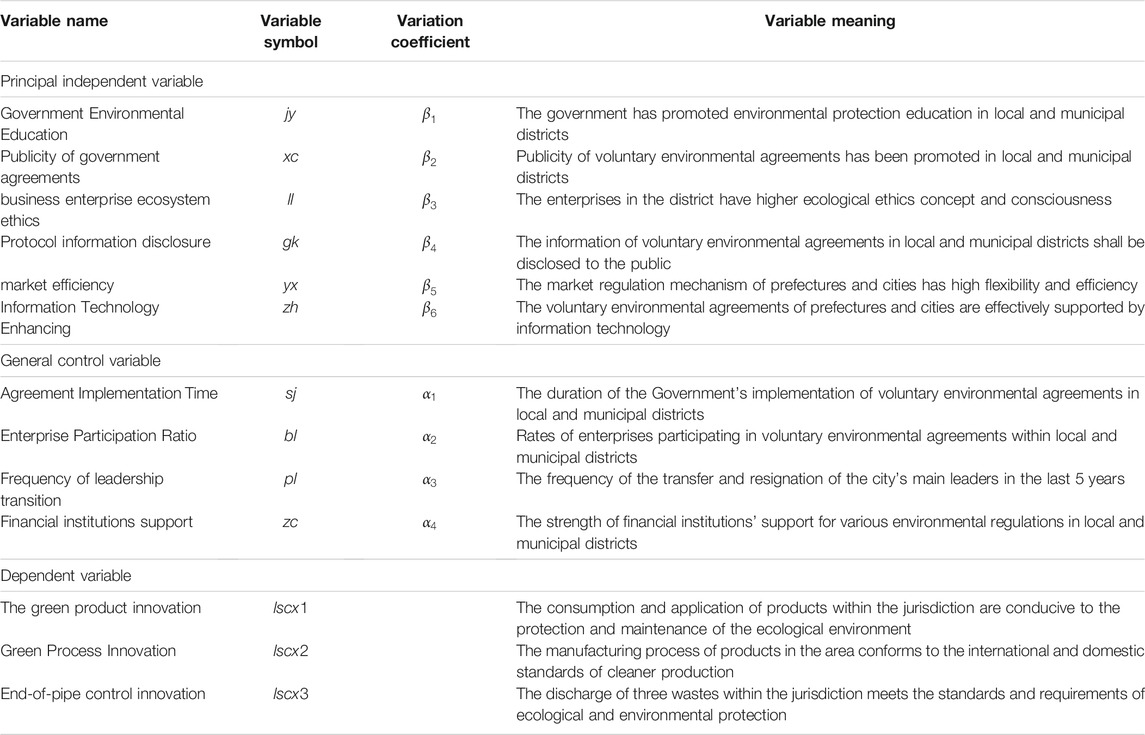
TABLE 1. Variable characteristics.
4 Research Model Test
4.1 Data Collection
This study adopts a 7-point scale to collect data. The sample units are prefecture-level cities in China, and the respondents are prefecture-level environmental protection bureaus. The period of investigation is from 2017 to 2019, and the change of influencing factors on the implementation status of voluntary environmental agreements in this city and the dynamic change status of green technology innovation. Generally speaking, the professional staff of environmental protection agencies have a profound and comprehensive understanding of this aspect of the problem and can give a more scientific and reasonable judgment. This data survey started from 1 January 2020 to 13 March 2020, with a total of 100 valid samples obtained. Sample characteristics are shown in Table 2.
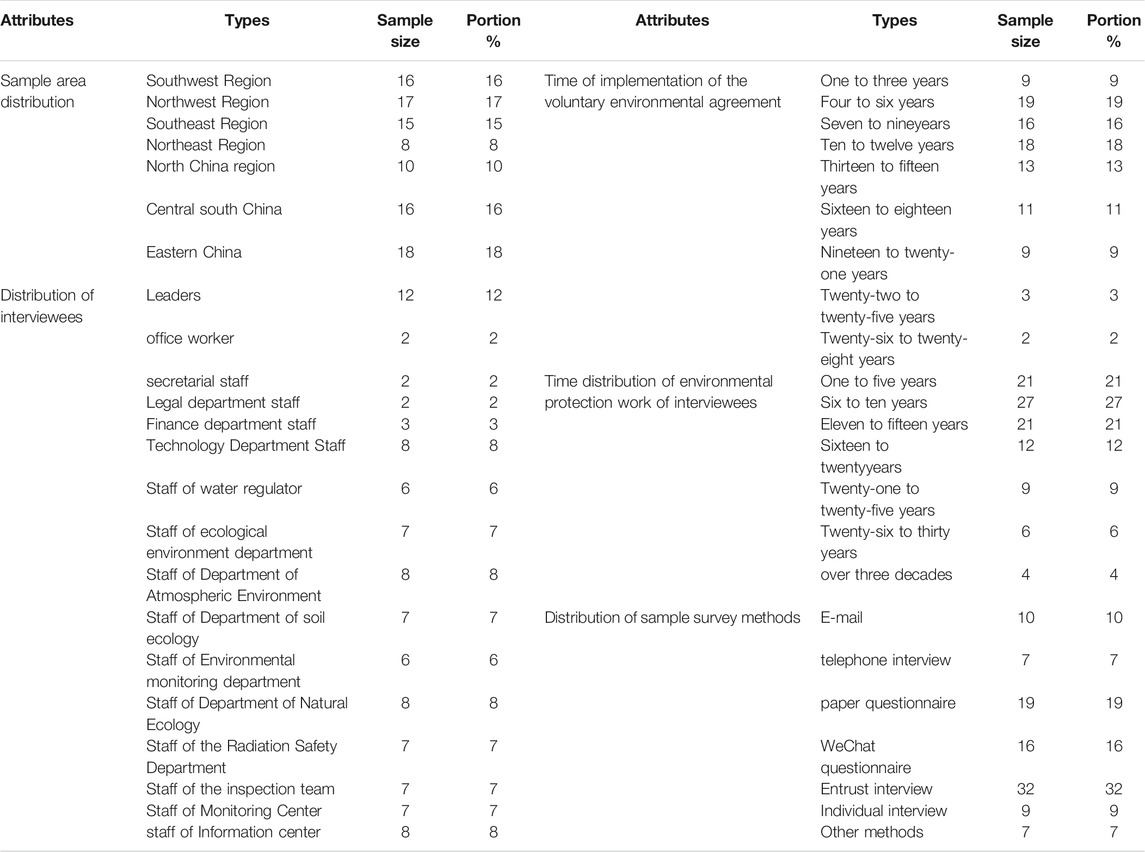
TABLE 2. Sample characteristics.
4.2 Empirical Test of the Model
Before the formal empirical study, descriptive statistics of valid data were firstly carried out. The descriptive statistics results of measurement items of each variable are shown in Table 3, including mean value and standard deviation. According to the descriptive statistical results, the average values of the statistical data of the research variables are between 2.21 and 3.65, and the standard deviations are between 0.09 and 0.31, which reflects that the data obtained through the questionnaire has good discreteness and differentiation, which is suitable for follow-up research.
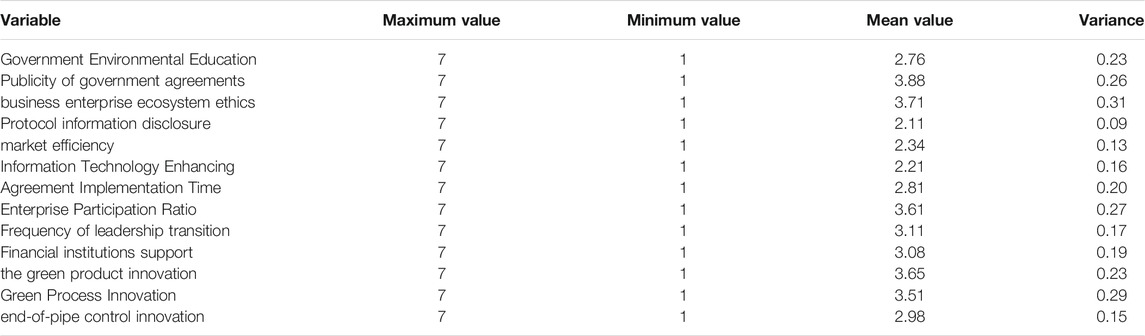
TABLE 3. Descriptive statistics of measuring variables.
Based on the data of 100 samples and with the help of SPSS18.0 software, the correlation coefficient matrix method was adopted in this study to conduct a multicollinearity test on the research model, and the test results are shown in Table 3. According to Table 2, the correlation coefficient between variables is generally low, so there is no multicollinearity problem in the model design.
Based on the multicollinearity test and based on 100 sample data, Eview8.0 software was used to test the research model with green product innovation, green process innovation, and end-of-pipe control innovation as the dependent variable, and the test results were shown in Table 4.
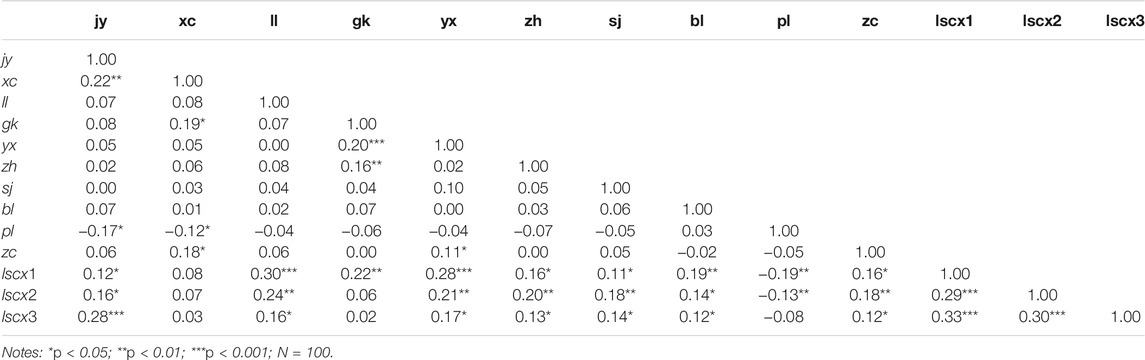
TABLE 4. Correlation coefficient matrix.
4.3 Robustness Test
In order to make the research conclusions more reliable, the model was re-estimated using panel data of different years (2016–2019) (data source: Wind Economic Database https://www.wind.com.cn/) to verify the estimated results. Compared with Table 4, it can be seen that in the second model estimation result, the coefficient of each parameter changes, but the symbol, and significance of corresponding parameters do not change significantly. The estimated coefficient of each model is above 0.5, and the equation fitting effect is good, so it can be judged that the regression model is robust. Table 5, 6 lists the regression results of a second test using the new data.
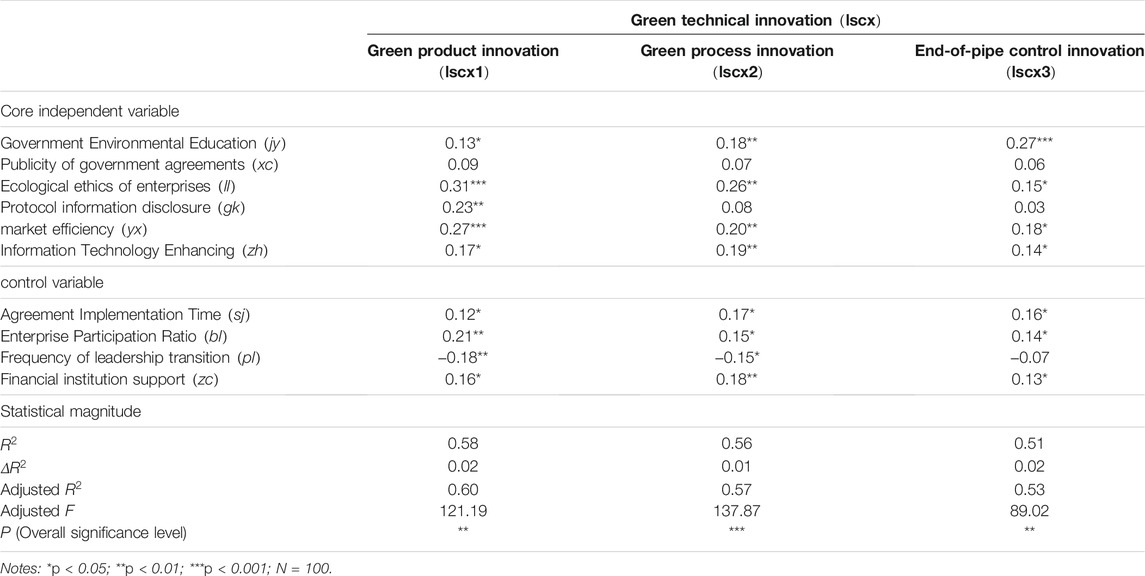
TABLE 5. Empirical test of model.
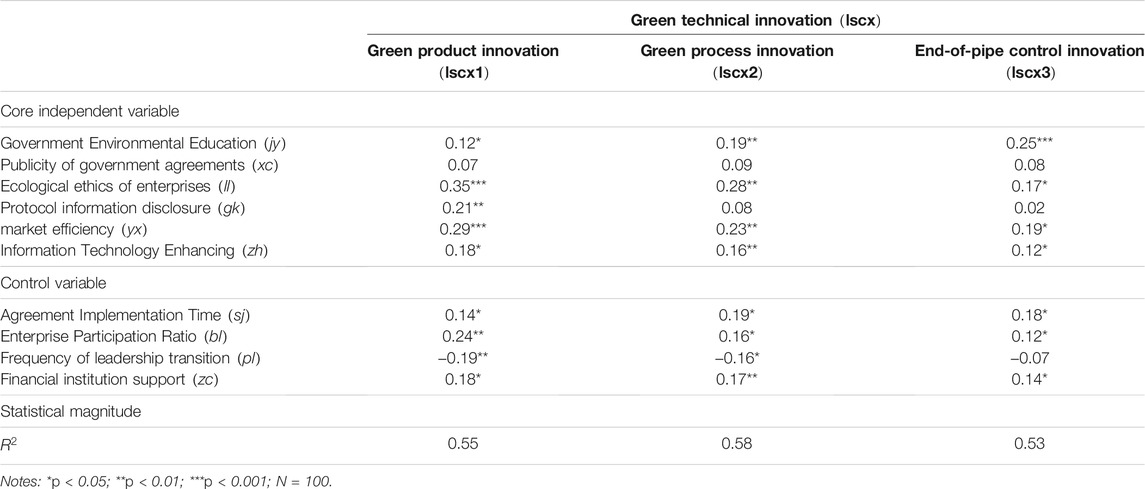
TABLE 6. Robustness test.
4.4 Analysis of Inspection Results
According to the test results of the core independent variables, it can be seen that: 1) Government environmental education has a significant promoting effect on the end governance innovation of green product innovation and green process innovation, This has something in common with Wagner’s (2007) research that stakeholders’ environmental awareness has a great impact on enterprises’ green patent output. 2) The publicity of government agreements lacks the promotion function for green product innovation, green process innovation, and terminal governance innovation, it is the part that has been seldom studied in previous literature. We believe that the current publicity of government agreements has the situation of lack of rules and insufficient implementation, which is difficult to promote green innovation. 3) The construction of enterprise ecological ethics has a promoting effect on the innovation of green products and green technology. This is consistent with the conclusion reached by Chang (2011) through empirical research on Taiwan’s manufacturing industry. 4) Protocol information disclosure has a promoting effect on green product innovation, but it lacks a promoting function on green process innovation and end-of-pipe control innovation, this indicates that manufacturers can respond to market changes more fully if they speed up the acquisition of green market, and green technology information. 5) Market efficiency has a positive effect on green product innovation, green process innovation, and end treatment innovation. This is consistent with the research results of Eiadat et al. (2008), Demirel and Kesidou (2012), who believe that market tools can promote enterprises’ green innovation and help enterprises to establish incentive mechanisms of a circular economy. 6) Information technology support has a promoting effect on green product innovation, green process innovation, and end-of-pipe control innovation.
According to the test results of the control variables, it can be seen that: 1) The longer the time that the city implements the voluntary environmental agreement, the more significant the effect of green product innovation and green process innovation and end-of-pipe control innovation will be; 2) The higher the proportion of enterprises participating in the voluntary environmental agreements in local and municipal districts, the more significant the effect of green product innovation and green process innovation, and end-of-pipe control innovation will be; 3) The more frequent the change of prefectural and municipal leaders is, the more unfavorable the innovation of green products and green technology and end-of-pipe control innovation will be; 4) The greater the support of financial institutions in local and municipal districts, the more significant the effect of green product innovation and green process innovation, and end-of-pipe control innovation will be.
5 Conclusion and Recommendations
At the level of cities and prefectures in China, voluntary environmental agreement regulation has initially shown the characteristics of the Porter hypothesis and has produced a certain promotion effect on green technology innovation. However, this promotion effect still has some limitations, which need to be further explored. According to the test results of the research model, combined with the investigation understanding of the implementation of voluntary environmental agreements in China, we can put forward some strategies for the deepening of voluntary environmental agreements in cities, and to promote the growth of green technology innovation more effectively.
First, give full play to the leading role of the government. The economic model implemented in China is a socialist market economy, and the government plays a leading role in economic development. Such ideas and methods are also applicable to the implementation of voluntary environmental agreements. The government should guide enterprises to recognize the value of voluntary environmental agreements, take into account the bearing capacity of enterprises, formulate the norms of voluntary environmental agreements, and guide the implementation methods and directions of enterprises. Since many enterprises in China are still unfamiliar with voluntary environmental agreements, the government should play a leading role in the whole process, and assume more responsibilities for organization promotion and implementation. When China’s voluntary environmental agreements enter a mature state, industry associations, non-governmental organizations, and enterprises will undertake the main implementation tasks.
Second, implement a gradual promotion policy. In view of the fact that the current environmental regulation in our country is in its initial stage, on the whole, the command-type environmental regulation and the incentive-type environmental regulation are in the exploratory stage, therefore, the voluntary environmental regulation should carry out the promotion strategy step by step, and rather than rushing forward. Generally speaking, it can take the lead in large enterprises or state-owned enterprises, sum up experience and summarizing skills, and gradually transition to private enterprises, foreign-funded enterprises, and small, and medium-sized enterprises. In the implementation of voluntary environmental regulation, western countries also adopt such a strategy of gradual progress. Some local governments in China, in pursuit of political achievements, blindly start to implement environmental regulations. In the end, they did not achieve the expected results but discouraged the enthusiasm of enterprises to participate.
Thirdly, voluntary environmental agreements need to be complemented by other environmental regulations. Although voluntary environmental agreements play an important role in environmental protection, any one country or region of the voluntary environmental agreement cannot be isolated, nor for the voluntary environmental agreement send to full of hope, need to match the mandatory environmental agreement and incentive environment and implement, complement each other, common to complete the task of environmental protection. In an ecological economy, enterprises have the characteristics of “rational economic man”, there is a certain tendency of opportunistic behavior, there is a certain limit of voluntary nature, and it needs to rely on mandatory and incentive to play a more effective role can be regarded as a voluntary environmental agreement as a key element of environmental regulation, but not all.
Fourth, the public and the media should play a supervisory role. The implementation of voluntary environmental agreements involves many subjects, including not only the government and enterprises but also social organizations, trade associations, media, and the public. In particular, the supervision role of the public and media should be played to reduce the regulation cost of voluntary environmental agreements and improve the implementation efficiency. Many of China’s major environmental accidents were investigated only after the public and the media exposed them. In the absence of supervision from the public and the media, enterprises are likely to breed opportunistic behaviors in the implementation of voluntary environmental regulations, which weakens the effectiveness of regulations. With the enhancement of the public awareness of environmental protection in our country, the role of supervision is gradually rising, and the potential of supervision is being tapped.
Fifth, learn from the western countries’ voluntary environmental agreement regulation experience. China’s voluntary environmental agreements not only started late but also lack regulatory experience, while Europe, Japan, and the United States have made outstanding achievements in this field, which is worth learning, and reference. Voluntary environmental agreements need to be based on efficient market regulation mechanisms, a powerful tool that the United States, Europe, and Japan are better at using. Voluntary environmental agreements in many areas of China are still mandatory, similar to mandatory environmental regulations, which are not true to the name and lose the essential characteristics of voluntary. Of course, the experience of Western countries should be used for reference with conditions, limits, and targets, instead of blindly and rigidly imitating them comprehensively.
Sixth, promote the development of green credit. In many countries, green credit is a concrete form of voluntary environmental agreement, but it has not been widely implemented in China. Green credit also accords with the long-term development goals of financial institutions and is a concrete manifestation of the environmental and social responsibility of financial institutions. Under the premise of the increasing demand for environmental protection in China and the increasing ecological risk, green credit can also bring business opportunities to financial institutions, which is the result of the change of the commercial credit era. If financial institutions do not actively fulfill their social responsibility for environmental protection, their brand image, and social reputation will be damaged and the loss outweighs the gain.
Finally, the legal authorization of voluntary environmental agreements is concerned. As a system innovation of environmental regulation, voluntary environmental agreements should meet the requirements of laws and regulations and have legal authorization. When voluntary environmental agreements carry out institutional innovation within the framework of existing laws and regulations, there will be no disputes. However, when voluntary environmental agreements go beyond the framework of laws and regulations or fail to obtain authorization from the legislative unit, disputes will arise. Therefore, when signing a voluntary environmental agreement, the specific content must be carefully reviewed to ensure not only its rationality but also its legality.
Prior to this paper, there was no quantitative study on the relationship between environmental regulation and green technology innovation from the perspective of the green technology innovation process. Although the viewpoints proposed in this paper are supported by relevant theories and data, they still need to be strengthened due to the limitations of personal time, and level: 1) In practice, the subjects of green technology innovation diffusion in manufacturing enterprises include not only innovation suppliers and potential demand enterprises, but also intermediary institutions. Due to limited personal ability and research time, follow-up research should be focused on; 2) When evaluating the driving force of green technology innovation, it is difficult to obtain or measure the statistical data limited by some indicators, so it is measured in a way of approximate substitution. Continuous attention should be paid to the latest measurement developments of relevant data and timely verification of relevant issues and conclusions. In addition, the analysis and discussion of environmental regulation and the driving force, behavior, efficiency, and diffusion of green technology innovation in this study are still in the preliminary exploratory stage and will be further studied in the future.
Data Availability Statement
The raw data supporting the conclusion of this article will be made available by the authors, without undue reservation.
Author Contributions
All authors listed have made a substantial, direct, and intellectual contribution to the work and approved it for publication.
Conflict of Interest
The authors declare that the research was conducted in the absence of any commercial or financial relationships that could be construed as a potential conflict of interest.
Publisher’s Note
All claims expressed in this article are solely those of the authors and do not necessarily represent those of their affiliated organizations, or those of the publisher, the editors and the reviewers. Any product that may be evaluated in this article, or claim that may be made by its manufacturer, is not guaranteed or endorsed by the publisher.
References
Ambec, S., and Barla, P. (2002). A Theoretical Foundation of the Porter Hypothesis. Econ. Lett. 75, 355–360. doi:10.1016/s0165-1765(02)00005-8
Arduini, R., and Cesaroni, F. (2002). Environmental Technologies in the European Chemical industry[R]. Urbino, Italy: University of Urbino.
Bachmann, T. M. (2020). Considering Environmental Costs of Greenhouse Gas Emissions for Setting a CO2 Tax: A Review. Sci. Total Environ. 720 (9), 137524. doi:10.1016/j.scitotenv.2020.137524
Braun, E., and Wield, D. (1994). Regulation as a Means for the Social Control of Technology. Techn. Anal. Strateg. Manag. 6 (3), 259–272. doi:10.1080/09537329408524171
Cantono, S., and Silverberg, G. (2008). A Percolation Model of Eco-Innovation Diffusion: the Relationship between Diffusion, Learning Economies and Subsidies[J]. Technol. Forecasting& Soc. Change 76 (4), 487–496. doi:10.1016/j.techfore.2008.04.010
Cao, K. (2019). An Outline of Ethical Research on Green Technology Innovation [J]. Stud. Dialectics Nat. 35 (10), 37–43. (In Chinese). doi:10.19484/j.cnki.1000-8934.2019.10.007
Chang, C. H. (2011). The Influence of Corporate Environmental Ethics on Competitive Advantage: The Mediation Role of Green Innovation[J]. J. Business Ethics 104 (3), 1–10. doi:10.1007/s10551-011-0914-x
Chen, X., Zhang, T., Wei, Z., and Zhu, J. (2018). Strategic Design and Implementation of Ecological Emergency Decision Support System in China [J]. J. Hunan Univ. Finance Econ. 34 (175), 113–119. (In Chinese). doi:10.16546/j.cnki.cn43-1510/f.2018.05.014
Chen, Y. (2018). Retesting of ‘Strong Potter Hypothesis’ under Fiscal Decentralization: From the Perspectives of Enterprise Environmental Protection Innovation and Non-environmental Protection Innovation [J]. Commercial Res. 1, 143–152. (In Chinese).
Chen, Y., and Zhong, W. (2019). The Influence of Environmental Regulation on Innovation Output: from the Perspective of Regional Absorption Capacity [J]. Urban Probl. 11, 69–78. (In Chinese).
Cheng, C. C., and Shiu, E. C. (2012). Validation of a Proposed Instrument for Measuring Eco-Innovation: An Implementation Perspective. Technovation 32 (6), 329–344. doi:10.1016/j.technovation.2012.02.001
Chintrakarn, P. (2008). Environmental Regulation and U.S. States' Technical Inefficiency. Econ. Lett. 100 (3), 363–365. doi:10.1016/j.econlet.2008.02.030
Cohen, M. C., Lobel, R., and Perakis, G. (2014). The Impact of Demand Uncertainty on Consumer Subsidies for Green Technology Adoption[J]. Social Sci. Electron. Publishing 62 (5), 868–878. doi:10.2139/ssrn.2376662
Cole, M. A., Elliott, R. J. R., and Okubo, T. (2010). Trade, Environmental Regulations and Industrial Mobility: An Industry-Level Study of Japan. Ecol. Econ. 69 (10), 1995–2002. doi:10.1016/j.ecolecon.2010.05.015
Cooke, P. (2010). Regional Innovation Systems: Development Opportunities from the 'green Turn'. Techn. Anal. Strateg. Manag. 22 (7), 831–844. doi:10.1080/09537325.2010.511156
Crespi, F., Ghisetti, C., and Quatraro, F. (2015). Environmental and Innovation Policies for the Evolution of green Technologies: a Survey and a Test. Eurasian Bus Rev. 5 (2), 343–370. doi:10.1007/s40821-015-0027-z
Demirel, P., and Kesidou, E. (2012). Stimulating Different Types of Eco-Innovation in the UK: Government Policies and Firm Motivations[J]. Ecol. Econ. 70, 1546–1557. doi:10.2139/ssrn.1718708
Domazlicky, B. R., and Weber, W. L. (2004). Does Environmental Protection Lead to Slower Productivity Growth in the Chemical Industry. Environ. Resource Econ. 28 (3), 301–324. doi:10.1023/b:eare.0000031056.93333.3a
Dubey, R., Gunasekaran, A., and Samar Ali, S. (2015). Exploring the Relationship between Leadership, Operational Practices, Institutional Pressures and Environmental Performance: A Framework for green Supply Chain. Int. J. Prod. Econ. 160, 120–132. doi:10.1016/j.ijpe.2014.10.001
Eiadat, Y., Kelly, A., Roche, F., and Eyadat, H. (2008). Green and Competitive? an Empirical Test of the Mediating Role of Environmental Innovation Strategy. J. World Business 43 (2), 131–145. doi:10.1016/j.jwb.2007.11.012
Gil-Moltó, M. J., and Varvarigos, D. (2013). Emission Taxes and the Adoption of Cleaner Technologies: The Case of Environmentally Conscious Consumers[J]. Resource Energ. Econ. 35 (4), 486–504. doi:10.1016/j.reseneeco.2013.04.006
Horbach, J. (2008). Determinants of Environmental Innovation-New Evidence from German Panel Data Sources. Res. Pol. 37 (1), 163–173. doi:10.1016/j.respol.2007.08.006
Huang, H., and Ge, L. (2014). The Implementation of Japan's Voluntary Environmental Agreements and its Implications for China [J]. Contemp. Economy Jpn. 6, 80–92. (In Chinese).
Hurley, J., Buckley, N. J., and Cuff, K. (2011). Determinants of Eco-Innovations by Type of Environmental Impact: The Role of Regulatory Push/Pull, Technology Push and Market Pull[J]. Zew Discussion Pap. 78 (32), 112–122. doi:10.1016/j.ecolecon.2012.04.005
James, P. (1997). The Sustainability circle: a New Tool for Product Development and Design[J]. J. Sustain. Product. Des. 2, 52–57.
Jiang, Y. (2019). Research on Dynamic Effects of Environmental Regulation, Scientific and Technological Innovation and Economic Growth [J]. J. Kashi Univ. 40 (6), 24–31. (In Chinese).
Ju, K., and Zhou, D. (2020). What Comes after Picking Pollution Intensive Low-Hanging Fruits? Transfer Direction of Environmental Regulation in China[J]. J. Clean. Prod. 22 (2), 779–789. doi:10.1016/j.jclepro.2020.120405
Kawai, K. (2005). Design for Product Innovation: System Development and Beyond[M]. Soft Comput. as Transdisciplinary Sci. Techn. 29 doi:10.1007/3-540-32391-0_2
Kemp, R., and Pontoglio, S. (2011). The Innovation Effects of Environmental Policy Instruments - A Typical Case of the Blind Men and the Elephant. Ecol. Econ. 72 (1725), 28–36. doi:10.1016/j.ecolecon.2011.09.014
Krass, D., Nedorezov, T., and Ovchinnikov, A. (2013). Environmental Taxes and the Choice of Green Technology[J]. Prod. Operations Manag. 22 (5), 1035–1055. doi:10.1111/poms.12023
Lee, S. Y. (2008). Drivers for the Participation of Small and Medium‐sized Suppliers in green Supply Chain Initiatives. Supp Chain Mnagmnt 13 (3), 185–198. doi:10.1108/13598540810871235
Li, L. (2017). Degree of Environmental Regulation and Performance of green Technology Innovation [J]. Econ. Forum 4, 97–102. (In Chinese).
Li, N. (2019). Environmental Regulation and Green Technology Innovation of Enterprise—Analysis of the Conditional Process [J]. Inner Mongolia Soc. Sci. 40 (6), 109–115. (In Chinese). doi:10.14137/j.cnki.issn1003-5281.2019.06.016
Lin, M., and Yang, Y. (2011). Environmental Regulation and Technology Innovation: Evidence from China[J]. Energ. Proced. 5, 572–576. doi:10.1016/j.egypro.2011.03.100
Milliman, S. R., and Prince, R. (1989). Firm Incentives to Promote Technological Change in Pollution Control. J. Environ. Econ. Manag. 17 (3), 247–265. doi:10.1016/0095-0696(89)90019-3
Montero, J.-P. (2002). Permits, Standards, and Technology Innovation. J. Environ. Econ. Manag. 44 (1), 23–44. doi:10.1006/jeem.2001.1194
Nath, P., Ramanathan, R., and Black, A. (2010). Impact of Environmental Regulations on Innovation and Performance in the UK Industrial Sector[J]. Manag. Decis. 48 (48), 1493–1513. doi:10.1108/00251741011090298
Ouyang, X., and Li, Q. (2020). How Does Environmental Regulation Promote Technological Innovations in the Industrial Sector? Evidence from Chinese Provincial Panel Data[J]. Energy Policy 67 (9), 11–22. doi:10.1016/j.enpol.2020.111310
Peng, W., Xiong, K., and Li, H. (2020). Environmental Decentralization, Technological Innovation and Green Transformation of China's Industry: An Empirical Study Based on Provincial Spatial Panel Data [J]. Contemp. Econ. Manag. 42 (1), 1–14. (In Chinese). doi:10.13253/j.cnki.ddjjgl.2020.10.007
Perino, G., and Requate, T. (2012). Does More Stringent Environmental Regulation Induce or Reduce Technology Adoption? when the Rate of Technology Adoption Is Inverted U-Shaped. J. Environ. Econ. Manag. 64 (3), 456–467. doi:10.1016/j.jeem.2012.03.001
Porter, M. E., and Linde, C. v. d. (1995). Toward a New Conception of the Environment-Competitiveness Relationship. J. Econ. Perspect. 9 (4), 97–118. doi:10.1257/jep.9.4.97
Qin, Y., and Sun, H. (2020). Relationship between Voluntary Participation in Environmental Regulation and R&D: Based on Government Supervision and Media Attention [J]. Sci. Techn. Manag. Res. 4, 254–262. (In Chinese).
Ramus, C. A., and Steger, U. (2000). The Roles of Supervisory Support Behaviors and Environmental Policy in Employee "Ecoinitiatives" at Leading-Edge European Companies. The Academy of Management Journal 43 (4), 605–626. doi:10.5465/1556357
Reinganum, J. F. (1981). On the Diffusion of New Technology: A Game Theoretic Approach. Rev. Econ. Stud. 48 (3), 395–405. doi:10.2307/2297153
Roper, S., and Tapinos, E. (2016). Taking Risks in the Face of Uncertainty: An Exploratory Analysis of green Innovation. Technol. Forecast. Soc. Change 112, 357–363. doi:10.1016/j.techfore.2016.07.037
Schaefer, A. (2007). Contrasting Institutional and Performance Accounts of Environmental Management Systems: Three Case Studies in the UK Water & Sewerage Industry. J. Manag. Stud. 44 (4), 506–535. doi:10.1111/j.1467-6486.2006.00677.x
Sheng, Y. (2008). The System Innovation of Environmental Regulation: Voluntary Environmental Agreements [J]. East China Econ. Manag. 22 (10), 27–30. (In Chinese).
Song, M., and Wang, S. (2020). Could Environmental Regulation and R&D Tax Incentives Affect green Product Innovation? [J]. J. Clean. Prod. 59 (9), 29–38. doi:10.1016/j.jclepro.2020.120849
Storrøsten, B. H. (2014). Prices versus Quantities: Technology Choice, Uncertainty and Welfare[J]. Environ. Resource Econ. 59 (2), 275–293. doi:10.1007/s10640-013-9728-x
Testa, F., Iraldo, F., and Frey, M. (2011). The Effect of Environmental Regulation on Firms' Competitive Performance: The Case of the Building & Construction Sector in Some EU Regions. J. Environ. Manage. 92 (9), 2136–2144. doi:10.1016/j.jenvman.2011.03.039
Wagner, M. (2007). On the Relationship between Environmental Management, Environmental Innovation and Patenting: Evidence from German Manufacturing Firms. Res. Pol. 36 (10), 1587–1602. doi:10.1016/j.respol.2007.08.004
Walter, J. M., and Chang, Y.-M. (2020). Environmental Policies and Political Feasibility: Eco-Labels versus Emission Taxes [J]. Econ. Anal. Pol. 66, 194–206. doi:10.1016/j.eap.2020.04.004
Wang, Q., Qu, J., Wang, B., Wang, P., and Yang, T. (2019). Green Technology Innovation Development in China in 1990-2015. Sci. Total Environ. 696 (9), 134008–134098. doi:10.1016/j.scitotenv.2019.134008
Wang, X., and Liu, Q. (2019). Analysis on the Effect of Environmental Regulation on Enterprise Green Technological Innovation [J]. Econ. Res. Guide 5, 8–11. (In Chinese).
Wang, Y. (2017). Voluntary Environmental Agreements: A New Approach to Environmental Governance Is Based on the Initial Development of Consultative Administration [J]. J. Gansu Polit. Sci. L. Inst. 3, 62–70. (In Chinese).
Wang, Y., and Shen, N. (2016). Environmental Regulation and Environmental Productivity: The Case of China. Renew. Sustain. Energ. Rev. 62, 758–766. doi:10.1016/j.rser.2016.05.048
Wei, L., and Zhang, H. (2020). How Environmental Regulations Affect the Efficiency of Green Technology Innovation? [J]. Am. J. Ind. Business Manag. 10 (3), 29–44. doi:10.4236/ajibm.2020.103034
Weitzman, M. L. (1974). Prices vs. Quantities. Rev. Econ. Stud. 41 (4), 477–491. doi:10.2307/2296698
Yin, X., and Zhang, F. (2019). Technological Innovation of Environmental Regulation and Evolution of Energy Consumption Structure Balance in Manufacturing Industry [J]. Stat. Decis. 24, 114–118. (In Chinese).
Zhang, Q., and Wu, L. (2017). Dynamic Evolution on green Technology Innovation of Coal Enterprises under Environmental Regulations [J]. Coal Econ. Res. 37 (11), 51–56. (In Chinese). doi:10.13202/j.cnki.cer.2017.11.010
Zhang, Q., and Yao, P. (2018). The Impact of Environmental Regulation on the Path and Dynamic Evolution of Technological Innovation Based on Porter Hypothesis [J]. J. Ind. Technol. Econ. 8, 52–59. (In Chinese).
Keywords: porter hypothesis, voluntary environmental agreement, green technology innovation, environmental regulation, market effectiveness
Citation: Ren K, Kong Y-S, Imran M and Bangash AK (2022) The Impact of the Voluntary Environmental Agreements on Green Technology Innovation: Evidence From the Prefectural-Level Data in China. Front. Environ. Sci. 10:833724. doi: 10.3389/fenvs.2022.833724
Received: 12 December 2021; Accepted: 24 January 2022;
Published: 10 February 2022.
Edited by:
Magdalena Radulescu, University of Pitesti, RomaniaReviewed by:
Abdul Rehman, Henan Agricultural University, ChinaMuhammad Abdul Kamal, Abdul Wali Khan University Mardan, Pakistan
Alexandra Horobet, Bucharest Academy of Economic Studies, Romania
Copyright © 2022 Ren, Kong, Imran and Bangash. This is an open-access article distributed under the terms of the Creative Commons Attribution License (CC BY). The use, distribution or reproduction in other forums is permitted, provided the original author(s) and the copyright owner(s) are credited and that the original publication in this journal is cited, in accordance with accepted academic practice. No use, distribution or reproduction is permitted which does not comply with these terms.
*Correspondence: Muhammad Imran, aW1yYW5AdWpzLmVkdS5jbg==