 Jiaji An
 He Di
He Di Meifang Yao
- School of Business and Management, Jilin University, Changchun, China
Based on the traditional internal factor model, high environmental awareness should bring higher engagement in environmental practices. In reality, however, many studies have found no significant correlation between the two. To explain this, frontier research is focusing on what external factors influence environmental sustainability. As a typical example of such external factors, this article focuses on the innovation of Internet payment technology. Based on a survey of 623 individuals living across mainland China, we conduct path analysis, stepwise regression analysis, and a mediation test on Internet payment technology, environmental awareness, environmental protection practices, and demographics such as age, income, and sex. We find that Internet payment technology plays a significant mediator role between environmental awareness and environmental behaviors, and that demographics also affect sustainability. Internet payment technology can expand the range of ways in which consumers participate in environmental protection and encourage them to put more green practices through emotional and physical incentives. We thus demonstrate the positive impact of technological innovation on environmental sustainability and unfold the underlying mechanism. Besides providing a reference for other researchers, our study also proposes some applications relevant to the scientific community.
1 Introduction
Planned behaviors based on psychological factors and their improved models are the traditional research foundations for individual participation in environmental protection behaviors. The theoretical model posits that personal environmental awareness or perception positively affects the degree of participation in environment-friendly practices. Yet according to a survey conducted by the Ministry of Ecology and Environment of the People’s Republic of China, 2018, there is a phenomenon of “high awareness, low practice” in waste classification, green consumption, and participation. In environmental behavior research, the inconsistent or weak influence of environmental attitudes on environmental behaviors has been partially verified and gradually attracted more research attention (Brand, 1997). Blake (1999) proposes that external factors mediate between environmental attitudes and environmental behaviors, such as personality and feasibility. This is inconsistent with the traditional theoretical model of internal factor research, so the original analysis alone cannot explain the complicated relationship between environmental awareness and environmental behavior. To solve this problem, some scholars began to pay attention to the influence and mechanism of individual demographics and external situational factors, that is, new technology, such as the Internet and other media (Garz, 2014; Ellison et al., 2015; Peng et al., 2019). Similarly, many studies contend that technological innovation can directly affect sustainability (Murty and Kumar, 2003; Yin et al., 2014; Gkika et al., 2020; Iqbal et al., 2022). To build on these earlier works, this article innovatively focuses on the digital technology of Internet payments, exploring its role in sustainability. With the rapid development of Internet technology in recent years, especially the increasing green and low-carbon life scenes based on network payment technology, many new platforms have emerged for public participation in environmental protection. These platforms have brought new opportunities and possibilities for the public to implement green and low-carbon behaviors (Liu and Hao, 2017; Li and Liu, 2018). Internet payments can reduce the printing of paper receipts, while online shopping and online utility payments can greatly reduce the need to drive to make purchases, thereby reducing CO2 emissions. Therefore, Internet payment technology has a natural spillover effect in the field of environmental protection, and should be investigated as an external situational factors (Yang et al., 2018). This research is motivated by the unresolved questions of whether and how Internet payment technology spillover significantly impacts on individual environmental perception and green practices.
Our focus on China is motivated by the following considerations. Based on population dynamics, Balsa-Barreiro et al. (2019) analyzed the shifting locations of centers of gravity of four basic global indicators during 1960–2016: gross domestic product (GDP), CO2 emissions, total population, and urban population. They found that the centers of gravity of GDP and CO2 emissions have shifted eastward: the weight of CO2 emissions to GDP is ×2 in China and ×1.6 in the Asian region, compared to ×0.5 in Japan, ×0.6 in the United States, and ×0.3 in the European Union. This demonstrates that the economic growth model of some countries in Southeast Asia consumes high levels of resources. This has been particularly true of China: according to 2018 data from the United Nations Environment Programme, China is the country with the largest CO2 emissions, accounting for over one-quarter of the global total. Therefore, studying China’s environmental issues is especially valuable for global sustainability.
This study uses data from China to empirically analyze the impact of Internet payment technology on personal environmental awareness and green practices, aiming to open the black box of the internal mechanism of action to yield theoretical and practical implications.
2 Literature Review and Hypotheses
2.1 Theories on Psychological Influencing Factors
2.1.1 Theory of Planned Behavior
In 1975, Fishbein and Ajzen proposed the theory of reasoned action (TRA), which posits how attitudes form based on cognitive information and consciously affect individual behavior. The basic assumption is that people are rational and will synthesize various kinds of information to consider the meaning and consequences of their actions before acting in a certain way (Fishbein and Ajzen, 1975). Ajzen’s later research (2011) found that human behavior is affected by external environment. On this basis, he expanded the TRA by adding the new concept of perceived behavioral control (PBC), thus developing a new behavioral theory model: the theory of planned behavior (TPB). This posits that human behavior results from deliberate thoughts, and that behavior is produced and changed through a complex psychological process. The TPB has been endorsed by several scholars. Hopkins and Potcovaru (2021) found that consumer attitudes, values, needs, and expectations were affected by external factors such as COVID-19. Also focusing on effects of the pandemic, Priem (2021) found that COVID-19-related lockdowns limited the financial behavior of individual investors. Regarding environmental behavior, the main determinant according to the TPB is willingness to engage in environmental behavior, while three other factors are also influential: environmental attitude, subjective norms, and PBC (Ajzen, 2011). Since the TPB was first applied in environmental research, increasing numbers of scholars have begun to study the willingness of individuals to pay the price for improving environmental conditions, engaging in environment-conscious behaviors, and execution practices. Scholars contend that the TPB fully affirms the role of environmental attitudes but somewhat weakens the influence of external behavior constraints. For example, in Kaiser and Gustcher’s (2003) survey of 895 Swiss residents, PBC did not have an obvious effect on environmental behavior.
2.1.2 Norm Activation Model
Due to the limited explanatory power of the TPB on environmental awareness and behavior differences, Schwartz (1977) proposed the norm activation model. It assumes that social norms must first become individual norms before they can influence an individual’s pro-social behavior. The activation of individual norms depends on two factors: the individual’s awareness of the consequences of the action (AC) and ascription of responsibility for these consequences (AR). Therefore, according to this model, only when AC and AR are high will individual norms be activated, leading the individual to take environmental actions (Schwartz, 1977). As the norm activation theory does not fully consider differences in environmental behaviors caused by individual heterogeneity, it is often used to research mandated forms of environmental protection behavior in areas such as recycling, energy conservation, and yard-waste landfill. Therefore, there are certain limitations to the application of this model (Black et al., 1985).
2.1.3 Value-Belief-Norm Theory
Stern (2000) combined norm activation theory with value theory to propose the value-belief-norm (VBN) theory. It emphasizes the causal chain of value→belief→personal norms: values on environmental behaviors lead to beliefs that then activate behavioral norms. The individual’s sense of responsibility for taking environmental actions, and finally the environmental actions. Relevant values include biospheric values, altruistic values, and egoistic values, of which the latter will negatively affect environmental behavior. The theoretical model is depicted in Figure 1.
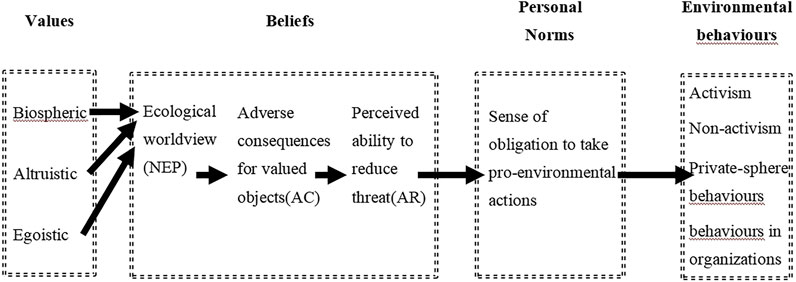
FIGURE 1. A schematic representation of variables in the VBN theory of environmentalism.
The VBN theory incorporates values into the analysis model, explores the types of values and their effects, and broadens the influencing factors of environmental behavior research. However, there has been insufficient discussion of external factors and individual heterogeneity (Bamberg and Moser, 2007).
Based on the three branches of theory considered above, environmental awareness is an important internal factor that positively affects environmental behavior. Birtus and Lăzăroiu (2021) studied the neurobehavioral economics of the COVID-19 pandemic from the perspective of consumer cognition, perception, sentiment, choice, and decision-making; they found a significant positive relationship between consumer cognition and decision-making. Similarly, Rydell and Kucera (2021) examined the relationship between cognitive attitudes, behavioral choices, and purchasing habits during the COVID-19 pandemic; they also found that cognitive attitudes directly affected behavioral choices. Accordingly, we propose the following hypothesis:
H1. Environmental awareness and sustainability are positively related.
2.2 External Situational Factors: The A-B-C Model of Behavior
As mentioned earlier, the problem of “high awareness, low practice” for environmental protection is contrary to traditional psychological theory. Therefore, while the classical theoretical model analyzes the individual’s internal psychology, environmental behavior research increasingly considers external factors, concentrating especially on the inconsistent or weak influence of environmental attitudes on environmental behaviors. Scholars have focused on other factors that mediate this relationship, such as norms, values, and external situational factors (Peng, 2013). Guagnano et al. (1995) proposed an A-B-C model for predicting waste recycling behavior. The model integrates internal (psychological) processes with external conditions, and considers environmental behaviors (B) to be the result of the individual’s general and specific environmental attitude (A) and of external conditions (C). Specifically, when external conditions are favorable and environmental attitudes positive, environmental behaviors will occur; when external conditions are unfavorable and individuals hold negative environmental attitudes, environmental behaviors will not occur; when external conditions are relatively neutral, environmental attitudes have a strong effect on environmental behavior. The A-B-C model proposes that environmental behaviors result from the combined influence of environmental attitudes and external conditions, and points out that the effect of environmental attitudes on environmental behaviors depends on the specific external conditions. This theory opened a new direction of environmental behavior research, thus attracting scholars to start investigating external factors (Steg et al., 2005; Scherbaum et al., 2008). Therefore, this study adopts the A-B-C model.
2.2.1 Influence of Demographic Features
Many studies have shown that demographics such as gender, age, social status, education level, and residence attributes can impact on environmental behaviors. Wang and Zhong (2016) found that individual gender and age factors significantly impacted on residents’ private environmental behavior in China. Mi et al. (2019) studied the driving force of environmental knowledge among people with different education levels; they found that people with higher education levels had greater willingness to engage in low-carbon purchasing behavior. Gong and Lei (2007) used factor analysis and multiple linear regression to study the impact of gender on the environmental behaviors of residents in different fields; they found that women were more inclined than men to adopt environmentally friendly behaviors. Empirical research by Li (2006) showed that gender and education level have important influences on individual environmental behaviors. In Al Mamun et al. (2018) study of green consumption behaviors, low-income households were found to engage significantly less than did high-income households. Nakamura (2020) contends that sustainability behavior is not always uniform across residents of a specific region. In sum, these demographics need to be considered.
2.2.2 Influences of External Situational Variables
Situational variables are external factors that impact on an individual’s implementation of environmental behaviors. For instance, environmental pollution, environmental governance behaviors, social norms, behavioral costs, and mass media are all considered to have significant impacts (Yuan, 2016; Štreimikienė et al., 2021). De Young (1990) found that Michigan residents’ garbage collection behaviors were significantly influenced by whether community public facilities such as recycling bins had been set up, whether these facilities were convenient to use, and whether engaging in these behaviors was time-consuming. Based on a questionnaire survey, Men and Xiong (2018) found that government input indirectly affects the public’s ecological behaviors by influencing the public’s environmental knowledge and environmental awareness. Kyriakopoulos et al. (2020) investigated the environmental behaviors of business and accounting students at the University of West Attica, Greece. They found that environmental education had a significant positive effect on environmental behavior, while also increasing the significance of the effect of ecological sensitivity on environmental behavior. Other studies contend that in addition to school education, family environmental awareness positively affects students’ green behaviors (Ntanos et al., 2018). Wang and Han (2016) found that the interweaving of economic development and environmental pollution impacted on public environmental protection behavior. On this basis, scholars began to pay attention to the impact of the Internet on environmental attitudes and behaviors.
2.3 Internet and Environmental Behaviors
As research into Internet payment technology and environmental protection is relatively new, there are few existing theoretical discussions. Research on the Internet and environmental behaviors is mostly based on information dissemination attributes, the popularization of environmental protection information, the supervision of environmental behavior, the fear of vicious environmental protection news, and the spread of positive environmental protection information (Krätzig and Warren-Kretzschmar, 2014). Hong (2013) and Stockemer (2018) found that for residents who frequently use the Internet to browse information, the increased transparency of government information induced greater participation in decision-making on environmental protection and in environmental supervision, forming a positive environmental attitude. Through increasing participation in environmental protection decision-making, Internet use has promoted the democratization process and strengthened the cooperative relationship between the government and netizens. In addition, the Internet provides an important channel for the government to promote the idea of “environmental protection and benefiting the people.” Environmental protection improves physical health, in turn improving one’s income-earning ability, which may induce a positive attitude toward the environment (Wang and Ye, 2016). Analyzing China’s comprehensive social survey data, Peng et al. (2019) found that regular use of the Internet to browse information promoted residents’ environmental protection attitudes and environmental literacy; moreover, residents’ environmental literacy was improved more by regular Internet use than by formal (academic) education.
Drawing on information transfer theory to explain why internal environmental literacy lags behind external environmental literacy, Ellison et al. (2015) and Okazaki and Taylor (2013) pointed out that information flow is impeded by blockages and the inability to enjoy equal access to information. The emergence of online media has broken the pattern of unevenly distributed information, helping to build an advanced, better-structured system of environmental knowledge and deepen environmental knowledge reserves, thereby reducing the external gap in and improving the overall level of environmental literacy. Fischer and Reuber (2011) contend that network information interaction is inclusive: netizens at different levels can chat about hot topics on environmental protection, exchanging knowledge and views, thereby enhancing one another’s environmental literacy.
Most studies in this field explore whether information dissemination on the Internet is related to environmental protection, green and sustainable development, and the majority find positive correlations. However, Internet payment technology represents a step beyond information media: as a tool to replace or supplement traditional payment methods, it has potential technological spillover effects on environmental awareness and practice. Therefore, this article extensively investigates the impact of Internet payment technology. As a sub-concept in the Internet category, Internet payment technology can be expected to positively affect environmental behaviors. Based on the conclusions of the cutting-edge research (Barbu et al., 2021; Ionescu, 2021; Bin, 2022), we propose the following hypothesis:
H2. Use of Internet payment technology and sustainability are positively related.
2.4 Mediation Effect of Internet Payment Technology
Internet payment technology is rapidly becoming a global hotspot and the focus of in-depth scholarly research. Kshetri (2017) pointed out it has already achieved all-round impact on residents’ lives in the emerging economies of China and India. China has become a major country in the application of Internet payment technology. According to data from iResearch Consulting (2020), the transaction amount of Internet payments in China was USD 31.7 trillion in 2019, ranking first in the world. According to the 43rd “Statistical Report on the Development of China’s Internet,” as of December 2018, China had 827 million Internet users and the penetration rate of Internet payment technology had reached 59.6% (Cyberspace Administration of China, 2019).
With the rapid development of Internet payment technology, it has become an important platform for residents to participate in environmental protection (Policy Research Center for Environment and Economy, 2019a). Internet payment technology promotes public green consumption in four main ways. First, it guides consumers to buy green products. Internet payment technology significantly reduces the cost for consumers to obtain green information on products (Chen and Wu, 2020; He et al., 2021), and comparative advantages of green products by a wide range of consumer groups (Lv, 2018). Internet payment technology also improves the competitiveness of green products in the market, guiding consumers to purchase these products through the transmission and sequencing of information. Second, it can give the public ways and incentives to implement green behaviors in different consumption scenarios (He, 2018; Li, 2018; Luo et al., 2019). For example, some online payment platforms enable users to accumulate “green energy” that they can ultimately exchange for the planting of a real sapling in the desert (Ren et al., 2019; Wu et al., 2019; Xia, 2019). Third, as Internet payment technology relies on the sharing economy of payment platforms and the rise of idle goods trading platforms, it facilitates the reuse of consumer goods and optimizes resource allocation (Huang, 2018). Fourth, Internet payment technology increases the online proportion of consumption and payment and reduces related travel, thereby lowering carbon emissions (Wang et al., 2018).
Green consumption behaviors based on Internet payment platforms are continuing to increase. In terms of green product consumption, over 65 million people bought green commodities on the Alibaba platform in 2015 (“Alibaba Green Consumption Big Data Report”), which indicates the substantial scale of the online green consumer population. The overall purchase of energy-saving home appliances increased by 25% year-on-year from 2013 to 2015 (Chinese Internet Data Information Network, 2016). In 2018 (vs. 2017), sales volume on the Taobao platform increased by over 100% for eco-friendly shopping bags, by 51% for environment-friendly home improvement building materials, and by over 50% for energy-saving and environment-friendly LED lights. As of the end of August 2019, the carbon emissions saved by use of Internet payments amounted to nearly 7.93 million tons, equivalent to saving 11.6 billion kWh of electricity—approximately equal to the annual electricity consumption of all residents in a super city. Paying through the Internet also saved 373 billion plastic bags, which would cover an area of nearly 160,000 km2 (larger than Greece). It would take at least 100 years for these plastic bags to completely degrade (Policy Research Center for Environment and Economy, 2019b).
In summary, Internet payment technology provides more opportunities for environment-conscious people to participate in environmental practices through diversified platforms and channels, at a lower cost and in a convenient and friendly way. Therefore, there is a logical basis for Internet payment technology positively affecting environmental behaviors, especially as a mediating mechanism. May et al. (2021) examined the relationship between corporate social responsibility, employee green behaviors, and environmental sustainability. They found that organizational trust and identity may play an intermediary role. This enlightened us that external factors may mediate the relationship between perception and behavior. We thus propose the following hypothesis:
H3. Use of Internet payment technology mediates the effect of environmental awareness on sustainability.The above theoretical analysis and literature review revealed that while most research still uses the traditional internal factor model, attention is increasing on the mediator role of external situational factors. Studies focusing on the role of the Internet are primarily at the stage of qualitative analysis, and thus lack quantitative empirical evidence. To address this gap, this study adopts the A-B-C model and investigates Internet payment technology as an innovative external situational variable, aiming to discover whether it mediates between environmental awareness and sustainability.Based on the above analysis, Figure 2 depicts the research framework.
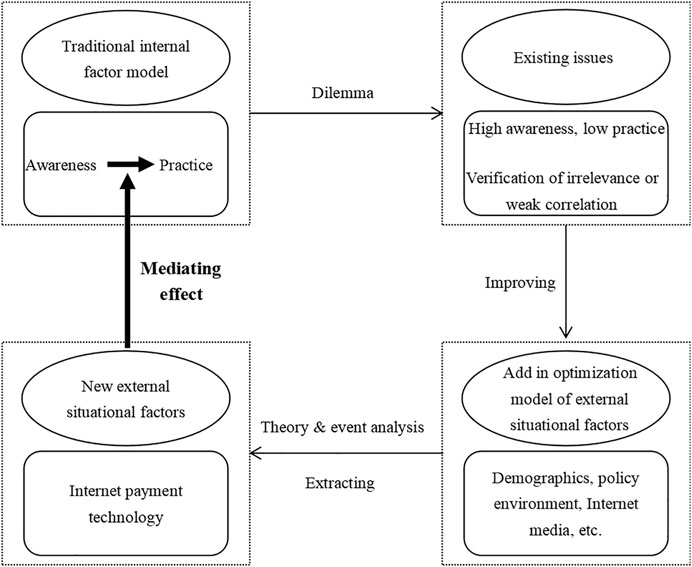
FIGURE 2. Research logic framework.
3 Methods
3.1 Questionnaire Design and Data Processing
This article uses the classic five-point Likert scale, adding self-designed questions to Peng et al.’s (2019) questionnaire on the relationship between the Internet and the environment. In order to filter out invalid responses, we also designed logically related questions that do not enter the model. We distributed our online questionnaire to residents of 31 provinces in mainland China. Through the largest online questionnaire distribution platform in China, a total of 1,083 questionnaires were distributed in May 2020, which were taken back in August 2020. After excluding invalid responses and those with missing information, 623 were retained for analysis of the study variables. Sustainability is the explained variable; environmental awareness is the explanatory variable; Internet payment technology is the intermediary variable; and demographics are the control variables. Data were processed using SPSS 25.0. The confidence interval is set to 95%.
3.1.1 Dependent Variable
The concept of sustainability includes green, environmental practice, recycling ,etc. In designing the questionnaire, we focused on the attributes of environmental practices, referring to the degree of residents’ actual participation in environmental protection activities. Such activities include the use of old objects, low-carbon transportation, tree planting, garbage recycling, and other public welfare projects targeting environmental protection (Liu and Hao, 2017). Sustainability was quantified through seven questions each covering a distinct aspect: reducing paper shopping receipts, reducing dependence on plastic packaging, not using disposable tableware, low-carbon travel, item reuse, tree planting, and other environmental protection projects. Each question was answered on a 5-point scale; the higher the score, the higher is the degree of environmental sustainability. Summing up the scores of each question produced the overall score for sustainability (SS).
3.1.2 Independent Variable
Environmental awareness refers to residents’ views on, attitudes toward, and knowledge of environmental protection (Stern and Dietz, 1994). This research quantifies environmental awareness through 15 questions covering seven aspects: consumers’ willingness to purchase green products, extra costs for green added value, awareness of environmental knowledge, environmental protection norms of people around them, ease of participating in environmental protection, environmental value recognition, and basic conditions of environmental protection. Each question was answered on a 5-point scale; the higher the score, the higher is environmental awareness. Summing up the scores for each question produced the overall score for environmental awareness (EA).
3.1.3 Mediator
Scholars often measure Internet payments by the total transaction amount (Weeks, 2018; Yao et al., 2018). Although this indicator is somewhat representative, it does not capture the per capita transaction amount of Internet payments, the number of such transactions per capita, and the transaction penetration rate, all of which reflect the application degree of Internet payment technology (Dorn, 2018). To include more comprehensive information and take into account the reliability of the data, we quantified the use of Internet payment technology (IPT) using the Internet Payment Development Index developed by the Institute of Internet Finance, Peking University (China Center for Economic Research, 2018). This index has been adopted by the National Development Institute, and so has recognized authority. It provides a value for each region in each year. To ensure the consistency and validity of the data from 2016 to 2019, we average the cross-year data and match the region data with the residence location of each respondent.
3.1.4 Control Variables
Based on previous findings on which demographics influence environmental perceptions and practices (Wang and Zhong, 2016; Li, 2006; Gong and Lei, 2007), this study includes five control variables: sex (SE), age (AG), education level (EL), monthly household income (HI), and urban-county-rural distribution (UCR). They are classified and scored based on the scale results.
The definitions and descriptions of all study variables are presented in Table 1.
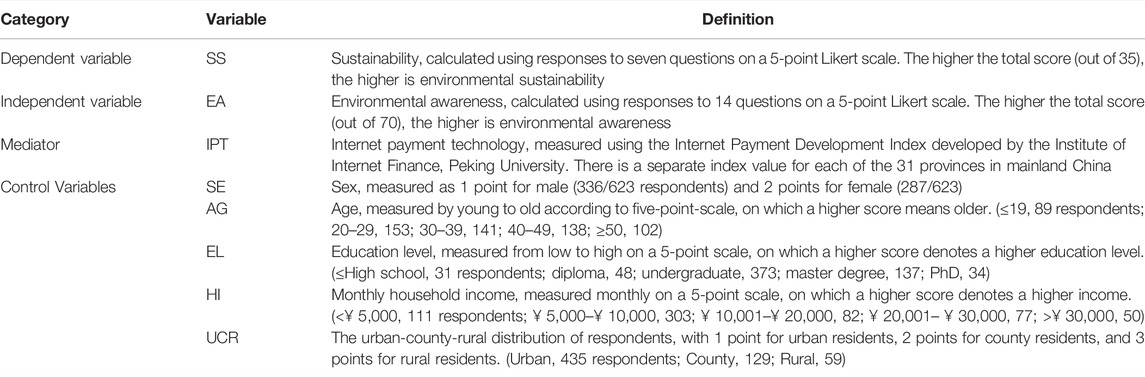
TABLE 1. Variable definitions.
3.2 Reliability and Validity Tests of the Questionnaire
To ensure the consistency and rationality of the questionnaire items (Brener et al., 2002; Ratko et al., 2020), the scales measuring the dependent variable, independent variable, and mediator (22 items in total) were subject to the following tests of reliability and validity.
3.2.1 Reliability
Reliability is achieved when repeatedly measuring the same object using the same method produces consistent results (Long and Johnson, 2000). We used the Cronbach’s α coefficient to test the reliability of the questionnaire (Bland and Altman, 1997). The calculation formula is:
where k is the total number of questions in the scale; Si2 is the variance of the ith question; and ST2 is the variance of the total score of all questions (Jackson et al., 2020). The Cronbach’s α of the whole questionnaire is 0.832, which is greater than the threshold of 0.8, confirming that reliability is sufficiently high (Eisinga et al., 2013; Lisawadi et al., 2019).
3.2.2 Validity
Validity measures whether the design of the questions is scientific (Mayer-Davis et al., 2019). We used factor analysis to test whether the relationship between each factor and its corresponding questions is good. First, we measured the communality of each factor to screen for invalid questions. The results are shown in Table 2.
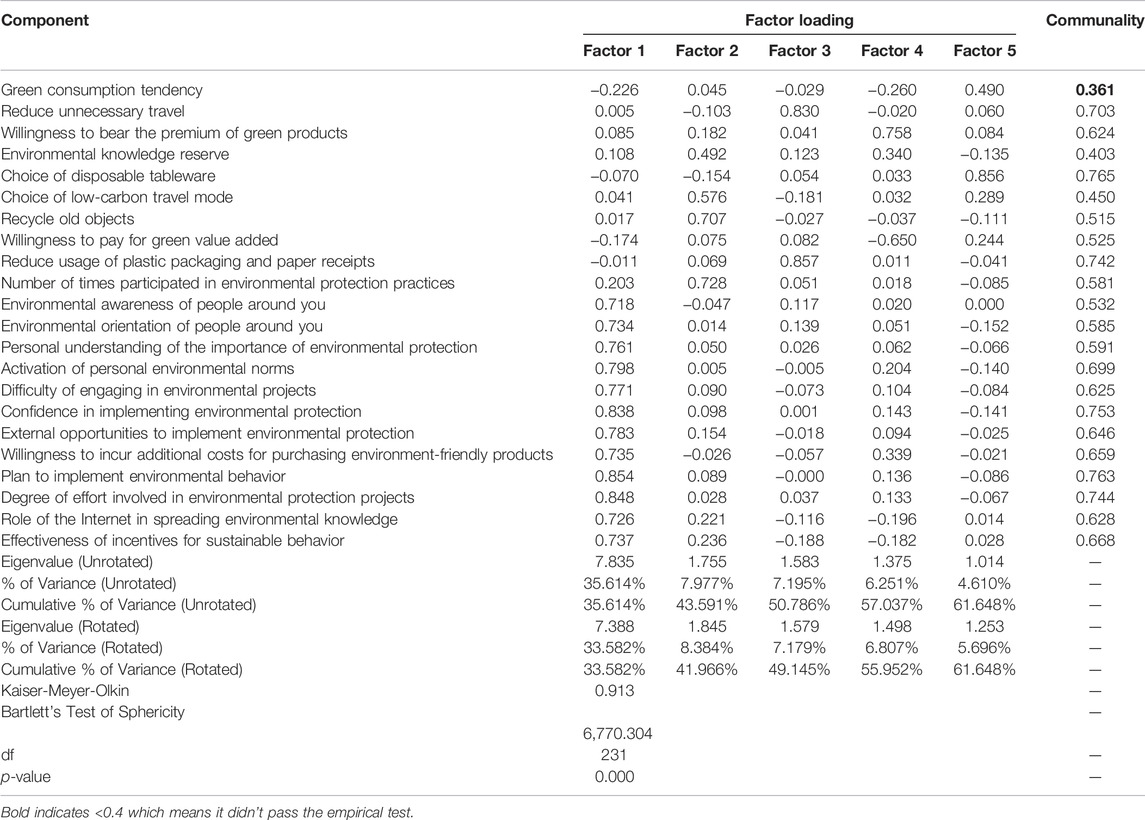
TABLE 2. First validity test.
The communality of “green consumption tendency” (used to evaluate environmental awareness) is smaller than 0.4, which shows that the information of this question cannot be effectively expressed (Mayer-Davis et al., 2019). Therefore, we removed this item and ran the validity analysis again. The results are shown in Table 3.
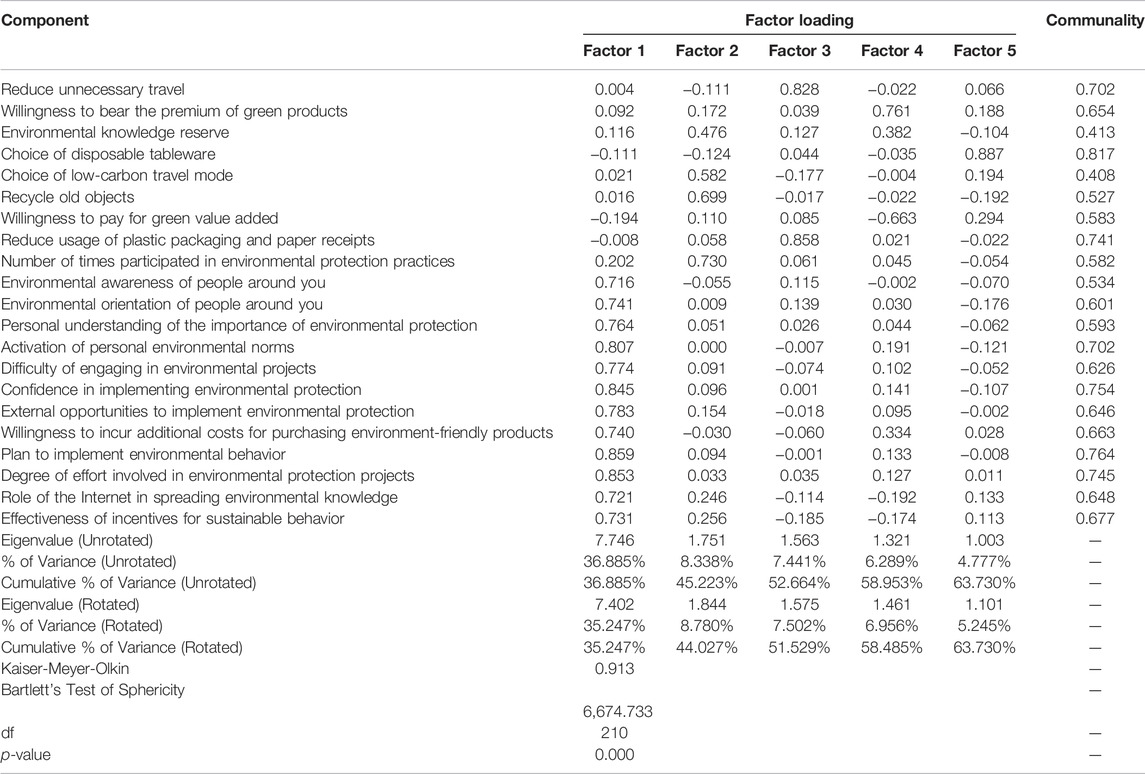
TABLE 3. Final validity test.
All questions now had communality values above 0.4, indicating that the information of research subject can be effectively extracted. The Kaiser-Meyer-Olkin (KMO) value is 0.913, which exceeds the threshold of 0.6 required to indicate valid data. In addition, the rotated cumulative percentage of variance is 63.730%, which exceeds the 50% threshold required to indicate that the information amount of the research subject can be effectively extracted (Chung et al., 2004). In summary, the test results reported in Table 3 confirm that the questionnaire measures have good validity. After excluding the question with low communality, seven questions are used to evaluate sustainability and 14 to evaluate environmental awareness.
3.3 Mediation Effect
Although measurement software can directly analyze a mediation effect, it does not intuitively reflect the identification process of each stage of the effect. To test the mediation effect, we adopted from the field of psychology the causal step method, following the three steps shown in Figures 3, 4. This method has been used by many psychologists (Coman et al., 2017; Fairchild et al., 2019; Liu et al., 2021). Compared with measurement software, it can better reflect the intermediate process and internal mechanism of the mediation effect, highlighting causal links (Intasao and Hao, 2018; Zhao et al., 2020). The explanatory variable is EA (X), the mediating variable is IPT (M), and the explanatory variable is SS (Y).
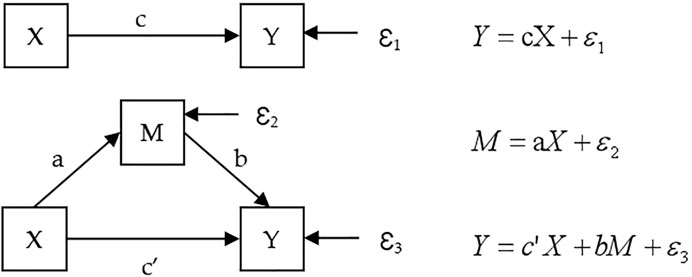
FIGURE 3. Model of mediating effect.
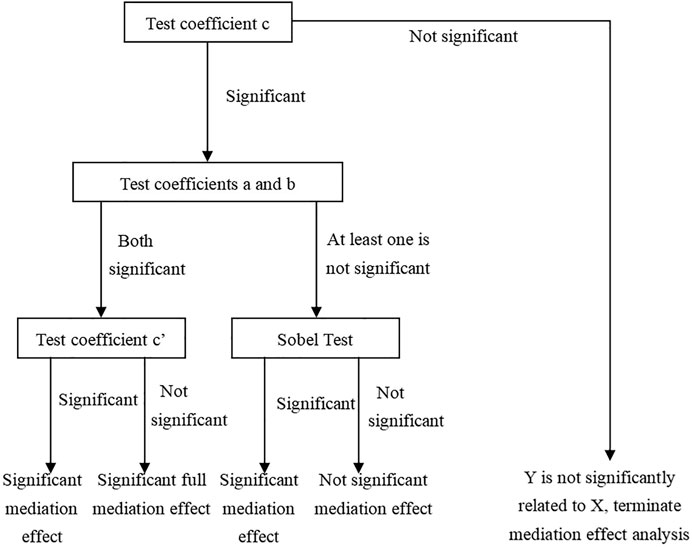
FIGURE 4. Mediating effect test process.
We first explored the influence of the independent variable on the dependent variable (
Based on the above analysis of the classic mediation effect model, the correlation between the independent variable and the mediator also needs to be considered. Peng et al. (2019) found that residents who often use the Internet to browse information have a higher level of environmental literacy. Accordingly, we propose the following hypothesis:
H4. Environmental awareness and use of Internet payment technology are positively related.The research model and hypotheses are depicted in Figure 5.
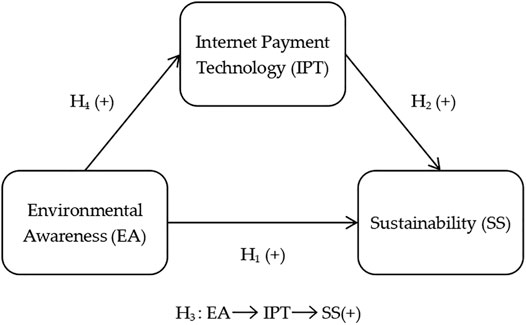
FIGURE 5. Research model and hypotheses.
4 Results
4.1 Descriptive Analysis
Table 4 presents the descriptive statistics of all the study variables. The standard deviations of EA, SS, and IPT are large, suggesting a high degree of heterogeneity in respondents’ perception and behavior, and there is a clear gap between environmental protection attitudes and behaviors among different people which can be inferred from the value of the standard deviation. This high degree of heterogeneity in the sample somewhat increases the credibility of the experiment (Beck, 1992; Liu and Hao, 2017; Stockemer, 2018). Because the range of values is far greater for IPT than for the other variables, we use the logarithm of IPT in our analyses (ln (IPT)).
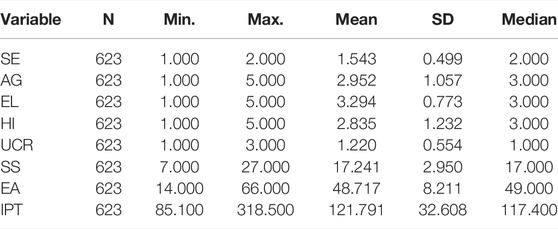
TABLE 4. Descriptive statistics.
The descriptive statistics also manifest the phenomenon of “high awareness, low practice” in the field of sustainable development. Specifically, the mean scores of EA and SS were 48.717 points and 17.241 points, respectively 70% and 49% of the maximum possible scores.
4.2 Path Analysis: Demographics
This section uses path analysis to test the correlations between demographic variables (i.e., the five control variables) and EA and SS, respectively.
4.2.1 Demographics and Environmental Awareness
Table 5 reports the regression coefficients between demographic variables and EA. Gender, age, and income are each positively correlated with EA, consistent with prior findings (Zelezny et al., 2000; Hunter et al., 2004). Conversely, there is no significant correlation between either education level or urban-county-rural areas and EA. Based on these findings, we infer that women, older individuals, and households with a higher monthly income tend to have higher environmental awareness.

TABLE 5. Path analysis: demographic variables and environmental awareness.
4.2.2 Demographics and SS
Table 6 reports the regression coefficients between demographic variables and SS. Only monthly household income is significantly correlated with SS, showing a positive relationship. This indicates that higher family income is associated with higher actual participation in environmental protection (Olli et al., 2001). This may be because more income equates to higher disposable funds, which can be invested in green consumption or environmental protection projects.

TABLE 6. Path analysis: demographic variables and sustainability.
4.3 Stepwise Regression
We used SPSS 25.0 to perform a stepwise regression testing the mediation effect. Following the logic of regression analysis explained in Section 3, the mediation effect is tested in four steps:
Step 1. Verify the correlation between EA and SS.
Step 2. Verify the correlation between EA and ln(IPT).
Step 3. Verify the correlation between EA, ln(IPT), and SS.
Step 4. If appropriate, carry out a Sobel test.The results are reported in Table 7. First, in Model 2 we find a significant positive correlation between EA and SS (B = 0.128, p < 0.05), indicating that people with higher environmental awareness engage more in environmental practices. This supports H1. It should be noted that this result does not conflict with the “high awareness, low practice” phenomenon in a given individual: the positive correlation is for the overall sample.Second, in Model 1 we find no significant correlation between EA and ln (IPT) (p = 0.079), indicating that residents’ environmental awareness is not significantly related to their use of Internet payment technology. Thus, H4 is not supported and a Sobel test must be conducted to observe whether the mediation effect is significant.Third, Model 3 shows significant positive correlations between EA and SS (B = 0.125, p < 0.05) and between ln (IPT) and SS (B = 1.841, p < 0.05) in the overall mediation effect model, thus further verifying H1 and supporting H2. Moreover, adding ln (IPT) in Model 3 increases the value of R2 to 0.457, compared to 0.443 in Model 2, indicating a higher goodness of fit.Fourth, we use the Sobel test to verify the mediation effect, reporting the results in Table 8. The confidence interval of the Sobel test is 4.49%, from which we can conclude that the partial mediation effect is significant. To ensure the stability of the experimental results, we use the bootstrap procedure with 1,000 samples. As reported in Table 9, the results show that the 95% confidence interval does not include both a positive number and a negative number (95% CI: 0.000–0.007), thus indicating that ln (IPT) has a mediation effect between EA and SS. EA first affects ln (IPT), then SS through ln (IPT). The results provided support for H3.For the control variables, we see in Model 3 (Table 7) that there are significant negative correlations between SE and SS (B = −0.572, p < 0.05) and between AG and SS (B = −0.295, p < 0.05), whereas HI and SS are significantly positively correlated (B = 0.215, p < 0.05). By contrast, neither EL nor UCR are significantly correlated with SS.
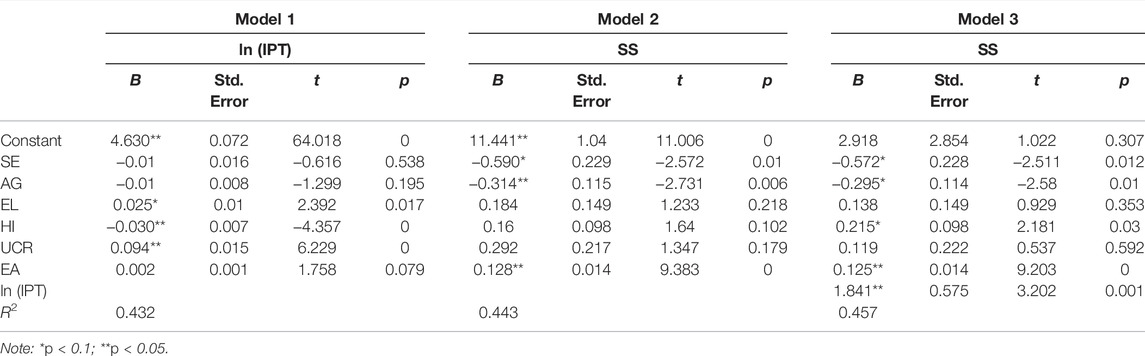
TABLE 7. Stepwise regression.

TABLE 8. Sobel test.

TABLE 9. Bootstrap sampling test.
5 Discussion
Based on the A-B-C model, this study investigated the mechanism between environmental awareness and sustainability by considering the potential mediator role of Internet payment technology. We proposed and tested several hypotheses based on theoretical analysis and prior studies. Stepwise regression yielded the following main findings.
First, environmental awareness can significantly promote sustainability. This is consistent with traditional theories of environmental behavior research, such as the TPB, norm activation theory, and value-belief-norm theory. Focused on psychological influencing factors, these theories posit that individuals need high awareness of the results of environmental actions for individual norms to be activated, leading them to adopt environmental behaviors (Kim and Chung, 2011; Lao and Wu, 2013; Ntanos et al., 2018; Kyriakopoulos et al., 2020). This study’s findings provide empirical proof. Specifically, it can be discussed and explained from three aspects. First, sustainable practices benefit the community, society, and future generations. For individuals, it has a typical spillover effect and outstanding externalities. Based on the economic man assumption, sustainability is inconsistent with personal short-term profit-seeking. Therefore, the value norm of environmental awareness is the most important internal factor for environmental protection behaviors (Fretwell and Greig, 2019). Second, people with higher environmental awareness are more inclined to pay attention to positive environmental information, advocate environmental values, and disseminate environmental knowledge. They also tend to implement more environmental practices to set an example for others (Sadorsky, 2012; Mohiuddin et al., 2018). Third, people with higher environmental awareness often pay more attention to and are more anxious about negative information on sustainability (Cho et al., 2007). Therefore, they are more likely to be motivated by crisis and, thus, more actively implement environmental behaviors.
The second main finding is that environmental awareness does not significantly affect the use of Internet payment technology. Although Internet payment technology can function as an external factor promoting sustainability, it primarily functions as a payment tool (Kim, 2018). Therefore, this findings is consistent with practice in real life. We explored residents’ motivations for using Internet payment technology. Only 16% of people reported using Internet payment technology from the perspective of sustainable development; the vast majority of respondents indicated other reasons, such as convenience and simplicity.
Third, Internet payment technology was significantly positively related to sustainability. This reflects the role it plays in guiding consumers to buy green products, significantly reducing the cost of obtaining green information about products, and enabling the social functions, green responsibilities, and comparative advantages of green products to be accepted by a wide range of consumer groups. Internet payment technology can also give the public ways and incentives to implement green behaviors in different consumption scenarios. According to Lao (2019) statistics, China’s 500 million plus users of Internet payment technology have collectively achieved a reduction in carbon emissions of 7.92 million tons, as well as the planting of 122 million trees, whose planting area is 1.5 times the size of Singapore.
Fourth, Internet payment technology plays a mediator role between environmental awareness and sustainability. The empirical results have a certain practical basis. Internet payment technology provides richer scenes and platforms for green consumption and green public welfare, which gives residents more convenient opportunities to engage more extensively in sustainable development, thus enabling environmental awareness to more fully affect environmental protection practices. We summarize in Table 10 the ways in which Internet payment technology can facilitate or promote sustainability actions. Internet payment technology gives residents greater and broader opportunities to engage directly in environmental protection, via platforms enabling diversified green consumption and sustainable practices. This technology also shortens the distance between individuals and sustainability, and broadens the channels for participating in environmental behaviors (Romm, 2002).
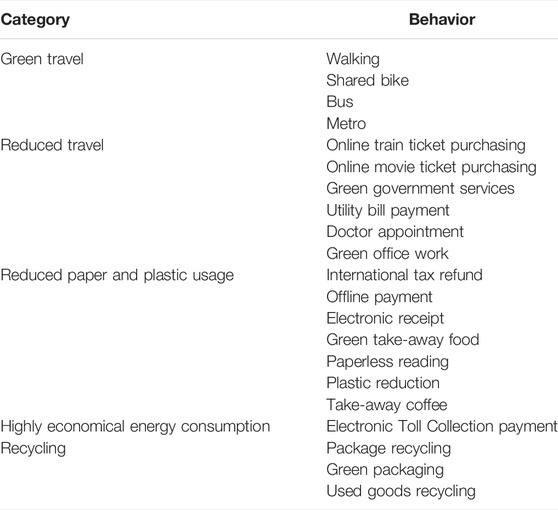
TABLE 10. Opportunities for sustainability supported by Internet payment platforms.
Fifth, we found that some demographics significantly affect sustainability. Regarding gender, our path analysis found that females have higher environmental awareness (consistent with Liang et al., 2018) but males are more likely to engage in environmental practices (consistent with Hong, 2005). In terms of age, older individuals were found less likely to engage in sustainability, confirming that young people are still the main protagonists in sustainable development. As regards income, higher monthly household income was associated with a greater likelihood of participating in sustainability. Combining the results of the path and regression analyses, we infer that young males with high income levels are most likely to engage in environmental practices.
6 Conclusion
6.1 Contributions
This article focus on a new research perspective, integrating Internet payment technology as a new external situational factor in an A-B-C-model. Our study makes the following theoretical and practical contributions.
First, to enhance research on the external contextual factors influencing sustainability, through the mediation effect analysis, we compare goodness of fit in models with and without the external situational factor of Internet payment technology. It verifies the importance of this external factor, thereby expanding theoretical models focused on internal (psychological) factors.
Second, this study verifies the role of technological innovation in breaking the traditional environmental protection and green development model. Specifically, it provides empirical data supporting the mediator role of Internet payment technology in the field of sustainability.
Third, by analyzing demographic variables, we profile which populations have higher environmental awareness and engage more in sustainability. Women who are older and have higher monthly household income tend to have higher environmental awareness, whereas younger males with high income levels are more likely to participate in sustainable development. These results not only verify the conclusions of previous studies (Li, 2006; Gong and Lei, 2007) but also provide a basis to further refine understanding of how demographics impact on sustainability.
Fourth, this study empirically proves the mediator role played by Internet payment technology between environmental awareness and environmental behaviors, thereby clarifying the internal mechanism of action. Our serial mediation model of environmental awareness–Internet payment technology–sustainability can be used as a reference in subsequent research.
Sustainability is an important issue for all mankind. According to Balsa-Barreiro et al. (2019), CO2 emissions are highly correlated with GDP. Compared with Western countries, developing countries have lower resource utilization efficiency. China is the largest developing country and the second largest economy. Accordingly, raising China’s level of environmental sustainability will benefit the world. Moreover, relevant experience provides a valuable reference for other developing countries. From the perspective of population dynamics, the marginal utility of carbon-reduction effects will be much higher in the East than in the West. This study provides some inspiration for global environmental governance and green development. First, our data show that Internet payment technology can increase residents’ participation in environmental protection. Our study thereby presents new ideas for sustainable development in other countries and encourages the innovative application of Internet payment technology. Second, this article reveals which demographics are associated with higher environmental awareness and higher sustainability. This should help governments and enterprises to more accurately identify target groups, more effectively promote green products and green public welfare projects.
6.2 Limitations and Future Research Directions
This study has certain limitations. First, we did not examine the endogenous variables of sustainable development, such as the internal factors proposed by the value-belief-norm theory (personal values, beliefs, world views, and responsibility). Instead, we grouped internal factors to measure the overall level of an individual’s environmental awareness. Future research should consider more internal factors within the research model. Second, the scores assigned to each question are averaged without weighting to generate the values of each variable. In future research, factor analysis or a Pareto test can be used to assign weights to scale questions, thereby obtaining more accurate experimental results. Third, we did not discuss the correlations between some control variables and the independent variable, and did not consider possible endogenous effects. Future research should explore the endogeneity among variables to further refine the model.
Data Availability Statement
The raw data supporting the conclusion of this article will be made available by the authors, without undue reservation.
Ethics Statement
Ethical review and approval was not required for this study in accordance with the local legislation and institutional requirements. The participants provided their written informed consent to participate in this study.
Author Contributions
JA and HD were responsible for writing the initial draft of the manuscript, developing the main propositions and conducting the study. HD and SJ were responsible for modifying and improving the manuscript. MY was responsible for reviewing and editing the manuscript. All authors have read and approved the submitted version.
Funding
This research was funded by the National Natural Science Foundation of China (No. 72091313).
Conflict of Interest
The authors declare that the research was conducted in the absence of any commercial or financial relationships that could be construed as a potential conflict of interest.
Publisher’s Note
All claims expressed in this article are solely those of the authors and do not necessarily represent those of their affiliated organizations, or those of the publisher, the editors and the reviewers. Any product that may be evaluated in this article, or claim that may be made by its manufacturer, is not guaranteed or endorsed by the publisher.
References
Ajzen, I. (2011). The Theory of Planned Behaviour: Reactions and Reflections. Psychol. Health 26 (9), 1113–1127. doi:10.1080/08870446.2011.613995
Al Mamun, A., Mohamad, M. R., Yaacob, M. R. B., and Mohiuddin, M. (2018). Intention and Behavior towards Green Consumption Among Low-Income Households. J. Environ. Manag. 227, 73–86. doi:10.1016/j.jenvman.2018.08.061
Balsa-Barreiro, J., Li, Y., Morales, A., and Pentland, A. S. (2019). Globalization and the Shifting Centers of Gravity of World's Human Dynamics: Implications for Sustainability. J. Clean. Prod. 239, 117923. doi:10.1016/j.jclepro.2019.117923
Bamberg, S., and Möser, G. (2007). Twenty Years after Hines, Hungerford, and Tomera: a New Meta-Analysis of Psycho-Social Determinants of Pro-environmental Behaviour. J. Environ. Psychol. 27 (1), 14–25. doi:10.1016/j.jenvp.2006.12.002
Barbu, C. M., Florea, D. L., Dabija, D.-C., and Barbu, M. C. R. (2021). Customer Experience in Fintech. Jtaer 16 (5), 1415–1433. doi:10.3390/jtaer16050080
Bin, L. (2022). Goods Tariff vs Digital Services Tax: Transatlantic Financial Market Reactions. Econ. Manag. Financ. Mark. 17 (1), 9–30. doi:10.22381/emfm17120221
Birtus, M., and Lăzăroiu, G. (2021). The Neurobehavioral Economics of the COVID-19 Pandemic: Consumer Cognition, Perception, Sentiment, Choice, and Decision-Making. Anal. Metaphys. 20, 89–101. doi:10.22381/am2020216
Black, J. S., Stern, P. C., and Elworth, J. T. (1985). Personal and Contextual Influences on Househould Energy Adaptations. J. Appl. Psychol. 70 (1), 3–21. doi:10.1037/0021-9010.70.1.3
Blake, J. (1999). Overcoming the 'value‐action Gap' in Environmental Policy: Tensions between National Policy and Local Experience. Local Environ. 4 (3), 257–278. doi:10.1080/13549839908725599
Bland, J. M., and Altman, D. G. (1997). Statistics Notes: Cronbach's Alpha. Bmj 314 (7), 572. doi:10.1136/bmj.314.7080.572
Brand, K. W. (1997). “Environmental Consciousness and Behaviour: the Greening of Lifestyles,” in The International Handbook of Environmental Sociology. Editors M. Redclift, and G. Woodgate (Cheltenham: Edward Elgar)), 204.
Brener, N., Kann, L., McManus, T., Kinchen, S., Sundberg, E., and Ross, J. (2002). Reliability of the 1999 Youth Risk Behavior Survey Questionnaire. J. Adolesc. Health 31 (4), 336–342. doi:10.1016/S1054-139X(02)00339-7
Chen, A. C.-H., and Wu, H.-H. (2020). How Should Green Messages Be Framed: Single or Double? Sustainability 12, 4257. doi:10.3390/su12104257
China Center for Economic Research (2018). Peking University Internet Finance Development Index Report (Phase 1). Available at: https://www.ccer.pku.edu.cn/yjcg/yjbg/243148.htm (accessed May 24, 2020).
Chinese Internet Data Information Network (2016). Ali Research Institute: 2016 China Green Consumer Report. Available at: http://www.199it.com/archives/503487.html (Accessed May 25, 2020).
Cho, Y., Lee, J., and Kim, T.-Y. (2007). The Impact of ICT Investment and Energy Price on Industrial Electricity Demand: Dynamic Growth Model Approach. Energy Policy 35 (9), 4730–4738. doi:10.1016/j.enpol.2007.03.030
Coman, E. N., Thoemmes, F., and Fifield, J. (2017). Commentary: Causal Effects in Mediation Modeling: an Introduction with Applications to Latent Variables. Front. Psychol. 8, 151. doi:10.3389/fpsyg.2017.00151
Cyberspace Administration of China (2019). Statistical Report on Internet Development in China. Available at: http://www.cac.gov.cn/2019-02/28/c_1124175677.htm (accessed May 25, 2020).
De Young, R. (1990). Recycling as Appropriate Behavior: a Review of Survey Data from Selected Recycling Education Programs in Michigan. Resour. Conservation Recycl. 3 (4), 253–266. doi:10.1016/0921-3449(90)90022-V
Dorn, S. (2018). Assessing the Promise and Risks of Income-Based Third-Party Payment Programs. Commonw. Fund. Issue Briefs 5 (1), 1–13.
Eisinga, R., Grotenhuis, M. t., and Pelzer, B. (2013). The Reliability of a Two-Item Scale: Pearson, Cronbach, or Spearman-Brown? Int. J. Public Health 58 (4), 637–642. doi:10.1007/s00038-012-0416-3
Ellison, N. B., Gibbs, J. L., and Weber, M. S. (2015). The Use of Enterprise Social Network Sites for Knowledge Sharing in Distributed Organizations. Am. Behav. Sci. 59 (1), 103–123. doi:10.1177/0002764214540510
Fairchild, A. J., Cai, C., McDaniel, H., Shi, D., Gottschall, A., and Masyn, K. E. (2019). Evaluating a Method to Estimate Mediation Effects with Discrete-Time Survival Outcomes. Front. Psychol. 10, 740. doi:10.3389/fpsyg.2019.00740
Fischer, E., and Reuber, A. R. (2011). Social Interaction via New Social Media: (How) Can Interactions on Twitter Affect Effectual Thinking and Behavior? J. Bus. Ventur. 26 (1), 1–18. doi:10.1016/j.jbusvent.2010.09.002
Fretwell, K., and Greig, A. (2019). Towards a Better Understanding of the Relationship between Individual's Self-Reported Connection to Nature, Personal Well-Being and Environmental Awareness. Sustainability 11 (5), 1386. doi:10.3390/su11051386
Garz, M. (2014). Good News and Bad News: Evidence of Media Bias in Unemployment Reports. Public Choice 161 (3–4), 499–515. doi:10.1007/s11127-014-0182-2
Gim Chung, R. H., Kim, B. S. K., and Abreu, J. M. (2004). Asian American Multidimensional Acculturation Scale: Development, Factor Analysis, Reliability, and Validity. Cult. Divers. Ethn. Minority Psychol. 10 (1), 66–80. doi:10.1037/1099-9809.10.1.66
Gkika, E. C., Anagnostopoulos, T., Ntanos, S., and Kyriakopoulos, G. L. (2020). User Preferences on Cloud Computing and Open Innovation: a Case Study for University Employees in Greece. JOItmC 6 (2), 41. doi:10.3390/joitmc6020041
Gong, W. J., and Lei, J. (2007). An Analysis of Gender Difference in the Environmental Concern and Environmentally Friendly Behaviors of Chinese Urban Residents: Based on the Research of GSS in 2003. Humanit. Soc. Sci. J. Hainan Univ. 3, 340. doi:10.15886/j.cnki.hnus.2007.03.018
Guagnano, G. A., Stern, P. C., and Dietz, T. (1995). Influences on Attitude-Behavior Relationships. Environ. Behav. 27 (5), 699–718. doi:10.1177/0013916595275005
He, H., Zhang, S., and Zhu, L. (2021). Green Product Quality Supervision Strategy in Online Shopping with Consumer Evaluation and Complaint. Front. Environ. Sci. 9, 1–16. doi:10.3389/fenvs.2021.702151
He, M. Y. (2018). An Analysis of the Communication Strategy of Environmental Public Welfare in the “Internet +” Era: Take “Ant Forest” as an Example. Radio Tv. J. 7, 204–205. doi:10.19395/j.cnki.1674-246x.2018.07.115
Hill, R. J., Fishbein, M., and Ajzen, I. (1977). Belief, Attitude, Intention and Behavior: An Introduction to Theory and Research. Contemp. Sociol. 6 (2), 244–334. doi:10.2307/2065853
Hong, H. (2013). Government Websites and Social Media's Influence on Government-Public Relationships. Public Relat. Rev. 39 (4), 346–356. doi:10.1016/j.pubrev.2013.07.007
Hopkins, E., and Potcovaru, A.-M. (2021). Consumer Attitudes, Values, Needs, and Expectations Due to COVID-19. Anal. Metaphys. 20, 202–215. doi:10.22381/am20202114
Huang, X. (2018). On the Development of Sharing Economy under the Background of Internet. Co-op. Eco. Technol. 16, 46–47. doi:10.13665/j.cnki.hzjjykj.2018.16.015
Hunter, L. M., Hatch, A., and Johnson, A. (2004). Cross-National Gender Variation in Environmental Behaviors*. Soc. Sci. Q 85 (3), 677–694. doi:10.1111/j.0038-4941.2004.00239.x
Intasao, N., and Hao, N. (2018). Beliefs about Creativity Influence Creative Performance: the Mediation Effects of Flexibility and Positive Affect. Front. Psychol. 9, 1810. doi:10.3389/fpsyg.2018.01810
Ionescu, L. (2021). Corporate Environmental Performance, Climate Change Mitigation, and Green Innovation Behavior in Sustainable Finance. Econ. Manag. Financ. Mark. 16 (3), 94–106. doi:10.22381/emfm16320216
Iqbal, K., Hassan, S. T., Wang, Y., Shah, M. H., Syed, M., and Khurshaid, K. (2022). To Achieve Carbon Neutrality Targets in Pakistan: New Insights of Information and Communication Technology and Economic Globalization. Front. Environ. Sci. 9, 1–10. doi:10.3389/fenvs.2021.805360
iResearch Consulting (2020). 2019Q4 China Third-Party Payment Industry Data Release. Available at: https://www.iresearch.com.cn/Detail/report?id=3543&isfree=0 (accessed May 25, 2020).
Jackson, I. L., Okonta, J. M., and Ukwe, C. V. (2020). Development and Psychometric Evaluation of the Patient's HIV Knowledge Questionnaire (PHKQ). Int. J. Clin. Pharm. 42 (2), 695–702. doi:10.1007/s11096-020-00963-z
Kaiser, F. G., and Gutscher, H. (2003). The Proposition of a General Version of the Theory of Planned Behavior: Predicting Ecological Behavior1. J. Appl. Soc. Pyschol 33 (3), 586–603. doi:10.1111/j.1559-1816.2003.tb01914.x
Kim, J. (2018). Platform Adoption Factors in the Internet Industry. Sustainability 10, 3185. doi:10.3390/su10093185
Krätzig, S., and Warren-Kretzschmar, B. (2014). Using Interactive Web Tools in Environmental Planning to Improve Communication about Sustainable Development. Sustainability 6, 236–250. doi:10.3390/su6010236
Kshetri, N. (2017). The Evolution of the Internet of Things Industry and Market in China: an Interplay of Institutions, Demands and Supply. Telecommun. Policy 41 (1), 49–67. doi:10.1016/j.telpol.2016.11.002
Kyriakopoulos, G., Ntanos, S., and Asonitou, S. (2020). Investigating the Environmental Behavior of Business and Accounting University Students. Ijshe 21 (4), 819–839. doi:10.1108/IJSHE-11-2019-0338
Lao, K. F., and Wu, J. (2013). Research on Influencing Mechanism of Consumer Green Consumption Behavior Referring to TPB. Fin. Econ. 2, 91.
Lao, M. (2019). The Third Anniversary of Ant Forest’s Launch, 500 Million Users Accumulated Carbon Emission Reduction of 7.92 Million Tons. Available at: http://www.techweb.com.cn/internet/2019-08-27/2751495.shtml (Accessed May 25, 2020).
Li, M. D. (2018). Exploring the Communication Model of “Internet + Public Welfare” from the Perspective of Scene Theory: Taking “Ant Forest” as an Example. News World 6, 69–73. doi:10.19497/j.cnki.1005-5932.2018.06.022
Li, W. J. (2006). An Analysis of Multi-Factors Affecting Individual Environment Behavior: A Survey in Wuyishan City. Master’s thesis. Xiamen: Xiamen University.
Li, X. C., and Liu, H. (2018). Research on Influencing Factors Model of Urban Residents’ Low-Carbon Travel Behavior Decision. Urban Manag. Sci. Technol. 20 (4), 51.
Liang, S.-W., Fang, W.-T., Yeh, S.-C., Liu, S.-Y., Tsai, H.-M., Chou, J.-Y., et al. (2018). A Nationwide Survey Evaluating the Environmental Literacy of Undergraduate Students in Taiwan. Sustainability 10 (6), 1730. doi:10.3390/su10061730
Lisawadi, S., Ahmed, S. E., Reangsephet, O., and Shah, M. K. A. (2019). Simultaneous Estimation of Cronbach's Alpha Coefficients. Commun. Statistics - Theory Methods 48 (13), 3236–3257. doi:10.1080/03610926.2018.1473882
Liu, C., and Hao, Y. (2017). Research on Green Economy Platform of Agricultural Products Based on “Internet +. Manag. Obs. 15, 34.
Liu, M., Li, J., Xiong, T., Liu, T., and Chen, M. (2021). Intermediary Management and Employee Corporate Culture Identification Mediation and Mediation Effect Verification. Front. Psychol. 12, 545816. doi:10.3389/fpsyg.2021.545816
Long, T., and Johnson, M. (2000). Rigour, Reliability and Validity in Qualitative Research. Clin. Eff. Nurs. 4 (1), 30–37. doi:10.1054/cein.2000.0106
Luo, Y. D., Wei, Y. X., and Ding, H. (2019). An Analysis of the Co-creation Behavior of Online Public Welfare Value: Taking “Ant Forest” as an Example. Mark. Wkly. 4, 24.
Lv, Y. C. (2018). The Study on Green Consumption and its Realization Approaches Based on Sharing Economy. Doctoral thesis. Wuhan: Zhongnan University of Economics and Law.
May, A. Y. C., Hao, G. S., and Carter, S. (2021). Intertwining Corporate Social Responsibility, Employee Green Behavior, and Environmental Sustainability: The Mediation Effect of Organizational Trust and Organizational Identity. Econ. Manag. Financ. Mark. 16 (2), 32–61. doi:10.22381/emfm16220212
Mayer-Davis, E. J., Vitolins, M. Z., Carmichael, S. L., Hemphill, S., Tsaroucha, G., Rushing, J., et al. (1999). Validity and Reproducibility of a Food Frequency Interview in a Multi-Cultural Epidemiologic Study. Ann. Epidemiol. 9 (5), 314–324. doi:10.1016/s1047-2797(98)00070-2
Men, D., and Xiong, R. C. (2018). Analysis of the Mechanism for Public Environmental Protection Behaviors: Based on the Impact of the Government Input Effect. Sch. View 15 (17), 94. doi:10.16619/j.cnki.rmltxsqy.2018.17.013
Mi, L. Y., Cong, J. Q., and Ding, C. Q. (2019). Why Urban Residents’ Deeds Do Not Match Their Attitude? A Dual Mediation Model of Knowledge-Behavior in Low-Carbon Consumption. Resour. Sci. 41 (5), 908.
Ministry of Ecology and Environment of the People’s Republic of China (2018). The Ministry of Ecology and Environment and Other Five Departments Jointly Issued the “Code of Conduct for Citizens’ Ecological Environment (Trial). Available at: http://www.mee.gov.cn/gkml/sthjbgw/qt/201806/t20180605_442476.htm (accessed May 25, 2020).
Mohiuddin, M., Al Mamun, A., Syed, F., Mehedi Masud, M., and Su, Z. (2018). Environmental Knowledge, Awareness, and Business School Students' Intentions to Purchase Green Vehicles in Emerging Countries. Sustainability 10, 1534. doi:10.3390/su10051534
Murty, M. N., and Kumar, S. (2003). Win-win Opportunities and Environmental Regulation: Testing of Porter Hypothesis for Indian Manufacturing Industries. J. Environ. Manag. 67 (2), 139–144. doi:10.1016/s0301-4797(02)00203-7
Nakamura, A. (2020). Environmental Disparities in an Urban Area, Rural-Urban Migration, and Urban Unemployment. Asia-Pac. J. Reg. Sci. 4 (2), 463–477. doi:10.1007/s41685-019-00128-5
Ntanos, S., Kyriakopoulos, G., Arabatzis, G., Palios, V., and Chalikias, M. (2018). Environmental Behavior of Secondary Education Students: a Case Study at Central Greece. Sustainability 10 (5), 1663. doi:10.3390/su10051663
Okazaki, S., and Taylor, C. R. (2013). Social Media and International Advertising: Theoretical Challenges and Future Directions. Int. Mark. Rev. 30 (1), 56–71. doi:10.1108/02651331311298573
Olli, E., Grendstad, G., and Wollebaek, D. (2001). Correlates of Environmental Behaviors: Bringing Back Social Context. Environ. Behav. 33 (2), 181–208. doi:10.1177/0013916501332002
Peng, D. Y., Li, Y. C., and Li, C. Q. (2019). Research on the Impact of Internet Use on Environmental Attitudes and Environmental Literacy. Fin. Sci. 8, 97.
Peng, Y. C. (2013). A Review of Foreign Environmental Behavior Influencing Factors Research. China Popul. Res. Environ. 8, 142.
Policy Research Center for Environment and Economy (2019a). Chinese Low-Carbon Life Report Released: in the Past Three Years, the Internet Is Setting off a Low-Carbon Life Boom. Ministry of Ecology and Environment of the People’s Republic of China. Available at: http://www.prcee.org/zyhd/201908/t20190828_730376.html (accessed May 25, 2020).
Policy Research Center for Environment and Economy (2019b). The Political Research Center Released the “Research Report on Public Low-Carbon Lifestyle under the Background of Internet Platform.” Ministry of Ecology and Environment of the People’s Republic of China. Available at: http://www.prcee.org/yjcg/yjbg/201909/t20190909_733041.html (accessed May 25, 2020).
Priem, R. (2021). An Exploratory Study on the Impact of the COVID-19 Confinement on the Financial Behavior of Individual Investors. Econ. Manag. Financ. Mark. 16 (3), 9–40. doi:10.22381/emfm16320211
Radakovic, R., Gray, D., Dudley, K., Mioshi, E., Dick, D., Melchiorre, G., et al. (2020). Reliability and Validity of the Brief Dimensional Apathy Scale. Arch. Clin. Neuropsychol. 35 (5), 539–544. doi:10.1093/arclin/acaa002
Ren, B. J., Gao, S. H., and Zhu, Y. H. (2019). Research on Online Charity Behavior of College Students: Taking “Ant Forest” as an Example. Labour secur. World. 18, 78.
Romm, J. (2002). The Internet and the New Energy Economy. Resour. Conservation Recycl. 36 (3), 197–210. doi:10.1016/s0921-3449(02)00084-8
Rydell, L., and Kucera, J. (2021). Cognitive Attitudes, Behavioral Choices, and Purchasing Habits during the COVID-19 Pandemic. J. Self-Gov. Manag. Econ. 9 (4), 35–47. doi:10.22381/jsme9420213
Sadorsky, P. (2012). Information Communication Technology and Electricity Consumption in Emerging Economies. Energy Policy 48, 130–136. doi:10.1016/j.enpol.2012.04.064
Scherbaum, C. A., Popovich, P. M., and Finlinson, S. (2008). Exploring Individual-Level Factors Related to Employee Energy-Conservation Behaviors at Work. J. Appl. Soc. Pyschol 38 (3), 818–835. doi:10.1111/j.1559-1816.2007.00328.x
Schwartz, S. H. (1977). Normative Influences on Altruism. Adv. Exp. Soc. Psychol. 10, 221–279. doi:10.1016/s0065-2601(08)60358-5
Souza, A. L., Andrade, J. C., Alvarez, G., and Santos, N. (2013). Carbon Finance in the World and in Brazil: a Study on Financing, Investment Funds and Indices of Environmental Sustainability to Promote a Low Carbon Economy. GeAS 2 (2), 177–207. doi:10.5585/geas.v2i2.71
Steg, L., Dreijerink, L., and Abrahamse, W. (2005). Factors Influencing the Acceptability of Energy Policies: a Test of VBN Theory. J. Environ. Psychol. 25 (4), 415–425. doi:10.1016/j.jenvp.2005.08.003
Stern, P. C., and Dietz, T. (1994). The Value Basis of Environmental Concern. J. Soc. Issues 50 (3), 65–84. doi:10.1111/j.1540-4560.1994.tb02420.x
Stern, P. C. (2000). New Environmental Theories: Toward a Coherent Theory of Environmentally Significant Behavior. J. Soc. Isssues 56 (3), 407–424. doi:10.1111/0022-4537.00175
Stockemer, D. (2018). The Internet: an Important Tool to Strengthening Electoral Integrity. Gov. Inf. Q. 35 (1), 43–49. doi:10.1016/j.giq.2017.11.009
Štreimikienė, D., Mikalauskienė, A., Sturienė, U., and Kyriakopoulos, G. L. (2021). The Impact of Social Media on Sales Promotion in Entertainment Companies. E+M 24 (2), 189–206. doi:10.15240/tul/001/2021-2-012
Wang, Q., and Ye, J. Y. (2016). Health Status, Income and Overtime Labor of Migrant Workers. Chin. Rural. Econ. 2, 2.
Wang, X. X., and Zhong, Y. (2016). An Empirical Study of Influencing Factors for Environmental Behavior of China Urban Residents Based on a Nationwide Public Opinion Survey in 2013. J. Shanghai Jiaot. Uni. Phil. Soc. Sci. 107 (01), 71. doi:10.13806/j.cnki.issn1008-7095.2016.01.007
Wang, Y. J., and Han, D. L. (2016). Economic Development, Environmental Pollution and Public Pro-environmental Behavior: a Multi-Level Analysis of the 2013 Chinese General Social Survey. J. Renmin Uni. China 2, 79.
Wang, Y. Y., Wang, Y., and Pan, Y. (2018). The Status Quo of Internet Carbon Finance: Taking Ant Forest as an Example. Shanxi Agri. Econ. 9, 111–112. doi:10.16675/j.cnki.cn14-1065/f.2018.09.076
Weeks, J. (2018). Paradigm Change in Integrative Care: Third-Party Payment and the Cost-Benefit … Plus MorePlus More. Integr. Med. (Encinitas) 17 (4), 24.
Wu, J. Y., Mao, Q. Q., and Dong, B. C. (2019). Research on the Sustainable Development of Personal Carbon Accounts in the Era of Big Data: Taking Ant Financial as an Example. Times Fin. 14, 103.
Xia, W. (2019). A Research of Public Welfare Communication Effect Based on Internet Thinking: Take “Ant Forest” as an Example. Master’s thesis. Shanghai: Shanghai International Studies University.
Yang, J. X., Liu, Y. F., and Liu, M. M. (2018). The Challenges and Countermeasures for City-Level Low-Carbon Transportation Development in the Intemet Era. Environ. Prot. 46 (11), 43. doi:10.14026/j.cnki.0253-9705.2018.11.010
Yao, M., Di, H., Zheng, X., and Xu, X. (2018). Impact of Payment Technology Innovations on the Traditional Financial Industry: a Focus on China. Technol. Forecast. Soc. Change 135, 199–207. doi:10.1016/j.techfore.2017.12.023
Yeon Kim, H., and Chung, J. E. (2011). Consumer Purchase Intention for Organic Personal Care Products. J. Consum. Mark. 28 (1), 40–47. doi:10.1108/07363761111101930
Yin, H., Wang, H. J., Liu, S. J., and Kang, Q. (2014). Research and Application of Key Technology in Digital Environment Protection System. China Popul. Resour. Environ. 24 (171), 442.
Yuan, Y. Y. (2016). An Empirical Analysis on Residents’ Environmental Behavior and Influence Factors in China: Based on CGSS2013 Data. J. Arid. Land Resour. Environ. 212 (04), 42. doi:10.13448/j.cnki.jalre.2016.110
Zelezny, L. C., Chua, P.-P., and Aldrich, C. (2000). New Ways of Thinking about Environmentalism: Elaborating on Gender Differences in Environmentalism. J. Soc. Isssues 56, 443–457. doi:10.1111/0022-4537.00177
Keywords: payment technology innovation, environmental sustainability, consumers’ awareness, consumers’ practice, mediation effect
Citation: An J, Di H, Yao M and Jin S (2022) The Role of Payment Technology Innovation in Environmental Sustainability: Mediation Effect From Consumers’ Awareness to Practice. Front. Environ. Sci. 10:881293. doi: 10.3389/fenvs.2022.881293
Received: 22 February 2022; Accepted: 05 May 2022;
Published: 30 May 2022.
Edited by:
Yingcheng Li, Southeast University, ChinaReviewed by:
Luminita Ionescu, Spiru Haret University, RomaniaGrigorios L. Kyriakopoulos, National Technical University of Athens, Greece
Jose Balsa, Media Lab, Massachusetts Institute of Technology, Cambridge, United States
Copyright © 2022 An, Di, Yao and Jin. This is an open-access article distributed under the terms of the Creative Commons Attribution License (CC BY). The use, distribution or reproduction in other forums is permitted, provided the original author(s) and the copyright owner(s) are credited and that the original publication in this journal is cited, in accordance with accepted academic practice. No use, distribution or reproduction is permitted which does not comply with these terms.
*Correspondence: He Di, ZGloZUBqbHUuZWR1LmNu