 Hua Yang1†
 Qingmin Xu
 Huakun Zhou
 Yangong Du
- 1Tianjin Eco-Environmental Monitoring Center, Tianjin, China
- 2Tianjin Capital Environmental Protection Group Company Limited, Tianjin, China
- 3Qinghai Ecology and Environment Monitor Centre, Xining, China
- 4Qinghai Provincial Key Laboratory of Restoration Ecology for Cold Region, Northwest Institute of Plateau Biology, Chinese Academy of Sciences, Xining, China
Ecological security barriers on the Tibetan Plateau are threatened by climate change and human activities, such as grassland degradation and reduction of carbon fixation capacity. Understanding the influence of grazing on soil organic carbon (SOC) content and its regulating factors is important for improving the ecological barrier function of alpine grasslands. In this meta-analysis, we analysed the effects of grazing on SOC. The results indicate that grazing disturbance significantly reduced the SOC content by 13.93%, with an effect size of −0.15 ± 0.04 (p < 0.001). The effect of light grazing was not significant. The reduction range gradually increased with increasing grazing intensity. The effect of grazing activity on SOC content was driven mainly by pH and total nitrogen through a structural equation model. Future nitrogen deposition scenarios would significantly increase alpine meadow SOC on the Tibetan Plateau.
Introduction
The Tibetan Plateau is an important ecological security barrier in China, and is particularly susceptible to climate change (Mipam et al., 2016). Alpine meadows, a representative vegetation type of the region, cover over 60% of the Tibetan Plateau (Tang et al., 2019). Overgrazing has resulted in the degradation of over 80% of the grassland on the Tibetan Plateau and significantly decreased alpine meadow soil organic carbon (SOC) (Fu et al., 2021). Therefore, the ecosystem is fragile and faces uncertainty owing to environmental change against the backdrop of global warming.
Grazing intensity affects grassland ecosystem stability and livestock productivity, and is critical for grazing management (Mipam et al., 2016; Yang et al., 2020). Actual livestock carrying capacity is approximately 1.6 times the theoretical capacity, and 80.93% of counties have overloaded grazing on the Tibetan Plateau (Fu et al., 2021). Soil organic matter is the dominant source of grassland nutrients; 95% and 50% of soil total nitrogen and phosphorus, respectively, is derived from organic matter mineralisation (Yang et al., 2020). The disappearance of high-quality pastures is mainly caused by the depletion of soil nutrients due to overgrazing (Gebregergs et al., 2019; Li et al., 2022). Grazing affects photosynthesis by removing the aboveground parts of the pasture, thus affecting the input of pasture to SOC (Du et al., 2019a). Grazing also affects the composition of soil organic matter and available nitrogen through trampling and excretion (Gebregergs et al., 2019). Light grazing contributes to SOC accumulation, and can increase SOC by 0.78%; however, it can also moderately and severely reduce grasslands by 3.45% and 9.91%, respectively (Zhou et al., 2017). The average SOC content has been reported to be 3.4% and 2.4% in non-degraded and degraded grasslands on the eastern Tibetan Plateau, respectively (Du et al., 2019b). However, some studies have indicated that moderate grazing increased the SOC content in the Zoige marsh wetlands (Li et al., 2020).
Light and moderate grazing has been reported to increase grassland biomass and species diversity and promote the overcompensated growth of plant communities (Huidan et al., 2017). Moderate grazing is the best management method for alpine grassland growth (Du et al., 2020). Heavy grazing significantly accelerates the turnover of carbon and nitrogen in marsh meadow soil, increasing soil nutrient output and grassland degradation (Zhou et al., 2019). The decrease in total porosity, increase in soil bulk density and seepage resistance, and soil loss due to wind and water erosion have reduced the SOC pool in overgrazed grasslands (Liang et al., 2017). Heavy grazing damages the surface vegetation of alpine meadows, significantly reducing the soil carbon pool function and rainfall interception capacity (Yan et al., 2016; Dai et al., 2021). In the last 50 years, temperature and precipitation have increased by 0.3°C–0.4°C and 2.2%, respectively, every 10 years (Fu et al., 2021). The biomass of degraded alpine grasslands and the input of SOC have increased with the warming and humidifying climate (Chen et al., 2013). Heavy grazing increases grassland evapotranspiration and reduces water efficiency and SOC content (Huidan et al., 2017). Moreover, SOC content has increased perhaps with the increase of precipitation and the decrease of temperature (Zhou et al., 2019).
Previous studies have focused on the response of SOC to grazing intensity in the north-eastern and southwestern parts of the Tibetan Plateau. However, there is a lack of systematic quantitative analyses of the response characteristics of SOC in the Tibetan Plateau. The main regulatory factors of alpine meadow ecosystem SOC to grazing disturbance are also unclear. In this study, we holistically analyzed the effect of different grazing intensities on SOC content and driving factors on the Tibetan Plateau through meta-analysis and structural equation model. We hypothesized grazing decreased grassland SOC because reduction of plant carbon input into soils. Furthermore, SOC would decrease with grazing intensity increasing. This study aims to provide a scientific basis for exploring grassland grazing management systems.
Material and methods
Data compilation
We collected published papers using the keywords “grazing,” “soil organic carbon” or “SOC,” and “Tibet*” to search the Web of Science and Chinese articles database (China National knowledge Internet, https://www.cnki.net/) from January 1990, to November 2022. One hundred and eighty articles were selected and saved in the Endnote library (Endnote X9). Full-version papers were automatically added by the “find full text” function and Google Scholar.
We then screened the full articles to ensure that all the following criteria were met: 1) SOC was analysed; and 2) control and grazing activities (light, moderate, and heavy grazing) were included. All used data were collected from published article including different grazing intensities. Thus, light, moderate and heavy and control grasslands were comparable in one group. Some data were extracted using WebPlotDigitizer software (Burda et al., 2017). We collected 66 groups of field experimental results (Figure 1) and recorded soil and plant characteristics and climatic factors. If the standard error was missing, 1/10 of the average value was used as the default value (Burda et al., 2017).
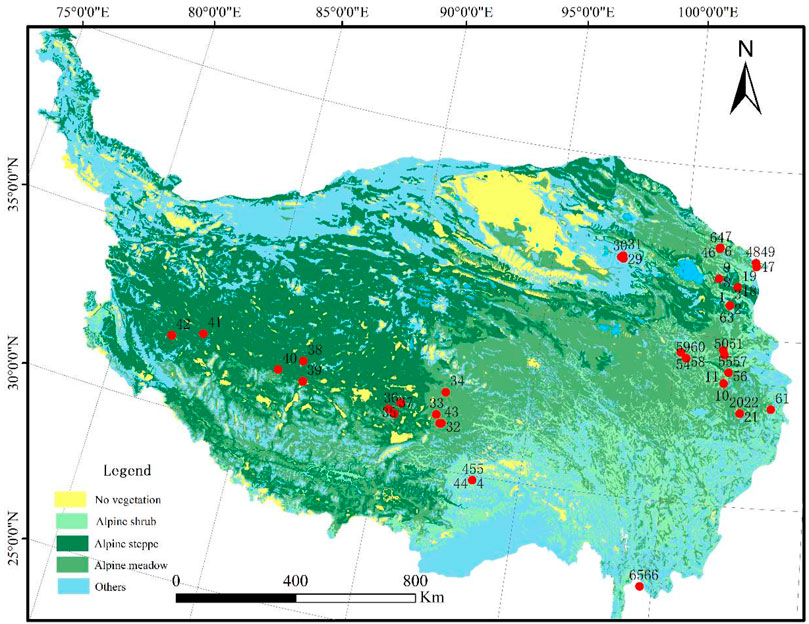
FIGURE 1. Main vegetation types distribution and 66 research sites on the Tibetan Plateau.
Log response ratios were calculated as a measure of the effect size. A 95% confidence interval (95% CI) was calculated. A random-effect-model meta-analysis was performed and the data were analysed using R statistical software.
where Xe and Xc are the mean values of SOC in the grazing and control groups, respectively.
The variance of lnR was calculated as follows:
where Se, Ne, xe, Sc, Nc and xc represent the standard deviations, sample sizes, and mean values of SOC in the grazed grasslands and controls, respectively.
The effect size of grazing activity on SOC and confidence interval based on the random effect model were calculated as follows:
Where vi and
95% confidence interval of effect size: CI =
Statistical analysis
Meta-statistical analyses were performed using R 3.6.2, and we ran a random-effect model of meta-analysis in metafor1.9-8 (Benítez-López et al., 2017). Random effects models were used to analyse the estimated values and standard errors (rma). The effect of climatic factors and soil characteristics on effect sizes of SOC were analysed using the structural equation model and the “piecewise SEM” package. There are likely biases due to the selection of negative results. In our study, the regression test for funnel plot asymmetry of publication bias was analysed using a mixed-effects meta-regression model (funnel and Egger’s test, rma in R 3.6.2).
Publication bias analysis of effect sizes on grassland SOC content
Meta-analysis data were obtained from published academic papers and a quantitative evaluation of the effect size. The bias in the evaluation results was perhaps affected by the selection of the papers. The symmetry test of the funnel plot of grassland SOC content affected by grazing disturbance showed that the p-value of 0.990 was much greater than the significance test level of 0.05 (Figures 2, 3). The standard error showed a symmetrical distribution, which indicated that the funnel plot of the data extracted was symmetrical, thus confirming that this study had no preference for paper publishing, and that the results had full credibility.
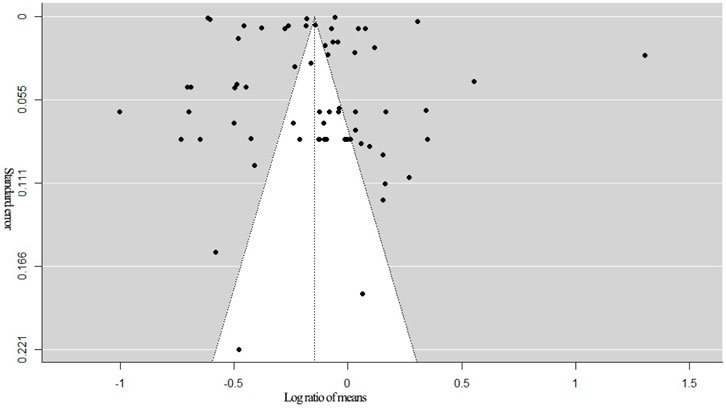
FIGURE 2. Funnel plot of effect sizes of grazing on grassland SOC contents. Note: Egger’s regression test for funnel plot asymmetry (z = −0.012, p = 0.990).
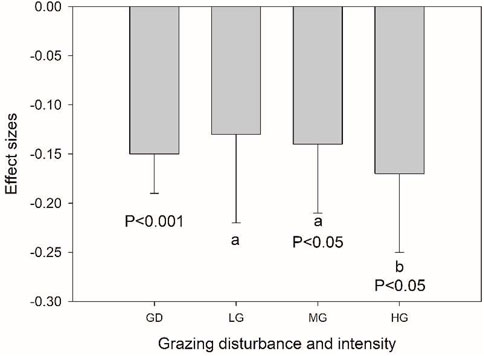
FIGURE 3. Effect size of grazing disturbance on alpine meadows SOC on the Tibetan Plateau. Note: GD, LG, MG and HG meant grazing disturbance, light grazing, moderate and heavy grazing. Different letters meant there was significant difference among three grazing intensities. Values of P indicated that there was significant difference on effect sizes of grazed grassland SOC contents.
Results
Effect size of grazing on SOC across the Tibetan Plateau
Grazing disturbance significantly reduced the SOC content in alpine grasslands on the Tibetan Plateau, with an effect size of −0.15 ± 0.04 (95% confidence interval: 0.23 to −0.06) and a decrease range of 13.93% (p < 0.001, Figure 2). The SOC content ranged from 0.40% to 23.72%, with an average of 5.84% ± 0.56% in grazed grasslands across the Tibetan Plateau.
Effect sizes of different grazing intensities on SOC across the Tibetan Plateau
The effect size of SOC content decreased with increasing grazing intensity (light, moderate, and heavy), with reductions of 12.19%, 13.06%, and 15.63%, respectively (Figure 2). The effect size of heavy grazing was approximately −0.17 ± 0.08 (95% confidence interval: −0.33 to −0.01).
The effect size of heavy grazing was significantly higher than that of light or moderate grazing (p < 0.05). The effect size of light grazing on SOC content was not statistically significant; thus, a light grazing system is preferrable to reduce the impact of grazing on SOC content.
Factors driving SOC content in grazed alpine meadows based on a structural equation model
According to a structural equation model, the effect of grazing activity on SOC content was mainly controlled by pH and total nitrogen (TN), with direct coefficients of −0.523 and 0.431, respectively (p < 0.05, Figure 4). The direct coefficients of temperature and precipitation on the effect sizes were 0.579 and −0.456, respectively. Total nutrient content was directly affected by SOC content, with a direct coefficient of 0.688 (p < 0.01). The driving factors of grassland pH were SOC and air temperature, with coefficients of −0.641 (p < 0.01) and −0.348 (p < 0.05), respectively.
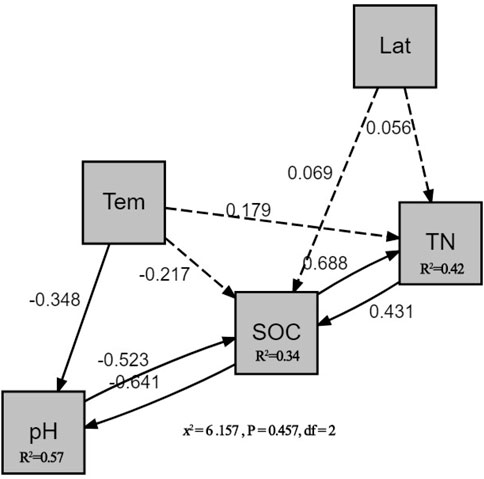
FIGURE 4. Driven factors of grazed grasslands SOC on the Tibetan Plateau by structural equation model. Note: pH, Tem, SOC, TN, and Lat were pH value, air temperature, soil organic carbon, total nitrogen, and latitude. Solid and dotted lines indicated significant and insignificant effect, separately.
Discussion
Degradation of grassland ecosystems in the Tibetan Plateau is severe and is mainly concentrated in the northwest (Li et al., 2022; Shen et al., 2022). Alpine meadows are rich in total nutrients, but lack available nutrients (Du et al., 2019a). Increasing grazing intensity has hindered the reproduction of grasses, which have gradually degenerated (Fu et al., 2015; Du et al., 2019b). Kobresia humilis and Kobresia pygmaea have gradually become the dominant plant populations as they are tolerant to grazing and trampling (Dorji et al., 2016). The intensive degradation of alpine meadows has reduced nutrient uptake and soil carbon and nitrogen storage in recent decades (Du et al., 2019a).
SOC is strongly associated with soil fertility and has an important impact on the global carbon cycle, both as a carbon source and carbon sink (Shen et al., 2022). In this study, we revealed that grazing disturbance significantly reduced SOC content by approximately 13.93% in alpine meadows on the Tibetan Plateau. Similar studies have found that the SOC content in continuously grazed grasslands was significantly lower than that in non-grazed grasslands (approximately 10.41% and 41.69%, respectively) (Li et al., 2014). The SOC content decreased by 15% and 41%, mainly because of the significant reduction in soil water content due to increased grazing, which altered plant functional groups and soil microorganisms and reduced carbon input on the south-eastern Tibetan Plateau (Dong et al., 2021). SOC content of heavily grazed grassland decreased by 45.75%, and the lack of nitrogen supply may be the main reason for the decline in grassland SOC fixation capacity (Zhan et al., 2020). Furthermore, the SOC content of grasslands with moderate and heavy grazing decreased significantly in the central Tibetan Plateau, from 2.79% to 1.02% and 1.39%, respectively (Wang, 2019). Grazing significantly reduced the SOC content and carbon storage of alpine meadows, which were mainly affected by soil bulk density in the Qinghai Province (Du et al., 2019b). Our study indicated that light grazing also reduced SOC content, but the result was not statistically significant; both moderate and heavy grazing significantly decreased SOC. Light grazing management systems should be adopted on the Tibetan Plateau based on the management of grassland soil carbon storage.
Root exudates are predicted to significantly alter the microbial community by affecting pH values (Xia et al., 2015). Soil pH is the strongest factor contributing to soil microbial community differences (Xiao et al., 2017; Liang et al., 2019). SOC content was also reported to show a significant negative correlation with grassland pH (Li et al., 2014). The soil pH of light, moderate, and heavily grazed grassland was 7.5, 7.7, and 7.9, respectively, while SOC decreased from 6.87% to 6.37% and 4.16%, respectively, on the Tibetan Plateau (Du et al., 2020). We also found that the SOC of grazed grasslands was negatively influenced by pH across the Tibetan Plateau. In this study, the pH was approximately 6.93 ± 1.56, ranging from 4.32 to 9.65 on the Tibetan Plateau. Future soil acidification could improve grassland SOC content.
Nitrogen is a basic nutrient for all organisms and is a key limiting factor for grassland plant growth (Kim et al., 2012; Kanter et al., 2016). In this study, a structural equation model revealed that the effect of grazing on SOC content was positively controlled by total nitrogen content. Similar studies have reported that heavy grazing significantly reduces the soil total nitrogen content of alpine meadows on the Tibetan Plateau (Du et al., 2020; Dai et al., 2021). The total nitrogen content of soil in alpine meadow grasslands with light and moderate grazing were 0.83% and 0.44%, respectively (Du et al., 2019a). Heavy grazing reduces soil total nitrogen content (by approximately 36.83%) and nitrogen storage in alpine grasslands at the source of the Three Rivers on the Tibetan Plateau (Fan et al., 2012). Altering the ratio of soil carbon to nitrogen may reduce the SOC content because the soil ecosystem maintains the stability of carbon and nitrogen chemical reserves (Fan et al., 2008; Gebregergs et al., 2019). Furthermore, enhanced nitrogen deposition is expected to occur in the next few decades owing to increased human activity, and grazing excreta are hotspots of nitrogen transformation (Liu et al., 2013; Du et al., 2021). The SOC content of alpine meadows will significantly increase in future scenarios of increasing nitrogen deposition.
Conclusion
In conclusion, strong heterogeneity of SOC content was observed in alpine meadows of the Tibetan Plateau. Grazing disturbance significantly reduced SOC content in alpine grasslands, especially at moderate and heavy grazing intensities. Light grazing did not not significantly reduce SOC, and we recommend using light grazing management practices to reduce SOC loss. The results of the structural equation model revealed that SOC was mainly affected by pH and TN. Future increases in nitrogen deposition would aid in improving grassland SOC content on the Tibetan Plateau.
Data availability statement
The raw data supporting the conclusion of this article will be made available by the authors, without undue reservation.
Author contributions
HY: Conceptualization, writing—original draft preparation. YZ and WL: Methodology and project administration. QX: Methodology and resources, and validation. HZ: Formal analysis, investigation, and data curation. YD: Writing—review and editing. All authors have read and agreed to the published version of the manuscript.
Funding
This work is supported by the key development and transformation projects in Qinghai Province (2022-NK-135).
Conflict of interest
YZ was employed by Tianjin Capital Environmental Protection Group Company Limited.
The remaining authors declare that the research was conducted in the absence of any commercial or financial relationships that could be construed as a potential conflict of interest.
Publisher’s note
All claims expressed in this article are solely those of the authors and do not necessarily represent those of their affiliated organizations, or those of the publisher, the editors and the reviewers. Any product that may be evaluated in this article, or claim that may be made by its manufacturer, is not guaranteed or endorsed by the publisher.
References
Burda, B. U., O'Connor, E. A., Webber, E. M., Redmond, N., and Perdue, L. A. (2017). Estimating data from figures with a Web-based program: Considerations for a systematic review. Res. Synth. Meth. 8 (3), 258–262. doi:10.1002/jrsm.1232
Chen, H., Zhu, Q., Peng, C., Wu, N., Wang, Y., Fang, X., et al. (2013). The impacts of climate change and human activities on biogeochemical cycles on the Qinghai–Tibetan Plateau. Glob. Change Biol. 19 (10), 2940–2955. doi:10.1111/gcb.12277
Dai, L., Fu, R., Guo, X., Du, Y., Lin, L., Zhang, F., et al. (2021). Long-term grazing exclusion greatly improve carbon and nitrogen store in an alpine meadow on the northern Qinghai–Tibet Plateau. Catena 197, 104955. doi:10.1016/j.catena.2020.104955
Dong, L., Li, J., Chen, S., Zhang, R., Sun, J., and Ma, M. (2021). Changes in soil organic carbon content and their causes during the degradation of alpine meadows in Zoig&#x000ea; Wetland. Chin. J. Plant Ecol. 45 (5), 507–515. doi:10.17521/cjpe.2020.0231
Dorji, T., Moe, S. R., Klein, J. A., Wang, S. P., and Totland, O. (2016). Performance of two alpine plant species along environmental gradients in an alpine meadow ecosystem in central Tibet. Ecol. Res. 31 (3), 417–426. doi:10.1007/s11284-016-1350-2
Du, Y., Ke, X., Dai, L., Cao, G., Zhou, H., and Guo, X. (2020). Moderate grazing increased alpine meadow soils bacterial abundance and diversity index on the Tibetan Plateau. Ecol. Evol. 10 (16), 8681–8687. doi:10.1002/ece3.6563
Du, Y., Ke, X., Guo, X., Cao, G., and Zhou, H. (2019a). Soil and plant community characteristics under long-term continuous grazing of different intensities in an alpine meadow on the Tibetan plateau. Biochem. Syst. Ecol. 85, 72–75. doi:10.1016/j.bse.2019.05.012
Du, Y., Ke, X., Li, J., Wang, Y., Cao, G., Guo, X., et al. (2021). Nitrogen deposition increases global grassland N2O emission rates steeply: A meta-analysis. Catena 199, 105105. doi:10.1016/j.catena.2020.105105
Du, Y., Zhou, G., Guo, X., and Cao, G. (2019b). Spatial distribution of grassland soil organic carbon and potential carbon storage on the Qinghai Plateau. Grass. Sci. 65 (3), 141–146. doi:10.1111/grs.12229
Fan, J., Zhong, H., Harris, W., Yu, G., Wang, S., Hu, Z., et al. (2008). Carbon storage in the grasslands of China based on field measurements of above- and below-ground biomass. Clim. Change 86 (3), 375–396. doi:10.1007/s10584-007-9316-6
Fan, Y., Hou, X., Shi, H., and Shi, S. (2012). The response of carbon reserves of plants and soils to differernt grassland managements on alpine meadow of three headwater source regions. Grassl. Turf 32 (5), 41–46.
Fu, B., Ouyang, Z., Shi, P., Fan, J., Wang, X., Zheng, H., et al. (2021). Current condition and protection strategies of qinghai-tibet plateau ecological security barrier. Bull. Chin. Acad. Sci. 36 (11), 1298–1306.
Fu, G., Shen, Z. X., Sun, W., Zhong, Z. M., Zhang, X. Z., and Zhou, Y. T. (2015). A meta-analysis of the effects of experimental warming on plant physiology and growth on the Tibetan Plateau. J. Plant Growth Regul. 34 (1), 57–65. doi:10.1007/s00344-014-9442-0
Gebregergs, T., Tessema, Z. K., Solomon, N., and Birhane, E. (2019). Carbon sequestration and soil restoration potential of grazing lands under exclosure management in a semi-arid environment of northern Ethiopia. Ecol. Evol. 9 (11), 6468–6479. doi:10.1002/ece3.5223
Huidan, H., Jingbin, H., Yaxi, W., Hongqin, L., Yongsheng, Y., and Yingnian, L. (2017). Study on the actual evapotranspiration and the effective utilization of water in alpine meadow under different grazing gradients. Eco. Environ. Sci. 26 (9), 1488–1493.
Kanter, D. R., Zhang, X., Mauzerall, D. L., Malyshev, S., and Shevliakova, E. (2016). The importance of climate change and nitrogen use efficiency for future nitrous oxide emissions from agriculture. Environ. Res. Lett. 11, 094003. doi:10.1088/1748-9326/11/9/094003
Kim, D. G., Saggar, S., and Roudier, P. (2012). The effect of nitrification inhibitors on soil ammonia emissions in nitrogen managed soils: A meta-analysis. Nutri. Cycl. Agroecos. 93 (1), 51–64. doi:10.1007/s10705-012-9498-9
Li, Q., Song, Y., Zhou, D., Wang, M., and Chen, X. (2014). Effects of fending and grazing on soil carbon, nitrogen, phosphorus storage in degraded alkali-saline grassland. Pratacul. Sci. 31 (10), 1811–1819.
Li, W., Xu, Q., Zhou, H., and Du, Y. (2022). Grazing significantly increases N2O emission rates in alpine meadows of the Tibetan Plateau. Front. Environ. Sci. 10, e920154. doi:10.3389/fenvs.2022.920154
Li, Z. F., Lü, P., Wang, Y. L., Yao, H., Guo, L. D., Sun, X., et al. (2020). Response of arbuscular mycorrhizal fungal community in soil and roots to grazing differs in a wetland on the Qinghai-Tibet plateau. PeerJ 8 (169), e9375. doi:10.7717/peerj.9375
Liang, M., Liu, X., Parker, I. M., Johnson, D., Yu, S., Luo, S., et al. (2019). Soil microbes drive phylogenetic diversity-productivity relationships in a subtropical forest. Sci. Advan. 5 (10), eaax5088. doi:10.1126/sciadv.aax5088
Liang, Y., Pei, M., Wang, D., Cao, S., Xiao, X., and Sun, B. (2017). Improvement of soil ecosystem multifunctionality by dissipating manure-induced antibiotics and resistance genes. Environ. Sci. Tech. 51 (9), 4988–4998. doi:10.1021/acs.est.7b00693
Liu, X., Zhang, Y., Han, W., Tang, A., Shen, J., Cui, Z., et al. (2013). Enhanced nitrogen deposition over China. Nature 494 (7438), 459–462. doi:10.1038/nature11917
Mipam, T. D., Wen, Y. L., Ai, Y., Zhao, H. W., and Chen, Y. J. (2016). Impact of different grazing intensity on soil physical properties and plant biomass in Qinghai-Tibet Plateau alpine meadow ecosystem. Pratacul. Sci. 33 (10), 1975–1980.
Shen, M., Wang, S., Jiang, N., Sun, J., Cao, R., Ling, X., et al. (2022). Plant phenology changes and drivers on the Qinghai–Tibetan Plateau. Nat. Revi. Earth Environ. 3 (10), 633–651. doi:10.1038/s43017-022-00317-5
Tang, S., Wang, K., Xiang, Y., Tian, D., Wang, J., Liu, Y., et al. (2019). Heavy grazing reduces grassland soil greenhouse gas fluxes: A global meta-analysis. Sci. Total Environ. 654, 1218–1224. doi:10.1016/j.scitotenv.2018.11.082
Wang, T. (2019). Study on degradation characteristics and health assessment of alpine grassland in the source area of the Yellow River. Gansu Agriculture University Thesis.
Xia, F., Zeleke, J., Sheng, Q., Wu, J.-H., and Quan, Z.-X. (2015). Communities of ammonia oxidizers at different stages of Spartina alterniflora invasion in salt marshes of Yangtze River estuary. J. Microbio 53 (5), 311–320. doi:10.1007/s12275-015-4660-0
Xiao, H., Schaefer, D. A., and Yang, X. (2017). pH drives ammonia oxidizing bacteria rather than archaea thereby stimulate nitrification under Ageratina adenophora colonization. Soil Biol. biochem. 114, 12–19. doi:10.1016/j.soilbio.2017.06.024
Yan, R., Tang, H., Xin, X., Chen, B., Murray, P. J., Yan, Y., et al. (2016). Grazing intensity and driving factors affect soil nitrous oxide fluxes during the growing seasons in the Hulunber meadow steppe of China. Environ. Res. Lett. 11 (5), 054004. doi:10.1088/1748-9326/11/5/054004
Yang, C., Hou, F., Sun, Y., Yang, H., Liu, Y., Zhang, Y., et al. (2020). Oats hay supplementation to yak grazing alpine meadow improves carbon return to the soil of grassland ecosystem on the Qinghai-Tibet Plateau, China. Glob. Eco. Conser. 23, e01158. doi:10.1016/j.gecco.2020.e01158
Zhan, T., Sun, J., Zhang, Z., and Liu, M. (2020). Effects of grazing on temperate grassland ecosystem based on a meta-analysis. Chin. J. Eco-Agricul. 28 (12), 1847–1858.
Zhou, G., Cheng, Y., Ma, Q., Shen, B., Qu, J., Tian, F., et al. (2019). Effects of grazing intensity on community structure and the soil's physical and chemical properties in an alpine meadow on the Eastern Qinghai-Tibet Plateau. Pratacu. Sci. 36 (4), 1022–1031.
Keywords: effect size, grazing intensity, SOC, structural equation model, Tibetan Plateau
Citation: Yang H, Zhang Y, Li W, Xu Q, Zhou H and Du Y (2023) Grazing disturbance significantly decreased soil organic carbon contents of alpine grasslands on the Tibetan Plateau. Front. Environ. Sci. 11:1113538. doi: 10.3389/fenvs.2023.1113538
Received: 01 December 2022; Accepted: 02 March 2023;
Published: 14 March 2023.
Edited by:
Qibing Wang, Institute of Botany (CAS), ChinaReviewed by:
Shuxia Zheng, Institute of Botany (CAS), ChinaXiaoming Kang, Chinese Academy of Forestry, China
Copyright © 2023 Yang, Zhang, Li, Xu, Zhou and Du. This is an open-access article distributed under the terms of the Creative Commons Attribution License (CC BY). The use, distribution or reproduction in other forums is permitted, provided the original author(s) and the copyright owner(s) are credited and that the original publication in this journal is cited, in accordance with accepted academic practice. No use, distribution or reproduction is permitted which does not comply with these terms.
*Correspondence: Wei Li, MTQzODYxMjZAcXEuY29t; Yangong Du, eWdkdUBud2lwYi5jYXMuY24=
†These authors have contributed equally to this work